


Barn Swallow
Swallow · Hirundo rustica
By the Birdfact teamChecked by Nathan Cope
See it in 3D
2 plumages
A Barn Swallow (European adult) is 17–19 cm (6.5–7.5 in) long, bill to tail.
European adult
© 2026 NC Digital Limited (Birdfact). All rights reserved. This 3D model may be viewed on this page and shared by link only. Downloading, extracting, copying or reusing it, or using it to train machine-learning models, is not permitted without our written permission. Using our models
On this page16 sections
How to recognise it
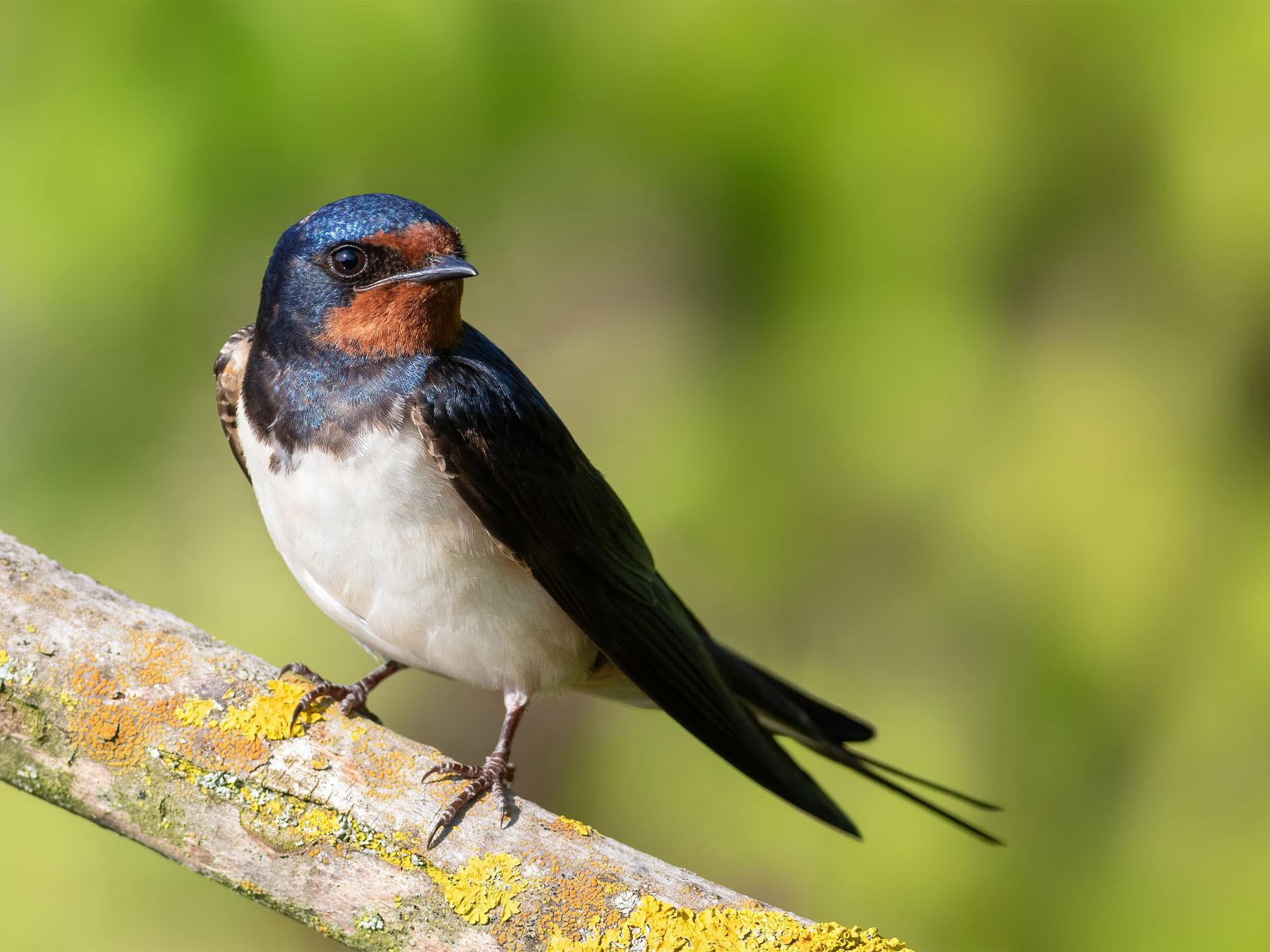
The Swallow, called the Barn Swallow in North America and in most world lists, is the slim, fork-tailed bird that skims low over fields and farmyards in summer and lines up on wires before it leaves. It is the most widespread swallow in the world, breeding right across Europe, Asia and North America, and it nests inside our barns, stables, sheds and porches.
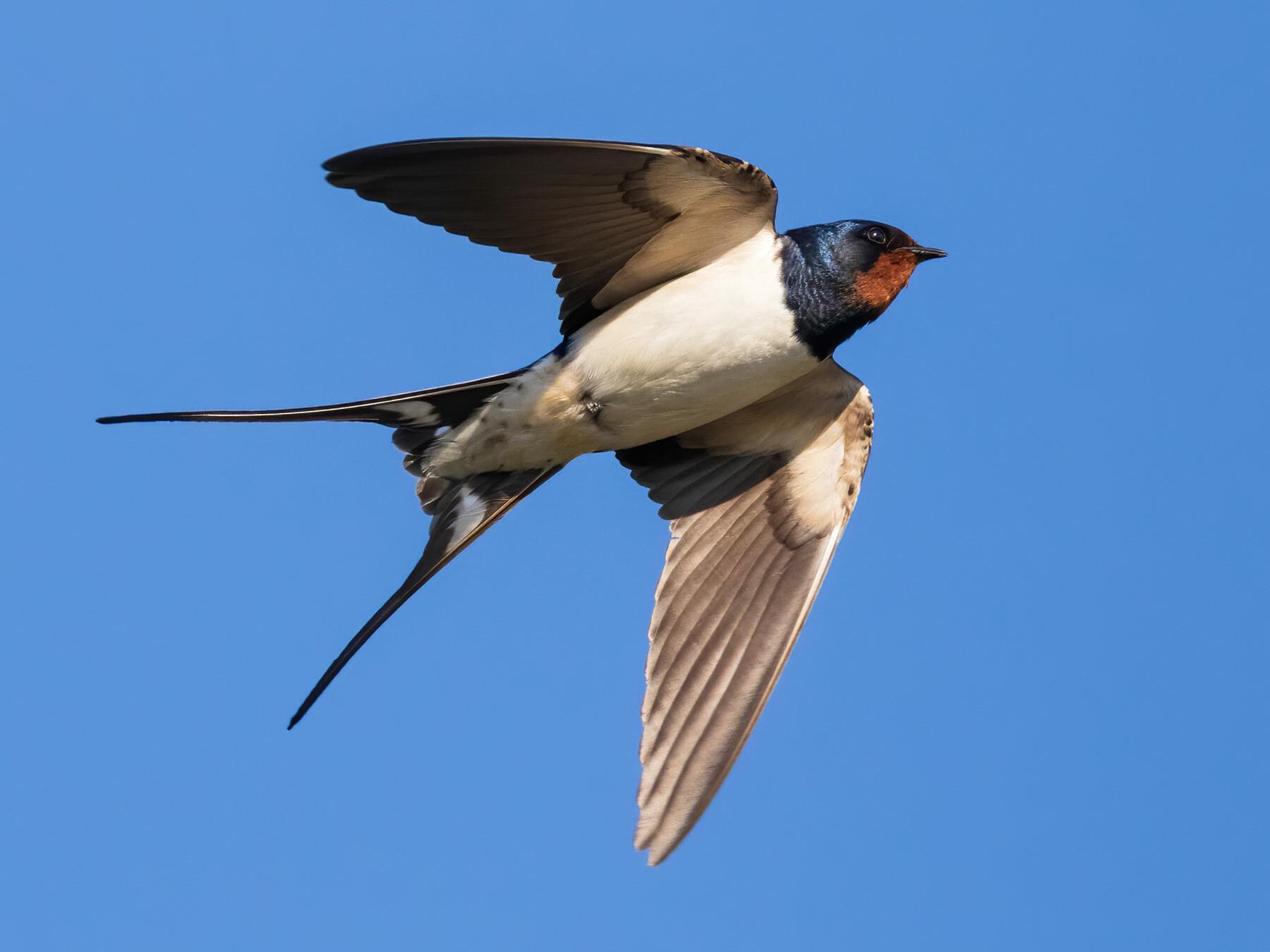
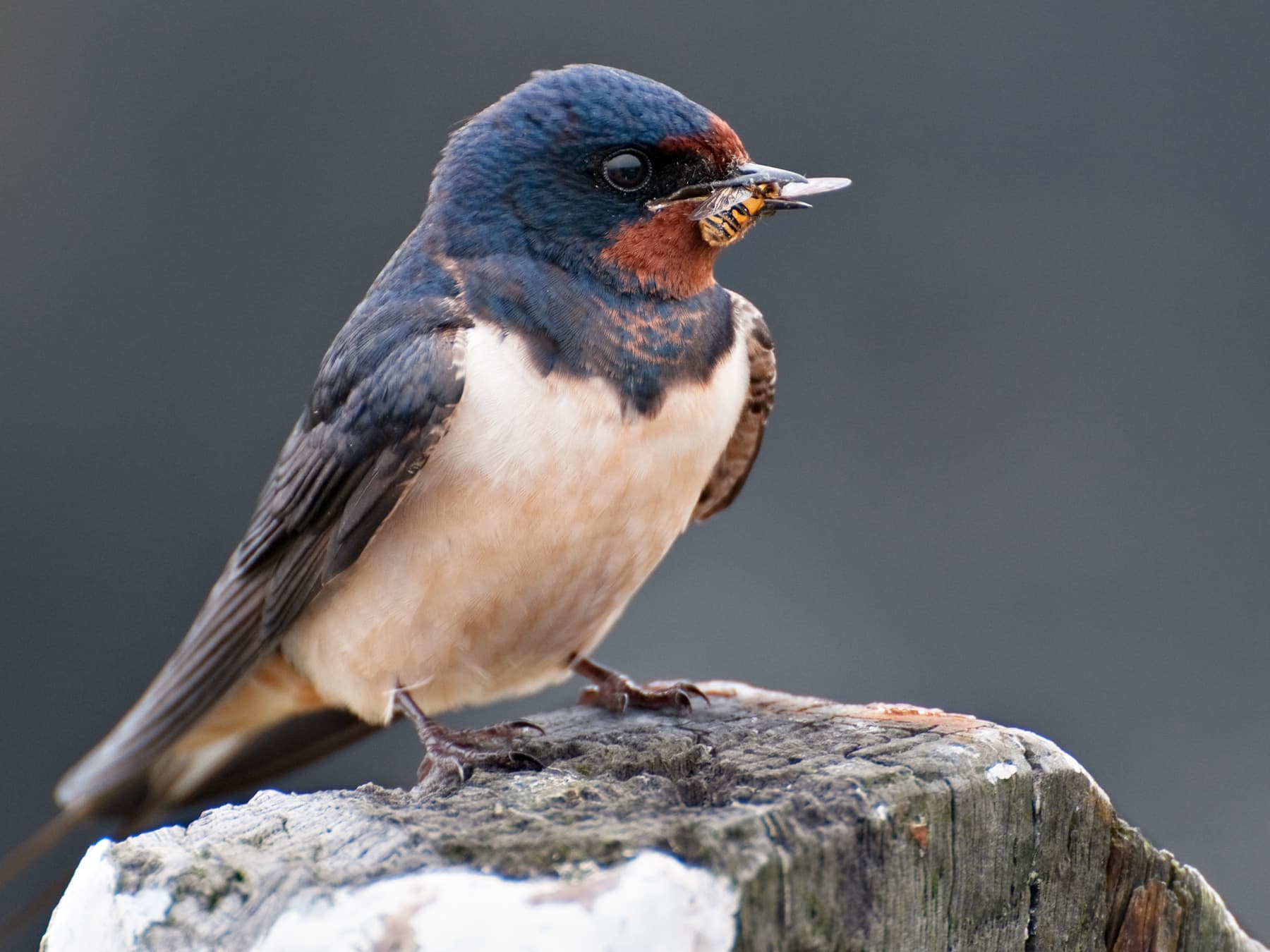
Adults are glossy steel blue above, with a chestnut-red forehead and throat and a dark blue band across the breast. The wings are long and pointed, and the tail is deeply forked, with long, thin outer streamers and a row of white spots that shows when it is spread. The bill is tiny but opens into a wide gape for catching insects.
Swallows in Britain and the rest of Europe are white to cream below, with a broad, complete breast band. North American birds are orange-buff to deep chestnut below, and their breast band is reduced to a dark patch at each side. Asia and North Africa have more forms, and AviList, the global checklist, recognises eight subspecies in all.1

Size
A Swallow is 17-19 cm (6.7-7.5 in) long, including the streamers, with a wingspan of 32-35 cm (12.6-13.8 in). Live adults caught by ringers in Britain and Ireland average 19.9 g (0.7 oz), most between 17 and 23 g (0.6-0.8 oz).2
Male, female and the tail streamers
Males and females look alike, but the male's outer tail streamers are longer and his underparts on average darker, and the female is a shade less glossy. In North American birds the male's outer tail feathers measure 79-106 mm (3.1-4.2 in) and the female's 68-84 mm (2.7-3.3 in).3
The streamers are among the best-studied ornaments of any bird. In a classic experiment, males whose tails were artificially lengthened found mates more quickly than males with shorter tails, raised more young in a season, and were preferred by females seeking partners outside the pair.4 Other tail-manipulation experiments suggested the streamers are mainly shaped by the needs of flight, with sexual selection stretching them only a little beyond the length that is best aerodynamically.5 In North America the evidence on tail length is mixed, and the darkness of a male's breast also seems to matter to females.3
Juveniles
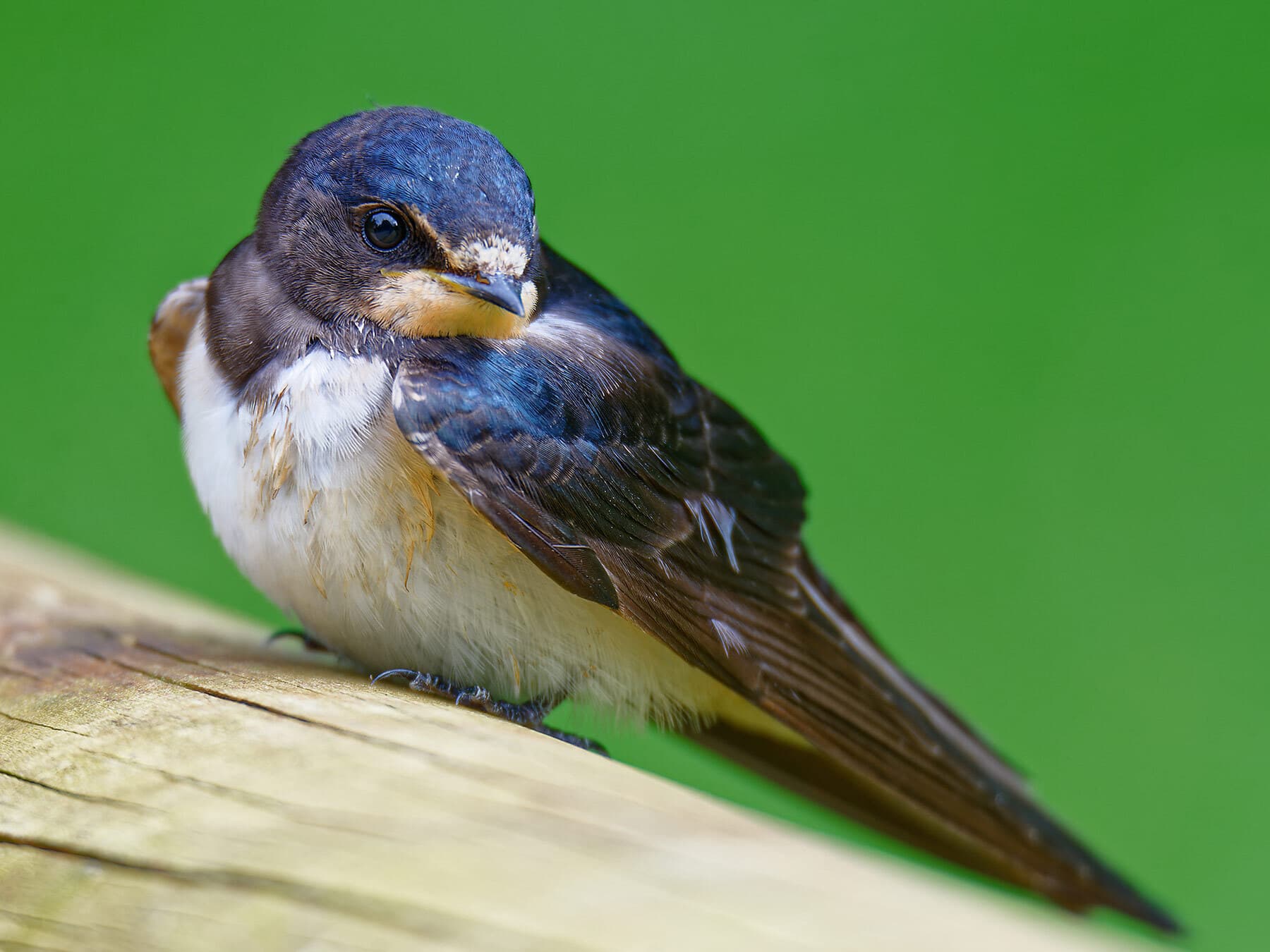
Young Swallows, out of the nest from early summer into the autumn, are duller than adults and lack the metallic gloss. The forehead and throat are paler, tawny rather than red (pinkish-cinnamon in North American birds), and the outer tail feathers are short and blunt, so the tail has no long streamers.
Identification: swifts, martins and lookalikes
Several birds hunt insects in the air over the same fields and water. Here is how to tell them from a Swallow, with its red throat, blue-black upperparts and long streamers:
- Swift: sooty brown all over with a small pale throat; longer, narrower, sickle-shaped wings and a short forked tail; screams rather than twitters, and never perches on wires.
- House Martin: smaller and plumper, with a white rump and pure white underparts, and a short forked tail with no streamers. Its mud nest under the eaves is closed, with a small opening at the top.
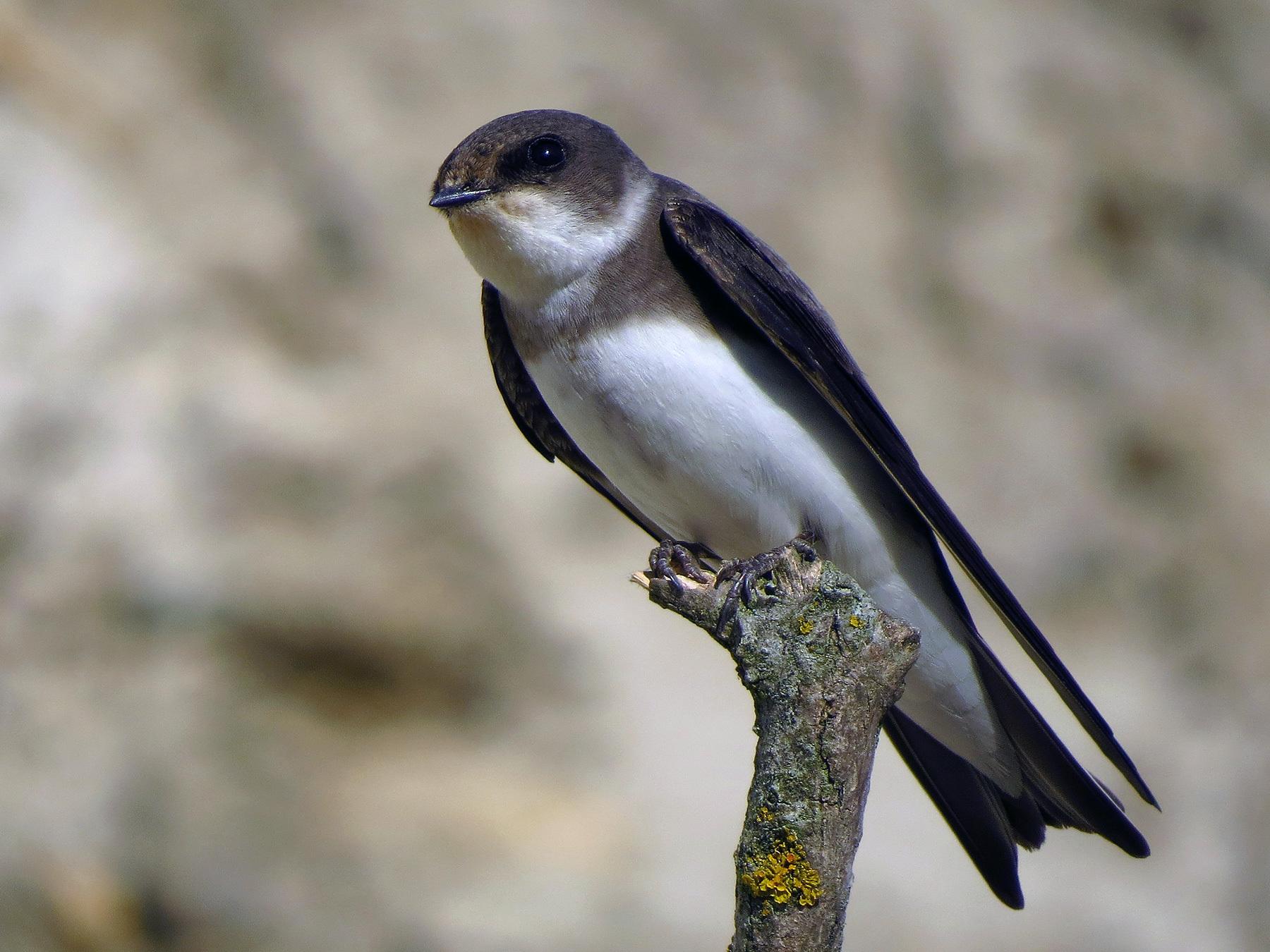
- Sand Martin (Bank Swallow in North America): small and grey-brown above, white below with a brown breast band, and a short, slightly forked tail; nests in burrows in sandy banks.
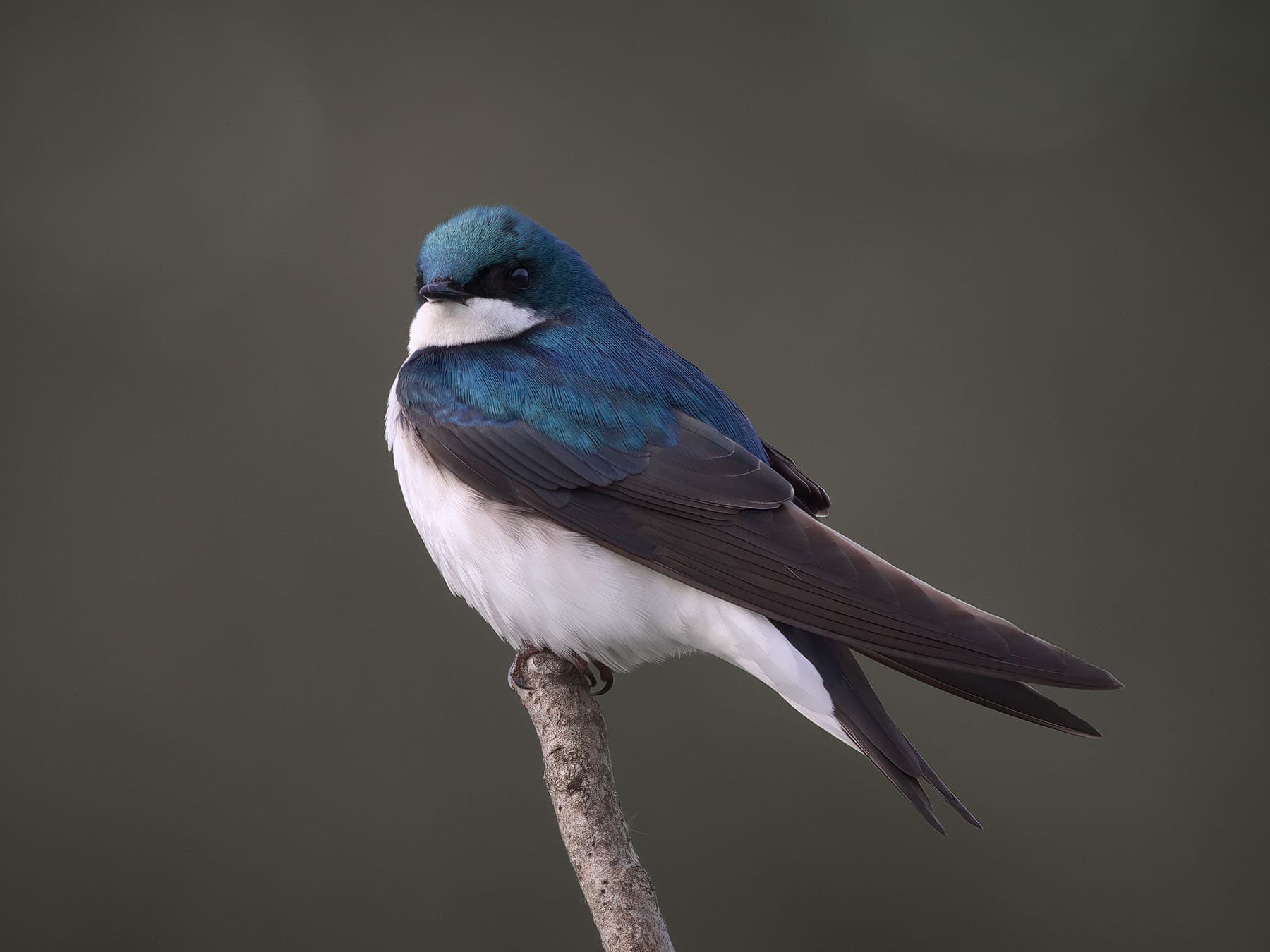
- Tree Swallow (North America): adults glossy blue-green above and clean white from throat to tail, with a short, barely notched tail.
In North America the long, deeply forked tail sets the Barn Swallow apart from every other swallow, and it is much rustier below than a Cliff Swallow. For the commonest confusion in Britain, see Swift or Swallow?
Not sure it’s a Barn Swallow? Check your photo: Birdfact names the bird and shows the look-alike side by side.
Its size
Adults- Length
- 17–19 cm
- Wingspan
- 32–35 cm
- Weight
- 17.2–23 g
Its song and calls
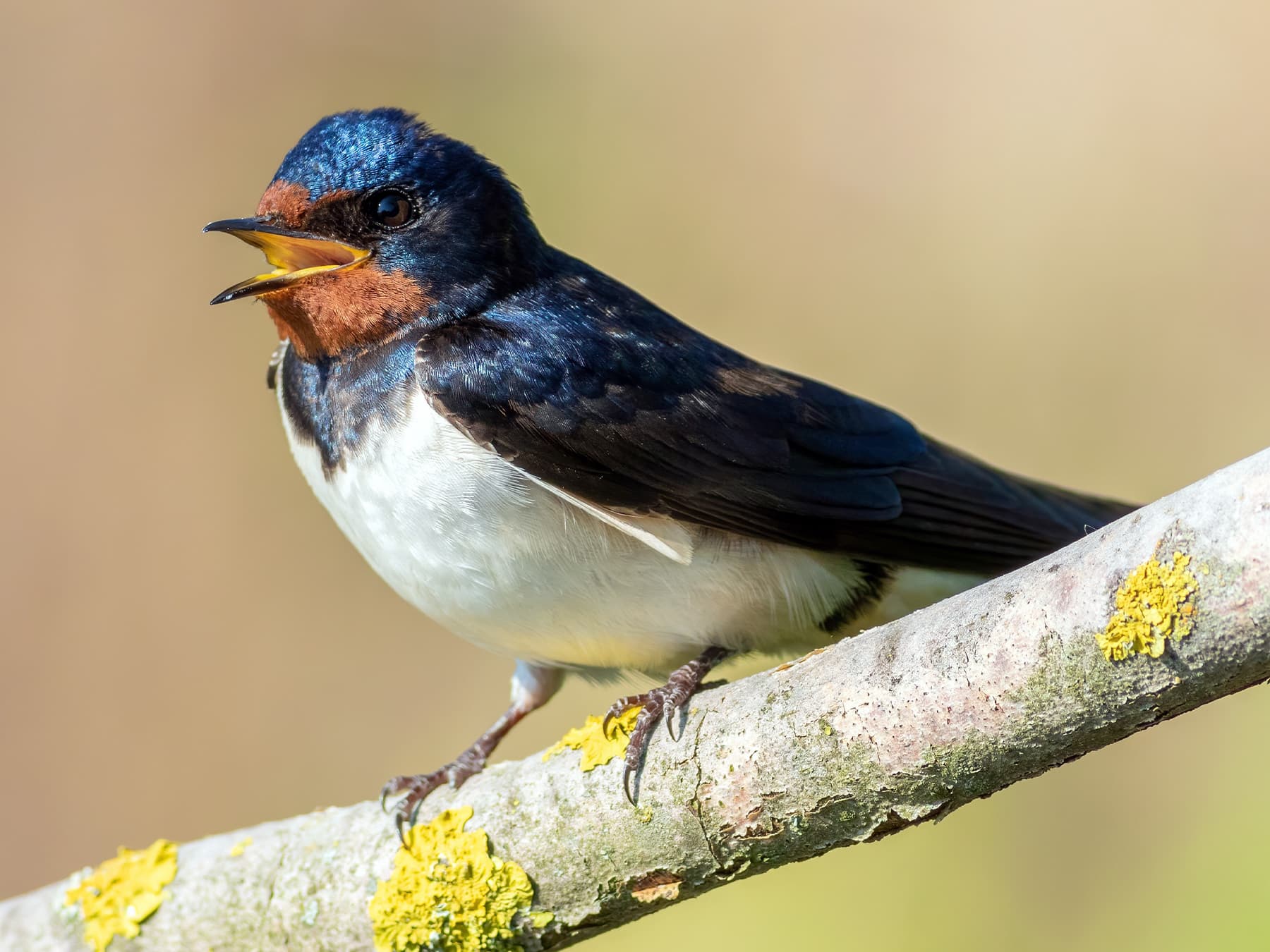
The song is a long, fast, twittering warble that usually ends in a harsh, grating rattle, sung from a wire or a rooftop or in flight. Males sing most while they are pairing and laying, and females sing too. The everyday call is a "vit" or "witt", often run together into a twitter; a "tsi-wit" warns that a predator is close, and alarm calls usually send the whole colony up to circle above it.
Older males sing longer, more complex songs than yearlings, and in an Italian study 33 males had up to 230 song types; males with longer tails sing longer rattles, and females prefer males with more complex songs.3
- Song0:00 / 0:07
Recorded in Carmarthenshire, United Kingdom · May 2024
- Song0:00 / 0:18
Recorded in Minnesota, United States · July 2011
- Calls0:00 / 0:25
Recorded in Anglesey, United Kingdom · July 2021
Heard one and not sure? Let the bird song identifier listen.
When and where to see it
November
Mostly absent
The year across the UK and Ireland
Choose a place on the map to see its year, or find yours.
Most recorded in November
Up to 5.3% of a place’s bird records that monthHere in other months
How this map is made
Each county, state or province is shaded by the Barn Swallow’s share of all the bird records there that month: the darker, the larger the share. A place with only a trace of records in a month is left unshaded. Shades compare places on this map with each other, not one bird with another. Records: GBIF eBird Observation Dataset, 2019–2024. Map: Natural Earth; place centres © OpenStreetMap contributors.
How often the Barn Swallow turns up in the UK, Ireland, the United States and Canada through the year, from birdwatchers' records.
United Kingdom
Summer visitor · regularly Apr–Oct · most records in August
Ireland
Summer visitor · regularly Apr–Oct · most records in August
United States
Summer visitor · regularly Mar–Oct · most records in August
Canada
Summer visitor · regularly Apr–Sep · most records in July
Show as a table
| Month | United Kingdom | Ireland | United States | Canada |
|---|---|---|---|---|
| January | 0.001% | 0.009% | 0.014% | 0.006% |
| February | <0.001% | 0.010% | 0.020% | 0.018% |
| March | 0.052% | 0.054% | 0.19% (regular) | 0.011% |
| April | 1.2% (regular) | 1.6% (regular) | 0.76% (regular) | 0.29% (regular) |
| May | 1.8% (regular) | 2.8% (regular) | 1.2% (regular) | 0.94% (regular) |
| June | 1.8% (regular) | 2.8% (regular) | 1.3% (regular) | 0.95% (regular) |
| July | 1.9% (regular) | 3.0% (regular) | 1.6% (regular) | 1.1% (regular) |
| August | 2.2% (regular) | 3.0% (regular) | 1.7% (regular) | 1.1% (regular) |
| September | 1.6% (regular) | 2.2% (regular) | 0.61% (regular) | 0.28% (regular) |
| October | 0.45% (regular) | 0.48% (regular) | 0.15% (regular) | 0.007% |
| November | 0.033% | 0.021% | 0.037% | 0.003% |
| December | 0.003% | 0.019% | 0.009% | 0.001% |
Recorded regularly in
Worldwide: recorded regularly in 208 countries
Countries where it was recorded in at least 3 of the 6 years 2019–2024. Linked countries have their own bird list.
Europe (50)
- Åland Islands
- Albania
- Andorra
- Austria
- Belarus
- Belgium
- Bosnia & Herzegovina
- Bulgaria
- Croatia
- Czechia
- Denmark
- Estonia
- Faroe Islands
- Finland
- France
- Germany
- Gibraltar
- Greece
- Guernsey
- Hungary
- Iceland
- Ireland
- Isle of Man
- Italy
- Jersey
- Kosovo
- Latvia
- Liechtenstein
- Lithuania
- Luxembourg
- Malta
- Moldova
- Montenegro
- Netherlands
- North Macedonia
- Norway
- Poland
- Portugal
- Romania
- Russia
- San Marino
- Serbia
- Slovakia
- Slovenia
- Spain
- Sweden
- Switzerland
- Ukraine
- United Kingdom
- Vatican City
Africa (49)
- Algeria
- Angola
- Benin
- Botswana
- Burundi
- Cameroon
- Cape Verde
- Central African Republic
- Chad
- Congo - Brazzaville
- Congo - Kinshasa
- Côte d’Ivoire
- Djibouti
- Egypt
- Equatorial Guinea
- Eswatini
- Ethiopia
- Gabon
- Gambia
- Ghana
- Guinea
- Guinea-Bissau
- Kenya
- Lesotho
- Liberia
- Libya
- Madagascar
- Malawi
- Mauritania
- Morocco
- Mozambique
- Namibia
- Nigeria
- Rwanda
- São Tomé & Príncipe
- Senegal
- Seychelles
- Sierra Leone
- Somalia
- South Africa
- South Sudan
- Sudan
- Tanzania
- Togo
- Tunisia
- Uganda
- Western Sahara
- Zambia
- Zimbabwe
Asia (49)
- Afghanistan
- Armenia
- Azerbaijan
- Bahrain
- Bangladesh
- Bhutan
- Brunei
- Cambodia
- China
- Cyprus
- Georgia
- Hong Kong SAR China
- India
- Indonesia
- Iran
- Iraq
- Israel
- Japan
- Jordan
- Kazakhstan
- Kuwait
- Kyrgyzstan
- Laos
- Lebanon
- Macao SAR China
- Malaysia
- Maldives
- Mongolia
- Myanmar (Burma)
- Nepal
- Oman
- Pakistan
- Palestinian Territories
- Philippines
- Qatar
- Saudi Arabia
- Singapore
- South Korea
- Sri Lanka
- Syria
- Taiwan
- Tajikistan
- Thailand
- Timor-Leste
- Turkey
- Turkmenistan
- United Arab Emirates
- Uzbekistan
- Vietnam
North America (40)
- Anguilla
- Antigua & Barbuda
- Aruba
- Bahamas
- Barbados
- Belize
- Bermuda
- British Virgin Islands
- Canada
- Caribbean Netherlands
- Cayman Islands
- Costa Rica
- Cuba
- Curaçao
- Dominica
- Dominican Republic
- El Salvador
- Grenada
- Guadeloupe
- Guatemala
- Haiti
- Honduras
- Jamaica
- Martinique
- Mexico
- Montserrat
- Nicaragua
- Panama
- Puerto Rico
- Sint Maarten
- St Barthélemy
- St Kitts & Nevis
- St Lucia
- St Martin
- St Pierre & Miquelon
- St Vincent & the Grenadines
- Trinidad & Tobago
- Turks & Caicos Islands
- United States
- US Virgin Islands
South America (14)
Oceania (6)
- Australia
- Christmas Island
- Cocos (Keeling) Islands
- Northern Mariana Islands
- Palau
- Papua New Guinea
Data: EOD – eBird Observation Dataset (Cornell Lab of Ornithology), accessed via GBIF.org, CC BY 4.0. Records from 2019–2024, aggregated and filtered by Birdfact. How these lists are made
Swallows are summer visitors to Britain and Ireland. The first arrive in March and most in April, with an average arrival date of 4 April, having advanced about 15 days between the 1960s and the 2000s.2 They leave in September and October, gathering on wires and in reedbeds first, and a few stragglers stay into October; a handful have tried, sometimes successfully, to spend the winter here.
They breed in 95% of the 10-km squares of Britain and Ireland, the widest range of any summer migrant, missing only from parts of northern Scotland and central London.2 They are birds of villages and the countryside rather than towns: look for them over pasture, farmyards, water and village greens, especially where cattle and horses are kept.
In North America Barn Swallows breed as far north as Alaska and northern Canada and as far south as central Mexico, and across almost all of the US. The first reach southern California by late January and Texas in early February; first arrivals reach Massachusetts in early April and Alaska in mid-May. They have spread into deserts, forests and mountains wherever bridges, culverts and buildings give them somewhere to nest.
Migration from Britain to southern Africa
British Swallows spend the winter in southern Africa, many of them in South Africa. Of 1,450 recoveries abroad of swallows ringed in Britain and Ireland, 450 were in South Africa, more than in any other country, and 109 ringed in South Africa have been found here. A nestling ringed at Low Bentham, North Yorkshire, in 1918 was found in East Griqualand, South Africa, in 1929, 9,903 km (6,150 miles) away, and a young bird ringed at Pett Level, East Sussex, was caught in Liberia nine days later, 4,933 km (3,065 miles) away.6
Across Europe, swallows from the north, Britain included, tend to winter furthest south, while many from southern Europe winter in western and central Africa.3 Eighty-five swallows from southern Switzerland and northern Italy tracked with geolocators mostly wintered in the Congo basin; they generally crossed the central Mediterranean and the Sahara in autumn and came back by a more westerly route along the Atlantic coast and through Iberia, travelling about 296 km (184 miles) a day in spring against about 208 km (129 miles) in autumn.7 Ringing recoveries from 1912 to 2008 show the African winter range of European swallows has shifted north by 350-950 km (220-590 miles) over the last century.8
Swallows migrate mainly by day, catching insects as they go, and roost at night in reedbeds. Migrating swallows in Britain have covered up to 194 km (121 miles) a day, the daily distance rising later in the autumn.3 People once believed swallows spent the winter asleep in the mud at the bottom of ponds.
Migration in the Americas
The bulk of North American Barn Swallows apparently winter in South America, with smaller numbers in Mexico and Central America, and most travel overland through Central America. Tracking has shown a migratory divide across the continent: of 27 birds tracked with geolocators, those from Washington and Saskatchewan wintered from Mexico and Central America to northern Colombia, while those from Ontario and New Brunswick wintered south of the Amazon, in Brazil, Bolivia and Argentina. New Brunswick birds flew about 10,400 km (6,460 miles) in autumn, more than twice as far as birds from Washington, and many eastern birds crossed the Caribbean by way of Florida.9
Since the early 1980s a population of Barn Swallows has bred in Argentina, during the northern winter, a jump of 7,000 km (4,350 miles) in breeding range. Nine tagged birds from this new population migrated no farther north than northern South America, and their moult, migration and breeding had shifted by about six months.10
Tips for seeing it
What it eats
Swallows eat flying insects, caught on the wing: flies of all kinds, such as horseflies, hoverflies and crane flies, along with beetles, bees and wasps, aphids and other bugs, moths and dragonflies. They prefer single large insects to swarms of small ones, and swallows studied in Britain picked their prey mainly by size, taking small insects only when large ones were scarce; in 467 North American stomachs, flies made up 39.5% of the food, beetles 15.6%, bugs and leafhoppers 15.1% and bees, wasps and ants 12.8%.3
They hunt lower than most other swallows in North America, usually under 10 m (33 ft) and often under 1 m (3 ft), over pasture, ploughed fields and water, and they follow cattle, horses and farm machinery for the insects they disturb. In cold weather they feed a few centimetres above lakes and rivers. Breeding Swallows in Europe usually feed within about 500 m (550 yards) of the nest.3 They also pick up grit, perhaps to help them digest insects or for calcium.
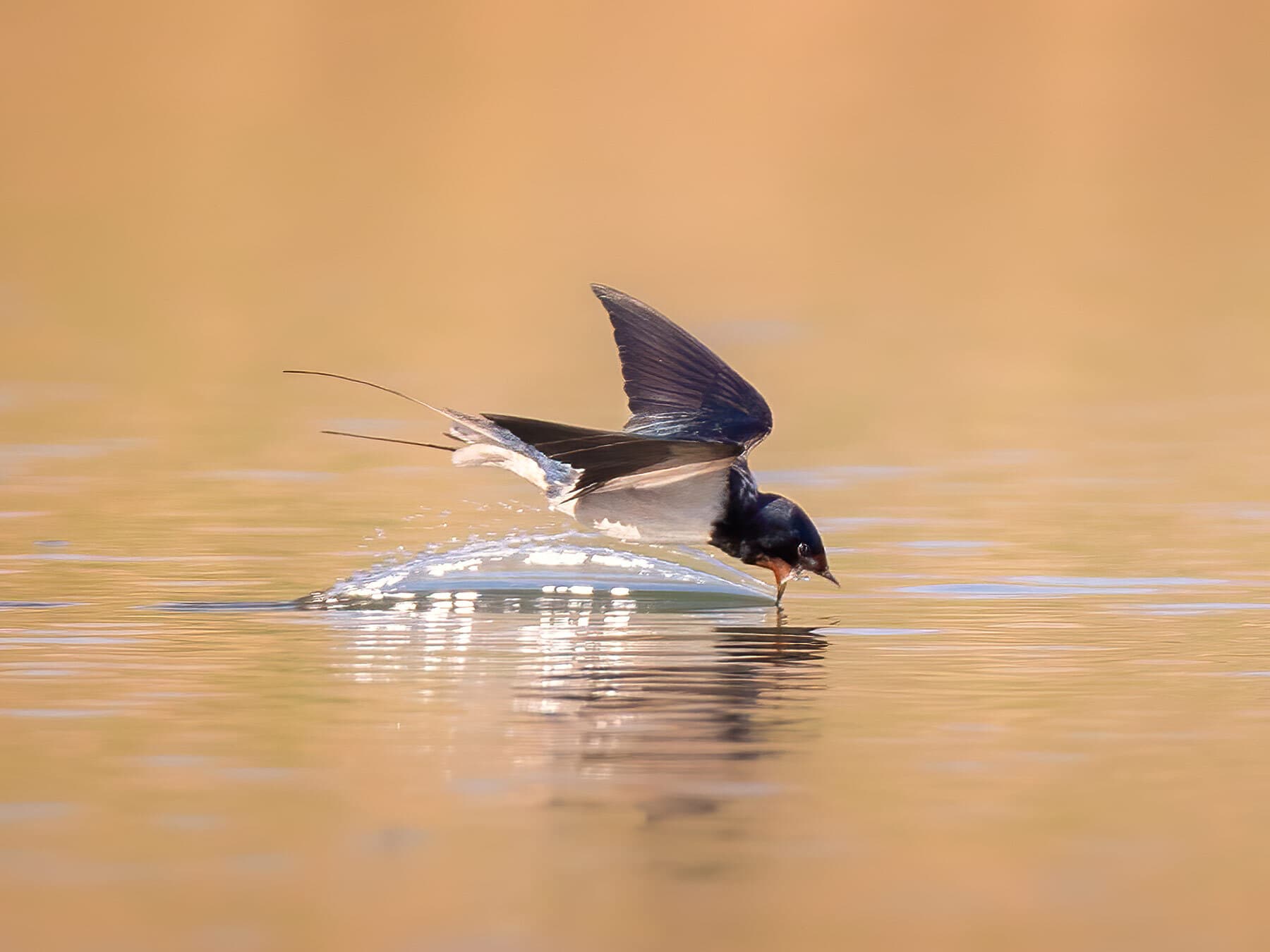
Swallows drink and bathe on the wing, skimming the water. They do not come to seed or suet feeders, but in North America they will sometimes take crushed eggshell or oyster shell put out on an open tray. For more, see what Swallows eat.
Nesting and breeding
The Swallow is a bird that moved in with people. It once nested in caves, on rock faces and, in Europe, in hollow trees, but now nests almost entirely in barns, stables, sheds, porches and garages, and under bridges and in culverts. In Europe it has lived alongside people and their buildings for more than 2,000 years, and in North America the move from caves to buildings began before European settlement and was nearly complete by the mid-1900s.3 A genetic study found the recent spread of swallows across Europe and Asia consistent with the new nest sites that human settlements provided.11
Swallows will fly in through an open door or window to nest in a dim building, and most pairs nest alone or in small groups. Only a few still nest in caves, among them a population on the Channel Islands off California.
The nest
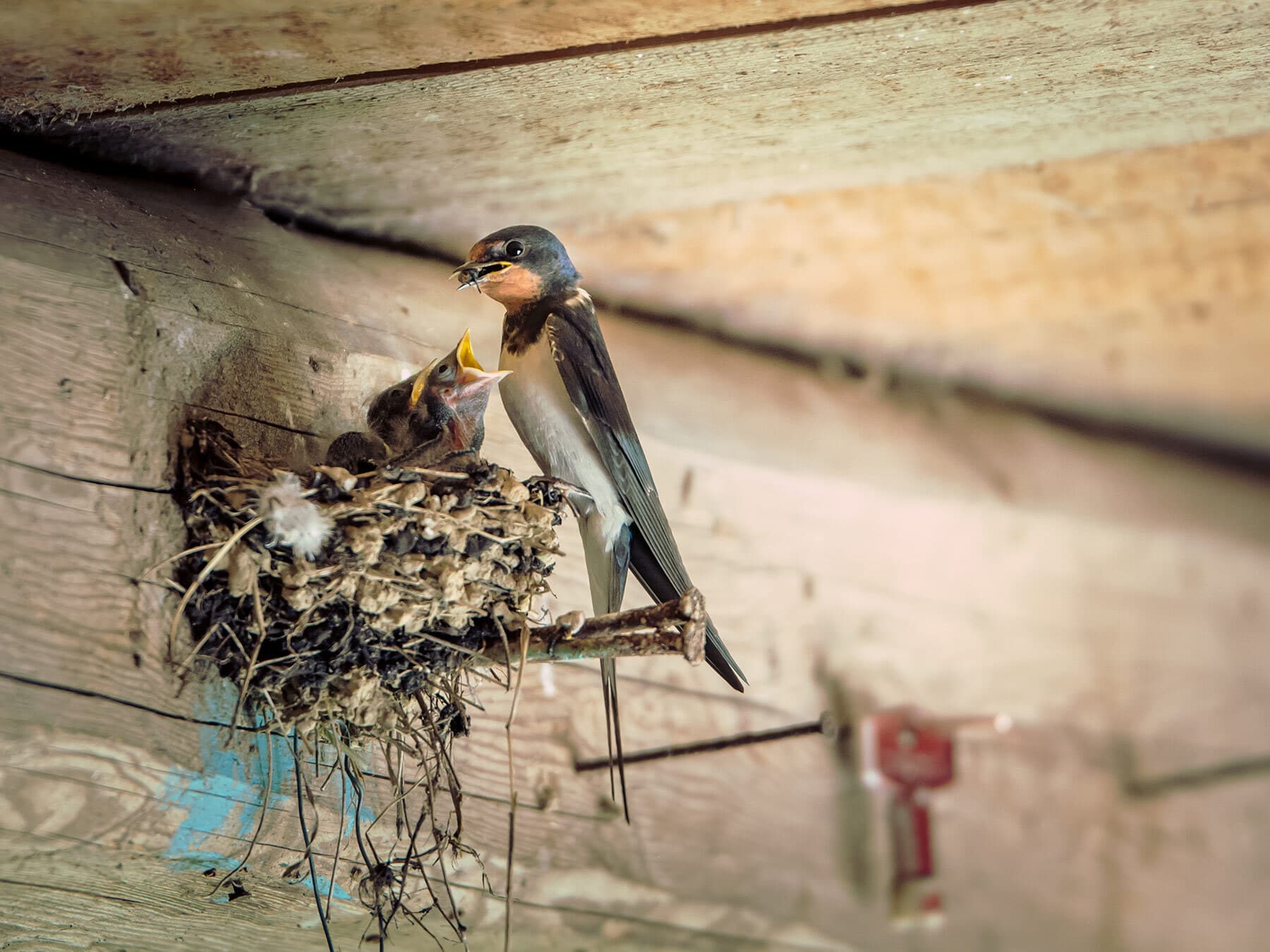
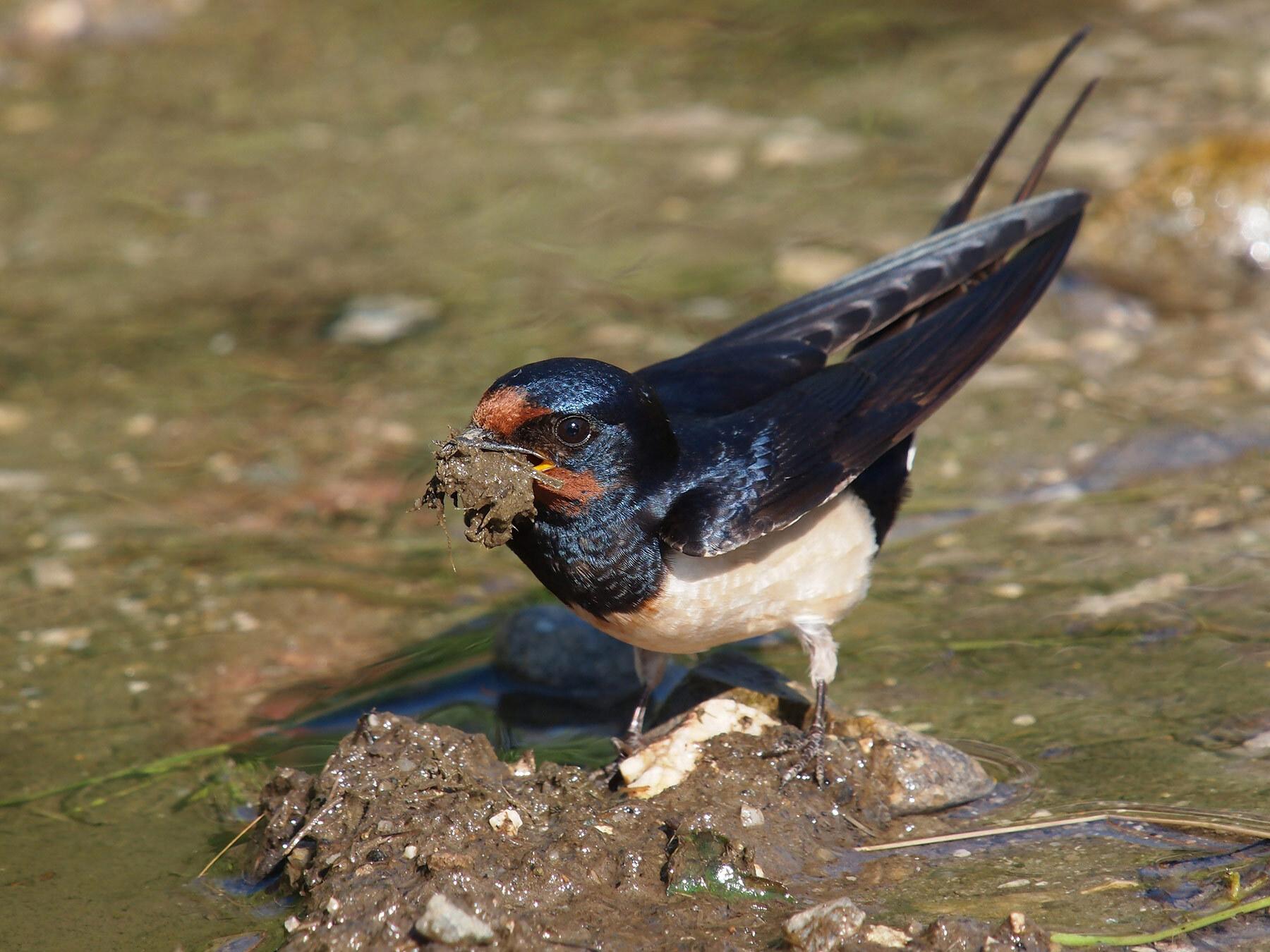
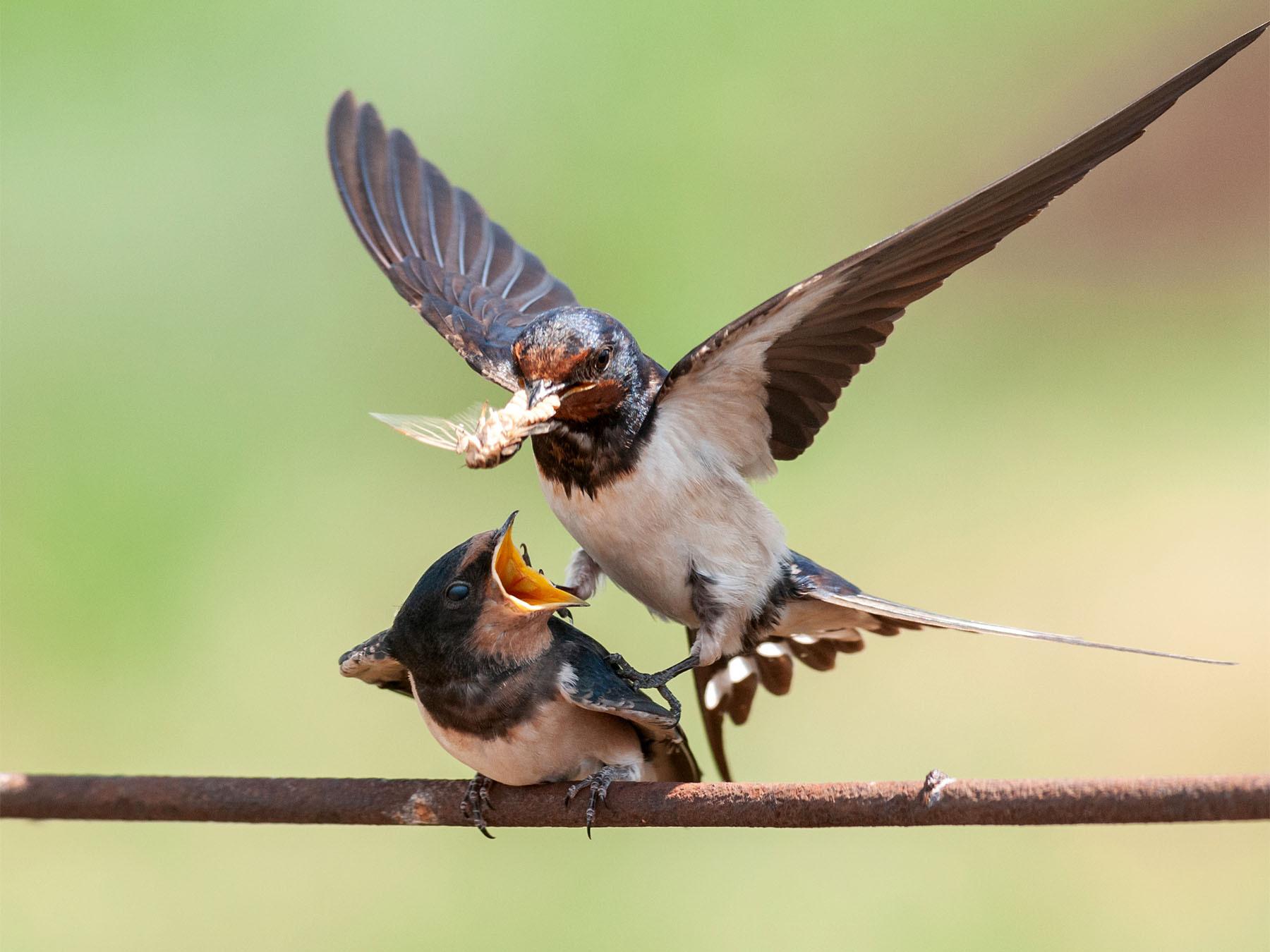
Both birds build, the female doing more of the shaping. They gather wet mud in the bill, often mixed with grass, and press the pellets onto a wall just below the ceiling or onto a beam, ledge, light fitting or nail. Against a wall the nest is a half-cup; on a ledge it is a full, open cup, lined with grass and then feathers. A European nest may take 750-1,400 mud pellets, and old nests are often repaired and reused; some in Nebraska have lasted at least 30 years, growing more than 70 cm (28 in) deep as mud is added each spring.3
Eggs and young
In the UK the average first clutch is laid on 5 June (range 9 May-31 July), and most pairs have two broods. The clutch is usually 4-5 white eggs, finely spotted with reddish brown. They are incubated for 16-18 days, mostly by the female, and the young fly at 20-22 days.2
For several days after they fly, the parents lead the young back to the nest to sleep and keep feeding them, at first while they perch and then in mid-air; families break up within about two weeks. Young from the first brood sometimes help their parents feed the second.
Helping them nest
If you have a barn, stable or shed, leave a door or window open in spring so Swallows can get in, and keep a patch of wet mud nearby for building. A narrow ledge or an artificial nest cup fixed high on a wall or under the eaves can help, put up well before the birds return.12
Nests and the law
Like all wild birds in the UK, Swallows and their nests are protected. In England and Wales it is an offence to intentionally take, damage or destroy the nest of any wild bird while it is in use or being built (Wildlife and Countryside Act 1981); in Scotland and Northern Ireland reckless acts are offences too, and so is stopping a bird from using its nest.13, 14 In the US the Barn Swallow is protected by the Migratory Bird Treaty Act, which makes it unlawful to take or possess the birds, their nests or their eggs except as regulations allow.15, 16
Behaviour
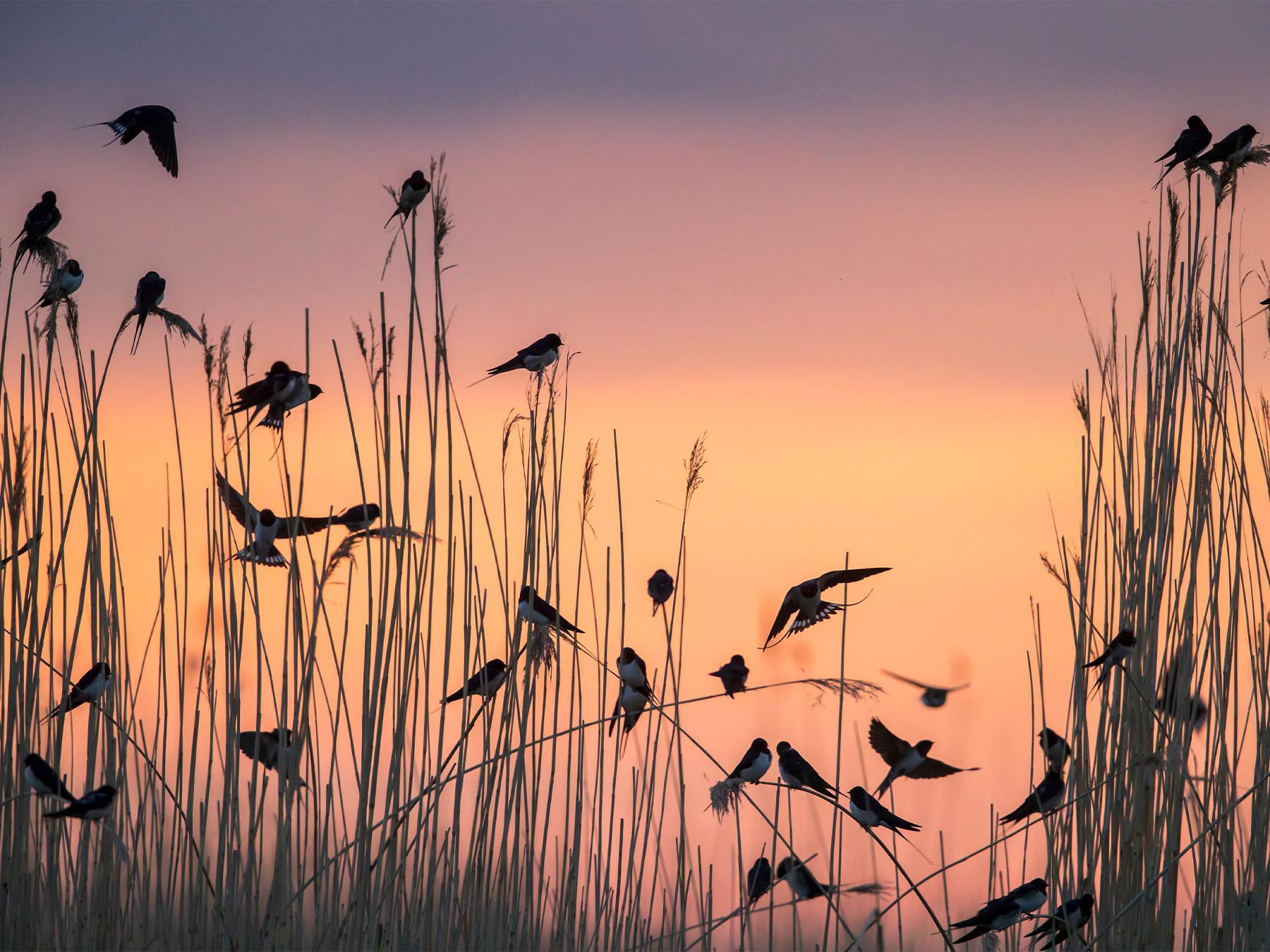
Swallows fly low and in long, straight runs, making sharper turns and dives than other swallows, and they rarely glide. They land on the ground mainly to collect mud, nest material or grit, and walk rather than hop. They perch on wires, especially in late summer, when big gatherings build up before migration, and at dusk they drop into reedbeds and marshes to roost; some winter roosts in eastern and southern Africa reportedly hold a million birds or more.3
Near the nest they mob cats, hawks and other predators, circling, calling and diving at them, sometimes striking them.
Pairs and mating behaviour
Swallows pair up anew each spring, though many pairs stay together for a second season after a successful year and many split after a failure; in a New York study 73% divorced between seasons.3 They are socially monogamous, but matings outside the pair are common: in a two-year DNA study, 28% of 261 chicks had a father other than the mother's partner, and a third of 63 broods held at least one such chick.17 Males guard their mates closely while they are fertile, and unmated males sometimes kill the chicks of a nesting pair, which often breaks up the pair and lets that male pair with the female.3

Lifespan and predators
Most Swallows live only a few years. One that reaches breeding age typically lives about two years, breeding when one year old, and about 37% of adults survive from one year to the next.2
The oldest on the British and Irish ringing record was ringed as a nestling at Weyhill, Hampshire, on 10 June 1925 and found dead near Basingstoke on 21 July 1936, 11 years 1 month 11 days later.18 EURING's list of European records holds one Barn Swallow, a bird caught by a ringer in the Channel Islands at 20 years 2 months, an exceptional record almost twice the age of the British and North American records. EURING counts age from the likely year of hatching, a minimum for birds ringed as adults, while the BTO gives the time since ringing.19 The oldest on the North American banding record was a female at least 10 years old, banded in Maryland in 2006 and caught and released there in 2015.20
Predators and other dangers
Birds of prey, owls, gulls and crows, and in North America grackles, catch adults or raid nests, and cats, rats, weasels and snakes take eggs and chicks, though nest predation is generally rare. Weather kills more: cold, wet spells in late spring starve adults and nestlings, and in September 1974 record cold in Europe killed at least a million migrating swifts and swallows, many of them young birds; volunteers rescued about 500,000 and carried them by plane, train and car to warmer places beyond the Alps.3
Conservation
The Swallow is Green-listed in the UK's Birds of Conservation Concern (2021), but on the separate Red List for Great Britain it is assessed as Vulnerable, after a 31% fall between 2008 and 2018.21 Worldwide it is still widespread and listed as Least Concern. The UK has about 705,000 territories (2016).22
Population trends
The Breeding Bird Survey puts the UK fall at 23% between 1995 and 2024, and 39% in the ten years to 2024; England lost 33% over the whole period and Wales 20%, while Scotland's 2% fall is not significant, as is Northern Ireland's ten-year fall of 11%.23 Across Europe as a whole the trend has been broadly stable since 1980.2
In North America the Breeding Bird Survey shows Barn Swallows falling by 0.65% a year from 1966 to 2025, much faster in Canada (2.2% a year) than in the US (0.26%), and, by our calculation from the survey's yearly indices, numbers fell about 17% between 2015 and 2025.24
Why the population has fallen
The causes are not certain. In Britain, farming change is thought to be a main driver: the loss of livestock and grazed grassland in the east, with more intensive arable farming, while more pasture in the west and north helped; conditions in Africa may matter too: yearly changes in numbers have tracked rainfall in the western Sahel, on the spring route, and survival has tracked rainfall in southern Africa.2 On farms in southern Britain there were more than twice as many flying insects over pasture as over silage, and about twice as many Swallows feeding there.25 In one study, Swallows fell by 48% on average on farms where dairy farming stopped, with fewer insects and fewer second clutches.26
In North America the trends of swallows, swifts and nightjars turned for the worse together in the 1980s, likely a response to a shared cause.27 A review found no single threat to blame, with several factors that could be contributing.28 Keeping livestock on the land, fewer pesticides and wetlands should all help swallows find food.
Similar birds
Often mistaken for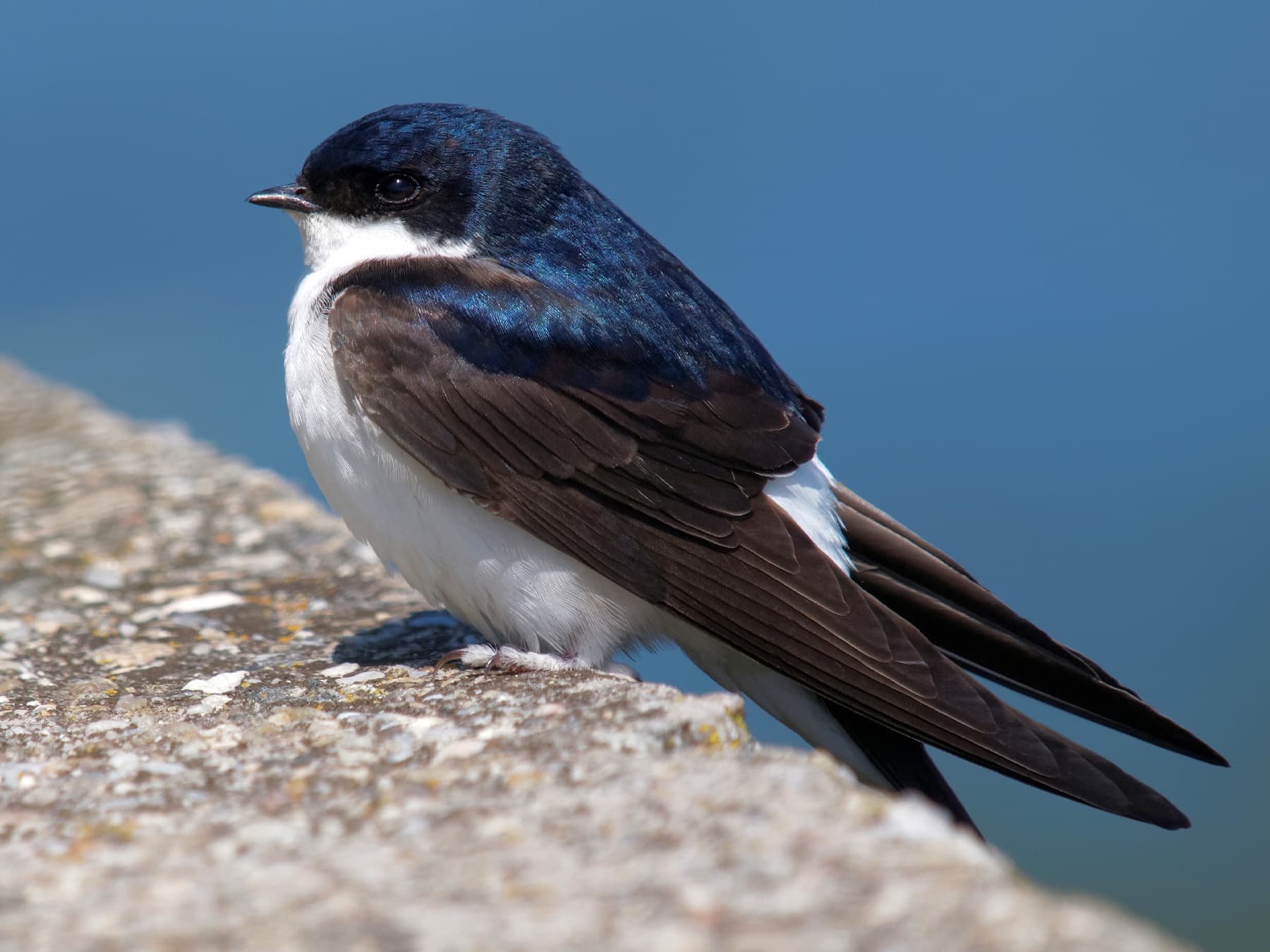

More photos
1 photos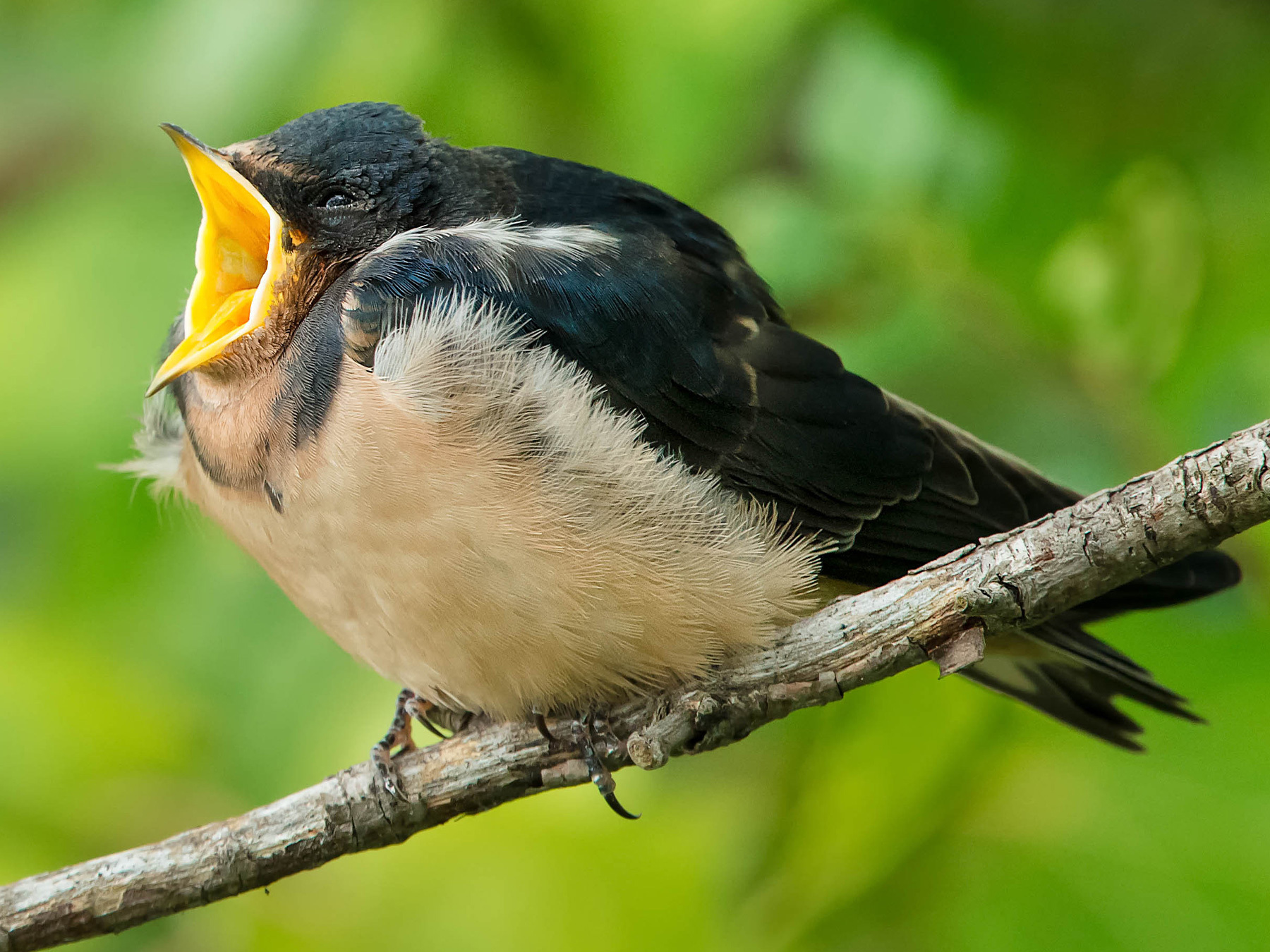
Barn Swallow guides
2 guidesQuick facts
- Length
- 17–19 cm
- Wingspan
- 32–35 cm
- Weight
- 17.2–23 g
- Lifespan
- oldest recorded 20.2 years · UK record 11 years 1 month · North American record at least 10 years
- Family
- Swallows & Martins
- Migration
- Long-distance Migrant
- Global status (IUCN)
- Least Concern
- World population
- About 705,000 territories in the UK (2016)
- Population trend
- UK numbers down 23% between 1995 and 2024; North American numbers falling by about 0.65% a year since 1966
- Also called
- Swallow
- Scientific name
- Hirundo rustica
Questions
4Is a Swallow the same as a Barn Swallow?
Yes. In Britain and Ireland it is simply the Swallow; Barn Swallow is its name in North America and in most world lists. American birds look a little different, with orange-buff underparts. See how to recognise it.
Do swallows mate for life?
No. Pairs form each spring, though many stay together for a second year if they nested successfully, and many split after a failure. See pairs and mating.
Do swallows ever land?
Yes, often. Unlike Swifts they perch on wires, roofs and branches, roost at night in buildings or reedbeds, and come down to the ground to collect mud for the nest.
Sources
37- 1AviList Core Team (2025). AviList: The Global Avian Checklist, v2025b. doi:10.2173/avilist.v2025b (opens in a new tab)
- 2British Trust for Ornithology. Swallow. BirdFacts. Accessed 9 November 2026. Source (opens in a new tab)
- 3Brown, M. B. and Brown, C. R. (2020). Barn Swallow (Hirundo rustica), version 1.0. Birds of the World (P. G. Rodewald, editor). Cornell Lab of Ornithology. doi:10.2173/bow.barswa.01 (opens in a new tab)
- 4Møller, A. P. (1988). Female choice selects for male sexual tail ornaments in the monogamous swallow. Nature 332: 640-642. doi:10.1038/332640a0 (opens in a new tab)
- 5Evans, M. R. (1998). Selection on swallow tail streamers. Nature 394: 233-234. doi:10.1038/28297 (opens in a new tab)
- 6British Trust for Ornithology. Summary of all recoveries for Swallow (Hirundo rustica). The Online Demography Report (BTO). Accessed 9 November 2026. Source (opens in a new tab)
- 7Pancerasa, M. et al. (2022). Across the deserts and sea: inter-individual variation in migration routes of south-central European barn swallows (Hirundo rustica). Movement Ecology 10: 51. doi:10.1186/s40462-022-00352-3 (opens in a new tab)
- 8Ambrosini, R. et al. (2011). Climate change and the long-term northward shift in the African wintering range of the barn swallow Hirundo rustica. Climate Research 49: 131-141. doi:10.3354/cr01025 (opens in a new tab)
- 9Hobson, K. A. et al. (2015). A continent-wide migratory divide in North American breeding Barn Swallows (Hirundo rustica). PLoS ONE 10: e0129340. doi:10.1371/journal.pone.0129340 (opens in a new tab)
- 10Winkler, D. W. et al. (2017). Long-distance range expansion and rapid adjustment of migration in a newly established population of Barn Swallows breeding in Argentina. Current Biology 27: 1080-1084. doi:10.1016/j.cub.2017.03.006 (opens in a new tab)
- 11Zink, R. M., Pavlova, A., Rohwer, S. and Drovetski, S. V. (2006). Barn swallows before barns: population histories and intercontinental colonization. Proceedings of the Royal Society B 273: 1245-1251. doi:10.1098/rspb.2005.3414 (opens in a new tab)
- 12Cornell Lab of Ornithology. Barn Swallow. All About Birds. Accessed 9 November 2026. Source (opens in a new tab)
- 13UK Parliament (1981). Wildlife and Countryside Act 1981, section 1. legislation.gov.uk. Accessed 9 November 2026. Source (opens in a new tab)
- 14UK Government (1985). The Wildlife (Northern Ireland) Order 1985, Article 4. legislation.gov.uk. Accessed 9 November 2026. Source (opens in a new tab)
- 15United States Congress (1918). Migratory Bird Treaty Act, 16 U.S.C. 703. United States Code, Title 16 (GovInfo, 2024 edition). Accessed 9 November 2026. Source (opens in a new tab)
- 16U.S. Fish and Wildlife Service (2026). 50 CFR 10.13: List of Birds Protected by the Migratory Bird Treaty Act. Electronic Code of Federal Regulations. Accessed 9 November 2026. Source (opens in a new tab)
- 17Møller, A. P. and Tegelström, H. (1997). Extra-pair paternity and tail ornamentation in the barn swallow Hirundo rustica. Behavioral Ecology and Sociobiology 41: 353-360. doi:10.1007/s002650050395 (opens in a new tab)
- 18Robinson, R. A., Leech, D. I. and Clark, J. A. (2026). Longevity records for Britain & Ireland in 2025. The Online Demography Report: Bird ringing and nest recording in Britain & Ireland in 2025 (BTO). Accessed 9 November 2026. Source (opens in a new tab)
- 19Fransson, T., Kolehmainen, T., Moss, D. and Robinson, R. (2023). EURING list of longevity records for European birds (1 September 2023). EURING. Accessed 9 November 2026. Source (opens in a new tab)
- 20USGS Bird Banding Laboratory. Longevity records of North American birds. USGS Eastern Ecological Science Center, Bird Banding Laboratory. Accessed 9 November 2026. Source (opens in a new tab)
- 21Stanbury, A. et al. (2021). The status of our bird populations: the fifth Birds of Conservation Concern in the United Kingdom, Channel Islands and Isle of Man and second IUCN Red List assessment of extinction risk for Great Britain. British Birds 114: 723-747. Accessed 9 November 2026. Source (opens in a new tab)
- 22Woodward, I. et al. (2020). Population estimates of birds in Great Britain and the United Kingdom. British Birds 113: 69-104. Accessed 9 November 2026. Source (opens in a new tab)
- 23Heywood, J. J. N., Massimino, D., Baker, L., Balmer, D. E. et al. (2026). The Breeding Bird Survey 2025. BTO Research Report 802. British Trust for Ornithology, Thetford. Accessed 9 November 2026. Source (opens in a new tab)
- 24Hostetler, J. A. et al. (2026). The North American Breeding Bird Survey, Analysis Results 1966-2025. U.S. Geological Survey data release. doi:10.5066/P1OSNSFC (opens in a new tab)
- 25Evans, K. L., Wilson, J. D. and Bradbury, R. B. (2007). Effects of crop type and aerial invertebrate abundance on foraging barn swallows Hirundo rustica. Agriculture, Ecosystems & Environment 122: 267-273. doi:10.1016/j.agee.2007.01.015 (opens in a new tab)
- 26Møller, A. P. (2001). The effect of dairy farming on barn swallow Hirundo rustica abundance, distribution and reproduction. Journal of Applied Ecology 38: 378-389. doi:10.1046/j.1365-2664.2001.00593.x (opens in a new tab)
- 27Smith, A. C., Hudson, M.-A. R., Downes, C. M. and Francis, C. M. (2015). Change points in the population trends of aerial-insectivorous birds in North America: synchronized in time across species and regions. PLoS ONE 10: e0130768. doi:10.1371/journal.pone.0130768 (opens in a new tab)
- 28Spiller, K. J. and Dettmers, R. (2019). Evidence for multiple drivers of aerial insectivore declines in North America. The Condor 121: duz010. doi:10.1093/condor/duz010 (opens in a new tab)
- 29RSPB. House Martin, Swift or Swallow? How to tell the difference. RSPB. Accessed 9 November 2026. Source (opens in a new tab)
- 30RSPB. Swallow. RSPB Birds and wildlife. Accessed 9 November 2026. Source (opens in a new tab)
- 31National Audubon Society. Barn Swallow. Guide to North American Birds. Accessed 9 November 2026. Source (opens in a new tab)
- 32NestWatch, Cornell Lab of Ornithology. Barn Swallow. NestWatch: All About Birdhouses. Accessed 9 November 2026. Source (opens in a new tab)
- 33Kleven, O. et al. (2006). Male tail streamer length predicts fertilization success in the North American barn swallow (Hirundo rustica erythrogaster). Behavioral Ecology and Sociobiology 59: 412-418. doi:10.1007/s00265-005-0065-0 (opens in a new tab)
- 34Safran, R. J., Neuman, C. R., McGraw, K. J. and Lovette, I. J. (2005). Dynamic paternity allocation as a function of male plumage color in barn swallows. Science 309: 2210-2212. doi:10.1126/science.1115090 (opens in a new tab)
- 35Smith, C. C. R. et al. (2018). Demographic inference in barn swallows using whole-genome data shows signal for bottleneck and subspecies differentiation during the Holocene. Molecular Ecology 27: 4200-4212. doi:10.1111/mec.14854 (opens in a new tab)
- 36National Audubon Society. Tree Swallow. Guide to North American Birds. Accessed 9 November 2026. Source (opens in a new tab)
- 37Cornell Lab of Ornithology. Tree Swallow. All About Birds. Accessed 2 November 2026. Source (opens in a new tab)

Checked by
Nathan Cope, founder and editor
Nathan founded Birdfact and leads its writers and contributors in the UK, the US and Canada. He has watched and studied birds for more than ten years, and checks every article and species guide before it’s published.