


Tree Swallow
Tachycineta bicolor
By the Birdfact teamChecked by Nathan Cope
See it in 3D
3 plumages 3D model
An adult Tree Swallow is 4.5–5.5 in (12–14 cm) long, bill to tail.
3D model · Adult · Length 4.5–5.5 in (12–14 cm) · How we make our birds · Report a problem
© 2026 NC Digital Limited (Birdfact). All rights reserved. This 3D model may be viewed on this page and shared by link only. Downloading, extracting, copying or reusing it, or using it to train machine-learning models, is not permitted without our written permission. Using our models
On this page14 sections
How to recognise it
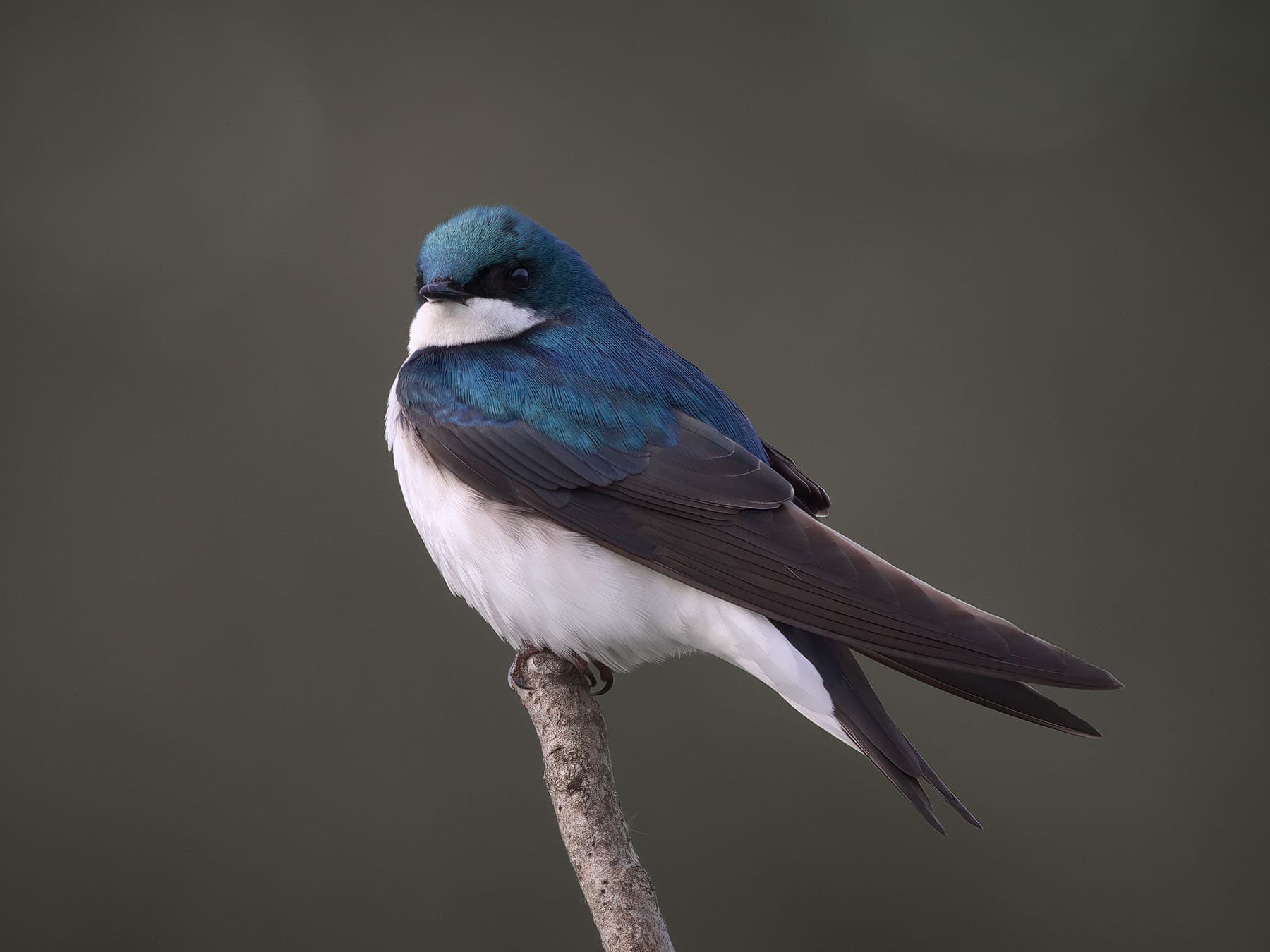
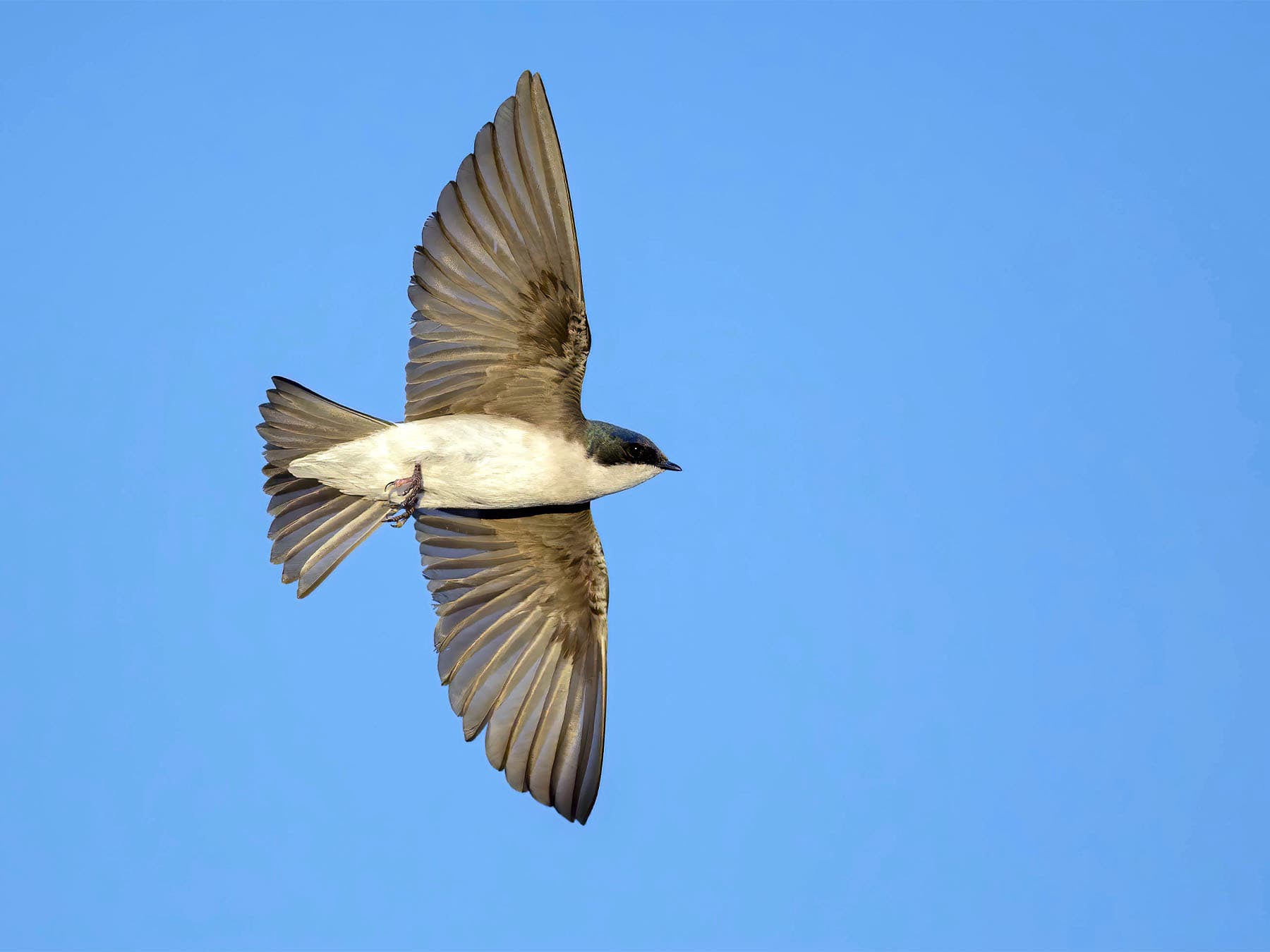
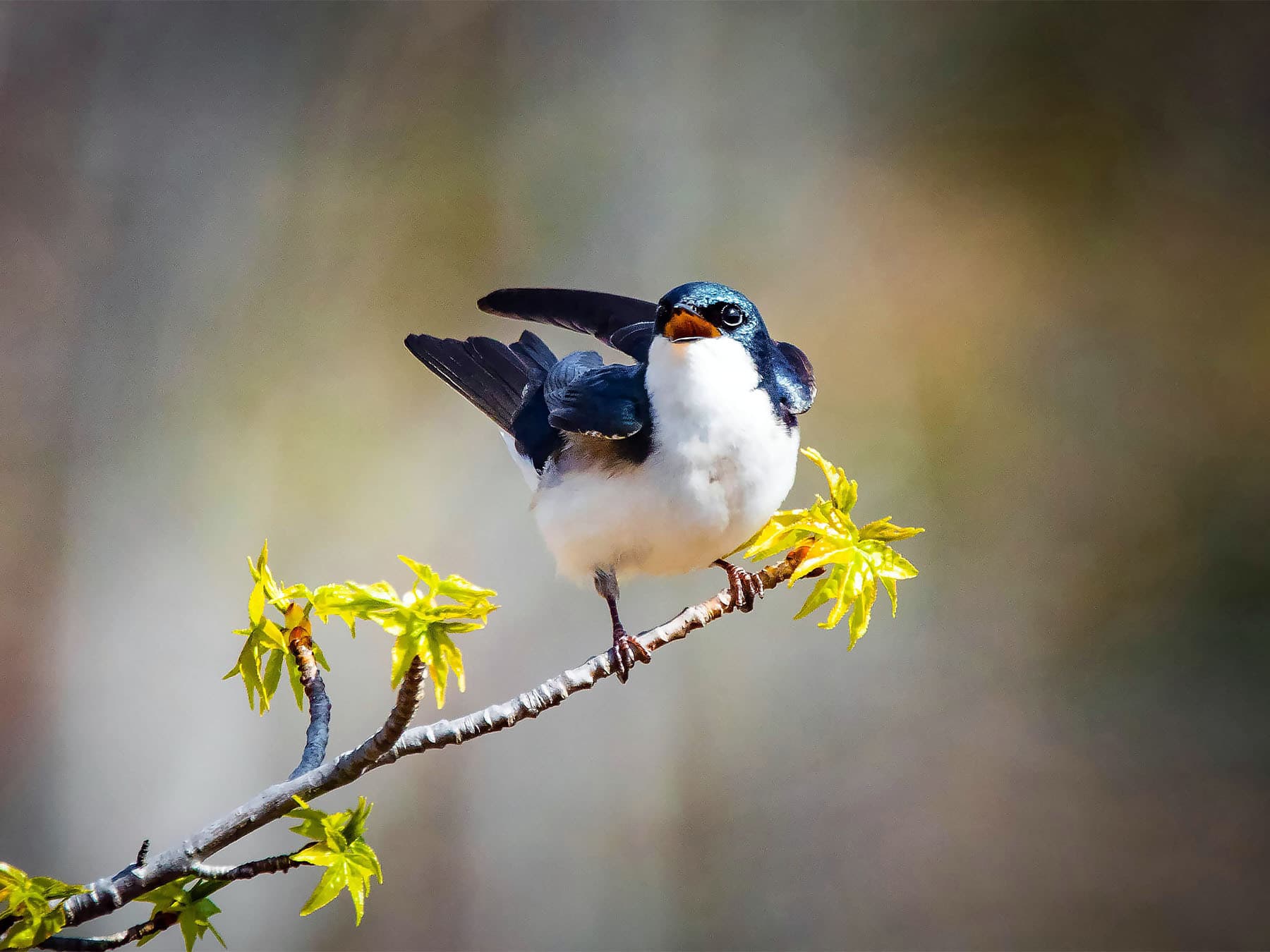
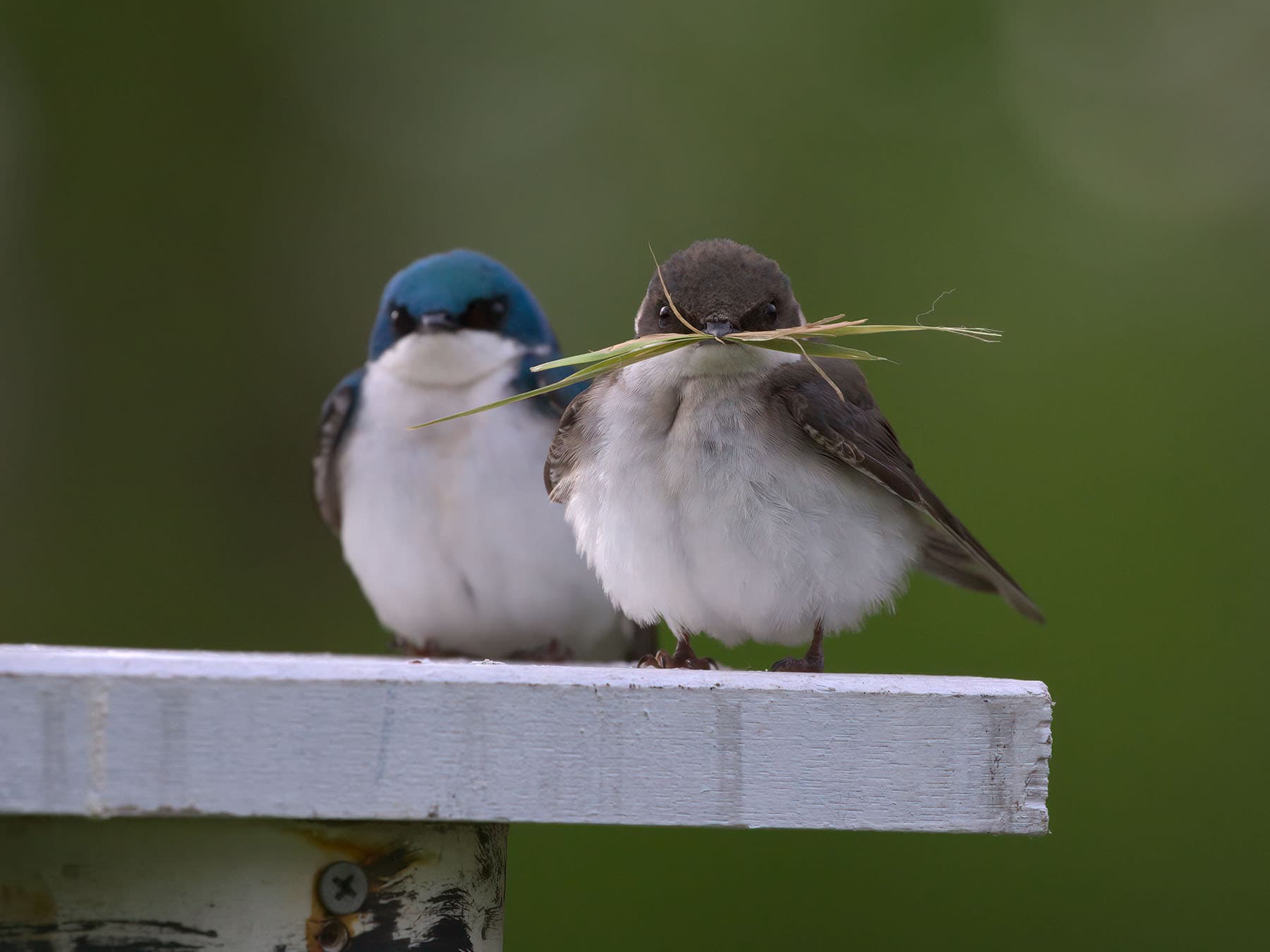
The Tree Swallow is a small, streamlined swallow, glossy blue-green above and clean white below. In sunlight the crown, back and rump shine steely blue or green; the wings and tail are blackish gray, and a thin black mask runs through the eye. The dark cap comes down to the eye, with no white above or behind it.1
The bill is tiny and flat, the wings long and pointed, and the tail short, squared or only slightly notched, with no long streamers. It perches in the open on wires, shrubs and nest boxes, and it rarely lands on the ground; when it does, it walks clumsily.
Size
Tree Swallows are 4.7 to 5.9 inches (12-15 cm) long, with a wingspan of 11.8 to 13.8 inches (30-35 cm), and weigh 0.6 to 0.9 ounces (16-25 g).2 That is sparrow-sized or smaller: smaller than a Purple Martin and slightly larger than a Bank Swallow.
Males, females and young
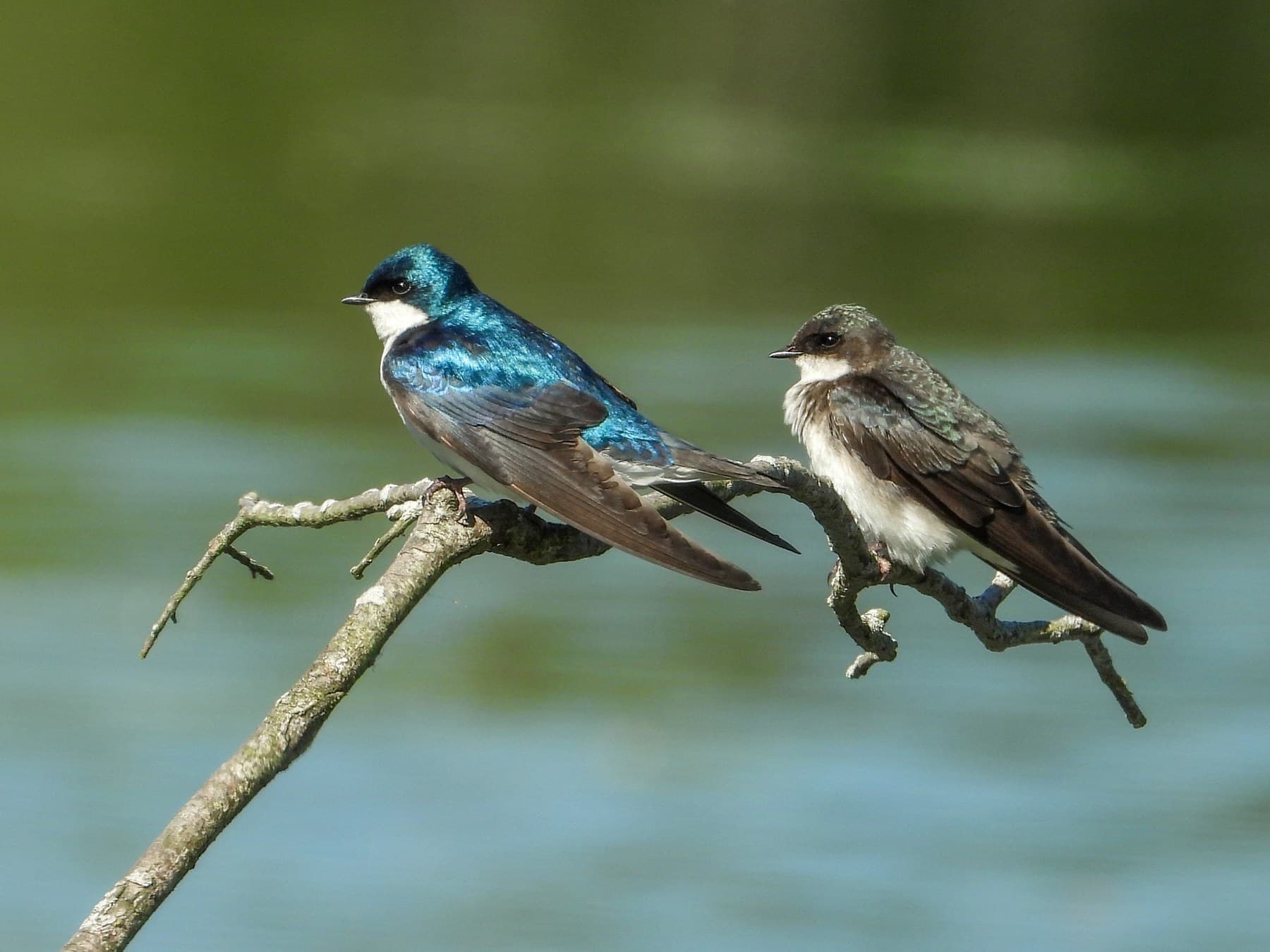
Adult males and most older females look alike. Females are usually a little duller and greener, and some keep a little brown on the forehead, but the brightest females may be impossible to tell from males in the field.
Females in their first breeding season look different: most are dull brown above, with a few to many blue-green feathers mixed in. In studies, 84 to 90% of them had blue-green on less than half the upperparts.1 Only females have this separate first-year plumage. Young males look like adults after their first molt.
Juvenile plumage
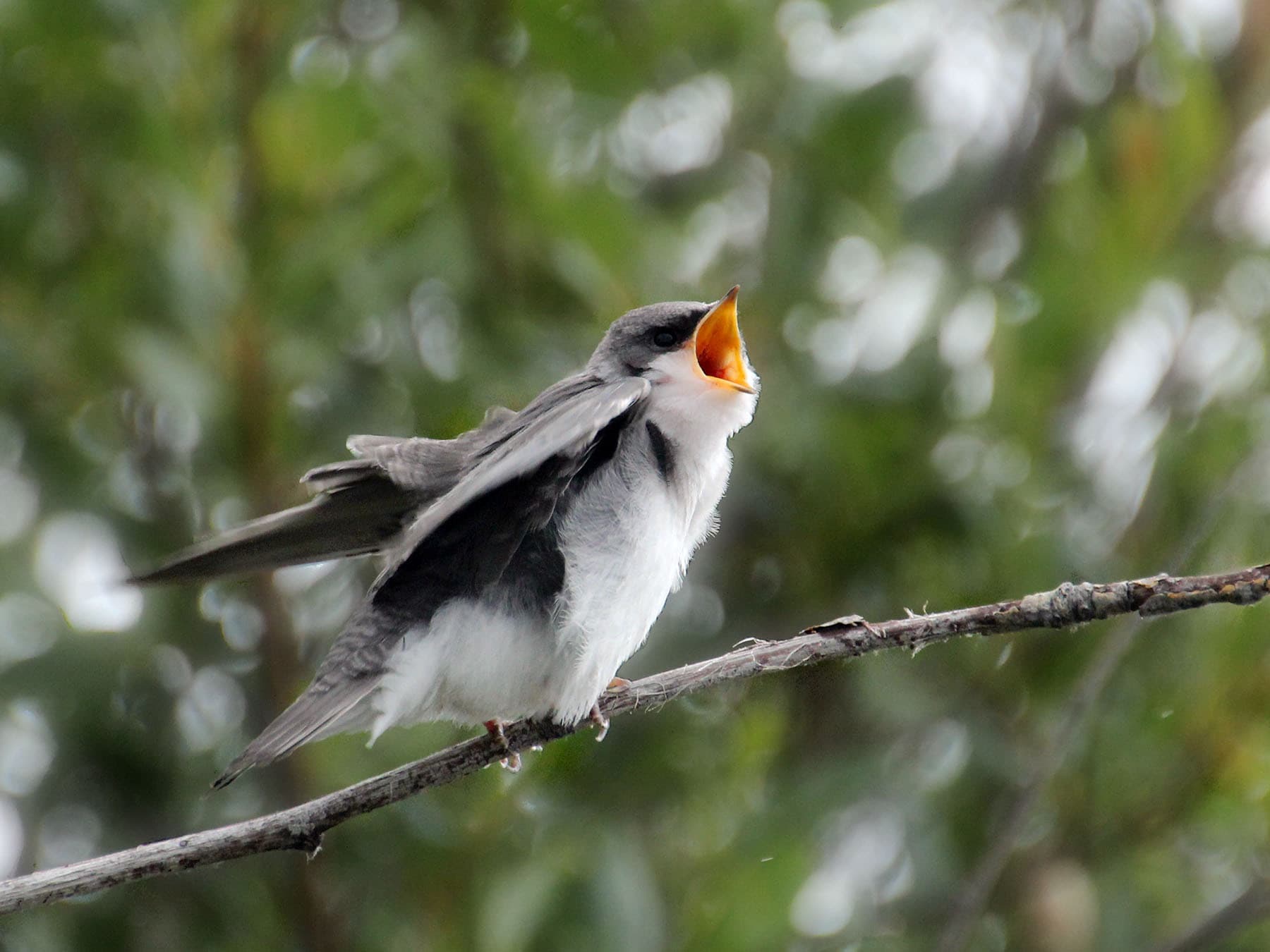
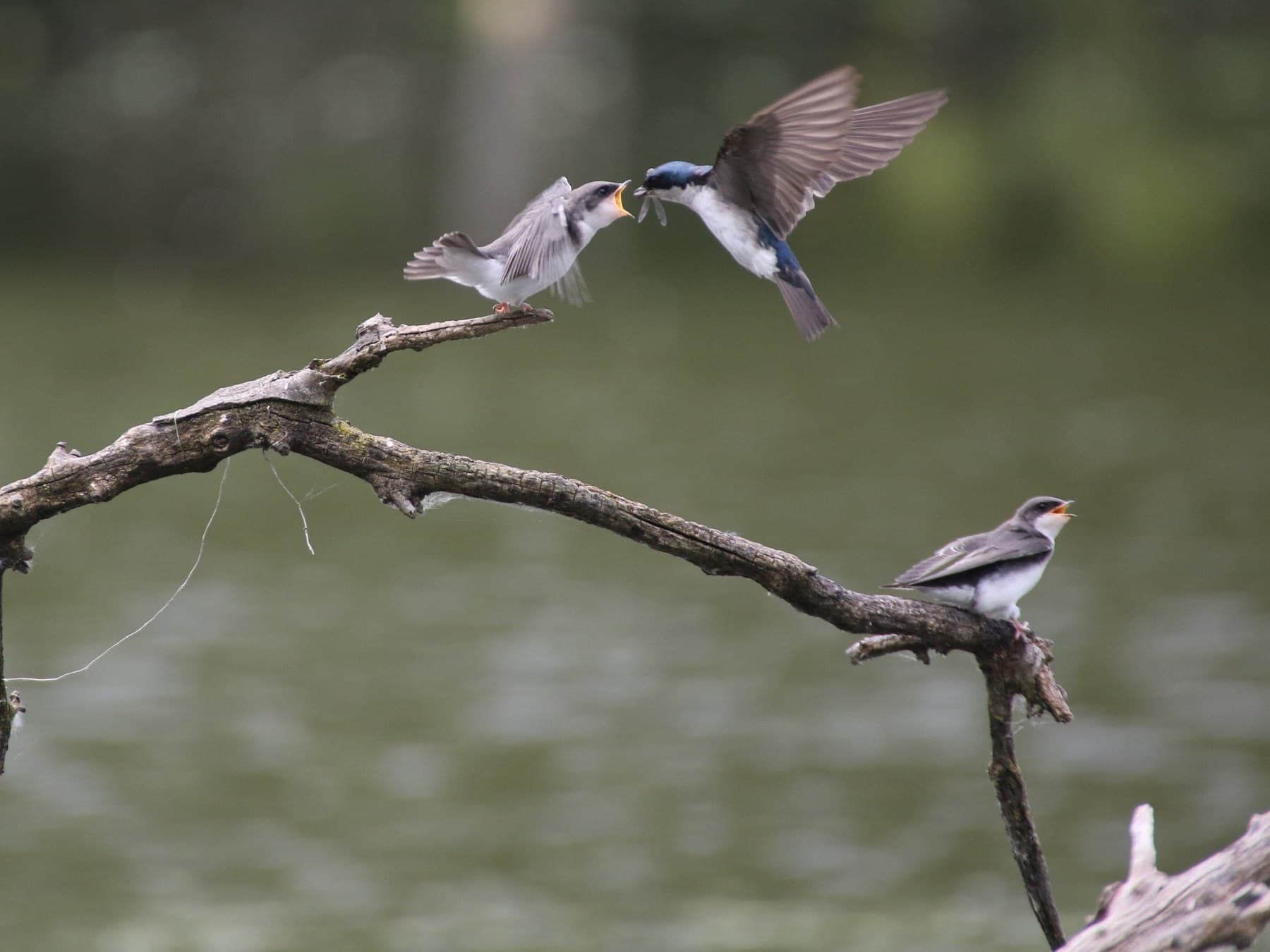
Juveniles, the young birds seen from late spring into fall, are plain sooty gray-brown above with no blue-green and dull white below, often with a faint, blurry gray-brown band across the chest. These brown birds are easily confused with Bank and Northern Rough-winged Swallows (see below).
Young birds have a complete molt from August to December, mostly after leaving the area where they hatched but before much migration; after it, males look like adults and most females are brown above. Adults molt from July to November, usually starting on the breeding grounds and carrying on during migration. In fresh fall plumage the tertials, the innermost wing feathers, have white edges, which wear off by spring.
Identification: similar birds
Barn Swallow. It has a rusty-red throat, buff to whitish underparts and a forked tail with white spots, shorter in young birds. A Tree Swallow is clean white from throat to tail, with a short, barely notched tail.
Violet-green Swallow. A bird of the West, with white curling up around and above the eye and white patches on the sides of the rump that nearly join over the tail. A Tree Swallow's dark cap reaches the eye, with at most a little white at the edges of the rump.
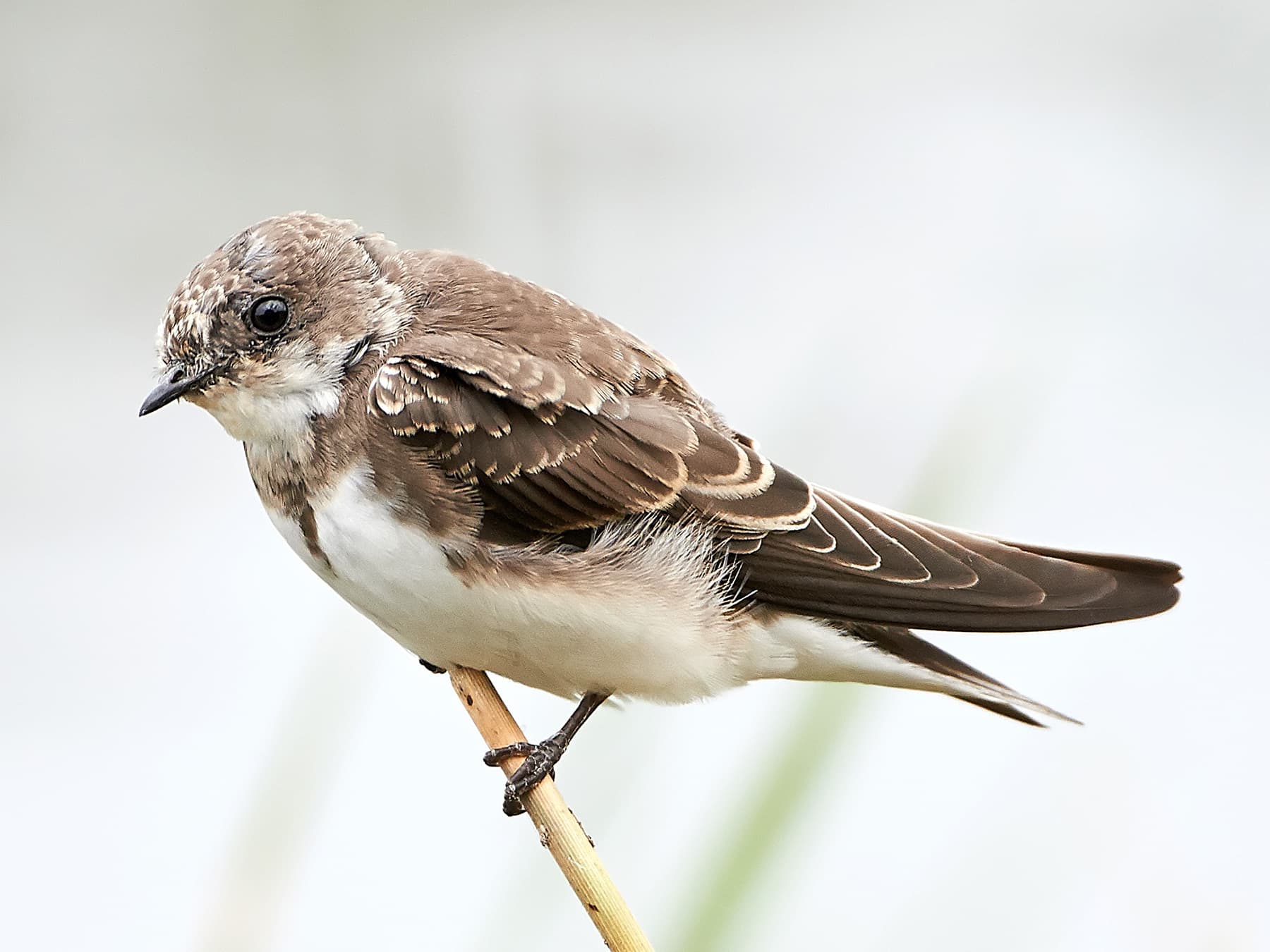
Bank Swallow. Known in Britain as the Sand Martin. It is smaller and warmer brown above, with a sharply defined dark band across a white breast. A brown juvenile Tree Swallow has a blurrier gray-brown band, usually narrowest in the middle.
Northern Rough-winged Swallow. Brown above, with a dingy gray-brown throat and breast fading to white. A juvenile Tree Swallow has a white throat.
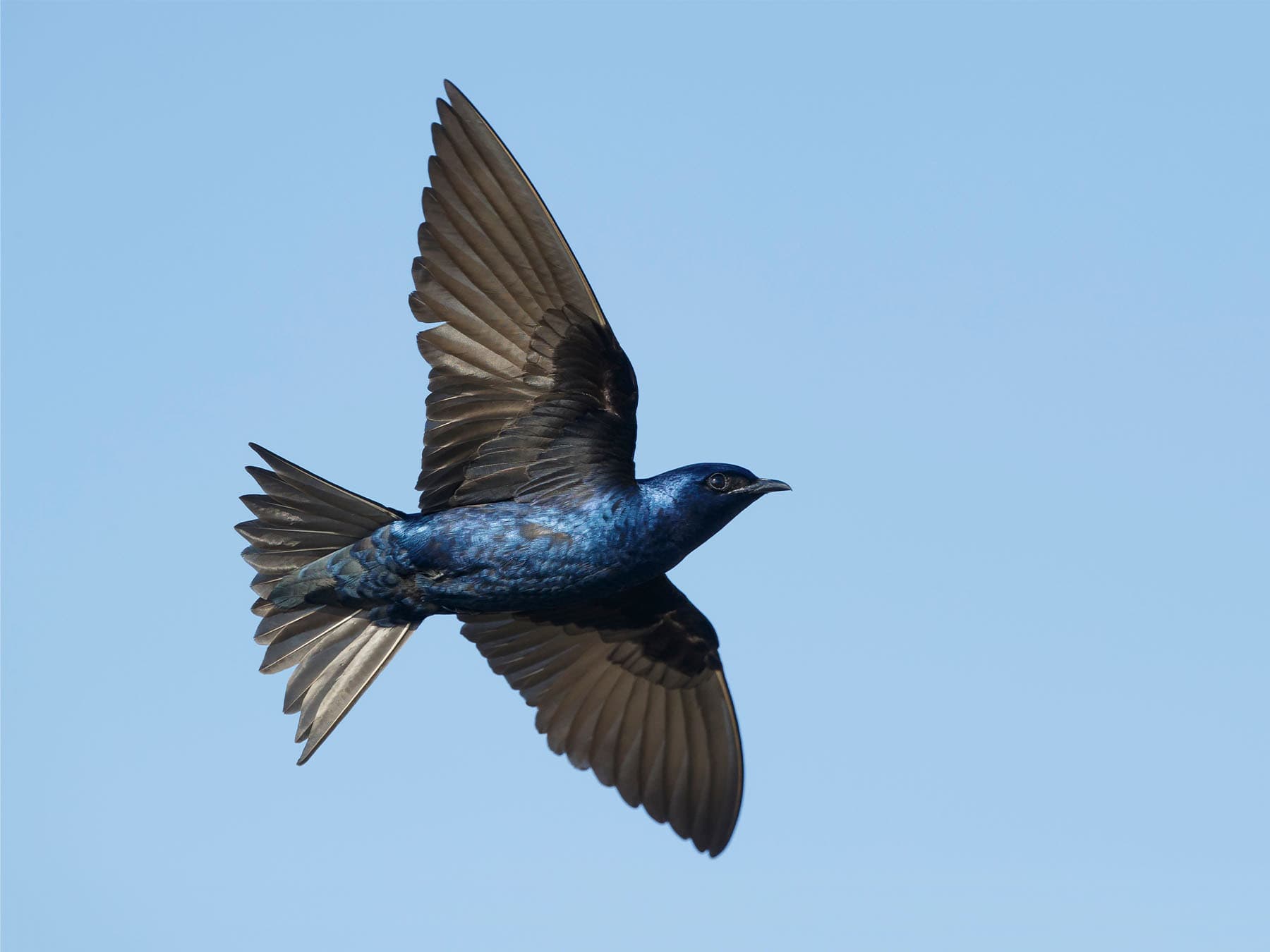
Purple Martin. Much bigger, 7 to 8½ inches (18-22 cm), with a forked tail. Males are glossy blue-black all over; females and young are grayish below with a white belly.
Not sure it’s a Tree Swallow? Check your photo: Birdfact names the bird and shows the look-alike side by side.
Its size
Adults- Length
- 12–15 cm
- Wingspan
- 30–35 cm
- Weight
- 16–25 g
Its song and calls
The song is a high, liquid twittering of chirps, whines and gurgles, strung together in endless patterns. In an Ontario study both males and females sang through the day;3 in Colorado and Nova Scotia only males sang, with a separate dawn song.1
Before dawn in spring, males circle over the nest box, singing in the dark. In Nova Scotia the dawn song ran at about 1.5 syllables a second, and each male used one to seven syllable types, 2.6 on average.4 The song seems to be more for defending the nest site than for attracting a mate.
Its calls include a rapid chatter aimed at other Tree Swallows near the nest, a shrieking alarm at predators, low-pitched for a songbird's alarm, and quiet chirps and gurgles between mates. When one gives the alarm at a predator, its neighbors take off and circle overhead, calling, until it passes. Flocks are fairly quiet, though winter flocks give buzzy notes while feeding in bayberry bushes, and a perched bird snaps its bill at a neighbor that comes too close.
- Calls0:00 / 0:02
Recorded in Washington, United States · May 2014
- Calls at a nest box0:00 / 0:08
Recorded in Wisconsin, United States · April 2026
Heard one and not sure? Let the bird song identifier listen.
When and where to see it
Look for Tree Swallows over open fields, marshes, ponds and shorelines, where flying insects are plentiful near water, and on wires and nest boxes nearby. They need a hole to nest in, so dead trees or nest boxes decide where they can breed.
They breed across northern North America, from Alaska and the Yukon, to at least 68 degrees north at Old Crow, through Canada and the northern and central United States, and are most numerous in the Rockies, along the Pacific coast, around the Great Lakes, in New England and across Canada.1 Before the 1920s they bred uncommonly south of Maryland. They now nest locally but regularly across the Southeast, west to Oklahoma and Texas, a spread helped by bluebird boxes and perhaps also by beaver ponds, dammed streams and cleared land.
Migration and winter
Tree Swallows migrate, but they winter farther north than any other American swallow.2 Most spend the winter in Florida and along the Gulf Coast, in large numbers in California and the southern Southwest, and south through Mexico, Cuba and Central America to Honduras, more rarely to Panama and northern South America. Small numbers stay along the Atlantic coast, occasionally as far north as eastern Massachusetts, probably because they can live on bayberries. In parts of the South they are present all year.
They come back long before other swallows: from late January in southern California, mid-March to early April in much of the north, and as late as early May in parts of British Columbia and interior Alaska. At Fortine, Montana, the average first arrival over 46 years was 25 March.5
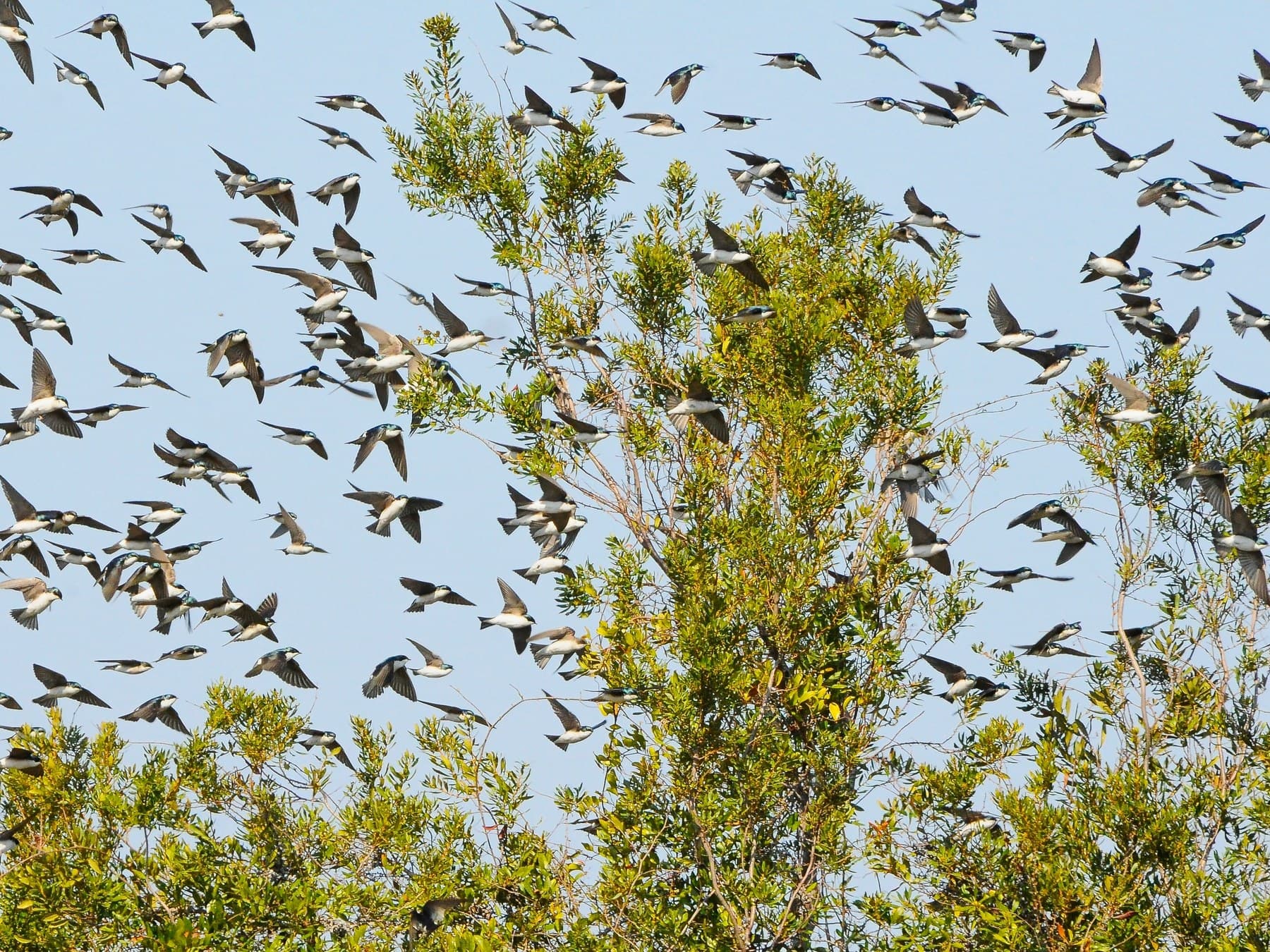
Fall migration starts soon after nesting, in July and August. By late August most have left their breeding grounds, and numbers peak in early to mid fall: 750,000 were counted at Cape Charles, Virginia, on 25 September 1971.1 They migrate by day in loose flocks and roost at night. Eastern birds follow the Atlantic coast to Florida, Cuba and Central America; prairie and Midwest birds follow the Mississippi valley to the Gulf Coast.6
Tips for seeing it
What it eats
Tree Swallows eat mostly flying insects, caught in the air with sharp twists and turns, often low over water or fields. True flies, dragonflies and damselflies, mayflies and caddisflies make up most of the food, with beetles, bugs, ants, bees and wasps, moths, spiders and small snails. Prey ranges from smaller than a grain of sand to about 2 inches (5 cm) long, though most is under 10 mm (0.4 inch). Breeding adults mostly forage within about 40 feet (12 m) of the ground and close to the nest.
In stomachs collected through the year, 80% of the food was animal and 20% plant; flies made up 41%, beetles 14% and ants 6%.7 The menu varies from place to place: dragonflies and damselflies made up 82% of the biomass brought to nestlings at a Minnesota site but under 10% in Ontario and Alberta.1
They do eat mosquitoes, but parents feeding young in New York chose dragonflies and bigger flies, and took small, thin-bodied flies such as midges and mosquitoes less often than their numbers would suggest.1
Winter food: bayberries
Unlike other swallows, Tree Swallows can live on plant food. They eat the berries of bayberry and wax myrtle, digesting the waxy coat, which few birds can do. Plant food, mostly taken in winter, makes up to about a fifth of the year's diet.7 They can apparently live on bayberries alone for long periods.8 It helps them survive cold spells when insects are scarce.
In the breeding season they look for calcium for their eggs: fish bones, crayfish shells, clam and snail shells and bits of gull and loon eggshell. They will even search backyard compost piles for eggshell. The way to attract Tree Swallows is a nest box rather than a feeder (see nest boxes).
Nesting and breeding
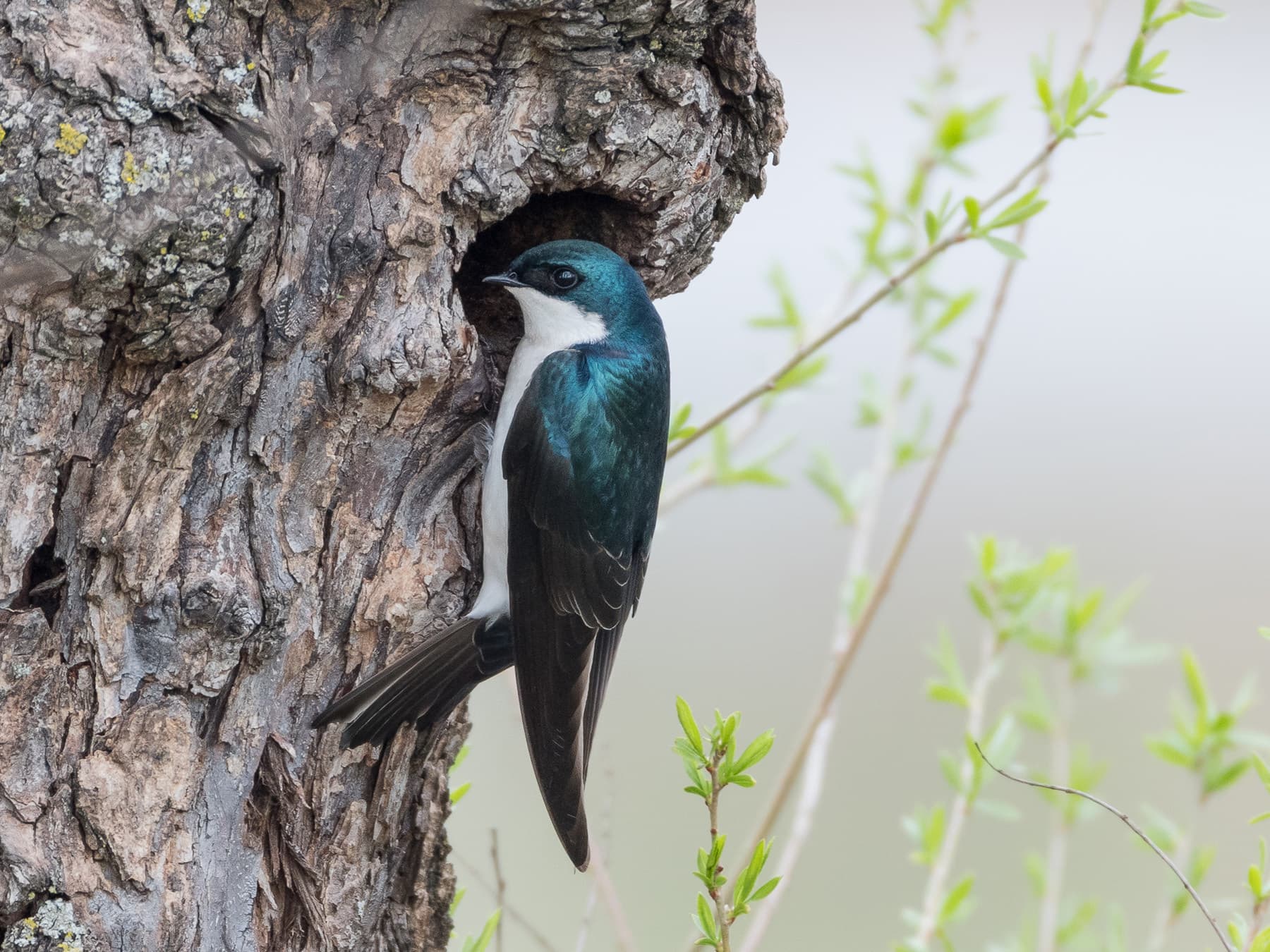
Tree Swallows nest in holes but cannot dig their own. They use old woodpecker holes, natural cavities in dead trees and old sapsucker holes in aspens, and they readily take to nest boxes, usually in open country near water. They have also nested in building eaves, Wood Duck boxes, old Cliff Swallow nests, fire hydrants, active ferries and holes in the ground.
Good cavities are often scarce. Competition for them has probably shaped the Tree Swallow's early arrival and its fierce defense of the hole, and a shortage of nest sites probably limits its numbers.
The nest
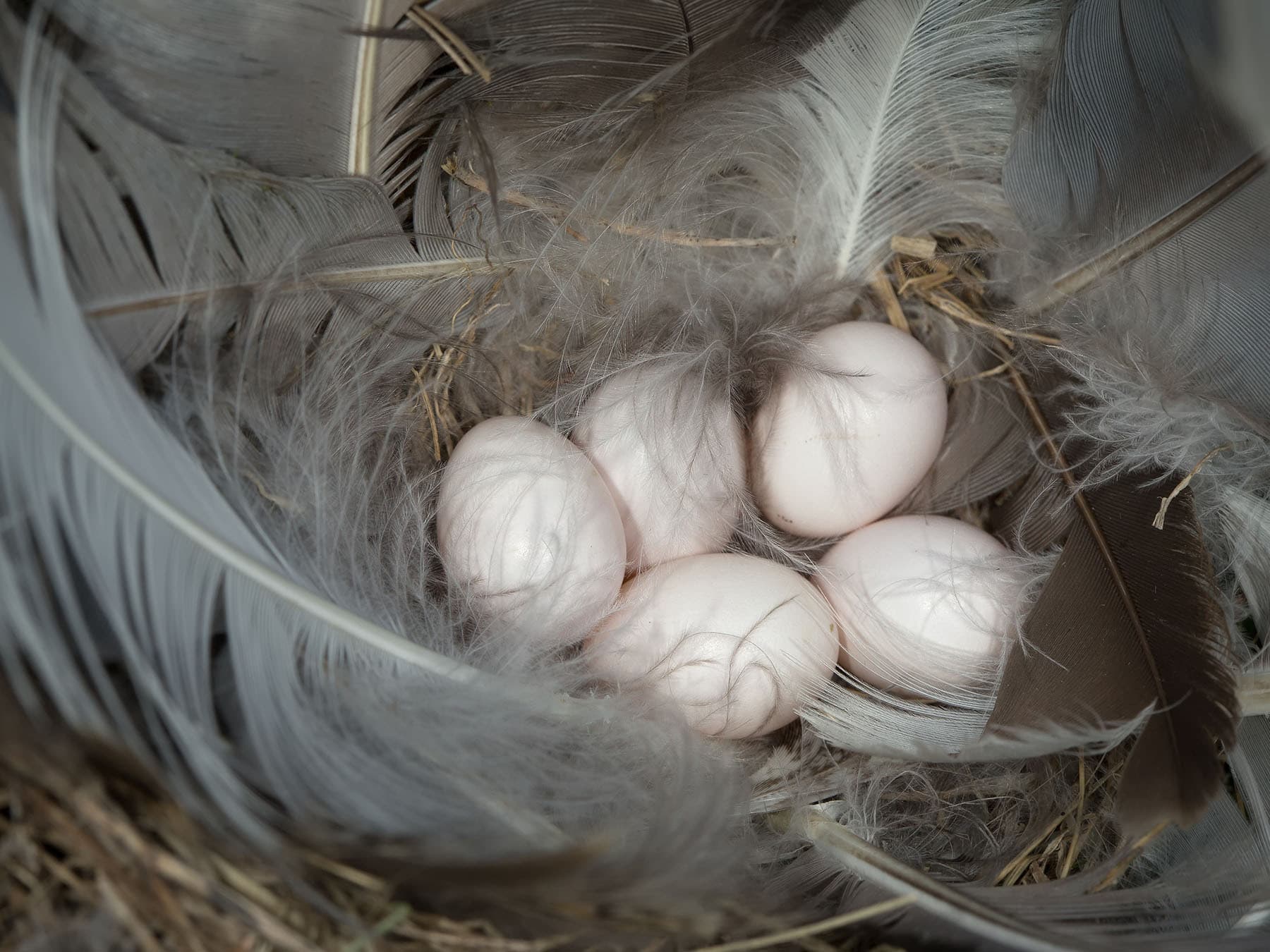
The female builds a cup of grass, sometimes with pine needles, moss or rootlets, gathered mostly within about 100 feet (30 m) of the site; building takes a few days to two weeks. Both sexes bring feathers of other birds for the lining, in some populations mostly the male, and most are added after laying begins. The feathers are tucked quill-down so their tips curl over the eggs.
The feathers matter: in experiments, nests with the feathers removed had longer incubation, slower-growing chicks and fewer fledglings.9, 10
Eggs and young
Laying runs mainly through May and June: from April in the South, with a median of 21 April in Tennessee, to June in Alaska (median 1 June). The New York median is 10 May.1 The female lays usually 4 to 7 eggs, from 1 to 9; across 28 populations, average clutches ran from 4.7 to 6.5 eggs, larger in the north.1 The eggs are pale rosy pink when laid, turning pure white after about four days of incubation, and are unmarked.
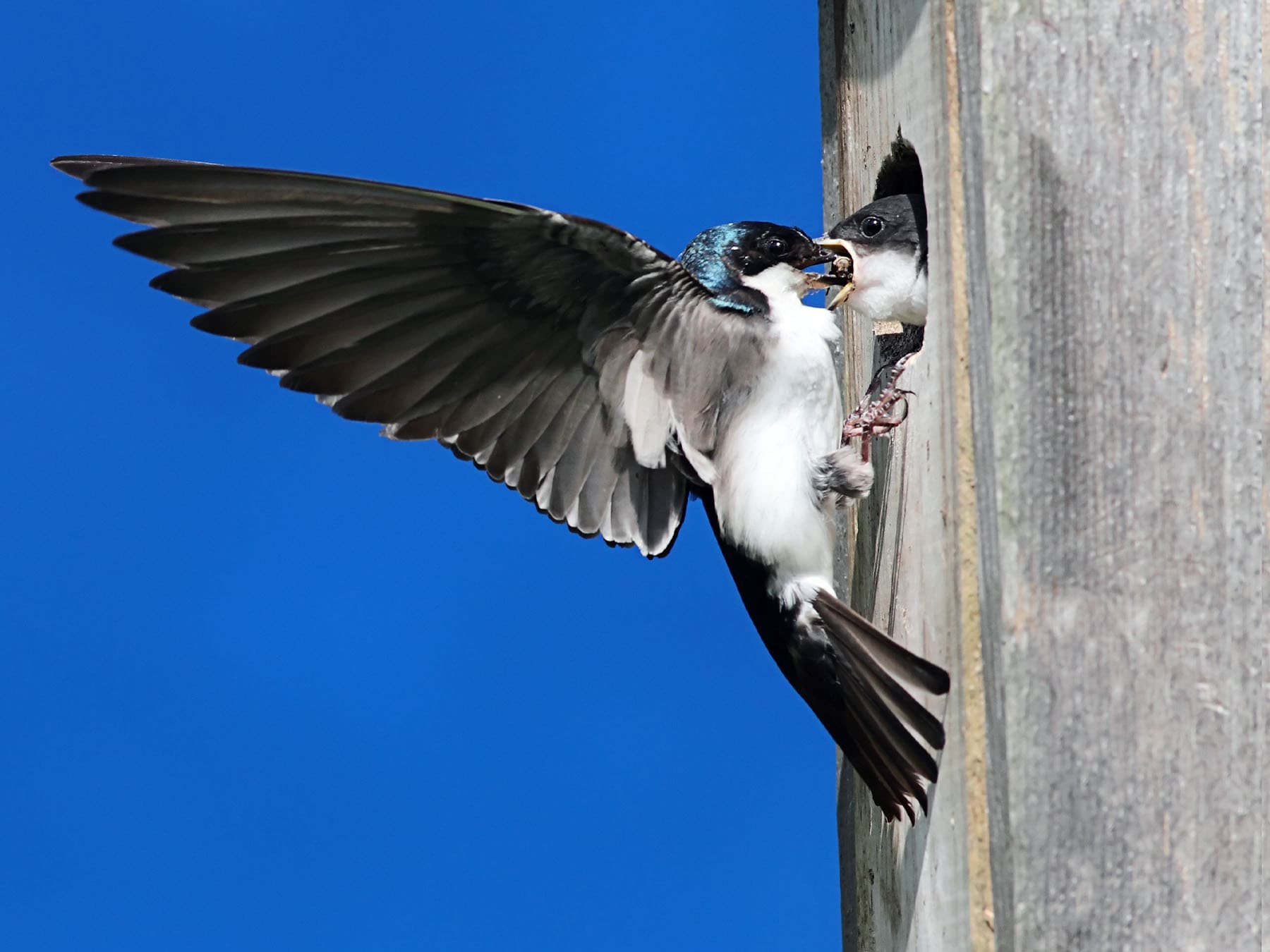
The female incubates for 11 to 20 days, usually 13 to 14. Both parents feed the young, and the female broods them while they are small. At peak demand a pair may bring 6,000 to 7,000 insects to the nest in a day.11 Nestlings reach about 0.8 ounce (22-24 g) at 12 to 14 days, heavier than a typical adult, then slim down to adult weight, about 0.7 ounce (20-21 g), before they leave.1 The young leave the nest at 15 to 25 days old, mostly 18 to 22, already flying well, and rarely return to it.
Most pairs raise one brood a year, but in some southern and western populations up to 5% raise a second,1 as in Virginia12 and California. A female that loses her eggs often lays again within 10 days. Both sexes can breed at one year old, but in some populations most yearling females do not breed, either because older birds take the nest sites or because they are less experienced. Brown-headed Cowbirds rarely lay in their nests: 1 of 3,624 Ontario nest records.1
Nest boxes
A nest box is the way to bring Tree Swallows to a yard or field near water. A good box has an entrance hole of 1 3/8 inches (35 mm), a floor of 5 1/2 x 5 1/2 inches (14 x 14 cm) and is 9 inches (23 cm) deep inside.13 Mount it on a pole 5 to 6 feet (1.5-1.8 m) up, facing south or east, in open grassy ground near water, with a predator guard on the pole. Space boxes about 35 feet (11 m) apart.
In tests with paired boxes, birds chose south-facing over north-facing boxes and a 6-inch (15 cm) floor over a 4-inch (10 cm) one, and showed no preference between 1 3/8 and 1 3/4 inch (3.5 and 4.4 cm) holes.14 A fledgling ladder (shallow grooves or hardware cloth inside, below the hole) helps the young climb out, and boxes too smooth inside may trap birds in early-spring cold. Clean the box after the young leave. Feathers put out nearby may be taken for the lining.
Tree Swallows readily take over bluebird boxes, and Eastern Bluebirds often hold their box against them. Put a second box about 20 to 25 feet (6-8 m) away so the bluebirds have their own.
Boxes help locally, but box trails have room for only about 2% of Tree Swallows (a 2010 estimate), far too few to make up for the natural tree holes lost over the last two centuries.1
Behaviour
Tree Swallows are highly social, especially outside the breeding season. Pairs often nest close together where boxes are plentiful, though most nests are at least 33 to 50 feet (10-15 m) apart. Tree Swallows can be aggressive at the nest: both sexes defend the nest hole and the space around it from other Tree Swallows, mostly of the same sex, and fights can be vicious: losers are sometimes injured or killed. They also compete hard for holes with House Wrens, House Sparrows, bluebirds and other cavity nesters.
Birds chase each other for feathers, and a bird carrying one may drop it again and again high in the air, drawing others to chase it; these chases may be partly play. Near the nest they swarm and dive-bomb predators with alarm calls, without striking them. In cold weather they huddle in tight clusters, sometimes inside cavities, and bask in the sun with wings slightly spread.
Pairs raise their young together, but by 2011 extra-pair paternity in Tree Swallows was among the highest recorded in songbirds,1 with most of the evidence from Ontario and Wisconsin. In some populations almost 90% of nests hold at least one chick fathered by a male other than the one feeding it.15, 16
Flight and roosts
Tree Swallows are agile fliers that glide more than many other swallows; breeding adults fly at up to about 16 to 22 mph (7-10 m a second).1 They drink and bathe in flight, dipping to the water's surface, and catch raindrops on their heads while perched.
In fall and winter they roost in reed and cane beds, often hundreds of thousands together. They gather in the hour after sunset, circle in a dense cloud about 330 feet (100 m) up, then pour down into the marsh in a swirling funnel, and they leave in a rush a few minutes before sunrise.17 Weather radar shows roosts spaced about 60 to 90 miles (100-150 km) apart across the continent, and the birds may migrate by hopping from roost to roost. In winter they fan out from the roost each morning to feed and come back to it in the evening.
Lifespan and predators
The oldest Tree Swallow on the US Bird Banding Laboratory's longevity list was at least 12 years and 1 month old: banded as a nestling in Ontario in 1986, it was caught and released there in 1998.18 Most live far shorter lives. A life table gives an average life span of 2.7 years, with about 20% of young surviving their first year,6 and about 40 to 50% of adults survive each year.1
Cold snaps soon after they arrive can kill many adults, and cold rain starves nestlings. In a New York cold-weather die-off of 216 birds, up to 15 were found dead in one box,19 and in Alberta a June cold snap with heavy rain coincided with the death of 48% of nestlings.20
Predators
Eggs and young are taken by raccoons, cats, weasels, chipmunks, mice, black bears and rat snakes, and by birds such as Northern Flickers, Common Grackles, American Crows and American Kestrels. Adults, in the air or perched, fall to Merlins, Peregrine Falcons, American Kestrels and Sharp-shinned Hawks, and Great Horned Owls and Black-billed Magpies also catch them.
Predator guards make a big difference at boxes. In Ontario, up to 70% of nests failed in natural cavities and 77% in boxes without guards, with predators causing 19 to 54% of the failures; once guards went on, predation all but stopped.21 Of 293 banded birds found dead with a known cause, 20.5% were killed by other birds and 18.4% by traffic or collisions.6
Conservation
The Tree Swallow is listed as Least Concern on the IUCN Red List and is still common: Partners in Flight puts it at about 19 million birds (an estimate for about 2006-2015) and gives it a Continental Concern Score of 10 out of 20 (2023), with its population trend the highest-scoring factor.22
It is declining. Across the North American Breeding Bird Survey, numbers fell 0.90% a year from 1966 to 2025, about 41% in all; the index peaked in 1982 and is still falling, about 21% down since 2015.23 In the United States alone the 1966-2025 trend is flat: the US index rose to a peak in 2000, while the bird spread south, and has fallen about 40% since. Over 1966-2025 numbers rose in Tennessee, Virginia, North Carolina and Maryland and fell in Canada, New England and New York (Maine about 3.7% a year, Ontario 2.3%); since about 2015 they have fallen in most of these places too.23
The causes are not fully known. By 2011 the declines were greatest where it was most common and, in eastern Canada, were part of a wider decline of birds that feed on flying insects. Loss of nest sites has played a part. The birds also face wetland loss and contaminants such as mercury and PCBs, picked up from aquatic insects, and in the West dead snags are one of the most consistent predictors of how many breed in an area. Its laying date moved up to nine days earlier across North America between 1959 and 1991, in step with warmer springs,24 though one later Ontario study questioned how general this is.
Similar birds
Often mistaken for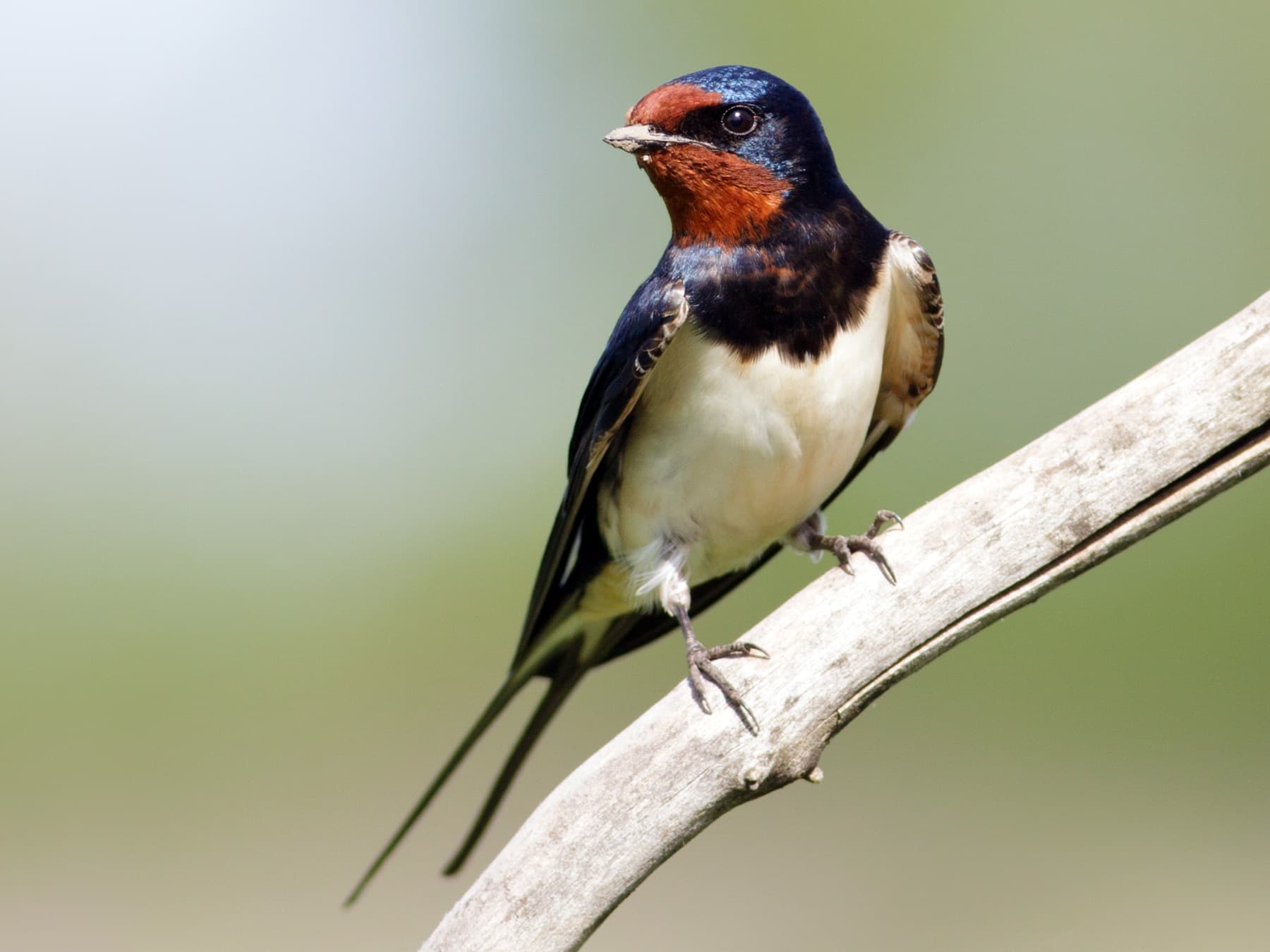
Quick facts
- Length
- 12–15 cm
- Wingspan
- 30–35 cm
- Weight
- 16–25 g
- Lifespan
- oldest recorded at least 12 years 1 month
- Family
- Swallows & Martins
- Migration
- Long-distance Migrant
- Global status (IUCN)
- Least Concern
- World population
- About 19 million (Partners in Flight 2023 assessment)
- Population trend
- Common but declining, especially in the north
- Scientific name
- Tachycineta bicolor
Questions
4Do Tree Swallows mate for life?
Do Tree Swallows come back to the same nest?
Often to the same area, and sometimes to the same box. As many as 96% of surviving adults come back to breed in the same area, and in New York 95% of surviving females that bred successfully came back to the same breeding site.26 In Colorado, 66% of returning males that had nested successfully used the same box, but only 33% of returning females.1
Are Tree Swallows rare?
No. They are a common, widespread native bird of North America, though numbers have fallen since the early 1980s. See conservation status.
Why is it called a Tree Swallow?
For nesting in tree holes, though it is mostly seen over open fields, marshes and water.
Sources
36- 1Winkler, D. W. et al. (2020). Tree Swallow (Tachycineta bicolor), version 1.0. Birds of the World (A. F. Poole, editor). Cornell Lab of Ornithology. doi:10.2173/bow.treswa.01 (opens in a new tab)
- 2Cornell Lab of Ornithology. Tree Swallow. All About Birds. Accessed 2 November 2026. Source (opens in a new tab)
- 3Sharman, M. Y., Robertson, R. J. and Ratcliffe, L. M. (1994). Vocalizations of the Tree Swallow (Tachycineta bicolor) during the prelaying period: a structural and contextual analysis. American Midland Naturalist 132: 264-274. doi:10.2307/2426582 (opens in a new tab)
- 4Horn, A. G. (1996). Dawn song repertoires of Tree Swallows (Tachycineta bicolor). Canadian Journal of Zoology 74: 1084-1091. doi:10.1139/z96-120 (opens in a new tab)
- 5Weydemeyer, W. (1973). The spring migration pattern at Fortine, Montana. Condor 75: 400-413. doi:10.2307/1366562 (opens in a new tab)
- 6Butler, R. W. (1988). Population dynamics and migration routes of Tree Swallows, Tachycineta bicolor, in North America. Journal of Field Ornithology 59: 395-402. Accessed 2 November 2026.
- 7Beal, F. E. L. (1918). Food habits of the swallows, a family of valuable native birds. Bulletin of the U.S. Department of Agriculture 619. Accessed 2 November 2026.
- 8Hausman, L. A. (1927). On the winter food of the Tree Swallow (Iridoprocne bicolor) and the Myrtle Warbler (Dendroica coronata). American Naturalist 61: 379-382. doi:10.1086/280160 (opens in a new tab)
- 9Winkler, D. W. (1993). Use and importance of feathers as nest lining in Tree Swallows (Tachycineta bicolor). Auk 110: 29-36. Accessed 2 November 2026.
- 10Lombardo, M. P. et al. (1995). Effect of feathers as nest insulation on incubation behavior and reproductive performance of Tree Swallows (Tachycineta bicolor). Auk 112: 973-981. doi:10.2307/4089028 (opens in a new tab)
- 11McCarty, J. P. (1995). PhD dissertation. Cornell University, Ithaca, NY. Accessed 2 November 2026.
- 12Monroe, A. P., Hallinger, K. K., Brasso, R. L. and Cristol, D. A. (2008). Occurrence and implications of double brooding in a southern population of Tree Swallows. Condor 110: 382-386. doi:10.1525/cond.2008.8341 (opens in a new tab)
- 13NestWatch, Cornell Lab of Ornithology. Right Bird, Right House: Tree Swallow. NestWatch. Accessed 2 November 2026. Source (opens in a new tab)
- 14Lumsden, H. G. (1986). Choice of nest boxes by Tree Swallows, Tachycineta bicolor, House Wrens, Troglodytes aedon, Eastern Bluebirds, Sialia sialis, and European Starlings, Sturnus vulgaris. Canadian Field-Naturalist 100: 343-349. doi:10.5962/p.355646 (opens in a new tab)
- 15Lifjeld, J. T., Dunn, P. O., Robertson, R. J. and Boag, P. T. (1993). Extra-pair paternity in monogamous Tree Swallows. Animal Behaviour 45: 213-229. doi:10.1006/anbe.1993.1028 (opens in a new tab)
- 16Dunn, P. O., Robertson, R. J., Michaud-Freeman, D. and Boag, P. T. (1994). Extra-pair paternity in Tree Swallows: why do females mate with more than one male?. Behavioral Ecology and Sociobiology 35: 273-281. doi:10.1007/BF00170708 (opens in a new tab)
- 17Winkler, D. W. (2006). Roosts and migrations of swallows. Hornero 21: 85-97. doi:10.56178/eh.v21i2.790 (opens in a new tab)
- 18USGS Bird Banding Laboratory. Longevity records of North American birds. USGS Eastern Ecological Science Center, Bird Banding Laboratory. Accessed 2 November 2026. Source (opens in a new tab)
- 19Hess, P. J., Zenger, C. G. and Schmidt, R. A. (2008). Weather-related Tree Swallow mortality and reduced nesting effort. Northeastern Naturalist 15: 630-631. doi:10.1656/1092-6194-15.4.630 (opens in a new tab)
- 20Gentes, M. L., Waldner, C., Papp, Z. and Smits, J. E. G. (2006). Effects of oil sands tailings compounds and harsh weather on mortality rates, growth and detoxification efforts in nestling Tree Swallows (Tachycineta bicolor). Environmental Pollution 142: 24-33. doi:10.1016/j.envpol.2005.09.013 (opens in a new tab)
- 21Robertson, R. J. and Rendell, W. B. (1990). A comparison of the breeding ecology of a secondary cavity nesting bird, the Tree Swallow (Tachycineta bicolor), in nest boxes and natural cavities. Canadian Journal of Zoology 68: 1046-1052. doi:10.1139/z90-152 (opens in a new tab)
- 22Partners in Flight (2023). Avian Conservation Assessment Database and Population Estimates Database. Bird Conservancy of the Rockies. Accessed 2 November 2026. Source (opens in a new tab)
- 23Hostetler, J. A. et al. (2026). The North American Breeding Bird Survey, Analysis Results 1966-2025. U.S. Geological Survey data release. doi:10.5066/P1OSNSFC (opens in a new tab)
- 24Dunn, P. O. and Winkler, D. W. (1999). Climate change has affected the breeding date of Tree Swallows throughout North America. Proceedings of the Royal Society of London B 266: 2487-2490. doi:10.1098/rspb.1999.0950 (opens in a new tab)
- 25Llambías, P. E., Wrege, P. and Winkler, D. W. (2008). Effects of site fidelity and breeding performance on mate retention in a short-lived passerine, the Tree Swallow Tachycineta bicolor. Journal of Avian Biology 39: 493-499. doi:10.1111/j.0908-8857.2008.04274.x (opens in a new tab)
- 26Winkler, D. W., Wrege, P. H., Allen, P. E. et al. (2004). Breeding dispersal and philopatry in the Tree Swallow. Condor 106: 768-776. doi:10.1093/condor/106.4.768 (opens in a new tab)
- 27National Audubon Society. Tree Swallow. Guide to North American Birds. Accessed 2 November 2026. Source (opens in a new tab)
- 28National Audubon Society. Barn Swallow. Guide to North American Birds. Accessed 2 November 2026. Source (opens in a new tab)
- 29National Audubon Society. Violet-green Swallow. Guide to North American Birds. Accessed 2 November 2026. Source (opens in a new tab)
- 30National Audubon Society. Bank Swallow. Guide to North American Birds. Accessed 2 November 2026. Source (opens in a new tab)
- 31National Audubon Society. Northern Rough-winged Swallow. Guide to North American Birds. Accessed 2 November 2026. Source (opens in a new tab)
- 32National Audubon Society. Purple Martin. Guide to North American Birds. Accessed 2 November 2026. Source (opens in a new tab)
- 33National Audubon Society. Eastern Bluebird. Guide to North American Birds. Accessed 2 November 2026. Source (opens in a new tab)
- 34Place, A. R. and Stiles, E. W. (1992). Living off the wax of the land: bayberries and Yellow-rumped Warblers. Auk 109: 334-345. doi:10.2307/4088202 (opens in a new tab)
- 35Jones, J. (2003). Tree Swallows (Tachycineta bicolor): a new model organism?. Auk 120: 591-599. doi:10.1642/0004-8038(2003)120[0591:TSTBAN]2.0.CO;2 (opens in a new tab)
- 36AviList Core Team (2025). AviList: The Global Avian Checklist, v2025. data/reference/avilist.csv. Accessed 2 November 2026. Source (opens in a new tab)

Checked by
Nathan Cope, founder and editor
Nathan founded Birdfact and leads its writers and contributors in the UK, the US and Canada. He has watched and studied birds for more than ten years, and checks every article and species guide before it’s published.