
Stonechat
European Stonechat · Saxicola rubicola
By the Birdfact teamChecked by Nathan Cope
On this page14 sections
How to recognise it
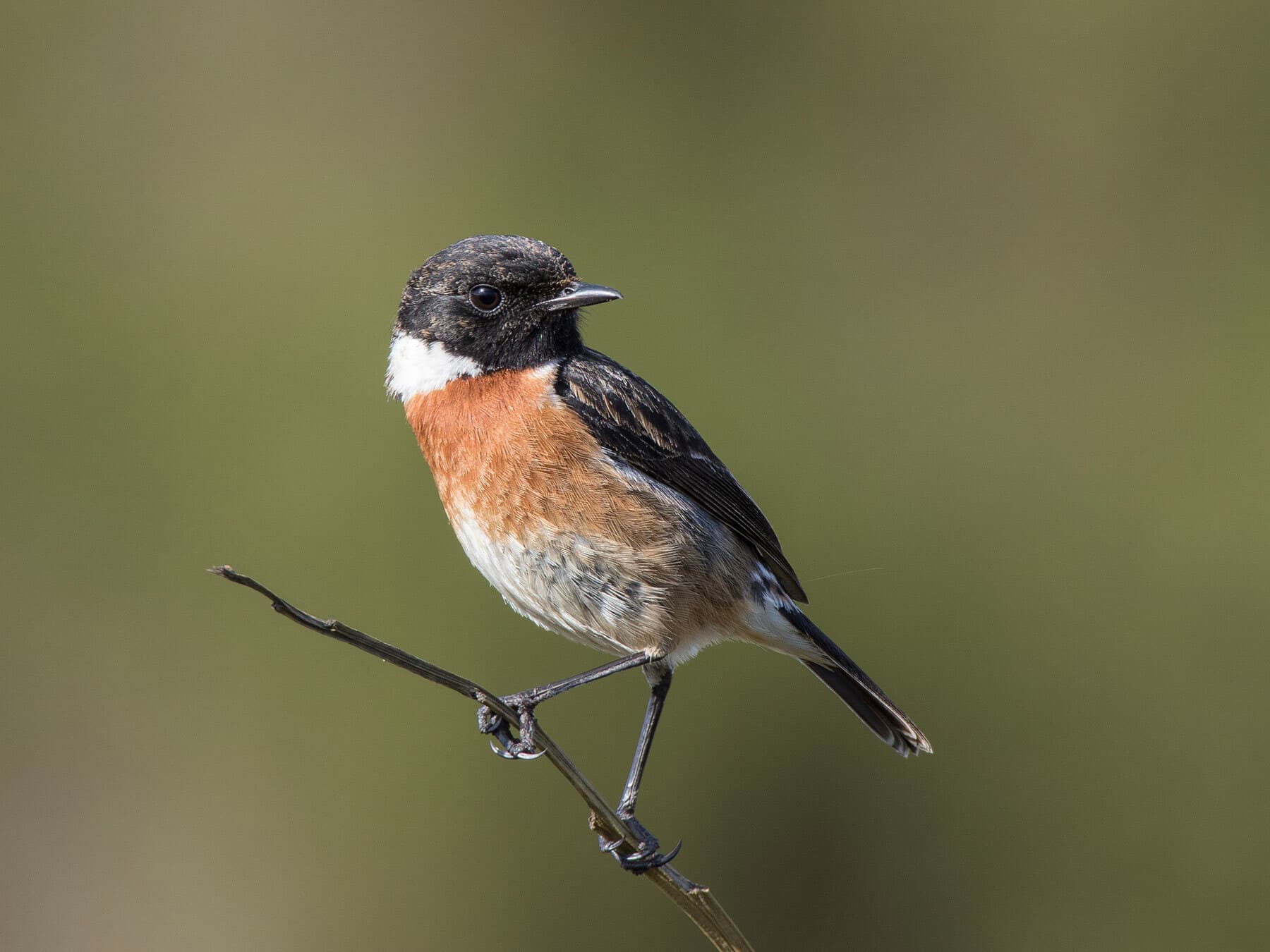
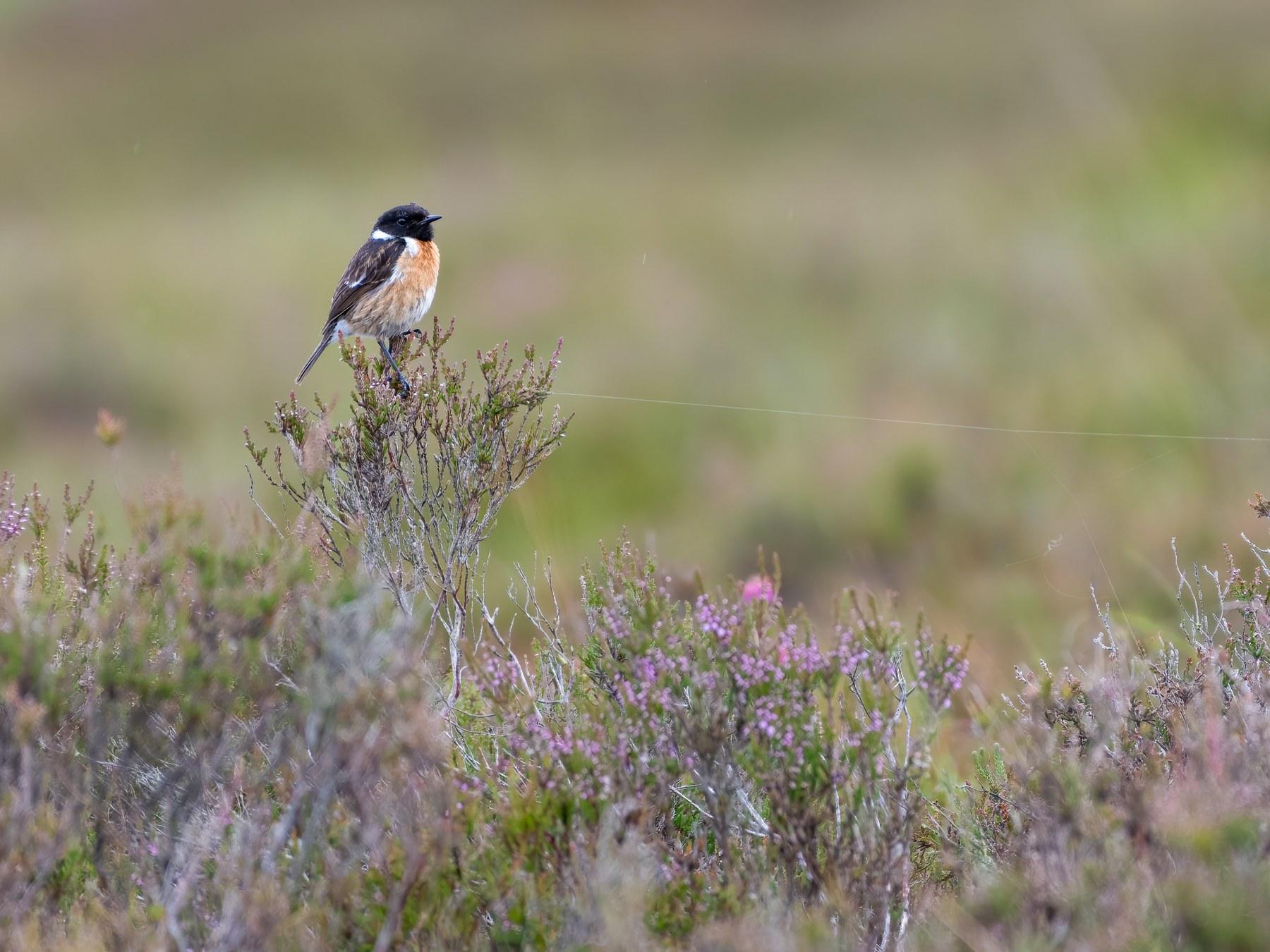
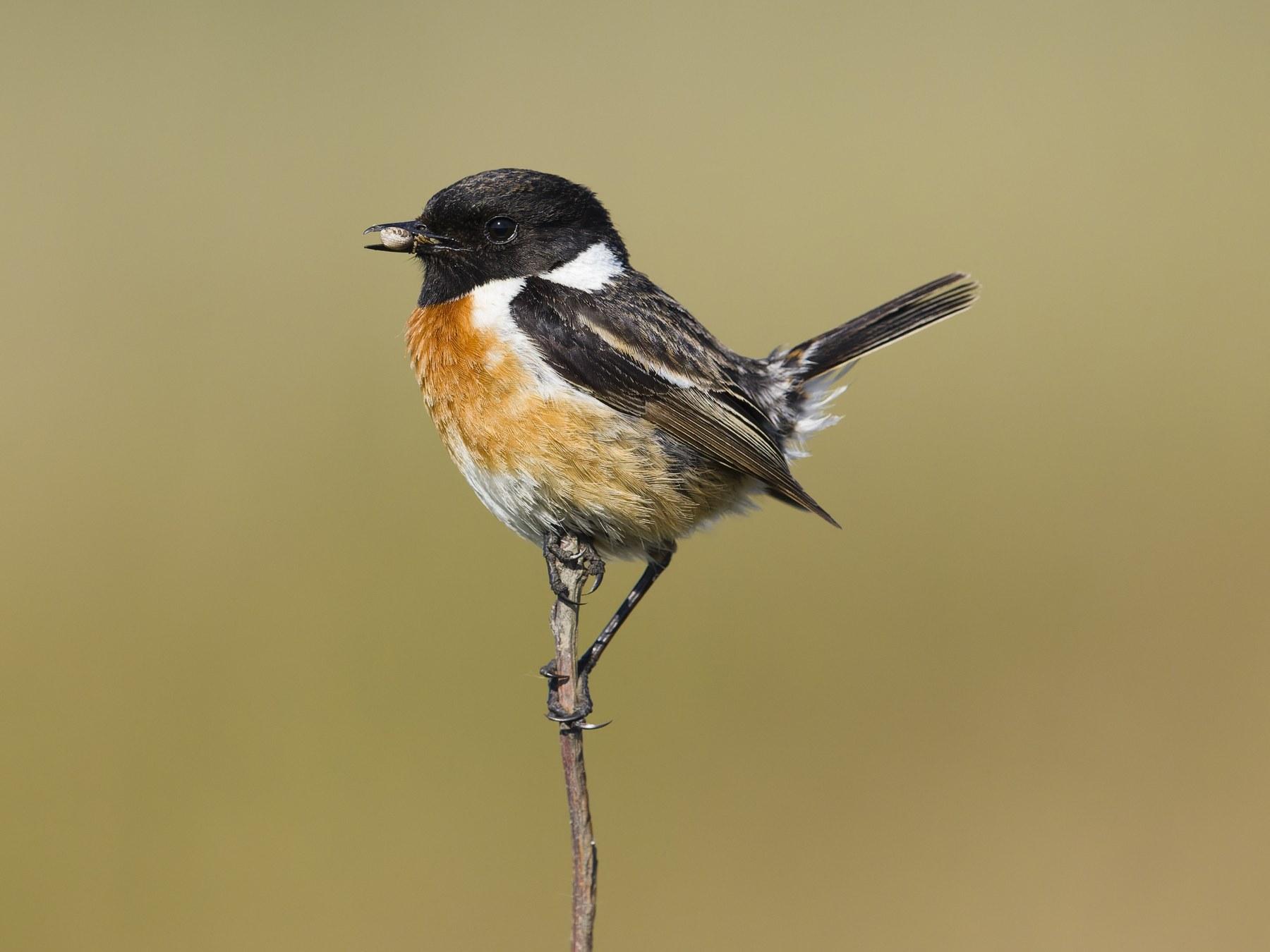
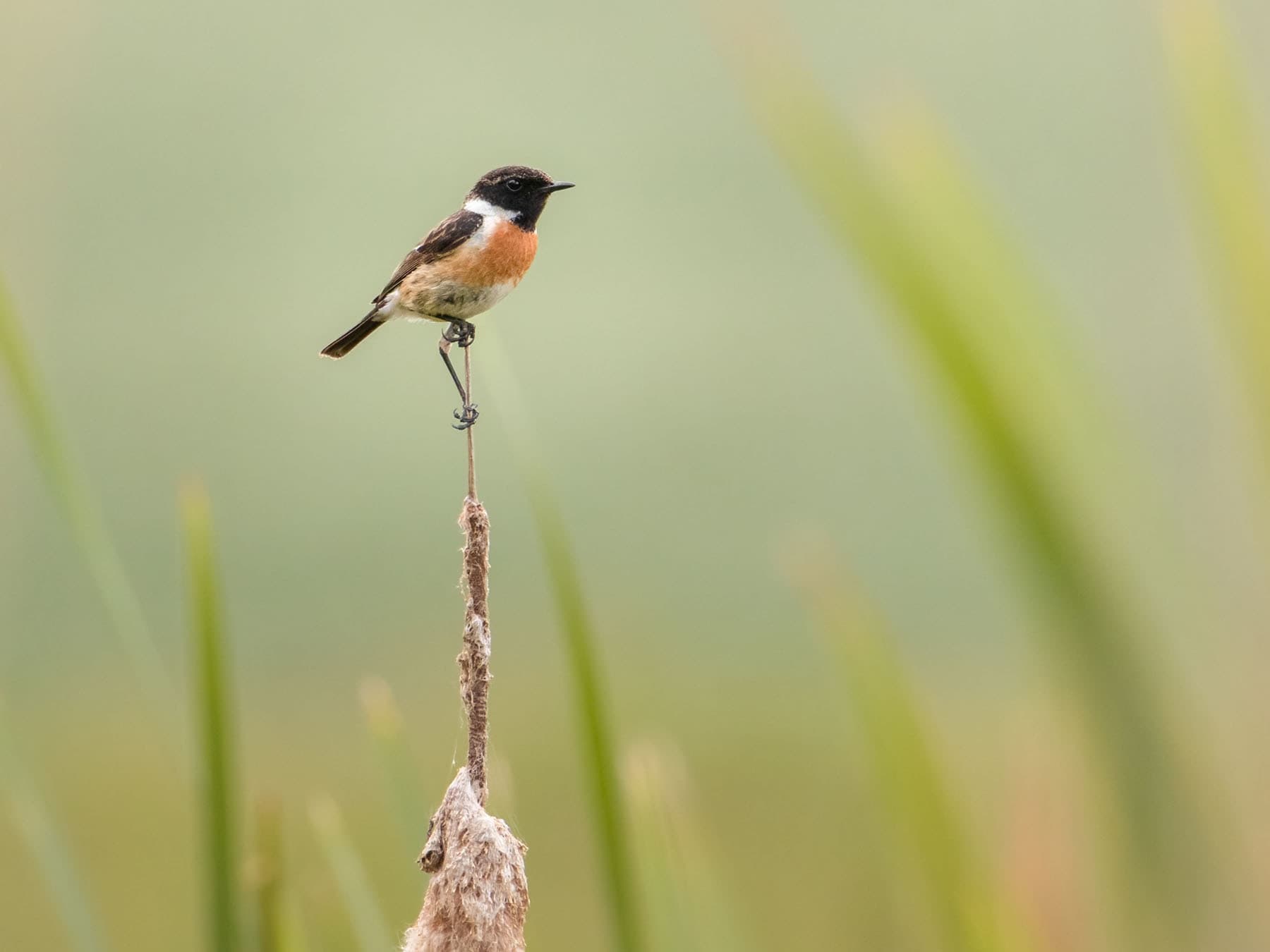
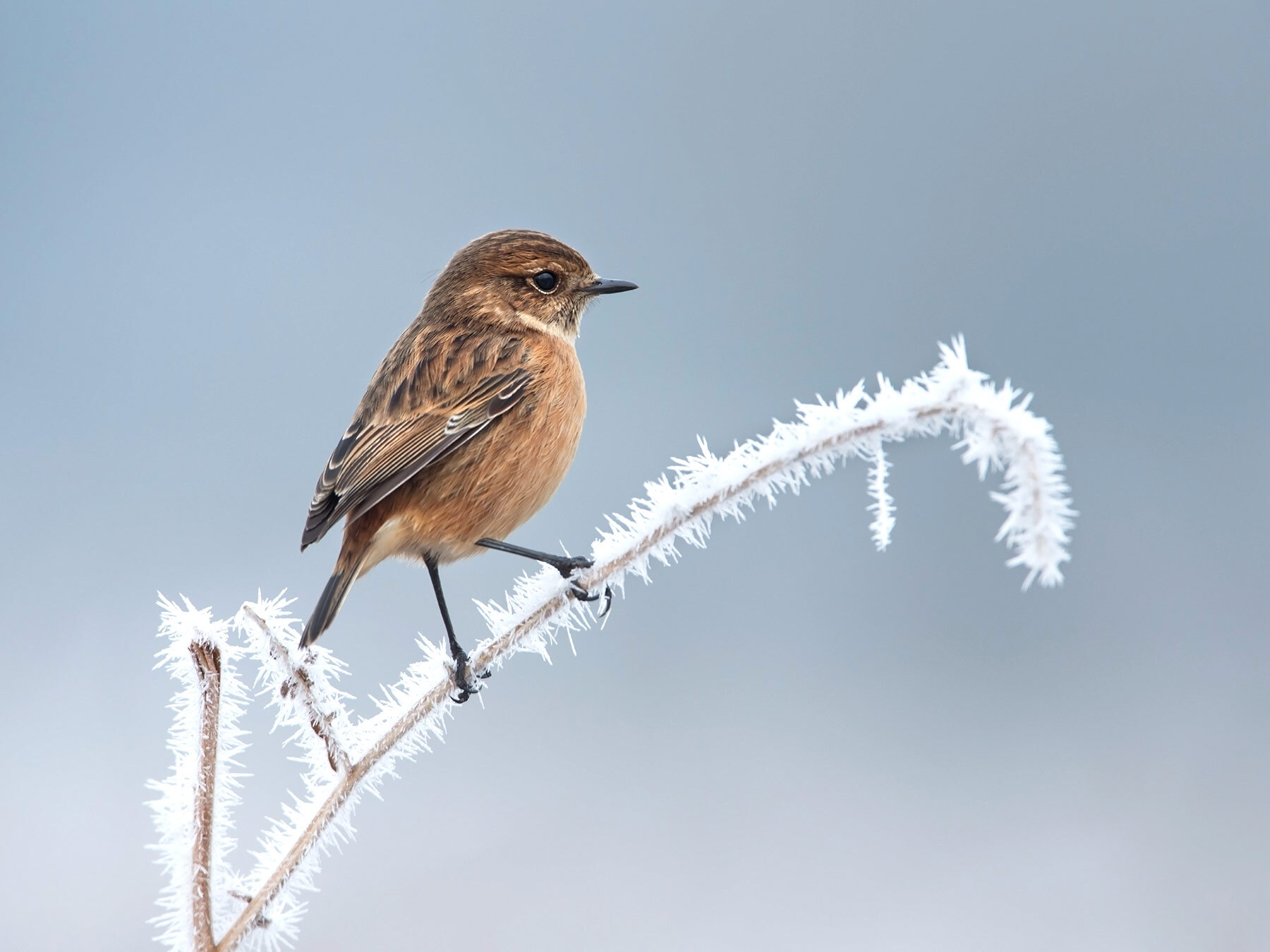
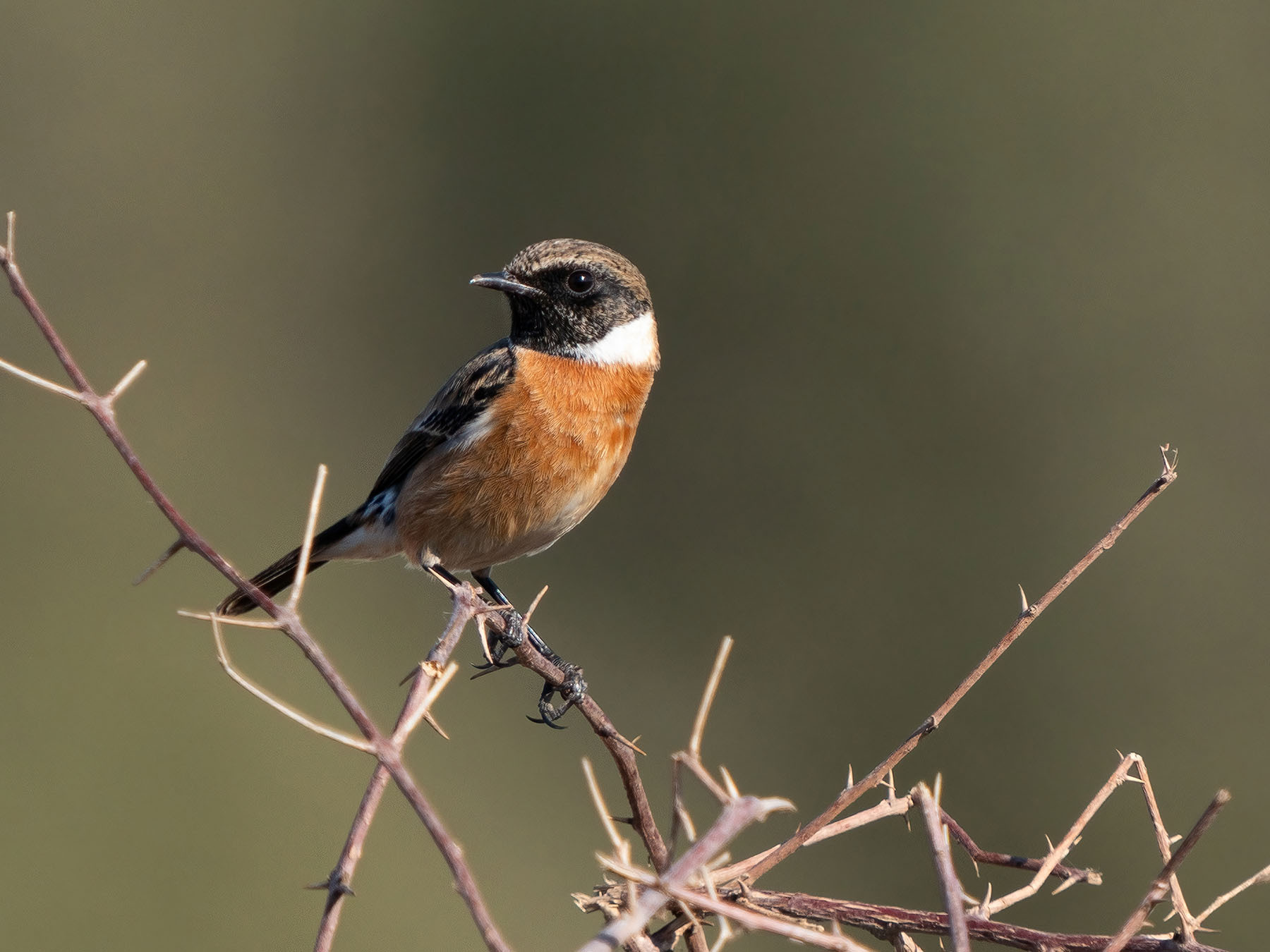
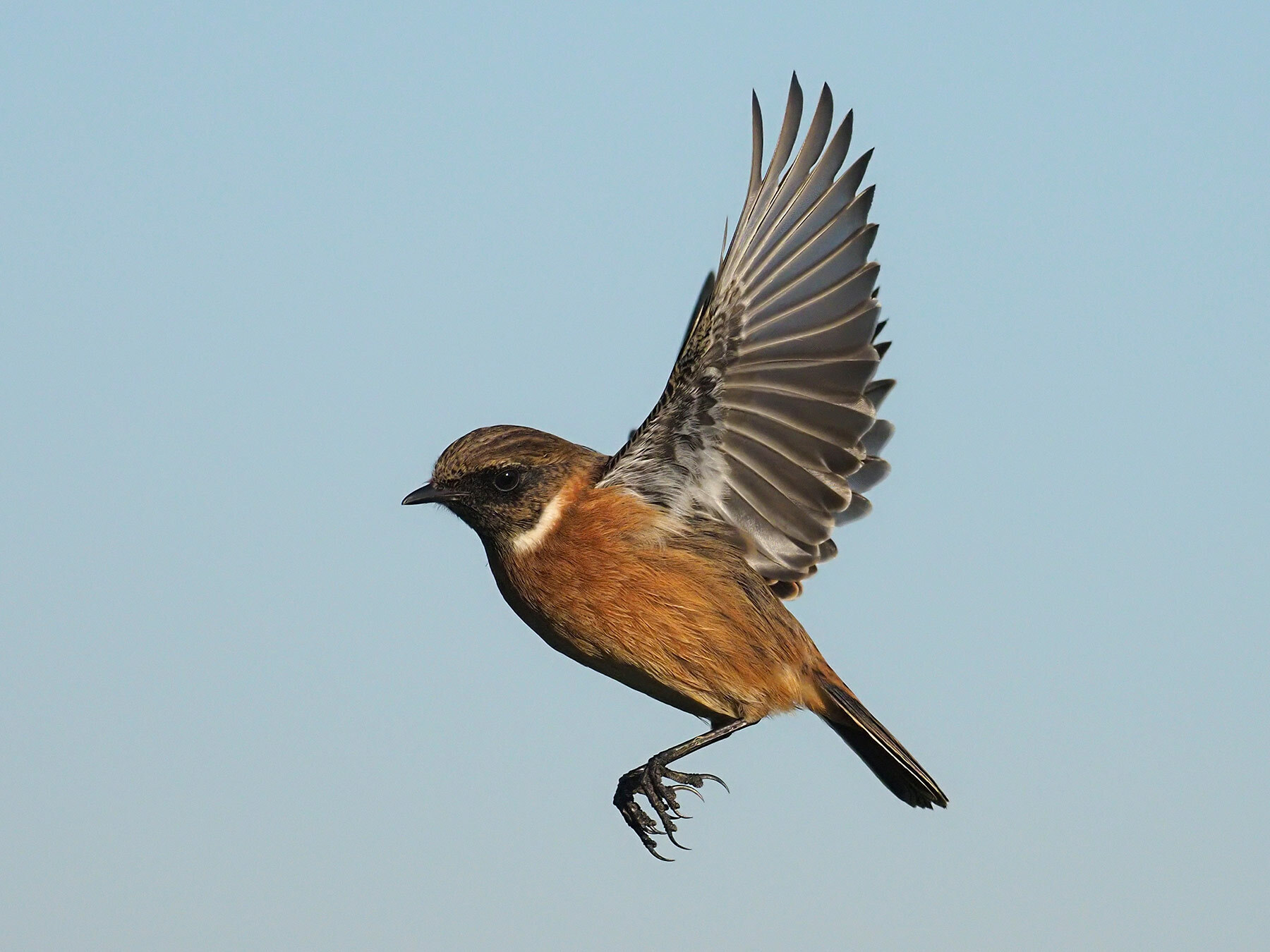
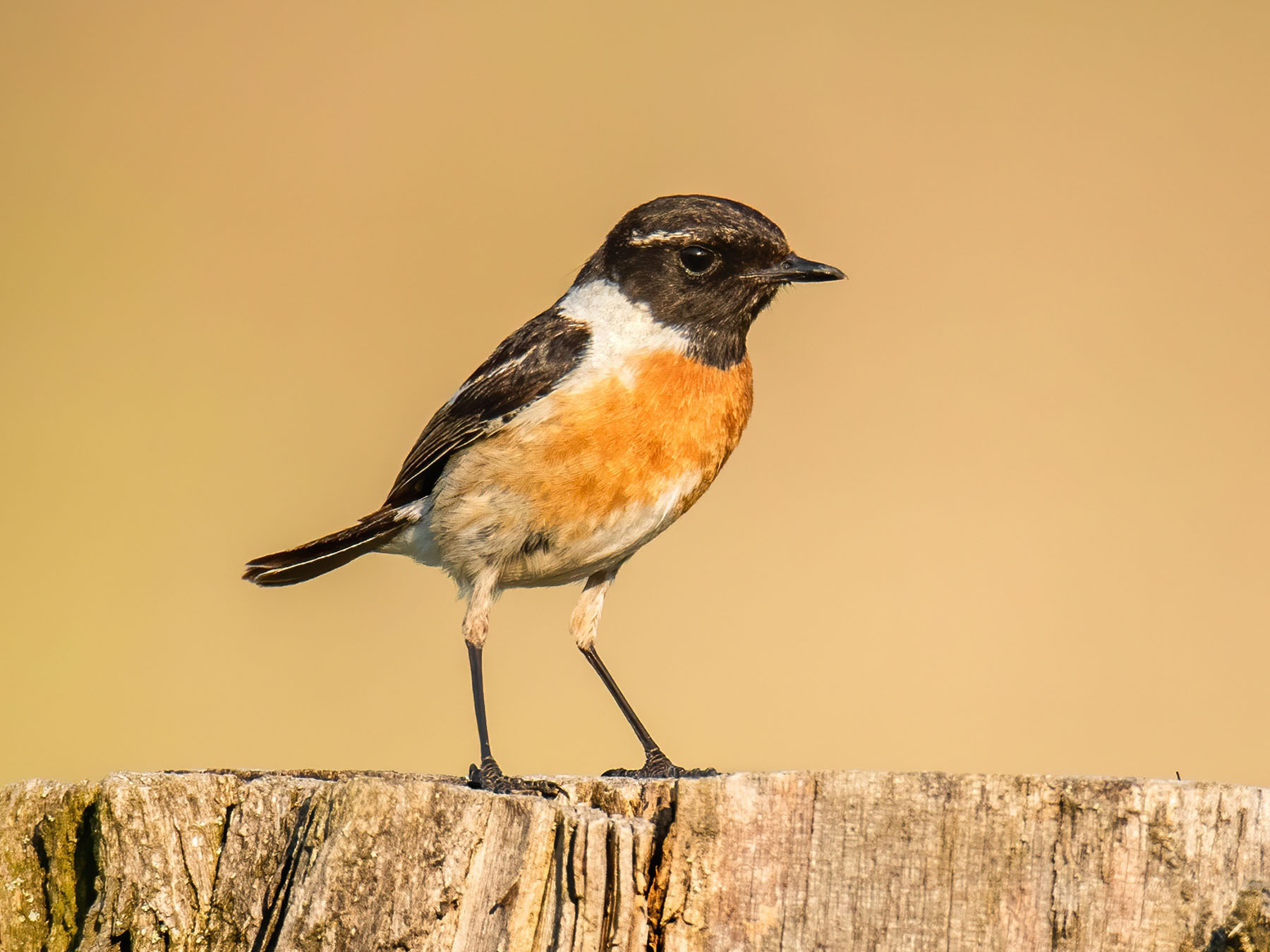
The Stonechat, also called the European Stonechat, is a small, strikingly marked chat about the size of a Robin, found in Britain and Ireland all year. It is easiest to see perched on the top of a gorse bush, a fence post or a tall stem on heaths and rough ground near the coast, often flicking its wings. The breeding male has a black head, white neck patches and an orange-red breast; females lack the black head and are browner overall.
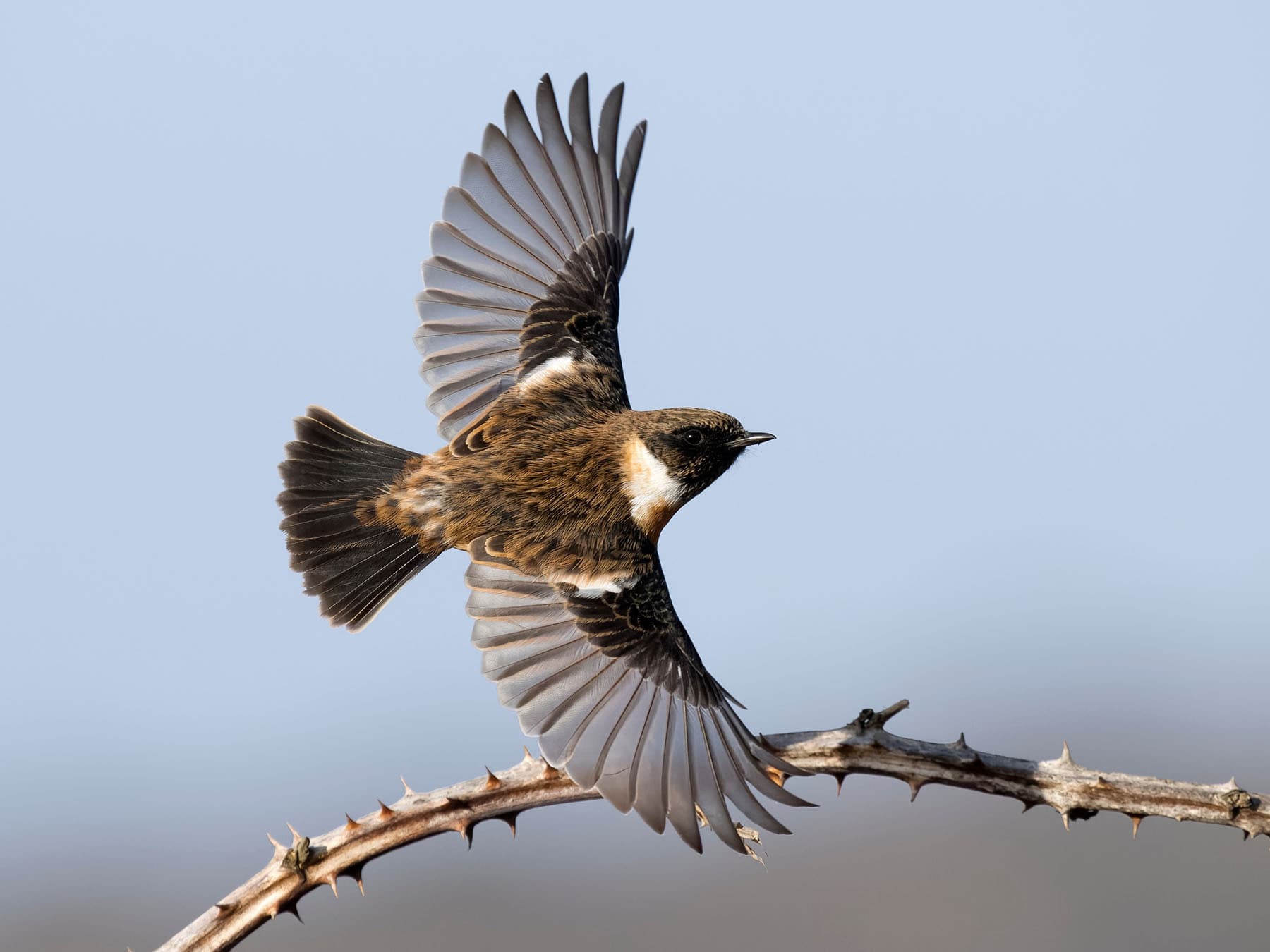
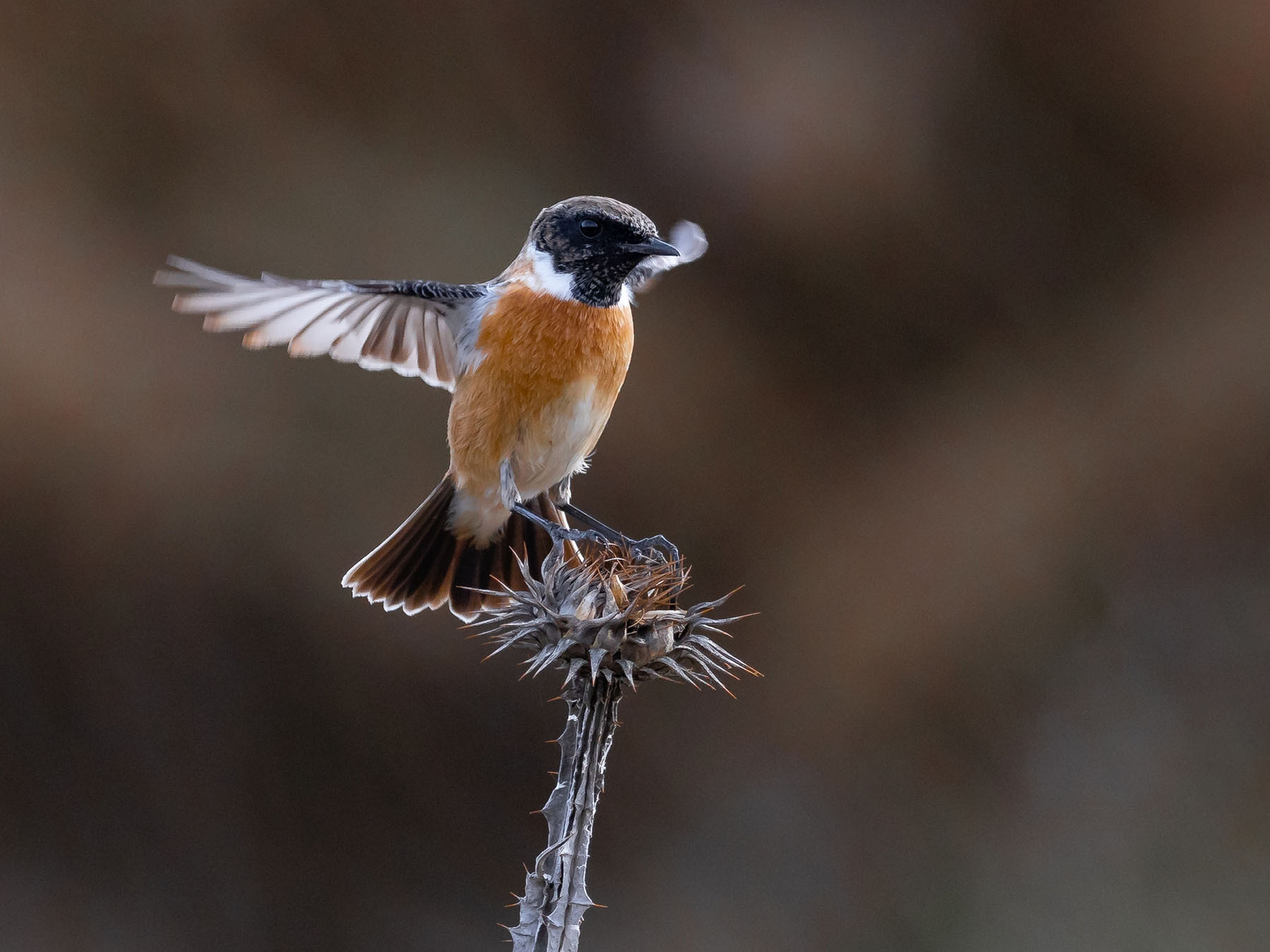
Look too for a small white patch on the wing, easiest to see in flight. Birds in Britain and Ireland belong to the race hibernans, which is a little darker than mainland birds, with a smaller white neck patch and a less white rump. Even mainland males show only a small, mostly dark-streaked whitish rump.
Male, female and young
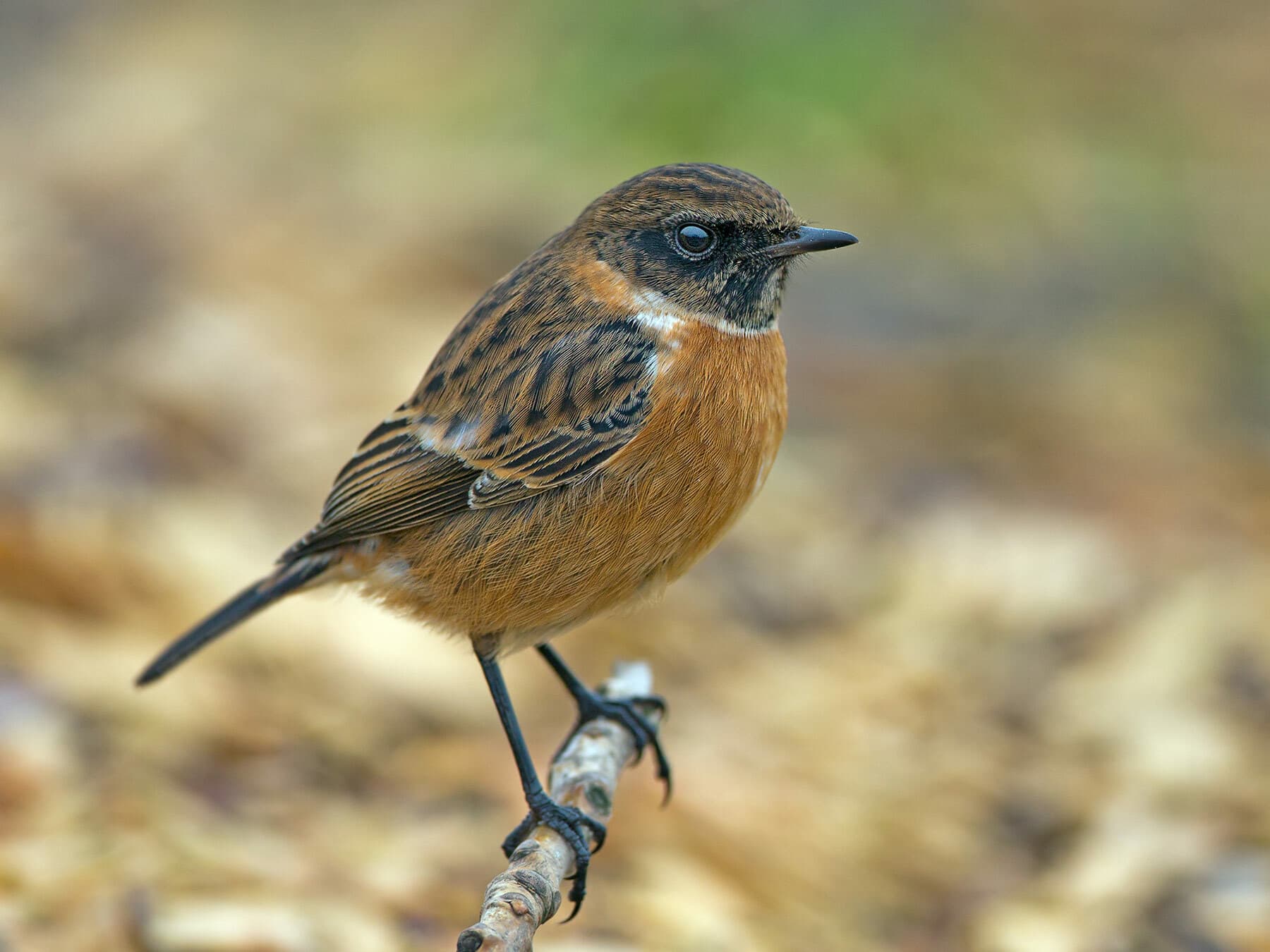
Up close, the breeding male's black head and throat are set off by a white half-collar on each side of the neck and an orange-red breast that fades to a paler belly. He also has a dark, mottled brown and black back, a black tail and a black bill. Rarely, a male shows a thin white stripe over the eye, never as broad as a Whinchat's. Outside the breeding season males look more subdued.
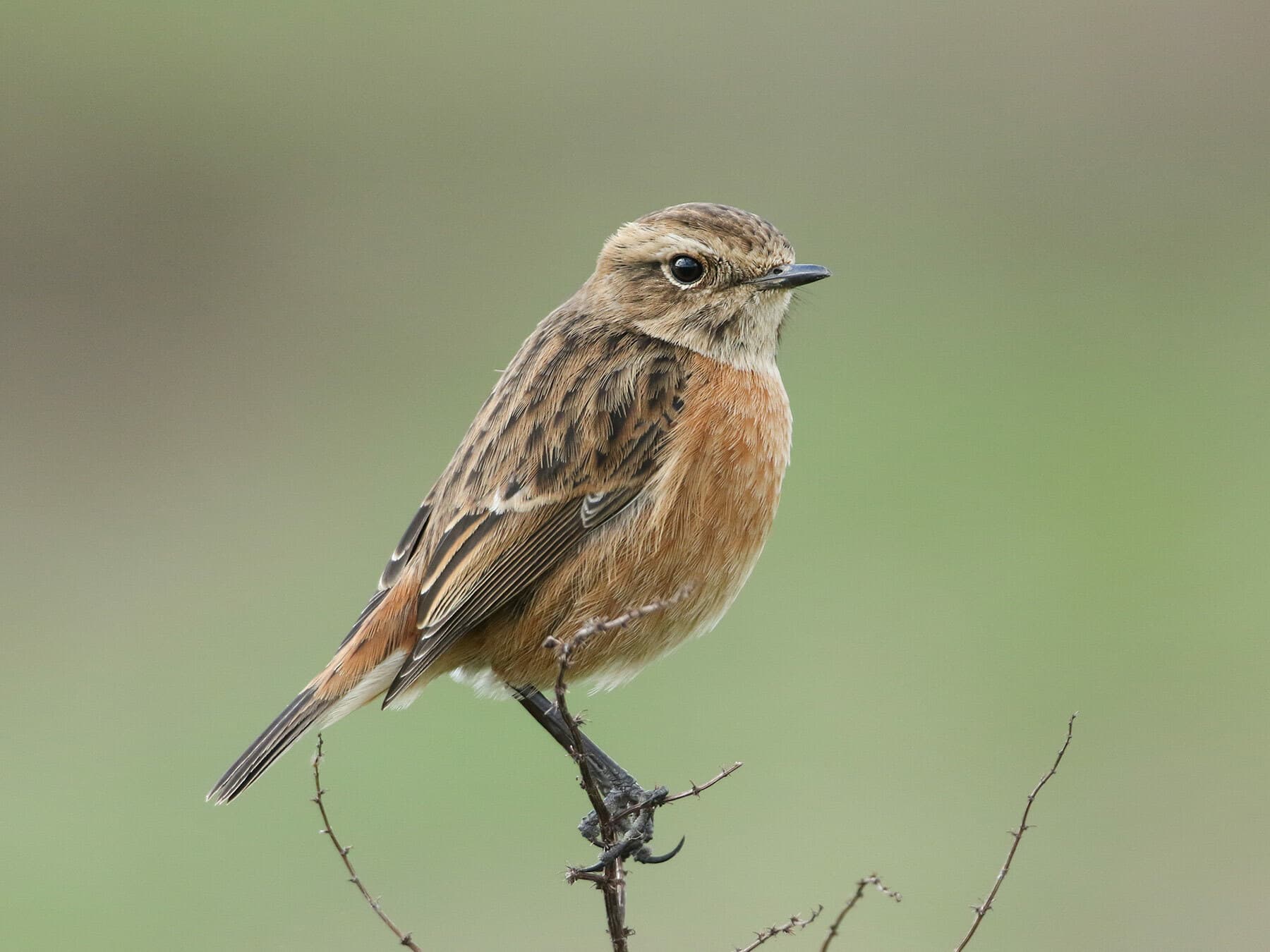
The female has no black on the head. Her head and back are brown and streaked, the pale patch on the side of the neck is less obvious, a faint pale stripe runs over the eye and the breast has an orange tinge. First-winter birds look like a pale adult female, with a beige-brown head.
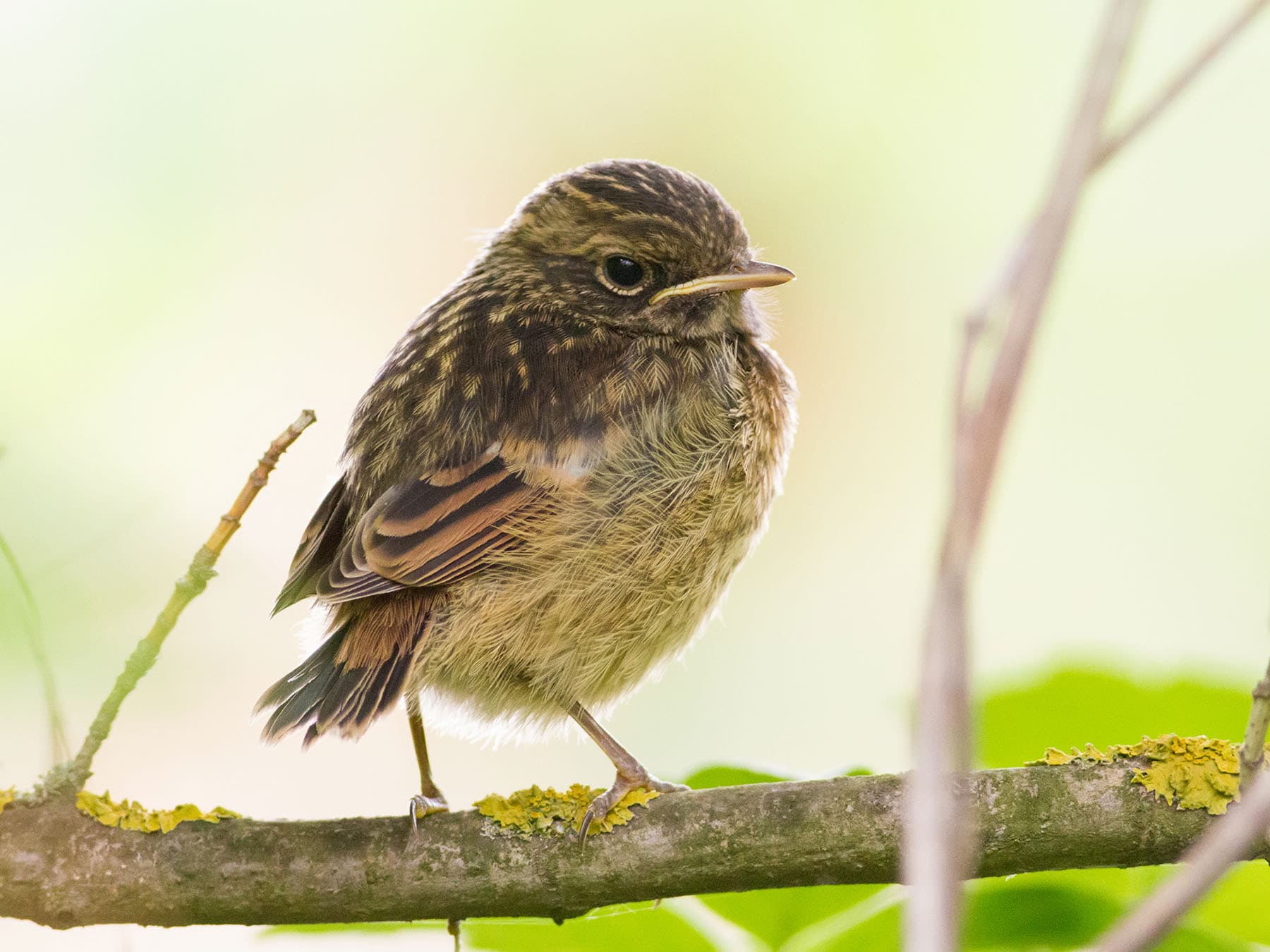
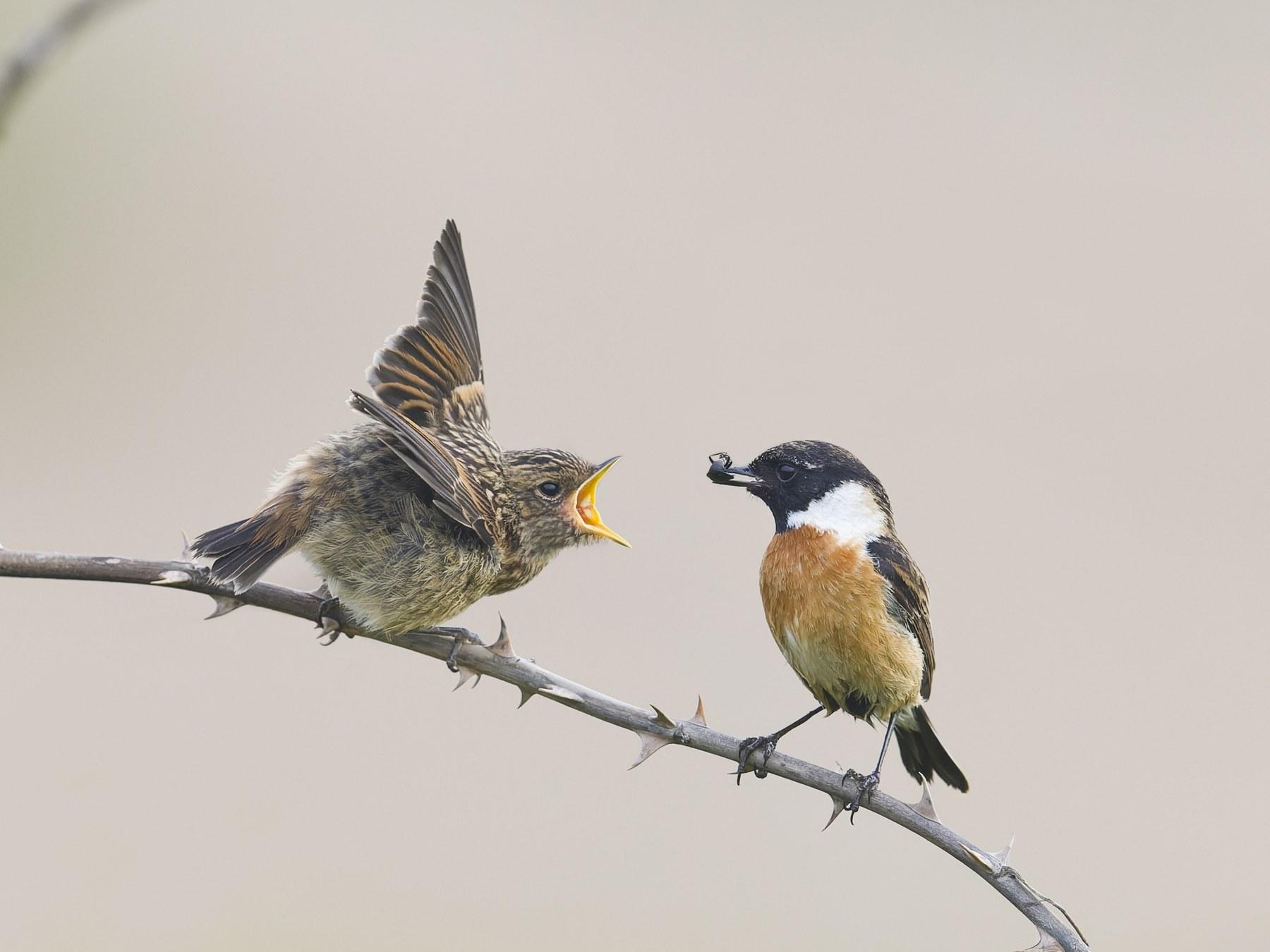
Juveniles, this year's young, are streaked all over, and BirdWatch Ireland describes them as rather grey with fine black streaks.1 The Birds of the World account (2013 text), written for the old, wider species, describes a browner young bird: dark brown above with buff streaks and a buff stripe over the eye, buffy below with dark streaks on the breast and flanks, a buffish rump and a small white wing patch.2
The white wing patch varies with age and sex. In a Spanish population of mainland birds followed from 2007 to 2012, males had bigger white wing patches than females at every age, and first-year birds had smaller ones than older birds, especially among males. The patch changed little from the moult to the breeding season, then shrank sharply.3
Size and weight
The Stonechat is about 12.5 cm (5 in) long, with a wingspan of 18-21 cm (7-8.3 in). Live adults weighed by ringers in Britain and Ireland average 15.8 g (about 0.56 oz), and 90% of 765 birds weighed between 14.1 and 18 g. Females average 16.2 g and males 15.5 g, though the males have the longer wings, averaging 68 mm against 66.6 mm.4
Identification: Whinchat and other lookalikes
The Whinchat is the closest lookalike. It has a bold pale stripe over the eye, white on males and buff on females, a streaky buff back and rump, and white patches at the sides of the base of its short black tail. The male Stonechat's tail is all black, and any stripe over its eye is thin or faint. Whinchats are summer visitors that winter in tropical Africa, arriving in late April or early May and leaving from late August to September. They also tend to use wetter, grassier, more open ground with fewer woody plants, though the Whinchat's Birds of the World account notes that the difference has not been measured.
The Siberian Stonechat, a vagrant from the east, is a separate species. The male has a white rump and more white on the neck and wing than European birds, with the orange-red more confined to the centre of the breast.
A Common Redstart has an orange-red tail with dark central feathers in every plumage, which it flicks constantly. Males have a grey back, a black face and throat, a white forehead and an orange-red rump.
Not sure it’s a Stonechat? Check your photo: Birdfact names the bird and shows the look-alike side by side.
Its size
Adults- Length
- 12.5 cm
- Wingspan
- 18–21 cm
- Weight
- 14.1–18 g
Its song and calls
The English name is said to come from the call, likened to two stones being tapped together (see the questions below).
Its calls include a high, rising whistle in warning and a harsh note on territory, which run together as 'whit trac-trac' in stronger alarm.2 BirdWatch Ireland writes the call heard most often as 'vish-track-track'.
The male's song is a run of brief, fast, jingling phrases of thin, sweet whistles and dry trills, shriller and plainer than a Whinchat's, and fuller when he sings in a short, bouncing song flight. It can also sound like a quiet, scratchy Whitethroat warble.
In one studied population, males began singing about a month before nesting, when territorial disputes were commonest, though individuals varied in their timing. Within each nesting attempt they sang most before the eggs were laid and fell silent when the eggs hatched.5 In spring in a heathland study, males sang from higher perches (1.8 m on average) than they foraged from (0.9 m).6
The recordings on this page are calls from Strathblane in Stirlingshire, a pair calling at Dersingham in Norfolk, and a male singing in Normandy.
- Calls0:00 / 0:06
Recorded in Stirlingshire, United Kingdom · May 2025
- Pair calling0:00 / 0:09
Recorded in Norfolk, United Kingdom · April 2025
- Song (Normandy)0:00 / 0:22
Recorded in Normandie, France · March 2024
Heard one and not sure? Let the bird song identifier listen.
When and where to see it
November
In season
The year across the UK and Ireland
Choose a place on the map to see its year, or find yours.
Most recorded in November
Up to 1.8% of a place’s bird records that monthHere in other months
How this map is made
Each county, state or province is shaded by the Stonechat’s share of all the bird records there that month: the darker, the larger the share. A place with only a trace of records in a month is left unshaded. Shades compare places on this map with each other, not one bird with another. Records: GBIF eBird Observation Dataset, 2019–2024. Map: Natural Earth; place centres © OpenStreetMap contributors.
How often the Stonechat turns up in the UK and Ireland through the year, from birdwatchers' records.
United Kingdom
Resident · all year · most records in October
Ireland
Resident · all year · most records in October
Show as a table
| Month | United Kingdom | Ireland |
|---|---|---|
| January | 0.44% (regular) | 0.68% (regular) |
| February | 0.41% (regular) | 0.65% (regular) |
| March | 0.35% (regular) | 0.77% (regular) |
| April | 0.31% (regular) | 0.85% (regular) |
| May | 0.38% (regular) | 0.93% (regular) |
| June | 0.38% (regular) | 0.96% (regular) |
| July | 0.35% (regular) | 0.96% (regular) |
| August | 0.36% (regular) | 0.77% (regular) |
| September | 0.52% (regular) | 1.0% (regular) |
| October | 0.79% (regular) | 1.2% (regular) |
| November | 0.59% (regular) | 0.97% (regular) |
| December | 0.44% (regular) | 0.75% (regular) |
Recorded regularly in
Worldwide: recorded regularly in 65 countries
Countries where it was recorded in at least 3 of the 6 years 2019–2024. Linked countries have their own bird list.
Europe (44)
- Albania
- Andorra
- Austria
- Belarus
- Belgium
- Bulgaria
- Croatia
- Czechia
- Denmark
- Finland
- France
- Germany
- Gibraltar
- Greece
- Guernsey
- Hungary
- Iceland
- Ireland
- Isle of Man
- Italy
- Jersey
- Kosovo
- Latvia
- Liechtenstein
- Lithuania
- Luxembourg
- Malta
- Moldova
- Montenegro
- Netherlands
- North Macedonia
- Norway
- Poland
- Portugal
- Romania
- Russia
- Serbia
- Slovakia
- Slovenia
- Spain
- Sweden
- Switzerland
- Ukraine
- United Kingdom
Data: EOD – eBird Observation Dataset (Cornell Lab of Ornithology), accessed via GBIF.org, CC BY 4.0. Records from 2019–2024, aggregated and filtered by Birdfact. How these lists are made
Stonechats live in Britain and Ireland all year. In Britain, look on rough coastal grassland with patches of gorse, heather and bracken, on lowland and upland heaths and in young plantations; in Ireland, on scrubby ground with some gorse, and among bracken in the uplands. They are widespread in Ireland, mainly near the coast, and scarce in the midlands.
Bird Atlas 2007-11 found them breeding in virtually every 10-km square of northern and western Britain and on lowland heaths in the south-east, and in almost three quarters of Irish squares, especially in the west and along the east coast. The breeding range grew by 48.4% between the 1968-72 and 2008-11 atlases. The winter range grew by 147.7% between 1981-84 and 2007-11, so that by 2007-11 they were found in about four-fifths of the UK's 10-km squares in winter, and in the Breeding Bird Survey they turn up most often in coastal habitat. Recent shifts in range have been northward and along the west coast, with a move to higher ground.4
Do they migrate?
Some do. Stonechats are partial migrants: many British birds stay all year, while some move to southern Europe and North Africa, and outside the breeding season some leave their territories to winter on the coast. A run of mild winters is thought to favour the birds that stay. In Ireland, birds are mainly sedentary in the lowlands, and those that breed in the uplands move lower in autumn.
The summary of a study of 1,162 ringing recoveries puts a figure on it: on conservative estimates, almost half (42.1%) of British birds migrated, over a continuous range of distances rather than as two separate groups, some of them reaching North Africa.7
Ringing shows where some of them go. A nestling ringed at Wimbleball Lake in Somerset in May 1995 was caught in Morocco in January 1997, 1,762 km (about 1,100 miles) to the south, and a first-year bird ringed in 1974 was found injured near Faro in Portugal, 1,905 km (about 1,200 miles) away. Colour-ringed birds from Glen Dye in Aberdeenshire were seen in Norfolk in January and in Cambridgeshire in February, and were back at Glen Dye by April.8
Range and subspecies
There are two subspecies. Birds in Britain and Ireland belong to hibernans, which also breeds in north-west France and on the west coast of Iberia and has bred in south-west Norway. The nominate race, rubicola, breeds across western, central and southern Europe and north-west Africa east to south-west Russia and northern Turkey, and winters into North Africa and the Middle East. Across Europe the Stonechat lives in open, scrubby country with bushes or low perches such as stone walls, fences and wires, mostly from sea level to 500 m (1,640 ft).
Tips for seeing it
What it eats
Insects, mostly. Stonechats eat almost entirely invertebrates, mainly small and medium-sized insects and their larvae: beetles, moths and their caterpillars, flies, ants, sawflies, grasshoppers and bugs, with spiders, woodlice, snails and small earthworms. Now and then they take a small lizard, seeds or fruit such as blackberries.
They hunt from a low, open perch, dropping to take prey on the ground and often returning to the same perch; at times they catch insects in the air, hover to pick them off plants or chase them. In the same heathland study, the perches they used averaged 1.0 m high in spring and 1.6 m in summer; in spring they only dropped to the ground for prey, and in summer they also caught insects in flight and snatched them off leaves.6
In Germany, 1,758 droppings of adults and nestlings collected from March to October showed beetles as the commonest prey (43% for adults, 37% for nestlings), followed by flies.2 We found no source that recommends a garden food for Stonechats.
Feeding chicks
Nestlings are fed only on invertebrates. Around Cork Harbour in Ireland, beetles, sawflies, ichneumon flies, bees, wasps and ants, larvae, and spiders and harvestmen made up 81% of the diet, from 1,557 prey items found in 182 droppings from 55 broods.9
Nesting and breeding
Stonechats nest on the ground or in a low bank, well hidden at the base of a tussock or under a small bush such as gorse: 95% of British nests were below 30 cm (12 in).2 The nest is a loose, deep cup of roots, grass, leaves and stems, with a lining of finer roots and at times hair, wool or feathers.
The breeding season is long. In north-west Europe it runs from March to mid-August, mainly April to mid-July, and pairs usually raise two or three broods a year, exceptionally four. In British nest records, first clutches are laid from 25 March to 26 June, centred on 25 April.4
Eggs and chicks
The eggs are bluish-green, spotted and freckled reddish-brown. The typical clutch is 5-6 eggs, and British nest records average 5.17 (from 2 to 7). The female incubates, typically for 14 days (14.6 on average in the records), and the young leave the nest at typically 14-15 days (14.1 on average, from 12 to 16).4 Birds of the World gives a usual clutch of 4-6 for the western Palearctic, sometimes 7.
In Europe, young from the first brood depend on their parents for 8-14 days after leaving the nest, and the next clutch can be started as little as 4-5 days after they fledge. Stonechats breed at one year old. Studies summarised in that account found 64% of 332 eggs produced fledglings on Jersey, 91% of 122 eggs in western England and 59% of 475 in southern England.2
A 1977 study of British nest records suggested that the Stonechat's higher output of young might make up for a higher winter death rate than the Whinchat's.10
Behaviour
Across the range, pairs commonly hold a territory through the winter, and territories are often kept all year.
The Birds of the World account (2013 text) gives territories of 0.3-1 ha on British coastal cliffs and 0.8-4 ha on British lowland heaths, with 31.5 pairs per square kilometre on coastal cliffs and only 2.8-9.6 on inland heath.2
Other birds sometimes follow them. In a Mediterranean winter study, Dartford Warblers followed foraging Stonechats, and a warbler close by changed how the Stonechat searched and halved the Stonechat's success at catching prey.11
Lifespan and predators
Ringing shows wild Stonechats can live for more than seven years, though we found no measured figure for a typical lifespan: BTO BirdFacts gives no survival rate for the species.
The oldest on the British and Irish ringing list was ringed as a nestling at Dersingham, Norfolk, on 26 June 2018. It was seen alive, its colour rings read, on 23 September 2025 at Dersingham Bog, 3 km from the ringing site, 7 years 2 months 28 days after ringing.12 The next, an adult female ringed on Clee Hill in Shropshire in May 2018, was alive 7 years later, a minimum age for a bird ringed full-grown.8
On the European list, the oldest is a Spanish-ringed bird of 10 years 2 months, caught by a ringer, then a German bird of 8 years 10 months found dead. EURING counts age from 1 July of the likely hatching year, so for a bird ringed full-grown the age is a minimum.13
Predators and other dangers
The studies we read deal with losses at the nest. In a study of Whinchat and Stonechat nests on a nature reserve, nests failed mainly to Red Foxes, bad weather and desertion, and the daily chance of a nest surviving fell as it got older and when it rained. The Stonechats there appeared less specialised in their habitat and used most of the available habitat types.14
Across the range, Common Cuckoos sometimes use Stonechat nests. In model tests, Stonechats reacted more often and more aggressively to a cuckoo and a Sparrowhawk than to a Wood Pigeon, but treated the cuckoo and the hawk alike, which the authors read as fitting a short shared history with the cuckoo in that population.15
Hard winters can also cut numbers sharply (see Population trends below).
Conservation
They are not a bird of conservation concern in Britain or Ireland. The Stonechat is on the UK's Green list (2021), having been Amber-listed in 1996 and 2002 and Green since 2009, with about 65,000 pairs in the UK in 2016 (95% confidence interval 43,000-87,000), and it is Green-listed in Ireland for 2020-2026.16, 17, 18
Worldwide it is of Least Concern, but that 2020 assessment covers the old, wider Common Stonechat from before the split; the European Stonechat has no assessment of its own yet.19
Population trends
Numbers in the UK have risen strongly. The Breeding Bird Survey shows a 281% rise from 1995 to 2024 (95% limits +192% to +406%, from 219 squares) and 156% over 2014-24, both significant. Over 1995-2024 England is up 358%, Scotland 196% and Wales 411%, while the report gives no Stonechat trend for Northern Ireland.20 The government's index for upland birds has UK Stonechats up more than 300% since 1994 and still rising over the short term.21
The rise came despite a sharp fall from about 2008 to 2012, partly after snowy winters; for the decline between 2008 and 2011, severe winter weather was likely an important driver. Before the survey began the trend is poorly known: a long-term decline is suspected, and severe winters and the loss and break-up of habitat inland are believed to have cut numbers from the 1940s. The rise to 2006 is read as a substantial, possibly complete, recovery, and by 2008-11 the range lost between the 1968-72 and 1988-91 atlases had almost all been regained.
Why numbers rose is less clear. Nest failure fell in the 1990s and clutches and broods grew while numbers rose, which could have contributed, though the BTO calls the causes speculative, with little good evidence, and those gains in productivity have since reversed.4 The RSPB says the species is benefiting from warmer winters.22 Over 40 years of British atlases, the Stonechat gained in numbers overall, with differences by region and altitude, while the Whinchat declined.23
In the Republic of Ireland, the Countryside Bird Survey found a moderate, significant decline of 1.03% a year from 1998 to 2019, though the index has recovered well since 2010/11. The Stonechat, with Grey Wagtail and Meadow Pipit, showed the survey's steepest falls, in 2010 and 2011, after two harsh winters, which the survey considers the cause.24 An earlier analysis of 1998-2008 had it among the greatest increases of 52 species.25
Europe's figures disagree, and both still cover the old Common Stonechat. The pan-European monitoring scheme classes it as stable, +6% from 1989 to 2024 and -4% over the last ten years, from 21 national or regional series in 19 countries; the European Red List of 2021 calls it decreasing, with 11.8-18.4 million mature individuals in Europe.26, 27
Conservation: burning and bracken on the moors
A study on Dartmoor followed 498 nests of Meadow Pipit, Stonechat and Whinchat on a site of 4.3 km² (about 1.7 sq miles) from 2008 to 2014. All three permitted end-dates for burning that were studied overlapped with Stonechat breeding, and bracken control from July could have affected over a quarter of the Stonechat and Meadow Pipit nests. The study summary says the authors think the overlap probably causes many nests to fail each year.28
Legal status
In Great Britain the Stonechat is protected, like all wild birds, by section 1 of the Wildlife and Countryside Act 1981. Killing, injuring or taking one, taking, damaging or destroying its nest while it is in use or being built, and taking or destroying its eggs are offences if done intentionally in England and Wales. In Scotland the offences also cover reckless acts, interfering with a nest in use and preventing a bird from using its nest. It is not on Schedule 1, so the extra protection from disturbance at the nest does not apply.29
In Northern Ireland it is protected as a wild bird under article 4 of the Wildlife (Northern Ireland) Order 1985, which covers intentional and reckless acts, and it is not on Schedule 1.30 In the Republic of Ireland it is protected under section 19 of the Wildlife Act 1976, which protects wild birds other than those on its Third Schedule; the Stonechat is not on that schedule as enacted, and we did not read the amended list.31
Similar birds
Often mistaken for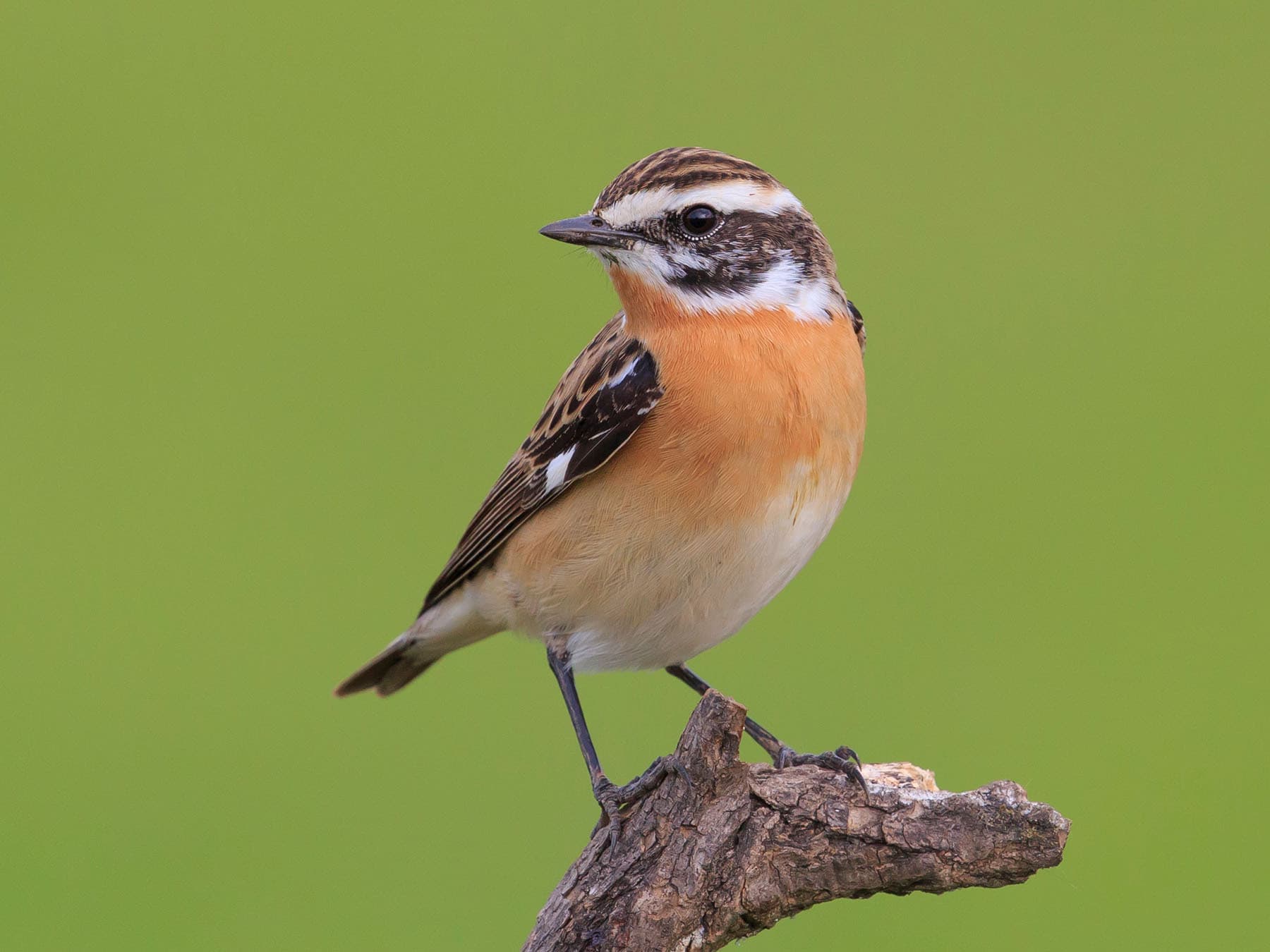
More photos
6 photos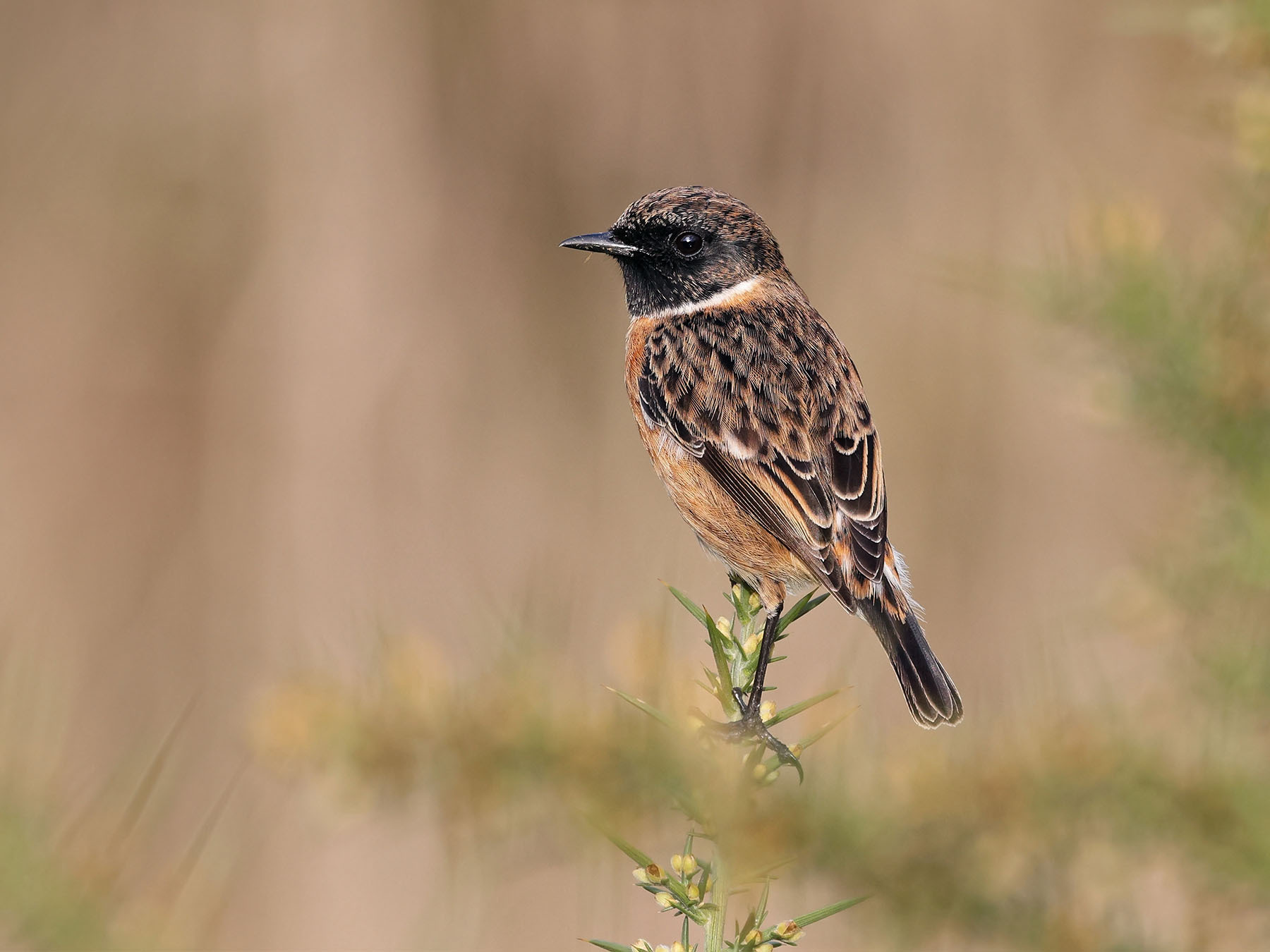
Quick facts
- Length
- 12.5 cm
- Wingspan
- 18–21 cm
- Weight
- 14.1–18 g
- Lifespan
- oldest recorded 7 years 2 months
- Family
- Old World Flycatchers
- Migration
- Partial migrant
- Global status (IUCN)
- Least Concern
- World population
- About 65,000 pairs in the UK (2016)
- Population trend
- UK: up 281% from 1995 to 2024 (Breeding Bird Survey), despite a sharp fall from about 2008 to 2012, partly after snowy winters
- Also called
- European Stonechat
- Scientific name
- Saxicola rubicola
Questions
2Why is it called a Stonechat?
Is it the same bird as the Common Stonechat?
Not quite. The old Common Stonechat is now treated as three species: the European Stonechat (Saxicola rubicola), the Siberian Stonechat (S. maurus) and the African Stonechat (S. torquatus). The BOU's taxonomic sub-committee recognised the three in its 2011 report, with European and Siberian Stonechats on the British List, and mitochondrial DNA had placed the European birds closer to the Canary Islands Stonechat than to Siberian or African ones.33 AviList follows the three-way split and says a fuller review of the group is still needed.34
A 2018 study of measurements, plumage, song and alarm calls went further and proposed three species in northern Eurasia: European, eastern (S. maurus) and Japanese (S. stejnegeri) stonechats. AviList keeps stejnegeri within S. maurus pending further research.35, 34 Some European lists and the IUCN still use the older, wider name, Common Stonechat.19
Sources
39- 1BirdWatch Ireland. Stonechat. BirdWatch Ireland. Accessed 19 November 2026. Source (opens in a new tab)
- 2Collar, N. (2020). European Stonechat (Saxicola rubicola), version 1.0. Birds of the World. Cornell Lab of Ornithology. doi:10.2173/bow.stonec4.01 (opens in a new tab)
- 3Oficialdegui, F. J. and Serrano, D. (2023). Variability of a consistent trait: the size of the white wing patch in European Stonechats (Saxicola rubicola rubicola). Ibis: 166(1): 187-199. doi:10.1111/ibi.13252 (opens in a new tab)
- 4BTO. Stonechat. BTO BirdFacts. Accessed 19 November 2026. Source (opens in a new tab)
- 5Greig-Smith, P. W. (1982). Seasonal patterns of song production by male stonechats Saxicola torquata. Ornis Scandinavica: 13(3): 225-231. doi:10.2307/3676303 (opens in a new tab)
- 6Greig-Smith, P. W. (1983). Use of perches as vantage points during foraging by male and female stonechats Saxicola torquata. Behaviour: 86(3-4): 215-236. doi:10.1163/156853983x00372 (opens in a new tab)
- 7Helm, B., Fiedler, W. and Callion, J. (2006). Movements of European stonechats Saxicola torquata according to ringing recoveries. Ardea: 94(1): 33-44. Accessed 19 November 2026. Source (opens in a new tab)
- 8Robinson, R. A., Leech, D. I. and Clark, J. A. (2026). Stonechat ringing recoveries (all years), species 11390. BTO Online Demography Report. Accessed 19 November 2026. Source (opens in a new tab)
- 9Cummins, S. and O'Halloran, J. (2002). An assessment of the diet of nestling Stonechats Saxicola torquata using compositional analysis. Bird Study: 49(2): 139-145. doi:10.1080/00063650209461258 (opens in a new tab)
- 10Fuller, R. J. and Glue, D. E. (1977). The breeding biology of the Stonechat and Whinchat. Bird Study: 24(4): 215-228. doi:10.1080/00063657709476561 (opens in a new tab)
- 11Zamora, R., Hódar, J. A. and Gómez, J. M. (1992). Dartford Warblers follow Stonechats while foraging. Ornis Scandinavica: 23(2): 167-174. doi:10.2307/3676445 (opens in a new tab)
- 12Robinson, R. A., Leech, D. I. and Clark, J. A. (2026). The Online Demography Report: Bird ringing and nest recording in Britain & Ireland in 2025 (longevity records). BTO, Thetford. Accessed 19 November 2026. Source (opens in a new tab)
- 13Fransson, T., Kolehmainen, T., Moss, D. and Robinson, R. (2023). EURING list of longevity records for European birds. EURING. Accessed 19 November 2026. Source (opens in a new tab)
- 14Küblbeck, M. et al. (2024). Multi-scale habitat selection and nest survival of whinchats and stonechats: implications for grassland conservation management. Wildlife Biology: 2025(4): e01238. doi:10.1002/wlb3.01238 (opens in a new tab)
- 15López Luengo, M. C., Soler, M., Huertas-Gómez, J. I., Hladká, T. et al. (2026). Lack of parasite-specific nest defence in the European stonechat is consistent with a short coevolutionary history with the common cuckoo (supplementary data and videos). figshare. Accessed 19 November 2026. Source (opens in a new tab)
- 16Stanbury, A. et al. (2021). The status of our bird populations: the fifth Birds of Conservation Concern in the United Kingdom, Channel Islands and Isle of Man and second IUCN Red List assessment of extinction risk for Great Britain. British Birds: 114: 723-747. Accessed 19 November 2026.
- 17Woodward, I. et al. (2020). Population estimates of birds in Great Britain and the United Kingdom. British Birds: 113: 69-104. Accessed 19 November 2026.
- 18Gilbert, G., Stanbury, A. and Lewis, L. (2021). Birds of Conservation Concern in Ireland 4: 2020-2026. Irish Birds: 43: 1-22. Accessed 19 November 2026.
- 19BirdLife International (2020). Saxicola torquatus. The IUCN Red List of Threatened Species 2020: e.T22710184A181614254. IUCN. Accessed 19 November 2026. Source (opens in a new tab)
- 20Heywood, J. J. N., Massimino, D., Baker, L. et al. (2026). The Breeding Bird Survey 2025 (BTO Research Report 802). British Trust for Ornithology, Thetford. ISBN 978-1-918170-02-3.
- 21Defra (2025). Wild bird populations in the UK and England, 1970 to 2025. GOV.UK. Accessed 19 November 2026. Source (opens in a new tab)
- 22RSPB. Stonechat. RSPB. Accessed 19 November 2026. Source (opens in a new tab)
- 23Henderson, I. et al. (2014). Evidence for contrasting causes of population change in two closely related, sympatric breeding species the Whinchat Saxicola rubetra and Stonechat Saxicola torquata in Britain. Bird Study: 61(4): 553-565. doi:10.1080/00063657.2014.962482 (opens in a new tab)
- 24Lewis, L., Coombes, R. H., Burke, B. et al. (2020). Countryside Bird Survey Report 1998-2019 (Report Number 6). BirdWatch Ireland. Accessed 19 November 2026.
- 25Crowe, O. et al. (2010). Population trends of widespread breeding birds in the Republic of Ireland 1998-2008. Bird Study: 57(3): 267-280. doi:10.1080/00063651003615147 (opens in a new tab)
- 26PECBMS. Common Stonechat Saxicola torquatus: Trends of wild birds in Europe, 2025 update. PECBMS. Accessed 19 November 2026. Source (opens in a new tab)
- 27BirdLife International (2021). European Red List of Birds 2021. BirdLife International / European Commission. Accessed 19 November 2026.
- 28Zonneveld, S. et al. (2024). Timing of upland vegetation management affects breeding of three species of passerine birds: a case study from southwest England. Bird Study: 71(1): 76-86. doi:10.1080/00063657.2024.2307472 (opens in a new tab)
- 29(1981). Wildlife and Countryside Act 1981, section 1 and Schedules 1, 1A, A1, 2, 3 and 4. Accessed 19 November 2026. Source (opens in a new tab)
- 30(1985). Wildlife (Northern Ireland) Order 1985, article 4 and Schedules 1-4. Accessed 19 November 2026. Source (opens in a new tab)
- 31(1976). Wildlife Act 1976 (Republic of Ireland), section 19 and Third Schedule. Accessed 19 November 2026. Source (opens in a new tab)
- 32Jobling. The Key to Scientific Names: Saxicola; rubicola. Birds of the World. Cornell Lab of Ornithology. Accessed 19 November 2026.
- 33Sangster, G. et al. (2011). Taxonomic recommendations for British birds: seventh report. Ibis: 153(4): 883-892. doi:10.1111/j.1474-919x.2011.01155.x (opens in a new tab)
- 34AviList (2025). AviList: The Global Avian Checklist, v2025b. AviList. doi:10.2173/avilist.v2025b (opens in a new tab)
- 35Opaev, A., Red'kin, Y., Kalinin, E. and Golovina, M. (2018). Species limits in Northern Eurasian taxa of the common stonechats, Saxicola torquatus complex (Aves: Passeriformes). Vertebrate Zoology: 68(3): 199-211. doi:10.3897/vz.68.e31606 (opens in a new tab)
- 36Collar, N. and Garcia, E. F. J. (2020). Whinchat (Saxicola rubetra), version 1.0. Birds of the World. Cornell Lab of Ornithology. doi:10.2173/bow.whinch1.01 (opens in a new tab)
- 37Collar, N. (2021). Siberian Stonechat (Saxicola maurus), version 1.1. Birds of the World. Cornell Lab of Ornithology. doi:10.2173/bow.sibsto1.01.1 (opens in a new tab)
- 38Martinez, N. (2025). Common Redstart (Phoenicurus phoenicurus), version 2.0. Birds of the World. Cornell Lab of Ornithology. doi:10.2173/bow.comred2.02 (opens in a new tab)
- 39Csörgő, T. et al. (2022). The status of the European Stonechat (Saxicola rubicola) in Hungary: a review. Ornis Hungarica: 30(1): 1-20. doi:10.2478/orhu-2022-0001 (opens in a new tab)

Checked by
Nathan Cope, founder and editor
Nathan founded Birdfact and leads its writers and contributors in the UK, the US and Canada. He has watched and studied birds for more than ten years, and checks every article and species guide before it’s published.