


Meadow Pipit
Titlark, Meadow Lark · Anthus pratensis
By the Birdfact teamChecked by Nathan Cope
On this page21 sections
- How to recognise it
- Its size
- Its song and calls
- When and where to see it
- What it eats
- Nesting and breeding
- Behaviour
- Lifespan and predators
- Conservation
- What does a Meadow Pipit look like?
- How big is a Meadow Pipit?
- How much does a Meadow Pipit weigh?
- Subspecies of Meadow Pipit
- What is the scientific name of a Meadow Pipit?
- Are Meadow Pipits aggressive?
- Are Meadow Pipits endangered?
- Do Meadow Pipits mate for life?
- Are Meadow Pipits common?
- Similar birds
- Quick facts
- Sources
How to recognise it
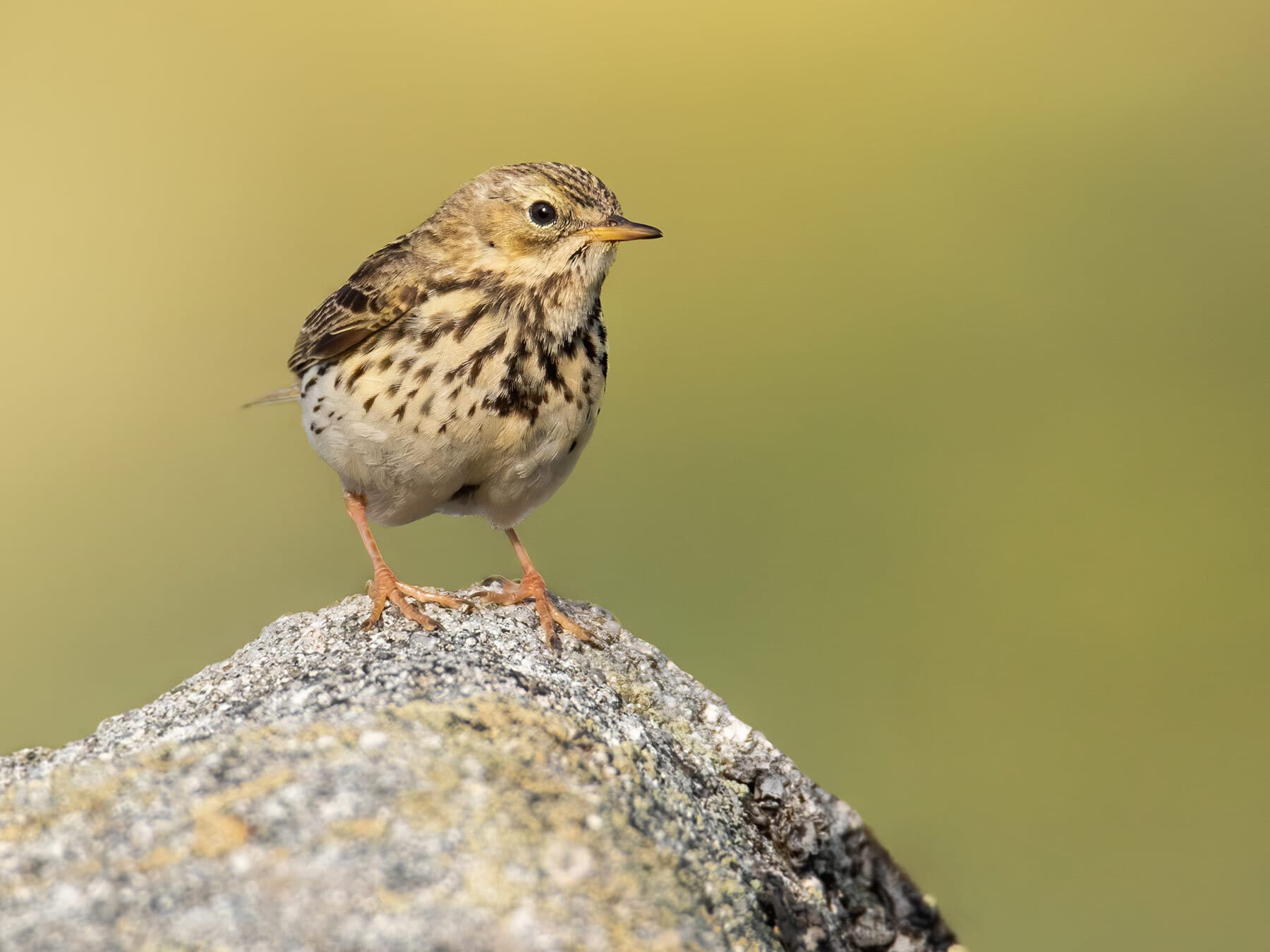
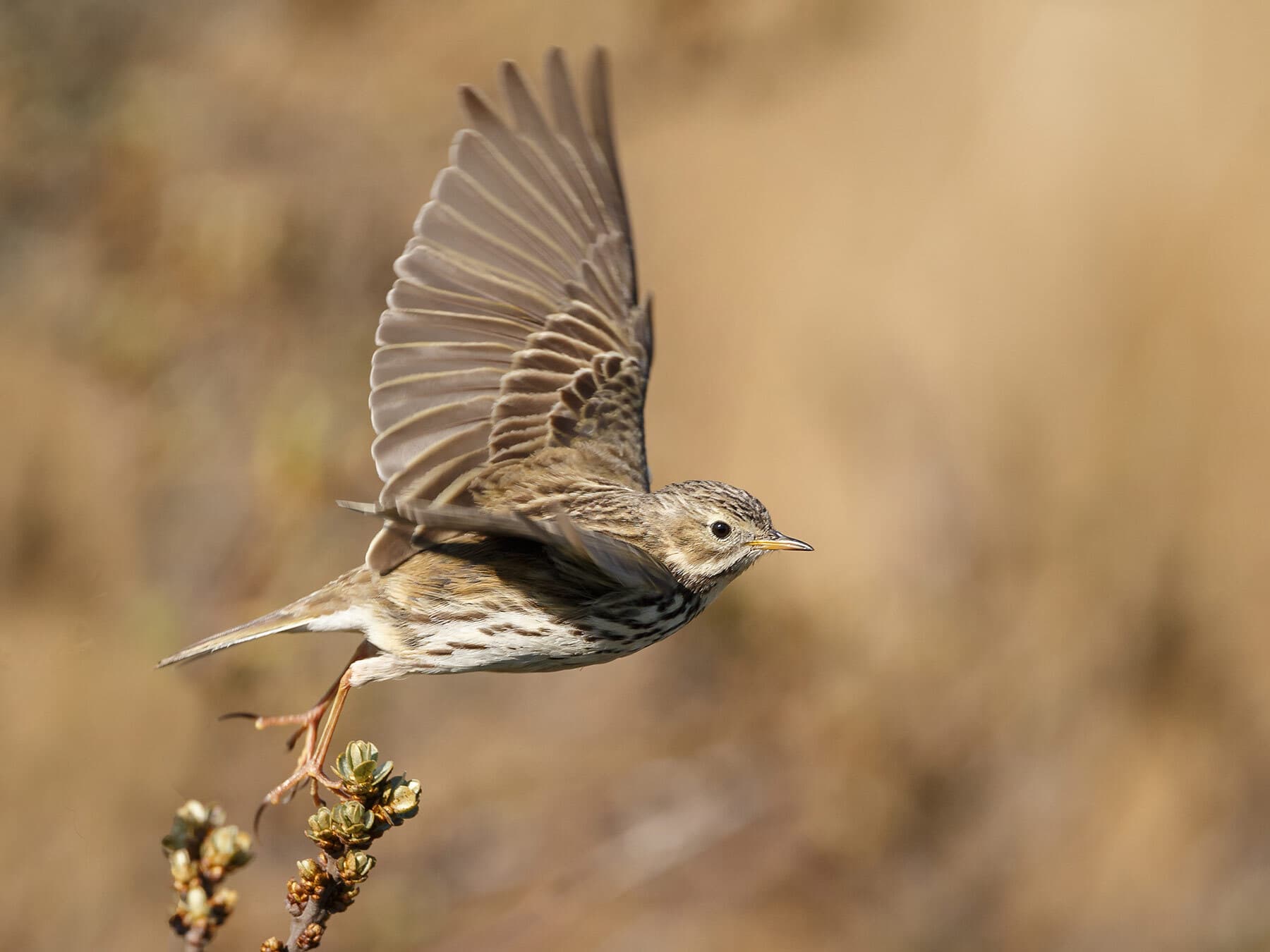
The Meadow Pipit is a small, slender bird with brown upperparts streaked with darker brown. Its underparts are pale buff with heavy streaking on the breast and flanks. The bird has a thin bill, long legs, and a noticeably long hind claw.
Both sexes look similar, with juveniles having a more yellowish tinge to their plumage. During the breeding season, adults may show slightly brighter plumage, but the change is subtle.
Its size
Adults- Length
- 14–15 cm
- Wingspan
- 22–25 cm
- Weight
- 15–22 g
Its song and calls
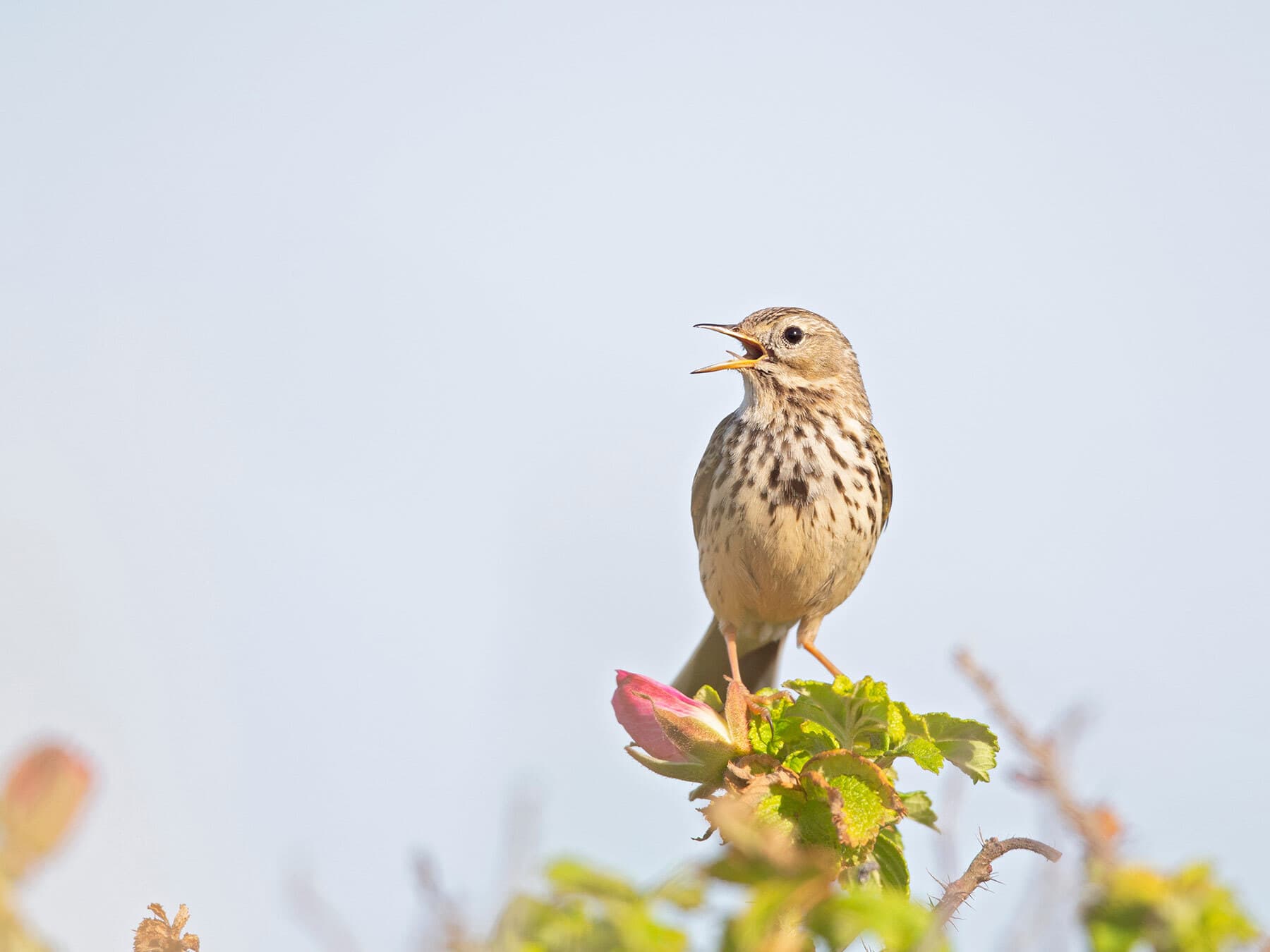
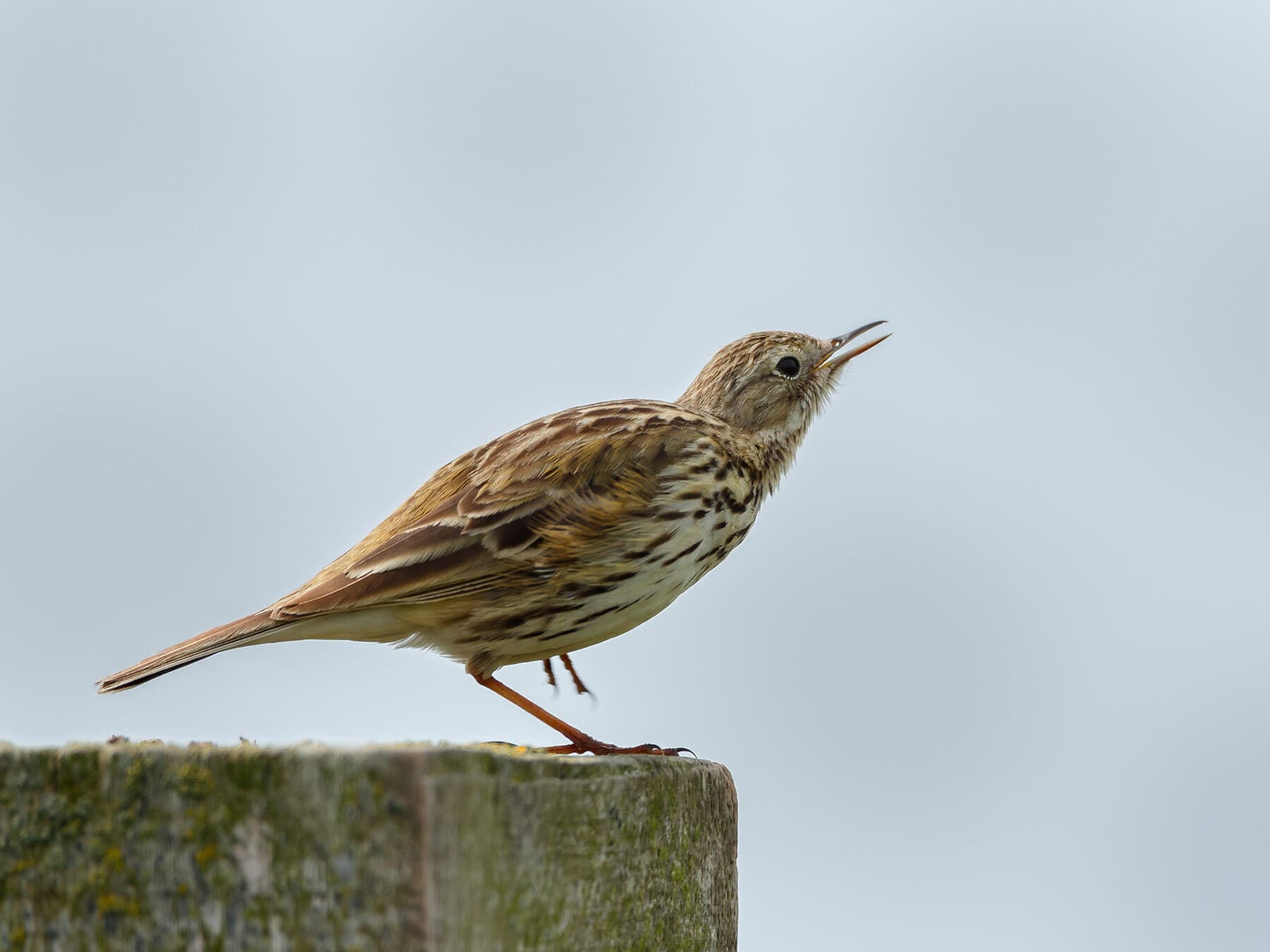
When singing from the ground the song consists of simple and repetitive ‘zi’ or ‘tsip’ sounds.
When protecting its territory the meadow pipit has a call, issued in flight, similar to a ‘tsip’, ‘tlip’ or ‘zu’, sung in a number of distinct phrases starting softly and increasing in volume and speed, culminating in a fanfare of mixed sounds ‘tee - swia - swia’.
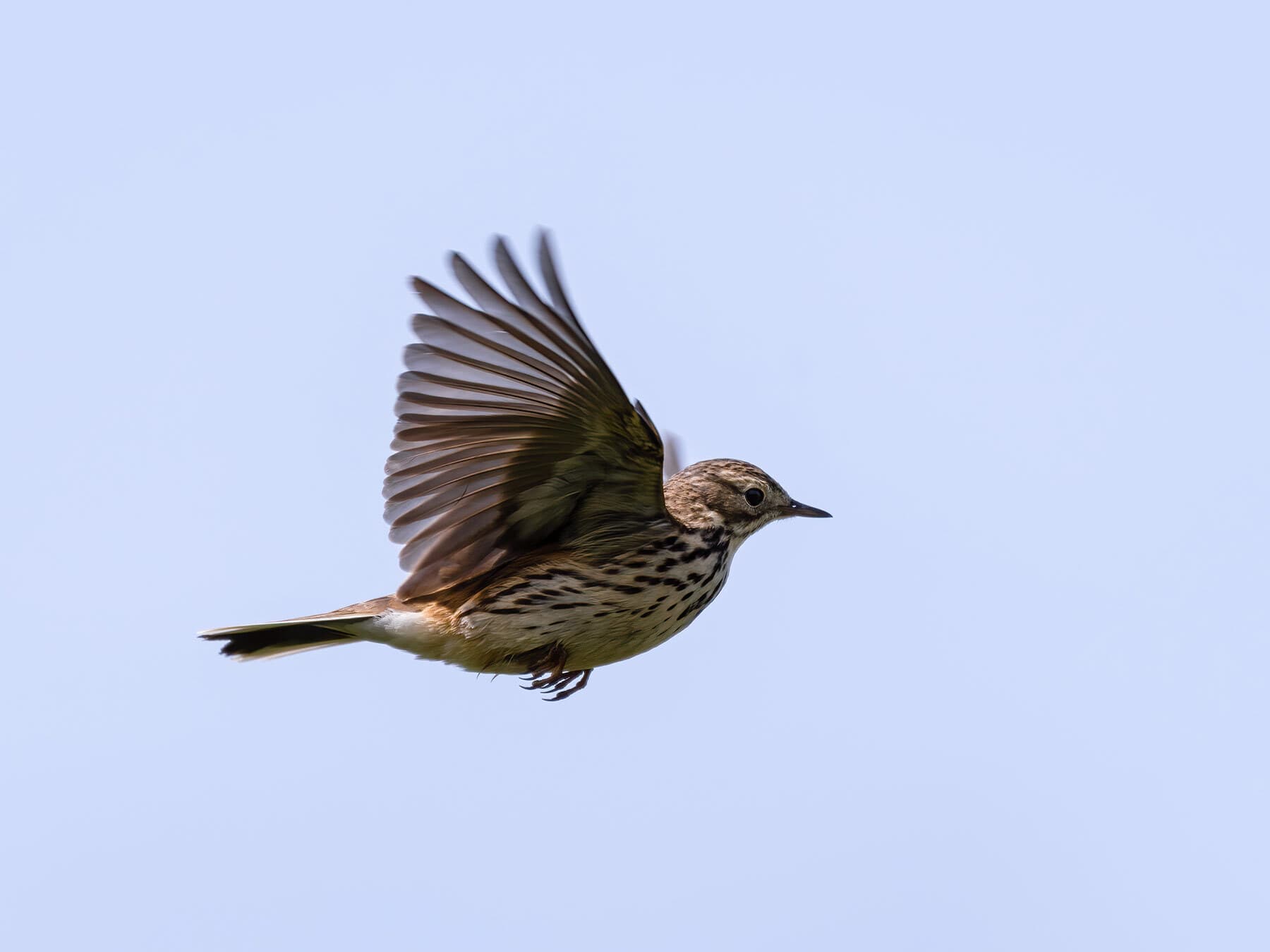
During the breeding season the adult male can be seen singing in flight as it rises almost vertically to a height of approximately 25 metres and then descends to the ground with its wings half open and tail raised in what has become known as a ‘parachuting’ display to attract its mate.
- Song0:00 / 0:10
Recorded in Normandie, France · June 2022
- Call0:00 / 0:41
Recorded in Normandie, France · May 2024
When and where to see it
OctoberPeak season
Most recorded in October
- 1. Mayo3.4%
- 2. Bridgend3.0%
- 3. Shetland Islands2.7%
- 4. South Ayrshire2.6%
- 5. Clare2.4%
Each dot is a county, state or province: the bigger and darker, the larger the bird’s share of that place’s bird records that month. Grey dots: no regular records. The ringed point is the centre of the bird’s records this month; the arrow shows how it moved since last month, and the dashed loop its path through the year. “Arrivals” colours places where it becomes regular this month (orange) or is in its last regular month (grey). GBIF eBird Observation Dataset, 2019–2024. Map data: Natural Earth, US Census Bureau; place centres © OpenStreetMap contributors.
In your area
See when the Meadow Pipit is recorded in your county, state or province.
How often the Meadow Pipit turns up in the UK and Ireland through the year, from birdwatchers' records.
United Kingdom
Resident · all year · most records in October
Ireland
Resident · all year · most records in October
Show as a table
| Month | United Kingdom | Ireland |
|---|---|---|
| January | 0.64% (regular) | 0.88% (regular) |
| February | 0.57% (regular) | 0.94% (regular) |
| March | 0.79% (regular) | 1.2% (regular) |
| April | 0.72% (regular) | 1.3% (regular) |
| May | 0.62% (regular) | 1.5% (regular) |
| June | 0.70% (regular) | 1.6% (regular) |
| July | 0.62% (regular) | 1.5% (regular) |
| August | 0.53% (regular) | 1.1% (regular) |
| September | 1.3% (regular) | 1.6% (regular) |
| October | 1.5% (regular) | 1.7% (regular) |
| November | 1.0% (regular) | 1.2% (regular) |
| December | 0.71% (regular) | 0.92% (regular) |
Recorded regularly in
Worldwide: recorded regularly in 71 countries
Countries where it was recorded in at least 3 of the 6 years 2019–2024. Linked countries have their own bird list.
Europe (45)
- Åland Islands
- Albania
- Austria
- Belarus
- Belgium
- Bosnia & Herzegovina
- Bulgaria
- Croatia
- Czechia
- Denmark
- Estonia
- Faroe Islands
- Finland
- France
- Germany
- Gibraltar
- Greece
- Guernsey
- Hungary
- Iceland
- Ireland
- Isle of Man
- Italy
- Jersey
- Latvia
- Lithuania
- Luxembourg
- Malta
- Moldova
- Montenegro
- Netherlands
- Norway
- Poland
- Portugal
- Romania
- Russia
- Serbia
- Slovakia
- Slovenia
- Spain
- Svalbard & Jan Mayen
- Sweden
- Switzerland
- Ukraine
- United Kingdom
Asia (21)
- Armenia
- Azerbaijan
- Bahrain
- China
- Cyprus
- Georgia
- Iran
- Iraq
- Israel
- Jordan
- Kazakhstan
- Kuwait
- Lebanon
- Oman
- Palestinian Territories
- Qatar
- Saudi Arabia
- Taiwan
- Turkey
- United Arab Emirates
- Uzbekistan
North America (1)
- Greenland
Data: EOD – eBird Observation Dataset (Cornell Lab of Ornithology), accessed via GBIF.org, CC BY 4.0. Records from 2019–2024, aggregated and filtered by Birdfact. How these lists are made
Meadow pipits spend a lot of their time on the ground both foraging and nesting. The adult female alone will construct a small cup shaped nest from grasses, lined with animal hair, down and fine vegetation which is located upon the ground, hidden amongst vegetation within their normal area of habitation.
Interestingly the Cuckoo favours the meadow pipit’s nest in which to lay its own eggs. The cuckoo chick hatches first and pushes the pipit eggs out of the nest fooling the meadow pipit into raising the cuckoo chick as its own, to the detriment of the pipit's own attempts to produce a family.
What is the habitat of a Meadow Pipit?
Only rarely will meadow pipits venture into woodland, preferring by far the open spaces of pasture, heath, moorland, tundra, saltmarsh, agricultural land, coastal meadows and even park land.
Where can I see Meadow Pipits?
Within their range meadow pipits are considered to be very common and within the United Kingdom, they are the most common songbird of upland areas, particularly within the northern and western regions of the Kingdom. During the winter many UK based meadow pipits will move south into central and southern England.
Do Meadow Pipits migrate?
Not all meadow pipits migrate with many remaining within their chosen territory year round, or undertaking a partial migration south. However, those who breed in northern Europe and Russia migrate annually, between September and November, to southern and central Europe, North Africa, Southwest Asia and the Middle East.
Tips for seeing it
- Look for Meadow Pipits in open grasslands and moorlands
- Listen for their distinctive 'seep-seep' call as they fly
- Watch for their characteristic bobbing tail movement when on the ground
- Observe their parachuting display flight during the breeding season
- In the UK, they're common in upland areas and coastal regions
What it eats
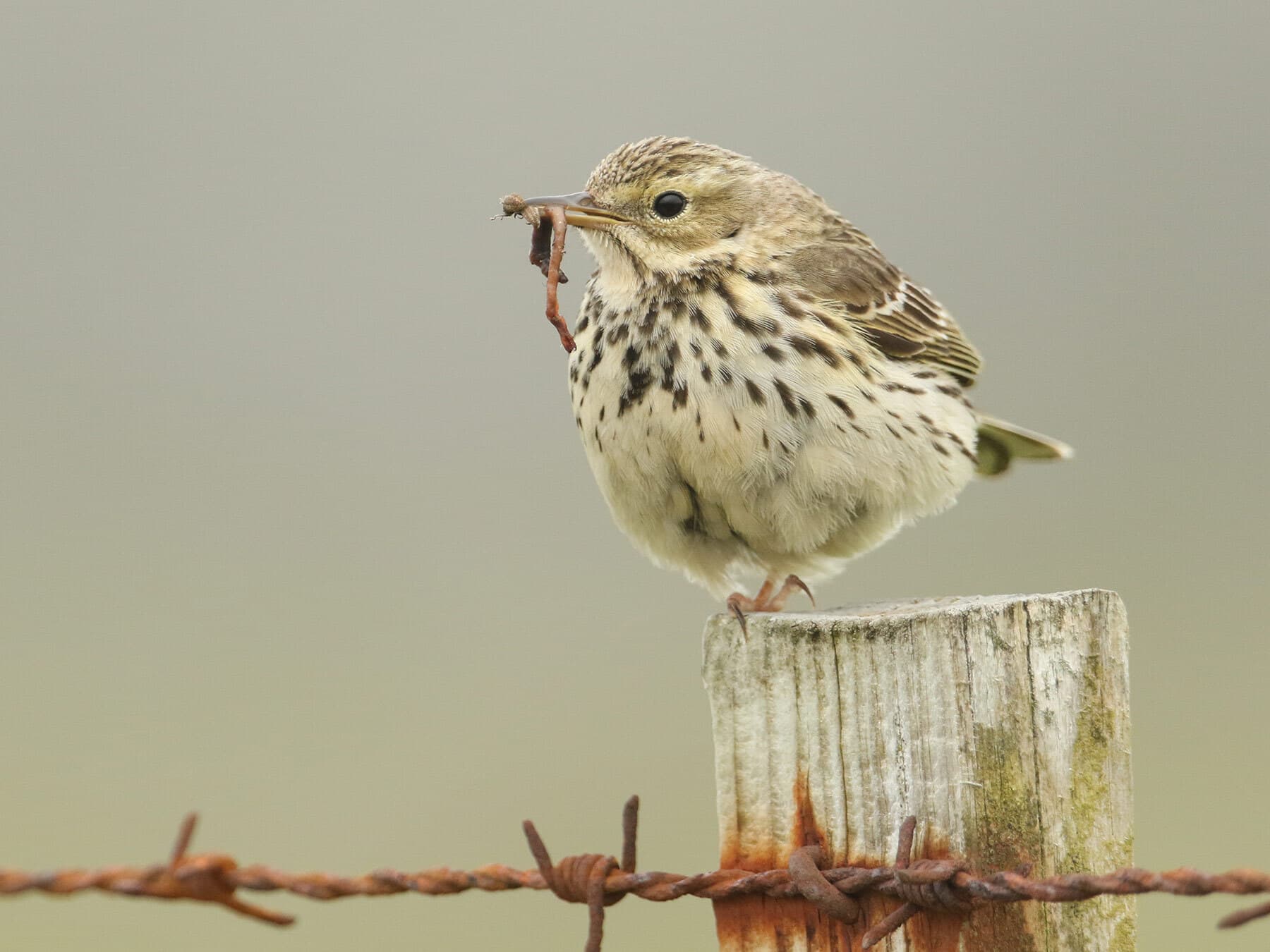
Meadow pipits are mainly insectivores with the addition of spiders, moths, larvae and worms. They will also occasionally eat seeds and are predominantly ground feeders, often seen foraging in short grass or moorland of less than 4 inches in height. Whilst they are known to grab flying insects this is usually from the ground and is much less common whilst the bird is in flight.
Nesting and breeding
Meadow pipits normally produce two broods a season (occasionally 3) between the months of March to August, dependent upon geographical location. Each clutch numbers between 2 - 7 eggs and is incubated by the female for an average of thirteen days. Fledging occurs up to two weeks after hatching, prior to which the chicks are fed by both parents, a duty that continues for a further 14 days after the young have fledged.
What do Meadow Pipit eggs look like?
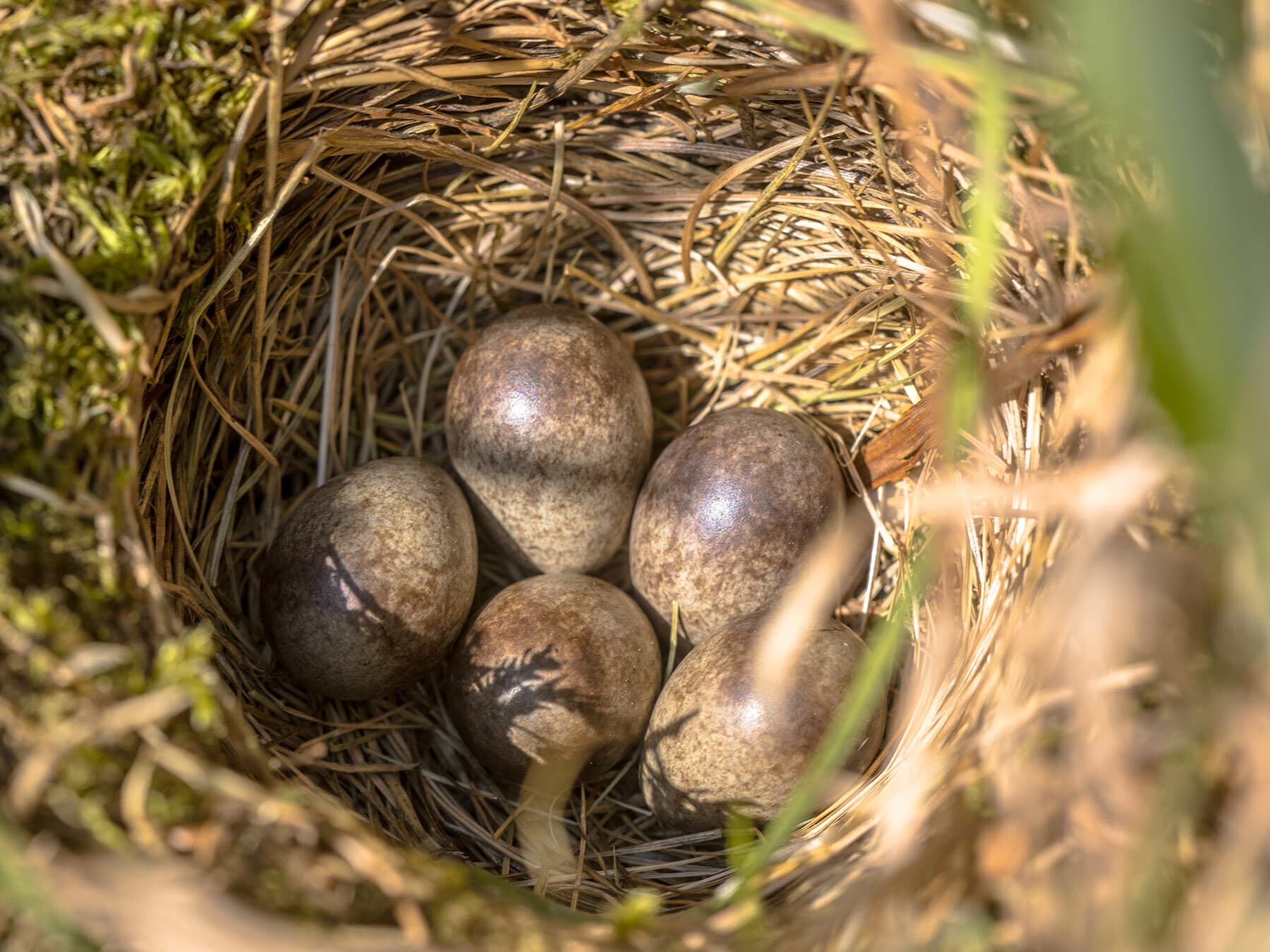
Meadow pipit eggs are a glossy white base colour spotted with dark brown and measure 20 mm x 14 mm (approximately ¾ inch x ½ inch). They weigh an average of 2.1 grams which equates to 0.07 of an ounce.
Behaviour
Meadow Pipits are often seen walking or running on the ground, bobbing their tails as they move. During the breeding season, they frequently perform a distinctive parachuting display flight, rising up to 50 meters before descending with wings and tail spread.
These birds are generally gregarious, forming small flocks outside the breeding season.
Lifespan and predators
The lifespan for a meadow pipit is between 1 and 5 years giving an average of 3 years. Avian predators, particularly Hen Harriers and Merlins, will often prey on meadow pipits.
The oldest recorded meadow pipit achieved an age of over 7 years 9 months (from ringing).
Conservation
While listed as Least Concern globally, Meadow Pipit populations have declined in some areas due to agricultural intensification and habitat loss.
Conservation efforts focus on maintaining suitable grassland habitats and promoting sustainable farming practices that benefit ground-nesting birds.
What does a Meadow Pipit look like?
Being a predominantly ground dwelling bird, restricted in the main to saltmarshes, moors, heaths and agricultural land, the plumage of the meadow pipit is cryptic, which means it is patterned in such a way so as to to blend in with the surroundings of its natural habitat.
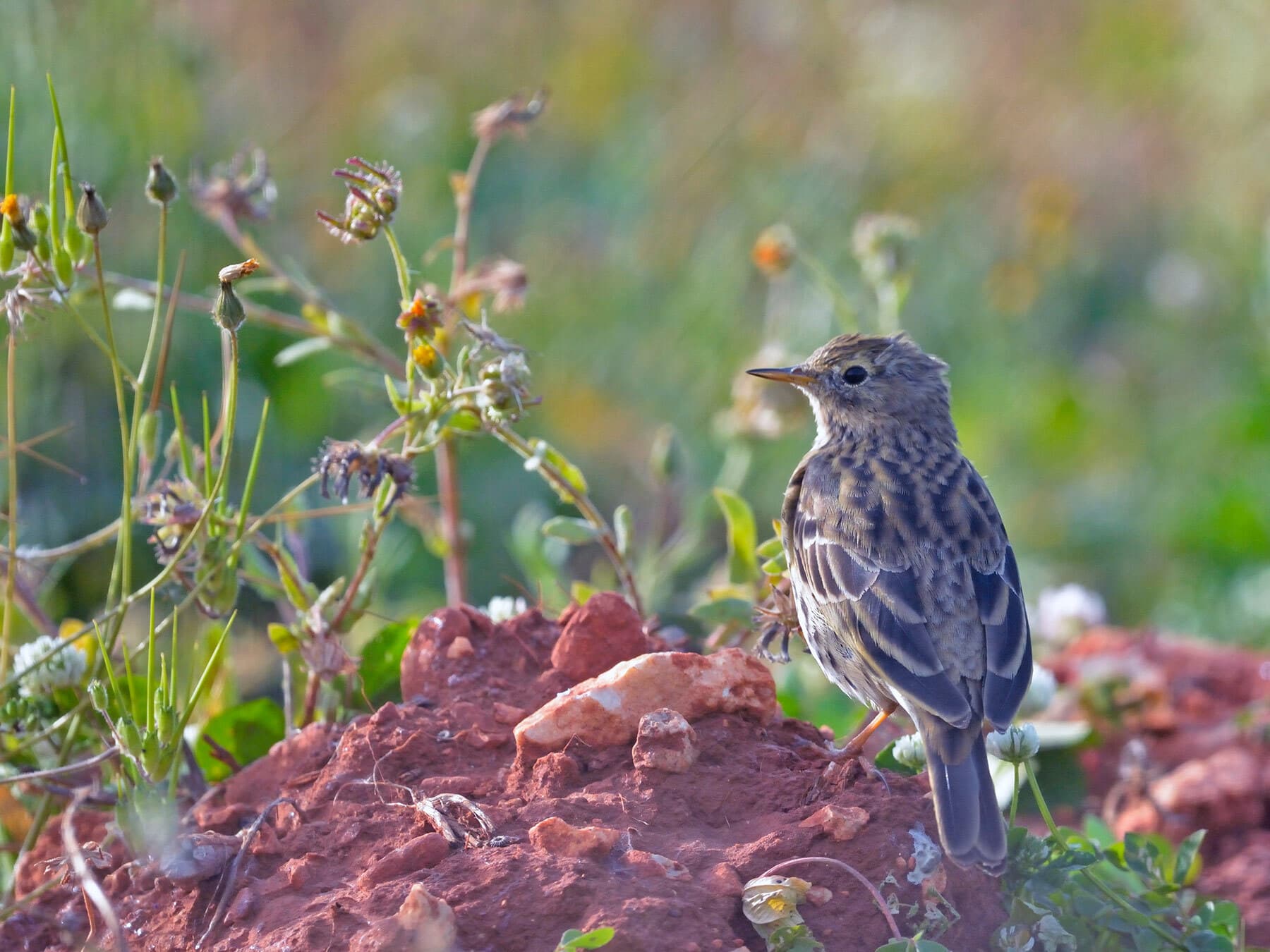
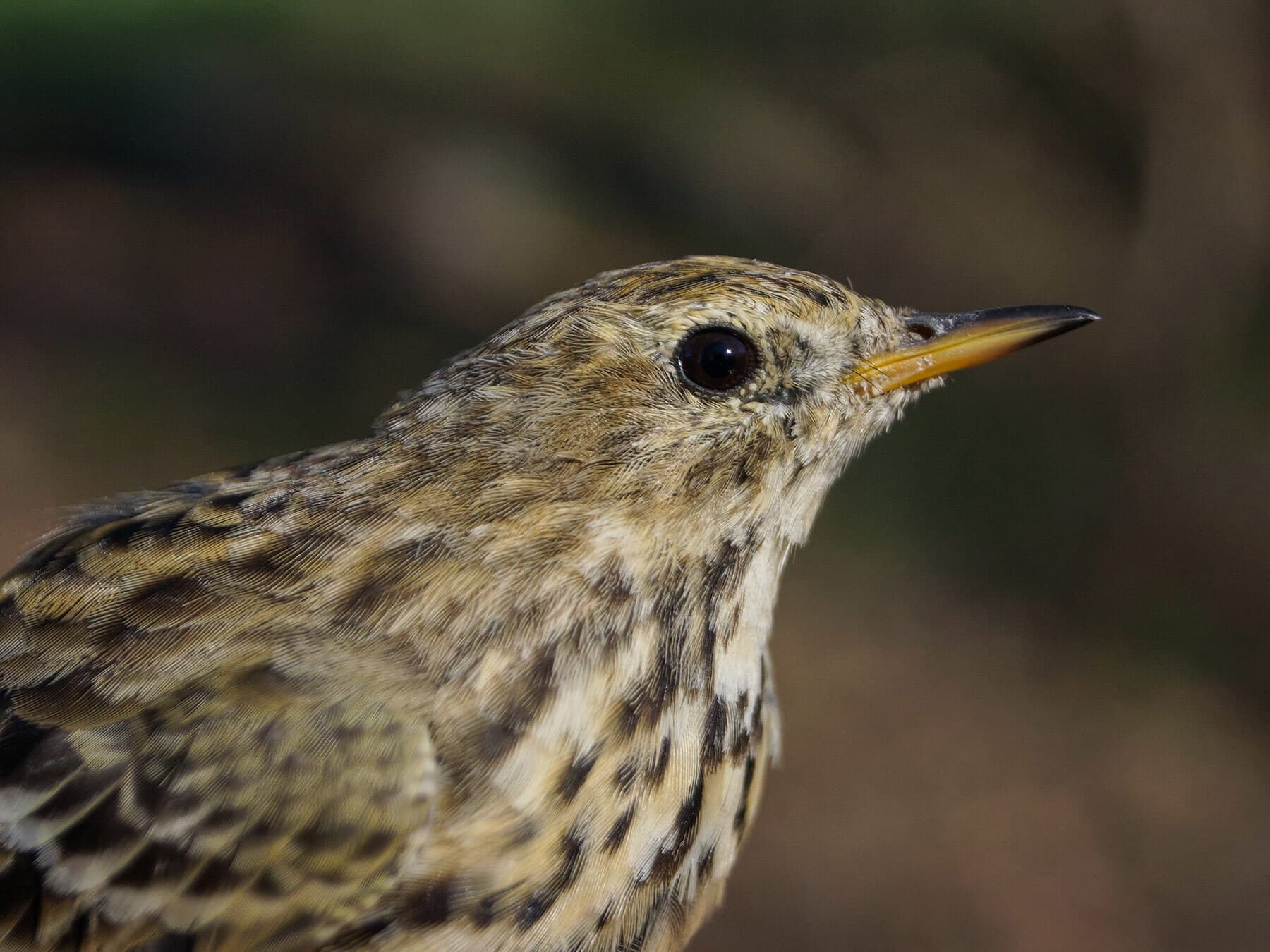
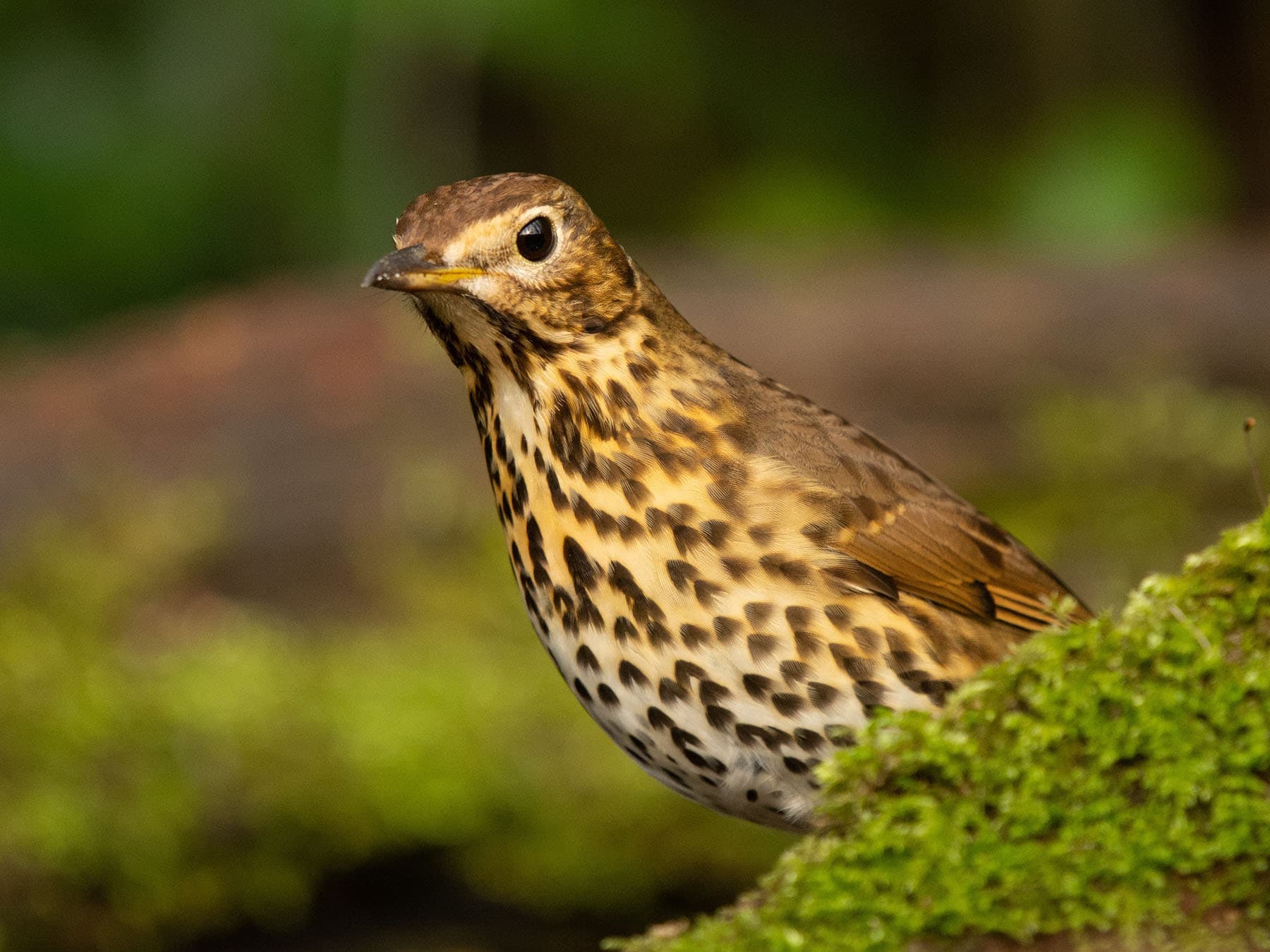
Adult meadow pipits are an earthy brown or olive brown on the upperparts with a paler buff colouration to the bird’s underparts and dark brown or black streaks across the head, shoulders, back, breast and flanks. The tertials and upperwing coverts are edged in white, forming two distinctive white wing bars and the tail is dark brown with prominent white edges across the outer feathers. The underwing is a pale buff or white and a pale ring surrounds the blackish brown of the iris of the eye. The lower cheek (malar area) contains a thin black stripe and the medium sized, slim, bill is a dark to yellowish brown in colour.
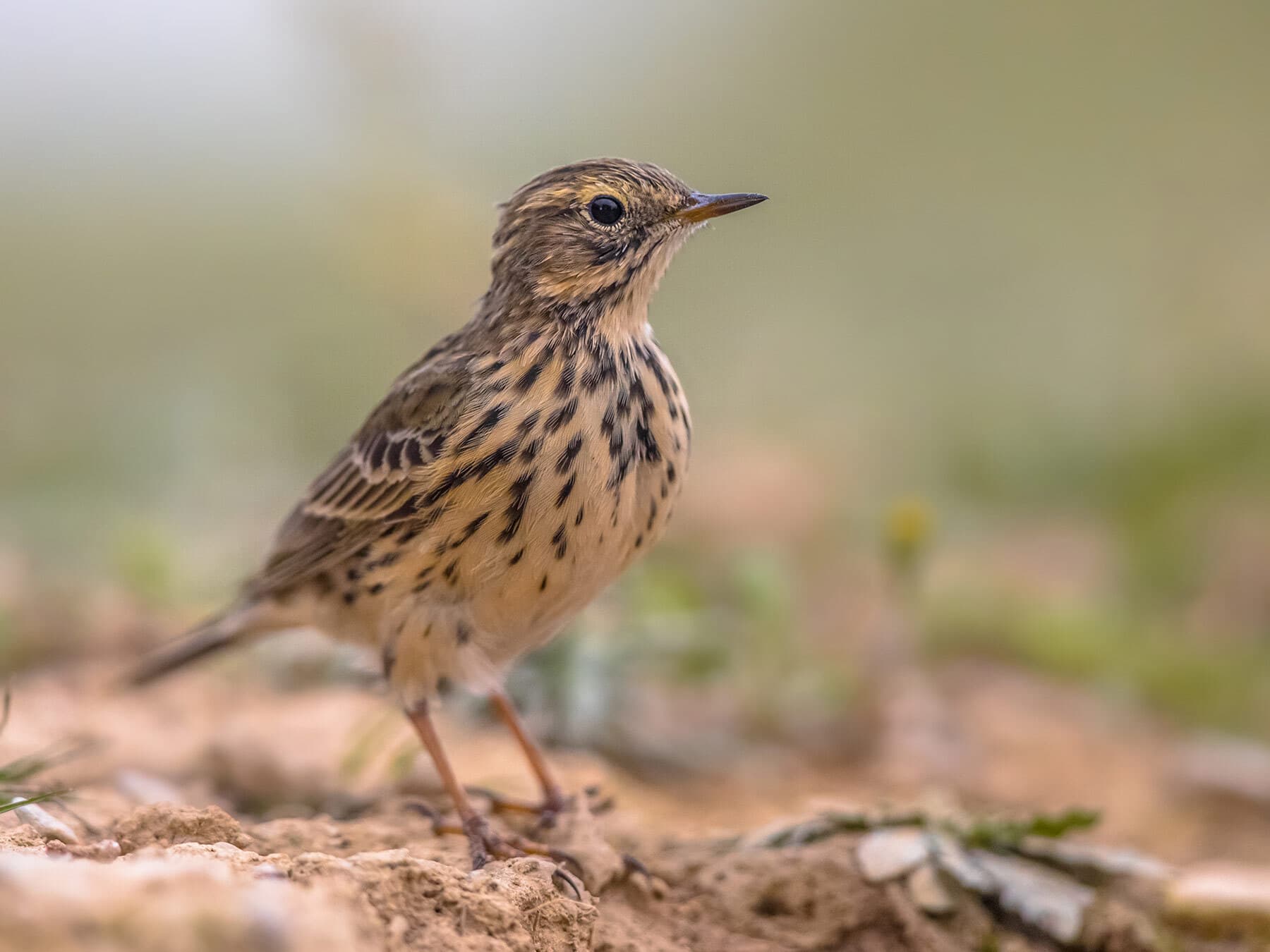
The legs are either a flesh or brownish yellow in colour with an exceptionally elongated claw on the hallux. The hallux, in ornithological terms, is the bird’s rearward facing toe where the other three toes all face forwards. This foot formation is found on all passerines and allows birds to perch on branches, fence posts and overhead cables etc. Males and females are similar in appearance and plumage.
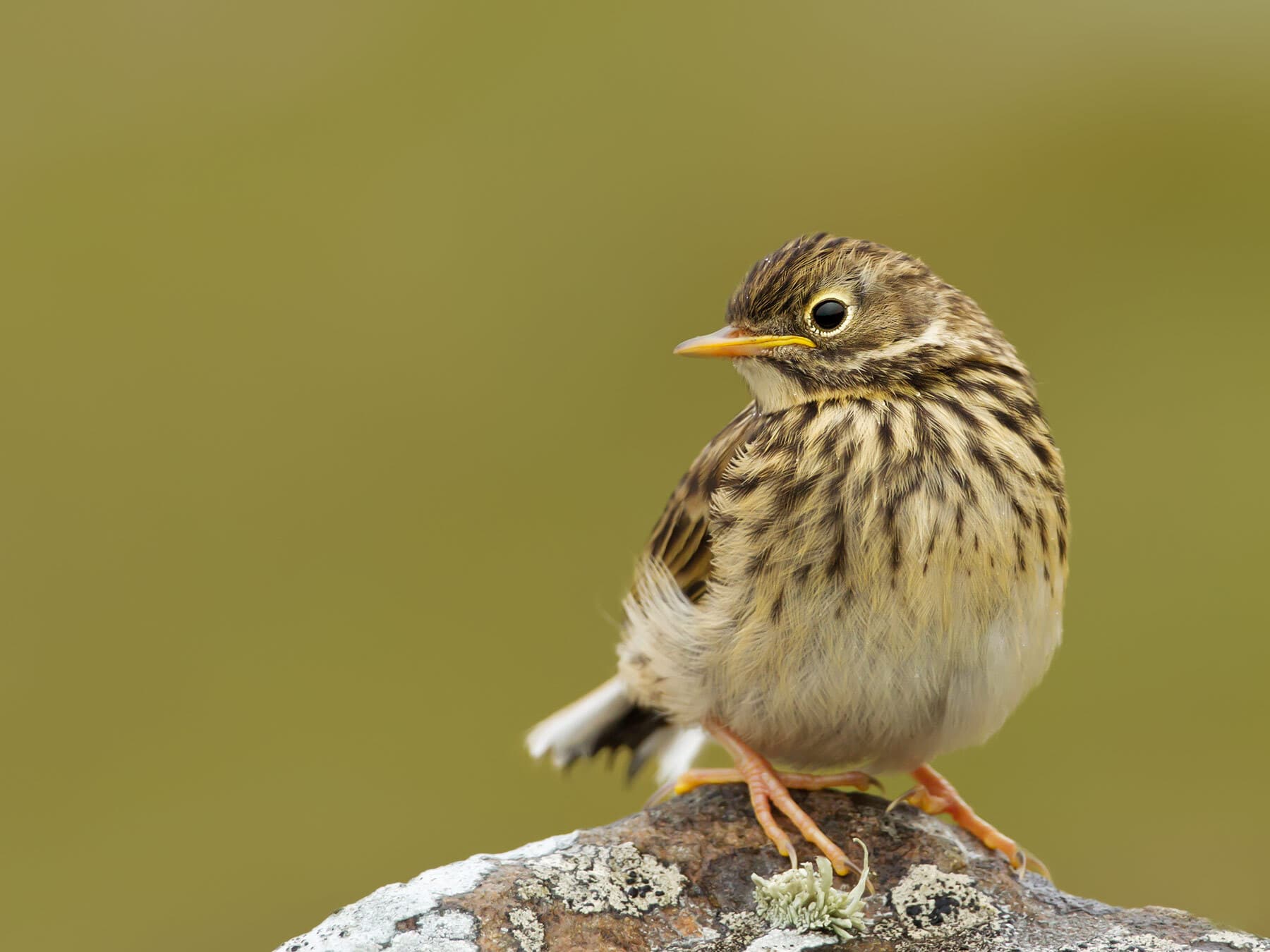
Juvenile meadow pipits are generally paler than the adults with heavily streaked dark buff upperparts and off white underparts, devoid of the adult’s streaking to the flanks.
On hatching, chicks are covered in a pale grey down which prior to fledging changes to mirror the plumage of juvenile birds.
How big is a Meadow Pipit?
Whilst the adult female is often marginally larger than the adult male meadow pipit, they are on average between 14.5 cm to 15 cm in length (up to approximately 6 inches) with a wingspan of 24 cm, which equates to 9.5 inches.
How much does a Meadow Pipit weigh?
The average weight of an adult meadow pipit is 19 grams, the equivalent of just 0.67 ounces.
Subspecies of Meadow Pipit
There is currently some dispute between scientists as to whether the meadow pipit is monotypic or not. Whilst opinion is divided, those who consider the bird to be polytypic (containing two or more subspecies) define them as follows:
Anthus pratensis pratensis which is the nominate, is found in S E Greenland, throughout Europe and into Western Siberia. Those birds that do migrate over winter in North Africa, Iran and S W Asia.
Anthus pratensis whistleri has a more limited range, from Iceland and the Faroe Islands to Scotland, England and Ireland. Most of this subspecies is resident year round although there is some partial migration south and along nearby coastal areas.
The plumage of these two subspecies is very similar although the anthus pratensis whistleri is generally darker on the upperparts with bolder streaking across its back.
What is the scientific name of a Meadow Pipit?
Meadow pipits belong to the largest order of birds known as Passeriformes which total over half of all the world’s birds and are made up largely of what are generally described as perching or song birds. They are from the family Motacillidae which consists of 67 species of pipits and wagtails.
The scientific name for the meadow pipit is Anthus pratensis where anthus is a Latin word meaning a small grassland bird and pratensis derives from the Latin for meadow (pratum) where pratensis means ‘of the meadow’.
Are Meadow Pipits aggressive?
Generally meadow pipits are not aggressive, in fact quite the contrary, they are social birds who often form small to medium sized flocks, particularly out of the breeding season.
Are Meadow Pipits endangered?
The International Union for Conservation of Nature (IUCN) classifies the meadow pipit as ‘Near Threatened’, a classification which falls between ‘Least Concern’ and ‘Vulnerable’. The UK Conservation status is Amber although in the recent past it has been at Red. This follows a decline in the meadow pipit breeding population from 1969 onwards and the winter population decline from the early 1980’s.
However, within its range, the meadow pipit is considered common or very common and it is estimated that globally the total adult population of the bird could be up to 40 million individuals.
Do Meadow Pipits mate for life?
Meadow pipits are monogamous meaning that they pair for life and as a breeding pair they tend to restrict themselves to a specific area, which they consider their own, and will protect from other pipits. They reach breeding age after one year.
Are Meadow Pipits common?
Within Europe in particular and to a lesser extent Western Siberia, the meadow pipit is a common sight. Europe accounts for up to 94% of the global range of the meadow pipit and although there has been a gradual decline in European numbers since the 1970s, due in the main, it is believed, to agricultural intensification, numbers are still fairly high.
Within the United Kingdom, it is still the most common songbird found in upland areas.
Similar birds
Often mistaken for
Quick facts
- Length
- 14–15 cm
- Wingspan
- 22–25 cm
- Weight
- 15–22 g
- Lifespan
- 2–3 years
- Family
- Wagtails & Pipits
- Migration
- Partial migrant
- Global status (IUCN)
- Least Concern
- World population
- 24,000,000 - 33,000,000 mature individuals
- Population trend
- Decreasing
- Also called
- Titlark, Meadow Lark
- Scientific name
- Anthus pratensis
Sources
3- 1BirdLife International. 2021. Anthus pratensis. The IUCN Red List of Threatened Species 2021: e.T22718556A154480081. Source (opens in a new tab)
- 2BirdLife International. 2021. Anthus pratensis. The IUCN Red List of Threatened Species 2021: e.T22718556A154480081. Source (opens in a new tab)
- 3BirdLife International. 2021. Anthus pratensis. The IUCN Red List of Threatened Species 2021: e.T22718556A154480081. Source (opens in a new tab)

Checked by
Nathan Cope, founder and editor
Nathan founded Birdfact and leads its writers and contributors in the UK, the US and Canada. He has watched and studied birds for more than ten years, and checks every article and species guide before it’s published.