


Mistle Thrush
Stormcock · Turdus viscivorus
By the Birdfact teamChecked by Nathan Cope
On this page15 sections
How to recognise it
What do Mistle Thrushes look like?
Although mistle thrushes are superficially similar to their more common relative the song thrush, there are some subtle differences between the two species.
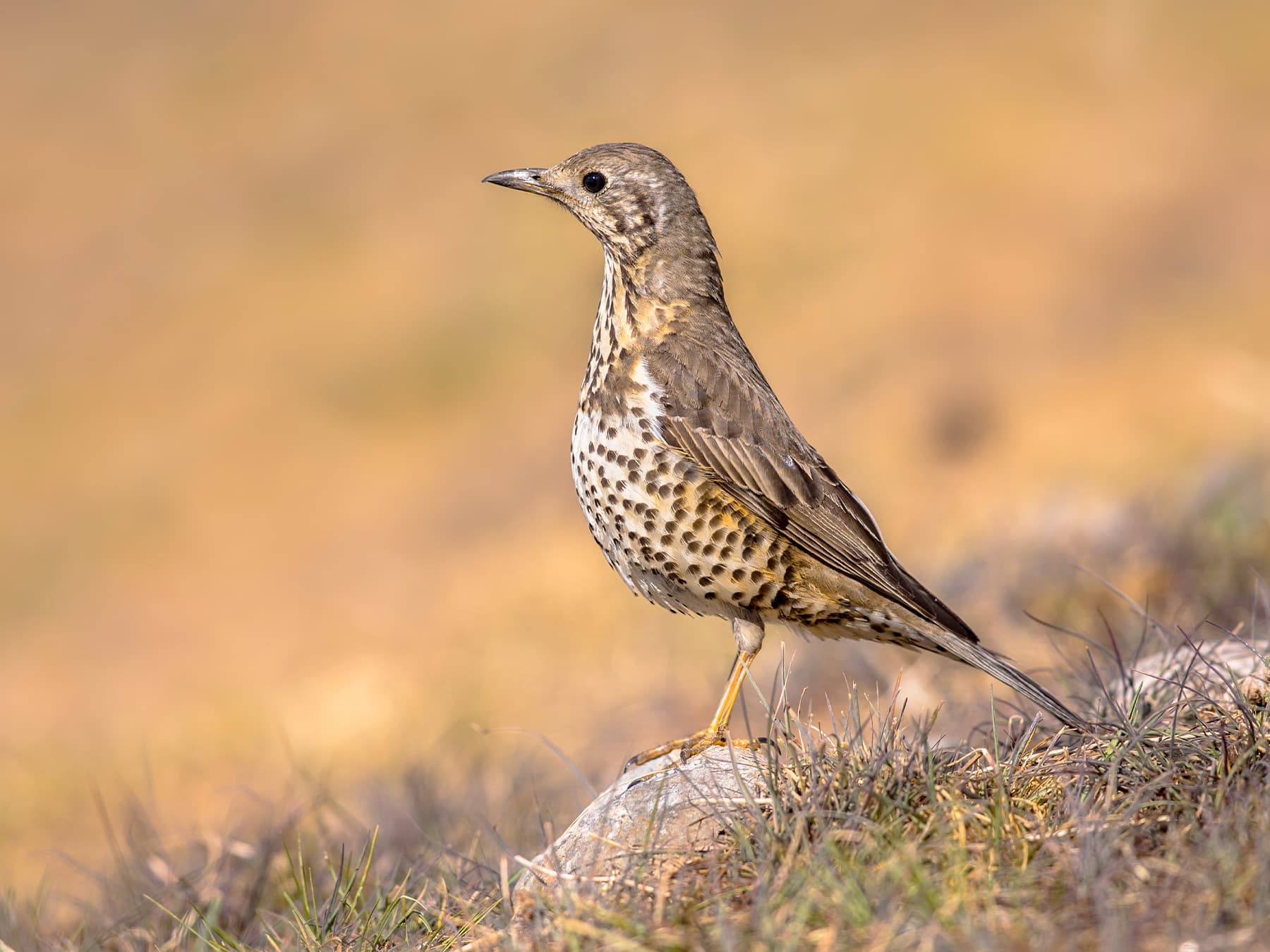
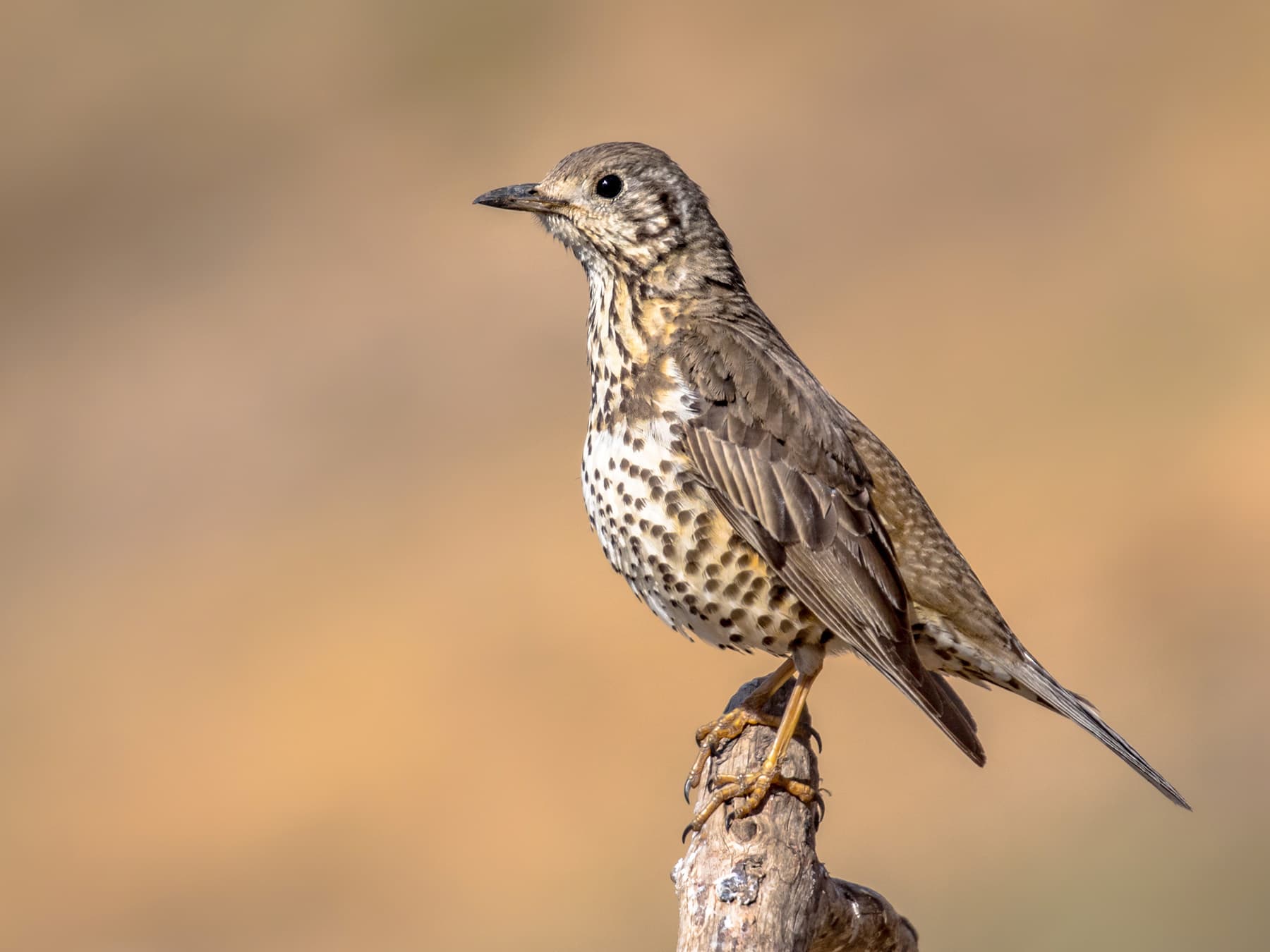
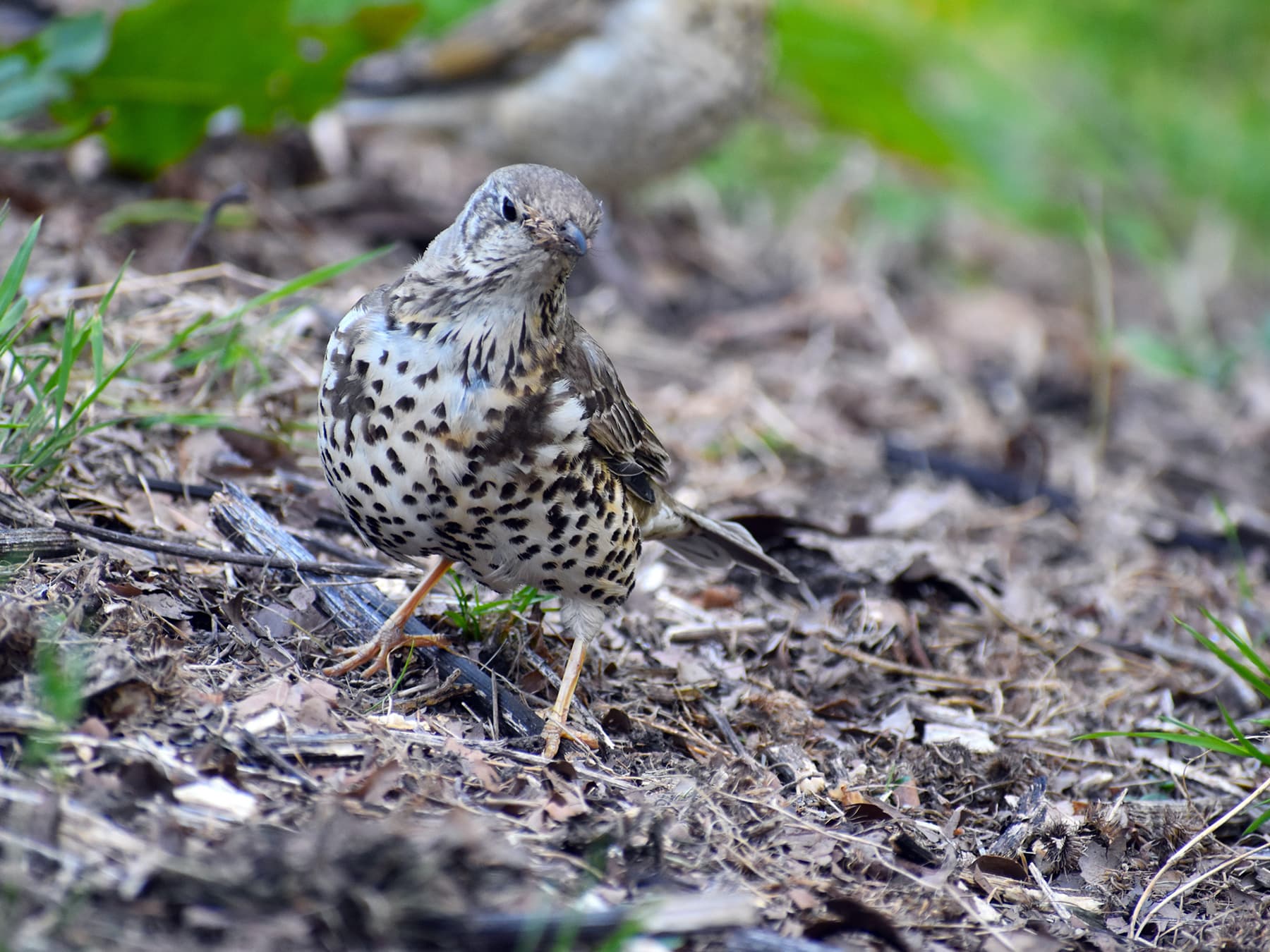
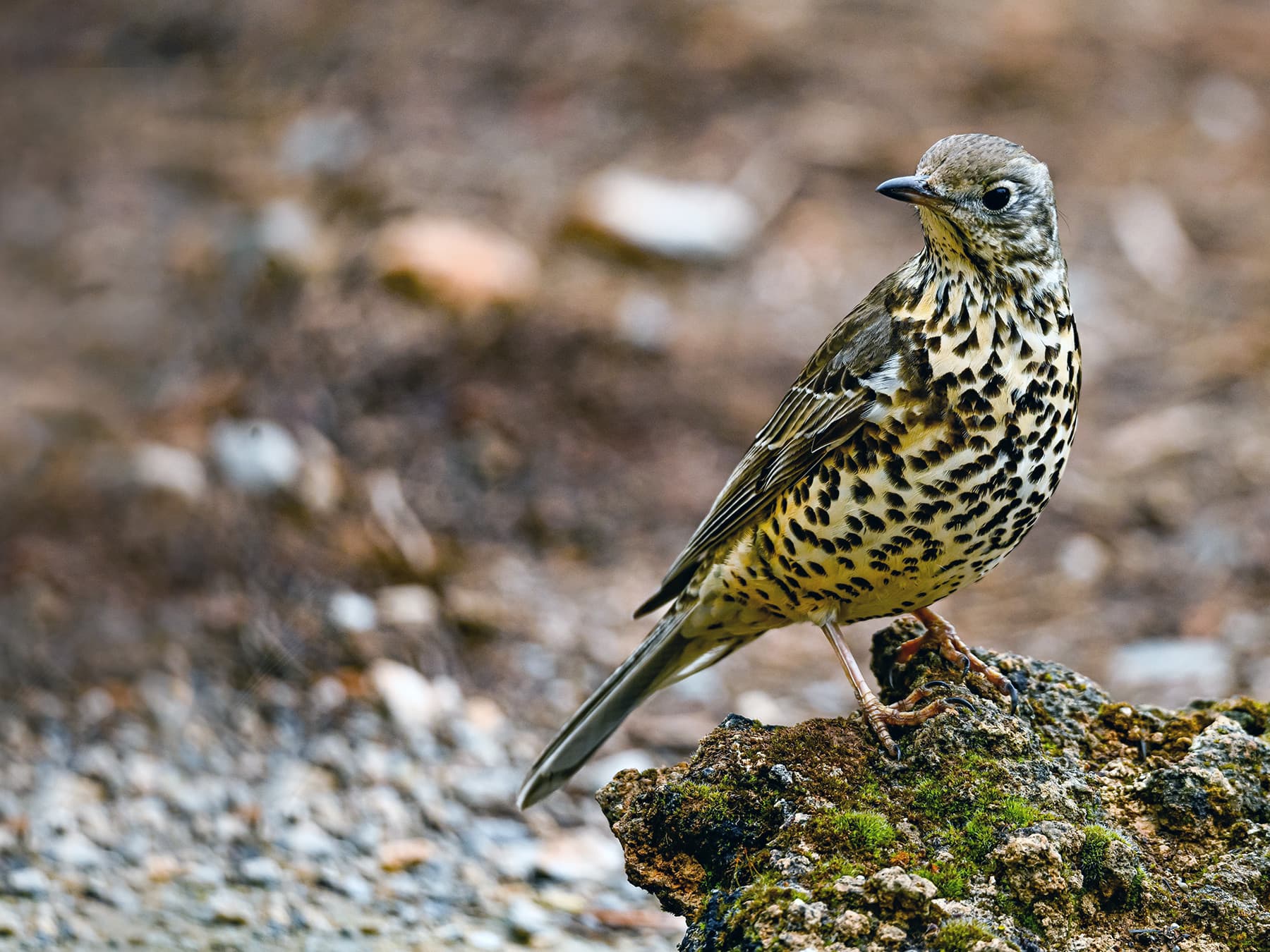
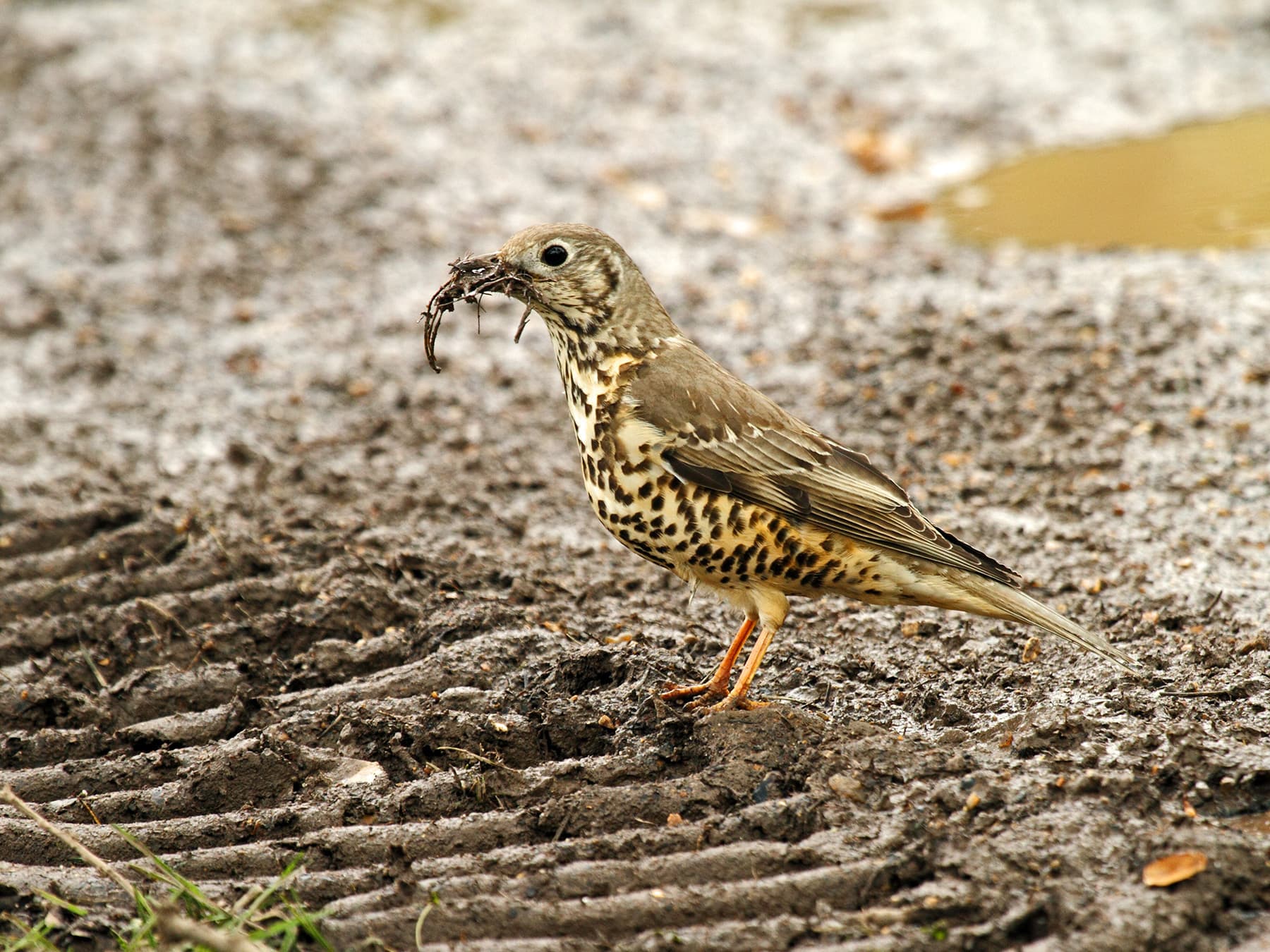
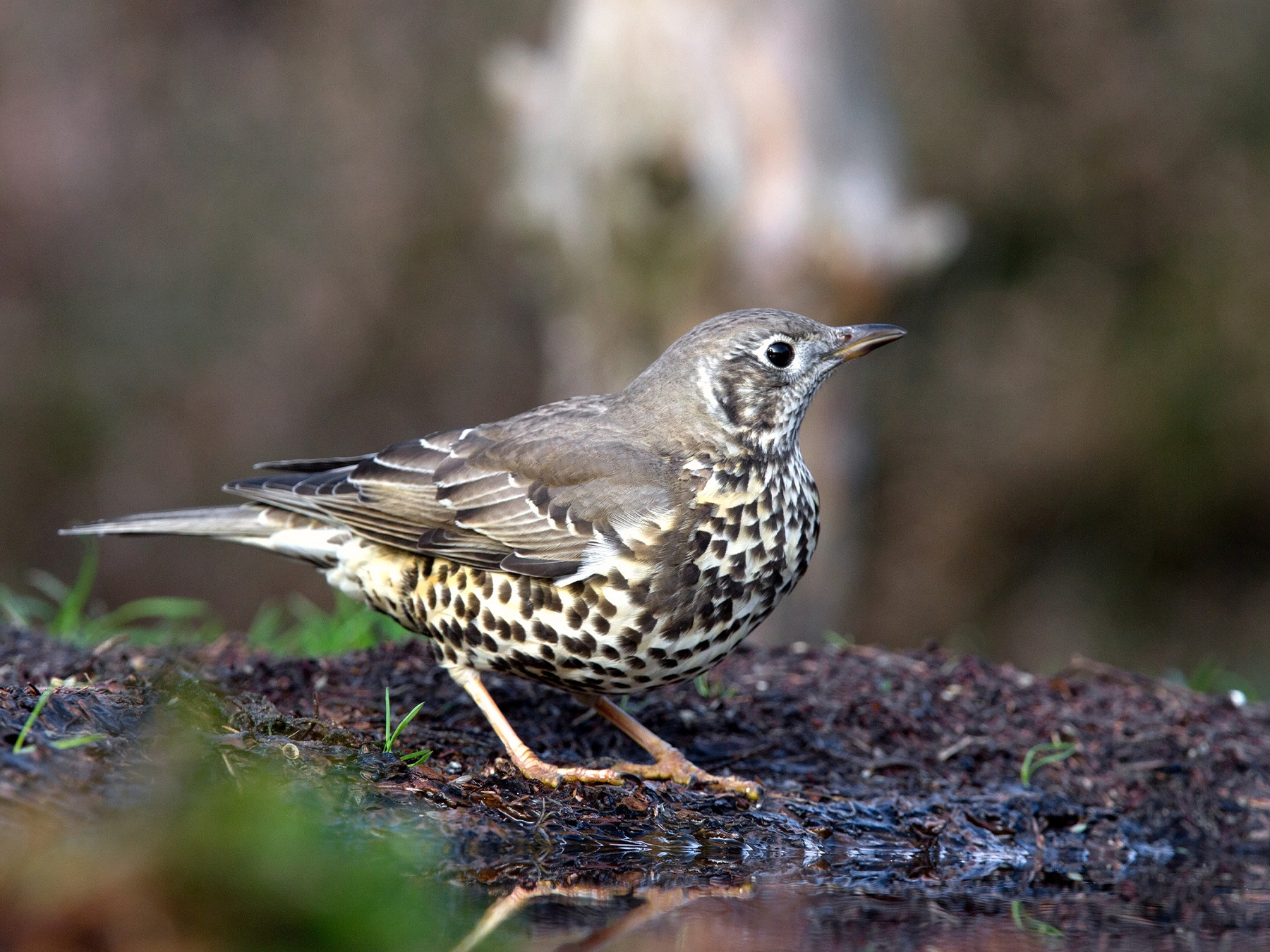
Mistle thrushes are large, stocky thrushes. Their upper parts are greyish-brown and there is a clear white bar on the wings. The underside of the wings is white, which is a key way of identifying the species from the song thrush, which has buffish-orange underwings.
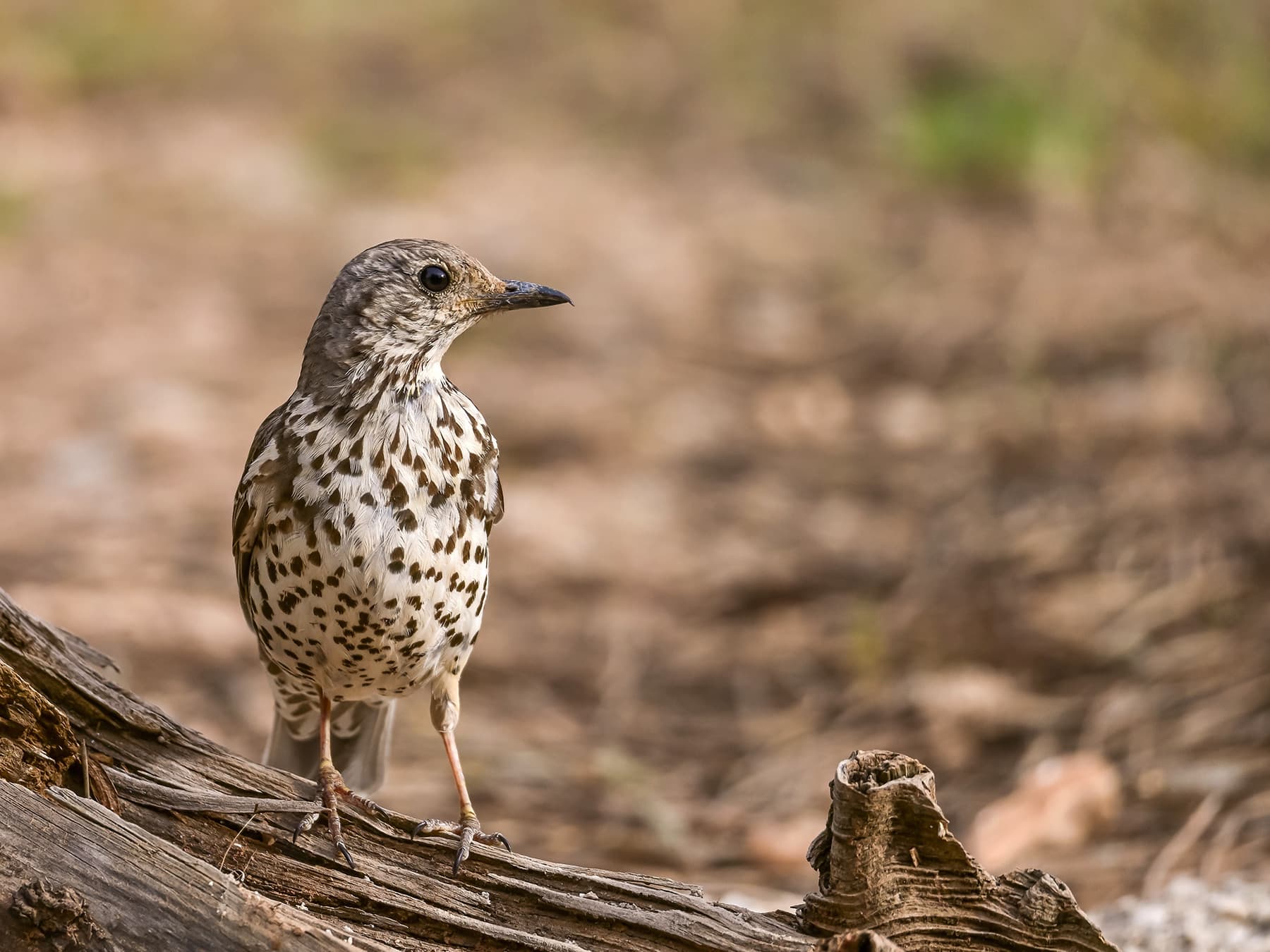
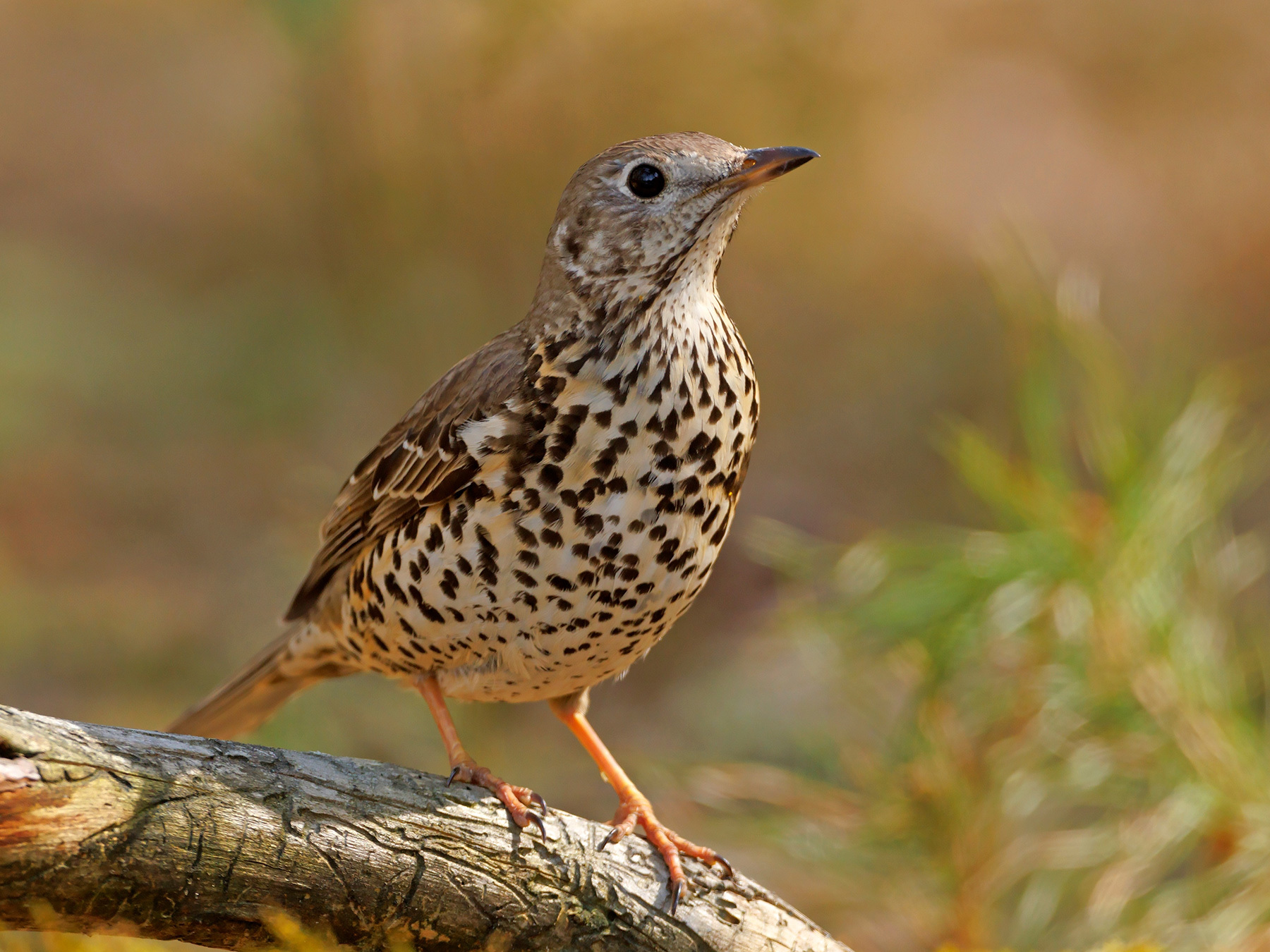
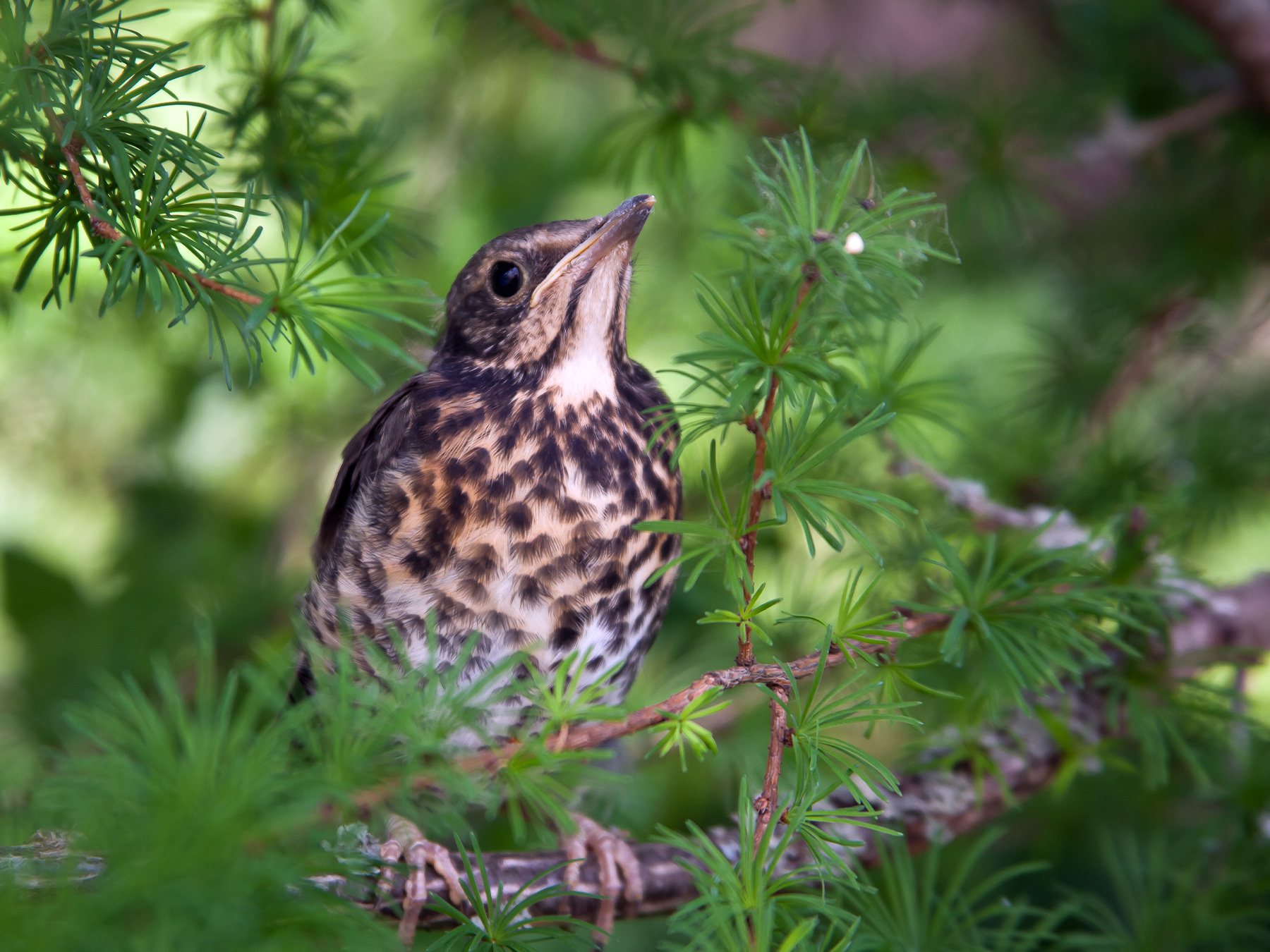
Distinctive black spotting marks a mistle thrush’s white breast and belly. The lower flanks have a pale buff wash, and the undertail is plain white. They have a white throat, with some black speckling, and the face is mainly greyish-brown with a slight white eye ring around the black eye. Legs are yellowish-brown, and the bill is dark grey-brown.
Juveniles are similar to adults, although until they gain their full adult plumage, their head and back are speckled with white spots.
How big are Mistle Thrushes?
Considerably larger in size than the similar redwing and song thrush, mistle thrushes are the biggest and most powerful UK thrush as well as Europe’s largest songbird. Males and females are the same size and weight for this species.
- Length: 27 cm to 29 cm (10.6 in to 11.4 in)
- Wingspan: 42 cm to 48 cm (16.5 in to 18.9 in)
- Weight: 100 g to 150 g (3.5 oz to 5.3 oz)
Its size
Adults- Length
- 26–29 cm
- Wingspan
- 45–50 cm
- Weight
- 93–167 g
Its song and calls
What sound does a Mistle Thrush make?
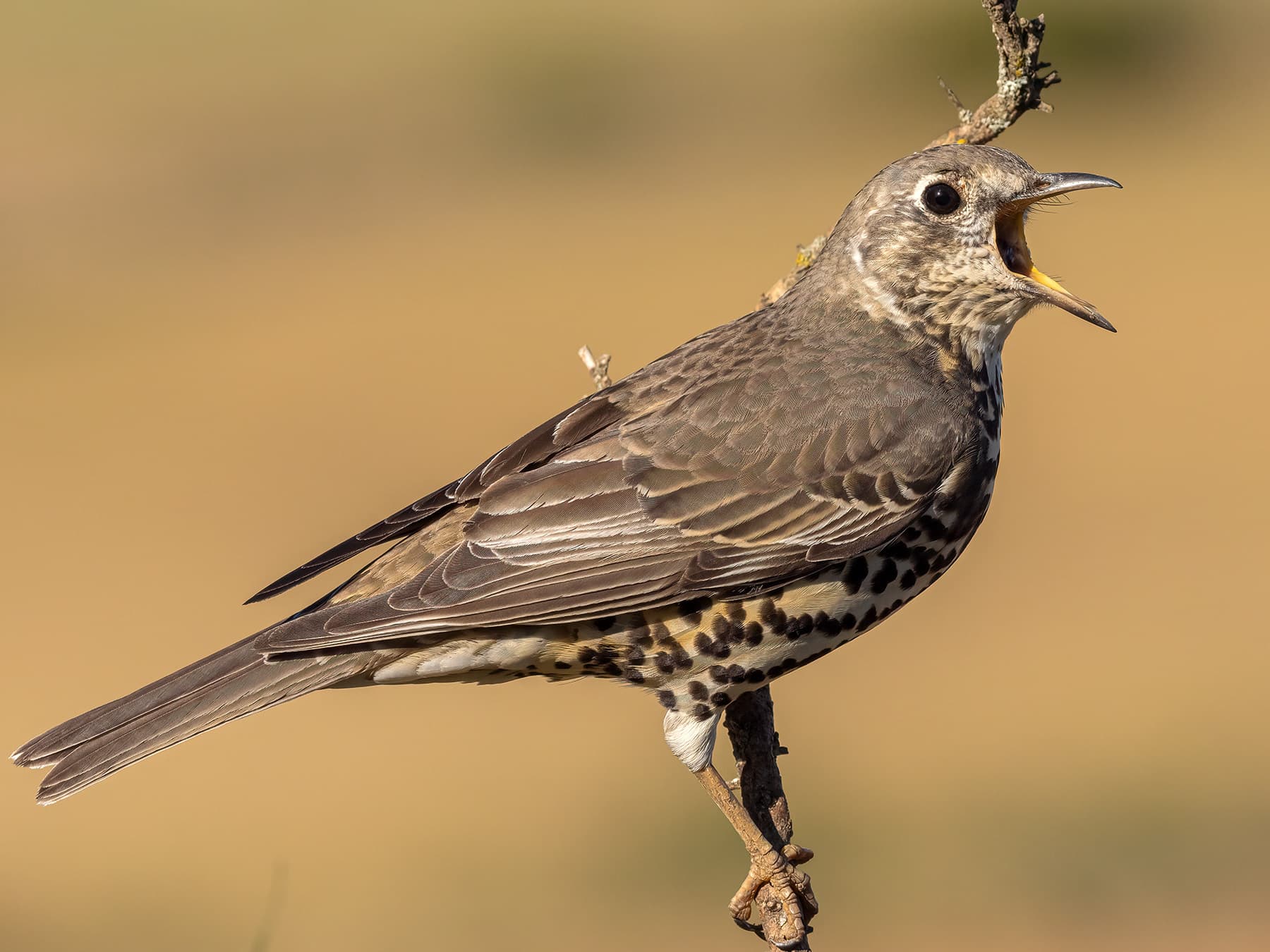
Mistle thrushes have a characteristically loud, fluting song, heard in short bursts as well as long, chattering phrases. A rattling ‘tak-tak-tak’ can be heard when alarmed or warning of nearby threats.
- Song0:00 / 0:19
Recorded in Normandie, France · April 2023
- Call0:00 / 0:31
Recorded in Normandie, France · December 2024
When and where to see it
OctoberArriving
Most recorded in October
- 1. Tipperary3.1%
- 2. Offaly3.0%
- 3. Carlow2.7%
- 4. Kildare2.2%
- 5. Longford2.1%
Each dot is a county, state or province: the bigger and darker, the larger the bird’s share of that place’s bird records that month. Grey dots: no regular records. The ringed point is the centre of the bird’s records this month; the arrow shows how it moved since last month, and the dashed loop its path through the year. “Arrivals” colours places where it becomes regular this month (orange) or is in its last regular month (grey). GBIF eBird Observation Dataset, 2019–2024. Map data: Natural Earth, US Census Bureau; place centres © OpenStreetMap contributors.
In your area
See when the Mistle Thrush is recorded in your county, state or province.
How often the Mistle Thrush turns up in the UK and Ireland through the year, from birdwatchers' records.
United Kingdom
Resident · all year · most records in February
Ireland
Resident · all year · most records in January
Show as a table
| Month | United Kingdom | Ireland |
|---|---|---|
| January | 0.49% (regular) | 0.92% (regular) |
| February | 0.51% (regular) | 0.82% (regular) |
| March | 0.51% (regular) | 0.86% (regular) |
| April | 0.48% (regular) | 0.91% (regular) |
| May | 0.41% (regular) | 0.76% (regular) |
| June | 0.32% (regular) | 0.53% (regular) |
| July | 0.18% (regular) | 0.25% (regular) |
| August | 0.12% (regular) | 0.15% (regular) |
| September | 0.17% (regular) | 0.25% (regular) |
| October | 0.36% (regular) | 0.55% (regular) |
| November | 0.46% (regular) | 0.80% (regular) |
| December | 0.47% (regular) | 0.86% (regular) |
Recorded regularly in
Worldwide: recorded regularly in 65 countries
Countries where it was recorded in at least 3 of the 6 years 2019–2024. Linked countries have their own bird list.
Europe (44)
- Åland Islands
- Albania
- Andorra
- Austria
- Belarus
- Belgium
- Bosnia & Herzegovina
- Bulgaria
- Croatia
- Czechia
- Denmark
- Estonia
- Finland
- France
- Germany
- Greece
- Hungary
- Iceland
- Ireland
- Isle of Man
- Italy
- Jersey
- Kosovo
- Latvia
- Liechtenstein
- Lithuania
- Luxembourg
- Moldova
- Montenegro
- Netherlands
- North Macedonia
- Norway
- Poland
- Portugal
- Romania
- Russia
- Serbia
- Slovakia
- Slovenia
- Spain
- Sweden
- Switzerland
- Ukraine
- United Kingdom
Asia (18)
- Armenia
- Azerbaijan
- China
- Cyprus
- Georgia
- India
- Iran
- Israel
- Kazakhstan
- Kuwait
- Kyrgyzstan
- Lebanon
- Mongolia
- Nepal
- Palestinian Territories
- Tajikistan
- Turkey
- Uzbekistan
Data: EOD – eBird Observation Dataset (Cornell Lab of Ornithology), accessed via GBIF.org, CC BY 4.0. Records from 2019–2024, aggregated and filtered by Birdfact. How these lists are made
What is the habitat of a Mistle Thrush?
Open woodland, parks, and mature gardens are the preferred habitats of mistle thrushes, including expanses of rolling landscapes with scattered tree cover. Hilly country, with low, craggy slopes, is popular, as well as farmland and scrub, rich in berry bushes and upland orchards and mixed forests.
What is the range of a Mistle Thrush?
Mistle thrushes are year-round residents across much of central Europe, from the UK and Portugal in the west, through France, Germany, Italy, and Greece to Turkey, and into Iran, Turkmenistan and Uzbekistan. Parts of North Africa (Morocco, Algeria and Tunisia) also have resident populations.
To the north of this range, breeding mistle thrushes can be found across Denmark, Sweden, Finland, Poland, the Baltic States, and through eastern Europe into Russia as far as western Mongolia. Once breeding is complete, these populations shift southwards into Europe and Central Asia.
Where do Mistle Thrushes live?
The global population of mistle thrushes is estimated at between 13.75 and 29.8 million, of which around 60 percent (up to 17.9 million individuals) live in Europe. Spain, Turkey, and Russia are among the leading strongholds of the species, with local declines reported in Ukraine, Estonia, Italy, and northern Italy since the 1980s.
How rare are Mistle Thrushes?
Less common and widespread than song thrushes, there are around 165,000 breeding pairs of mistle thrushes in the UK. Numbers have declined significantly since the 1990s, but the species continues to be relatively common, particularly in winter and spring. Later in the year, once the final broods of the season have fledged, small groups may gather.
Where can you see Mistle Thrushes in the UK?
Mistle thrushes are widespread throughout the UK all year round and are only absent from extremely remote areas in the Scottish Highlands and the Outer Hebrides. Areas with large trees and short grasslands are the most likely spots for a sighting during the breeding season.
Migration
Do Mistle Thrushes migrate?
In much of their distribution range, mistle thrushes are resident all year round. Populations in the regions furthest north, for example, Scandinavia, eastern Europe, and Russia, arrive on their breeding grounds each spring and migrate south once colder weather arrives as autumn approaches.
Are Mistle Thrushes native to the UK?
Mistle thrushes are found throughout the UK, with the exception of the far northern Highlands of Scotland and its offshore islands in the north-west. During winter, the UK’s resident population of mistle thrushes increases with an influx of migrants from Scandinavian breeding grounds.
Tips for seeing it
- Look for Mistle Thrushes in open woodlands, parks, and large gardens
- Listen for their distinctive rattling call, often given from treetops
- Observe their aggressive behaviour when defending food sources
- In the UK, watch for them singing from high perches, even in stormy weather
What it eats
What do Mistle Thrushes eat?
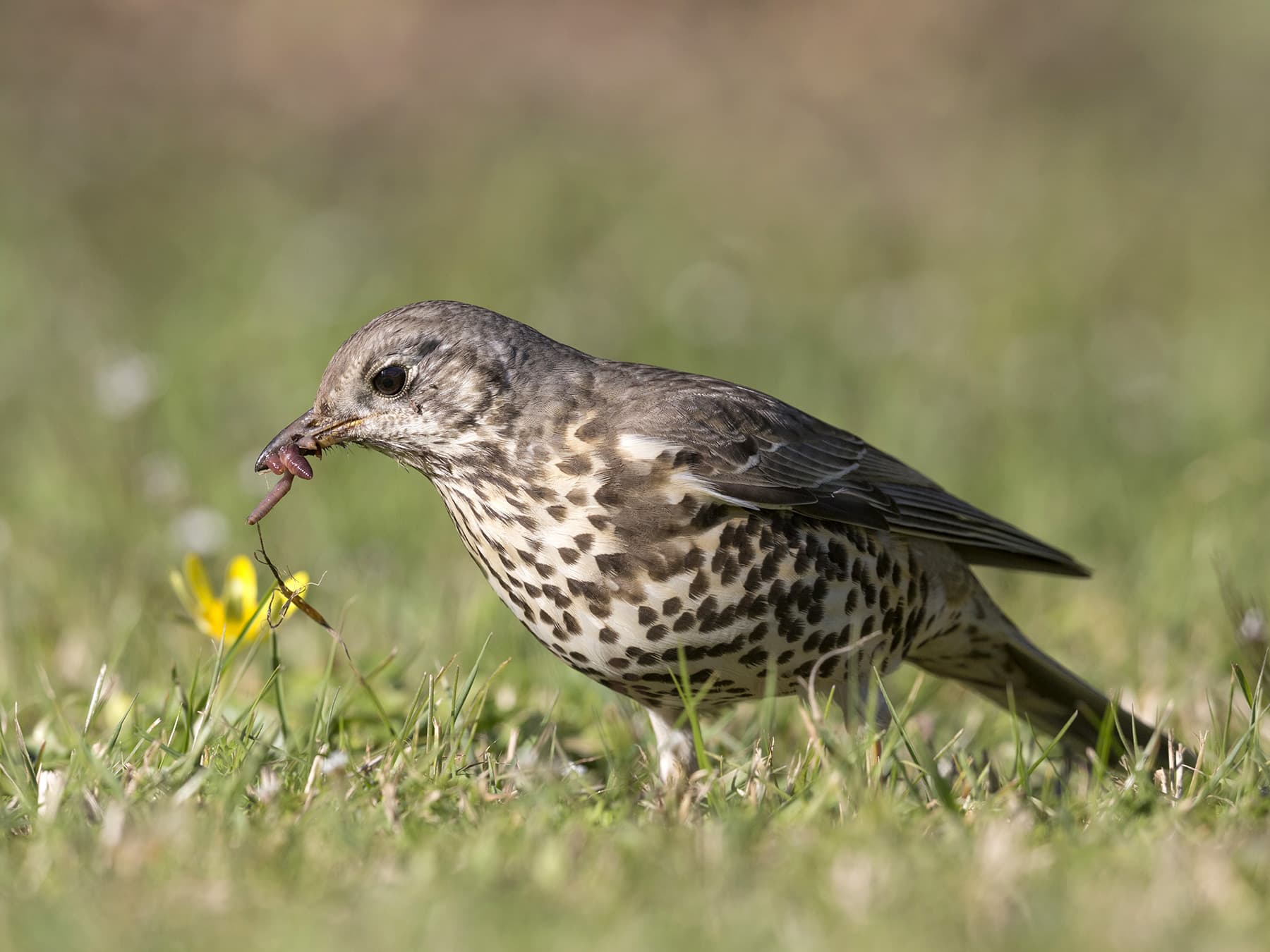
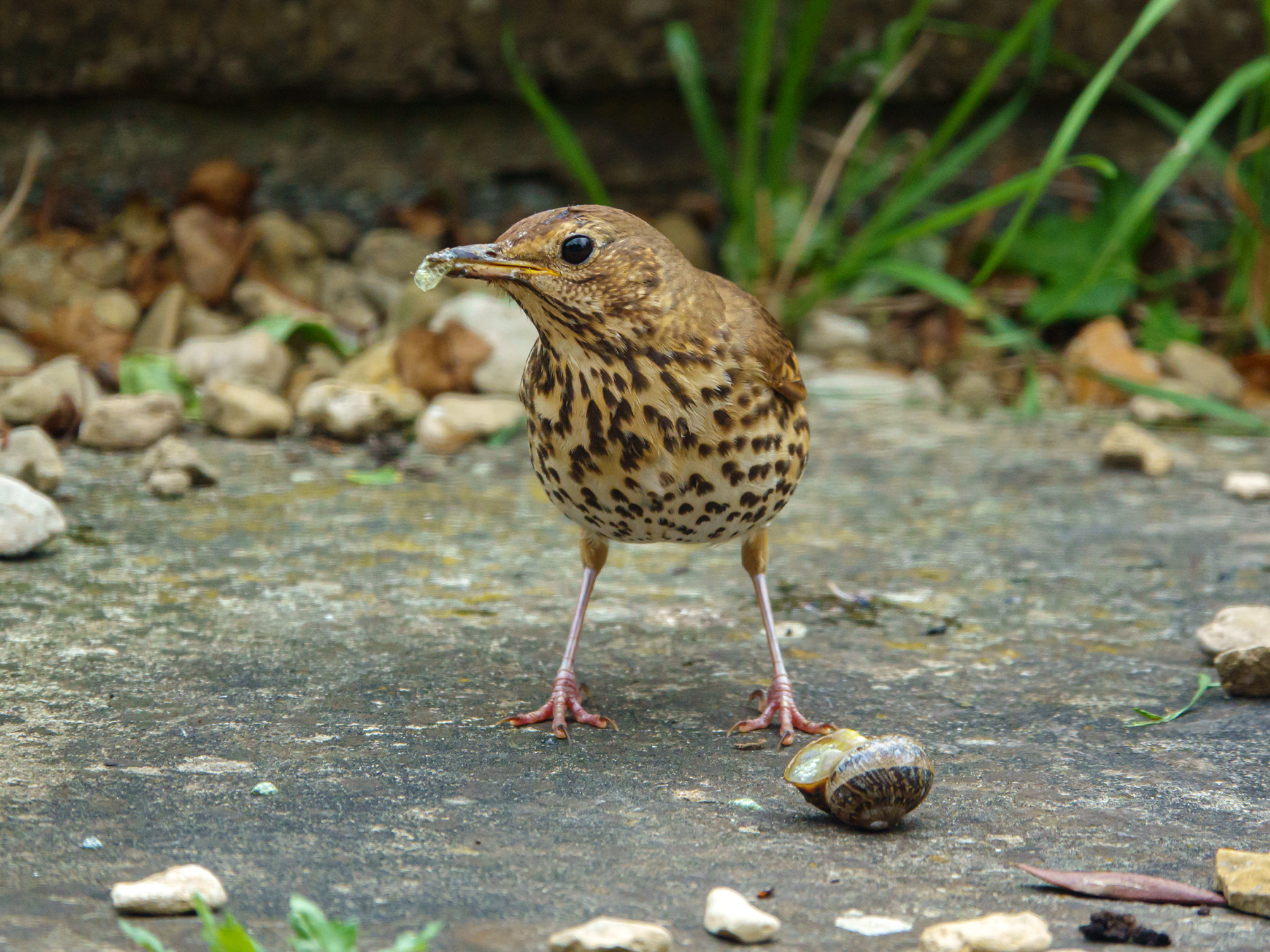
The diet of mistle thrushes is varied, consisting of invertebrates, fruit and berries. Worms, slugs, insects and their larvae, molluscs, and spiders are among the most common animal prey, although during the breeding season larger animals, including slowworms, and young of other birds may be caught and fed to their young.
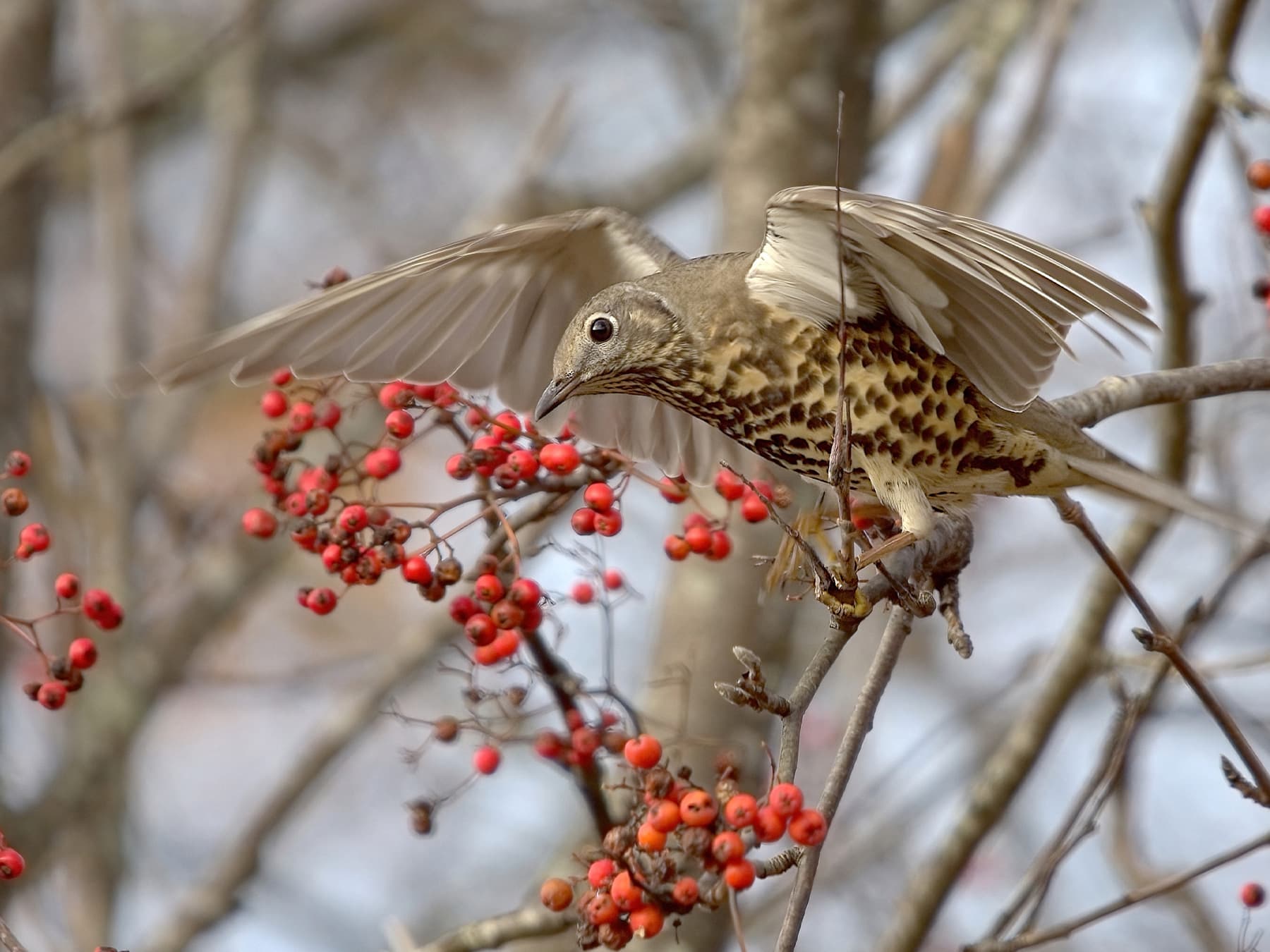
Mistletoe berries are popular, as well as rowan and holly, yew, and hawthorn, and mistle thrushes are aggressive defenders of berry trees in winter, driving other thrushes away from their feeding territories.
What do Mistle Thrush chicks eat?
Young mistle thrushes are fed on invertebrates, particularly those collected from low foliage and bushes, including beetles, worms and larvae. Occasionally nesting mistle thrushes will kill young dunnocks, blackbirds, and song thrushes to feed to their babies. Both parents feed the young.
Nesting and breeding
Where do Mistle Thrushes nest?
Mistle thrush nests are usually built between 2 m and 10 m (7 ft to 30 ft) above ground, in the upper forked branches of trees, particularly pine, juniper, and holm oak. Nests are largely woven cups, crafted from grasses, stems, and moss, held in shape by mud, and lined with pine needles and soft grasses.
When do Mistle Thrushes nest?
One of the earliest songbirds to nest each year, mistle thrushes may lay their first clutch of the season in February, although more commonly in March or early April. Up to three broods are raised in a typical year. Incubation, which lasts between 12 and 15 days, is the sole responsibility of the female.
Fledging takes place after 14 to 16 days, followed by a period of continuing care outside of the nest. By this stage, the female has usually begun incubating her next clutch of eggs, so the care of juveniles falls to the male.
What do Mistle Thrush eggs look like?
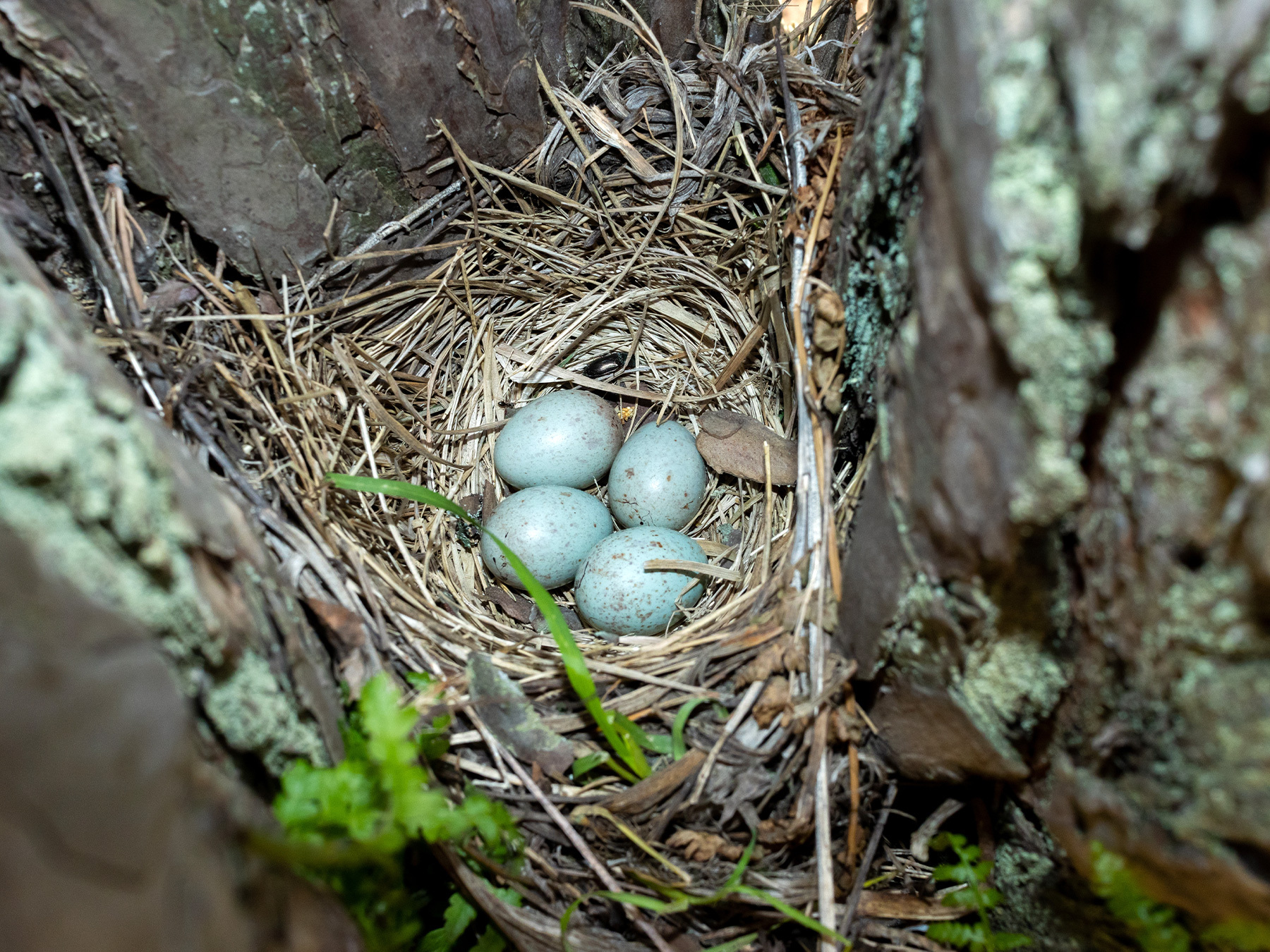
A typical mistle thrush clutch contains between 2 and 5 pale blue to green eggs, marked with purple or reddish speckling. Eggs measure 30 mm by 22 mm (1.2 in by 0.9 in).
Do Mistle Thrushes mate for life?
Mistle thrushes are seasonally monogamous, pairing at the start of the breeding season and raising up to three broods together in a year. Once breeding is complete, the pair bond dissolves and a different mate is found the following season.
Behaviour
Are Mistle Thrushes aggressive?
Mistle thrushes have a reputation as being aggressive and intolerant of other birds in close proximity. This is particularly observed in the breeding period and during winter when they defend a feeding territory around berry trees and will chase off intruders rather than share access to food.
Aggression is shown both vocally and physically, with a heightened alert call, posturing, and physical confrontations.
Where do Mistle Thrushes sleep at night?
Overnight roosting is in pairs or individually in bushes or trees. Later in the autumn, small family groups may roost together.
Lifespan and predators
How long do Mistle Thrushes live?
On average, mistle thrushes live for around 3 years, breeding for the first time at the age of one. Occasional records of much older individual birds are identified through ringing schemes, including one that reached 11 years and 4 months.
What are the predators of Mistle Thrushes?
Cats, corvids, foxes, and birds of prey are among the chief threats to mistle thrushes and their eggs and young. Tawny owls, sparrowhawks, and red kites are among the most successful predators, as mistle thrushes are a particularly aggressive defender of their nests and will fearlessly attack potential intruders, even humans.
Are Mistle Thrushes protected?
The UK’s mistle thrushes are protected by the Wildlife and Countryside Act, 1981. This legislation makes it an offence to knowingly kill, injure or take an individual of this species into captivity.
Are Mistle Thrushes endangered?
While globally mistle thrushes are categorised as a species of least concern, in the UK they were initially upgraded from Green to Amber status on the British Birds of Conservation Concern list in 2002 due to declines in the local population. By 2015, this status was changed again to Red, as the situation worsened and numbers continued to fall.
Deforestation and a decrease in available insect populations are believed to be key factors in this fall.
Conservation
While listed as Least Concern globally, Mistle Thrush populations have declined in some areas, particularly in the UK. Habitat loss and changes in agricultural practices are potential threats. Conservation efforts focus on maintaining suitable woodland and parkland habitats.
Similar birds
Often mistaken for
More photos
6 photos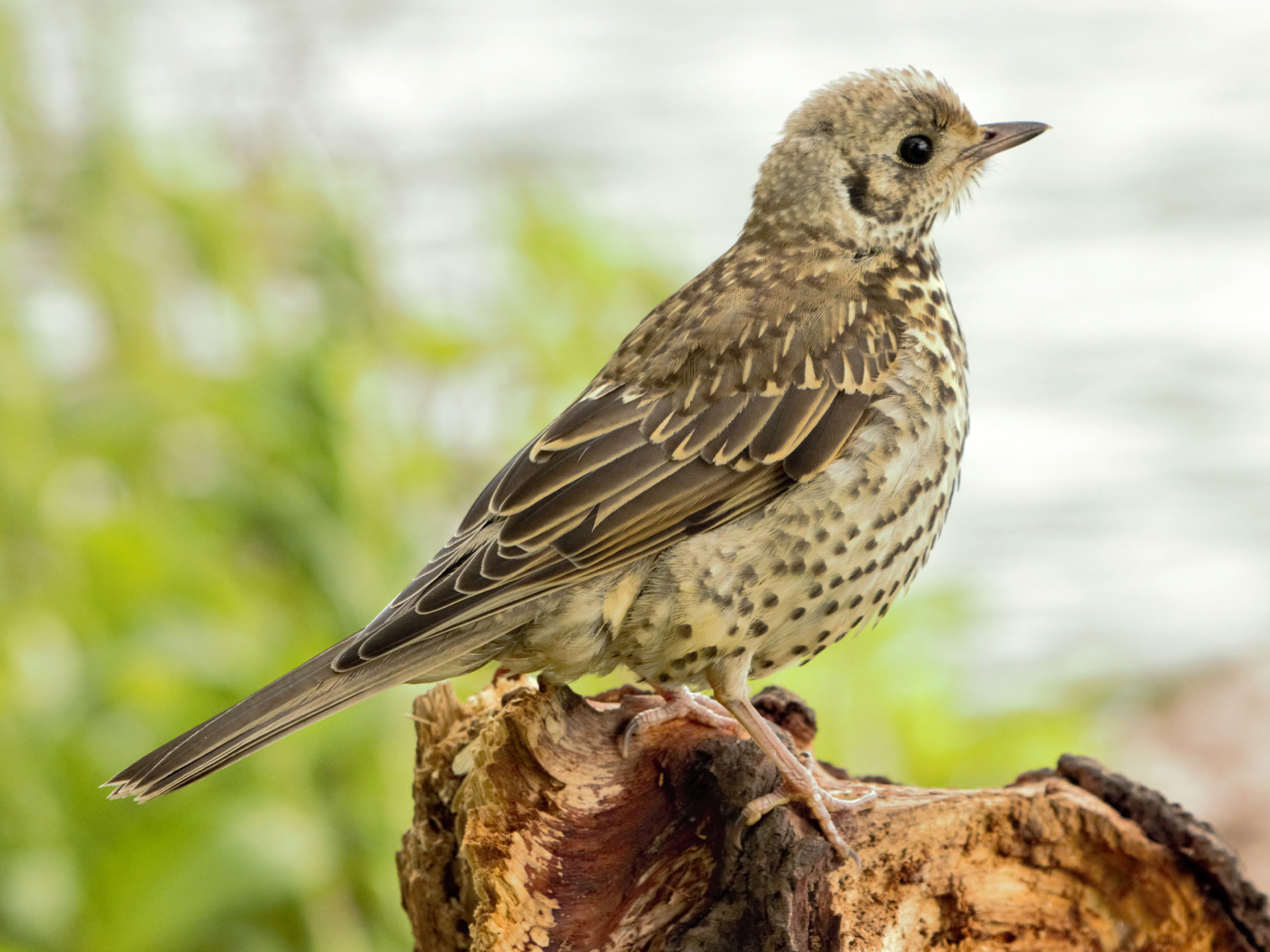
Mistle Thrush guides
3 guidesQuick facts
- Length
- 26–29 cm
- Wingspan
- 45–50 cm
- Weight
- 93–167 g
- Lifespan
- 3–5 years · oldest recorded 11.3 years
- Family
- Thrushes
- Migration
- Partial migrant
- Global status (IUCN)
- Least Concern
- World population
- 13,750,000 - 29,800,000 mature individuals
- Population trend
- Decreasing
- Also called
- Stormcock
- Scientific name
- Turdus viscivorus
Questions
1Why is a Mistle Thrush called a Stormcock?
The ‘stormcock’ is just one of many nicknames by which the mistle thrush is known. This particular name comes from its tendency to continue singing at the top of its voice even in the wettest, windiest weather.
Other names include 'Jeremy Joy' because it sings early in the year (thought to be a play on the phrase ‘January joy’) and ‘Big Mavis’, an old English dialect word for a thrush.
Sources
4- 1BirdLife International. 2016. Turdus viscivorus. The IUCN Red List of Threatened Species 2016: e.T22708829A87878799. Source (opens in a new tab)
- 2EBCC (2015)
- 3BirdLife International. 2016. Turdus viscivorus. The IUCN Red List of Threatened Species 2016: e.T22708829A87878799. Source (opens in a new tab)
- 4BTO longevity records: maximum age from a ringed bird, 11 years, 4 months, 9 days (set in 1982), BirdFacts: Mistle Thrush (1982) Source (opens in a new tab)

Checked by
Nathan Cope, founder and editor
Nathan founded Birdfact and leads its writers and contributors in the UK, the US and Canada. He has watched and studied birds for more than ten years, and checks every article and species guide before it’s published.