


Fieldfare
Felty-fare, Felty-bird · Turdus pilaris
By the Birdfact teamChecked by Nathan Cope
On this page21 sections
- How to recognise it
- Its size
- Its song and calls
- When and where to see it
- What it eats
- Nesting and breeding
- Behaviour
- Lifespan and predators
- Conservation
- What does a Fieldfare look like?
- How big is a Fieldfare?
- How much does a Fieldfare weigh?
- What is the scientific name of a Fieldfare?
- Are Fieldfares aggressive or friendly?
- Are Fieldfares endangered?
- Do Fieldfares mate for life?
- When do Fieldfares arrive in Britain?
- Similar birds
- Fieldfare guides
- Quick facts
- Sources
How to recognise it
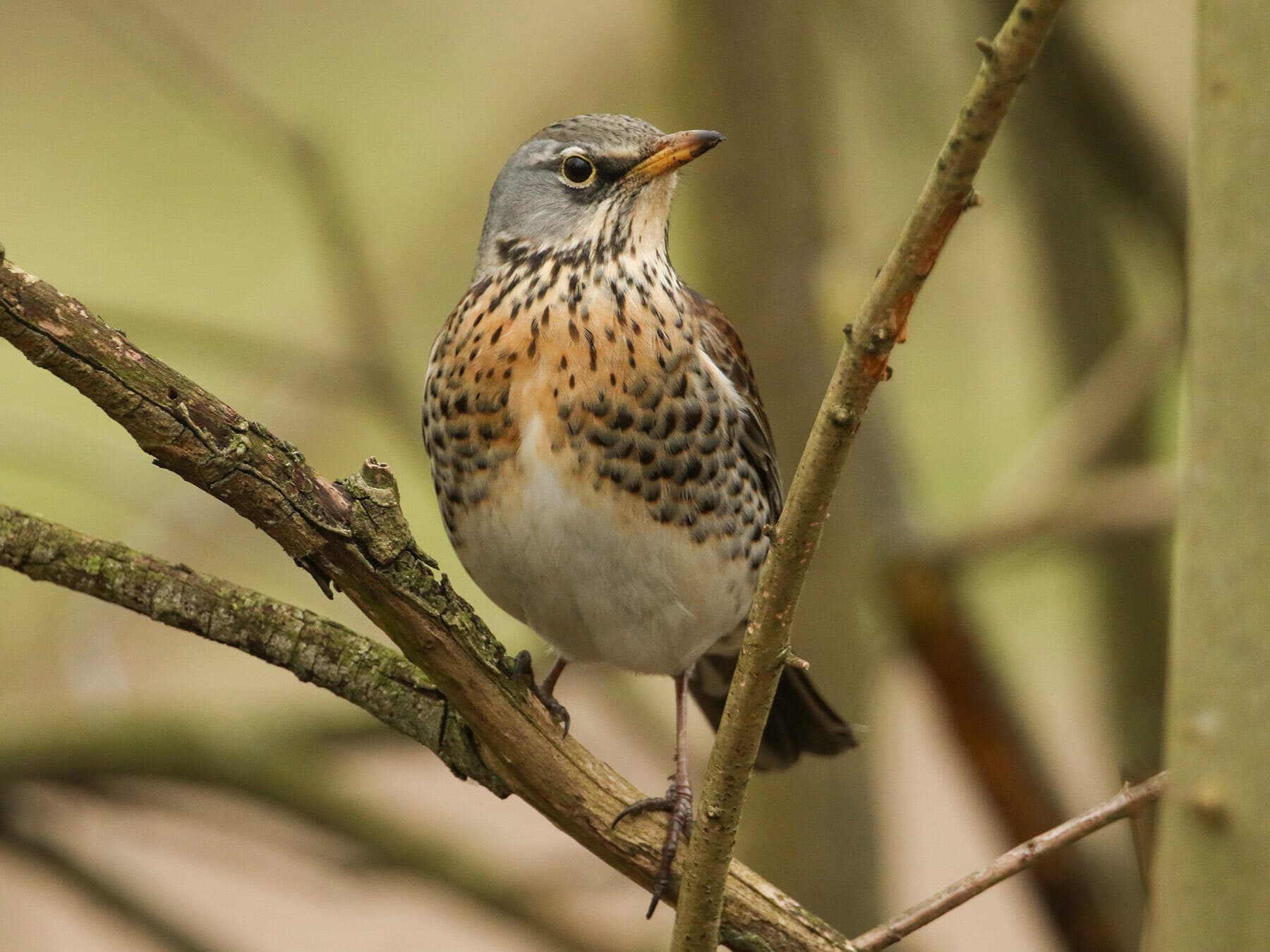
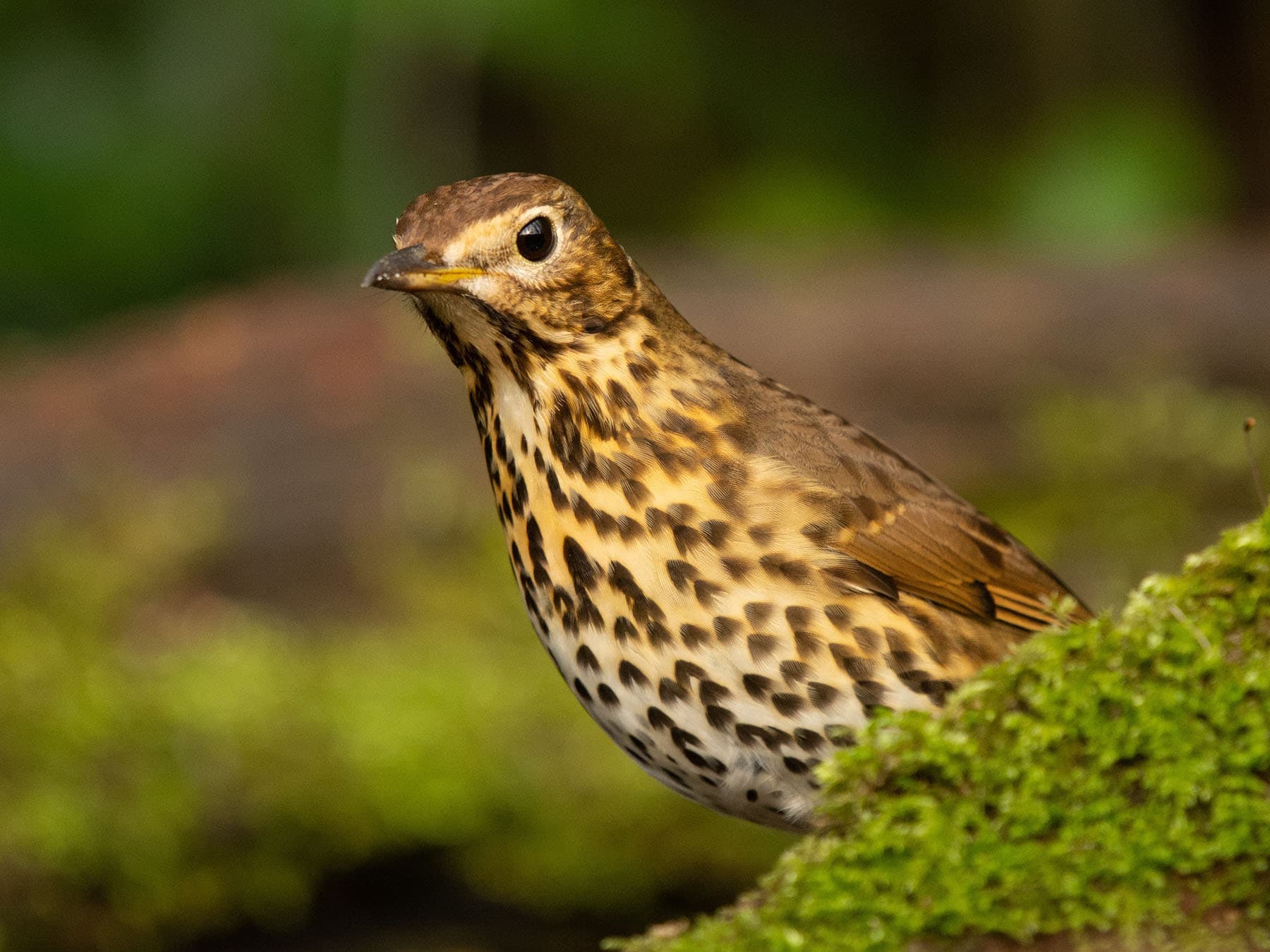
The Fieldfare is a robust thrush with distinctive grey plumage on its head and rump, contrasting with chestnut-brown wings and back. Its breast is heavily spotted with black, fading to a white belly. The bird has a yellow bill with a dark tip and brown legs.
Both sexes look similar, with juveniles showing a more mottled appearance and less defined head colouration. In winter, the bill darkens to a brownish-yellow.
Its size
Adults- Length
- 22–27 cm
- Wingspan
- 39–42 cm
- Weight
- 80–130 g
Its song and calls
Being a gregarious species the fieldfare is also fairly vocal and has a distinctive and characteristic flight call of ‘chak – chak – chak’, like a chuckling sound, particularly when flocking with other fieldfares.
It is not known as a spectacular songster, in fact quite the opposite and during the breeding season adult males will frequently be heard uttering a wheezing, chattering, whistling, unmusical symphony of squeaks and warbles in an attempt to attract a mate. If alarmed the bird will warn others with a ‘trt – trt – trrrt’ call.
- Song0:00 / 0:34
Recorded in Troms og Finnmark, Norway · May 2023
- Call0:00 / 0:15
Recorded in Normandie, France · November 2024
When and where to see it
OctoberArriving
Most recorded in October
- 1. Offaly1.7%
- 2. Antrim0.83%
- 3. Clackmannanshire0.70%
- 4. Shropshire0.68%
- 5. Herefordshire0.67%
Each dot is a county, state or province: the bigger and darker, the larger the bird’s share of that place’s bird records that month. Grey dots: no regular records. The ringed point is the centre of the bird’s records this month; the arrow shows how it moved since last month, and the dashed loop its path through the year. “Arrivals” colours places where it becomes regular this month (orange) or is in its last regular month (grey). GBIF eBird Observation Dataset, 2019–2024. Map data: Natural Earth, US Census Bureau; place centres © OpenStreetMap contributors.
In your area
See when the Fieldfare is recorded in your county, state or province.
How often the Fieldfare turns up in the UK, Ireland and Canada through the year, from birdwatchers' records.
United Kingdom
Winter visitor · regularly Oct–Apr · most records in November
Ireland
Winter visitor · regularly Oct–Mar · most records in December
Canada
Passage migrant · regularly Jan · most records in January
Show as a table
| Month | United Kingdom | Ireland | Canada |
|---|---|---|---|
| January | 0.72% (regular) | 0.40% (regular) | 0.007% (regular) |
| February | 0.49% (regular) | 0.26% (regular) | <0.001% |
| March | 0.28% (regular) | 0.13% (regular) | <0.001% |
| April | 0.080% (regular) | 0.015% | <0.001% |
| May | 0.007% | 0.010% | – |
| June | <0.001% | – | – |
| July | <0.001% | – | – |
| August | <0.001% | – | – |
| September | 0.005% | – | – |
| October | 0.32% (regular) | 0.058% (regular) | – |
| November | 0.81% (regular) | 0.31% (regular) | 0.001% |
| December | 0.78% (regular) | 0.44% (regular) | 0.003% |
Recorded regularly in
Worldwide: recorded regularly in 56 countries
Countries where it was recorded in at least 3 of the 6 years 2019–2024. Linked countries have their own bird list.
Europe (42)
- Åland Islands
- Austria
- Belarus
- Belgium
- Bosnia & Herzegovina
- Bulgaria
- Croatia
- Czechia
- Denmark
- Estonia
- Faroe Islands
- Finland
- France
- Germany
- Greece
- Hungary
- Iceland
- Ireland
- Isle of Man
- Italy
- Jersey
- Kosovo
- Latvia
- Liechtenstein
- Lithuania
- Luxembourg
- Moldova
- Montenegro
- Netherlands
- Norway
- Poland
- Portugal
- Romania
- Russia
- Serbia
- Slovakia
- Slovenia
- Spain
- Sweden
- Switzerland
- Ukraine
- United Kingdom
Asia (13)
- Armenia
- Azerbaijan
- China
- Cyprus
- Georgia
- Iran
- Israel
- Japan
- Kazakhstan
- Kyrgyzstan
- Mongolia
- Palestinian Territories
- Turkey
North America (1)
Data: EOD – eBird Observation Dataset (Cornell Lab of Ornithology), accessed via GBIF.org, CC BY 4.0. Records from 2019–2024, aggregated and filtered by Birdfact. How these lists are made
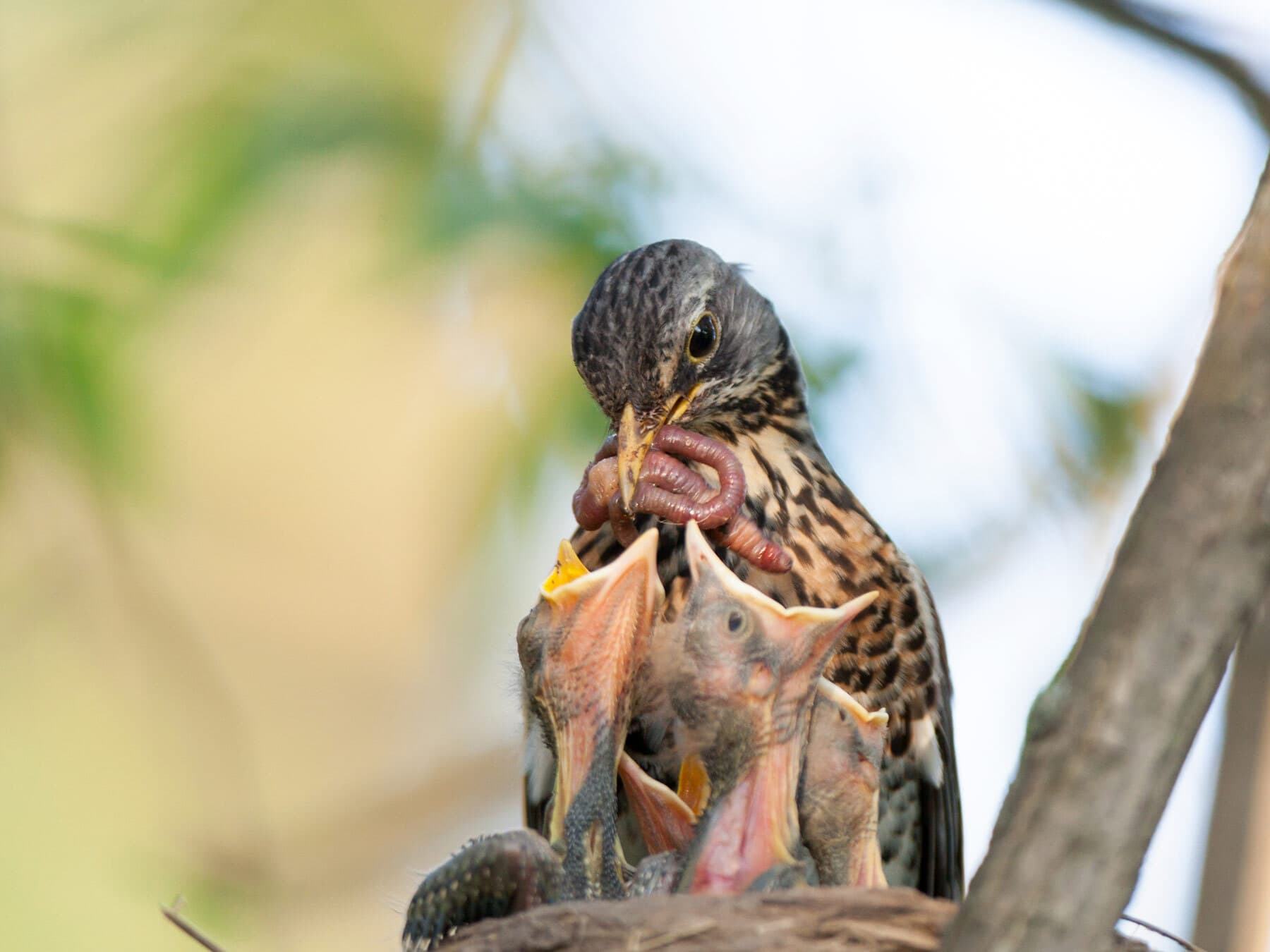
Fieldfares generally nest in trees or bushes although occasionally they will build their nests directly on the ground. Nests are normally built in situ and are constructed from small roots and twigs, leaves, grasses, lichen and moss. They are cup-shaped and cemented together using mud, with the interior being lined with animal hair, down and fine vegetation.
Often nests are built in small colonies amongst other breeding fieldfares although there is usually a minimum distance of 5 metres (16 feet) between each nest. Colonies offer protection and can minimise chick mortality rates due to predation.
What is the habitat of a Fieldfare?
Fieldfares are, in the main, a European bird and can be found in their year-round and breeding areas across north and central Europe including Scandinavia and eastwards through Russia to central and southern Siberia, northern Kazakhstan and the Altai Mountains at the borders of Kazakhstan with China, Mongolia and Russia.
Many, but by no means all fieldfares over winter in southwestern Asia, north Africa and southern and western Europe including the United Kingdom.
Typically, fieldfares live in what is best described as a mixed habitat consisting of partly open and partly wooded countryside where grasslands are favoured for foraging and woods and boreal forests for roosting and breeding.
Although they venture into high latitudes during the summer months they rarely venture above the tree line and during winter they tend to choose open lowland areas of arable and pasture land surrounded by hedges and in close proximity to trees and orchards.
Where can I see Fieldfares?
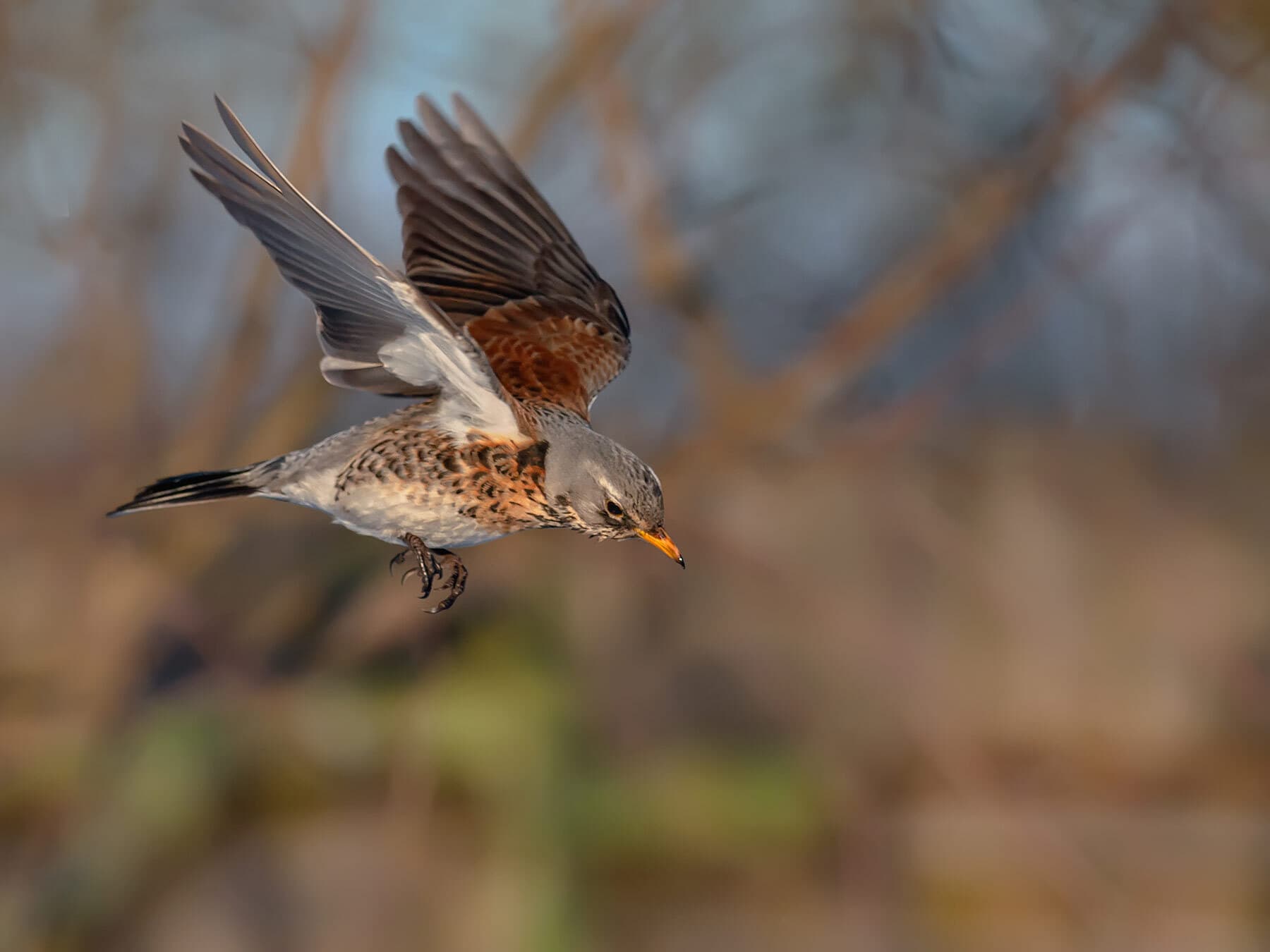
Fieldfares tend to flock in numbers up to several hundred birds, particularly during the winter months and can easily be identified and spotted either in flight or whilst feeding in open fields and pastures (they very much favour hawthorn hedgerows).
They are easy to recognise on the ground due to their upright and proud stance with head held high as they hop quickly about their business. In particularly harsh winters they will venture into gardens and parks and even forage for molluscs along the seashore.
Do Fieldfares migrate?
Not all fieldfares migrate but many do. Those that breed within Scandinavia and across north, central and eastern Russia migrate south whilst those from central Europe generally remain where they are year-round. The United Kingdom attracts its migrant Fieldfares predominantly from Scandinavia.
Tips for seeing it
- Look for large flocks in open fields during winter
- Listen for their distinctive 'chack-chack' alarm call
- Observe their habit of suddenly flying up from the ground when disturbed
- In the UK, check berry-laden trees and hedgerows in autumn and winter
What it eats
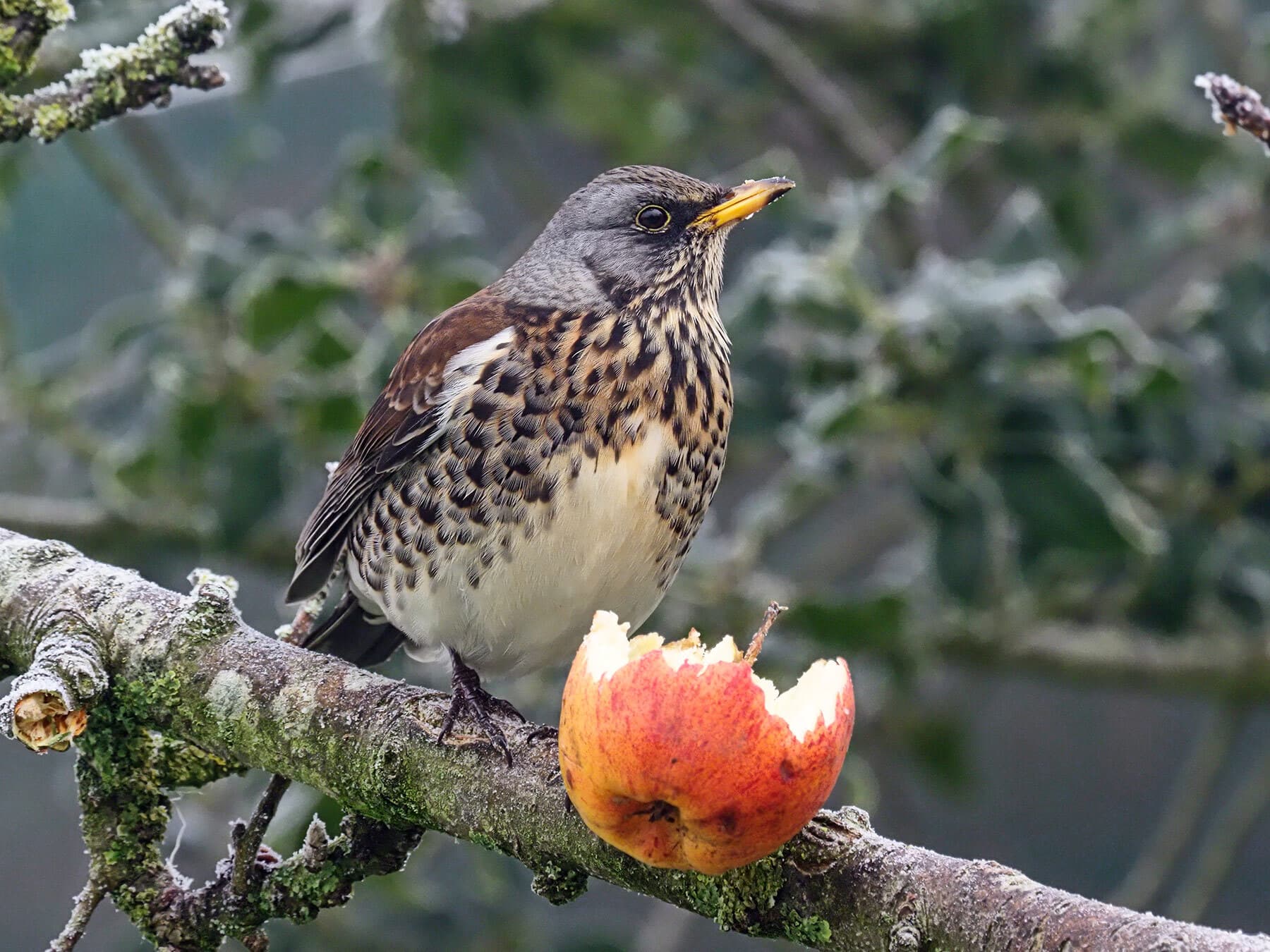
Depending upon the season and what is available, the preferred diet of fieldfares consists of worms, slugs, snails, insects and grubs. During harsh winter months when the ground freezes and worms and grubs are deep in the ground and difficult to forage then the fieldfare’s diet changes to a vegetarian one with berries, seeds and fruits used as sustenance, often taken directly from hedges, trees and bushes although windfall apples are also a favourite.
Nesting and breeding
During the breeding season from late April through to August, females will lay one or two clutches of 3 to 7 eggs (normally 5 or 6). The female alone incubates the eggs for between ten days and two weeks whilst fledging occurs up to fifteen days after hatching. Both parents feed the young and continue to do so for approximately one month.
What do Fieldfare eggs look like?
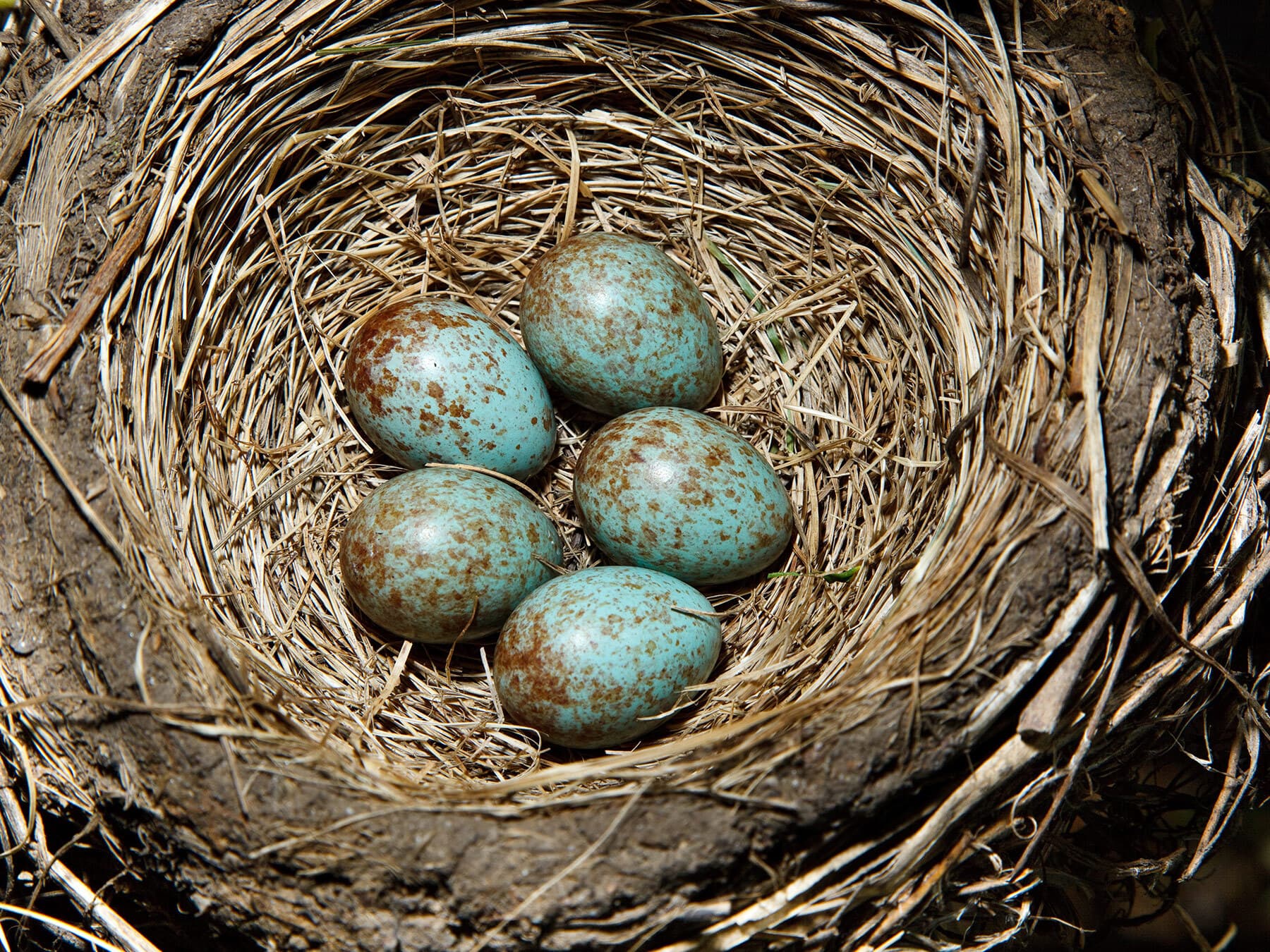
Fieldfare eggs are glossy and smooth in texture and normally coloured pale blue with rufous speckles or blotches and could easily be mistaken as coming from a Eurasian Blackbird. Alternatively, some eggs are bright blue in colour and can be rufous marked as previously described or simply plain blue. The eggs range in size from 33.5 x 24.5 cm down to 29 x 21 cm.
Behaviour
Fieldfares are highly social birds, often seen in large flocks during winter. They forage on the ground, hopping and running in search of food.
When alarmed, they give a characteristic 'chack-chack' call and fly off together, displaying their white underwings.
Lifespan and predators
The expected lifespan of a fieldfare is between five to ten years.
Conservation
While the Fieldfare is currently listed as Least Concern, it faces threats from habitat loss due to agricultural intensification and climate change. Conservation efforts focus on maintaining suitable breeding habitats and protecting important European wintering grounds.
What does a Fieldfare look like?
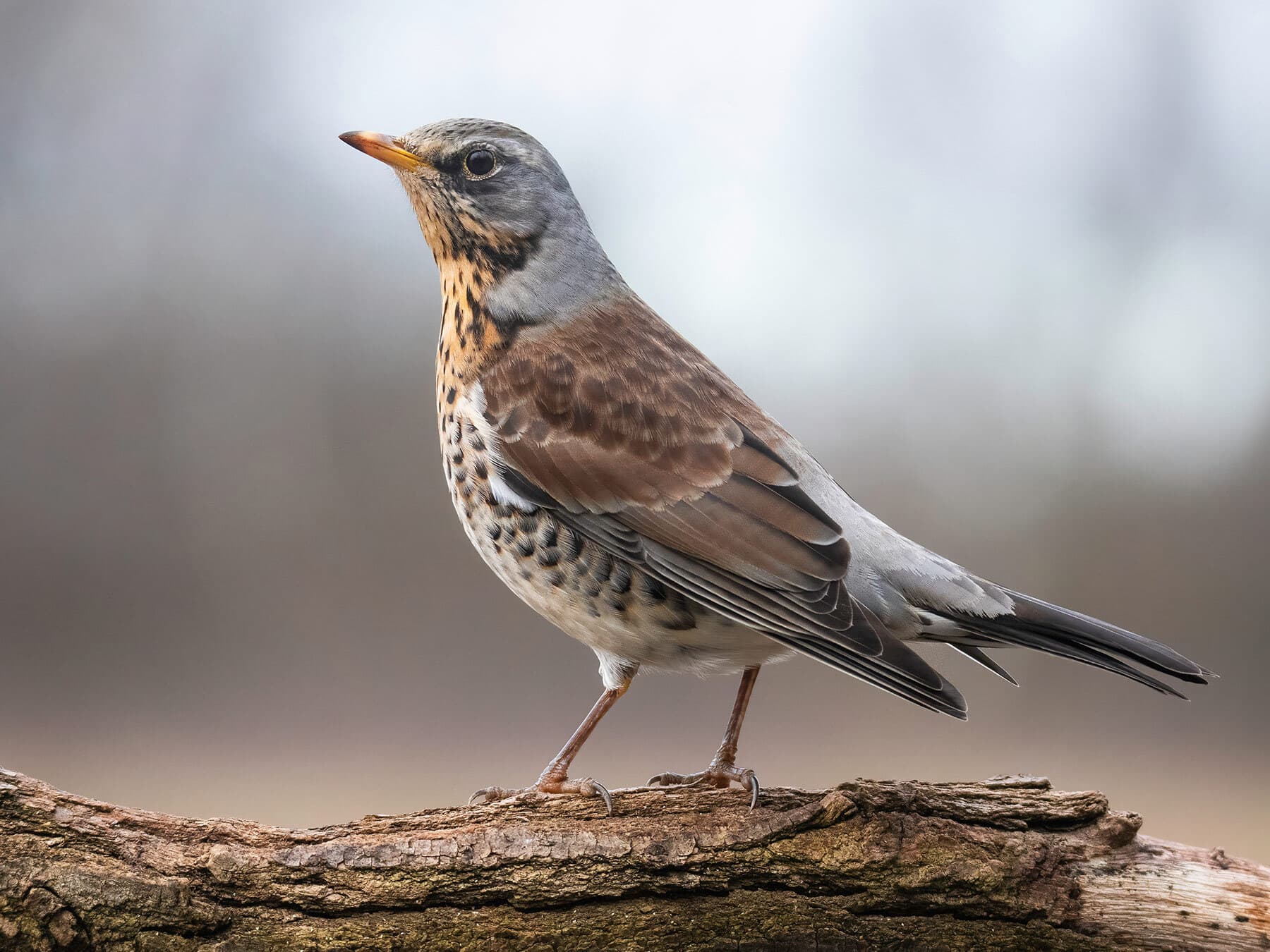
Adult male fieldfares have a striking plumage consisting of a grey head, nape and rump, chestnut coloured back and wings and a black tail. The supercilium is white. The supercilium is the area on the face of some birds consisting of a feathered stripe commencing at the base of the bill and running over the eye towards the back of the head.
There is a black ‘mask’, below the supercilium, running from the beak through the eye and a black patch on the side of the neck. Black tips are also frequently evident across the flight feathers. The belly is white and the chest and flanks are speckled with black spots or streaks over a light buff colouration which is also tinged orange across the breast area.
The underwing area is mostly white. The yellow bill is of medium length and tipped black. The legs are a black to dark brown in colour. The female is similar in appearance to the male although often browner on the upper parts and paler across the breast and flanks.
Juvenile Fieldfares
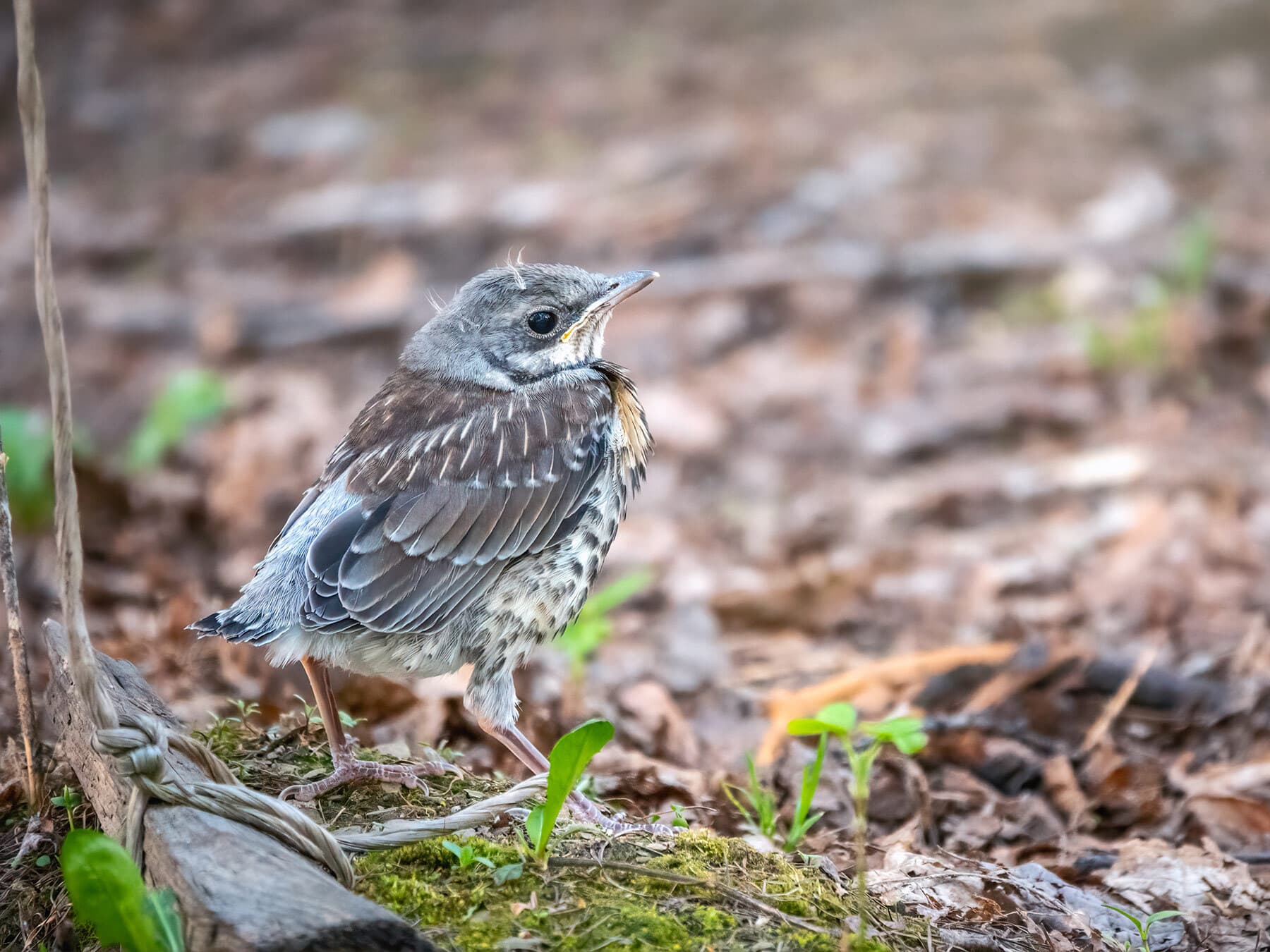
Juvenile birds appear overall duller than the adults and have brownish grey upperparts with buff coloured streaks across the shoulders. They will receive their adult plumage at a relatively early age following their first Autumn moult.
Fieldfare Chicks
Chicks are born underdeveloped (altricial) and are totally reliant on their parents. Once their feathers develop, they are initially predominantly grey and downy with greyish brown wings. As they grow and prior to fledging they assume more of a juvenile colouration with prominent dark spotting on the belly and flanks.
How big is a Fieldfare?
A fieldfare is one of the larger species of thrush, being 25cm (10 in) in length with a wingspan of 39 – 42 cm (15.5 – 16.5 in). In comparison with the common Blackbird, also known as the Eurasian Blackbird, the fieldfare comes out on top being larger in both size and weight.
A further indication as to the size of a fieldfare is to compare it with a European Robin (Erithacus rubecula), often called Robin Redbreast, a bird well known to gardeners throughout Europe. The fieldfare, is twice the length and has double the wingspan of the robin.
How much does a Fieldfare weigh?
Fieldfares weigh in at between 80 – 130g (2.75 – 5 oz) which is up to six times that of a European Robin and up to 20g heavier than a Blackbird.
What is the scientific name of a Fieldfare?
Fieldfares are a monotypic species (meaning there are no subspecies) identified as ‘Turdus pilaris’ from the family ‘Turdidae’, which includes chats and thrushes. They belong to the order known as ‘Passeriformes’ which is the largest order of birds by far containing over 6,500 species.
A characteristic common to all birds of the order is the formation of the foot where the bird has three forward pointing toes and one backward pointing toe (known as the hallux). This enables the bird to balance easily on branches and overhead wires.
Are Fieldfares aggressive or friendly?
Fieldfares are very gregarious and sociable birds frequently seen in large flocks both flying and feeding together with not only other fieldfares but in mixed groups containing Mistle Thrushes, Blackbirds and Redwings.
Are Fieldfares endangered?
The International Union for Conservation of Nature (IUCN) classes the fieldfare as being of Least Concern, indicating that it believes its status is secure and not endangered.
Do Fieldfares mate for life?
Fieldfares do not mate for life. They form breeding pairs in early Spring and are generally monogamous (having one partner only) but only for the season. It is believed that having more than one partner within the same season is not uncommon.
When do Fieldfares arrive in Britain?
The arrival of fieldfares into Britain is largely dependent upon the prevailing weather conditions in northern Europe but generally speaking these charismatic birds can be seen arriving from October to late November, returning north to their breeding grounds in early Spring.
Similar birds
Often mistaken for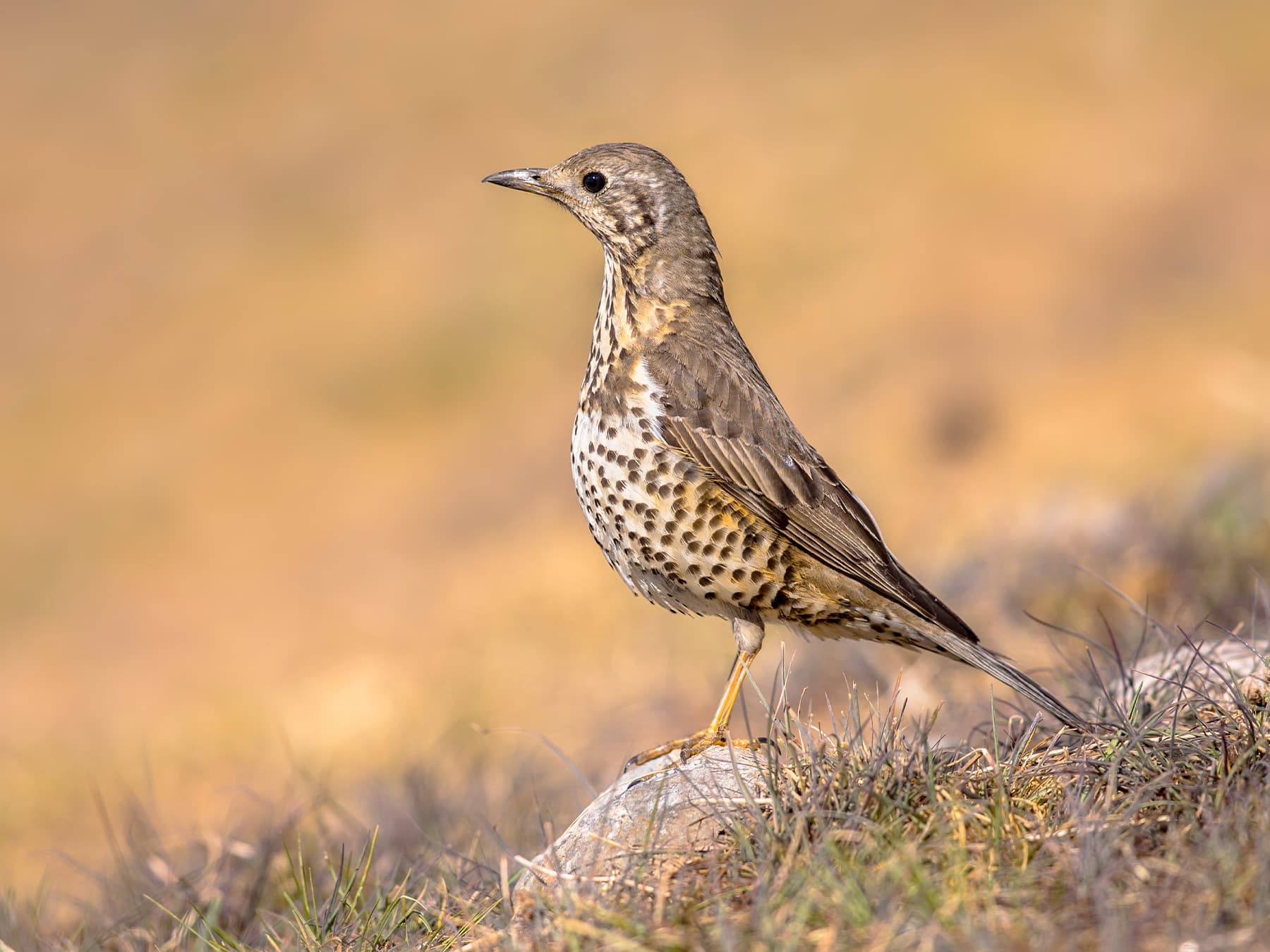
Fieldfare guides
1 guidesQuick facts
- Length
- 22–27 cm
- Wingspan
- 39–42 cm
- Weight
- 80–130 g
- Lifespan
- 3–5 years · oldest recorded 14.7 years
- Family
- Thrushes
- Migration
- Partial migrant
- Global status (IUCN)
- Least Concern
- World population
- 71,000,000 - 143,000,000 mature individuals
- Population trend
- Stable
- Also called
- Felty-fare, Felty-bird
- Scientific name
- Turdus pilaris
Sources
4- 1BirdLife International. 2016. Turdus pilaris. The IUCN Red List of Threatened Species 2016: e.T22708816A87874379. Source (opens in a new tab)
- 2EBCC (2015)
- 3BirdLife International. 2016. Turdus pilaris. The IUCN Red List of Threatened Species 2016: e.T22708816A87874379. Source (opens in a new tab)
- 4BTO longevity records: maximum age from a ringed bird, 14 years, 8 months, 24 days (set in 2010), BirdFacts: Fieldfare (2010) Source (opens in a new tab)

Checked by
Nathan Cope, founder and editor
Nathan founded Birdfact and leads its writers and contributors in the UK, the US and Canada. He has watched and studied birds for more than ten years, and checks every article and species guide before it’s published.