


Song Thrush
Throstle, Mavis · Turdus philomelos
By the Birdfact teamChecked by Nathan Cope
See it in 3D
3D model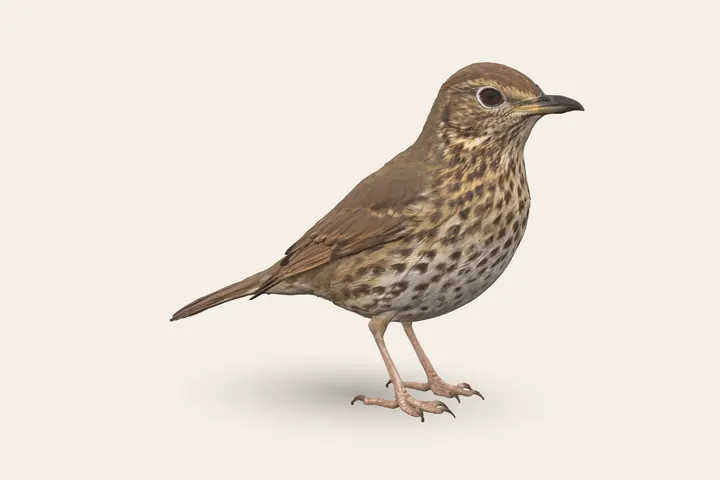 3D model
A Song Thrush is 20–23 cm (8–9 in) long, bill to tail.
3D model · Adult · Length 20–23 cm (8–9 in) · How we make our birds · Report a problem
© 2026 NC Digital Limited (Birdfact). All rights reserved. This 3D model may be viewed on this page and shared by link only. Downloading, extracting, copying or reusing it, or using it to train machine-learning models, is not permitted without our written permission. Using our models
On this page16 sections
How to recognise it
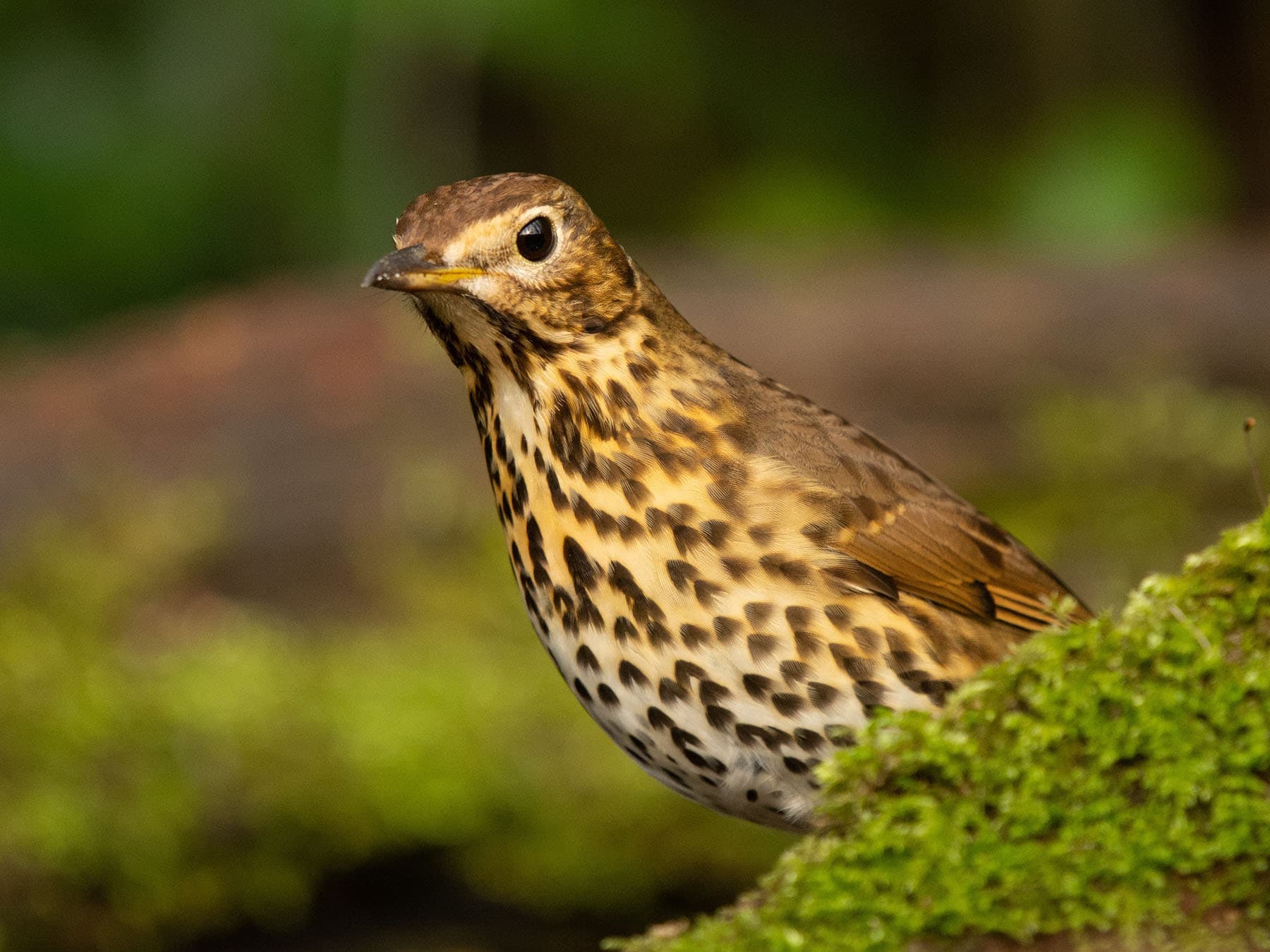
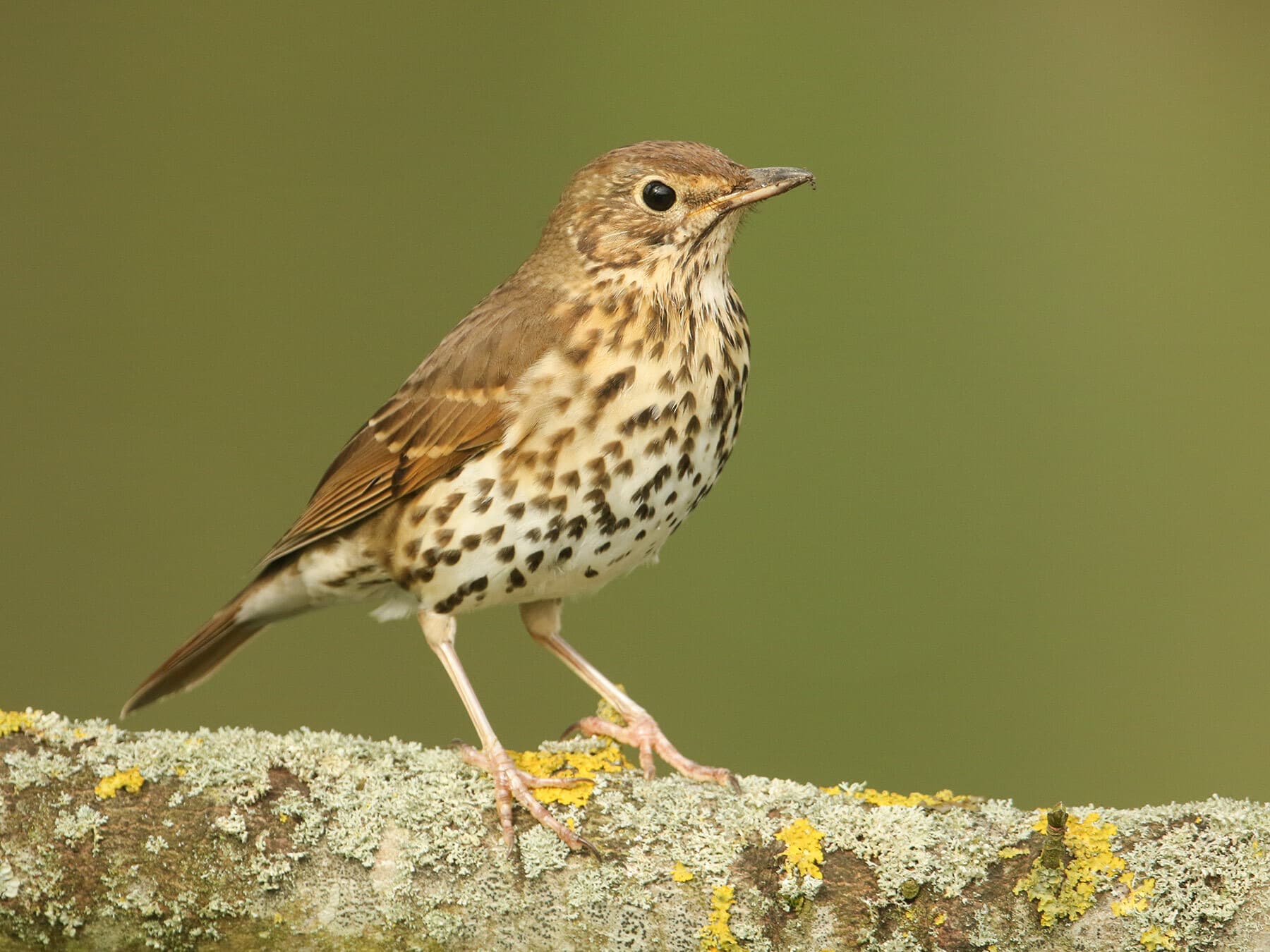
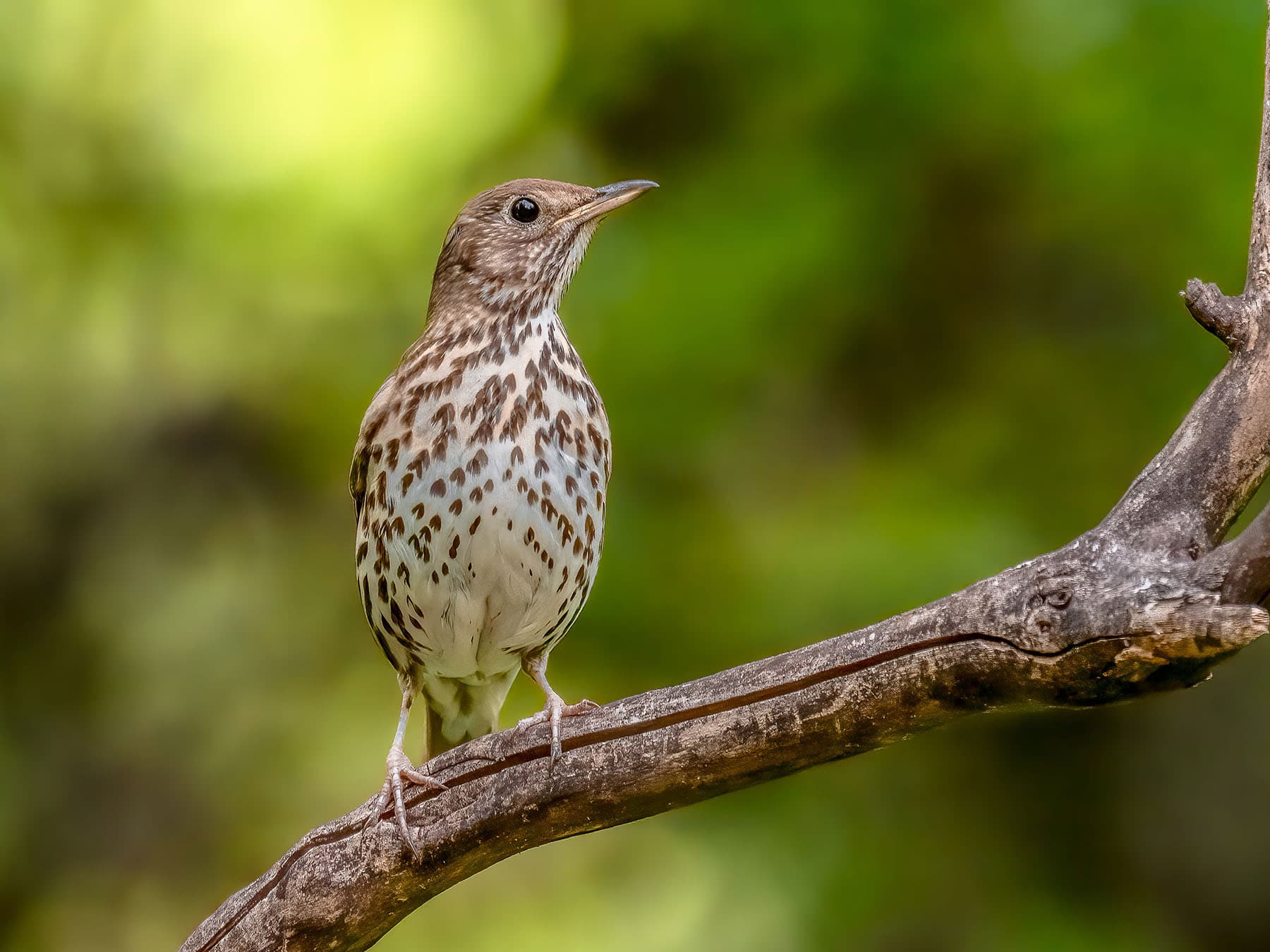
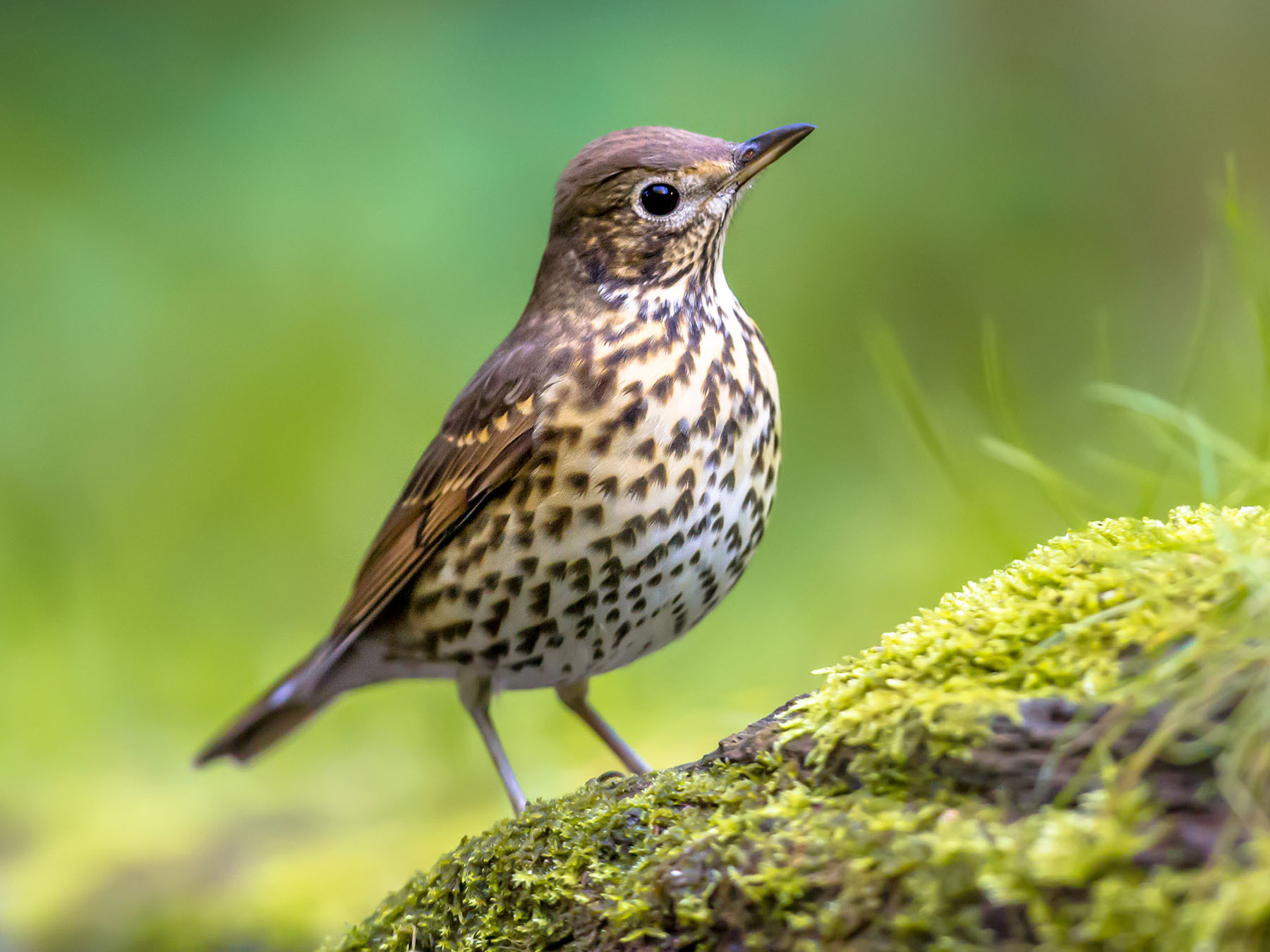
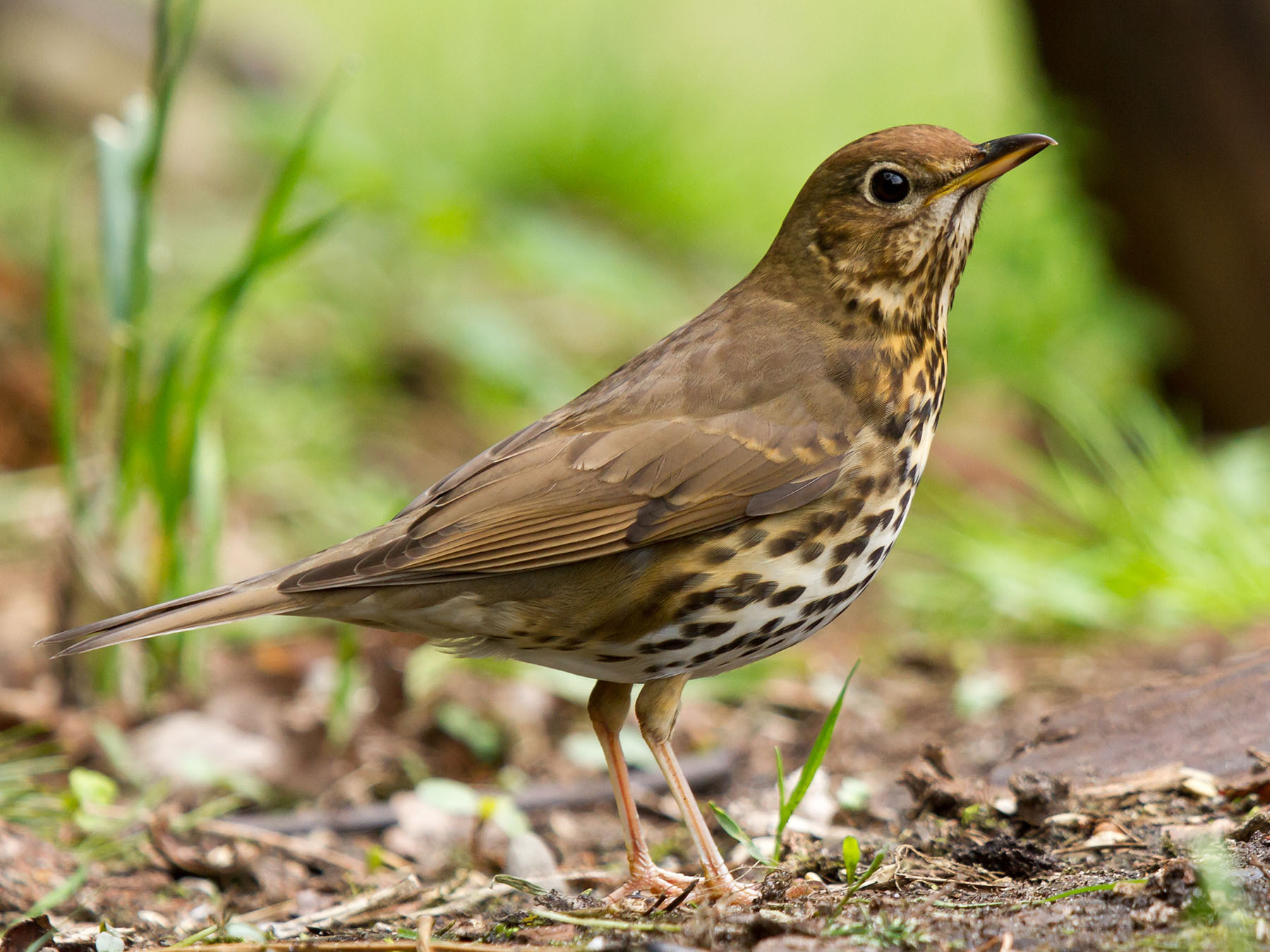
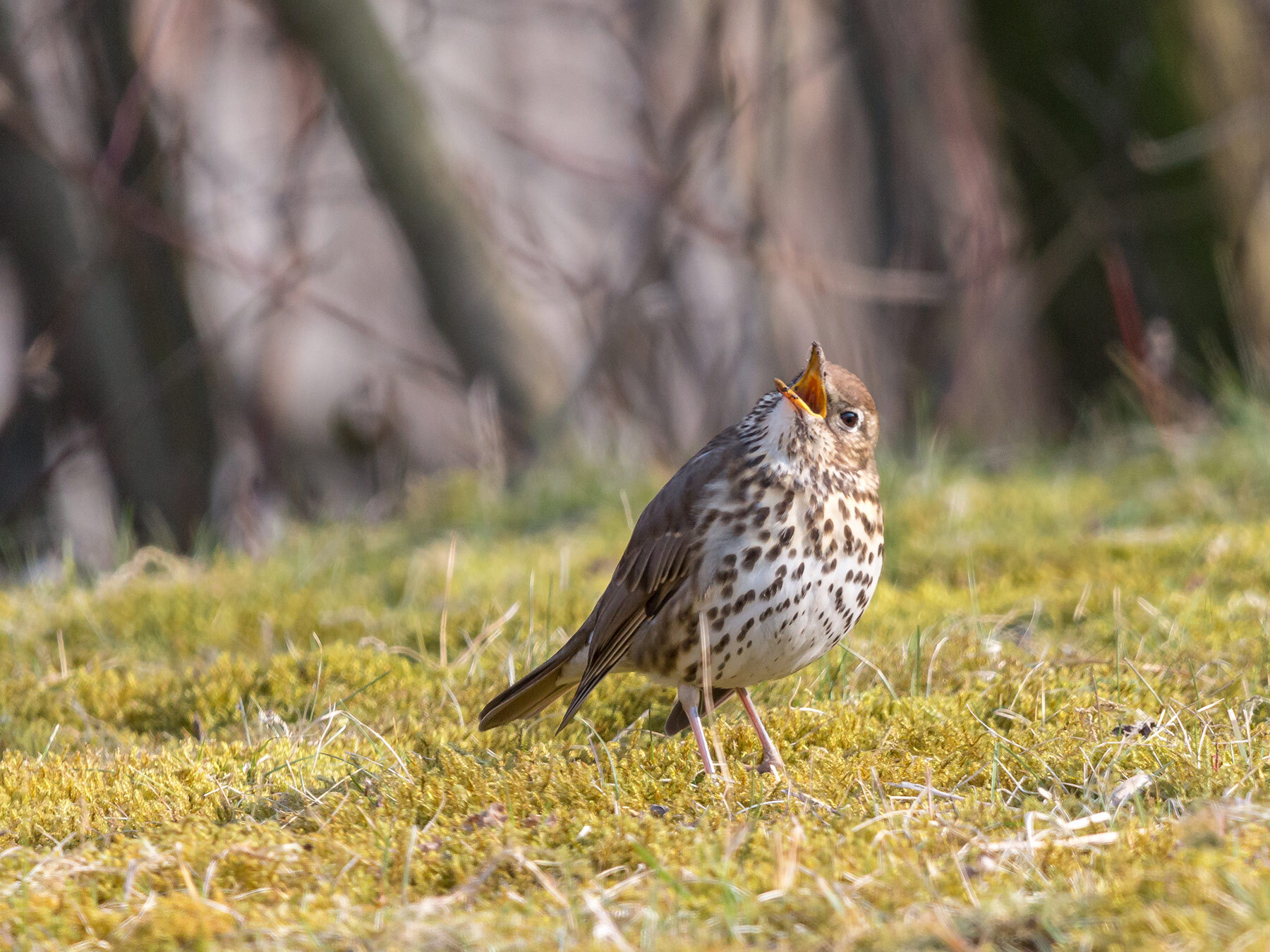
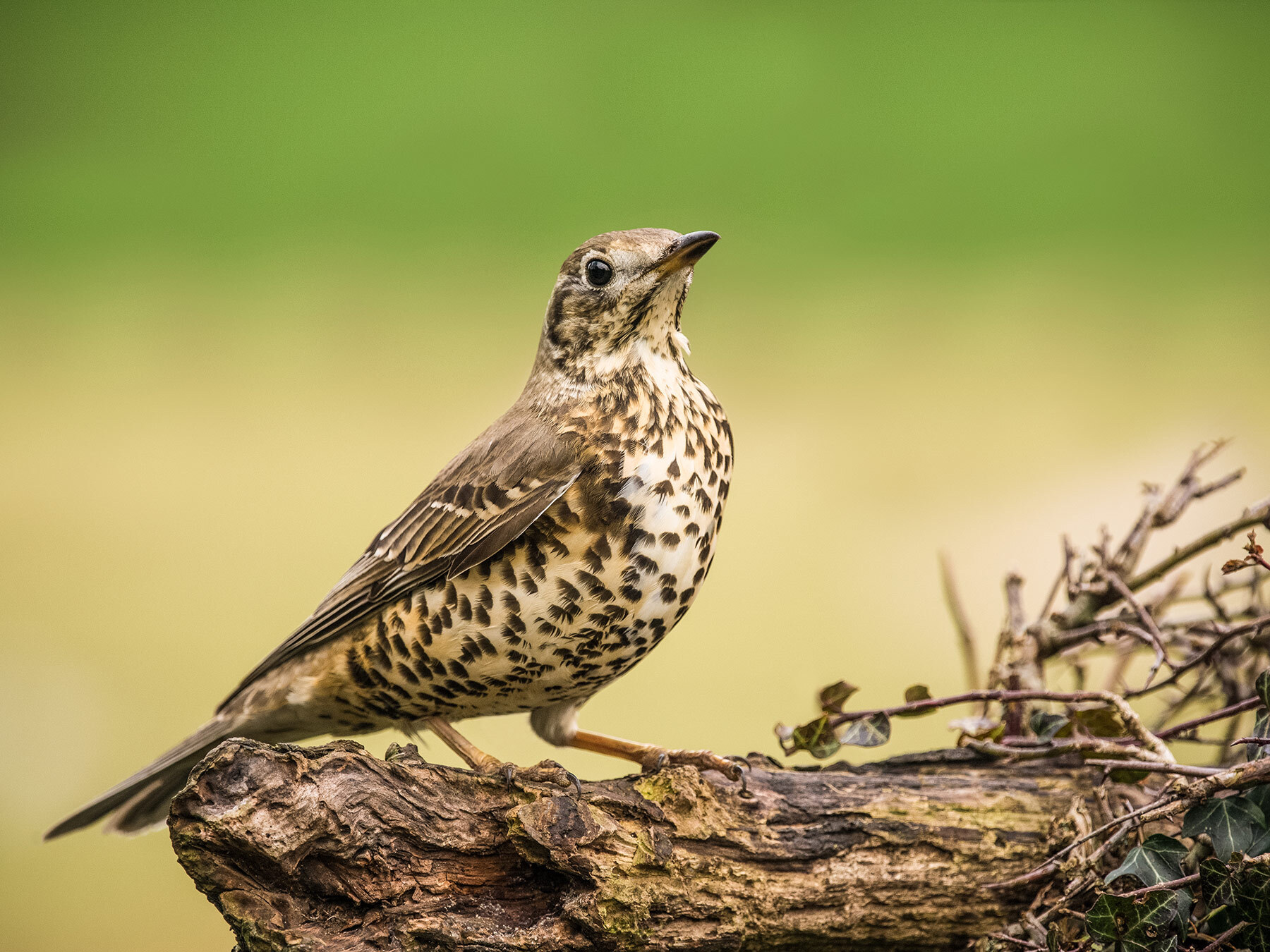
A thrush about 20 to 23 cm long, a little smaller than a Blackbird. It is plain warm brown above and creamy white below, washed with buff across the breast, and covered in neat dark spots shaped like upside-down hearts.1, 2
Look closely and the spots are fairly evenly spread from the breast down the belly and flanks. There is a dark stripe down each side of the throat, a faint dark patch on the cheek, and buff spots on the wing. In flight the underwing is warm yellowish-buff. The bill is dark with a paler base, and the legs are pinkish.3
Adults weigh about 75 g on average, according to BTO ringers' records of live birds, and most weigh 64 to 90 g.4
Male, female and young
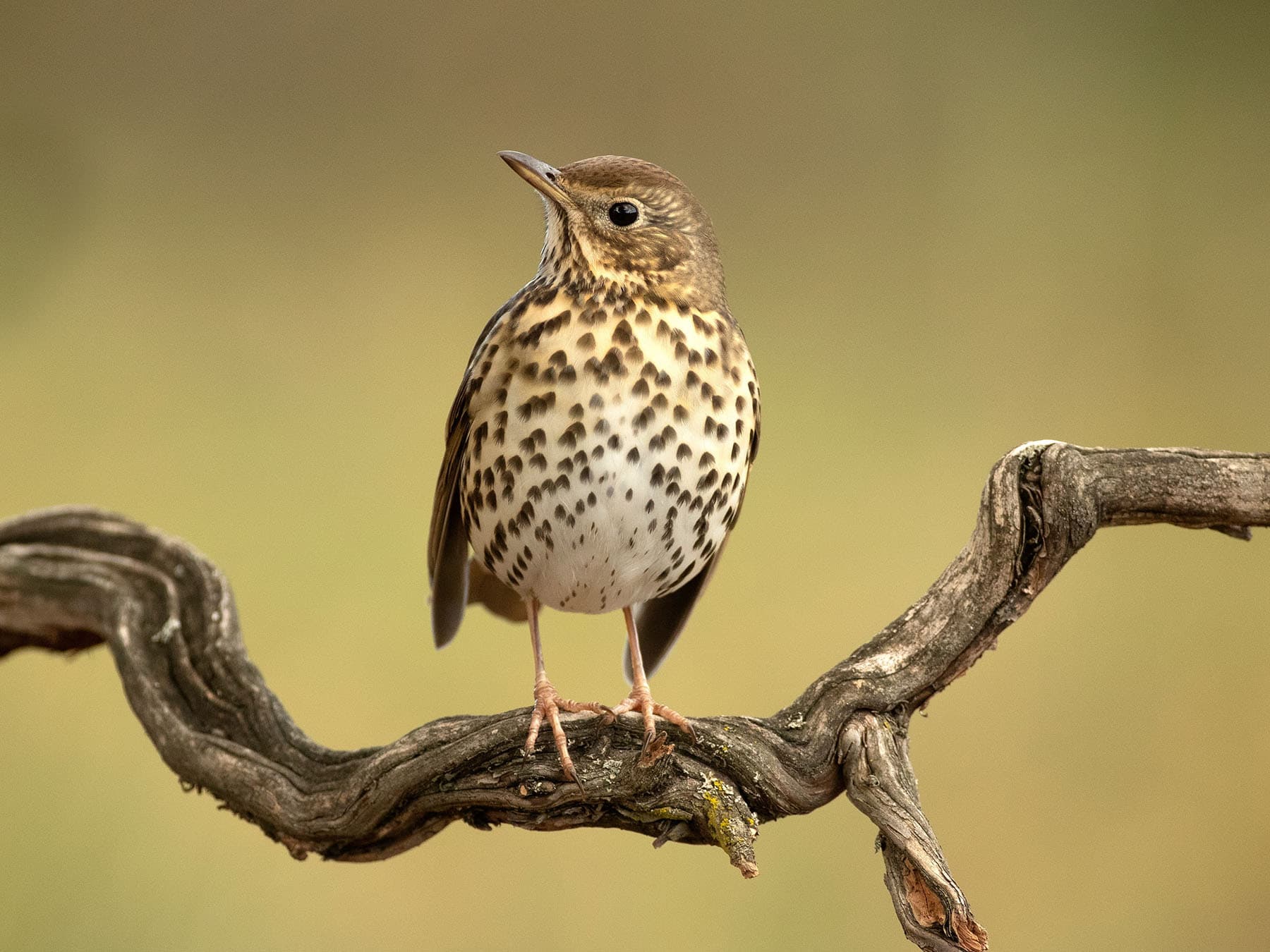
Males and females look the same. Males are a little bigger on average (77.7 g against 71 g in BTO's samples), but you cannot tell a pair apart by eye.
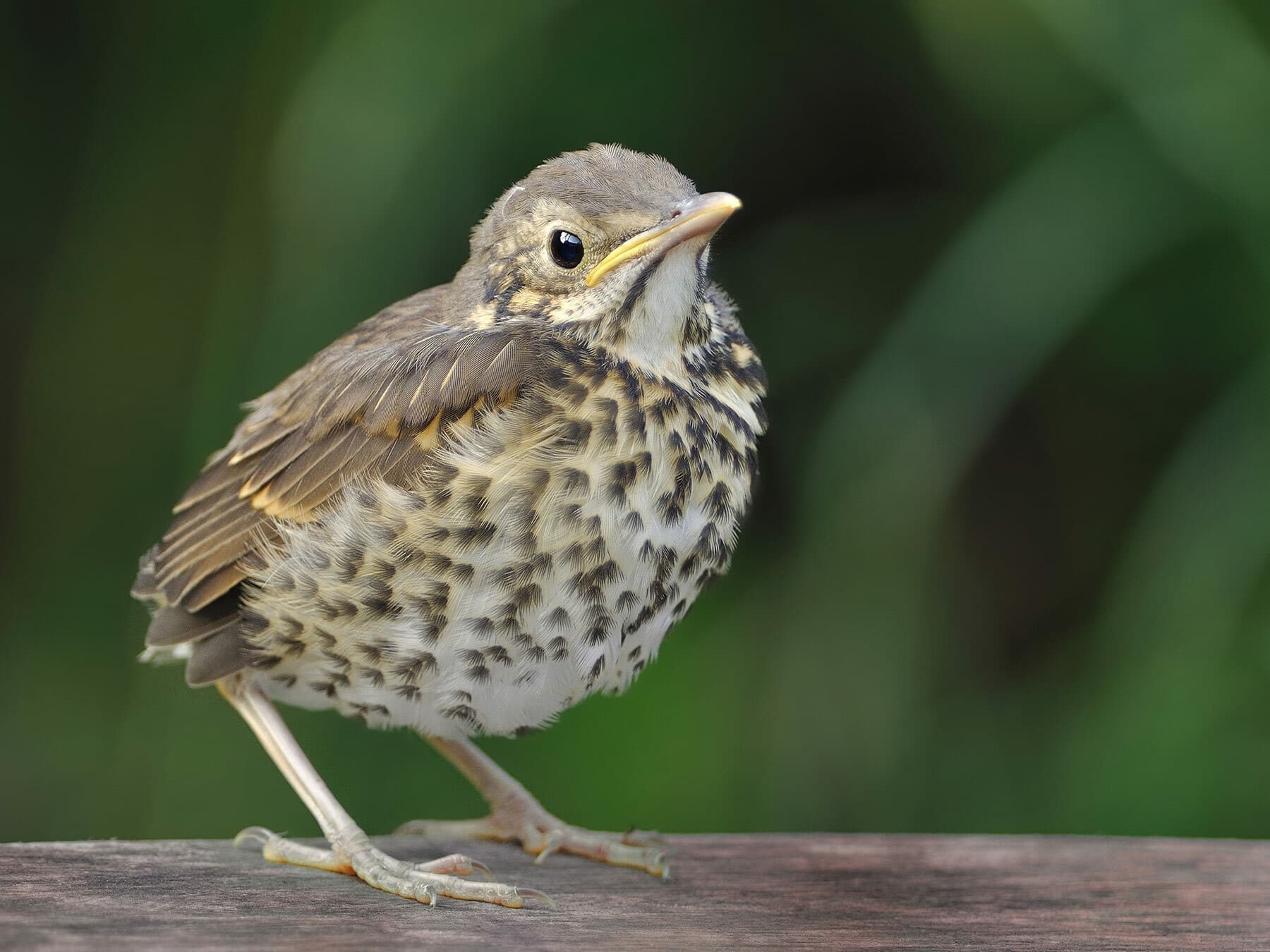
Young birds, out of the nest in spring and summer, look much like adults but are buffier on the head, with buff streaks on the back and shoulders.
Identification: similar birds
The Mistle Thrush is the bird to check first. It is bigger, colder grey-brown and has no warm brown tones, with very heavy dark spots5; it shows white under the wing and white on the tail6, stands boldly upright and gives a loud rattling call.7 Side by side, with photos: Mistle Thrush or Song Thrush?
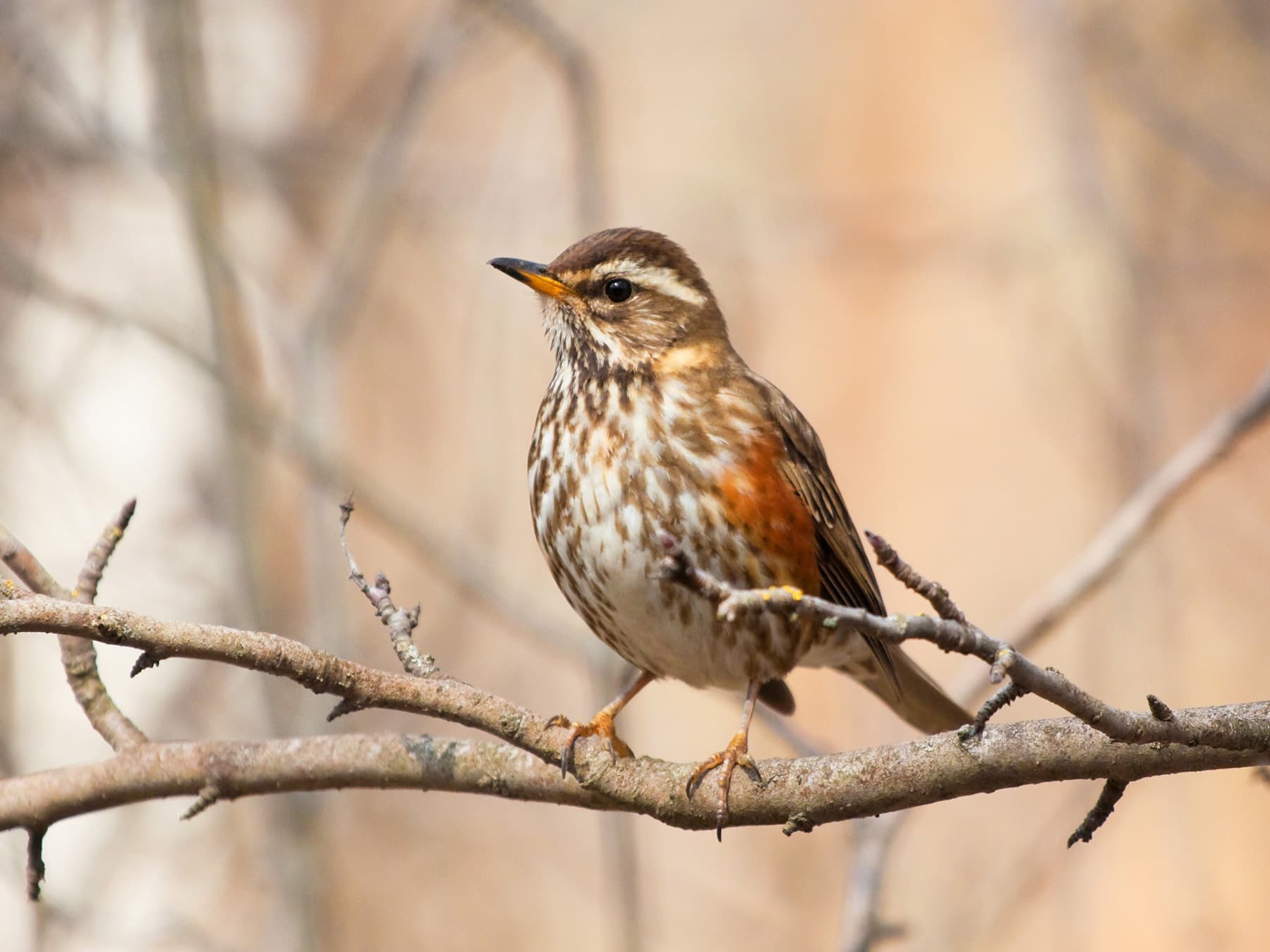
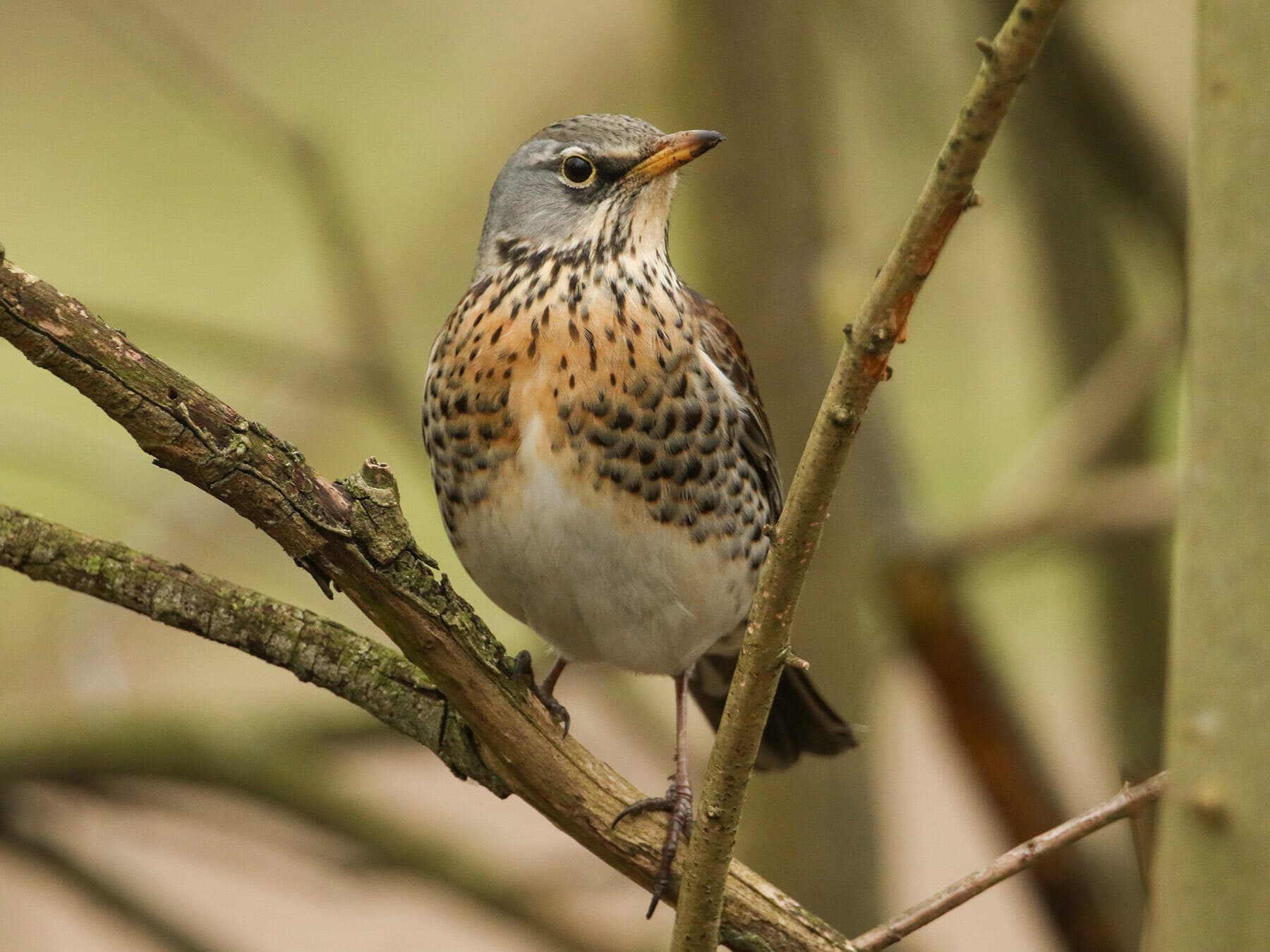
In winter, look out for the Redwing, a visitor from northern Europe about the same size, with a bright white stripe over the eye and rusty-red flanks and underwings; and the bigger Fieldfare, with a grey head and rump, chestnut back and black tail.
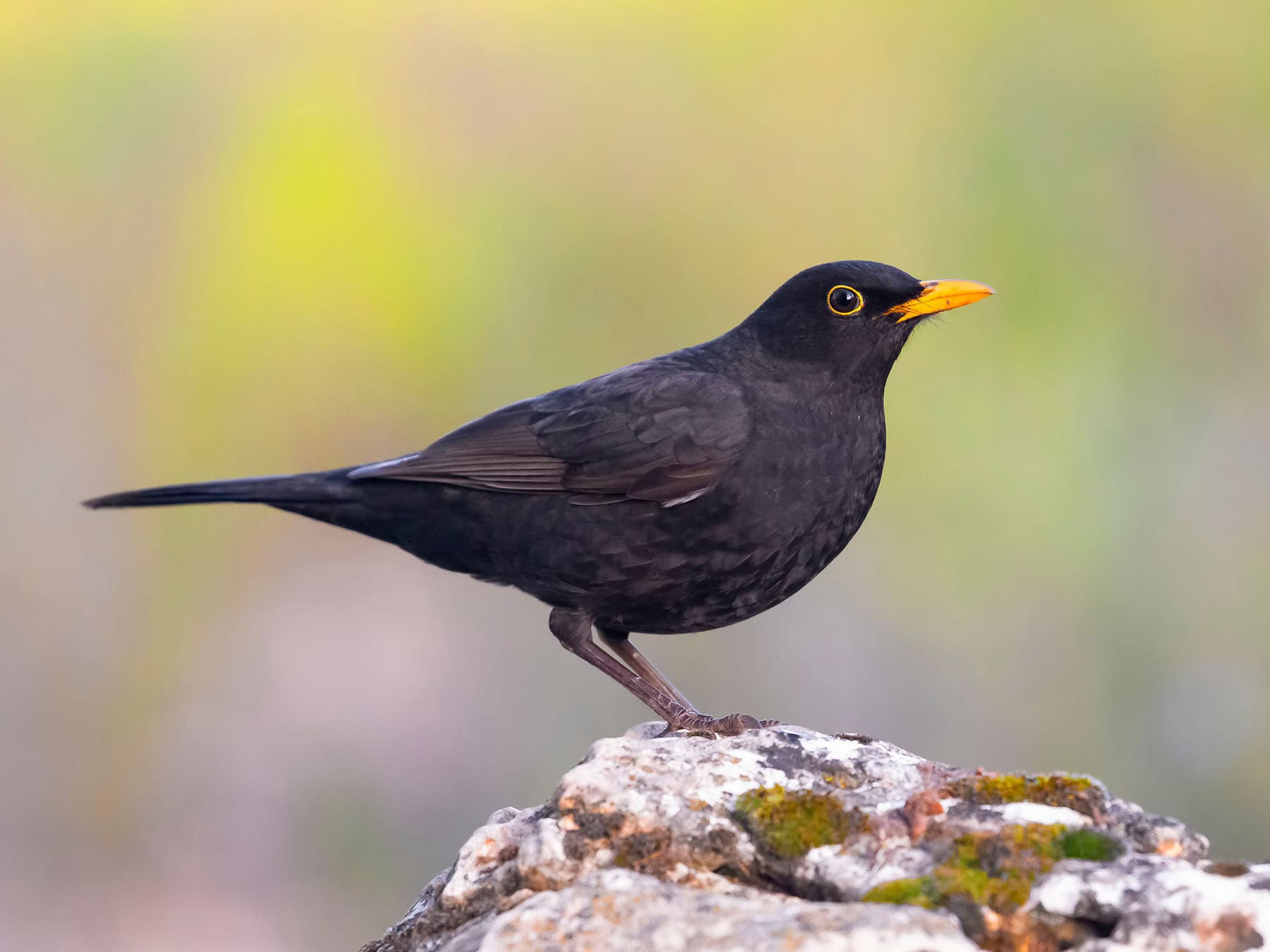
A female or young Blackbird can have a spotted or streaky breast, but it is bigger and deep brown all over, with its streaks and spots on a brown breast rather than a creamy one. A singing Blackbird does not repeat its phrases.
Plumage: the Hebridean form
Most British Song Thrushes belong to the western European form clarkei. Birds of the Outer Hebrides and Skye are a separate form, hebridensis: darker brown above, with a greyish rump and larger spots below. Birds of the World places it on the west coast of mainland Scotland and in western Ireland too.8
Its size
Adults- Length
- 20–23 cm
- Wingspan
- 33–36 cm
- Weight
- 65–100 g
Its song and calls
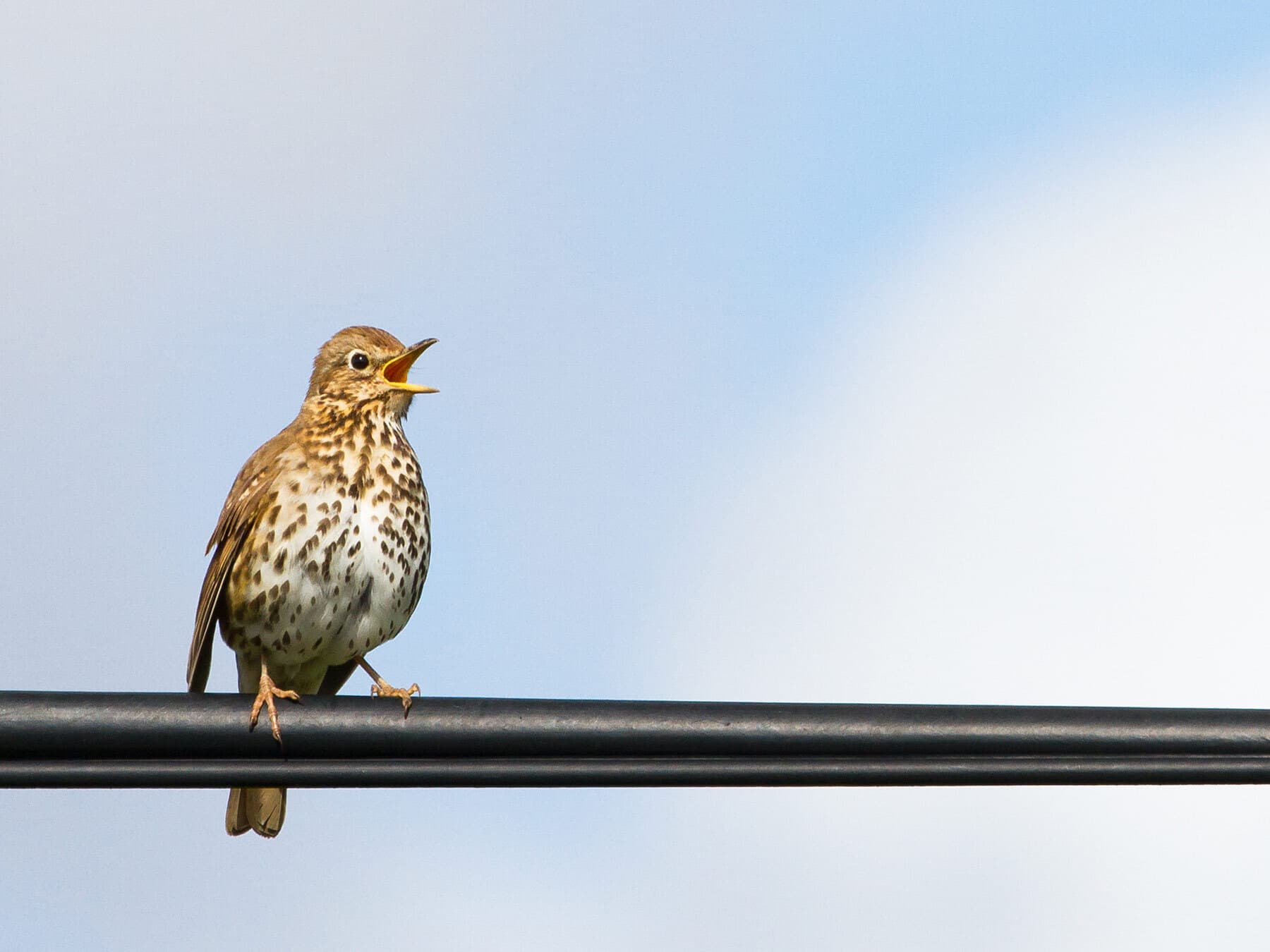
The song gives the bird its name: loud, clear, whistled phrases, each usually sung two or three times, sometimes more, before the bird moves on to the next. The RSPB says this repetition sets it apart from a singing Blackbird.
Song Thrushes are often heard at first light and as dusk falls4, and often sing from the tops of trees. Song can start as early as January. It is most noticeable in late winter and spring.
The common call is a short "tsip" (the RSPB writes it "tsit"), often given as a bird flies up. Others include a high, thin "siih" when a hawk is overhead and an explosive chatter in high alarm in the breeding season.
Listen to British recordings, and see the repeats drawn as spectrograms: Song Thrush song and calls.
- Song0:00 / 0:39
Recorded in Liverpool, United Kingdom · April 2025
- Flight call0:00 / 0:11
Recorded in Normandie, France · October 2021
When and where to see it
OctoberArriving
Most recorded in October
- 1. Tipperary1.8%
- 2. Cornwall1.8%
- 3. Vale of Glamorgan1.7%
- 4. Pembrokeshire1.6%
- 5. Carlow1.5%
Each dot is a county, state or province: the bigger and darker, the larger the bird’s share of that place’s bird records that month. Grey dots: no regular records. The ringed point is the centre of the bird’s records this month; the arrow shows how it moved since last month, and the dashed loop its path through the year. “Arrivals” colours places where it becomes regular this month (orange) or is in its last regular month (grey). GBIF eBird Observation Dataset, 2019–2024. Map data: Natural Earth, US Census Bureau; place centres © OpenStreetMap contributors.
In your area
See when the Song Thrush is recorded in your county, state or province.
How often the Song Thrush turns up in the UK and Ireland through the year, from birdwatchers' records.
United Kingdom
Resident · all year · most records in February
Ireland
Resident · all year · most records in May
Show as a table
| Month | United Kingdom | Ireland |
|---|---|---|
| January | 1.0% (regular) | 1.4% (regular) |
| February | 1.4% (regular) | 1.3% (regular) |
| March | 1.3% (regular) | 1.1% (regular) |
| April | 1.4% (regular) | 1.5% (regular) |
| May | 1.4% (regular) | 1.7% (regular) |
| June | 1.4% (regular) | 1.5% (regular) |
| July | 0.93% (regular) | 0.66% (regular) |
| August | 0.34% (regular) | 0.27% (regular) |
| September | 0.34% (regular) | 0.42% (regular) |
| October | 0.75% (regular) | 0.64% (regular) |
| November | 0.75% (regular) | 0.87% (regular) |
| December | 0.90% (regular) | 1.3% (regular) |
Recorded regularly in
Worldwide: recorded regularly in 74 countries
Countries where it was recorded in at least 3 of the 6 years 2019–2024. Linked countries have their own bird list.
Europe (48)
- Åland Islands
- Albania
- Andorra
- Austria
- Belarus
- Belgium
- Bosnia & Herzegovina
- Bulgaria
- Croatia
- Czechia
- Denmark
- Estonia
- Faroe Islands
- Finland
- France
- Germany
- Gibraltar
- Greece
- Guernsey
- Hungary
- Iceland
- Ireland
- Isle of Man
- Italy
- Jersey
- Kosovo
- Latvia
- Liechtenstein
- Lithuania
- Luxembourg
- Malta
- Moldova
- Montenegro
- Netherlands
- North Macedonia
- Norway
- Poland
- Portugal
- Romania
- Russia
- Serbia
- Slovakia
- Slovenia
- Spain
- Sweden
- Switzerland
- Ukraine
- United Kingdom
Asia (19)
- Armenia
- Azerbaijan
- China
- Cyprus
- Georgia
- Iran
- Iraq
- Israel
- Jordan
- Kazakhstan
- Kuwait
- Lebanon
- Mongolia
- Oman
- Palestinian Territories
- Qatar
- Saudi Arabia
- Turkey
- United Arab Emirates
Oceania (3)
- Australia
- New Zealand
- Norfolk Island
Data: EOD – eBird Observation Dataset (Cornell Lab of Ornithology), accessed via GBIF.org, CC BY 4.0. Records from 2019–2024, aggregated and filtered by Birdfact. How these lists are made
All year, across almost all of the UK. In the 2007-11 Bird Atlas Song Thrushes were recorded in 94% of the UK's 10-km squares in the breeding season and 91% in winter, missing then only from parts of the Scottish Highlands and Southern Uplands. Densities are higher in Ireland than in Britain.
They need trees or bushes to nest in and damp ground nearby to feed on: woods (above all broadleaved woods), scrub, parks, gardens, cemeteries and farmland with hedges. Look on short grass, along the edges of shrub beds and under bushes.
Spotting tips
Listen for the repeated phrases early and late in the day, and look for broken snail shells scattered around a stone or the edge of a path: a sign that a Song Thrush has been using it as an anvil.
Do they migrate?
Some do. Song Thrushes are partial migrants: in Britain, about half the adults and two-thirds of the young birds move some way for the winter, while the rest stay put. Birds from northern Britain winter further south in Iberia than those from the south.
Ringing shows where some go: there have been over 1,000 reports abroad of Song Thrushes ringed in Britain and Ireland, most from France, Spain and Portugal; some of these birds were migrants from elsewhere, ringed here on passage. One young bird ringed on Fair Isle in October 1952 was found in Dorset, 981 km away, 15 months later.9
At the same time, birds from northern Europe arrive in late autumn; some spend the winter here and others go on south, as far as North Africa.
What it eats
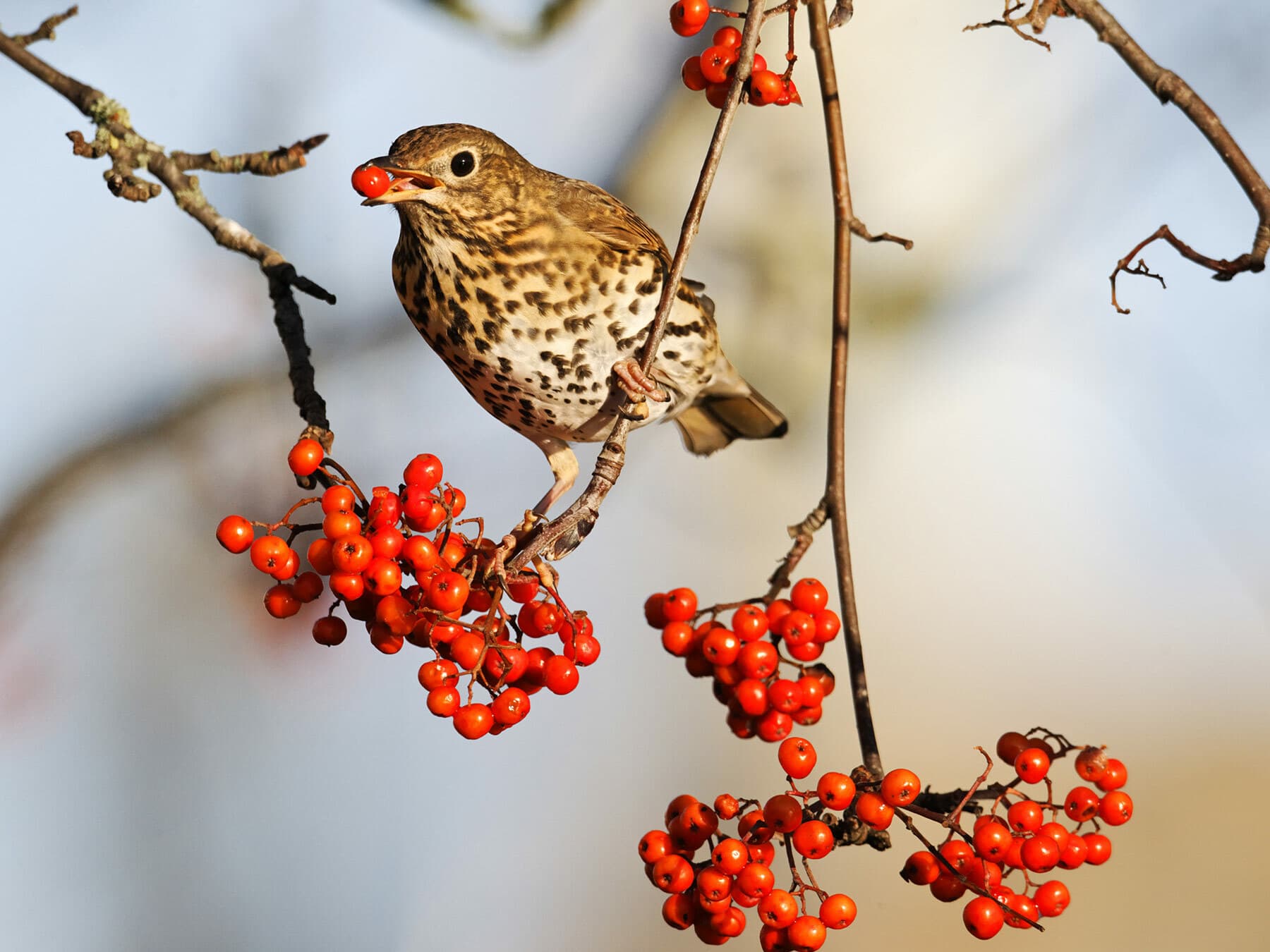
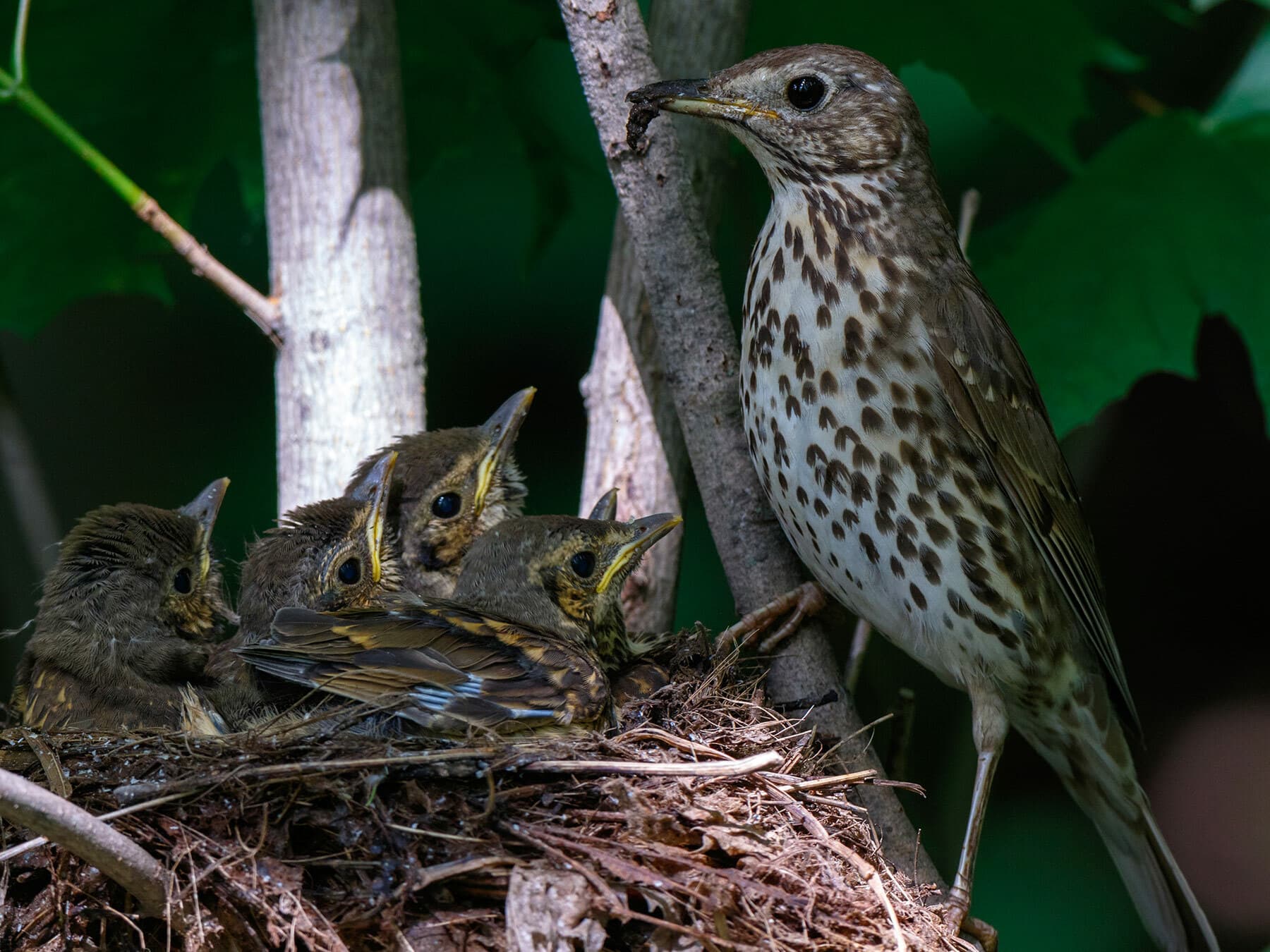
Earthworms, snails and insects, and in autumn and winter fruit and berries. In Britain, earthworms are the main food in early spring, snails take over in early summer, and berries matter from September to November.
Beetles and their larvae, caterpillars, flies and spiders are all eaten, and the fruit list is long: ivy, rowan, elder, bramble, yew, cherries, honeysuckle and cotoneaster among others. One study in suburban southern Britain found that, from December to March, earthworms made up as much as 94% of feeding records. Nestlings are fed softer food than the adults eat, such as caterpillars and grubs.
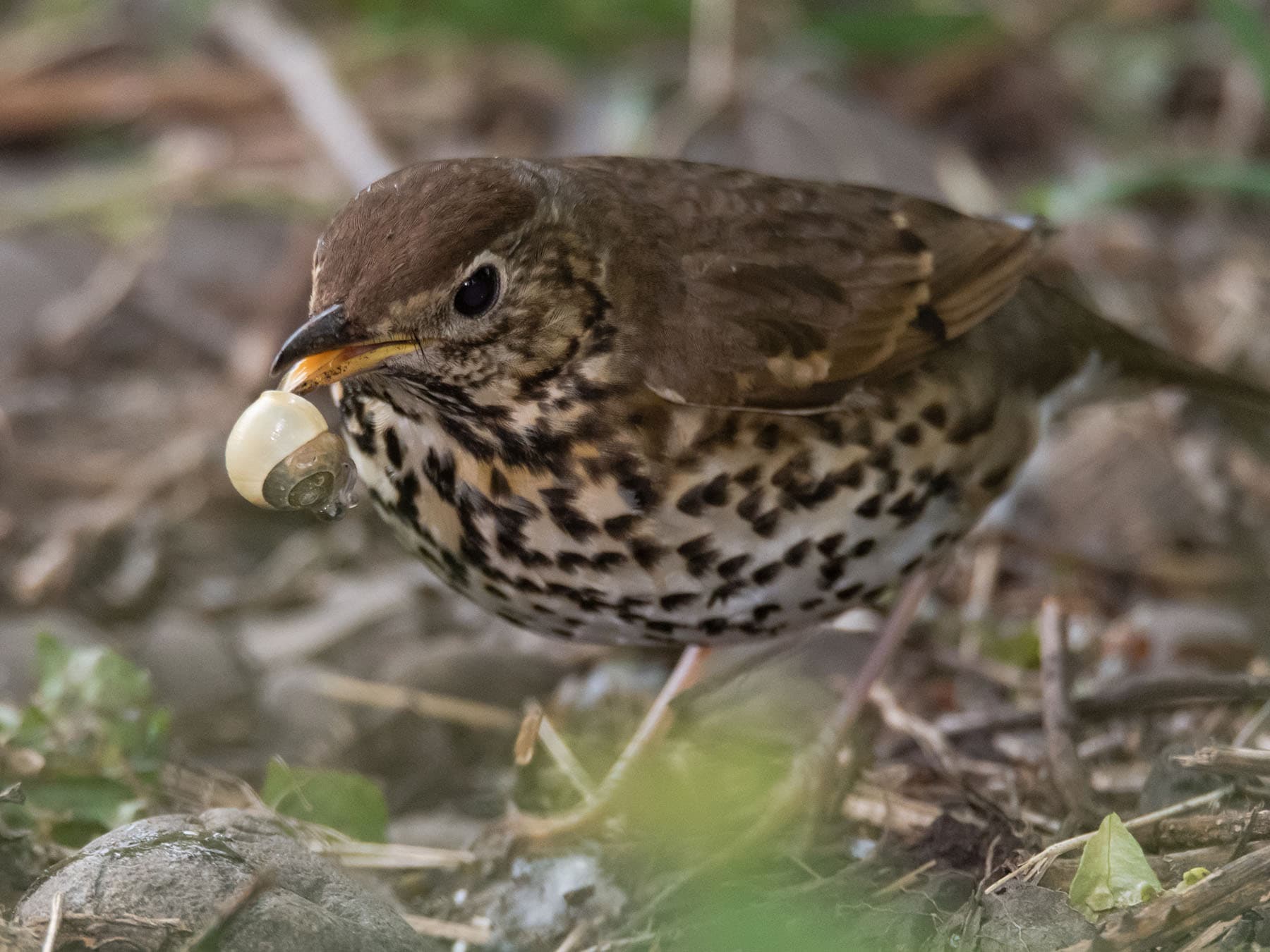
How they eat snails
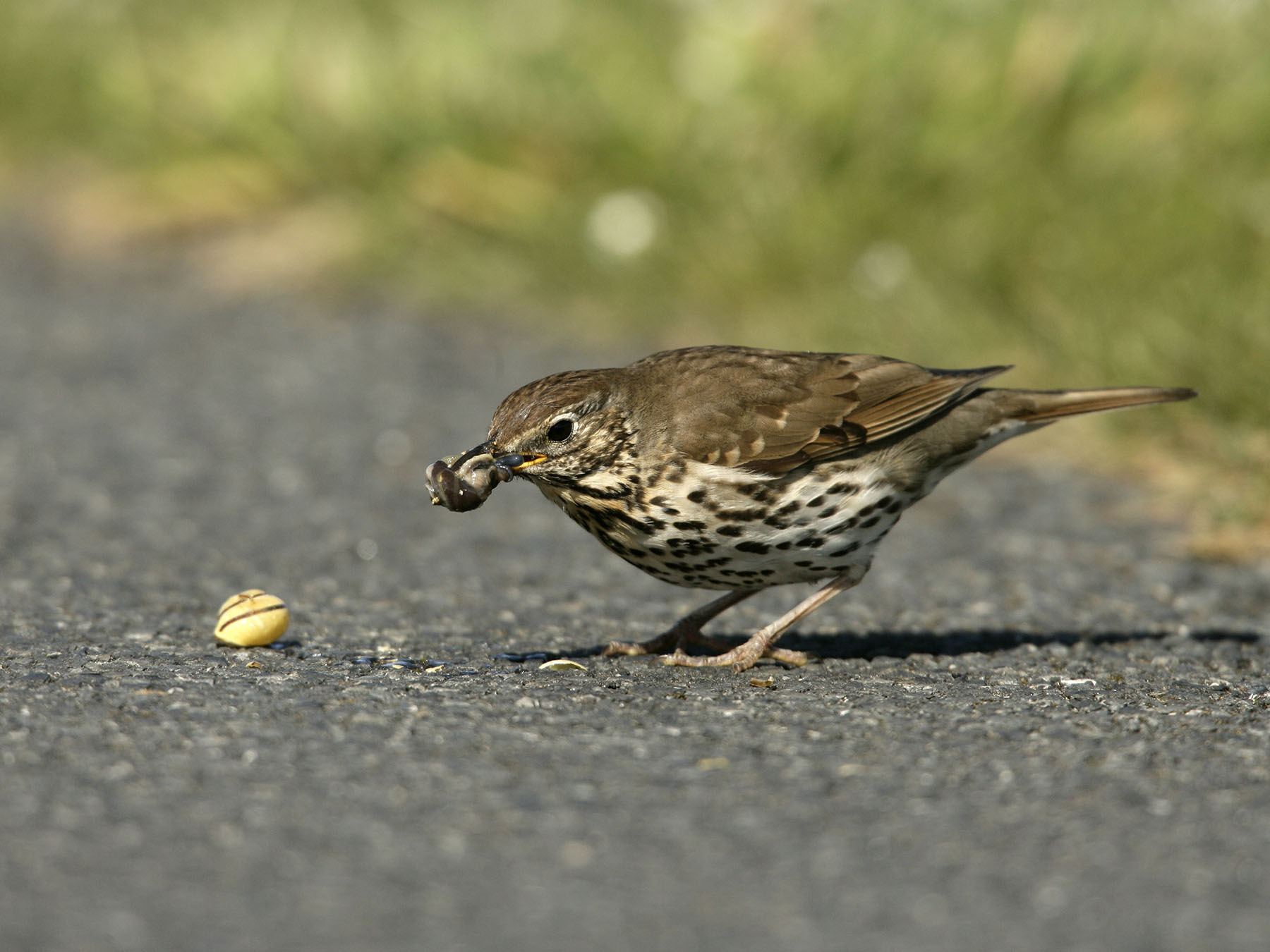
A Song Thrush breaks a snail's shell by beating it against a stone with a flick of the head. A favoured stone is called an anvil, and the broken shells around it give the bird away. Small snails, under about 1 cm, are swallowed whole.
Feeding them in your garden
The RSPB's advice for Song Thrushes in gardens is about habitat rather than feeders: leave some wild, untidy patches, which can give extra food and cover. In a radio-tracking study on farmland, bare soil in gardens was among the places they preferred to forage.10
Nesting and breeding
In the UK the first eggs are laid between late March and late June, on average around 21 April, and a pair usually raises two or three broods a year, occasionally four.4
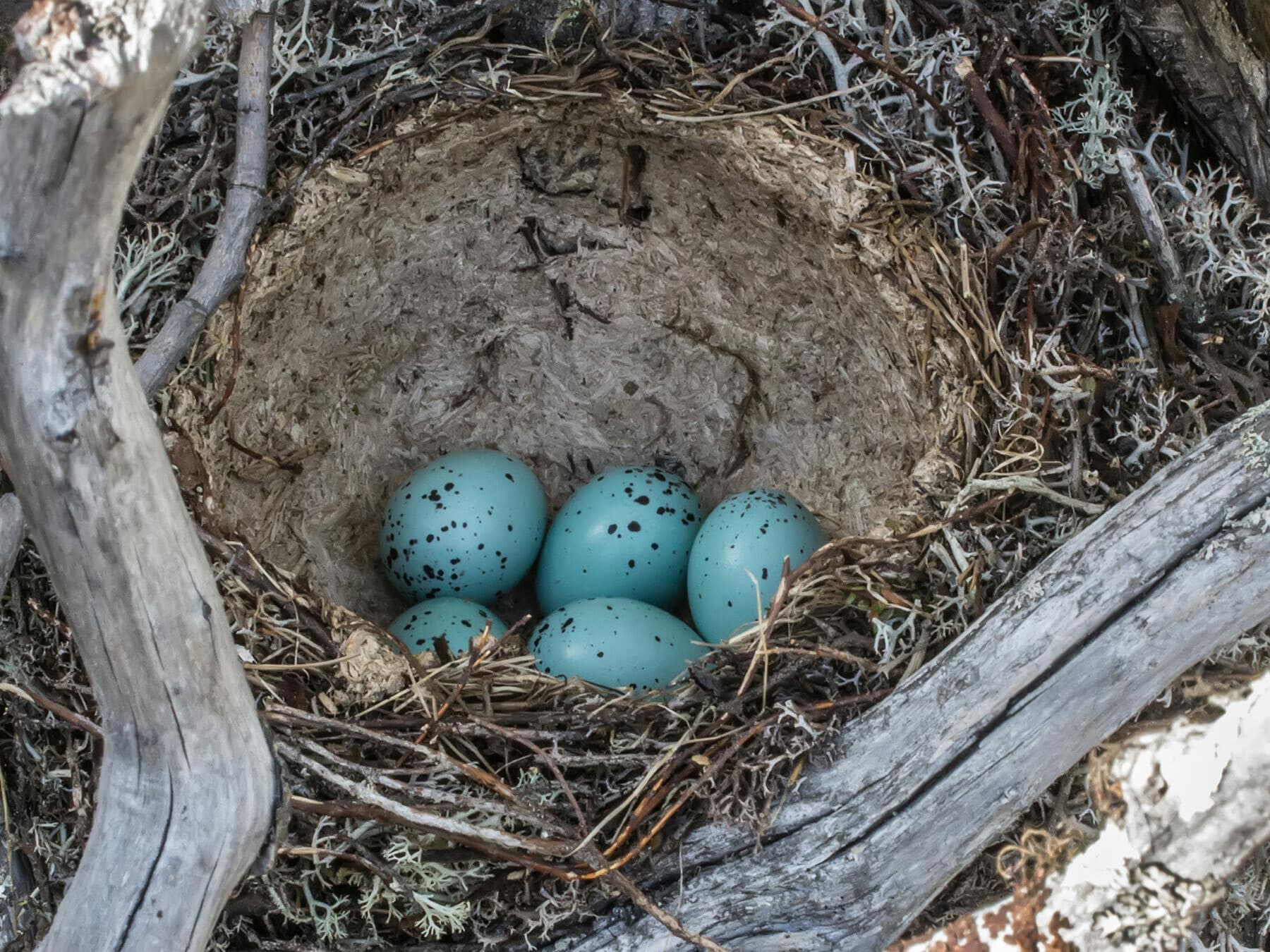
Built from moss, grass and twigs, the tidy cup sits in a bush, hedge, tree or creeper, often tucked against the trunk. What makes it easy to recognise is the inside: a smooth, hard lining of mud, clay, dung or rotten wood.
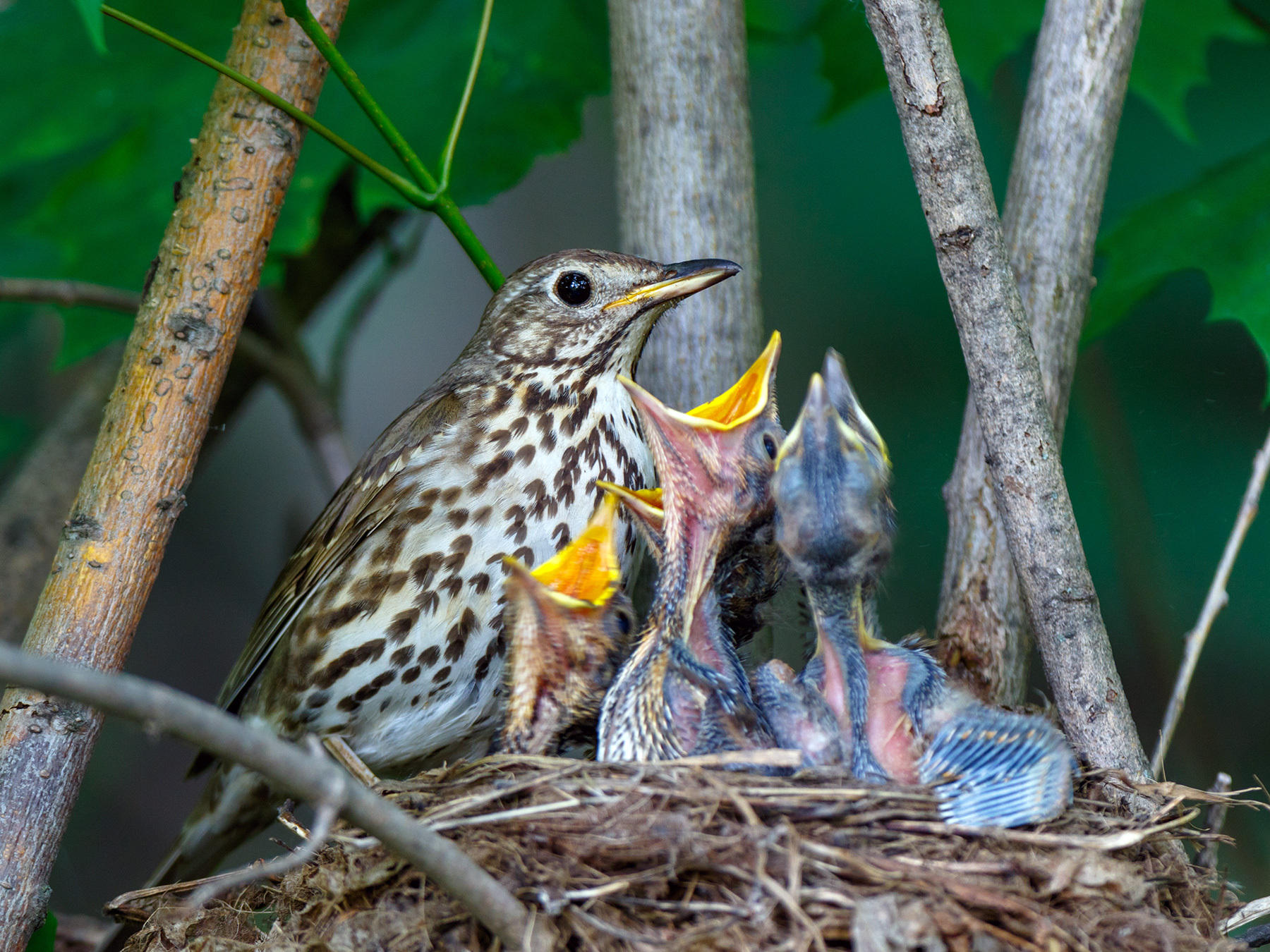
The eggs are glossy blue with blackish spots, usually 4 to a clutch (2 to 7). The female incubates them for about 14 days and the young leave the nest at about 14 days old. The parents go on feeding them for one to three weeks after that.
Behaviour
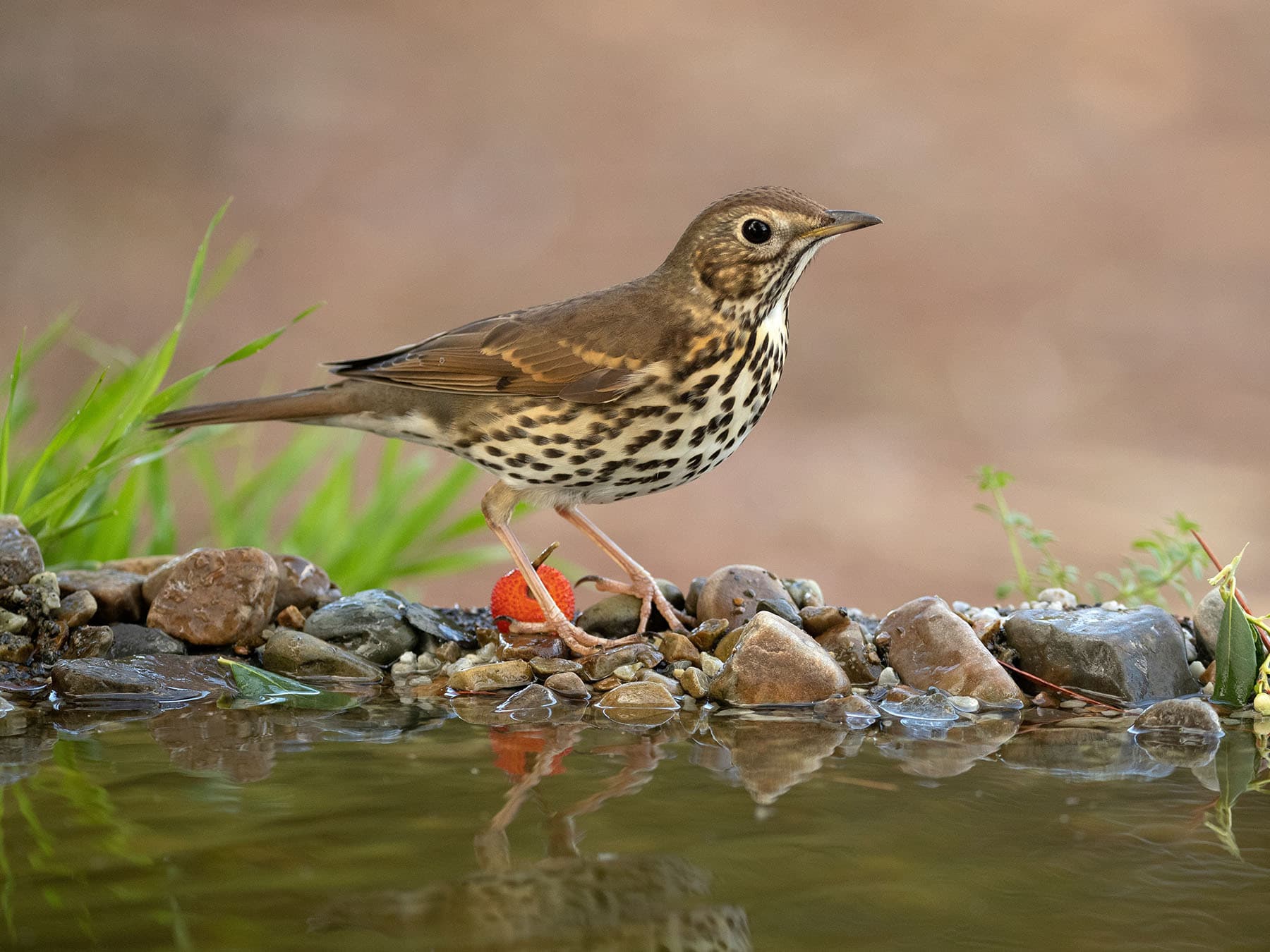
Song Thrushes feed on the ground close to cover, foraging more under bushes and trees, and less in the open, than many other thrushes. In the breeding season a pair holds a territory, as small as 0.2 hectares and usually 0.4 to 0.6 hectares in suburban gardens; a male sings louder and harder when a neighbour sings back.
In winter they may join mixed flocks of thrushes in fields and orchards where there is plenty of food.
Lifespan and predators
A Song Thrush that survives to breed typically lives about 3 years. About 56% of adults survive from one year to the next, and 46% of young birds survive their first year.4
The oldest on the BTO's ringing list is a male ringed at Pittance Park near Edwinstowe, Nottinghamshire, in June 2001 and caught there by a ringer in June 2012, 11 years and 8 days later; it was ringed as a second-year bird, so it was older still.11 The oldest on the European list, a bird ringed in Germany and later hunted (presumably shot), was aged 18 years 4 months.12
Predators and other dangers
The Woodland Trust lists Sparrowhawks and domestic cats among its predators. Nests fail more often during incubation where crows and their relatives are common. Long frosts lower the survival of young birds, and long summer droughts that of adults.
Conservation
The Song Thrush is on the UK Amber List and is of Least Concern worldwide. It moved from the Red List to Amber in 2021, when it was judged still close to the Red-list threshold.13 There are about 1.3 million territories in the UK (2016).
Population decline and recovery
From the mid-1970s Song Thrush numbers fell steeply, and many gardens lost their resident pair.4 One study put the fall in lowland rural Britain at about 70% between 1970 and 1995, worst on intensive arable farms.
A review of the research highlights more young birds dying in their first year as a potential cause. Several lines of evidence suggest that drier soils in summer, partly from field drainage, harm breeding and survival by leaving fewer earthworms within reach; the loss of grassland has probably contributed, and the loss of hedgerows and scrub may have. The part played by predators is unclear.14
Numbers have been rising again. UK numbers were up 37% between 1995 and 2024, with rises in all four countries.15 Even so, there are 45% fewer Song Thrushes than in 1967 (BTO), and the RSPB says they are nowhere near as numerous as they once were.
Similar birds
Often mistaken for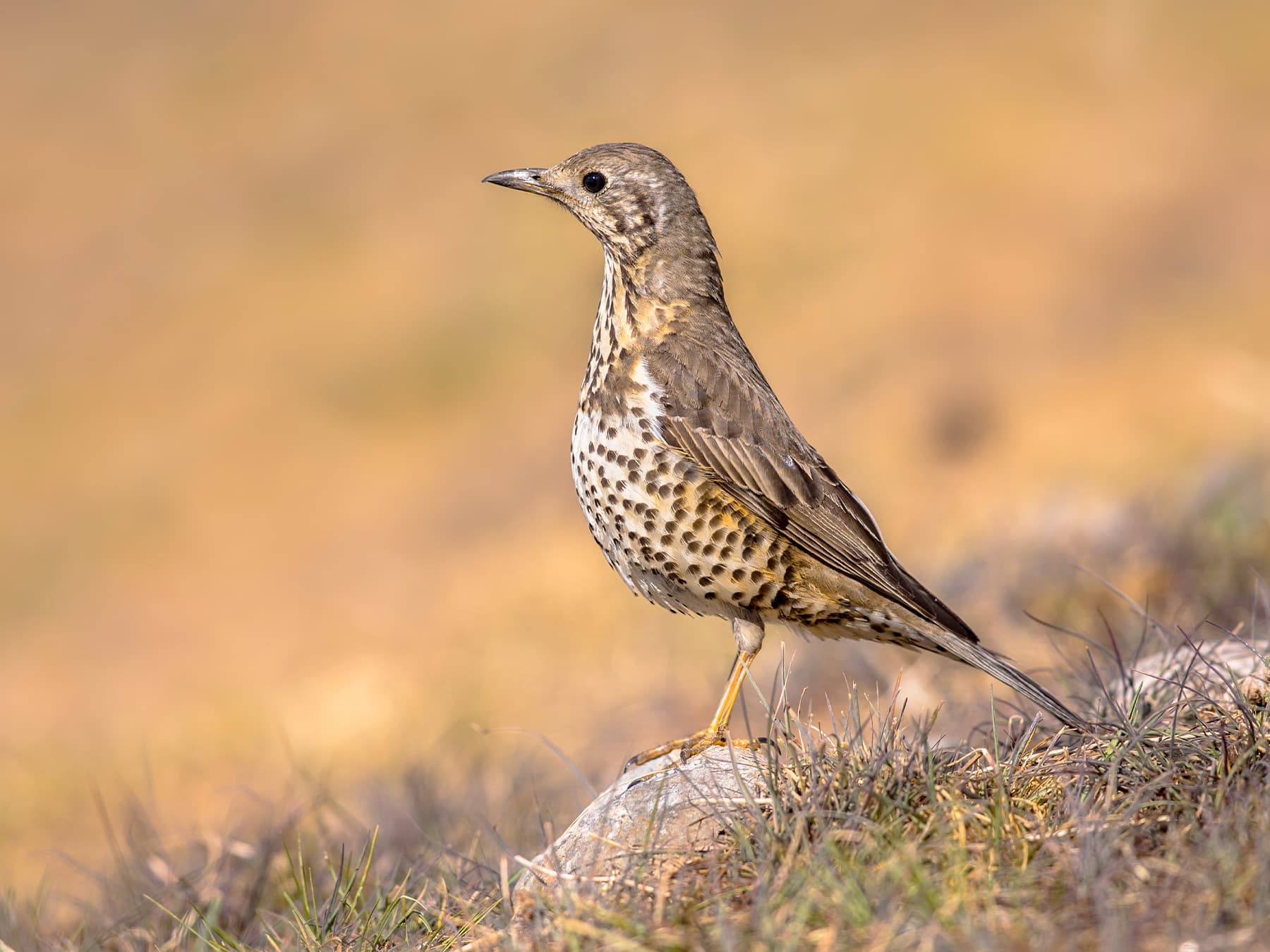
More photos
9 photos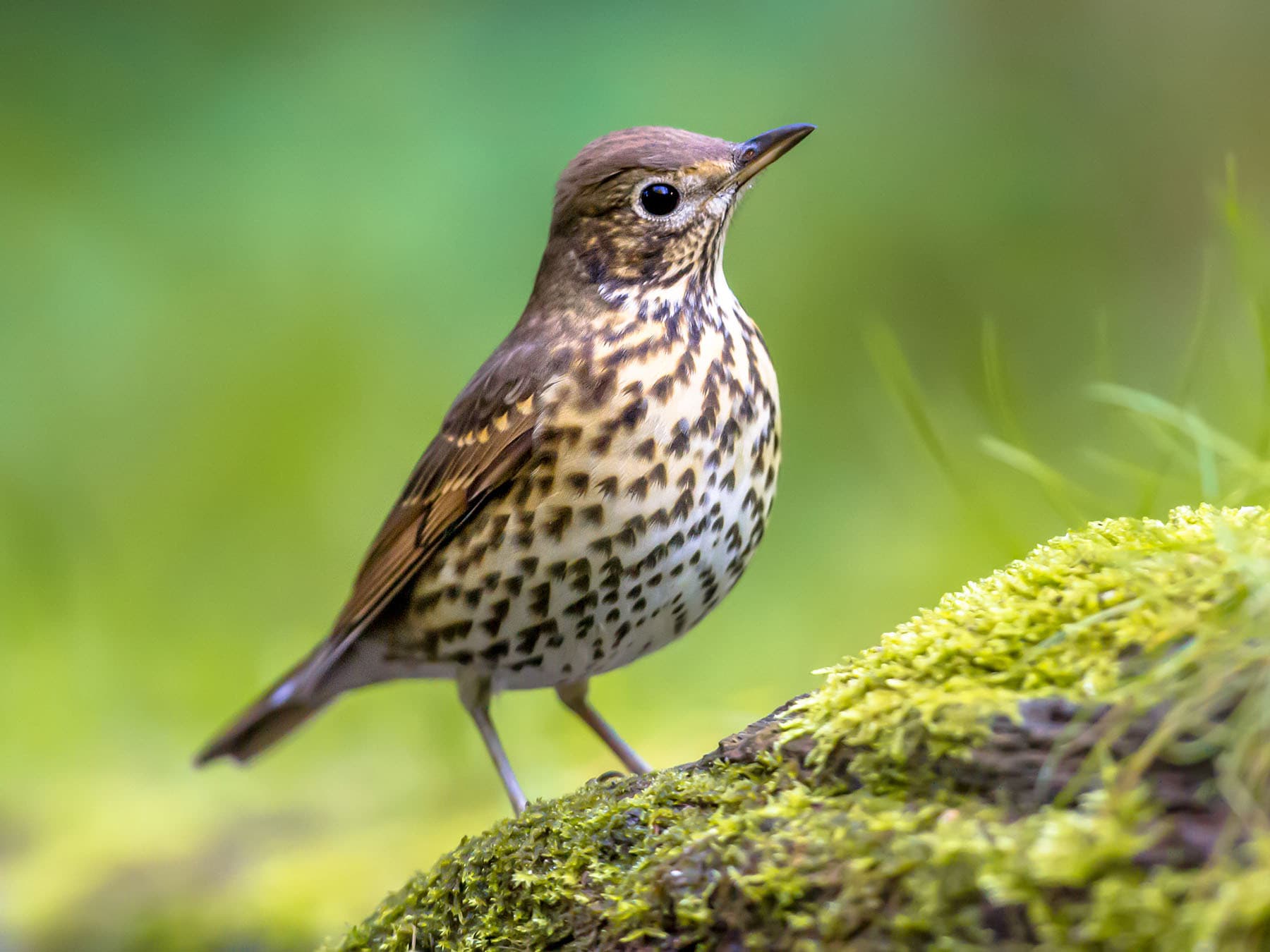 A Song Thrush on a mossy bank
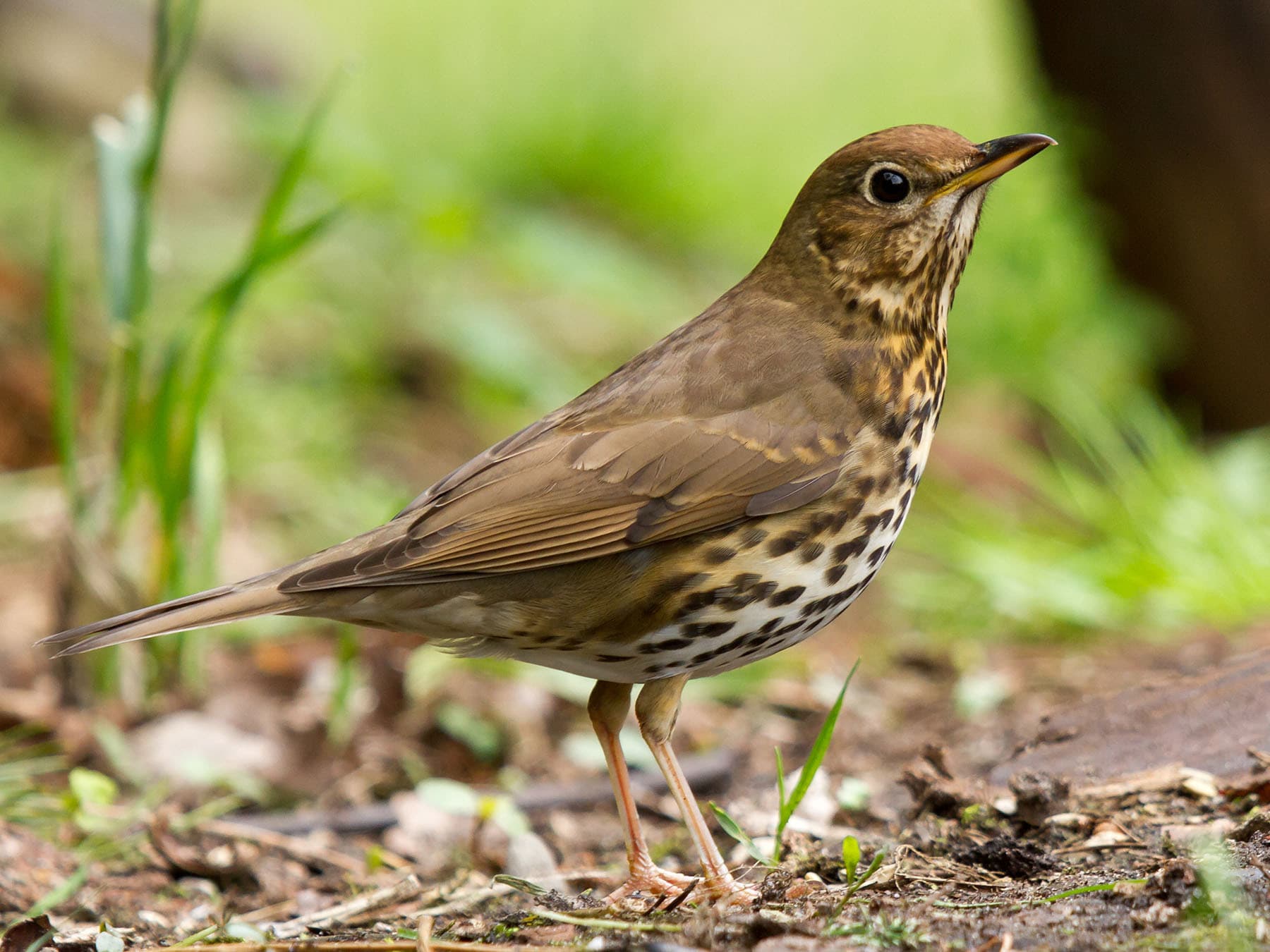 A Song Thrush on leaf litter
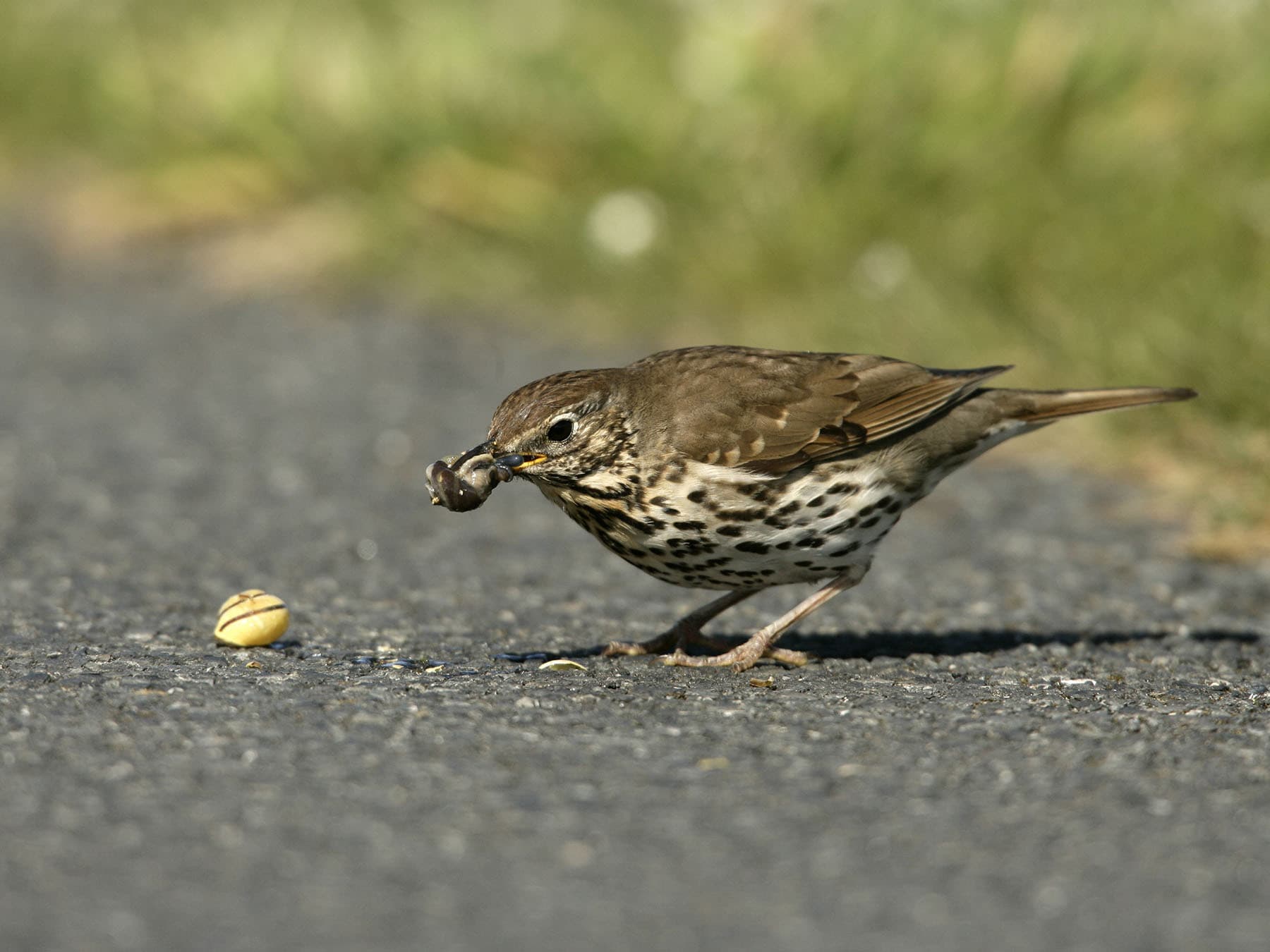 A Song Thrush with a snail on a path
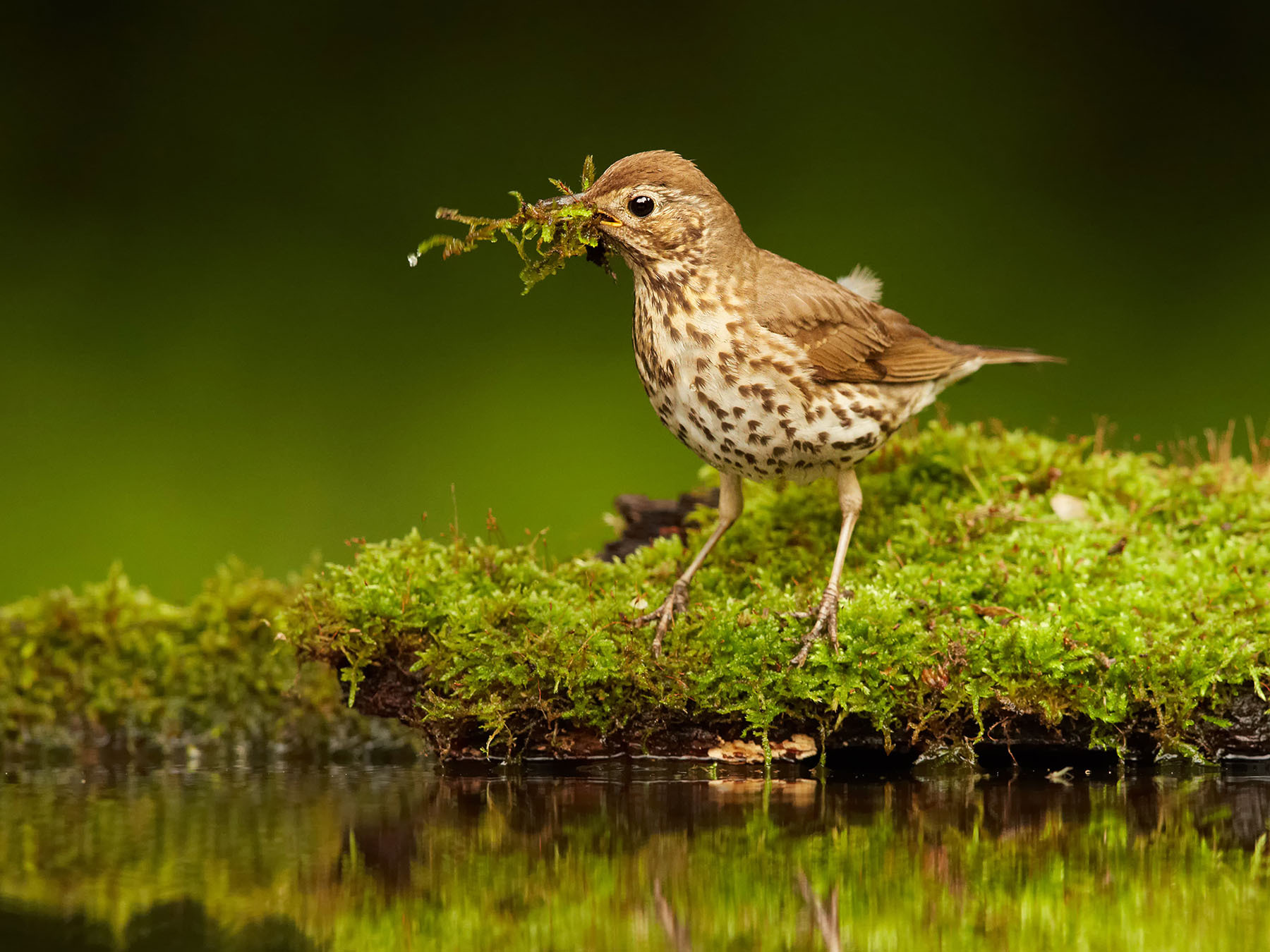
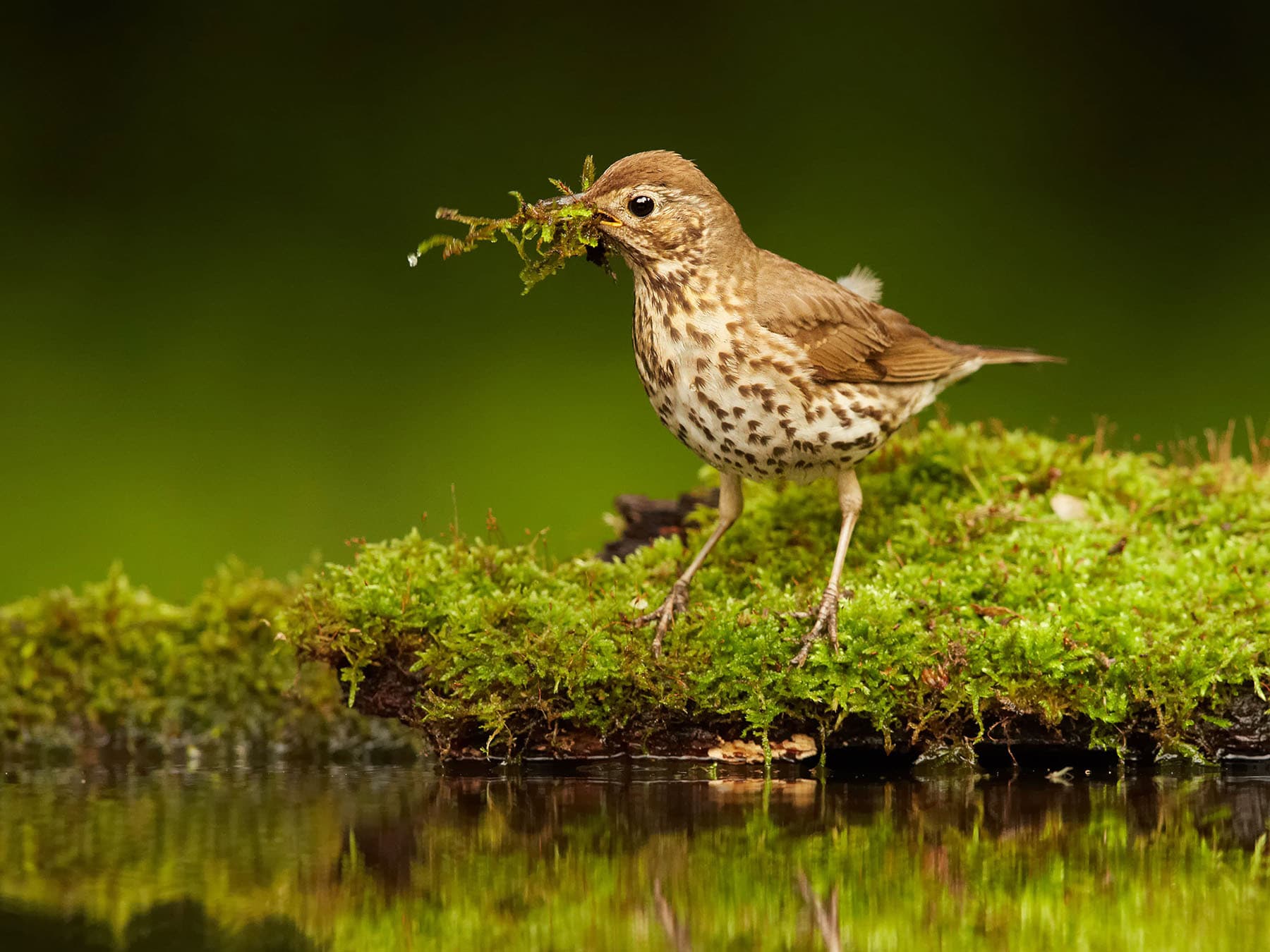 A Song Thrush with moss in its bill
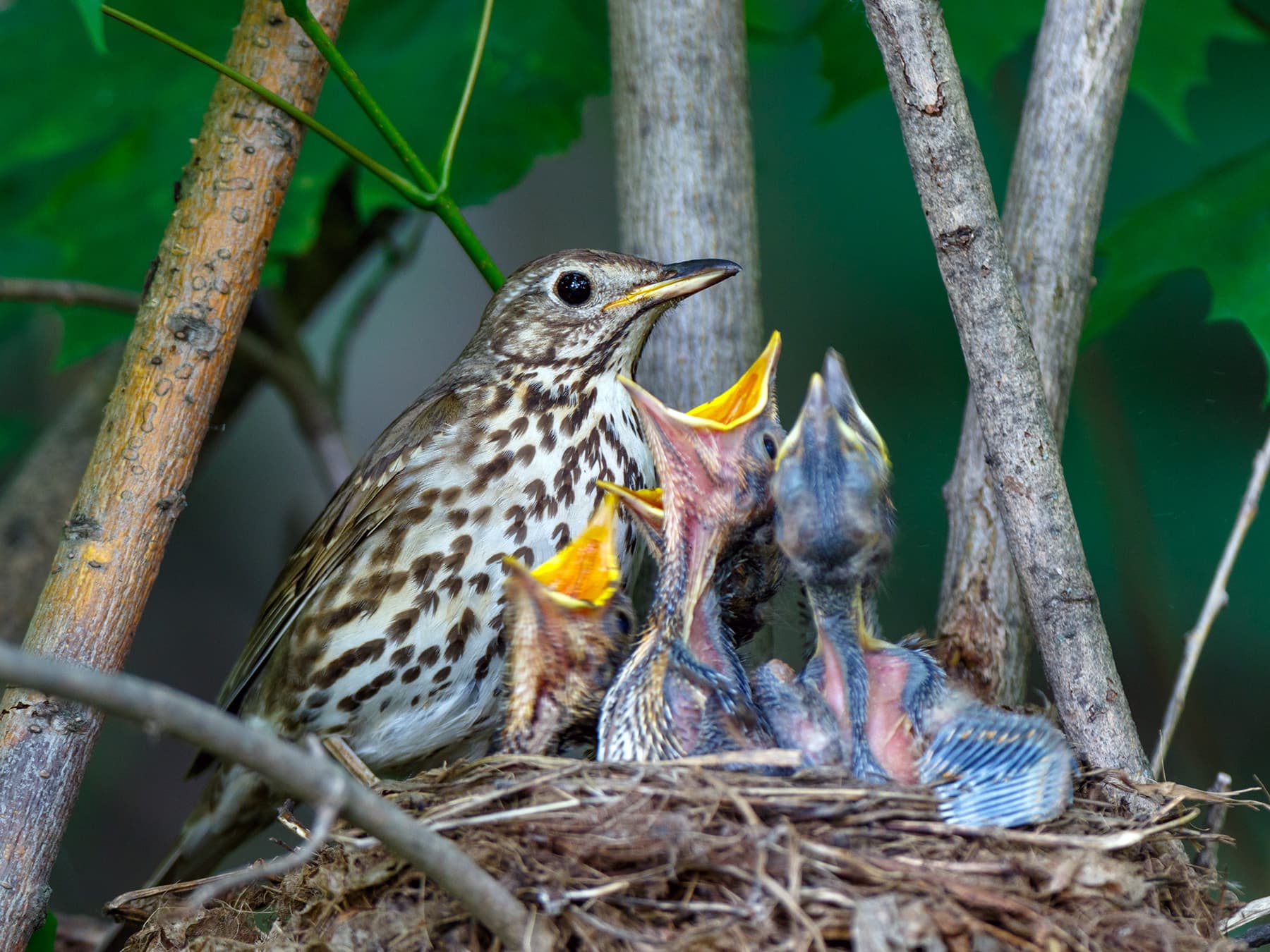 An adult Song Thrush at a nest of chicks with their bills open
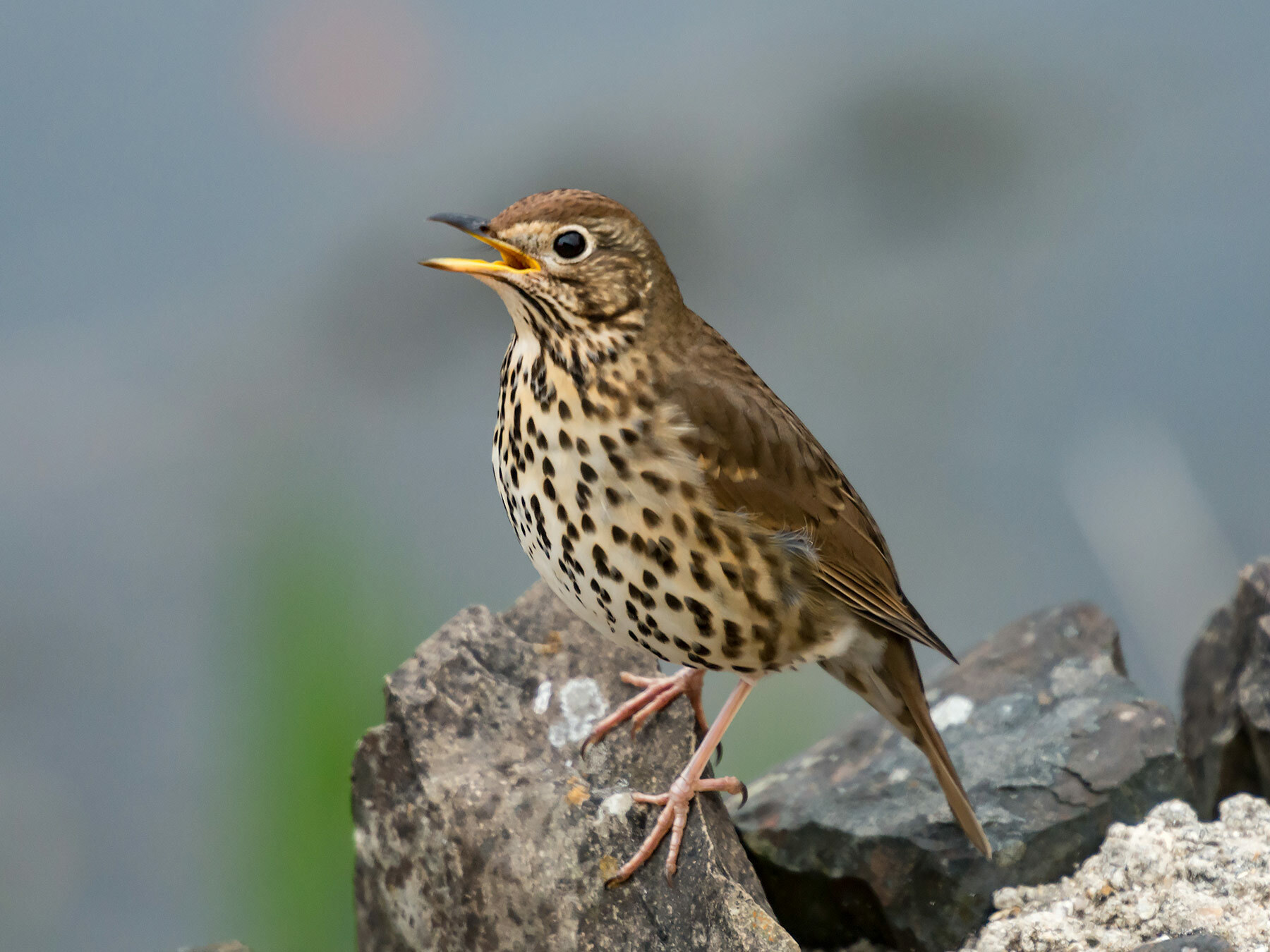
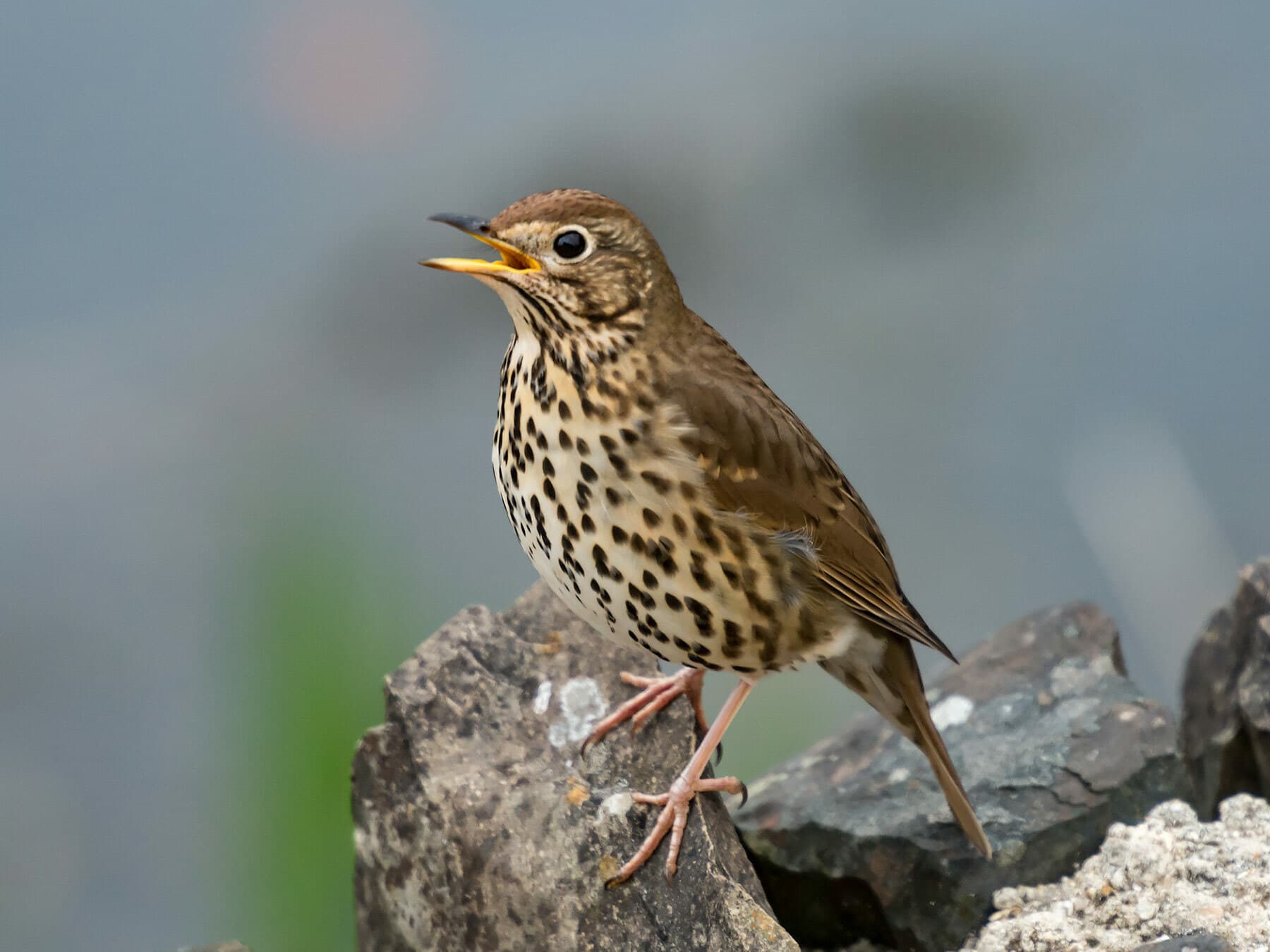 A Song Thrush on a rock with its bill open
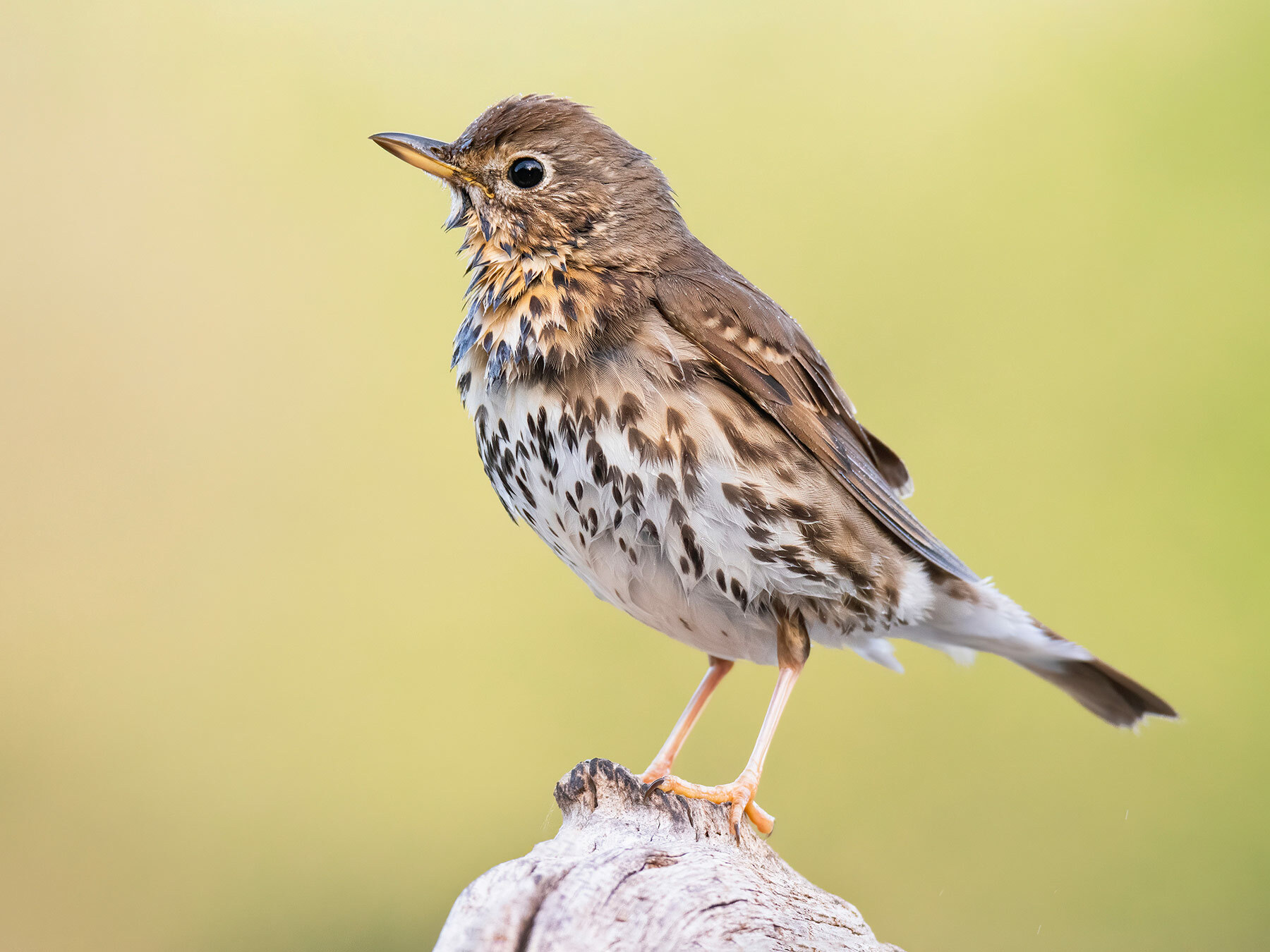
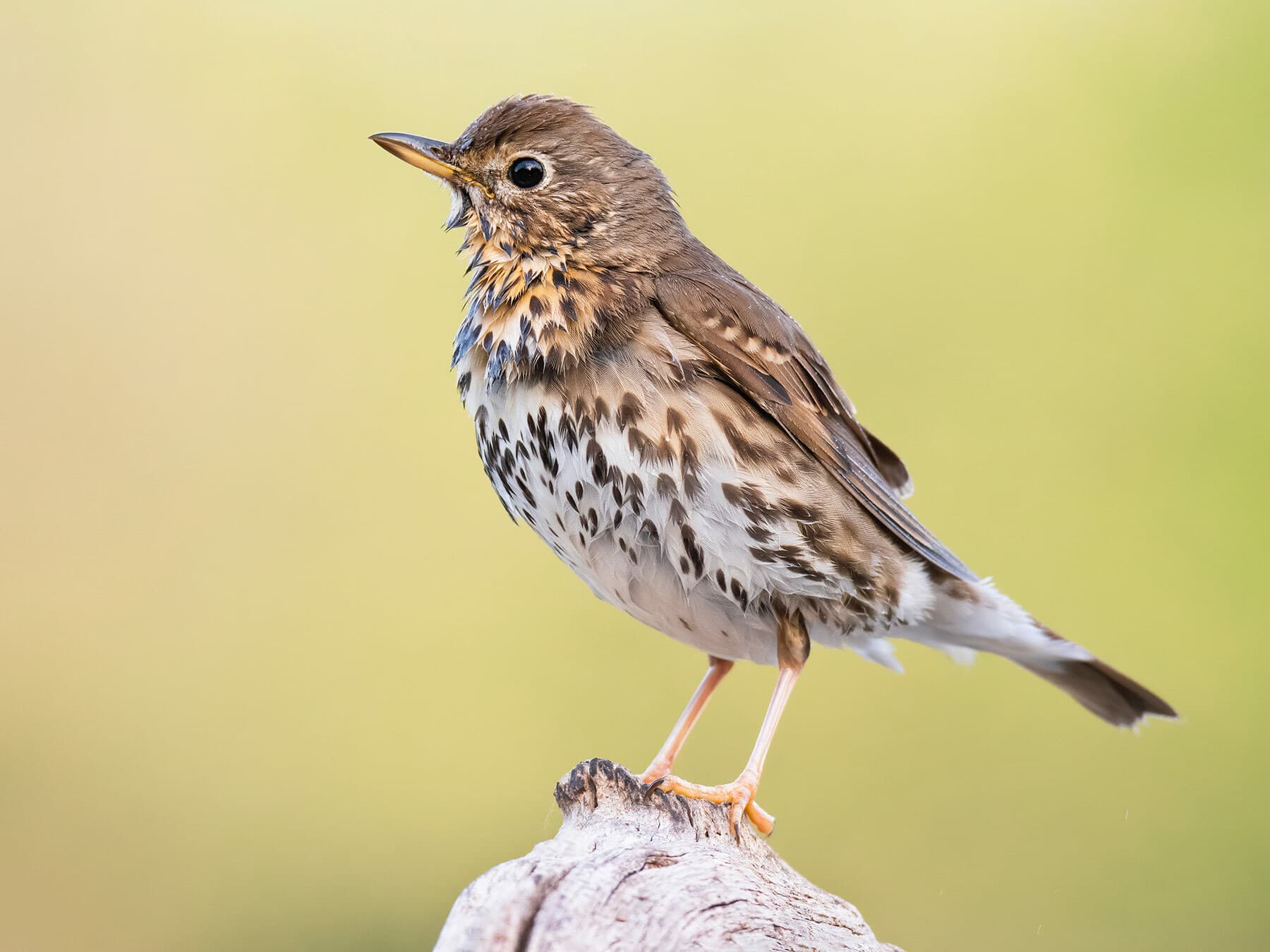 A Song Thrush with damp, ruffled feathers
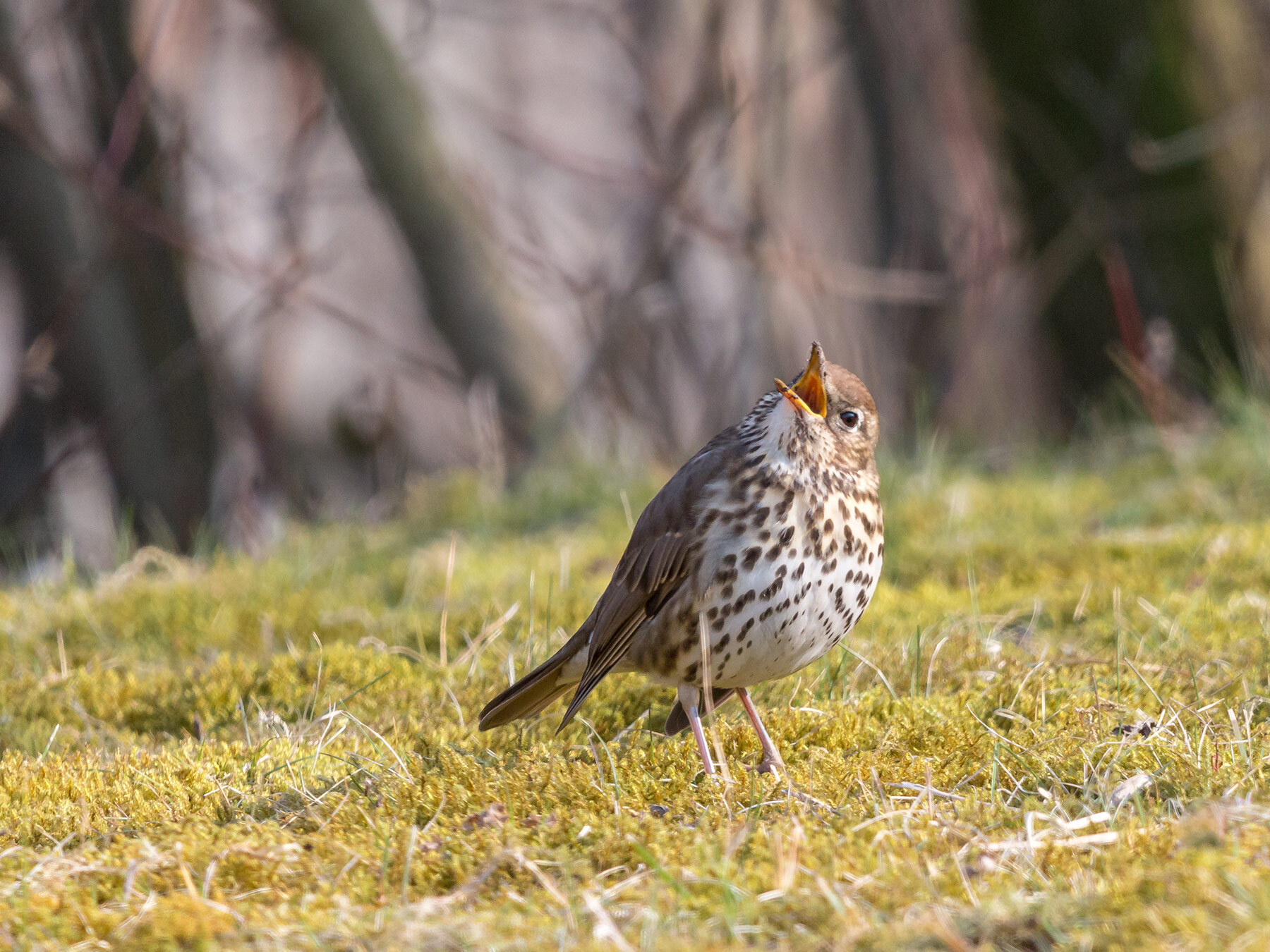 A Song Thrush on mossy ground with its bill open
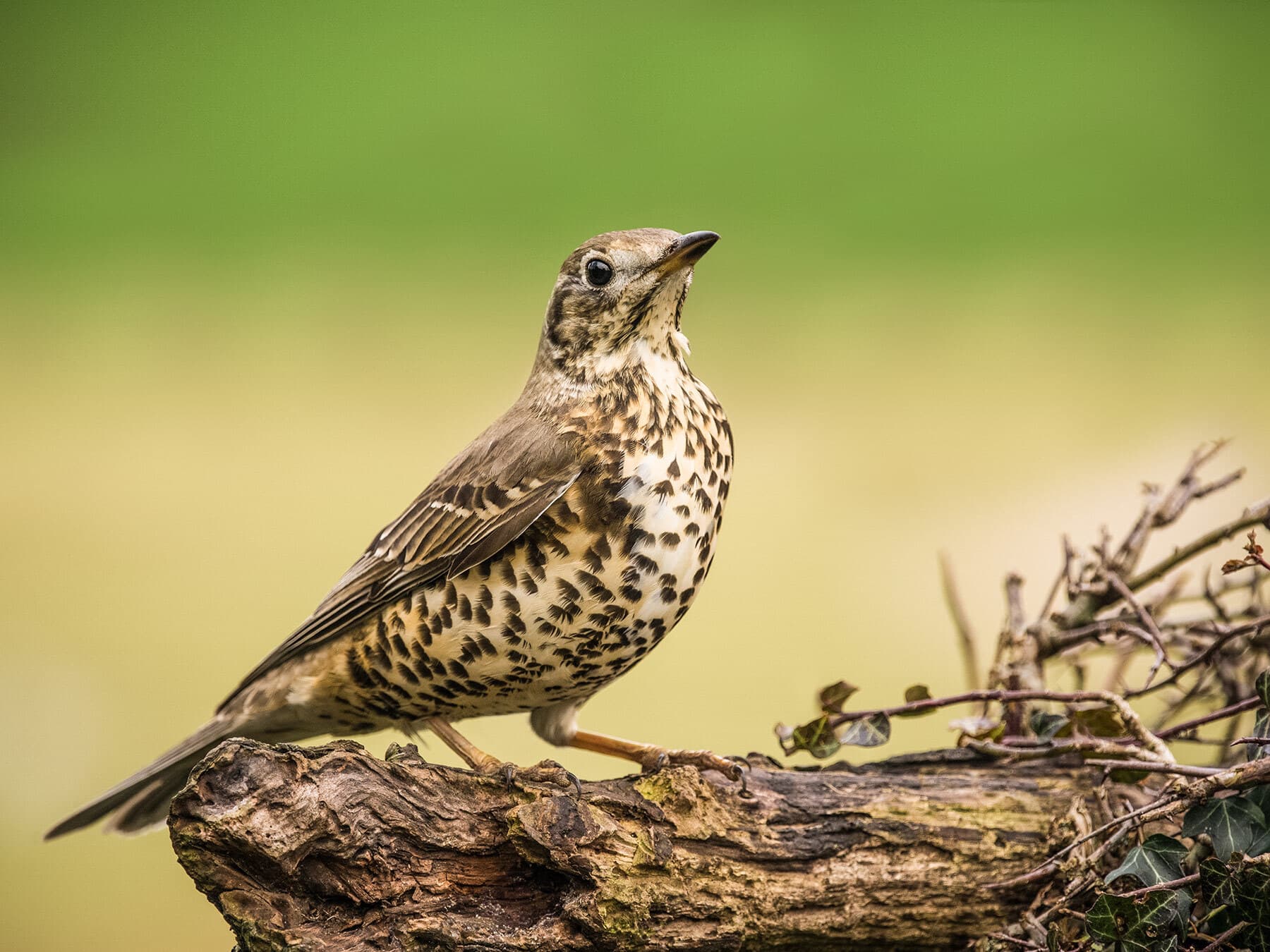 A Song Thrush on a log
Song Thrush guides
3 guidesQuick facts
- Length
- 20–23 cm
- Wingspan
- 33–36 cm
- Weight
- 65–100 g
- Lifespan
- 3 years · oldest recorded 18.3 years · UK record 11 years
- Family
- Thrushes
- Migration
- Partial migrant
- Global status (IUCN)
- Least Concern
- Population trend
- UK numbers fell 45% between 1967 and 2024 (BTO) but rose 37% between 1995 and 2024 (BBS).
- Also called
- Throstle, Mavis
- Scientific name
- Turdus philomelos
Questions
3Why is it called a Song Thrush?
For its song: the RSPB calls it "famed and named" for it. Older names are throstle, once used in northern England, the Midlands and Ireland, and mavis, in East Anglia, Ireland and Scotland.18
Are Song Thrushes rare in the UK?
No, but they are less common than they were. There are about 1.3 million territories, and numbers are rising again after a steep fall from the 1970s. See conservation status.
Are there Song Thrushes in New Zealand and Australia?
Yes. They were introduced in the 19th century. In New Zealand, where the birds came from Britain, they are now among the commonest land birds19; in Australia they have spread little beyond the Melbourne area. New Zealand birds lay smaller clutches than British ones.
Sources
22- 1RSPB. Song Thrush. RSPB Birds A-Z. Accessed 8 October 2026. Source (opens in a new tab)
- 2Woodland Trust. Song thrush (Turdus philomelos). Woodland Trust, Animals: birds. Accessed 8 October 2026. Source (opens in a new tab)
- 3Collar, N. (2020). Song Thrush (Turdus philomelos), version 1.0. Birds of the World (J. del Hoyo, A. Elliott, J. Sargatal, D. A. Christie and E. de Juana, editors). Cornell Lab of Ornithology. doi:10.2173/bow.sonthr1.01 (opens in a new tab)
- 4BTO. Song Thrush (Turdus philomelos). BTO BirdFacts. Accessed 8 October 2026. Source (opens in a new tab)
- 5RSPB. How to identify the UK's thrushes, including two special winter visitors. RSPB, Identifying birds. Accessed 8 October 2026. Source (opens in a new tab)
- 6Collar, N. (2020). Mistle Thrush (Turdus viscivorus), version 1.0. Birds of the World (J. del Hoyo, A. Elliott, J. Sargatal, D. A. Christie and E. de Juana, editors). Cornell Lab of Ornithology. doi:10.2173/bow.misthr1.01 (opens in a new tab)
- 7RSPB. Mistle Thrush. RSPB Birds A-Z. Accessed 8 October 2026. Source (opens in a new tab)
- 8AviList Core Team (2025). AviList: The Global Avian Checklist, v2025b. doi:10.2173/avilist.v2025b (opens in a new tab)
- 9Robinson, R. A., Leech, D. I. and Clark, J. A. (2025). Summary of all recoveries for Song Thrush (Turdus philomelos). The Online Demography Report: bird ringing and nest recording in Britain & Ireland in 2024 (BTO). Accessed 8 October 2026. Source (opens in a new tab)
- 10Peach, W. J., Denny, M., Cotton, P. A., Hill, I. F., Gruar, D., Barritt, D. et al. (2004). Habitat selection by song thrushes in stable and declining farmland populations. Journal of Applied Ecology 41(2): 275-293. doi:10.1111/j.0021-8901.2004.00892.x (opens in a new tab)
- 11BTO. Longevity records for Britain & Ireland in 2024. BTO Online Ringing and Nest Recording Report. Accessed 8 October 2026. Source (opens in a new tab)
- 12Fransson, T., Kolehmainen, T., Moss, D. and Robinson, R. (2023). EURING list of longevity records for European birds (1 September 2023). EURING. Accessed 8 October 2026. Source (opens in a new tab)
- 13RSPB, BTO et al. (2021). Birds of Conservation Concern 5 (leaflet). The status of all regularly occurring birds in the UK, Channel Islands and Isle of Man. Accessed 8 October 2026. Source (opens in a new tab)
- 14Peach, W. J., Robinson, R. A. and Murray, K. A. (2004). Demographic and environmental causes of the decline of rural Song Thrushes Turdus philomelos in lowland Britain. Ibis 146 (suppl. 2): 50-59. doi:10.1111/j.1474-919x.2004.00362.x (opens in a new tab)
- 15Heywood, J. J. N., Massimino, D., Baker, L., Balmer, D. E. et al. (2026). The Breeding Bird Survey 2025. BTO Research Report 802. British Trust for Ornithology, Thetford. Accessed 8 October 2026. Source (opens in a new tab)
- 16UK Parliament (1981). Wildlife and Countryside Act 1981, section 1. Accessed 7 October 2026. Source (opens in a new tab)
- 17UK Government (1985). The Wildlife (Northern Ireland) Order 1985, Article 4. Accessed 8 October 2026. Source (opens in a new tab)
- 18Swainson, C. (1885). Provincial Names and Folk Lore of British Birds. Trübner, for the English Dialect Society, London. Accessed 8 October 2026. Source (opens in a new tab)
- 19Congdon, N. M. (2010). Life-history traits and potential causes of clutch-size decline in the introduced song thrush (Turdus philomelos) in New Zealand. PhD thesis, University of Canterbury. doi:10.26021/5748 (opens in a new tab)
- 20BTO. Mistle Thrush (Turdus viscivorus). BTO BirdFacts. Accessed 8 October 2026. Source (opens in a new tab)
- 21BTO. Nest boxes for birds. BTO, Helping birds. Accessed 8 October 2026. Source (opens in a new tab)
- 22Macgillivray, W. (1839). A History of British Birds, vol. 2. Scott, Webster and Geary, London. Accessed 8 October 2026. Source (opens in a new tab)

Checked by
Nathan Cope, founder and editor
Nathan founded Birdfact and leads its writers and contributors in the UK, the US and Canada. He has watched and studied birds for more than ten years, and checks every article and species guide before it’s published.