
Little Egret
Egretta garzetta
By the Birdfact teamChecked by Nathan Cope
See it in 3D
3 plumages
A Little Egret (Adult nonbreeding) is 55–65 cm (21.5–25.5 in) long, bill to tail.
Adult nonbreeding
© 2026 NC Digital Limited (Birdfact). All rights reserved. This 3D model may be viewed on this page and shared by link only. Downloading, extracting, copying or reusing it, or using it to train machine-learning models, is not permitted without our written permission. Using our models
On this page16 sections
How to recognise it
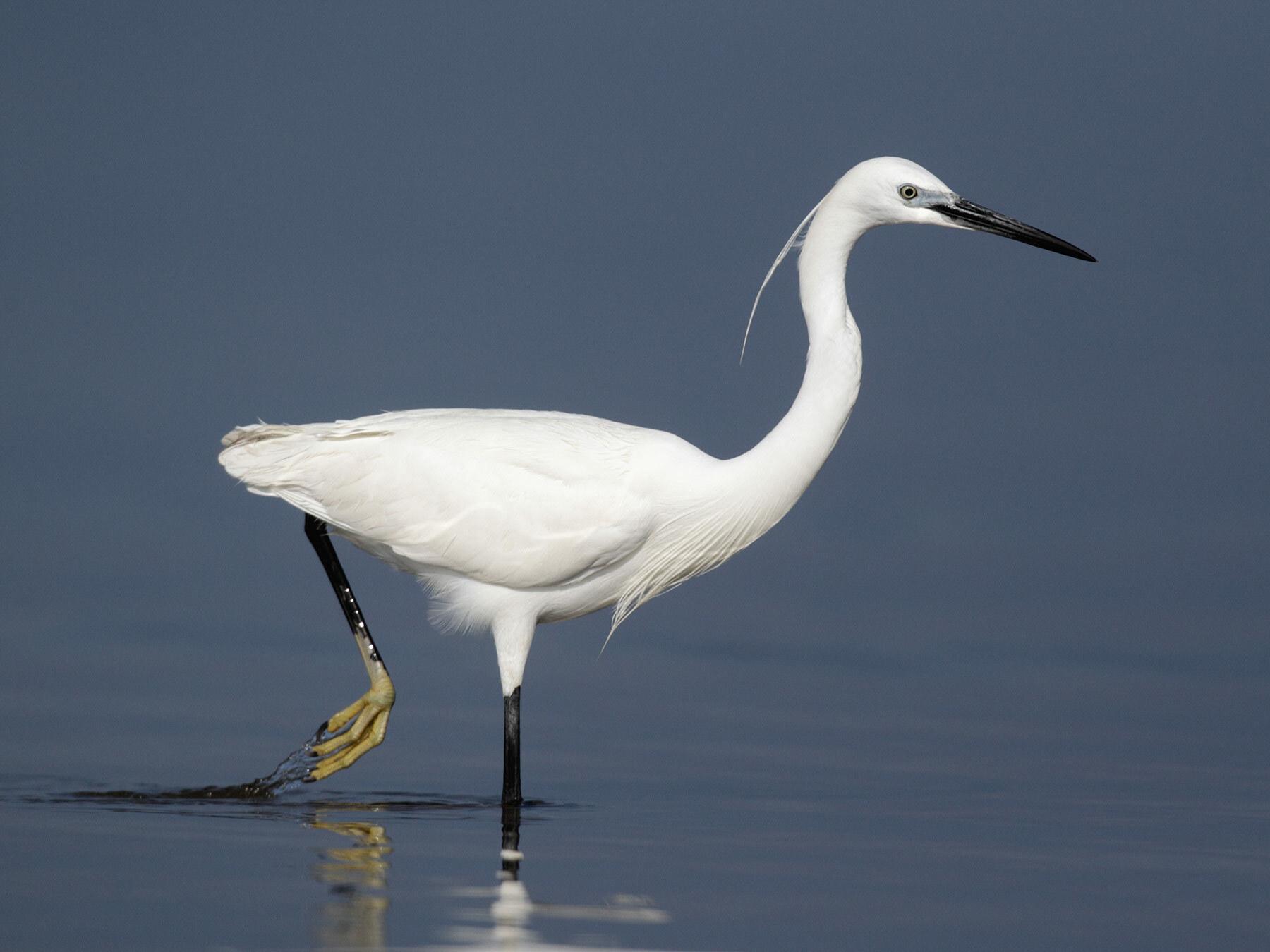
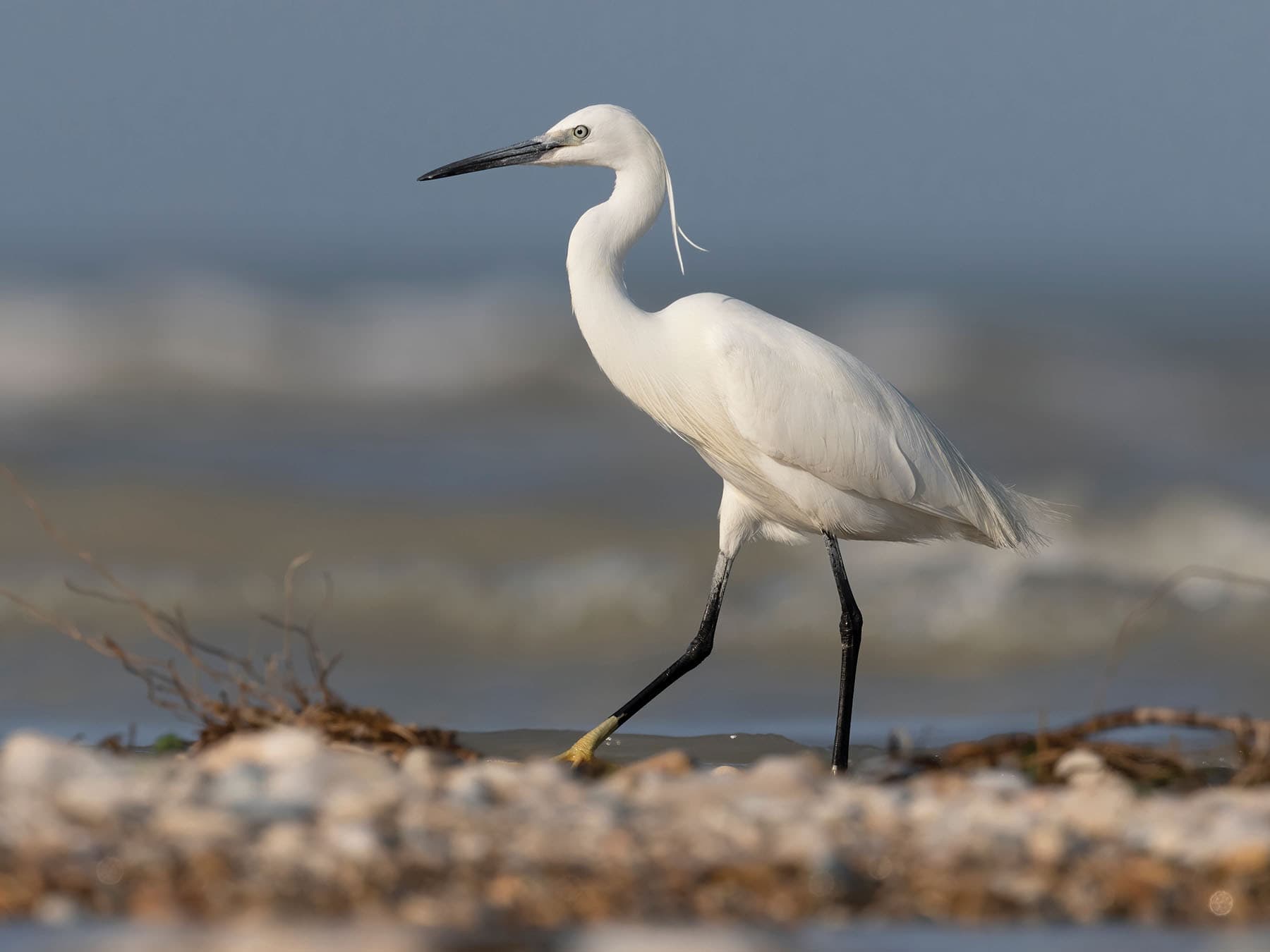
The Little Egret is a small, slim, all-white heron with a thin black bill, black legs and bright yellow feet. A rare visitor to Britain until the late 1980s, it has bred here since 1996 and is now a common sight all year on estuaries, saltmarsh, lakes and rivers, especially in the south.
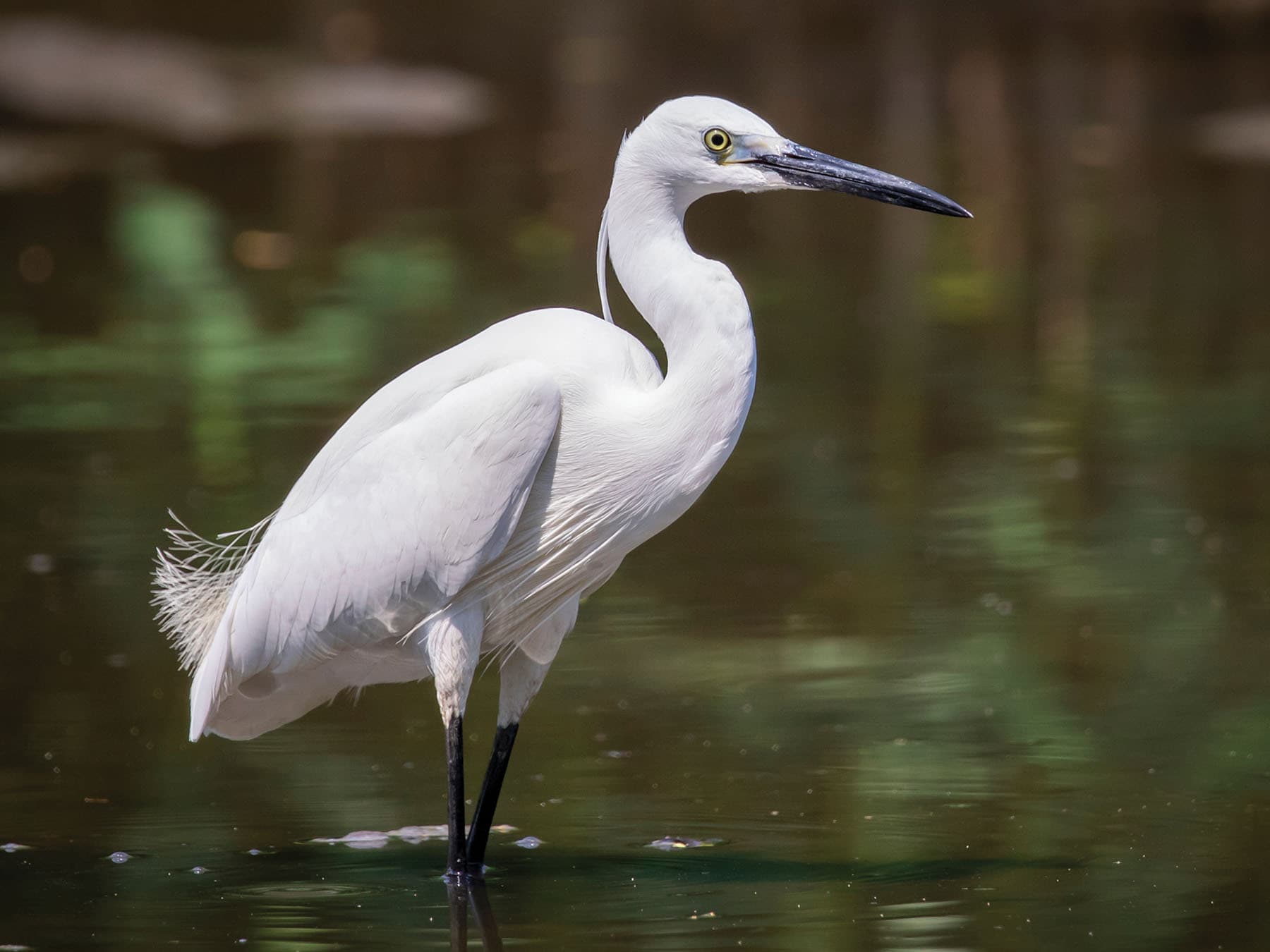
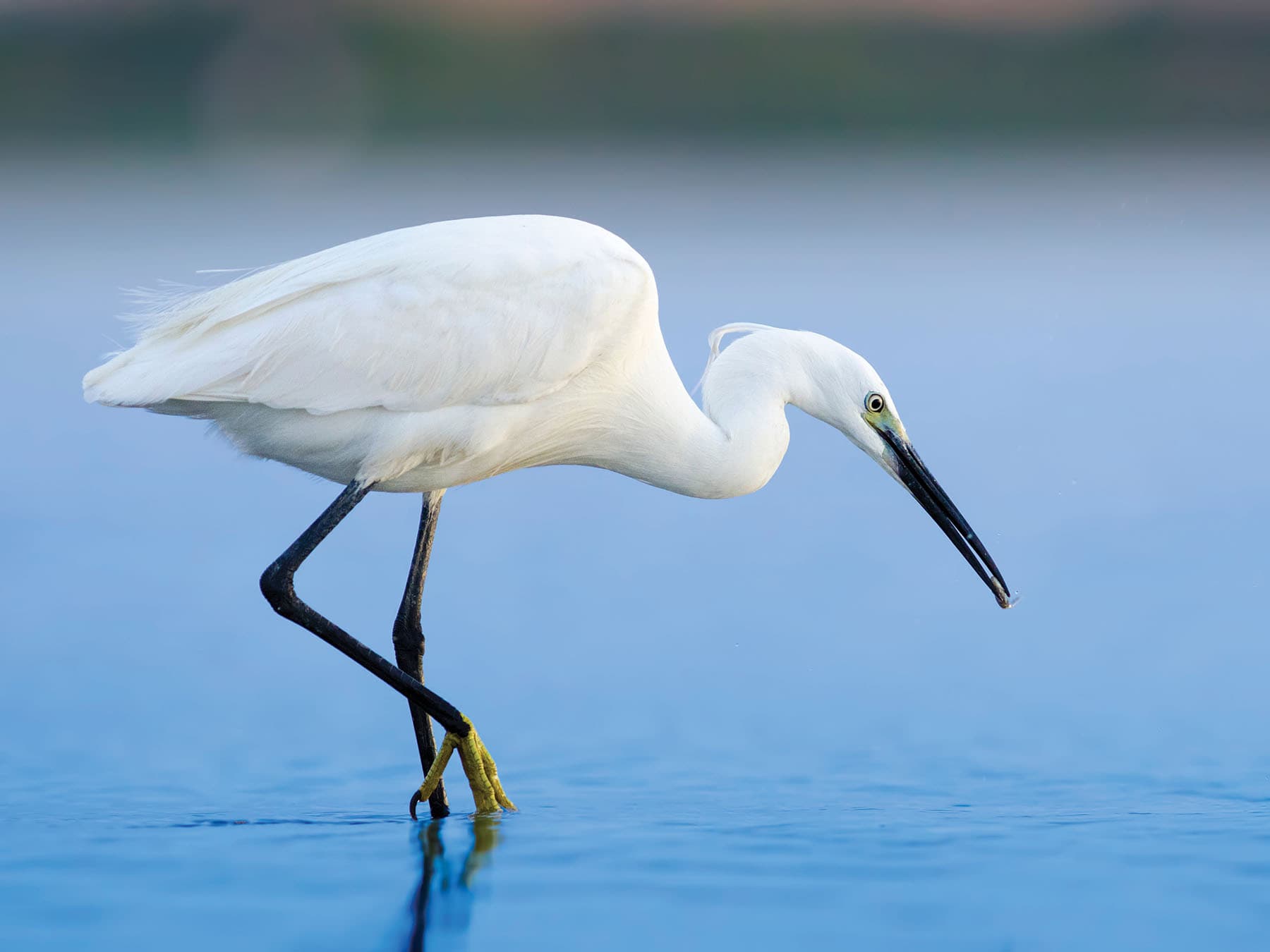
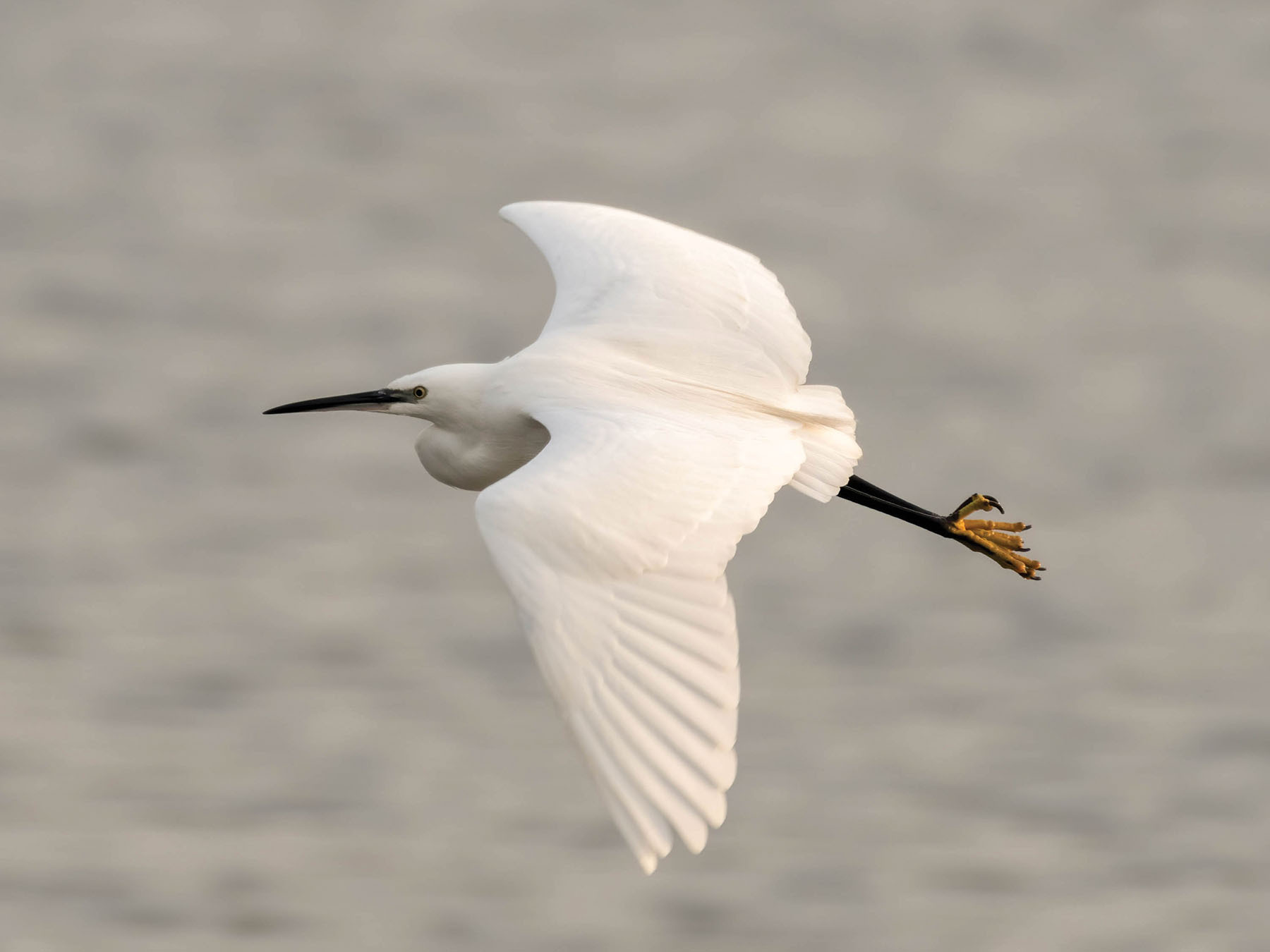
Look for the long, dagger-shaped bill, black or dark grey, and the pale yellow eye. The bare skin between the eye and the bill, the lores, is blue-grey to greenish grey for most of the year, duller and often olive outside the breeding season. The yellow on the feet almost always stops at the feet and the very bottom of the leg, so they are easy to miss on a wading bird; watch for them as it walks, flies or lands.
Plumage through the year
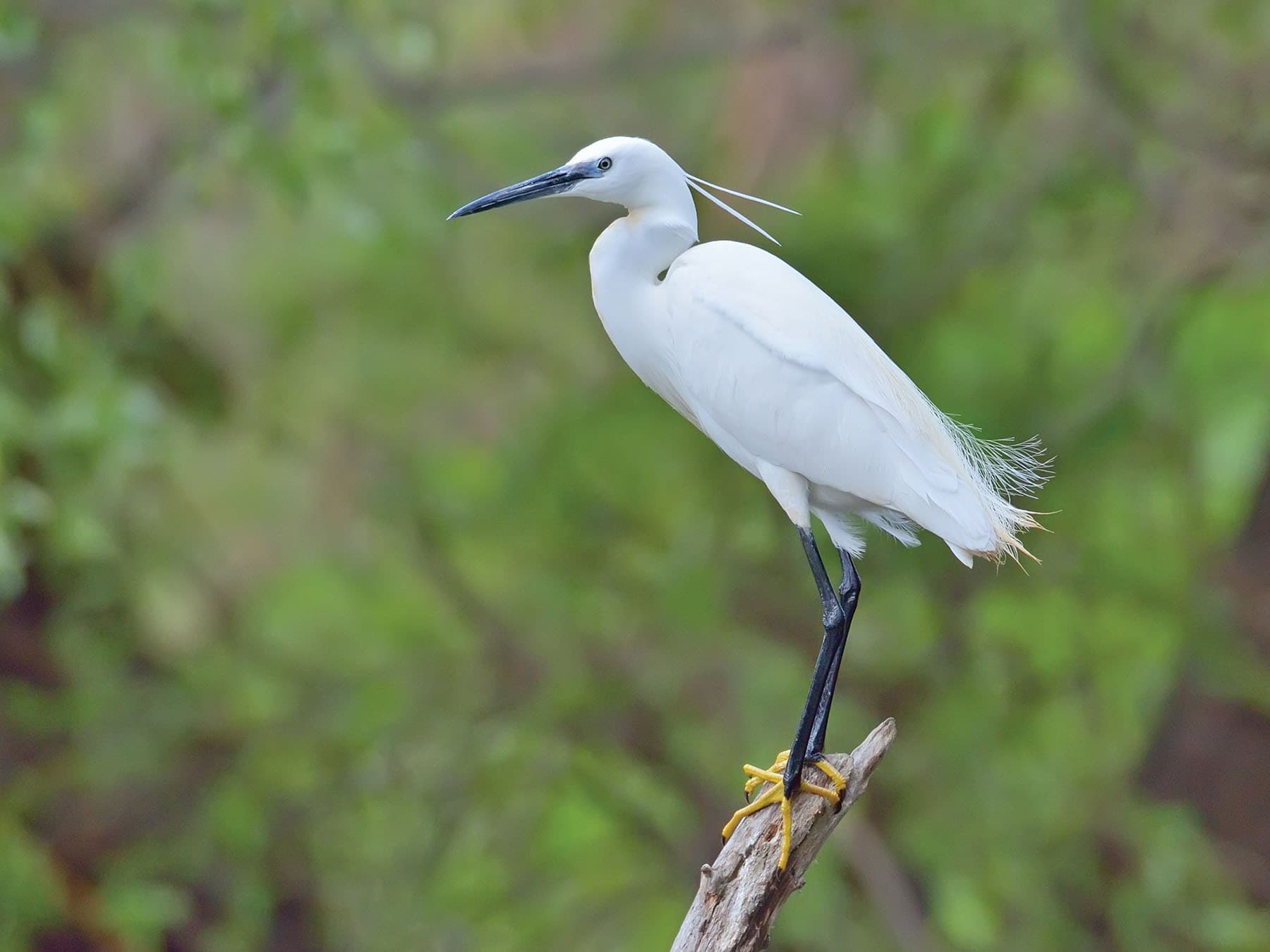
By late winter adults wear their finery: two long, narrow plumes from the back of the head, reaching the middle or lower neck, fine lacy plumes on the back that reach the tail, and shorter, stringy plumes on the breast. In display the back plumes are raised and spread.
These plumes are not a separate breeding plumage: they are part of the ordinary feather coat, often shed first in the moult of late summer and autumn and then taking four to six months to grow back, so they are shortest in autumn and full grown by the breeding season; the head plumes can reach 160 mm and the back plumes 280 mm; at the height of courtship the lores and the yellow of the feet are said to flush pink or red, though in photographs this is 'rare at best', and photographs also suggest bills are blackest around the breeding season and greyer, with a paler base, in moult.1
Size and weight
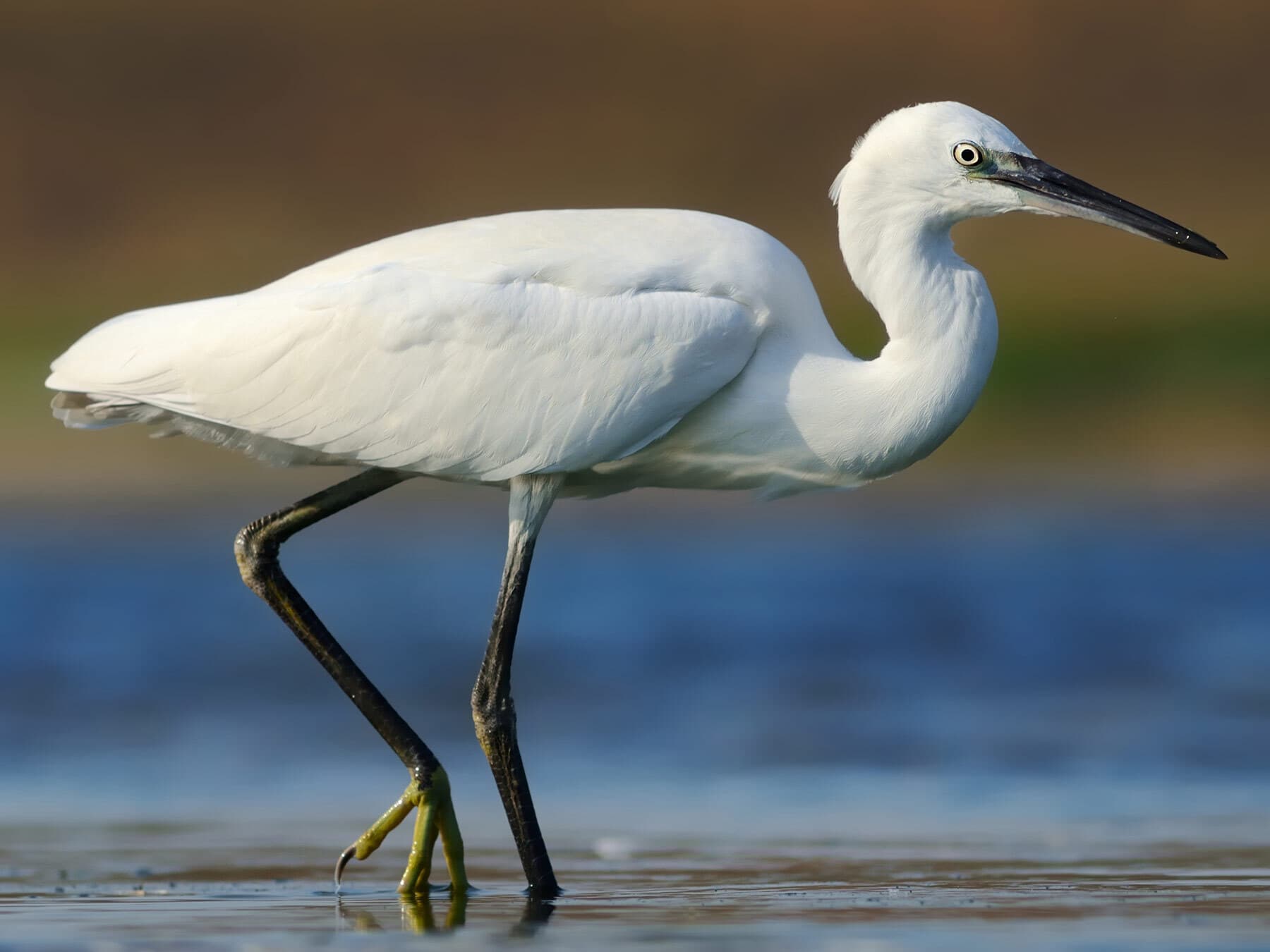
Little Egrets are 55-65 cm (22-26 in) long, with a wingspan of 88-106 cm (35-42 in), and usually weigh 350-550 g (12-19 oz). That makes them much smaller than a Great White Egret.
Male, female and young
The sexes look alike in every plumage. Males average a little larger in every measurement: in a handbook table of museum specimens, wings averaged 280 mm in males and 272 mm in females, and in a captive study males were bigger and more aggressive than females.1, 2
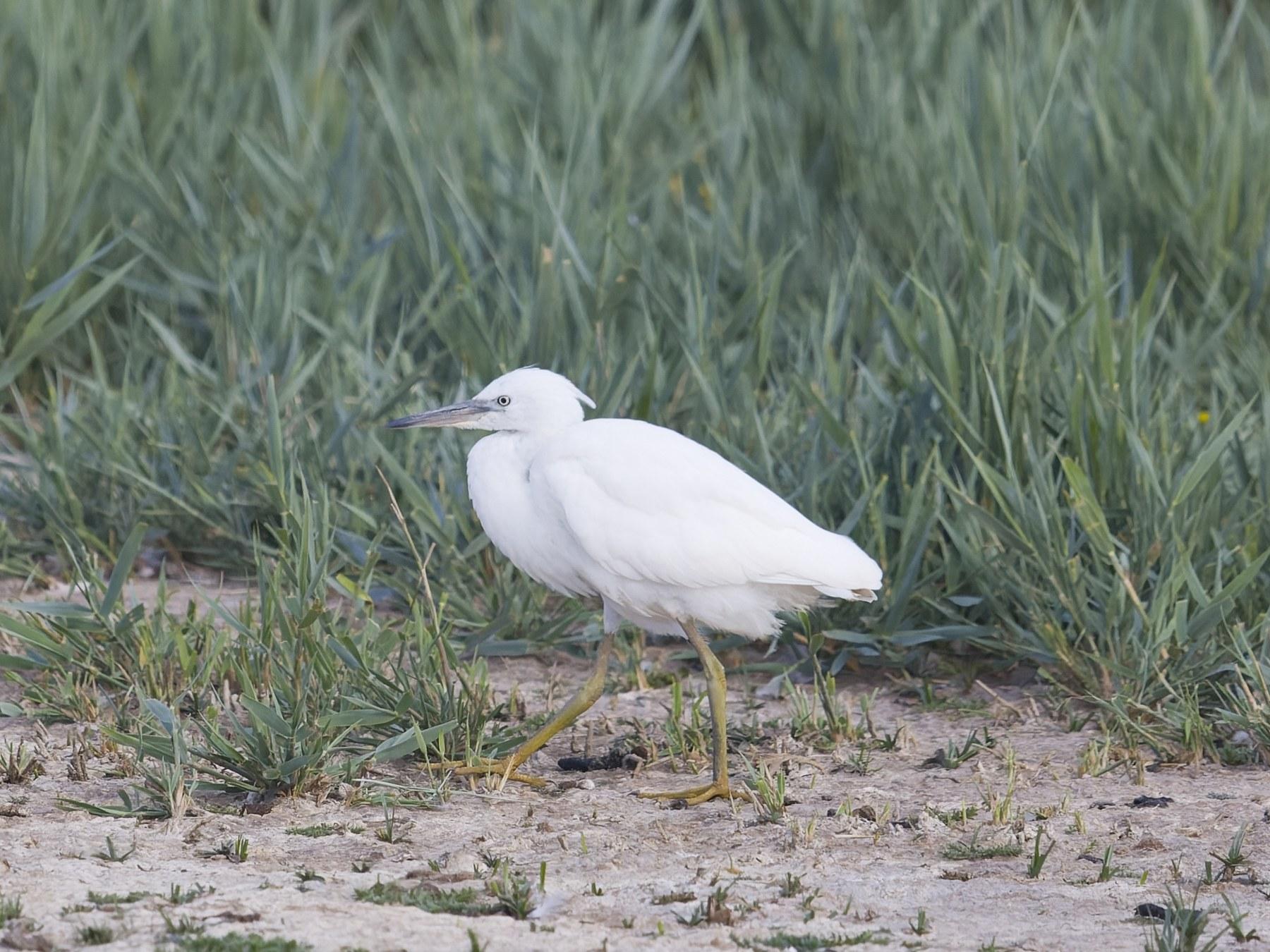
Young birds are all white with no long plumes. Once they leave the nest the bill is mostly dark with a pale base to the lower half, the lores are a dull yellowish green, and the legs are grey-green to yellow-green, turning black over the first year or more. So greenish legs alone do not make a young egret a Snowy or Cattle Egret. First-year birds grow plumes, but fewer and shorter than an adult's.
In the race found in Europe, Asia and Africa a grey or dark Little Egret is exceptionally rare, and most dark birds are probably hybrids with the Western Reef Heron; the race on the East African coast and Madagascar has a common dark grey form.1
Identification: other white herons
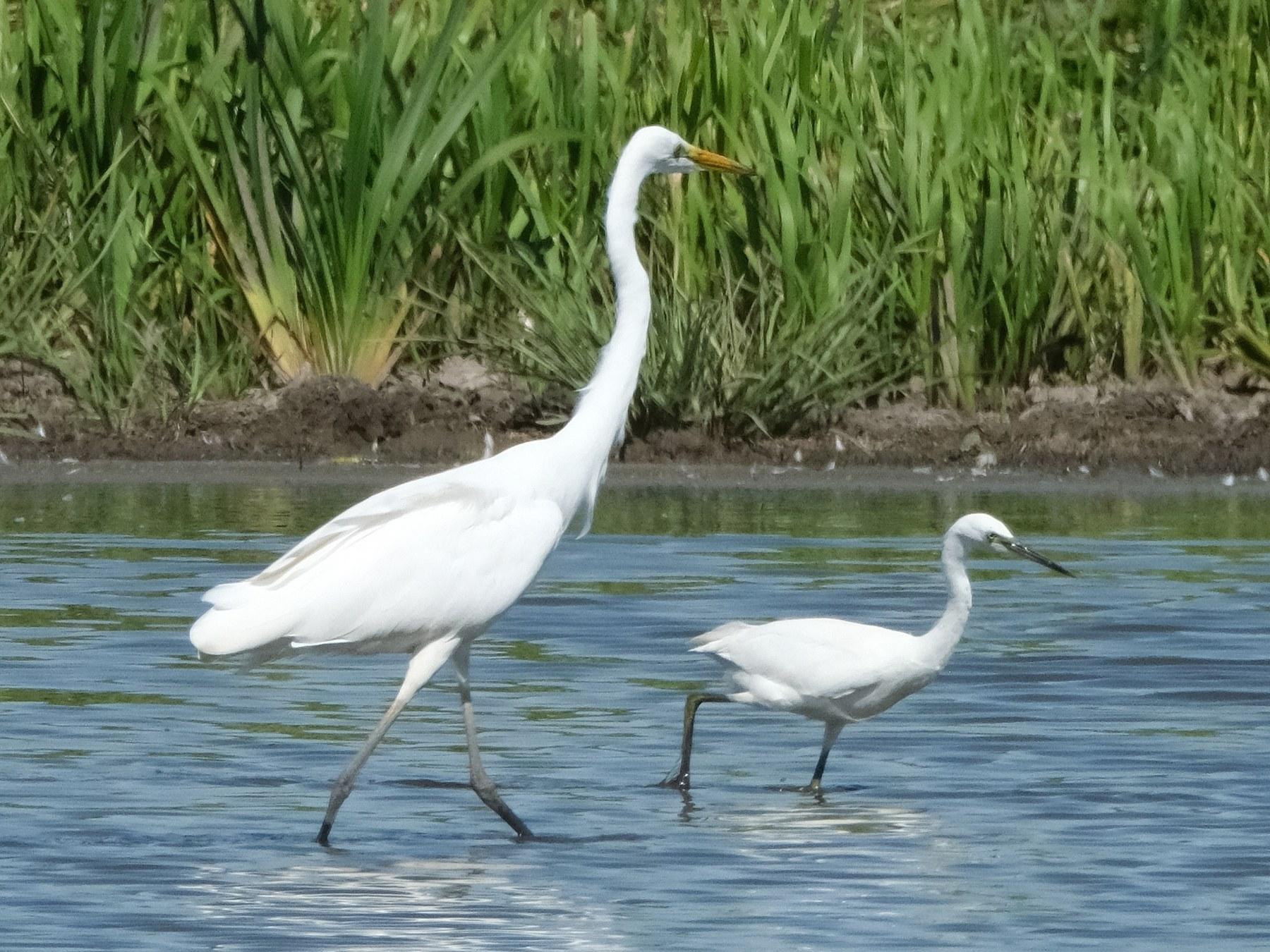
The Great White Egret (Great Egret) is the one to check. It is much bigger, the size of a Grey Heron, with longer legs that trail well past the tail in flight, slower wingbeats, black feet and yellow on the upper legs, and outside the breeding season a yellow bill. It never has plumes on the nape.
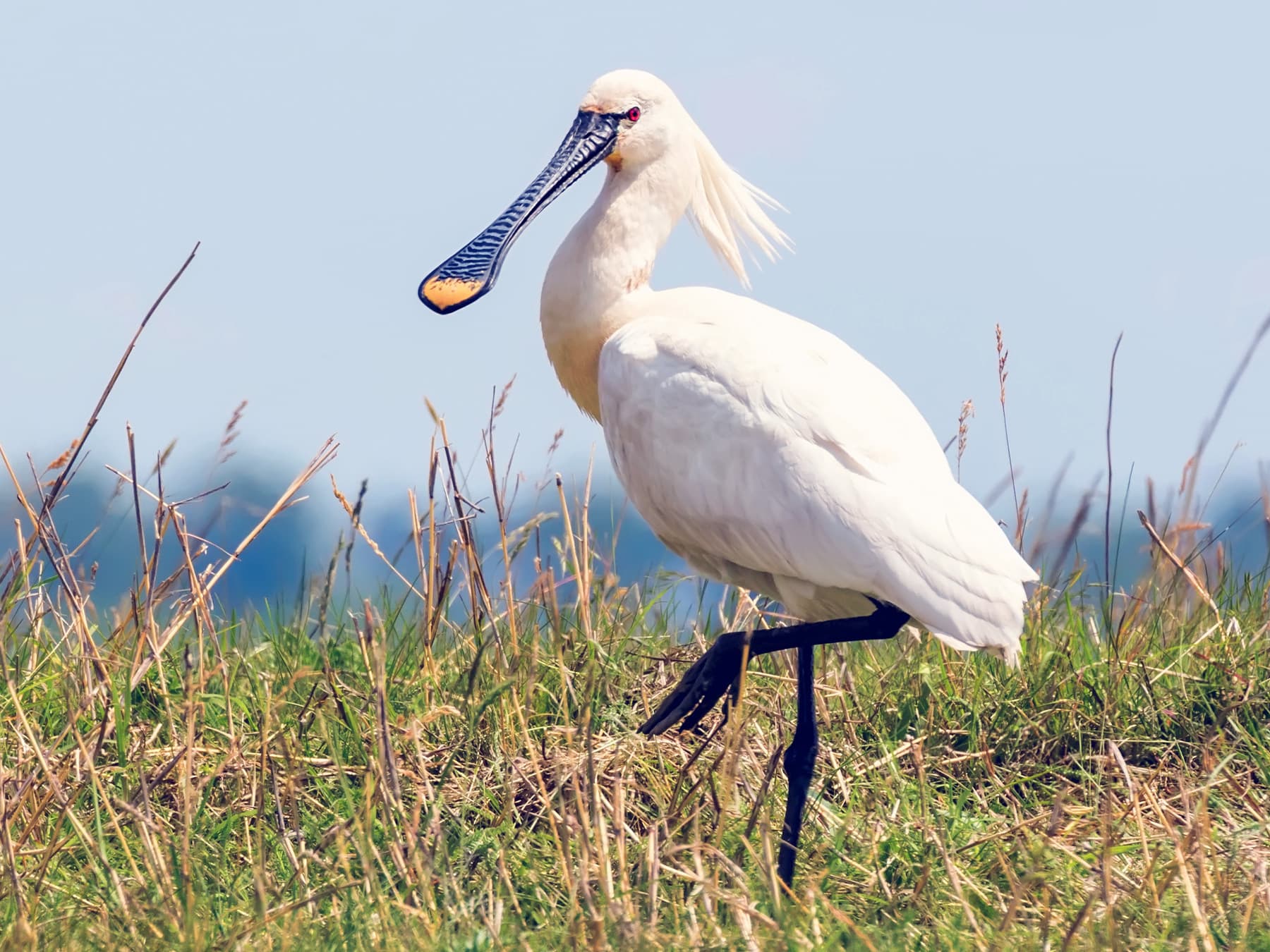
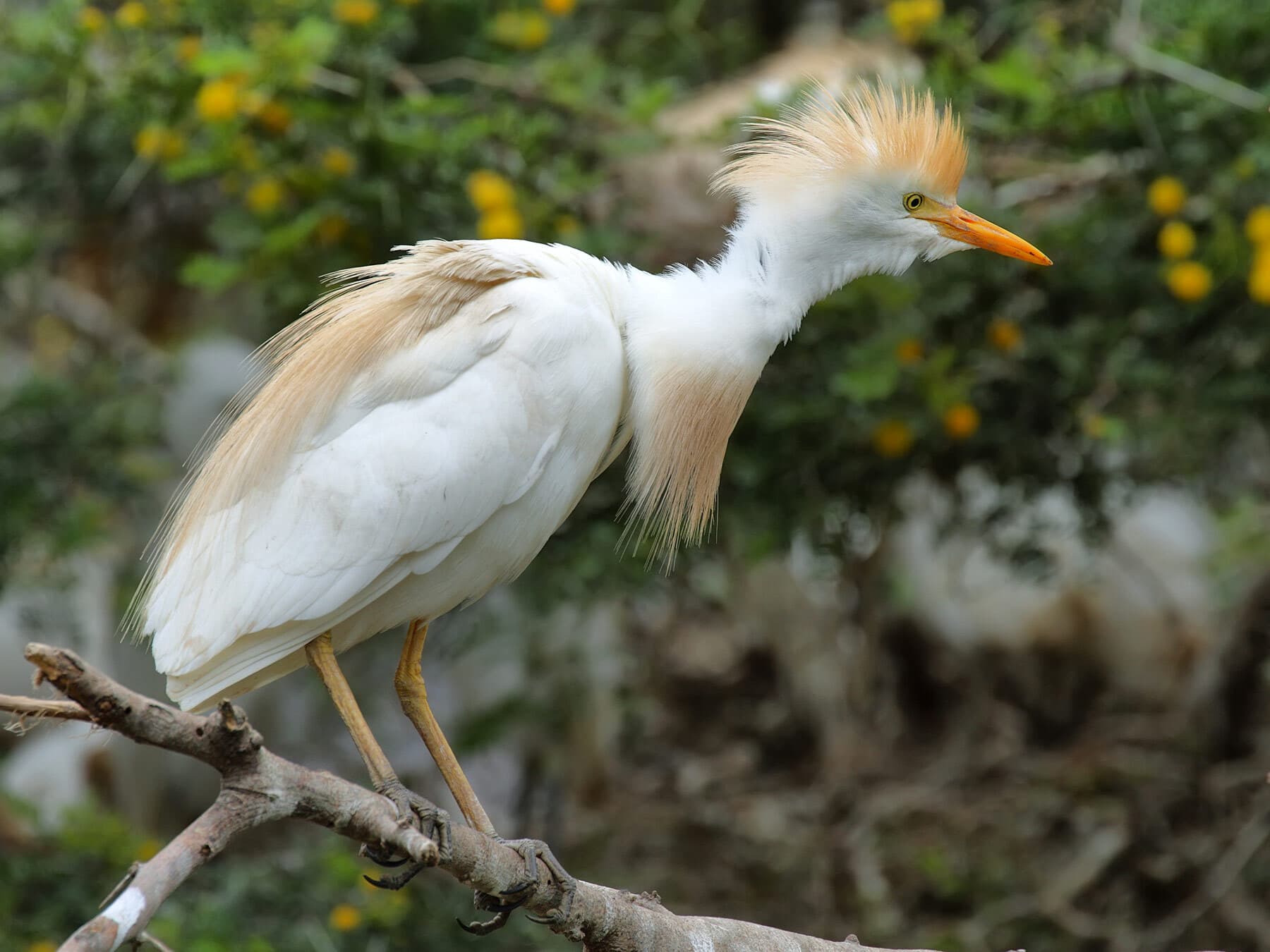
The Cattle Egret is slightly smaller and much stockier, with a short, thick neck, a yellow bill and no contrasting yellow feet, and it often feeds among livestock; breeding adults have orange-buff plumes. A Spoonbill is much bigger and heavier; breeding adults have a crest and a yellow patch at the base of the neck, and young birds have black tips to the primaries.
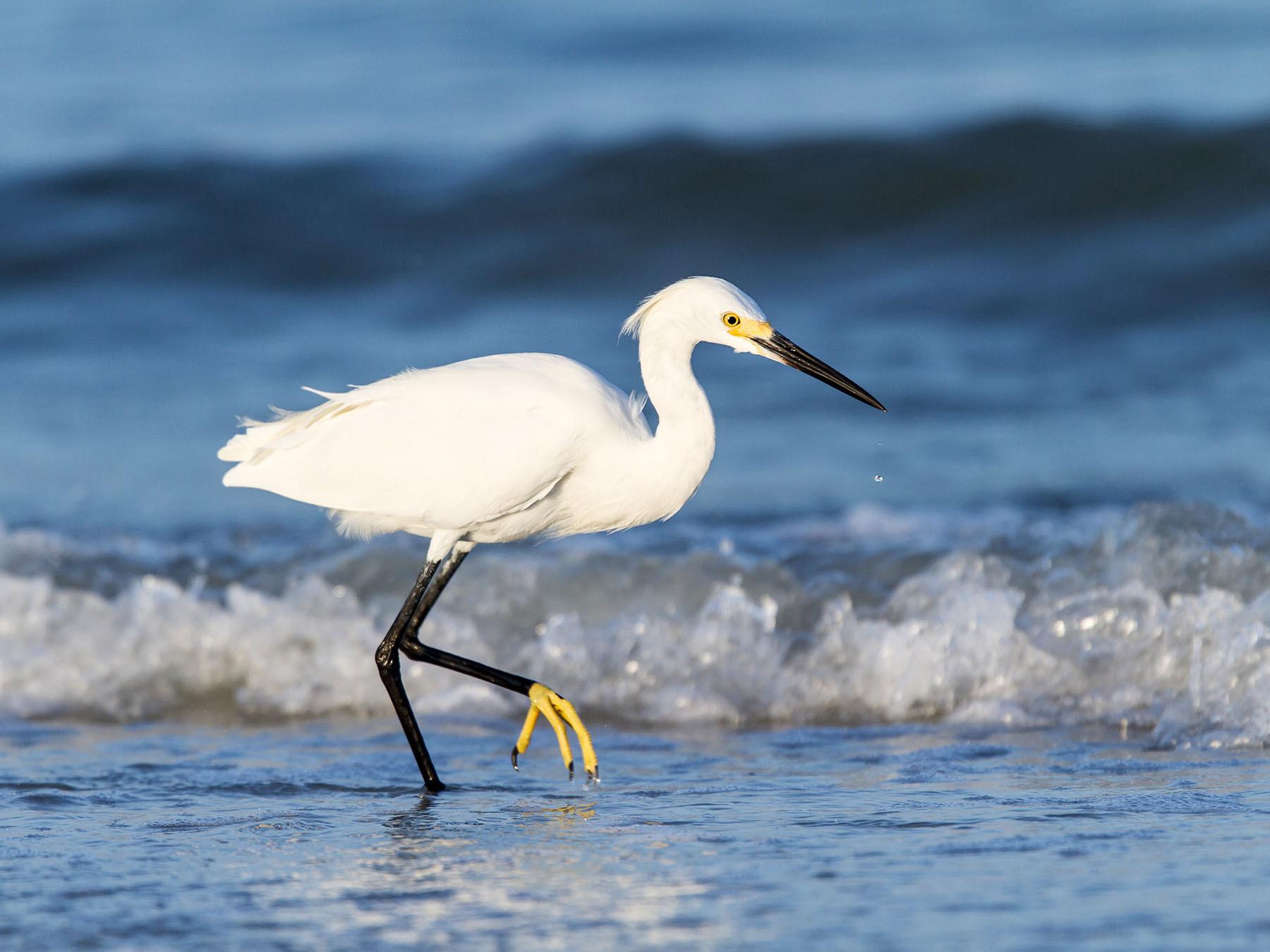
Two rarer white herons need care. The Snowy Egret of the Americas has bright yellow skin in front of the eye, a shaggy crest instead of two long head plumes, back plumes that curl up at the tips, and yellow that usually runs well up the back of the legs; the Little Egret looks slightly larger and stockier, with a longer, thicker bill, and young birds of the two may not be separable. White Western Reef Herons have a heavier bill that often looks slightly drooped, yellowish at the base below, yellow often reaching the middle of the leg, and often a few dark feathers, though in West Africa only about 1% of reef herons are white.1
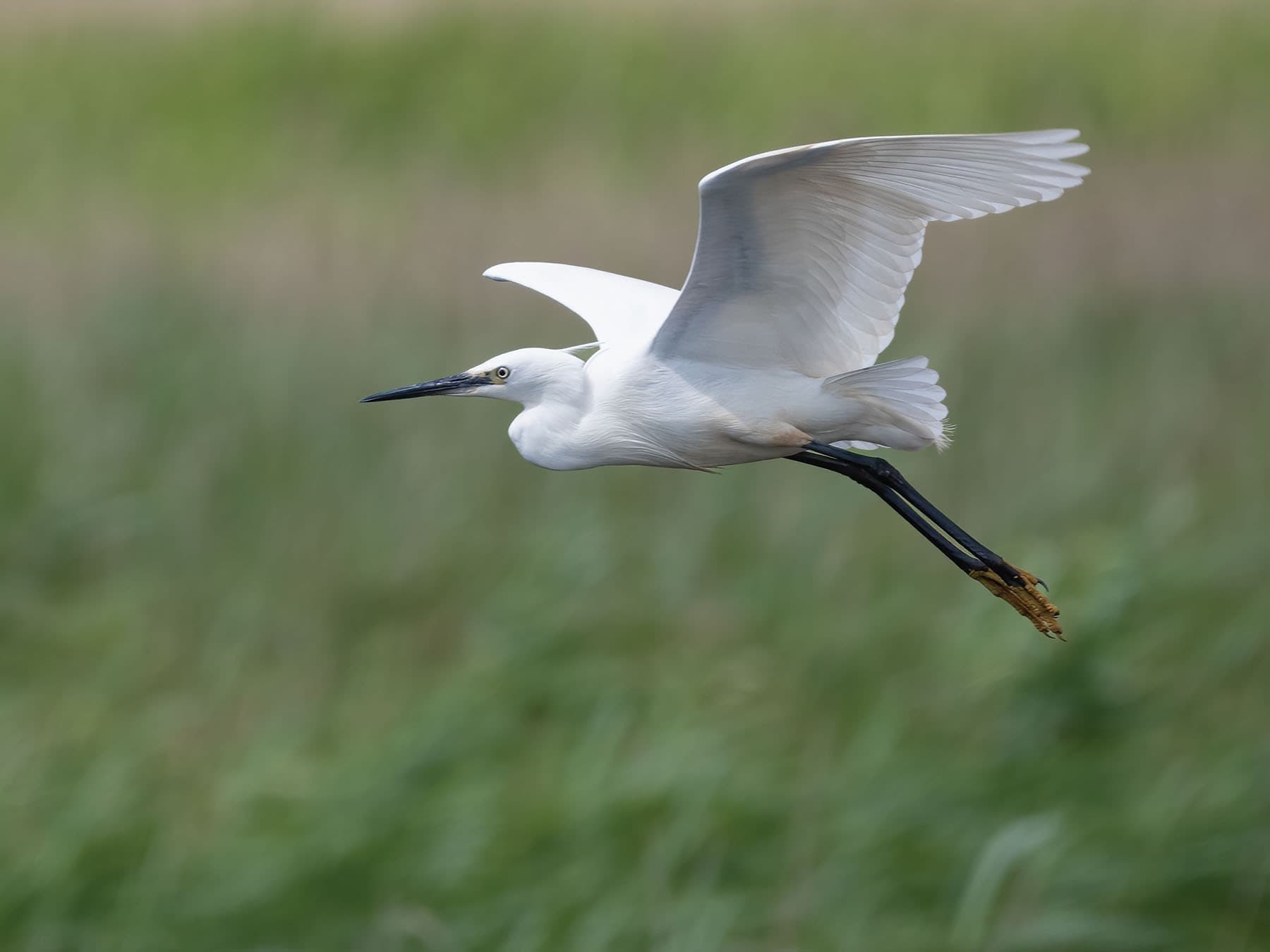
Not sure it’s a Little Egret? Check your photo: Birdfact names the bird and shows the look-alike side by side.
Its size
Adults- Length
- 55–65 cm
- Wingspan
- 88–106 cm
- Weight
- 350–550 g
Its song and calls
Little Egrets have no song, but they can be rather vocal. Calls written kre-kre-kre or kark-kark-kark come in disputes and in flight. Birds often say aaah as they take off or feed, and da-wah as they land; ggrow is another call of aggression. BirdWatch Ireland describes a hoarse, Rook-like aaah when a bird lands rather than when it leaves.3
At the colony, advertising birds give a variable la-la-la-la-ah-h-h-h, a gargle also written gulla-gulla-gulla, and runs of dow or po notes; begging young give an incessant ka-ka-ka, and in courtship the adults snap their bills together with a click. The first British nest came to light in 1996 when staff on Brownsea Island heard strange, guttural sounds from a treetop.4
The recordings on this page come from the French coast: three calls from Normandy, and a longer series from a bird seen in flight in the Vendée.
- Flight call0:00 / 0:03
Recorded in Normandie, France · February 2021
- Flight calls, Vendée (France)0:00 / 0:13
Recorded in Vendée, France · October 2026
Heard one and not sure? Let the bird song identifier listen.
When and where to see it
November
In season
The year across the UK and Ireland
Choose a place on the map to see its year, or find yours.
Most recorded in November
Up to 2.3% of a place’s bird records that monthHere in other months
How this map is made
Each county, state or province is shaded by the Little Egret’s share of all the bird records there that month: the darker, the larger the share. A place with only a trace of records in a month is left unshaded. Shades compare places on this map with each other, not one bird with another. Records: GBIF eBird Observation Dataset, 2019–2024. Map: Natural Earth; place centres © OpenStreetMap contributors.
How often the Little Egret turns up in the UK, Ireland and Canada through the year, from birdwatchers' records.
United Kingdom
Resident · all year · most records in August
Ireland
Resident · all year · most records in September
Canada
Passage migrant · regularly Oct–Nov · most records in October
Show as a table
| Month | United Kingdom | Ireland | Canada |
|---|---|---|---|
| January | 0.75% (regular) | 1.2% (regular) | – |
| February | 0.72% (regular) | 1.2% (regular) | – |
| March | 0.69% (regular) | 1.2% (regular) | – |
| April | 0.64% (regular) | 0.97% (regular) | – |
| May | 0.64% (regular) | 0.87% (regular) | <0.001% |
| June | 0.70% (regular) | 1.1% (regular) | <0.001% |
| July | 1.0% (regular) | 1.4% (regular) | <0.001% |
| August | 1.1% (regular) | 1.6% (regular) | – |
| September | 1.1% (regular) | 1.6% (regular) | <0.001% |
| October | 0.95% (regular) | 1.4% (regular) | 0.001% (regular) |
| November | 0.86% (regular) | 1.4% (regular) | <0.001% (regular) |
| December | 0.76% (regular) | 1.3% (regular) | <0.001% |
Recorded regularly in
Worldwide: recorded regularly in 149 countries
Countries where it was recorded in at least 3 of the 6 years 2019–2024. Linked countries have their own bird list.
Europe (39)
- Albania
- Austria
- Belgium
- Bosnia & Herzegovina
- Bulgaria
- Croatia
- Czechia
- Denmark
- France
- Germany
- Gibraltar
- Greece
- Guernsey
- Hungary
- Iceland
- Ireland
- Isle of Man
- Italy
- Jersey
- Kosovo
- Luxembourg
- Malta
- Moldova
- Montenegro
- Netherlands
- North Macedonia
- Norway
- Poland
- Portugal
- Romania
- Russia
- Serbia
- Slovakia
- Slovenia
- Spain
- Sweden
- Switzerland
- Ukraine
- United Kingdom
Africa (49)
- Algeria
- Angola
- Benin
- Botswana
- Burkina Faso
- Burundi
- Cameroon
- Cape Verde
- Central African Republic
- Chad
- Congo - Brazzaville
- Congo - Kinshasa
- Côte d’Ivoire
- Djibouti
- Egypt
- Equatorial Guinea
- Eswatini
- Ethiopia
- Gabon
- Gambia
- Ghana
- Guinea
- Guinea-Bissau
- Kenya
- Liberia
- Libya
- Madagascar
- Malawi
- Mali
- Mauritania
- Morocco
- Mozambique
- Namibia
- Nigeria
- Rwanda
- Senegal
- Seychelles
- Sierra Leone
- Somalia
- South Africa
- South Sudan
- Sudan
- Tanzania
- Togo
- Tunisia
- Uganda
- Western Sahara
- Zambia
- Zimbabwe
Asia (46)
- Armenia
- Azerbaijan
- Bahrain
- Bangladesh
- Bhutan
- Brunei
- Cambodia
- China
- Cyprus
- Georgia
- Hong Kong SAR China
- India
- Indonesia
- Iran
- Iraq
- Israel
- Japan
- Jordan
- Kazakhstan
- Kuwait
- Laos
- Lebanon
- Macao SAR China
- Malaysia
- Maldives
- Myanmar (Burma)
- Nepal
- Oman
- Pakistan
- Palestinian Territories
- Philippines
- Qatar
- Saudi Arabia
- Singapore
- South Korea
- Sri Lanka
- Syria
- Taiwan
- Tajikistan
- Thailand
- Timor-Leste
- Turkey
- United Arab Emirates
- Uzbekistan
- Vietnam
- Yemen
North America (6)
- Barbados
- Canada
- Guadeloupe
- St Lucia
- St Vincent & the Grenadines
- Trinidad & Tobago
South America (1)
- French Guiana
Oceania (8)
- Australia
- Christmas Island
- Cocos (Keeling) Islands
- Guam
- New Zealand
- Northern Mariana Islands
- Palau
- Papua New Guinea
Data: EOD – eBird Observation Dataset (Cornell Lab of Ornithology), accessed via GBIF.org, CC BY 4.0. Records from 2019–2024, aggregated and filtered by Birdfact. How these lists are made
You can see Little Egrets in Britain and Ireland in every month. They feed in shallow water of almost any kind, fresh, brackish or salt: estuaries, saltmarsh, mudflats, coastal lagoons, the edges of lakes and rivers, marshes and flooded fields. They are most numerous on the coasts and estuaries of southern England and Wales, and scarcer inland and in Scotland. In Ireland they live along the coasts and rivers but are still thin on the ground in the Midlands and the north-west.
Bird Atlas 2007-11 found them in 40% of the UK's 10-km squares in winter and 11% in the breeding season, where earlier atlases had them only as a rare vagrant.5 In Ireland, Cork Harbour, Dublin Bay and Lough Foyle hold the most in winter.6 Outside the nesting season they gather to roost, flying in at dusk to trees or dense scrub and leaving at dawn.
Worldwide, Little Egrets breed from Britain, Spain and north-west Africa east across Europe and Asia to Korea and Japan, through much of Africa and southern Asia, and south to Australia. About 20 pairs have nested on Barbados since 1994, and a bird ringed in western Spain turned up in Trinidad in 1957.1
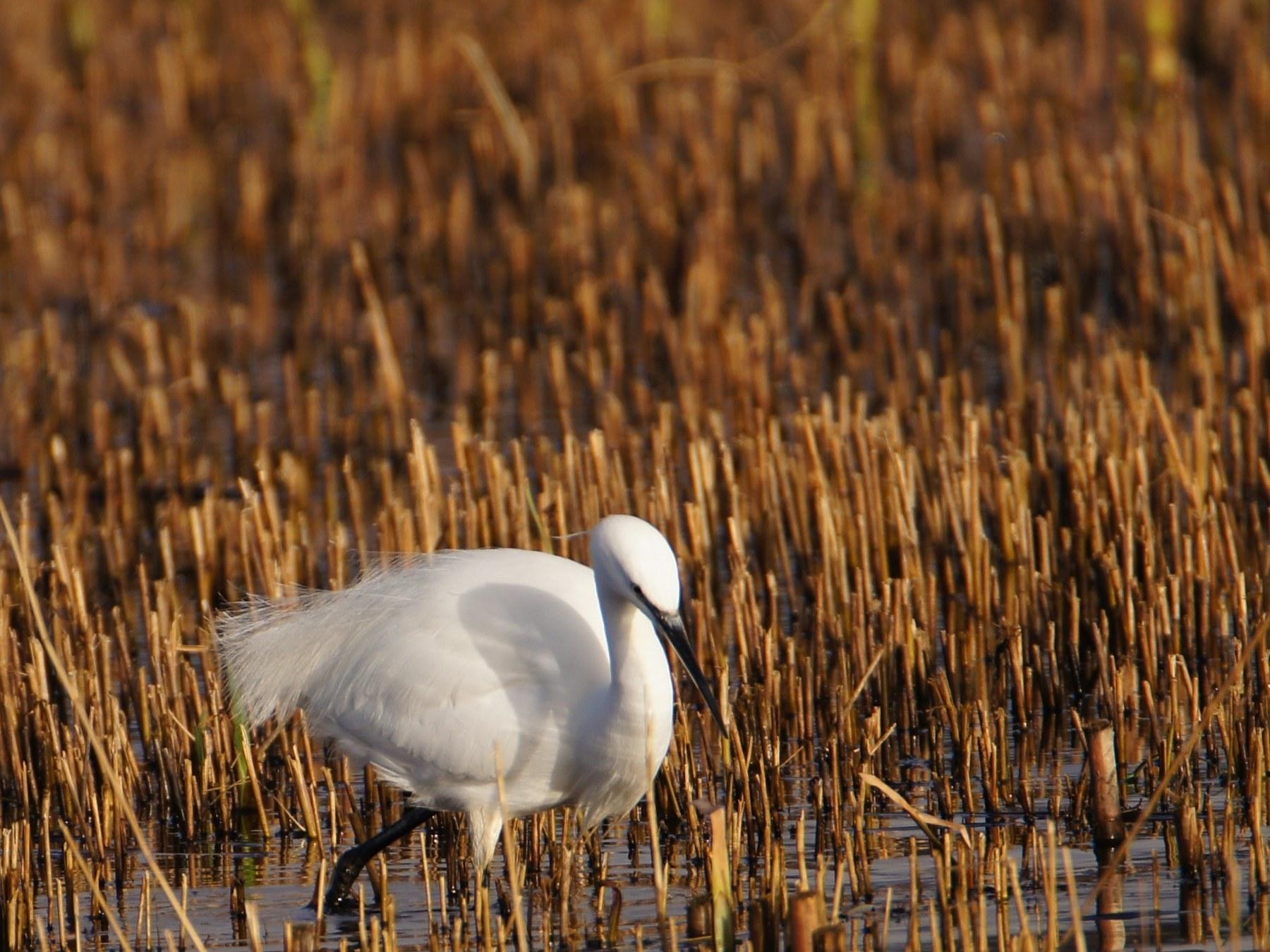
Do they migrate?
Some do. The BTO calls the Little Egret a year-round resident in Britain, joined in winter by birds from the Continent.5 Young birds wander widely after they leave the nest, from July to September, in any direction.
Ringing shows the range: the oldest British bird, ringed as a nestling at Sowley Pond, was seen over 18 years on marshes 5-10 km away, but a Hampshire nestling turned up 546 km north on Holy Island, Northumberland, and a Gwynedd nestling on South Uist, 504 km away, at six months old; abroad, nestlings ringed in Galway reached the Azores (2,134 km) and, at four months old, Iceland (1,270 km), one from St Albans reached the Azores (2,553 km) at five months, and others have gone to France (561 km) and to the Netherlands and Germany (673 km); British-ringed birds have been found in Spain 21 times and the Netherlands 20, and 16 birds ringed in the Netherlands and 11 in the Channel Islands have been found here.7
Further south and east the species is a partial migrant: European breeders spend the winter mainly round the Mediterranean, in the Middle East and in tropical Africa, moving south from late August to November and back in March and April. British counts in the 1990s showed a small rise each March, which the 2002 review of British counts judged was probably birds from south-west Europe and Africa overshooting the colonies in Brittany.8
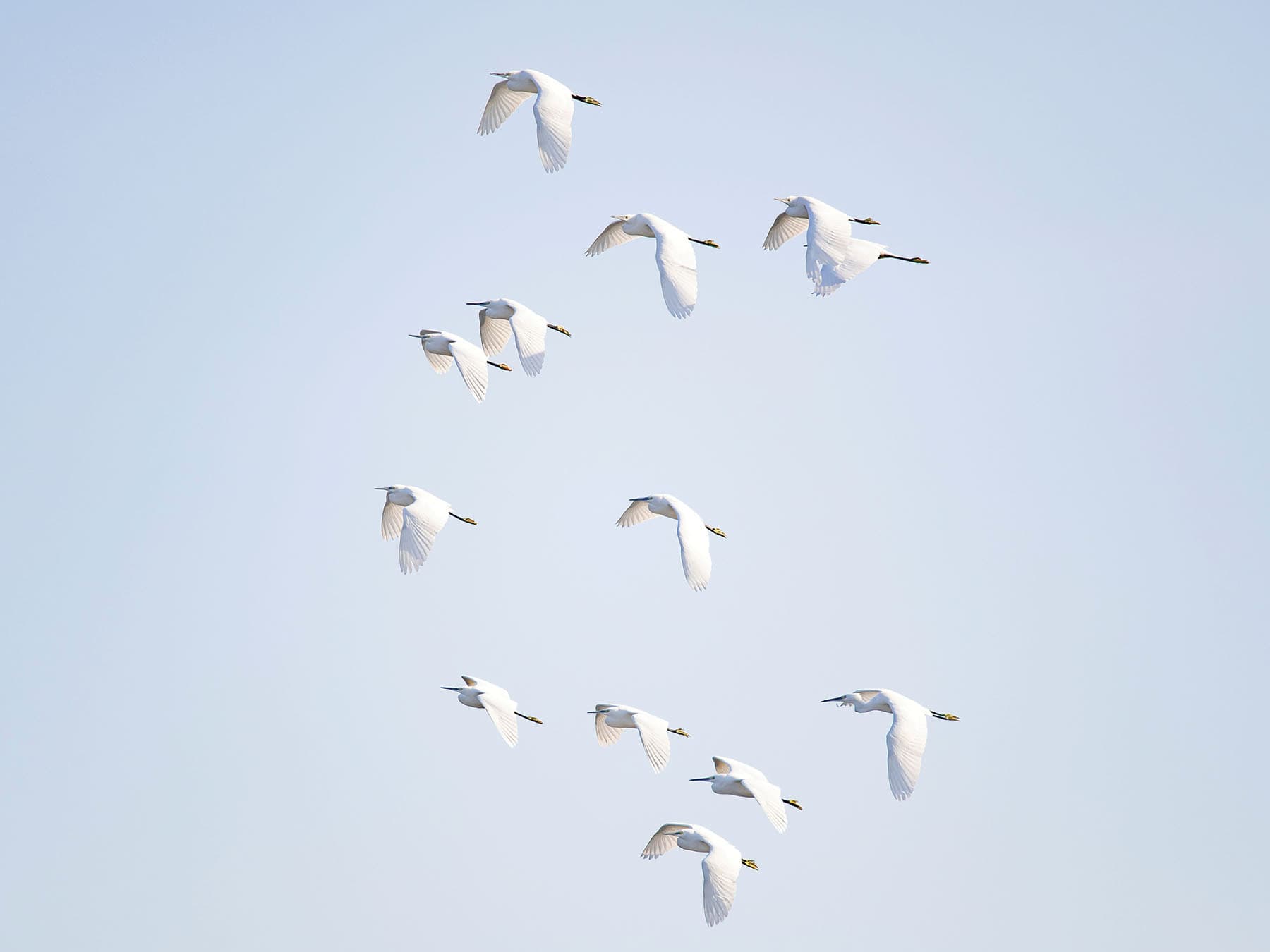
Range in Britain and Ireland: how they spread
The Little Egret is a natural colonist: its arrival followed its spread into western and northern France, and the British list places it in Category A. The first documented British record is one shot in East Yorkshire in 1826, though older books report earlier birds, at Cork in 1792, Christchurch in 1822 and Penzance in 1824.5, 8, 9
For a long time it stayed a rarity: a handbook of 1939 could list only two records that century, and from 1958 to 1988 about 13 a year were seen in Britain, 403 in all (some perhaps counted twice), most of them in spring.10, 8 Then, in the second half of 1989, came an unprecedented influx: birds arrived from mid July to a peak in late August, with a second, smaller wave in December, mostly along the south coast from Cornwall to West Sussex, and six reached Ireland; the British Birds Rarities Committee, allowing that some birds were probably counted twice, suggested no fewer than 120 in Britain that year, and they probably came from north-west France; after 113 more records in 1990 the committee stopped treating it as a rarity, and by September 1999 more than 1,650 were in Britain, over 40% of them on the coast from Swanage Bay, Dorset, to Pagham Harbour, West Sussex.10, 8
Breeding followed. In 1996 one pair raised three young on Brownsea Island in Poole Harbour, Dorset, the first confirmed breeding in Britain, and a second, confidential site in south-west England was also occupied; in 1997 five pairs reared 12 young on Brownsea, and the first account allowed that egrets may have bred unnoticed before.4, 11 Ireland's first breeding came in 1997: a colony of 12 pairs nesting in a heronry in the Blackwater valley in the south, in a row of beech trees, where a single bird had summered the year before.4, 12
UK pairs passed 100 by 2001 and topped 1,000 in 2014, the first year the Rare Breeding Birds Panel reported more than that (BirdFacts dates it 2015), and breeding was confirmed in Northern Ireland in 2012, at two colonies in Co. Down, and in Scotland in 2020, on the Solway Firth in Dumfries & Galloway, and by 2023 the Little Egret bred in all four UK nations.5, 13, 14, 15, 16
Why it spread is not settled. The BTO says there is little good evidence, and that climate change may have helped by letting more birds survive the winter, while the 2002 review of British counts found it seemed undeniable that the spread was linked to milder weather, and the 1998 account of the colonisation noted the suggestion that the protection given by the EC Birds Directive from 1979 helped the egrets spread in France.5, 8, 4
Whether Little Egrets lived here in the Middle Ages is disputed. The list of food for George Neville's feast on becoming Archbishop of York, in the 1460s, has 1,000 'egrittes' on it, and Birds of the World suggests these, with egrets at Henry VI's coronation feast of 1429, were Little Egrets and that the bird was apparently once numerous in England; Warner, printing the list in 1791, glossed them as young herons, and Fleming and Selby, quoted by Yarrell in 1856, suggested Lapwings, while the 2002 review wrote that the Little Egret was not a regular British bird in historical times.17, 1, 9, 8
Tips for seeing it
What it eats
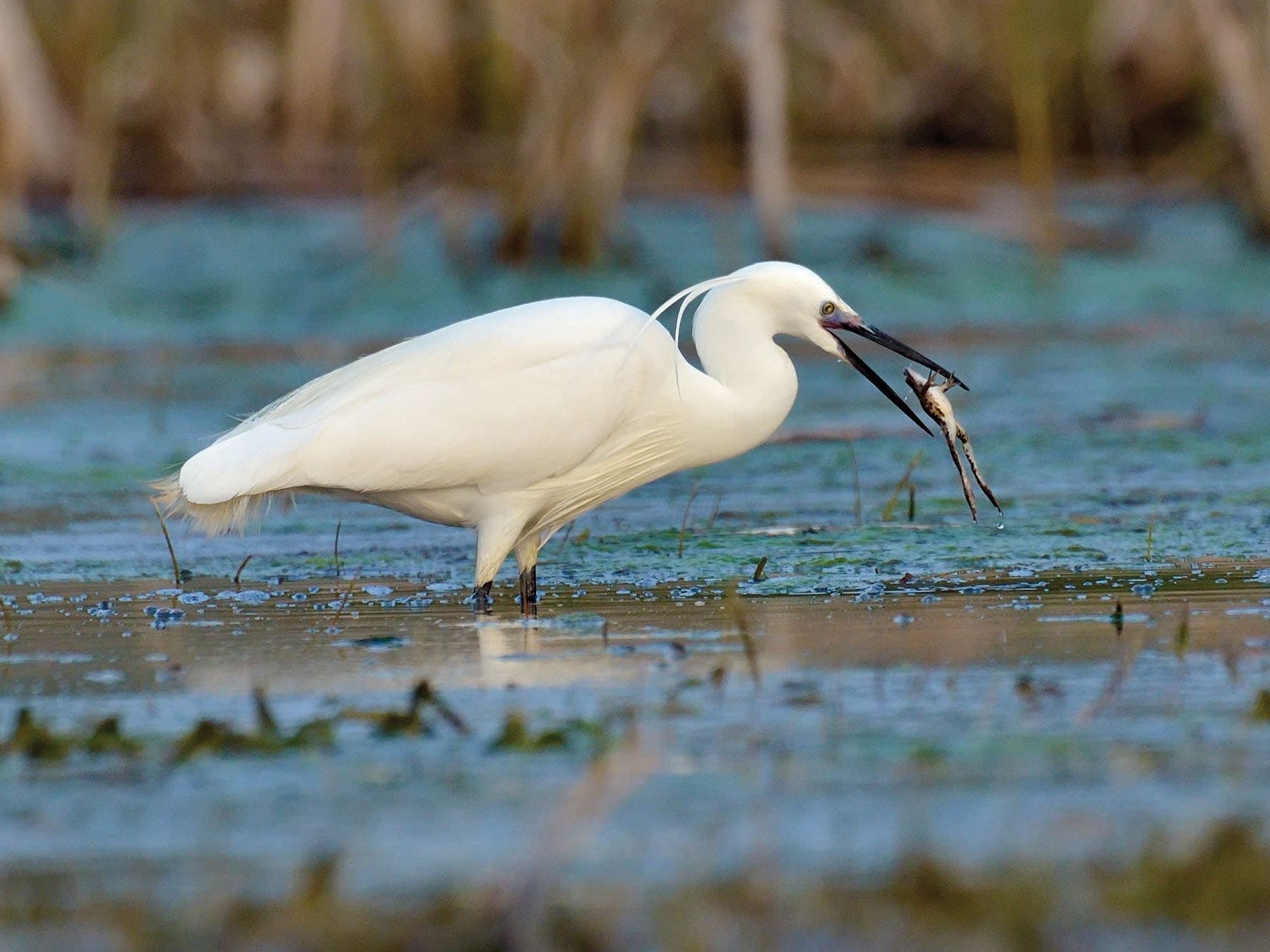
Little Egrets take whatever small prey the wetland offers: small fish, usually 1-4 cm long, shrimps and other crustaceans, insects such as water beetles, dragonflies and their larvae and crickets, and frogs, as well as small mammals, small birds, worms, spiders and molluscs. On Brownsea the first British pair fed their chicks shrimps and small fish from close by.4
What they eat depends on the region and the wetland. In the Camargue in southern France chicks were fed mostly freshwater fish, while in Greece's Axios delta they got mostly invertebrates and tadpoles from rice fields, with some saltwater fish.18 On Japanese tidal flats fish made up 54.7% of the diet, but on farmland small vertebrates made up 72.5% and fish only 7.6%.1 At one colony in South Korea nestlings were fed mainly insects (43.4% of items) and fish (33.2%), with fish making up 64.2% of the weight.19 And in 654 pellets from an Italian lagoon, collected from Little and Great White Egrets together, the Little Egrets took the wider range of prey: insects, fish, marine worms, crustaceans, molluscs, spiders and small mammals.20
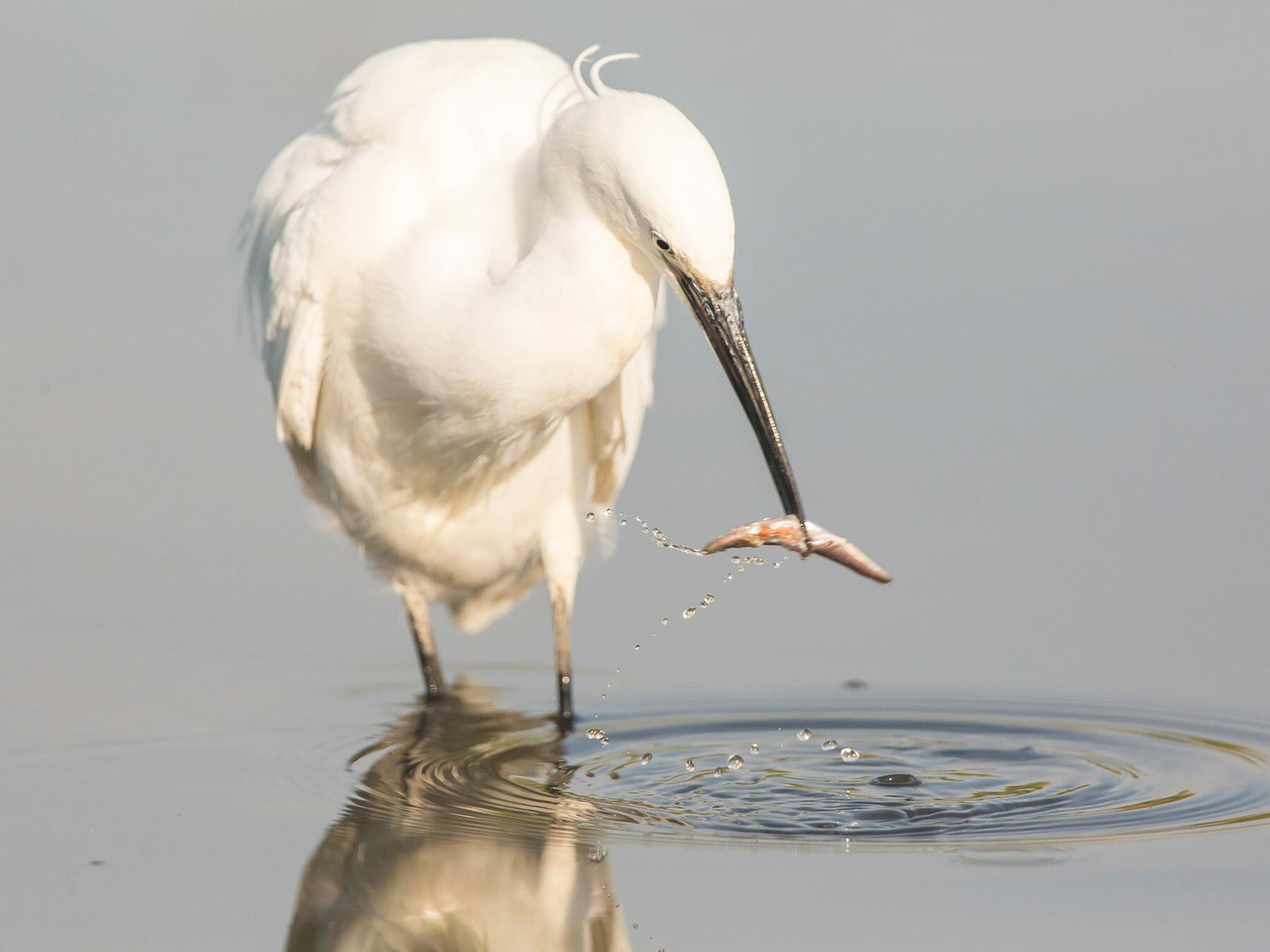
Feeding: foot-stirring and other methods
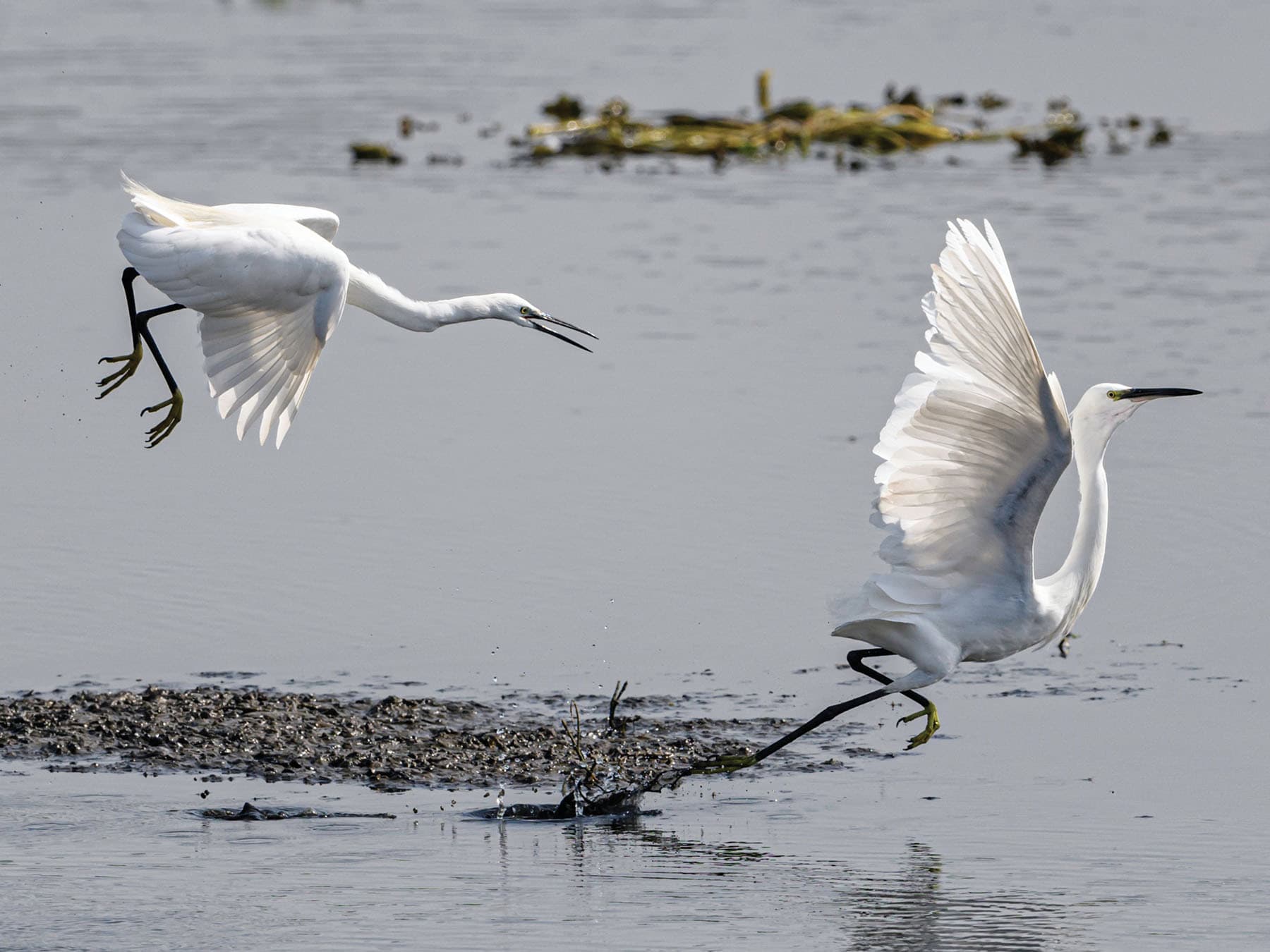
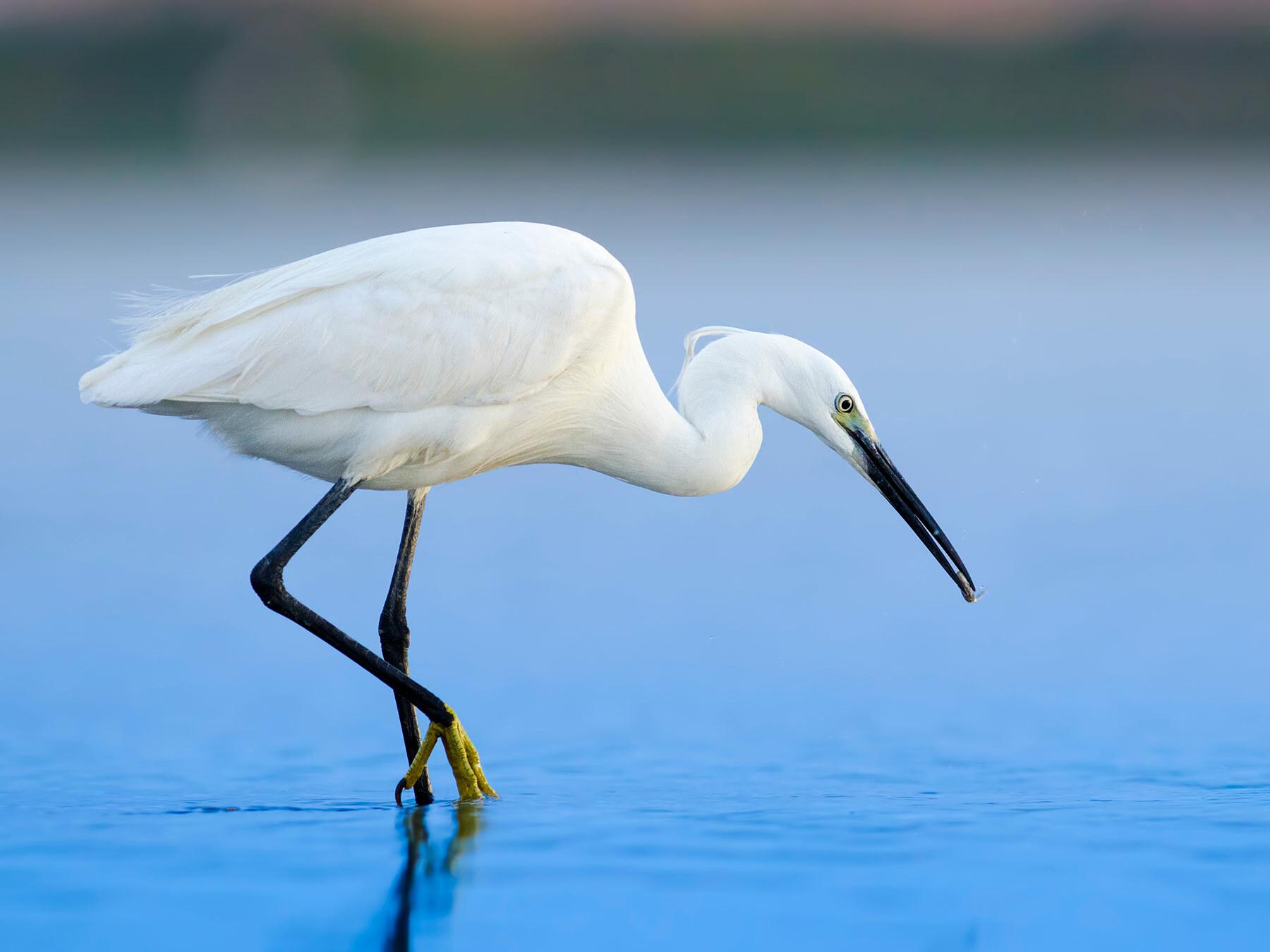
Little Egrets feed mostly by walking slowly through shallow water and by foot-stirring: shuffling a yellow foot in the water or mud to flush prey from cover. They also walk quickly, run, feed with their wings open, and hover and dip over deeper water. On the coast their feeding hours follow the tide.
A Little Egret often feeds alone and defends its feeding patch hard, but birds also gather in loose groups, sometimes with other species. In a Japanese study of 26 colour-ringed birds watched for three years, the birds holding the most strongly defended patches were the largest and fed most efficiently.21 In the Camargue, flocks at dawn fed on mosquitofish concentrated for a while by low oxygen overnight.22 Black-headed Gulls sometimes rob them of their catch, and they rob other birds in turn.
At fish farms they take mostly fish fry that are not part of the stock, unhealthy fish and fish that prey on the stock, which Birds of the World judges more helpful than harmful to fish farming.1
Nesting and breeding
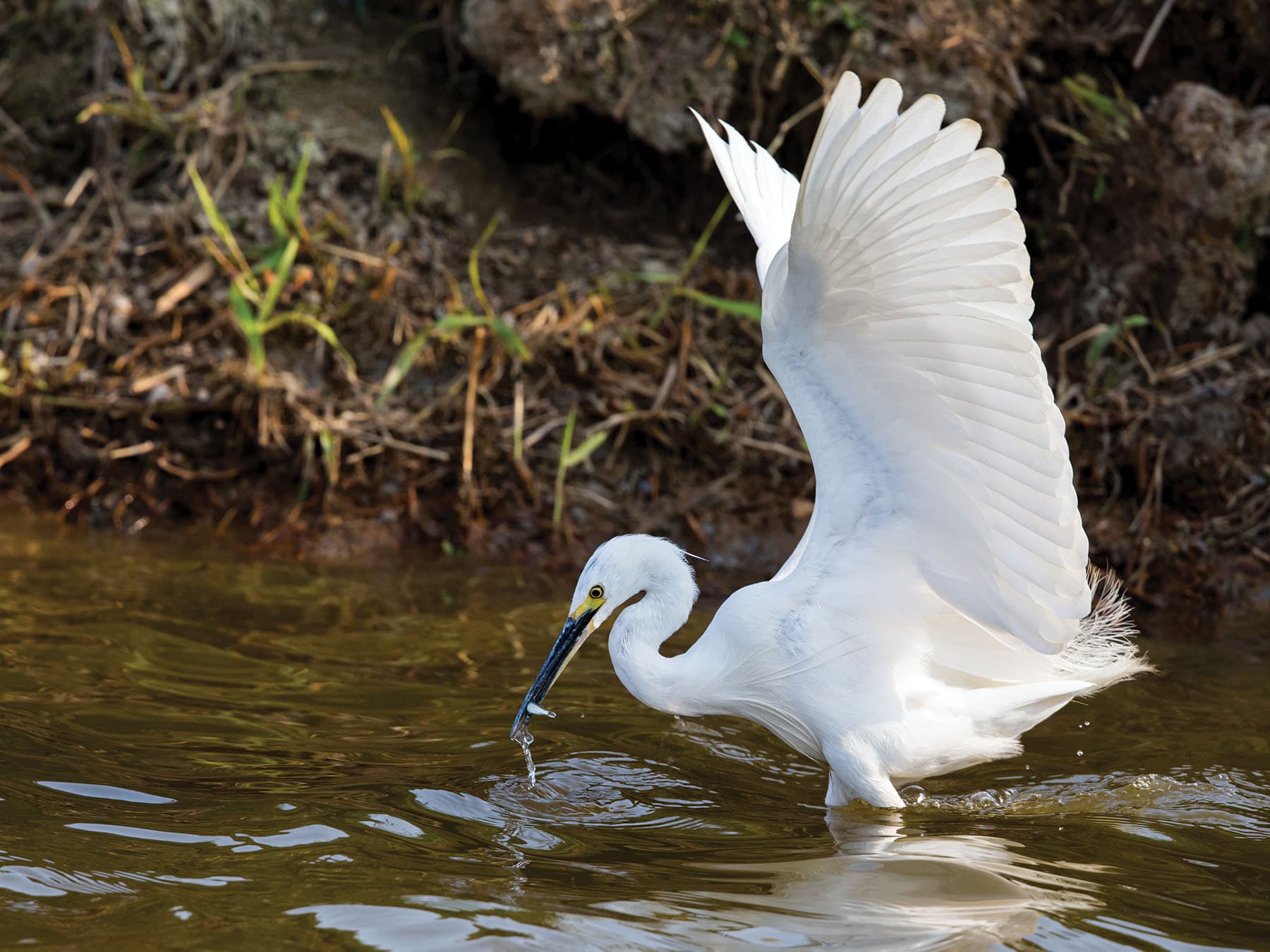
Little Egrets nest in colonies, and in Britain most colonies have formed inside existing Grey Heron heronries, the two species nesting side by side. The nest is a platform of sticks built by both birds, the male bringing most of the material. The first Brownsea nest was smaller than a Grey Heron's.4 Pairs are monogamous. In the western Palearctic, Europe and North Africa, eggs are laid mainly from March to July, sometimes from February.
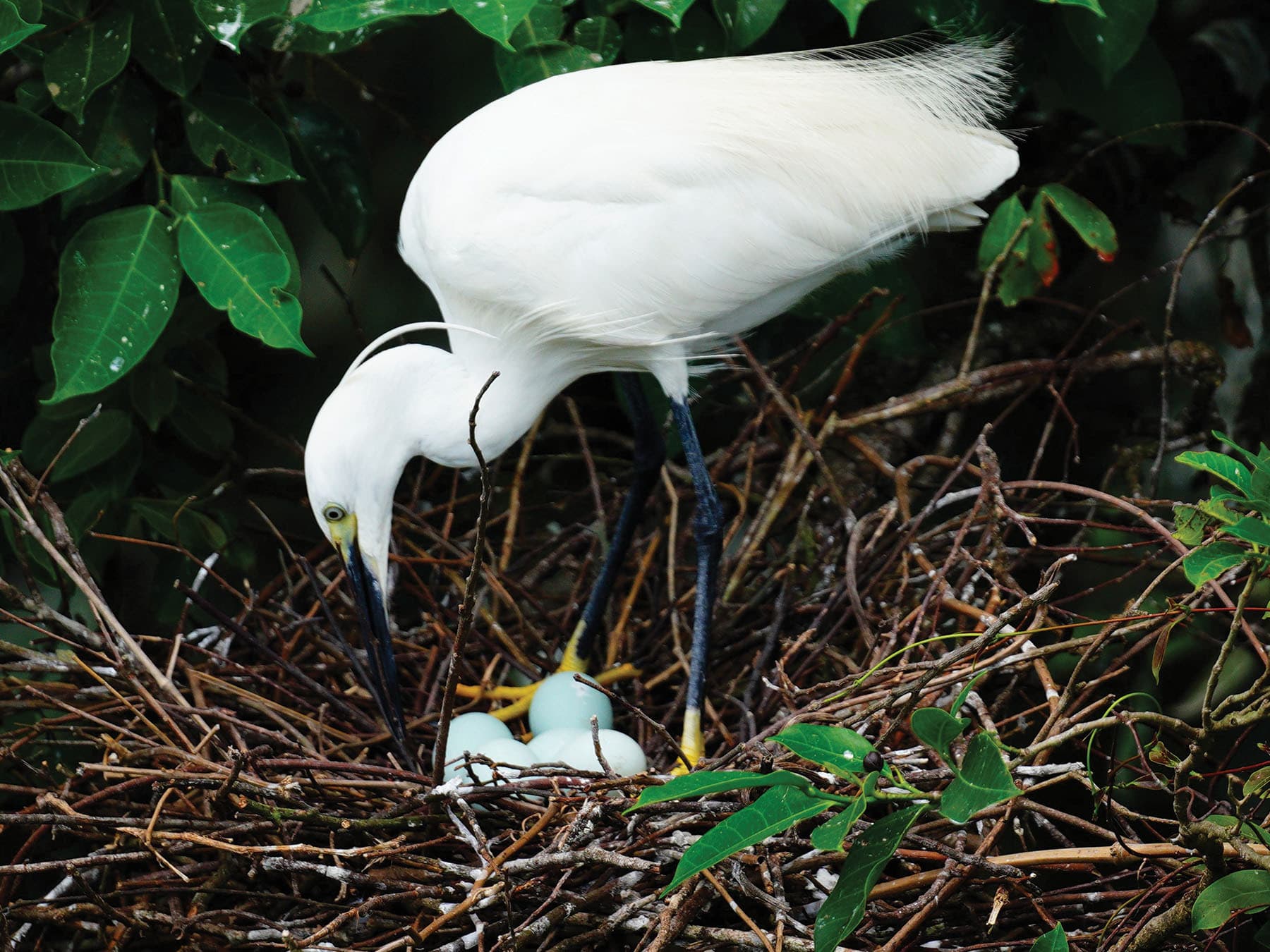
The eggs are greenish blue. BTO BirdFacts gives a typical clutch of 4-5 (3-7 at the extremes), incubated by both parents for 21-22 days, with one brood a year, while Birds of the World gives 1-7 eggs across the range, with average clutches from 2.2 in Australia to 4.9 in Japan and 4.2-4.8 in south-west Europe, and 21-25 days of incubation; they also differ on the age at which birds first breed, typically two years old in the first and one in the second.5, 1
Do they nest in trees?
Yes. The first British nest was in a treetop on Brownsea and the first Irish nests in a row of beech trees, and most British colonies are in heronries alongside Grey Herons. Across their range Little Egrets nest in trees, bushes or reeds, from the ground up to 20 m, often with other egrets, night herons, ibises, spoonbills and cormorants.
Eggs and young
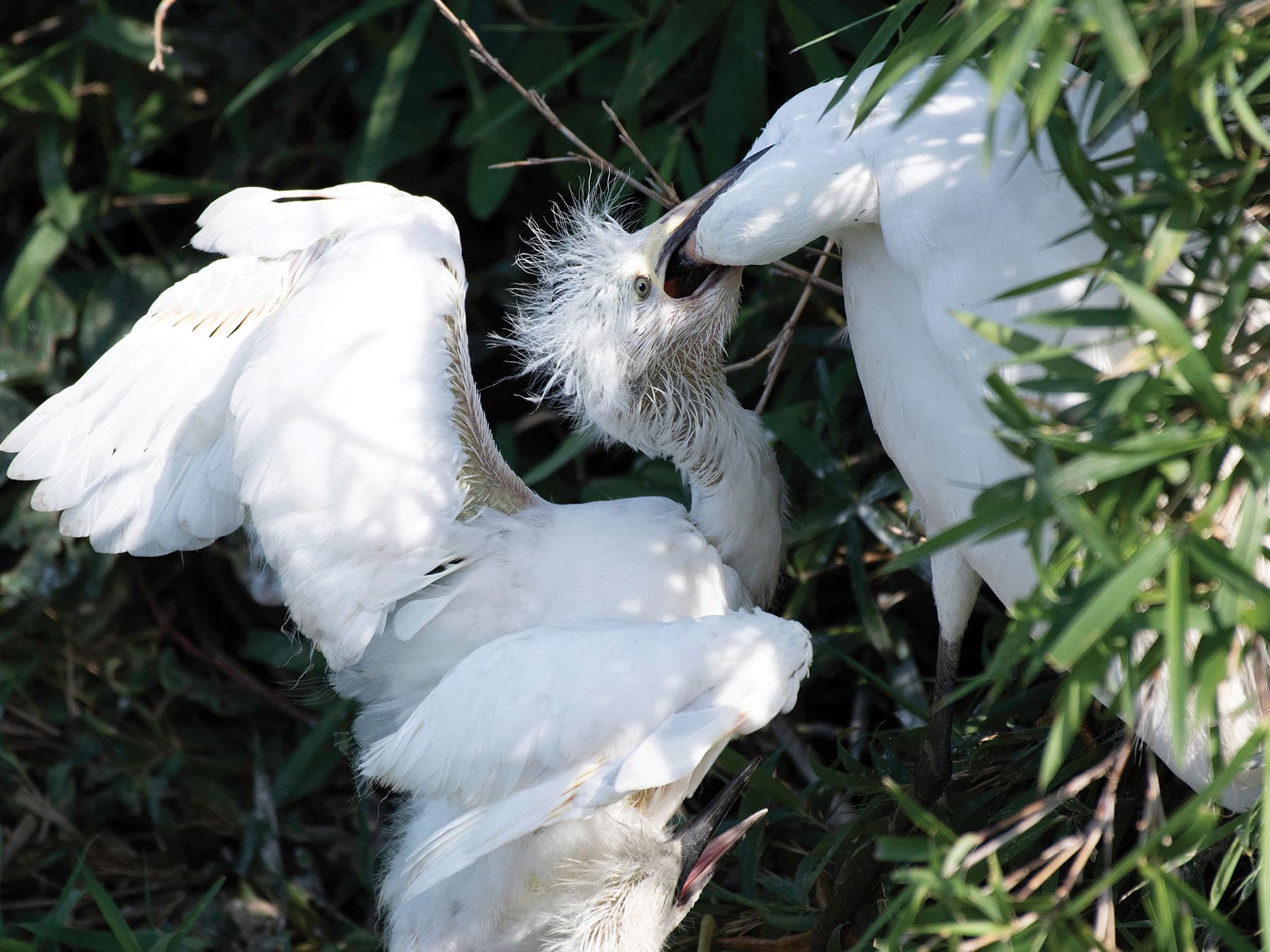
Incubation usually starts with the second or third egg, so the chicks hatch at different times, in white down with a yellowish bill and greenish legs. Both parents guard them for their first 10-15 days and feed them by regurgitation, and the last-hatched chicks often die in competition with their siblings. The young fledge at about 40-45 days, sometimes leaving the nest from about 30 days, and a replacement clutch may follow if one is lost.
At one Camargue colony, where nests stood on electronic balances, both parents fed the chicks, each making three to five alternating trips a day, and a brood aged 10-20 days took about 385 g of food a day.22 In 1997 about 2.6 young per pair were raised in Ireland and 2.4 in Dorset, and the Brownsea family stayed together after fledging.4
Behaviour
A Little Egret walks upright, its neck slightly arched, and climbs about nest trees using its bill as well as its legs and wings. It is active by day, feeding alone or in loose groups, and sometimes feeds alongside cormorants, ibises and spoonbills.
Birds do not always return to the same colony. In the Camargue, a bird had a 0.45 chance of nesting in a different colony the next year; adults mostly stayed within 10 km of their old colony, and birds generally fed within 8 km of it.23
Social behaviour and courtship
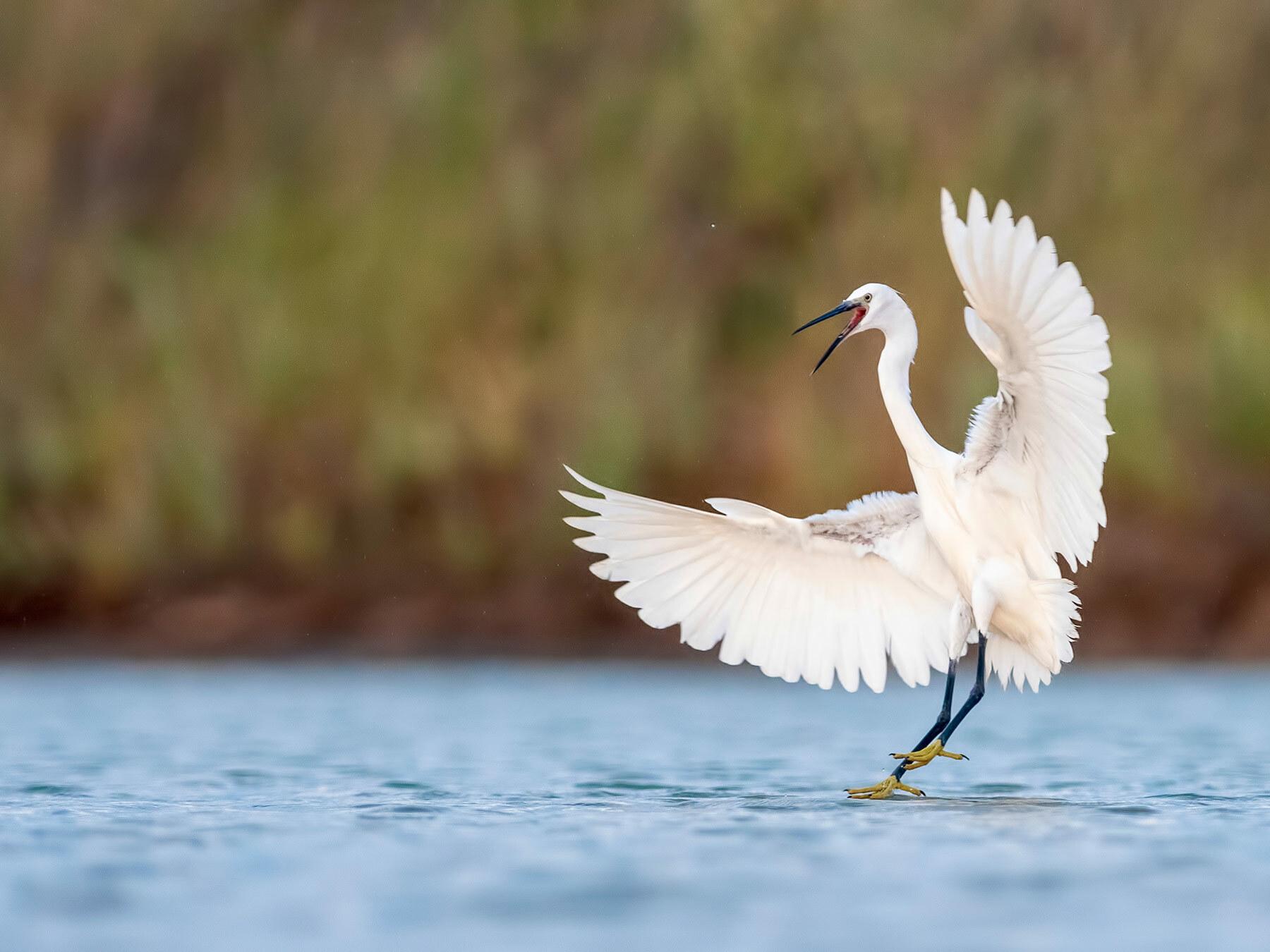
At the colony, males display from a string of temporary perches. In the Stretch they crouch, point the bill skyward, raise the back plumes and pump the head; in the Forward display all the plumes and the crest go up. They also fly in circles with the neck stretched out and loud, whooshing wingbeats. Pairs preen each other and clap their bills, and they meet at the nest with a greeting ceremony of calls and raised plumes. After pairing, both birds defend the territory around the nest.
Lifespan and predators
A Little Egret that reaches breeding age typically lives about 5 years; about 71% of adults survive each year, but only about a third of first-year birds.5, 1
The oldest on the British and Irish ringing list was ringed as a nestling at Sowley Pond, Hampshire, on 11 June 2006, and its colour rings were read on the living bird at Normandy Marsh, Lymington, on 7 October 2024, 18 years 3 months 26 days later; BTO BirdFacts still shows 13 years 6 months, the record as it stood in 2019.24, 5 On the European list the oldest are a Spanish-ringed bird of 20 years 11 months that was shot and a French-ringed bird of 20 years 5 months reported as hunted; EURING gives birds ringed as adults a minimum age from their age when ringed, while the BTO gives the time since ringing.25
Predators and cold winters
Across the range, chicks are taken by rats, monitor lizards, dogs, hawks, harriers, gulls, eagle owls and crows, and a Great Skua was once seen apparently killing an adult.
For adults, harsh winters are a major danger, mostly because their feeding places freeze: in the Camargue the hard frost of January 1985 hit the wintering birds but numbers soon recovered, and the cold spell of 1996/97 killed 60% of the egrets at Croisic in 1997, though in Brittany it had no long-term effect on the breeding population.1, 26, 4 British numbers dipped after the cold winters of 2009/10 and 2010/11 and again after the 'Beast from the East' of early 2018, which killed many birds, before growing by about 4.5% a year.13, 27, 28
Conservation
Not any more, though the Rare Breeding Birds Panel still counts it as a 'less scarce' breeder. The Little Egret is Green-listed in the UK (BoCC5, 2021), as it has been since 2015, after Amber listings in 2002 and 2009 because its breeders were concentrated at a few key sites; it is Green-listed in Ireland too, and of Least Concern in Great Britain, in Europe and worldwide; the Panel said it would consider the species at least until the pairs reported reached 2,000, and might then drop it; the 2024 count was 1,957 confirmed and up to 2,000 pairs, at 203 sites.29, 5, 30, 31, 32, 33, 34
Population and trends
A model joining the BTO's Heronries Census to the Panel's counts puts the UK and Channel Islands population at about 2,274 pairs (2,145-2,500) in 2023; for 2022 it came out about 40% above the Panel's raw count.33 The previous official estimate was 1,100+ pairs (2013-17) and 11,500 wintering birds (2012/13-2016/17); in the whole of Ireland about 1,340 winter (2018-2023), and 73 pairs bred in Northern Ireland, at 10 sites, in 2023.35, 6, 16
The Breeding Bird Survey shows UK counts up 2,748% between 1995 and 2024, roughly 28-fold, and up 55% over 2014-24, both statistically significant, though the survey notes that its counts include many birds away from breeding sites.36 The winter index rose 573% over the 25 years to 2023/24.28 Heronries Census data suggest numbers rose again in 2024 but fell sharply in 2025, leaving the population about 6% below 2023, perhaps after spells of severe winter weather in 2024/25 and the long dry spells of spring 2025.33
Europe is less clear. The 2021 European Red List gives a decreasing trend for 121,000-190,000 mature birds, while the PECBMS index from France, Italy, Portugal and Spain is stable (-12%, 2000-2024).31, 37 Worldwide there were about 660,000-3,150,000 Little Egrets around the year 2000.1
Conservation history: the plume trade
In the late 19th century feathers and plumes were in fashion. Birds of the World, citing BTO BirdFacts (2005), says Little Egret plumes were 'more valuable than gold' and fetched £15 an ounce when smuggled into Europe, each bird giving about 1 g.1 In 1889 Emily Williamson formed the Society for the Protection of Birds to oppose a fashion for plumes that, the RSPB says, was driving birds including little egrets towards extinction; the society merged with Eliza Phillips' Croydon group in 1891, published W. H. Hudson's leaflet 'The Osprey, or Egrets and Aigrettes', and gained its Royal Charter in 1904.38
The Importation of Plumage (Prohibition) Act 1921 banned bringing the plumage of any bird into the UK from 1 April 1922, except ostriches, eider ducks, birds imported alive and birds eaten as food; it did not ban selling or wearing plumes already here.39 Across Europe the Little Egret's range shrank in the 1800s and early 1900s because of hunting, then grew again beyond its old limits with protection and new wetlands such as rice fields and fish farms.1
Legal status
In Great Britain the Little Egret is protected like other wild birds under section 1 of the Wildlife and Countryside Act 1981: killing, injuring or taking one intentionally is an offence, as is taking, damaging or destroying its nest while the nest is being built or used, or taking or destroying its eggs; in Scotland reckless acts are offences too, as is interfering with a nest in use.40 It is not on Schedule 1, and none of the 2026 general licences we read names it as a bird that may be killed or taken: England's GL40-42 mention egrets only when defining 'waders', and it is not named in Wales's GL001, GL002 or GL004, Scotland's GL01 or Northern Ireland's TPG/1-3.41, 42, 43, 44, 45
Northern Ireland has listed it on Schedule 1 Part I of the Wildlife (Northern Ireland) Order 1985 since 17 August 2011, which brings special penalties.46 Ireland's Wildlife Act 1976 protects it as a wild bird in the Republic; it is listed on Annex I of the EU's Birds Directive and on Appendix II of the Bern Convention in its 1979 text, and is listed under the African-Eurasian Waterbird Agreement (AEWA).47, 48, 49, 50
Similar birds
Often mistaken for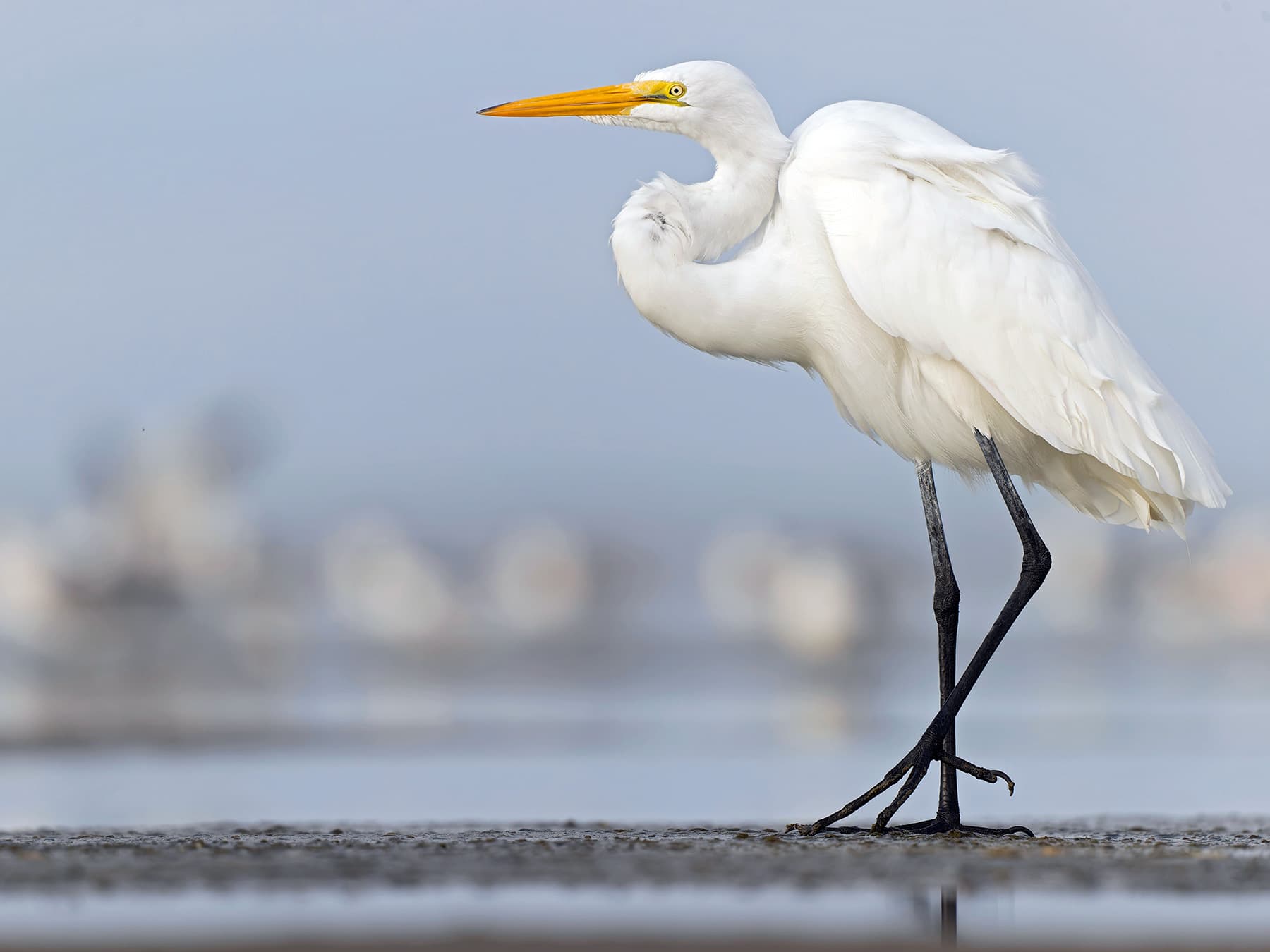
More photos
2 photos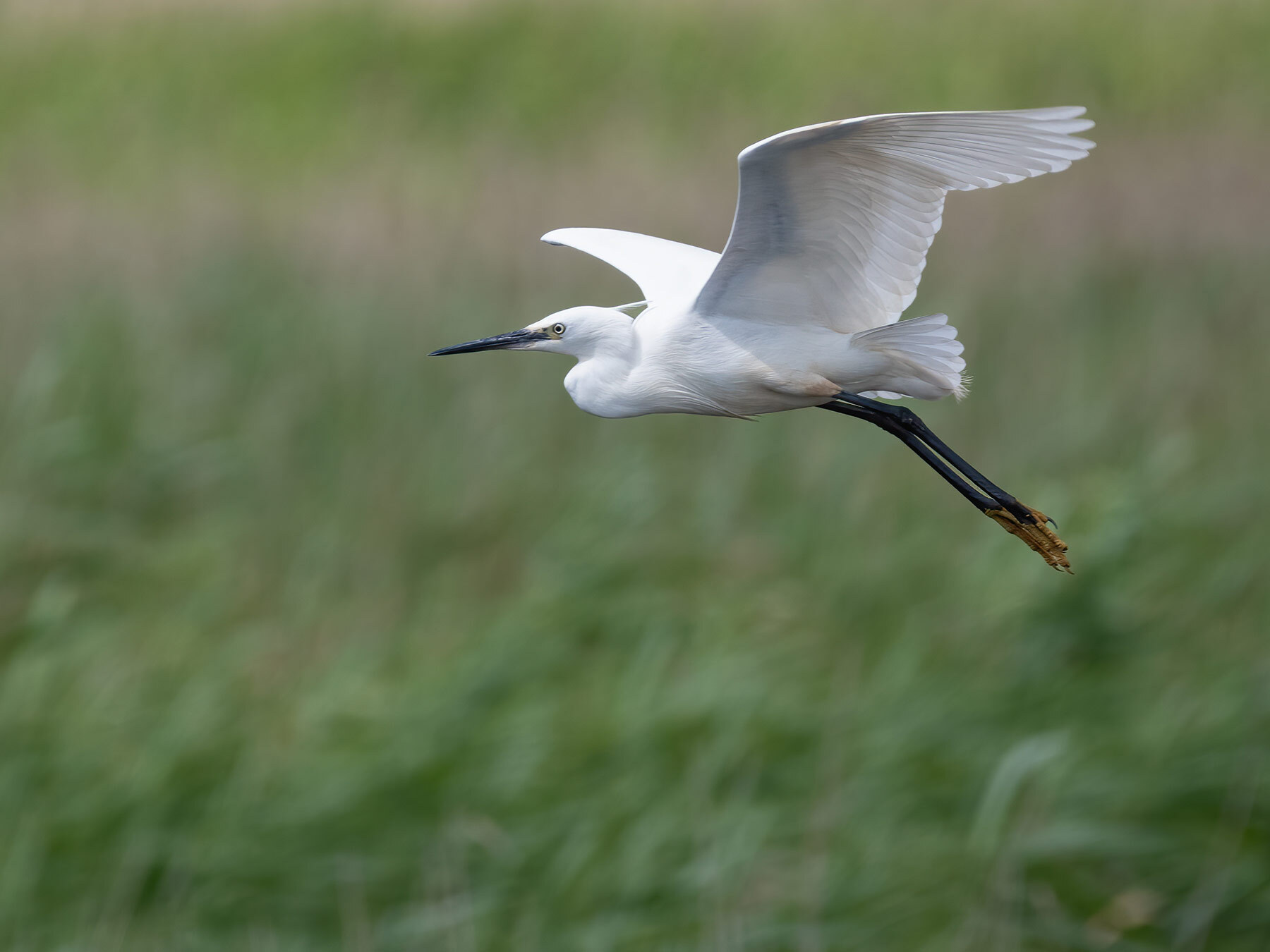
Little Egret guides
2 guidesQuick facts
- Length
- 55–65 cm
- Wingspan
- 88–106 cm
- Weight
- 350–550 g
- Lifespan
- oldest recorded 18 years 3 months
- Family
- Herons & Egrets
- Migration
- Partial migrant
- Global status (IUCN)
- Least Concern
- World population
- 660,000-3,150,000 birds worldwide (c. 2000); about 2,300 pairs in the UK and Channel Islands (2023) and 11,500 birds in winter (2012-17)
- Population trend
- UK Breeding Bird Survey counts up about 28-fold since 1995
- Scientific name
- Egretta garzetta
Questions
3Why do Little Egrets have yellow feet?
The feet are used to flush prey: the egret shuffles one in shallow water or mud to stir up fish and other prey (see what they eat). We found no source in the accounts we read that explains why the feet are yellow rather than black. The yellow is brightest before breeding, and in a young bird the whole leg is greenish at first.5, 1
Is the Little Egret a heron?
Yes. Egrets are herons: the Little Egret belongs to the heron family, Ardeidae.
Where does the name Egretta garzetta come from?
Linnaeus named the bird Ardea garzetta in 1766. Egretta is the genus name Forster gave in 1817, with the Little Egret as its type species, and garzetta is the bird's Italian name. Older English books also called it the Egret or the Little Egret Heron; in Welsh it is Crëyr Bach, in Irish Éigrit Bheag and in Scottish Gaelic Corra-gheal-bheag.5, 9
Sources
60- 1Mlodinow, S. G., Kirwan, G. M. and Pyle, P. (2024). Little Egret (Egretta garzetta), version 2.1. Birds of the World (B. K. Keeney, N. D. Sly and S. M. Billerman, editors). Cornell Lab of Ornithology. doi:10.2173/bow.litegr.02.1 (opens in a new tab)
- 2Vardi, R., Kotler, B. P., Altstein, O. and Abramsky, Z. (2021). Social behaviour and foraging success of little egrets (Egretta garzetta). Behavioural Processes 183: 104318. doi:10.1016/j.beproc.2021.104318 (opens in a new tab)
- 3BirdWatch Ireland. Little Egret. BirdWatch Ireland. Accessed 15 November 2026. Source (opens in a new tab)
- 4Lock, L. and Cook, K. (1998). The Little Egret in Britain: a successful colonist. British Birds 91: 273-280. Accessed 15 November 2026. Source (opens in a new tab)
- 5British Trust for Ornithology. Little Egret Egretta garzetta: BirdFacts. BTO. Accessed 15 November 2026. Source (opens in a new tab)
- 6Burke, B., Kennedy, J., Gadd, R. et al. (2025). The status and distribution of wintering waterbirds in Ireland in 2023: I-WeBS. Irish Wildlife Manuals No. 162. National Parks and Wildlife Service. Accessed 15 November 2026. Source (opens in a new tab)
- 7Robinson, R. A., Leech, D. I. and Clark, J. A. (2026). Summary of all recoveries for Little Egret (Egretta garzetta). The Online Demography Report (BTO). Accessed 15 November 2026. Source (opens in a new tab)
- 8Musgrove, A. J. (2002). The non-breeding status of the Little Egret in Britain. British Birds 95: 62-80. Accessed 15 November 2026. Source (opens in a new tab)
- 9Yarrell, W. (1856). A history of British birds, 3rd edn, vol. 2. John Van Voorst, London. Accessed 15 November 2026. Source (opens in a new tab)
- 10Combridge, P. and Parr, C. (1992). Influx of Little Egrets in Britain and Ireland in 1989. British Birds 85: 16-21. Accessed 15 November 2026. Source (opens in a new tab)
- 11Ogilvie, M. and Rare Breeding Birds Panel (1999). Rare breeding birds in the United Kingdom in 1996. British Birds 92: 120-154. Accessed 15 November 2026. Source (opens in a new tab)
- 12Viney, M. (1998). Blow-ins breed along the Blackwater. The Irish Times (9 May 1998). Accessed 15 November 2026. Source (opens in a new tab)
- 13Holling, M. and Rare Breeding Birds Panel (2016). Rare breeding birds in the United Kingdom in 2014. British Birds 109: 491-545. Accessed 15 November 2026.
- 14Holling, M. and Rare Breeding Birds Panel (2014). Rare breeding birds in the United Kingdom in 2012. British Birds 107: 504-560. Accessed 15 November 2026. Source (opens in a new tab)
- 15Eaton, M. and Rare Breeding Birds Panel (2022). Rare breeding birds in the UK in 2020. British Birds 115: 617-692. Accessed 15 November 2026.
- 16Eaton, M. and Rare Breeding Birds Panel (2025). Rare breeding birds in the UK in 2023. British Birds 118: 561-636. Accessed 15 November 2026. Source (opens in a new tab)
- 17Warner, R. (1791). Antiquitates culinariae. R. Blamire, London. Accessed 15 November 2026. Source (opens in a new tab)
- 18Kazantzidis, S., Hafner, H. and Goutner, V. (1996). Comparative breeding ecology of the Little Egret (Egretta g. garzetta) in the Axios delta (Greece) and the Camargue (France). Revue d'Écologie (La Terre et La Vie) 51: 313-327. doi:10.3406/revec.1996.2213 (opens in a new tab)
- 19Choi, Y.-S., Kwon, I.-K. and Yoo, J.-C. (2016). Nestling diet of three sympatric egret species: rice fields support breeding egret populations in Korea. Ornithological Science 15: 55-62. doi:10.2326/osj.15.55 (opens in a new tab)
- 20Privileggi, N., Colla, A. and Vicario, G. (2009). L'alimentazione della garzetta Egretta garzetta e dell'airone bianco maggiore Ardea alba nella Valle Canal Novo di Marano Lagunare (Udine). Avocetta 33. doi:10.30456/avo.32453 (opens in a new tab)
- 21Nota, Y. (2003). Effects of body size and sex on foraging territoriality of the Little Egret (Egretta garzetta) in Japan. The Auk 120: 791-798. doi:10.1093/auk/120.3.791 (opens in a new tab)
- 22Hafner, H. et al. (1993). Flock feeding and food intake in Little Egrets Egretta garzetta and their effects on food provisioning and reproductive success. Ibis 135: 25-32. doi:10.1111/j.1474-919x.1993.tb02806.x (opens in a new tab)
- 23Fasola, M. et al. (2002). Individual dispersal among colonies of Little Egrets Egretta garzetta. Ibis 144: 192-199. doi:10.1046/j.1474-919x.2002.00060.x (opens in a new tab)
- 24Robinson, R. A., Leech, D. I. and Clark, J. A. (2026). Longevity records for Britain & Ireland in 2025. The Online Demography Report: Bird ringing and nest recording in Britain & Ireland in 2025 (BTO). Accessed 15 November 2026. Source (opens in a new tab)
- 25Fransson, T., Kolehmainen, T., Moss, D. and Robinson, R. (2023). EURING list of longevity records for European birds (1 September 2023). EURING. Accessed 15 November 2026. Source (opens in a new tab)
- 26Hafner, H., Pineau, O. and Kayser, Y. (1994). Ecological determinants of annual fluctuations in numbers of breeding Little Egrets (Egretta garzetta L.) in the Camargue, S. France. Revue d'Écologie (La Terre et La Vie) 49: 53-62. doi:10.3406/revec.1994.2126 (opens in a new tab)
- 27Eaton, M. and Rare Breeding Birds Panel (2024). Rare breeding birds in the UK in 2022. British Birds 117: 585-660. Accessed 15 November 2026.
- 28Frost, T. M., Calbrade, N. A., Birtles, G. A. et al. (2026). Waterbirds in the UK 2024/25. BTO, RSPB and JNCC, in association with WWT and NatureScot. British Trust for Ornithology, Thetford. Accessed 15 November 2026. Source (opens in a new tab)
- 29Stanbury, A., Eaton, M., Aebischer, N., Balmer, D. et al. (2021). The status of our bird populations: the fifth Birds of Conservation Concern in the United Kingdom, Channel Islands and Isle of Man and second IUCN Red List assessment of extinction risk for Great Britain. British Birds 114: 723-747. Accessed 15 November 2026. Source (opens in a new tab)
- 30Gilbert, G., Stanbury, A. and Lewis, L. (2021). Birds of Conservation Concern in Ireland 4: 2020-2026. Irish Birds 43: 1-22. Accessed 15 November 2026. Source (opens in a new tab)
- 31BirdLife International (2021). European Red List of Birds. Publications Office of the European Union. Accessed 15 November 2026. Source (opens in a new tab)
- 32BirdLife International. Egretta garzetta. The IUCN Red List of Threatened Species. IUCN Red List. Accessed 15 November 2026. Source (opens in a new tab)
- 33Birtles, G. A. et al. (2026). BTO Heronries Census 2025 Summary Report. British Trust for Ornithology, Thetford. Accessed 15 November 2026. Source (opens in a new tab)
- 34Rare Breeding Birds Panel (2026). Rare Breeding Birds in the UK in 2024: report summary table. RBBP. Accessed 15 November 2026. Source (opens in a new tab)
- 35Woodward, I., Aebischer, N., Burnell, D., Eaton, M. et al. (2020). Population estimates of birds in Great Britain and the United Kingdom. British Birds 113: 69-104. Accessed 15 November 2026. Source (opens in a new tab)
- 36Heywood, J. J. N., Massimino, D., Baker, L., Balmer, D. E. et al. (2026). The Breeding Bird Survey 2025. BTO Research Report 802. British Trust for Ornithology. Accessed 15 November 2026. Source (opens in a new tab)
- 37PECBMS (2026). Little Egret Egretta garzetta: species trends. Pan-European Common Bird Monitoring Scheme. Accessed 15 November 2026. Source (opens in a new tab)
- 38RSPB. Our history. Royal Society for the Protection of Birds. Accessed 15 November 2026. Source (opens in a new tab)
- 39UK Parliament (1921). Importation of Plumage (Prohibition) Act 1921 (c. 16), as enacted. Accessed 15 November 2026. Source (opens in a new tab)
- 40UK Parliament (1981). Wildlife and Countryside Act 1981, section 1 (England and Wales; Scotland). Accessed 15 November 2026. Source (opens in a new tab)
- 41UK Parliament (1981). Wildlife and Countryside Act 1981, Schedule 1. Accessed 15 November 2026. Source (opens in a new tab)
- 42Natural England (2026). General licences GL40, GL41 and GL42 (1 January 2026). Accessed 15 November 2026. Source (opens in a new tab)
- 43Natural Resources Wales (2026). General licences GL001, GL002 and GL004 (2026). Natural Resources Wales. Accessed 15 November 2026. Source (opens in a new tab)
- 44NatureScot (2026). General licence for birds GL01/2026. NatureScot (Wayback capture 11 Feb 2026). Accessed 15 November 2026. Source (opens in a new tab)
- 45DAERA (2026). General licences TPG/1, TPG/2 and TPG/3 (2026). Department of Agriculture, Environment and Rural Affairs. Accessed 15 November 2026. Source (opens in a new tab)
- 46UK Government (1985). The Wildlife (Northern Ireland) Order 1985, Article 4 and Schedule 1. Accessed 15 November 2026. Source (opens in a new tab)
- 47Oireachtas (1976). Wildlife Act 1976, section 22 (revised). Accessed 15 November 2026. Source (opens in a new tab)
- 48European Parliament and Council (2009). Directive 2009/147/EC on the conservation of wild birds (consolidated 26 June 2019). Accessed 15 November 2026. Source (opens in a new tab)
- 49Council of Europe (1979). Convention on the Conservation of European Wildlife and Natural Habitats (Bern Convention), Appendix II. Accessed 15 November 2026. Source (opens in a new tab)
- 50UNEP/AEWA Secretariat (2026). Agreement on the Conservation of African-Eurasian Migratory Waterbirds: text and annexes 2026-2028. Accessed 15 November 2026. Source (opens in a new tab)
- 51RSPB. Little Egret. Royal Society for the Protection of Birds. Accessed 15 November 2026. Source (opens in a new tab)
- 52AviList Core Team (2025). AviList: The Global Avian Checklist, v2025b. AviList. doi:10.2173/avilist.v2025b (opens in a new tab)
- 53The Wildlife Trusts. Little Egret. The Wildlife Trusts. Accessed 15 November 2026. Source (opens in a new tab)
- 54McCrimmon Jr., D. A. et al. (2025). Great Egret (Ardea alba), version 2.0. Birds of the World. Cornell Lab of Ornithology. Accessed 15 November 2026. Source (opens in a new tab)
- 55RSPB. Great White Egret. Royal Society for the Protection of Birds. Accessed 15 November 2026. Source (opens in a new tab)
- 56RSPB. Cattle Egret. Royal Society for the Protection of Birds. Accessed 15 November 2026. Source (opens in a new tab)
- 57Telfair II, R. C. (2024). Western Cattle-Egret (Bubulcus ibis), version 1.1. Birds of the World. Cornell Lab of Ornithology. Accessed 15 November 2026. Source (opens in a new tab)
- 58Parsons, K. C. and Master, T. L. (2020). Snowy Egret (Egretta thula), version 1.0. Birds of the World. Cornell Lab of Ornithology. Accessed 15 November 2026. Source (opens in a new tab)
- 59del Hoyo, J., Collar, N., Kirwan, G. M. and Moura, N. (2020). Western Reef-Heron (Egretta gularis), version 1.1. Birds of the World. Cornell Lab of Ornithology. Accessed 15 November 2026. Source (opens in a new tab)
- 60Matheu, E. et al. (2020). Eurasian Spoonbill (Platalea leucorodia), version 1.0. Birds of the World. Cornell Lab of Ornithology. Accessed 15 November 2026. Source (opens in a new tab)

Checked by
Nathan Cope, founder and editor
Nathan founded Birdfact and leads its writers and contributors in the UK, the US and Canada. He has watched and studied birds for more than ten years, and checks every article and species guide before it’s published.