


Snowy Egret
Egretta thula
By the Birdfact teamChecked by Nathan Cope
See it in 3D
3 plumages
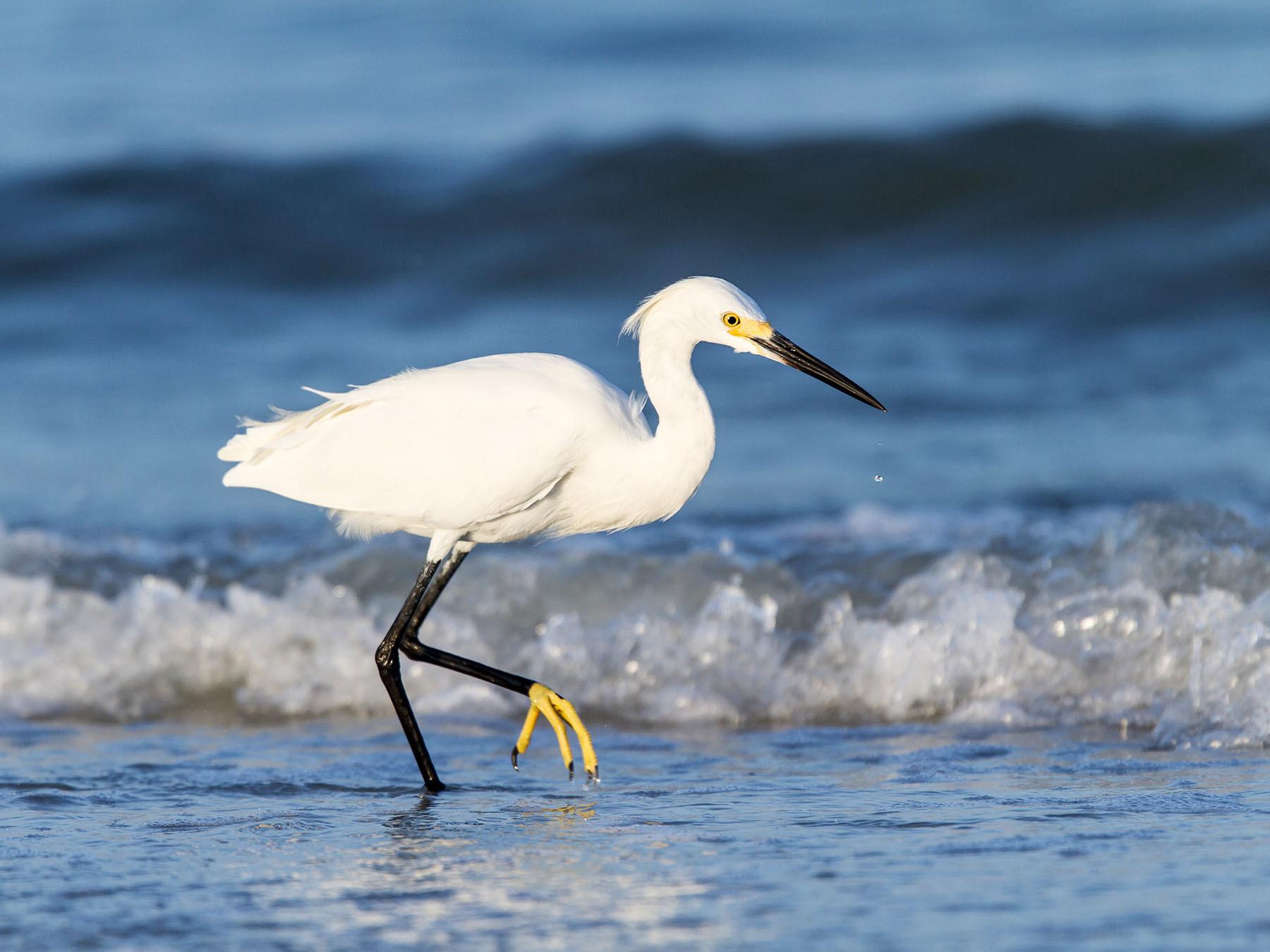
A Snowy Egret (Adult nonbreeding) is 22–26 in (56–66 cm) long, bill to tail.
Adult nonbreeding
© 2026 NC Digital Limited (Birdfact). All rights reserved. This 3D model may be viewed on this page and shared by link only. Downloading, extracting, copying or reusing it, or using it to train machine-learning models, is not permitted without our written permission. Using our models
On this page15 sections
How to recognise it
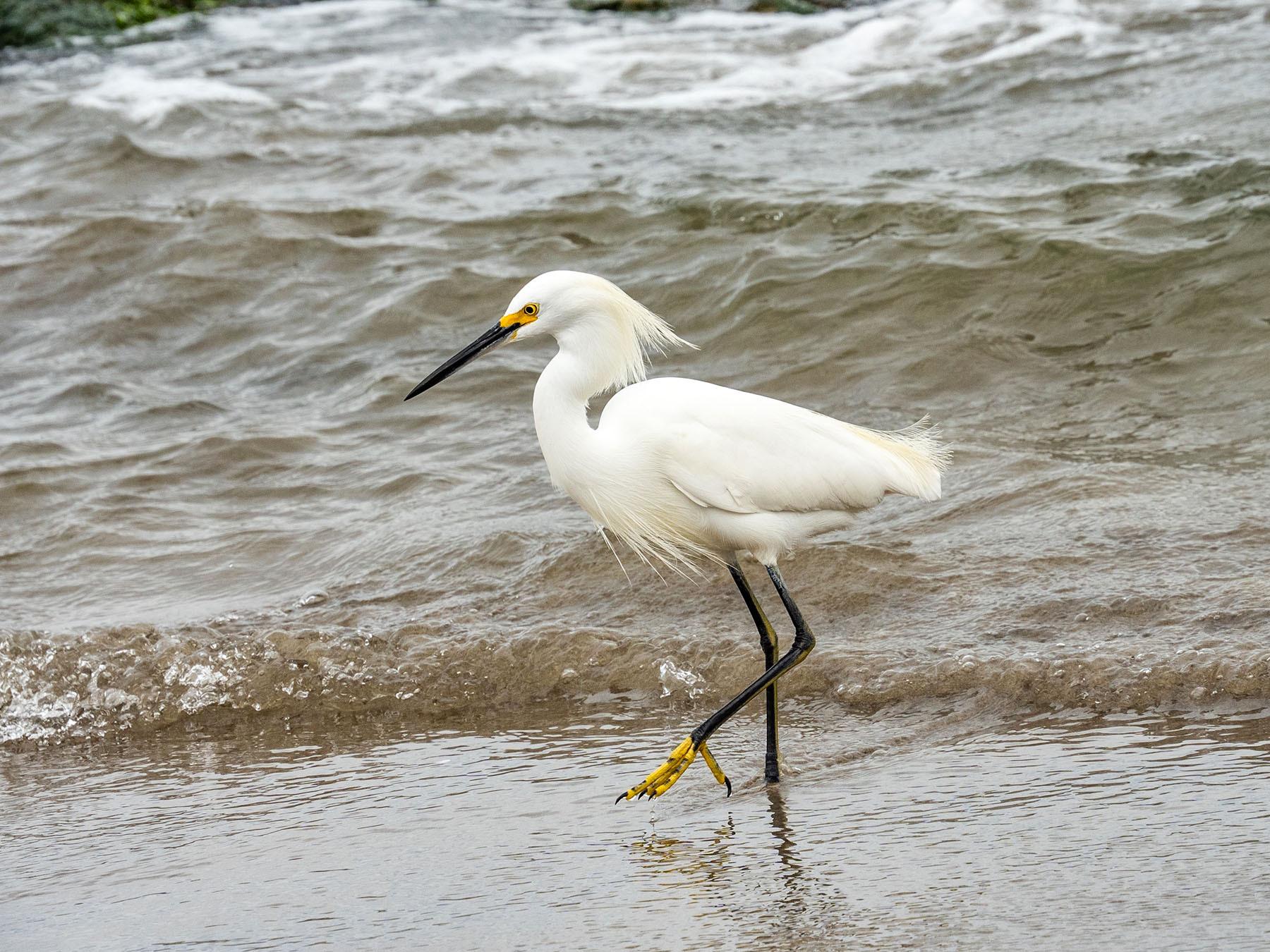
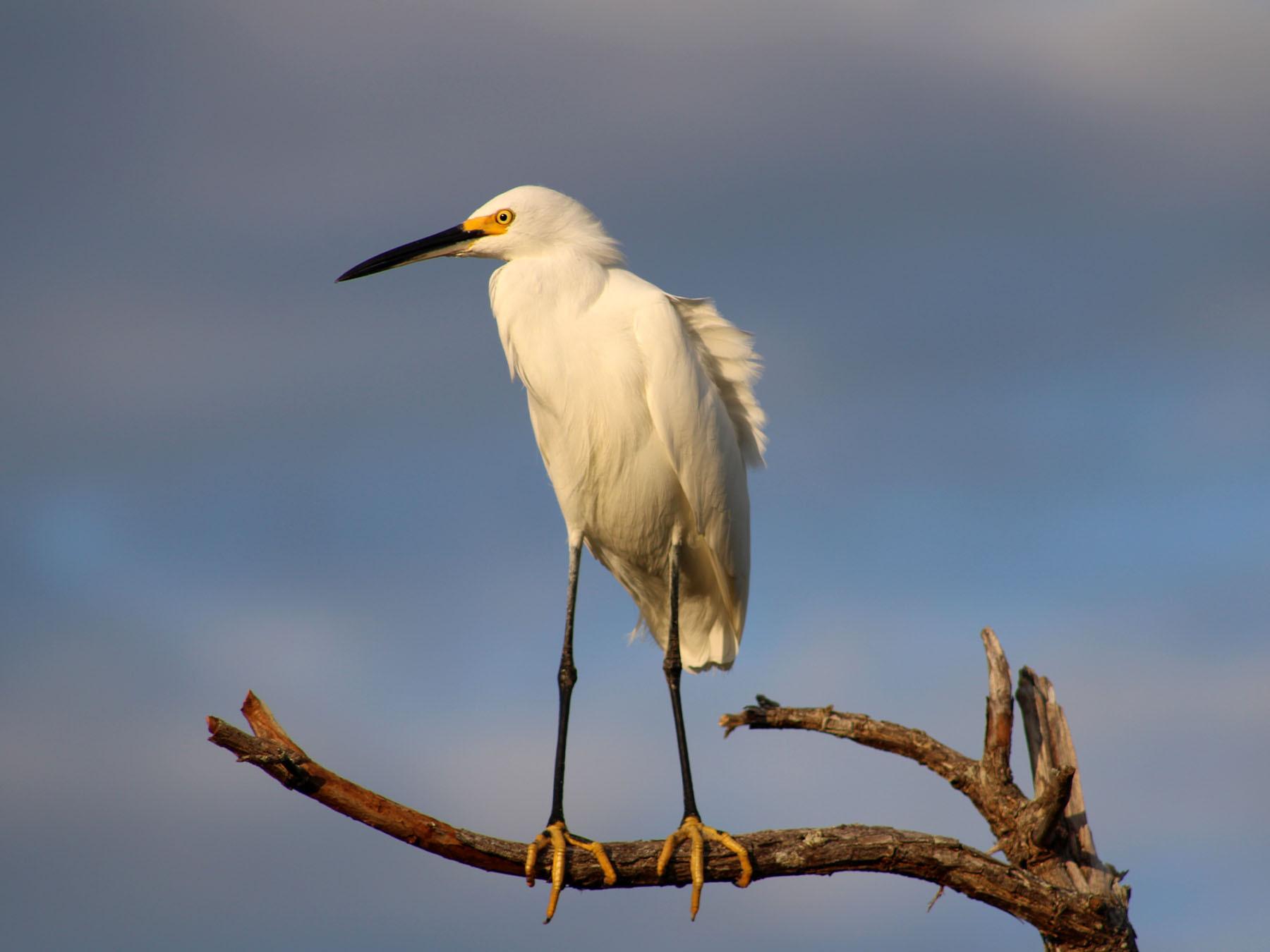
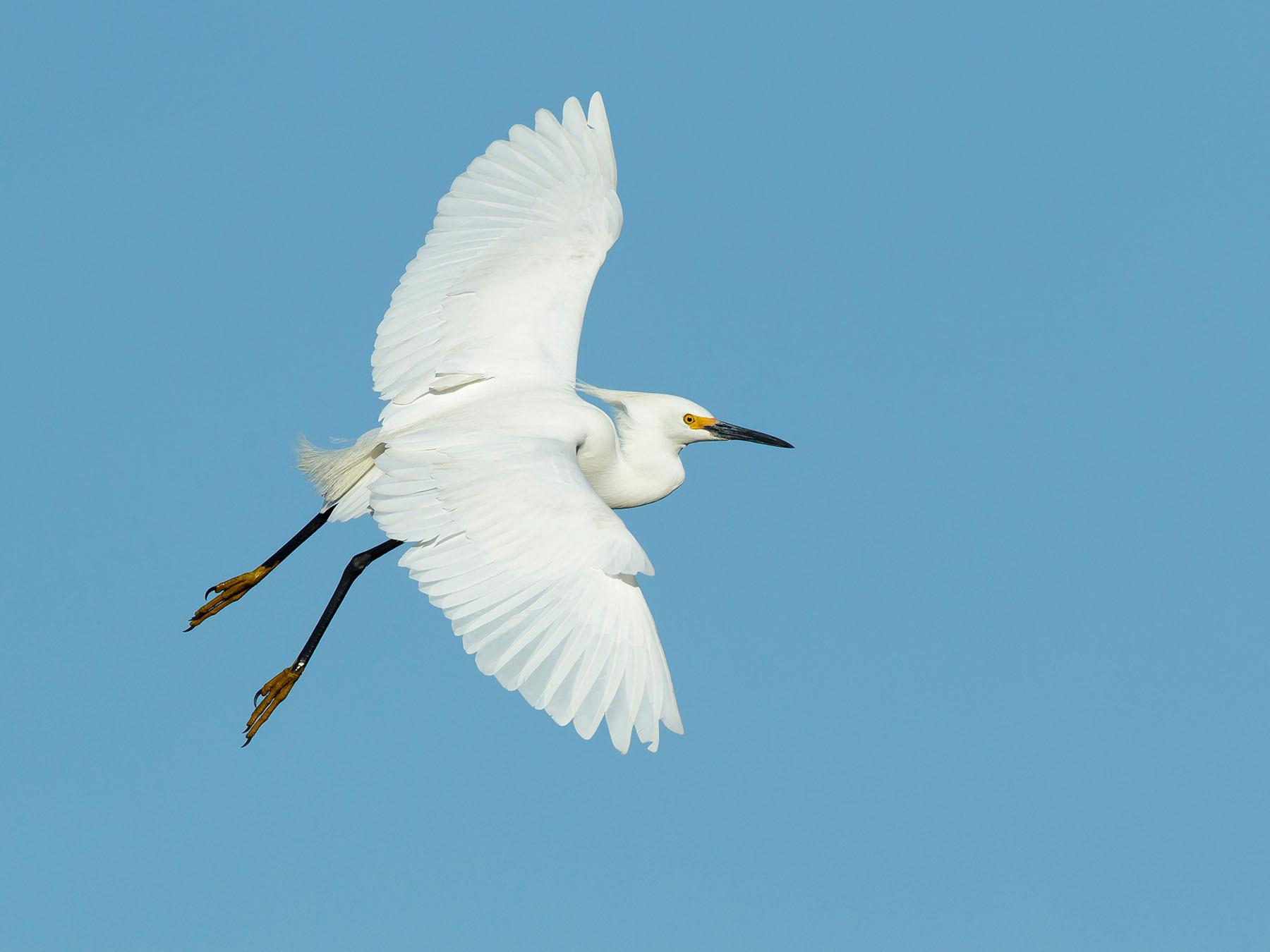
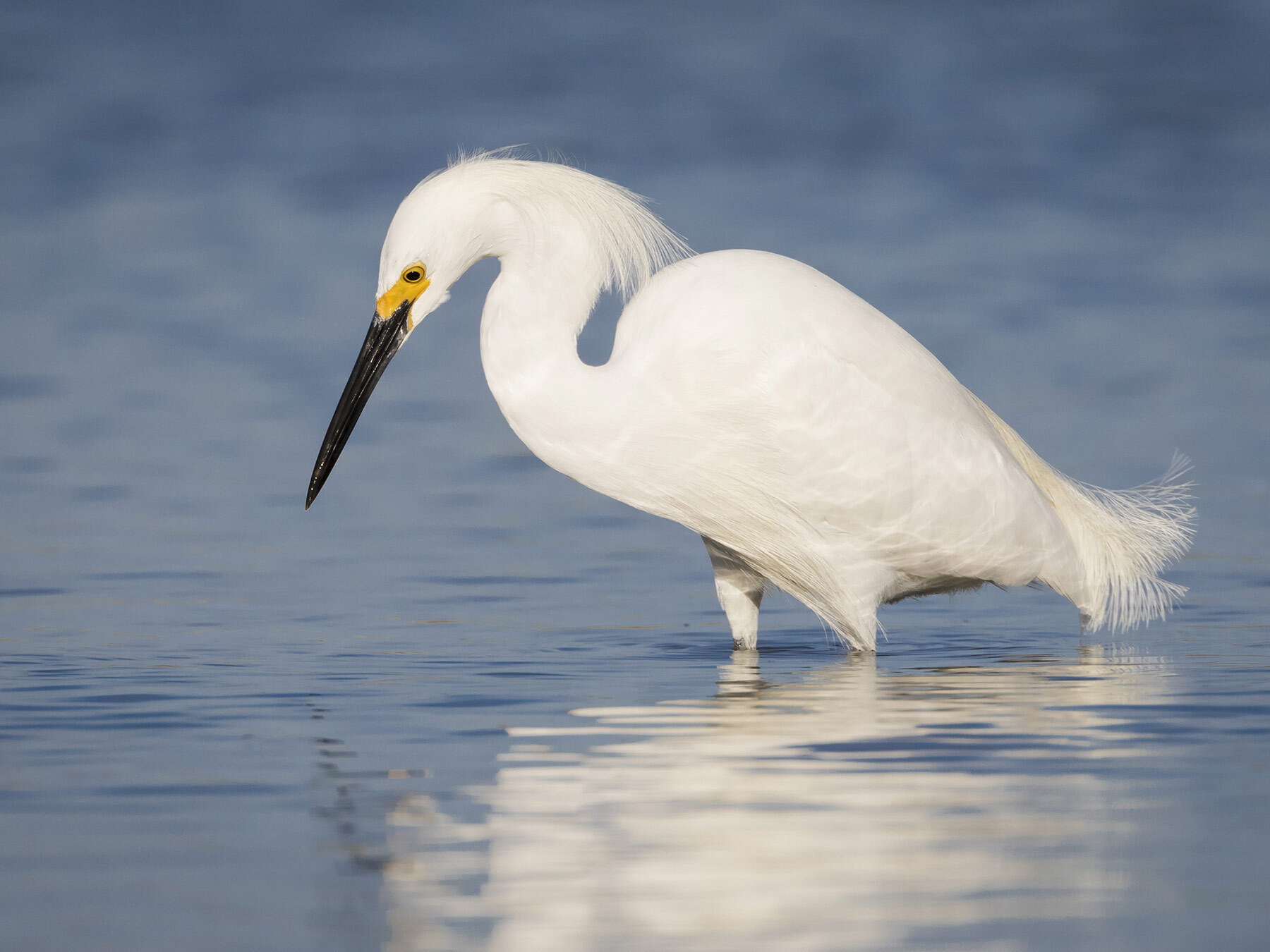
The Snowy Egret is a slim, all-white heron of North and South America with a slender black bill, black legs and bright yellow feet, the "golden slippers" that make it one of the easiest egrets to name. Look too for the patch of bright yellow bare skin between the eye and the bill. It is a medium-sized, delicately built bird: smaller than a Great Egret and bigger than a Cattle Egret, and very active when it feeds, dashing, stirring and hovering through the shallows.
Males and females look alike in every plumage. In flight the yellow feet show clearly beyond the tail.
Size
A Snowy Egret is 22-26 in (56-66 cm) long, with a wingspan of about 39-43 in (100-110 cm), and weighs about 13-15 oz (370-420 g). Males average slightly larger, with longer bills, legs and wings; in measurements Palmer published in 1962, males' bills averaged 3.3 in (83 mm) and females' 3.1 in (79 mm).1 Western birds average a little bigger than eastern ones, and those breeding in Baja California may be the biggest in North America. On that size difference, two subspecies are named: thula across most of the range, and brewsteri from the western US to Baja California and northwestern Mexico.
Plumage: plumes and courtship colors
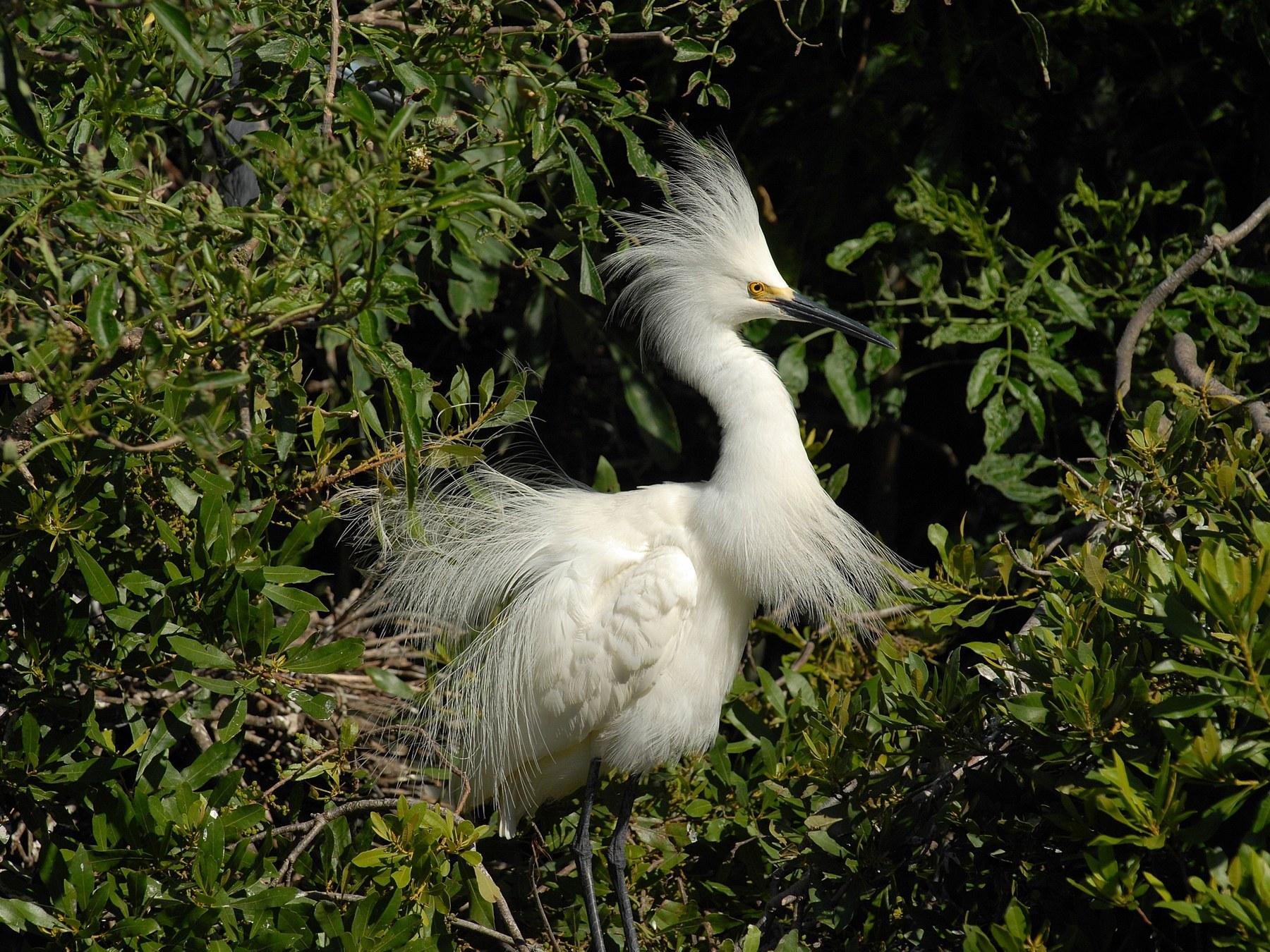
In spring and summer adults grow long, lacy plumes: a short, shaggy crest on the back of the head, a spray on the breast and a cloak of plumes on the back that curl up at the tips and reach the tail or beyond. Outside the breeding season the plumes are much shorter and the back plumes nearly straight. For a short time early in the season, the skin in front of the eye flushes reddish, pink or orange and the feet turn a richer orange-yellow. This flush does not always come at the same time as the plumes, and it can show in a bird that is displaying or fighting at the nest.
Juveniles and young birds
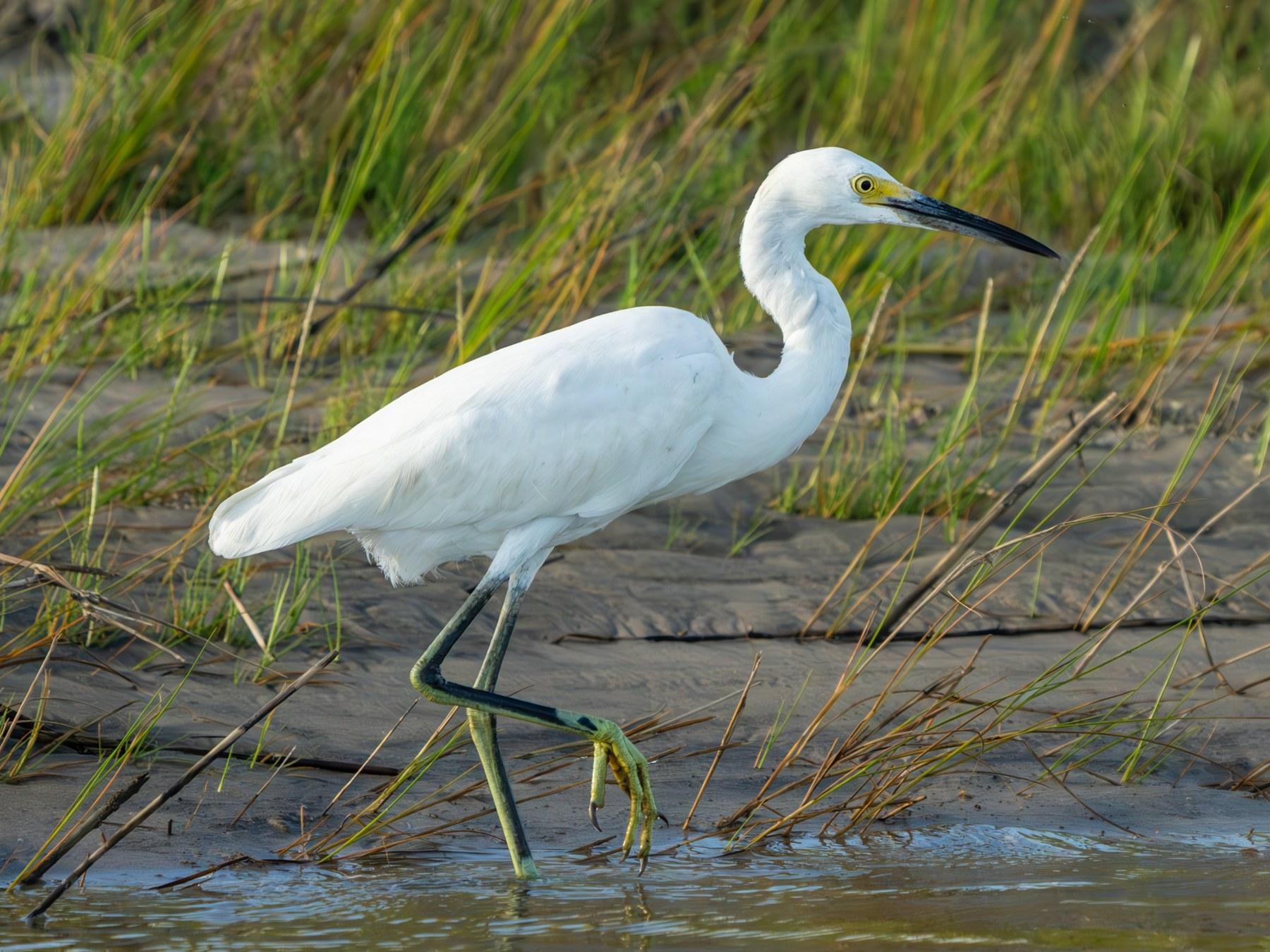
A young Snowy Egret is all white with no plumes. The feet are duller, greenish-yellow, and the yellow-green runs up the back of the leg. The base of the lower bill is paler and grayish. By about five months old young birds show the adult's clean black legs and yellow feet, and in their first winter they grow short plumes. Adults outside the breeding season can also show greenish-yellow feet and a pale bill base.
Identification: similar birds
Several white herons share its range, and the feet and bill settle most of them.
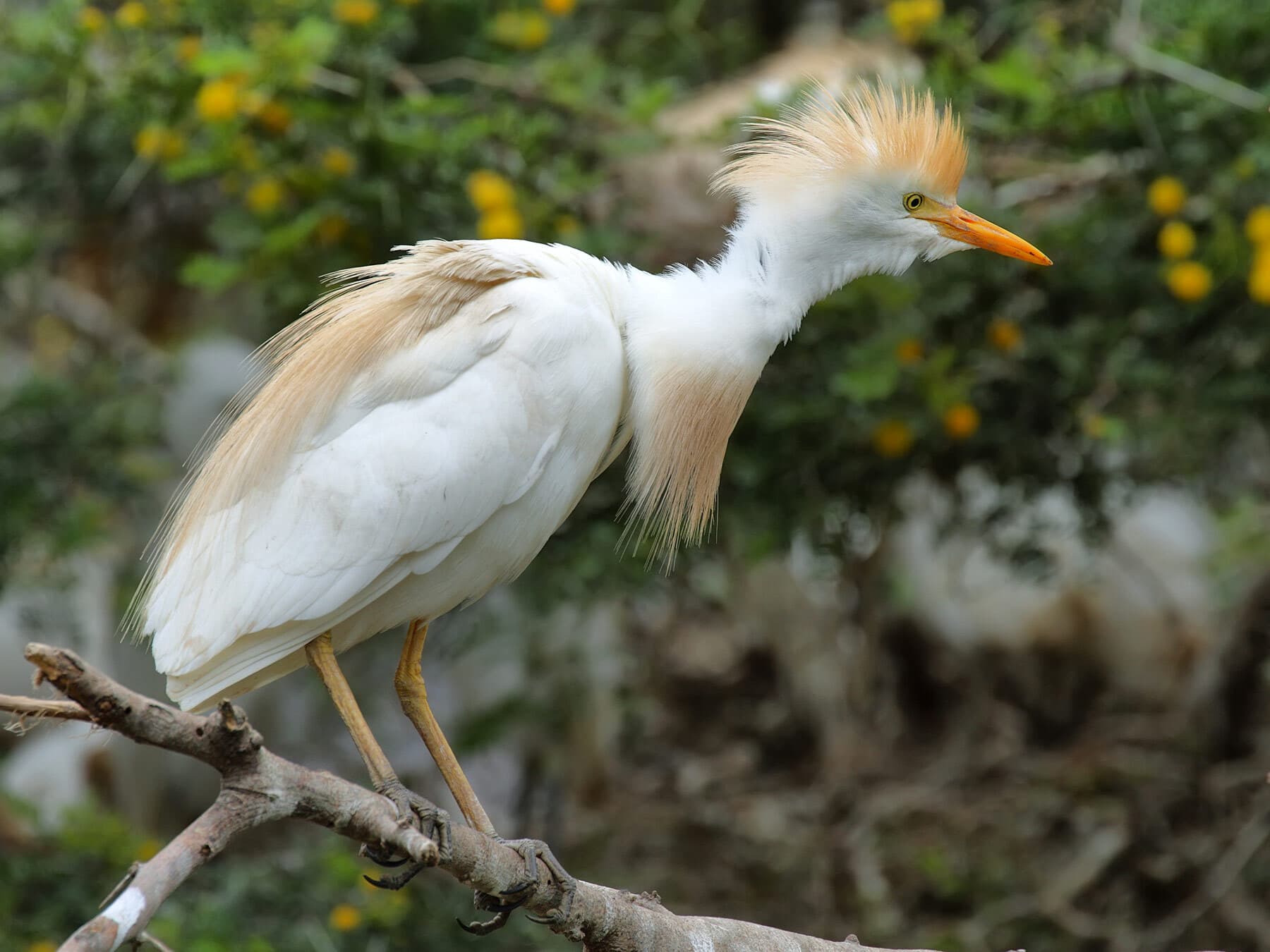
A Great Egret is far bigger, with a yellow bill and black legs and feet, and it flies with slower, deeper wingbeats. A Cattle Egret is smaller and stockier, with a short yellow bill and yellowish or dark legs, and usually feeds in dry fields. A young Little Blue Heron is all white like a Snowy, but it has a thicker gray bill with a dark tip, grayish skin in front of the eye, dull greenish legs with no contrasting yellow feet, and often dusky wingtips; it feeds slowly and deliberately. A white Reddish Egret, seen mainly in Florida and on the Gulf Coast, is bigger, with a long, heavy bill, pink at the base and black-tipped when breeding, and no yellow on the face or feet.
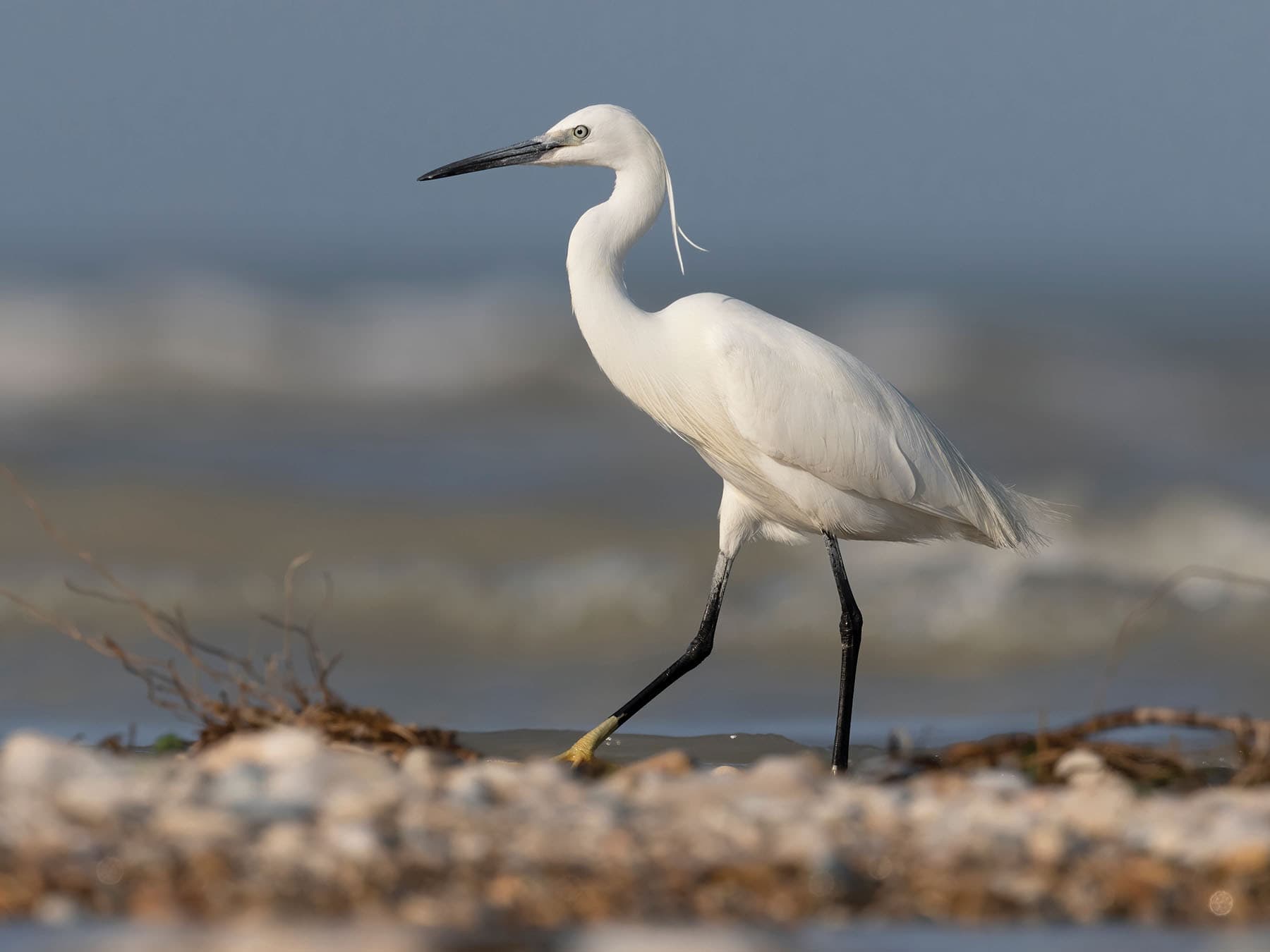
The hardest is the Little Egret of Europe, Africa and Asia, a rare visitor to the US Atlantic coast that has also settled in the West Indies. It has the same black legs and yellow feet. It can look slightly bigger and stockier, though sizes overlap, and the best clue is the skin in front of the eye, gray or bluish-gray on a Little Egret, and in breeding plumage it grows two long, thin plumes on the back of the head instead of a bushy crest. Some birds in New England have shown a mix of both, which may be hybrids or unusual Snowy Egrets.1
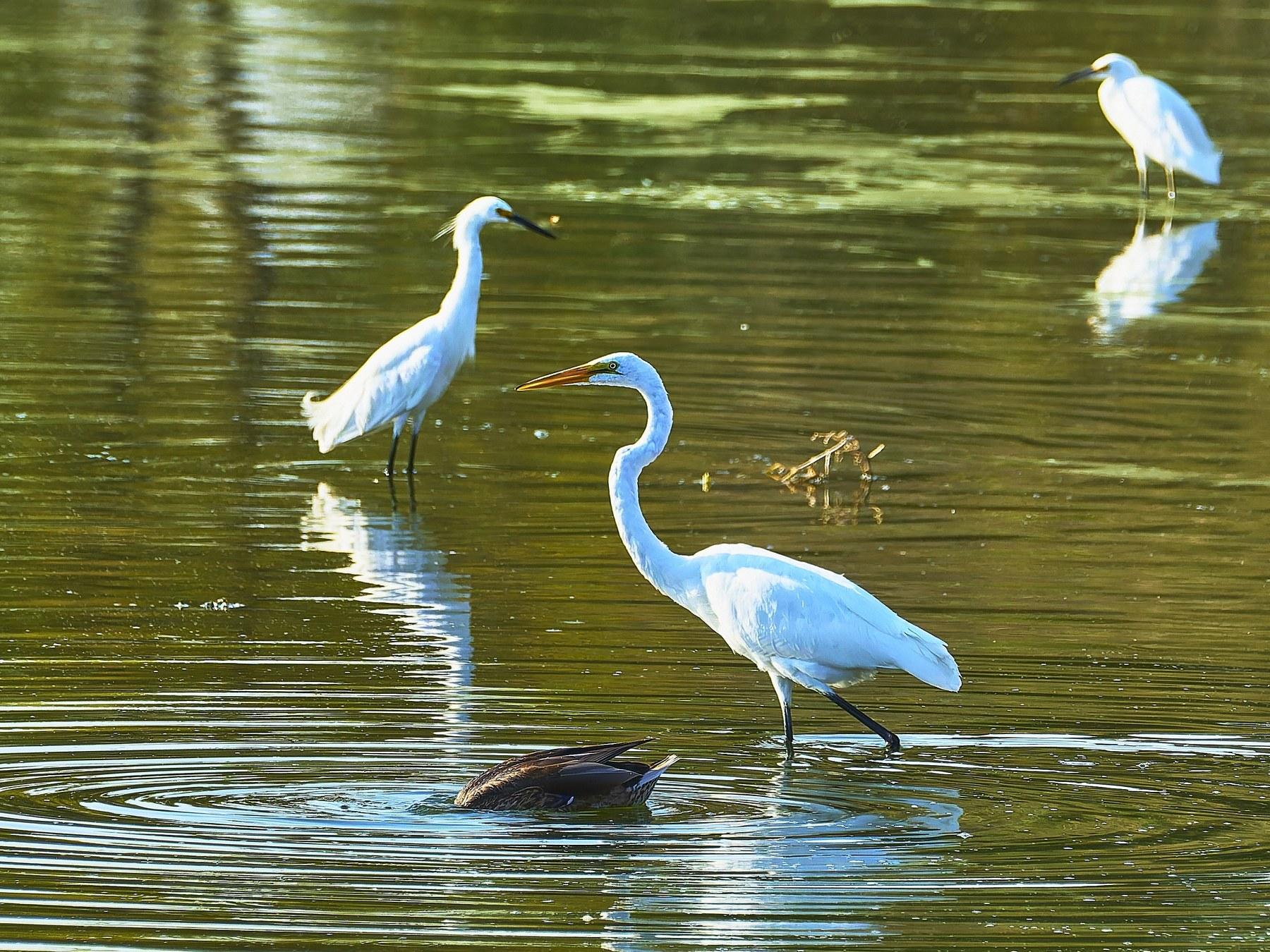
Not sure it’s a Snowy Egret? Check your photo: Birdfact names the bird and shows the look-alike side by side.
Its size
Adults- Length
- 56–66 cm
- Wingspan
- 100–110 cm
- Weight
- 370–420 g
Its song and calls
Snowy Egrets have no song and are quiet away from their colonies. At the colony they are noisy, with harsh, raspy squawks and croaks. A bird flushed from a feeding spot may give a high, grating call; lower calls go with threat displays and grow harsher as a dispute heats up; and in courtship the male alone gives a low, bubbling or gurgling call. A displaying male calls as he pumps his body with the bill pointed at the sky. Birds also snap the bill shut with a click in display, and downy chicks give soft buzzing calls.
- Harsh calls0:00 / 0:07
Recorded in California, United States · June 2022
Heard one and not sure? Let the bird song identifier listen.
When and where to see it
Snowy Egrets live across the warmer parts of the Americas, from the US through Mexico, Central America and the Caribbean to Chile and Argentina. In the US your best chance is on the coast, especially around mudflats, salt marshes and tidal channels. By the late 1990s they bred along the Atlantic coast north to southern Maine, all around Florida and the Gulf Coast, up the Mississippi valley, and at scattered wetlands in the West, from California and Oregon to Idaho, Utah, Nevada and Colorado. Colony sites often move from one year to the next.
They feed in shallow water: salt-marsh pools, tidal flats and channels, shallow bays, mangroves, freshwater marshes and the edges of lakes and rivers, and sometimes in wet or flooded fields.
Do they migrate?
Some do. Birds that breed inland and along the northern Atlantic coast all migrate, while many in Florida, along southern coasts and in the Pacific lowlands stay all year. Northern birds return in March and April and leave in September and October. In winter they range along the Atlantic coast from southern New Jersey (a few) south, through Florida and the Gulf Coast, in California and Arizona, and south through Mexico and the Caribbean to northern South America.
Bands show where they go. Young birds banded in the eastern US have been found in Haiti, Cuba and the Bahamas, and one banded as a nestling in New Jersey in August 1968 was in Trinidad that November.1 Some western birds winter in central California and Mexico. After breeding, some wander well north of the breeding range, as far as southern Canada, and strays have reached Iceland, the Azores and Tristan da Cunha in the South Atlantic.1
Tips for seeing it
What it eats
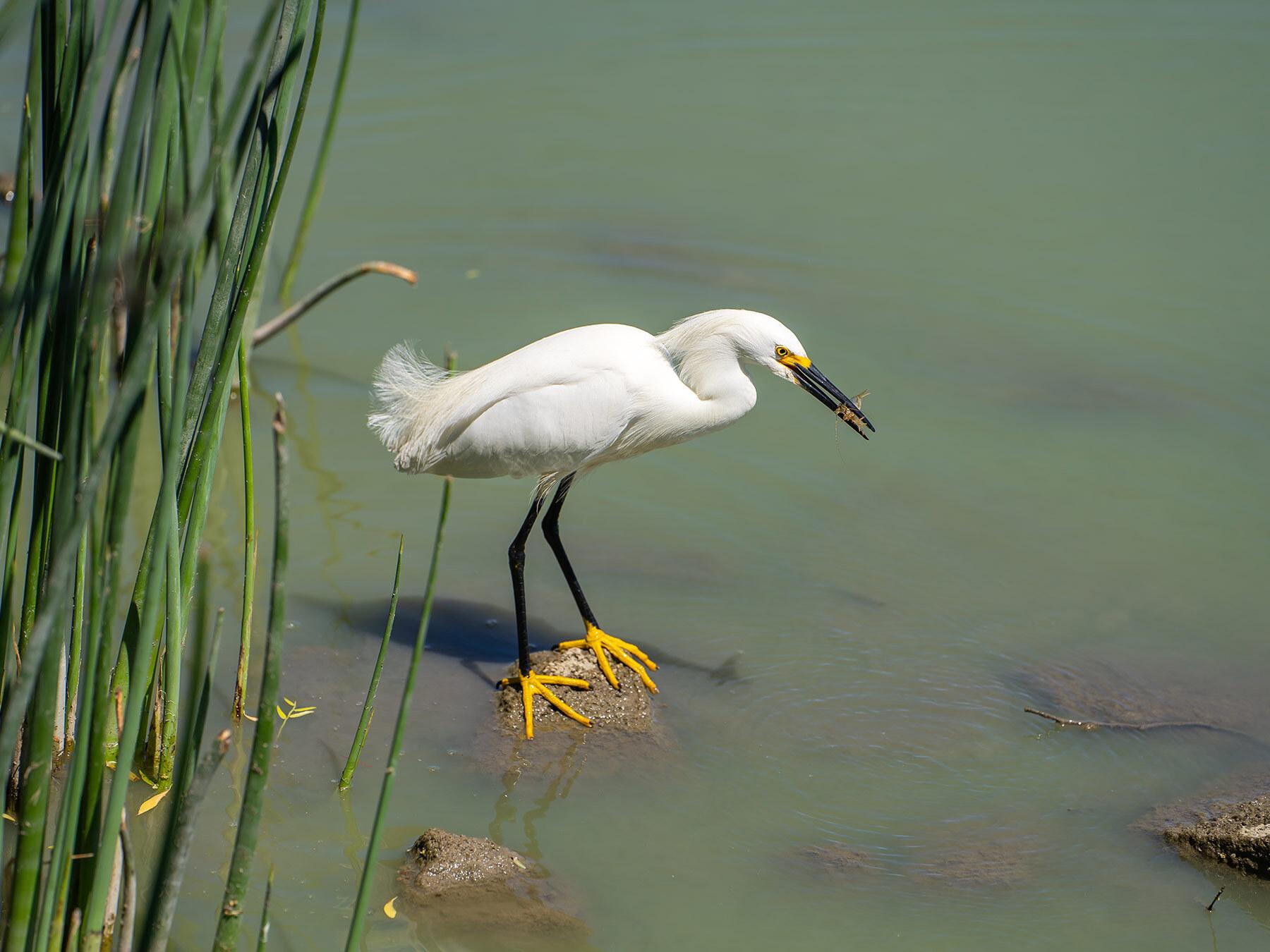
Snowy Egrets eat mostly small fish and crustaceans such as shrimp, crabs and crayfish, with worms, insects, snails, frogs and small snakes and lizards. The fish are small: in southern New Jersey they averaged about 1 in (2.8 cm) long, and in food brought to chicks at four Atlantic coast estuaries fish made up about three-quarters and crustaceans a quarter.1
How they feed: the golden slippers at work
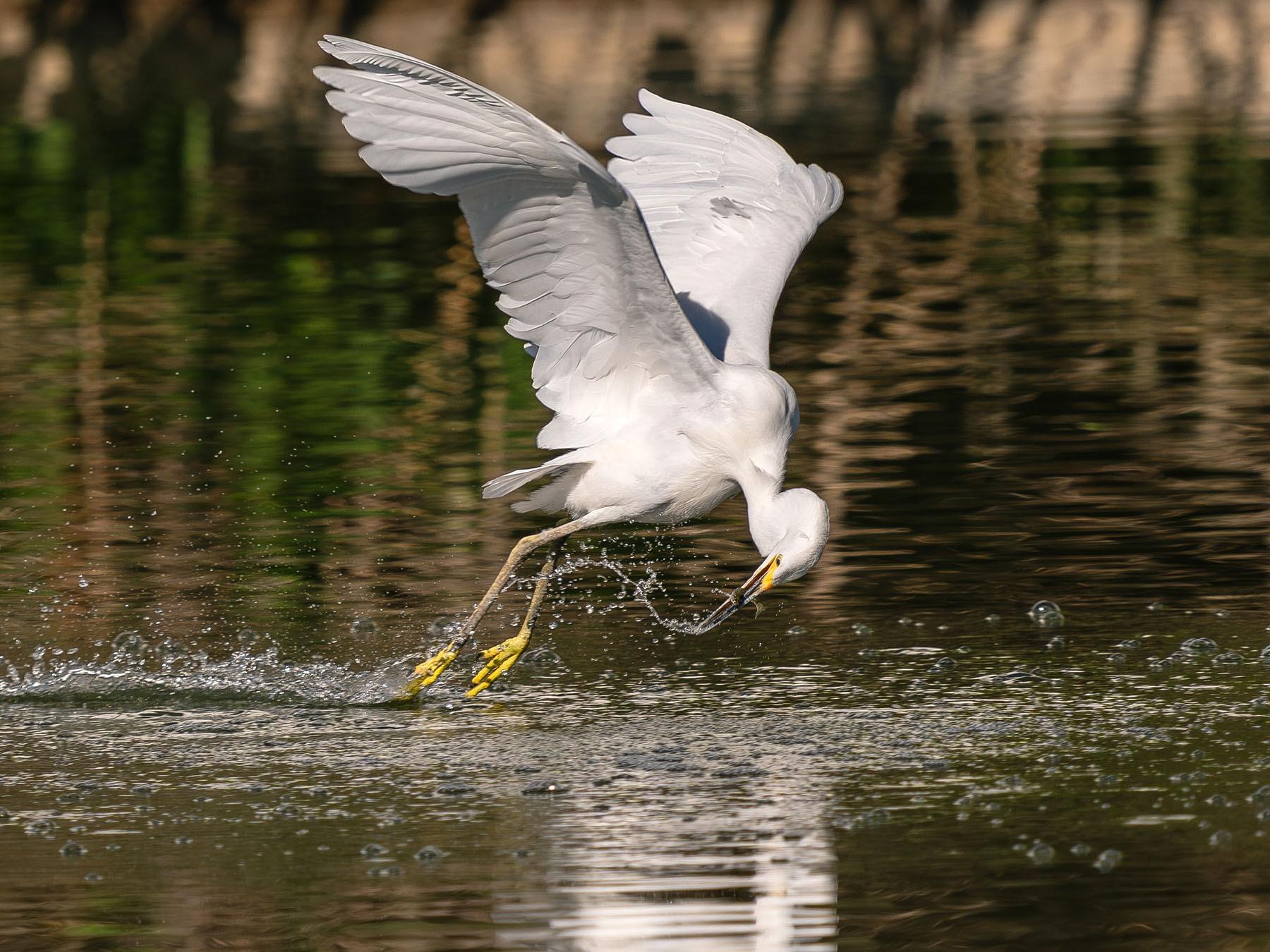
No North American heron feeds in more ways. Of 34 heron feeding behaviors described, the Snowy Egret has been seen using 21.1 Many of them use the yellow feet: it stirs or rakes the mud with its feet to flush hidden prey, probes with its toes, and hovers low over the water dabbling its feet. It also stands and waits, walks slowly, dashes and runs with wings spread, flicks its wings, sways its head and vibrates its bill to lure fish. In San Francisco Bay, two-thirds of strikes went with foot-stirring.1 It sometimes follows cattle to catch the insects they flush; in a dry Florida pasture with no cattle around, one bird foot-stirring through short grass caught 34 grasshoppers in 42 strikes.2
In a New Jersey study it was the only one of five herons that regularly hunted on mudflats left bare by the tide, and its foot-stirring brought up prawns and young eels that the others rarely took.3 Newer studies are still adding to the list: in a northeastern US estuary, 8.4% of foraging observations over three years were of "tongue-fluttering", the egret setting its bill tip in the water and fluttering its tongue to send out ripples that seemed to draw in small fish.4
This busy hunting costs energy, so Snowy Egrets spend more of the day feeding than many other herons, mostly in the morning and evening when breeding.

Feeding in flocks
Other wading birds often gather around feeding Snowy Egrets, and big mixed flocks build up around them. In southern New Jersey, feeding flocks averaged 130 birds, about 75% of them Snowy Egrets, and an egret in a flock caught 1.9 prey a minute against 1.3 alone, and succeeded with 64% of its strikes against 42%, as neighbors flushed fish toward it.1
Nesting and breeding
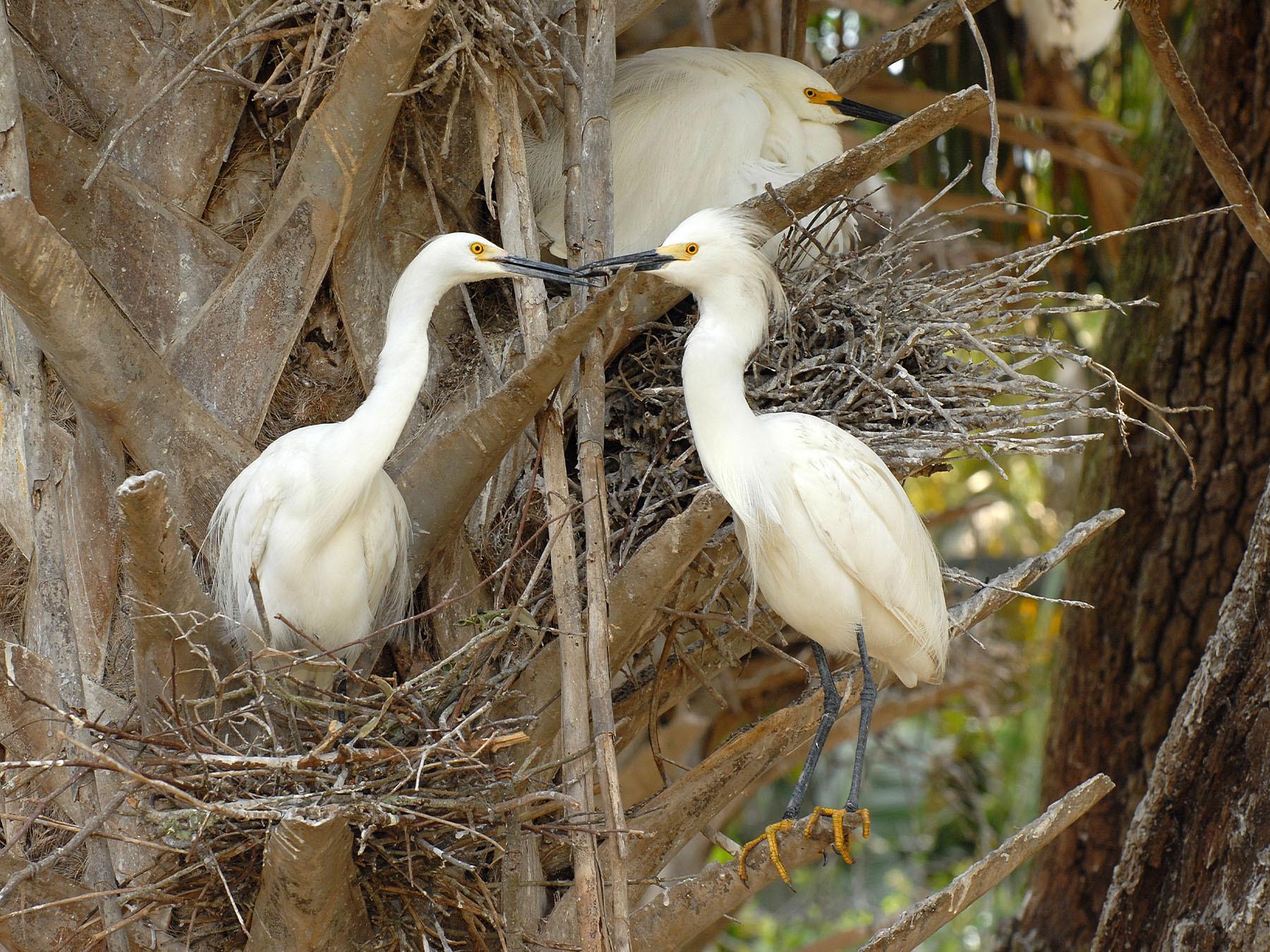
Snowy Egrets nest in colonies, almost always with other herons, egrets, night-herons and ibises, and are often one of the commonest birds there. They prefer islands, which raccoons and other predators find harder to reach: barrier, dredge-spoil and salt-marsh islands in the East, mangroves in the South, and lakes and rivers in the West. The nest is usually low down in a shrub, small tree or tangle of vines, often 5-10 ft (1.5-3 m) up, and sometimes on the ground in dense reeds.
The male picks the site, starts a nest and displays there. Once paired, the female does most of the building with sticks he brings. The nest is a shallow platform of loosely woven twigs lined with finer stems, rushes or Spanish moss, and old nests are reused. In the Northeast, eggs are laid from late April into May.
Eggs and young
The 3-5 pale greenish-blue eggs, sometimes 2-6, are laid about two days apart. Both parents incubate for about 22-24 days: studies give averages of 22 days in Florida and 23-24 days for each egg in Texas.1 A bird arriving to take over on the eggs sometimes hands its mate a stick.
Because incubation often starts with the first egg, the chicks hatch about a day apart, and the youngest may starve when food is short. Both parents brood them for about the first 10 days and feed them, at first by dropping food into the nest and later by letting the chicks grab their bill in a scissor grip. From about 10 days old the chicks climb out onto branches when disturbed. They are fully feathered at about five weeks, may leave the nest at 20-25 days, and probably cannot fly before 30 days. Pairs raise one brood a year, but may lay again if they lose their eggs. Most probably first breed at two years old.
Feeding the chicks can mean long trips: radio-tagged parents at a Kansas colony made round trips averaging 10 miles (16.1 km), and up to 30 miles (49 km), to find food.5

Behaviour
Snowy Egrets are social all year, feeding and nesting with other waterbirds. In spring the male claims a small territory in the colony and displays to attract a mate. In the stretch display he points his bill skyward, raises his plumes and pumps his body up and down while calling, and a ring of other egrets often gathers to watch. He also flies circles around the site and, in the most spectacular display, climbs and then tumbles toward the ground. Pairs then defend the small area around the nest, raising their crests and calling harshly at intruders.
Lifespan and predators
The oldest Snowy Egret on the North American banding list reached at least 17 years 7 months: banded as a nestling in Colorado in July 1970, it was shot in Mexico in January 1988. The next two on the list, also banded as nestlings in the interior West, reached at least 16 years 11 months and 11 years 3 months.6 An older report of a bird of 22 years 10 months from Utah, published in 1982, is not on the list today.1, 6
Most live far shorter lives. Band recoveries analyzed in 1978 suggested that about 72% of young birds die in their first year, and, depending on the estimate, about 31-52% of older birds each year.1 The weeks after leaving the colony are dangerous: in a coastal Virginia study of Snowy Egret and night-heron chicks, most of the radio-tagged chicks (the oldest in each nest) lived to dispersal age, about 53-55 days old for the egrets, but only 25-60% survived the next 40-55 days.7
Predators and other dangers
Raccoons, Great Horned and Barred Owls, American and Fish Crows, alligators and rat snakes take eggs and chicks, which is one reason Snowy Egrets favor island colonies. Starvation and predators cause most losses of chicks, and bad weather can kill young nestlings.
Conservation
The Snowy Egret is listed as Least Concern worldwide.8 Partners in Flight puts the world population at about 2.1 million birds, an estimate for about 2010, with only around a tenth of them in the US and Canada.9 Its numbers are hard to pin down: on the roadside North American Breeding Bird Survey the yearly index for this species has wide margins of error, and it shows no clear change across the US from 1966 to 2025 (+0.71% a year, with a 95% credible interval of -1.90 to +2.31), but big regional differences: a long decline in Florida, where the survey's index has fallen by about 80% since the late 1960s, and an increase in Louisiana, mostly before 2000.10
Conservation history: the plume trade
The Snowy Egret's lacy breeding plumes made it one of the herons most sought after by the plume trade. From about 1880, plume hunters shot adults at their colonies to supply the trade in feathers for women's hats, and with the parents gone their eggs and chicks died too. Plumes were valued at $32 an ounce, reckoned at twice the price of gold: Birds of the World gives that figure for 1886, and a 1905 account quoted by Bent gives it for 1903.11 The killing peaked in 1903 and went on until about 1910, wiping it out locally along the Atlantic coast from Long Island south to North Carolina and nearly from Florida, and it lasted longer in Central and South America to supply Europe.1 Plume hunters called it the "short white", and it was killed in greater numbers than the bigger Great Egret because it was commoner, less shy and its delicate plumes were more in demand, and a writer of the time reckoned that 1902 sales at one London auction house of heron plumes, 48,240 ounces, meant about 192,960 herons killed at their nests.11
Egrets helped start the American bird conservation movement.12 Outrage at the killing of egrets and other waders for hats led to the founding of the Massachusetts Audubon Society in 1896.13 Laws followed. The Lacey Act of 1900 made it a federal offense to ship birds killed against state law from one state to another; the Tariff Act of 1913 banned the import of egret plumes and wild-bird feathers into the US; and the 1916 Migratory Bird Treaty with Great Britain, for Canada, gave herons a closed season all year round, put into US law by the Migratory Bird Treaty Act of 1918.14, 15, 16, 17
With protection the Snowy Egret came back and spread north of its old range: its first nesting records after 1930 came in New Jersey in 1939, New York in 1949, Massachusetts in 1955 and Maine in 1961.1
Population today
Since then its fortunes have varied from place to place. After spreading north in the mid-1900s, it declined in parts of the Northeast in the 1970s and 1980s: on Long Island, New York, nesting pairs fell from 1,228 in 1978 to 650 in 1985.1 Surveys there have since found no clear trend, with 476 pairs in 2010 and 487 in 2022.18 Florida has seen some of the steepest losses. Christmas Bird Counts there showed a decline across 30 years of data,19 and in South Florida the small herons of its genus have declined steeply: Everglades nests fell to 228 in 2017, the lowest since 1990, before recovering to 2,933 in 2021, still well short of the restoration target of 10,000-20,000 pairs, which it has not reached in any year since the counts began in 1986; the causes are not known, though the report suggests food shortages driven by water levels are at least partly responsible.20 Louisiana's increase has been linked to the spread of crayfish ponds, which concentrate prey.21 Around San Francisco Bay, nests averaged about 509 a year from 1995 to 2019, varying a lot between years, and some of the few colonies it uses there are in towns, in Santa Rosa and Fairfield.22
The North American Waterbird Conservation Plan of 2002 placed it in its High Concern category,23 while Partners in Flight rates it of low concern (7 out of 20 on its Continental Concern Score).9 Its main threat is the loss of wetlands, especially coastal ones: a 1978 estimate put US wetlands in colonial times at 127 million acres, of which about 100 million had been drained.1 Florida's wildlife agency says today's threats are not well understood, but names coastal development, disturbance at feeding and nesting sites and predators.24 Cattle Egrets may compete for nest sites: in one study, Snowy Egrets hatched 68% of their eggs where they shared colonies with Cattle Egrets and 88% where they did not, though how much such competition matters is unclear.1 In Idaho in 1979, DDE, a breakdown product of DDT, was in every egg tested, and the most contaminated eggs had thinner shells and hatched less; the author suspected the birds picked it up on their Mexican wintering grounds.25
Legal status
In the US the Snowy Egret is on the federal list of protected migratory birds, and under the Migratory Bird Treaty Act it is illegal to kill, take or possess the bird, its eggs, nest or feathers, or to sell them, except as regulations allow.26, 17 No federal order allows them to be killed without a permit, so killing one needs an individual federal permit.27 It is not listed under the Endangered Species Act.24 Several states list it: as endangered in Ohio, Illinois and Missouri, as threatened in Connecticut and as a species of special concern in North Carolina.28, 29, 30, 31, 32 Florida removed it from its list on 11 January 2017, after a status review found it met no listing criteria, but keeps it in its plan for imperiled species.24, 33 In Canada it is protected under the Migratory Birds Convention Act, 1994.34
Similar birds
Often mistaken for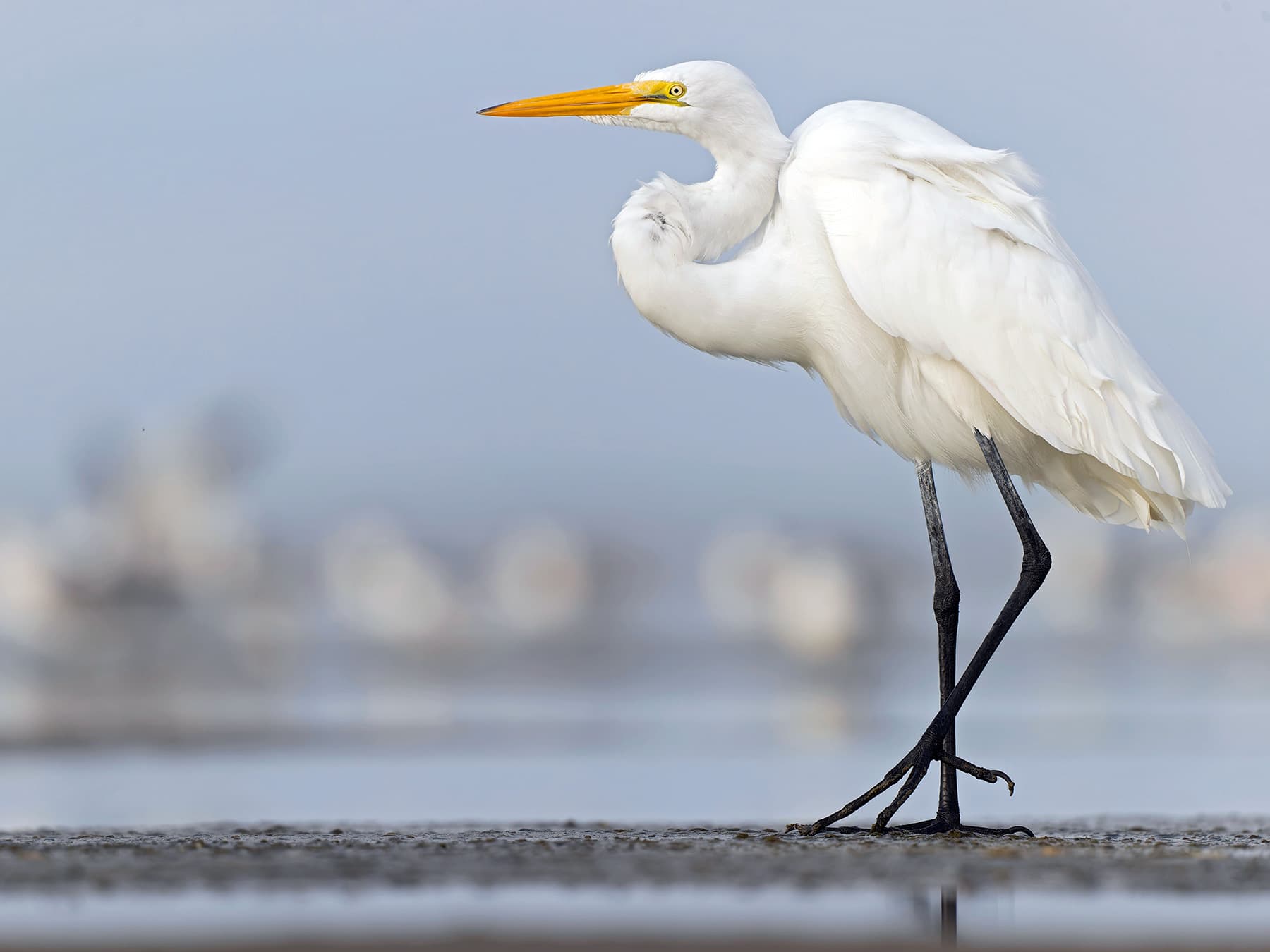
More photos
2 photos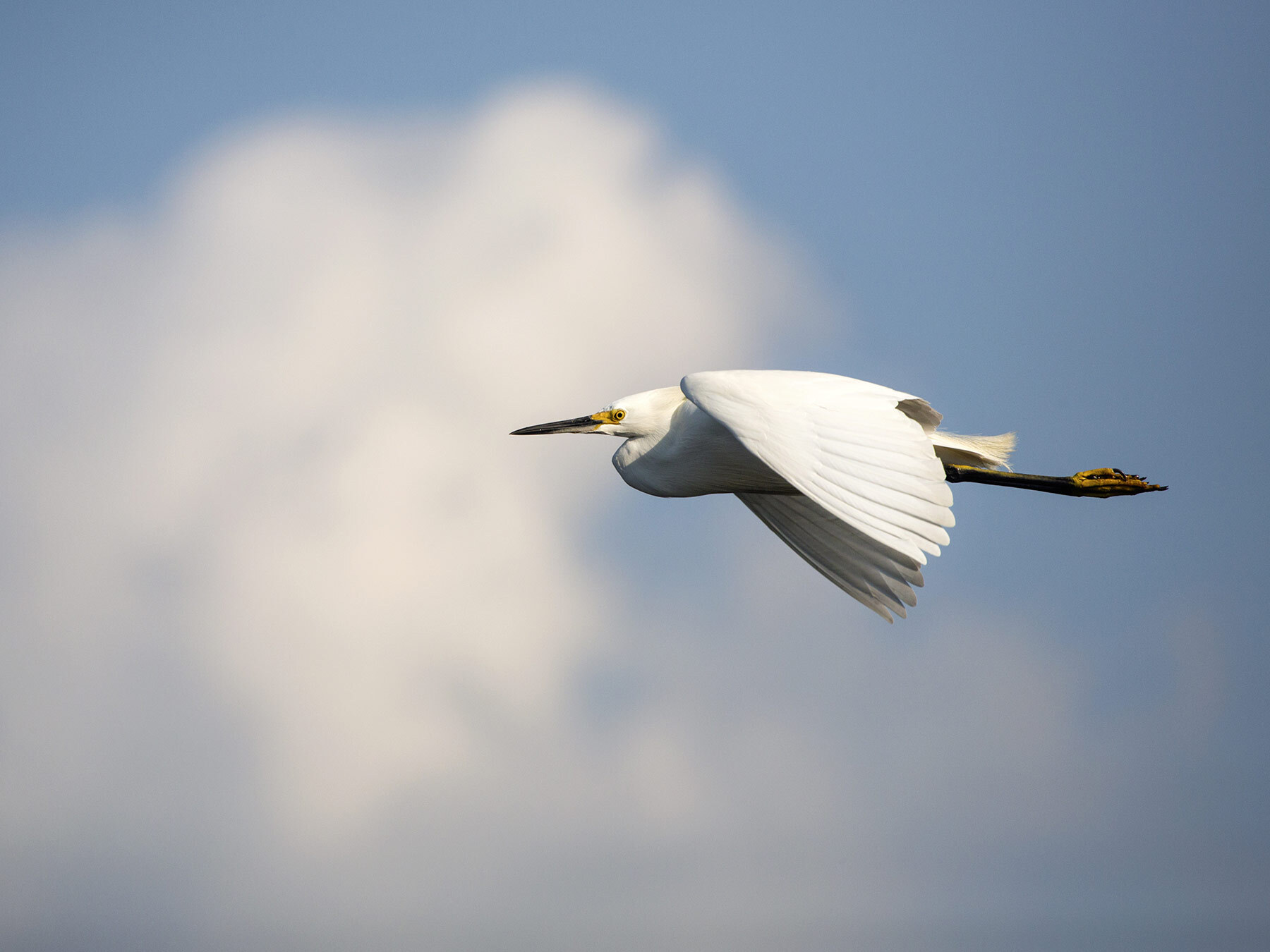
Quick facts
- Length
- 56–66 cm
- Wingspan
- 100–110 cm
- Weight
- 370–420 g
- Lifespan
- oldest recorded 17 years 7 months
- Family
- Herons & Egrets
- Migration
- Partial migrant
- Global status (IUCN)
- Least Concern
- World population
- 2,100,000 (Partners in Flight, about 2010)
- Population trend
- No clear change across the US since 1966 on a roadside survey with wide error margins; a long decline in Florida and an increase in Louisiana
- Scientific name
- Egretta thula
Questions
3Are there Snowy Egrets in the UK?
Only one has ever been recorded in Britain: a single bird found in Argyll, western Scotland, in 2001.35 Any white egret with yellow feet seen there should be checked against the Little Egret, which has the same yellow feet but grayish skin in front of the eye.
Do Snowy Egrets mate for life?
Probably not. Pairs are thought to stay together for a single breeding season, though there are few data.
Why does the Snowy Egret have yellow feet?
We found no study that has tested why. One early suggestion was that the bright feet lure prey; a New Jersey study found that foot-stirring often led to chases, which fits the view that it flushes prey into motion instead.3 The feet also matter in courtship: they turn a richer orange-yellow as the breeding season begins, a sign that a bird is coming into breeding condition.
Sources
44- 1Parsons, K. C. and Master, T. L. (2020). Snowy Egret (Egretta thula), version 1.0. Birds of the World (A. F. Poole and F. B. Gill, editors). Cornell Lab of Ornithology. doi:10.2173/bow.snoegr.01 (opens in a new tab)
- 2Meyerriecks, A. J. (1966). Additional observations on "foot-stirring" feeding behavior in herons. The Auk 83: 471-472. doi:10.2307/4083060 (opens in a new tab)
- 3Willard, D. E. (1977). The feeding ecology and behavior of five species of herons in southeastern New Jersey. The Condor 79: 462-470. doi:10.2307/1367726 (opens in a new tab)
- 4Nisbet, I. C. T. (2024). Tongue-fluttering by Snowy Egrets (Egretta thula) foraging in a tidal estuary. Waterbirds 47. doi:10.1675/063.047.0302 (opens in a new tab)
- 5Maccarone, A. D., Brzorad, J. N. and Stone, H. M. (2012). A telemetry-based study of Snowy Egret (Egretta thula) nest-activity patterns, food-provisioning rates and foraging energetics. Waterbirds 35: 394-401. doi:10.1675/063.035.0304 (opens in a new tab)
- 6USGS Bird Banding Laboratory. Longevity records of North American birds: Snowy Egret. USGS Patuxent Wildlife Research Center. Accessed 12 November 2026. Source (opens in a new tab)
- 7Erwin, R. M., Stotts, D. B. and Hatfield, J. S. (1996). Reproductive success, growth and survival of Black-crowned Night-Heron (Nycticorax nycticorax) and Snowy Egret (Egretta thula) chicks in coastal Virginia. The Auk 113: 119-130. doi:10.2307/4088940 (opens in a new tab)
- 8BirdLife International (2025). Egretta thula. The IUCN Red List of Threatened Species 2025. doi:10.2305/IUCN.UK.2025-2.RLTS.T22696974A281845566.en (opens in a new tab)
- 9Partners in Flight (2024). Avian Conservation Assessment Database, version 2024.05.23 (global). Bird Conservancy of the Rockies. Accessed 12 November 2026. Source (opens in a new tab)
- 10Hostetler, J. A. et al. (2026). The North American Breeding Bird Survey, Analysis Results 1966 - 2025. U.S. Geological Survey. doi:10.5066/P1OSNSFC (opens in a new tab)
- 11Bent, A. C. (1926). Life histories of North American marsh birds (United States National Museum Bulletin 135). Smithsonian Institution, Washington. Accessed 12 November 2026. Source (opens in a new tab)
- 12Kushlan, J. A. (2012). A history of conserving colonial waterbirds in the United States. Waterbirds 35: 608-625. doi:10.1675/063.035.0410 (opens in a new tab)
- 13National Audubon Society. History of Audubon and Waterbird Conservation. Audubon (archived page). Accessed 12 November 2026. Source (opens in a new tab)
- 14United States Congress (1900). An Act To enlarge the powers of the Department of Agriculture, prohibit the transportation by interstate commerce of game killed in violation of local laws, and for other purposes (Lacey Act), 31 Stat. 187. United States Statutes at Large. Accessed 12 November 2026. Source (opens in a new tab)
- 15United States Congress (1913). An Act To reduce tariff duties and to provide revenue for the Government (Underwood Tariff Act), 38 Stat. 114, Schedule N paragraph 347. United States Statutes at Large. Accessed 12 November 2026. Source (opens in a new tab)
- 16United States and Great Britain (1916). Convention between the United States and Great Britain for the protection of migratory birds, 39 Stat. 1702. United States Statutes at Large. Accessed 12 November 2026. Source (opens in a new tab)
- 17United States Congress (1918). Migratory Bird Treaty Act, 16 U.S.C. 703. United States Code (govinfo, 2023 edition). Accessed 12 November 2026. Source (opens in a new tab)
- 18New York State Department of Environmental Conservation (2025). Species Status Assessment: Snowy Egret (date updated 11 March 2025). New York State Wildlife Action Plan. Accessed 12 November 2026. Source (opens in a new tab)
- 19McCrimmon, D. A., Fryska, S. T., Ogden, J. C. and Butcher, G. S. (1997). Nonlinear population dynamics of six species of Florida Ciconiiformes assessed by Christmas Bird Counts. Ecological Applications 7: 581-592. doi:10.1890/1051-0761(1997)007[0581:NPDOSS]2.0.CO;2 (opens in a new tab)
- 20Cook, M. I. and Baranski, M. (2023). South Florida Wading Bird Report, Volume 27 (2021 nesting season). South Florida Water Management District. Accessed 12 November 2026. Source (opens in a new tab)
- 21Fleury, B. E. and Sherry, T. W. (1995). Long-term population trends of colonial wading birds in the southern United States: the impact of crayfish aquaculture on Louisiana populations. The Auk 112: 613-632. Accessed 12 November 2026. Source (opens in a new tab)
- 22Jennings, S. S. et al. (2024). Status and trends of breeding Ardeidae in the San Francisco Bay region. San Francisco Estuary and Watershed Science 22. doi:10.15447/sfews.2024v22iss3art1 (opens in a new tab)
- 23Kushlan, J. A., Steinkamp, M. J., Parsons, K. C. et al. (2002). Waterbird Conservation for the Americas: The North American Waterbird Conservation Plan, Version 1. Waterbird Conservation for the Americas, Washington, D.C.. Accessed 12 November 2026. Source (opens in a new tab)
- 24Florida Fish and Wildlife Conservation Commission. Snowy Egret. FWC species profile. Accessed 12 November 2026. Source (opens in a new tab)
- 25Findholt, S. L. (1984). Organochlorine residues, eggshell thickness, and reproductive success of Snowy Egrets nesting in Idaho. The Condor 86. doi:10.2307/1367033 (opens in a new tab)
- 26U.S. Fish and Wildlife Service (2023). 50 CFR 10.13, List of Birds Protected by the Migratory Bird Treaty Act. Electronic Code of Federal Regulations. Accessed 12 November 2026. Source (opens in a new tab)
- 27U.S. Fish and Wildlife Service (2022). 50 CFR 21.100, Depredation permits. Electronic Code of Federal Regulations. Accessed 12 November 2026. Source (opens in a new tab)
- 28Ohio Department of Natural Resources (2026). Ohio Administrative Code 1501:31-23-01, Special endangered wild animal regulations (effective 6 July 2026). Ohio Administrative Code. Accessed 12 November 2026. Source (opens in a new tab)
- 29Illinois Department of Natural Resources. Snowy Egret. Wild About Birds (IDNR). Accessed 12 November 2026. Source (opens in a new tab)
- 30Missouri Department of Conservation. Snowy Egret. MDC Field Guide. Accessed 12 November 2026. Source (opens in a new tab)
- 31Connecticut Department of Energy and Environmental Protection. Snowy Egret (Egretta thula) fact sheet. CT DEEP. Accessed 12 November 2026. Source (opens in a new tab)
- 32North Carolina Wildlife Resources Commission. Snowy Egret. NCWRC species profile. Accessed 12 November 2026. Source (opens in a new tab)
- 33Florida Fish and Wildlife Conservation Commission (2013). A species action plan for six imperiled wading birds: little blue heron, reddish egret, roseate spoonbill, snowy egret, tricolored heron, and white ibis. Florida Fish and Wildlife Conservation Commission, Tallahassee. Accessed 12 November 2026. Source (opens in a new tab)
- 34Environment and Climate Change Canada. Birds protected in Canada. Government of Canada (page modified 10 Feb 2025). Accessed 12 November 2026. Source (opens in a new tab)
- 35British Trust for Ornithology. Snowy Egret. BTO BirdFacts. Accessed 12 November 2026. Source (opens in a new tab)
- 36National Audubon Society. Snowy Egret (Egretta thula). Guide to North American Birds. Accessed 12 November 2026. Source (opens in a new tab)
- 37AviList Core Team (2025). AviList: The Global Avian Checklist, v2025b. AviList. doi:10.2173/avilist.v2025b (opens in a new tab)
- 38Cornell Lab of Ornithology. Snowy Egret: overview, identification, life history and sounds. All About Birds. Accessed 12 November 2026. Source (opens in a new tab)
- 39National Audubon Society. Great Egret (Ardea alba). Guide to North American Birds. Accessed 12 November 2026. Source (opens in a new tab)
- 40National Audubon Society. Western Cattle-Egret (Ardea ibis). Guide to North American Birds. Accessed 12 November 2026. Source (opens in a new tab)
- 41National Audubon Society. Little Blue Heron (Egretta caerulea). Guide to North American Birds. Accessed 12 November 2026. Source (opens in a new tab)
- 42National Audubon Society. Reddish Egret (Egretta rufescens). Guide to North American Birds. Accessed 12 November 2026. Source (opens in a new tab)
- 43National Audubon Society. Little Egret (Egretta garzetta). Guide to North American Birds. Accessed 12 November 2026. Source (opens in a new tab)
- 44McCrimmon Jr., D. A. et al. (2025). Great Egret (Ardea alba), version 2.0. Birds of the World (G. D. Engelbrecht, B. K. Keeney and G. M. Kirwan, editors). Cornell Lab of Ornithology. doi:10.2173/bow.greegr.02 (opens in a new tab)

Checked by
Nathan Cope, founder and editor
Nathan founded Birdfact and leads its writers and contributors in the UK, the US and Canada. He has watched and studied birds for more than ten years, and checks every article and species guide before it’s published.