



Great White Egret
Great Egret, Common Egret · Ardea alba
By the Birdfact teamChecked by Nathan Cope
On this page14 sections
How to recognise it
What do Great Egrets look like?
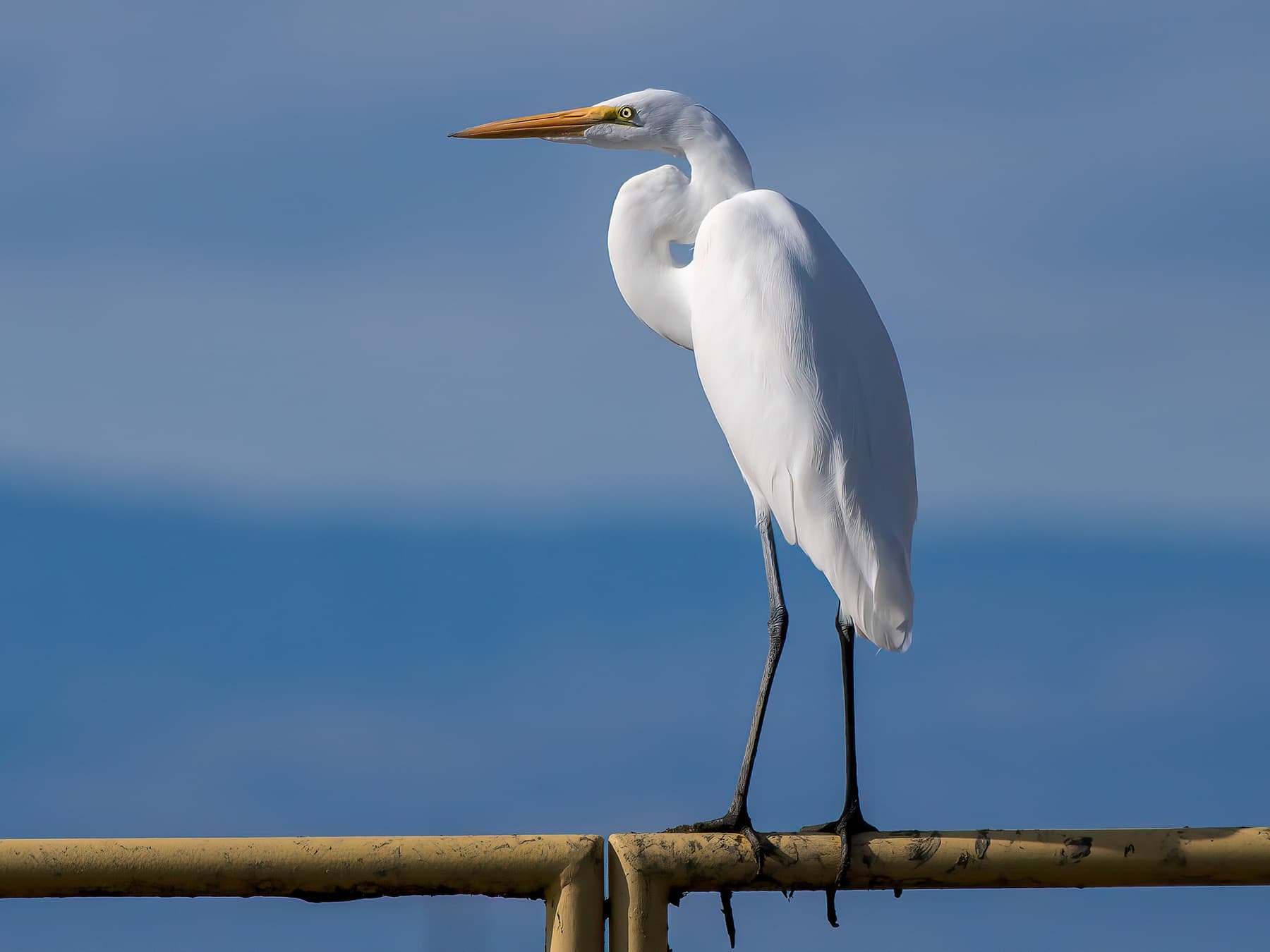
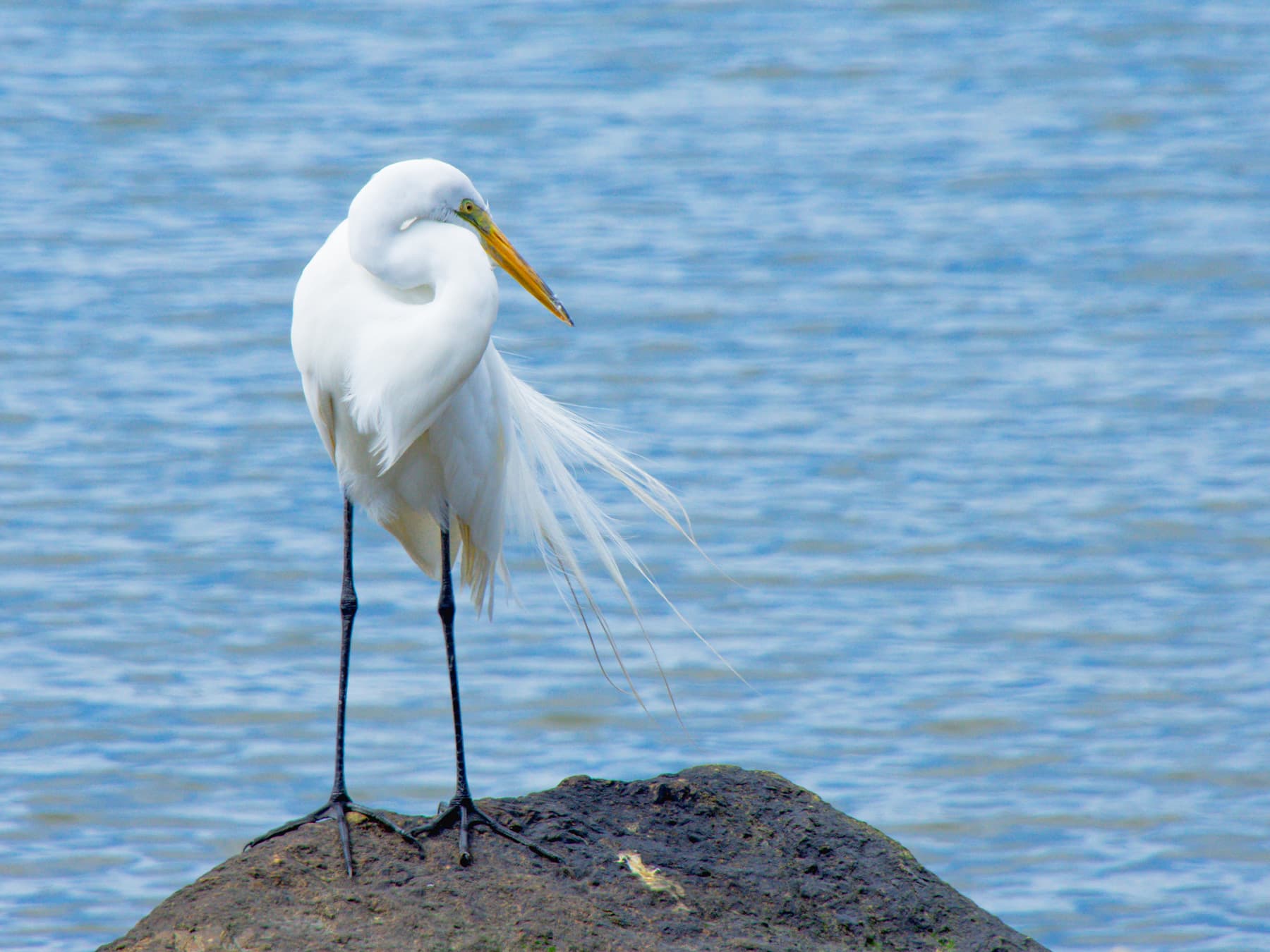
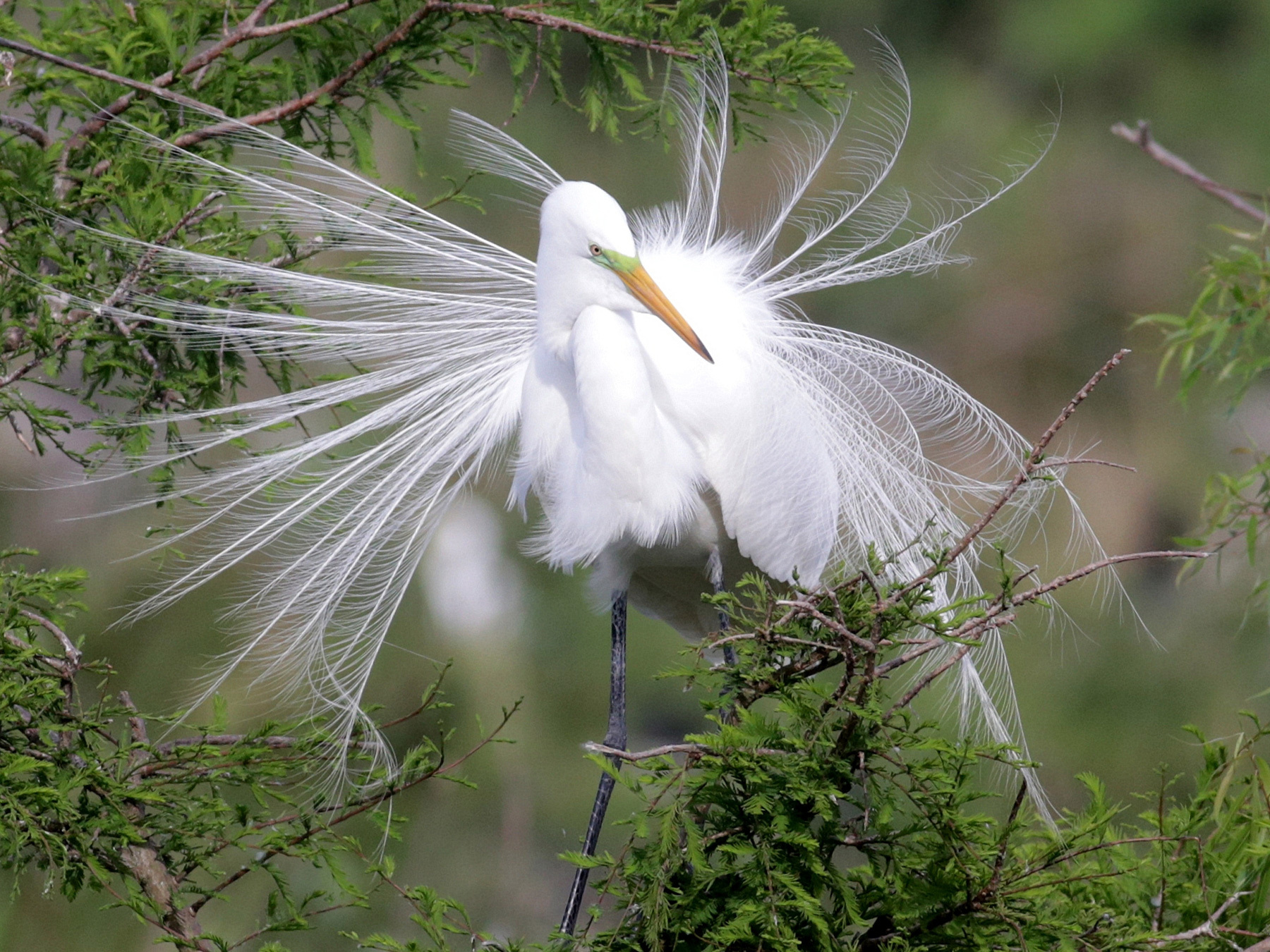
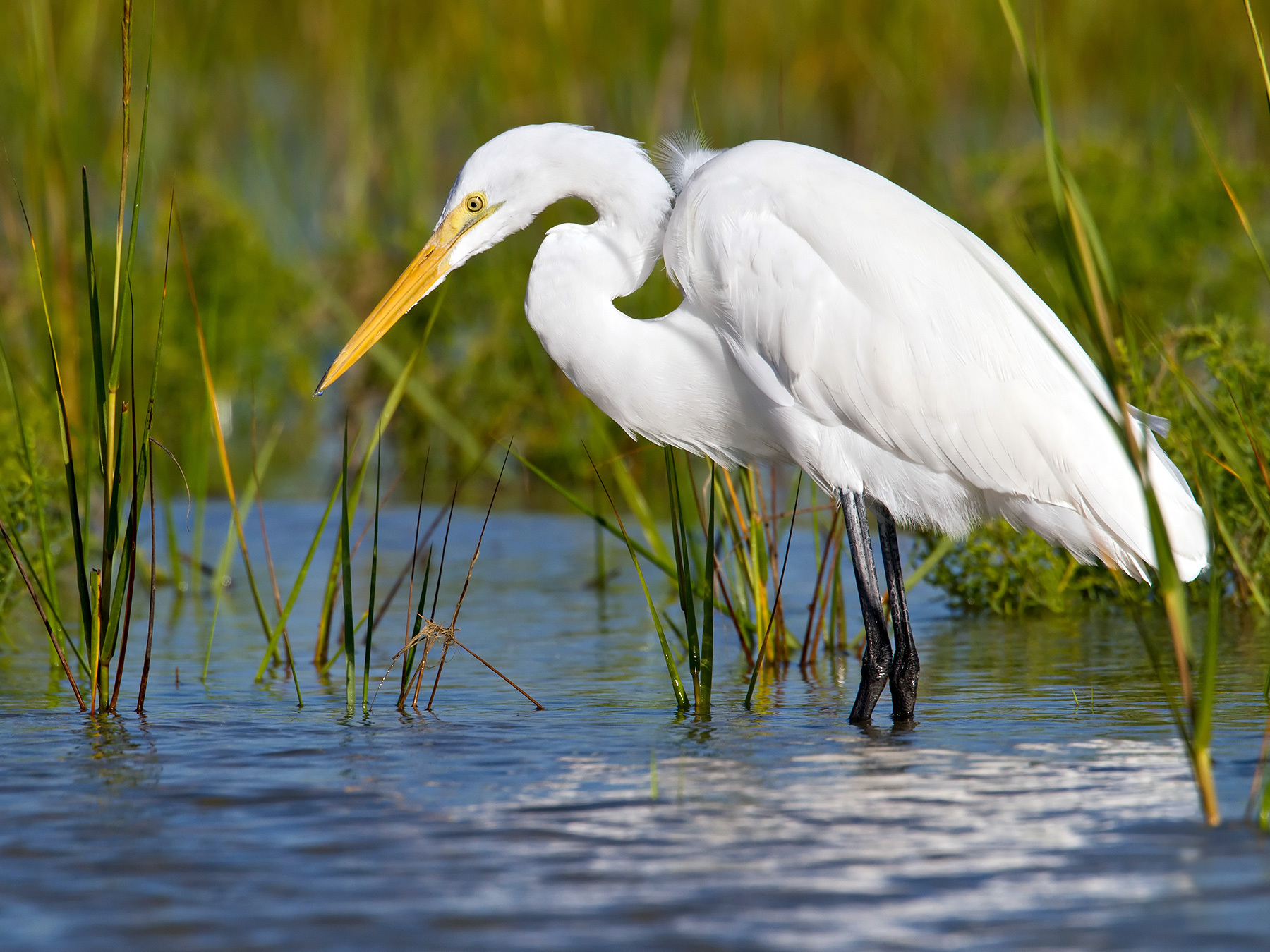
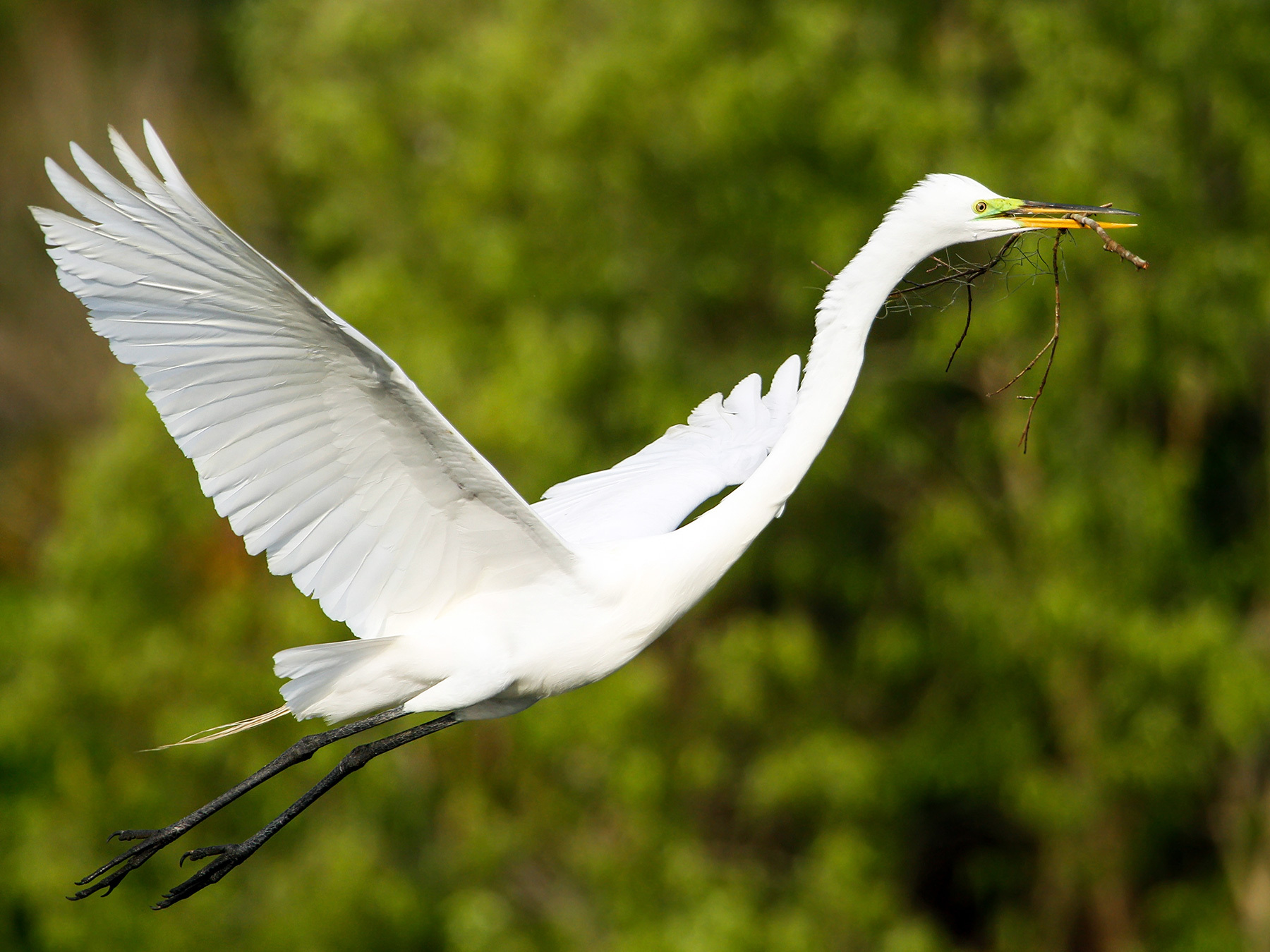
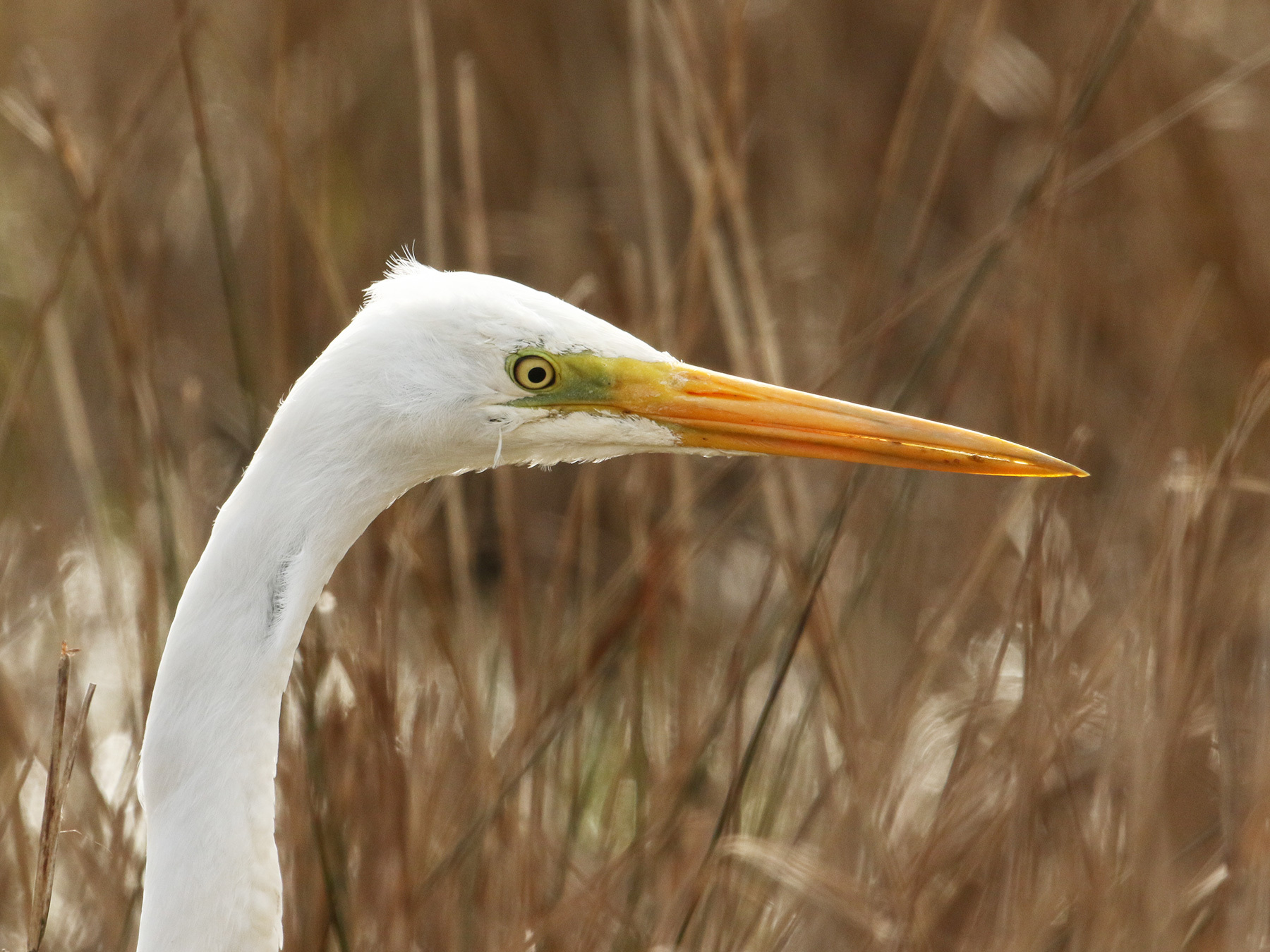
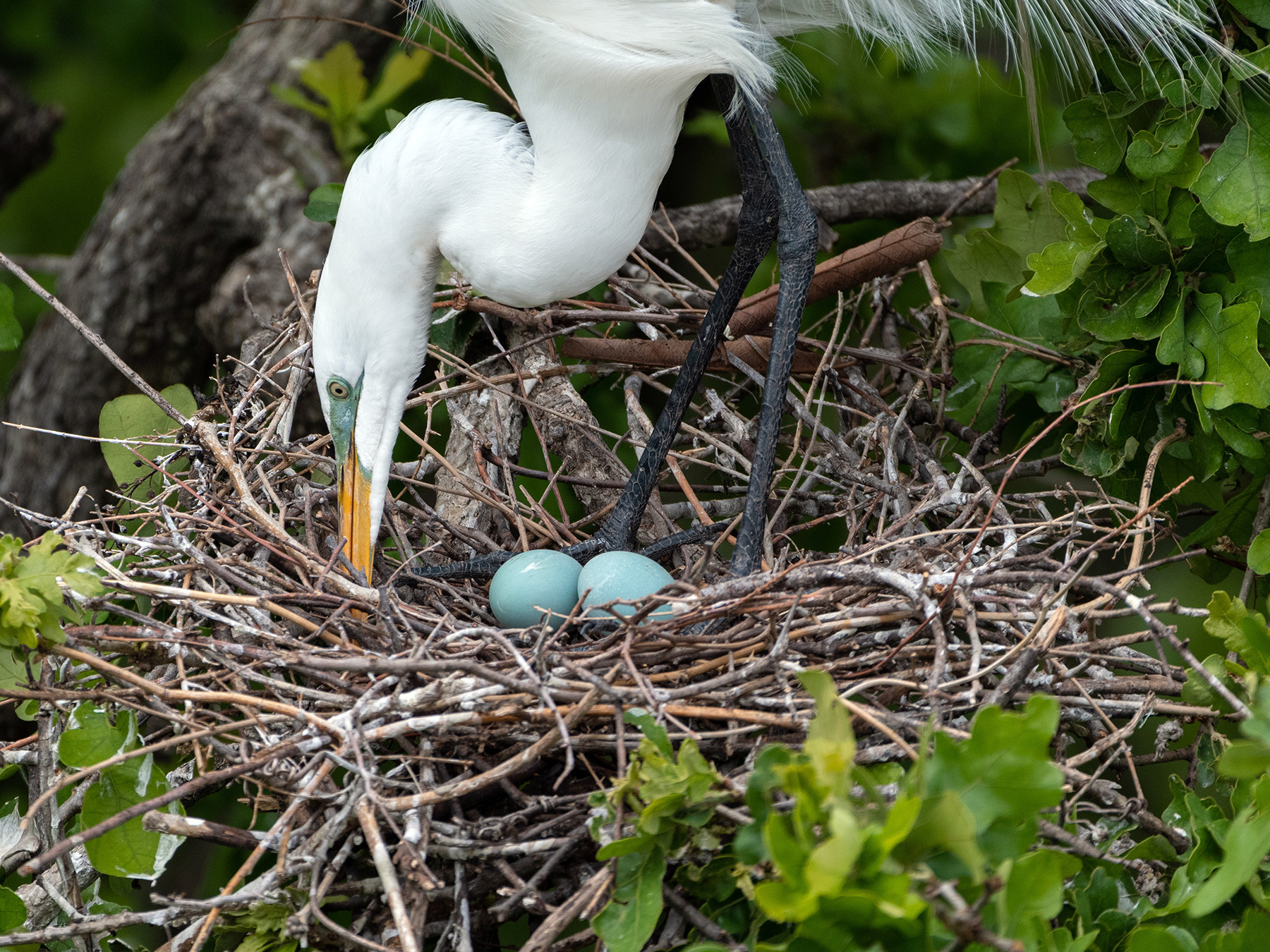
The Great Egret is a tall, slender bird with all-white plumage and a small head that merges into a long, S-shaped neck. They have very long black legs and a spear-like yellow bill. In the breeding season, adults develop green lores between the eyes and bill and long, showy plumes on their backs.
Females and males look alike throughout the year, although males tend to be larger and heavier. Juveniles resemble non-breeding adults.
Great Egrets look very similar to smaller white Egrets like the Cattle Egret, Snowy Egret, and Little Egret (UK). They can also be confused with the all-white Southeastern form of the Great Blue Heron and the white form of the Reddish Egret. The combination of size, shape, leg and bill color is the best way to differentiate the species.
How big are Great Egrets?
Length
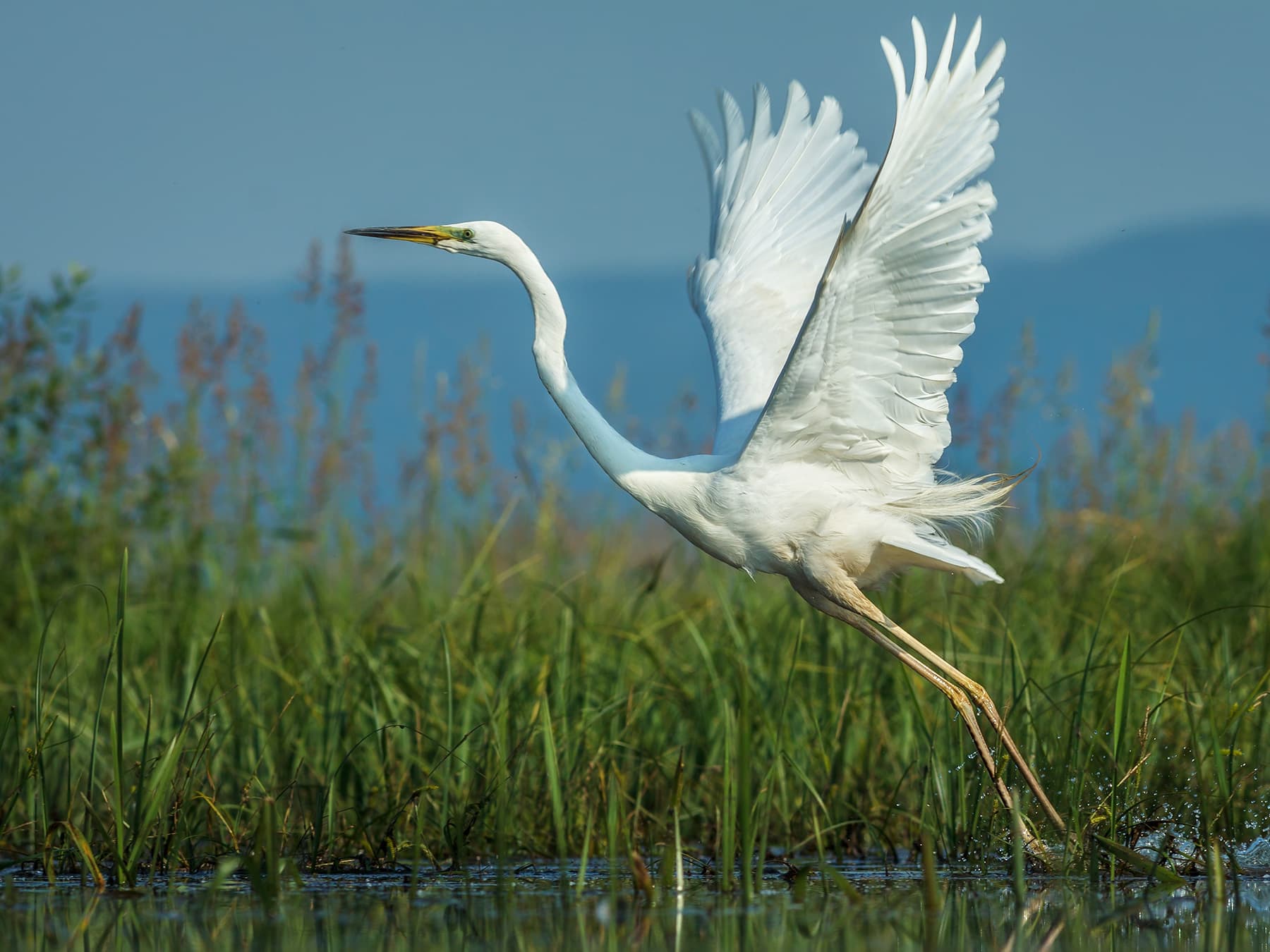
Great Egrets are tall, lanky birds. They have a body length of 37 to 41 inches (approximately 1 meter) and stand at about the same height.
Weight
Despite their impressive height, these birds weigh just 2.2 pounds or 1 kilogram on average, with a weight range of 1½ - 3¾ pounds or 0.7 to 1.7 kilograms.
Wingspan
Typical wingspans range between 55 and 67 inches or 1.4 to 1.7 meters.
Its size
Adults- Length
- 80–104 cm
- Wingspan
- 131–170 cm
- Weight
- 700–1500 g
Its song and calls
What sound does a Great Egret make?
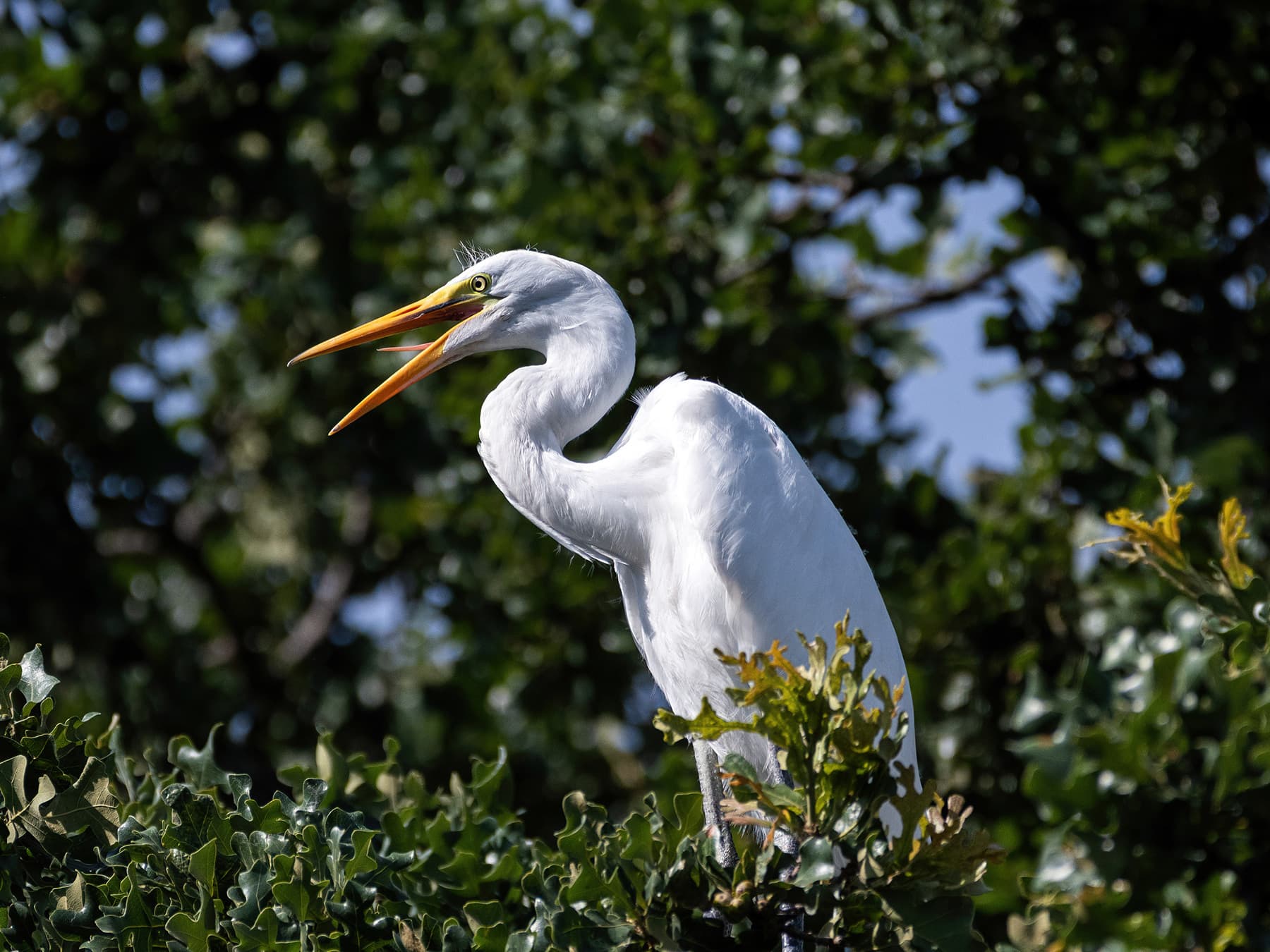
Great Egrets are most vocal during the breeding season when they make various harsh croaking calls, while alarmed birds make a raucous ‘kraaak’ call at any time of the year. They also snap their bills shut to create a loud non-vocal sound during aggressive displays.
- Call0:00 / 0:08
Recorded in Normandie, France · January 2022
When and where to see it
OctoberPeak season
Most recorded in October
- 1. Rutland1.5%
- 2. Somerset1.2%
- 3. Northamptonshire1.0%
- 4. Nottinghamshire0.88%
- 5. Flintshire0.86%
Each dot is a county, state or province: the bigger and darker, the larger the bird’s share of that place’s bird records that month. Grey dots: no regular records. The ringed point is the centre of the bird’s records this month; the arrow shows how it moved since last month, and the dashed loop its path through the year. “Arrivals” colours places where it becomes regular this month (orange) or is in its last regular month (grey). GBIF eBird Observation Dataset, 2019–2024. Map data: Natural Earth, US Census Bureau; place centres © OpenStreetMap contributors.
In your area
See when the Great White Egret is recorded in your county, state or province.
How often the Great White Egret turns up in the UK, Ireland, the United States and Canada through the year, from birdwatchers' records.
United Kingdom
Resident · all year · most records in October
Ireland
Winter visitor · all year · most records in January
United States
Resident · all year · most records in August
Canada
Summer visitor · regularly Apr–Nov · most records in September
Show as a table
| Month | United Kingdom | Ireland | United States | Canada |
|---|---|---|---|---|
| January | 0.24% (regular) | 0.046% (regular) | 0.72% (regular) | 0.005% |
| February | 0.21% (regular) | 0.036% (regular) | 0.62% (regular) | <0.001% |
| March | 0.16% (regular) | 0.026% (regular) | 0.50% (regular) | 0.006% |
| April | 0.11% (regular) | 0.024% (regular) | 0.54% (regular) | 0.12% (regular) |
| May | 0.10% (regular) | 0.006% (regular) | 0.45% (regular) | 0.15% (regular) |
| June | 0.12% (regular) | 0.004% (regular) | 0.50% (regular) | 0.13% (regular) |
| July | 0.19% (regular) | 0.010% (regular) | 0.75% (regular) | 0.22% (regular) |
| August | 0.26% (regular) | 0.009% (regular) | 1.0% (regular) | 0.43% (regular) |
| September | 0.29% (regular) | 0.020% (regular) | 0.93% (regular) | 0.45% (regular) |
| October | 0.29% (regular) | 0.036% (regular) | 0.81% (regular) | 0.26% (regular) |
| November | 0.27% (regular) | 0.035% (regular) | 0.71% (regular) | 0.031% (regular) |
| December | 0.23% (regular) | 0.035% (regular) | 0.68% (regular) | 0.006% |
Recorded regularly in
Worldwide: recorded regularly in 195 countries
Countries where it was recorded in at least 3 of the 6 years 2019–2024. Linked countries have their own bird list.
Europe (42)
- Åland Islands
- Albania
- Austria
- Belarus
- Belgium
- Bosnia & Herzegovina
- Bulgaria
- Croatia
- Czechia
- Denmark
- Estonia
- Finland
- France
- Germany
- Greece
- Hungary
- Ireland
- Isle of Man
- Italy
- Kosovo
- Latvia
- Liechtenstein
- Lithuania
- Luxembourg
- Malta
- Moldova
- Montenegro
- Netherlands
- North Macedonia
- Norway
- Poland
- Portugal
- Romania
- Russia
- Serbia
- Slovakia
- Slovenia
- Spain
- Sweden
- Switzerland
- Ukraine
- United Kingdom
Africa (45)
- Algeria
- Angola
- Benin
- Botswana
- Burkina Faso
- Cameroon
- Cape Verde
- Central African Republic
- Chad
- Comoros
- Congo - Brazzaville
- Congo - Kinshasa
- Côte d’Ivoire
- Djibouti
- Egypt
- Eswatini
- Ethiopia
- Gabon
- Gambia
- Ghana
- Guinea
- Guinea-Bissau
- Kenya
- Liberia
- Madagascar
- Malawi
- Mauritania
- Mayotte
- Morocco
- Mozambique
- Namibia
- Niger
- Nigeria
- Rwanda
- Senegal
- Sierra Leone
- South Africa
- South Sudan
- Sudan
- Tanzania
- Togo
- Tunisia
- Uganda
- Zambia
- Zimbabwe
Asia (47)
- Armenia
- Azerbaijan
- Bahrain
- Bangladesh
- Bhutan
- Brunei
- Cambodia
- China
- Cyprus
- Georgia
- Hong Kong SAR China
- India
- Indonesia
- Iran
- Iraq
- Israel
- Japan
- Jordan
- Kazakhstan
- Kuwait
- Kyrgyzstan
- Laos
- Lebanon
- Macao SAR China
- Malaysia
- Maldives
- Mongolia
- Myanmar (Burma)
- Nepal
- Oman
- Pakistan
- Palestinian Territories
- Philippines
- Qatar
- Saudi Arabia
- Singapore
- South Korea
- Sri Lanka
- Taiwan
- Tajikistan
- Thailand
- Timor-Leste
- Turkey
- United Arab Emirates
- Uzbekistan
- Vietnam
- Yemen
North America (39)
- Anguilla
- Antigua & Barbuda
- Aruba
- Bahamas
- Barbados
- Belize
- Bermuda
- British Virgin Islands
- Canada
- Caribbean Netherlands
- Cayman Islands
- Costa Rica
- Cuba
- Curaçao
- Dominica
- Dominican Republic
- El Salvador
- Grenada
- Guadeloupe
- Guatemala
- Haiti
- Honduras
- Jamaica
- Martinique
- Mexico
- Montserrat
- Nicaragua
- Panama
- Puerto Rico
- Sint Maarten
- St Barthélemy
- St Kitts & Nevis
- St Lucia
- St Martin
- St Vincent & the Grenadines
- Trinidad & Tobago
- Turks & Caicos Islands
- United States
- US Virgin Islands
South America (13)
Oceania (9)
- Australia
- Christmas Island
- Cocos (Keeling) Islands
- Guam
- New Zealand
- Norfolk Island
- Northern Mariana Islands
- Palau
- Papua New Guinea
Data: EOD – eBird Observation Dataset (Cornell Lab of Ornithology), accessed via GBIF.org, CC BY 4.0. Records from 2019–2024, aggregated and filtered by Birdfact. How these lists are made
What is the habitat of a Great Egret?
Great Egrets occur in a variety of wetland environments, including both freshwater and tidal saltwater habitats. They occasionally hunt over dry fields and pastures.
What is the range of a Great Egret?
Great Egrets are a cosmopolitan species that is present on every continent except Antarctica. In the Northern Hemisphere, these birds occur through North America to Southern Canada, in scattered localities across Europe, and throughout Southern and Southeast Asia.
They are most widespread in the Southern Hemisphere, occurring as a resident species in suitable habitats throughout Africa, Asia, Australia, and South America.
Where do Great Egrets live?
Great Egrets spend most of their day in and around the water where they hunt. They rest and nest in colonies, usually with other Egrets, Herons, and Cormorants.
How rare are Great Egrets?
Great Egrets are generally common and easy to spot in suitable habitats.
Where can you see Great Egrets in the US?
Great White Egrets are most numerous across the south of the United States where they are resident. However, they occur throughout the year as far north as Oregon on the West Coast and New Jersey in the Northeast. Many birds migrate through the South and into the Midwest to breed in the summer, reaching Minnesota and Wisconsin in the north.
Where can you see Great Egrets in Canada?
Great Egrets occur as summer breeding visitors to southeast Canada. They reach the northern limits of their breeding range in southern Manitoba but also nest in southern Ontario and Quebec.
Where can you see Great Egrets in the UK?
Great Egrets are rare in the United Kingdom, with less than a hundred breeding pairs. They have, however, become a regular sighting, particularly in East Anglia and southeast England.

Migration
Do Great Egrets migrate?
Great Egrets are migratory across much of their Northern Hemisphere range. These birds migrate north to breed in the summer months and return to the south or to lower-altitude coastal areas for the winter.
Why do Great Egrets migrate?
Great Egrets migrate to ice-free hunting grounds in the winter. These birds usually hunt in shallow water, so the northern limits of their range are only suitable in the warmer months.
Are Great Egrets native to North America?
Great Egrets are widespread native migrants and breeding residents in North America, occurring from Panama in the south to southeastern Canada in the north.
Are Great Egrets native to the UK?
Great Egrets appear to be newcomers to the United Kingdom, with the first record in 1821. They are colonizing the UK without assistance or introduction and have now become a regular breeding species.

Tips for seeing it
- Look for them in shallow waters of wetlands, marshes, and coastal areas
- Observe their patient hunting technique, standing still for long periods
- During the breeding season, watch for their elaborate courtship displays in rookeries
- In the UK, visit Somerset Levels or East Anglian fens for sightings
What it eats
What do Great Egrets eat?
Great Egrets are carnivorous birds that feed primarily on fish and other small aquatic vertebrates and invertebrates. They hunt in water up to about a foot (0.3m) deep, usually by walking slowly and striking at their prey with lightning speed. Great Egrets occasionally hunt away from the water, stalking prey like gophers and other rodents.
Check out this detailed guide to learn more about Egrets' diets (various species).
What do Great Egret chicks eat?
Great Egret chicks eat fish regurgitated directly into their bill or deposited onto the floor of the nest.

Nesting and breeding
Where do Great Egrets nest?
Great Egrets nest in colonies, usually in trees and shrubs over the water or on islands, although some pairs nest in reedbeds or on the ground. They construct a large platform nest of twigs, up to about four feet (1.2m) wide but usually smaller. The nest site is chosen by the male who does most or all of the construction.
When do Great Egrets nest?
Great Egrets lay their eggs as early as March in the United States, with a peak in April and May. The eggs hatch after 23 to 29 days, and the young birds begin to leave the nest temporarily after about three weeks. However, they aren’t capable of sustained flight until they are about two months old.
What do Great Egret eggs look like?
Great Egrets usually lay about three blue-green eggs per season, although clutch sizes of one to six have been recorded. Their eggs measure about 56 millimeters long and 41 millimeters wide, but the average dimensions vary between the subspecies.
Do Great Egrets mate for life?
It is unclear whether Great Egret pairs last more than a single season, although they are seasonally monogamous when nesting.
Behaviour
Are Great Egrets aggressive?
Great Egrets are aggressively territorial when breeding and will fight off intruders with their bills, legs, and wings. They are also territorial over prime hunting grounds, although they feed in flocks when food is abundant.
Where do Great Egrets sleep at night?
Great Egrets roost in trees and shrubs, often in groups and in the company of other bird species. They will also sleep in the nest while incubating eggs.
Lifespan and predators
How long do Great Egrets live?
Great Egrets can live for over 22 years in the wild.
What are the predators of Great Egrets?
Adult Great Egrets are vulnerable to mammals like Raccoons and Otters, while eggs and young may be taken by a variety of birds, including Corvids, Red-tailed Hawks, Great-horned Owls, Turkey Vultures, and Peregrine Falcons.
Are Great Egrets protected?
Great Egrets are protected by the Migratory Bird Treaty Act in the United States and the Migratory Birds Convention Act of 1994 in Canada. They are also protected by the Wildlife and Countryside Act in the United Kingdom.
Are Great Egrets endangered?
Great Egrets are a ‘Least Concern’ species on the IUCN Red List, with a global population estimated at up to 22 million individuals.

Conservation
While currently listed as Least Concern globally, Great White Egrets faced severe declines in the past due to hunting for their plumes.
Conservation efforts, including habitat protection and hunting regulations, have helped populations recover in many areas. However, wetland loss remains a concern.
More photos
7 photos

Great White Egret guides
2 guidesQuick facts
- Length
- 80–104 cm
- Wingspan
- 131–170 cm
- Weight
- 700–1500 g
- Lifespan
- 15–20 years
- Family
- Herons & Egrets
- Migration
- Partial migrant
- Global status (IUCN)
- Least Concern
- World population
- 590,000 - 2,200,000 mature individuals
- Population trend
- Unknown
- Also called
- Great Egret, Common Egret
- Scientific name
- Ardea alba
Questions
3Is a Great White Heron the same as a Great White Egret?
Although similar in size and appearance, the Great White Heron is an all-white subspecies of the Great Blue Heron (Ardea herodias) that is rare outside of Florida in the United States and the Caribbean and Yucatan Peninsula to the south. The Great White Egret (A. alba), or Great Egret, is a smaller, more slender species that occurs in suitable habitats throughout the Old and New Worlds.
What makes the Great Egret special?
The Great Egret is the largest and most widespread Egret species in the world.
Is a Great Egret bigger than a Heron?
The Great Egret is bigger than many types of Herons, although it is smaller than large species like the Great Blue Heron and the Gray Heron.
Sources
2- 1BirdLife International. 2019. Ardea alba (amended version of 2016 assessment). The IUCN Red List of Threatened Species 2019: e.T22697043A155465940. Source (opens in a new tab)
- 2BirdLife International. 2019. Ardea alba (amended version of 2016 assessment). The IUCN Red List of Threatened Species 2019: e.T22697043A155465940. Source (opens in a new tab)

Checked by
Nathan Cope, founder and editor
Nathan founded Birdfact and leads its writers and contributors in the UK, the US and Canada. He has watched and studied birds for more than ten years, and checks every article and species guide before it’s published.