



Wood Thrush
Hylocichla mustelina
By the Birdfact teamChecked by Nathan Cope
On this page15 sections
How to recognise it
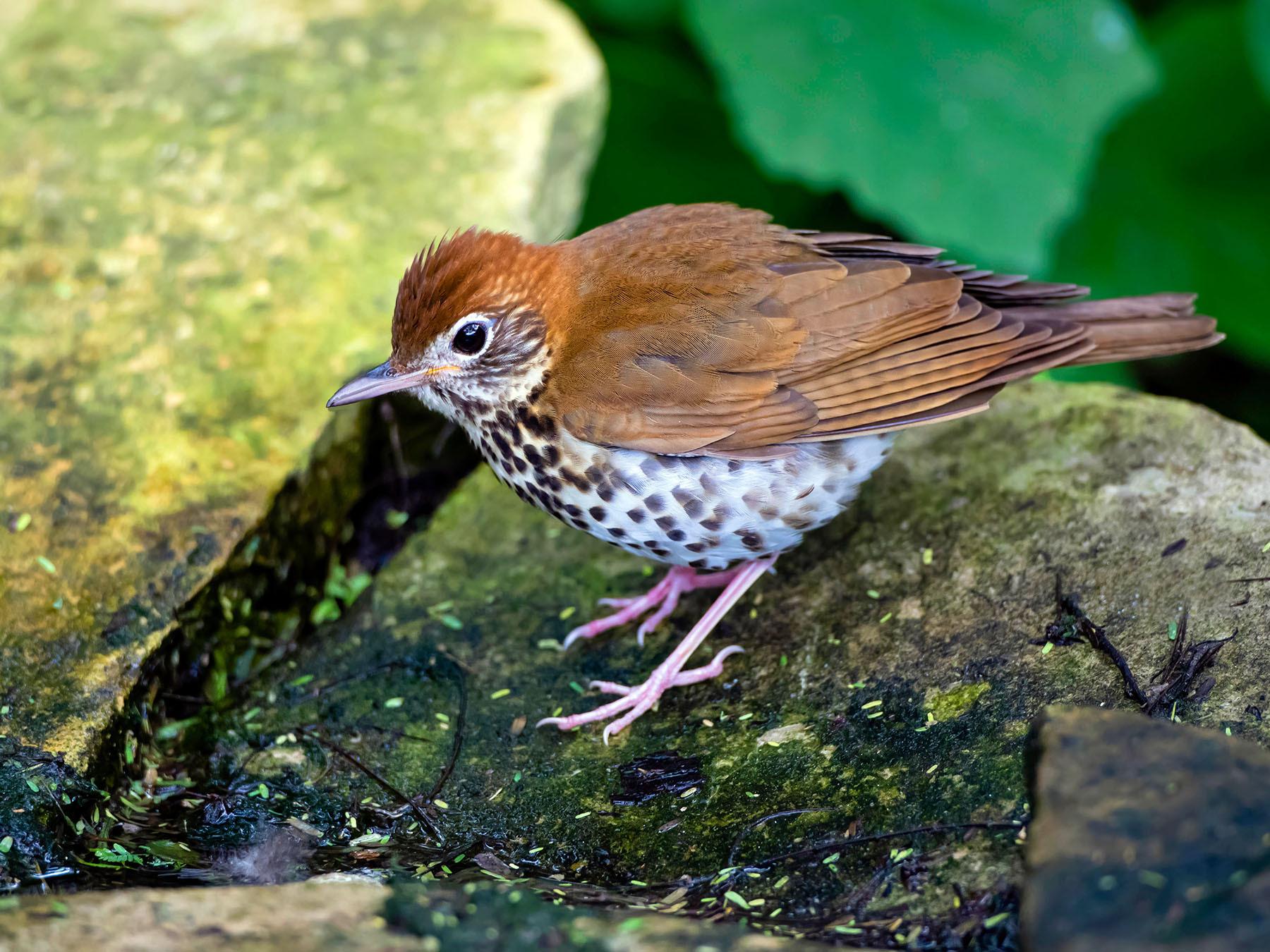
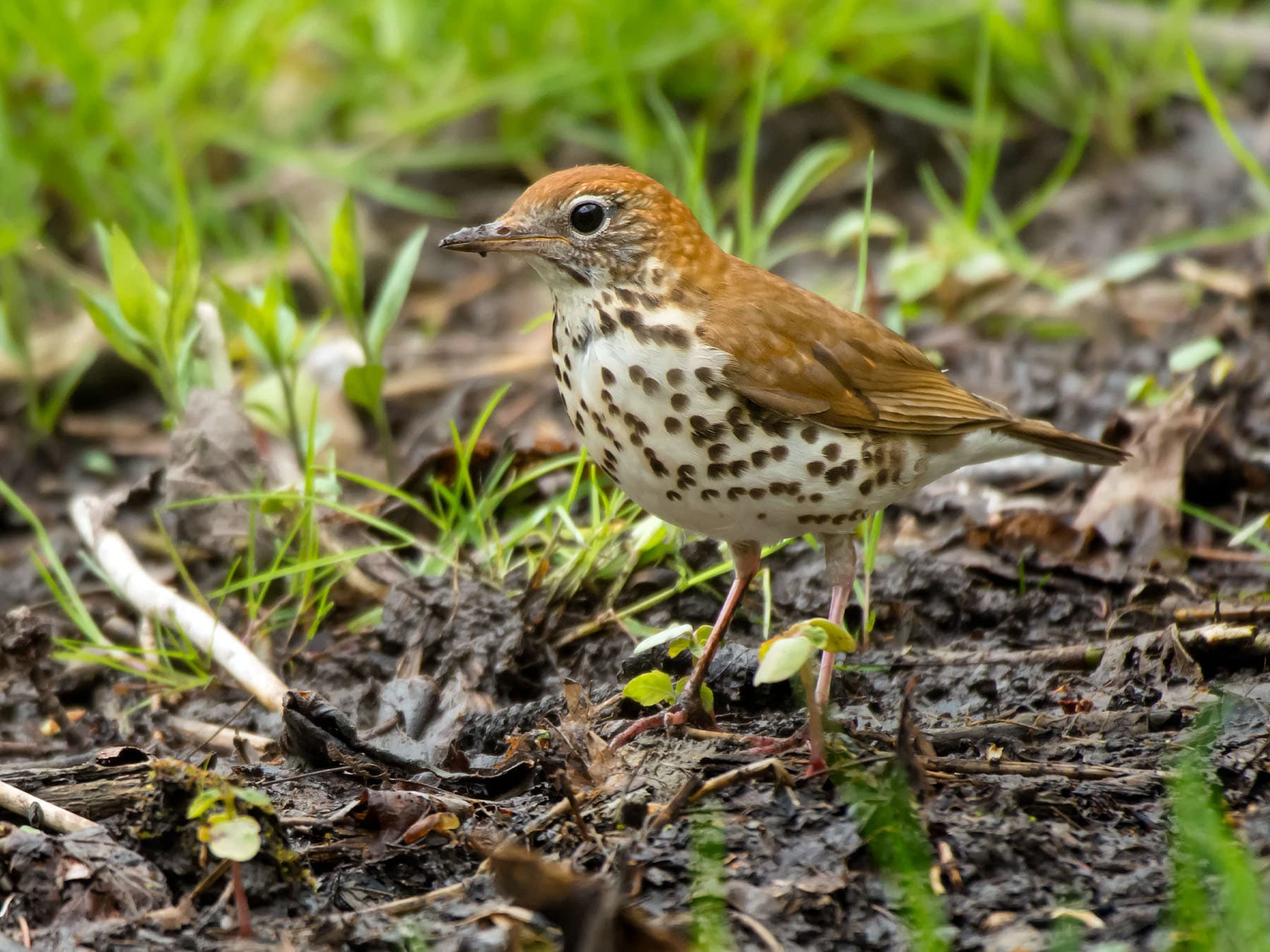
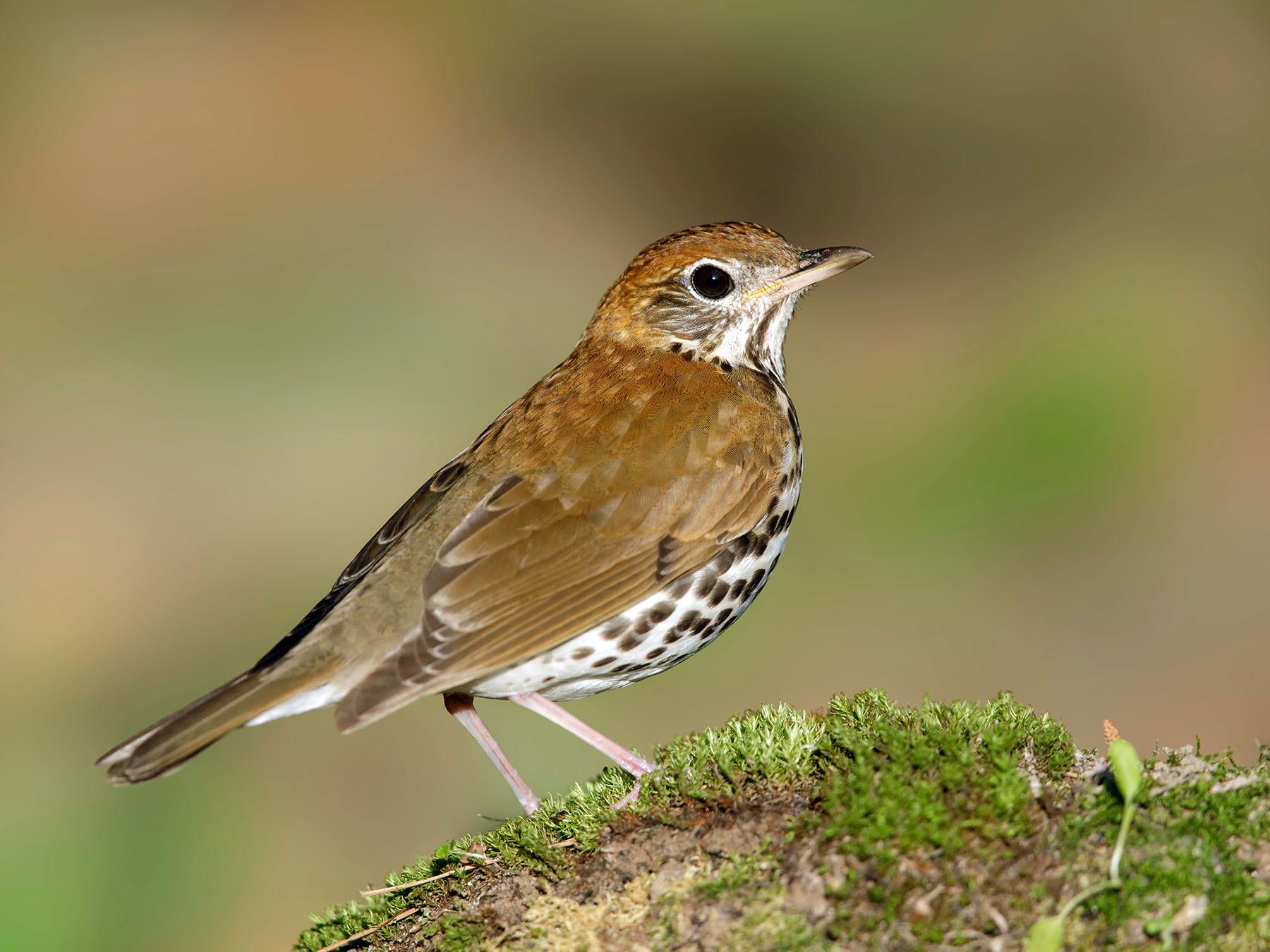
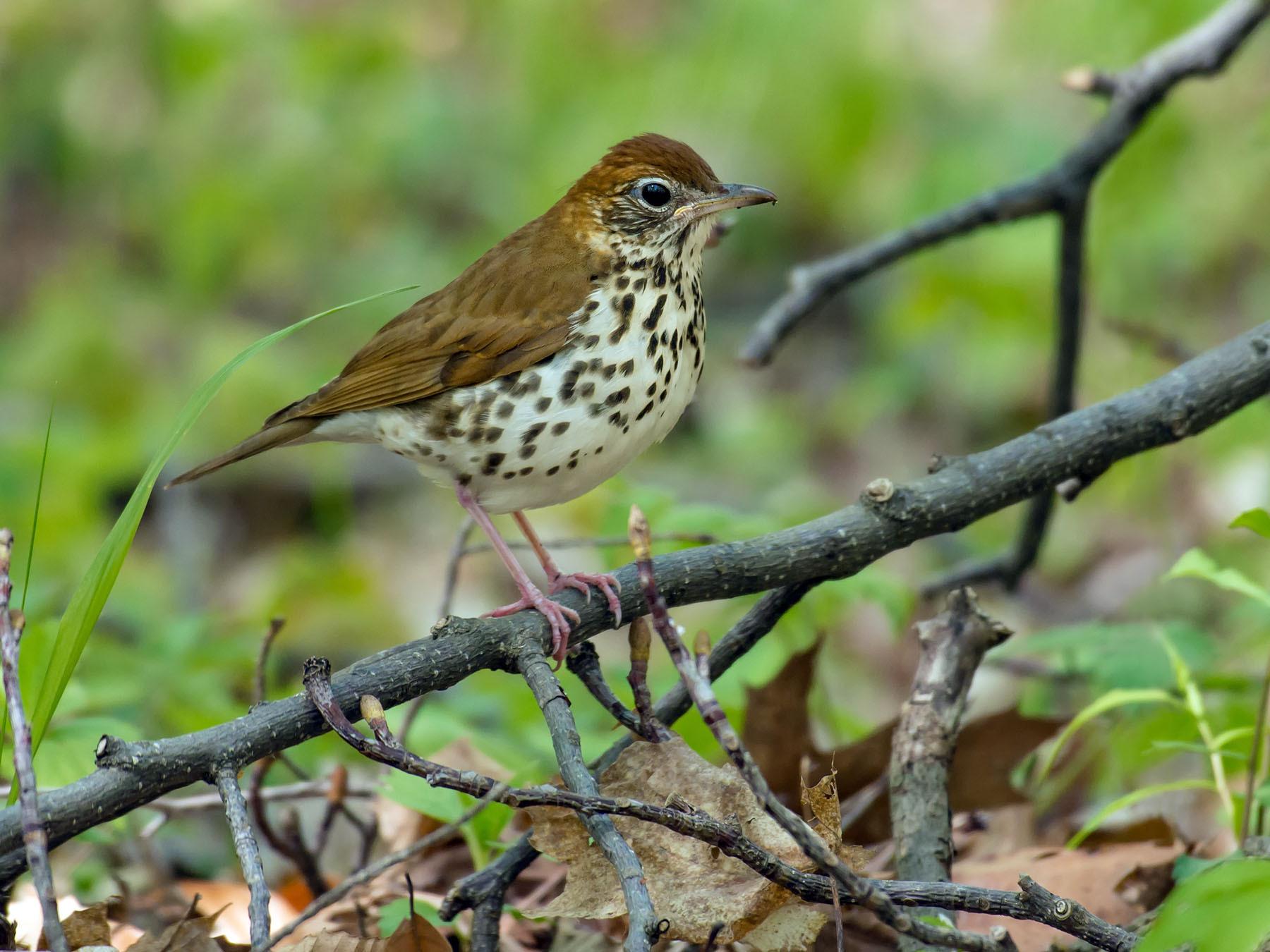
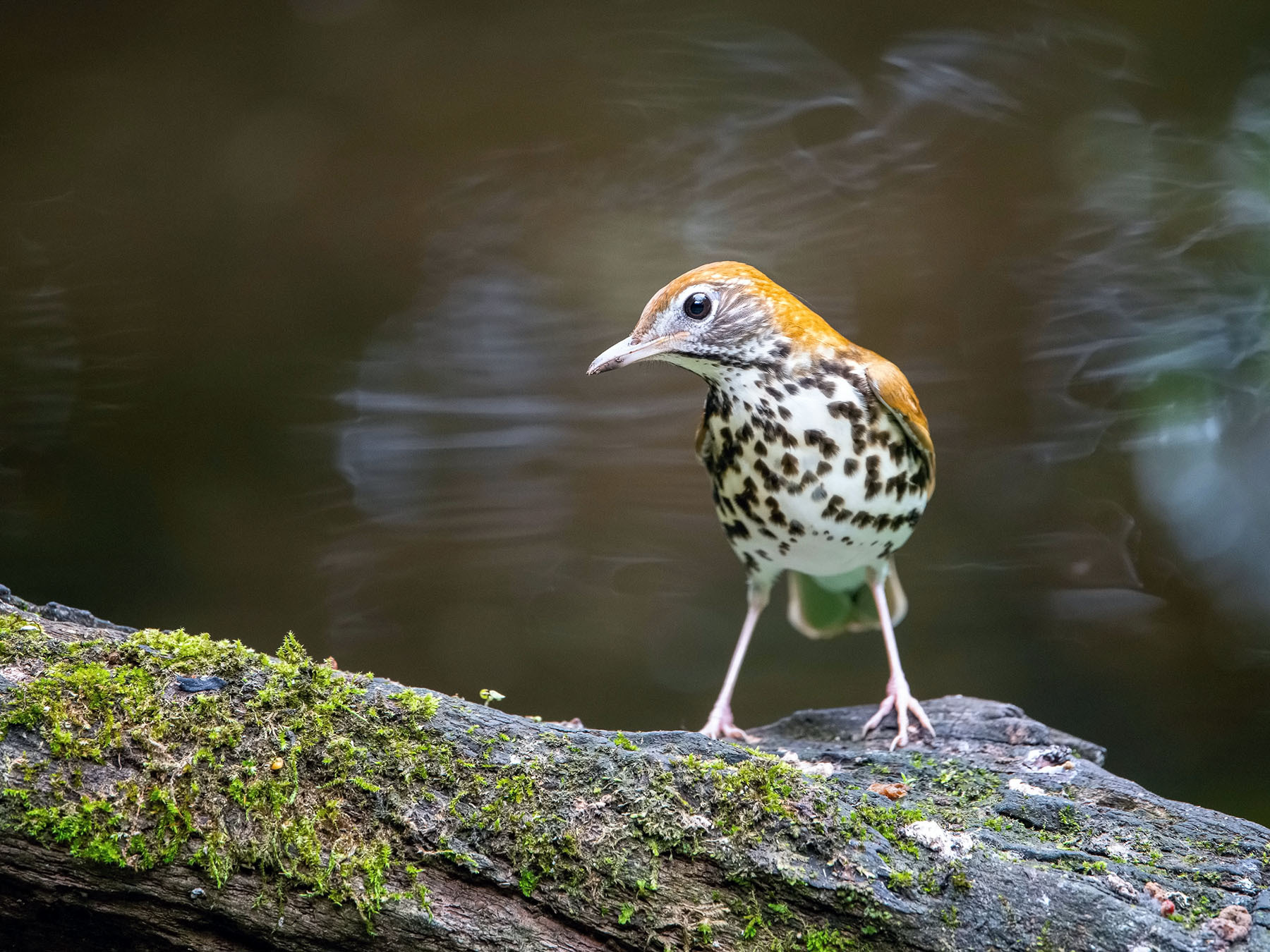
The Wood Thrush is a plump, upright thrush of eastern woods, shaped like a small American Robin, with a big head, a round belly, a short tail and a straight bill. It is warm cinnamon-brown above, brightest on the crown and nape and duller olive-brown on the back, wings and tail. Below it is clean white, covered in big, round blackish spots from the breast down the flanks, and a white eye-ring stands out on a face streaked dark and white. Males and females look alike.
Seen well, it is hard to mistake: no other North American thrush has a rusty head and bold black spots on pure white. It is far easier to hear than to see, though. The male's flute-like song carries through the woods at dawn and dusk, while the bird itself keeps to the shade, often on the ground in the leaf litter.

Size and weight
A Wood Thrush is 7.5-8.3 in (19-21 cm) long, with a wingspan of 11.8-13.4 in (30-34 cm), and weighs 1.4-1.8 oz (40-50 g): a little smaller than an American Robin and bigger than a Hermit Thrush.
Weight shifts with sex and season. In a long-running Delaware study, breeding males averaged 1.7 oz (47.8 g) and females 1.9 oz (52.5 g), and females outweighed males at every stage of nesting and were heaviest while laying; fall migrant males in northwest Florida averaged 2.1 oz (59.9 g).1
Adult plumage
The crown and nape are a rich cinnamon-brown, the brightest part of the bird, fading to olive-brown on the back, wings and tail; the rump is the dullest part of the upperparts. The face is streaked dark and white, with a black stripe below the cheek, and a narrow white ring circles the dark brown eye. The underparts are white with large round blackish spots on the breast, sides and flanks: when the bird is relaxed they lie in loose rows, and when it puffs its breast they stand out one by one. The bill is dark above and pale pinkish at the base of the lower half, the legs pale pink, and the inside of the mouth, the gape, bright yellow.
Adults molt once a year, completely, from July to September on or near the breeding grounds. Birds in heavy molt fly much less efficiently, and some leave their nesting woods to molt elsewhere.1

Juvenile plumage
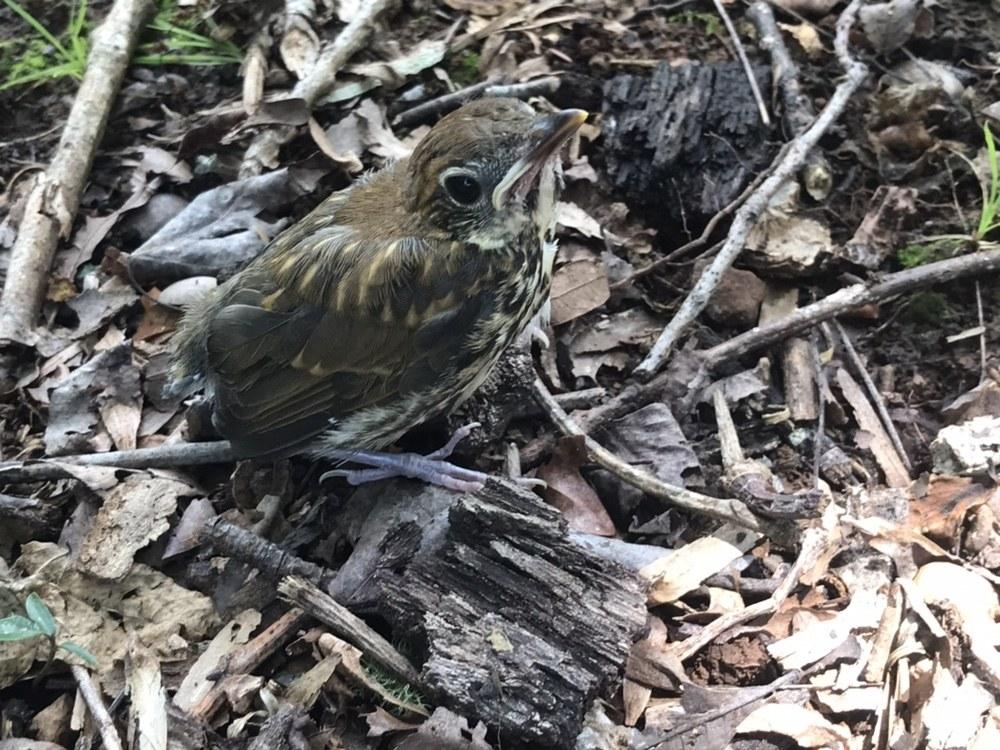
Young Wood Thrushes leave the nest in a spotted juvenile plumage, seen from June to August. A juvenile is a darker, more streaky copy of the adult: its brown crown, neck and back carry pale tawny streaks and spots, the wing coverts have pale tips or wedge-shaped spots, and the spots below are softer-edged and sootier than an adult's. Recently fledged birds also have a stubby, half-grown tail.
The juvenile plumage does not last long. Before fall migration young birds replace most of their body feathers, so by fall most of them look like adults, though many still show some wing coverts with buff tips beside plain new ones.
Male and female
Males and females look the same in every plumage. Males average slightly longer in the wing and tail, but the overlap is too great to tell them apart in the field, and breeding females are on average the heavier. Song is the best clue: singing is the male's job, and the 2011 handbook text lists only a few anecdotal reports of females singing.
Identification: Brown Thrasher and other lookalikes
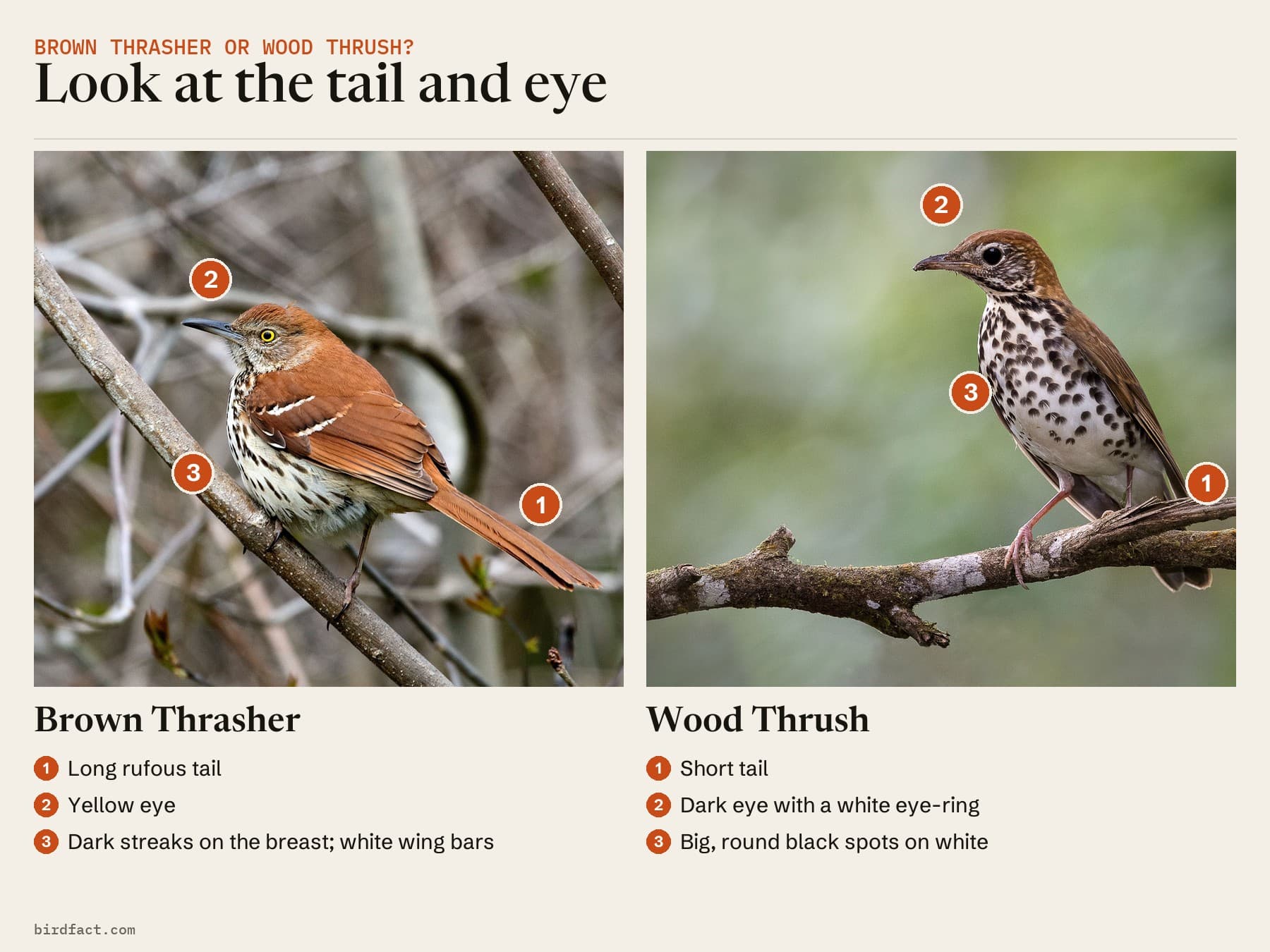
The lookalike people ask about most is the Brown Thrasher, though the two are not close relatives. It has a longer tail, a longer, curved bill, dark streaks rather than round spots below and a pale yellow eye; a Wood Thrush has a short tail and a dark eye in a white eye-ring. Our Brown Thrasher or Wood Thrush? page sets the two side by side.
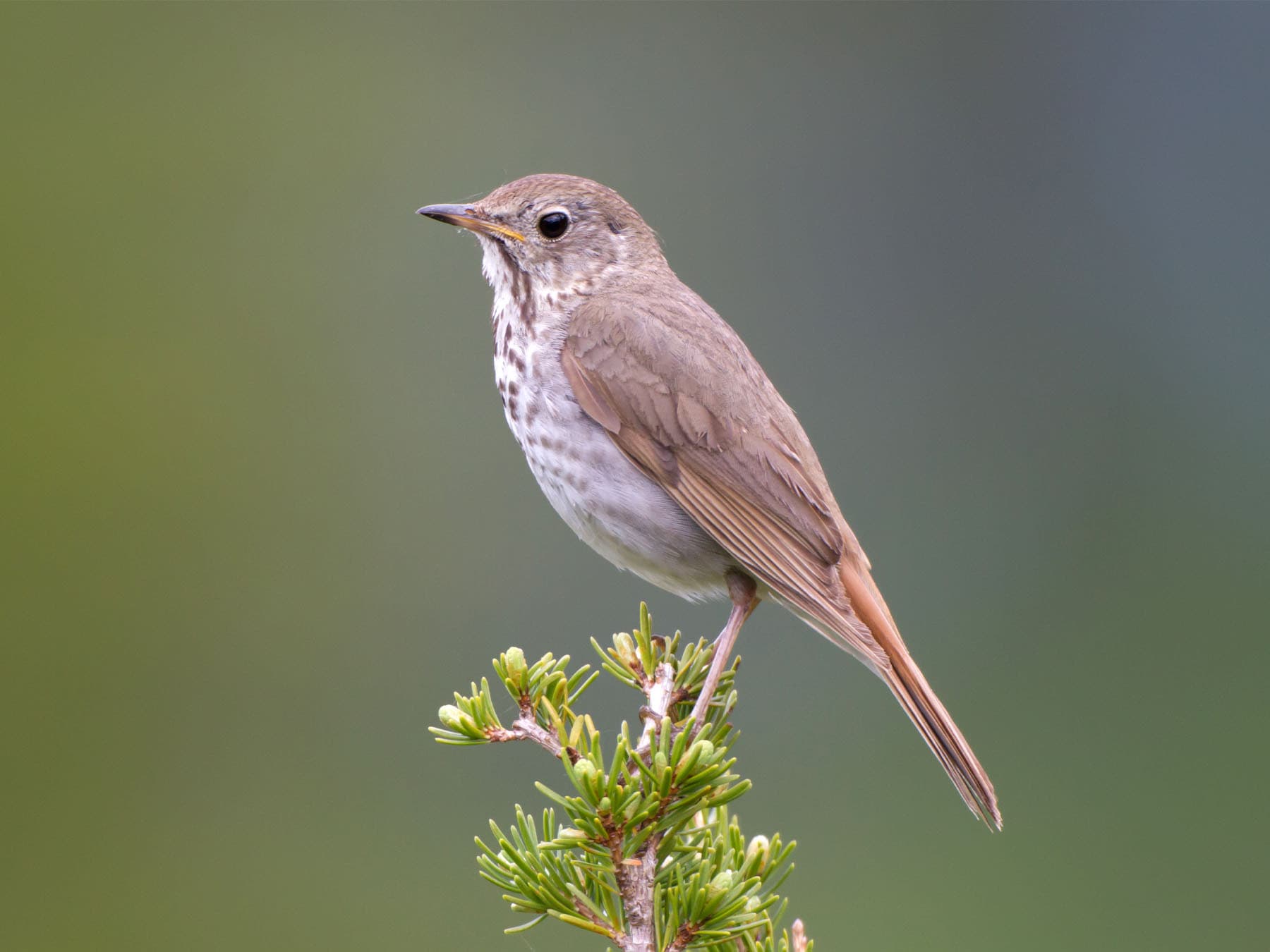
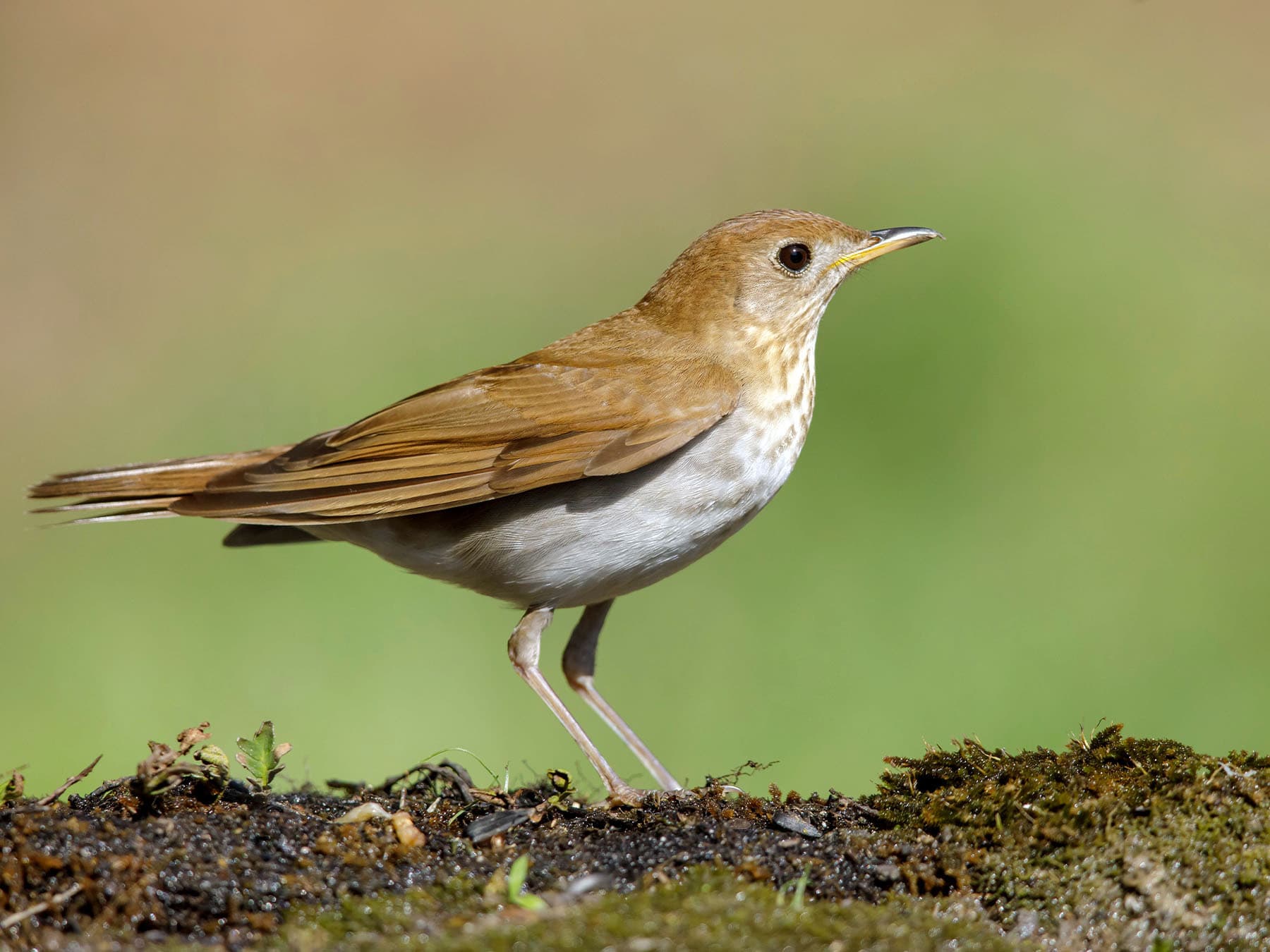
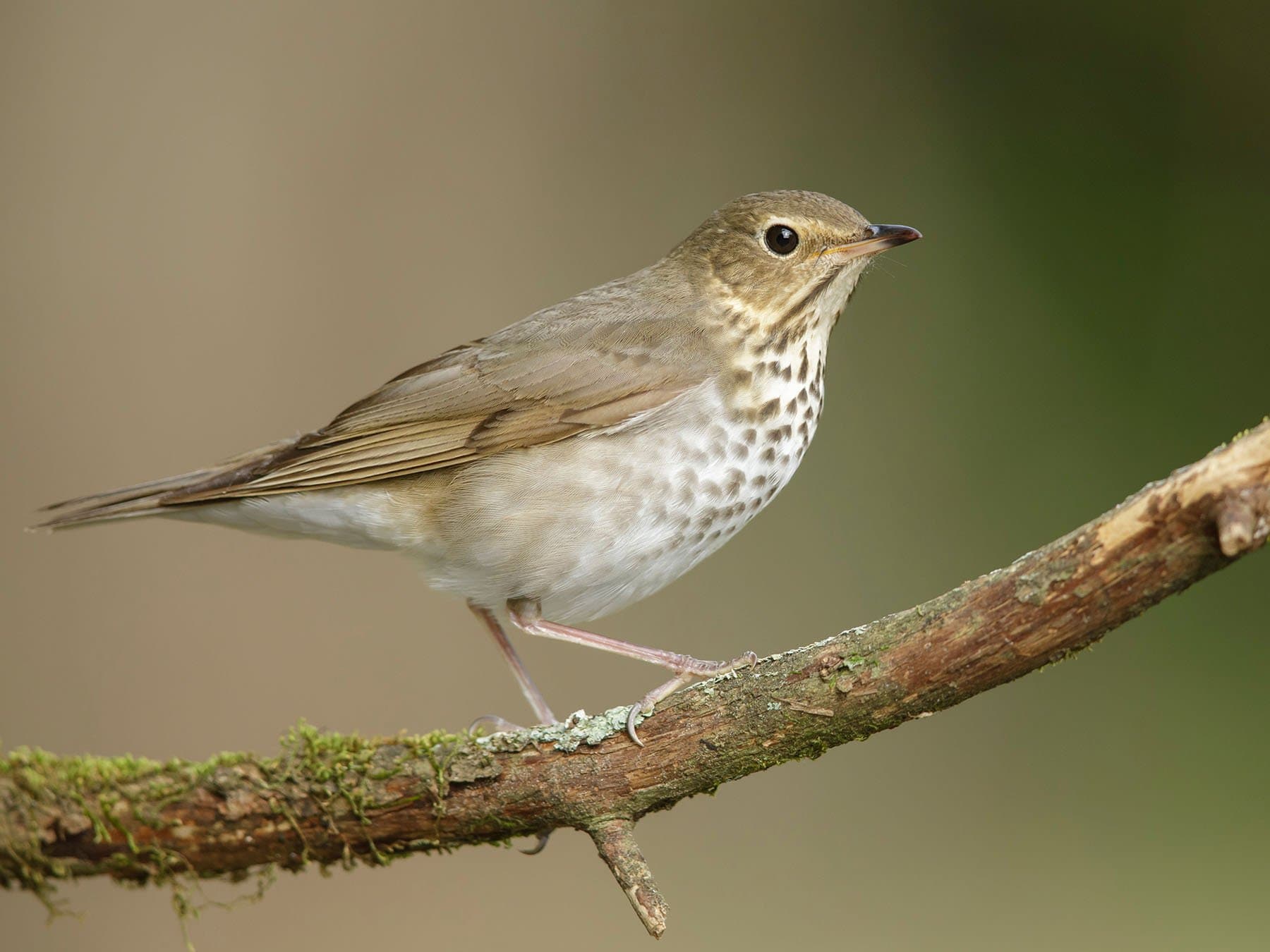
The spotted brown thrushes of the genus Catharus, the Hermit Thrush, Swainson's Thrush, Gray-cheeked Thrush and Veery, are the other likely confusion. All are smaller and less boldly spotted below, with their rufous brightest on the rump, the dingiest part of a Wood Thrush's upperparts. A Hermit Thrush has small, smudgy spots that fade toward the belly and a plain brown back and wings; a Swainson's Thrush has less bold spots and a buff wash on the face and breast that a Wood Thrush lacks.
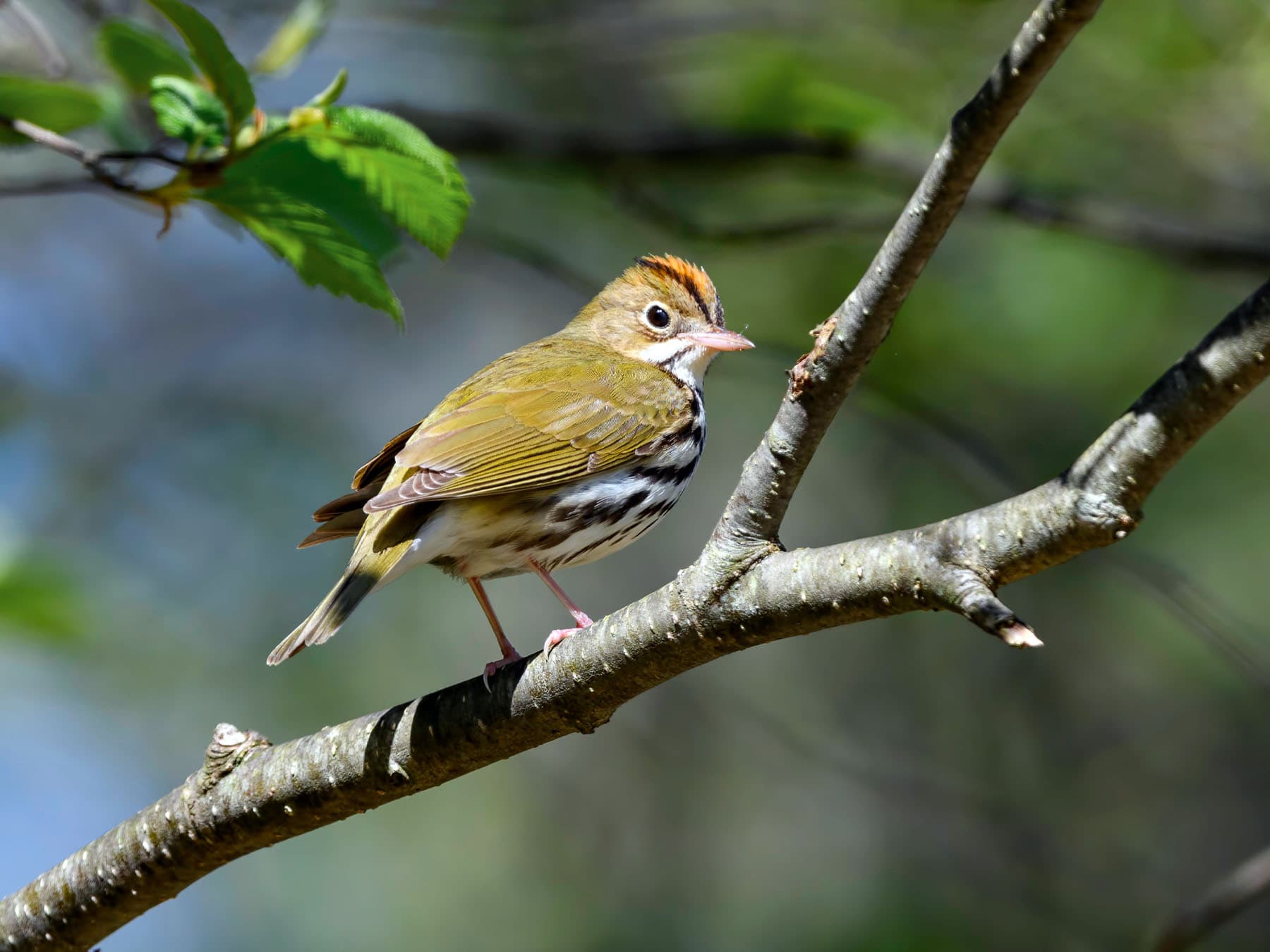
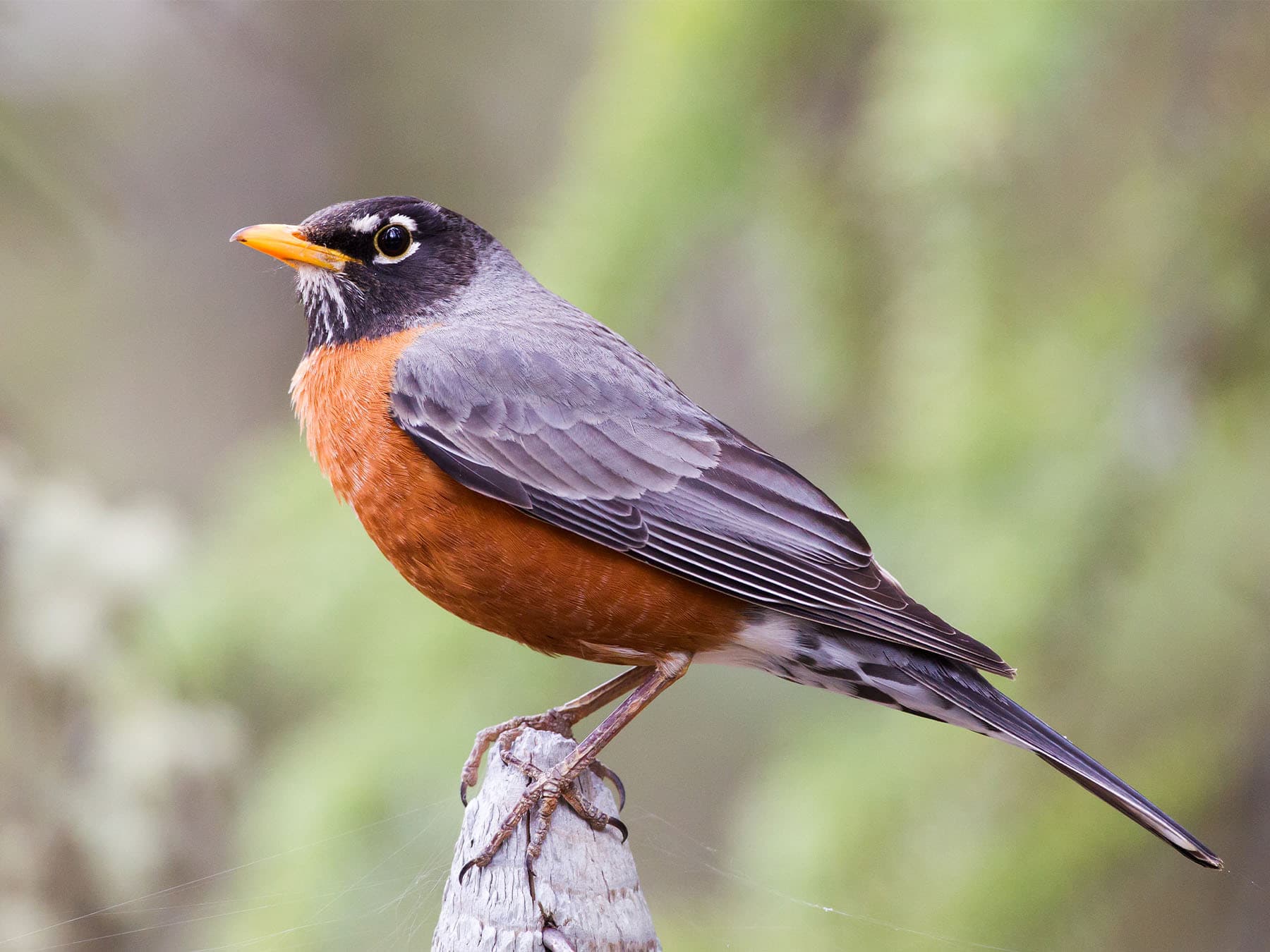
An Ovenbird can look similar at a glance, but it is a smaller warbler with a sharper bill, shorter legs, dark streaks rather than round spots below and black stripes on the crown. An American Robin stands the same upright way but is bigger, with gray upperparts and a rusty-red breast and belly.
Not sure it’s a Wood Thrush? Check your photo: Birdfact names the bird and shows the look-alike side by side.
Its size
Adults- Length
- 19–21 cm
- Wingspan
- 30–34 cm
- Weight
- 40–50 g
Its song and calls
The song is the Wood Thrush's fame. Each song has up to three parts: a few soft, low notes that you hear only close by, then the loud, clear flute phrase, the ee-oh-lay of the field guides, then a fast, trill-like ending. The flute phrase is the loudest and most musical part and the one least often left out, though from July males often drop it to give short, fast songs, and the ending often seems to come from somewhere else, a ventriloquist's trick. A male pauses after each song and changes the flute phrase from one song to the next, so the woods ring with variations on a theme.
What makes the song so unusual is that the bird often sings two notes at once. The flute phrase usually holds notes that overlap in time without being harmonics of each other, probably made by the two sides of the syrinx, the bird's voice box, working at the same time, and the ending is a fast run of note pairs, often sounded together.1

Song repertoire and learning
A male has one to three versions of the soft opening, two to eight of the flute phrase and six to twelve of the ending, and mixes them into different songs, and he can run through all his flute phrases in 15 songs or fewer and his whole repertoire in 34 or fewer, about 3 minutes' singing at the dawn rate, and one Ohio male sang 18 of his 90 possible combinations in 55 songs.1 He sings his flute phrases in a predictable order until a neighbor sings, then switches, probably to avoid answering with a similar phrase, and matching a rival's song is uncommon.1
The flute phrase is learned from other Wood Thrushes, while the opening and ending may be inborn or made up. Hand-reared birds kept apart from other thrushes sang only a slurred, short flute phrase, and in a captive study four of five young males tutored with recordings at 20-80 days old copied the phrases they heard.1, 2 There are no strong regional dialects: most song types turn up across the range, and in one population the mix stayed the same for 14 years.3
How the song sounds to the ear
The naturalist Aretas Saunders wrote down Wood Thrush songs by ear in his own notation. In a 1961 paper he described 583 flute phrases from 179 birds: 428 of them, nearly three in four, had three notes, and 109 of 580, about one in five, sat on the notes of a major chord, the "bugle-notes played on a flute" one of his pupils heard; a singer gave nearly 10 phrases in 38-40 seconds, and the ending, he noted from earlier analysis, may hold three, four or even five notes at once.4
Henry David Thoreau wrote of its song in his journal in 1852: "Whenever a man hears it, he is young."5
Song season and dawn song
Males start singing within days of arriving in spring, at first in short bouts at dawn and dusk. In a Delaware study the first songs came as early as 18 April; singing peaked in the first half of May, when pairs form and lay, fell to 16-20% of that rate in early June while males fed young, dwindled by early August and lingered in short dawn and dusk bouts into early September.1 In southern Connecticut, Saunders heard song from about 1 May to an average last date of 3 August.4
Dawn is the time to listen. Singing is most intense in the half-hour before sunrise, at about three times the rate of the next 3 hours, 126 songs in 21 minutes in Delaware; then come short bouts through the day, a brief burst at dusk, and as darkness falls the pit calls are the last sounds the bird makes.1 Males sing mostly from bare branches, often high in the trees early in the season and at dusk, sometimes from the ground while feeding, and in July and August they give shorter songs from more hidden perches.
Calls
The calls rise with alarm. A low, quick bup-bup or tut-tut means mild disturbance; as the bird gets more agitated it switches to a louder, higher pit-pit-pit, which can run faster and higher still, a rapid burst that carries a long way through the woods. Near the nest adults give a thin, high tsee, and they add a single quirt and snap their bills in disputes. Fledglings keep in touch with a flat chip. The bup and pit calls go on into fall in the US and through the day on the wintering grounds, where song may be heard in March.
- Song0:00 / 1:20
Recorded in Louisiana, United States · April 2017
- Calls0:00 / 0:42
Recorded in Minnesota, United States · May 2014
- Song (Rhode Island)0:00 / 0:17
Recorded in Rhode Island, United States · May 2023
Heard one and not sure? Let the bird song identifier listen.
When and where to see it
November
Mostly absent
The year across North America
Choose a place on the map to see its year, or find yours.
Most recorded in November
Up to 1.1% of a place’s bird records that monthHere in other months
How this map is made
Each county, state or province is shaded by the Wood Thrush’s share of all the bird records there that month: the darker, the larger the share. A place with only a trace of records in a month is left unshaded. Shades compare places on this map with each other, not one bird with another. Records: GBIF eBird Observation Dataset, 2019–2024. Map: Natural Earth; place centres © OpenStreetMap contributors.
How often the Wood Thrush turns up in the United States and Canada through the year, from birdwatchers' records.
United States
Summer visitor · regularly Apr–Oct · most records in May
Canada
Summer visitor · regularly May–Sep · most records in May
Show as a table
| Month | United States | Canada |
|---|---|---|
| January | <0.001% | 0.001% |
| February | <0.001% | – |
| March | 0.002% | – |
| April | 0.14% (regular) | 0.007% |
| May | 0.52% (regular) | 0.24% (regular) |
| June | 0.46% (regular) | 0.18% (regular) |
| July | 0.37% (regular) | 0.14% (regular) |
| August | 0.084% (regular) | 0.020% (regular) |
| September | 0.11% (regular) | 0.018% (regular) |
| October | 0.039% (regular) | 0.002% |
| November | 0.003% | <0.001% |
| December | <0.001% | 0.002% |
Worldwide: recorded regularly in 13 countries
Countries where it was recorded in at least 3 of the 6 years 2019–2024. Linked countries have their own bird list.
North America (13)
- Belize
- Bermuda
- Canada
- Cayman Islands
- Costa Rica
- Cuba
- El Salvador
- Guatemala
- Honduras
- Mexico
- Nicaragua
- Panama
- United States
Data: EOD – eBird Observation Dataset (Cornell Lab of Ornithology), accessed via GBIF.org, CC BY 4.0. Records from 2019–2024, aggregated and filtered by Birdfact. How these lists are made
The Wood Thrush is a summer bird of the eastern US and southeastern Canada. It breeds from Minnesota, southern Ontario and Quebec, New Brunswick and southwestern Nova Scotia south to northern Florida and the Gulf Coast, and west as far as the eastern Great Plains, from eastern Texas to southeastern South Dakota. It is commonest along the Appalachians and in parts of the Mid-Atlantic, and it spends the winter in southern Mexico and Central America.
It lives inside and at the edges of deciduous and mixed forest, above all moist, mature woods with tall trees, a moderate layer of shrubs and saplings, shade, a fairly open floor, damp soil and plenty of rotting leaf litter. The best woods have trees more than about 50 ft (16 m) tall, and it is often near streams. It also nests in small woodlots, wooded neighborhoods and parks with big trees.
Spotting tips
Listen first. From late April to July a male's flute song carries through the woods, loudest in the half-hour before sunrise and again at dusk; then look for a robin-shaped bird on a bare branch in the midstory, or hopping and pausing on the forest floor. Once singing fades in August, listen for the pit-pit-pit alarm and check fruiting shrubs such as spicebush and dogwood.
Migration and the winter range
Wood Thrushes migrate at night, and many cross the Gulf of Mexico in spring and fall. They leave the wintering grounds from early March to late April and reach the US Gulf Coast from early April, Oklahoma to North Carolina by mid-April, central Illinois to Delaware by late April, and southern Maine and Minnesota in mid- to late May. Males arrive a few days before females. In fall they leave the north from mid-August to mid-September; passage peaks in Delaware from early September to early October and in Alabama and northern Florida from late September to early October, and they reach the wintering grounds from late August in Veracruz to November in Panama.1
In winter they live mainly in the shaded understory of tall lowland rainforest, on the Caribbean slope from southern Veracruz south and on the Pacific slope from eastern Oaxaca to western Panama, also using forest edges and second growth; a few stray to the southeastern US. Many appear to hold a winter territory and come back to the same place in later winters, and in one Mexican study settled birds died less often than wanderers.1 In Honduras, radio-tracked birds chose heavily shaded coffee farms over forest, yet survived and stayed put less well there than in forest.6
Migration tracking
Wood Thrushes were among the first songbirds tracked on migration with geolocators, tiny light-logging tags: in a study published in 2009, five birds from one northwestern Pennsylvania site wintered in a narrow band of Central America, in Honduras and Nicaragua, and flew north at about 145-173 mi (233-279 km) a day, most of them straight across the Gulf, though one went overland around it; spring migration was two to six times faster than fall.7, 1
Geolocators on 102 birds from across the range have since given an estimate that more than half of all Wood Thrushes spend the winter between Honduras and Costa Rica, that about half travel south through Florida in fall, and that about 73% make landfall on a narrow stretch of the central Gulf Coast in spring.8 Individual birds are creatures of habit: of 10 tracked in more than one year, each left its winter home on average within about 3 days of the previous year's date, though their routes differed.9
Young birds do it differently. On their first trip north they left about 8 days later than adults and stopped more often, yet were just as likely to cross the Gulf, 500-620 mi (800-1,000 km) of open water.10 In southwestern Ontario, young birds left in fall earlier than adults but traveled south more slowly, about 29 mi (47 km) a day against 45 mi (72 km), and before leaving, 78% of them made long night flights of more than 3 mi (5 km), mostly in the 2 hours before sunrise, which adults rarely did.11, 12
Range changes
The breeding range has shifted over the last century and more. In the late 1800s and early 1900s it spread north, and one New Hampshire naturalist dated a marked arrival in the White Mountain valleys to 1890-1910; it spread further in Maine, Ontario and New Brunswick after 1950, while in Kansas and Oklahoma, as of the 2011 handbook text, it had pulled back east since the 1930s.13, 1
What it eats
A Wood Thrush feeds mostly on the forest floor, on small animals from the leaf litter and soil: beetles and their larvae, flies, ants, caterpillars and moths, spiders, millipedes, centipedes, woodlice, snails and earthworms. It hops a few times, pauses, then flips a leaf aside with its bill or probes the soil, almost always under the canopy, and now and then it takes insects from leaves and bark, or a small salamander. From late summer it eats more and more fruit.
Studies put numbers on the mix. Of 179 stomachs from the US and Canada, mostly from May and July, 62% of the food was animal and 38% plant.1, 13 In New Hampshire in summer, 329 food items from 60 birds were 33% adult beetles, 18% flies, 17% ants, wasps and bees (mostly ants), 12% moths and caterpillars, and 10% centipedes, millipedes and snails.1 In New York, the amount of calcium-rich prey, above all millipedes, correctly predicted where Wood Thrushes bred at more than 70% of 40 sites.14
Fruit in the diet
Fruit matters most in late summer, fall and late winter. Wood Thrushes take spicebush, dogwood, black cherry, elderberry, pokeweed, Virginia creeper, black gum, wild grape, holly, blueberry and jack-in-the-pulpit, swallow the fruit whole and cough up the big seeds. Before migrating they switch to fatty fruits, which they seem to choose, and in Illinois in fall birds ate spicebush berries at 4.3 a minute; in winter in Costa Rica, 93% of 259 droppings held insects and 59% held fruit.1
Parents feed their nestlings soft-bodied invertebrates and fruit they have softened first.
Feeders and yards
Wood Thrushes are birds of the forest interior and rarely come to feeders, and we found no source that recommends a feeder food for them. If you live near a small woodlot you may still hear one from your yard. Big trees, native shrubs such as spicebush, dogwood and arrowwood, and fallen leaves left on moist ground give them the food and cover they use.
Nesting and breeding
Some males arrive several days before the first females, and a male may have a mate within days of arriving. The female probably makes the final choice of nest site, though the male may call her to a spot or carry material there. The nest is usually in a sapling or shrub, in a fork or saddled on a horizontal branch, often on a lower limb and with some cover. Most nests are below 20 ft (6 m) and a few above 65 ft (20 m); in a Delaware wood 80% of 963 nests were lower than 20 ft, at an average of 13 ft (4.0 m).1
The nest: mud, rootlets and white paper
The female does most of the building, over 3-6 days. She lays a base of dead leaves, grass and stems, sometimes starting with a scrap of pale paper or plastic that is often draped over the branch and may hang below the nest, then molds a cup of mud inside it with her body and lines it with rootlets. The outside of the finished nest is 4-5.5 in (10-14 cm) across.
The white scraps are a Wood Thrush habit. In Florence Grow Weaver's study, published in 1949, all but 2 of 20 nests held paper, cellophane, white cloth or other white material; A. A. Allen suggested that predators might not see such large objects as nests, and Weaver thought the white broke up the nest's outline, but no study we read has tested either idea, and Weaver's own attempt, scattering colored material near two renesting pairs, came to nothing.13
Eggs and young
The eggs are plain turquoise-green, about 1 in (25.5 mm) long, usually 3 or 4 to a clutch; in Delaware first clutches averaged 3.7 eggs, mostly 4, and later ones about 3, and only the female incubates, for 12.7 days on average (11-14) in the same study, while Audubon's guide gives 13-14 days and some guides 12-15.1, 15, 16
Chicks hatch pinkish, helpless and nearly naked, with wisps of gray down and a yellow mouth. Their eyes open at about 5 days and their breast spots appear at 9-10 days. Both parents feed them, and in a Delaware study the male fed more: 1.2 trips per chick an hour against the female's 0.7.1 The young leave the nest at 12-15 days and feed themselves at 23-25 days. In a Virginia radio-tracking study of 23 fledglings they were independent at 28-36 days after hatching: when a pair nested again, the female tended the fledglings for about 13 days before starting a new clutch and the male carried on about 6 days longer, and after the last brood of the summer the parents split the young between them.1, 17
Broods and nest success
Most pairs try to raise two broods a summer, and rarely three. In Delaware 80% of 376 females laid a second clutch, 30% a third and 6% a fourth, counting replacements for nests that failed, and the females fledged an average of 2.6 young a year over 20 years; in southern Ontario 74% of females were double-brooded.1
Many nests fail, most of them to predators, which took 71% of 378 failed nests in Delaware, and nests do worse in small woods, in broken-up landscapes and in the Midwest than in the East, with many exceptions: over a season, 14-29% of nests survived in fragmented landscapes against 30-50% in more forested ones, and in rural Pennsylvania 86% of nests in unbroken forest succeeded against 43% in forests under about 200 acres (80 ha).1
Nest predators
Nest cameras have shown who robs Wood Thrush nests. In the Great Smoky Mountains, cameras at 57 nests caught American Crows, black rat snakes, black bears and an Eastern Screech-Owl at active nests, and southern flying squirrels, a weasel, a mouse and a gray squirrel at nests already robbed.18 In another video study of 56 nests, at least 9 kinds of predator were filmed, southern flying squirrels most often, and researchers who guessed from the remains whether a bird, a mammal or a snake had robbed the nest were wrong 57% of the time.19
Blue Jays, Common Grackles, Brown-headed Cowbirds, least weasels and white-footed mice also take eggs or young, and Sharp-shinned Hawks take fledglings. Parents freeze or raise the crown at the nest, then call, chase, dive at and strike intruders; one bird harassed a timber rattlesnake, coming within about 20 in (0.5 m) of it.1
Cowbird eggs in the nest
The Wood Thrush is a frequent host of the Brown-headed Cowbird, which lays its eggs in other birds' nests, and it accepts them: it rarely rejects a cowbird egg, and parents that peck at a laying cowbird almost never drive it off. How often it happens depends on place, heaviest in the Midwest and lightest in the East. In northern Indiana 90% of 278 nests held cowbird eggs, 2.4 a nest on average.20 Other studies found 75-95% in Illinois, 47% in southwestern Ontario, 9% in Pennsylvania and none in South Carolina.1 In central Virginia it was almost absent along the undisturbed Blue Ridge, against 20-50% in two other regions.21
The cost varies too. In Delaware a parasitized nest fledged 0.4 fewer young thrushes, but by nesting again, parasitized females raised as many young a year as the rest, 3.1 each.1 Even in heavily parasitized Indiana woods, pairs that nest several times can raise their own young alongside cowbirds, and in some years those woods may still add birds to the wider population.22
Behaviour
On the ground a Wood Thrush moves in low hops, then stops and stands upright, watching. Males set up and defend territories of about 0.2-10 acres (0.08-4.0 ha), and in a dispute a male flicks his wings and tail and raises his crest, then puffs out his breast and back feathers; most contests end without contact.1 It has been seen anting, rubbing ants, and also a snail, through its feathers.
Its territories overlap those of Veeries and Hermit Thrushes with little fighting, though early in the season males may chase them. In winter it may join mixed flocks or wait at the edges of army-ant swarms, where it gives way to the resident ant-following birds.
Social behavior: do they mate for life?
No. Pairs probably form during silent circling flights a few feet up, led by the female. In a Delaware wood a pair usually stayed together through the season, but most birds that came back the next year took a new mate, only 3-8% of pairs a year were re-pairings, and 59% of males and 45% of females returned to breed in the same woods; and while pairs are socially monogamous, females also mate with other males, so that 6% of young in a Pennsylvania study and up to 40% in Ontario had a different father from the male raising them.1
Lifespan and predators
The oldest Wood Thrush on the US banding records was a male at least 10 years 2 months old: banded in Connecticut on 13 June 2002, when already in at least his third year, and caught and released there by banders on 4 August 2010; the earlier record-holders were 8 years 11 months.23 Most live far less. Canada's 2012 status report put life expectancy at probably around 5 years,24 and in Delaware adults probably survive from one year to the next at about 70% (males) and 75% (females).1
The first year is the hardest. Of 189 nestlings radio-tagged in southwestern Ontario, about 70% survived their first 16 days out of the nest and 89% the weeks before migration, but survival over the first migration and winter was only about 26% (apparent survival: birds that settled elsewhere count as lost).25 Tracking in Indiana and Belize found apparent survival (deaths plus birds that moved away) lowest during migration, and lower in spring than fall,26 and in a 31-year study in Delaware, breeding success and survival peaked in middle age and fell in older birds.27
Adults are seldom found killed. Accipiter hawks and Great Horned Owls (an adult on its nest) are suspected; in Mexico in winter Ferruginous Pygmy-Owls and Barred Forest-Falcons take adults, and boa constrictors have also been recorded taking them.1
Conservation
The Wood Thrush is still common: Partners in Flight estimates about 12 million breeding-age birds, nearly all in the US and Canada, for around 2010.28 But it has declined. The North American Breeding Bird Survey shows a fall of 0.95% a year from 1966 to 2025 (95% credible interval 0.82 to 1.08, from 2,251 routes), about 43% in all; numbers peaked in 1977, fell fastest in the 1980s and 2000s and hit their low in 2011; since then they have risen significantly, by 1.87% a year over 2015-2025 survey-wide.29
The picture differs by region. The long-term falls are steepest in the Northeast, 4.51% a year in Maine, 3.61% in New Hampshire and 2.74% in Vermont, while numbers rose in Minnesota (3.17%) and Ohio (1.02%); over 2015-2025, New Hampshire, New York, Maryland and North Carolina were still falling, and in Canada the long-term fall is steeper, 1.75% a year, with no recovery yet.29 Canada held an estimated 260,000-665,000 mature birds in 2012.24
Conservation status: is it endangered?
Not globally. Some guides still list it as Near Threatened; the current IUCN Red List assessment (BirdLife International, 2020) is Least Concern.30, 15 Partners in Flight puts it on its Yellow Watch List, with a Continental Concern Score of 14,28 and it is a US Bird of Conservation Concern across the continental US (2021).31 In Canada it is listed as Threatened (see Legal status, below).
Conservation: forests, cowbirds and acid rain
The loss and breakup of forest at both ends of its migration are thought to lie behind the long decline. In small and broken-up forests more nests are robbed and more are parasitized by cowbirds, especially in the Midwest, so fewer young are raised.32, 1 The picture is not all one way: in southwestern Ontario, adults nesting in small forest fragments showed no strong costs, and young raised in small fragments survived as well as others.33, 25
Its lowland wintering forests are being cleared. An estimated more than half the population winters between Honduras and Costa Rica, a region with only a third of the winter habitat and heavy deforestation,8 and in Veracruz's Tuxtla Mountains, wintering numbers in 1985 were estimated at only 30% of those in 1960, after forest loss.1 Two 2016 models disagree on which season matters more: one found that losing breeding habitat weighs at least three to six times as much as losing the same amount of winter habitat, the other that the species' decline is driven mainly by deforestation in Central America.34, 35
Other pressures are more local or less certain. A range-wide study linked acid rain to a lower chance of Wood Thrushes breeding, more so at high elevation, on acidic soils and in fragmented forest.36 Acid rain lowers soil calcium and may reduce calcium-rich prey such as millipedes, and at 40 New York sites the amount of such prey correctly predicted whether Wood Thrushes bred at more than 70% of them.1, 14 A national study of building collisions rated it highly vulnerable to window strikes, from data mostly gathered in eastern cities during migration,37 and in the Southeast tower kills are commoner in fall than spring.1
Legal status
In the United States the Wood Thrush is protected under the Migratory Bird Treaty Act. It is on the federal list of protected birds (50 CFR 10.13), so killing, capturing or keeping one, or taking its nest or eggs, needs a federal permit.38, 39 In Canada it has been listed as Threatened on Schedule 1 of the Species at Risk Act since 2 November 2017, after COSEWIC assessed it as Threatened in November 2012, and it is also protected under the Migratory Birds Convention Act, 1994.40, 41, 24, 42 Ontario listed it as Special Concern in 2014, on a provincial list replaced in 2026.43
Similar birds
Often mistaken for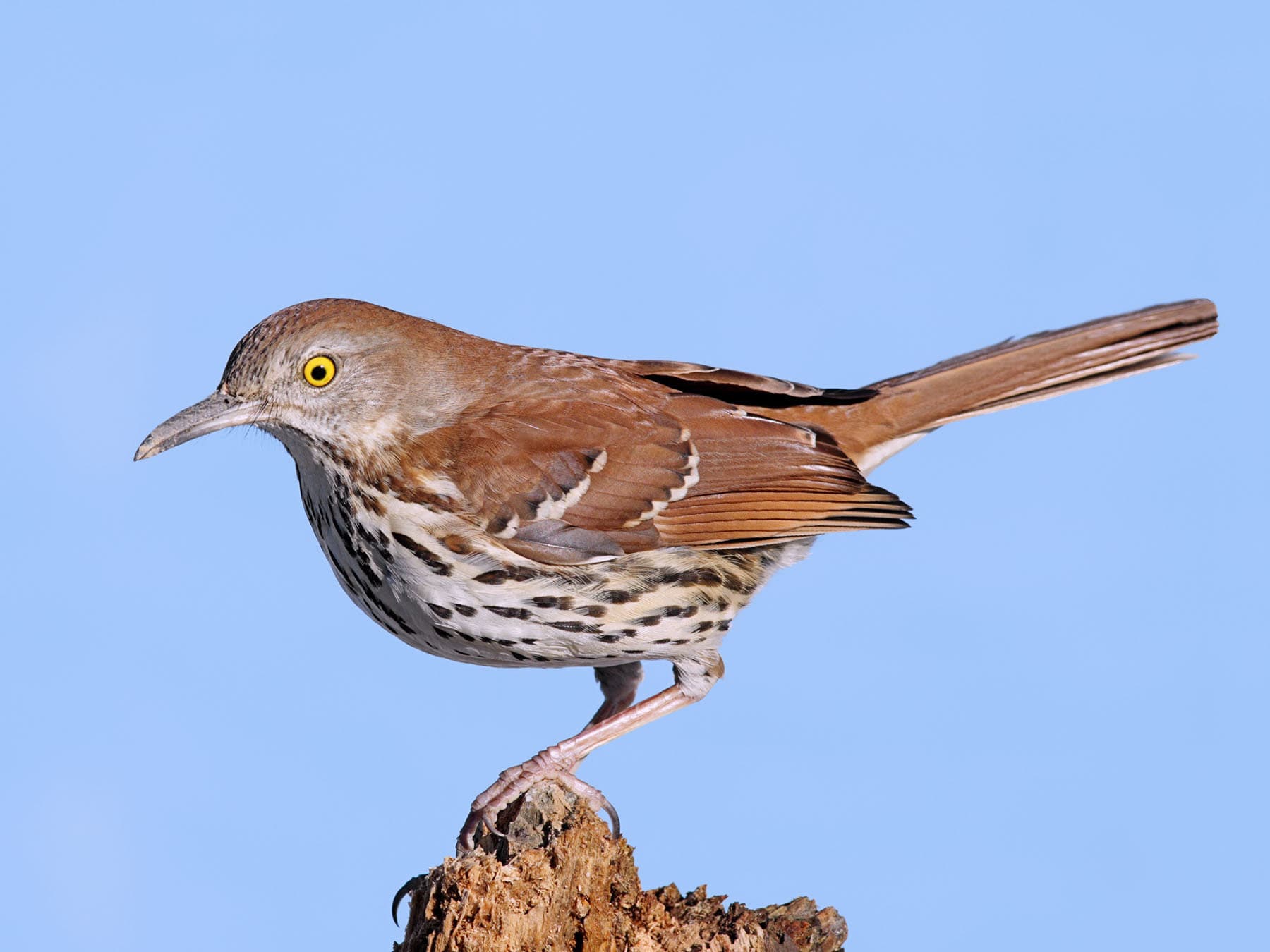
More photos
2 photos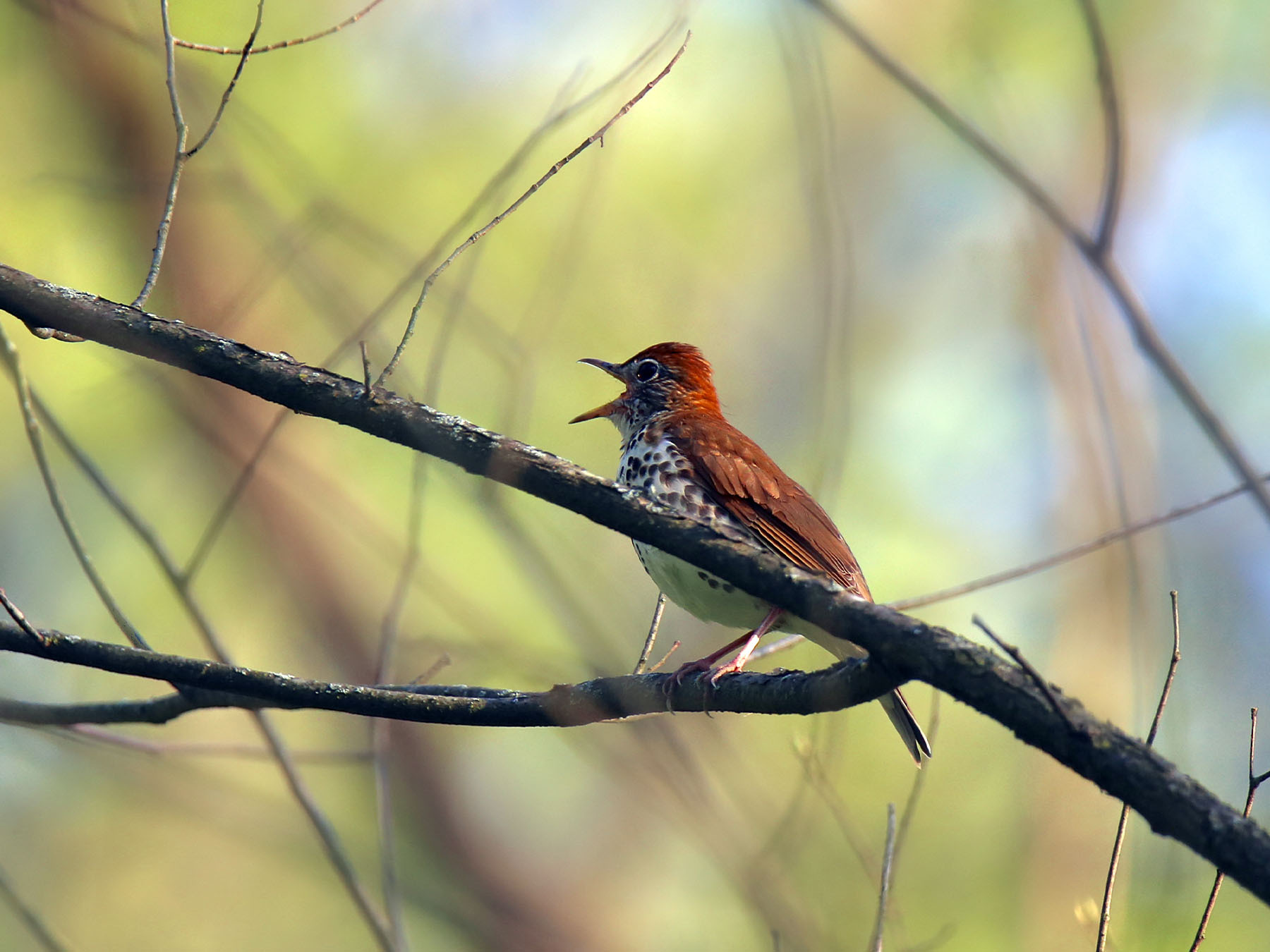
Wood Thrush guides
1 guidesQuick facts
- Length
- 19–21 cm
- Wingspan
- 30–34 cm
- Weight
- 40–50 g
- Lifespan
- oldest recorded 10 years 2 months
- Family
- Thrushes
- Migration
- Long-distance Migrant
- Global status (IUCN)
- Least Concern
- World population
- About 12 million breeding-age birds (Partners in Flight, around 2010)
- Population trend
- Decreasing: down about 0.95% a year since 1966 in the North American Breeding Bird Survey (about 43% in all), though rising since a low in 2011
- Scientific name
- Hylocichla mustelina
Questions
3Is the Wood Thrush the official bird of Washington, D.C.?
Yes. It has been named as the District of Columbia's bird since at least 1932, though we found no law or adoption date for the choice.44
Has a Wood Thrush ever reached Britain?
Very rarely. A bird on the Isles of Scilly, off southwest England, in October 1987 was the first for Britain, and single birds have also turned up in Iceland (1967) and the Azores (19th century).45, 1 To British eyes it looks like a bright, boldly spotted Song Thrush.
What does Hylocichla mustelina mean?
Hylocichla is Greek for wood thrush, and mustelina is Latin for weasel-like, for its tawny-brown upperparts. Gmelin named it Turdus mustelinus in 1789, with New York as the type locality, and Baird gave it its own genus, Hylocichla, in 1864.46, 47 It is the only member of its genus, and whether it belongs instead in Catharus, with the Veery and the Hermit Thrush, is still debated.1
Sources
50- 1Evans, M. et al. (2020). Wood Thrush (Hylocichla mustelina), version 1.0. Birds of the World (A. F. Poole, editor). Cornell Lab of Ornithology. doi:10.2173/bow.woothr.01 (opens in a new tab)
- 2Whitney, C. L. and Miller, J. (1987). Song learning in the wood thrush. Canadian Journal of Zoology 65(4): 1038-1042. doi:10.1139/z87-165 (opens in a new tab)
- 3Whitney, C. L. and Miller, J. (1987). Distribution and variability of song types in the wood thrush. Behaviour 103(1-3): 49-67. doi:10.1163/156853987x00260 (opens in a new tab)
- 4Saunders, A. A. (1961). The songs and calls of the Wood Thrush. The Auk 78(4): 595-606. doi:10.2307/4082192 (opens in a new tab)
- 5Missouri Department of Conservation. Wood Thrush. Missouri Department of Conservation field guide. Accessed 15 November 2026. Source (opens in a new tab)
- 6Bailey, B. A. and King, D. I. (2019). Habitat selection and habitat quality for wintering wood thrushes in a coffee growing region in Honduras. Global Ecology and Conservation 20: e00728. doi:10.1016/j.gecco.2019.e00728 (opens in a new tab)
- 7Stutchbury, B. J. M. et al. (2009). Tracking long-distance songbird migration by using geolocators. Science 323: 896. doi:10.1126/science.1166664 (opens in a new tab)
- 8Stanley, C. Q. et al. (2015). Connectivity of wood thrush breeding, wintering, and migration sites based on range-wide tracking. Conservation Biology 29(1): 164-174. doi:10.1111/cobi.12352 (opens in a new tab)
- 9Stanley, C. Q. et al. (2012). Repeat tracking of individual songbirds reveals consistent migration timing but flexibility in route. PLoS ONE 7(7): e40688. doi:10.1371/journal.pone.0040688 (opens in a new tab)
- 10McKinnon, E. A., Fraser, K. C., Stanley, C. Q. and Stutchbury, B. J. M. (2014). Tracking from the tropics reveals behaviour of juvenile songbirds on their first spring migration. PLoS ONE 9(8): e105605. doi:10.1371/journal.pone.0105605 (opens in a new tab)
- 11Boyd, B. P., Hayes, S. M., Migotto, A. A. and Stutchbury, B. J. M. (2025). Age-related differences in fall migration timing and performance of juvenile and adult Wood Thrushes departing from a breeding site. Movement Ecology 13(1): 32. doi:10.1186/s40462-025-00556-3 (opens in a new tab)
- 12Hayes, S., Boyd, B. and Stutchbury, B. (2024). Why do juvenile Wood Thrushes make long-distance pre-migratory movements across a fragmented landscape?. Journal of Field Ornithology 95(2): art9. doi:10.5751/jfo-00465-950209 (opens in a new tab)
- 13Bent, A. C. (1949). Life Histories of North American Thrushes, Kinglets, and Their Allies (U.S. National Museum Bulletin 196). Government Printing Office, Washington. Accessed 15 November 2026. Source (opens in a new tab)
- 14Hames, R. S., Lowe, J. D., Swarthout, S. B. and Rosenberg, K. V. (2006). Understanding the risk to Neotropical migrant bird species of multiple human-caused stressors: elucidating processes behind the patterns. Ecology and Society 11(1): 24. doi:10.5751/es-01673-110124 (opens in a new tab)
- 15National Audubon Society. Wood Thrush. Guide to North American Birds. Accessed 15 November 2026. Source (opens in a new tab)
- 16Cornell Lab of Ornithology. Wood Thrush. All About Birds. Accessed 15 November 2026. Source (opens in a new tab)
- 17Vega Rivera, J. H., Haas, C. A., Rappole, J. H. and McShea, W. J. (2000). Parental care of fledgling Wood Thrushes. The Wilson Bulletin 112(2): 233-237. doi:10.1676/0043-5643(2000)112[0233:pcofwt]2.0.co;2 (opens in a new tab)
- 18Farnsworth, G. L. and Simons, T. R. (2000). Observations of Wood Thrush nest predators in a large contiguous forest. The Wilson Bulletin 112(1): 82-87. doi:10.1676/0043-5643(2000)112[0082:oowtnp]2.0.co;2 (opens in a new tab)
- 19Williams, G. E. and Wood, P. B. (2002). Are traditional methods of determining nest predators and nest fates reliable? An experiment with Wood Thrushes (Hylocichla mustelina) using miniature video cameras. The Auk 119(4): 1126-1132. doi:10.1093/auk/119.4.1126 (opens in a new tab)
- 20Fauth, P. T. (2000). Reproductive success of Wood Thrushes in forest fragments in northern Indiana. The Auk 117(1): 194-204. doi:10.1093/auk/117.1.194 (opens in a new tab)
- 21Etterson, M. A., Greenberg, R. and Hollenhorst, T. (2014). Landscape and regional context differentially affect nest parasitism and nest predation for Wood Thrush in central Virginia, USA. The Condor 116(2): 205-214. doi:10.1650/condor-13-045.1 (opens in a new tab)
- 22Fauth, P. T. (2001). Wood Thrush populations are not all sinks in the agricultural midwestern United States. Conservation Biology 15(2): 523-527. doi:10.1046/j.1523-1739.2001.015002523.x (opens in a new tab)
- 23USGS Bird Banding Laboratory. Longevity records of North American birds: Wood Thrush. USGS Eastern Ecological Science Center, Bird Banding Laboratory. Accessed 15 November 2026. Source (opens in a new tab)
- 24COSEWIC (2012). COSEWIC assessment and status report on the Wood Thrush Hylocichla mustelina in Canada. Committee on the Status of Endangered Wildlife in Canada. Environment Canada, Ottawa. Accessed 15 November 2026. Source (opens in a new tab)
- 25Hayes, S. M., Boyd, B. P., Israel, A. M. and Stutchbury, B. J. M. (2024). Natal forest fragment size does not predict fledgling, pre-migration or apparent annual survival in Wood Thrushes. Ornithological Applications 126(1): duad054. doi:10.1093/ornithapp/duad054 (opens in a new tab)
- 26Rushing, C. S. et al. (2017). Spatial and temporal drivers of avian population dynamics across the annual cycle. Ecology 98(11): 2837-2850. doi:10.1002/ecy.1967 (opens in a new tab)
- 27Brown, W. P. and Roth, R. R. (2009). Age-specific reproduction and survival of individually marked Wood Thrushes, Hylocichla mustelina. Ecology 90(1): 218-229. doi:10.1890/07-2061.1 (opens in a new tab)
- 28Partners in Flight (2024). Avian Conservation Assessment Database, version 2024.05.23 (global). Partners in Flight. Accessed 15 November 2026. Source (opens in a new tab)
- 29Hostetler, J. A. et al. (2026). The North American Breeding Bird Survey, Analysis Results 1966-2025. U.S. Geological Survey data release. doi:10.5066/P1OSNSFC (opens in a new tab)
- 30BirdLife International (2020). Hylocichla mustelina. The IUCN Red List of Threatened Species 2020: e.T22708670A154163742. doi:10.2305/IUCN.UK.2020-3.RLTS.T22708670A154163742.en (opens in a new tab)
- 31U.S. Fish and Wildlife Service (2021). Birds of Conservation Concern 2021. U.S. Fish and Wildlife Service, Migratory Bird Program. Accessed 15 November 2026. Source (opens in a new tab)
- 32Robinson, S. K. et al. (1995). Regional forest fragmentation and the nesting success of migratory birds. Science 267(5206): 1987-1990. doi:10.1126/science.267.5206.1987 (opens in a new tab)
- 33Boyd, B. P., Hayes, S., Israel, A. M. and Stutchbury, B. J. M. (2023). Breeding season forest fragment size does not create negative carry-over for adult Wood Thrushes on fall migration timing or apparent annual survival. Ornithological Applications 125(4). doi:10.1093/ornithapp/duad028 (opens in a new tab)
- 34Rushing, C. S., Ryder, T. B. and Marra, P. P. (2016). Quantifying drivers of population dynamics for a migratory bird throughout the annual cycle. Proceedings of the Royal Society B 283(1823): 20152846. doi:10.1098/rspb.2015.2846 (opens in a new tab)
- 35Taylor, C. M. and Stutchbury, B. J. M. (2016). Effects of breeding versus winter habitat loss and fragmentation on the population dynamics of a migratory songbird. Ecological Applications 26(2): 424-437. doi:10.1890/14-1410 (opens in a new tab)
- 36Hames, R. S. et al. (2002). Adverse effects of acid rain on the distribution of the Wood Thrush Hylocichla mustelina in North America. PNAS 99(17): 11235-11240. doi:10.1073/pnas.172700199 (opens in a new tab)
- 37Loss, S. R., Will, T., Loss, S. S. and Marra, P. P. (2014). Bird-building collisions in the United States: estimates of annual mortality and species vulnerability. The Condor 116(1): 8-23. doi:10.1650/condor-13-090.1 (opens in a new tab)
- 38U.S. Fish and Wildlife Service (2026). 50 CFR 10.13: List of Migratory Birds. Electronic Code of Federal Regulations. Accessed 15 November 2026. Source (opens in a new tab)
- 39United States Congress (1918). Migratory Bird Treaty Act, 16 U.S.C. 703-712. United States Code. Accessed 15 November 2026. Source (opens in a new tab)
- 40Government of Canada (2026). Species at Risk Act (S.C. 2002, c. 29), Schedule 1. Justice Laws Website. Accessed 15 November 2026. Source (opens in a new tab)
- 41Government of Canada (2017). Order Amending Schedule 1 to the Species at Risk Act, SOR/2017-229. Canada Gazette, Part II, Vol. 151, No. 23. Accessed 15 November 2026. Source (opens in a new tab)
- 42Environment and Climate Change Canada. Birds protected under the Migratory Birds Convention Act, 1994. Government of Canada. Accessed 15 November 2026. Source (opens in a new tab)
- 43Government of Ontario. Wood thrush. Ontario.ca species at risk. Accessed 15 November 2026. Source (opens in a new tab)
- 44Westwood, R. W. (1932). Birds of the States: four States still lack official avian emblems. Nature Magazine 20(4): 168ff. Accessed 15 November 2026. Source (opens in a new tab)
- 45British Trust for Ornithology. Wood Thrush. BTO BirdFacts. Accessed 15 November 2026. Source (opens in a new tab)
- 46Eaton, E. H. (1914). Birds of New York, part 2 (New York State Museum Memoir 12). University of the State of New York, Albany. Accessed 15 November 2026. Source (opens in a new tab)
- 47AviList Core Team (2026). AviList: The Global Avian Checklist, v2025b. doi:10.2173/avilist.v2025b (opens in a new tab)
- 48Wilson, A. (1808). American Ornithology, vol. 1. Bradford and Inskeep, Philadelphia. Accessed 15 November 2026. Source (opens in a new tab)
- 49Audubon, J. J. (1831). Ornithological Biography, vol. 1. Adam Black, Edinburgh. Accessed 15 November 2026. Source (opens in a new tab)
- 50NatureServe. Hylocichla mustelina: Wood Thrush. NatureServe Explorer. Accessed 15 November 2026. Source (opens in a new tab)

Checked by
Nathan Cope, founder and editor
Nathan founded Birdfact and leads its writers and contributors in the UK, the US and Canada. He has watched and studied birds for more than ten years, and checks every article and species guide before it’s published.