Species Profile
Swainson's Thrush
Catharus ustulatus
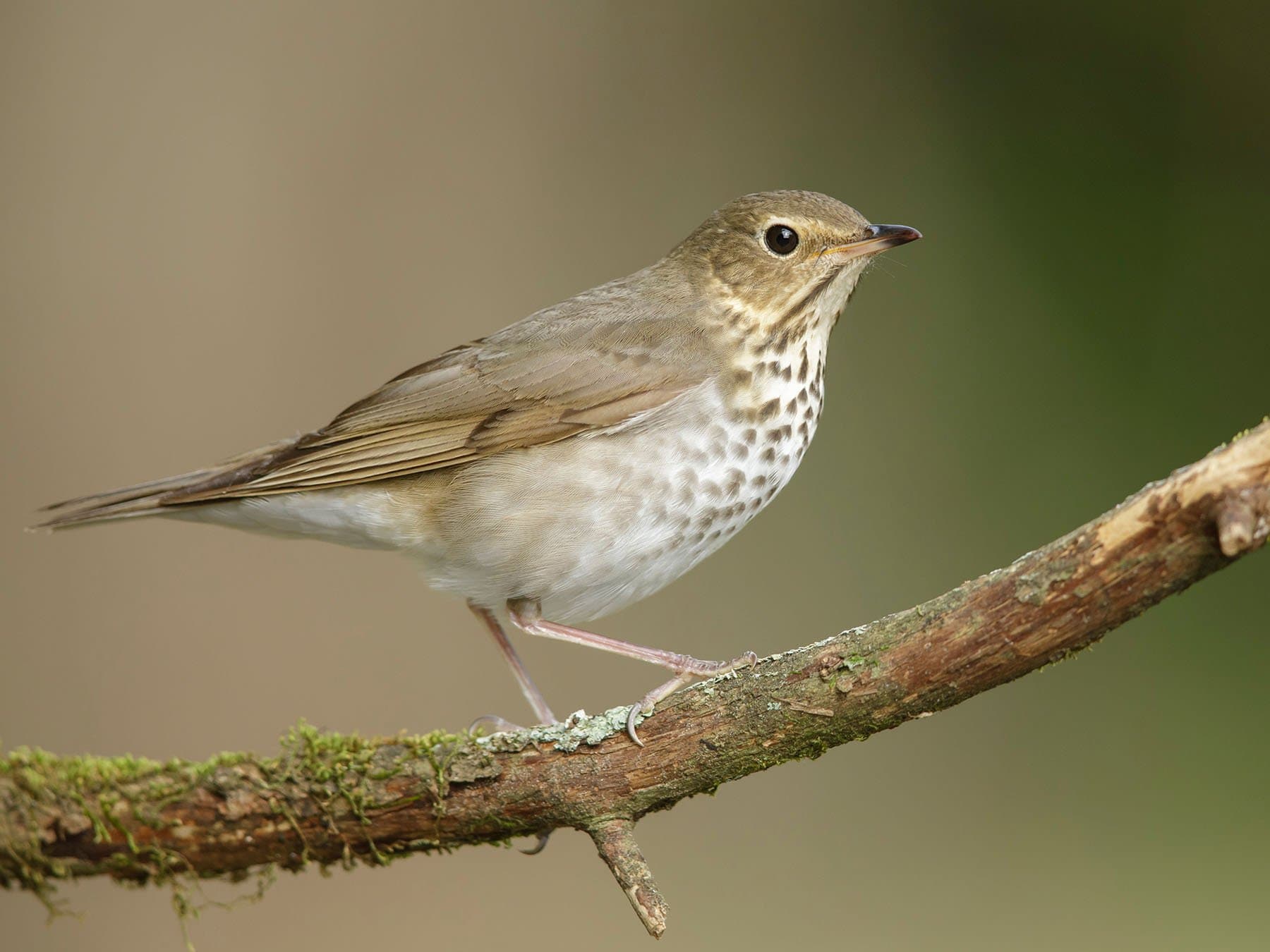
Swainson's Thrush perched on a mossy branch, showing its brown back, spotted breast, and pale eye-ring.
Quick Facts
Conservation
LCLeast ConcernLifespan
2–10 years
Length
16–20 cm
Weight
23–45 g
Wingspan
29–31 cm
Migration
Long-distance Migrant
Swainson's Thrush announces itself with one of the most evocative sounds in the North American boreal forest — a hurried, flute-like spiral of notes that winds upward in pitch like a musical helix climbing into the canopy. Look for the bold, buffy eye-ring that gives this slim, olive-brown songbird its distinctive "spectacled" expression, and you'll understand why birders across the continent stop in their tracks when one appears.
Think you've spotted a Swainson's Thrush?
Upload a photo and we'll confirm it instantly
Confirm with a PhotoAppearance
Swainson's Thrush is a medium-sized, slim songbird with a round head, fairly long wings, and a short, straight bill. The most immediately striking feature is the bold, buffy eye-ring that extends forward in front of the eye to create a "spectacled" or "goggled" expression — the single most reliable field mark separating it from the similar Grey-cheeked Thrush, which lacks this prominent ring entirely. The face and upper chest are washed with warm buff tones that complement the eye-ring.
Adults are uniformly brown on the upperparts from crown to tail, with no contrasting rump or tail colour. The underparts are white with brown on the flanks; the breast is lighter brown with clearly defined darker brown spots that become smudgier towards the belly. The whitish throat is bordered on each side by a dark brown malar stripe. Legs are dull pink and the bill is dark. The long, pointed wings give the rear of the bird an elongated look in the hand.
Two main forms exist. The "Olive-backed" group — subspecies swainsoni and allies — breeds across the boreal interior and eastern North America and is more olive-brown above. The "Russet-backed" group — subspecies ustulatus and allies — breeds along the Pacific Coast and is warmer reddish-brown or russet above, with slightly thinner, paler eye-rings and medium-brown chest spotting. Both groups share the white-dark-white underwing pattern characteristic of Catharus thrushes.
The species shows no seasonal plumage change, and males and females are identical in appearance — the only consistent difference between the sexes is that male wing lengths average slightly longer than those of females. Wing chord measures 8.7–10.5 cm; bill 1.5–1.9 cm; tarsus 2.5–3.1 cm.
Identification & Characteristics
Colors
- Primary
- Brown
- Secondary
- White
- Beak
- Black
- Legs
- Pink
Markings
Bold, buffy eye-ring extending forward in front of the eye, creating a distinctive "spectacled" expression; warm buff wash on face and upper chest; brown-spotted breast on white underparts
Tail: Plain brown, uniform with upperparts; no contrasting rump or tail colour
Attributes
Understanding Attributes
Rated 0–100 based on research and observation. A score of 50 is average across all bird species. These attributes are relative and don't necessarily indicate superiority.
Habitat & Distribution
On the breeding grounds, Swainson's Thrush is strongly associated with dense coniferous forests — particularly spruce, fir, and hemlock — with a well-developed shrubby understory. Studies show that areas with higher tree density and complete canopy cover support significantly more birds than open-canopied stands. In the Rocky Mountains and Pacific states, it also breeds in dense deciduous riparian woodland dominated by willow and alder along streams running through coniferous forest. In coastal California, birds are found primarily in deciduous streamside woodlands and alder or willow thickets, generally below about 150 m elevation. The species ranges from sea level up to approximately 2,600 m, though it is most common at mid-range elevations around 1,000 m.
The breeding range extends from the southern two-thirds of Alaska across Canada south of Great Bear Lake, encompassing most of British Columbia, Alberta, Saskatchewan, Manitoba, Ontario, Quebec, and the Maritime provinces. In the United States, breeding populations occur in the Pacific Coast states, the Rocky Mountain chain south to New Mexico and Utah, and in the northern tier of eastern states including Minnesota, Wisconsin, Michigan, New York, Vermont, New Hampshire, and Maine. An estimated 73% of the global population breeds within the North American Boreal Forest.
In winter, Swainson's Thrushes vacate North America almost entirely. The Russet-backed (coastal) group winters from Mexico to Costa Rica, while the Olive-backed (continental) group winters from Panama south through the western Amazon Basin to northern Argentina and Bolivia. During migration, the species becomes widespread across virtually all of forested North America, passing through every US state and Canadian province — making spring and autumn the best times to encounter it across much of the continent.
In the UK and Ireland, Swainson's Thrush is a very rare vagrant, recorded in small numbers in autumn — primarily in western Britain including Cornwall, Devon, Scotland, and Wales. The BTO records only a handful of occurrences each autumn. In September 2024, a bird found on St Kilda in the Outer Hebrides became the earliest autumn record for Britain at the time and only the sixth record for the Outer Hebrides. The first live bird recorded in Britain and Ireland was found in Pembrokeshire in 1967.
Where to See This Bird
Explore regional guides for locations where this bird has been recorded.
United States
Montana
Illinois
Idaho
Indiana
New Hampshire
Maine
Michigan
Minnesota
Alaska
North Dakota
California
New York
Oregon
South Dakota
Washington
Wyoming
Canada
Alberta
Manitoba
British Columbia
New Brunswick
Newfoundland and Labrador
Nova Scotia
Northwest Territories
Ontario
Saskatchewan
Prince Edward Island
Quebec
Yukon Territory
Diet
Swainson's Thrush is omnivorous, with diet shifting markedly by season. During the breeding season, insects and other arthropods dominate. Key prey includes beetles, caterpillars, flies, grasshoppers, ants, wasps, moths, and crickets, along with spiders and other invertebrates. Notably, the species feeds heavily on ants — a dietary habit more commonly associated with woodpeckers and unusual among temperate songbirds. Nestlings are fed almost exclusively insects, particularly caterpillars, beetles, moths, and flies.
Fruits and berries become increasingly important from late summer onwards and constitute over one-third of the summer diet; in autumn and winter they are the primary food source. The species shows a strong preference for red fruits over yellow ones, favouring elderberries, blackberries, raspberries, twinberries, huckleberries, and the fruits of brier, false Solomon's seal, and sumac. On the wintering grounds in Central and South America, birds are often found in fruiting trees, including Cymbopetalum mayanum and Trophis racemosa when available.
Foraging techniques are varied. Birds peck and glean from leaves and bark, aerial-lunge at insects, hover momentarily to take prey from foliage, and occasionally flycatch — catching insects in mid-air. The species forages at higher levels than most related thrushes, moving freely between the forest floor and the canopy. In the tropics, it follows army-ant swarms to intercept flushed prey, though resident tropical species typically dominate these gatherings and displace the thrushes when competition arises.
Behaviour
Swainson's Thrush is a largely solitary bird outside the breeding season, spending much of its time in dense cover and often going undetected despite being abundant. On the breeding grounds, males establish territories and defend them vigorously through song. Territorial disputes can escalate into full singing duels, with rivals matching each other phrase for phrase at increasing volume and frequency. In rare cases, a male will invert his customary upward-spiralling melody so that it spirals downward in pitch — a striking vocal reversal that signals heightened aggression. Duels occasionally end in a chase and, rarely, physical contact.
The species forages at higher levels than most related thrushes, spending considerable time in the canopy as well as on the forest floor. On the ground, birds move in long, springy hops between hunting stops, pausing to scan for prey. In the tropics during winter, Swainson's Thrushes follow army-ant swarms to catch insects flushed by the advancing columns — though they are typically displaced by resident tropical species when direct encounters occur.
During migration, the species becomes far more visible, moving through a wide variety of habitats and occasionally appearing in suburban parks and gardens. Migration is conducted almost entirely at night. Daytime hours are spent feeding and resting, and birds can be surprisingly approachable when grounded after a long nocturnal flight. The species is more vocal during migration than many related thrushes, giving soft calls overhead in the darkness that can be mistaken for the calls of frogs.
Annual survival rates have been measured at 0.44–0.65, meaning a significant proportion of the population turns over each year. Despite this, the maximum recorded longevity stands at 12 years and 1 month, for a bird banded in Montana.
Calls & Sounds
The song of the Swainson's Thrush is one of the most celebrated sounds of the North American boreal forest: a hurried, ascending series of reedy, flute-like notes that spiral upward in pitch, giving the impression of a musical helix climbing into the sky. It has been described as the Veery's song in reverse — where the Veery spirals downward, Swainson's spirals up. Males sing most actively at dawn and dusk during the breeding season; because territories are small and the species is abundant in good habitat, a chorus of males can fill the forest morning and evening.
The song has a ventriloqual quality that makes the singer difficult to locate. This is partly because the bird moves quickly between perches between songs, and partly due to reverberation in dense foliage. Males sometimes sing quiet "whisper songs" that create the illusion the sound is coming from a more distant location — a useful trick in dense forest where sound carries unpredictably. During territorial disputes, rivals engage in singing duels with escalating volume and frequency; in rare cases, a male will invert his customary melody so that it spirals downward in pitch, a striking reversal that signals peak aggression.
The two subspecies groups differ subtly in vocalisation. The alarm call of the continental swainsoni group is a two-part "quit-BRRR" introduced with a short note, while the coastal ustulatus group begins with a longer, more musical "weee-BRRR" with a slower-paced trill. The most frequently heard call is a soft, liquid "whit" — a simple note easily imitated and often used to draw the bird out of cover. Another distinctive call is a "water-drip" note given throughout the day. During nocturnal migration, birds give soft, bell-like "peep" flight calls overhead that can be mistaken for the calls of frogs.
Flight
In flight, Swainson's Thrush appears slim and elongated, with fairly long, pointed wings that give it a swift, direct profile. The flight style is typically undulating over longer distances — a series of wingbeats followed by a brief closed-wing glide — though birds move more directly when crossing open ground or flying at altitude during nocturnal migration. The long wing projection, visible even in brief views, is one of the features that distinguishes it from shorter-winged thrushes in flight.
The underwing shows the white-dark-white banding pattern characteristic of Catharus thrushes, visible when a bird banks or takes off from a low perch. In dense forest, flight is more manoeuvrable and lower, with birds weaving between trunks and branches rather than rising above the canopy. When flushed from the ground, Swainson's Thrush typically flies a short distance before dropping back into cover, often giving a sharp "whit" call as it goes.
During nocturnal migration, Swainson's Thrushes fly at considerable altitude, and their soft "peep" flight calls are often the only indication of their passage overhead on autumn nights. The species is a powerful long-distance migrant: the continental population crosses the Gulf of Mexico and continues south to Bolivia and northern Argentina, a journey of thousands of kilometres completed twice each year. Geolocator studies have confirmed that individual birds maintain consistent routes between years, with strong migratory connectivity between specific breeding and wintering populations.
Nesting & Breeding
Males arrive on the breeding grounds a few days ahead of females, typically from late April to mid-May, and immediately begin singing to establish territories. When females arrive, males initially attempt to drive them away — a counterintuitive behaviour that gives way to pair bonding after several days of female persistence, usually within 3–4 days. The species is presumed to be seasonally monogamous, though females show an unusually high degree of between-year fidelity to nest sites, meaning pairs often effectively re-form in subsequent seasons after repeating the bonding process.
The female builds the nest alone over approximately four days, typically 3–4 weeks after the male's arrival. The nest is a compact, open cup placed in shady sites in the forest understory — especially in thickets of deciduous shrubs or conifer saplings — mostly 1–3 m off the ground, occasionally as high as 9 m. It is constructed of fine twigs, stems, grass, moss, bark shreds, and decayed leaves, and lined inside with skeletonised leaves, rootlets, lichens, or moss. The outer diameter measures approximately 9–15 cm, with an inner diameter of 5–8 cm and a depth of 2.5–6 cm.
In New England spruce-fir forests, nests are often lined with root-like cords of horsehair fungus (Marasmius androsaceus). Research by Vermont Center for Ecostudies biologists found that 85% of nests in montane spruce-fir forests contained copious amounts of these fungal filaments, which may have antibiotic properties that help deter nest pathogens — a highly specific and unusual adaptation.
Clutch size is typically 3–4 eggs (range 1–5), laid at one per day. Eggs are pale blue to greenish-blue, speckled with reddish or brown spots, measuring approximately 2.3 cm × 1.7 cm. The female incubates alone for 10–14 days (typically 12 days). Hatchlings weigh approximately 3.9 g and are blind and partially covered with natal down. Both parents feed the nestlings, and young fledge after 10–14 days. The species typically raises one brood per season. Nest failure rates are very high — sometimes exceeding 60% — and it is believed that most females do not nest successfully in any given season.
Lifespan
The typical lifespan of a Swainson's Thrush in the wild is 2–10 years, though annual survival rates of 0.44–0.65 mean that many birds do not reach the upper end of this range. The maximum recorded longevity is 12 years and 1 month, for a bird banded in Montana — a figure that places it among the longer-lived small songbirds of North America. For context, the closely related Hermit Thrush has a similar lifespan profile.
The main causes of mortality are predation, collision with man-made structures during migration, and the hazards of long-distance travel. Swainson's Thrush is killed at communications towers in greater numbers than any other bird species, and window collisions account for a disproportionate share of deaths among long-distance migrants. On the breeding grounds, nest failure rates exceeding 60% mean that many adults invest a full season's effort without successfully fledging young.
The species' short breeding season — typically a single brood per year — leaves little room to compensate for poor years. Females that lose a nest early in the season may attempt a replacement clutch, but second attempts are smaller and less likely to succeed. Despite these pressures, the large global population of approximately 120 million individuals provides some resilience, though the 30% decline recorded between 1966 and 2010 suggests the species is not immune to longer-term attrition.
Conservation
Swainson's Thrush is listed as Least Concern on the IUCN Red List, with a global population estimated at approximately 120 million individuals (Partners in Flight, 2020). Despite this large total, the species has been declining. The North American Breeding Bird Survey recorded an approximately 30% population reduction between 1966 and 2010, with Pacific Coast and Pacific Northwest populations showing the most pronounced declines. Partners in Flight rates the species 10 out of 20 on the Continental Concern Score.
The most striking single threat is collision with man-made structures during migration. Swainson's Thrush is killed at communications towers in greater numbers than any other bird species — studies at towers in Minnesota, Illinois, and West Virginia all confirmed this. One study found the species comprised 3% of all tower-kill deaths, and another found it accounted for 32% of all long-distance migrants killed in window collisions. The species' nocturnal migration and tendency to fly at low altitudes in poor weather make it particularly vulnerable.
Additional threats include habitat loss and deforestation on the breeding grounds through grazing, development, and invasion of non-native plants; deforestation of tropical wintering habitat; and displacement by Hermit Thrush where ranges overlap, as the latter adapts more readily to human encroachment. Climate change poses a longer-term threat to both breeding and wintering habitat. The species' short breeding season renders it particularly sensitive to disturbance on nesting grounds, and the high natural nest failure rate (exceeding 60%) leaves little buffer against additional pressures.
Conservation actions include the Fatal Light Awareness Program (FLAP), which campaigns for lights-out policies in tall buildings during migration periods, and Bird Friendly coffee certification, which supports the sustainable tropical agriculture that protects wintering habitat across Central and South America.
Population
Estimated: Approximately 120 million individuals
Trend: Declining
Declining. An approximately 30% population reduction was recorded between 1966 and 2010 (North American Breeding Bird Survey). Pacific Coast and Pacific Northwest populations show the most pronounced declines. Partners in Flight rates the species 10/20 on the Continental Concern Score.
Elevation
Sea level to approximately 2,600 m; most common around 1,000 m
Additional Details
- Family:
- Turdidae (Thrushes)
- Predators:
- Nest predators include corvids, squirrels, and small mammals. Adults taken by Accipiter hawks and other raptors.
- Subspecies:
- Two main groups: Olive-backed (swainsoni group, boreal interior and eastern North America) and Russet-backed (ustulatus group, Pacific Coast)
- Annual survival rate:
- 0.44–0.65
Cultural Significance
Across multiple Indigenous nations of the Pacific Northwest, Swainson's Thrush holds a place in ecological knowledge that no field guide captures. The bird is known as the "Salmonberry Bird" — its arrival song in spring is said by the Tlingit, Haida, Saanich, Haisla, Kwakwaka'wakw, Nuu-Chah-Nulth, and Straits Salish peoples to make salmonberries ripen. The Saanich people describe its call as xwexwelexwelexwelexwesh! — meaning "ripen, ripen, ripen, ripen!" — a phonetic rendering of the upward-spiralling song that doubles as an instruction to the fruit.
This is not mere folklore. The bird's arrival in coastal British Columbia and Washington in late April and May coincides precisely with the salmonberry (Rubus spectabilis) fruiting season, and the thrush is one of the primary dispersers of salmonberry seeds. The cultural knowledge encodes a genuine ecological relationship: the bird's song marks a moment in the seasonal calendar that matters for food gathering. Multiple independent nations across a wide geographic range arrived at the same observation, which speaks to how consistently the bird's timing tracks the berry season.
The species is named after the English naturalist William Swainson (1789–1855), who described numerous North American birds during the early nineteenth century. The scientific name ustulatus means "scorched" or "burnt" in Latin — a reference to the warm russet tones of the coastal subspecies, as if the bird's back had been lightly singed.
Subspecies And Regional Variation
Two main subspecies groups are recognised, and they differ enough in appearance, vocalisation, and migration route that some authorities have treated them as separate species. The "Russet-backed" group (subspecies ustulatus, oedicus, and phillipsi) breeds along the Pacific Coast from southern Alaska to central California. These birds are warmer reddish-brown or russet above, with slightly thinner and paler buffy eye-rings and medium-brown chest spotting. They migrate directly south along the Pacific Coast, wintering primarily from Mexico to Costa Rica.
The "Olive-backed" group (subspecies swainsoni, appalachiensis, and almae) breeds across the boreal interior and eastern North America. These birds are more olive-brown above, with bolder and more saturated buffy eye-rings and heavier, more clearly defined breast spotting. Their migration route is strikingly different: interior populations fly east across the entire continent before turning south, travelling down the Atlantic coast and across the Gulf of Mexico to Central America, then continuing south to wintering grounds from Panama to Bolivia and northern Argentina.
The two groups diverged during the Late Pleistocene, approximately 10,000 years ago, following the retreat of the last ice sheets. The circuitous migration route of the Olive-backed group is believed to be an evolutionary artefact of a rapid post-glacial range expansion — the birds colonised the interior of the continent so quickly that their inherited migratory programme, which still points them east before south, has not yet caught up with their modern breeding locations. Geolocator studies have confirmed these routes and revealed strong migratory connectivity between specific breeding and wintering populations within each group.
Birdwatching Tips
The buffy eye-ring is the key identification feature — look for the bold, spectacled expression that no other similar thrush shares. In the hand or at close range, the warm buff wash across the face and upper chest is equally distinctive. The similar Grey-cheeked Thrush has a grey, unringed face; the Hermit Thrush has a reddish tail it habitually raises and lowers; the Veery is more uniformly spotted and lacks the buff tones. Getting to grips with these four species is one of the rewarding challenges of North American birding.
In North America, the best time to encounter Swainson's Thrush is during spring migration (late April to early June) and autumn migration (August to October), when birds pass through a wide variety of habitats including suburban parks, woodland edges, and riparian corridors. In the boreal forest, listen at dawn and dusk from mid-May onwards for the upward-spiralling song — once heard, it is unmistakable. The soft, liquid "whit" call is easily imitated and will often draw a bird out of dense cover.
In the UK and Ireland, Swainson's Thrush is a very rare vagrant. The best chances of finding one are in late September and October at well-watched western headlands and island observatories — particularly in Cornwall, the Isles of Scilly, Pembrokeshire, and the Scottish islands including the Outer Hebrides and St Kilda. Any thrush-like bird with a prominent buffy eye-ring in these locations in autumn deserves very careful attention. Check local rare bird alerts and observatory reports during westerly weather systems, which are most likely to bring transatlantic vagrants to British shores.
During migration, Swainson's Thrushes are often found feeding on berry-bearing shrubs alongside other thrush species. They tend to forage higher in the vegetation than Veeries or Hermit Thrushes, which can help narrow down an identification before you get a clear view of the face.
Did You Know?
- Swainson's Thrush is killed at communications towers in greater numbers than any other bird species. One study found it accounted for 32% of all long-distance migrants killed in window collisions — making it the single most collision-vulnerable migratory songbird in North America.
- In New England spruce-fir forests, 85% of Swainson's Thrush nests contain copious amounts of horsehair fungus (Marasmius androsaceus) woven into the lining. The fungal filaments are thought to have antibiotic properties that help protect eggs and nestlings from pathogens.
- The continental (Olive-backed) subspecies group takes one of the most circuitous migration routes of any North American songbird — flying east across the entire continent before turning south, adding thousands of kilometres to the journey. Research confirms this is an evolutionary relic of a rapid post-glacial range expansion approximately 10,000 years ago; the birds are still following an inherited migratory programme that no longer makes geographic sense.
- DNA analysis shows that Swainson's Thrush is the most ancient North American species in the genus Catharus. Its outward similarities to the Veery, Hermit Thrush, and Grey-cheeked Thrush are the result of convergent evolution rather than close shared ancestry.
- The maximum recorded longevity for the species is 12 years and 1 month, for a bird banded in Montana — exceptional for a small songbird that faces annual survival rates of only 0.44–0.65.
Records & Accolades
Most Tower-Killed Bird
More than any other species
Swainson's Thrush is killed at communications towers in greater numbers than any other bird species in North America, and accounts for 32% of all long-distance migrants killed in window collisions.
The Salmonberry Bird
Named by multiple First Nations
Recognised independently by at least seven Pacific Northwest Indigenous nations — including the Tlingit, Haida, and Saanich — as the bird whose spring song makes salmonberries ripen.
Most Circuitous Migration
Thousands of extra kilometres
The continental Olive-backed subspecies group flies east across North America before turning south — a detour of thousands of kilometres that is an evolutionary relic of a post-glacial range expansion 10,000 years ago.
Community Photos
Be the first to share a photo of the Swainson's Thrush
Upload a PhotoIdentify Any Bird Instantly
- Upload a photo from your phone or camera
- Get an instant AI identification
- Ask follow-up questions about the bird
Monthly Birds in Your Area
- Personalised for your location
- Seasonal tips and garden advice
- Updated every month with new species