


Veery
Wilson's Thrush, Tawny Thrush · Catharus fuscescens
By the Birdfact teamChecked by Nathan Cope
On this page11 sections
How to recognise it
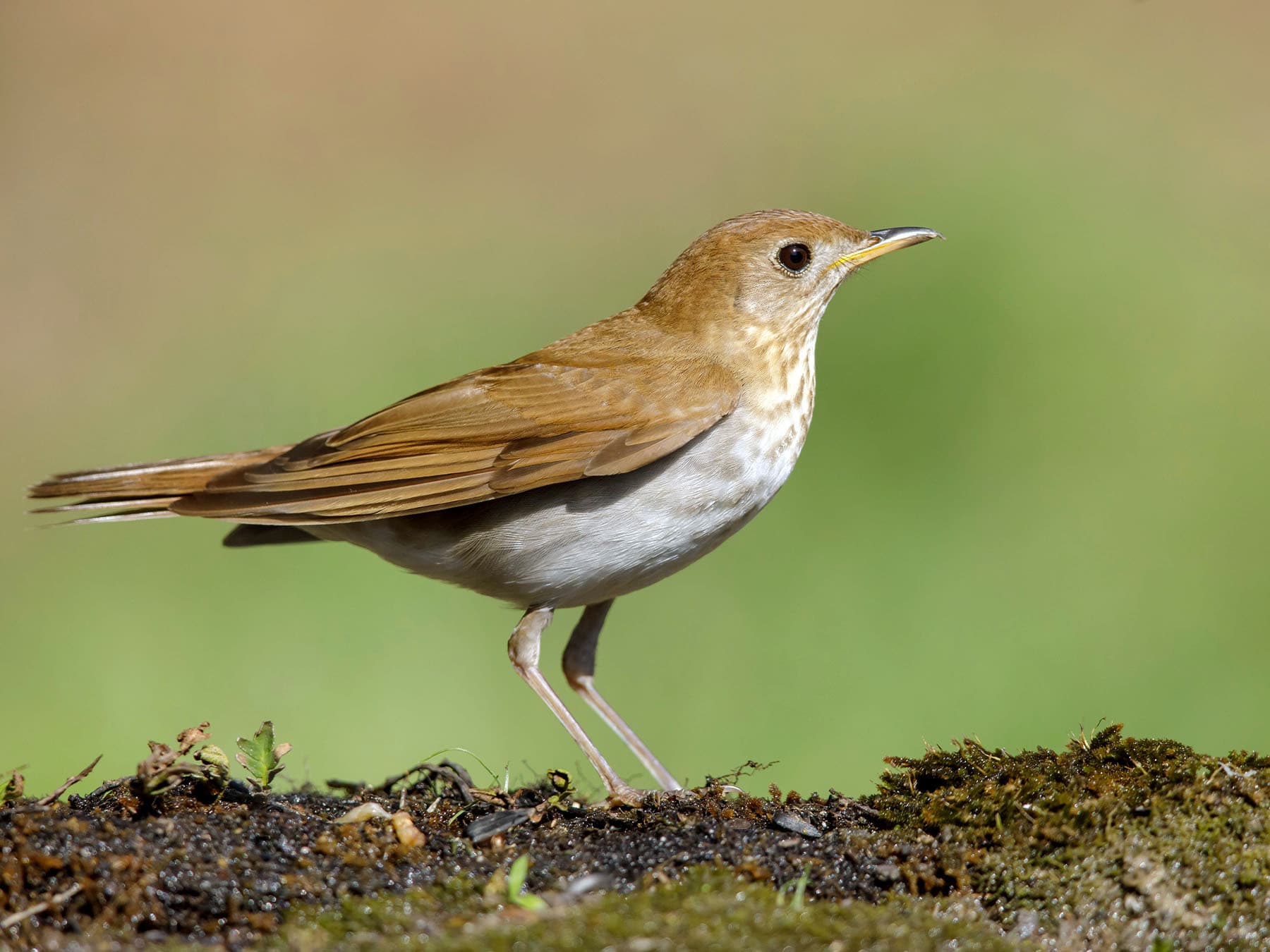
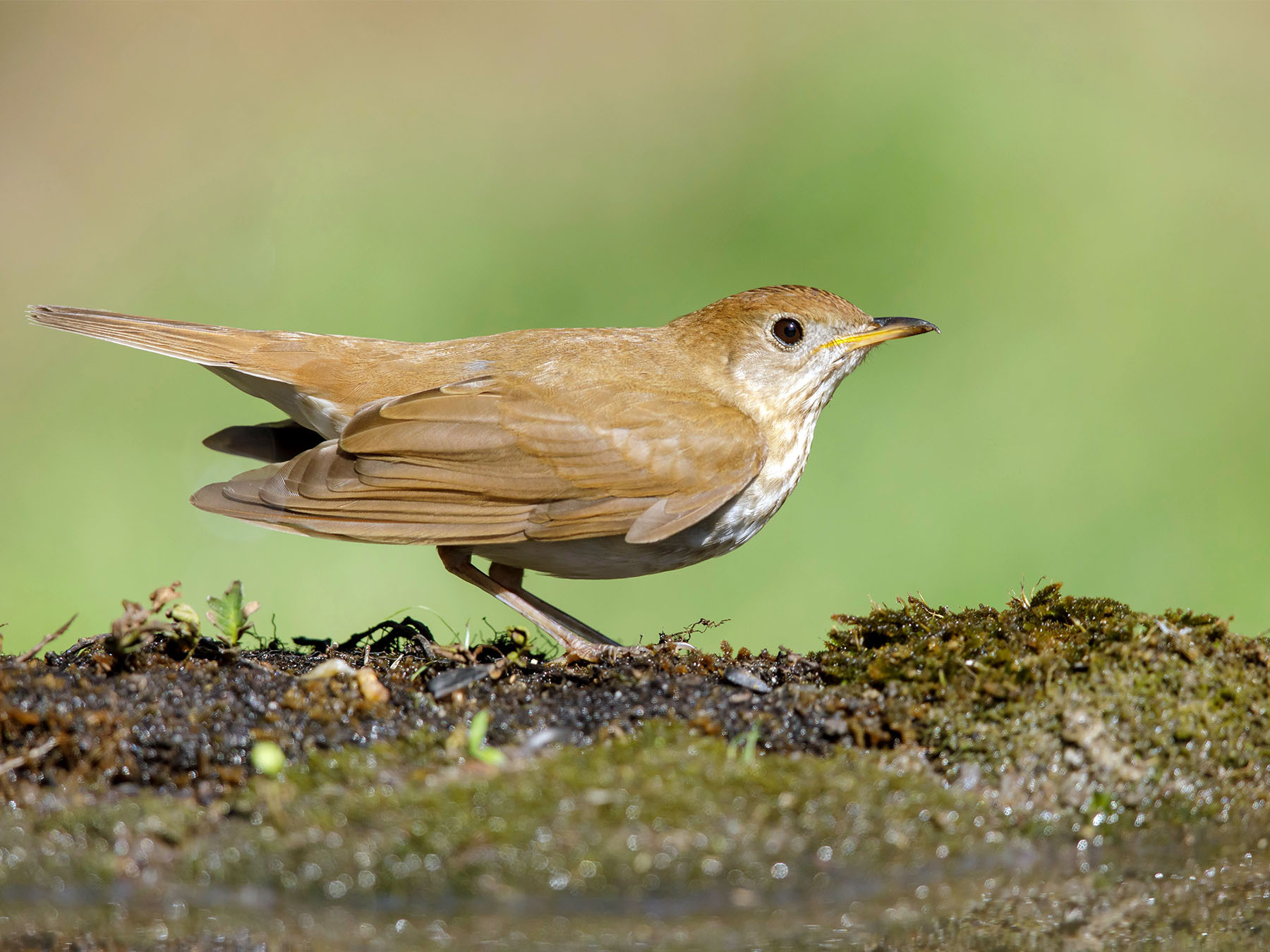
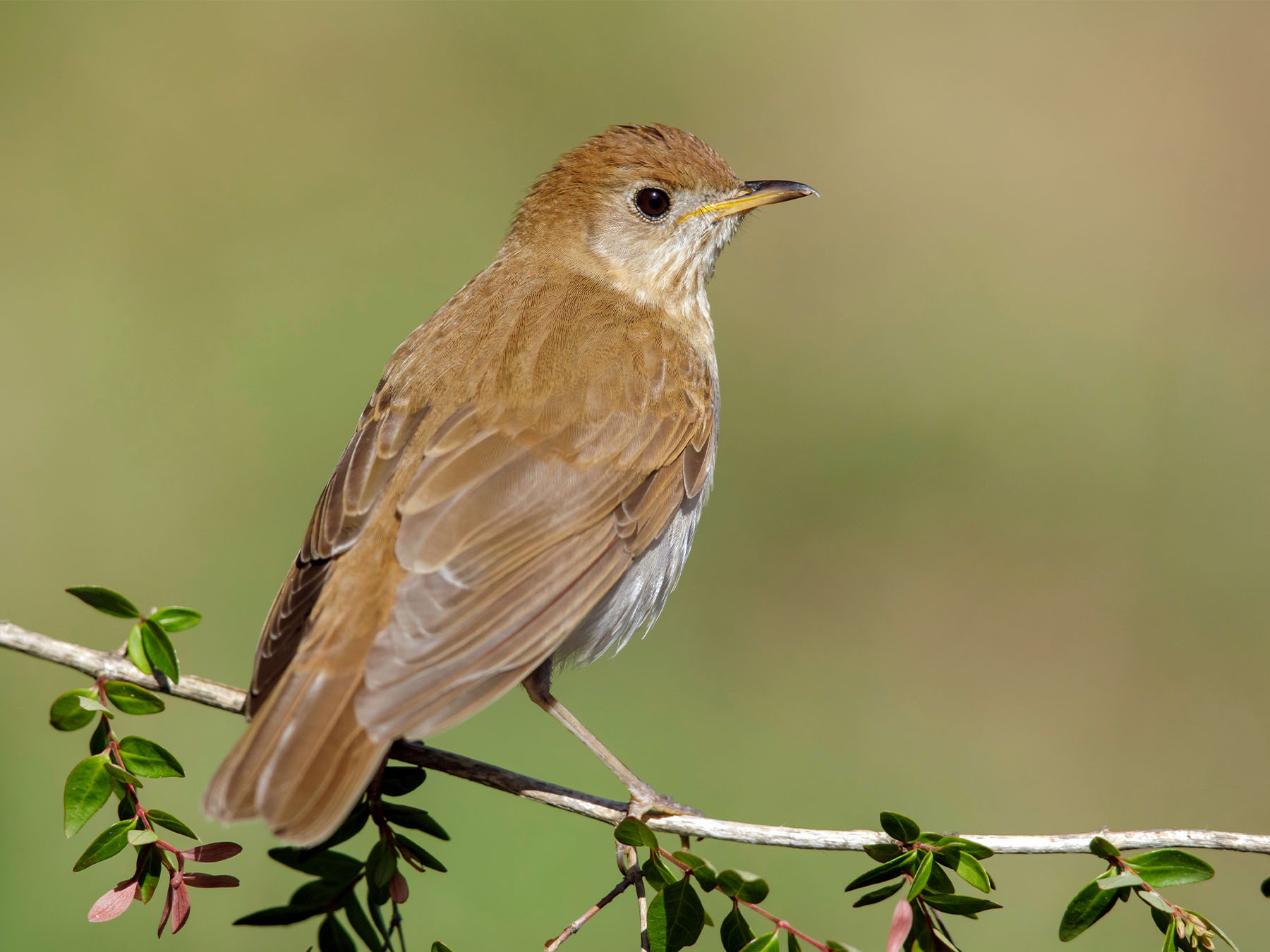
The Veery is a medium-sized thrush with a distinctive warm, reddish-brown upper body and pale underparts. Its breast is lightly spotted with brown, fading to white on the belly. The bird has a relatively short tail, large eyes, and a subtle pale eye-ring, giving it an alert appearance.
Males and females appear identical to casual observation, though they can be distinguished by careful measurement. Juveniles show a slightly more spotted pattern on their upperparts. The Veery maintains its plumage year-round, with no significant seasonal changes.
Its size
Adults- Length
- 16–19 cm
- Wingspan
- 28–33 cm
- Weight
- 28–32 g
Its song and calls
The Veery's song is a haunting, downward-spiraling series of flute-like notes, often described as "veer-veer-veer-veer." This ethereal song is most frequently heard at dawn and dusk.
Their call is a sharp, descending "veer" or a soft "pew" when alarmed.
- Song0:00 / 0:17
Recorded in New York, United States · June 2018
- Call0:00 / 1:06
Recorded in Wisconsin, United States · June 2013
When and where to see it
OctoberMostly absent
Most recorded in October
- 1. Floridaunder 0.1%
- 2. South Carolinaunder 0.1%
- 3. Georgiaunder 0.1%
- 4. District of Columbiaunder 0.1%
- 5. North Carolinaunder 0.1%
Each dot is a county, state or province: the bigger and darker, the larger the bird’s share of that place’s bird records that month. Grey dots: no regular records. The ringed point is the centre of the bird’s records this month; the arrow shows how it moved since last month, and the dashed loop its path through the year. “Arrivals” colours places where it becomes regular this month (orange) or is in its last regular month (grey). GBIF eBird Observation Dataset, 2019–2024. Map data: Natural Earth, US Census Bureau; place centres © OpenStreetMap contributors.
In your area
See when the Veery is recorded in your county, state or province.
How often the Veery turns up in the United States and Canada through the year, from birdwatchers' records.
United States
Summer visitor · regularly Apr–Sep · most records in June
Canada
Summer visitor · regularly May–Sep · most records in June
Show as a table
| Month | United States | Canada |
|---|---|---|
| January | <0.001% | <0.001% |
| February | – | – |
| March | <0.001% | – |
| April | 0.027% (regular) | 0.003% |
| May | 0.26% (regular) | 0.39% (regular) |
| June | 0.27% (regular) | 0.71% (regular) |
| July | 0.16% (regular) | 0.54% (regular) |
| August | 0.053% (regular) | 0.15% (regular) |
| September | 0.10% (regular) | 0.065% (regular) |
| October | 0.011% | 0.002% |
| November | <0.001% | <0.001% |
| December | <0.001% | <0.001% |
Worldwide: recorded regularly in 16 countries
Countries where it was recorded in at least 3 of the 6 years 2019–2024. Linked countries have their own bird list.
North America (13)
Data: EOD – eBird Observation Dataset (Cornell Lab of Ornithology), accessed via GBIF.org, CC BY 4.0. Records from 2019–2024, aggregated and filtered by Birdfact. How these lists are made
Tips for seeing it
- Look for Veeries in damp, deciduous forests with dense understory
- Listen for their unique, downward-spiraling flute-like song, especially at dusk
- Observe quietly, as they are shy and easily startled
- In the US and Canada, watch for them during spring and summer months
What it eats
Veeries primarily feed on insects and other invertebrates, including beetles, ants, caterpillars, and spiders. They also consume small fruits and berries, especially during late summer and fall, as they prepare for migration.
Their ground-foraging behavior is characterized by quick, short hops and sudden pauses to listen for prey.
Nesting and breeding
Veeries breed from May to July, with males establishing territories through song. Females build cup-shaped nests low to the ground, often in shrubs or on fallen logs.
The nest is constructed of leaves, grass, and twigs, lined with fine plant fibers. Females typically lay 3-5 pale blue eggs, sometimes with brown speckles.
Incubation lasts about 12 days, primarily by the female. Both parents feed the nestlings, which fledge after 10-12 days. Veeries usually raise one brood per season.
Behaviour
Veeries are known for their secretive nature, often staying close to the ground in dense undergrowth. They forage by hopping along the forest floor, flipping leaves to uncover insects.
During the breeding season, males become more visible as they perch on low branches to sing their distinctive song.
Conservation
While currently listed as Least Concern, Veery populations are declining due to habitat loss and fragmentation. Climate change may also affect their breeding and wintering grounds.
Conservation efforts focus on protecting large tracts of mature forests and managing understory vegetation.
More photos
3 photos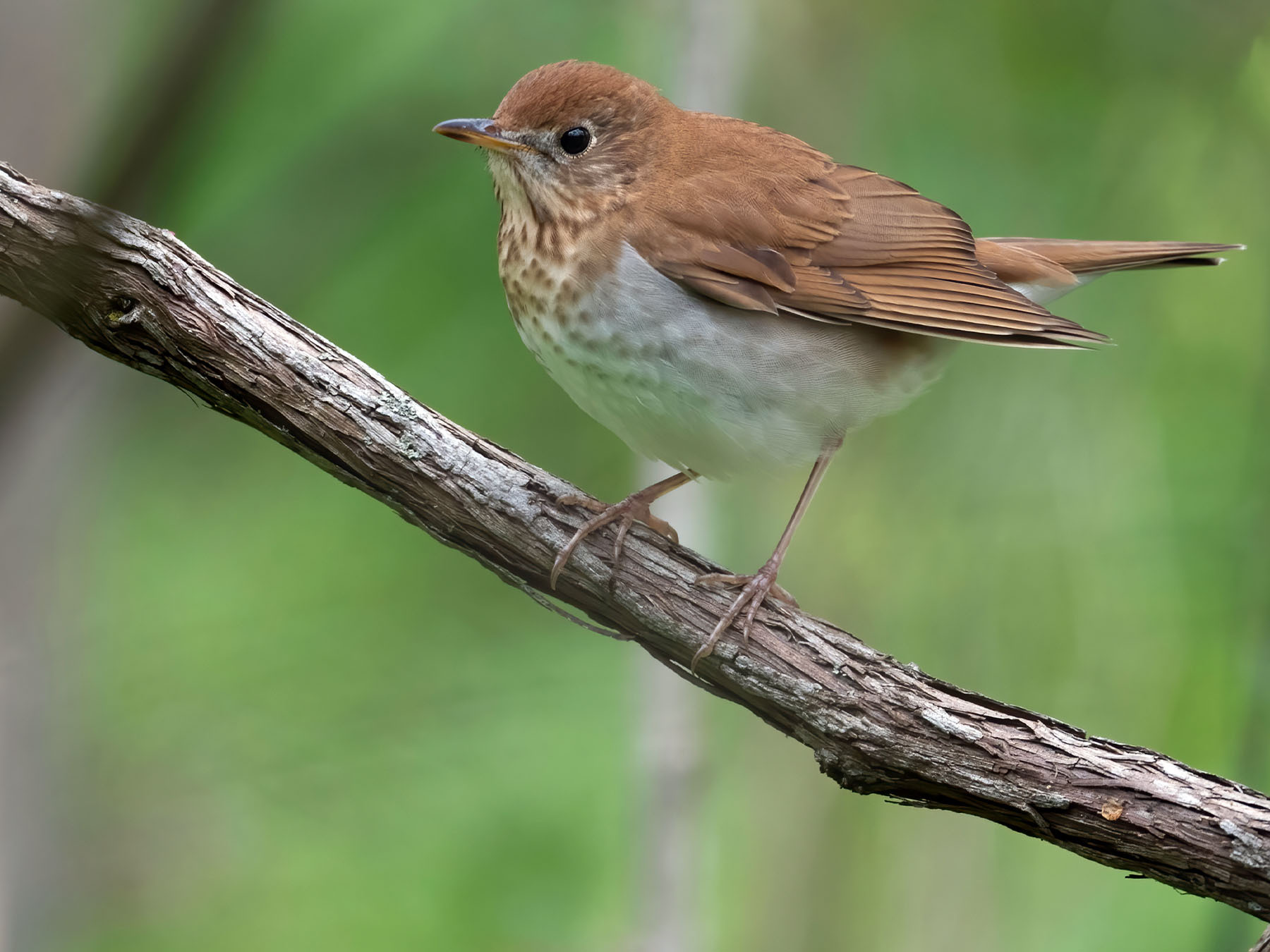
Quick facts
- Length
- 16–19 cm
- Wingspan
- 28–33 cm
- Weight
- 28–32 g
- Lifespan
- 8–10 years · oldest recorded 10.1 years
- Family
- Thrushes
- Migration
- Long-distance Migrant
- Global status (IUCN)
- Least Concern
- World population
- 11,000,000 mature individuals
- Population trend
- Decreasing
- Also called
- Wilson's Thrush, Tawny Thrush
- Scientific name
- Catharus fuscescens
Sources
4- 1BirdLife International. 2018. Catharus fuscescens. The IUCN Red List of Threatened Species 2018: e.T22708655A131949838. Source (opens in a new tab)
- 2del Hoyo et al. (2005)
- 3Partners in Flight (2019) Source (opens in a new tab)
- 4Carey and Judge, Longevity Records: Life Spans of Mammals, Birds, Amphibians, Reptiles, and Fish (2000) Source (opens in a new tab)

Checked by
Nathan Cope, founder and editor
Nathan founded Birdfact and leads its writers and contributors in the UK, the US and Canada. He has watched and studied birds for more than ten years, and checks every article and species guide before it’s published.