


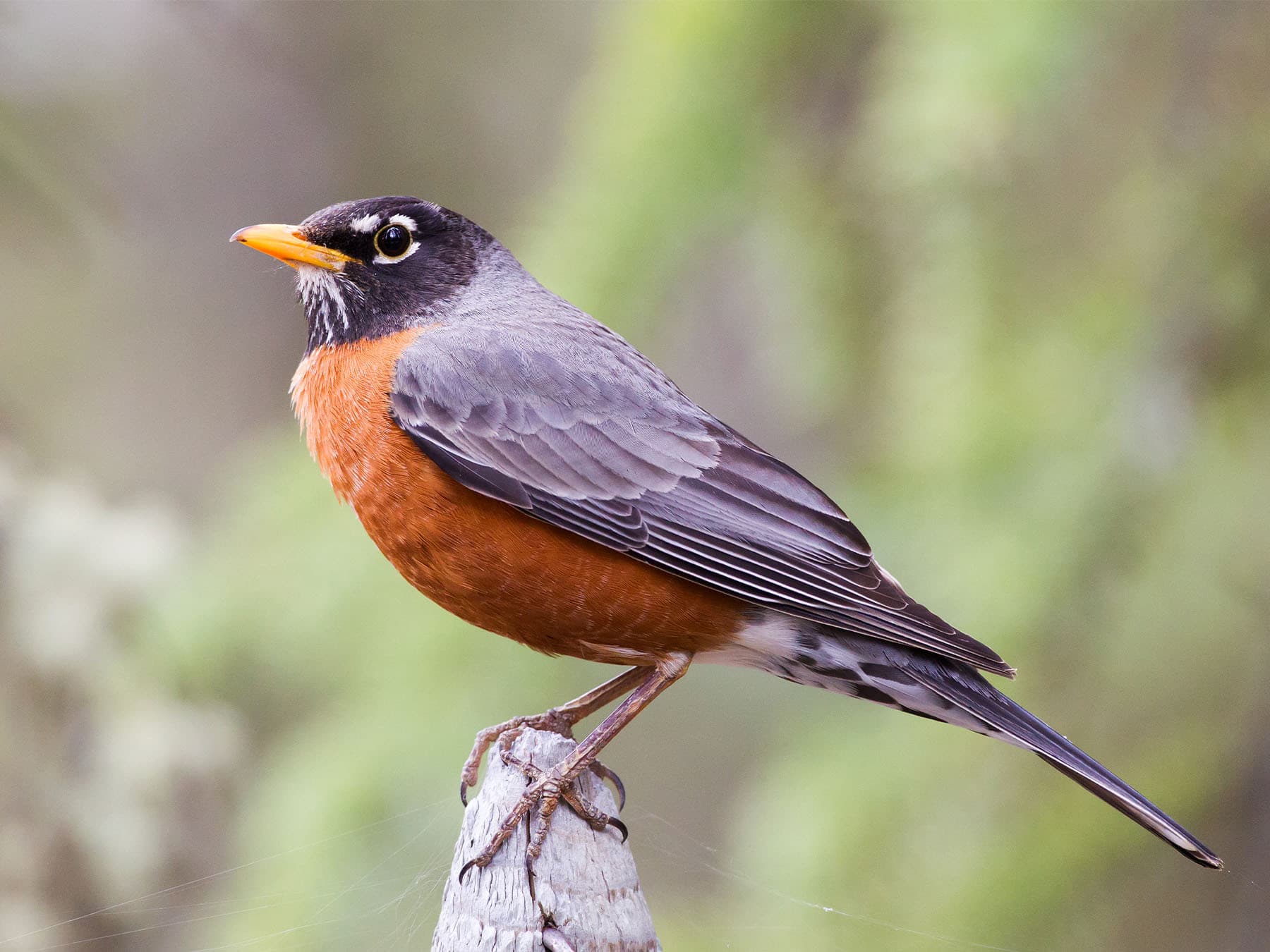
American Robin
Turdus migratorius
By the Birdfact teamChecked by Nathan Cope
See it in 3D
2 plumages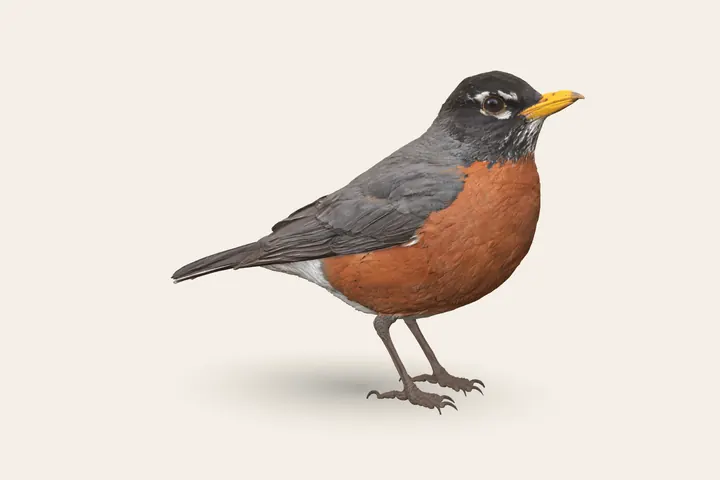 3D model
An American Robin is 8–11 in (20–28 cm) long, bill to tail.
3D model · Adult · Length 8–11 in (20–28 cm) · How we make our birds · Report a problem
© 2026 NC Digital Limited (Birdfact). All rights reserved. This 3D model may be viewed on this page and shared by link only. Downloading, extracting, copying or reusing it, or using it to train machine-learning models, is not permitted without our written permission. Using our models
On this page16 sections
How to recognise it
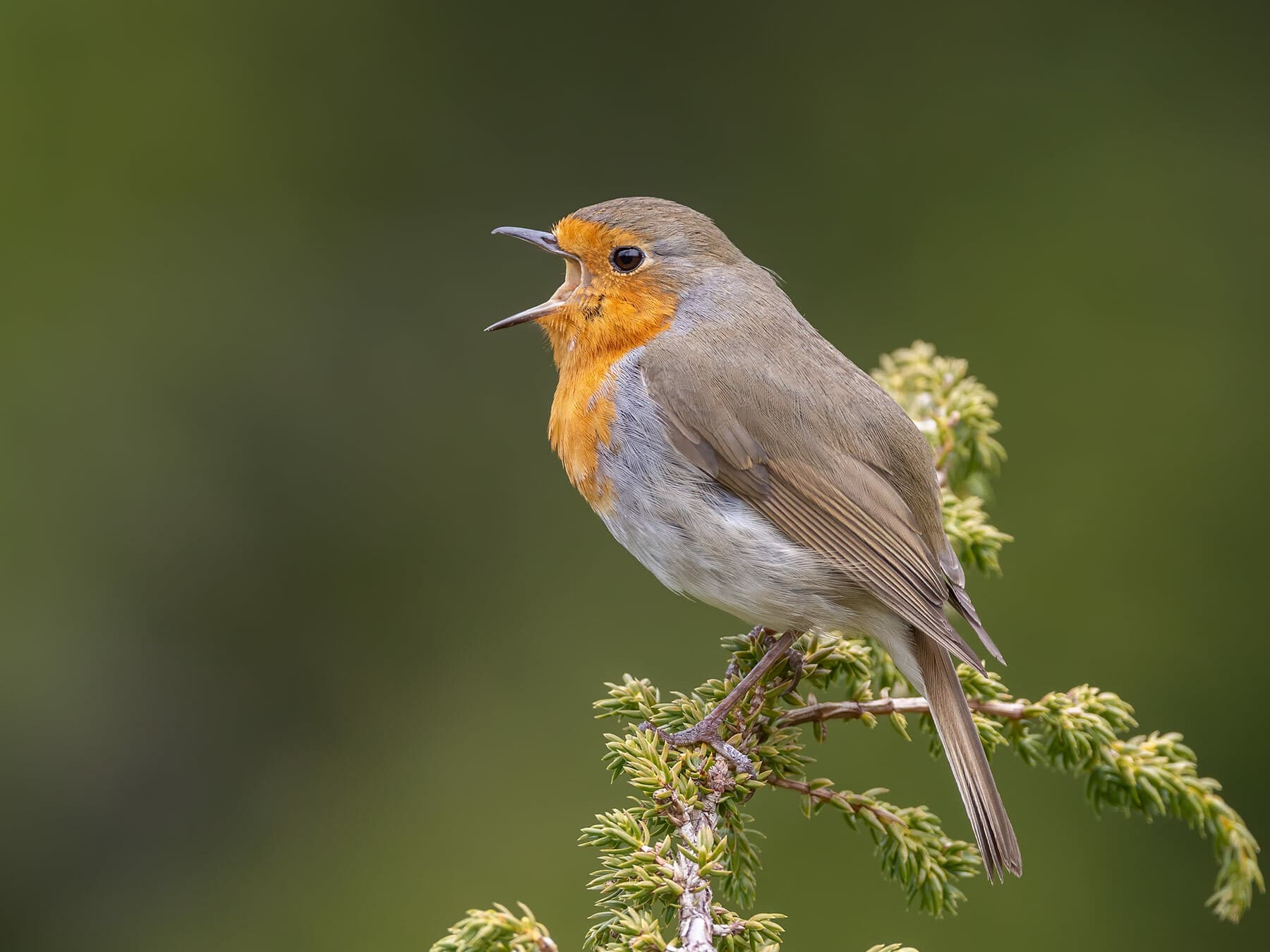
This is the American Robin of North America, a thrush. In Britain and Europe, "robin" means the European Robin, a much smaller bird in a different family: see American Robin vs European Robin.
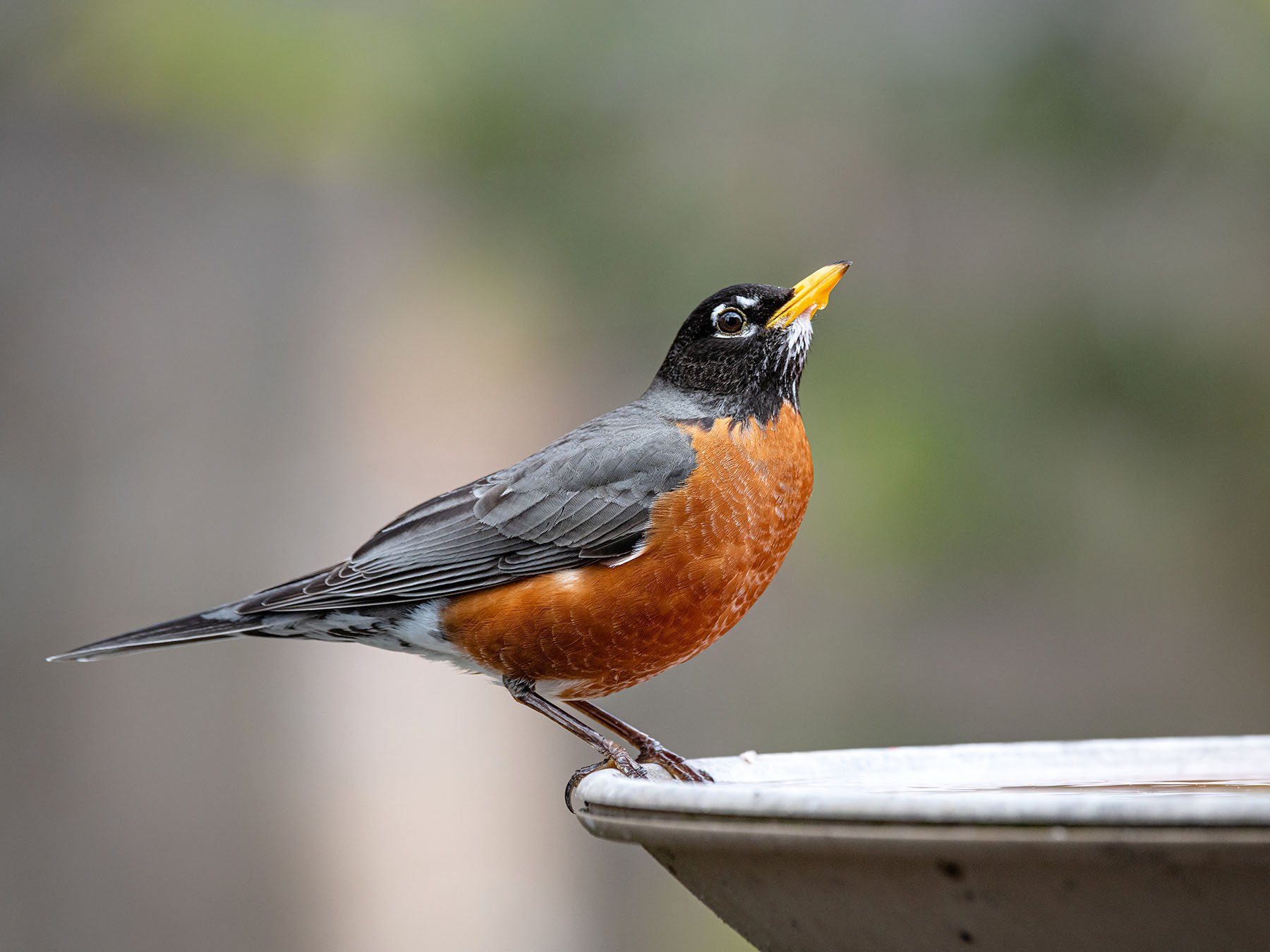
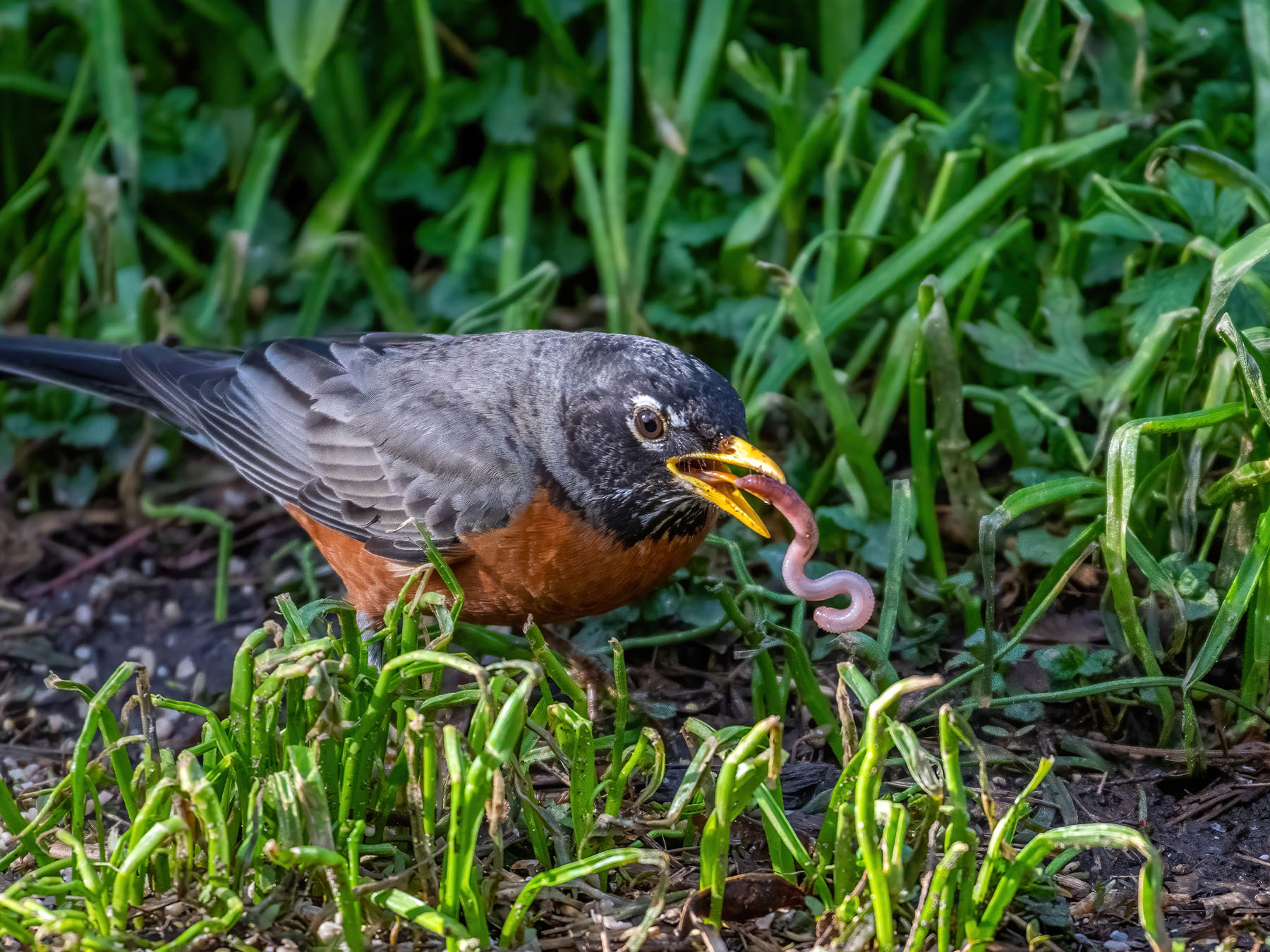
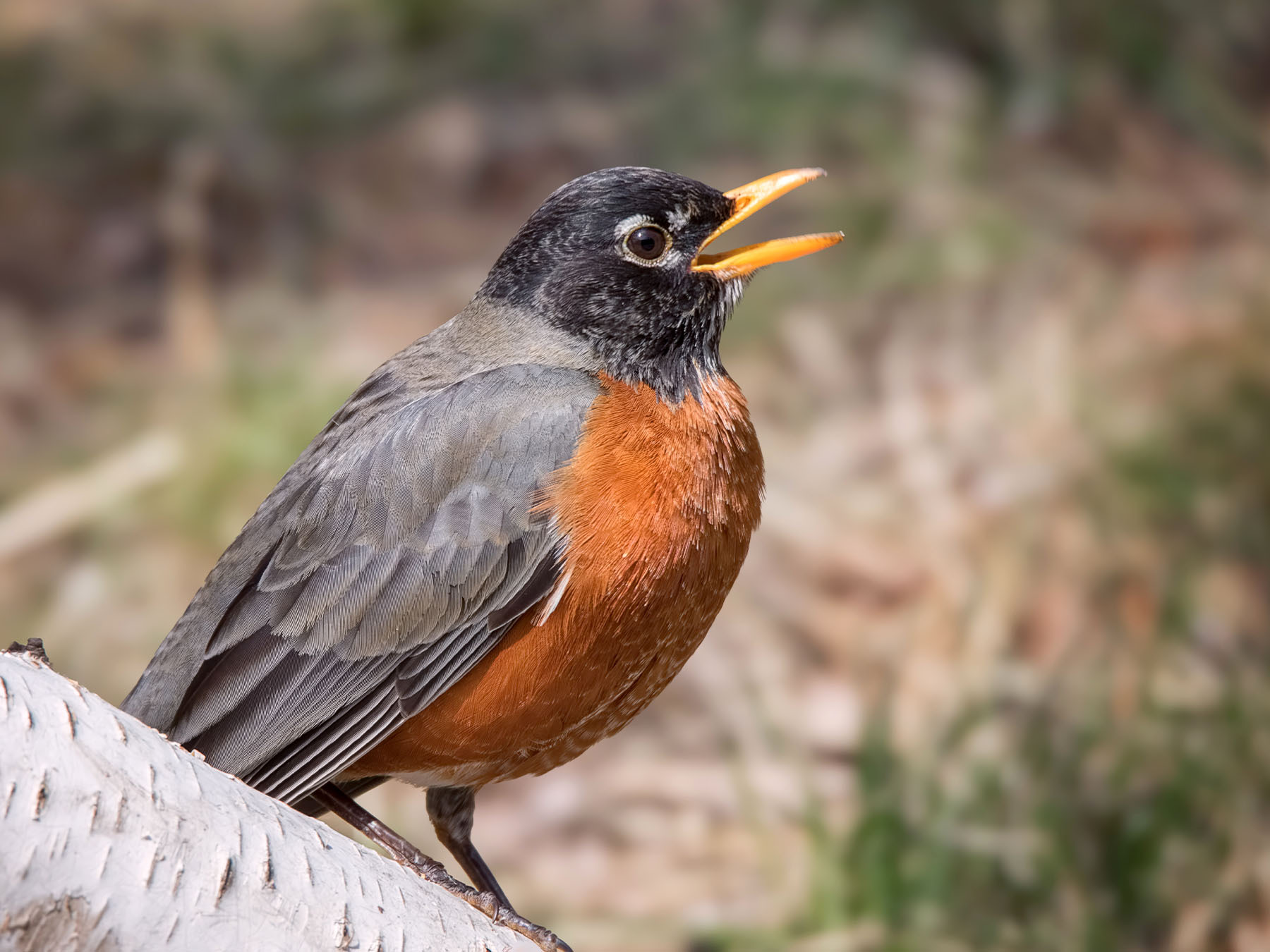
An American Robin is a large, round-bellied songbird with long legs and a fairly long tail. It is gray-brown above with a brick-red to orange breast, a dark head and a yellow bill. Look for the broken white ring around the eye, the white throat streaked with black, and the white patch under the tail as it flies off.
It is the largest thrush in North America: 8 to 11 in (20 to 28 cm) long, with a wingspan of 12 to 16 in (31 to 40 cm), and it weighs 2.7 to 3.0 oz (77 to 85 g). Field guides use "robin-sized" as a yardstick for other birds. When it lands, a robin flicks its tail down several times, and in flight the orange under the wing shows.1
Male, female and young
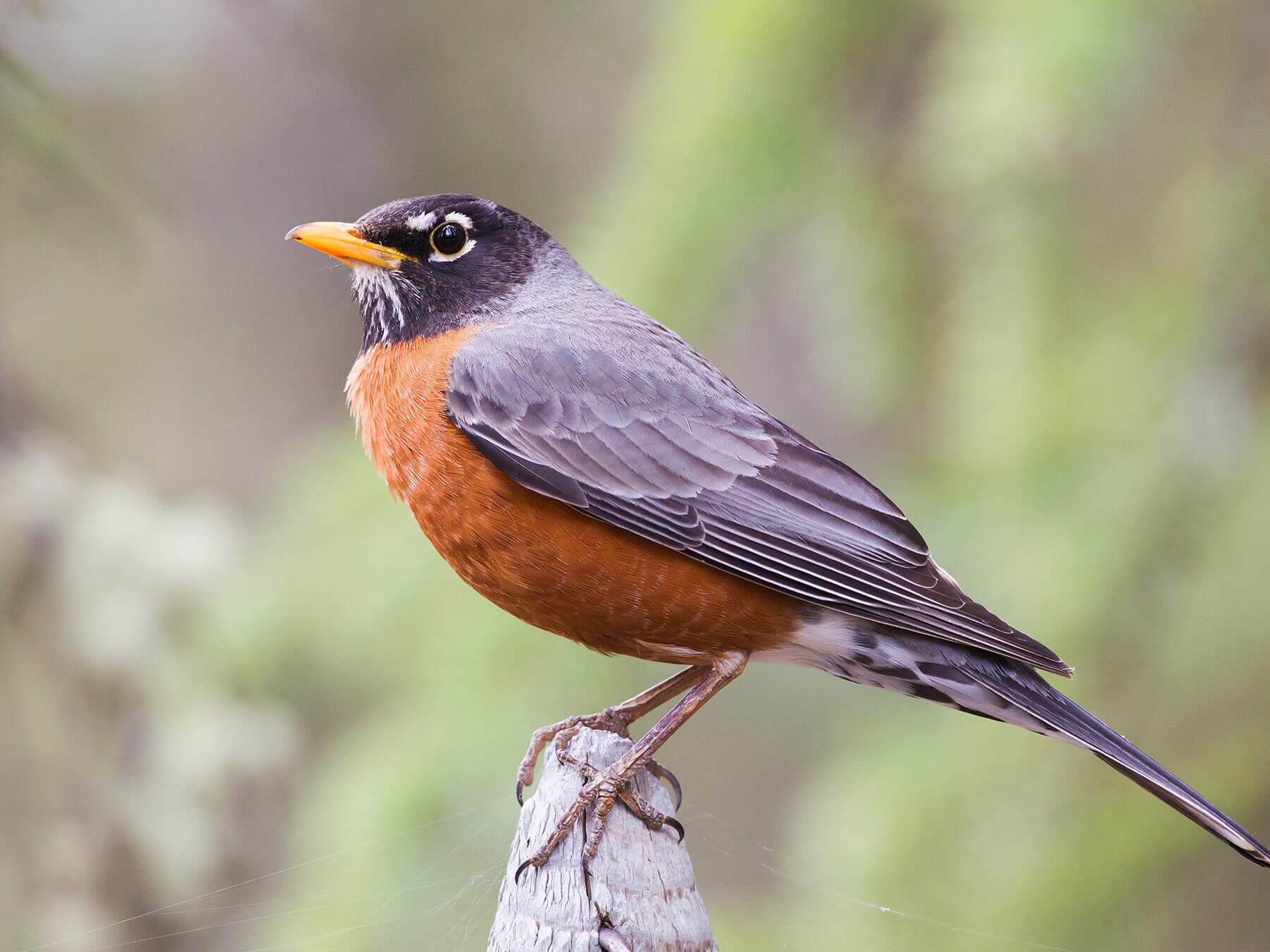
Males and females are similar, and some birds cannot be sexed at all. A typical female has a paler gray head that contrasts less with her back, a paler orange breast and more white on the belly. Males are at their darkest in spring.
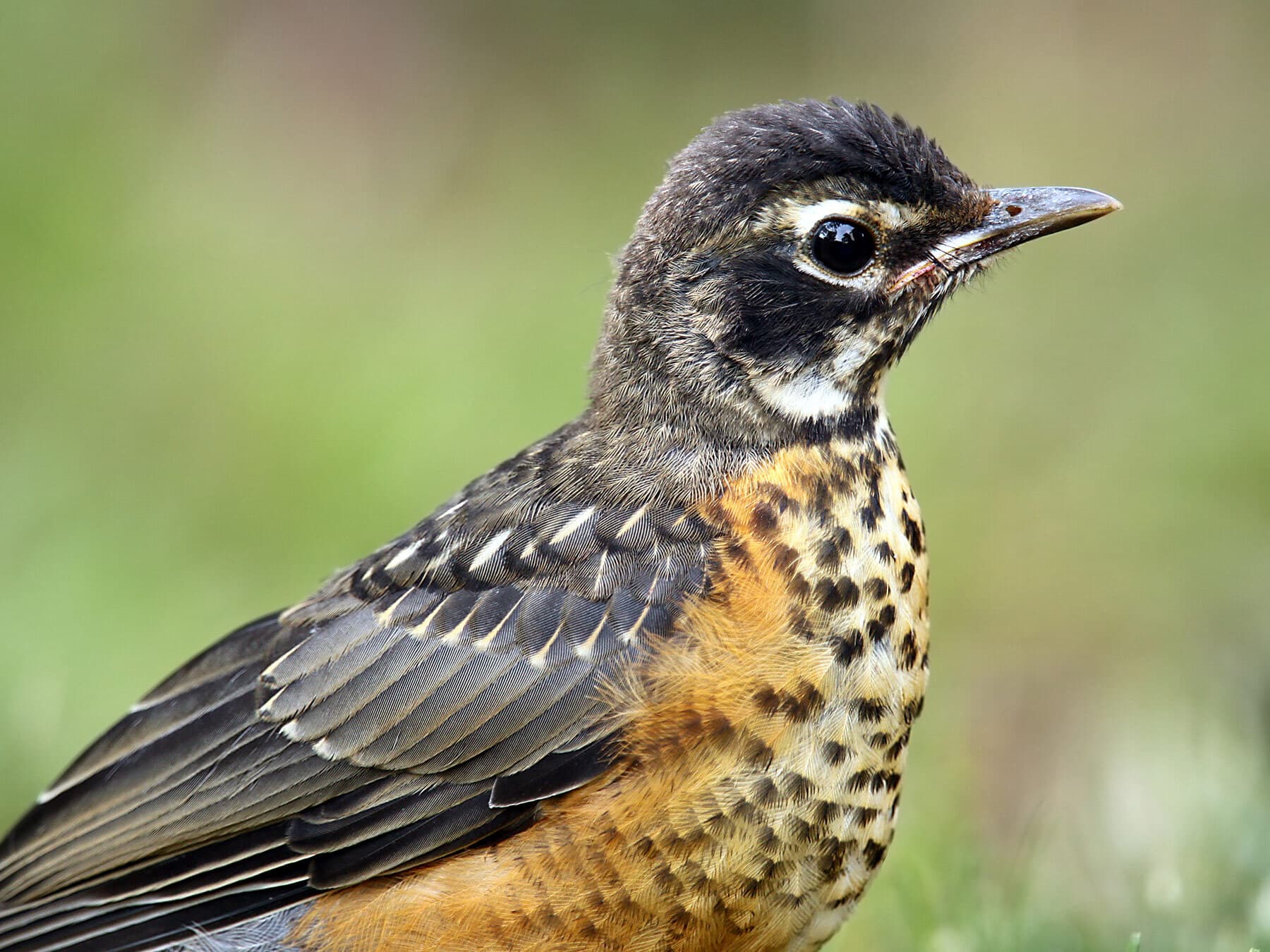
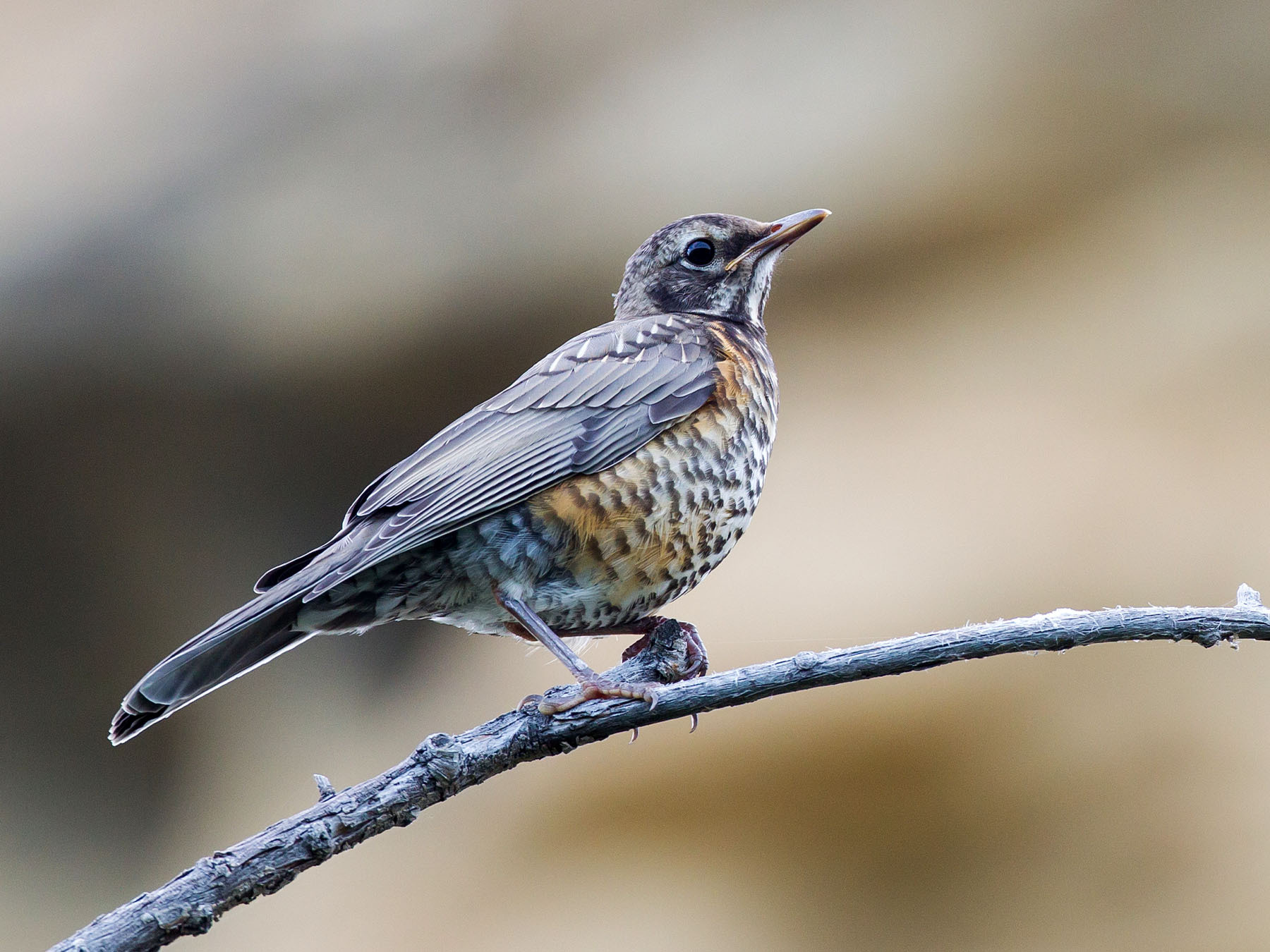
Young robins look different: the breast is pale orange to buff and covered in black spots, the back is speckled with pale spots, and the head is paler. For each stage from egg to juvenile, see baby American Robins.
Robins also vary across the continent. Western birds are paler and duller, with little or no white in the tail corners, while breeders in Newfoundland and Labrador are the darkest, with a blackish back. Birds of the World recognizes seven subspecies, including the very pale San Lucas Robin of southern Baja California, which BirdLife International treats as a separate species.2
Identification: similar birds
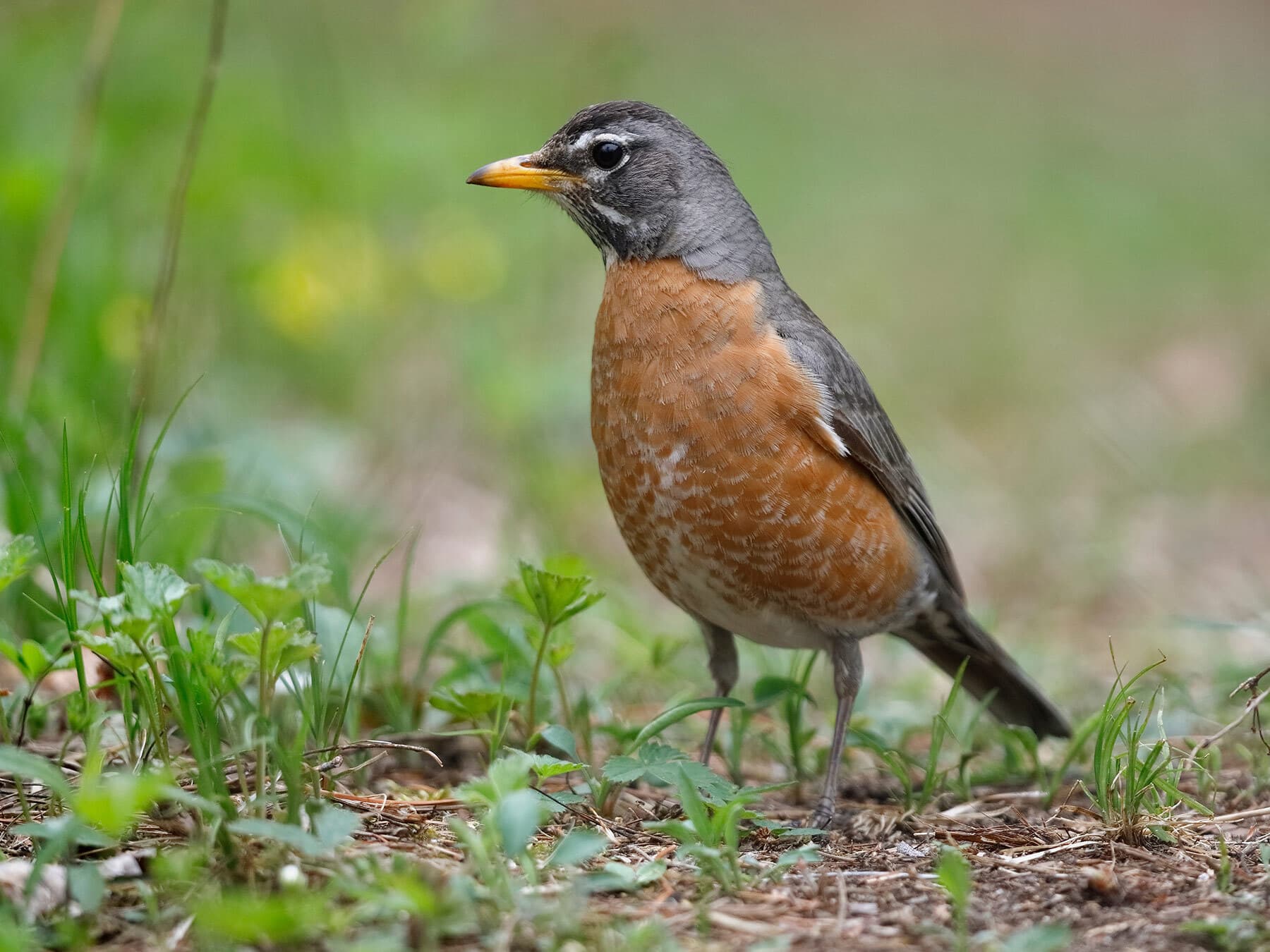
The Varied Thrush also has an orange breast, but it has an orange stripe over the eye, orange wing bars and a black band across the breast. In western Mexico, and rarely in the Southwest, the Rufous-backed Robin has a rufous back, no white around the eye and a more heavily streaked throat.
Its size
Adults- Length
- 20–28 cm
- Wingspan
- 31–40 cm
- Weight
- 77–85 g
Its song and calls
The song is a clear, caroling run of rising and falling whistles, often written as cheerily, cheer up, cheer up, cheerily, cheer up. The robin is one of the first birds to sing at dawn and one of the last at dusk.
Three calls are worth knowing. A sharp chuck or yeep is the alarm, aimed at snakes, jays and other predators. A rapid, rising chirr comes from winter flocks and birds taking off. A thin, high seet warns of a hawk overhead, and robins that hear it stop and look up at the sky.
Males start singing in late winter or early spring, sing most during courtship, and most go quiet in July and August while they molt. Most song is over by the end of October, though some robins sing through the winter.
Each male has 6 to 20 song types, and up to 85% of the notes in a robin's song are its own inventions rather than copies of its neighbors.3
Dawn song
Where there is artificial light, robins may start singing in the middle of the night: at one site in Pennsylvania the first songs came as early as 1:11 a.m.3
- Song0:00 / 0:43
Recorded in Newfoundland and Labrador, Canada · May 2010
- Call0:00 / 0:58
Recorded in Massachusetts, United States · June 2020
When and where to see it
OctoberIn season
Most recorded in October
- 1. Nebraska4.3%
- 2. South Dakota3.8%
- 3. North Dakota3.6%
- 4. Vermont3.6%
- 5. Minnesota3.5%
Each dot is a county, state or province: the bigger and darker, the larger the bird’s share of that place’s bird records that month. Grey dots: no regular records. The ringed point is the centre of the bird’s records this month; the arrow shows how it moved since last month, and the dashed loop its path through the year. “Arrivals” colours places where it becomes regular this month (orange) or is in its last regular month (grey). GBIF eBird Observation Dataset, 2019–2024. Map data: Natural Earth, US Census Bureau; place centres © OpenStreetMap contributors.
In your area
See when the American Robin is recorded in your county, state or province.
How often the American Robin turns up in the United States and Canada through the year, from birdwatchers' records.
United States
Resident · all year · most records in June
Canada
Resident · all year · most records in April
Show as a table
| Month | United States | Canada |
|---|---|---|
| January | 1.7% (regular) | 1.5% (regular) |
| February | 2.0% (regular) | 1.8% (regular) |
| March | 2.7% (regular) | 3.6% (regular) |
| April | 2.7% (regular) | 4.4% (regular) |
| May | 2.7% (regular) | 3.4% (regular) |
| June | 3.1% (regular) | 3.9% (regular) |
| July | 2.9% (regular) | 3.9% (regular) |
| August | 1.9% (regular) | 2.5% (regular) |
| September | 1.7% (regular) | 2.2% (regular) |
| October | 1.9% (regular) | 2.9% (regular) |
| November | 1.8% (regular) | 2.0% (regular) |
| December | 1.7% (regular) | 1.6% (regular) |
Worldwide: recorded regularly in 6 countries
Countries where it was recorded in at least 3 of the 6 years 2019–2024. Linked countries have their own bird list.
North America (6)
Data: EOD – eBird Observation Dataset (Cornell Lab of Ornithology), accessed via GBIF.org, CC BY 4.0. Records from 2019–2024, aggregated and filtered by Birdfact. How these lists are made
Almost anywhere with lawns and trees: yards, parks, towns, farmyards and golf courses, and also forests, burned or logged woodland, mountains up to the treeline and the tundra. Robins breed across nearly all of the US and Canada, north into Alaska, and south into the highlands of Mexico.
Across most of the US you can see robins in any month. In Florida they are mainly winter visitors, and in Alaska summer ones.
Do American Robins migrate?
Some do and some do not. Most robins that breed in the interior of Canada and the northern US spend the winter in the southern US and Mexico, while those in the far south, and many along the Pacific coast, stay all year.3 Many others stay surprisingly far north, but in winter they roost in trees and roam in flocks after berries, so you see far fewer on lawns. The "first robin of spring" may be a bird that spent the winter only a few miles away.
Robins migrate in flocks by day. In spring large numbers move north through Florida and the Gulf states from late February, roughly keeping pace with the thaw, and reach Michigan by early April.
Where do robins go in winter?
Wherever there is fruit. Winter flocks of a dozen to several hundred birds wander between fruiting trees and shrubs, and gather at night in communal roosts that can hold an estimated quarter of a million birds.31 There is no evidence that robins return to the same winter spot each year, and a flock moves on once the fruit runs out.
Spotting tips
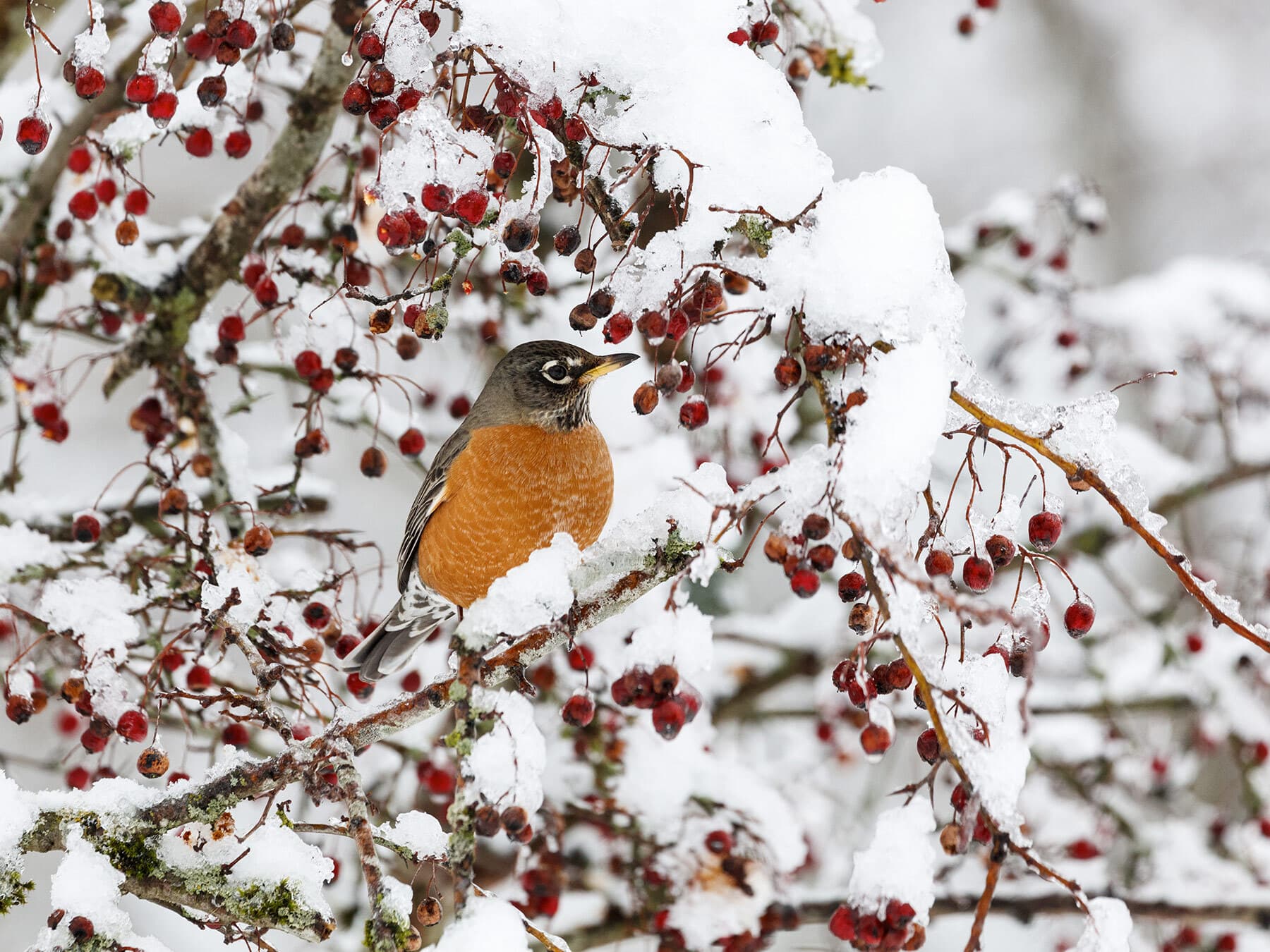
Watch a short lawn after rain or mowing: robins prefer short grass, and mowing sets off a burst of feeding. In winter, look up instead of down: check fruiting holly, hawthorn and juniper, and listen for the low cuck notes of a flock.
What it eats
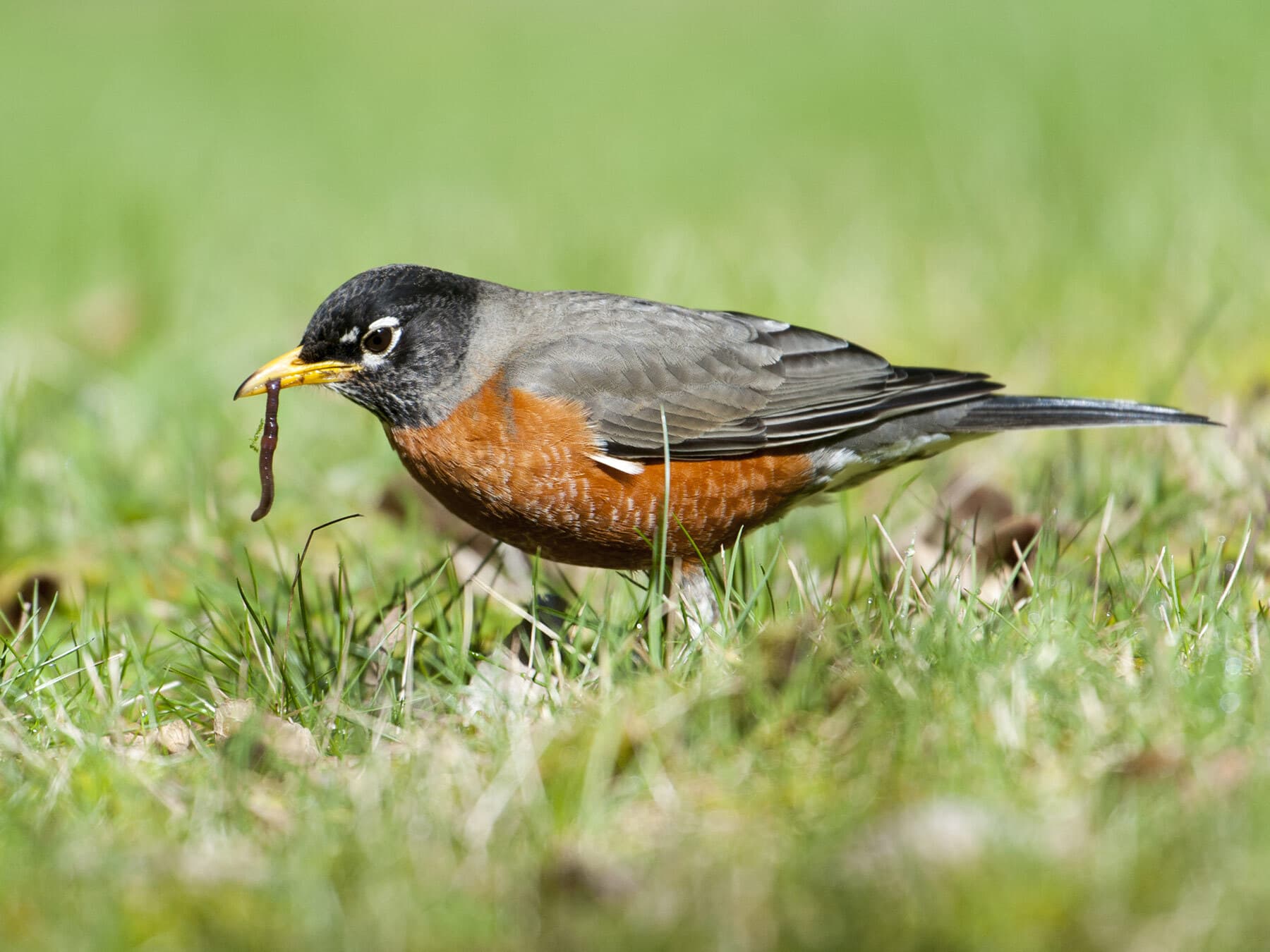
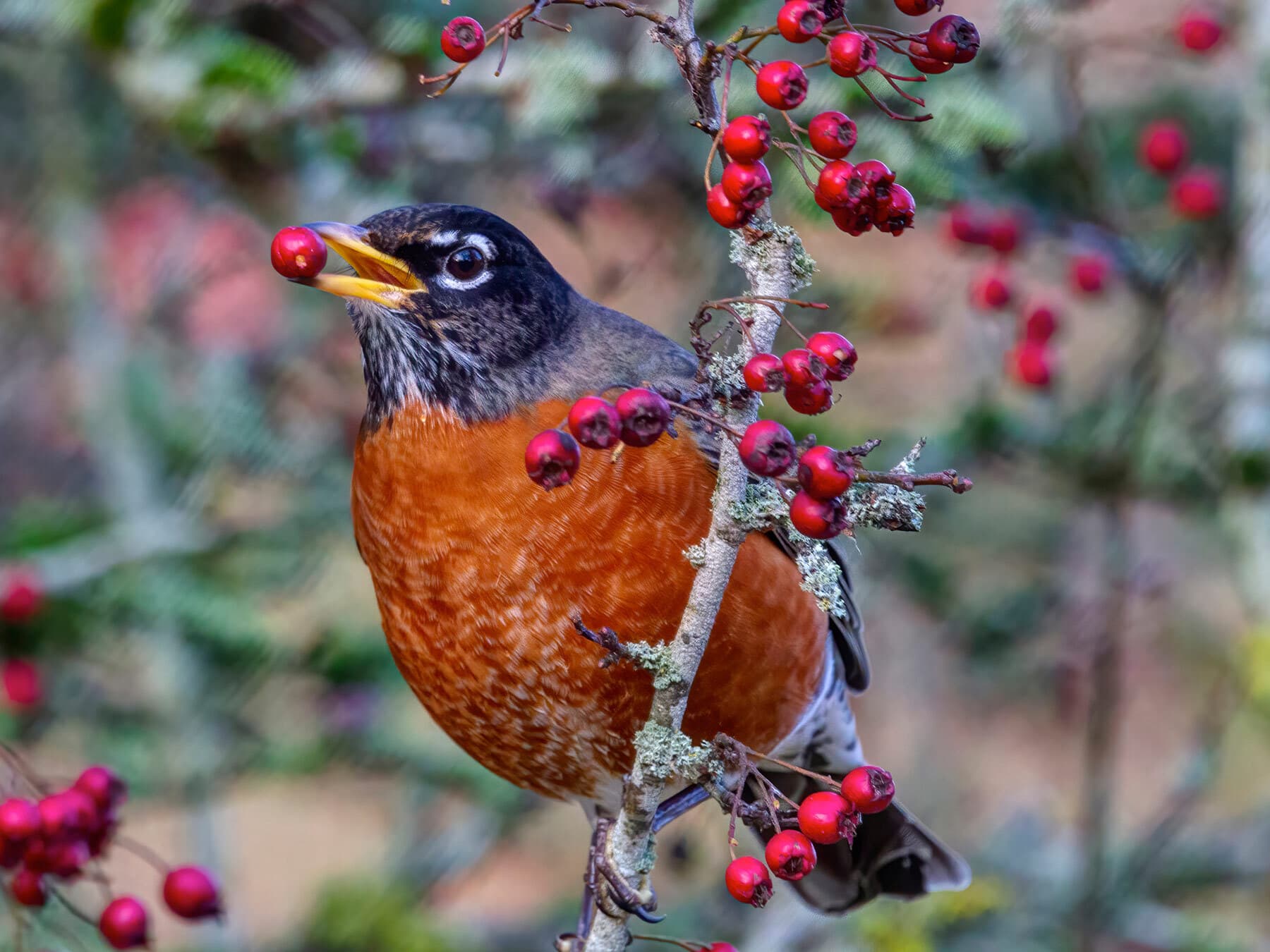
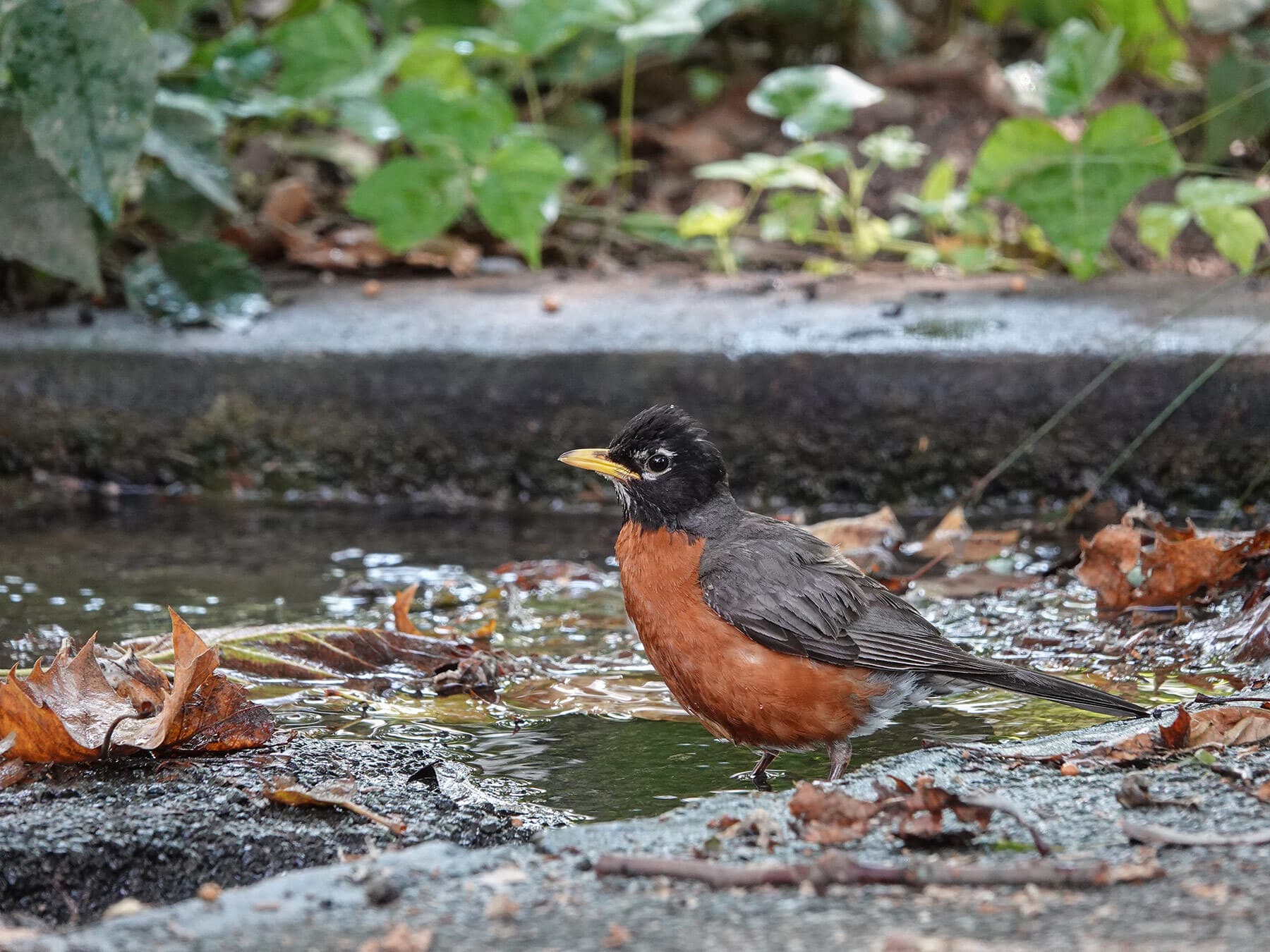
Earthworms and insects in spring and summer, fruit in fall and winter. Besides worms, robins eat beetles, caterpillars, grubs and snails, and a long list of fruit, from chokecherries, dogwood and sumac to hawthorn and juniper berries.
The switch is dramatic. In an analysis of 1,169 robin stomachs collected across North America, fruit made up more than 90% of the diet in fall and winter but less than 10% in spring.3
A robin hunting worms runs a few steps, stops, cocks its head to stare at the ground, then stabs. Early studies concluded it was looking, not listening, but in experiments published in 1997, captive robins found buried mealworms by hearing alone, and found fewer when white noise was played.4
Robins that eat nothing but honeysuckle fruit can become intoxicated.
Feeding them in your yard
Robins do visit feeders. Project FeederWatch lists fruit, mealworms, suet, hulled sunflower seeds and peanut hearts for them, offered on the ground or on a platform feeder.5
Water draws them too: robins bathe in birdbaths, puddles and lawn sprinklers. And go easy on lawn insecticides. In Québec, lawns treated with chlorpyrifos produced fewer young robins, probably because the treatment reduced the earthworms.3
Nesting and breeding
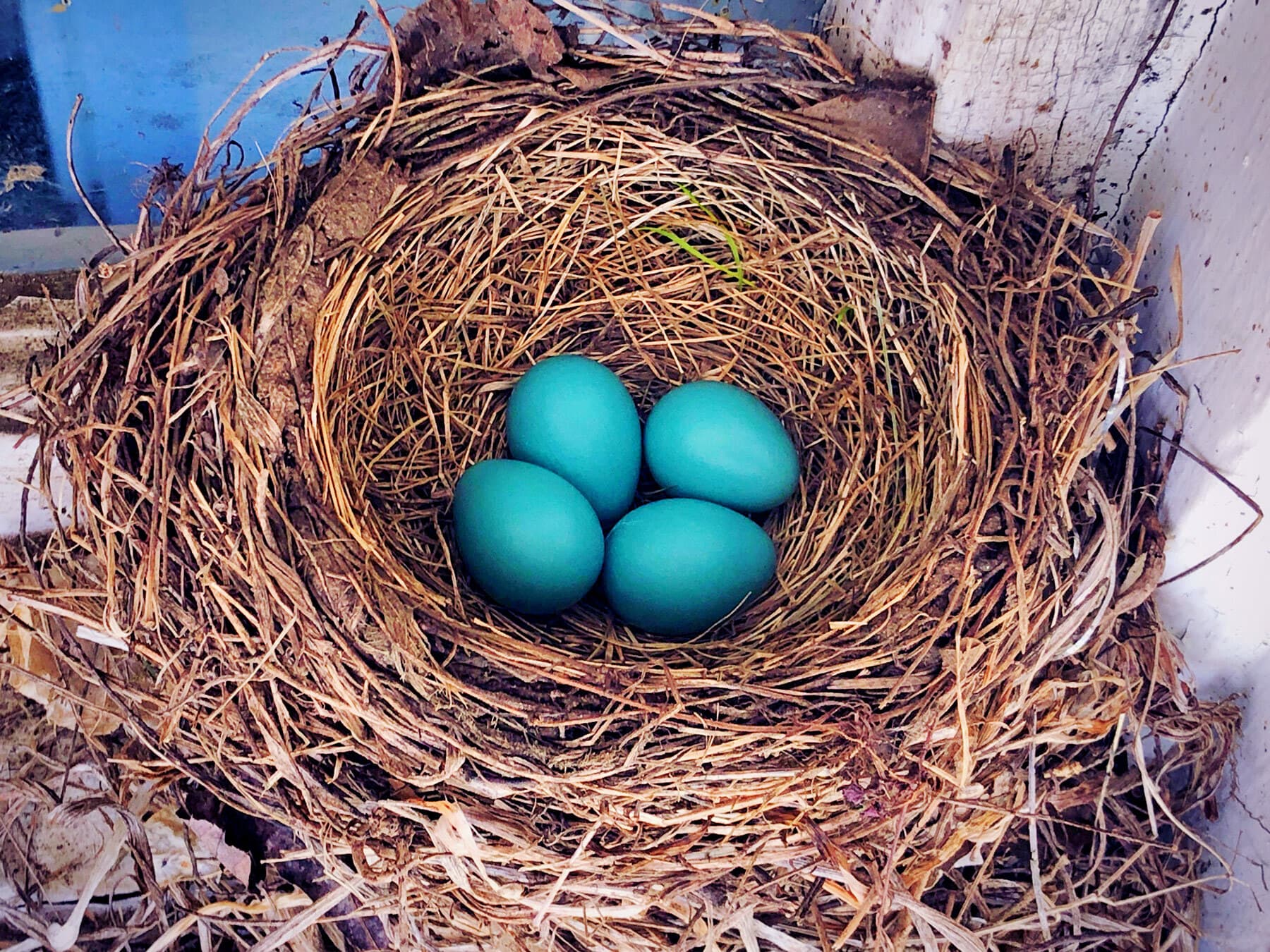
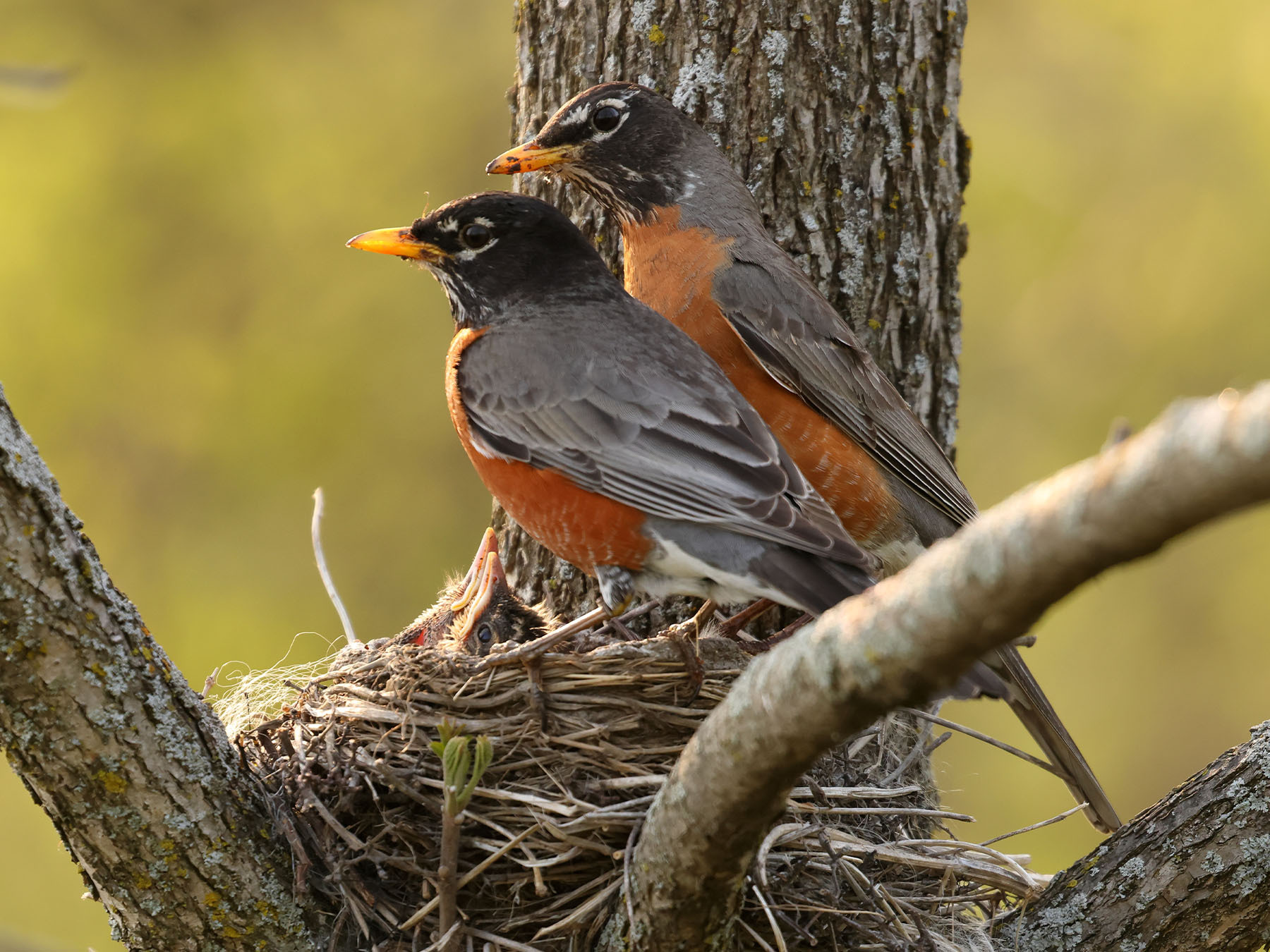
The female builds a sturdy cup of dead grass and twigs, shapes it with the wrist of her wing, plasters it with mud from worm castings and lines it with fine grass. The nest sits on a firm branch, often in the lower half of a tree, or on a ledge: gutters, eaves and outdoor light fixtures all get used.
She lays three or four sky-blue eggs, sometimes five, and incubates them for 12 to 14 days. The chicks leave the nest about 13 days after hatching, and most pairs raise two broods a year, sometimes three. An active nest is protected: under the Migratory Bird Treaty Act it is illegal to destroy a nest with eggs or young in it.6
More detail: American Robin nesting and eggs and baby American Robins.
Nest shelves
Robins nest on ledges, so NestWatch's design for them is an open nest shelf rather than an enclosed box, mounted 5 to 25 ft up on a building or post in a sheltered spot, such as under the eaves or over a light fixture.7
Behaviour
On a lawn a robin runs a few quick steps, stops dead and stands upright to scan; in long grass it hops. It spends about three-quarters of its time simply perching or standing still.
In the breeding season males hold a territory with song and chases, and some attack their own reflection in a window. Robins are keen bathers, and on warm afternoons they sunbathe on lawns with their wings spread and tail fanned.
Pairs, flocks and roosts: social behavior
Do American Robins mate for life? No. A pair stays together through a breeding season, but any re-pairing in later years seems to be chance. Even within a season, faithfulness is relative: in one Illinois study, 62 to 72% of broods included at least one chick fathered by a male other than the mate.3
Many breeding adults come back to the same territory year after year. Robins also judge people: in one study they let a person come closer when the person stayed on a path and was not looking at them, and robins nesting near buildings give fewer alarm calls.3
Outside the breeding season robins become sociable, feeding in loose flocks and sleeping in communal roosts. In summer, males and young birds roost together while females sleep on their nests.
Lifespan and predators
Most robins live short lives. Long-term field studies found that only about 40% of nests produce young, and only a quarter of the young that leave the nest are still alive in November. After that, only about half of adult robins live from one year to the next, so the whole population turns over in about six years.1
A young robin that makes it to its first November lives, on average, about another 1.7 years.3
Predators and other dangers
Hawks take adults, especially Cooper's and Sharp-shinned Hawks, and domestic cats kill many. Snakes, Blue Jays, crows, Common Grackles, squirrels, chipmunks and raccoons raid nests. Cars and windows kill many more: in a statewide survey in Indiana, robins were the most common bird found dead along roads.3
Lifespan records
The oldest known wild American Robin, identified from its leg band, was 13 years and 11 months old.1
Conservation
The American Robin is of Least Concern. There are an estimated 370 million adults,2 and numbers are stable or rising slightly: about 0.13% a year on the North American Breeding Bird Survey between 1966 and 2019.8 Suburbs, farms and watered lawns have helped it spread, because they bring earthworms near the surface.
Robins also warn of pollution. In the 1950s, DDT sprayed against Dutch elm disease killed many robins on the Michigan State University campus, because earthworms concentrate the chemical; populations took 10 to 17 years to recover.3
Like other native songbirds, it is protected under the Migratory Bird Treaty Act.
Similar birds
Often mistaken for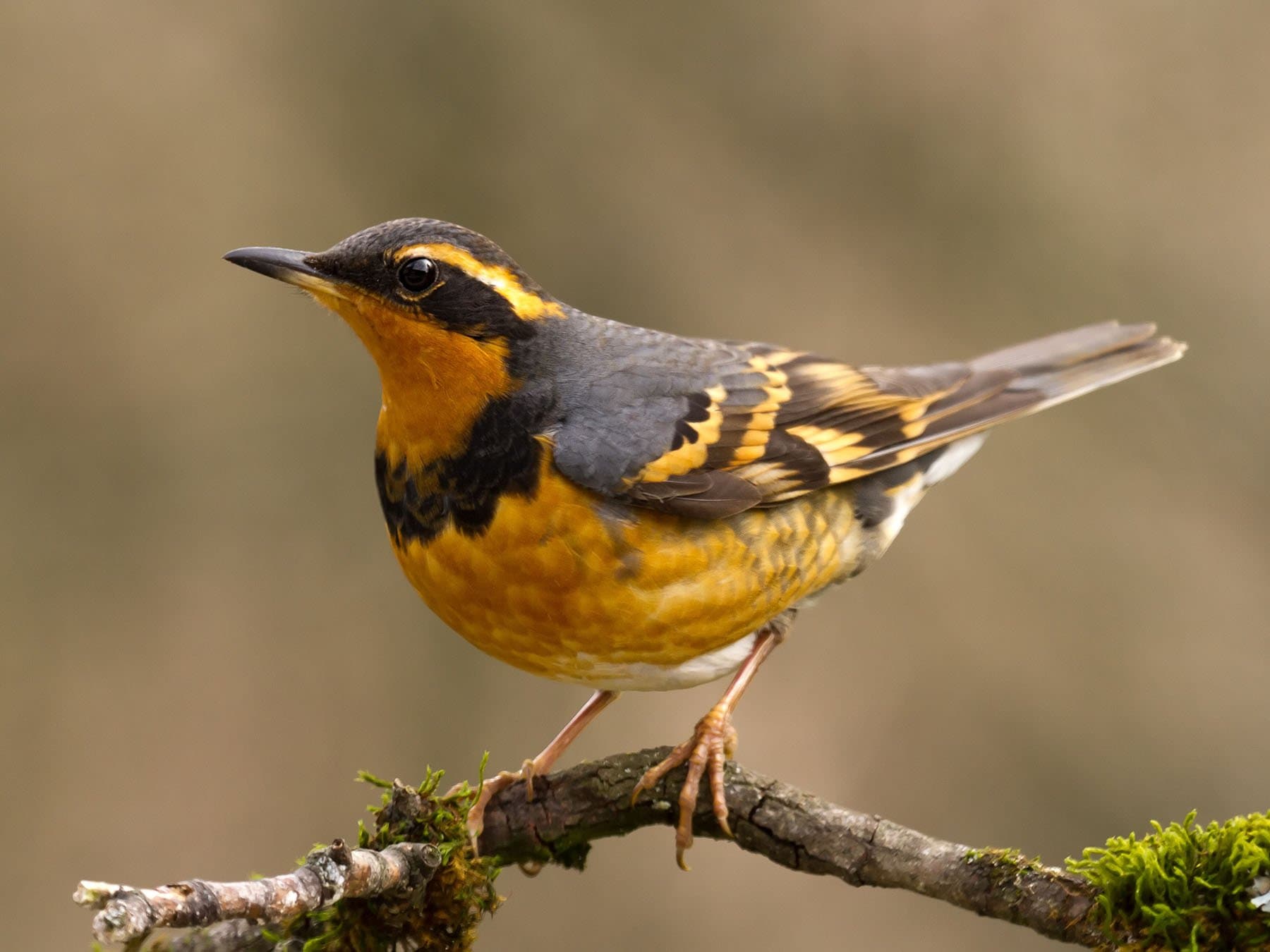
More photos
6 photos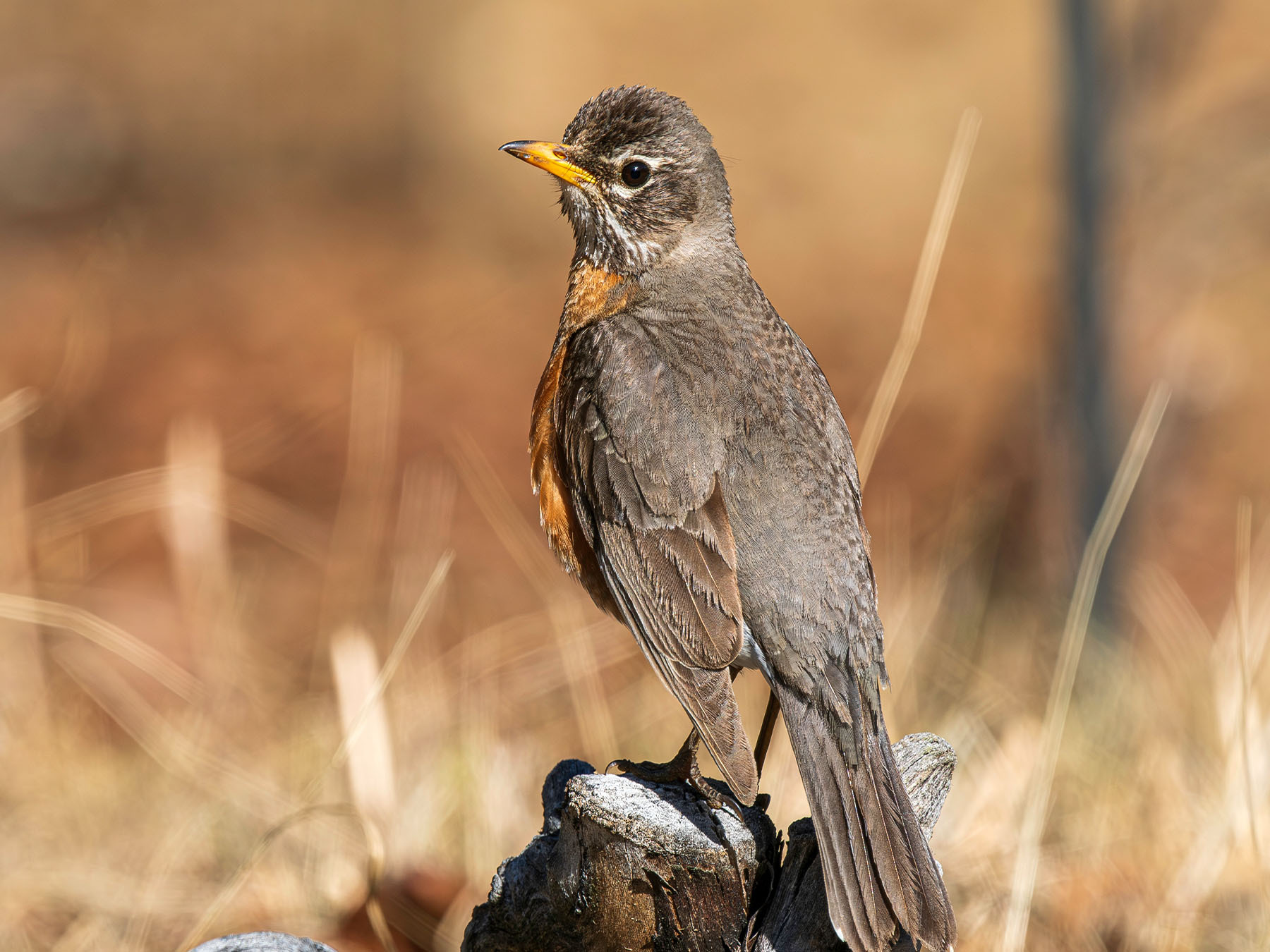
American Robin guides
3 guidesQuick facts
- Length
- 20–28 cm
- Wingspan
- 31–40 cm
- Weight
- 77–85 g
- Lifespan
- 2 years · oldest recorded 13 years 11 months
- Family
- Thrushes
- Migration
- Partial migrant
- Global status (IUCN)
- Least Concern
- World population
- 370,000,000 mature individuals
- Population trend
- Population stable, with some local fluctuations
- Scientific name
- Turdus migratorius
Questions
7How big is an American Robin?
About 10 in (25 cm) long and 2.7 to 3.0 oz (77 to 85 g): the largest thrush in North America. See how to recognize it.
Can you tell male and female American Robins apart?
Often, but not always. Females usually have a paler gray head and a paler breast; some birds cannot be sexed.
Do American Robins mate for life?
No. Pairs stay together for a breeding season, and re-pairing in later years seems to be chance. See behavior.
Why are robin eggs blue?
The color comes from biliverdin, a blue-green pigment laid down in the shell. See American Robin nesting.
Is the American Robin related to the European Robin?
Not closely. They share a name and an orange breast, but the American Robin is a thrush and the European Robin is an Old World flycatcher. See American Robin vs European Robin.
Are there American Robins in the UK?
Only as a very rare stray from across the Atlantic, mostly between October and February.
Which states have the American Robin as their state bird?
Connecticut, Michigan and Wisconsin. See state birds.
Sources
16- 1Cornell Lab of Ornithology. American Robin: Overview and Identification. All About Birds. Accessed 6 October 2026. Source (opens in a new tab)
- 2BirdLife International (2021). Species factsheet: American Robin Turdus migratorius. BirdLife DataZone. Accessed 6 October 2026. Source (opens in a new tab)
- 3Vanderhoff, E. N. et al. (2020). American Robin (Turdus migratorius), version 1.0. Birds of the World (P. G. Rodewald, editor). Cornell Lab of Ornithology. doi:10.2173/bow.amerob.01 (opens in a new tab)
- 4Montgomerie, R. and Weatherhead, P. J. (1997). How robins find worms. Animal Behaviour 54(1): 143-151. doi:10.1006/anbe.1996.0411 (opens in a new tab)
- 5Project FeederWatch. Common Feeder Birds: American Robin. Project FeederWatch, Cornell Lab of Ornithology and Birds Canada. Accessed 6 October 2026. Source (opens in a new tab)
- 6U.S. Fish and Wildlife Service. Bird nests. U.S. Fish and Wildlife Service. Accessed 6 October 2026. Source (opens in a new tab)
- 7NestWatch. Right Bird, Right House: American Robin. NestWatch, Cornell Lab of Ornithology. Accessed 6 October 2026. Source (opens in a new tab)
- 8Cornell Lab of Ornithology. American Robin: Life History. All About Birds. Accessed 6 October 2026. Source (opens in a new tab)
- 9National Audubon Society. American Robin. Audubon Guide to North American Birds (text adapted from Kenn Kaufman, Lives of North American Birds). Accessed 6 October 2026. Source (opens in a new tab)
- 10BirdLife International (2021). Turdus migratorius. The IUCN Red List of Threatened Species 2021: e.T103889499A139392811. doi:10.2305/IUCN.UK.2021-3.RLTS.T103889499A139392811.en (opens in a new tab)
- 11Kaufman, K. (2019). Ask Kenn Kaufman: Are American Robins Really Robins?. Audubon Magazine. Accessed 6 October 2026. Source (opens in a new tab)
- 12BTO. American Robin (Turdus migratorius). BTO BirdFacts. Accessed 6 October 2026. Source (opens in a new tab)
- 13USGS Bird Banding Laboratory. Longevity records of North American birds. Accessed 9 October 2026. Source (opens in a new tab)
- 14BTO. Robin (Erithacus rubecula). BTO BirdFacts. Accessed 25 September 2026. Source (opens in a new tab)
- 15RSPB. Robin. RSPB Bird A-Z. Accessed 25 September 2026. Source (opens in a new tab)
- 16National Audubon Society. Varied Thrush. Audubon Guide to North American Birds. Accessed 9 October 2026. Source (opens in a new tab)

Checked by
Nathan Cope, founder and editor
Nathan founded Birdfact and leads its writers and contributors in the UK, the US and Canada. He has watched and studied birds for more than ten years, and checks every article and species guide before it’s published.