


Common Grackle
Crow Blackbird · Quiscalus quiscula
By the Birdfact teamChecked by Nathan Cope
On this page12 sections
How to recognise it
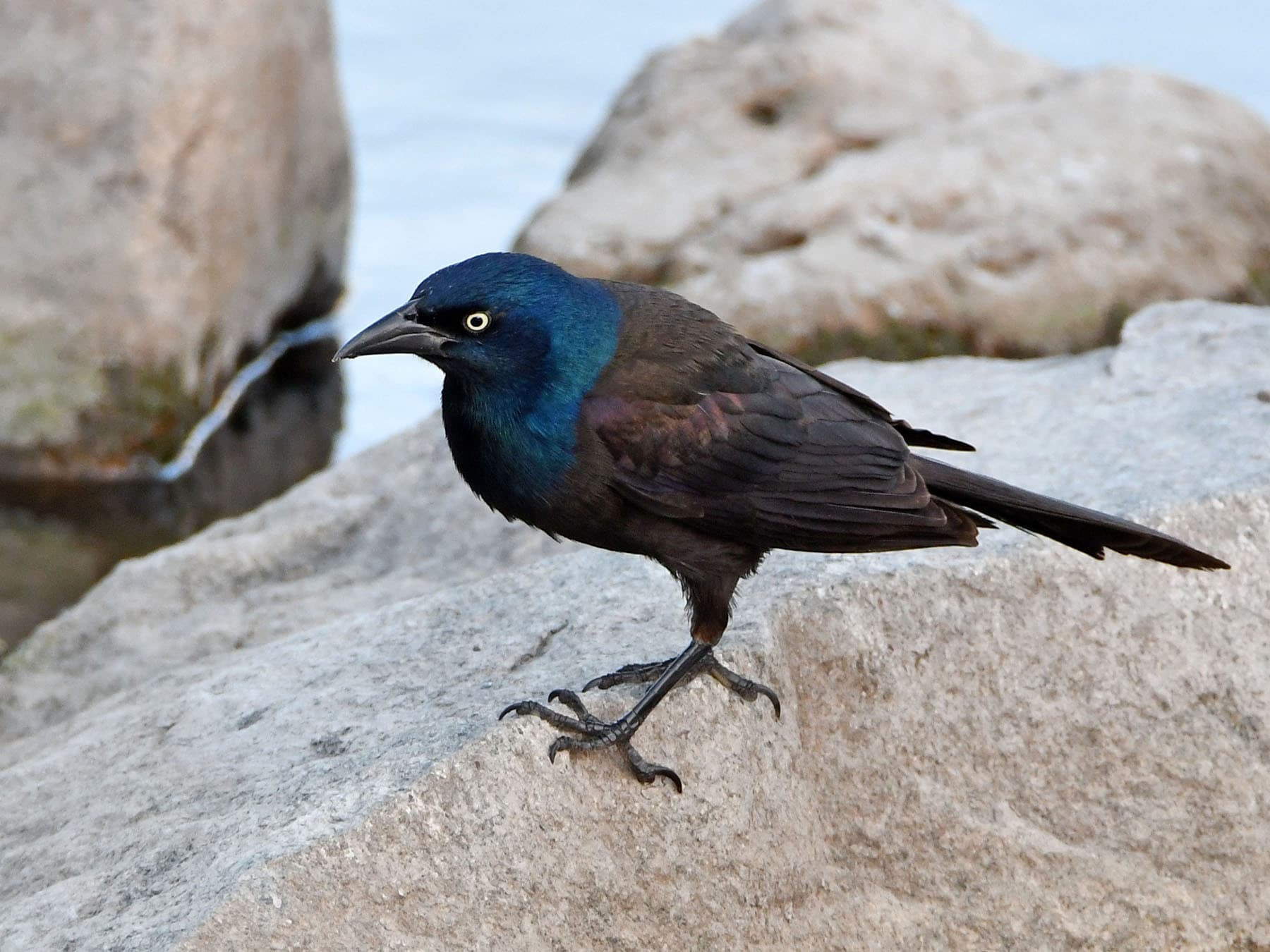
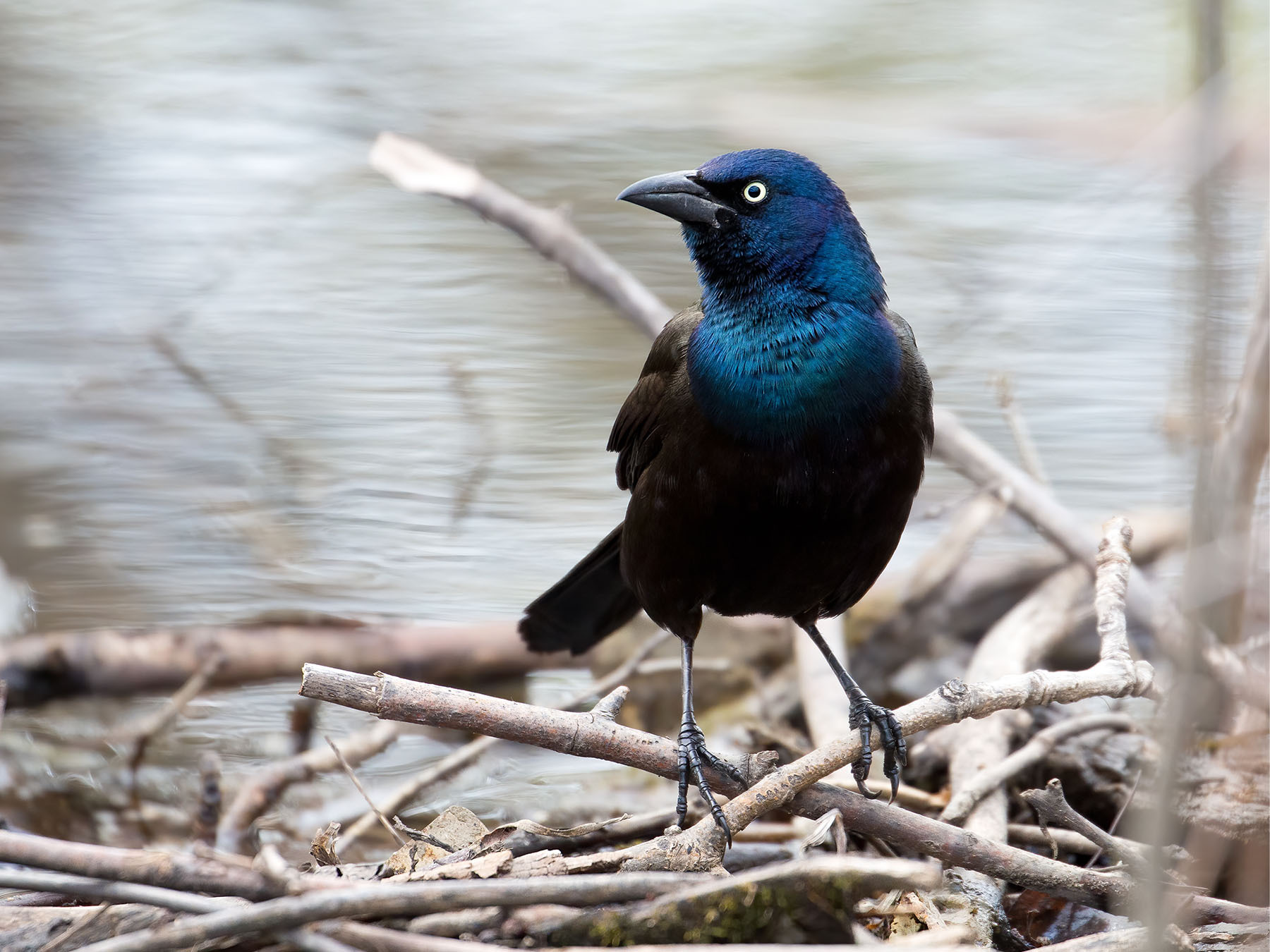
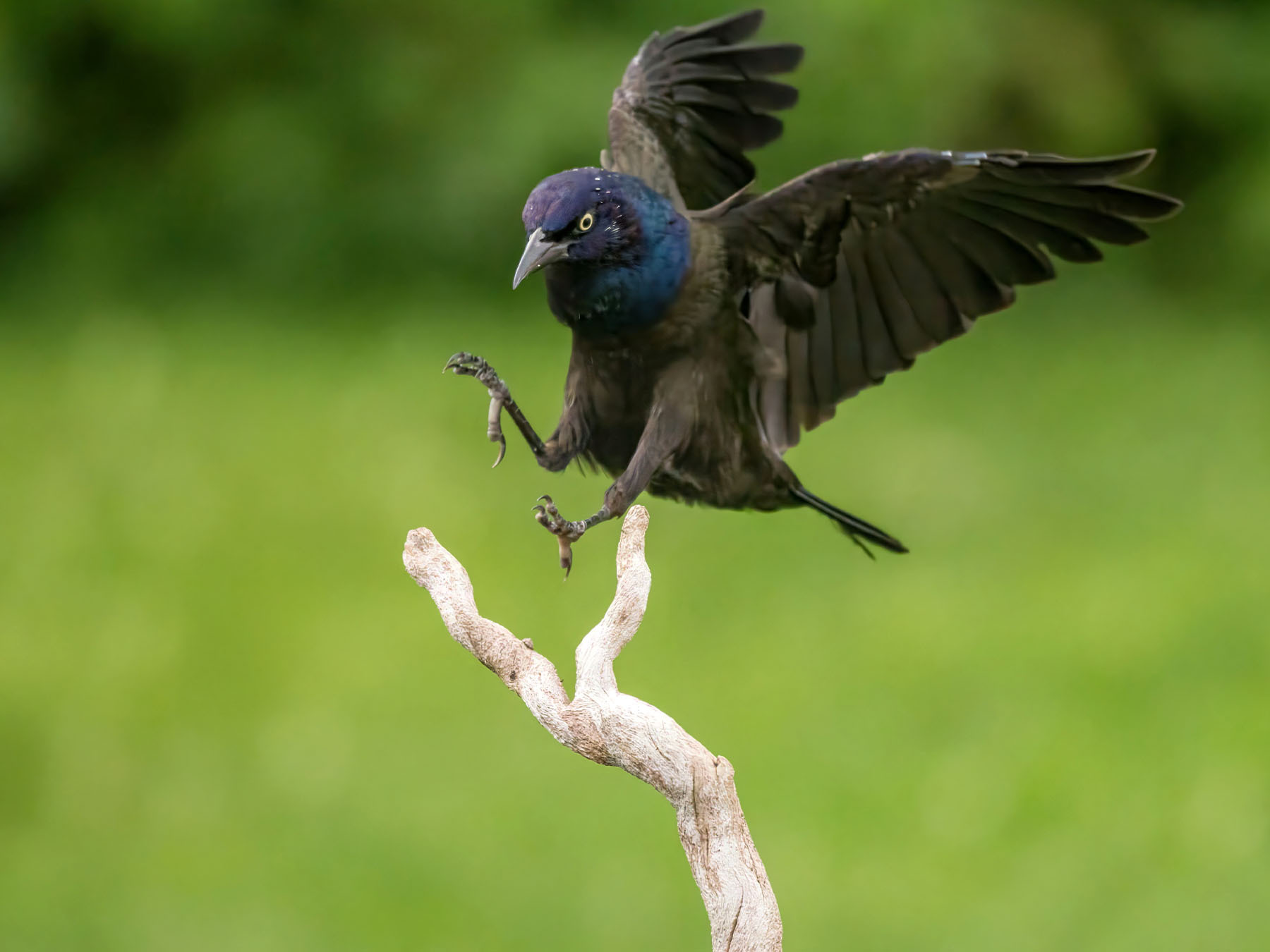
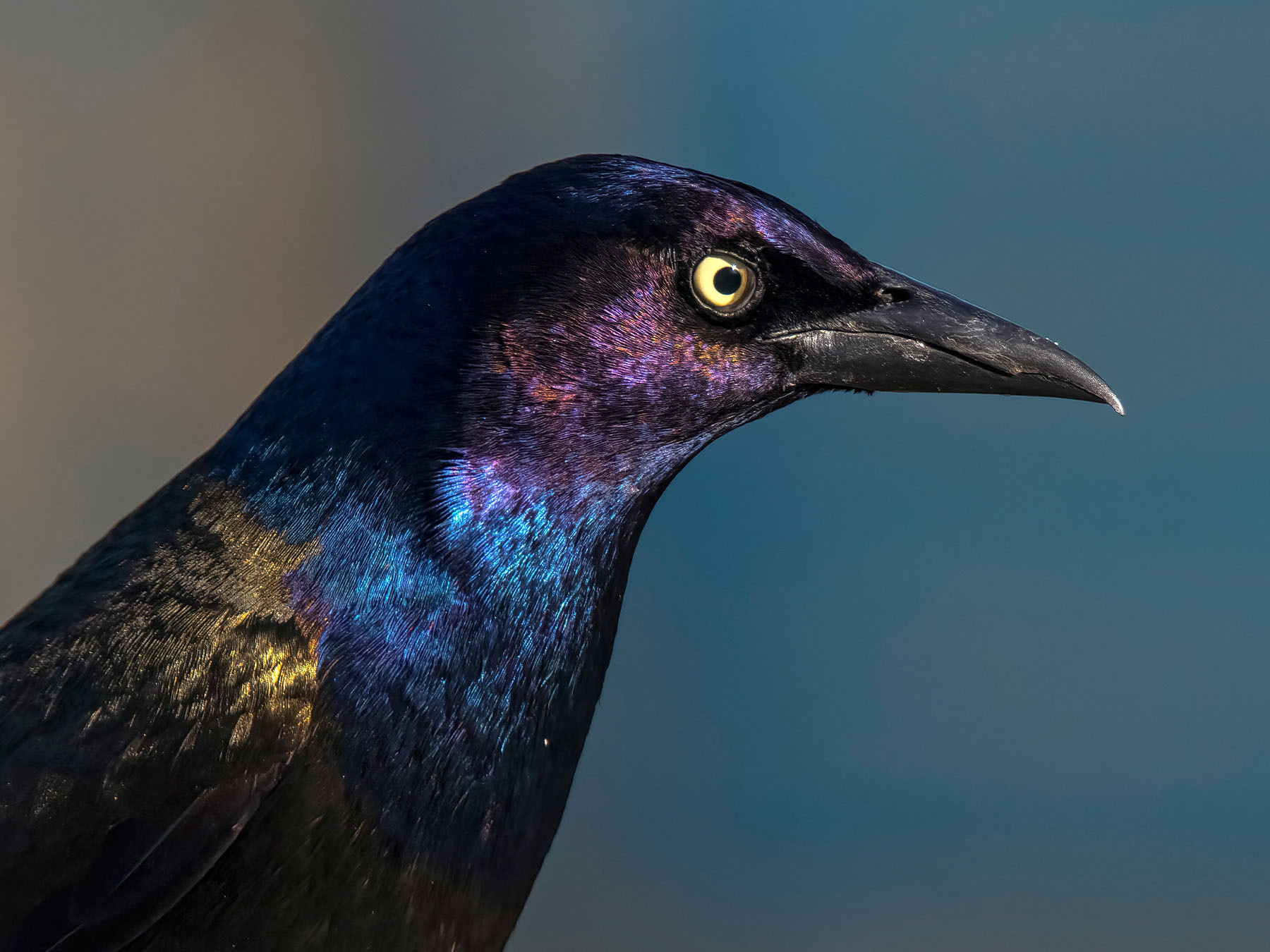
The Common Grackle is a striking bird with glossy black plumage that shimmers with iridescent purple, blue, and green hues in bright light. Males are larger and more colorful, with a long, keel-shaped tail and bright yellow eyes contrasting sharply with their dark feathers.
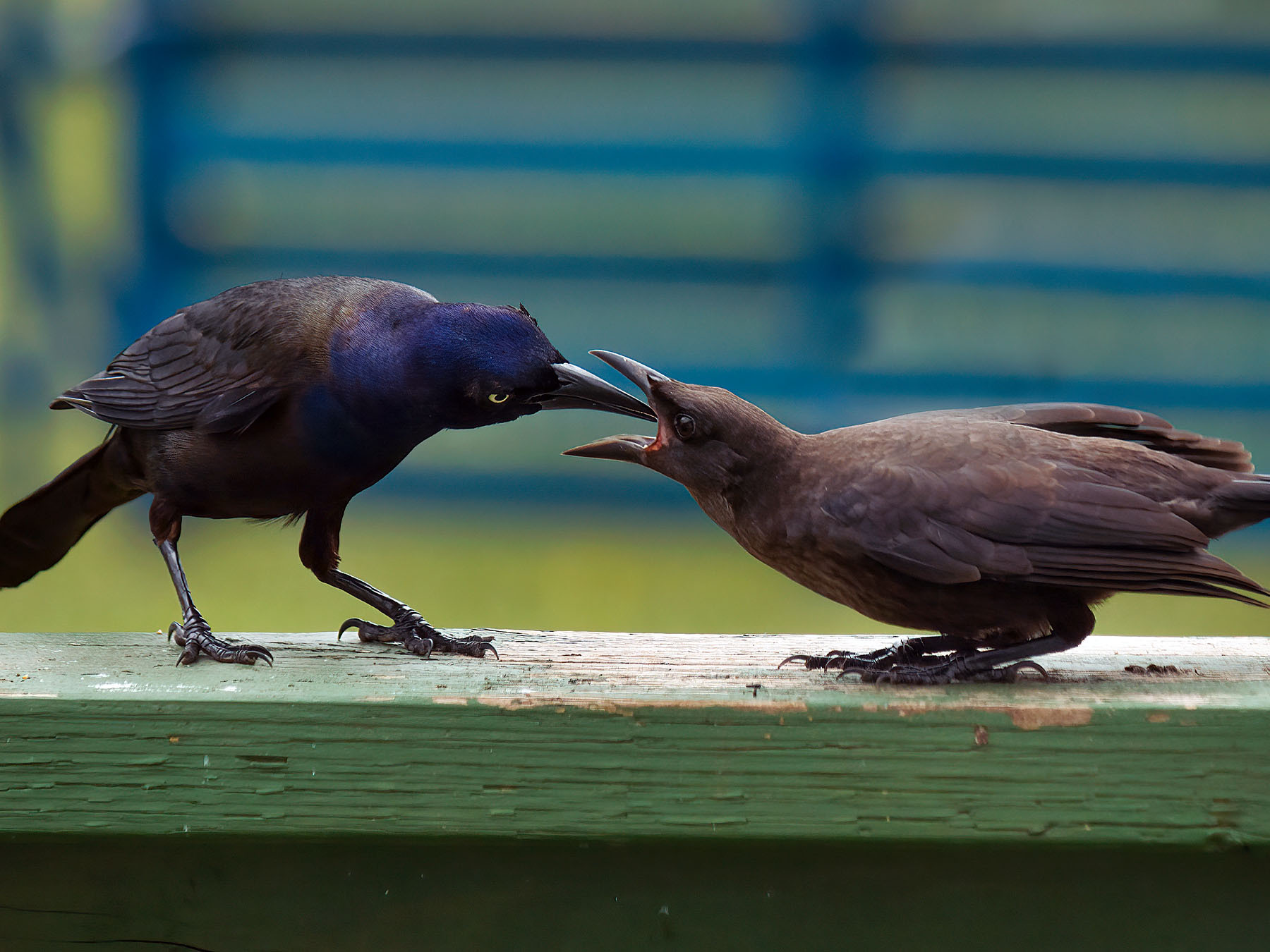
Females are slightly smaller and less iridescent, with a brown body and shorter tail. Juveniles resemble females but have dark eyes that gradually lighten to yellow as they mature.
Its size
Adults- Length
- 28–34 cm
- Wingspan
- 36–43 cm
- Weight
- 74–142 g
Its song and calls
Common Grackles have a diverse vocal repertoire. Their most recognizable call is a harsh, creaky 'readle-eak' or 'chlack.' Males produce a variety of whistles, croaks, and guttural sounds during courtship.
In flocks, they create a cacophony of chatters and squeaks, often described as sounding like a rusty gate opening.
- Song and calls0:00 / 1:00
Recorded in Iowa, United States · April 2013
- Call0:00 / 0:32
Recorded in St, United States · May 2011
When and where to see it
OctoberIn season
Most recorded in October
- 1. South Dakota1.4%
- 2. Florida1.3%
- 3. Kentucky1.3%
- 4. District of Columbia1.3%
- 5. Nebraska1.1%
Each dot is a county, state or province: the bigger and darker, the larger the bird’s share of that place’s bird records that month. Grey dots: no regular records. The ringed point is the centre of the bird’s records this month; the arrow shows how it moved since last month, and the dashed loop its path through the year. “Arrivals” colours places where it becomes regular this month (orange) or is in its last regular month (grey). GBIF eBird Observation Dataset, 2019–2024. Map data: Natural Earth, US Census Bureau; place centres © OpenStreetMap contributors.
In your area
See when the Common Grackle is recorded in your county, state or province.
How often the Common Grackle turns up in the United States and Canada through the year, from birdwatchers' records.
United States
Summer visitor · all year · most records in June
Canada
Summer visitor · regularly Mar–Nov · most records in April
Show as a table
| Month | United States | Canada |
|---|---|---|
| January | 0.27% (regular) | 0.058% |
| February | 0.53% (regular) | 0.090% |
| March | 1.2% (regular) | 1.8% (regular) |
| April | 1.4% (regular) | 2.3% (regular) |
| May | 1.5% (regular) | 2.1% (regular) |
| June | 1.5% (regular) | 1.9% (regular) |
| July | 1.1% (regular) | 1.6% (regular) |
| August | 0.72% (regular) | 1.1% (regular) |
| September | 0.50% (regular) | 0.75% (regular) |
| October | 0.54% (regular) | 0.66% (regular) |
| November | 0.37% (regular) | 0.20% (regular) |
| December | 0.25% (regular) | 0.083% |
Worldwide: recorded regularly in 3 countries
Countries where it was recorded in at least 3 of the 6 years 2019–2024. Linked countries have their own bird list.
North America (3)
Data: EOD – eBird Observation Dataset (Cornell Lab of Ornithology), accessed via GBIF.org, CC BY 4.0. Records from 2019–2024, aggregated and filtered by Birdfact. How these lists are made
Tips for seeing it
- Look for large flocks in open areas, especially near water sources
- Listen for their distinctive 'readle-eak' call and varied vocalizations
- Observe their unique, keel-shaped tail in flight
- Watch for iridescent plumage shimmering in sunlight
- In the US, check agricultural fields and urban parks during migration seasons
What it eats
Common Grackles are opportunistic omnivores with a varied diet. They primarily feed on insects, seeds, and grains but also consume small fish, frogs, and even other birds' eggs or nestlings.
They've adapted to scavenge human food scraps in urban areas, showcasing their dietary flexibility.
Nesting and breeding
Common Grackles begin their breeding season in early spring, with males performing elaborate displays to attract mates. They often nest in loose colonies, sometimes alongside other blackbird species.
Females construct bulky nests of grass, twigs, and mud, typically placed in dense foliage of trees or shrubs. The nest cup is lined with fine grasses. A clutch usually consists of 4-7 pale blue to pearl gray eggs marked with brown blotches.
Incubation lasts about 12-14 days, primarily done by the female. Both parents feed the nestlings, which fledge after about 16-20 days. Grackles often raise two broods per season in warmer regions.
Behaviour
Common Grackles are highly social birds, often seen foraging in large flocks on the ground. They have a distinctive walking strut and frequently engage in communal roosting, gathering in massive numbers during non-breeding seasons.
These birds are known for their intelligence and adaptability, often seen using tools to manipulate food items.
Conservation
Listed as Near Threatened, Common Grackle populations have declined by over 50% since the 1970s due to habitat loss and agricultural practices.
Conservation efforts focus on preserving diverse habitats and promoting bird-friendly farming methods to support their recovery.
More photos
5 photos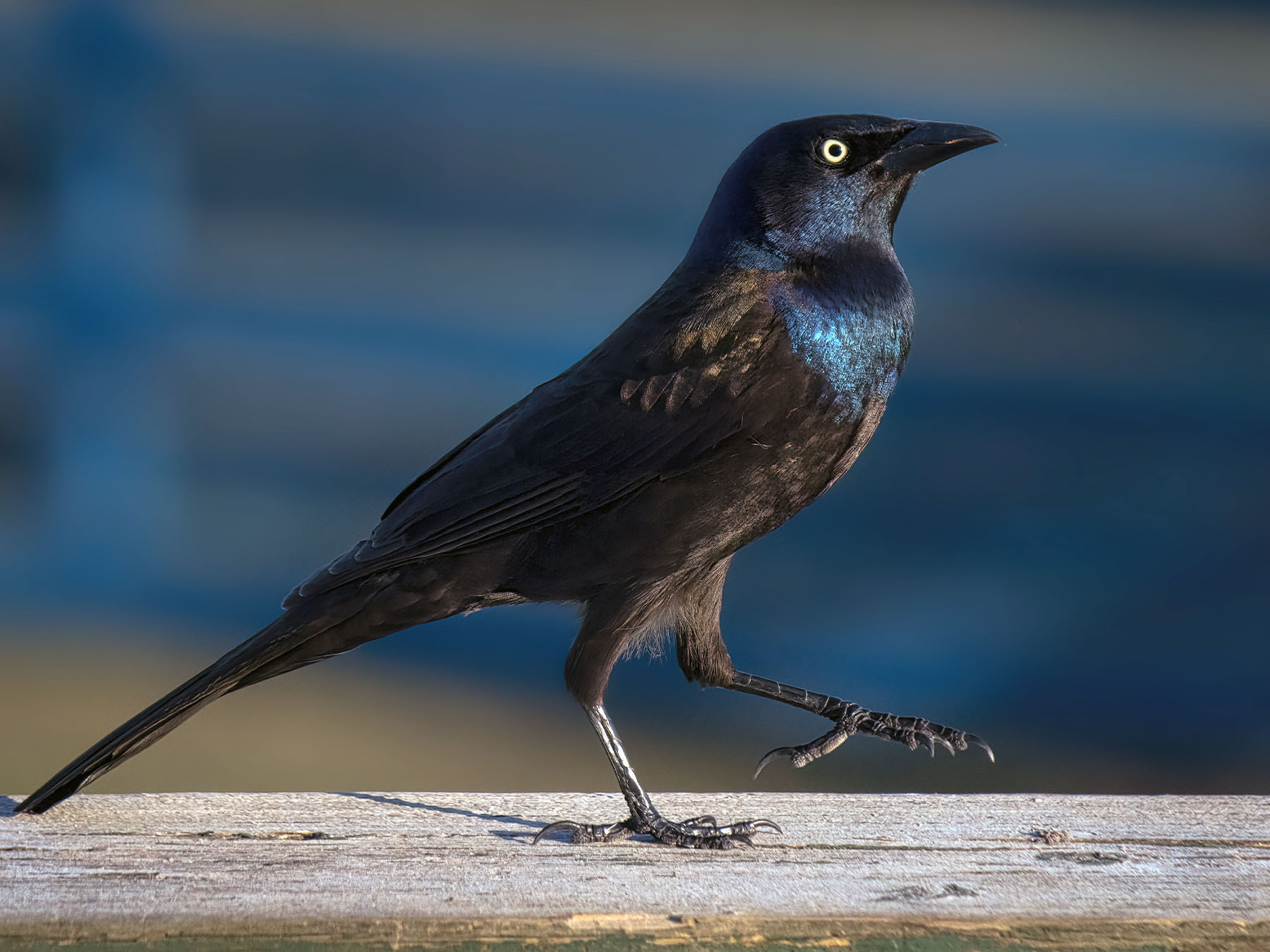
Common Grackle guides
2 guidesQuick facts
- Length
- 28–34 cm
- Wingspan
- 36–43 cm
- Weight
- 74–142 g
- Lifespan
- 5–17 years · oldest recorded 23.1 years
- Family
- New World Blackbirds
- Migration
- Partial migrant
- Global status (IUCN)
- Near Threatened
- World population
- 67,000,000 mature individuals
- Population trend
- Populations decreasing due to habitat loss and pesticides
- Also called
- Crow Blackbird
- Scientific name
- Quiscalus quiscula
Sources
4- 1BirdLife International. 2018. Quiscalus quiscula. The IUCN Red List of Threatened Species 2018: e.T22724320A131484290. Source (opens in a new tab)
- 2Breeding Bird Survey and/or Christmas Bird Count: Butcher and Niven (2007)
- 3Partners in Flight (2022) Source (opens in a new tab)
- 4Longevity Records Of North American Birds. Version 2023.1 Source (opens in a new tab)

Checked by
Nathan Cope, founder and editor
Nathan founded Birdfact and leads its writers and contributors in the UK, the US and Canada. He has watched and studied birds for more than ten years, and checks every article and species guide before it’s published.