


Great Horned Owl
Tiger Owl, Hoot Owl · Bubo virginianus
By the Birdfact teamChecked by Nathan Cope
On this page14 sections
How to recognise it
What do Great Horned Owls look like?
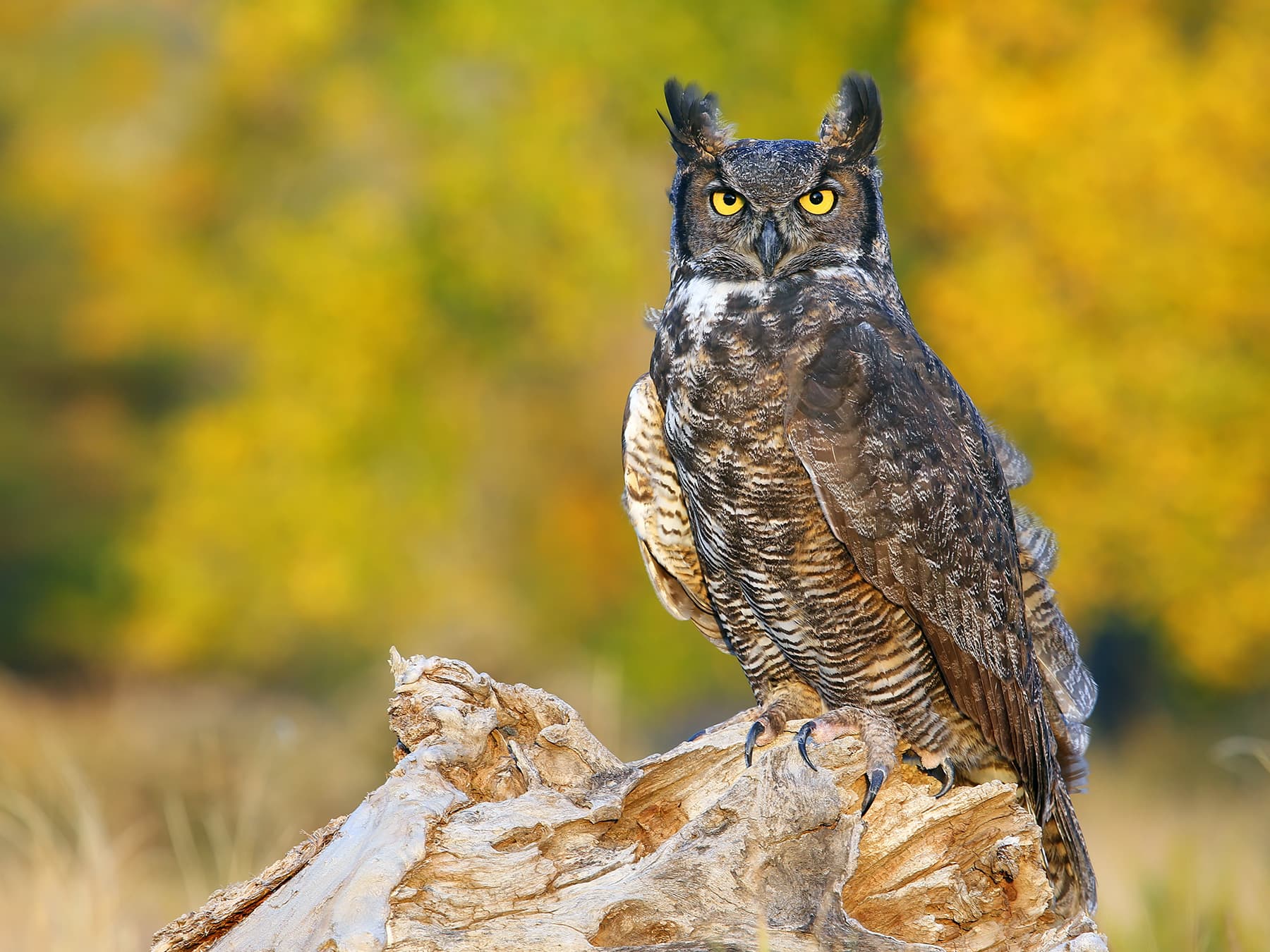
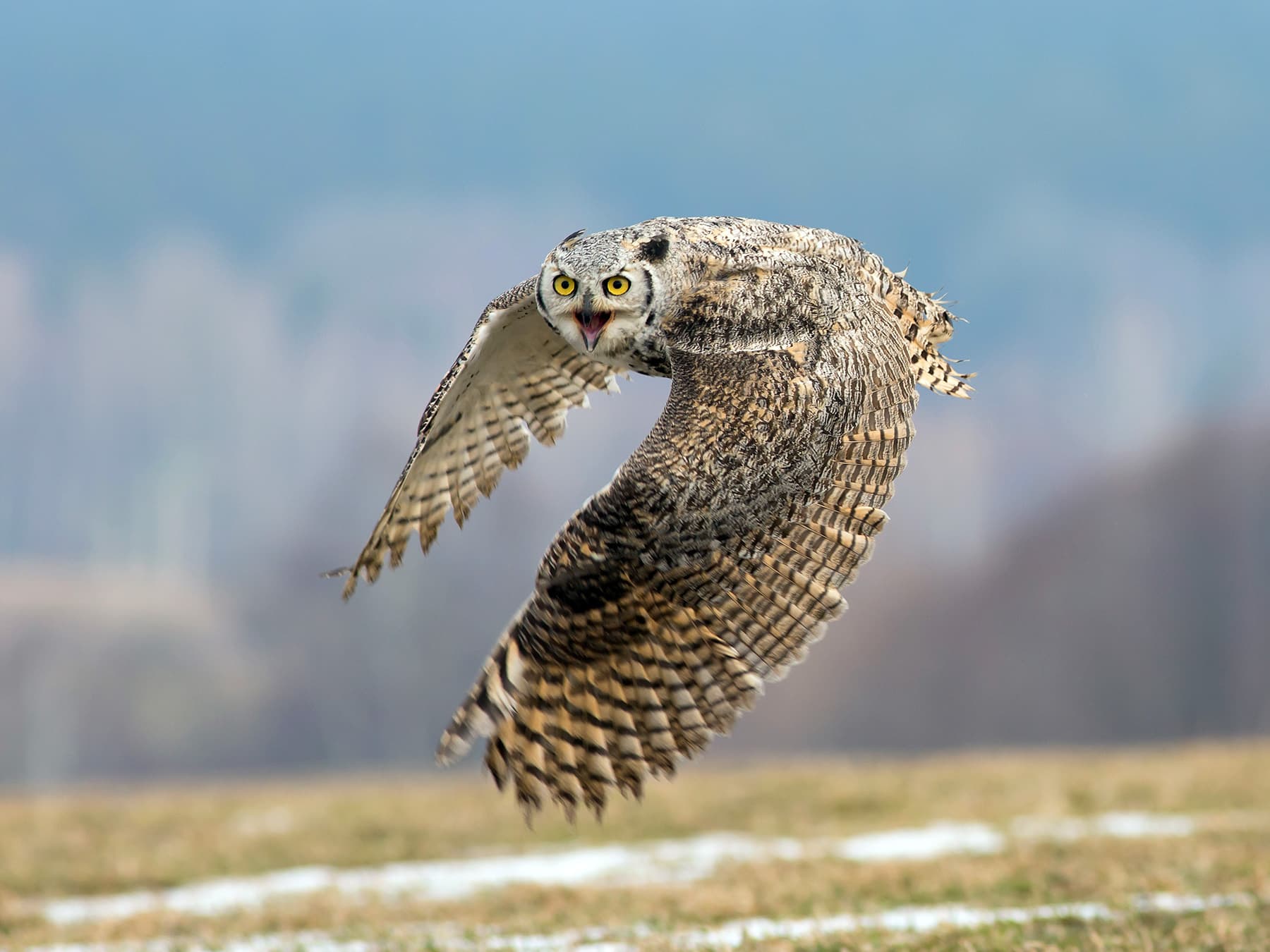
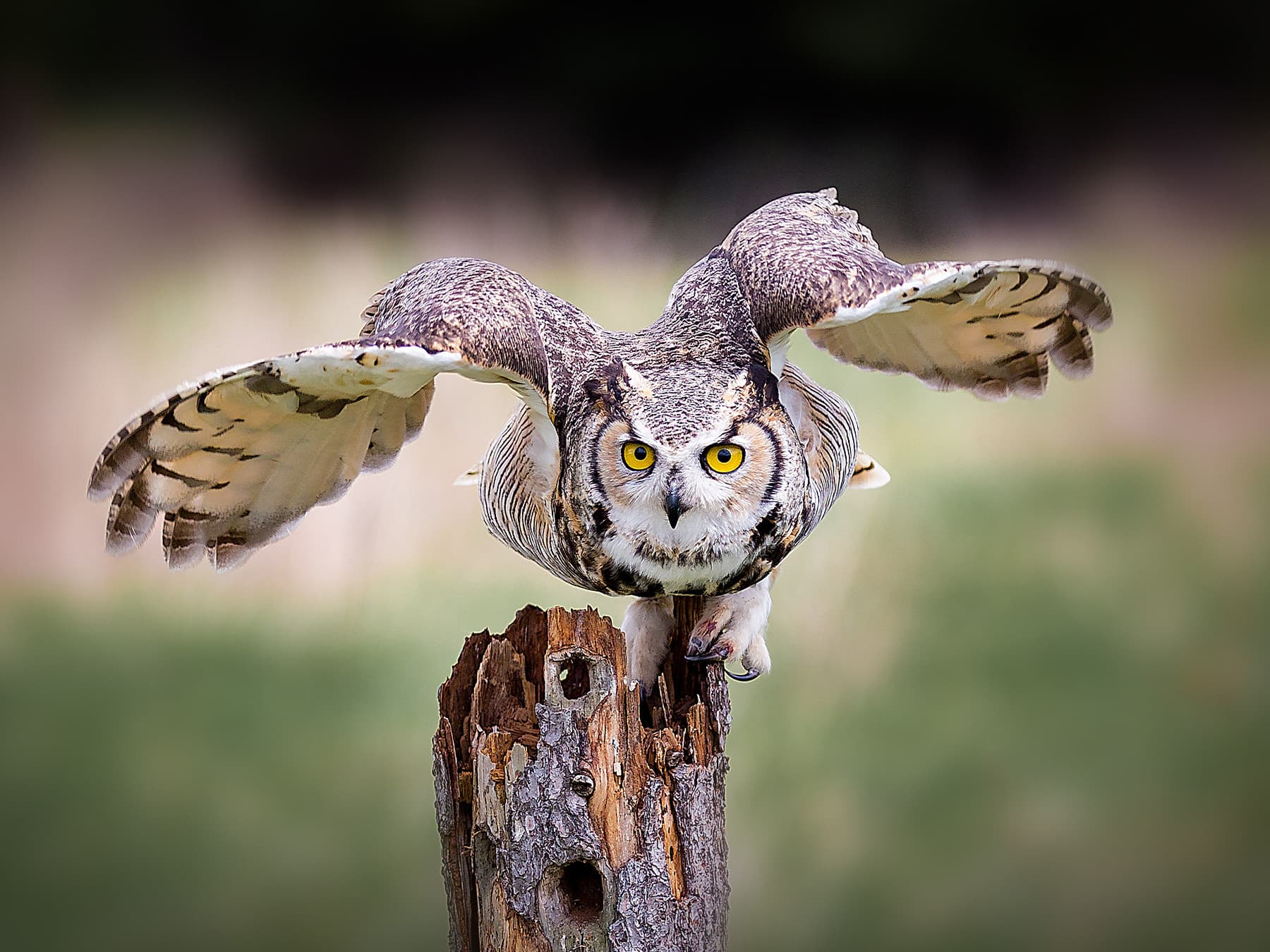
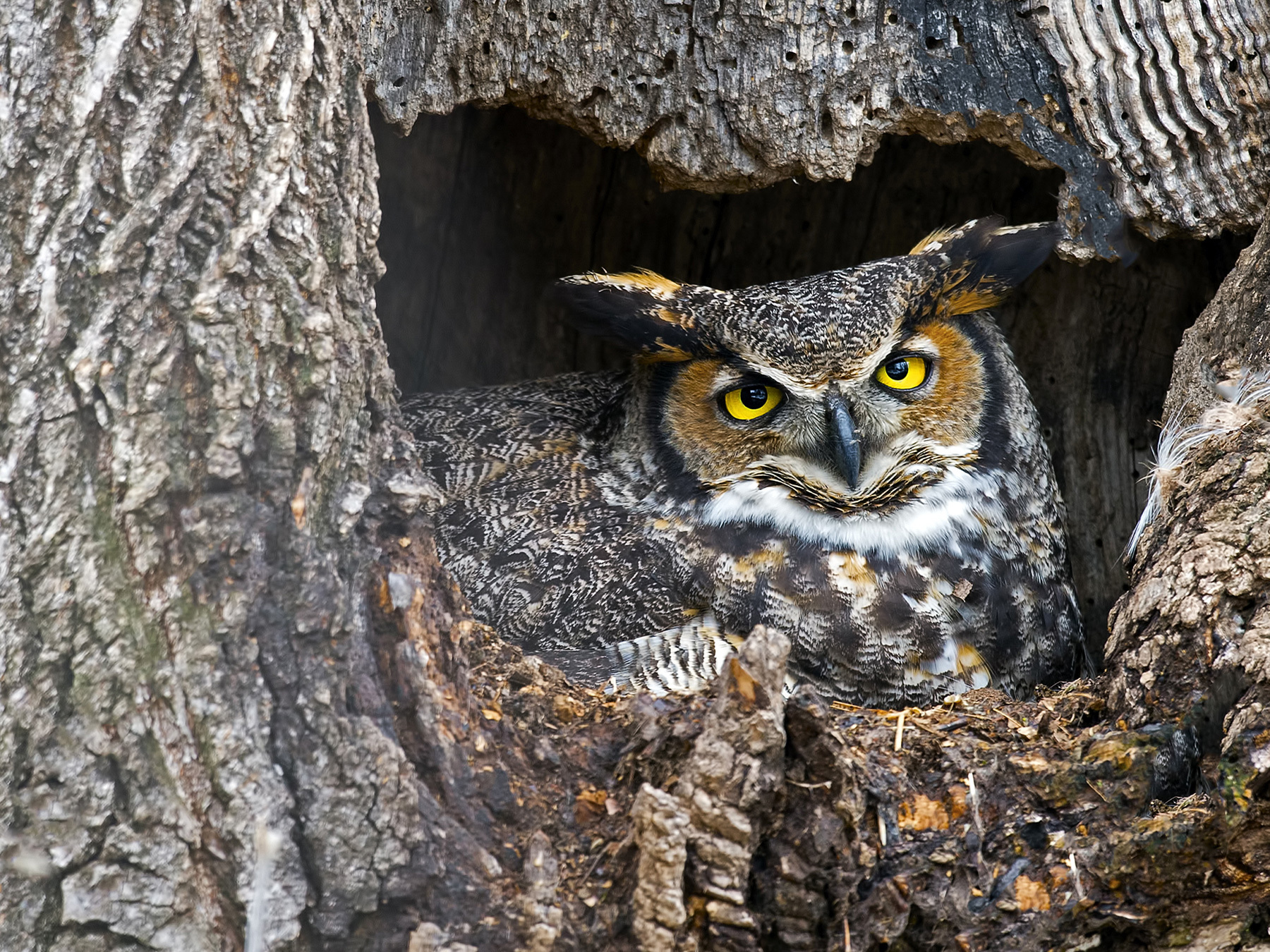
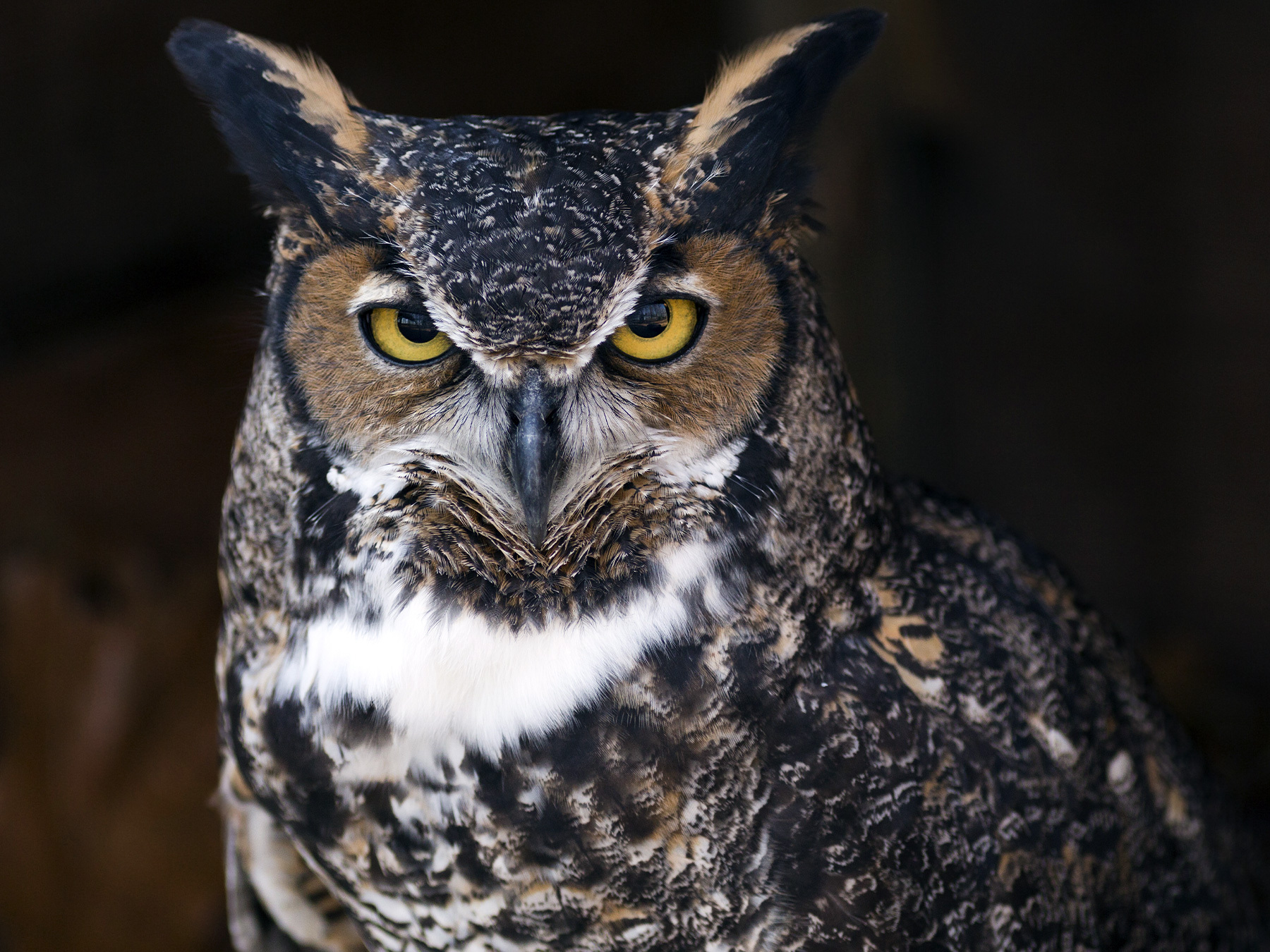
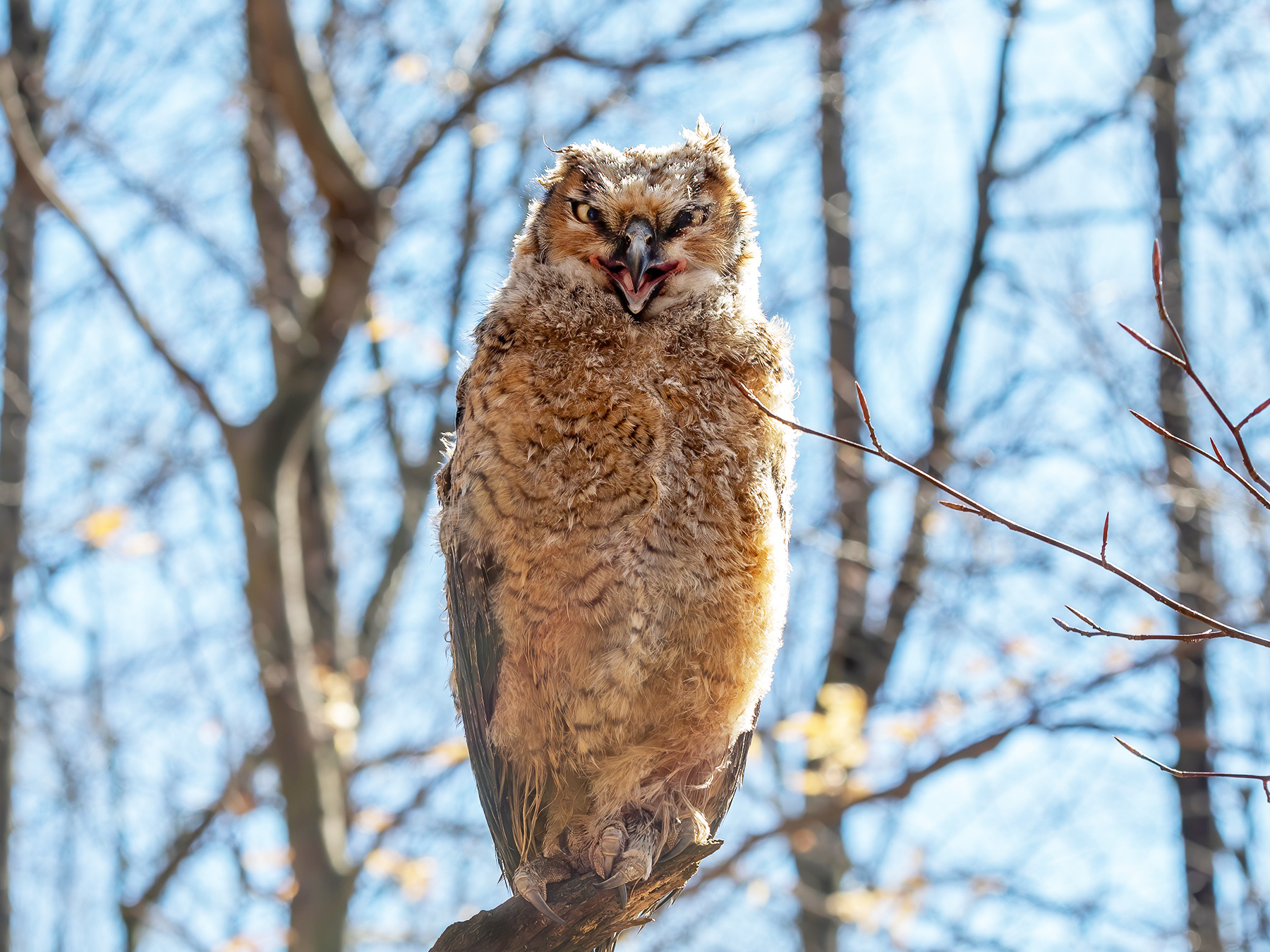
Apart from its large body size, prominent ear tufts are perhaps the most noticeable feature of a great horned owl. Its bright lemon-yellow eyes are among the largest of any bird species, and its black bill is not clearly visible beneath bristly facial feathers.
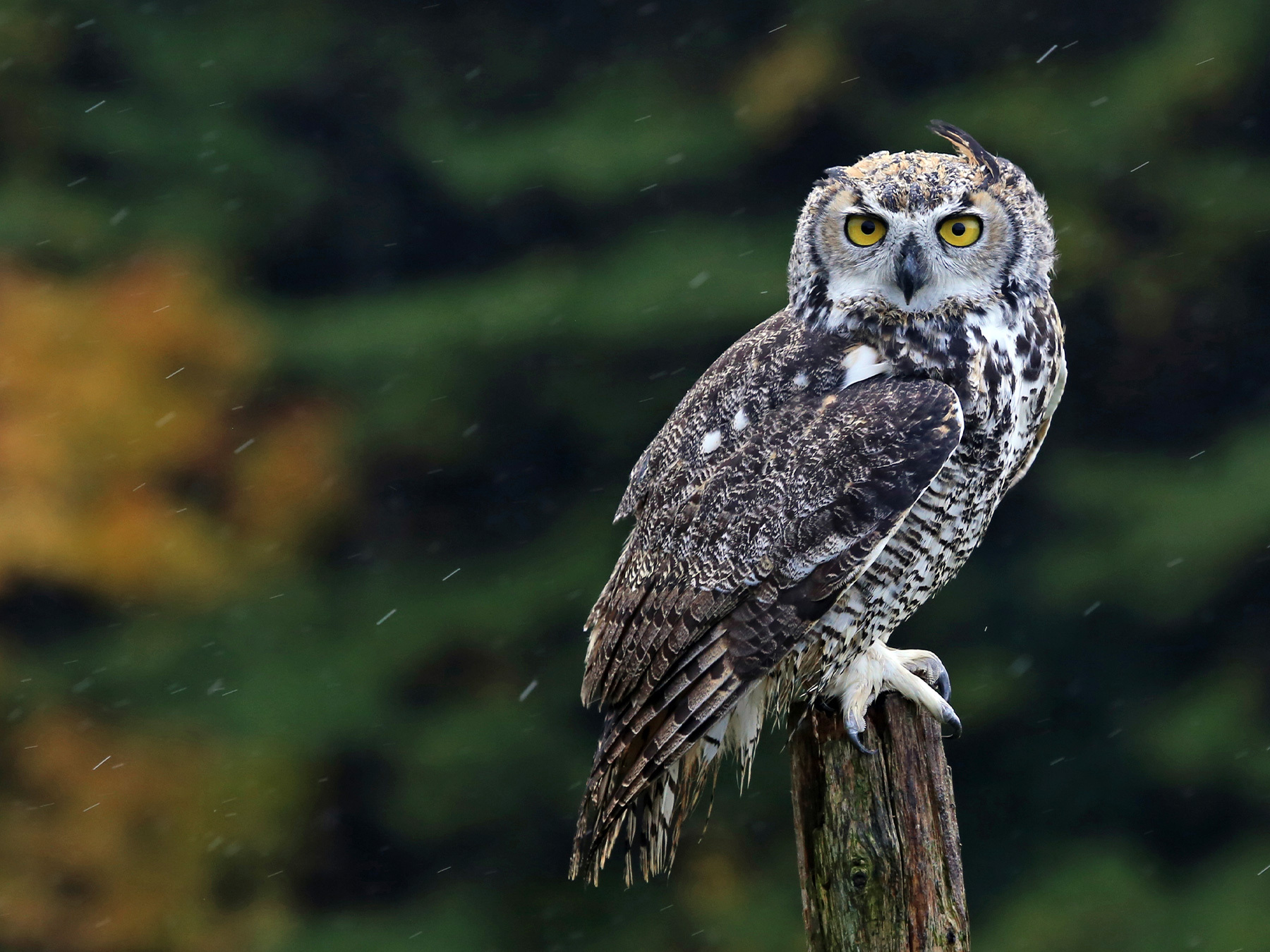
Sometimes known as the ‘tiger owl’ a great horned owl’s face features striped markings with brown, black, and buff streaks and a white bib. Its neck, mottled with chestnut and darker brown, becomes barred towards the breast and onto the belly. Upper wings are dark brown, heavily patterned with cryptic markings that offer good camouflage against tree trunks and branches.
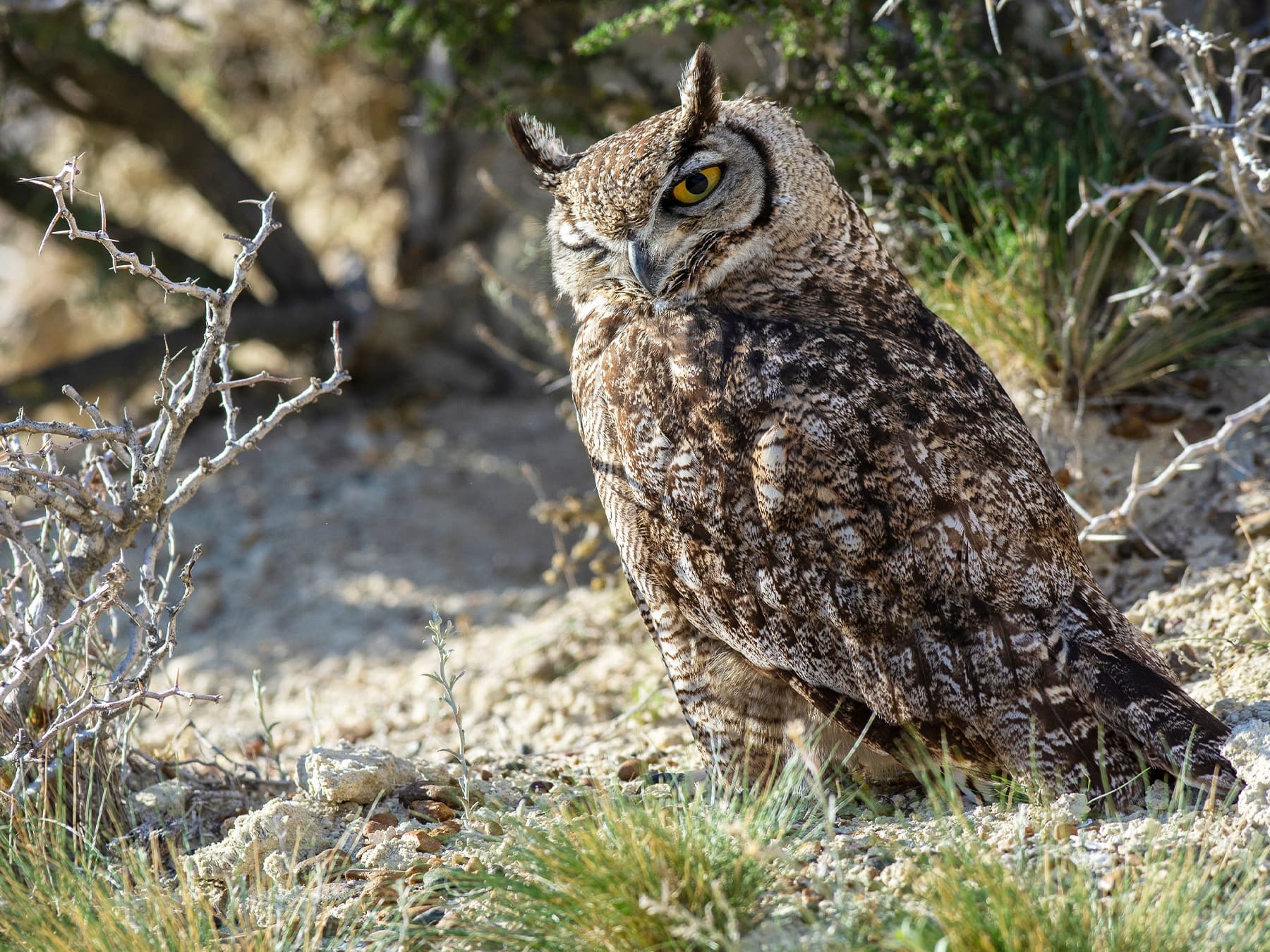
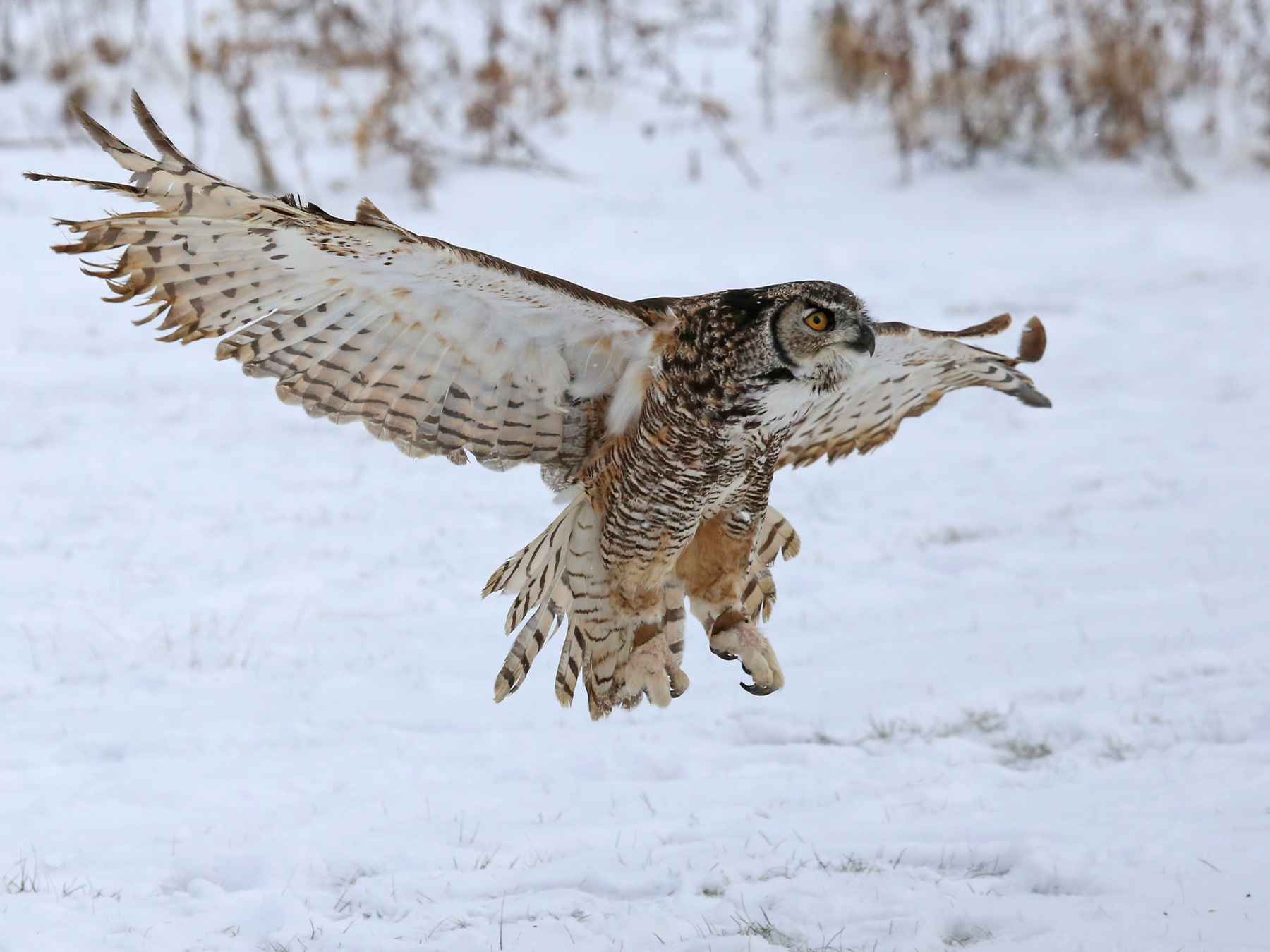
Feet are white, strong, and powerful with dark talons. Different color variations may be seen according to geographical location, with paler birds more common across Mexico and the southwestern US. Darker morphs are found along the Pacific coast.
Females and males have the same coloring and markings, but females are larger, so size is a fairly reliable way of telling individuals apart.
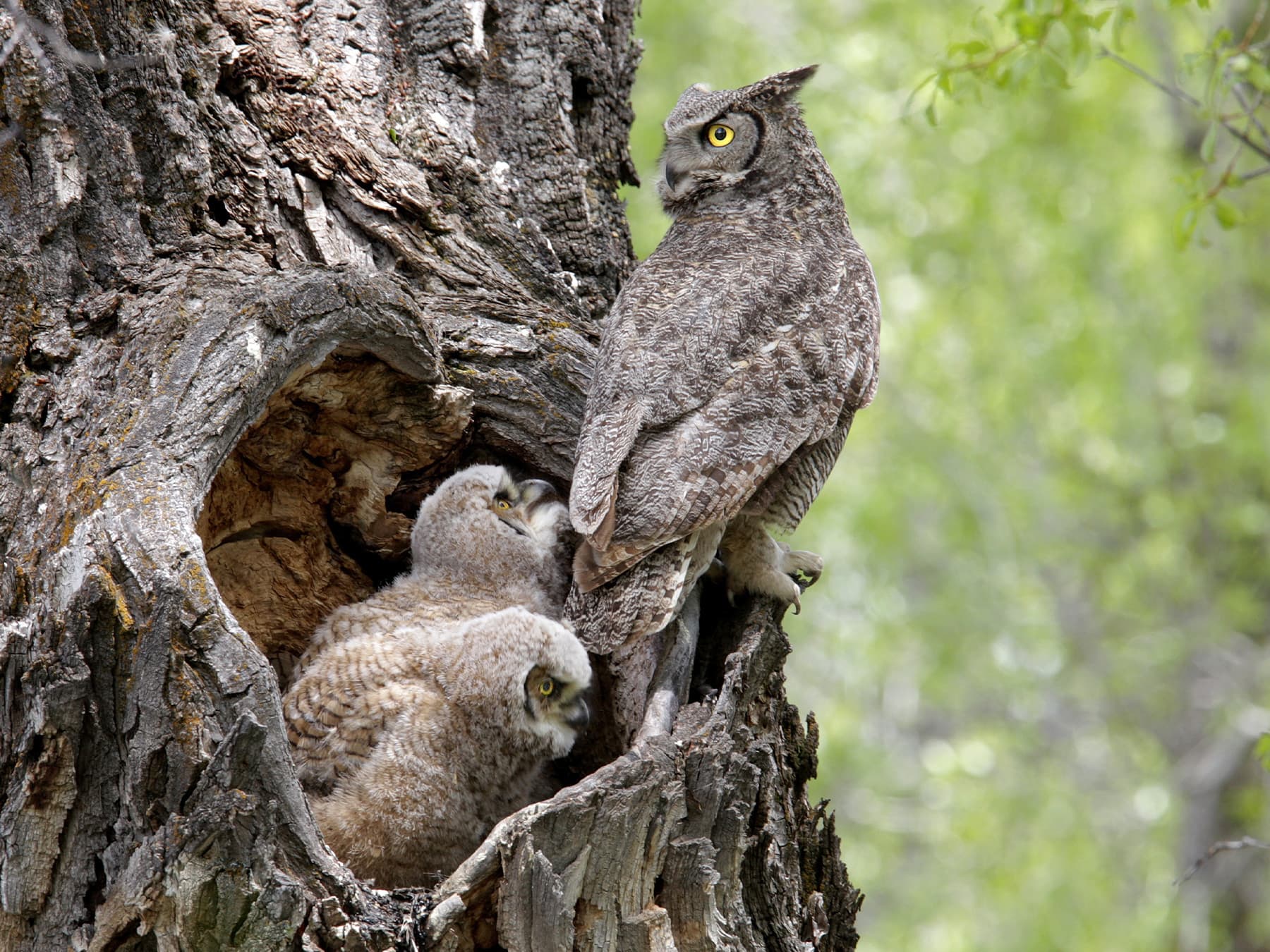
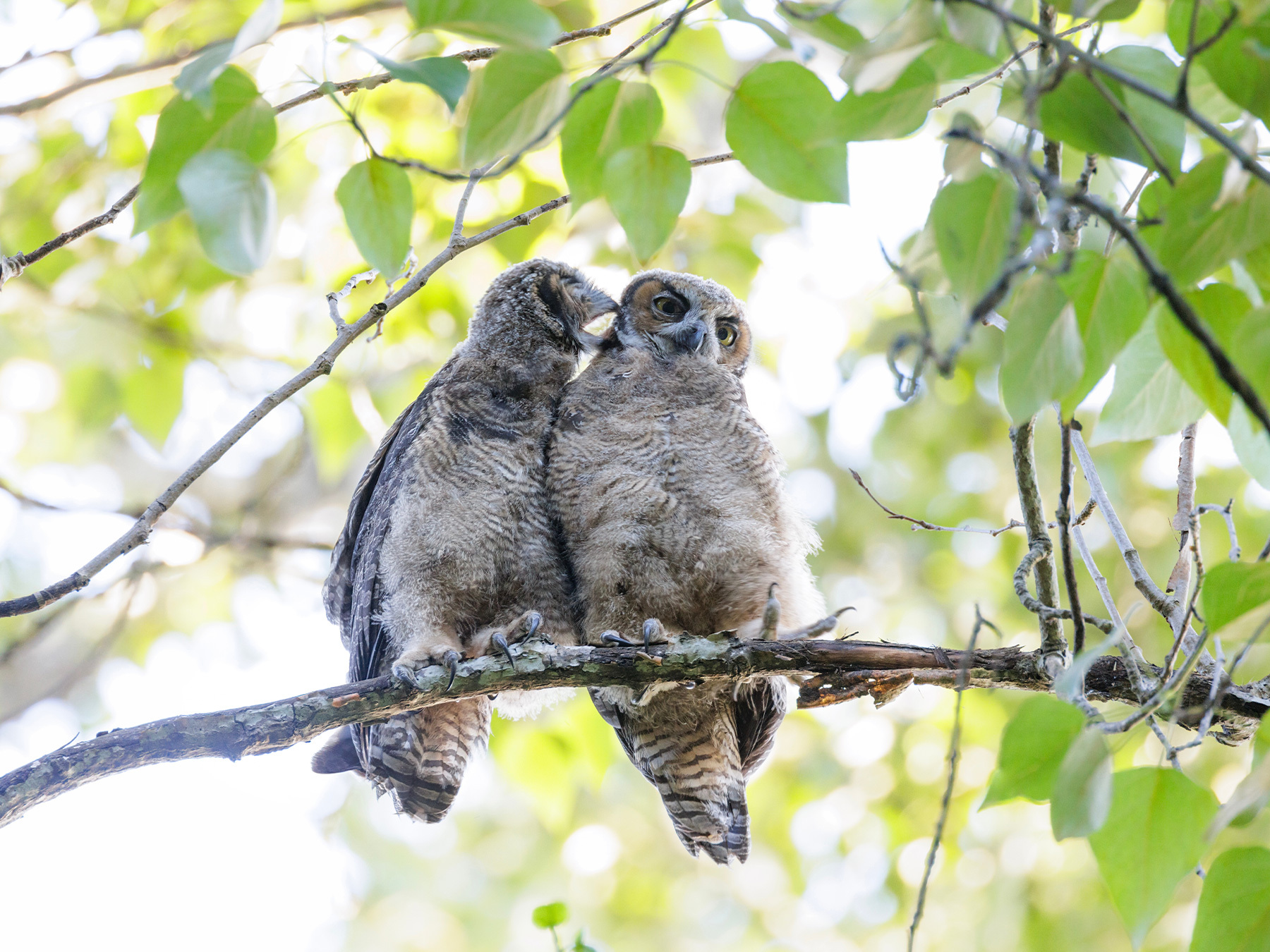
Juveniles are initially covered in a fluffy grayish-white down, which is gradually replaced on the wings and facial disk with darker marked feathers, and within a few weeks, they obtain their full adult plumage shortly after fledging.
How big are Great Horned Owls?
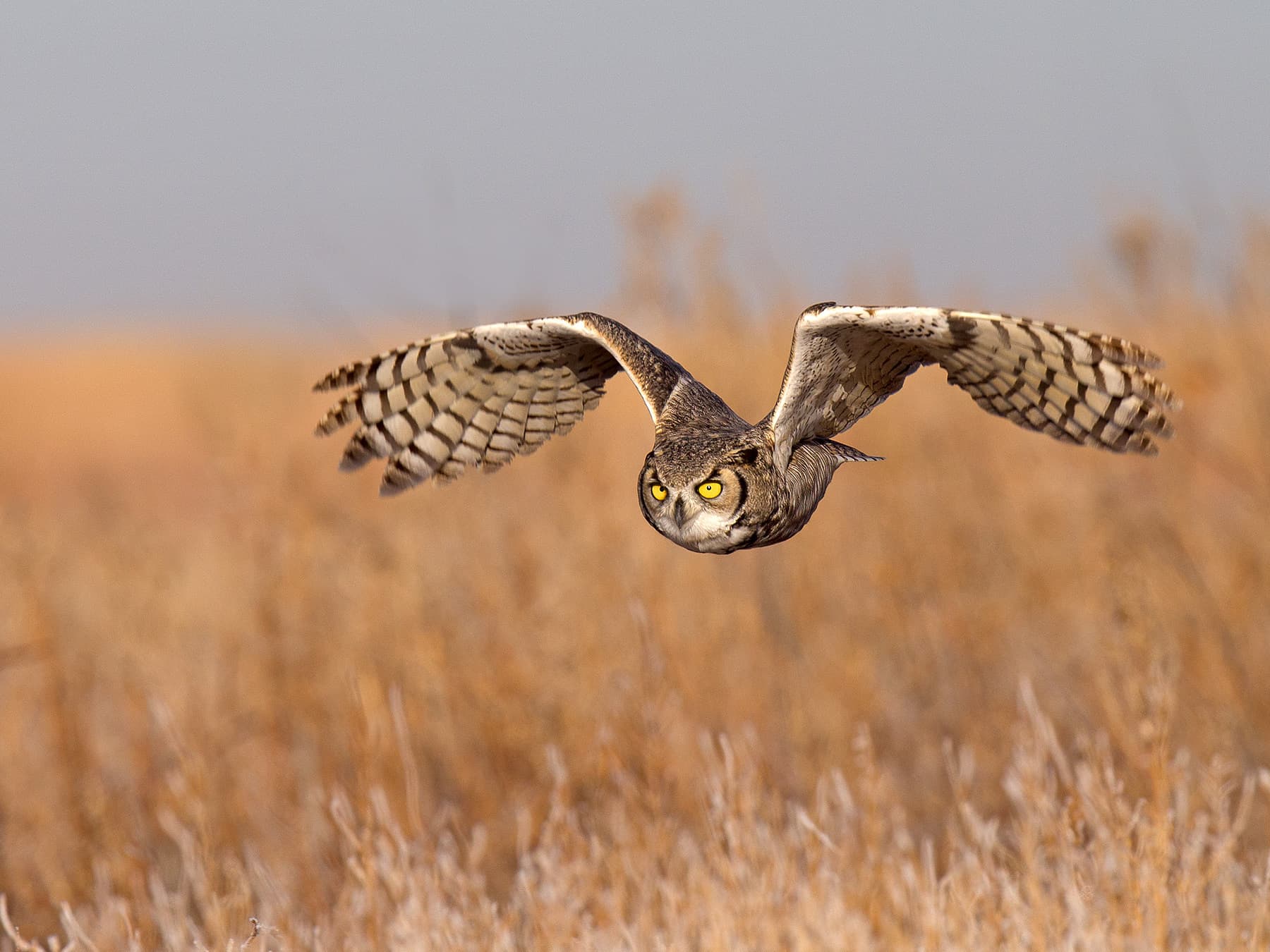
Large powerful owls, great horned owls are the largest owls in Central and South America but are pipped at the post for the title in North America by both the great gray owl and the snowy owl. Females are larger than males in all aspects.
- Length: 43 cm to 64 cm (17 in to 25 in)
- Wingspan: 91 cm to 153 cm (3 ft 0 in to 5 ft 0 in)
- Weight: 1.2 kg to 1.6 kg (2.7 lb to 3.6 lb)
The heaviest recorded great horned owl weighed 2.5 kg (5.5 lb).
Its size
Adults- Length
- 46–63 cm
- Wingspan
- 91–153 cm
- Weight
- 910–2500 g
Its song and calls
What sound does a Great Horned Owl make?
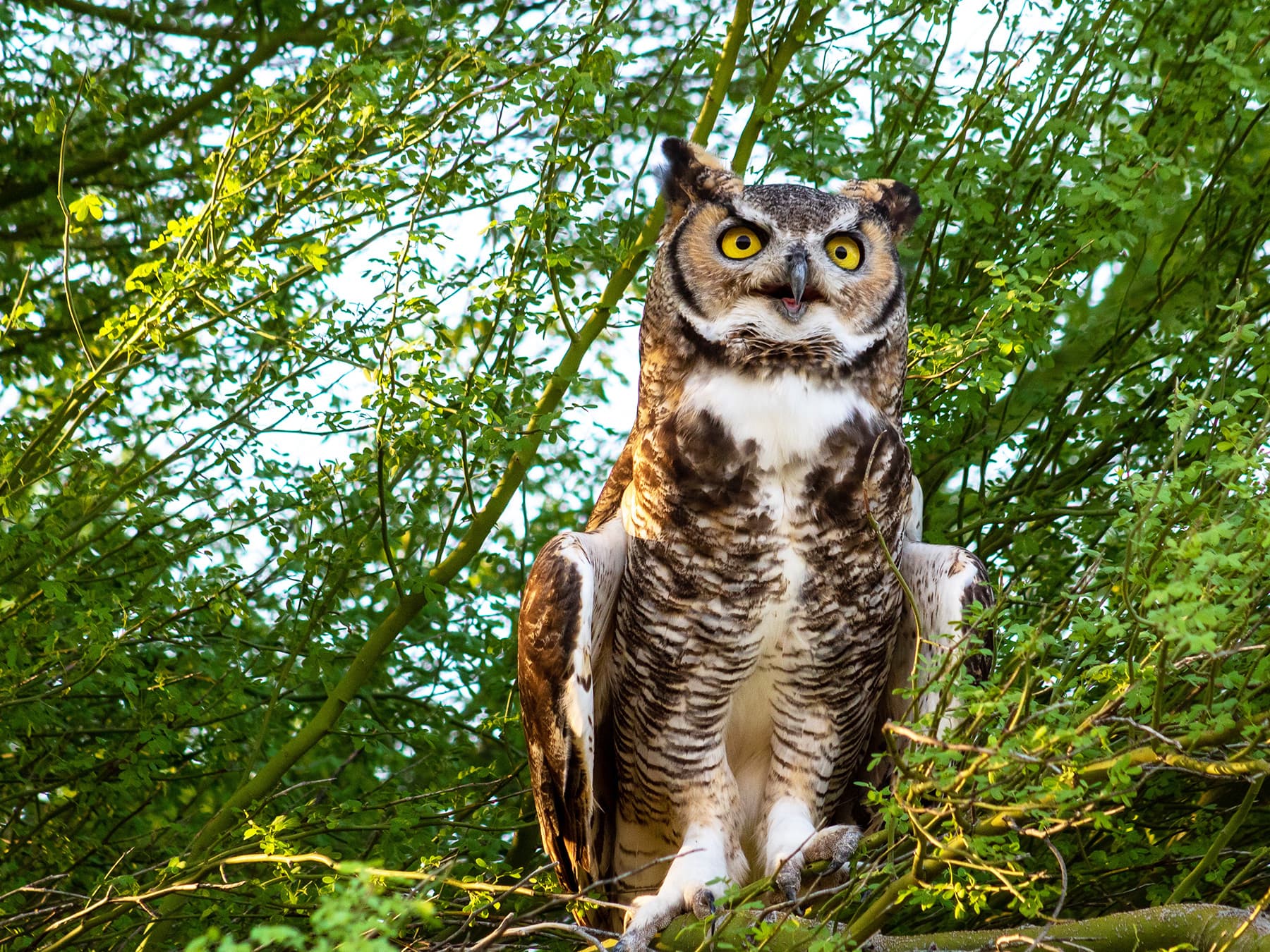
The identifying call of a great horned owl is a series of between three and eight loud, deep-pitched hoots. The second and third notes are shorter than the others in the series.
- Song0:00 / 0:54
Recorded in Newfoundland and Labrador, Canada · April 2010
- Call0:00 / 0:16
Recorded in Ohio, United States · January 2019
When and where to see it
OctoberIn season
Most recorded in October
- 1. Idaho0.38%
- 2. North Dakota0.32%
- 3. Wyoming0.32%
- 4. Colorado0.30%
- 5. Utah0.29%
Each dot is a county, state or province: the bigger and darker, the larger the bird’s share of that place’s bird records that month. Grey dots: no regular records. The ringed point is the centre of the bird’s records this month; the arrow shows how it moved since last month, and the dashed loop its path through the year. “Arrivals” colours places where it becomes regular this month (orange) or is in its last regular month (grey). GBIF eBird Observation Dataset, 2019–2024. Map data: Natural Earth, US Census Bureau; place centres © OpenStreetMap contributors.
In your area
See when the Great Horned Owl is recorded in your county, state or province.
How often the Great Horned Owl turns up in the United States and Canada through the year, from birdwatchers' records.
United States
Resident · all year · most records in December
Canada
Winter visitor · all year · most records in January
Show as a table
| Month | United States | Canada |
|---|---|---|
| January | 0.18% (regular) | 0.19% (regular) |
| February | 0.16% (regular) | 0.17% (regular) |
| March | 0.16% (regular) | 0.14% (regular) |
| April | 0.12% (regular) | 0.093% (regular) |
| May | 0.080% (regular) | 0.056% (regular) |
| June | 0.065% (regular) | 0.040% (regular) |
| July | 0.073% (regular) | 0.041% (regular) |
| August | 0.11% (regular) | 0.061% (regular) |
| September | 0.14% (regular) | 0.078% (regular) |
| October | 0.14% (regular) | 0.078% (regular) |
| November | 0.14% (regular) | 0.11% (regular) |
| December | 0.19% (regular) | 0.15% (regular) |
Worldwide: recorded regularly in 20 countries
Countries where it was recorded in at least 3 of the 6 years 2019–2024. Linked countries have their own bird list.
Data: EOD – eBird Observation Dataset (Cornell Lab of Ornithology), accessed via GBIF.org, CC BY 4.0. Records from 2019–2024, aggregated and filtered by Birdfact. How these lists are made
What is the habitat of a Great Horned Owl?
Great horned owls are adapted to survive in a diverse range of habitats across North America, including parkland, woodlands, open country, deserts, swamps, and northern coniferous forests near the treeline.
During the breeding season, great horned owls are not present in tundra and treeless plains or grasslands as they depend on the cover of trees and dense brush vegetation.
What is the range of a Great Horned Owl?
Widespread across North America, great horned owls are found as far north as the treeline across northern Alaska and Canada, with west and central Alaska and the northwestern Yukon Territories forming the northern limit of their range.
Moving southwards, the species is present throughout the entire United States, Mexico, and northern Central America. In South America, two separate populations exist. One has a relatively rare presence across southern Brazil into Bolivia, Paraguay, Uruguay, and parts of northeastern Argentina. In the north, great horned owls are also native to Venezuela, Columbia, and Ecuador.
Where do Great Horned Owls live?
Great horned owls are widespread throughout North and South America, but the United States has by far the largest population.
States with the highest concentrations of great horned owls include Minnesota, Wisconsin, Michigan, and Oregon, which have landscapes with dense forests and open woodlands, which are the preferred habitats of great horned owls.
How rare are Great Horned Owls?
The global population of great horned owls is estimated at up to 5.3 million individuals, and the species is common and widespread across much of its range in North America.
However, sightings remain rare and there is limited research available on many aspects of this species due to their preference to avoid areas with dense human habitation, their nocturnal behavior, and their highly cryptic and well-couflaged markings.
Where can you see Great Horned Owls in the US?
As the species is so widespread throughout the US, any national park with suitable forested landscapes may offer a fair chance of a sighting, particularly at dusk and during the breeding season.
Yellowstone National Park, in Idaho, and in the Everglades National Park, where great horned owls are regularly spotted over mangrove forests and in the cypress swamps.
Where can you see Great Horned Owls in Canada?
Alberta, British Columbia, and Ontario all have a well-established year-round presence of great horned owls. Sikome Lake in Fish Creek Provincial Park in Alberta is known for its regular nesting owls.
Migration
Do Great Horned Owls migrate?
Great horned owls are a sedentary species, breeding and wintering in the same territories. Irruptions may take place from time to time in years of poor prey availability, but these are unpredictable and generally short-term and short-distance.
Are Great Horned Owls native to the US?
Great horned owls are native to the US and widespread throughout the entire country except Hawaii. They are nonmigratory and remain in the same territories all year round.
Tips for seeing it
- Listen for their distinctive 'hoo-h'HOO-hoo-hoo' call at night
- Look for them perched in large trees at the edge of open areas
- Search for whitewash and pellets beneath potential roosting sites
- Scan for their silhouette against the sky at dusk
What it eats
What do Great Horned Owls eat?
The primary prey in a great horned owl’s diet is rabbits and hares, rats, mice, and voles.
Other small and mid-sized mammals, reptiles, amphibians, and invertebrates are also hunted opportunistically, mostly during the night, although some daytime hunting also occurs. Birds as large as herons and geese are occasionally caught, although mammals account for up to 90 percent of their usual diet.
What do Great Horned Owl chicks eat?
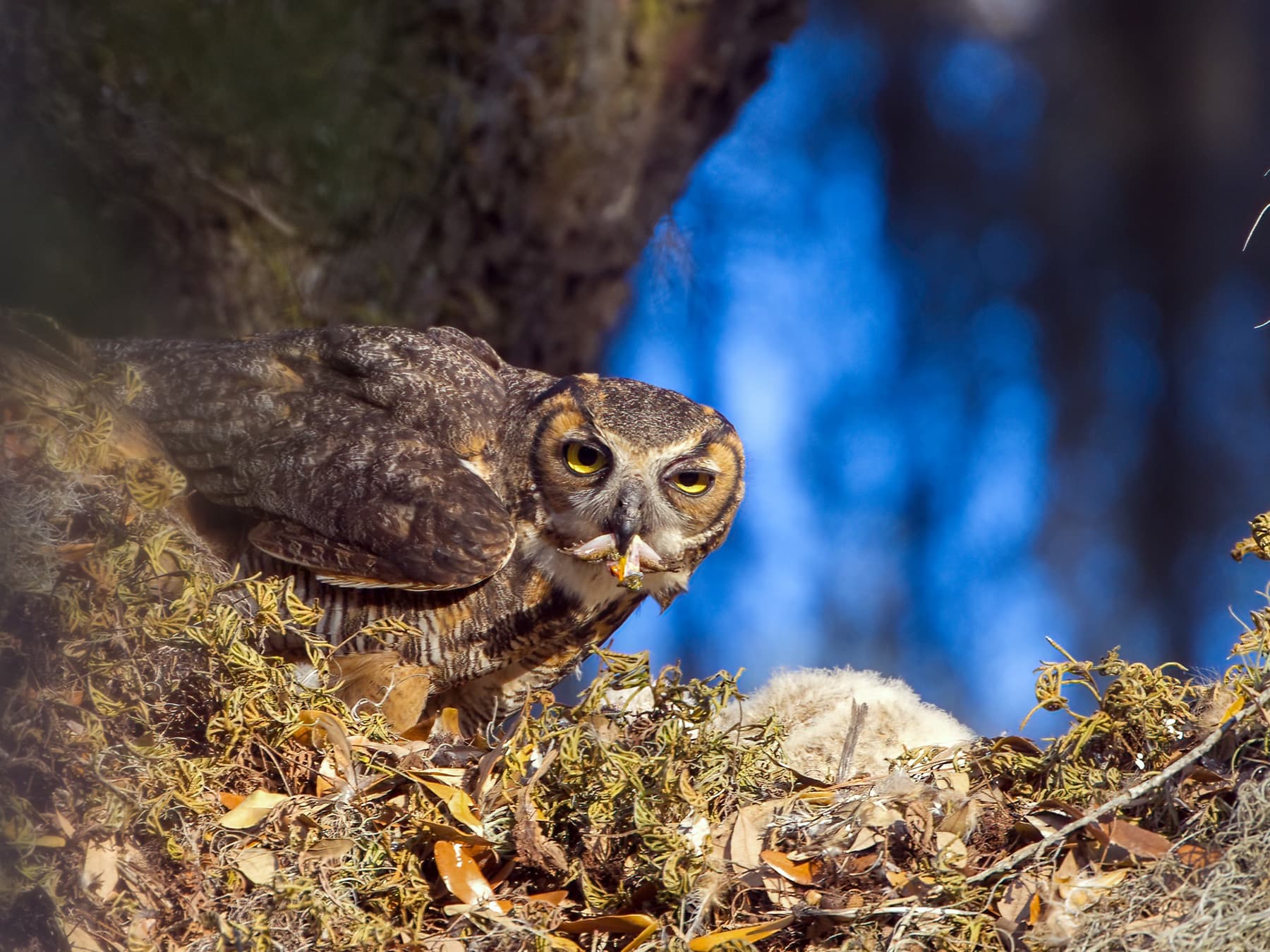
Male great horned owls bring prey to the nest for the female to then tear into smaller chunks and feed to their young. Voles are a common food choice for hatchlings to be fed.
Nesting and breeding
Where do Great Horned Owls nest?
Great horned owls are not one of nature’s talented nest-builders and instead rely on large platform nests that have been built in tall trees by other birds, particularly corvids, red-tailed hawks, and even squirrels.
Alternatively, cavity nests in tree trunks or snags may be used, as well as ledges, clifftops, and nest boxes, and on rare occasions, young are raised in ground-level nest sites.
When do Great Horned Owls nest?
One of the first birds to nest each season, on rare occasions great horned owls in Florida may lay eggs as early as November. Elsewhere, eggs are laid between December and May, reaching a peak in January and February.
Incubation is just the female’s job, while the male brings prey to the nest to feed her for the duration, which is between 30 and 37 days.
What do Great Horned Owl eggs look like?
Great horned owls’ eggs are white in color and rounded in shape. They have no markings on the outer shell and measure around 56 mm (2.2 in) by 4.7 mm (1.9 in). A typical clutch contains between one and four eggs, with two being the most common number.
Do Great Horned Owls mate for life?
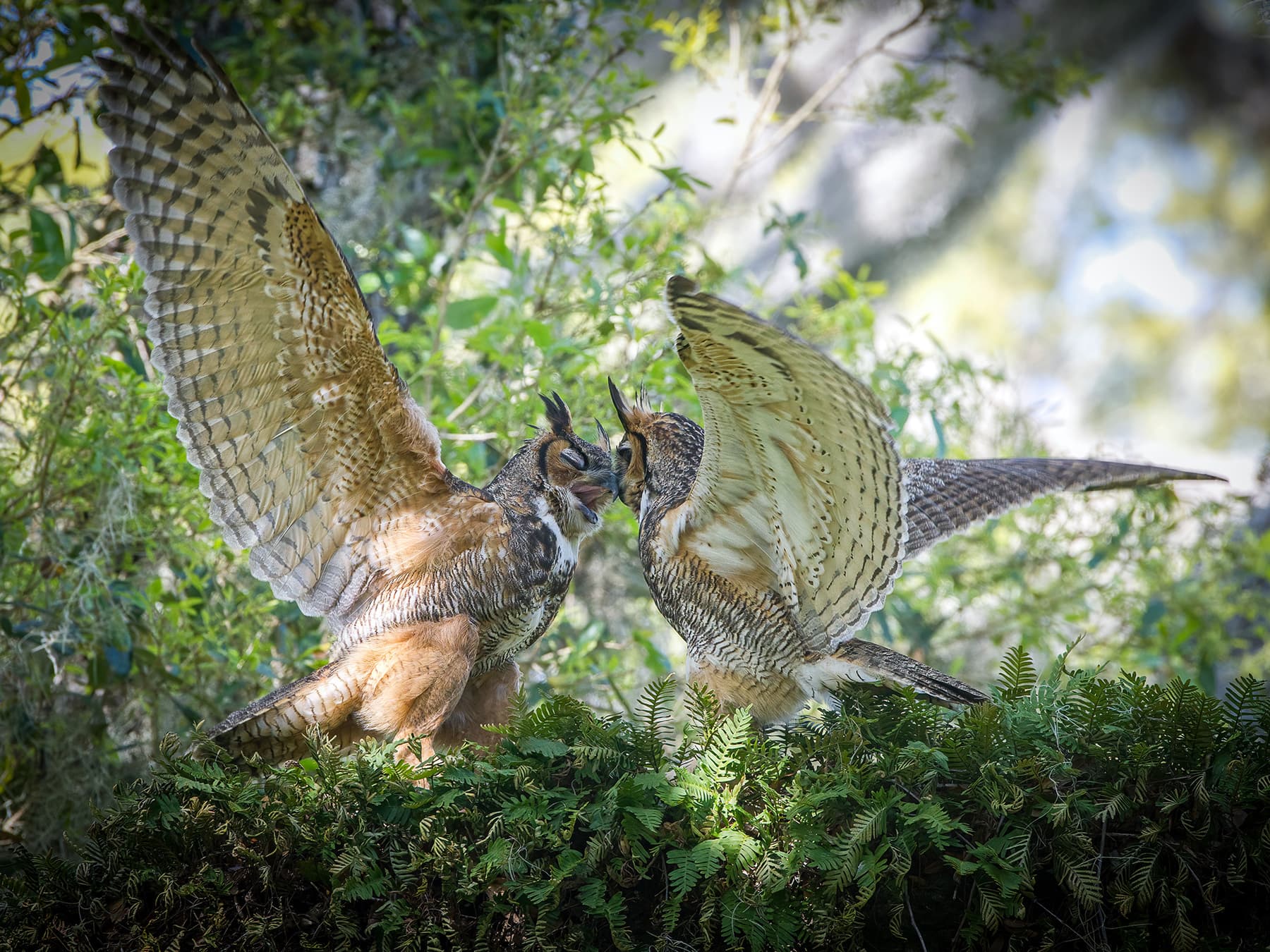
Pairs remain together during the breeding season, but once young have gained independence, great horned owls are usually solitary, and roost and forage alone. Pairs may remain in the same territory together but do not closely associate until it’s time to breed again the following year.
Long-term pair bonds seem likely, with evidence of pairs reuniting in five subsequent years. However, if one mate dies, then a replacement will usually be found relatively quickly.
Behaviour
Are Great Horned Owls aggressive?
A highly aggressive and powerful owl, the great horned owl has been known to inflict severe injuries on humans as well as on other birds, including members of its own species.
Where do Great Horned Owls sleep at night?
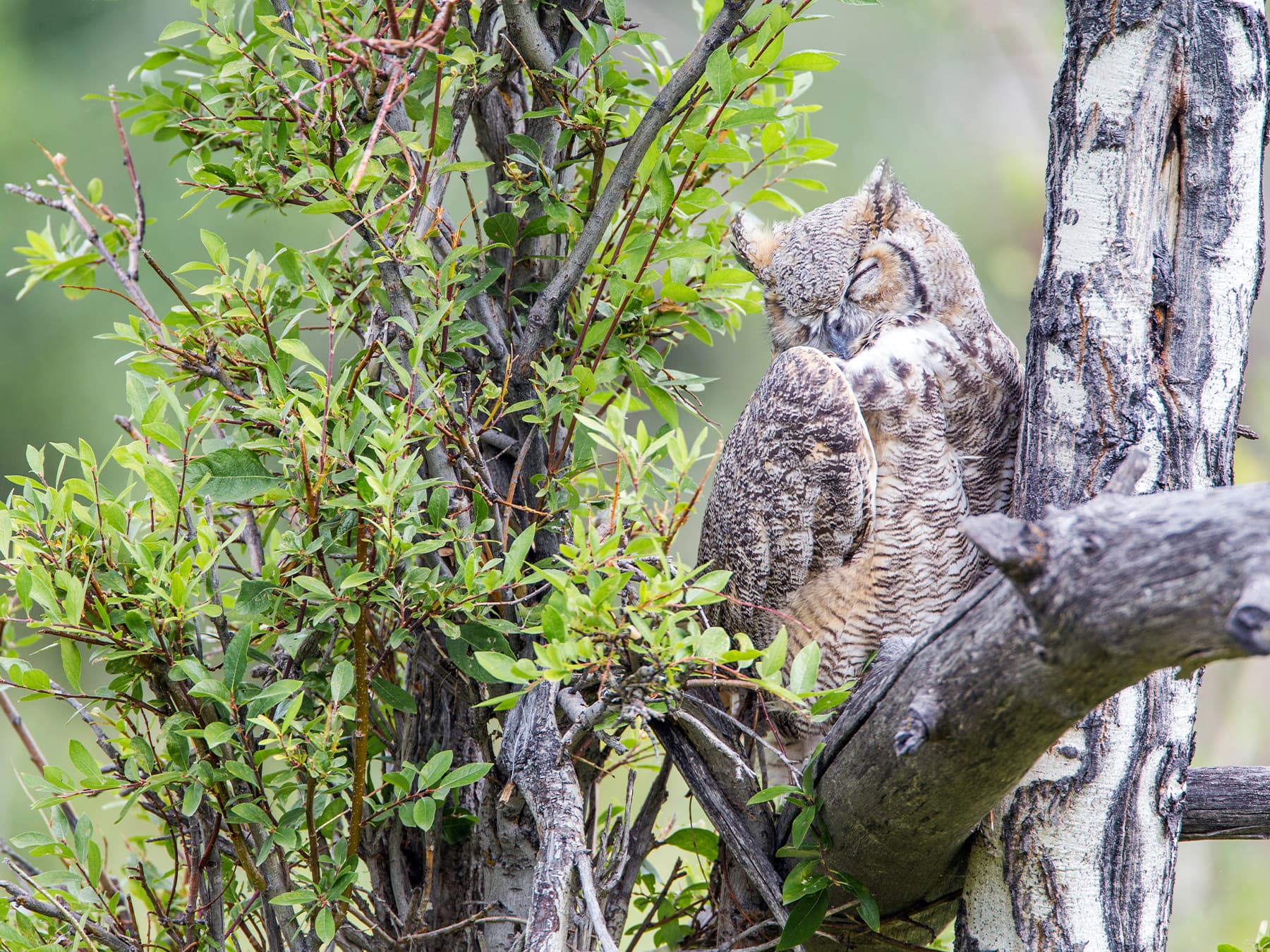
Great horned owls are nocturnal, hunting through the night and finding a suitable roosting site as day breaks. Roosting spots are usually located in woodlands and forests, both in cavities and in the branches of both coniferous and deciduous trees.
Males regularly use the same roosting spot, while during nesting, females roost in the nest chamber with eggs or young.
Lifespan and predators
How long do Great Horned Owls live?
Great horned owls hold the longevity record among North American owls, with the oldest known individual reaching 28 years and 7 months.
An injured banded great horned owl, was recovered at 28 years and cared for in captivity where it survived until the age of 34. Another captive example is a female at the San Francisco Zoo who reached an incredible 50 years of age.
Breeding usually occurs for the first time at two years of age although year-old great horned owls have been known to breed successfully.
What are the predators of Great Horned Owls?
Due to their position near the very top of the food chain, predation of great horned owls is rare and not frequently observed. Where nests are left unattended, opportunistic predation by crows and ravens may occur, and nestlings that fall from the nest ahead of fledging may also fall victim to foxes, raccoons, or coyotes.
Are Great Horned Owls protected?
Under the Migratory Bird Treaty Act of 1918, great horned owls and their young are protected against being killed, injured, traded for sale, or taken into captivity unless a particular license exists. Their nest sites and eggs are also protected against being destroyed or damaged. They do not have any additional conservation status.
Are Great Horned Owls endangered?
Great horned owls are rated as a species of least concern, and their populations are considered stable and robust across much of their range. As they have become well adapted to surviving in a diverse range of habitats, they are largely unaffected by changes in land use.
Conservation
While Great Horned Owls are currently listed as Least Concern, they face threats from habitat loss and collisions with vehicles.
Conservation efforts focus on preserving diverse habitats and educating the public about the importance of these apex predators in ecosystem balance.
More photos
7 photos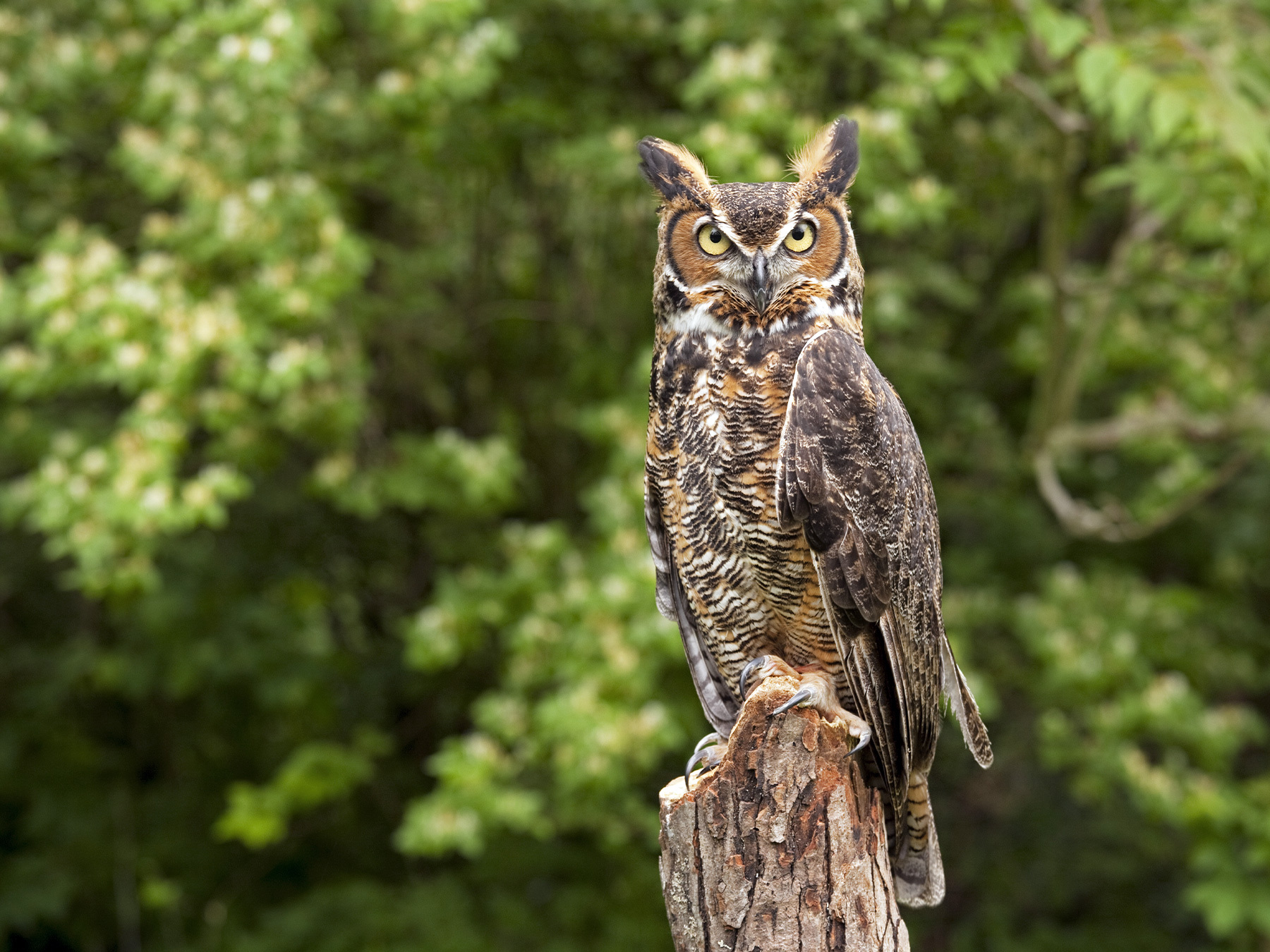
Great Horned Owl guides
4 guidesQuick facts
- Length
- 46–63 cm
- Wingspan
- 91–153 cm
- Weight
- 910–2500 g
- Lifespan
- 13–28 years
- Family
- Owls
- Migration
- Resident
- Global status (IUCN)
- Least Concern
- World population
- 5,700,000 mature individuals
- Population trend
- Stable
- Also called
- Tiger Owl, Hoot Owl
- Scientific name
- Bubo virginianus
Questions
4Is a Great Horned Owl bigger than a Bald Eagle?
Bald eagles eclipse great horned owls in length, wingspan, and weight. With a maximum wingspan of 2.44 m (88 in), bald eagles are almost a meter wider than the largest great horned owls. The maximum weight of a bald eagle is 6.3 kg (14 lb), almost three times heavier than the heaviest great horned owls.
Why do Great Horned Owls hoot so much?
The characteristic loud low hooting of a great horned owl serves a number of different purposes, including the establishment of a territory and later protecting that patch, as a communication between mates, and to deter predators or rivals from approaching. Their deep hoots carry across forests and woodlands, alerting wildlife and humans to their presence nearby.
How do I attract Great Horned Owls to my property?
It is not especially advised to attempt to attract great horned owls to a backyard or any location that has frequent human traffic or a chance of disturbing a nesting pair, as they are known to attack people when they feel threatened.
These powerful giant birds of prey are known to nest in tall trees, particularly drawn to a tree with an existing bulky nest platform that they can repurpose as their own. Nest boxes may also prove irresistible if no natural sites are available nearby.
Is it good luck to see a Great Horned Owl?
In some cultures, great horned owls are considered to be a lucky omen as they have a spiritual association with good fortune, especially in romantic matters. Some believe they carry messengers from the spirit world, and sightings bring protection and comfort.
Sources
3- 1BirdLife International. 2018. Bubo virginianus. The IUCN Red List of Threatened Species 2018: e.T61752071A132039486. Source (opens in a new tab)
- 2Breeding Bird Survey and/or Christmas Bird Count: Butcher and Niven (2007)
- 3Partners in Flight (2019)

Checked by
Nathan Cope, founder and editor
Nathan founded Birdfact and leads its writers and contributors in the UK, the US and Canada. He has watched and studied birds for more than ten years, and checks every article and species guide before it’s published.