Species Profile
Gray-cheeked Thrush
Catharus minimus
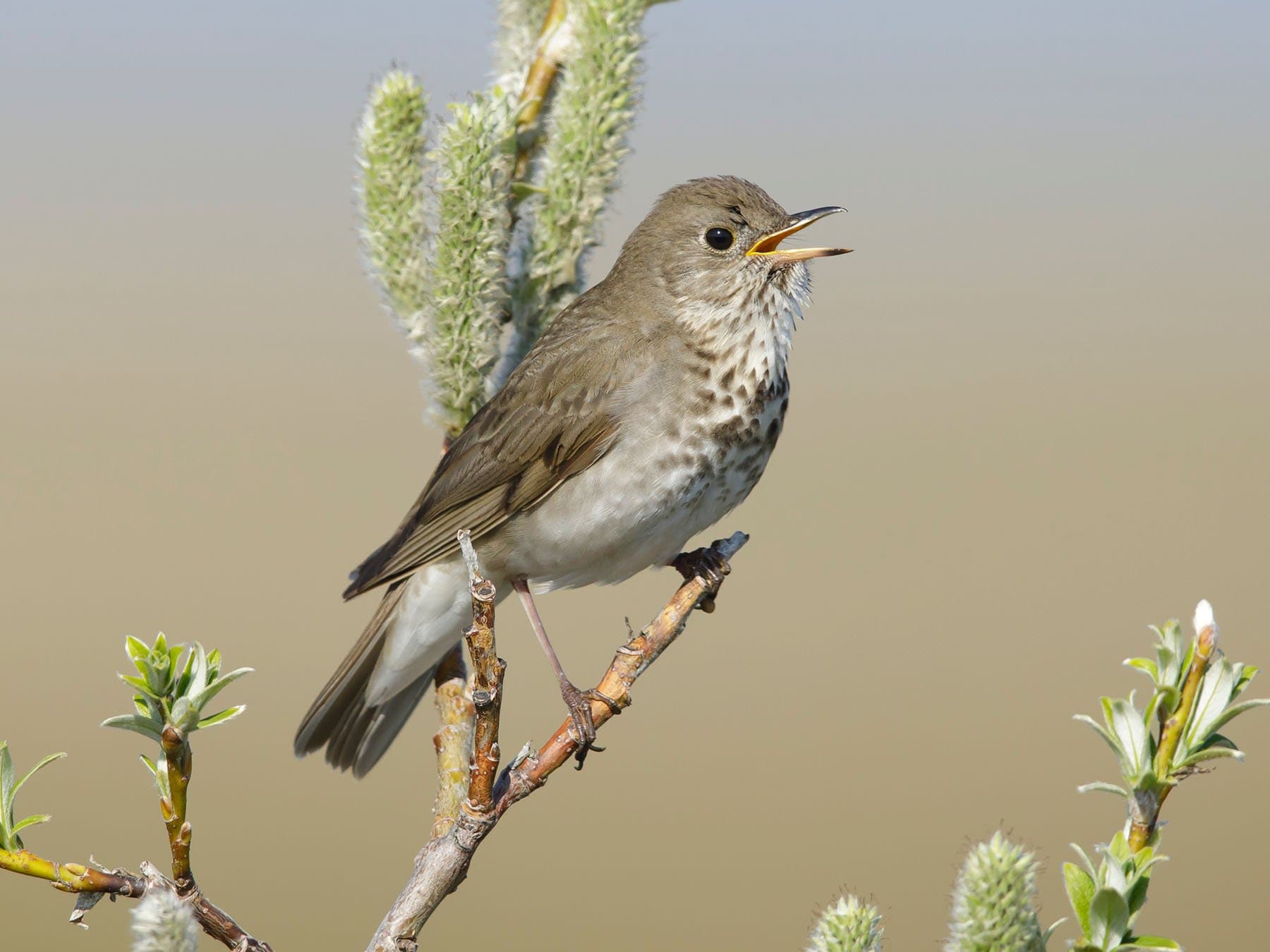
Gray-cheeked Thrush perched on a branch with green catkins, mouth open, showing its spotted breast and pale eye-ring.
Quick Facts
Conservation
LCLeast ConcernLifespan
3–6 years
Length
16–17 cm
Weight
26–30 g
Wingspan
32–34 cm
Migration
Long-distance Migrant
Crossing from Siberia to Alaska and then all the way to South America without a field guide entry most birders have ever read — the Gray-cheeked Thrush is one of North America's most widely travelled yet least-studied songbirds. Its plain grey face and faint eye-ring make it easy to overlook on the ground, but on autumn nights hundreds can pass overhead in a single hour, betrayed only by a high, piercing whe-eer call dropping out of the dark sky.
Also known as: Grey-cheeked Thrush
Think you've spotted a Gray-cheeked Thrush?
Upload a photo and we'll confirm it instantly
Confirm with a PhotoAppearance
The Gray-cheeked Thrush is a compact, medium-sized thrush measuring 16–17 cm (6.3–6.7 in) in length and weighing 26–30 g (0.9–1.1 oz), with a wingspan of 32–34 cm (12.6–13.4 in). Its most immediately useful field mark is the face: the cheeks, lores, and sides of the neck are all washed in grey, giving the bird a cold, expressionless look quite unlike the warm buff tones of the closely related Swainson's Thrush. The pale eye-ring is faint and incomplete — barely a suggestion — rather than the bold, complete spectacle of Swainson's.
The upperparts are dull greyish-brown (olive-brown), and the underparts are whitish with greyish flanks and dark brown spotting or stippling concentrated on the breast and sides of the throat. The bill is small, with a yellow base to the lower mandible and a dark culmen. The legs are pink. In flight, the underwing shows the characteristic white-dark-white banding pattern shared by all Catharus thrushes.
The species is not sexually dimorphic — males and females are identical in plumage. There is no dramatic seasonal change, though birds in fresh autumn plumage can appear very slightly warmer-toned. Juveniles resemble adults but show buff-tipped wing coverts. Two subspecies exist with subtle but consistent differences: C. m. aliciae (the widespread northern form) has greyish-olive upperparts and a lightly cream-washed breast; C. m. minimus (the Newfoundland form) is slightly smaller, has a warmer brown back and flanks, a more intensely cream underside, and a brighter, more extensive yellow base to the lower mandible. The species is nearly identical to Bicknell's Thrush, from which it is best separated by its slightly larger size, slightly less reddish plumage wash, and — most reliably — its song.
Identification & Characteristics
Colors
- Primary
- Brown
- Secondary
- White
- Beak
- Yellow
- Legs
- Pink
Markings
Plain grey face with faint incomplete eye-ring; dark brown breast spotting; greyish flanks; yellow base to lower mandible
Tail: Short, square-ended tail; dark brown, not pumped or fanned conspicuously
Attributes
Understanding Attributes
Rated 0–100 based on research and observation. A score of 50 is average across all bird species. These attributes are relative and don't necessarily indicate superiority.
Habitat & Distribution
The Gray-cheeked Thrush has the most northerly breeding range of all the American spotted thrushes. It breeds across the northern boreal forests and low Arctic scrub from Newfoundland and Labrador in the east, west across northern Quebec, Ontario, Manitoba, Saskatchewan, northern British Columbia, and Alaska, and extends across the Bering Sea into northeastern Siberia — making it one of very few American songbirds to breed in Asia. Approximately 35% of the global population breeds in Canada's boreal forest.
On the breeding grounds, the species favours areas where the boreal forest begins to give way to tundra: dense, stunted spruce and balsam fir forests near the treeline; willow and alder thickets along rivers and bogs; open-canopy old-growth conifer forests with a well-developed shrub understorey of dwarf birch, currant, rose, raspberry, or blueberry; and regenerating clearcuts with young conifers. The species avoids areas where shrub cover is shorter than approximately 1 m. In Newfoundland, the nominate subspecies uses mature spruce forests with heavy shrub cover, coastal conifer thickets, and old-growth balsam fir stands.
The species winters in northern South America, primarily east of the Andes. C. m. aliciae winters from Colombia east to the Guianas and south to northeastern Peru and northwestern Brazil; C. m. minimus winters in northeastern Colombia and northwestern Venezuela, possibly also eastern Panama. On the wintering grounds, birds occupy a variety of woodlands, second growth, thickets, and plantations in tropical lowlands.
During migration, the species passes through most of eastern North America, from the Great Plains eastward. It is uncommon to rare across the central and eastern United States during passage — spring migrants arrive in Illinois from mid-April, and autumn migrants return from mid-August. The species is rare along the Pacific coast. In the UK and Ireland, the Gray-cheeked Thrush is a rare but regular vagrant, with over 45 accepted records. Most fall in October, with almost all occurring in western Britain — particularly the Western Isles, Northern Isles, and Isles of Scilly — though records have also come from Cornwall, Devon, Hertfordshire, and Scotland. Ireland's first spring record was found in County Mayo in May 2015. The species is classified as a 'Mega' rarity by BirdGuides.
Where to See This Bird
Explore regional guides for locations where this bird has been recorded.
Diet
Diet shifts markedly with the seasons. During the breeding season, the Gray-cheeked Thrush is primarily insectivorous, taking beetles (including weevils), flies and fly larvae, wasps, bees, ants, caterpillars, and grasshoppers, along with spiders, earthworms, crayfish, and sow bugs. Prey is located by sight and sound while hopping through leaf litter, and the foot-vibration technique — rapidly stamping or trembling one foot against the ground — is used to startle hidden insects into movement before they are seized.
From late summer through migration and into winter, fruit becomes increasingly important. Wild cherries, blackberries, raspberries, grapes, and a range of other berries are taken both from the ground and by perching directly in fruiting shrubs and trees. This seasonal switch to fruit is ecologically significant: Gray-cheeked Thrushes consume berries whole and pass the seeds undigested, making them effective dispersers of many woodland plant species across the vast distances of their migration route.
On the wintering grounds in tropical South America, the diet is poorly documented, but birds have been recorded joining mixed-species flocks that follow army ant swarms through the forest floor — exploiting the ants' ability to flush invertebrates from the leaf litter rather than hunting the ants themselves. The winter diet likely combines invertebrates with tropical fruits, though the precise balance is not well established. Foraging is almost exclusively on or near the ground, and birds are rarely seen feeding in the open canopy.
Behaviour
Gray-cheeked Thrushes are quiet, secretive birds for most of the year. On the breeding grounds, males arrive before females and begin singing immediately to establish territories — sometimes while snow still covers the ground. Territory defence involves song, but also a suite of physical threat displays: pointing and opening the bill, raising the crown feathers, vibrating one foot rapidly against the ground, and flicking the wings and tail at intruders. These displays are rarely escalated to physical contact.
The foot-vibration behaviour is also used during foraging. Birds hop quietly through leaf litter and periodically stamp or vibrate a foot to startle hidden invertebrates before seizing them with a quick peck — a technique shared with several other thrush species. Foraging is almost entirely terrestrial, with birds working methodically through the understorey, pausing frequently to watch and listen.
Outside the breeding season, Gray-cheeked Thrushes are largely solitary. During migration they can occur in loose aggregations where fruiting shrubs concentrate birds, but they do not form cohesive flocks. On their tropical wintering grounds, they have been observed joining mixed-species flocks that follow army ant swarms (Labidus praedator) through the forest. The ants flush hidden invertebrates from the leaf litter, which the thrushes then snatch up. Competition with specialist antbirds for access to the swarms can be intense. This winter behaviour remains poorly studied, partly because the species was only formally separated from Bicknell's Thrush in 1995, meaning much earlier fieldwork in South America may have conflated the two species.
Males sing most actively at dawn and dusk, delivering their song from the tops of low trees, shrubs, or utility wires. During migration, the species is almost entirely nocturnal in its movements, making it far more likely to be heard than seen.
Flight
In flight, the Gray-cheeked Thrush appears compact and direct, with relatively long, pointed wings that reflect its status as one of the longest-distance songbird migrants in the Americas. The wingbeats are rapid and slightly undulating — typical of Catharus thrushes — and the bird covers ground efficiently without the bounding, deeply undulating flight of some other small passerines. Long pointed wings are an adaptation to sustained migratory flight. Birds are believed to make near-nonstop transoceanic crossings from northeastern North America directly to northern South America in autumn — a journey of several thousand kilometres over open water with no opportunity to land.
The underwing pattern is a useful in-flight identification feature: like all Catharus thrushes, the Gray-cheeked shows a distinctive white-dark-white banding pattern on the underwing coverts, visible when a bird banks or is caught in good light. The tail is relatively short and square-ended, and birds do not fan or pump the tail conspicuously in flight.
Migration is almost entirely nocturnal. Birds depart after dark, fly through the night, and descend into cover before dawn. On radar, large movements of Gray-cheeked Thrushes are visible as broad pulses of passerine migration moving south through eastern North America on clear autumn nights with northerly winds. The Siberian-breeding population performs an especially long detour — several thousand additional kilometres eastward across the Bering Sea — to join North American populations rather than heading west through Asia before turning south for South America.
Nesting & Breeding
Males arrive on the breeding grounds in mid- to late May, often when snow still covers the ground, and begin singing immediately to establish territories. The species is presumed monogamous and breeds at one year of age. Egg-laying typically begins in mid-June in Newfoundland. Nesting pairs are rarely found at high densities — territories are well-spaced — though observations of multiple singing males in small habitat patches suggest some tolerance of neighbours, similar to the partly cooperative arrangements seen in Veery and Bicknell's Thrush.
The female selects the nest site and builds the nest alone. Nests are typically placed in branch crotches of shrubs (willow, alder) or low conifers (spruce, birch), usually less than 2 m off the ground, though occasionally up to 7 m; some nests are built directly on the ground at the base of trees. The nest is a well-made open cup averaging approximately 10 cm across and 7 cm high. The exterior is constructed of small twigs, rootlets, grass stems, or horsetail plants (Equisetum), with a supporting layer of mud often incorporated; the interior is lined with lichen, moss, and fine grasses.
Clutch size is typically 3–5 eggs (occasionally up to 6). Eggs are light greenish-blue, marked with light brown blotches or dots concentrated around the larger end, and measure approximately 2.1–2.5 cm long by 1.6–2.0 cm wide. Incubation is by the female alone and lasts 12–14 days. Nestlings hatch helpless and are fed by both parents. Young fledge 11–13 days after hatching. There is normally only one brood per season, but a second clutch may be laid if the first nest fails early enough in the season to allow time for a replacement attempt.
Lifespan
The typical lifespan of a Gray-cheeked Thrush in the wild is estimated at 3–6 years, with most individuals likely surviving 3–4 years given the high mortality rates associated with long-distance migration. The oldest individual on record was at least 6 years and 11 months old, established through banding data — a figure that places it among the longer-lived small thrushes in North America, though still well below the maximum ages recorded for larger thrush species such as the Blackbird, which can exceed 20 years in exceptional cases.
Annual survival rates for the species are not well established, partly because the remote breeding habitat limits banding effort and partly because the 1995 species split means historical banding records attributed to 'Gray-cheeked Thrush' may include Bicknell's Thrush individuals. Mortality causes include predation at the nest (particularly by Red Squirrels in Newfoundland), predation by raptors and cats during migration, building and window strikes during nocturnal migration, and starvation during severe weather on the wintering grounds. The long transoceanic migration flights represent a significant energetic gamble. Birds must accumulate sufficient fat reserves before departure to sustain flights of potentially thousands of kilometres over open water with no opportunity to refuel.
Conservation
The Gray-cheeked Thrush is listed as Least Concern on the IUCN Red List (2016), with a global population estimated at approximately 46 million mature individuals (Partners in Flight, 2020), of which around 42 million breed in the US and Canada. However, the overall population trend is declining, and monitoring is hampered by the species' remote breeding habitat — Breeding Bird Survey coverage of its range is limited, making trend estimates uncertain.
The conservation picture is dramatically different at the subspecies level. The Newfoundland subspecies, C. m. minimus, has suffered one of the most severe declines ever recorded by Canada's Breeding Bird Survey. Between 1974 and 2019, breeding numbers in BBS-sampled areas fell by approximately 99.5%. More conservative estimates — correcting for unsampled high-elevation and coastal island habitats — still indicate a long-term decline of 93.5–95.5% and a 10-year decline of 26.7–30.4%. The global population of this subspecies is now estimated at approximately 91,000 mature individuals (COSEWIC, 2023). In December 2023, COSEWIC designated C. m. minimus as Threatened in Canada.
The primary driver of the Newfoundland collapse is the introduction of Red Squirrels (Tamiasciurus hudsonicus) to the island in 1963. Squirrels are highly effective nest predators, taking eggs and nestlings, and the two species rarely co-occur where squirrels are established. Additional threats on the breeding grounds include forestry operations, oil and gas exploration, and mining; deforestation and agricultural conversion of wintering habitat in South America also pose significant risks. Building strikes during nocturnal migration and potential climate-driven changes to Arctic and boreal ecosystems add further pressure on the species.
The ecological role of the species as a seed disperser — transporting undigested berry seeds across thousands of kilometres of migration route — adds further weight to the case for its protection.
Population
Estimated: Approximately 46 million mature individuals globally (Partners in Flight, 2020); nominate subspecies C. m. minimus estimated at approximately 91,000 mature individuals (COSEWIC, 2023)
Trend: Declining
Declining overall; the Newfoundland subspecies (C. m. minimus) has declined by an estimated 93.5–95.5% long-term and was designated Threatened in Canada by COSEWIC in December 2023
Elevation
Breeding: sea level to treeline (up to approximately 900 m in parts of range); wintering: tropical lowlands
Additional Details
- Predators:
- Red Squirrels (Tamiasciurus hudsonicus) are the primary nest predator in Newfoundland, where their introduction in 1963 is the main driver of the nominate subspecies' collapse. Raptors (including Sharp-shinned Hawk and Merlin) take adults during migration. Domestic and feral cats pose a significant mortality risk during migration stopovers. Corvids and other small mammals may take eggs and nestlings.
- Subspecies count:
- 2 (C. m. aliciae and C. m. minimus)
Subspecies
Two subspecies of Gray-cheeked Thrush are currently recognised, differing subtly in size, plumage tone, and wintering range. Catharus minimus aliciae — the 'Northern' Gray-cheeked Thrush — is the widespread form, breeding from Alaska east across northern Canada to Labrador and into northeastern Siberia. It has greyish-olive upperparts, a lightly cream-washed breast, and a relatively dull yellow base to the lower mandible. This subspecies winters from Colombia east to the Guianas and south to northeastern Peru and northwestern Brazil.
Catharus minimus minimus — the 'Newfoundland' Gray-cheeked Thrush — is the nominate subspecies, restricted to the island of Newfoundland as a breeding bird. It is slightly smaller than aliciae, with a warmer brown (rather than greyish) back and flanks, a more intensely cream underside, and a brighter, more extensive yellow base to the lower mandible. It winters in northeastern Colombia and northwestern Venezuela, possibly also eastern Panama — a more restricted wintering range than aliciae. This subspecies is now designated Threatened in Canada (COSEWIC, December 2023), with a global population estimated at approximately 91,000 mature individuals following a long-term decline of 93.5–95.5% driven primarily by introduced Red Squirrels on Newfoundland.
The two subspecies are not reliably separable in the field without detailed measurements or knowledge of breeding location. Most vagrant records in the UK and Ireland are not assigned to subspecies. The taxonomic status of the two forms has been debated — some authorities have suggested minimus may warrant full species status given its distinct range, wintering grounds, and conservation trajectory, but this split has not been widely adopted.
Vocalisation
Vocalisation is the most reliable way to identify a Gray-cheeked Thrush in the field — and the key to separating it from Bicknell's Thrush. The song is a complex series of burry, flute-like notes with a wiry, somewhat nasal quality. The overall pattern is a descending spiral — similar to the Veery's song but higher-pitched, thinner, and more nasal, with stuttering pauses between phrases. A useful phonetic rendering is ch-ch zreeew zi-zi-zreeee zizreeew. The critical identification feature is the final phrase: in Gray-cheeked Thrush it inflects downward in pitch, while in Bicknell's Thrush the final phrase rises. The middle phrase is notably high-pitched and ascending before the final descent.
Males sing most actively at dawn and dusk, delivering the song from the tops of low trees, shrubs, or utility wires. Song is also given during the day outside the breeding season. Only males are known to sing the full territorial song.
The flight call — the most commonly heard vocalisation during migration — is a high, penetrating, nasal queer or pzeeer. The nocturnal flight note, given by birds moving overhead at night, is a one- or two-note whe-eer that drops in pitch. This call is the primary way to detect the species during migration: on still autumn nights in eastern North America, it is far more likely to hear hundreds of birds calling overhead than to observe a single individual on the ground. An alarm chatter call has also been recorded from birds near the nest. Birders who invest time in learning the nocturnal flight call will find the species transforms from a rarity into a regular — if invisible — autumn presence.
Identification Tips
The Gray-cheeked Thrush is the plainest-faced of the North American spotted thrushes, and that plainness is the key to identifying it. Look for: a grey wash across the cheeks, lores, and sides of the neck; a faint, incomplete pale eye-ring (barely visible at distance); dull greyish-brown upperparts; whitish underparts with dark brown spotting on the breast; greyish flanks; a small bill with a yellow base to the lower mandible; and pink legs. The overall impression is of a cold, washed-out thrush — warmer tones are a warning sign that you may be looking at something else.
The most common confusion species is Swainson's Thrush, which shares the spotted breast but has a warm buff wash across the face and a bold, complete buffy eye-ring — a 'spectacled' look that Gray-cheeked entirely lacks. Hermit Thrush has a reddish tail it pumps slowly upward, which Gray-cheeked never does. The genuinely difficult separation is from Bicknell's Thrush, which is nearly identical.
Separating Gray-cheeked from Bicknell's in the field is best approached through vocalisation first: the song's final phrase descends in Gray-cheeked and rises in Bicknell's, and the flight calls differ subtly in pitch and quality. In the hand, Bicknell's averages smaller with a shorter wing. For vagrant birds in the UK and Ireland, photograph the bill base (yellow extent), note the overall plumage tone, and — if possible — record any calls; careful documentation is essential, as most records cannot be assigned to subspecies.
Birdwatching Tips
The Gray-cheeked Thrush is one of the most challenging North American migrants to observe well. During migration it moves almost entirely at night, and on the ground it skulks in dense shrubby cover, rarely venturing into the open. The single most useful skill for finding this species is learning its nocturnal flight call — a high, penetrating, slightly nasal whe-eer that drops in pitch. On still autumn nights in eastern North America, hundreds of birds can pass overhead in a single hour, yet remain completely invisible without this call in your ear.
In the US and Canada, the best windows for ground-level observation are during spring (mid-April to late May) and autumn (mid-August to early October) migration, particularly after nights of strong southerly winds in spring or northerly winds in autumn that ground large numbers of migrants. Check dense shrubby edges, woodland understorey, and areas with ripe berries — wild cherries, blackberries, and grapes are particularly attractive. Birds often feed quietly on the ground in dappled shade, so scan carefully rather than walking quickly through habitat.
Separating Gray-cheeked Thrush from the near-identical Bicknell's Thrush is genuinely difficult. Size is unreliable in the field. Focus on: (1) the song — Gray-cheeked's final phrase descends in pitch, Bicknell's rises; (2) the flight call — Gray-cheeked's whe-eer is slightly lower and less sharp than Bicknell's; (3) the bill base — Bicknell's tends to show a more extensively yellow lower mandible; (4) the overall plumage tone — Bicknell's has a slightly warmer, more reddish-brown wash. In the UK and Ireland, any October thrush with a plain grey face, faint eye-ring, and spotted breast in the Western Isles, Northern Isles, or Isles of Scilly should be carefully assessed — over 45 individuals have been accepted, and the species is a genuine annual vagrant in small numbers.
Did You Know?
- The Gray-cheeked Thrush is one of very few American songbirds to breed in Asia. A population nests in northeastern Siberia, then crosses the Bering Sea to join North American migrants heading south — a detour that makes them true 'trans-Beringian migrants.'
- The oldest recorded Gray-cheeked Thrush was at least 6 years and 11 months old, established through banding records — making it one of the longer-lived small thrushes in North America, and a figure that is all the more striking given the hazards of a transoceanic migration twice a year.
- Gray-cheeked and Bicknell's Thrushes were only recognised as separate species in 1995. Because Bicknell's Thrush breeds closer to centres of human population, most 20th-century scientific literature published under the name 'Gray-cheeked Thrush' actually described Bicknell's — meaning the true Gray-cheeked remains one of North America's least-studied songbirds.
- On their tropical wintering grounds, Gray-cheeked Thrushes join mixed-species flocks that follow army ant swarms (Labidus praedator) through the forest, competing with specialist antbirds to snatch invertebrates flushed by the ants from the leaf litter.
- The Newfoundland subspecies (C. m. minimus) was designated Threatened in Canada in December 2023, following a long-term population decline driven primarily by the introduction of Red Squirrels to the island in 1963.
Records & Accolades
Trans-Beringian Migrant
Breeds in Asia & Americas
One of very few American songbirds to breed in northeastern Siberia, crossing the Bering Sea to migrate south with North American populations.
Longest Thrush Migration
Alaska/Siberia to South America
Undertakes one of the longest migrations of any North American thrush, with birds believed to make near-nonstop transoceanic flights to northern South America.
Threatened Subspecies
93–96% decline in Newfoundland
The Newfoundland subspecies (C. m. minimus) has suffered one of the most severe declines ever recorded by Canada's Breeding Bird Survey, designated Threatened in 2023.
Community Photos
Be the first to share a photo of the Gray-cheeked Thrush
Upload a PhotoIdentify Any Bird Instantly
- Upload a photo from your phone or camera
- Get an instant AI identification
- Ask follow-up questions about the bird
Monthly Birds in Your Area
- Personalised for your location
- Seasonal tips and garden advice
- Updated every month with new species