


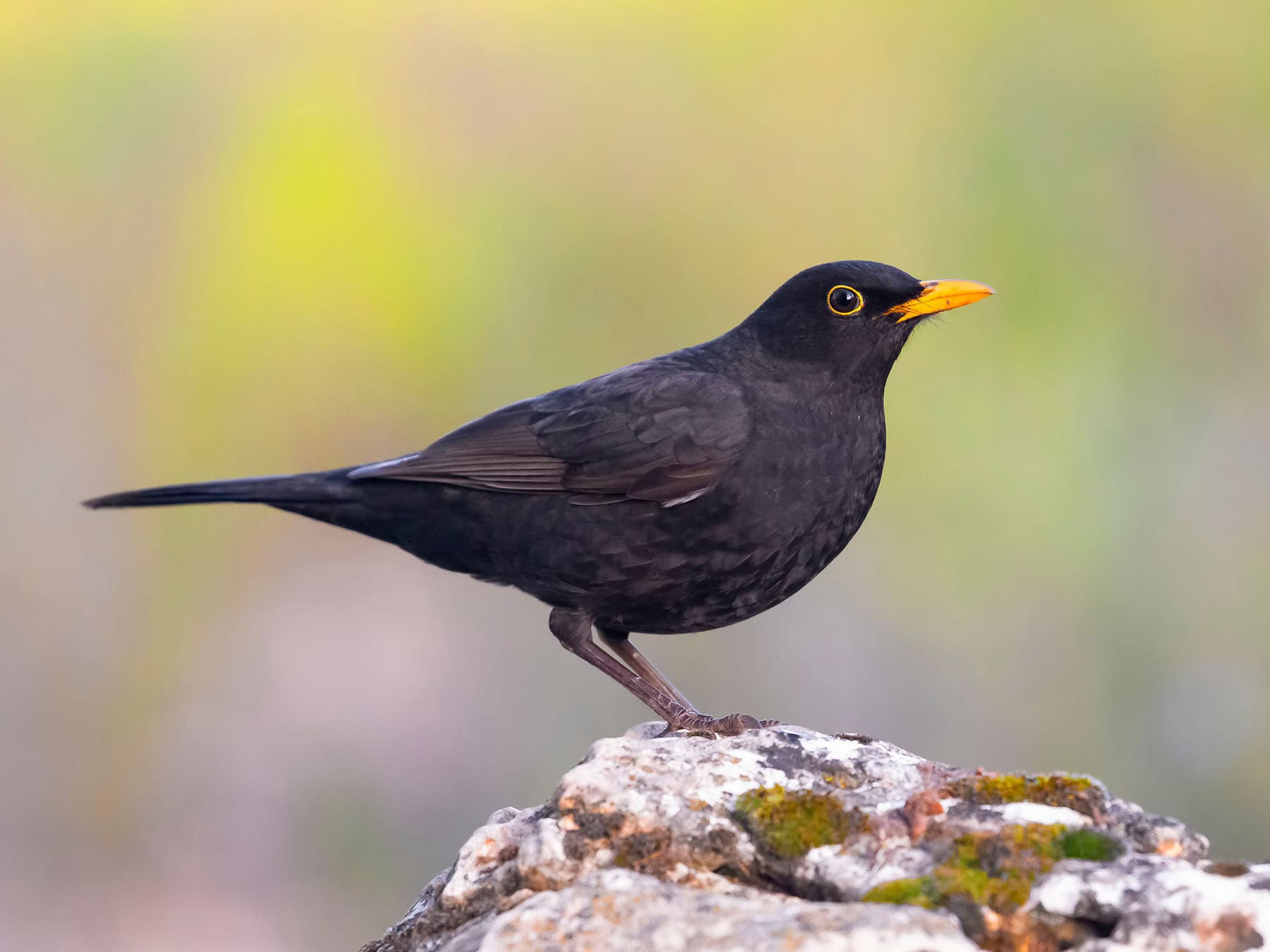
Blackbird
Common Blackbird, Eurasian Blackbird · Turdus merula
By the Birdfact teamChecked by Nathan Cope
See it in 3D
3 plumages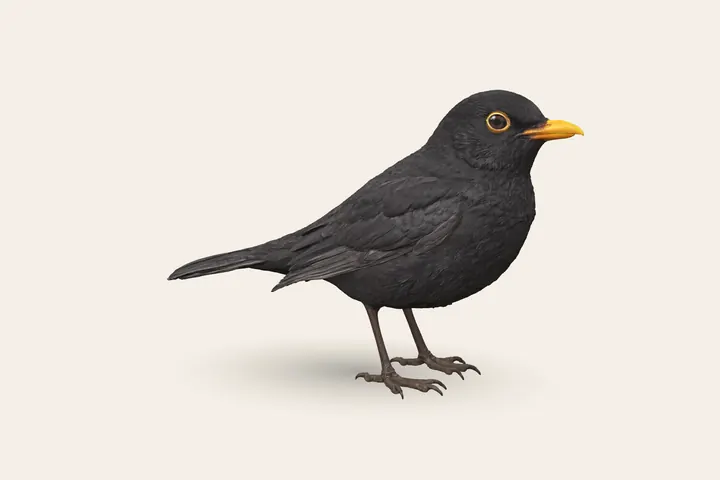 3D model
A Blackbird is 24–25 cm (9.5–10 in) long, bill to tail.
3D model · Male · Length 24–25 cm (9.5–10 in) · How we make our birds · Report a problem
© 2026 NC Digital Limited (Birdfact). All rights reserved. This 3D model may be viewed on this page and shared by link only. Downloading, extracting, copying or reusing it, or using it to train machine-learning models, is not permitted without our written permission. Using our models
On this page16 sections
How to recognise it
This page is about the Blackbird of Britain and Europe, Turdus merula, also called the Common or Eurasian Blackbird. It is a thrush. North America's Red-winged Blackbird is a different bird.
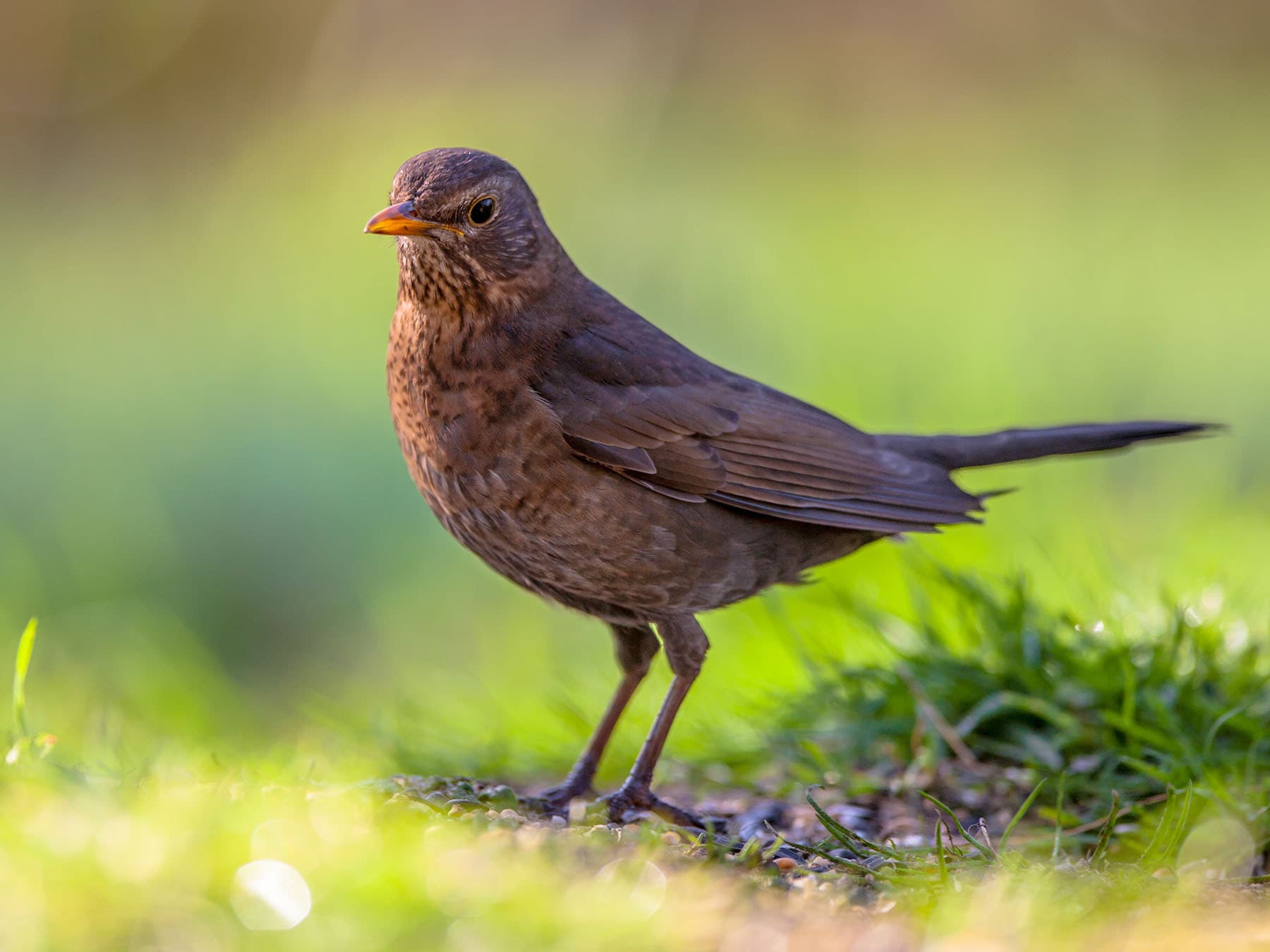
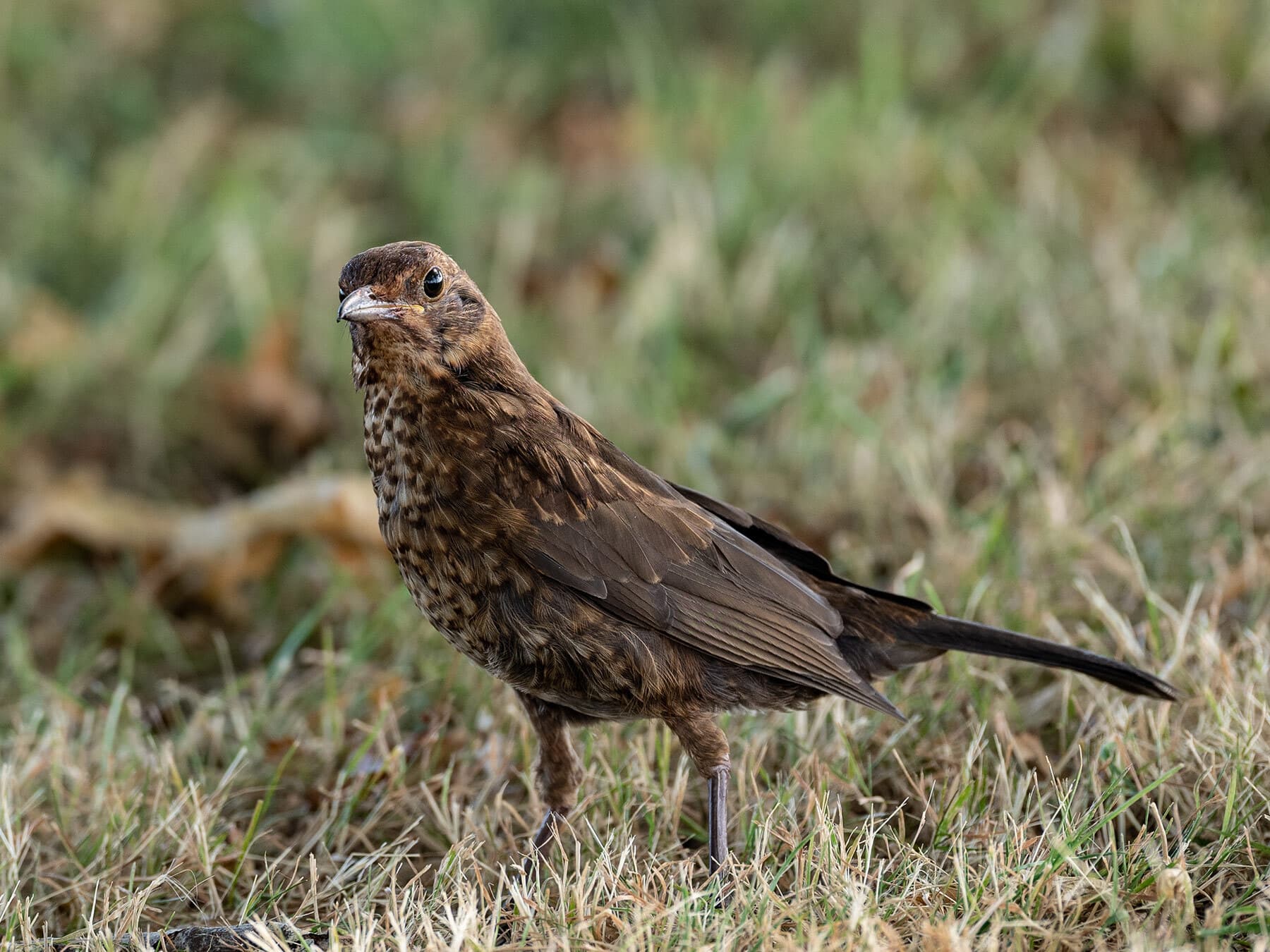
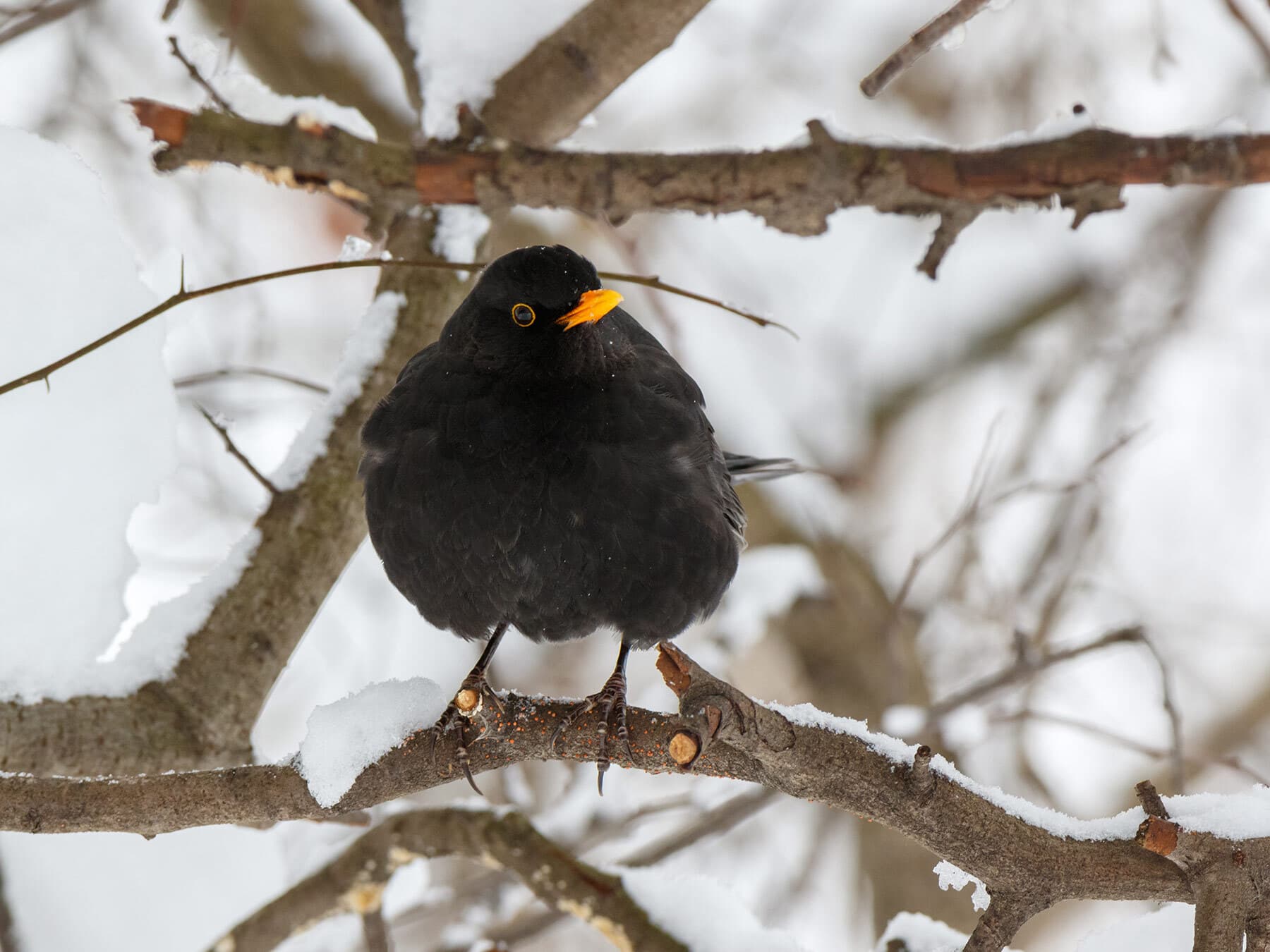
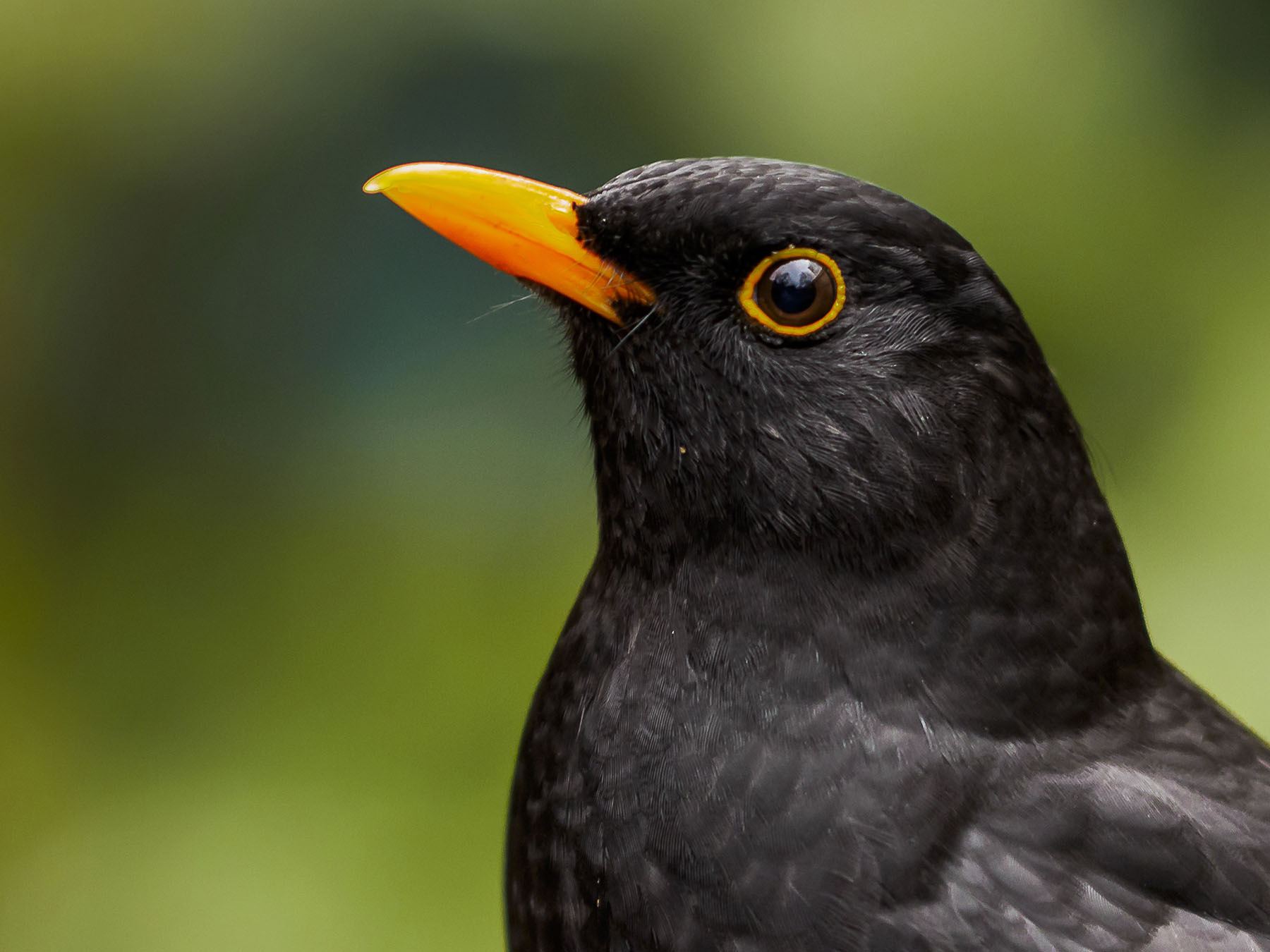
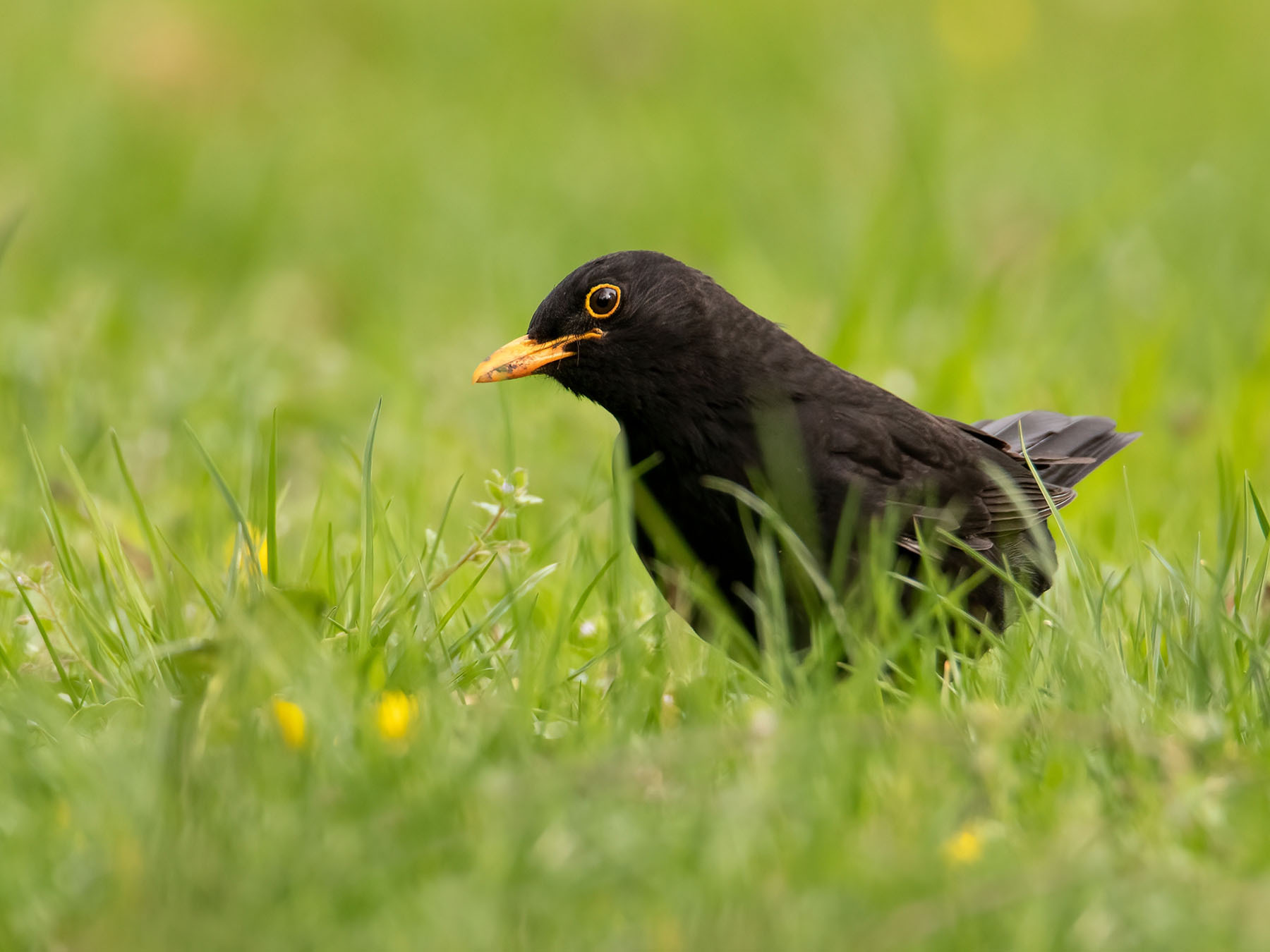
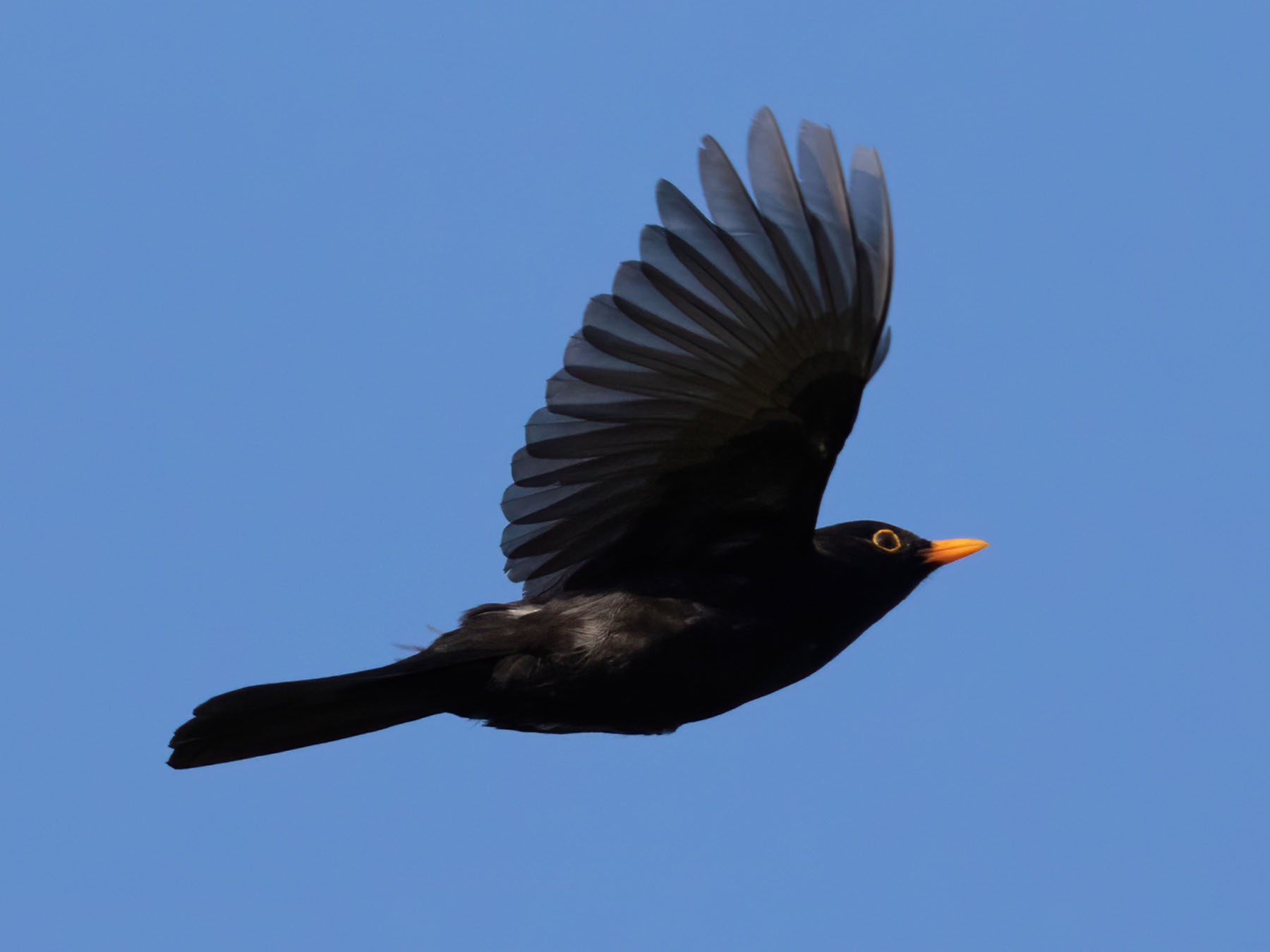
The male is easy: black all over, with a bright orange-yellow bill and a yellow ring round the eye. The female is dark brown, with a paler, mottled breast and a bill that can be anything from brown to yellow.
A Blackbird is 24 to 25 cm long, with a wingspan of 34 to 38.5 cm: bigger than a Starling, with a long tail. Weighed by BTO ringers, live adults average 101.8 g.1
On the ground it hops, or runs a few steps and stops dead, watching and listening, before stabbing at the soil. Its legs are dark.
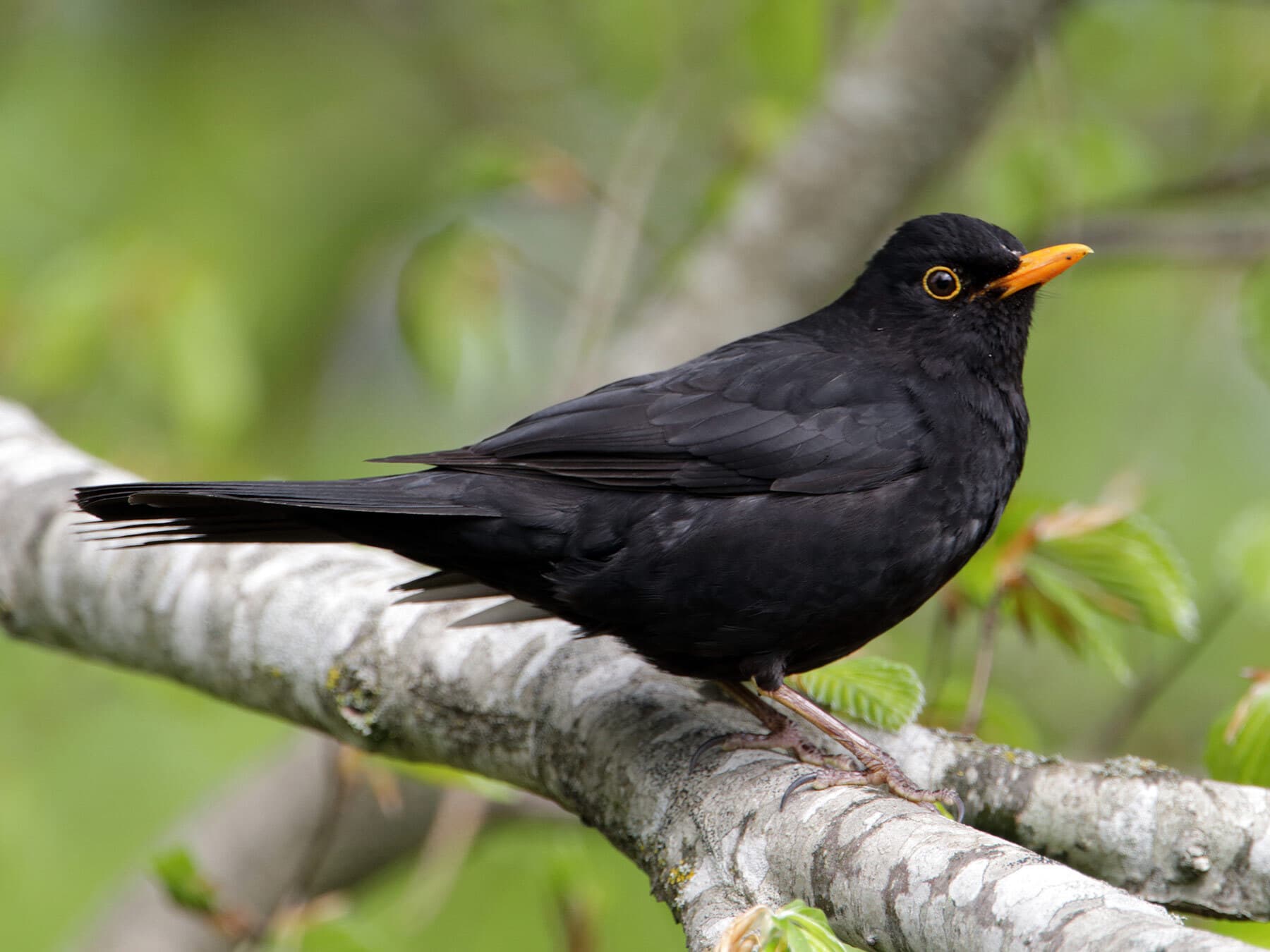
Male, female and young
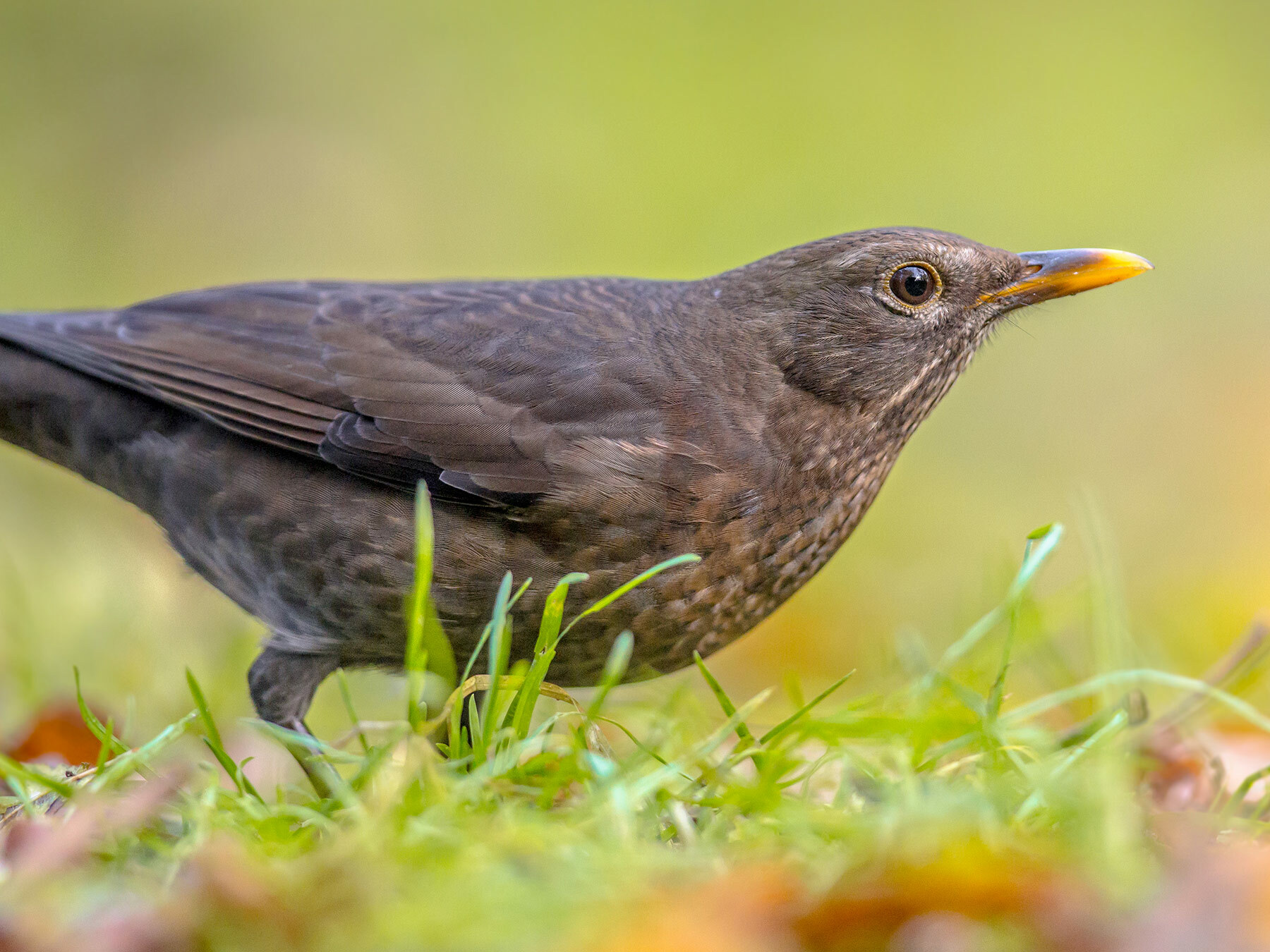
A female is dull dark brown with a slight reddish tinge, paler and mottled or streaked on the breast, with a paler, streaked throat. Many have a brownish bill with dull yellow at the base; some have a yellow one.
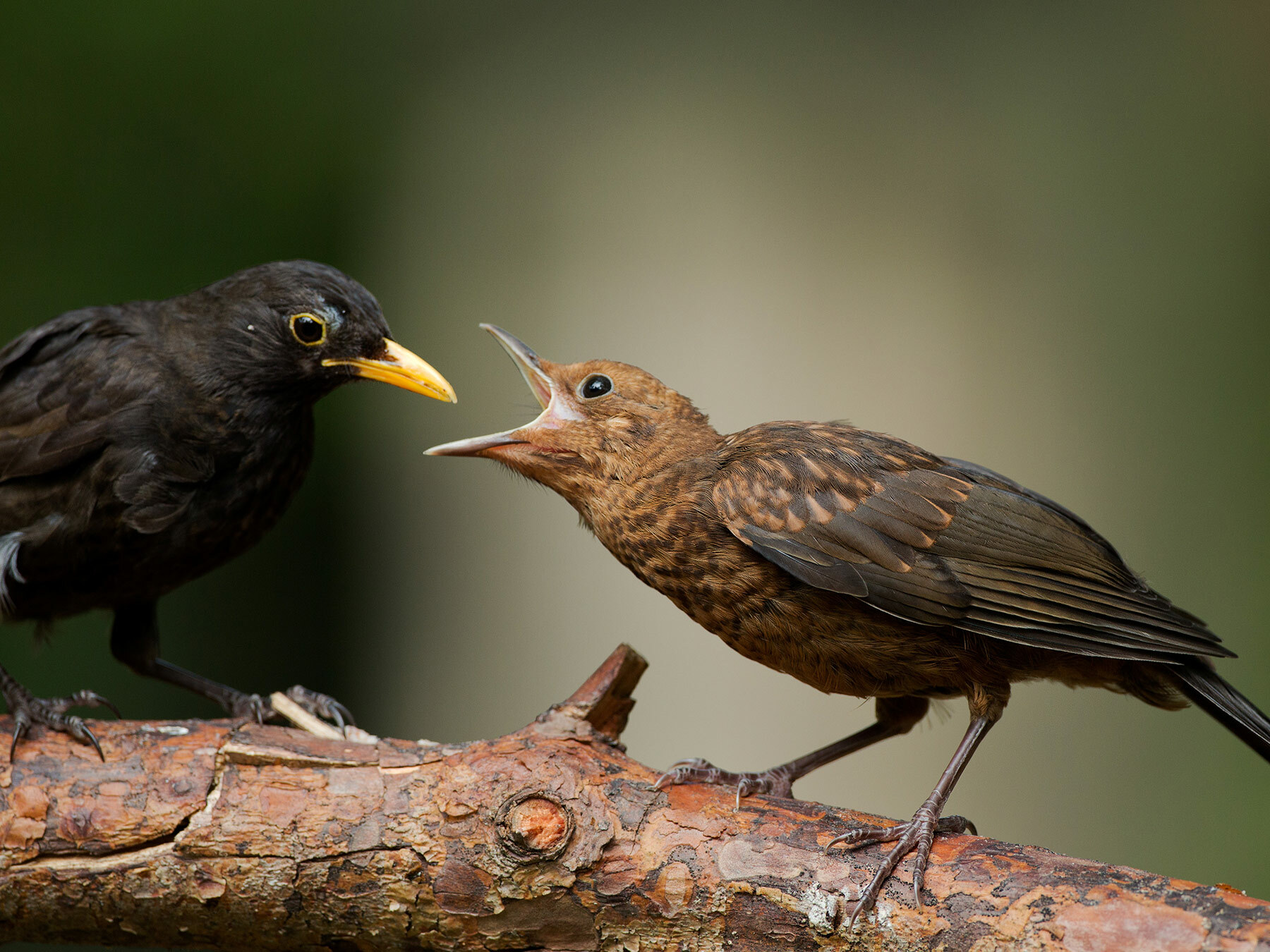
Young Blackbirds, out of the nest in spring and summer, are warm brown, streaked and spotted with buff, with a dark bill. From July they moult into adult-like plumage. A young male then looks black but keeps browner wings; some young males show a yellowish base to the bill by September, others keep a dark bill until the next spring.2
Photos of each, and how to tell a female from a Song Thrush: female Blackbirds. Chicks and fledglings: baby Blackbirds.
Identification: similar birds
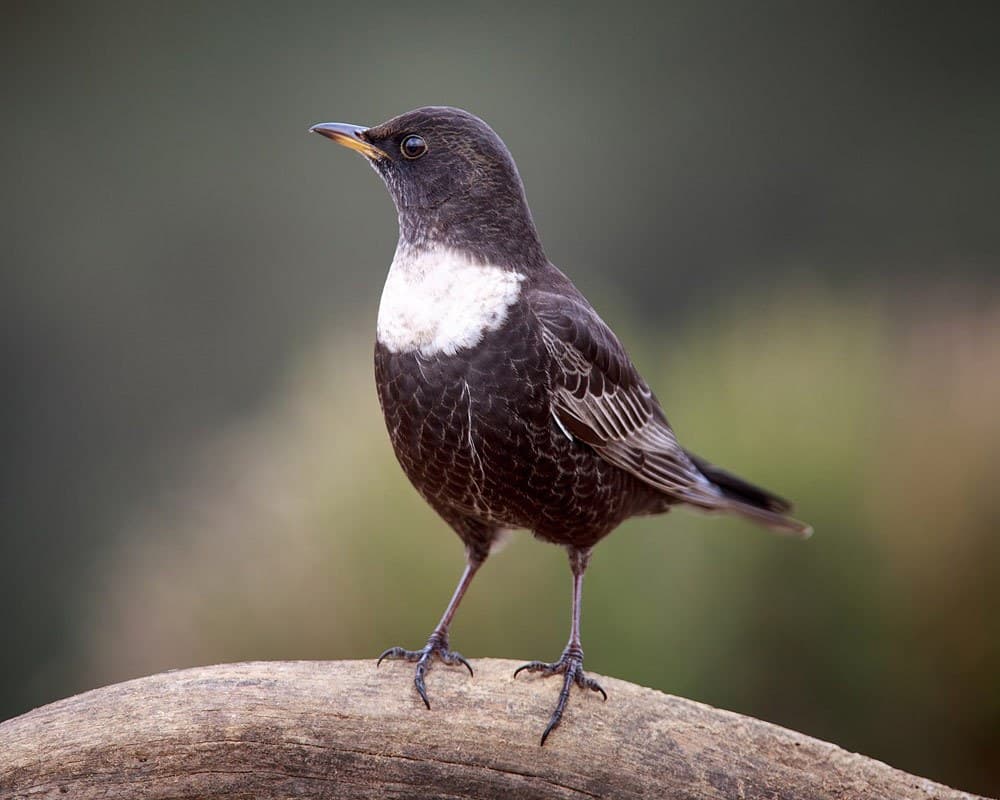
The Ring Ouzel, once known as the mountain blackbird, is slightly smaller and slimmer, with a white (male) or creamy (female) band across the breast and a pale panel in the wing. It is an upland summer visitor, here from late March to September.
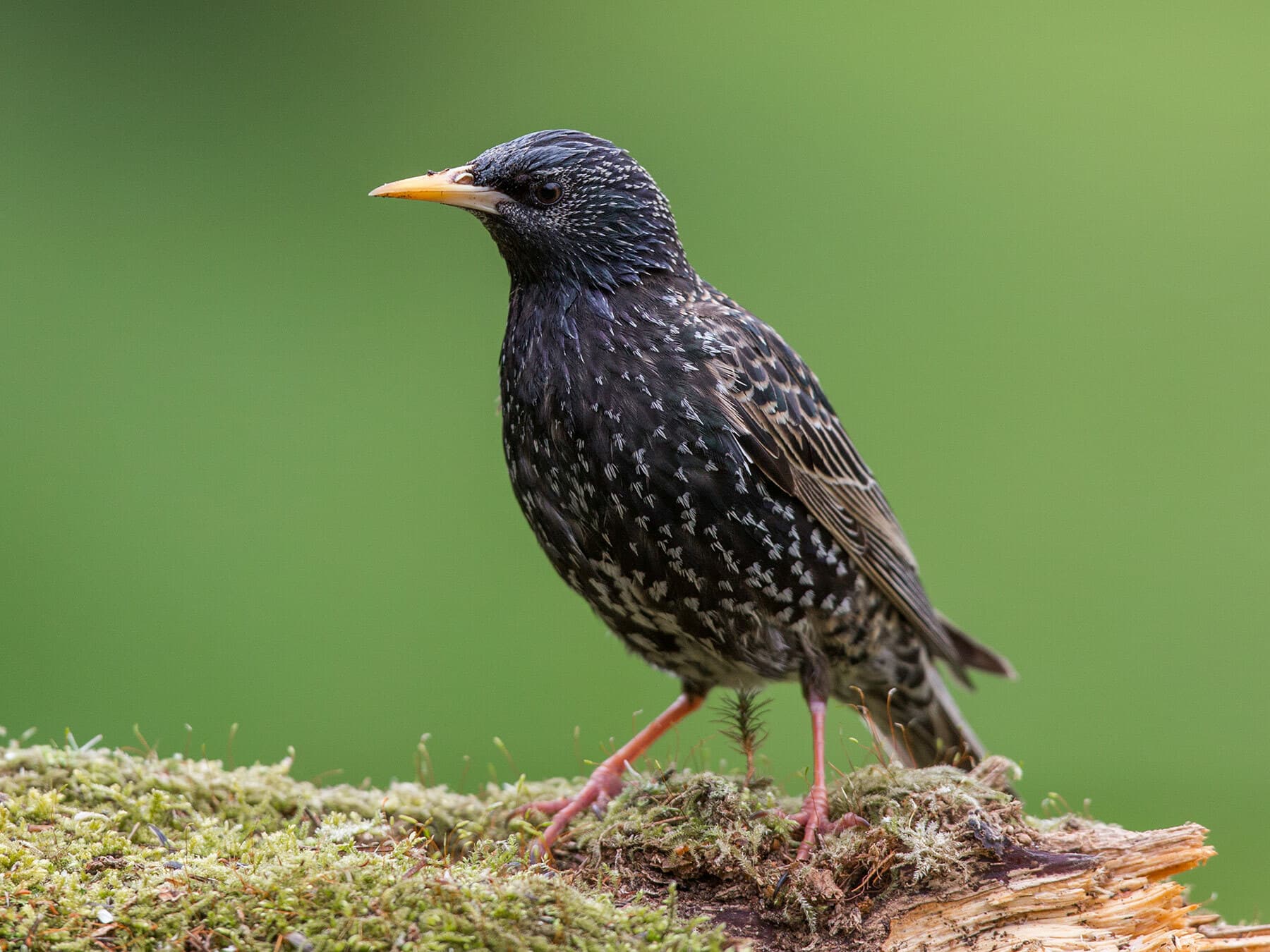
A Starling can look black at a distance but is smaller, with a short tail, a pointed head and triangular wings. Close up it is glossy purple and green, spotted with white in winter, and it walks and runs on the ground.
A female Blackbird is sometimes taken for a Song Thrush. The thrush is smaller, warm brown above, with neat dark spots like upside-down hearts on a creamy white breast.
Its size
Adults- Length
- 24–25 cm
- Wingspan
- 34–38.5 cm
- Weight
- 87–122 g
Its song and calls
In spring the male sings from a rooftop or the top of a tree: slow, mellow, fluting phrases, often ending in a short, chattering twitter. Blackbirds are a leading voice of the dawn chorus, and often start the evening chorus too. You can hear the song in any month, but most of all from March to June.
Unlike a Song Thrush, a Blackbird usually does not repeat a phrase, and the song is richest at dawn. Some males work in snatches of mimicry. In autumn and winter males sometimes sing a soft, rambling subsong, and a female gives a quiet subsong in courtship.
The calls are as familiar as the song: a loud chink chink chink in the late afternoon in autumn and winter, as territory holders go to roost, or when a cat is about; a low chook when a bird is uneasy, which can speed up into a loud, rattling alarm as it flies off; and a thin, high seee when a hawk is overhead.
- Song0:00 / 0:31
Recorded in Hampshire, England · June 2021
- Call0:00 / 0:58
Recorded in Normandie, France · October 2024
When and where to see it
OctoberArriving
Most recorded in October
- 1. Blaenau Gwent4.7%
- 2. Dundee4.5%
- 3. Wrexham4.5%
- 4. Neath Port Talbot4.4%
- 5. Monmouthshire4.1%
Each dot is a county, state or province: the bigger and darker, the larger the bird’s share of that place’s bird records that month. Grey dots: no regular records. The ringed point is the centre of the bird’s records this month; the arrow shows how it moved since last month, and the dashed loop its path through the year. “Arrivals” colours places where it becomes regular this month (orange) or is in its last regular month (grey). GBIF eBird Observation Dataset, 2019–2024. Map data: Natural Earth, US Census Bureau; place centres © OpenStreetMap contributors.
In your area
See when the Blackbird is recorded in your county, state or province.
How often the Blackbird turns up in the UK and Ireland through the year, from birdwatchers' records.
United Kingdom
Resident · all year · most records in June
Ireland
Resident · all year · most records in May
Show as a table
| Month | United Kingdom | Ireland |
|---|---|---|
| January | 3.1% (regular) | 2.6% (regular) |
| February | 3.0% (regular) | 2.5% (regular) |
| March | 2.9% (regular) | 2.9% (regular) |
| April | 2.9% (regular) | 3.3% (regular) |
| May | 3.1% (regular) | 3.6% (regular) |
| June | 3.3% (regular) | 3.1% (regular) |
| July | 2.7% (regular) | 1.9% (regular) |
| August | 1.7% (regular) | 1.3% (regular) |
| September | 1.6% (regular) | 1.5% (regular) |
| October | 2.2% (regular) | 1.9% (regular) |
| November | 2.8% (regular) | 2.5% (regular) |
| December | 3.2% (regular) | 2.8% (regular) |
Recorded regularly in
Worldwide: recorded regularly in 77 countries
Countries where it was recorded in at least 3 of the 6 years 2019–2024. Linked countries have their own bird list.
Europe (51)
- Åland Islands
- Albania
- Andorra
- Austria
- Belarus
- Belgium
- Bosnia & Herzegovina
- Bulgaria
- Croatia
- Czechia
- Denmark
- Estonia
- Faroe Islands
- Finland
- France
- Germany
- Gibraltar
- Greece
- Guernsey
- Hungary
- Iceland
- Ireland
- Isle of Man
- Italy
- Jersey
- Kosovo
- Latvia
- Liechtenstein
- Lithuania
- Luxembourg
- Malta
- Moldova
- Monaco
- Montenegro
- Netherlands
- North Macedonia
- Norway
- Poland
- Portugal
- Romania
- Russia
- San Marino
- Serbia
- Slovakia
- Slovenia
- Spain
- Sweden
- Switzerland
- Ukraine
- United Kingdom
- Vatican City
Asia (19)
- Armenia
- Azerbaijan
- China
- Cyprus
- Georgia
- Iran
- Iraq
- Israel
- Jordan
- Kazakhstan
- Kuwait
- Kyrgyzstan
- Lebanon
- Palestinian Territories
- Syria
- Tajikistan
- Turkey
- Turkmenistan
- Uzbekistan
Oceania (3)
- Australia
- New Zealand
- Norfolk Island
Data: EOD – eBird Observation Dataset (Cornell Lab of Ornithology), accessed via GBIF.org, CC BY 4.0. Records from 2019–2024, aggregated and filtered by Birdfact. How these lists are made
Almost anywhere with trees, bushes and some open ground: gardens, parks, hedgerows, farmland and woods, in towns as much as in the countryside. In the last national atlas Blackbirds were found in 96% of the UK's 10-km squares in winter and 95% in the breeding season, missing only a few upland and remote island squares.1
Blackbirds were woodland birds first. They moved into towns and gardens in the 1800s, and breeding densities in towns and suburbs can reach seven pairs to a hectare.2
Spotting tips
Mornings are best: in a 2024 BTO garden survey, afternoons were quieter. Look on lawns and under shrubs. In spring, scan rooftops and treetops for a singing male. In autumn, look in hedges and trees heavy with berries.
Do Blackbirds migrate?
Partly. Most British Blackbirds stay put all year, and a garden pair often keeps the same territory year after year. Some move south for the winter, and some British birds cross to Ireland.
Every autumn huge numbers of Blackbirds arrive from the Continent: from Scandinavia, the Netherlands, Germany and the Baltic states. They arrive mainly in October and early November and head back from late February to April. The RSPB puts the UK's winter Blackbird population at 10 to 15 million birds.3
Most of these migrants are females, and probably many are young birds. In Norway at least 61% of Blackbirds migrate, and three-quarters of those winter in Britain and Ireland.
Where they go in late summer
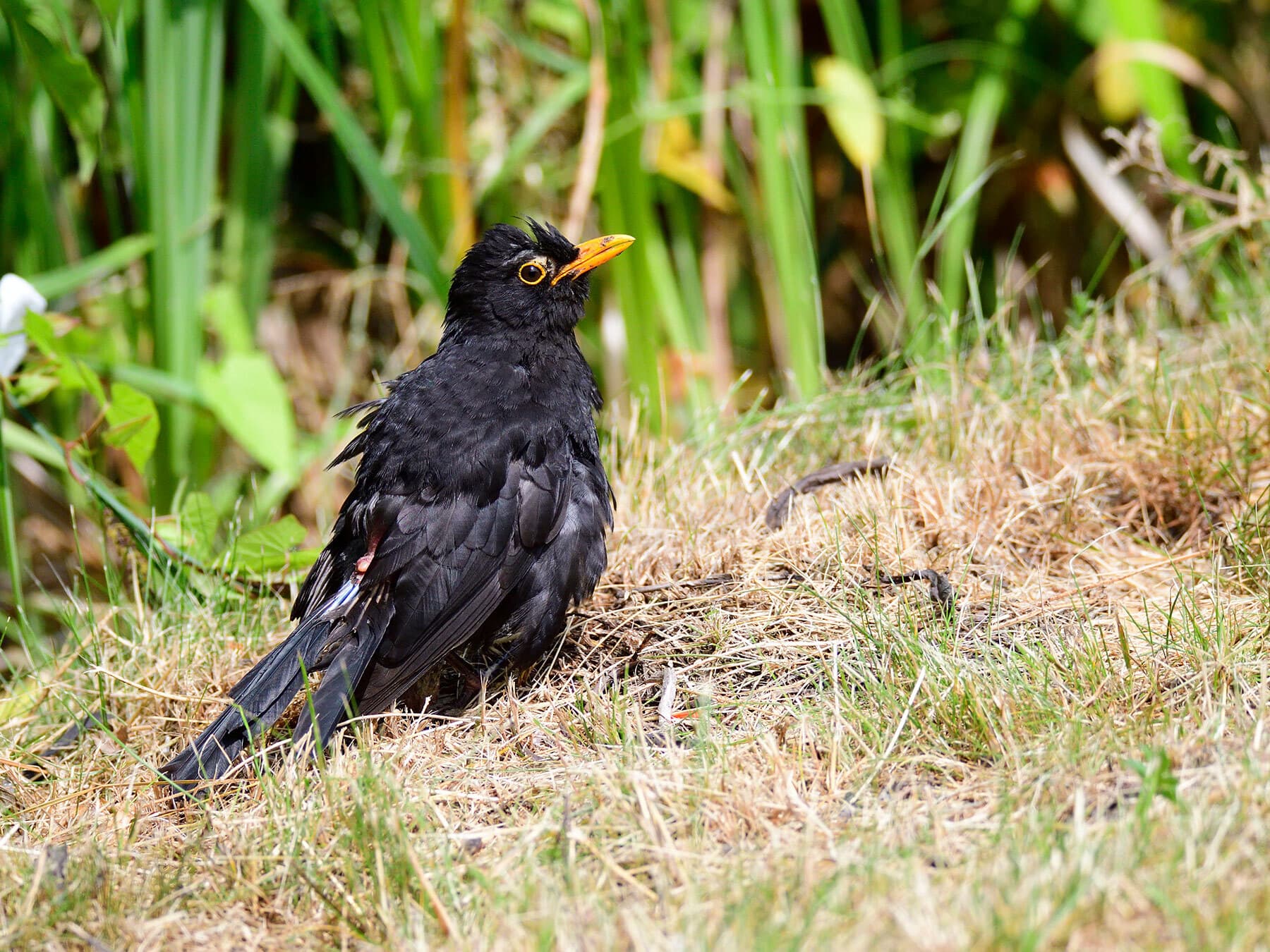
If the Blackbirds vanish from your garden in August, they have not gone far. After breeding, adults replace all their feathers and young birds most of theirs, and they keep out of sight while they moult. Others head into the countryside for the hedgerow berries. They drift back to gardens as the weather cools in autumn.
In a BTO survey in 2024, Blackbirds were seen in over 90% of gardens in early June but only about half in late August and early September.4
What it eats
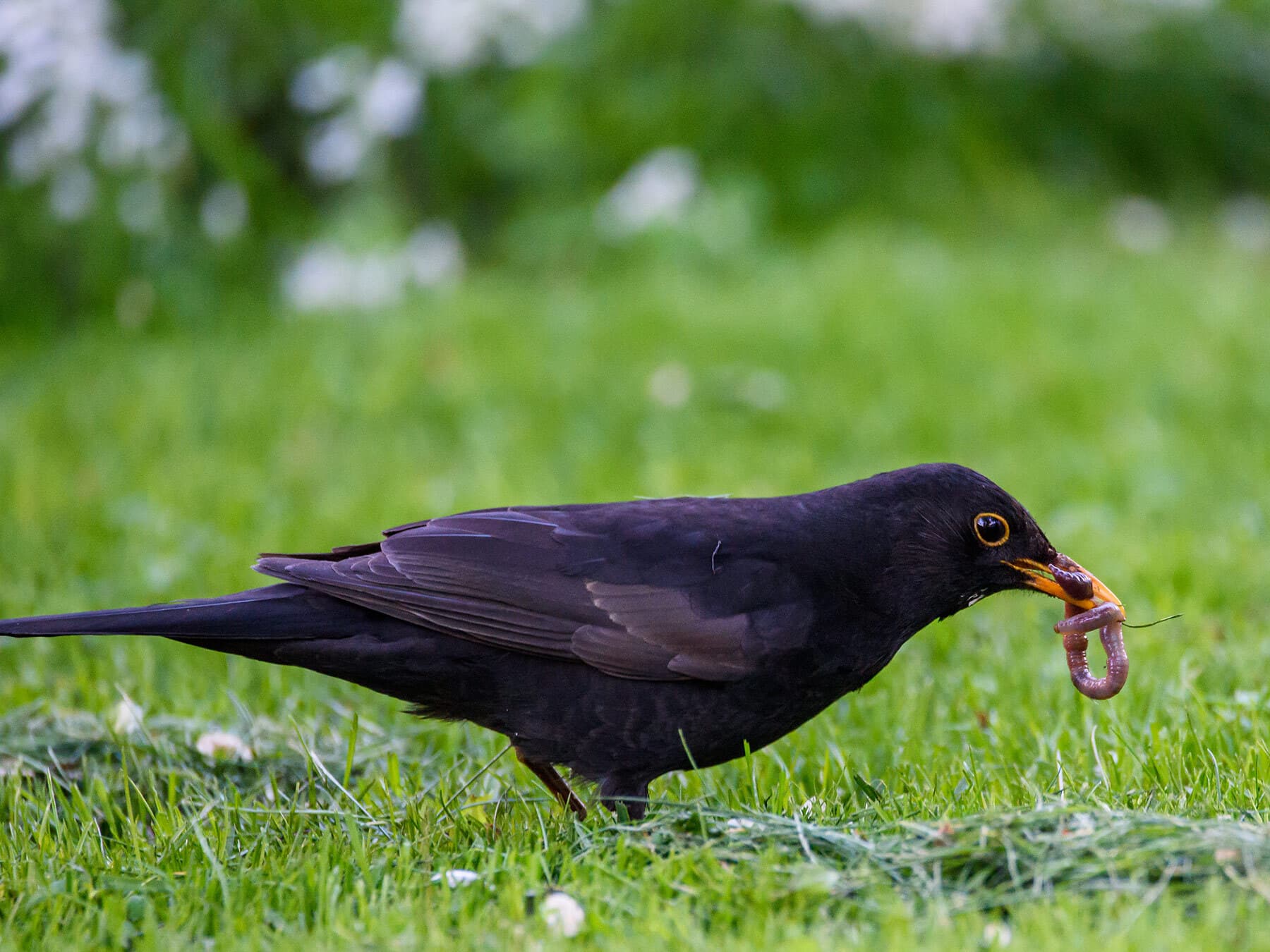
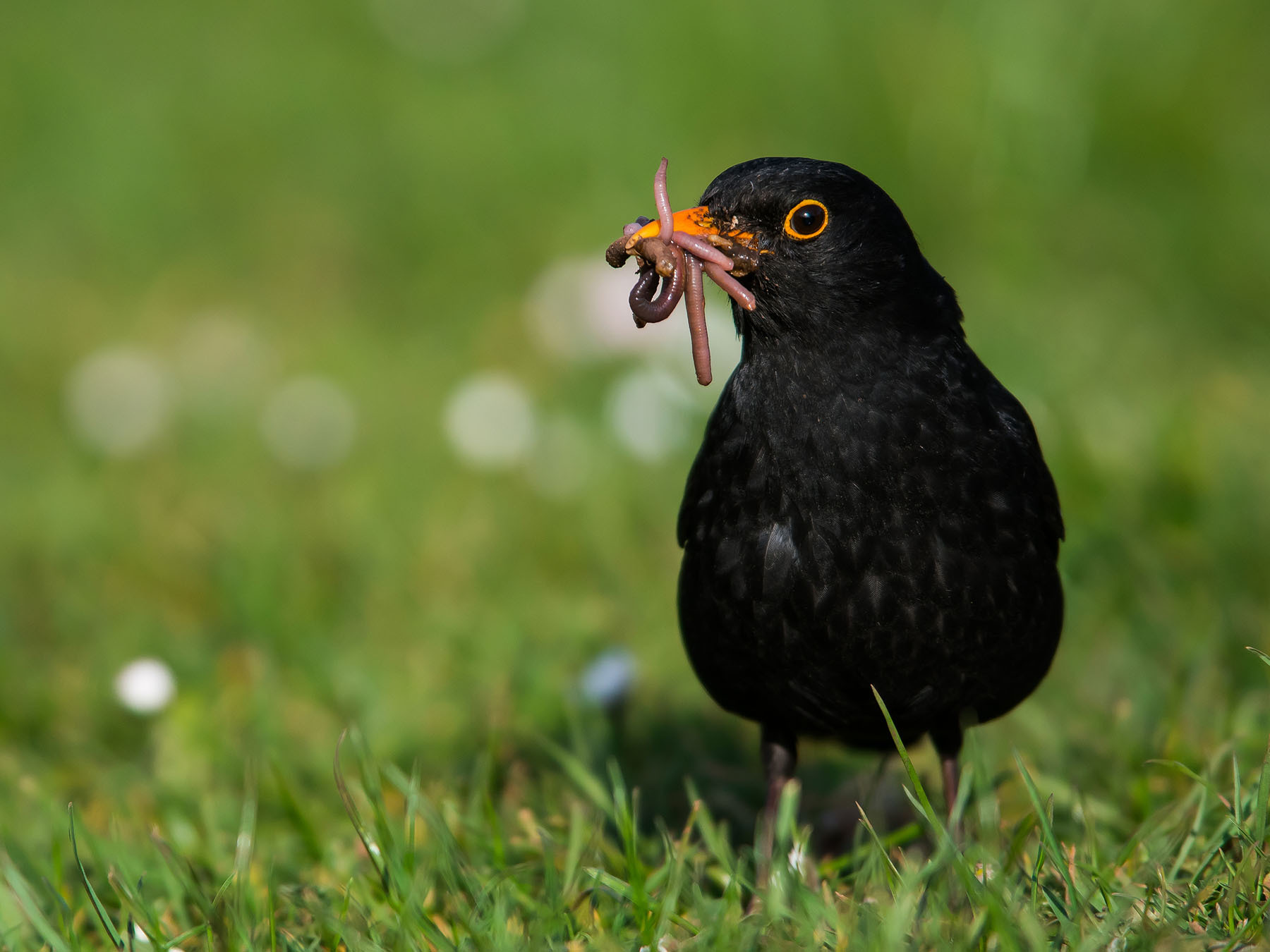
Earthworms, insects and fruit. On a lawn a Blackbird runs, stops, watches and listens, then stabs at the ground; under shrubs it flicks dead leaves aside with sideways sweeps of its bill to find beetles, grubs and other small animals.
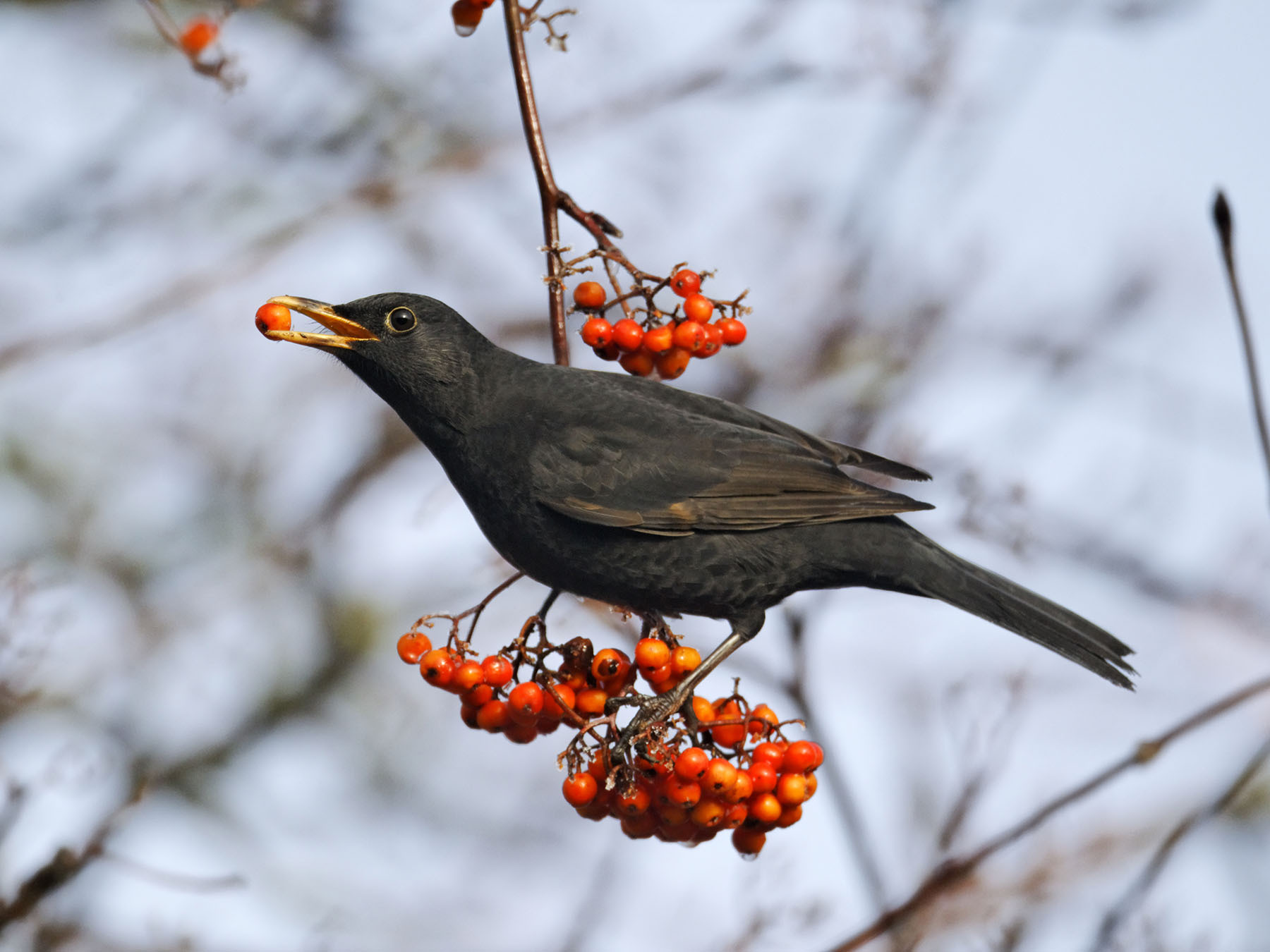
The menu changes with the seasons: caterpillars and other insects in late spring and early summer, earthworms all year but especially in late summer and autumn, and fruit from July to December, from hawthorn, rowan, ivy and bramble to apples. A Blackbird cannot live on fruit alone for long.3
More, from slugs and snails to what the chicks are fed: what Blackbirds eat.
Feeding them in your garden
Blackbirds take most of their food on the ground. Good garden foods for them are mealworms, sultanas soaked in water first, and windfall apples. Keep dried fruit away from dogs: grapes, raisins, sultanas and currants can poison them.5
The RSPB's July 2026 advice is to offer only small amounts of mealworms, fat or suet from May to October, and to clear away any mealworms not eaten by dusk, especially on the ground. Use hanging feeders rather than flat tables or trays, clean them every week, and change bird-bath water every day.6
Nesting and breeding
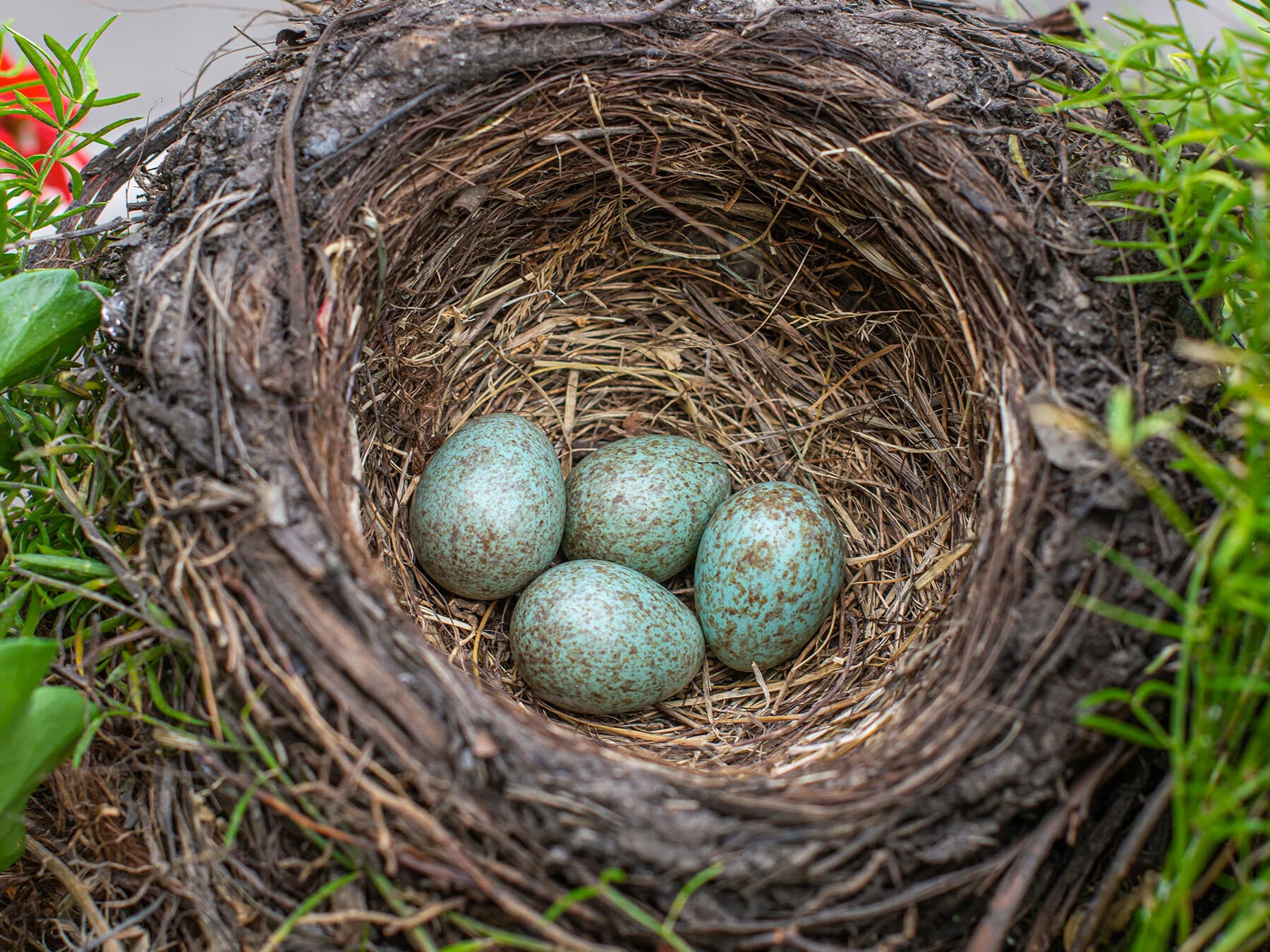
The female builds the nest almost on her own: a big cup of grass and twigs with a layer of mud inside, lined with fine grass. It is usually in a hedge, shrub, climber or tree, mostly below 4 m, and sometimes on a ledge of a building.
In Britain first eggs are laid around 22 April on average, but anywhere from late March to mid-June. She lays 3 to 4 pale greenish-blue eggs with reddish-brown speckles and sits on them alone for 12 to 14 days; the chicks leave the nest at 13.5 to 16 days old. Most pairs raise 2 or 3 broods a year.1
More: Blackbird nests and eggs and baby Blackbirds.
Behaviour
Blackbirds are territorial. In towns and suburbs a pair often holds the same patch year after year and tends to stay on it through the winter, when the male and female use different parts of it.2 In a 2024 BTO garden survey, territorial chases were commonest early in the morning.4
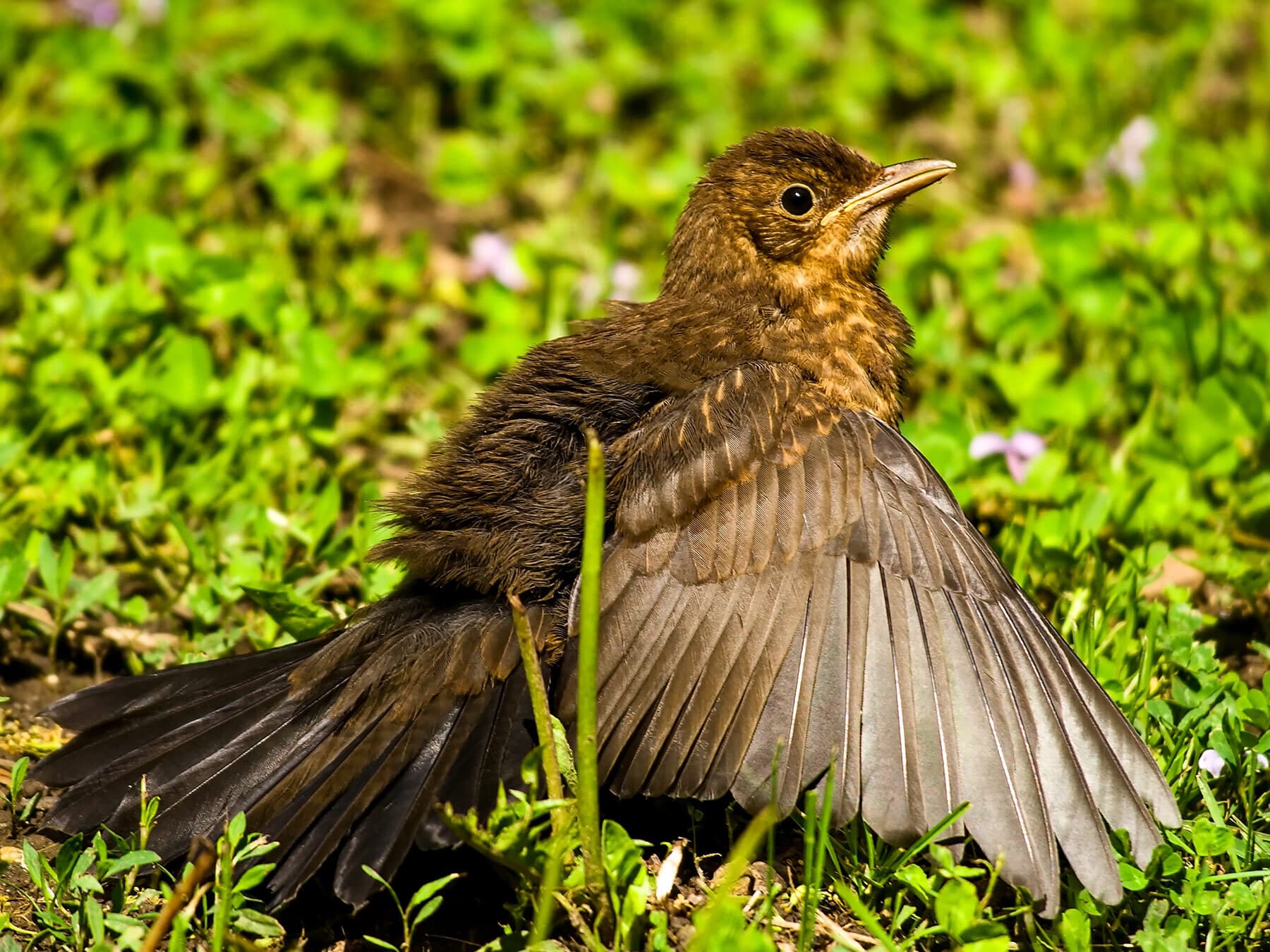
On a sunny day you may see a Blackbird with its body feathers fluffed up and one or both wings held out and spread. It is sunbathing, which helps spread oil from the preen gland through the feathers and drives out parasites. It is seen most often in Blackbirds and Robins.7
Some garden Blackbirds become very tame. The BTO has many reports of birds that follow people round the garden or call to be fed mealworms or sultanas; one learnt that a trip to the garage, where the sultanas were kept, meant food.
Roosting behaviour
On autumn and winter evenings you will often hear Blackbirds chinking before they settle for the night. They sleep in thick cover. Most are thought to roost on their own territory, alone or as a pair, but where a big, dense thicket is close by, Blackbirds from the nearby territories gather there to roost together, in summer as well as winter.
In a radio-tracking study in Dorset in 1995, Blackbirds living within 400 m of a large rhododendron thicket flew there to roost: 20 of 22 tagged birds used it at some point over the summer, many of them every night, moulting adults included. Birds tagged about 800 m away all slept on their own territories. One male left his mate sitting on their eggs each evening to spend the night at the roost.8 In winter, a small study that radio-tagged three Blackbirds found them roosting up to 6 m off the ground, often in a different spot from one night to the next.
Lifespan and predators
A Blackbird that survives to breed typically lives about 3 years. About 65% of adults survive from one year to the next, and 56% of young birds survive their first year.1
Of ringed Blackbirds found dead in north-west Europe, 31% had been killed by domestic predators such as cats, and 44% died in accidents linked to people.3
Conservation
The Blackbird is Green-listed in the UK and of Least Concern worldwide, with about 5.1 million pairs in the UK in 2016.1
That is fewer than there were. UK numbers fell until the mid-1990s, then partly recovered, but the recovery has stalled and the breeding population is 21% below its 1967 level. The steepest recent fall is in and around London.
The BTO puts the recent decline in south-east England down to Usutu virus, which is spread by mosquitoes and was first found in British wild birds in Greater London in 2020. Garden records of Blackbirds fell sharply near the outbreak10, and in the BTO's 2024 garden survey Blackbirds were reported from only 60% of London gardens, against 93% across the survey.4
Similar birds
Often mistaken for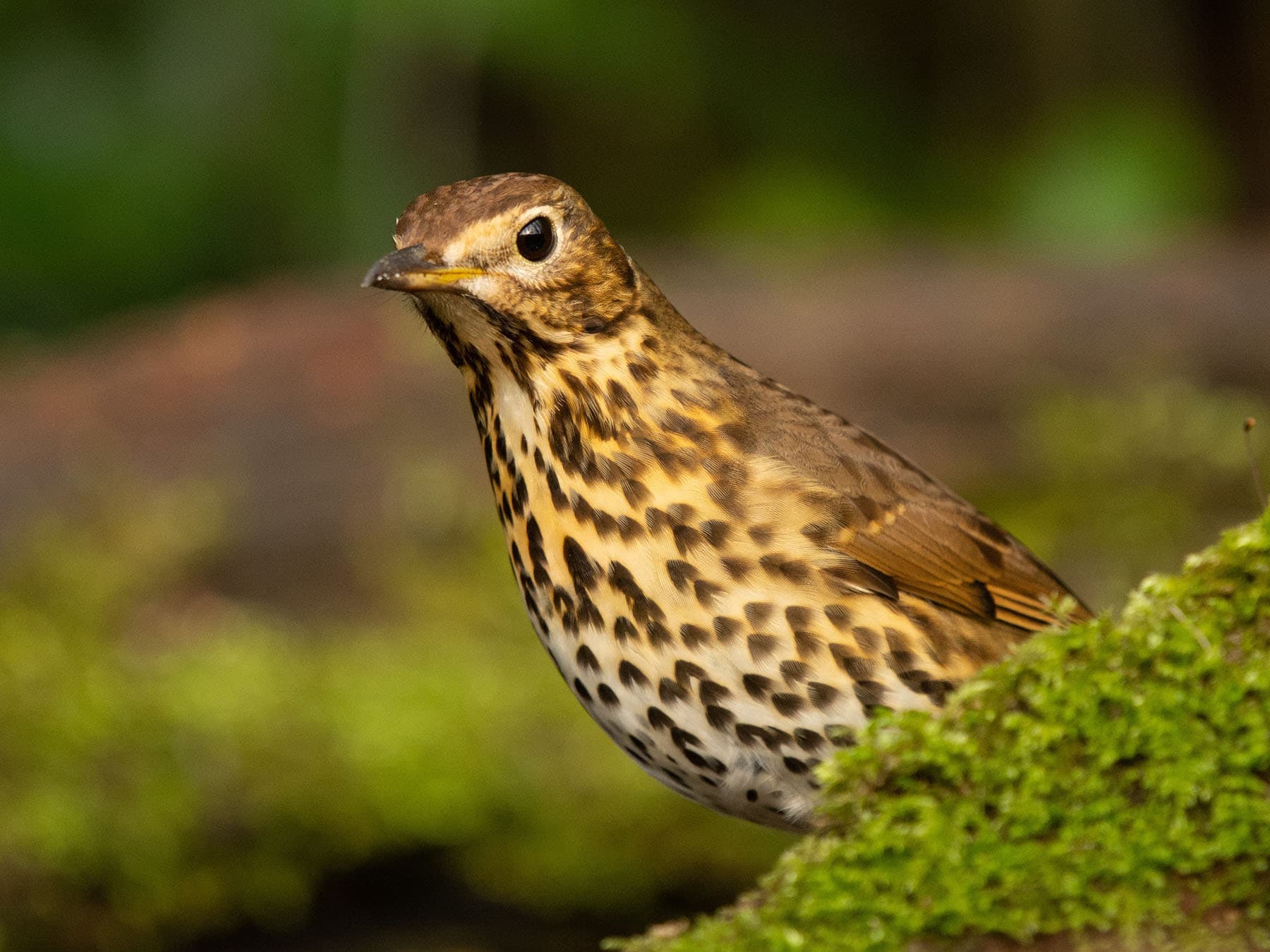
More photos
8 photos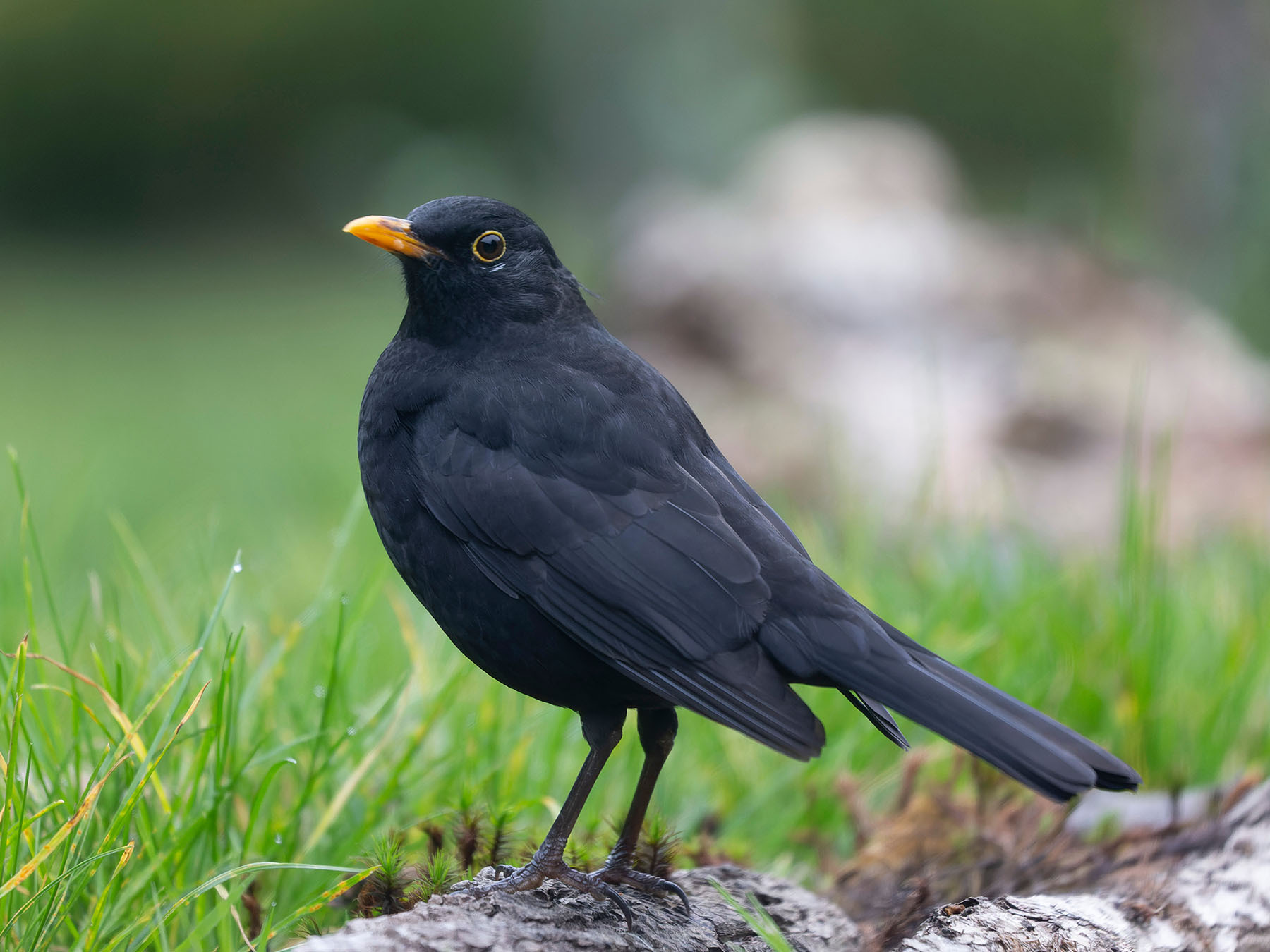
Blackbird guides
4 guidesQuick facts
- Length
- 24–25 cm
- Wingspan
- 34–38.5 cm
- Weight
- 87–122 g
- Lifespan
- 3 years · oldest recorded 20.8 years · UK record 15 years 2 months
- Family
- Thrushes
- Migration
- Partial migrant
- Global status (IUCN)
- Least Concern
- Population trend
- Declining in the UK (21% since 1967); increasing in Europe since 1980
- Also called
- Common Blackbird, Eurasian Blackbird
- Scientific name
- Turdus merula
Questions
8Do Blackbirds recognise people?
Garden Blackbirds can learn to link a person with food: some follow the people who feed them round the garden, or call until they are fed. See behaviour.
Do Blackbirds mate for life?
Blackbirds are monogamous and pairs often stay together from year to year, but not always: in one study 19% of pairs split up between seasons, and divorce was commonest where nest sites were poor.
Where do Blackbirds sleep at night?
In thick cover, such as a dense shrub or thicket. Most sleep on their own territory, but where a large thicket is nearby, Blackbirds from nearby territories gather there to roost together, even in summer. See roosting behaviour.
Do Blackbirds sleep in their nests?
A female sitting on eggs stays on the nest at night. Otherwise adults roost in cover: in one Dorset study, once the chicks were 11 days old both parents spent the night at a communal roost and came back just before dawn. See baby Blackbirds.
How long do Blackbirds stay in the same garden?
A garden pair can hold the same territory for years, though a typical Blackbird lives only about 3 years. See how long they live.
Are Blackbirds crows?
No. Blackbirds are thrushes, related to the Song Thrush, Mistle Thrush, Redwing and Fieldfare. See thrushes in the UK.
Do female Blackbirds sing?
Not the full song, which is the male's; a female gives only a quiet subsong in courtship. See female Blackbirds.
How big is a Blackbird?
24 to 25 cm long, with a wingspan of 34 to 38.5 cm, and about 100 g. See how to recognise it.
Sources
18- 1BTO. Blackbird (Turdus merula). BTO BirdFacts. Accessed 6 October 2026. Source (opens in a new tab)
- 2Toms, M. (2013). Blackbird: species focus. Bird Table (BTO Garden BirdWatch magazine) 76: 18-20. Accessed 6 October 2026. Source (opens in a new tab)
- 3Collar, N. and Christie, D. A. (2020). Eurasian Blackbird (Turdus merula), version 1.0. Birds of the World (J. del Hoyo, A. Elliott, J. Sargatal, D. A. Christie and E. de Juana, editors). Cornell Lab of Ornithology. doi:10.2173/bow.eurbla.01 (opens in a new tab)
- 4Hanmer, H. (2025). Blackbirds in Gardens. Bird Table (BTO Garden BirdWatch magazine) 121: 20-22. Accessed 6 October 2026. Source (opens in a new tab)
- 5BTO. Feeding garden birds. BTO, Helping birds. Accessed 6 October 2026. Source (opens in a new tab)
- 6RSPB (2026). How to help garden birds. RSPB news. Accessed 6 October 2026. Source (opens in a new tab)
- 7BTO. Preening, sunbathing, dustbathing and waterbathing. BTO. Accessed 6 October 2026. Source (opens in a new tab)
- 8Hill, I. F. and Cresswell, B. (1997). The use of a communal summer roost by radio-tagged Blackbirds Turdus merula. Bird Study 44: 114-116. doi:10.1080/00063659709461044 (opens in a new tab)
- 9Fransson, T., Kolehmainen, T., Moss, D. and Robinson, R. (2023). EURING list of longevity records for European birds (1 September 2023). Accessed 6 October 2026. Source (opens in a new tab)
- 10Lawson, B., Robinson, R. A., Briscoe, A. G. et al. (2022). Combining host and vector data informs emergence and potential impact of an Usutu virus outbreak in UK wild birds. Scientific Reports 12: 10298. doi:10.1038/s41598-022-13258-2 (opens in a new tab)
- 11RSPB. Blackbird. RSPB Birds A-Z. Accessed 6 October 2026. Source (opens in a new tab)
- 12RSPB. Ring Ouzel. RSPB Birds A-Z. Accessed 6 October 2026. Source (opens in a new tab)
- 13RSPB. Starling. RSPB Birds A-Z. Accessed 6 October 2026. Source (opens in a new tab)
- 14RSPB. Song Thrush. RSPB Birds A-Z. Accessed 6 October 2026. Source (opens in a new tab)
- 15O'Connell, M. J., Squirrell, F. I. and Greening, M. (2023). A preliminary study of the winter roosting behaviour of four woodland passerines. Bird Study 70(4): 243-250. doi:10.1080/00063657.2023.2269329 (opens in a new tab)
- 16RSPB. How and what to feed your garden birds. RSPB. Accessed 6 October 2026. Source (opens in a new tab)
- 17Stanbury, A. et al. (2021). The status of our bird populations: the fifth Birds of Conservation Concern in the United Kingdom, Channel Islands and Isle of Man and second IUCN Red List assessment of extinction risk for Great Britain. British Birds 114: 723-747. Accessed 6 October 2026. Source (opens in a new tab)
- 18BTO (2024). Longevity records for Britain & Ireland in 2024. BTO Online Ringing and Nest Recording Report. Accessed 9 October 2026. Source (opens in a new tab)

Checked by
Nathan Cope, founder and editor
Nathan founded Birdfact and leads its writers and contributors in the UK, the US and Canada. He has watched and studied birds for more than ten years, and checks every article and species guide before it’s published.