


Ring Ouzel
Mountain Blackbird · Turdus torquatus
By the Birdfact teamChecked by Nathan Cope
On this page15 sections
How to recognise it
What do Ring Ouzels look like?
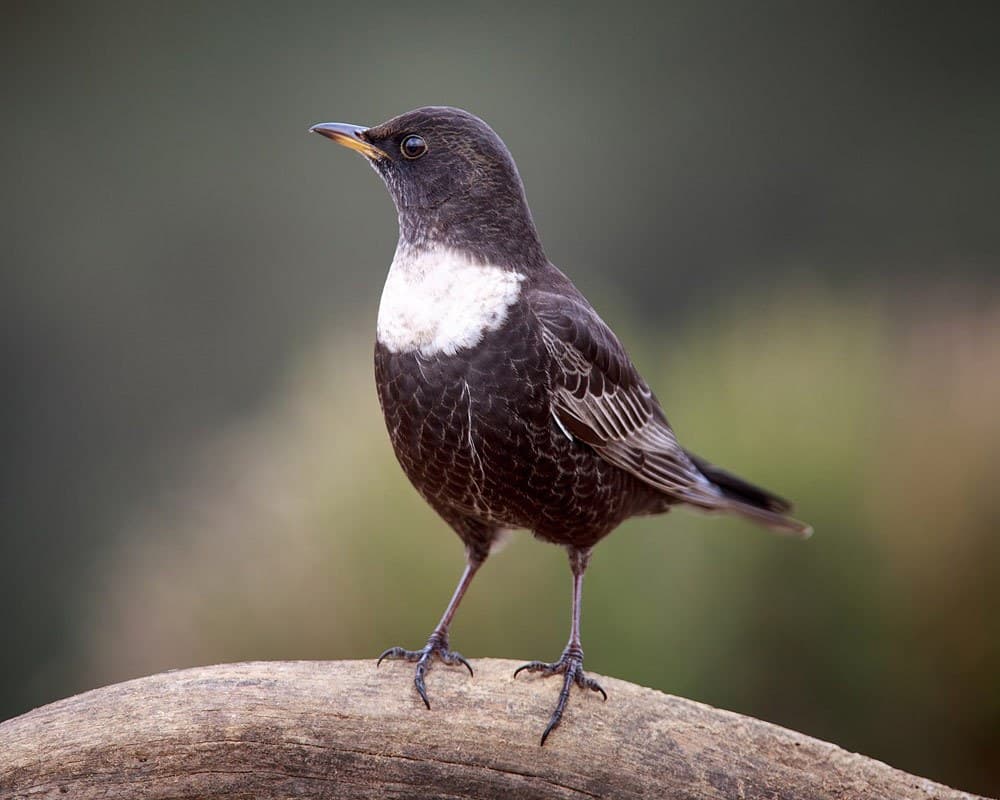
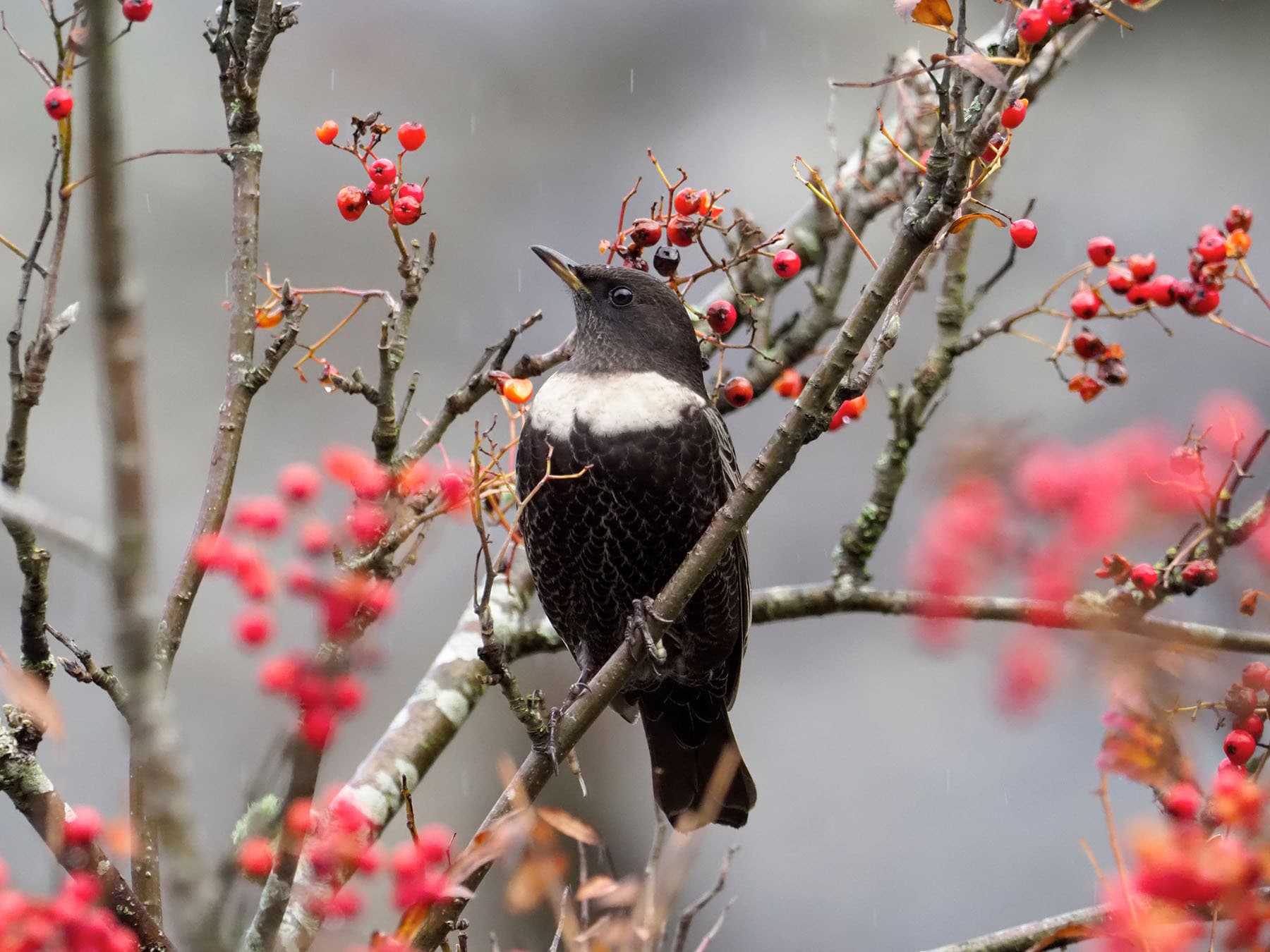
From a distance, it may not always be clear whether the black thrush-sized bird you’ve spotted is a blackbird or a ring ouzel. The two species share many features, including dark plumage and yellowish bills. Up close, however, identification becomes more clearcut.
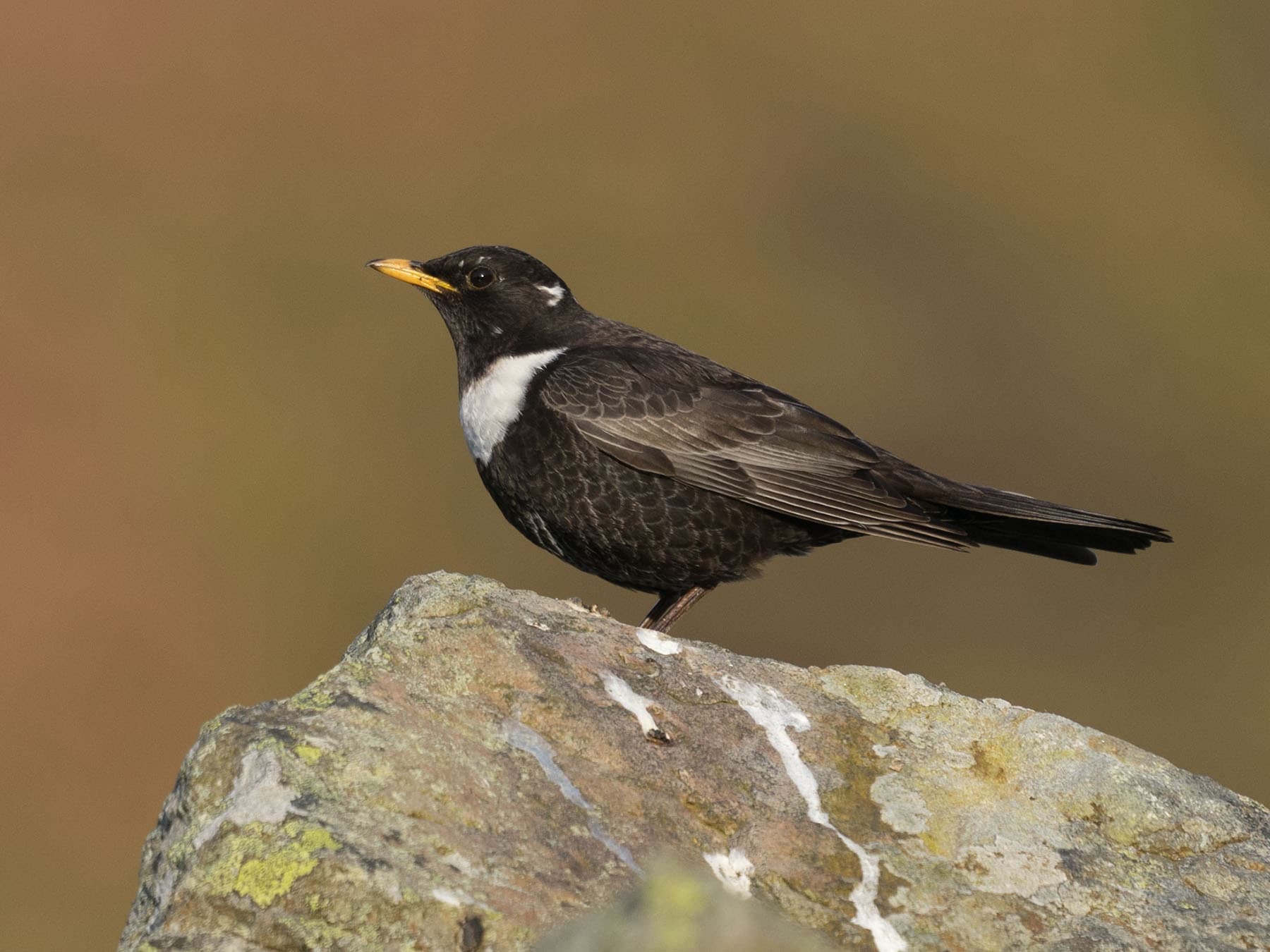
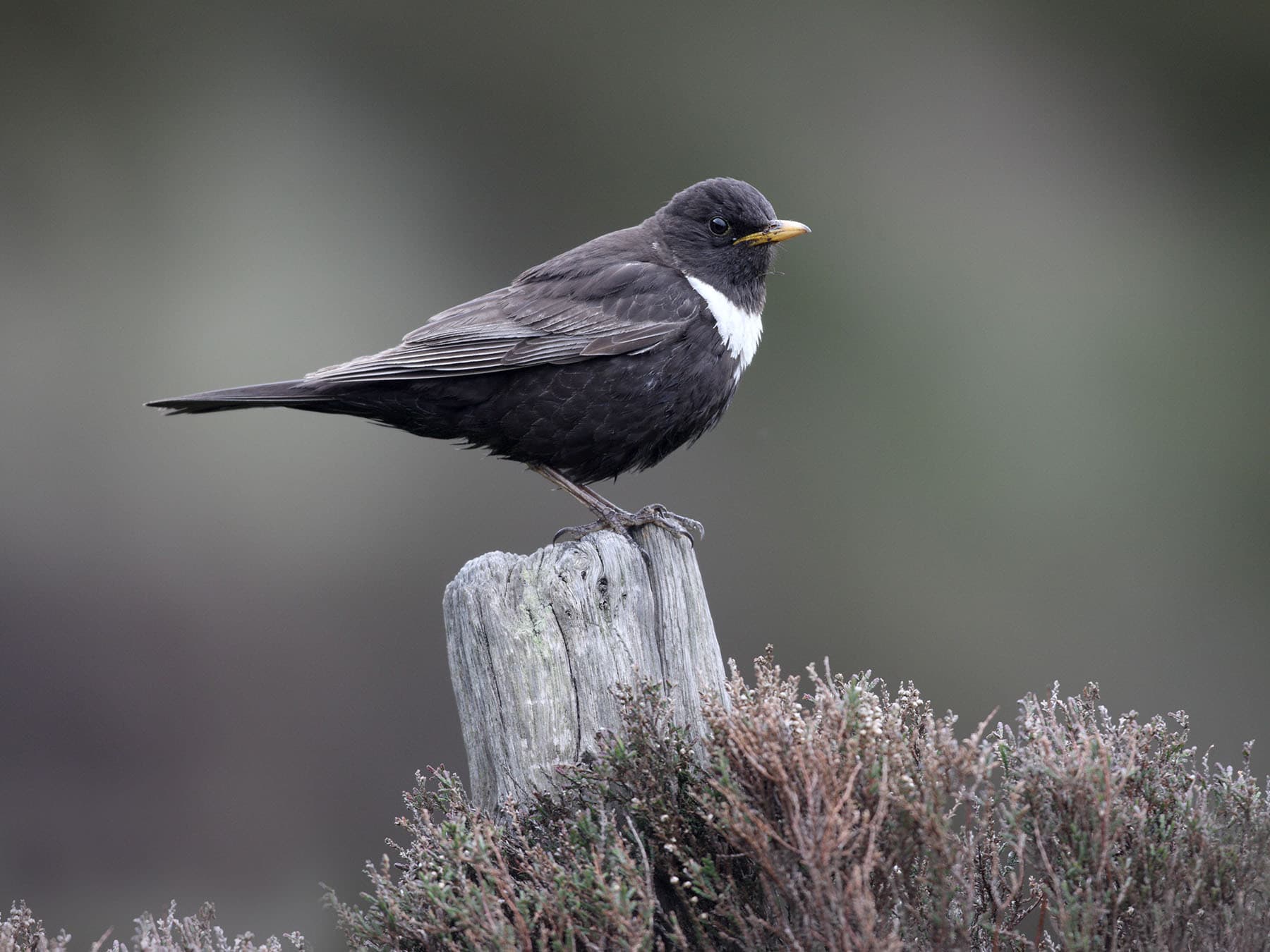
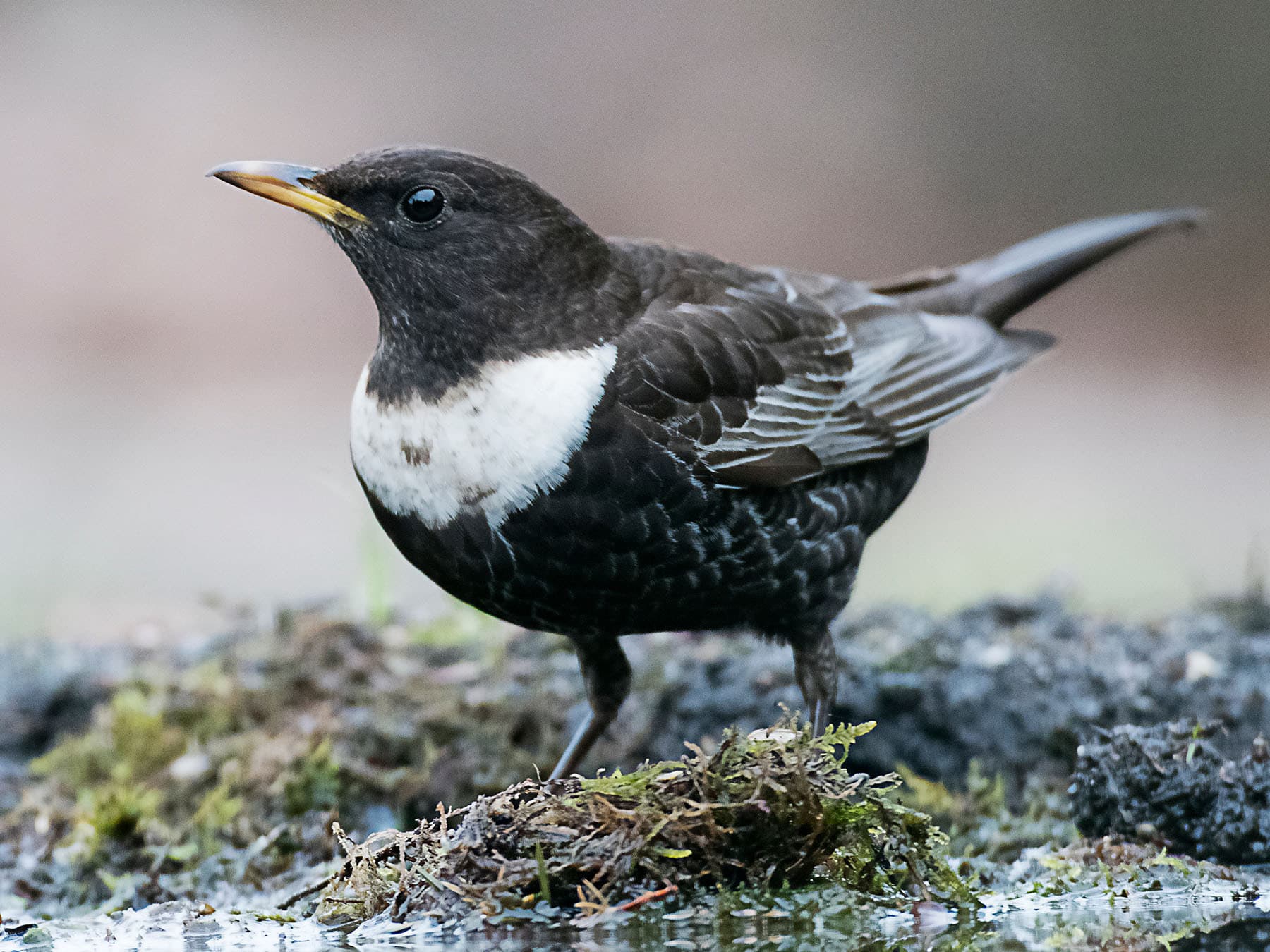
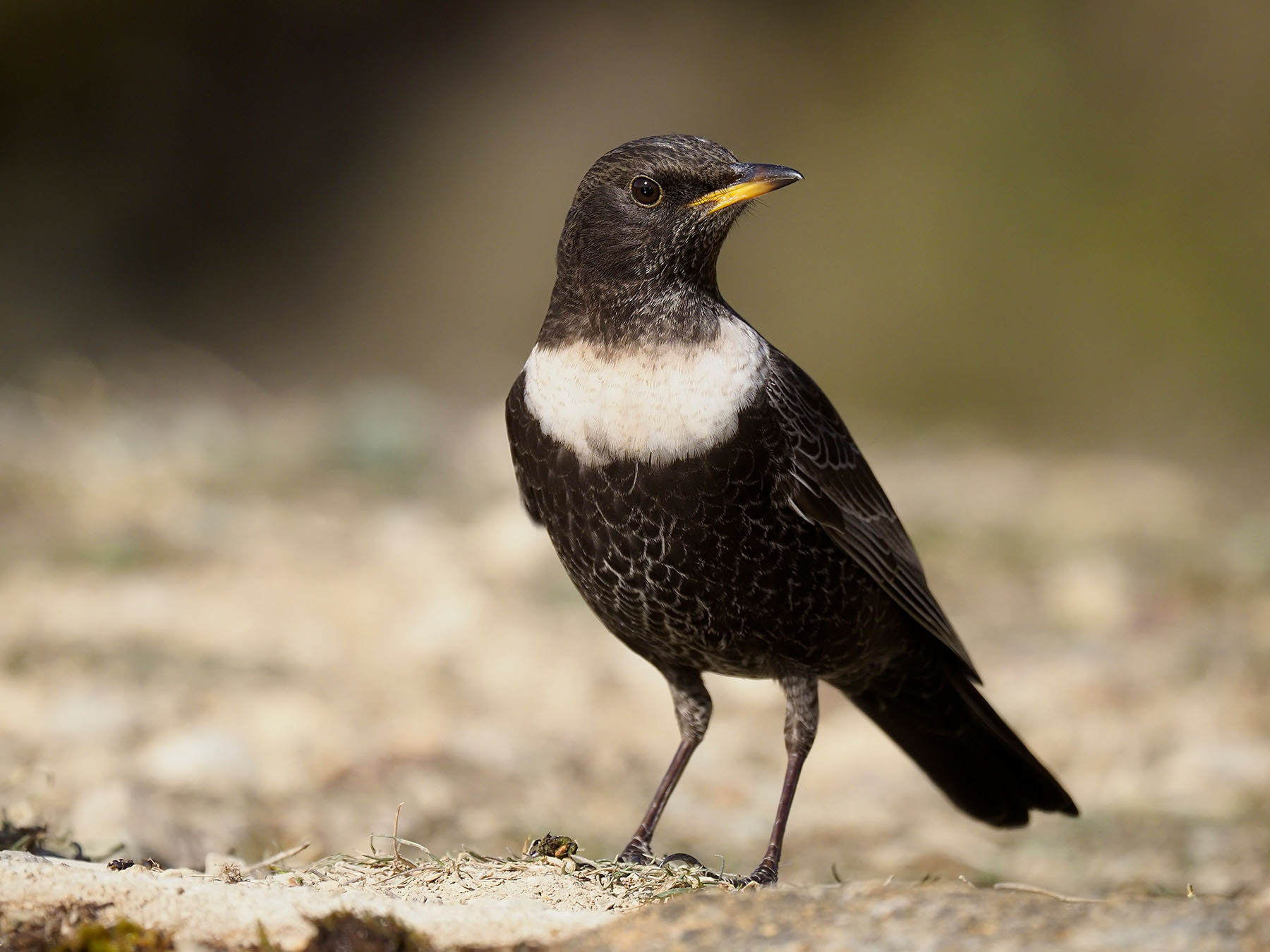
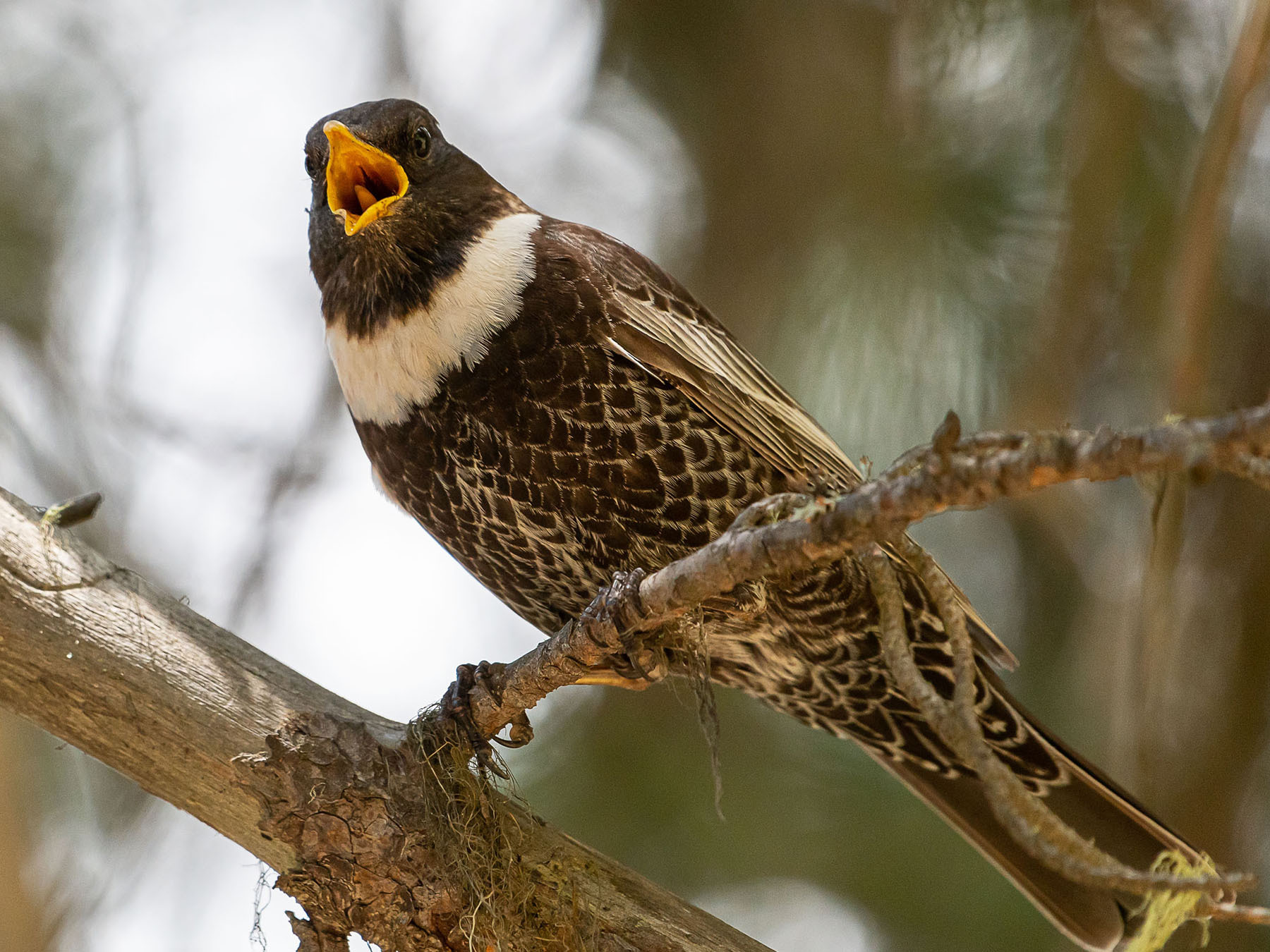
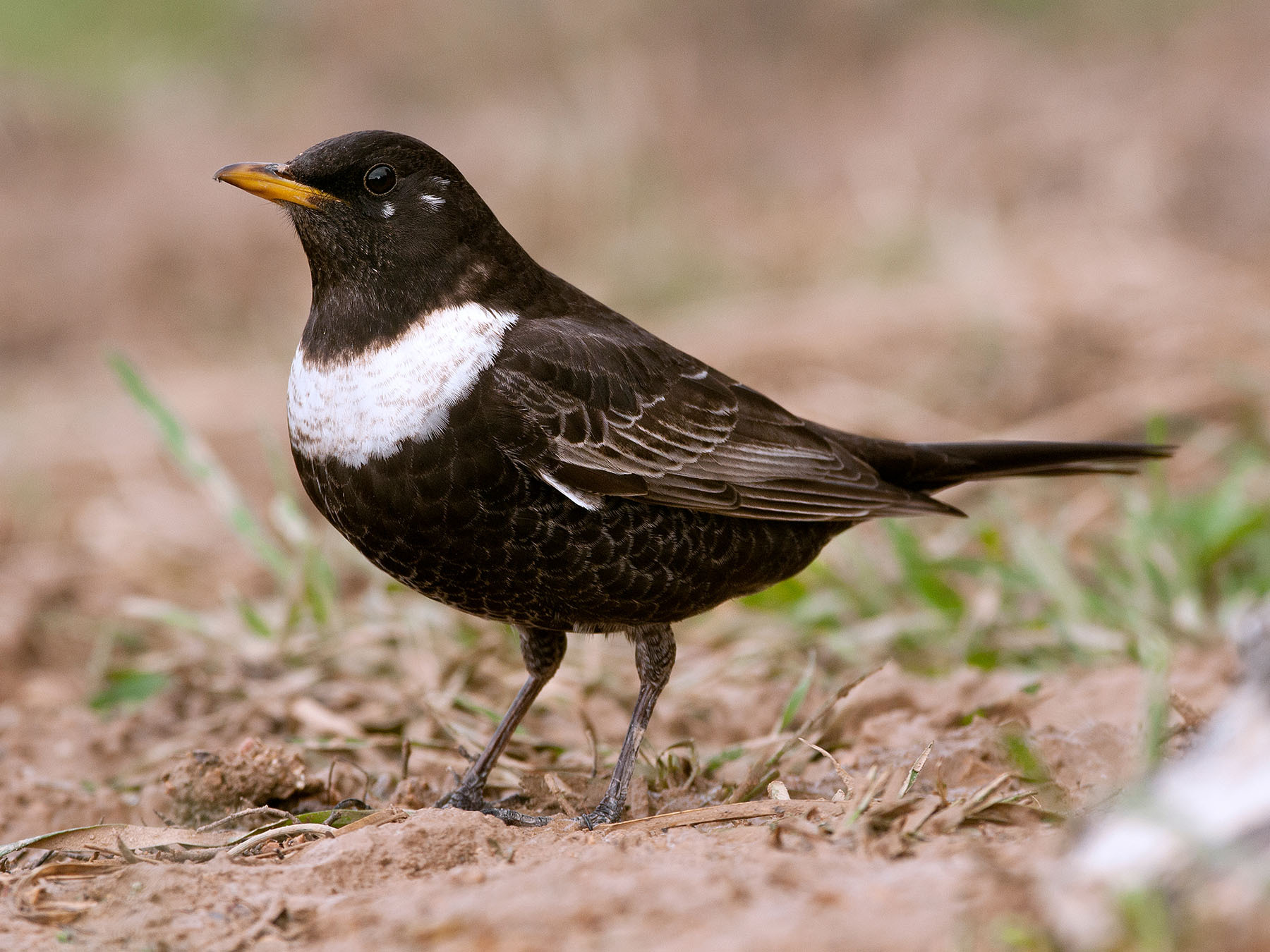
Males have rich black bodies, and a distinct white crescent on their upper breast, as well as pale markings on their wings. Ring ouzels are also slightly smaller than blackbirds and have longer tails.
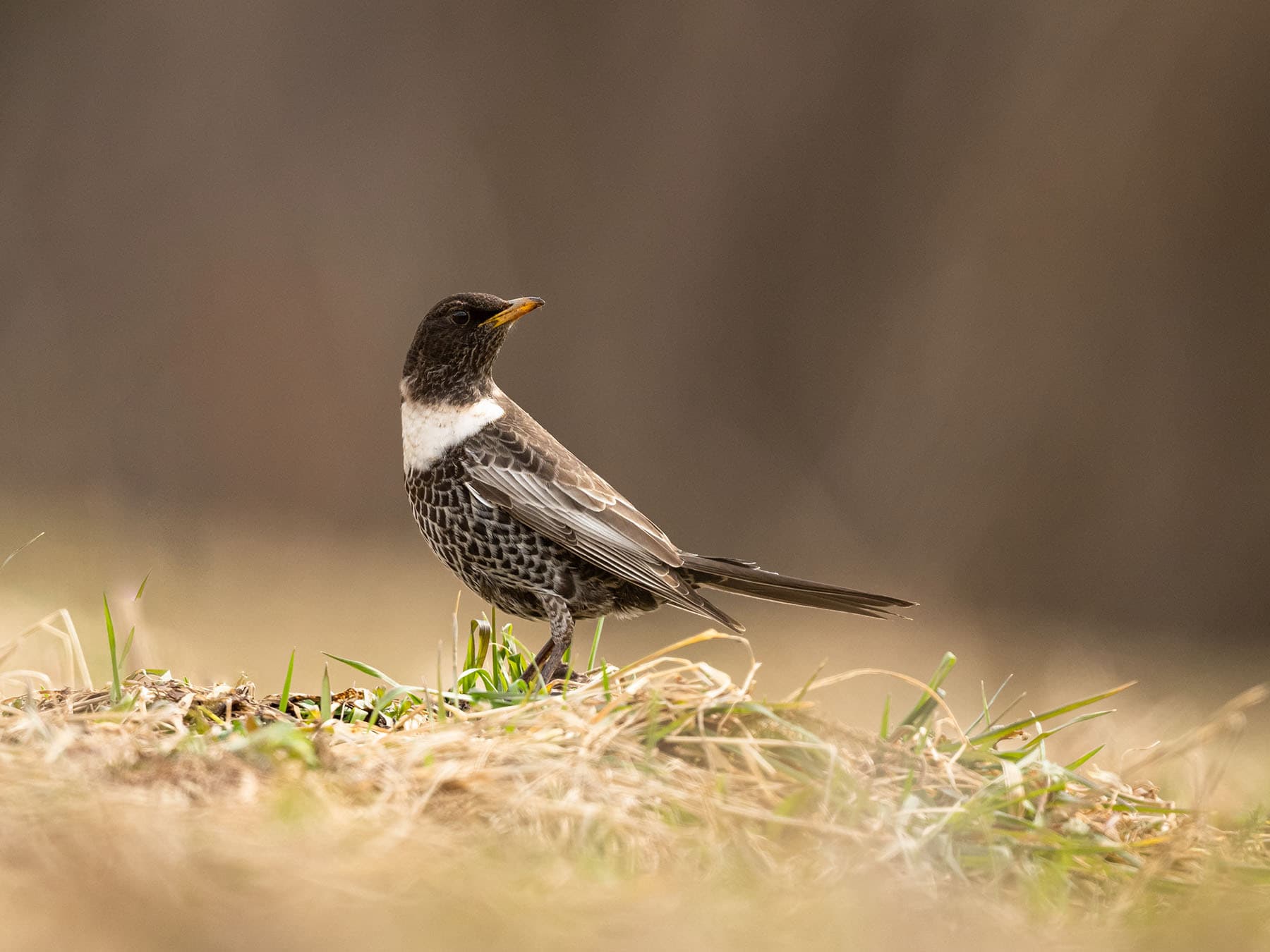
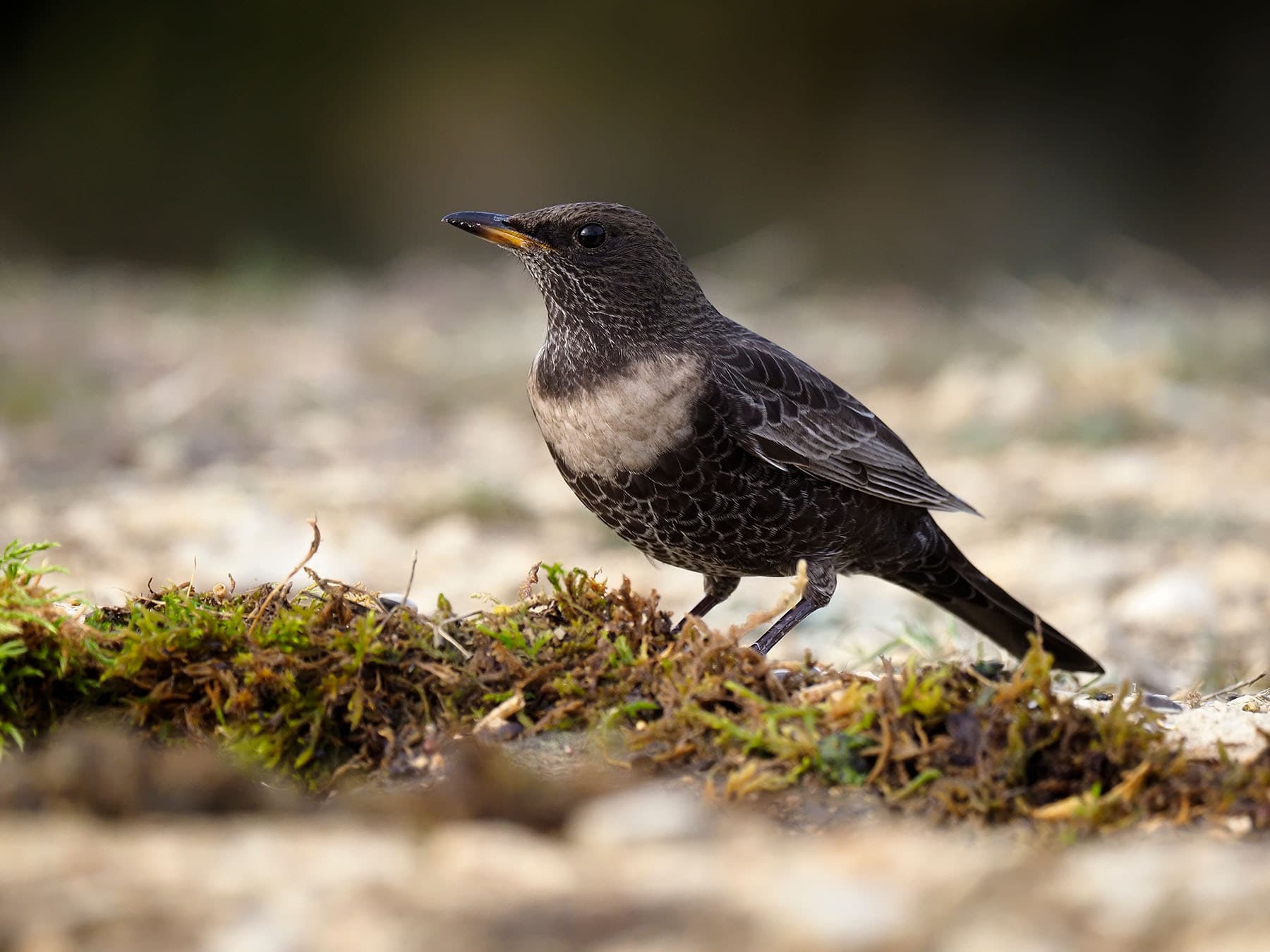
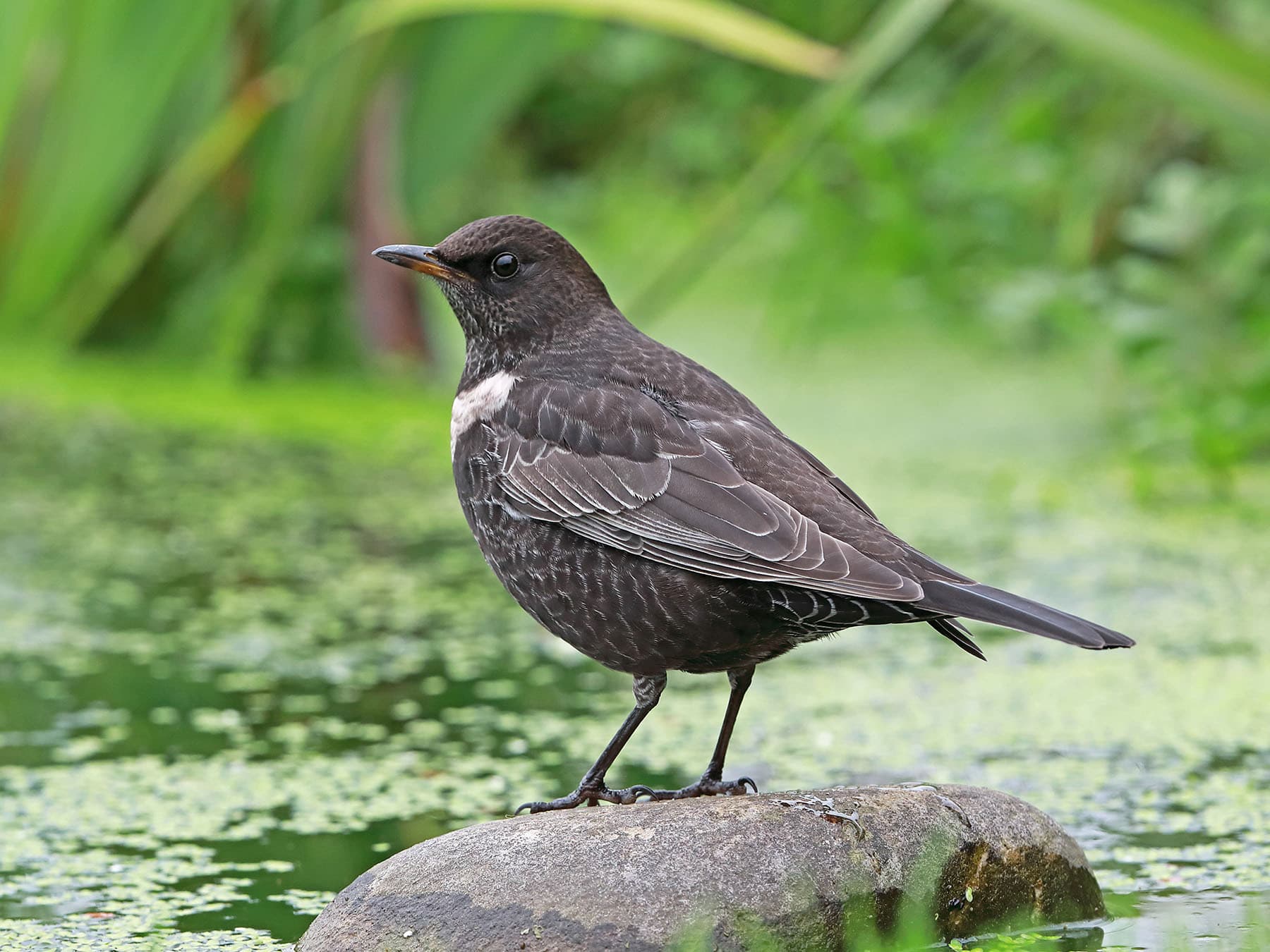
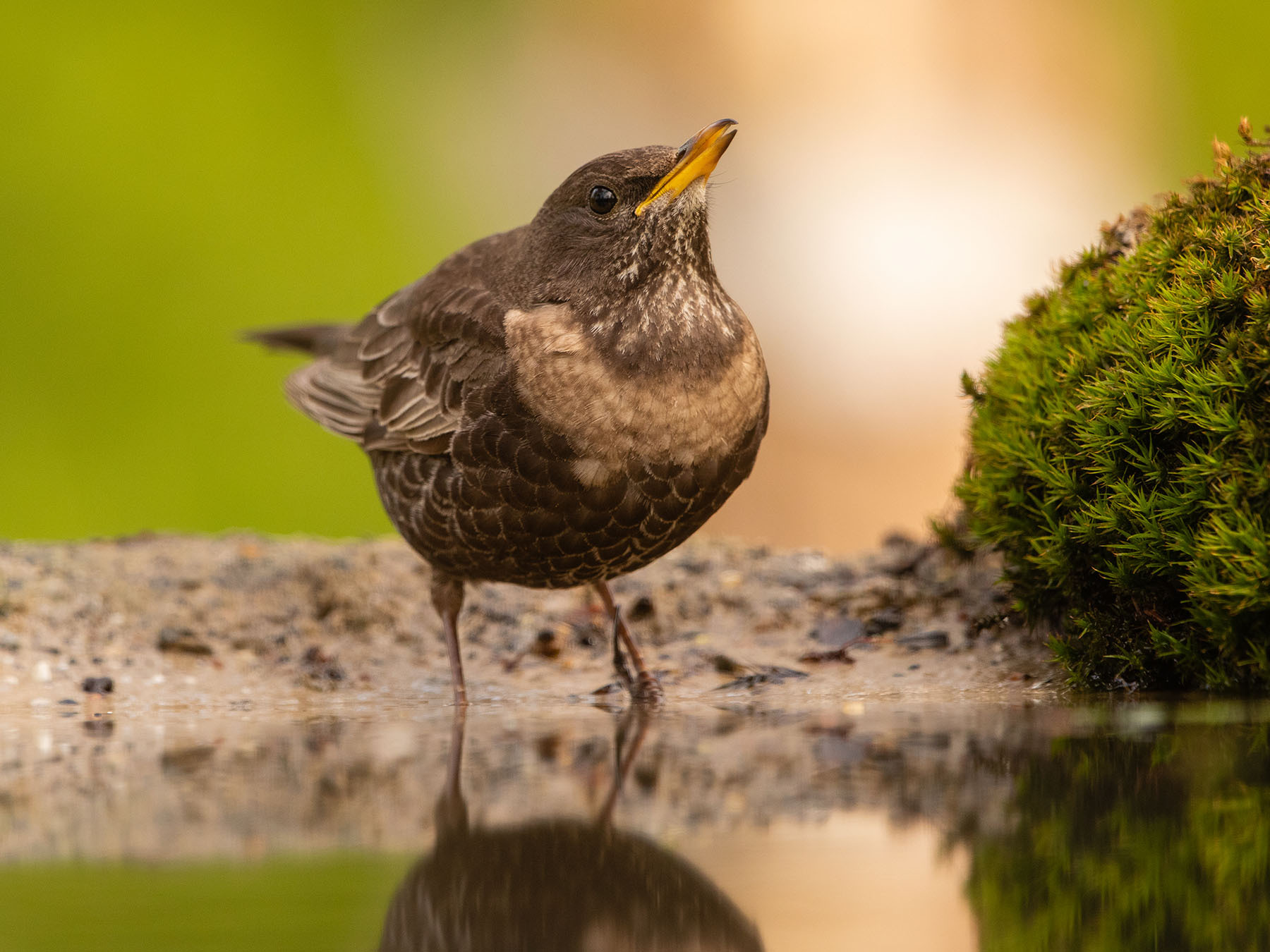
Female ring ouzels are also dark, with a dusky brown plumage, again similar to that of a female blackbird. Their breast is marked with a creamy crescent-shaped bib, smaller than that of the male.
Females have slightly more prominent silvery scale-like markings on their lower belly and wings. Their bill is brownish yellow, and they have grey-brown legs.
Juvenile ring ouzels are similar in colouring to females, with a dusky brown plumage rather than the glossy black of an adult male. Juveniles are marked with pale reddish-brown streaks, and look fairly similar in appearance to starlings, but have white throat markings and either no visible chest bib, or only the very faintest traces of one.
How big are Ring Ouzels?
Ring ouzels are medium thrushes, smaller in size than blackbirds and with shorter tails. Males and females are roughly the same size, with marginal differences in weight, length and wingspan between the sexes.
- Length: 23 cm to 24 cm (9.1 in to 9.4 in)
- Wingspan: 38 cm to 42 cm (15 in to 16.5 in)
- Weight: 90 g to 138 g (3.2 oz to 4.9 oz)
Its size
Adults- Length
- 23–24 cm
- Wingspan
- 38–42 cm
- Weight
- 90–138 g
Its song and calls
What sound does a Ring Ouzel make?
Male ring ouzels can be heard belting out a series of loud, flute-like notes from perches on top of heather sprigs or rocky ledges. It also has a distinctive warning call, when alerted to nearby predators, it emits a loud 'ttchack-ttchack' call.
- Song0:00 / 1:18
Recorded in Aberdeenshire, Scotland · April 2019
- Flight call0:00 / 0:18
Recorded in Normandie, France · October 2023
When and where to see it
OctoberArriving
Most recorded in October
- 1. Orkney Islands0.35%
- 2. Powys0.27%
- 3. Devon0.20%
- 4. Scottish Borders0.20%
- 5. East Riding of Yorkshire0.18%
Each dot is a county, state or province: the bigger and darker, the larger the bird’s share of that place’s bird records that month. Grey dots: no regular records. The ringed point is the centre of the bird’s records this month; the arrow shows how it moved since last month, and the dashed loop its path through the year. “Arrivals” colours places where it becomes regular this month (orange) or is in its last regular month (grey). GBIF eBird Observation Dataset, 2019–2024. Map data: Natural Earth, US Census Bureau; place centres © OpenStreetMap contributors.
In your area
See when the Ring Ouzel is recorded in your county, state or province.
How often the Ring Ouzel turns up in the UK and Ireland through the year, from birdwatchers' records.
United Kingdom
Summer visitor · regularly Mar–Nov · most records in April
Ireland
Passage migrant · regularly Oct · most records in October
Show as a table
| Month | United Kingdom | Ireland |
|---|---|---|
| January | 0.002% | 0.002% |
| February | <0.001% | – |
| March | 0.007% (regular) | – |
| April | 0.082% (regular) | <0.001% |
| May | 0.024% (regular) | 0.003% |
| June | 0.016% (regular) | – |
| July | 0.005% (regular) | – |
| August | 0.003% | – |
| September | 0.007% (regular) | – |
| October | 0.058% (regular) | 0.018% (regular) |
| November | 0.008% (regular) | 0.002% |
| December | <0.001% | – |
Recorded regularly in
Worldwide: recorded regularly in 43 countries
Countries where it was recorded in at least 3 of the 6 years 2019–2024. Linked countries have their own bird list.
Europe (35)
Asia (6)
- Armenia
- Azerbaijan
- Georgia
- Iran
- Israel
- Turkey
Data: EOD – eBird Observation Dataset (Cornell Lab of Ornithology), accessed via GBIF.org, CC BY 4.0. Records from 2019–2024, aggregated and filtered by Birdfact. How these lists are made
What is the habitat of a Ring Ouzel?
Craggy uplands and expanses of heath and moorland provide ideal nesting grounds for ring ouzels. Subalpine meadows and grasslands, at altitudes of up to around 1200 m, provide foraging opportunities.
Juniper trees feature heavily in the chosen wintering ground landscapes of ring ouzels across northern Africa and into Turkey.
Mountainous landscapes, with boulders, crags, and ledges interspersed with areas of open juniper forest, offer the shelter and foraging opportunities required to support ring ouzels through the winter months.
What is the range of a Ring Ouzel?
Ring ouzels have a large range, extending across an estimated 9.17 million sq km (3.54 million sq mi), from Ireland and Britain in the west, to Russia’s Kola Peninsula in the west. Ring ouzels breed as far north as northern Scandinavia.
The species’ wintering grounds form the southern limits of their range, and are found across North Africa, and into western Turkey.
Where do Ring Ouzels live?
Remote landscapes, in particular bleak moorlands and mountain slopes, offer suitable environments in which ring ouzels can both breed and find food.
Upland landscapes and hillside grasslands, from north-west Ireland throughout Scandinavia to northwest Russia, as well as mountainous terrain across central southern Europe from the Pyrenees and the Alps, the Balkans, Greece and Turkey east to Turkmenistan.
How rare are Ring Ouzels?
Outside the UK, ring ouzels are considered a species of least concern, with estimates of a global population of between 600,000 and 1.2 million in 2012.
Up to around 7,500 pairs of breeding ring ouzels visit the UK each spring to raise their young, so they are certainly not the most common bird you may encounter in Britain, but at certain times of year, and in particular habitats, it is not entirely unlikely that sightings might be recorded.
Where can you see Ring Ouzels in the UK?
In the UK, the best time to look for ring ouzels is between April and October. Sightings are most common in upland areas, e.g. in Scotland and northern England, where their breeding grounds can be found on open moorland and rocky crags.
Dartmoor, north-west Wales, northern England and the north of Scotland offer the best chances of seeing a temporary resident ring ouzel, while along the east and southern coasts, migration passage sightings are recorded each spring and autumn.
Migration
Do Ring Ouzels migrate?
Ring ouzels are summer migrants to the UK, arriving in March to breed and departing for wintering grounds in southern Europe, North Africa and Turkey by late September. Migration routes follow the availability of juniper berries.
Where do Ring Ouzels overwinter?
Wintering grounds of ring ouzels are located across southern Europe, North Africa and Turkey, with the Altas Mountains of Morocco hosting the species in large numbers during the non-breeding season.
Tips for seeing it
- Look for Ring Ouzels in upland areas, particularly on rocky slopes with scattered vegetation.
- Listen for their distinctive 'tac-tac-tac' alarm call, which often reveals their presence.
- In the UK, search for them during spring and autumn migrations in coastal areas and inland hills.
- Be patient and move slowly, as they can be quite shy and quick to flee.
What it eats
What do Ring Ouzels eat?
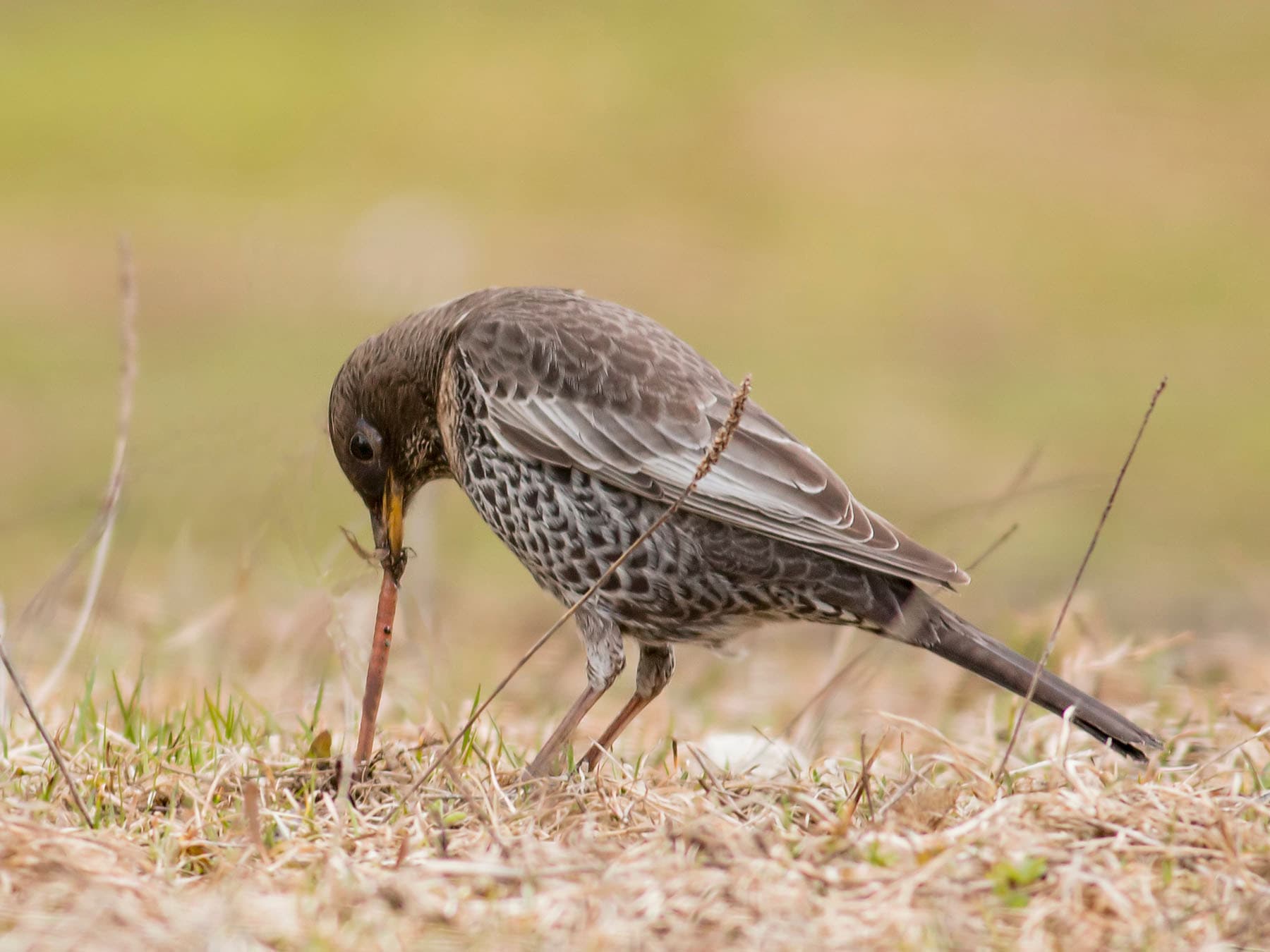
Ring ouzels follow an omnivorous diet, consisting of invertebrates, particularly earthworms, leatherjackets, insects and spiders. These food sources are especially important during spring migration and while raising young.
Later in the summer and autumn, moorland fruits, including bilberry, rowan, hawthorn, elderberry and crowberry, are eaten in large quantities.
Small reptiles, amphibians, and small mammals may also occasionally be caught on the ground and eaten.
During autumn migration, juniper berries form the most important element of a ring ouzel’s diet, and the availability of the fruit is a major influence over their migration routes and final destinations.
What do baby Ring Ouzels eat?
In the period immediately after hatching, young ring ouzels are fed invertebrates by their parents, particularly larvae, caterpillars, earthworms, black beetles and small insects.
Nesting and breeding
Where do Ring Ouzels nest?
Ring ouzel pairs choose nest sites in clumps of mature heather on moorlands and rocky slopes. Occasionally nests will be built beneath brack or on rock ledges or mountainsides.
In Britain, nests are usually found less than 1 m (3 ft 3 in) above ground level, with most found in vegetation up to 45 cm off the floor.
Nests are rough, cup-shaped structures, made from grass, which is not neatly woven into shape, giving a rather bulky, untidy and unfinished appearance. Moss and mud are used to line the nest and hold its shape.
What do Ring Ouzel eggs look like?
A typical ring ouzel clutch contains 3 to 6 greenish-blue eggs, which are flecked with brown speckles. Eggs measure 30 mm by 22 mm (1.18 in × 0.87 in) and weigh around 7.5 g (0.26 oz).
Either one or two broods are raised each season, with the earliest eggs usually laid in early May.
Do Ring Ouzels mate for life?
Not a huge amount of data is available on the mating habits and pair formation bonds of ring ouzels. However, research suggests that they are a monogamous species, although it’s uncertain whether this pairing lasts for longer than a single breeding season.
Behaviour
Are Ring Ouzels aggressive?
Ring ouzels have a reputation as being aggressive nest defenders, and are particularly intolerant of any intruders within range of their nest and young. Territorial behaviour includes a loud warning call when threatened, and divebombing any potential predators.
Outside of the breeding season, ring ouzels may lose their intense aggressive edge, and be observed in loose migration flocks with other thrushes.
Where do Ring Ouzels sleep at night?
When darkness falls, ring ouzels will typically roost in dense vegetation overnight.
However, they are nocturnal migrants, and during their spring and autumn migration flights, listen out for their calls through the darkness – a raucous 'tchrrk-tchik-tchik-tchik' sound can cut through the night sky as migration ring ouzels pass overhead.
Lifespan and predators
How long do Ring Ouzels live?
Typical lifespan of ring ouzels is around 2 years, with first-time breeding usual at one year. The oldest reported ring ouzel, as recorded through a ringing scheme, was 9 years and 13 days.
What are the predators of Ring Ouzels?
Ring ouzels’ choice of relatively exposed nest sites, either at or close to ground level, puts them at an increased risk of predation by mammals and birds that hunt on mountainous terrain.
Common predators include:
- Tawny owls
- Long-eared owls
- Common buzzards
- Kestrels
- Sparrowhawks
- Weasels
- Stoats
- Rats
- Hedgehogs
- Foxes
Are Ring Ouzels protected?
Ring ouzels are included in the protections offered to many wild bird species that are either native to or breed in Britain. The Wildlife & Countryside Act, 1981, makes it an offence to deliberately kill, injure or capture a ring ouzel, or to interfere with its nest site, eggs or young.
Are Ring Ouzels endangered?
Up to 7,300 pairs of ring ouzels breed in the UK each year. However, the population is in decline, and in Britain, the species has been added to the Red List of Birds of Conservation Concern due to a significant decline in breeding numbers over the last 40 years.
This decline is thought to be linked to the loss of their natural breeding habitat in the UK and was estimated at a drop of almost 60 percent between 1990 and 1999.
Conservation
While listed as Least Concern globally, Ring Ouzels have experienced significant declines in parts of their range, particularly in the UK. Habitat loss due to changes in upland land management and climate change are key threats.
Conservation efforts focus on maintaining suitable breeding habitats.
Similar birds
Often mistaken for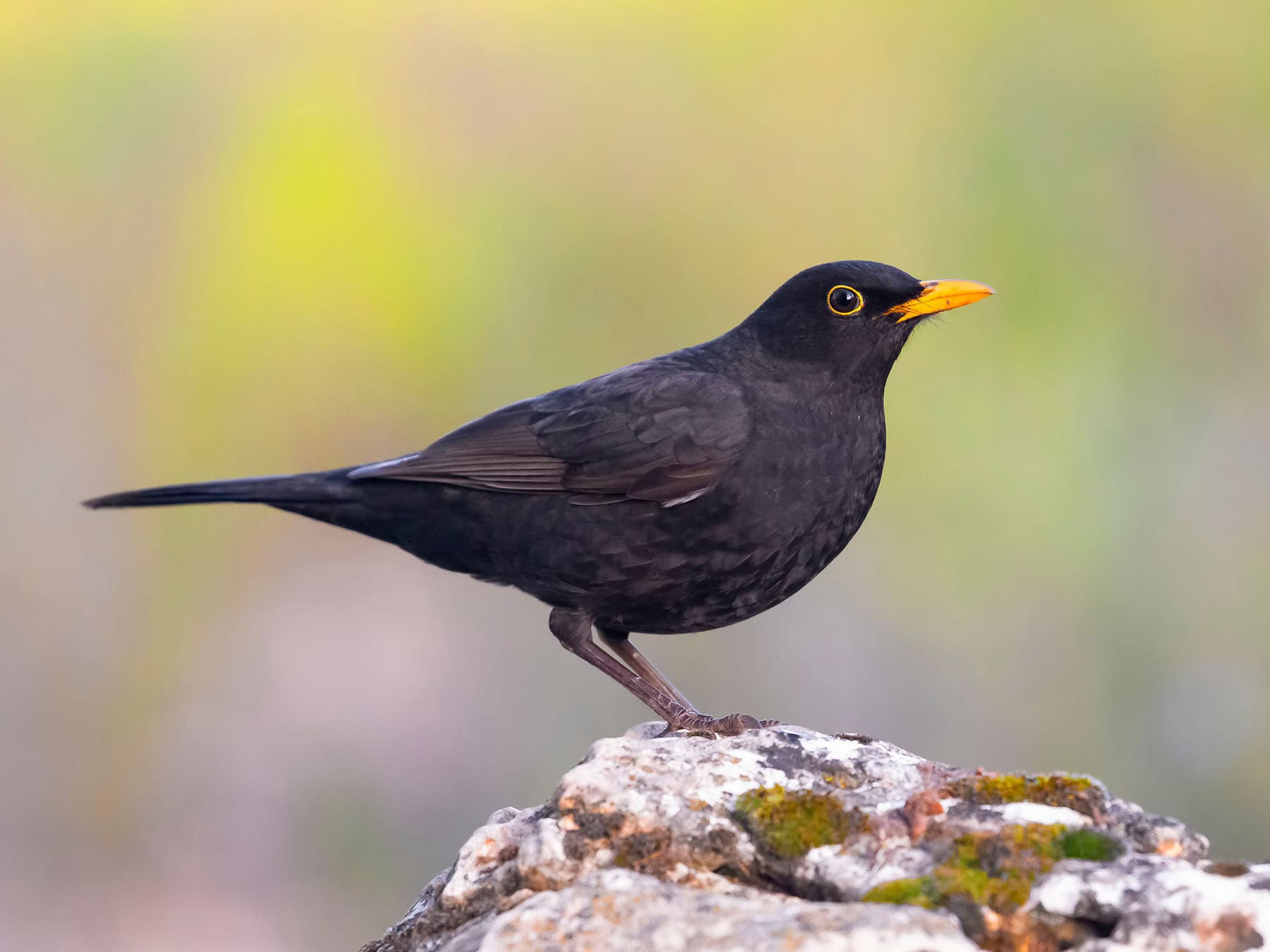
More photos
5 photos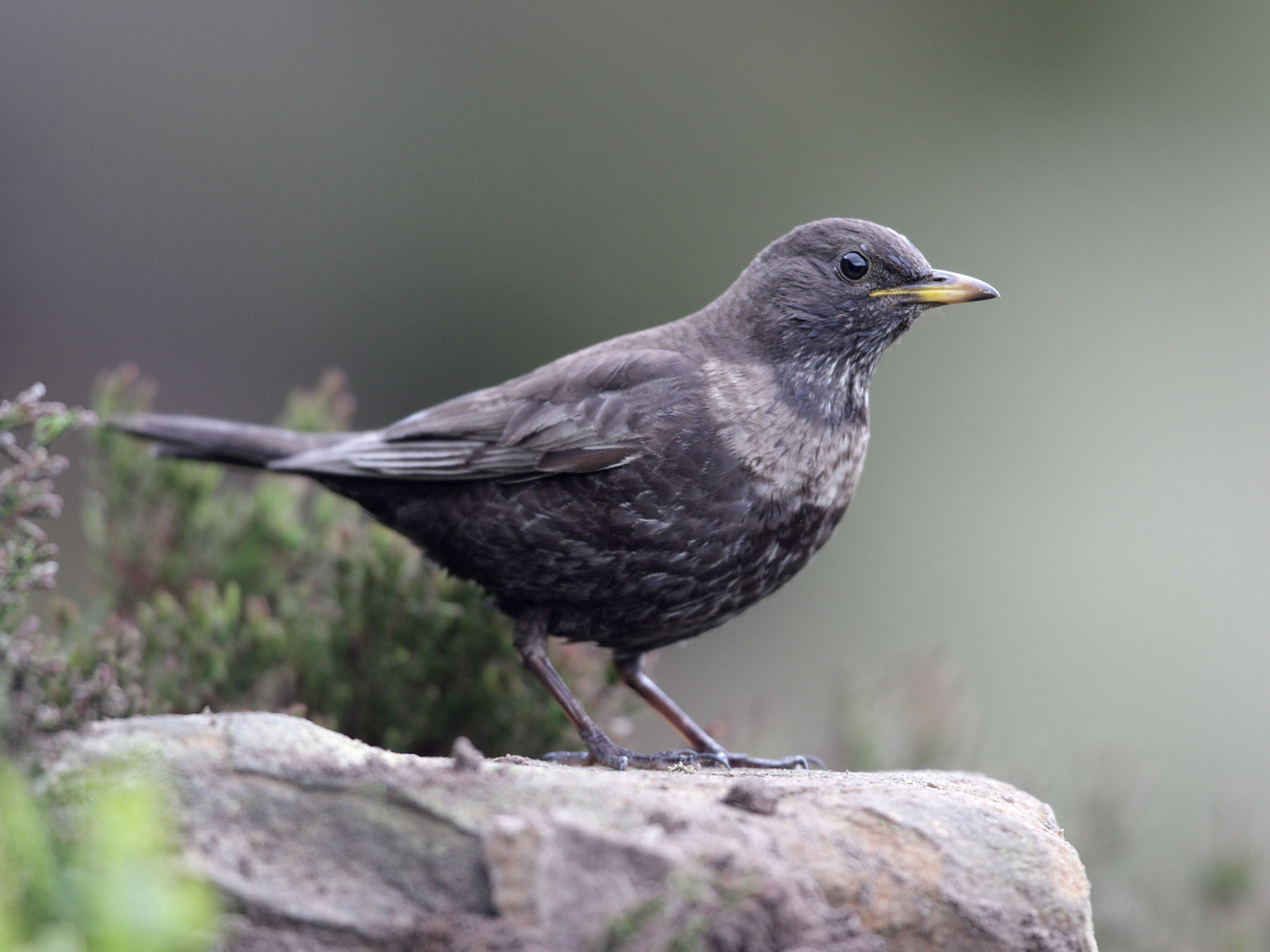
Ring Ouzel guides
1 guidesQuick facts
- Length
- 23–24 cm
- Wingspan
- 38–42 cm
- Weight
- 90–138 g
- Lifespan
- 2–4 years · oldest recorded 9.1 years
- Family
- Thrushes
- Migration
- Long-distance Migrant
- Global status (IUCN)
- Least Concern
- World population
- 597,000 - 1,200,000 mature individuals
- Population trend
- Stable
- Also called
- Mountain Blackbird
- Scientific name
- Turdus torquatus
Questions
1How to attract Ring Ouzels?
Ring ouzels are not especially fond of human company and seek fairly isolated out-of-the-way nesting sites to raise their young. Feeding takes place on short grassland slopes and moorlands rich in heather and other thorny vegetation.
Ring ouzels prefer sites that offer plenty of shelter and undergrowth as cover when raising their young and tend to favour areas that are undisturbed, with nesting sites used in previous years abandoned if they experience disturbance or too much exposure to human presence.
Sources
4- 1BirdLife International. 2019. Turdus torquatus (amended version of 2018 assessment). The IUCN Red List of Threatened Species 2019: e.T22708768A155629409. Source (opens in a new tab)
- 2EBCC (2015)
- 3BirdLife International. 2019. Turdus torquatus (amended version of 2018 assessment). The IUCN Red List of Threatened Species 2019: e.T22708768A155629409. Source (opens in a new tab)
- 4Fransson et al., EURING list of longevity records for European birds (2010) Source (opens in a new tab)

Checked by
Nathan Cope, founder and editor
Nathan founded Birdfact and leads its writers and contributors in the UK, the US and Canada. He has watched and studied birds for more than ten years, and checks every article and species guide before it’s published.