


Brown-headed Cowbird
Molothrus ater
By the Birdfact teamChecked by Nathan Cope
See it in 3D
3 plumages
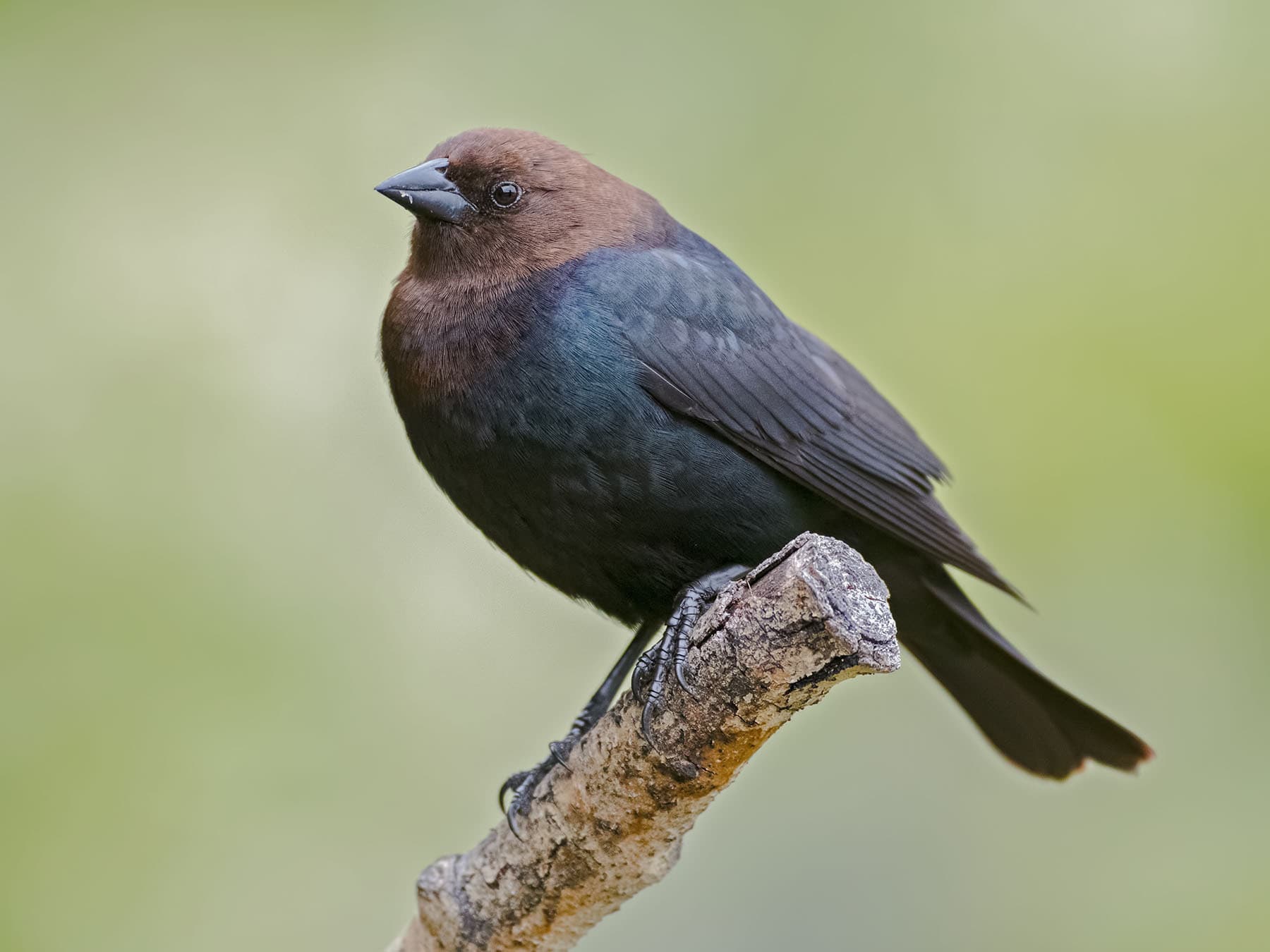
A Brown-headed Cowbird (Adult male) is 7.5–8.5 in (19–22 cm) long, bill to tail.
Adult male
© 2026 NC Digital Limited (Birdfact). All rights reserved. This 3D model may be viewed on this page and shared by link only. Downloading, extracting, copying or reusing it, or using it to train machine-learning models, is not permitted without our written permission. Using our models
On this page15 sections
How to recognise it
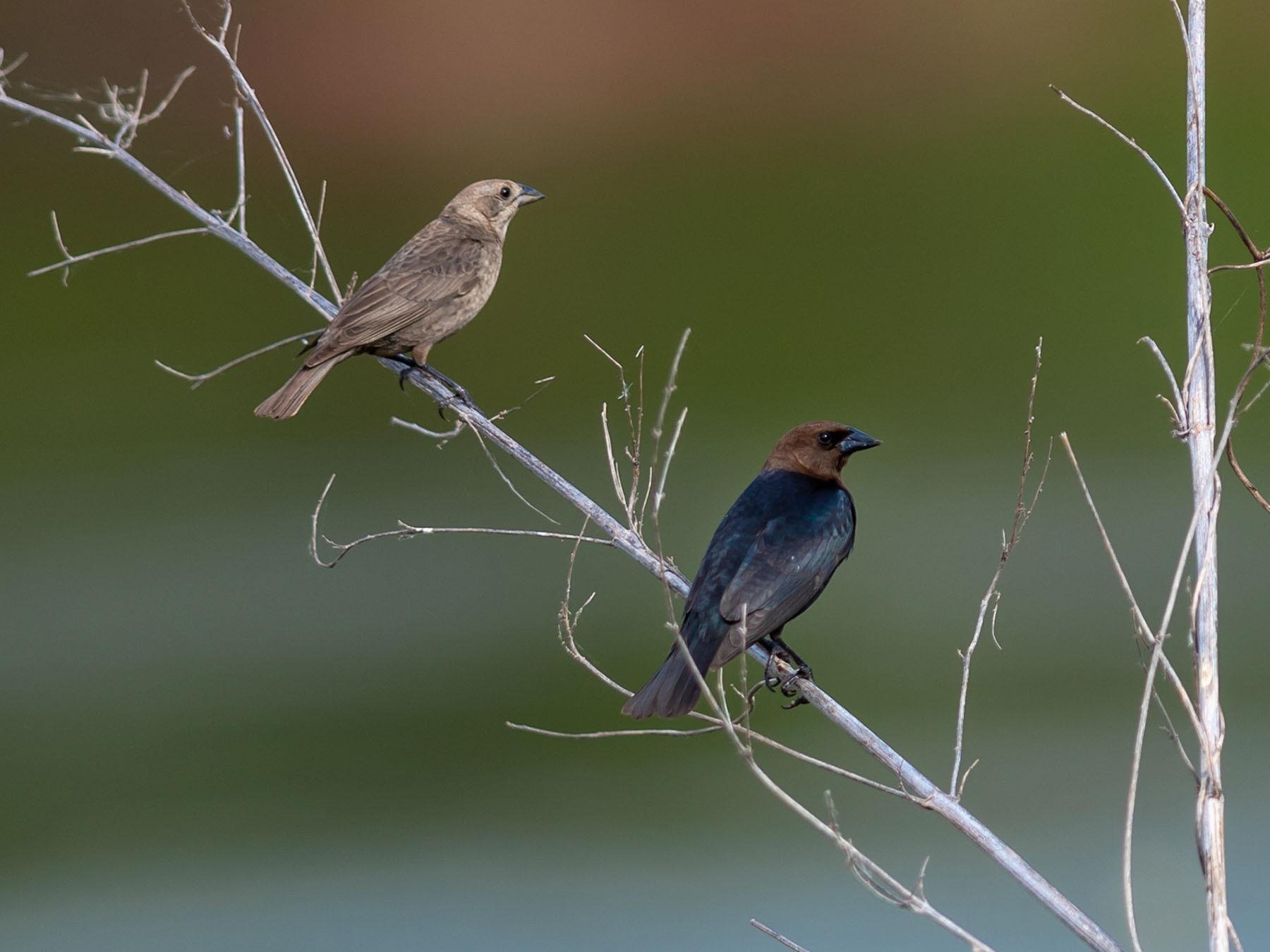
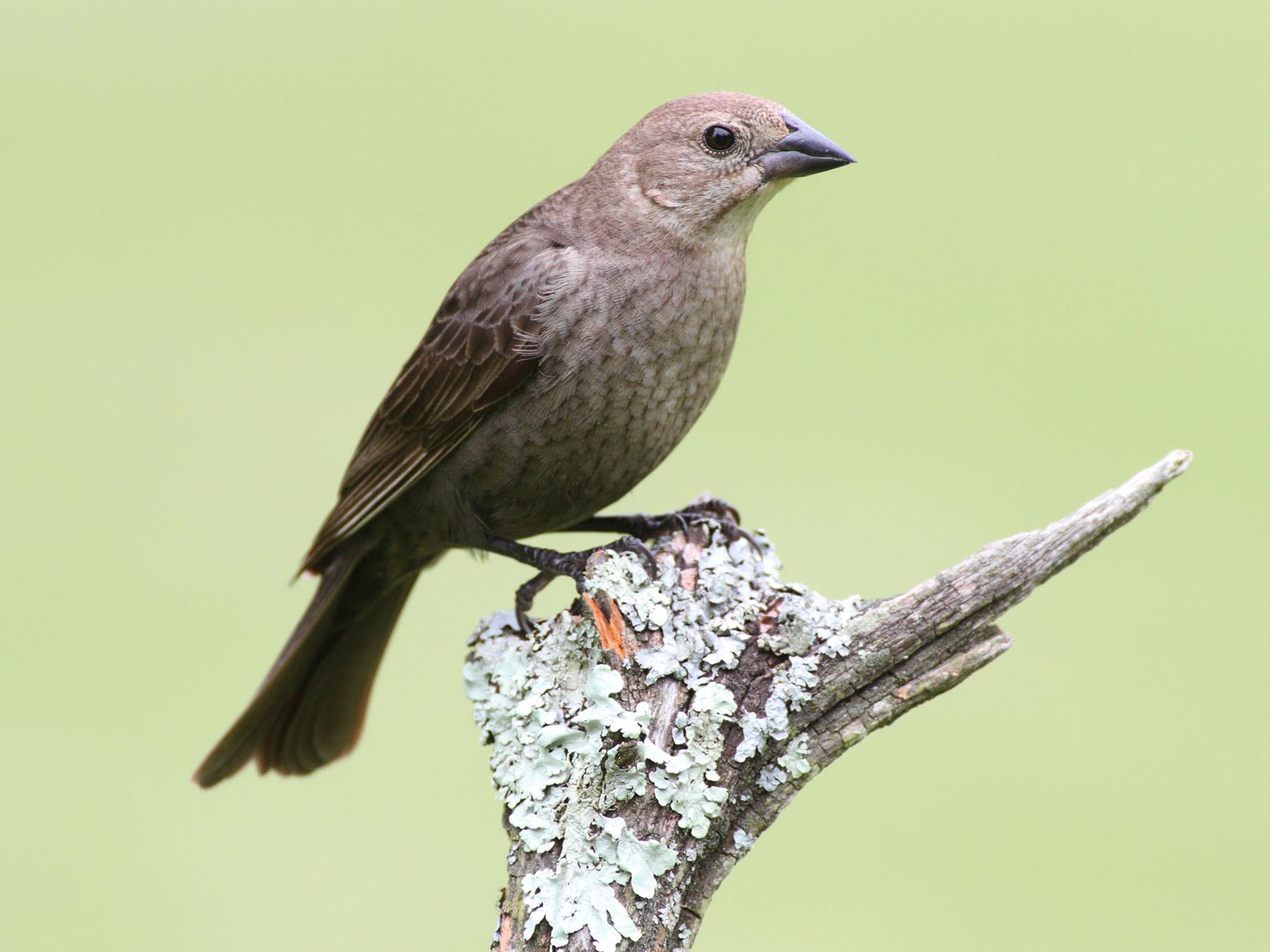
The Brown-headed Cowbird is a small, stocky blackbird with a short tail and a short, thick, sharply pointed bill, almost like a finch's. The male is glossy greenish black with a matte brown head, which can look black in poor light. The female is plain grayish brown, palest on the head and underparts, with a dark eye.1, 2
It is North America's most widespread brood parasite: the female never builds a nest, and lays in other birds' nests, which raise her young. Look for cowbirds walking on lawns, fields and pastures, often among other blackbirds, grackles and starlings, and for males puffing up and bowing as they sing.
Size
Cowbirds sit between a sparrow and a robin in size, slightly smaller than a Red-winged Blackbird. Males are 7.5 to 8.7 inches (19-22 cm) long and weigh 1.5 to 1.8 ounces (42-50 g); females are 6.3 to 7.9 inches (16-20 cm) and 1.3 to 1.6 ounces (38-45 g), though some guides give females a slightly wider range. The wingspan is about 12.6 to 15 inches (32-38 cm).1, 3 Birds of the interior West are the biggest and those of the Southwest the smallest.
Male, female and young
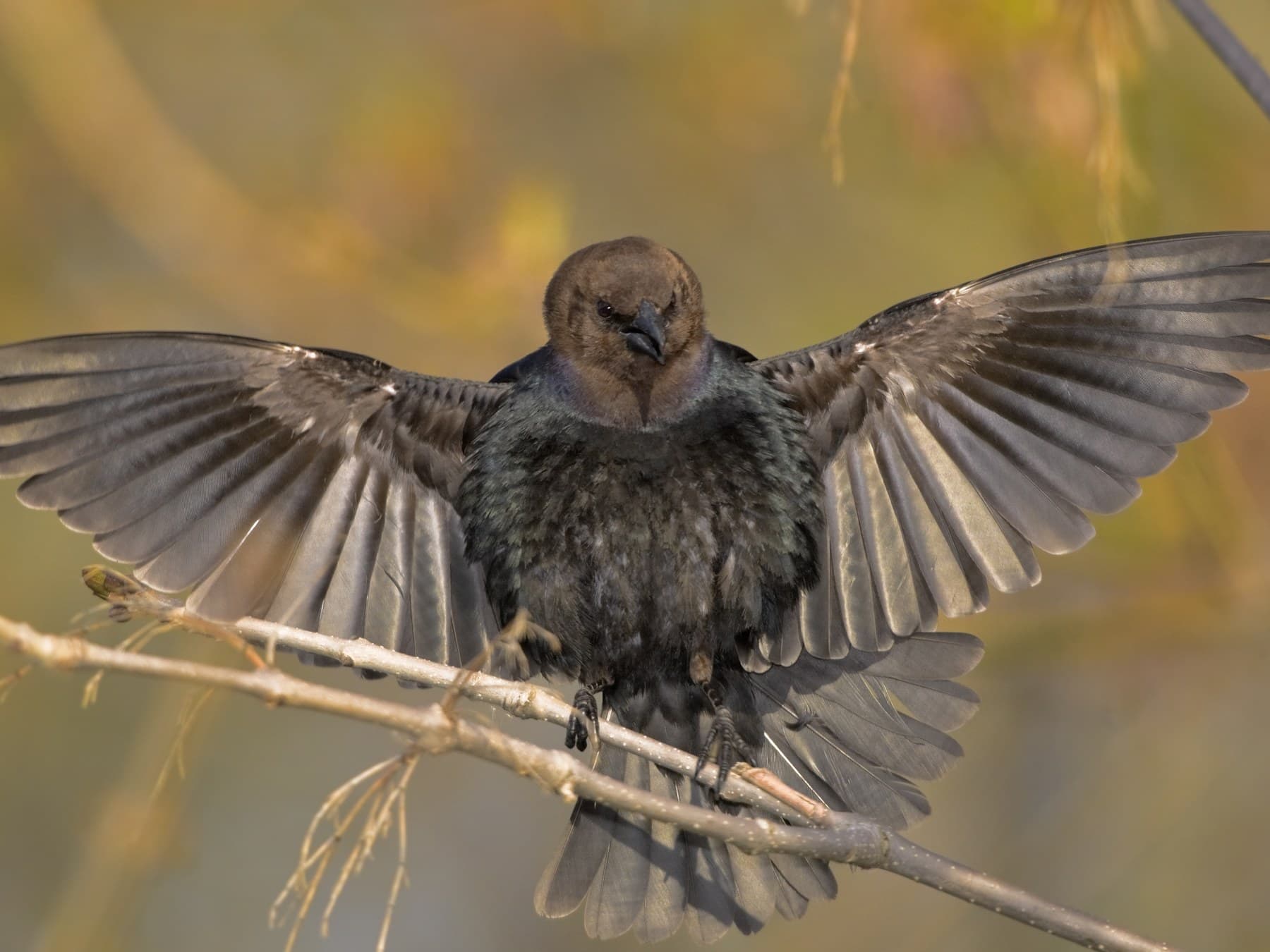
Adult males are distinctive: a glossy black body, often with a violet sheen on the upper back, and a brown head, neck and upper chest. Females are about a tenth smaller and plain grayish brown, with a paler throat and faint streaks or mottling on the belly. Their short, thick bill sets them apart from the female blackbirds they can be confused with, and they are much bigger and plainer than the sparrows and finches they are sometimes taken for.
Juveniles, seen mostly from May to August, look like females but are scaly above, from pale feather edges, and distinctly streaked below, sometimes with a buff or yellowish wash on the face and breast. Young males molting into adult plumage look patchy brown and black, mostly from July to October. About three-quarters of the species that raise cowbirds are smaller than a cowbird, so you may see a young cowbird begging from a smaller bird.
More: male vs female Brown-headed Cowbirds, and telling a female from a House Finch.
Identification: similar birds
Common Grackle. Much bigger, 11 to 13.4 inches (28-34 cm), with a long tail creased down the middle, a longer bill and, in adults, whitish-yellow eyes. A male cowbird has a short tail, a short, thick bill and a brown head.
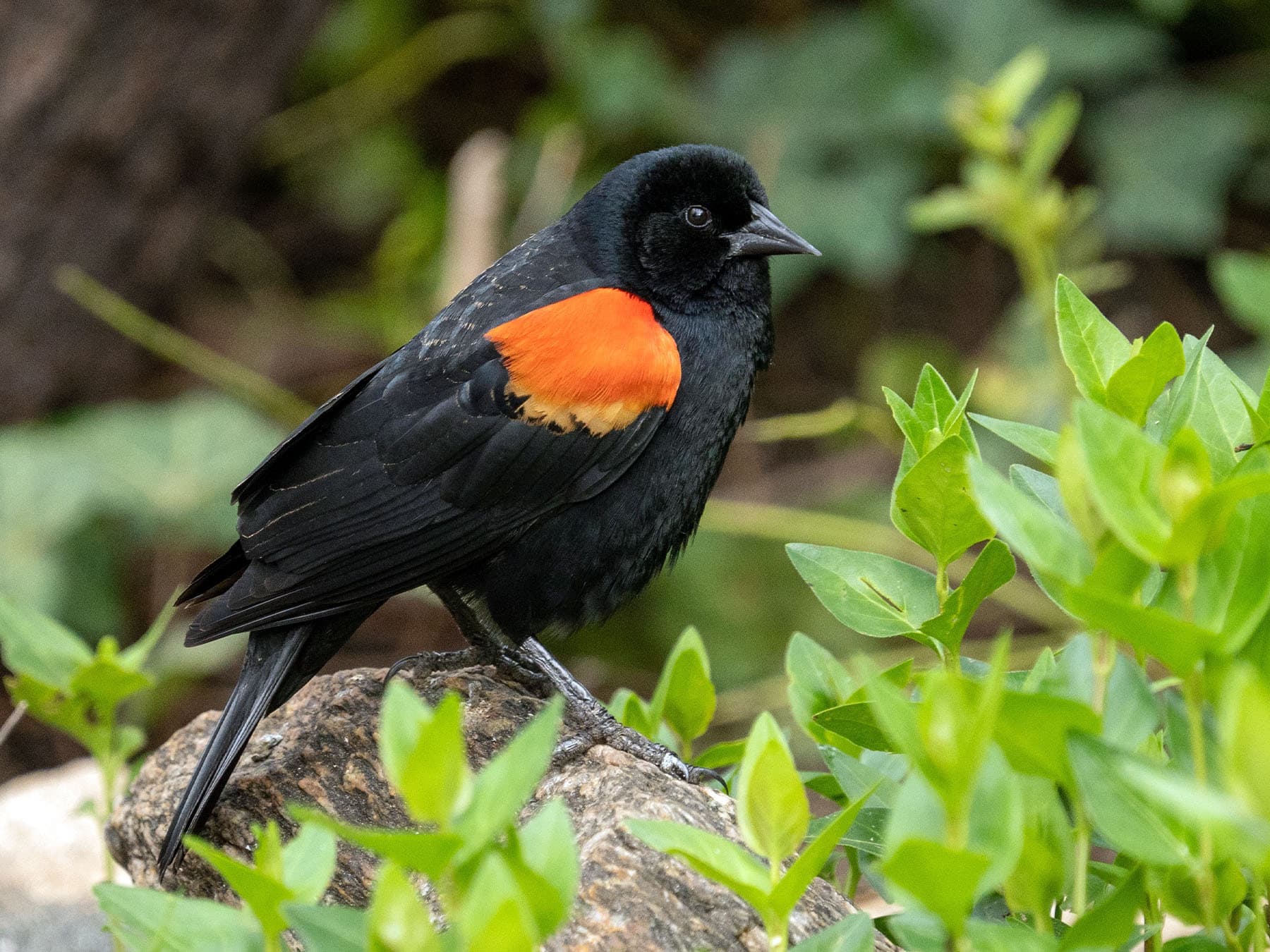
Red-winged Blackbird. Females are streaky brown with a buff eyebrow and a longer, less conical bill, unlike the plain female cowbird; males show red shoulder patches.
Brewer's Blackbird. The female is also plain gray-brown with a dark eye, but she is a little bigger, with a longer, slimmer bill; males are all glossy black with whitish eyes.
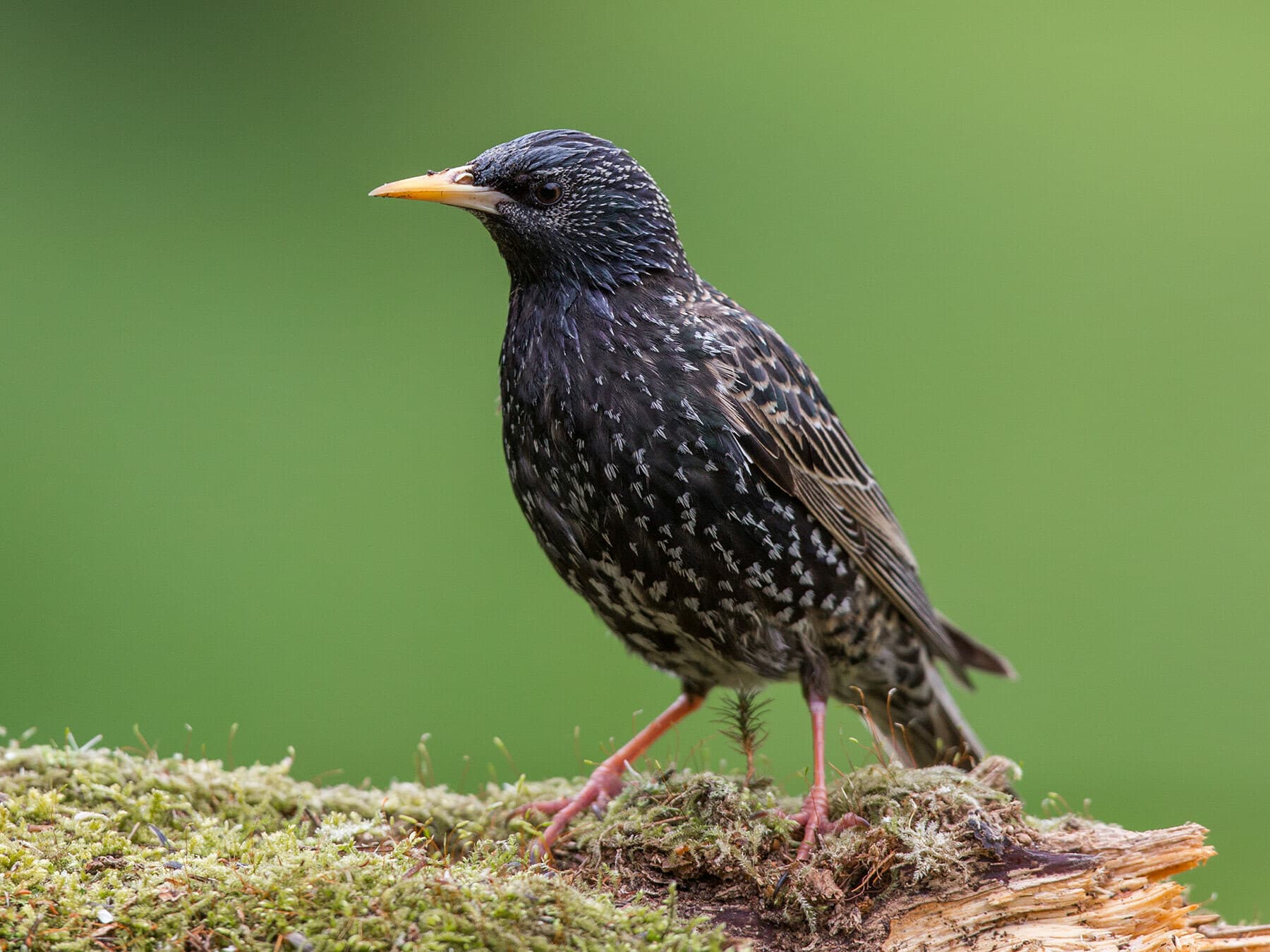
European Starling. A thin, straight bill, yellow in spring and summer, and white spots in fall and winter; young starlings are plain dusty gray with dark bills.
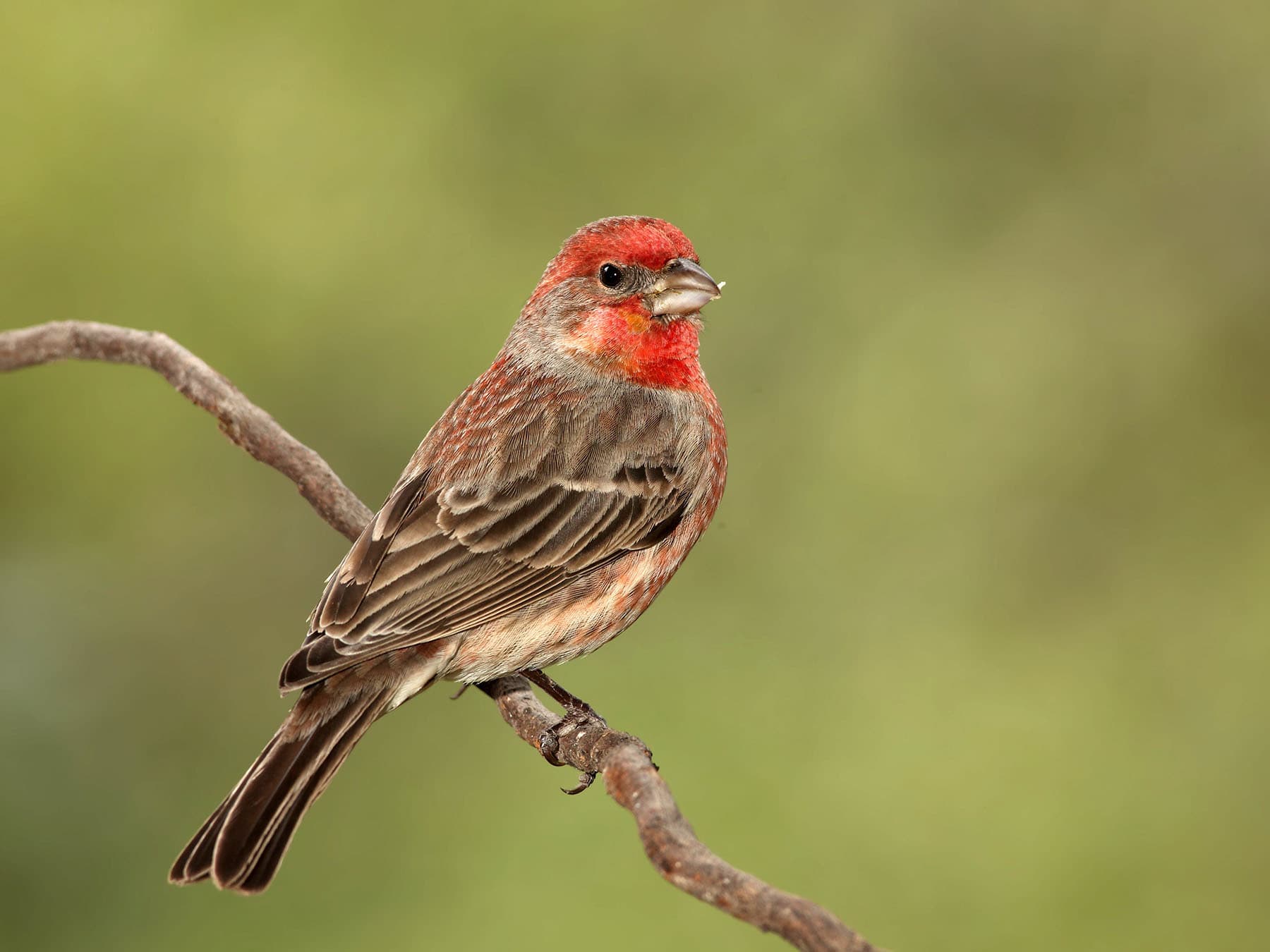
House Finch. A female House Finch is smaller, with blurry brown streaks over pale underparts and a short, curved bill.
Bronzed and Shiny Cowbirds. The Bronzed Cowbird is slightly bigger, with red eyes, a longer bill and a bigger head. The male Shiny Cowbird is glossy black all over, head included, and the female is typically darker and grayer, with a slimmer, darker bill.2
Not sure it’s a Brown-headed Cowbird? Check your photo: Birdfact names the bird and shows the look-alike side by side.
Its size
Adults- Length
- 16–22 cm
- Wingspan
- 32–38 cm
- Weight
- 38–50 g
Its song and calls
The male's song is a liquid, bubbling gurgle followed by a thin, high whistle, often written glug-glug-glee: one to four low glug notes, then high whistles between 3,000 and 12,000 hertz. When another cowbird is near, he almost always bows as he sings. Males also give high flight whistles just before, during or after flight. The other sound you will hear most is the chatter, a fast rattle given mainly by females, often in reply to a male's song or over the top of it.
Song is partly learned. Young males seem to practice in winter flocks, and in one study 85% of yearling males' songs in November and December were still rough, variable practice songs, against 20% by February. Females shape the result: a wing-stroke display when a song pleases them reinforces it, and they prefer songs in their local dialect.2
- Songs of a male0:00 / 0:21
Recorded in Georgia, United States · March 2026
- Chatter0:00 / 0:05
Recorded in North Carolina, United States · April 2022
Heard one and not sure? Let the bird song identifier listen.
When and where to see it
Cowbirds breed across most of North America, from southeast Alaska and the southern half of Canada to central Mexico, and live all year in many southern areas. They like open country with scattered trees: woodland edges, brushy thickets, fields, pastures, prairies, orchards, lawns and suburbs, and they generally avoid unbroken forest.2
It was not always so. Before European settlement the cowbird lived on the open grasslands of central North America, where it often fed alongside the bison. As forests were cleared it spread east from the early 1800s, reaching Ohio by 1850, Nova Scotia in 1933, Georgia in 1957 and Florida in the 1980s, and west across California from 1900 and into Oregon and Washington in the 1950s.2 In the breeding season cowbirds spend the morning in or near woods, where females find nests, and feed in open fields later in the day, usually less than about 0.6 mile (1 km) away.
Migration
Cowbirds are short-distance migrants. Birds from the north of the range move south for the winter, into the central and southern US and Mexico, while many in the South stay all year. Northeastern birds travel about 500 to 530 miles (800-850 km) between their breeding and winter grounds.
In spring they move north fast. In Friedmann's 1929 account of the eastern US, migrants reached the Gulf Coast states by about March 10, the southern Great Lakes by about March 25 and the northern border states by about April 10, moving about 25 miles (40 km) a day; males arrive before females, and older birds earlier. Recent data on timing are sparse. In the East fall migration peaks in August and September.2 Some birds leave their nesting areas as early as July.3
Tips for seeing it
What it eats
Mostly seeds of grasses and weeds, with some waste grain, plus insects, above all grasshoppers and beetles, and caterpillars, spiders and millipedes. In an analysis of 589 stomachs from across the US, seeds made up about 94% of the diet in winter and 48% in summer.2, 3
Cowbirds feed by walking on the ground, often right beside cattle and horses, catching the insects the animals flush from the grass, and they have been seen perched on the backs of bison and cattle. Before cattle they probably did the same with bison, which gave them the old names buffalo bird and bison bird. Laying females need extra calcium, which they get from snail shells, calcium at feeders and eggs taken from the nests they visit.
At bird feeders
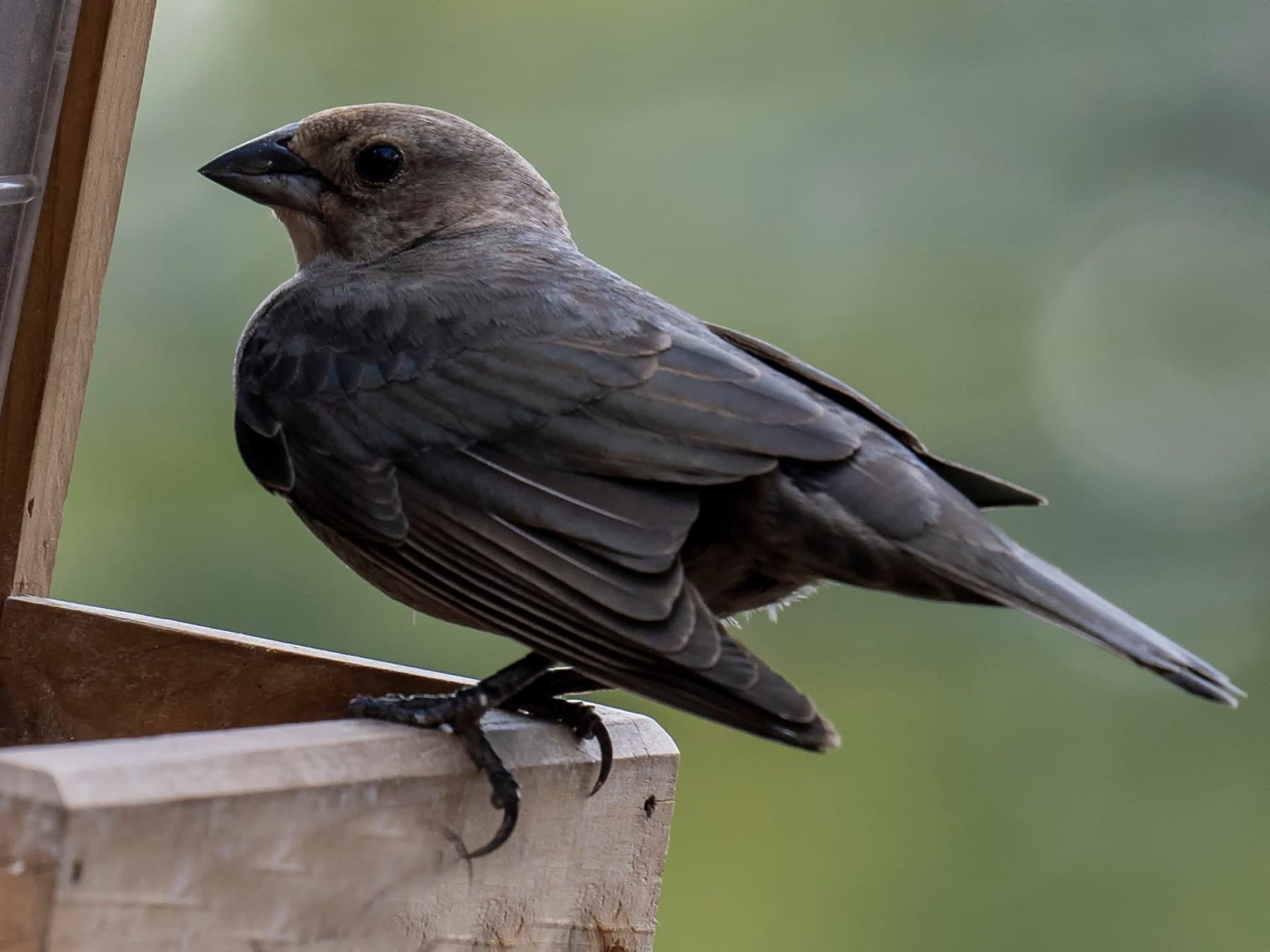
Cowbirds come to feeders across the US. They feed on the ground, on platform feeders and at large hoppers, and take black oil and hulled sunflower seed, cracked corn, millet, milo, oats and peanut hearts.4
Nesting and breeding
A cowbird never builds a nest or sits on eggs. The female finds the nests of other birds, by watching quietly from a treetop, walking and watching other birds, or fluttering noisily through the leaves as if to flush a sitting bird, and lays her eggs in them. The hosts incubate the eggs and raise the young.
She usually lays while the host is laying its own eggs, just before sunrise: in one study, a mean of about 9 minutes before. She is usually on the nest for only 20 to 40 seconds. That means remembering nests found in daylight and finding them again in near-darkness a day or more later. Compared with males, females have a larger hippocampus, the part of the forebrain linked to spatial memory5, and in lab tests they made fewer errors than males finding a hidden reward 24 hours later.6 They seem to choose nests by the host birds more than by the nest itself. In one nest-box study, cowbirds offered a pair of boxes laid only in the one with nesting Prothonotary Warblers; across the area they never laid in inactive boxes, and used the warblers more often than House Wrens or Tree Swallows.7
In one Michigan study, eggs were laid from mid- to late April until mid-July. A female lays one to seven eggs on consecutive days, then pauses for a day or two, and may lay up to about 40 eggs in a season.2 She often takes out one of the host's eggs before laying her own.3
Eggs
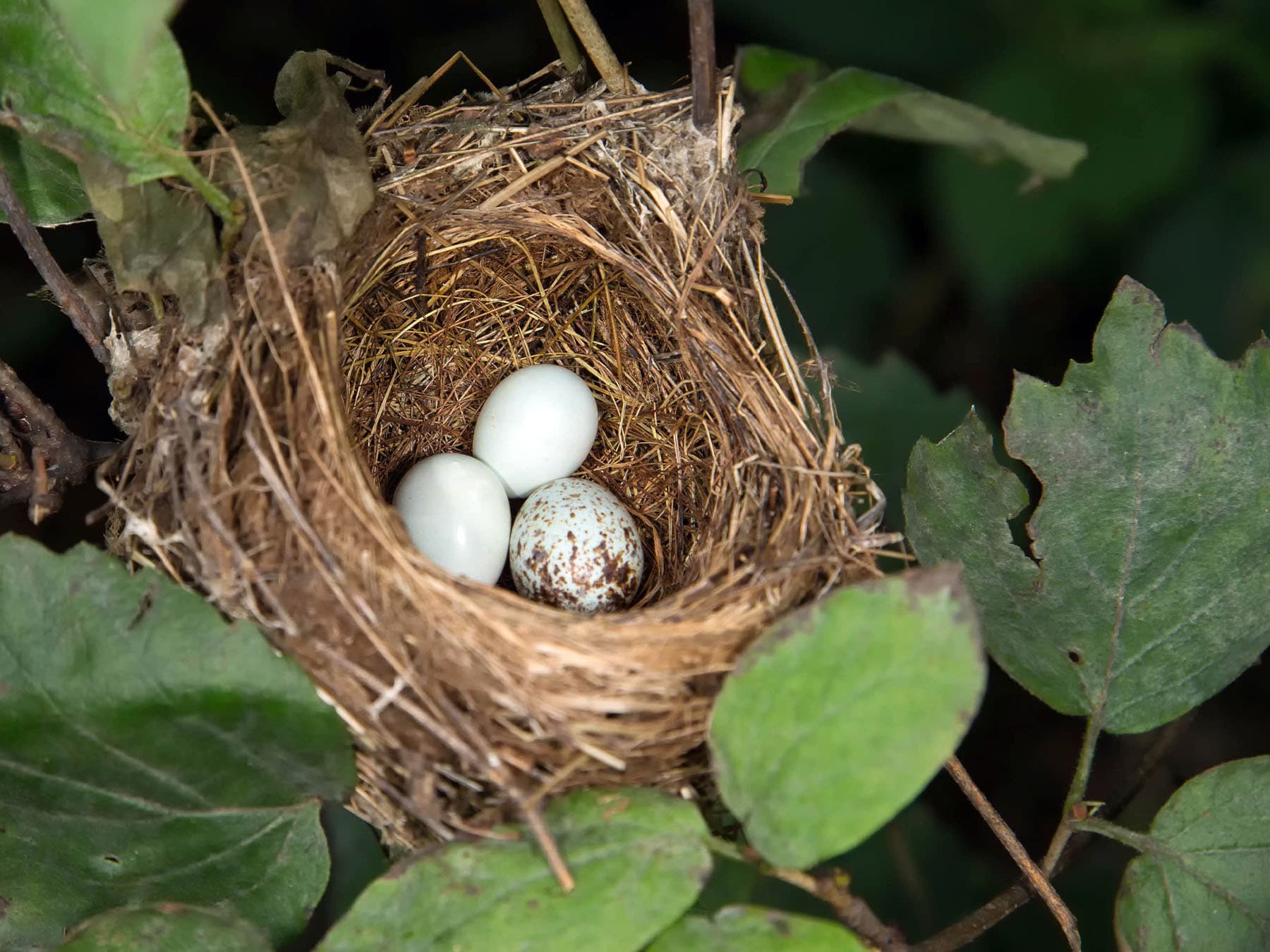
Cowbird eggs are white or grayish white with brown and gray spots, thickest at the larger end, and about 0.85 by 0.65 inch (21.5 by 16.4 mm) in the East; the small southwestern birds lay smaller eggs. The shell is thicker and stronger than a similar-sized host egg. In drop tests that copied the way cowbirds lay from above the nest, cowbird eggs were less likely to be damaged than host eggs, and they damaged the host eggs they landed on.8
Cowbird eggs have turned up in the nests of more than 220 species, 144 of which have raised young cowbirds, from 0.35 oz (10 g) kinglets and gnatcatchers to 5.3 oz (150 g) meadowlarks. In early records, mostly from the East, the most often recorded hosts include the Yellow Warbler, Song Sparrow, Red-eyed Vireo, Chipping Sparrow, Eastern Phoebe, Eastern Towhee, Ovenbird and Red-winged Blackbird. In one study, 60% of parasitized nests held a single cowbird egg.2
Young birds and their foster parents
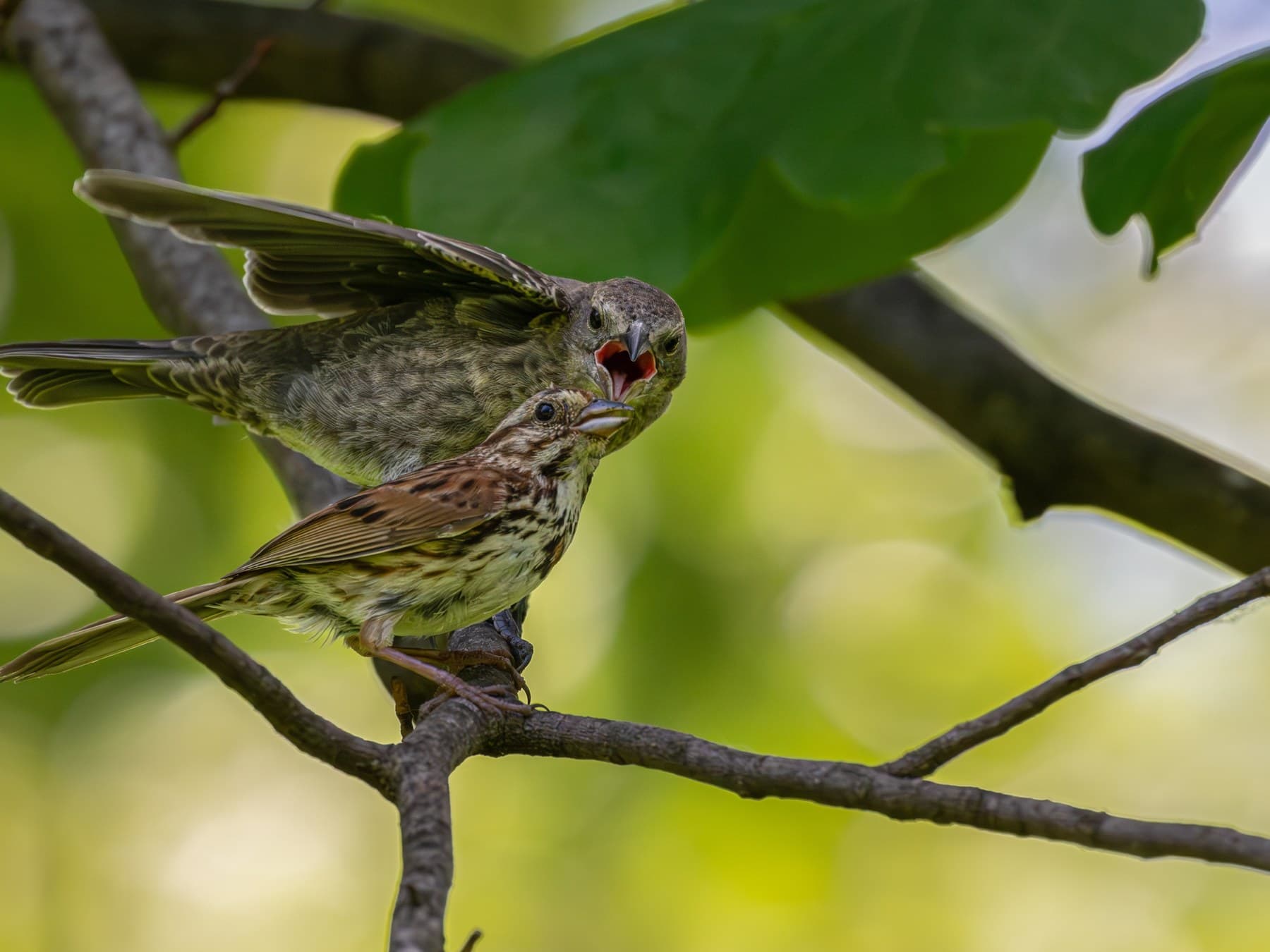
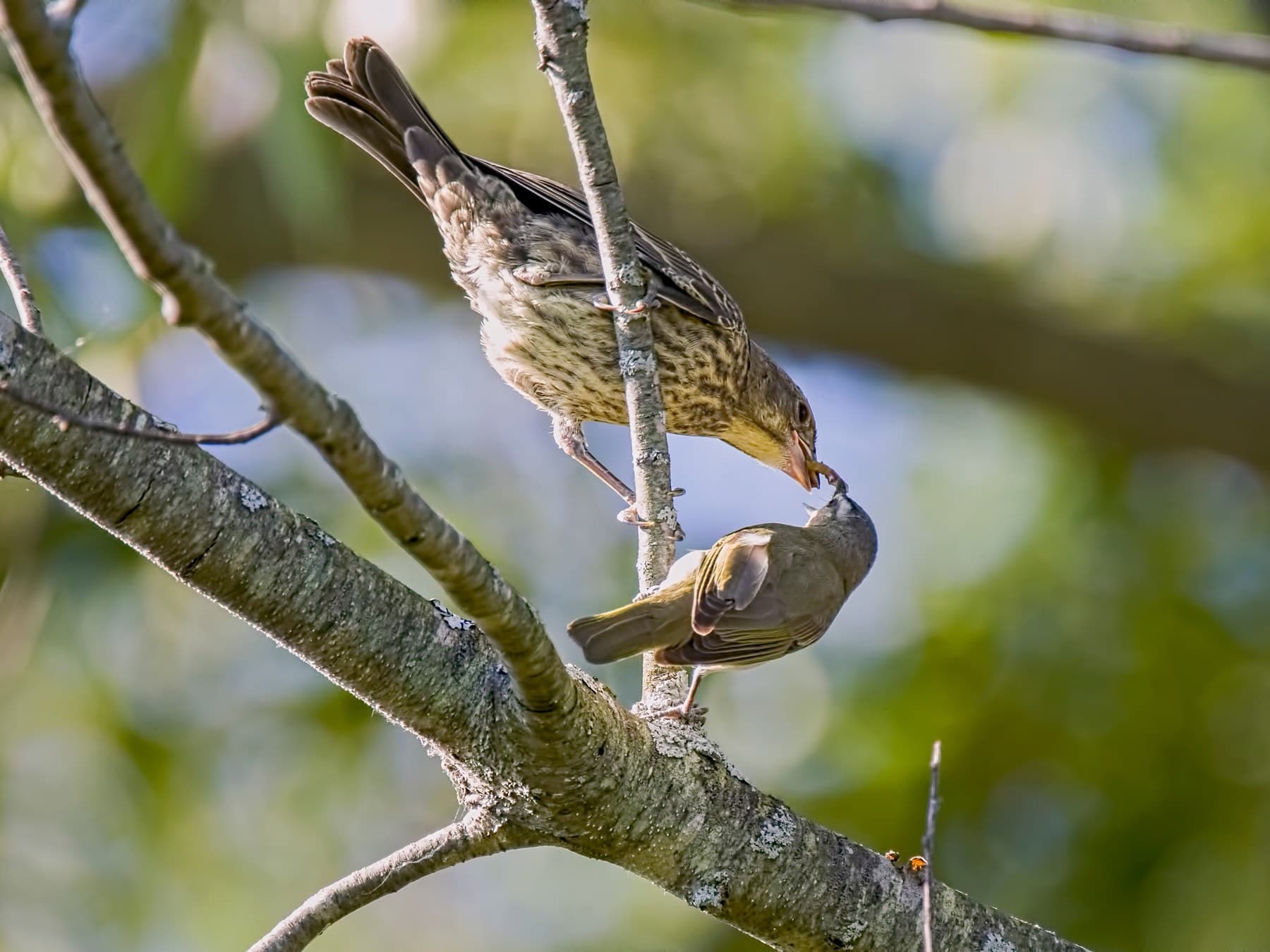
The cowbird egg hatches after 10 to 12 days, usually before the host's own eggs when it was laid in step with them, and the chick grows fast. It does not usually push its nestmates out; it outcompetes them for food instead, and even gains from them. In one study a cowbird chick got 56% of the food brought to the nest, against 22% for each of two host chicks.2 Experiments show the host chicks help the cowbird: with them in the nest the parents bring more food, so it grows faster.9 The cost to the host is greatest when the cowbird hatches early and is much bigger than its own chicks.
The young cowbird leaves the nest at 8 to 13 days old and is fed by its foster parents for another 1 to 3 weeks, begging loudly with shaking wings; in one study the young became independent at 25 to 39 days old. As they grow independent they spend more and more time with adult cowbirds.2 How does a young cowbird learn it is a cowbird? One idea, backed by experiments, is a password: the chatter call. Six-day-old nestlings begged more to recordings of chatter than to other birds' calls, and two-month-old fledglings approached it faster.10
Hosts that reject the eggs
Some hosts fight back. American Robins and Gray Catbirds throw the cowbird egg out, Yellow Warblers may bury it under a new nest floor, and other birds desert the nest. In experiments, birds of most species either nearly all accepted or nearly all rejected cowbird eggs, and most accepters rejected fewer than 20% of the eggs placed in their nests.11 Robins, catbirds, Blue Jays, Brown Thrashers, Cedar Waxwings, Baltimore Orioles and kingbirds reject cowbird eggs more than 88% of the time, and many hosts attack cowbirds near their nests.2
Why do so many hosts accept? One answer is what researchers call "mafia" behavior. In one experiment, cowbirds wrecked 56% of a warbler host's nests when their egg had been removed, against 6% of nests that kept it, and the nests whose cowbird egg was removed raised 60% fewer young.12 The idea is still debated: a 22-year study of Dark-eyed Juncos found no such effect, with more young fledged where the cowbird egg was removed.13
Behaviour
Cowbirds are sociable. Males gather on lawns to display: the male puffs up his back and chest feathers, lifts and spreads his wings and tail, and bows forward as he sings, and groups of males sometimes display together. Rivals also point their bills at the sky. Where cowbirds are dense, females may hold laying areas that they defend against other females with chatter calls; elsewhere they range widely and overlap. Males follow and guard their mates.2
After the breeding season small groups merge into larger flocks, and in winter cowbirds join huge roosts of blackbirds, grackles and starlings, often hundreds of thousands to millions of birds, though they are usually a small share: about 2 to 5% of one Kentucky roost of some five million. On the ground they usually walk, and they fly directly, with steady wingbeats.
Lifespan and predators
The oldest known wild Brown-headed Cowbird was a male at least 16 years 11 months old: banded in Wisconsin in 1969 as a full-grown bird, he was caught and released there in 1985.14 That is far beyond a typical life. In one study about 48.5% of adult males and 40.4% of adult females survived each year, and only a small share of eggs, about 13% across several studies, produce a young bird that leaves the nest.2 Birds of prey take adults from flocks, snakes and Blue Jays take fledglings, and some cowbirds die in freezing weather when also sick with bacterial infections.
Conservation
The Brown-headed Cowbird is listed as Least Concern by the IUCN.2 Partners in Flight puts the population at about 130 million birds, with a concern score of 8 out of 20, a low level of concern.15 It is slowly declining. The North American Breeding Bird Survey shows a fall of about 0.44% a year from 1966 to 2025, about 23% fewer birds over that time.16
The cowbird gained from the clearing of forests, but regrown eastern woods, less outdoor dairy farming and the steep decline of many of its host songbirds are thought to have cut its numbers since.2 In Missouri, as cowbirds fell, parasitism of three host species dropped and their nests produced more young from 1991 to 2010.17
Conservation: cowbirds and endangered birds
As the cowbird spread, parasitism threatened some already rare birds, above all Kirtland's Warbler, Black-capped Vireo and the Least Bell's Vireo, with up to 100% of nests parasitized in some populations. Managers trapped and removed cowbirds to protect them.2 The U.S. Fish and Wildlife Service trapped cowbirds for Kirtland's Warbler for more than 40 years; trapping was cut back from 2015 and stopped in 2018, and only 4 of 514 nests were parasitized in 2015 to 2018.18
That is not the whole story. The cowbird is a native bird and part of North America's natural ecosystems. The authors of its main scientific account note it is often depicted as evil, but "they are not so".2 Two cowbird researchers interviewed by Audubon in 2018 pointed to people's damage to habitat, not cowbirds, as the main reason those rare hosts declined.19
Protected status and the law
Brown-headed Cowbirds are protected under the Migratory Bird Treaty Act. Killing, capturing or keeping one, or taking its nest or eggs, is illegal except as federal regulations allow.20, 21 Removing a cowbird egg from a songbird's nest is illegal outside regulated programs.2 A federal depredation order allows control without a federal permit only in set cases, such as serious damage to crops or protecting an endangered or threatened species where it occurs, and state permits may still apply.22 Taking out a cowbird egg can also backfire: the host may desert the nest.19
Similar birds
Often mistaken for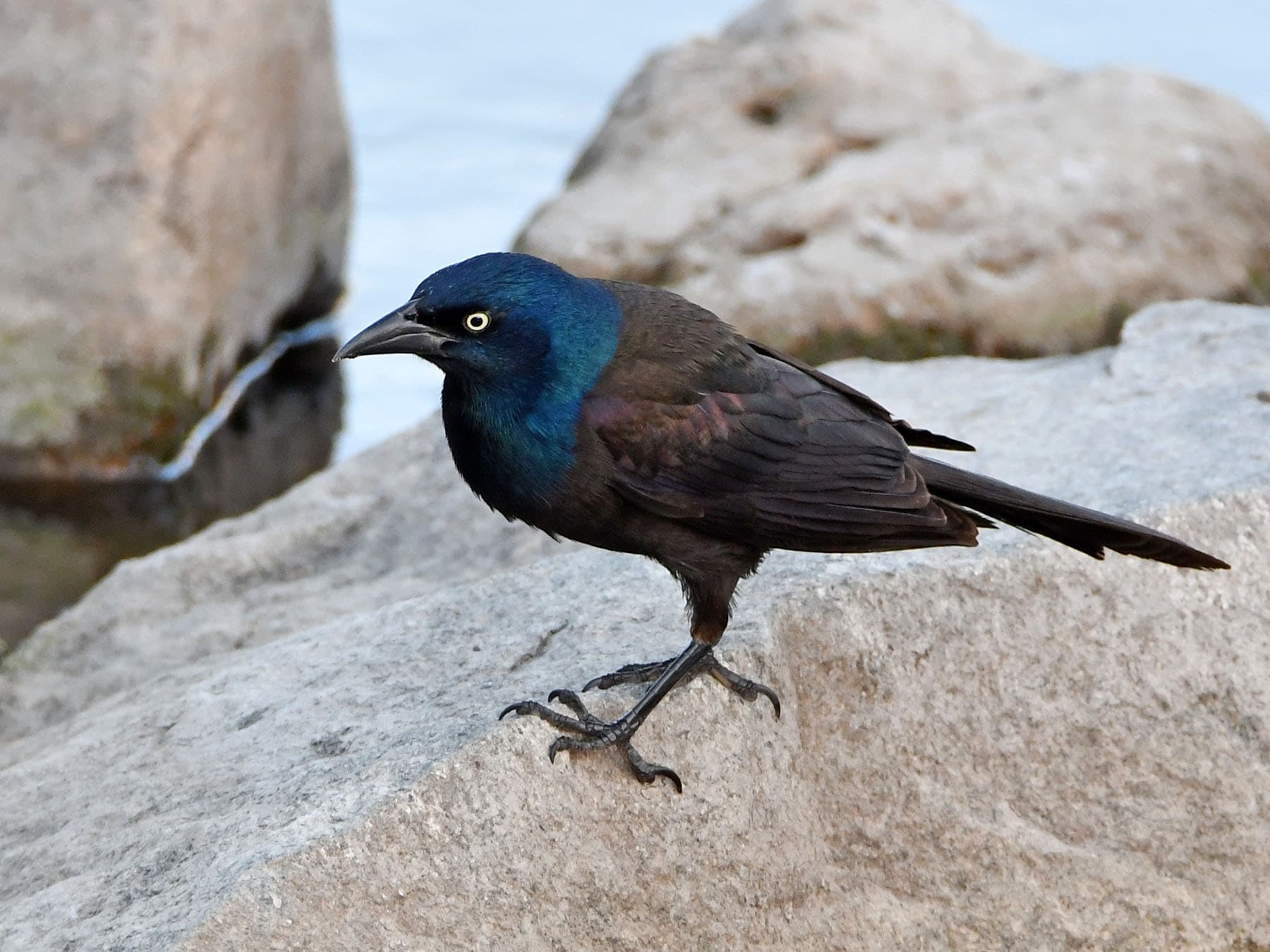
Brown-headed Cowbird guides
2 guidesQuick facts
- Length
- 16–22 cm
- Wingspan
- 32–38 cm
- Weight
- 38–50 g
- Lifespan
- oldest recorded 16 years 11 months
- Family
- New World Blackbirds
- World population
- About 130 million (Partners in Flight)
- Population trend
- Common and widespread, but slowly declining in recent decades
- Scientific name
- Molothrus ater
Questions
5Are cowbirds invasive?
No. The Brown-headed Cowbird is native to North America. It has spread far beyond its original grasslands as forests were cleared, so it now meets hosts that had not met it before.
What should I do if I find a cowbird egg in a nest?
Leave it. Removing it is illegal outside regulated programs, and the host may abandon the nest. See Protected status and the law and cowbird eggs.
Why is it called a cowbird?
For its habit of feeding around cattle and horses, catching the insects they stir up. On the Great Plains it fed alongside bison, and was called the buffalo bird.
Do cowbird chicks kill the other chicks?
Not usually. A young cowbird rarely pushes its nestmates out, but it grows faster and takes much of the food, so the host often raises fewer of its own young.
Do cowbirds mate for life?
Not usually. Pairs may stay together for a season, and some reunite in later years, but in some populations birds have several mates, and the mating system varies from place to place.
Sources
29- 1Cornell Lab of Ornithology. Brown-headed Cowbird. All About Birds. Accessed 31 October 2026. Source (opens in a new tab)
- 2Chamberlain, M. L., Lowther, P. E. and Hauber, M. E. (2026). Brown-headed Cowbird (Molothrus ater), version 2.1. Birds of the World (S. M. Billerman, editor). Cornell Lab of Ornithology. doi:10.2173/bow.bnhcow.02.1 (opens in a new tab)
- 3National Audubon Society. Brown-headed Cowbird. Guide to North American Birds. Accessed 31 October 2026. Source (opens in a new tab)
- 4Project FeederWatch. Common Feeder Birds: Brown-headed Cowbird. Project FeederWatch (Cornell Lab of Ornithology and Birds Canada). Accessed 31 October 2026. Source (opens in a new tab)
- 5Sherry, D. F., Forbes, M. R. L., Khurgel, M. and Ivy, G. O. (1993). Females have a larger hippocampus than males in the brood-parasitic brown-headed cowbird. Proceedings of the National Academy of Sciences 90(16): 7839-7843. doi:10.1073/pnas.90.16.7839 (opens in a new tab)
- 6Guigueno, M. F., Snow, D. A., MacDougall-Shackleton, S. A. and Sherry, D. F. (2014). Female cowbirds have more accurate spatial memory than males. Biology Letters 10(2): 20140026. doi:10.1098/rsbl.2014.0026 (opens in a new tab)
- 7Peer, B. D. and Liang, W. (2025). Brown-headed cowbirds select nests to parasitize based on individual host attributes rather than nest type. Animal Behaviour 223: 123157. doi:10.1016/j.anbehav.2025.123157 (opens in a new tab)
- 8López, A. V., Fiorini, V. D., Ellison, K. and Peer, B. D. (2018). Thick eggshells of brood parasitic cowbirds protect their eggs and damage host eggs during laying. Behavioral Ecology 29: 965-973. doi:10.1093/beheco/ary045 (opens in a new tab)
- 9Kilner, R. M., Madden, J. R. and Hauber, M. E. (2004). Brood parasitic cowbird nestlings use host young to procure resources. Science 305(5685): 877-879. doi:10.1126/science.1098487 (opens in a new tab)
- 10Hauber, M. E., Russo, S. A. and Sherman, P. W. (2001). A password for species recognition in a brood-parasitic bird. Proceedings of the Royal Society of London B 268: 1041-1048. doi:10.1098/rspb.2001.1617 (opens in a new tab)
- 11Rothstein, S. I. (1975). Evolutionary rates and host defenses against avian brood parasitism. American Naturalist 109: 161-176. doi:10.1086/282984 (opens in a new tab)
- 12Hoover, J. P. and Robinson, S. K. (2007). Retaliatory mafia behavior by a parasitic cowbird favors host acceptance of parasitic eggs. Proceedings of the National Academy of Sciences 104(11): 4479-4483. doi:10.1073/pnas.0609710104 (opens in a new tab)
- 13Turner, A. M., Hauber, M. E. and Reichard, D. G. (2022). Twenty-two years of brood parasitism data do not support the mafia hypothesis in an accepter host of the Brown-headed Cowbird (Molothrus ater). Journal of Field Ornithology 93(4): 4. doi:10.5751/JFO-00180-930404 (opens in a new tab)
- 14USGS Bird Banding Laboratory. Longevity records of North American birds. USGS Eastern Ecological Science Center, Bird Banding Laboratory. Accessed 31 October 2026. Source (opens in a new tab)
- 15Partners in Flight (2024). Avian Conservation Assessment Database, global scores. Partners in Flight Databases (Bird Conservancy of the Rockies). Accessed 31 October 2026. Source (opens in a new tab)
- 16Hostetler, J. A. et al. (2026). The North American Breeding Bird Survey, Analysis Results 1966-2025. U.S. Geological Survey data release. doi:10.5066/P1OSNSFC (opens in a new tab)
- 17Cox, W. A., Thompson, F. R., III, Root, B. and Faaborg, J. (2012). Declining Brown-Headed Cowbird (Molothrus ater) populations are associated with landscape-specific reductions in brood parasitism and increases in songbird productivity. PLoS ONE 7: e47591. doi:10.1371/journal.pone.0047591 (opens in a new tab)
- 18Cooper, N. W., Rushing, C. S. and Marra, P. P. (2019). Reducing the conservation reliance of the endangered Kirtland's warbler through adaptive management. Journal of Wildlife Management 83: 1297-1305. doi:10.1002/jwmg.21714 (opens in a new tab)
- 19Lewis, A. (2018). Is It Okay to Remove Cowbird Eggs From Host Nests?. Audubon Magazine (National Audubon Society). Accessed 31 October 2026. Source (opens in a new tab)
- 20United States Code. 16 U.S.C. 703: Taking, killing, or possessing migratory birds unlawful. Legal Information Institute, Cornell Law School. Accessed 31 October 2026. Source (opens in a new tab)
- 21U.S. Fish and Wildlife Service. 50 CFR 10.13: List of migratory birds. Electronic Code of Federal Regulations (via Legal Information Institute). Accessed 31 October 2026. Source (opens in a new tab)
- 22U.S. Fish and Wildlife Service. 50 CFR 21.150: Depredation order for blackbirds, cowbirds, crows, grackles, and magpies. Electronic Code of Federal Regulations (via Legal Information Institute). Accessed 31 October 2026. Source (opens in a new tab)
- 23National Audubon Society. Common Grackle. Guide to North American Birds. Accessed 31 October 2026. Source (opens in a new tab)
- 24National Audubon Society. Red-winged Blackbird. Guide to North American Birds. Accessed 31 October 2026. Source (opens in a new tab)
- 25National Audubon Society. Brewer's Blackbird. Guide to North American Birds. Accessed 31 October 2026. Source (opens in a new tab)
- 26National Audubon Society. European Starling. Guide to North American Birds. Accessed 31 October 2026. Source (opens in a new tab)
- 27Badyaev, A. V., Belloni, V. and Hill, G. E. (2020). House Finch (Haemorhous mexicanus), version 1.0. Birds of the World (A. F. Poole, editor). Cornell Lab of Ornithology. doi:10.2173/bow.houfin.01 (opens in a new tab)
- 28northerly (2026). Brown-headed Cowbird songs, Georgia, 13 March 2026. iNaturalist sound 1804376. Accessed 31 October 2026. Source (opens in a new tab)
- 29Ken Kneidel (2022). Brown-headed Cowbird chatter, Charlotte, North Carolina, 8 April 2022. iNaturalist sound 396503. Accessed 31 October 2026. Source (opens in a new tab)

Checked by
Nathan Cope, founder and editor
Nathan founded Birdfact and leads its writers and contributors in the UK, the US and Canada. He has watched and studied birds for more than ten years, and checks every article and species guide before it’s published.