


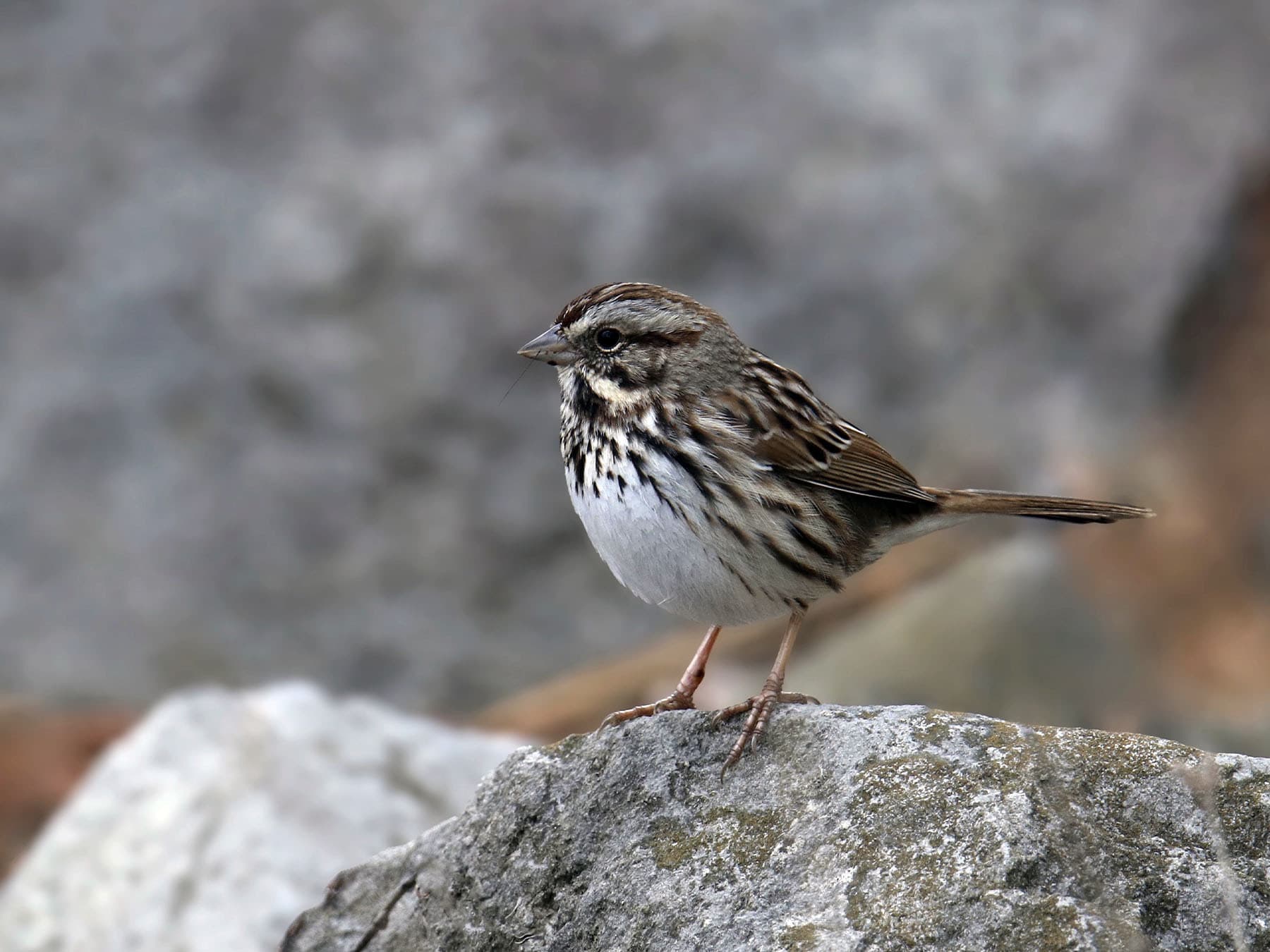
Song Sparrow
Melospiza melodia
By the Birdfact teamChecked by Nathan Cope
See it in 3D
3D model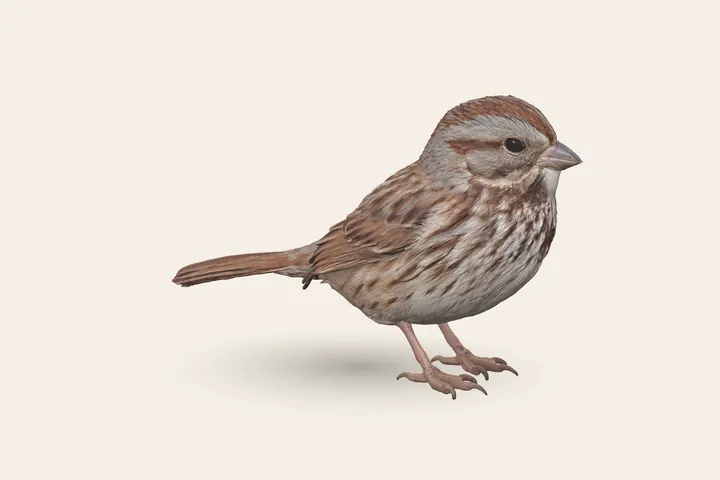 3D model
A Song Sparrow is 4.5–6.5 in (12–17 cm) long, bill to tail.
3D model · Adult · Length 4.5–6.5 in (12–17 cm) · How we make our birds · Report a problem
© 2026 NC Digital Limited (Birdfact). All rights reserved. This 3D model may be viewed on this page and shared by link only. Downloading, extracting, copying or reusing it, or using it to train machine-learning models, is not permitted without our written permission. Using our models
On this page16 sections
How to recognise it
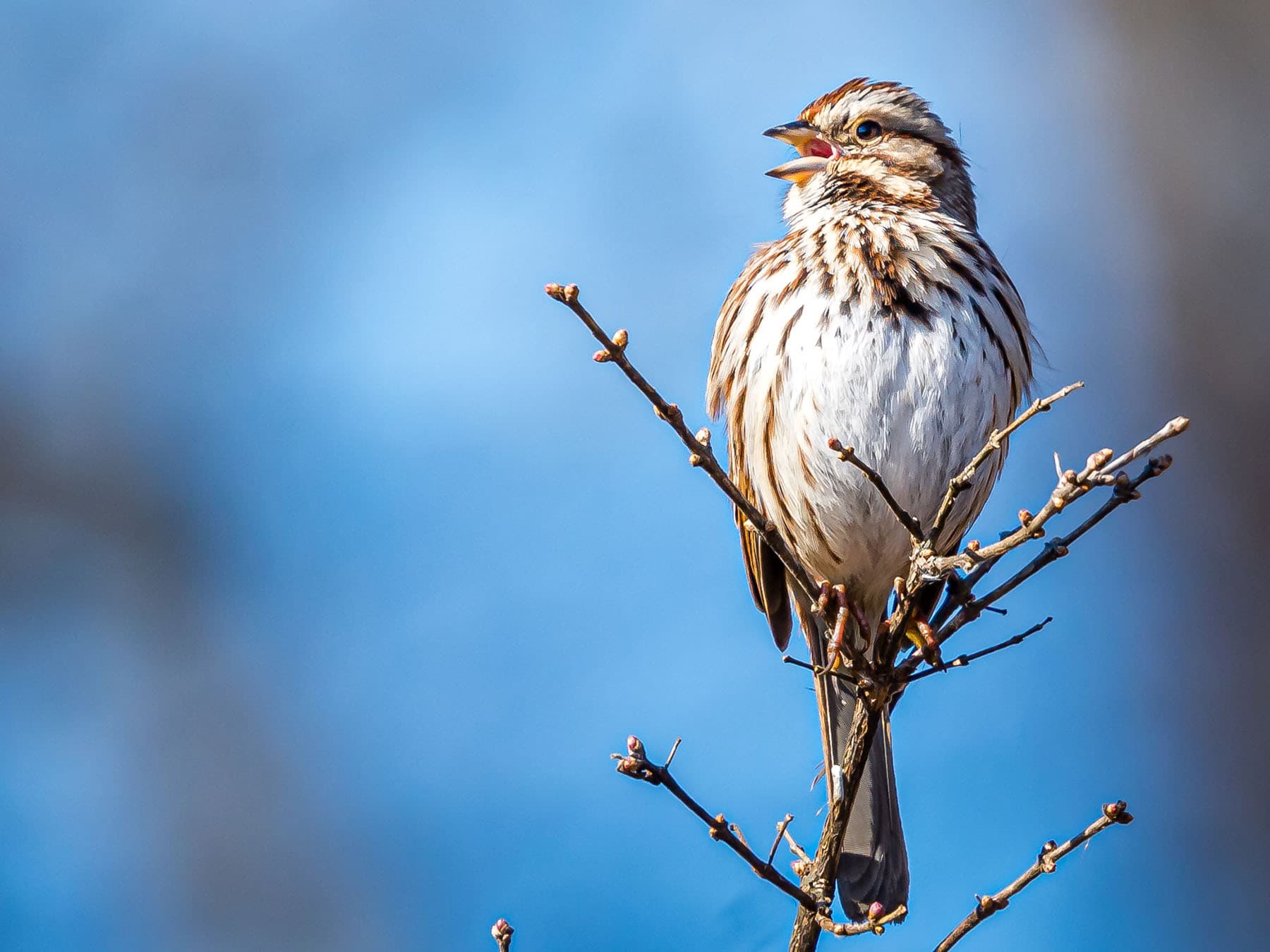
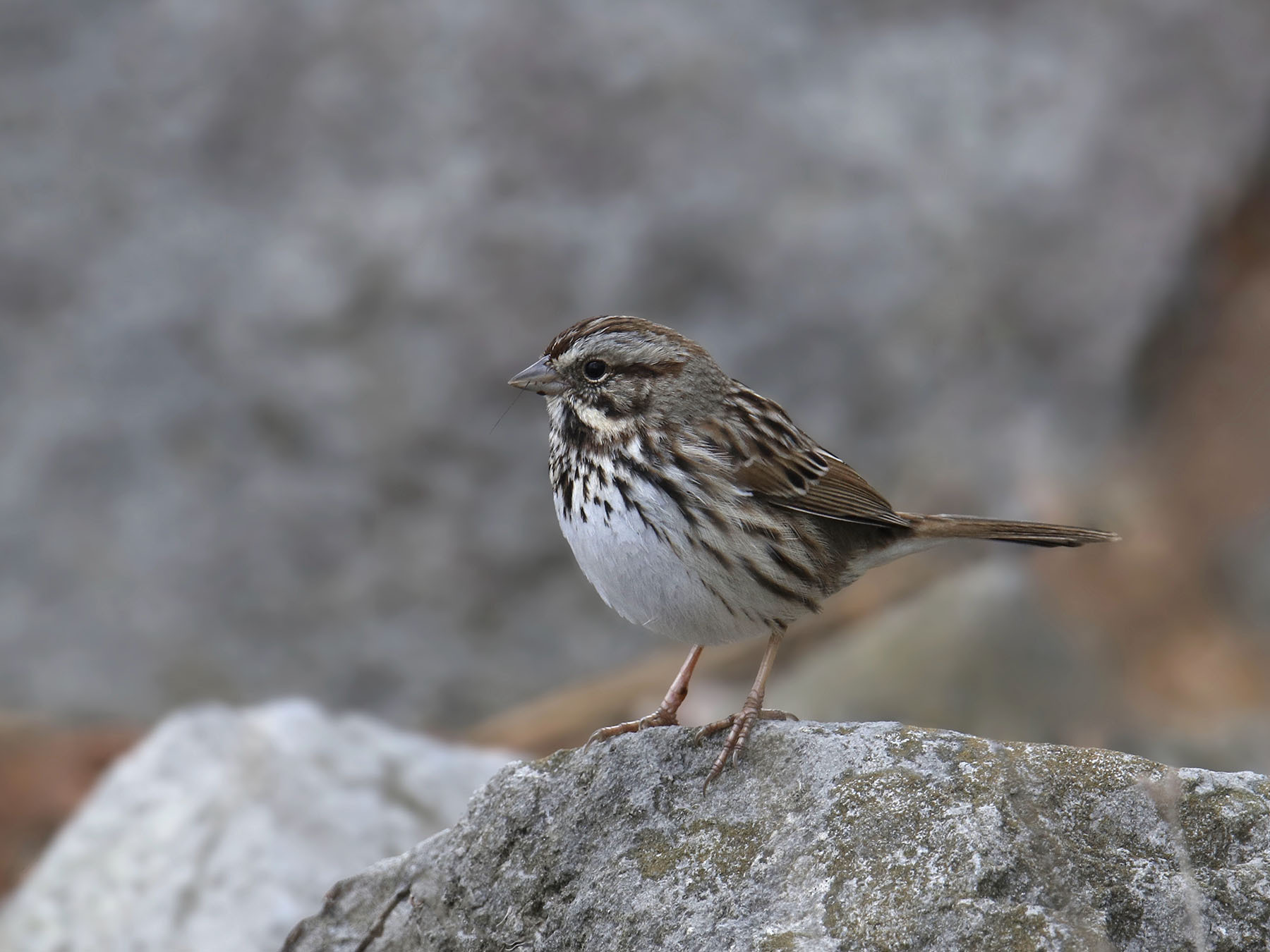
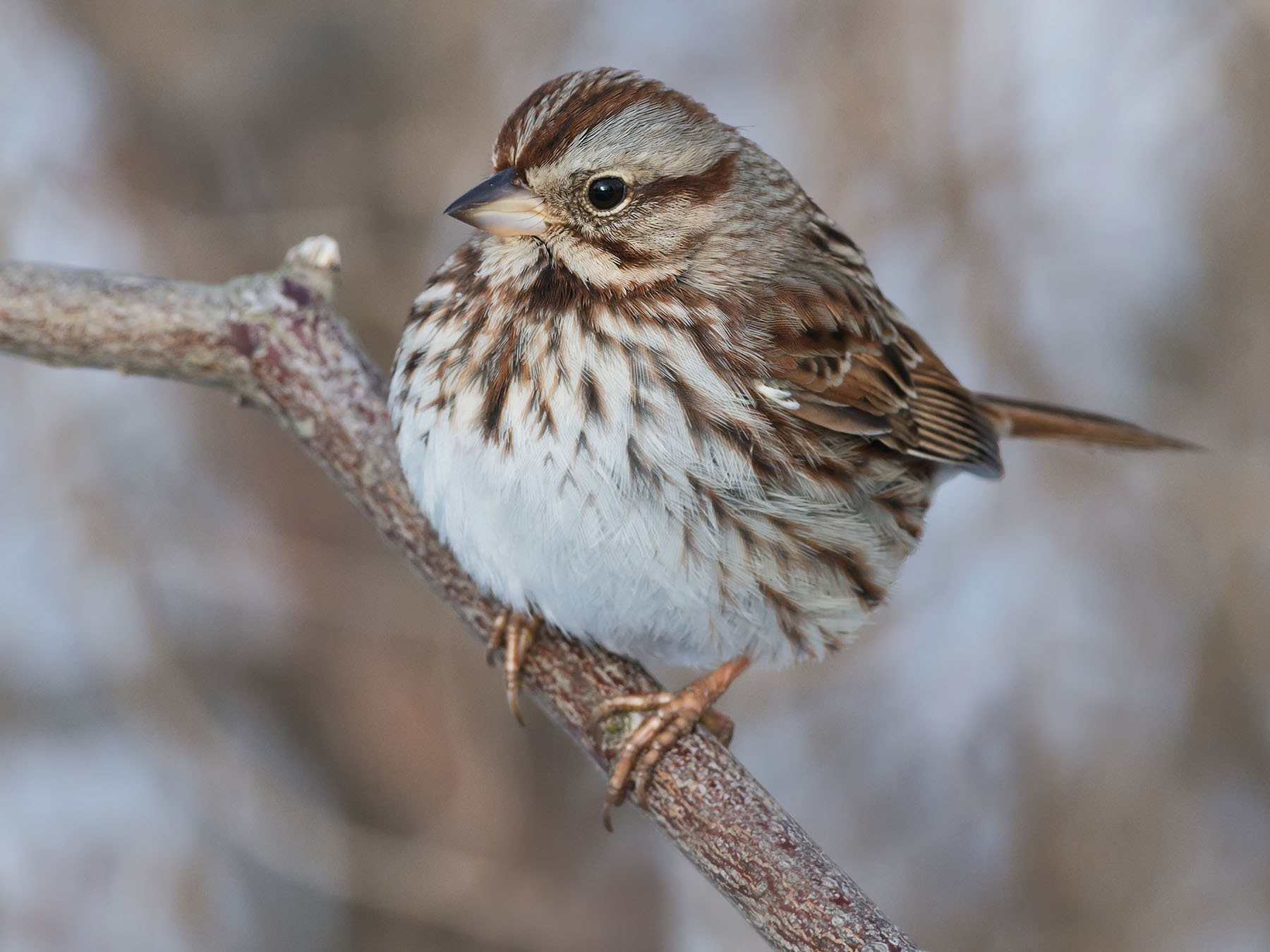
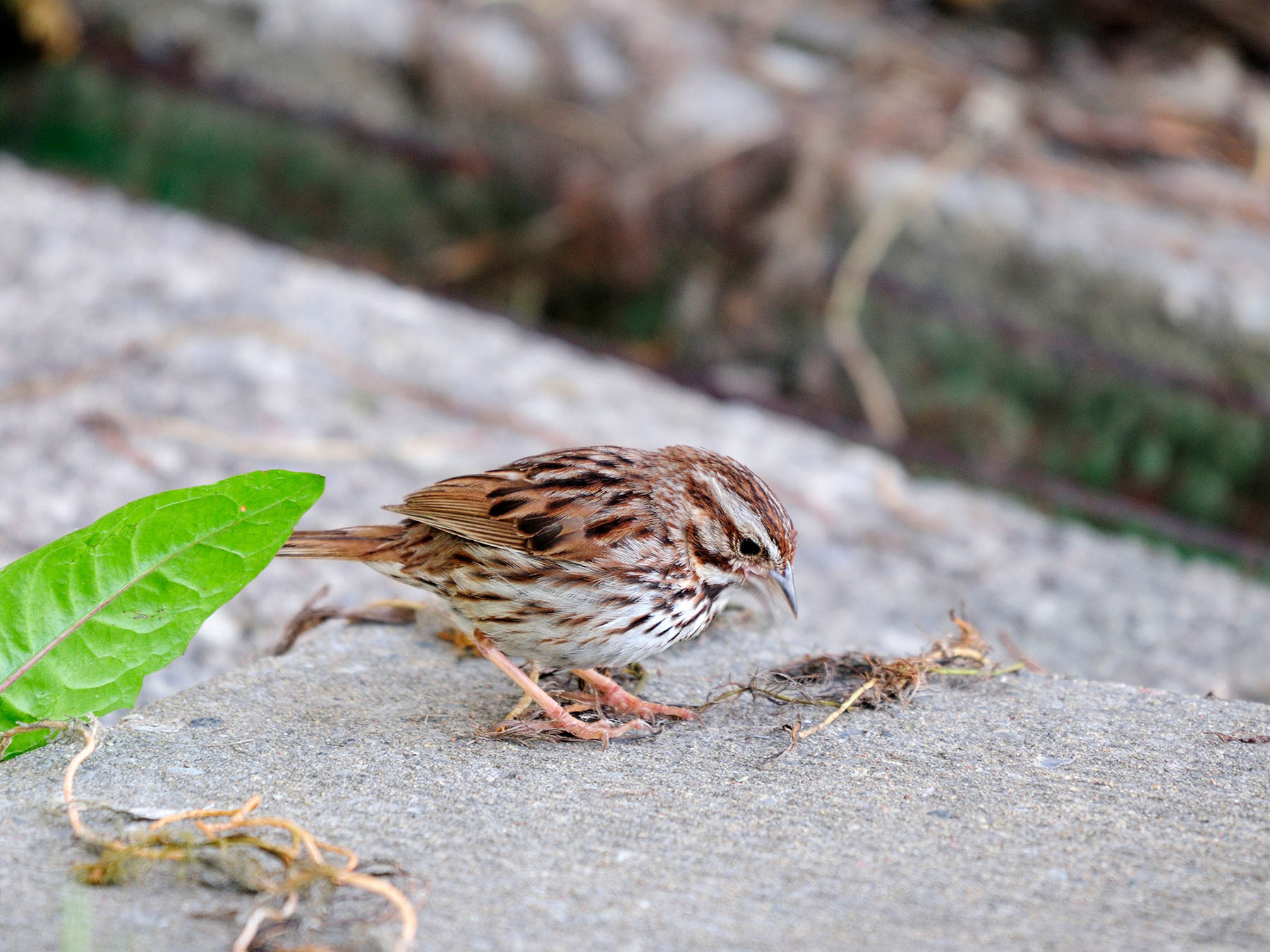
A Song Sparrow is a streaky brown sparrow, a little smaller than a Dark-eyed Junco and a little larger than a Chipping Sparrow. Look for thick brown streaks on a white chest and flanks, often running together into a dark spot in the middle of the breast; a grayish face with a russet stripe through the eye; and a broad dark stripe down each side of the throat, the mustache (or malar) stripe.1
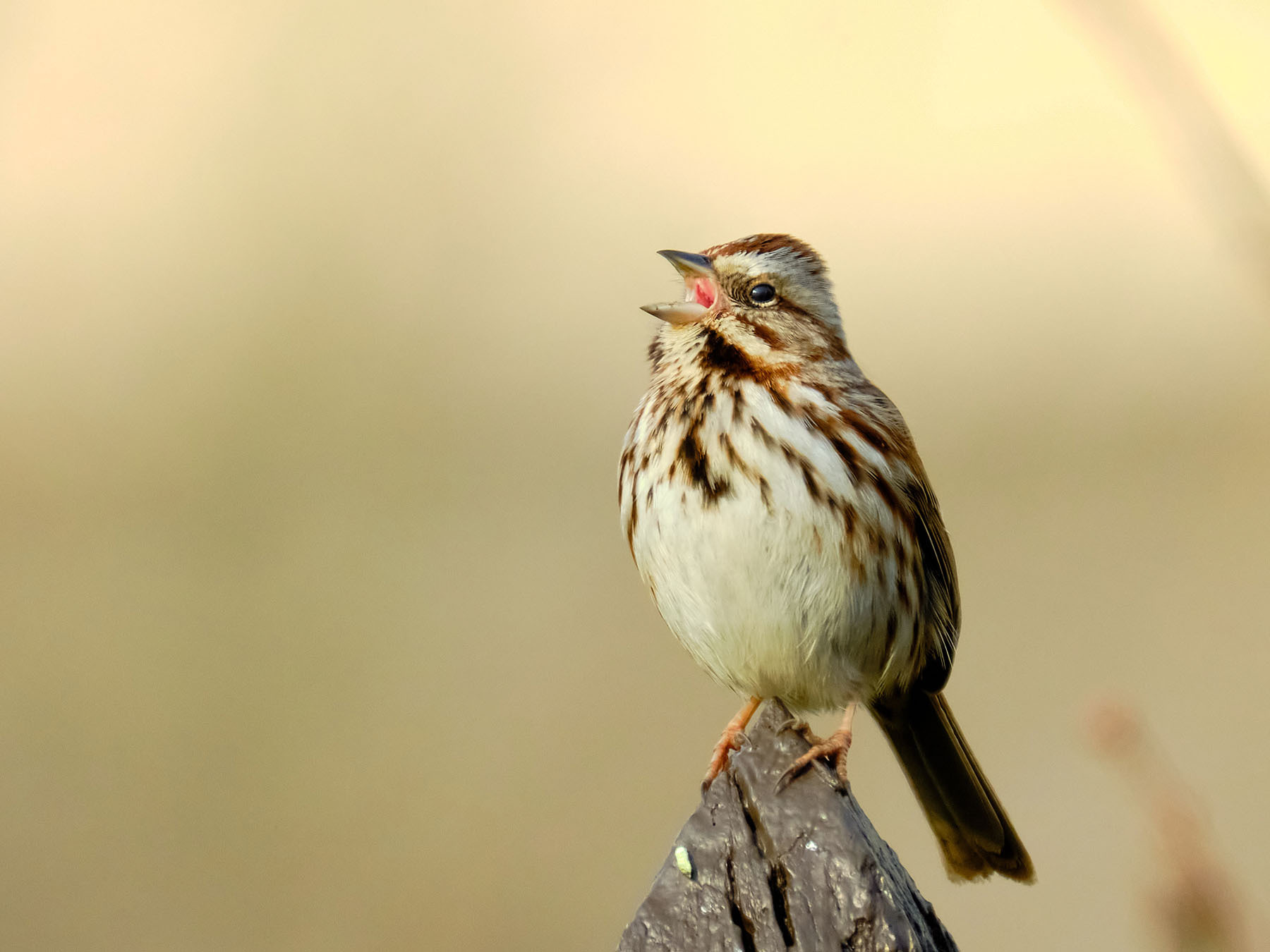
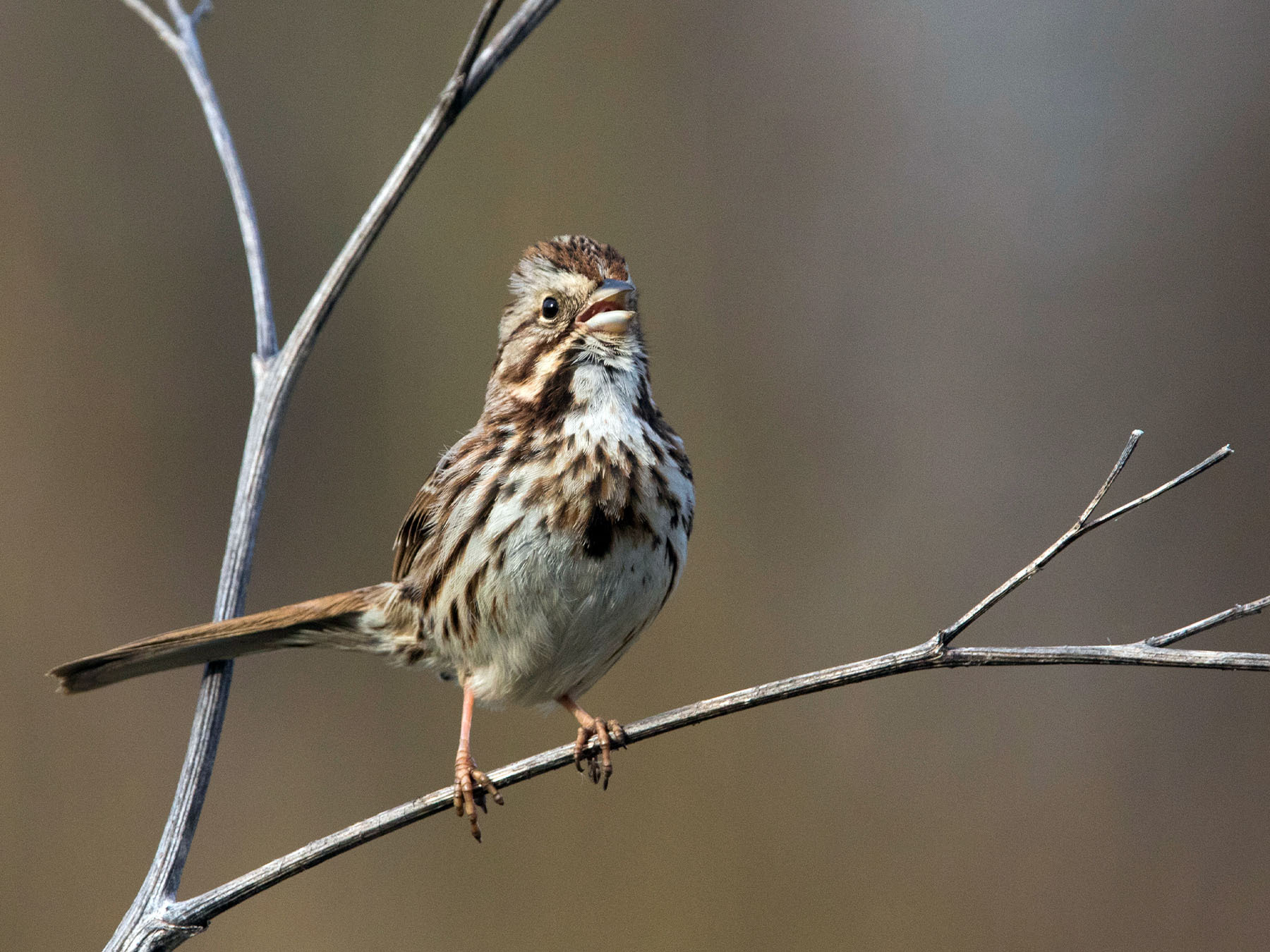
The tail is long and rounded, not notched, and the bird pumps it down as it flies, usually in short, low, fluttering flights from one bush to the next. A singing male perches upright on an open twig, often leaning back as he sings.1 The bill is short, stout and brown, and the legs brown to pinkish brown.2
Size depends on where it lives: from 4.7 to 6.7 inches (12-17 cm) long and from 0.4 to 1.9 oz (12-53 g), the biggest and heaviest in Alaska.
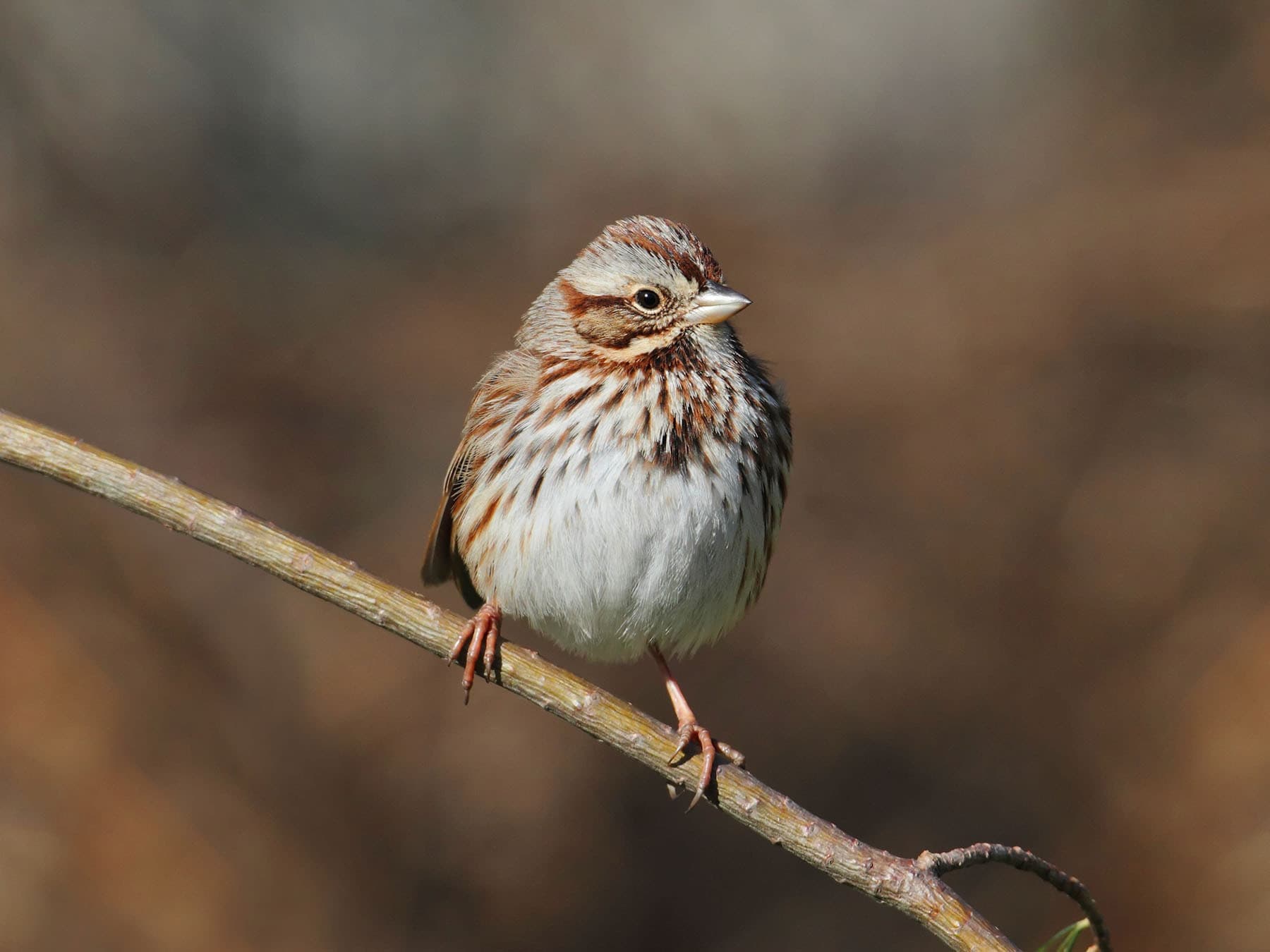
Identification: regional differences
Few North American birds vary as much. Scientists recognize 24 subspecies, and up to 52 have been named.3, 1 They fall into a few broad types: small, brown, black-streaked birds from the Great Basin to the Atlantic; large, dark birds with blurry streaks in Alaska and the Pacific Northwest; small grayish birds in California west of the Sierra; small, pale, rufous-streaked birds in the desert Southwest; and black-spotted, white-throated birds on the Mexican Plateau.
The pattern follows the climate: darker where it is humid, paler where it is dry, and bigger in the north. Song Sparrows on Alaska's Aleutian Islands are about one-third longer and twice as heavy as eastern birds. For all that, the genetic differences between regions are small; birds moving between populations may keep them alike underneath, while local conditions favor the local look.1
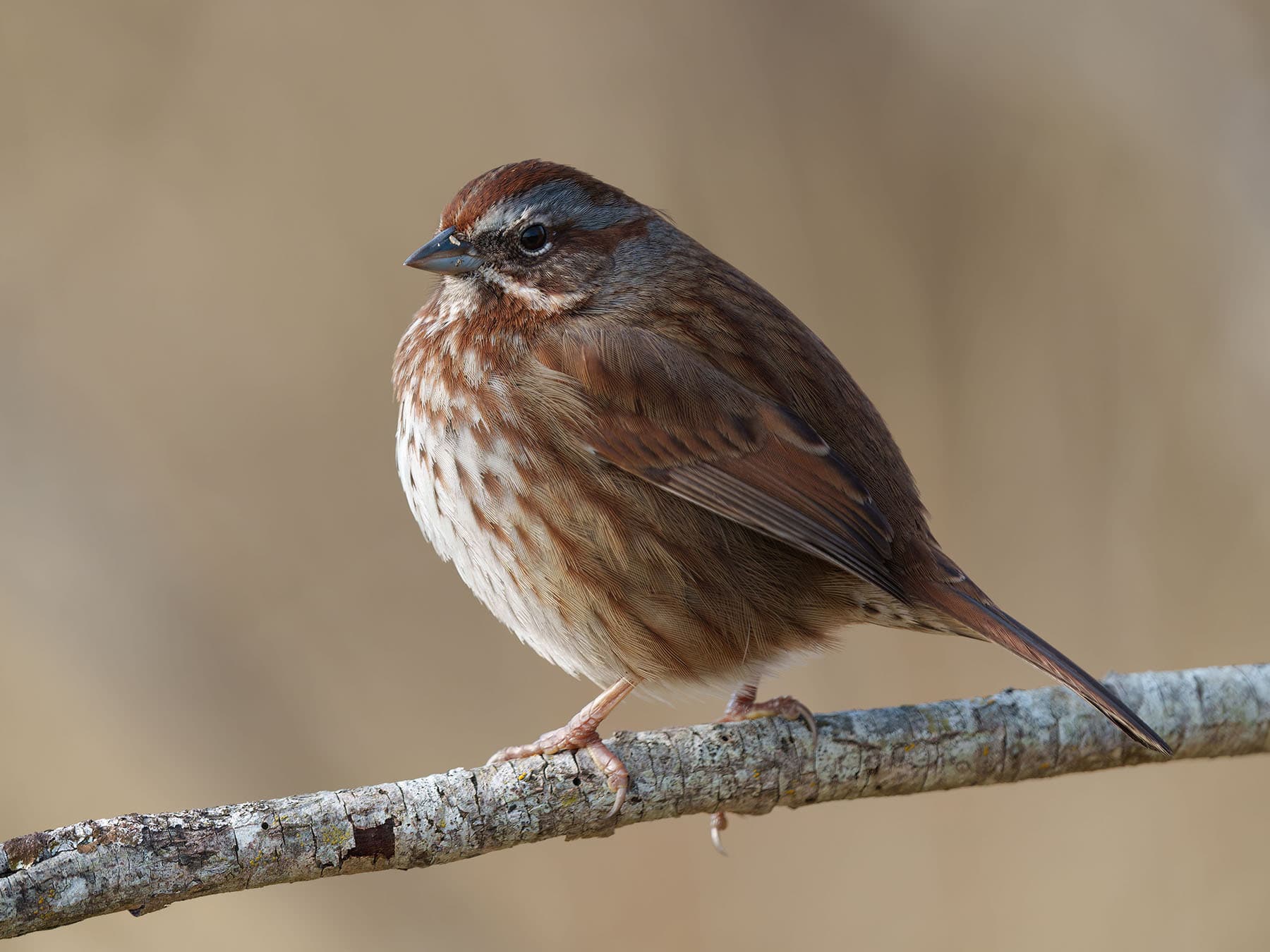
Male, female and young
Males and females look alike. Males are a little larger on average, but sizes overlap so much that 5-10% of birds cannot be sexed by size, even in the hand. The surest clue is behavior: the bird singing from the top of a bush is almost always a male, because females sing only rarely. More: male vs female Song Sparrows.
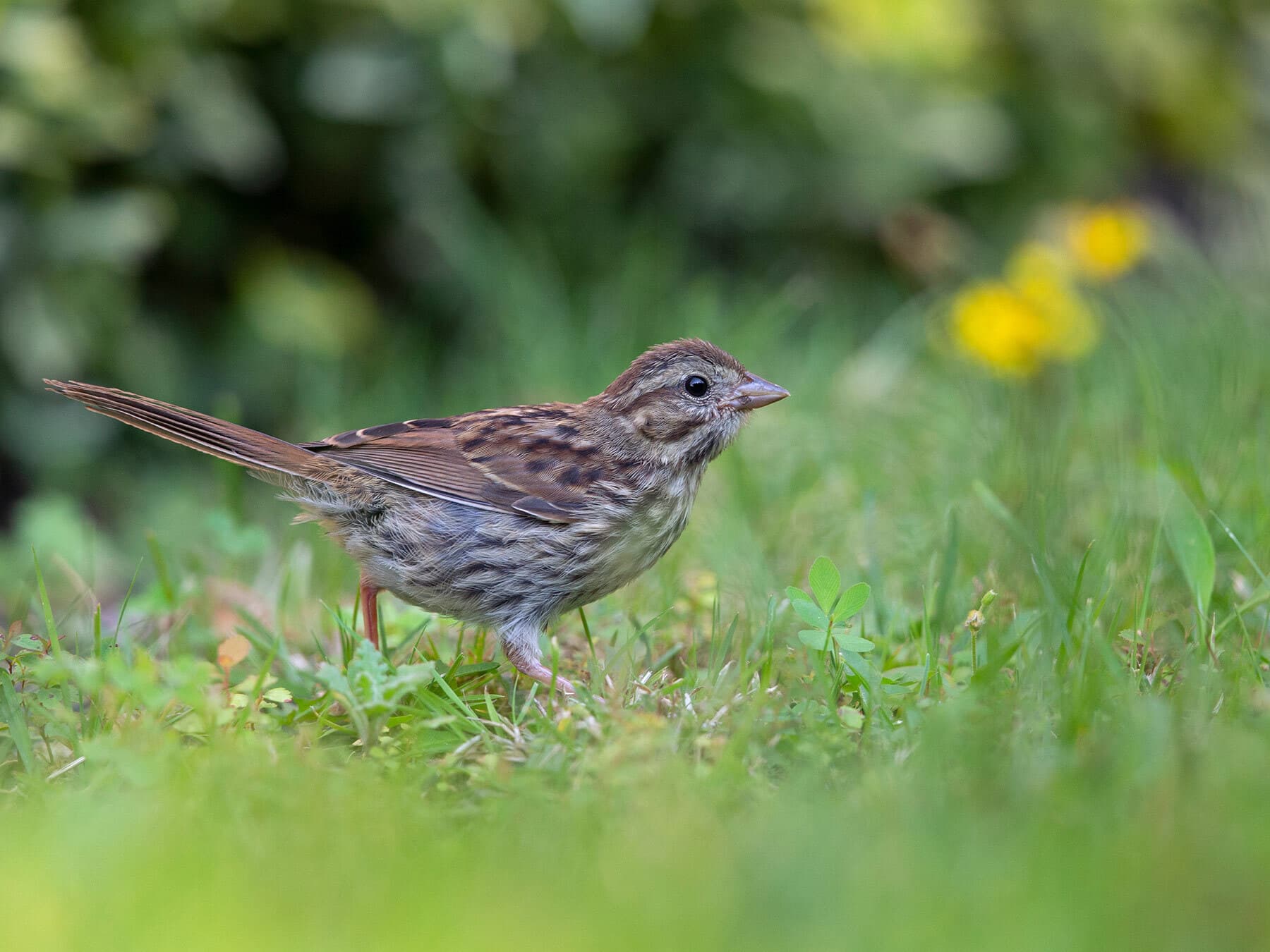
Juveniles, this year's young, are drabber and buffier than adults, with fuzzier streaks, weaker head stripes, no rusty tones on the crown and a buff eye-ring. On Mandarte Island in British Columbia, young hatched in March and April often look like adults by mid-September.
Identification: similar birds
House Sparrow. About the same size but stockier, with a stouter bill, a shorter tail and an unstreaked breast: the male has a black bib, the female is plain gray-brown below. Side by side: Song Sparrow or House Sparrow?
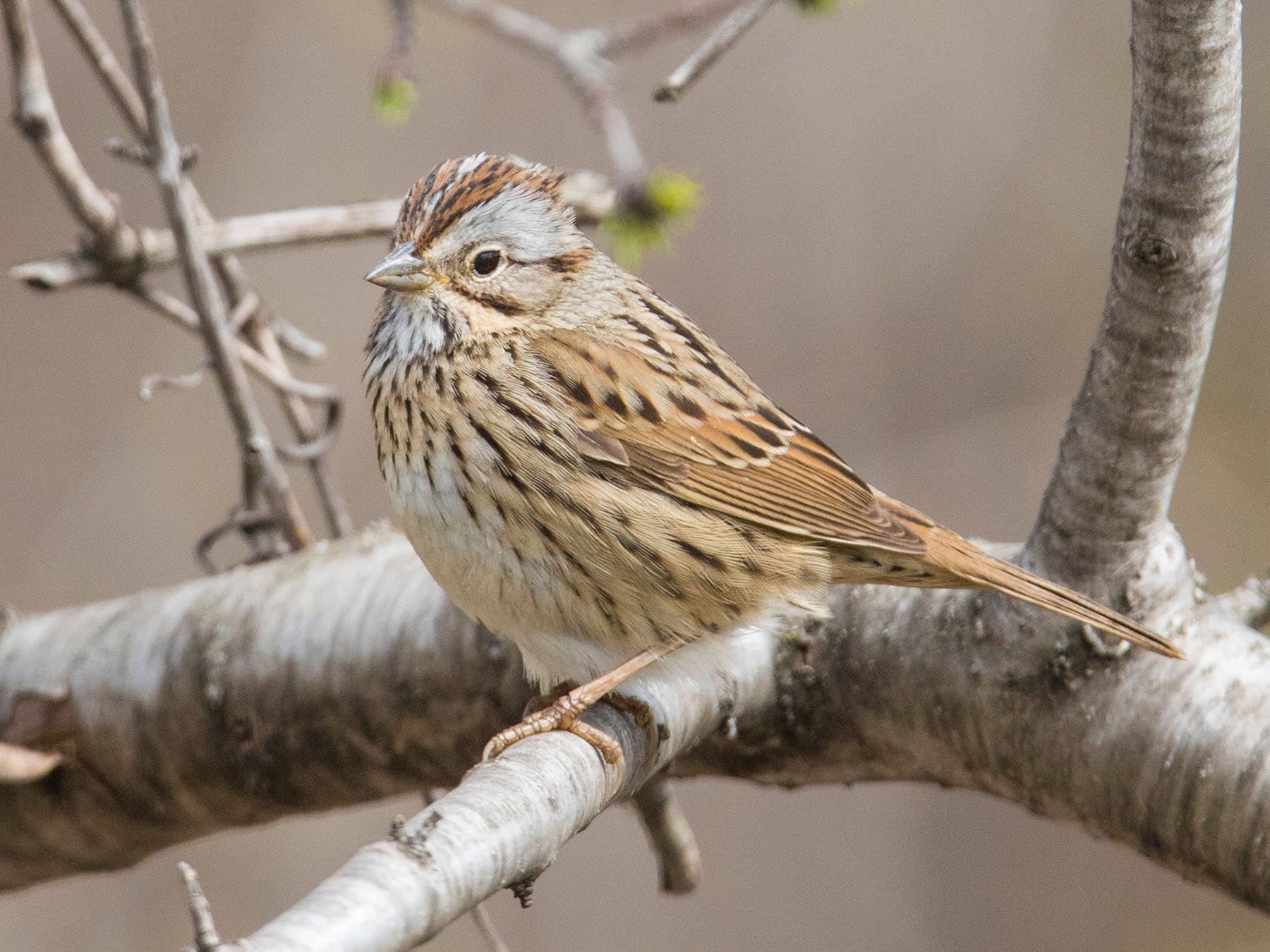
Lincoln's Sparrow. Smaller, with finer streaks on a buff-washed breast. An adult Song Sparrow is more heavily streaked, with no buff wash, though a juvenile Song Sparrow in summer can look buffy, with finer streaks.
Savannah Sparrow. A shorter, notched tail, yellowish lores (the spot between the eye and bill), a finer bill, and usually in open fields rather than brush.
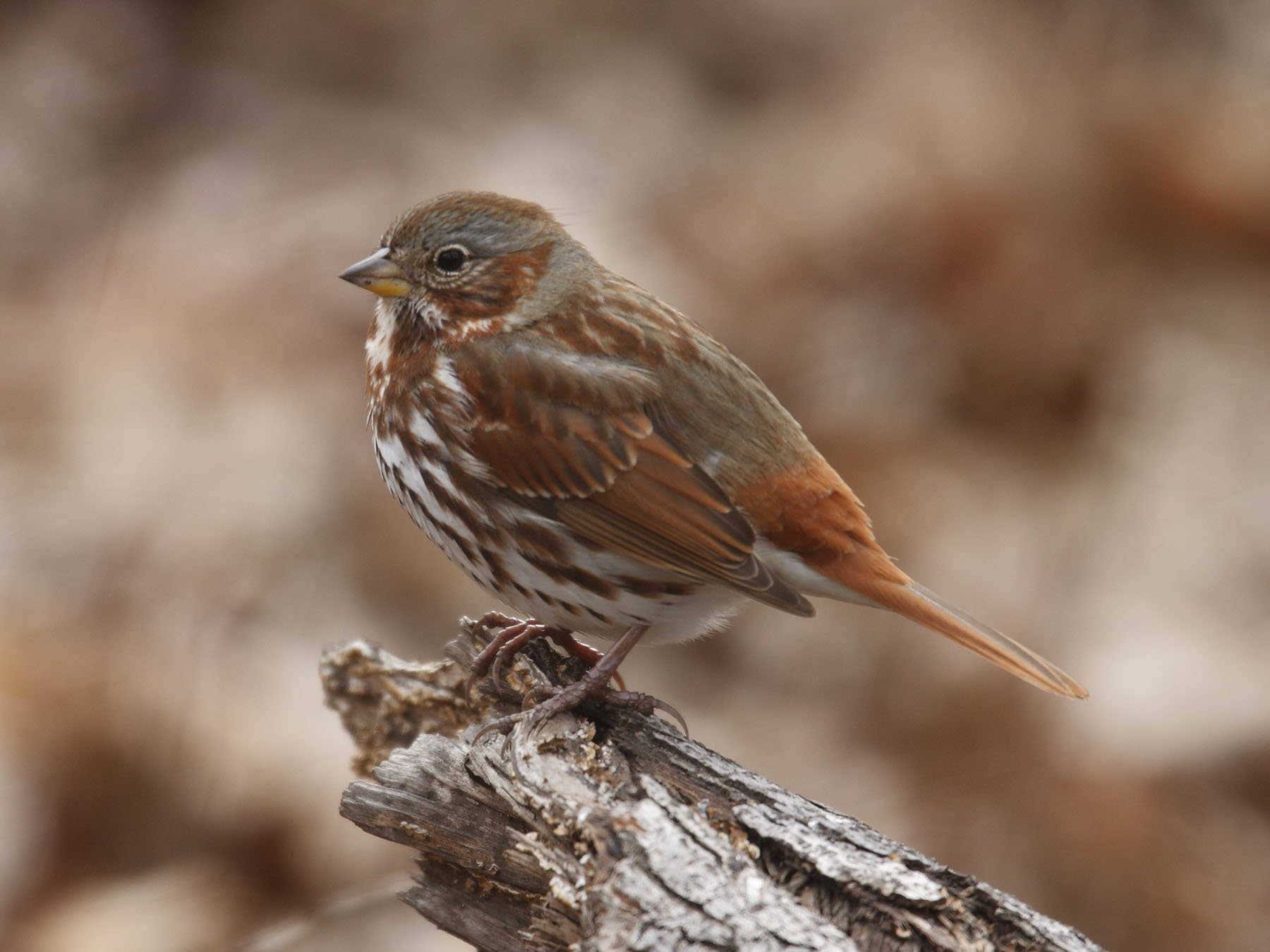
Fox Sparrow. Bigger, with a plainer face, triangular spots below and a less streaked back.
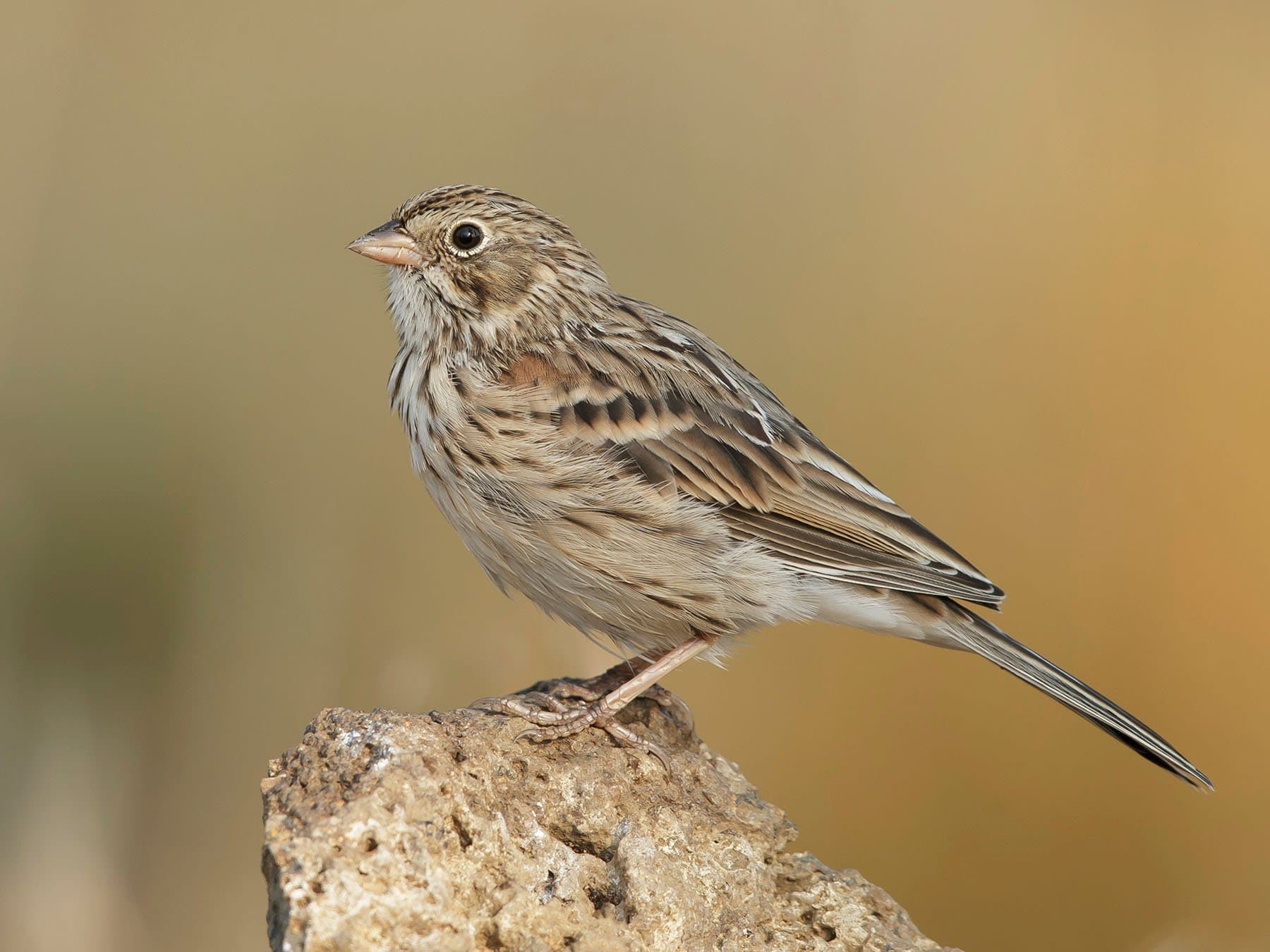
Vesper Sparrow. White outer tail feathers, best seen as it flies, a notched tail, and a chestnut shoulder patch that is often hidden.
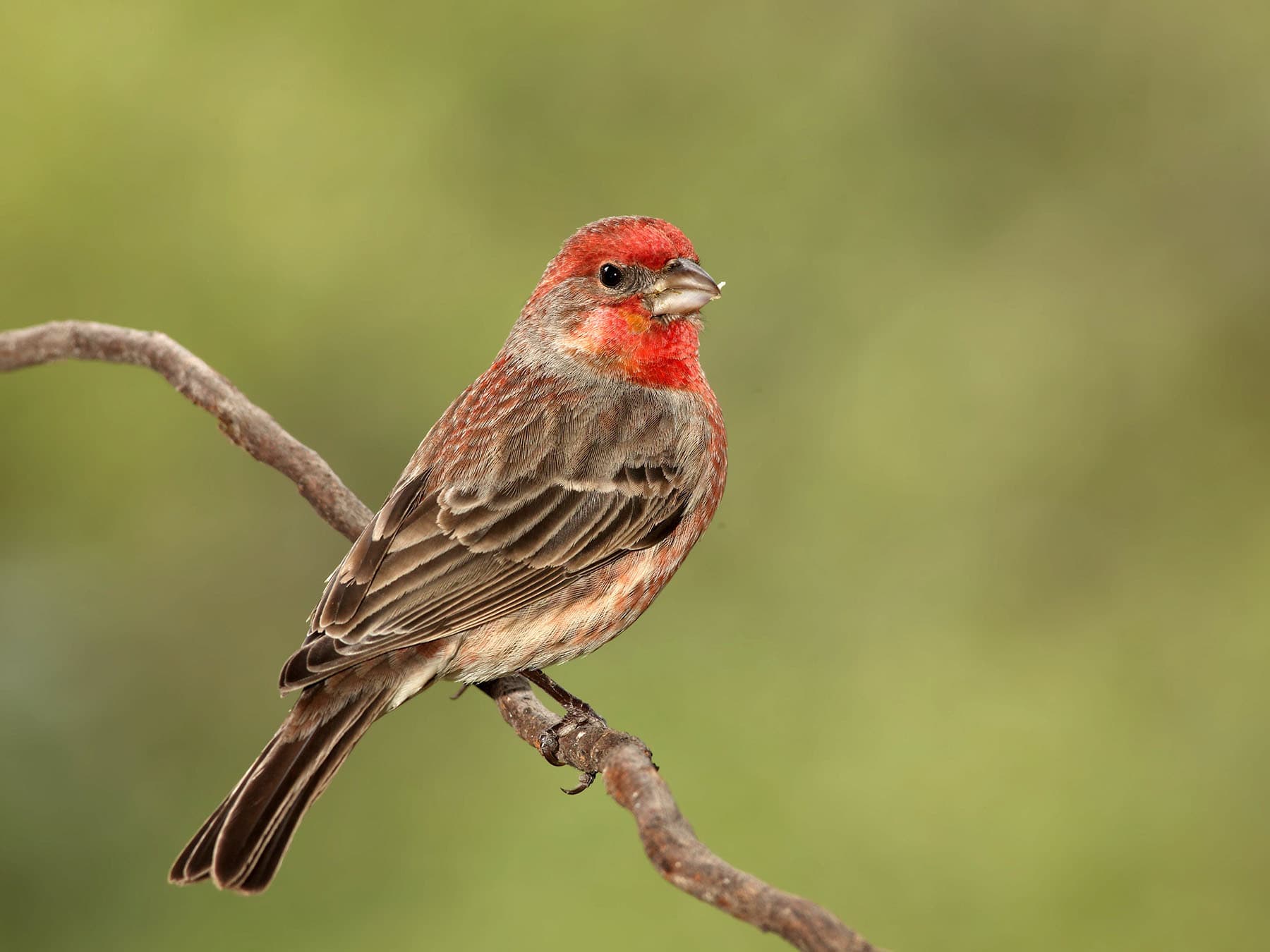
Female House Finch. A plain grayish-brown face with no head stripes, and thick, blurry streaks below.
Its size
Adults- Length
- 12–17 cm
- Wingspan
- 18–24 cm
- Weight
- 12–53 g
Its song and calls
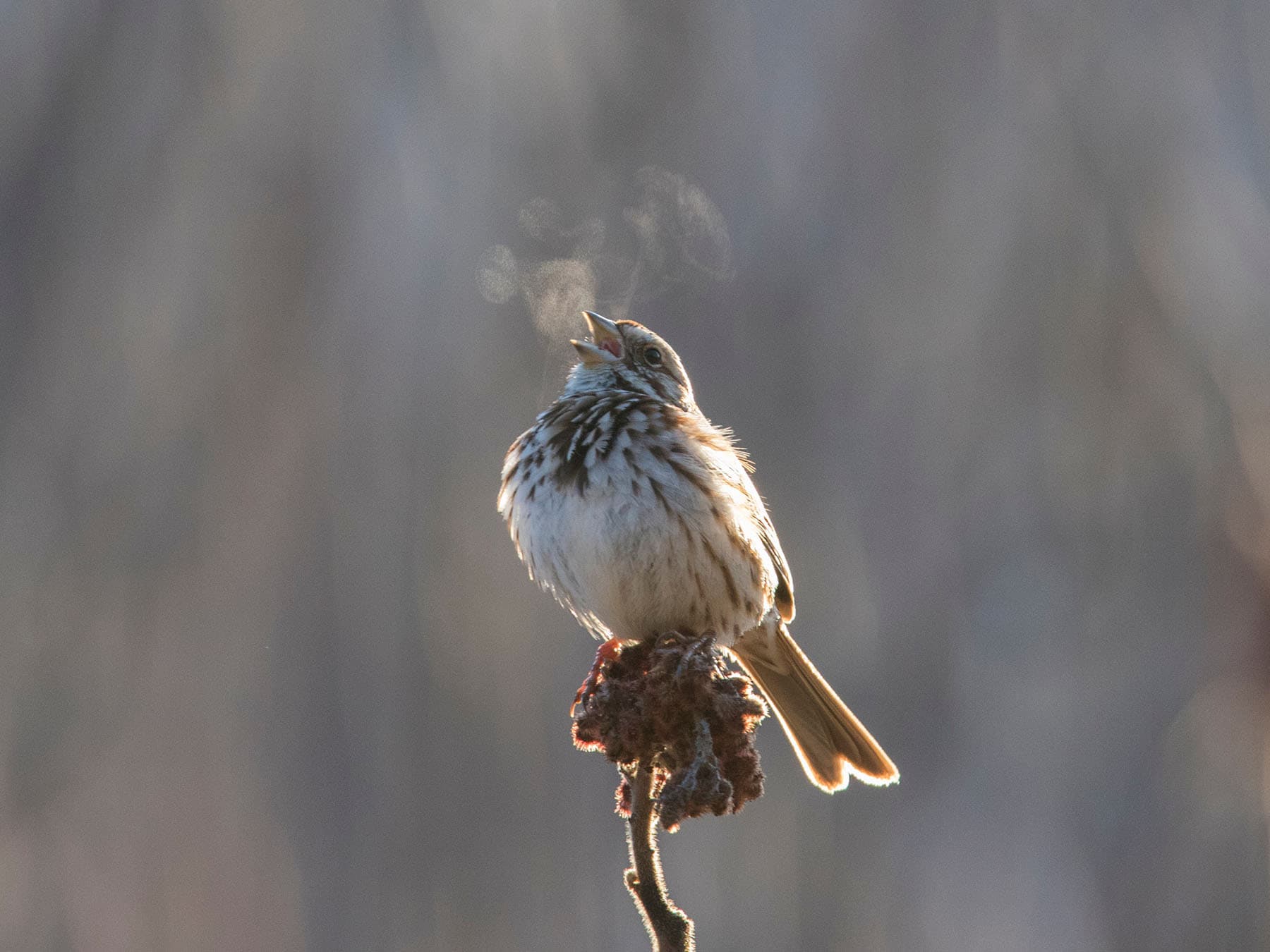
The song gives the bird its name, and males are recognized by it everywhere. It usually starts with a few loud, well-spaced notes and runs on into buzzes and trills, in 2 to 6 phrases, over 2 to 4 seconds. Songs differ from place to place, so the Song Sparrows you hear on a trip may not sound quite like the ones at home.1
Each male has a repertoire of about 5 to 13 song types. He repeats one type 5 to 15 times, then switches to another. Young males learn most of their songs from older males, and after their first year they keep the same repertoire.2
Song Sparrows sing in much of their range all year, most of all just before and during breeding, and again for a few weeks after the fall molt. In Margaret Morse Nice's classic Ohio study, unmated males sang 180-200 songs an hour, and a male whose mate had disappeared sang 2,305 songs in 15 hours.
A sharp chip, "tchunk", is the alarm call of both sexes. On Mandarte Island a higher "tik" was given when hawks flew over. Young and subordinate birds give a soft "tsip", and females have a harsh chatter for their mate or a rival female. Listen to seven recordings and see the songs drawn as spectrograms: Song Sparrow song and calls.
- Song0:00 / 0:40
Recorded in Maryland, United States · June 2025
- Call0:00 / 0:37
Recorded in California, United States · September 2012
When and where to see it
OctoberArriving
Most recorded in October
- 1. Nova Scotia4.6%
- 2. New Brunswick3.9%
- 3. Rhode Island3.5%
- 4. Prince Edward Island3.4%
- 5. Washington3.3%
Each dot is a county, state or province: the bigger and darker, the larger the bird’s share of that place’s bird records that month. Grey dots: no regular records. The ringed point is the centre of the bird’s records this month; the arrow shows how it moved since last month, and the dashed loop its path through the year. “Arrivals” colours places where it becomes regular this month (orange) or is in its last regular month (grey). GBIF eBird Observation Dataset, 2019–2024. Map data: Natural Earth, US Census Bureau; place centres © OpenStreetMap contributors.
In your area
See when the Song Sparrow is recorded in your county, state or province.
How often the Song Sparrow turns up in the United States and Canada through the year, from birdwatchers' records.
United States
Resident · all year · most records in July
Canada
Resident · all year · most records in April
Show as a table
| Month | United States | Canada |
|---|---|---|
| January | 1.6% (regular) | 1.4% (regular) |
| February | 1.7% (regular) | 1.4% (regular) |
| March | 2.1% (regular) | 2.4% (regular) |
| April | 1.9% (regular) | 3.5% (regular) |
| May | 1.7% (regular) | 2.6% (regular) |
| June | 2.0% (regular) | 3.0% (regular) |
| July | 2.1% (regular) | 3.4% (regular) |
| August | 1.5% (regular) | 2.5% (regular) |
| September | 1.3% (regular) | 2.2% (regular) |
| October | 1.7% (regular) | 2.4% (regular) |
| November | 1.7% (regular) | 1.4% (regular) |
| December | 1.7% (regular) | 1.5% (regular) |
Worldwide: recorded regularly in 5 countries
Countries where it was recorded in at least 3 of the 6 years 2019–2024. Linked countries have their own bird list.
North America (5)
Data: EOD – eBird Observation Dataset (Cornell Lab of Ornithology), accessed via GBIF.org, CC BY 4.0. Records from 2019–2024, aggregated and filtered by Birdfact. How these lists are made
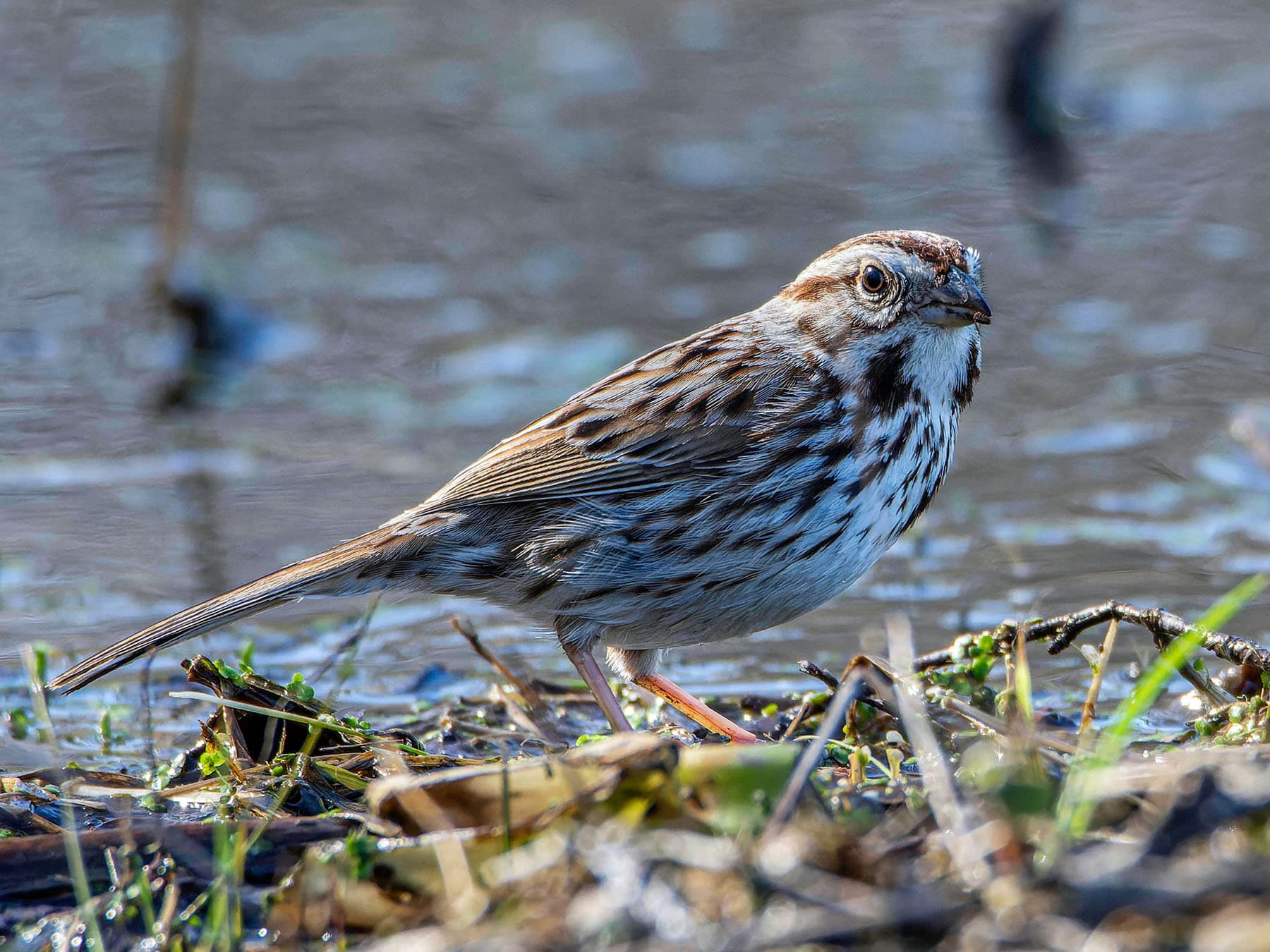
Song Sparrows live across most of North America, from the Aleutians, Alaska and much of Canada south through most of the US to Mexico. Look in brushy, shrubby and weedy places, often near water: streamsides, marsh edges, overgrown fields, hedgerows, forest edges, backyards and parks. Some live in salt marshes.4 In the Aleutians they live among beach grass and boulders.2
They rarely stray far from cover, usually less than 33 ft (10 m). In spring and summer they are among the most conspicuous sparrows, because the males sing from open perches; in winter, especially in the Southeast, they are often found with other sparrows such as White-throated Sparrows, at field edges and shrubby borders.
Spotting tips
Listen first: a bright song that starts with a few loud notes, from the top of a shrub or fence. Then watch the edge of the brush for a streaky sparrow that flies low to the next bush, pumping its tail, or scratches on the ground under cover. In a yard, check the ground under feeders that are close to shrubs.
Do they migrate?
Some do, some do not. Over most of the US they are present all year, but on the northern Plains, in the upper Midwest and in northern New England they are mainly summer birds. In the Gulf states, Texas, Oklahoma, Kansas, Arkansas, New Mexico, South Carolina and Florida they come mostly for the winter, from about October to April, though some breed in the north of New Mexico, Kansas, Alabama and South Carolina. Many coastal, southwestern and southern populations stay put, and so do the birds of Alaska's Aleutian Islands and Peninsula.
In the East, the birds that breed farthest north are the most likely to migrate, and they winter farthest south, passing over birds that stay. Banded adults that moved more than about 155 miles (250 km) traveled about 530 miles (850 km) on average. Spring migration runs mainly from mid-March to mid-April, and fall migration in September and October. In Nice's Ohio study, about half the males and 80% of the females migrated each year, and 90% of males and 98% of females kept the same habit for life.2
Song Sparrows are very rare visitors to Europe: the British Isles had six records up to 1990, all in spring.
What it eats
Insects in summer, seeds in winter. In a classic study of 401 stomachs from across the US, plant food made up about two-thirds of the diet over the year, but from May to August animal food was more than half. In the Northeast and Pacific regions, plant food made up 86% of the diet in winter and 92% in fall.2
The insects include beetles, grasshoppers and crickets, caterpillars such as cutworms and armyworms, ants, wasps, bugs and flies, along with spiders, snails and earthworms. The seeds are mostly weeds and grasses: smartweed, bristlegrass, ragweed, crabgrass, pigweed and knotweed. In July berries make up about 8% of the diet: blackberries, raspberries, strawberries, blueberries, mulberries and wild cherries. Coastal birds also take small crustaceans and mollusks.
Most feeding is on the ground under cover. A Song Sparrow scratches with both feet at once, a quick double hop, forward and back, that drags the leaf litter aside, and it also picks insects from leaves, catches them in the air and wades in very shallow water.
Feeding them in your yard
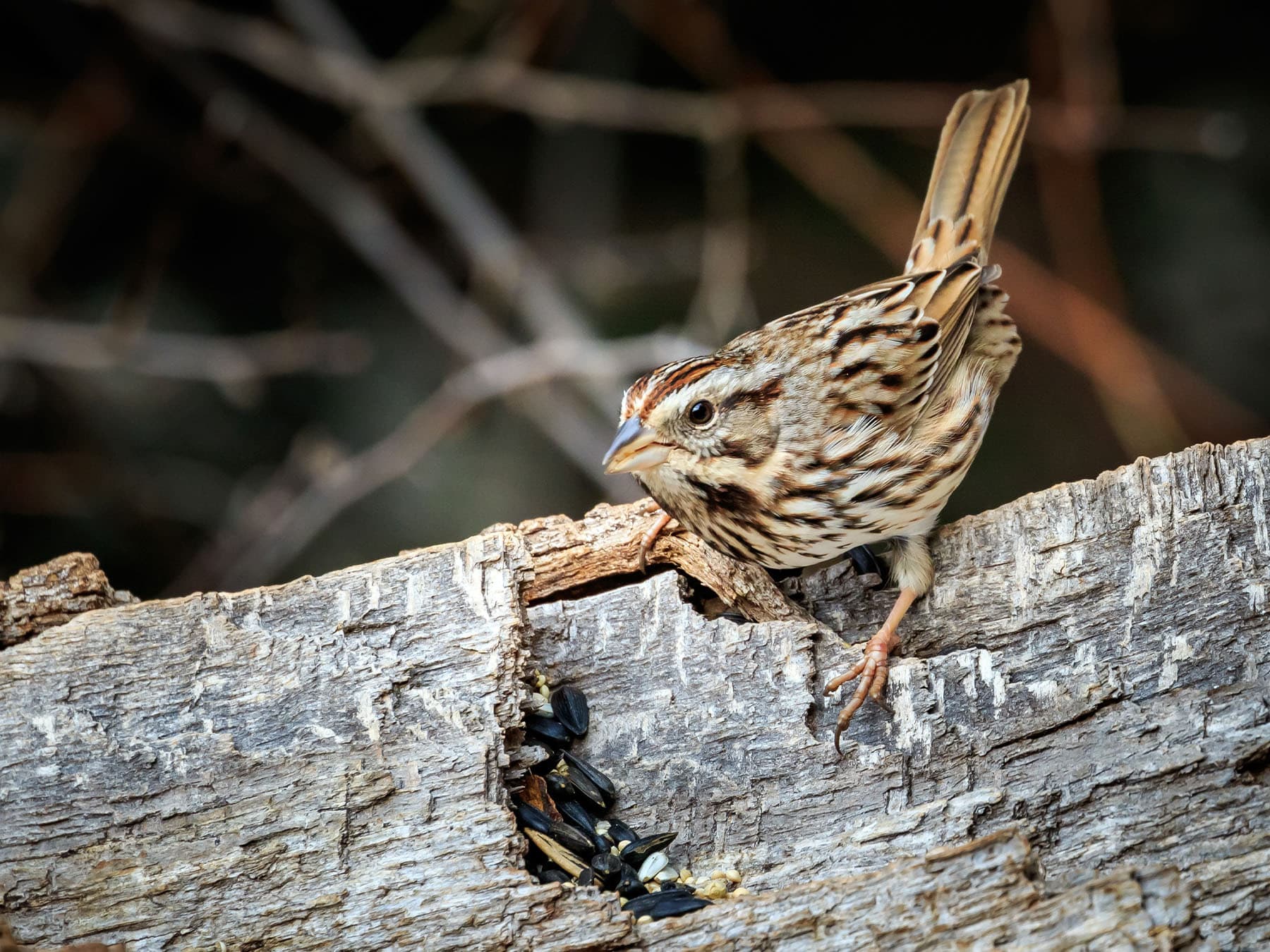
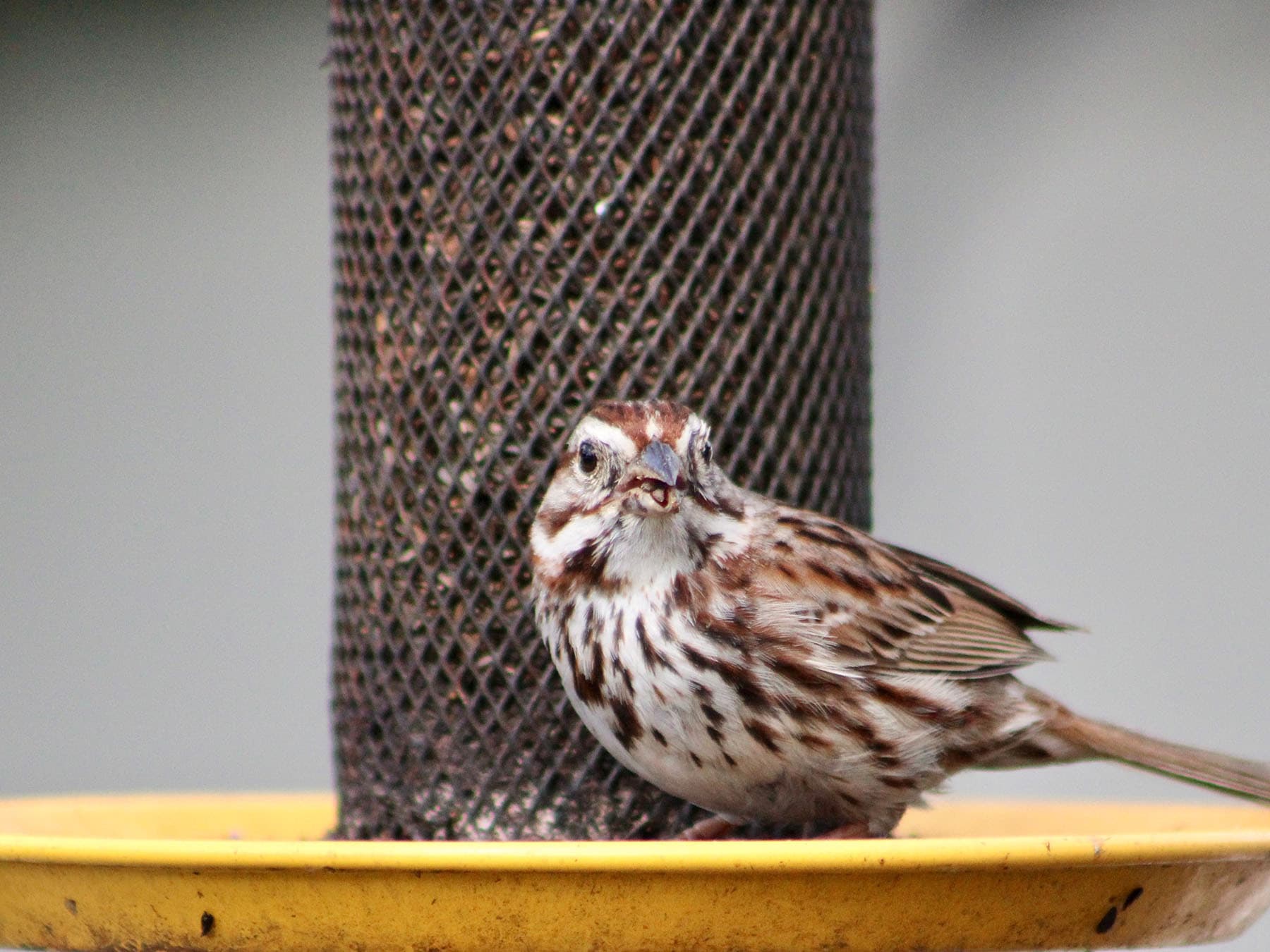
Song Sparrows often come to feeders, but they feed low. Project FeederWatch lists black-oil and hulled sunflower seed, cracked corn, millet, milo, nyjer, peanut hearts and safflower for Song Sparrows, offered on the ground or on a platform feeder, the two feeder types it lists for them.5 In feeding tests, millet was the seed they preferred and husked fastest.
Put feeders close to good cover, as Song Sparrows rarely feed far from it.4 Cats are the catch: domestic and feral cats kill Song Sparrows, and birds that nest near homes and feed at ground-level feeders may be at risk.
In the Northeast in winter 2021-22, Song Sparrows came to 52.69% of FeederWatch sites, the 16th most widespread feeder bird there.6
Nesting and breeding
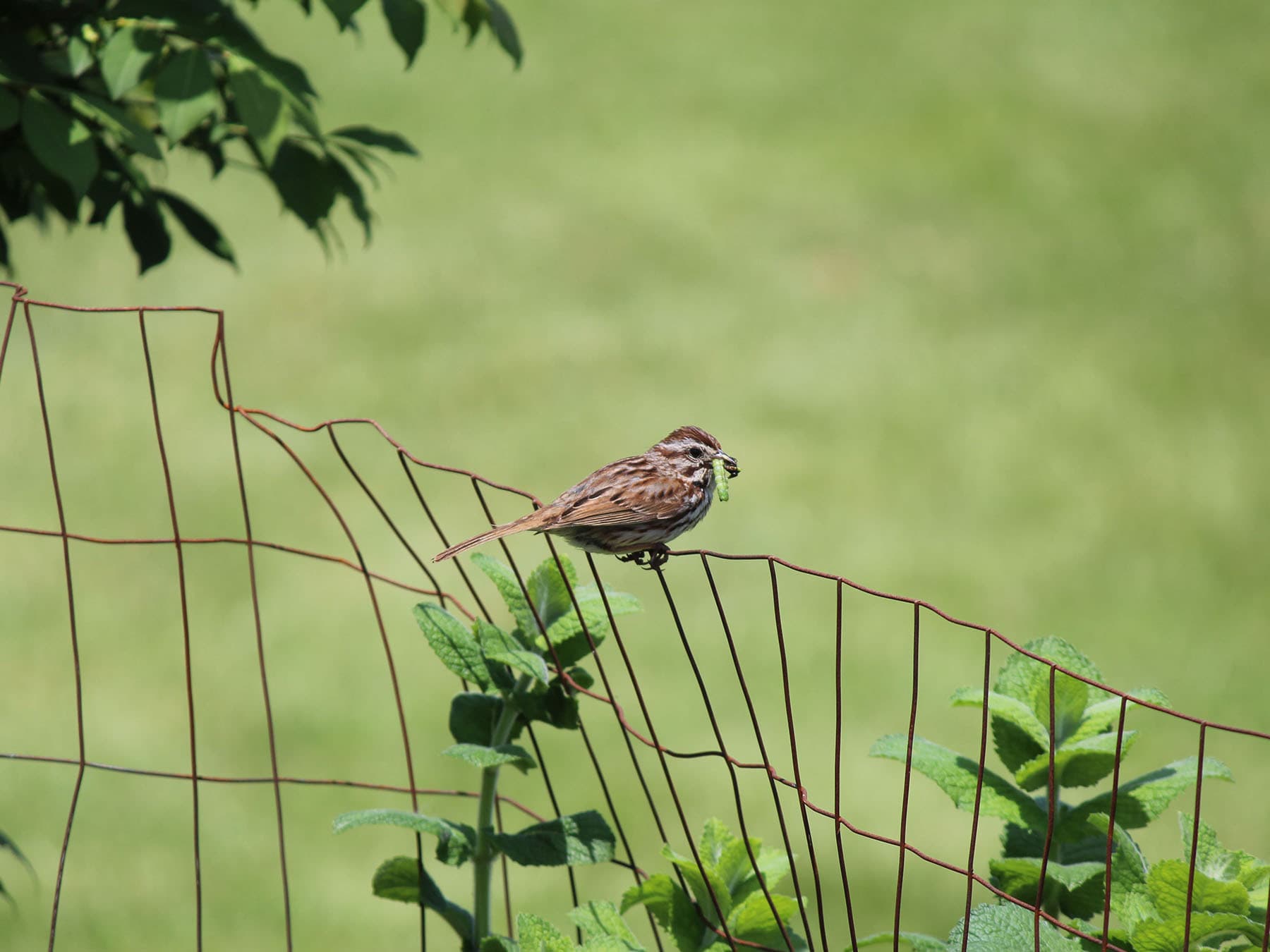
Song Sparrows nest on the ground under a tuft of grass or a shrub, or low in a bush, often near water, and sometimes in flower beds close to houses. The female builds a sturdy cup of grass, weed stems, leaves and bark in about 4 days and lays usually 3 to 5 eggs, pale blue or greenish and spotted brown. She incubates them for about 12 to 14 days, and both parents feed the chicks, which leave the nest at about 9 to 12 days old.
Pairs raise two or three broods a year, and where the birds are resident some make up to seven nesting attempts in a season. Song Sparrows are among the Brown-headed Cowbird's favorite hosts. More: Song Sparrow nests, eggs and young.
Behaviour
Song Sparrows are territorial. Where they live all year, both males and females hold territories in every season; elsewhere males claim their patches on return in spring, and singing picks up again in September and October after the molt. Birds without territories, called floaters, wait for a vacancy: in one study, removed males were replaced within 12-72 hours.
Most pairs are socially monogamous, but at least 15% of young are fathered by a male other than the female's mate. Fights that come to blows are rare; disputes are settled with song, puffed-up threat displays and chases. Song Sparrows hold their own against bigger birds: they won 99% of 251 encounters with White-throated Sparrows, though Fox Sparrows push them aside at feeders.2
Behavior: a model species for science
Song Sparrows are a model species for field biology. In the 1930s Margaret Morse Nice followed individually banded Song Sparrows on the Olentangy River floodplain in Ohio for years, and her studies set the standard for watching marked birds in the wild. On Mandarte Island in British Columbia, about 15 acres (6 ha), the Song Sparrows have been banded and followed for decades, showing how food, cowbirds, inbreeding and weather drive numbers.
One more recent experiment stands out. When researchers protected wild Song Sparrows' nests from real predators and played recordings of predator calls, the fear alone cut the number of young raised per year by 40%.7
Lifespan and predators
About half of adult Song Sparrows survive from one year to the next (45-63% in most studies), and only about 20-26% of young birds live to their first birthday. The oldest birds in long-term field studies were 8-9 years old.
The longevity record is 11 years, 4 months: a bird banded as an adult in Colorado in 1963 was caught and released there again in 1973.8
Predators and other dangers
Nests are the weak point. Snakes, raccoons, squirrels, mice, crows, cowbirds and cats all take eggs or chicks. Adults are caught by Cooper's and Sharp-shinned Hawks, owls, harriers, shrikes, foxes and cats; on Mandarte Island one Cooper's Hawk took about 20% of the population in a single winter. Song Sparrows give alarm calls at cats, raccoons, squirrels and foxes, and give a high "tik" and hide when a hawk passes over.
Conservation
The Song Sparrow is common and widespread, with a breeding population estimated at about 130 million, and it is of Least Concern worldwide. Numbers are falling, though: the North American Breeding Bird Survey found a decline of about 27% between 1966 and 2019.1 In survey data up to 2000, the losses were concentrated in the East, especially New England, while numbers rose in parts of the Southwest.2 Partners in Flight rates it 8 out of 20 for concern, which is low.
Some local populations have done badly. Song Sparrows have vanished from Santa Barbara and San Clemente islands off California after habitat loss, introduced hares and fire, and the salt-marsh subspecies of San Francisco Bay declined as the tidal marshes were lost. Habitat can come back: on Arizona's upper San Pedro River, Song Sparrows increased 50-fold after cattle were removed and the streamside thickets grew back. The Song Sparrow is protected under the Migratory Bird Treaty Act.9
Similar birds
Often mistaken for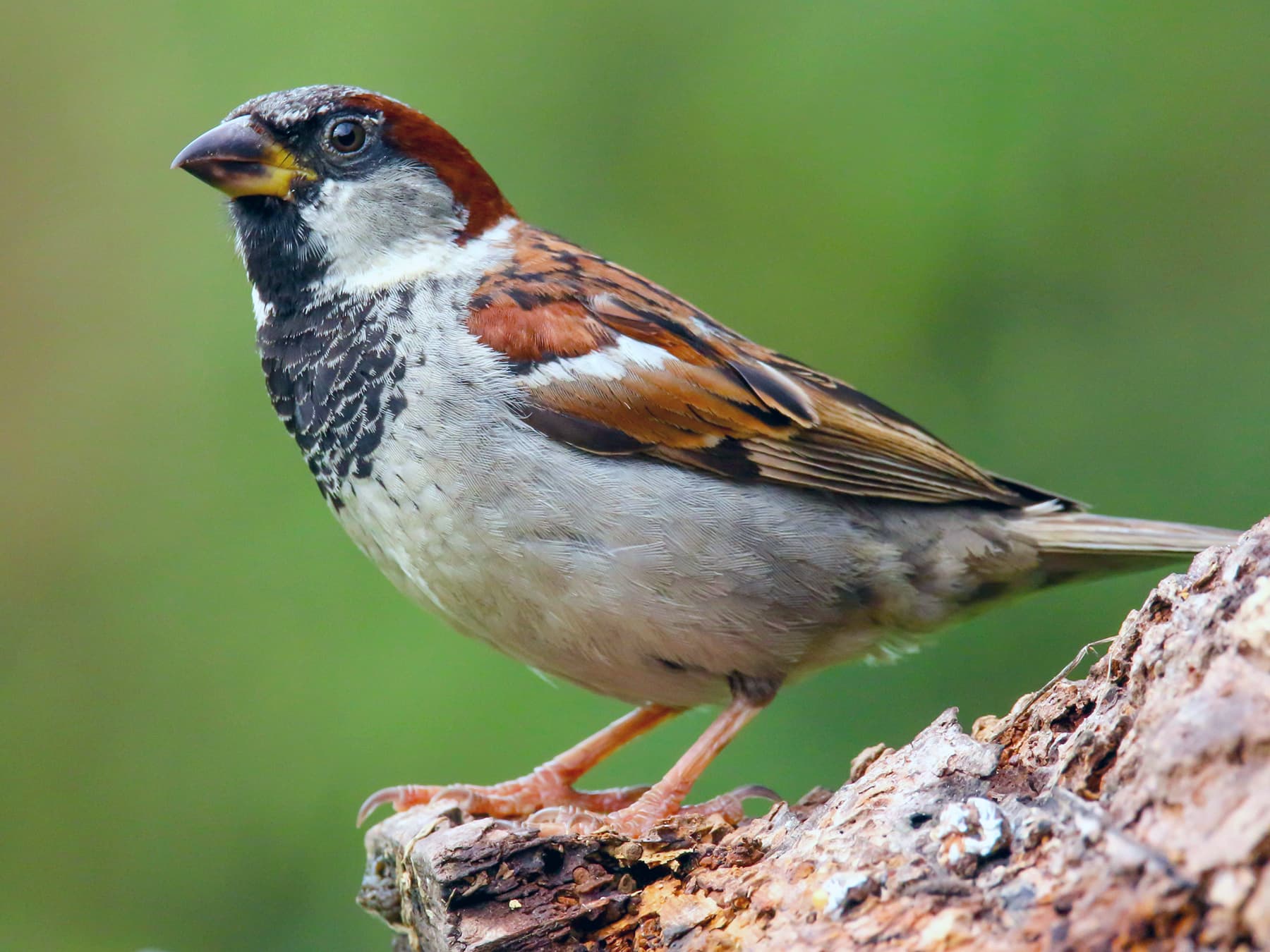
More photos
9 photos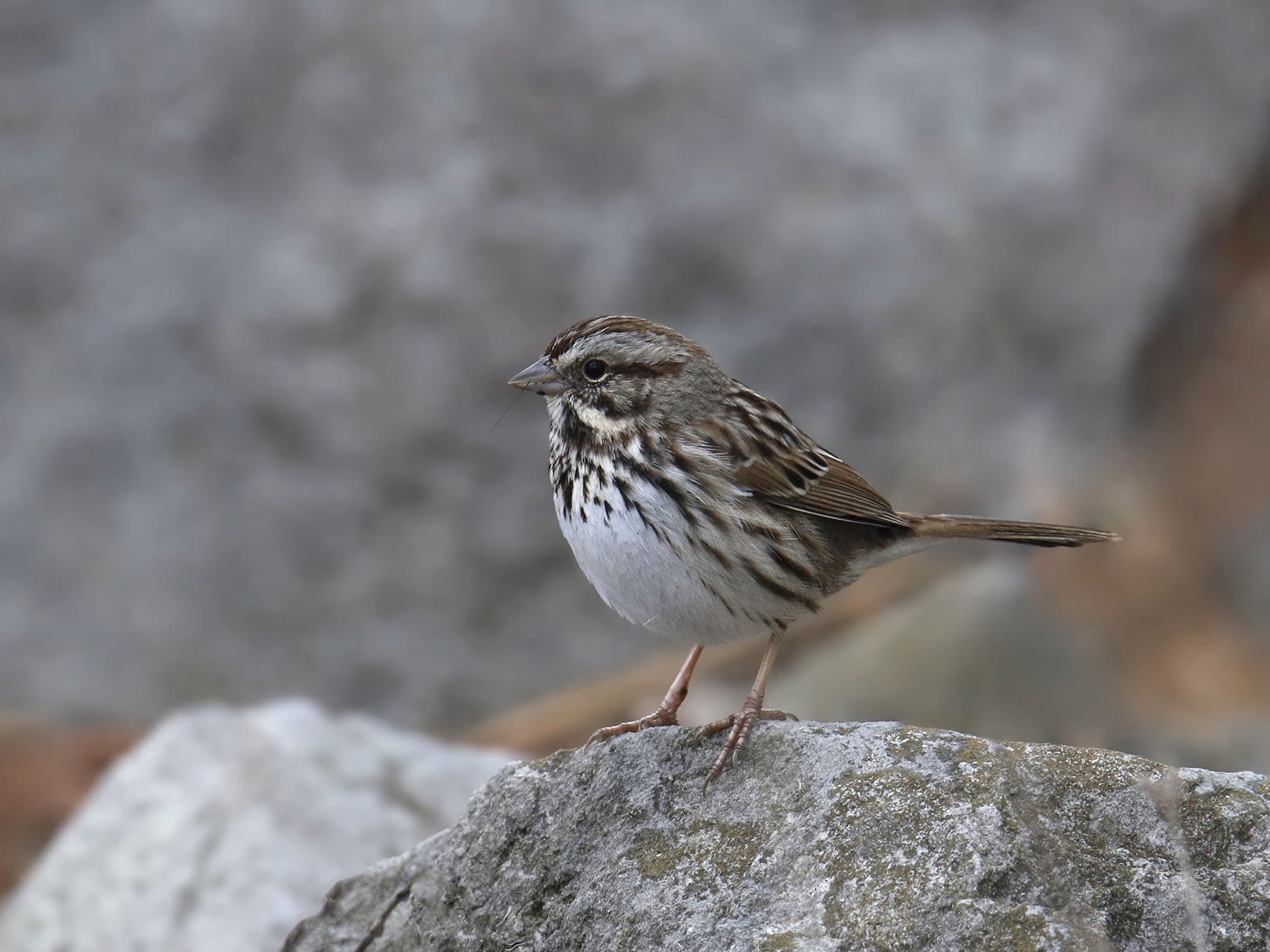 A Song Sparrow on a rock: streaked breast and flanks, and a striped head
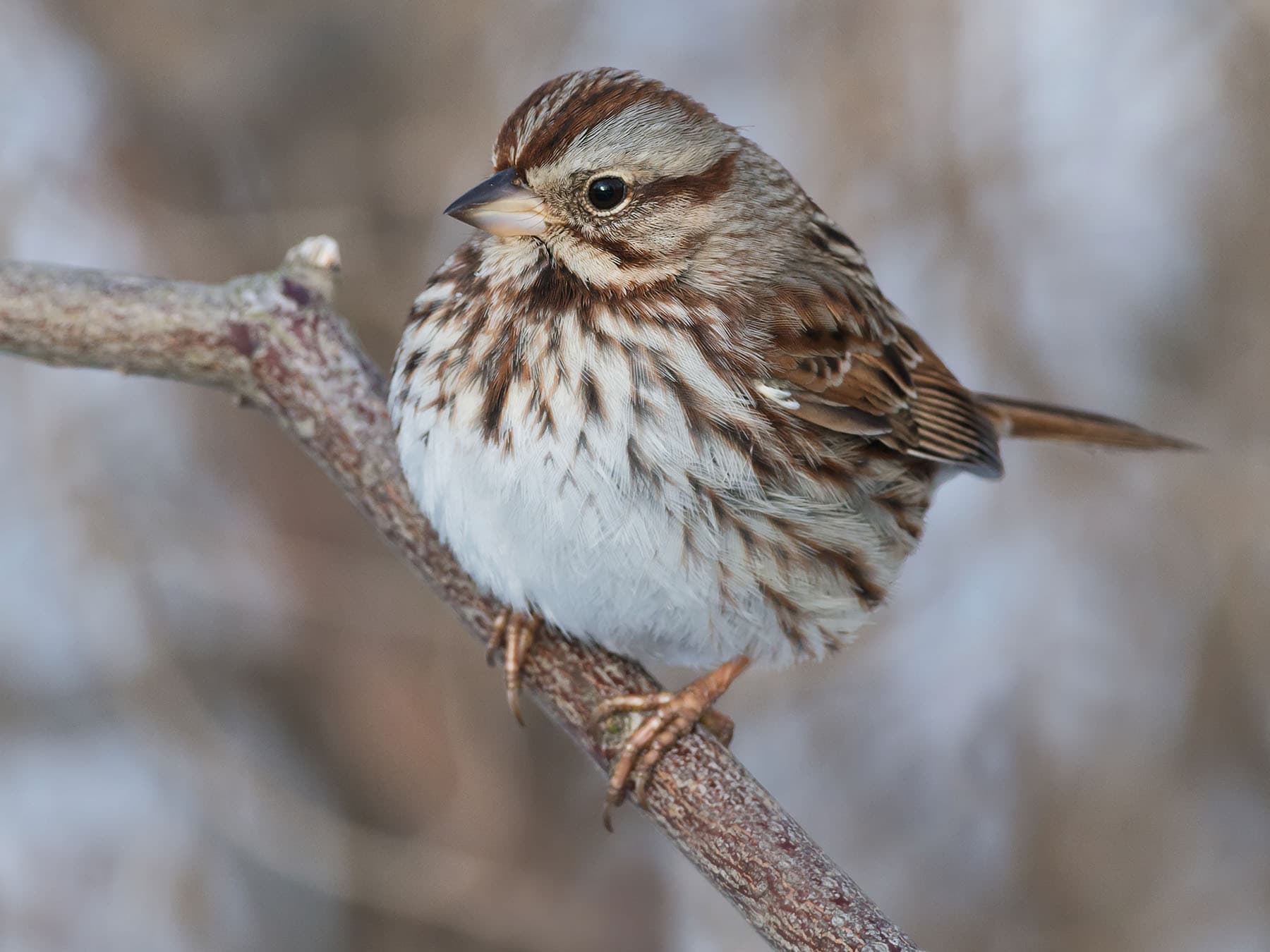 A Song Sparrow close up: grayish face, russet eye-stripe and a short, stout bill
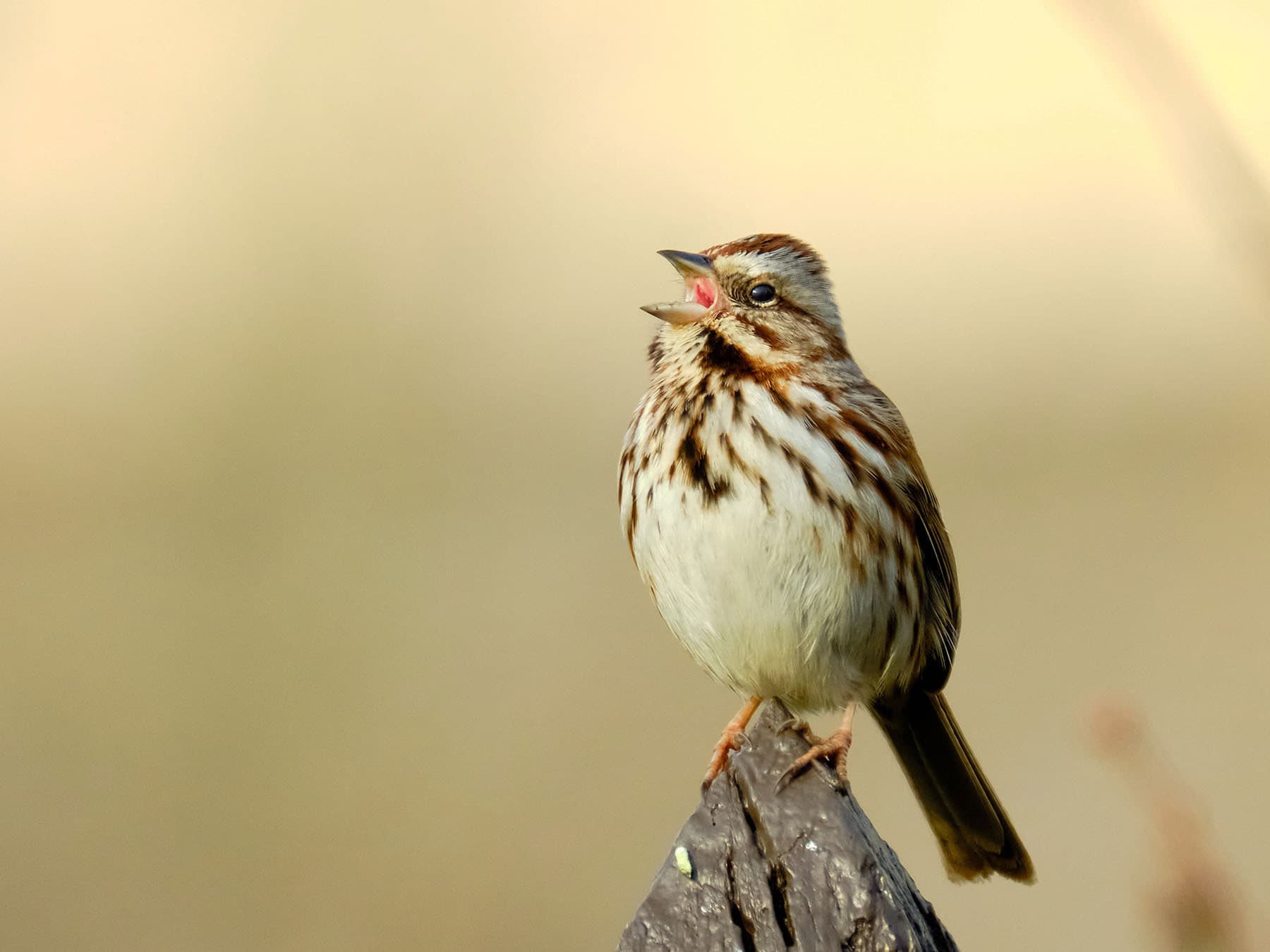 A Song Sparrow singing from the top of a post
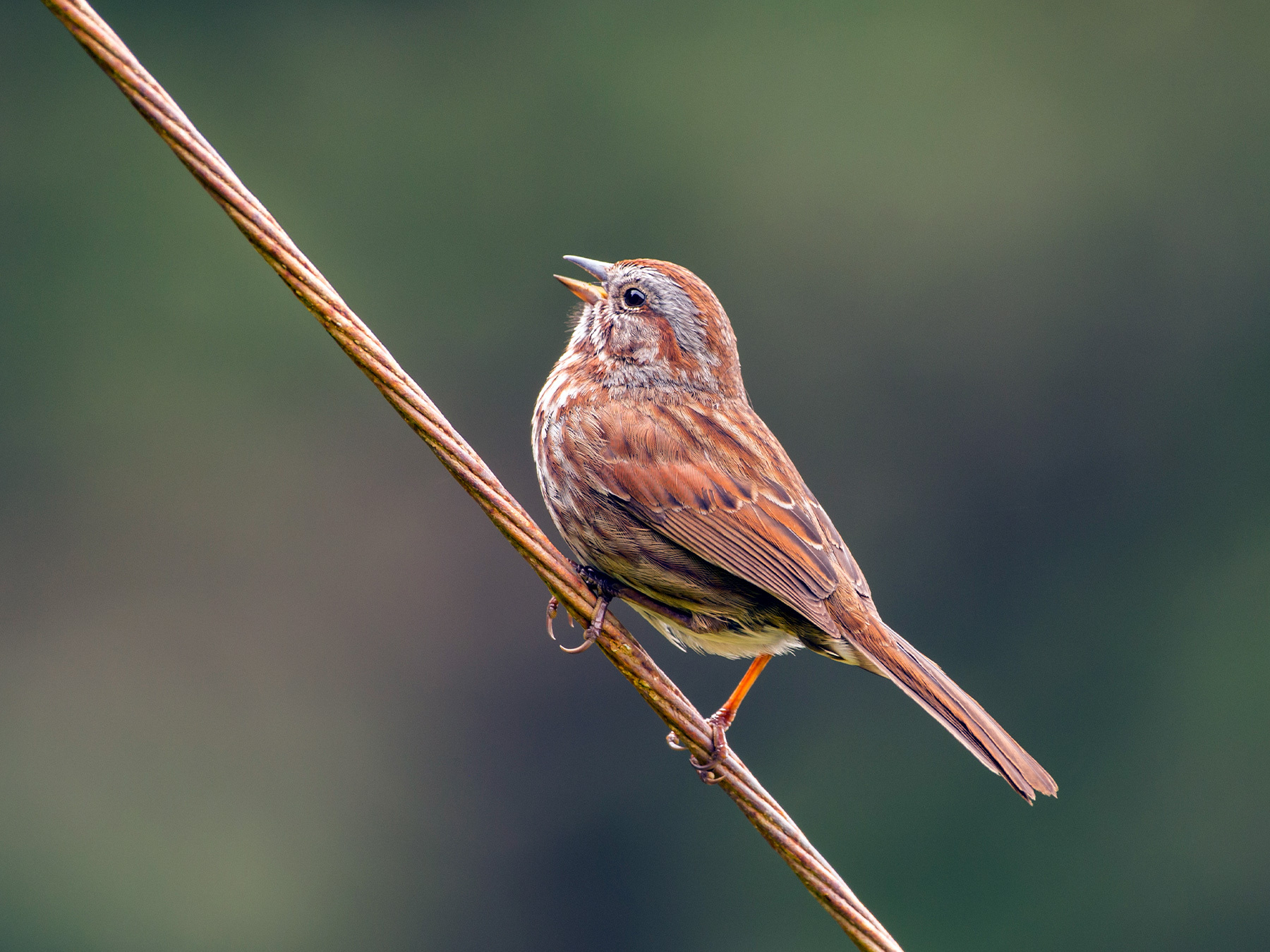
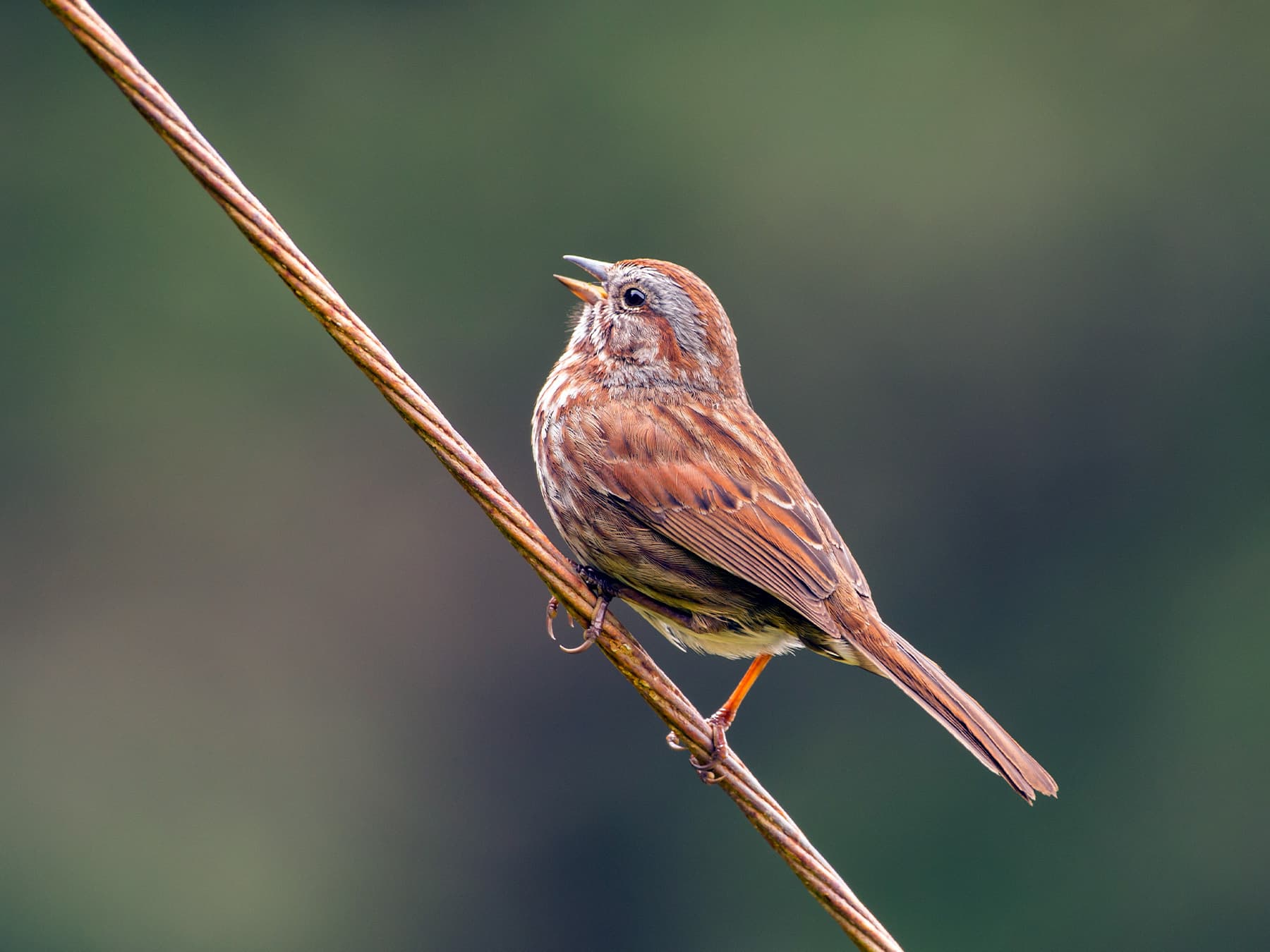 A rufous Song Sparrow singing from a wire
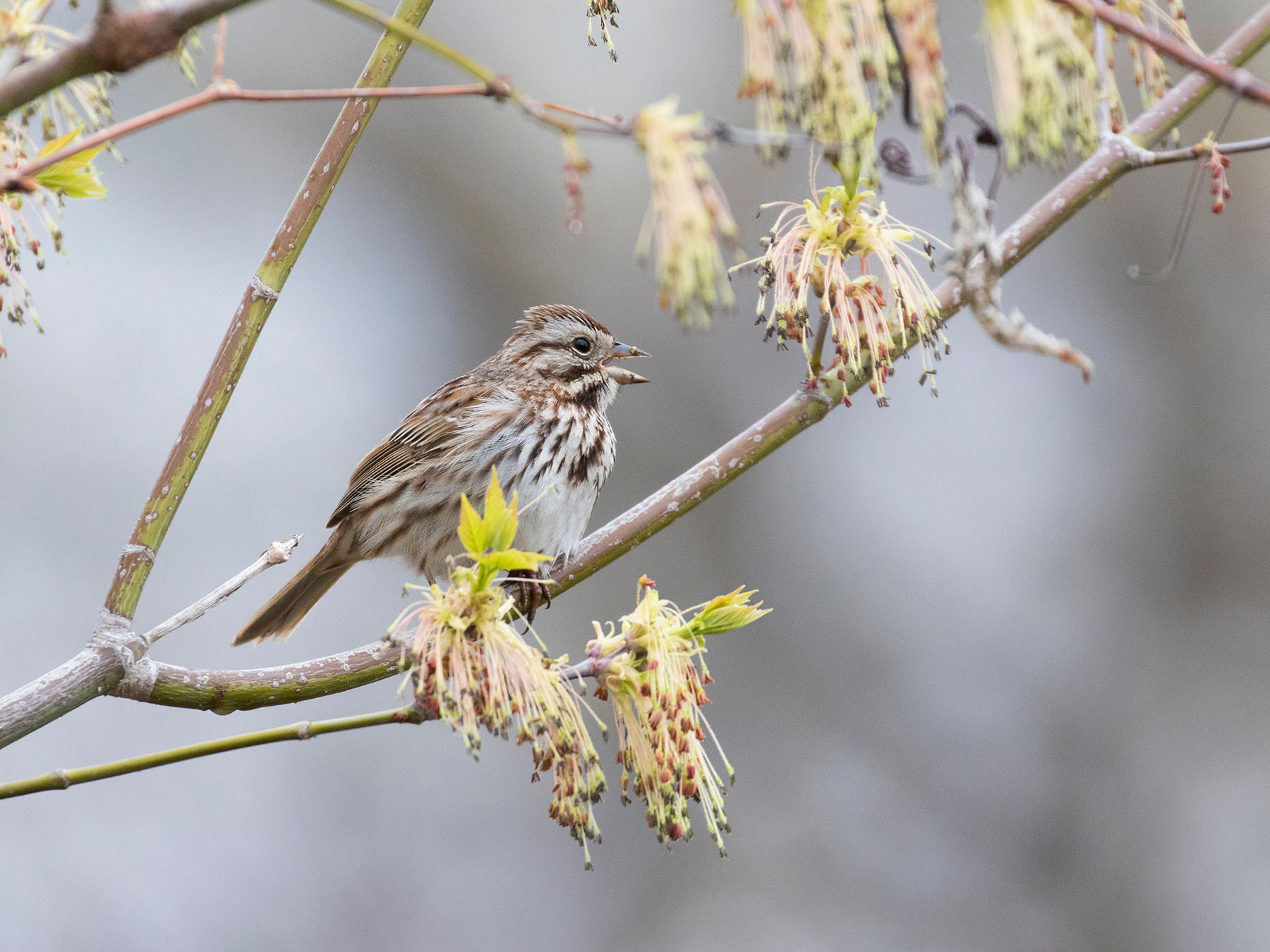
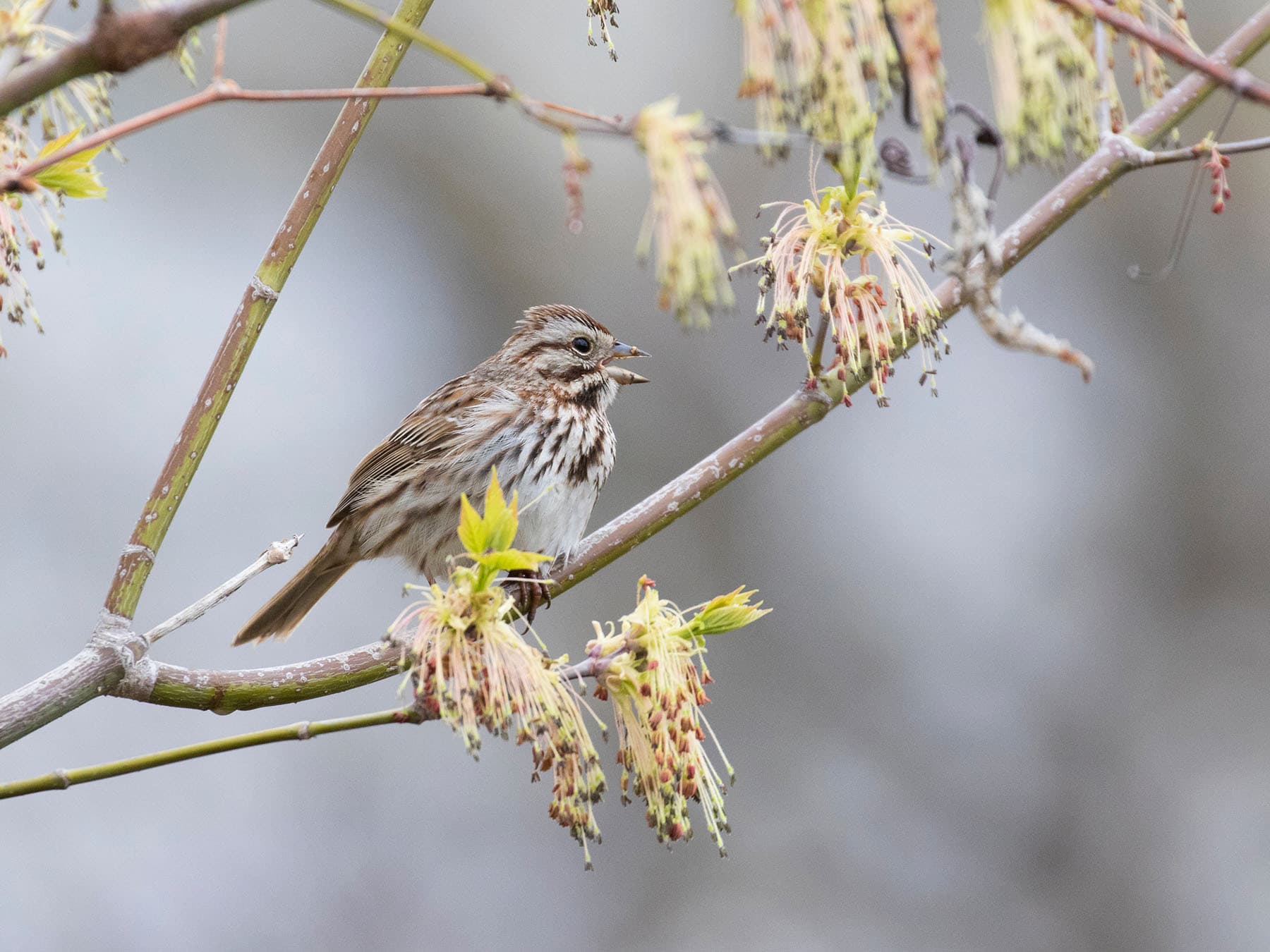 A Song Sparrow among new maple leaves and flowers
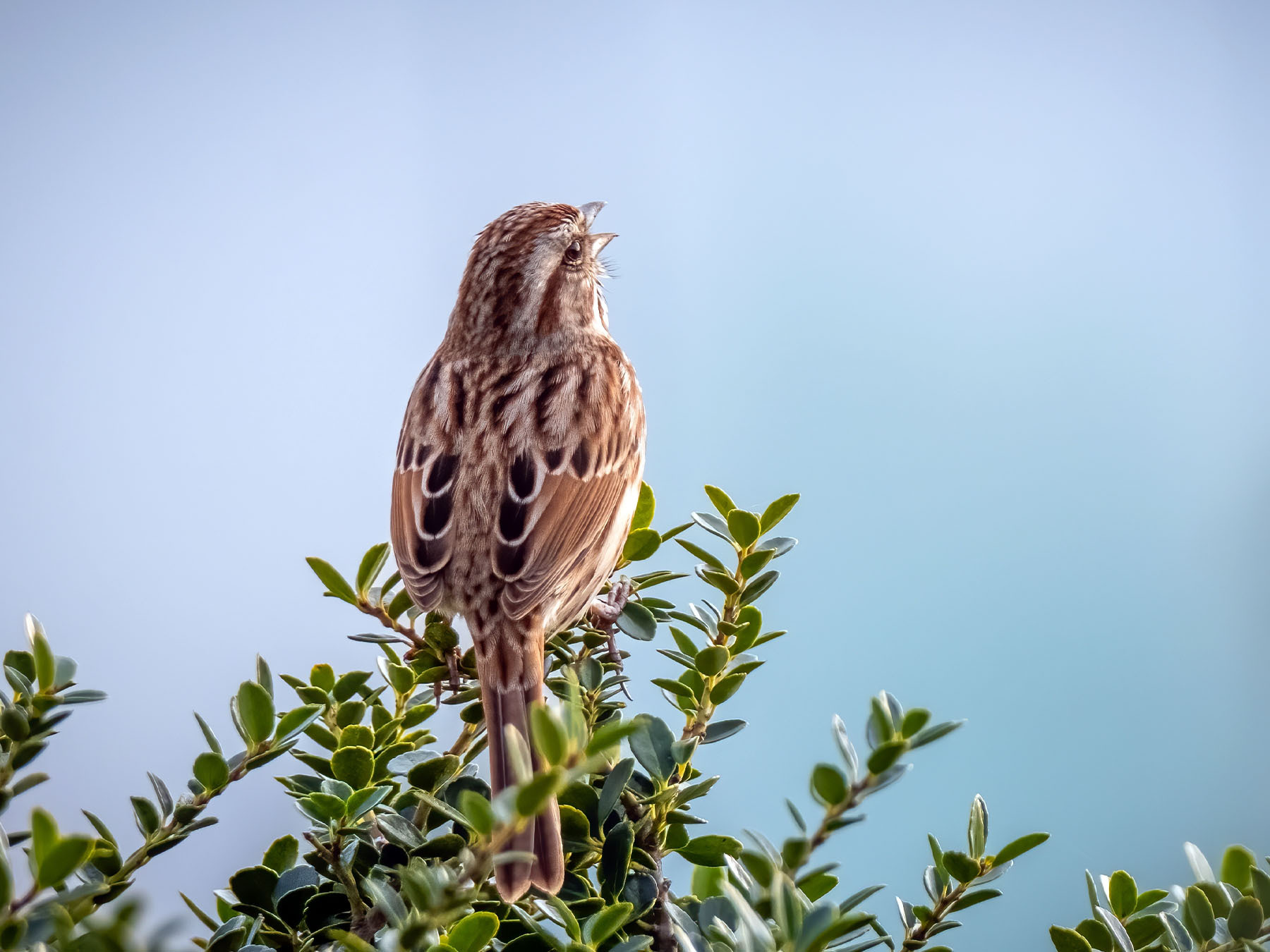
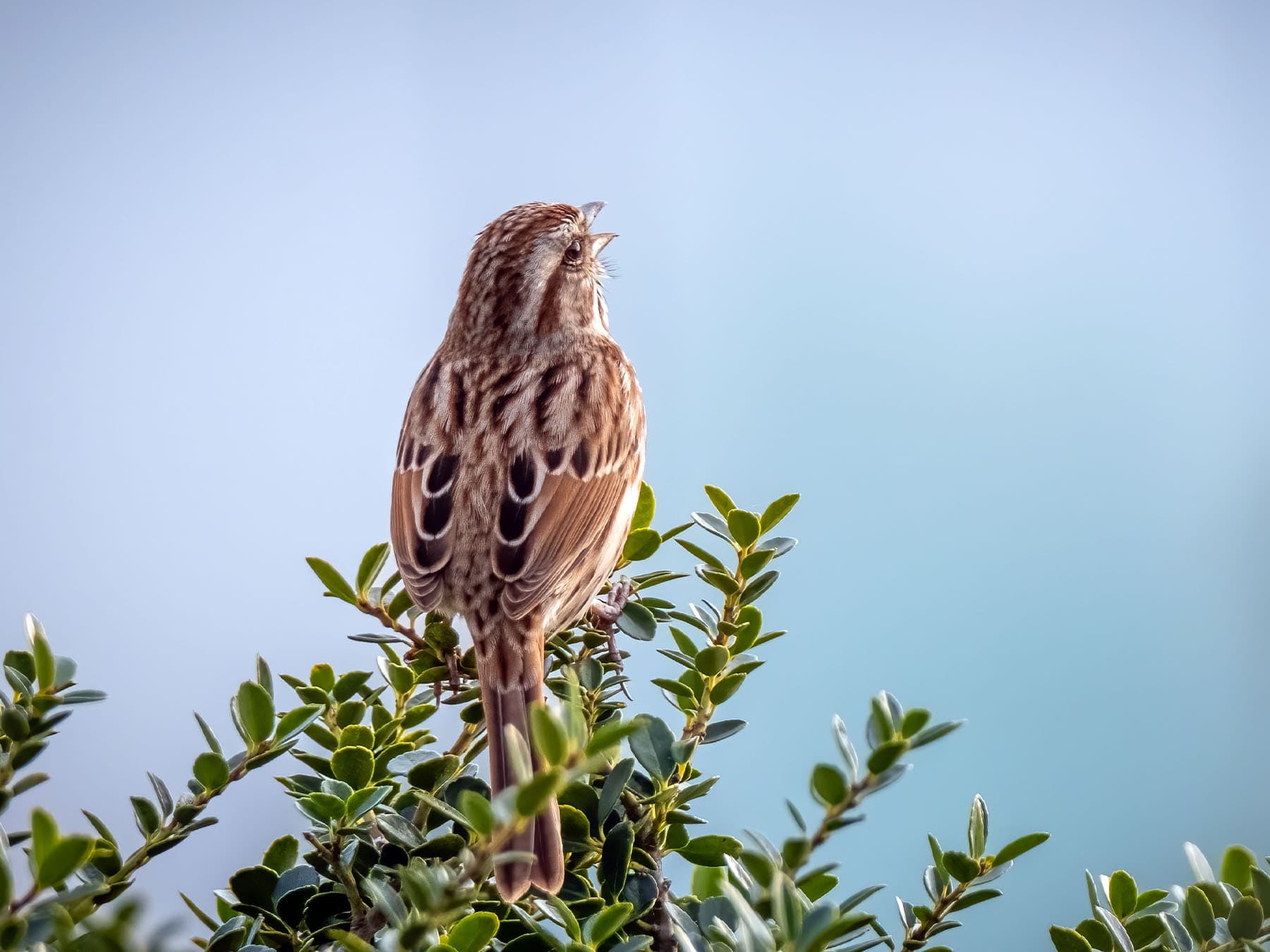 A Song Sparrow from behind, singing at the top of a shrub
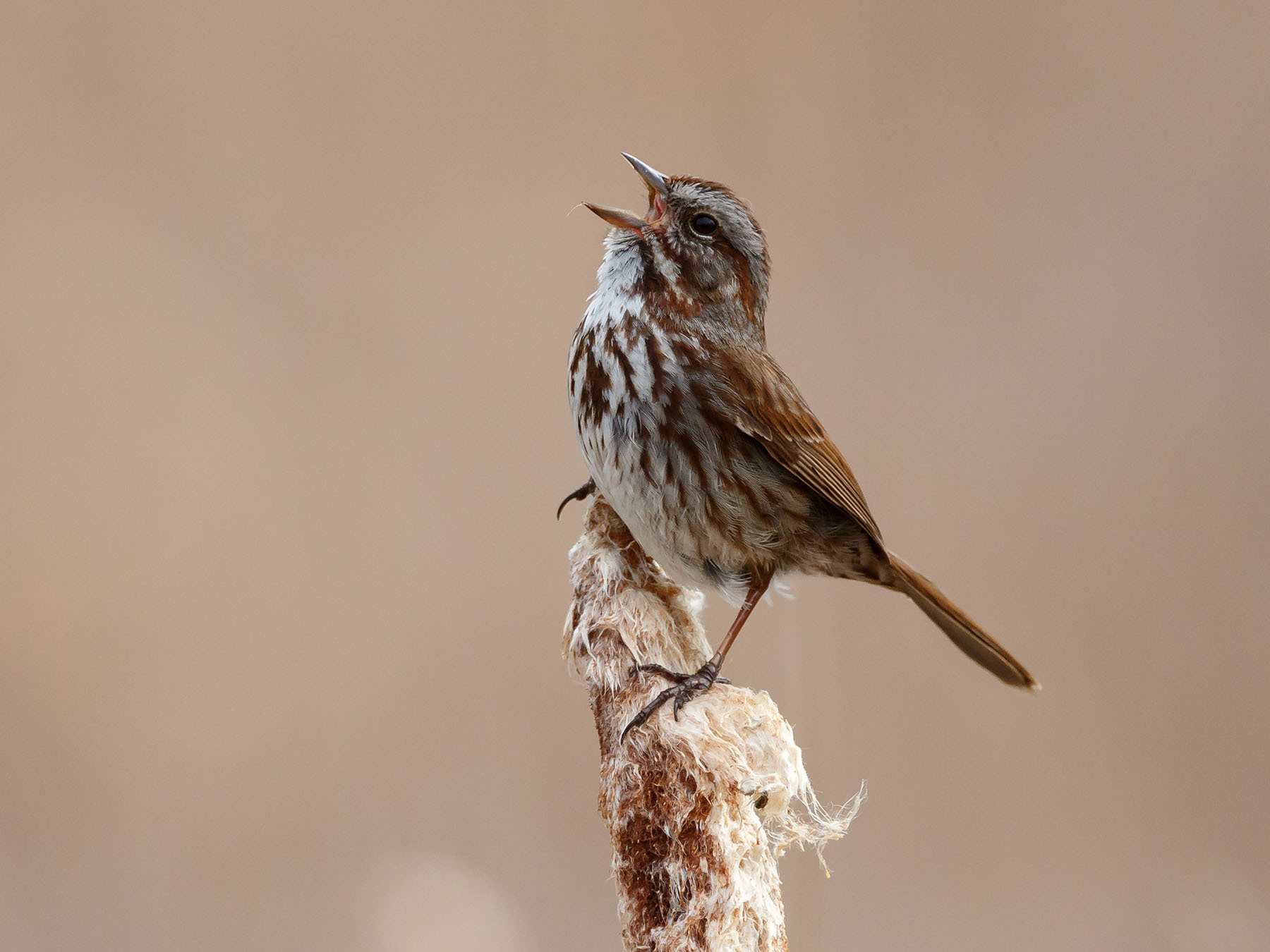
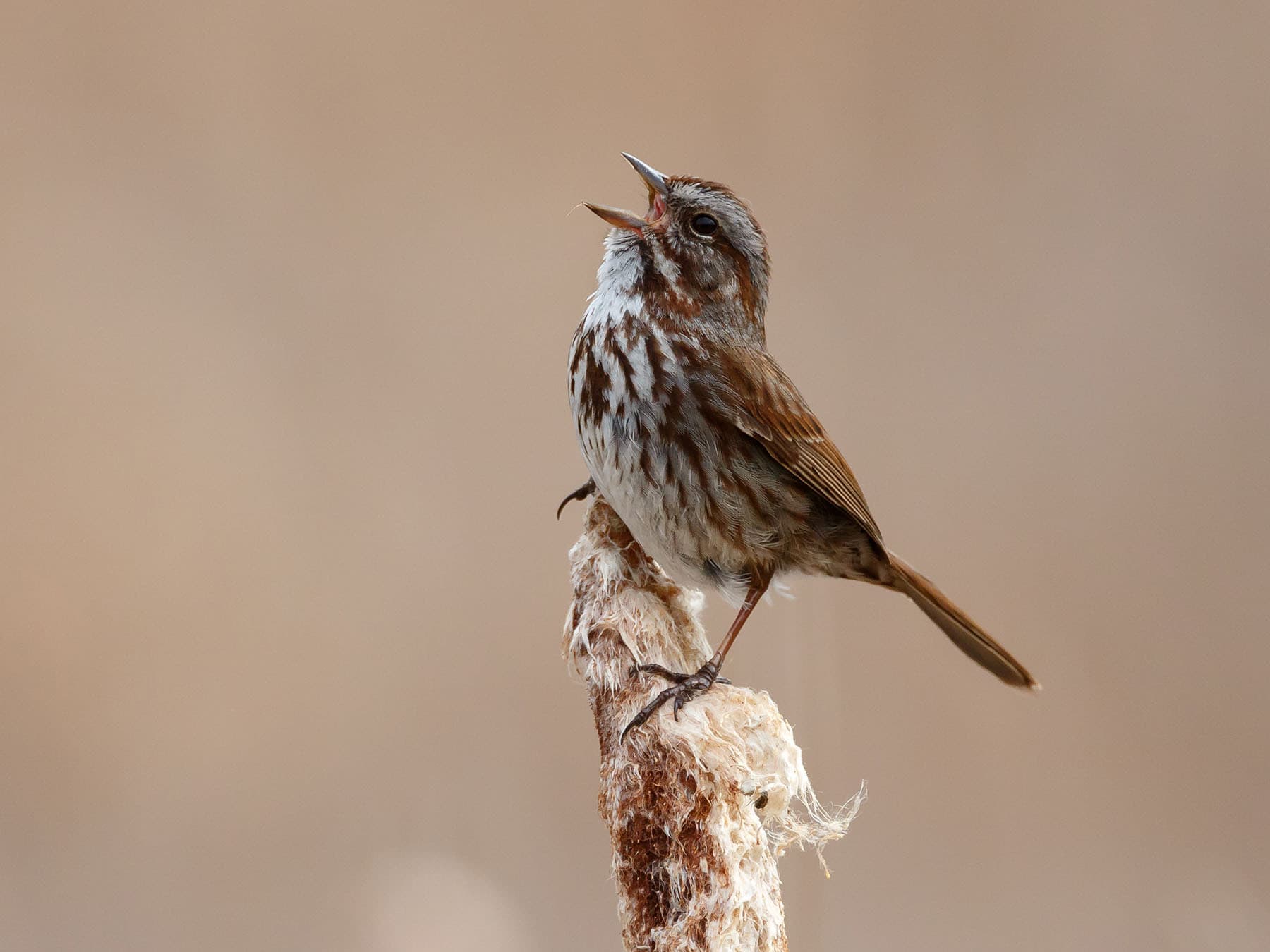 A Song Sparrow singing on a cattail
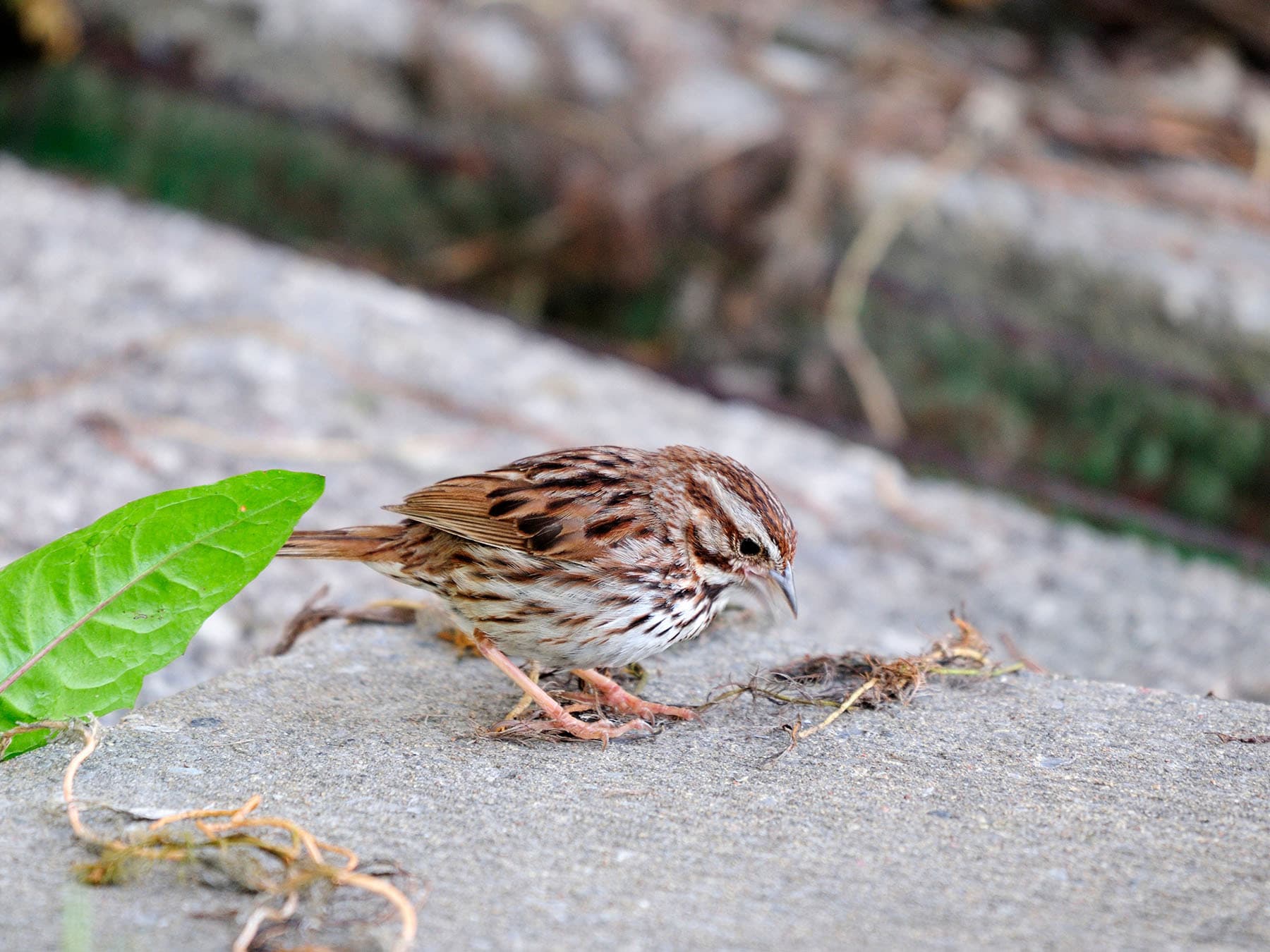 A Song Sparrow beside loose plant fibers on a path
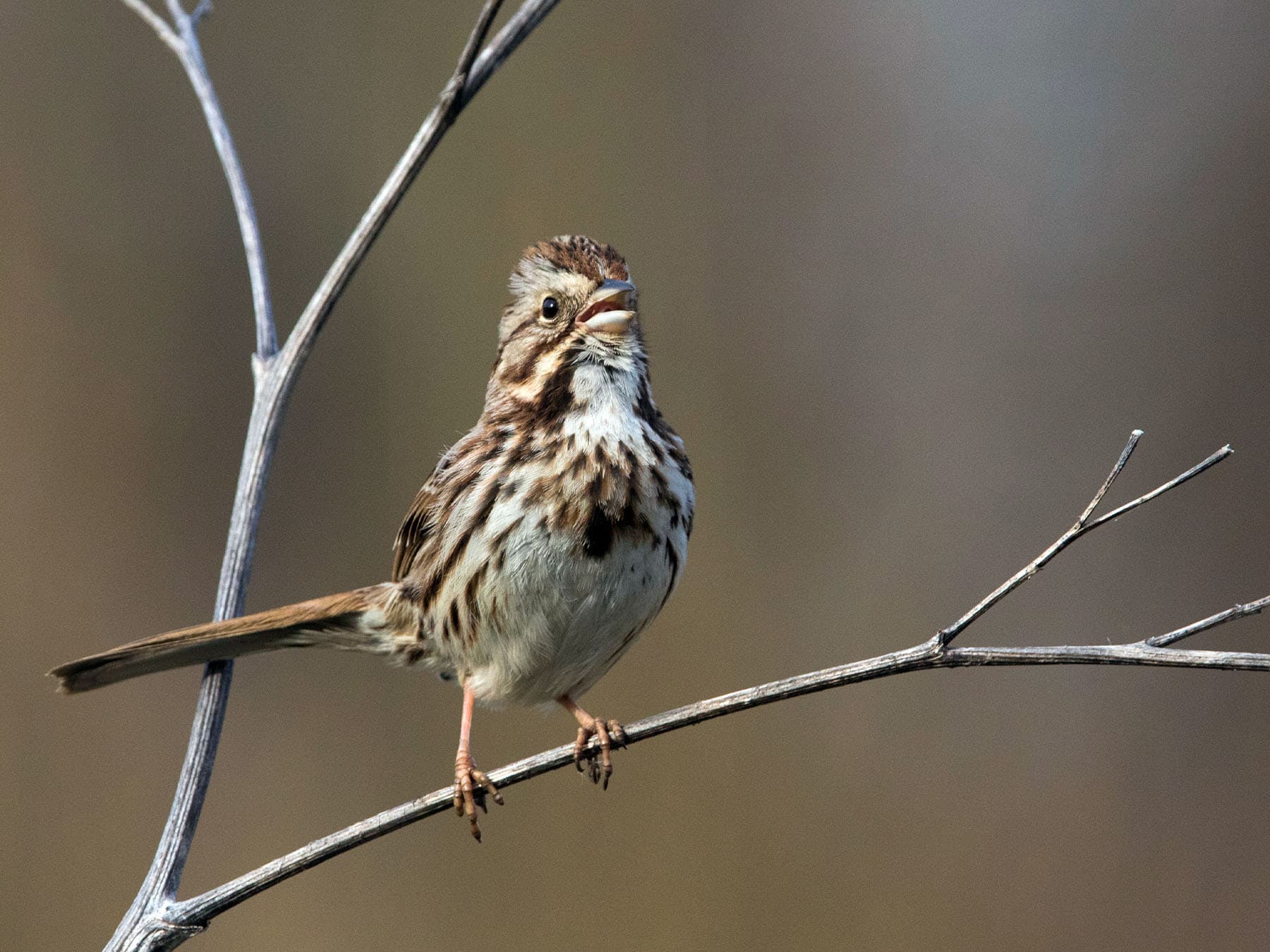 A Song Sparrow on a branch, its long, rounded tail held out behind
Song Sparrow guides
4 guidesQuick facts
- Length
- 12–17 cm
- Wingspan
- 18–24 cm
- Weight
- 12–53 g
- Lifespan
- oldest recorded 11 years 4 months
- Family
- New World Sparrows
- Migration
- Partial migrant
- Global status (IUCN)
- Least Concern
- World population
- About 130 million (Partners in Flight)
- Population trend
- Decreasing: down about 27% from 1966 to 2019 (North American Breeding Bird Survey); still widespread and common
- Scientific name
- Melospiza melodia
Questions
7Why is it called a Song Sparrow?
For its song: males sing a bright, varied song for much of the year. The scientific name says the same: Melospiza is Greek for "song finch" and melodia means singing. Alexander Wilson, who named it in 1810, called it the first singing bird of spring. See Song Sparrow song and calls.
What is the difference between a House Sparrow and a Song Sparrow?
Look at the breast. A Song Sparrow's is heavily streaked, often with a central spot; a House Sparrow's is plain, with a black bib on the male. House Sparrows are stockier, live around buildings and were introduced to North America in 1851. See Song Sparrow or House Sparrow?
Do female Song Sparrows sing?
Rarely. In one Ohio study only 11 of 200 breeding females were heard singing, mostly in disputes with other females in spring. See male vs female Song Sparrows.
Do Song Sparrows mate for life?
Not usually. On Mandarte Island only 0-25% of pairs stay together from one year to the next, mainly because one bird dies, and at least 15% of young have a different father. See behavior.
Are Song Sparrows aggressive?
They are territorial, and they chase other sparrows, often bigger ones, but real fights are rare. See behavior.
Are Song Sparrows invasive?
No. The Song Sparrow is a native North American bird, protected under the Migratory Bird Treaty Act. The House Sparrow, by contrast, was introduced from the Old World.
Do Song Sparrows nest on the ground?
Often, especially early in the season: on the ground under grass or a shrub. Later nests tend to be higher, in bushes. See Song Sparrow nesting.
Sources
17- 1Cornell Lab of Ornithology. Song Sparrow: Overview, Identification, Life History and Sounds. All About Birds. Accessed 7 October 2026. Source (opens in a new tab)
- 2Arcese, P., Sogge, M. K., Marr, A. B. and Patten, M. A. (2020). Song Sparrow (Melospiza melodia), version 1.0. Birds of the World (A. F. Poole and F. B. Gill, editors). Cornell Lab of Ornithology. doi:10.2173/bow.sonspa.01 (opens in a new tab)
- 3AviList Core Team (2025). AviList: The Global Avian Checklist, v2025b. doi:10.2173/avilist.v2025b (opens in a new tab)
- 4National Audubon Society (text: Kaufman, Lives of North American Birds). Song Sparrow. Audubon Guide to North American Birds. Accessed 7 October 2026. Source (opens in a new tab)
- 5Project FeederWatch (Cornell Lab of Ornithology and Birds Canada). Common Feeder Birds: Song Sparrow. Project FeederWatch. Accessed 7 October 2026. Source (opens in a new tab)
- 6Project FeederWatch (Cornell Lab of Ornithology and Birds Canada) (2022). Top 25 Feeder Birds, 2021-22, Northeast Region. Project FeederWatch. Accessed 7 October 2026. Source (opens in a new tab)
- 7Zanette, L. Y., White, A. F., Allen, M. C. and Clinchy, M. (2011). Perceived predation risk reduces the number of offspring songbirds produce per year. Science 334: 1398-1401. doi:10.1126/science.1210908 (opens in a new tab)
- 8USGS Bird Banding Laboratory. Longevity records of North American birds. Accessed 7 October 2026. Source (opens in a new tab)
- 9U.S. Fish and Wildlife Service. List of birds protected by the Migratory Bird Treaty Act. Code of Federal Regulations, 50 CFR 10.13. Accessed 7 October 2026. Source (opens in a new tab)
- 10Keller, L. F. et al. (1994). Selection against inbred song sparrows during a natural population bottleneck. Nature 372: 356-357. doi:10.1038/372356a0 (opens in a new tab)
- 11NestWatch, Cornell Lab of Ornithology. Song Sparrow. NestWatch Common Nesting Birds. Accessed 7 October 2026. Source (opens in a new tab)
- 12Cornell Lab of Ornithology. House Sparrow identification. All About Birds. Accessed 7 October 2026. Source (opens in a new tab)
- 13National Audubon Society (text: Kaufman, Lives of North American Birds). House Sparrow. Audubon Guide to North American Birds. Accessed 7 October 2026. Source (opens in a new tab)
- 14National Audubon Society (text: Kaufman, Lives of North American Birds). Lincoln's Sparrow. Audubon Guide to North American Birds. Accessed 7 October 2026. Source (opens in a new tab)
- 15National Audubon Society (text: Kaufman, Lives of North American Birds). Fox Sparrow. Audubon Guide to North American Birds. Accessed 7 October 2026. Source (opens in a new tab)
- 16National Audubon Society (text: Kaufman, Lives of North American Birds). Vesper Sparrow. Audubon Guide to North American Birds. Accessed 7 October 2026. Source (opens in a new tab)
- 17National Audubon Society (text: Kaufman, Lives of North American Birds). House Finch. Audubon Guide to North American Birds. Accessed 7 October 2026. Source (opens in a new tab)

Checked by
Nathan Cope, founder and editor
Nathan founded Birdfact and leads its writers and contributors in the UK, the US and Canada. He has watched and studied birds for more than ten years, and checks every article and species guide before it’s published.