


Eastern Phoebe
Phoebe · Sayornis phoebe
By the Birdfact teamChecked by Nathan Cope
See it in 3D
3 plumages
An adult Eastern Phoebe is 5.5–6.5 in (14–17 cm) long, bill to tail.
Adult
© 2026 NC Digital Limited (Birdfact). All rights reserved. This 3D model may be viewed on this page and shared by link only. Downloading, extracting, copying or reusing it, or using it to train machine-learning models, is not permitted without our written permission. Using our models
On this page15 sections
How to recognise it
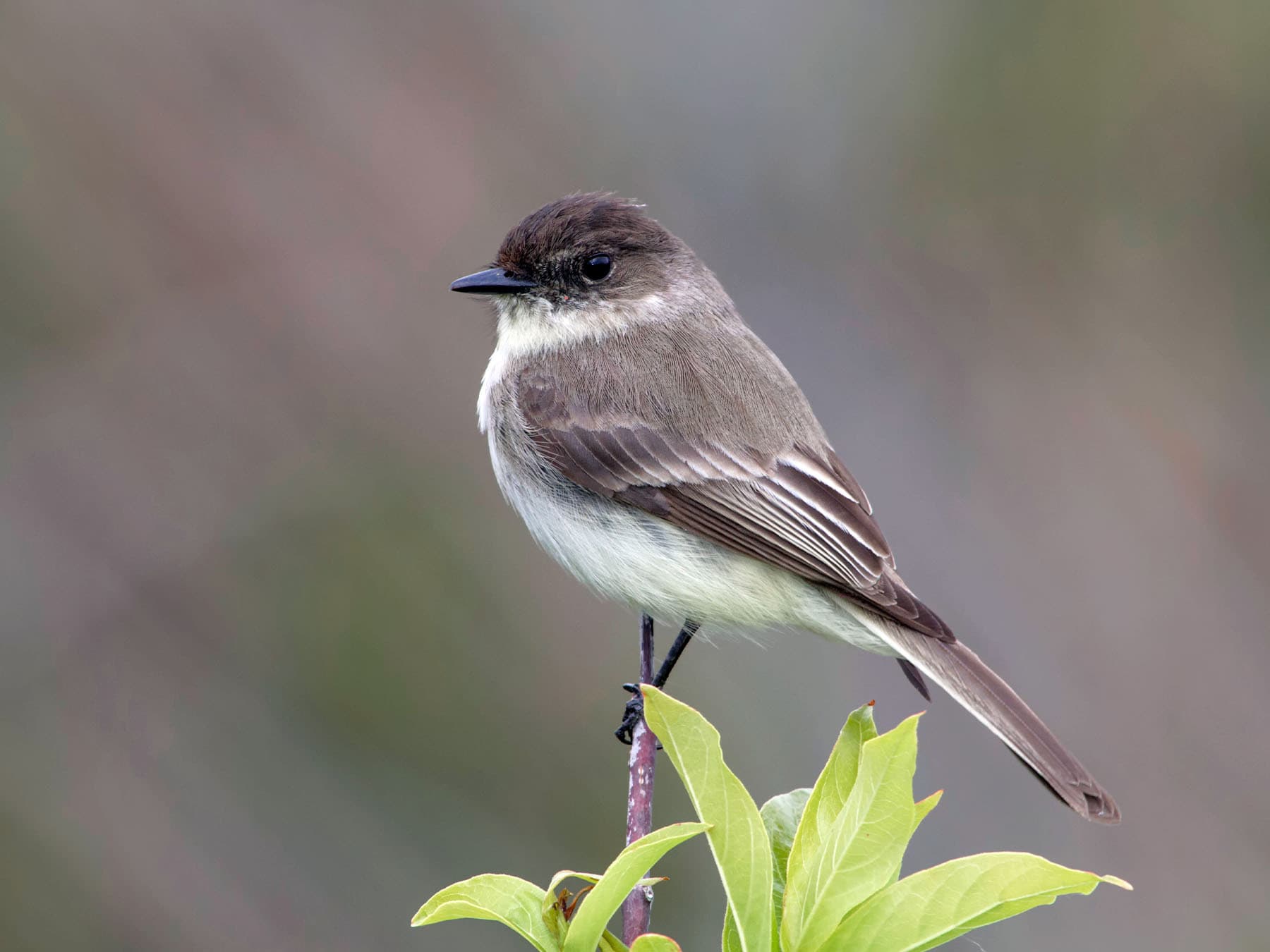
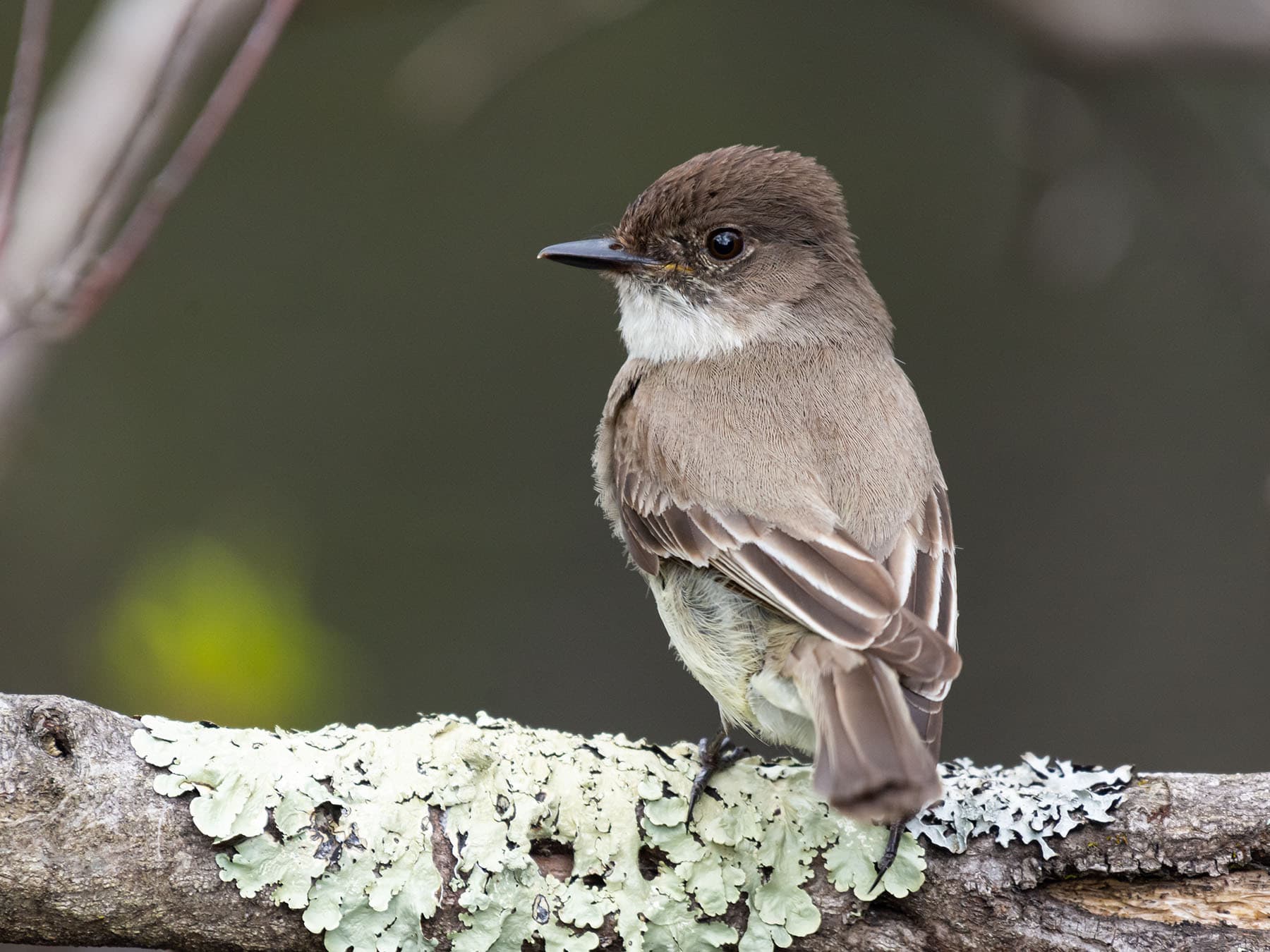
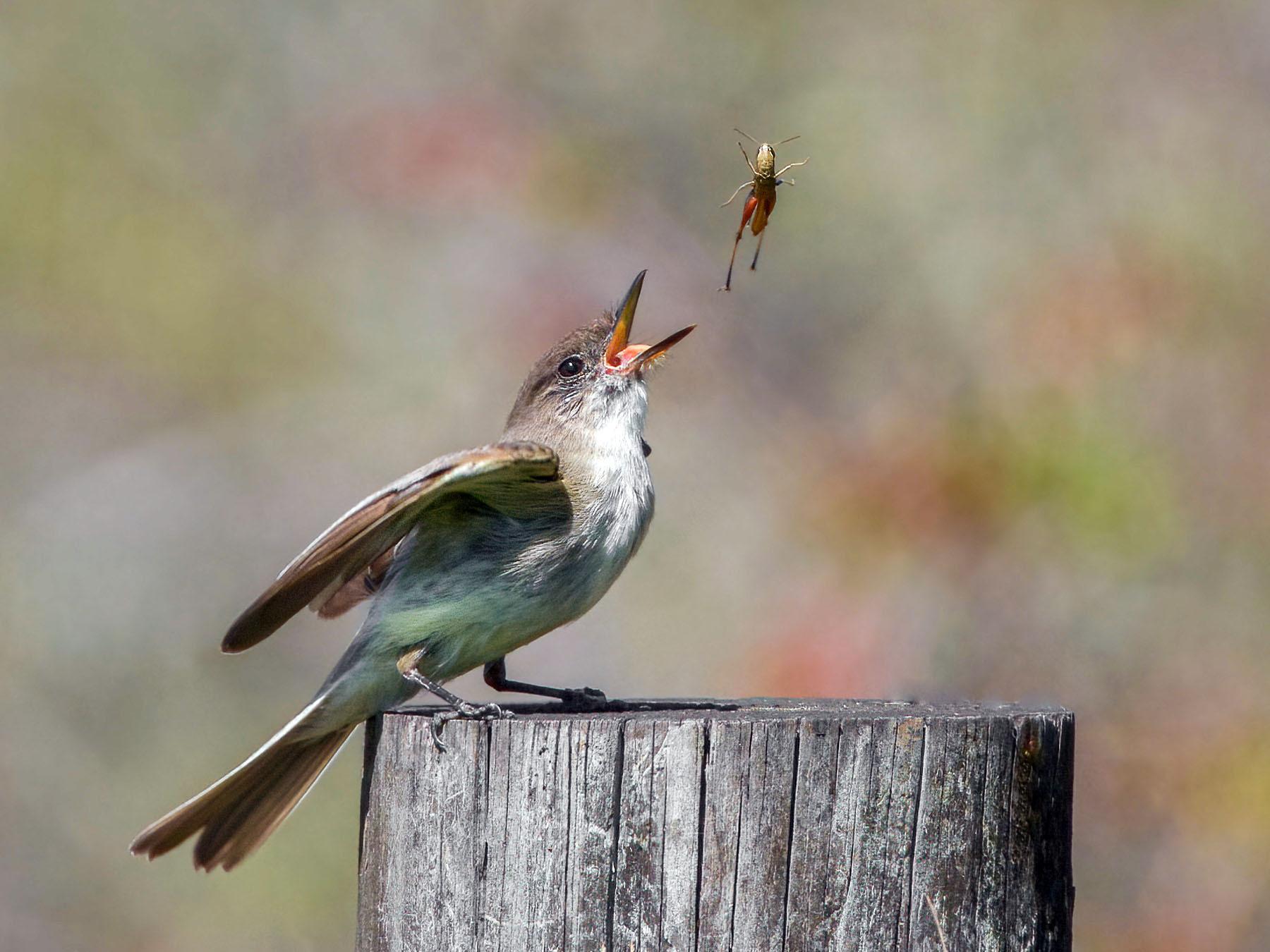
The Eastern Phoebe is a plain, gray-brown flycatcher that sits upright on a low, open perch and wags its tail. Its head is darker than the back, a sooty brown cap and face that stand out against the whitish throat. The underparts are off-white with a dusky wash on the sides of the breast, and the bill is short, thin and black.
Look for what it lacks. Adults have no eye-ring and no obvious wing bars, though pale edges to the wing feathers can make the folded wing look striped. After their late-summer molt, fresh birds are tinged olive above and washed yellow below; the yellow wears off and the underparts turn whiter.
Its most telling habit is the tail wag. A perched phoebe dips its tail down quickly, then lifts it slowly, often with a little sideways swing, and does it again and again.
Size and shape
Eastern Phoebes are 5.5 to 6.7 inches (14-17 cm) long, with a wingspan of 10.2 to 11 inches (26-28 cm), and weigh 0.6 to 0.7 ounces (16-21 g): sparrow-sized, a little larger than a Tufted Titmouse. They look plump and large-headed, with a medium-length, square-ended tail, and the crown often looks flat on top or raised into a slight peak.
Males, females and young
Males and females look alike. Males average slightly larger and darker, but the two overlap too much to tell a lone bird by size or color.
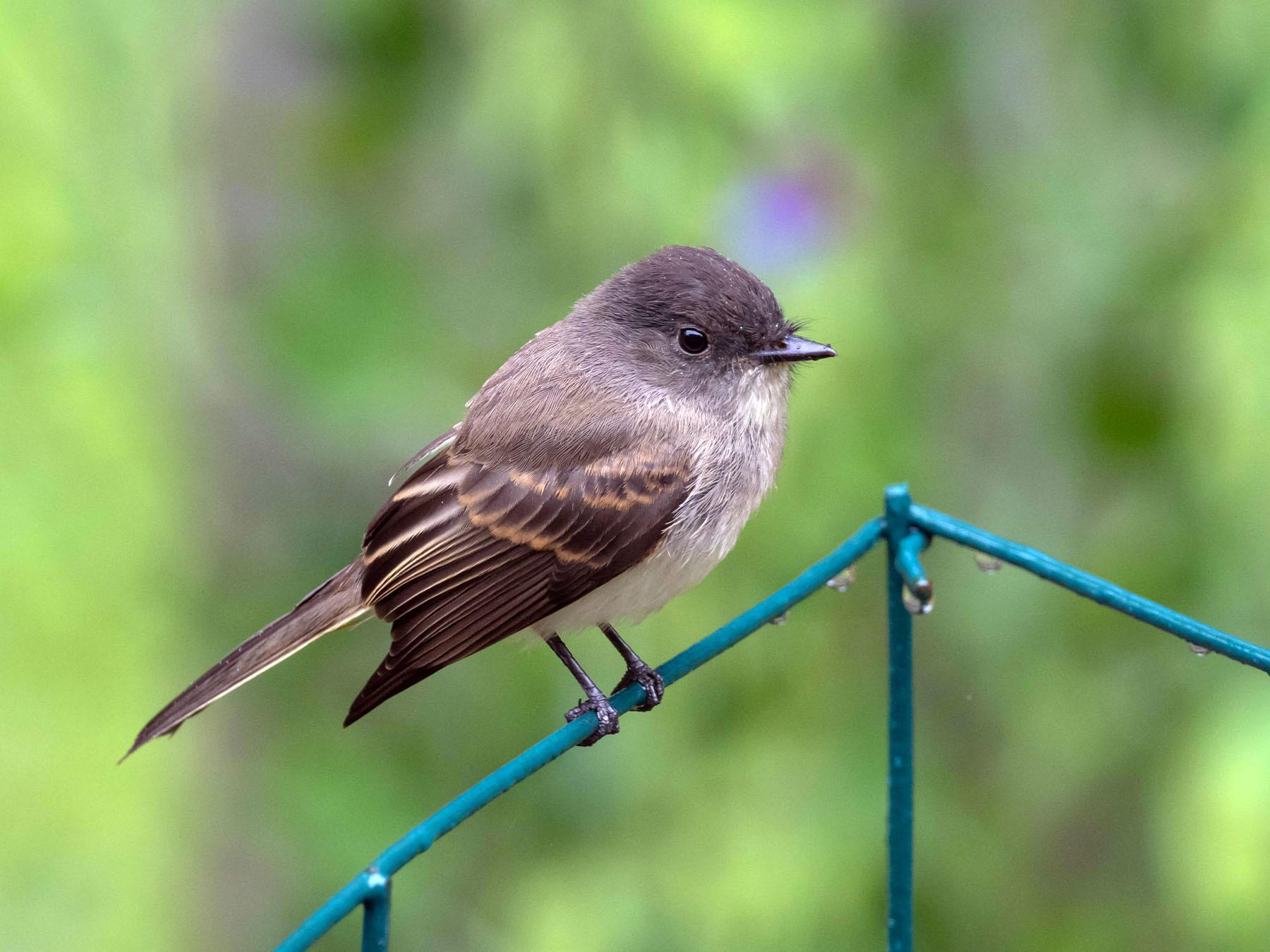
Young birds in their first summer look like adults with cinnamon-buff or reddish-brown wing bars, a paler head and a yellower belly. Those wing bars make a juvenile easy to mistake for another small flycatcher; the tail-wagging gives it away. A partial molt in late summer and fall makes first-year birds look like adults, though some keep narrow or partial wing bars.
Identification: similar birds
The two flycatchers most often confused with it, the Eastern Wood-Pewee and the Willow Flycatcher, are smaller and slimmer, with wing bars, and do not bob their tails the way a phoebe does.1
Eastern Wood-Pewee. The pewee has very long wingtips and faint wing bars, and comes back from the tropics much later in spring.2
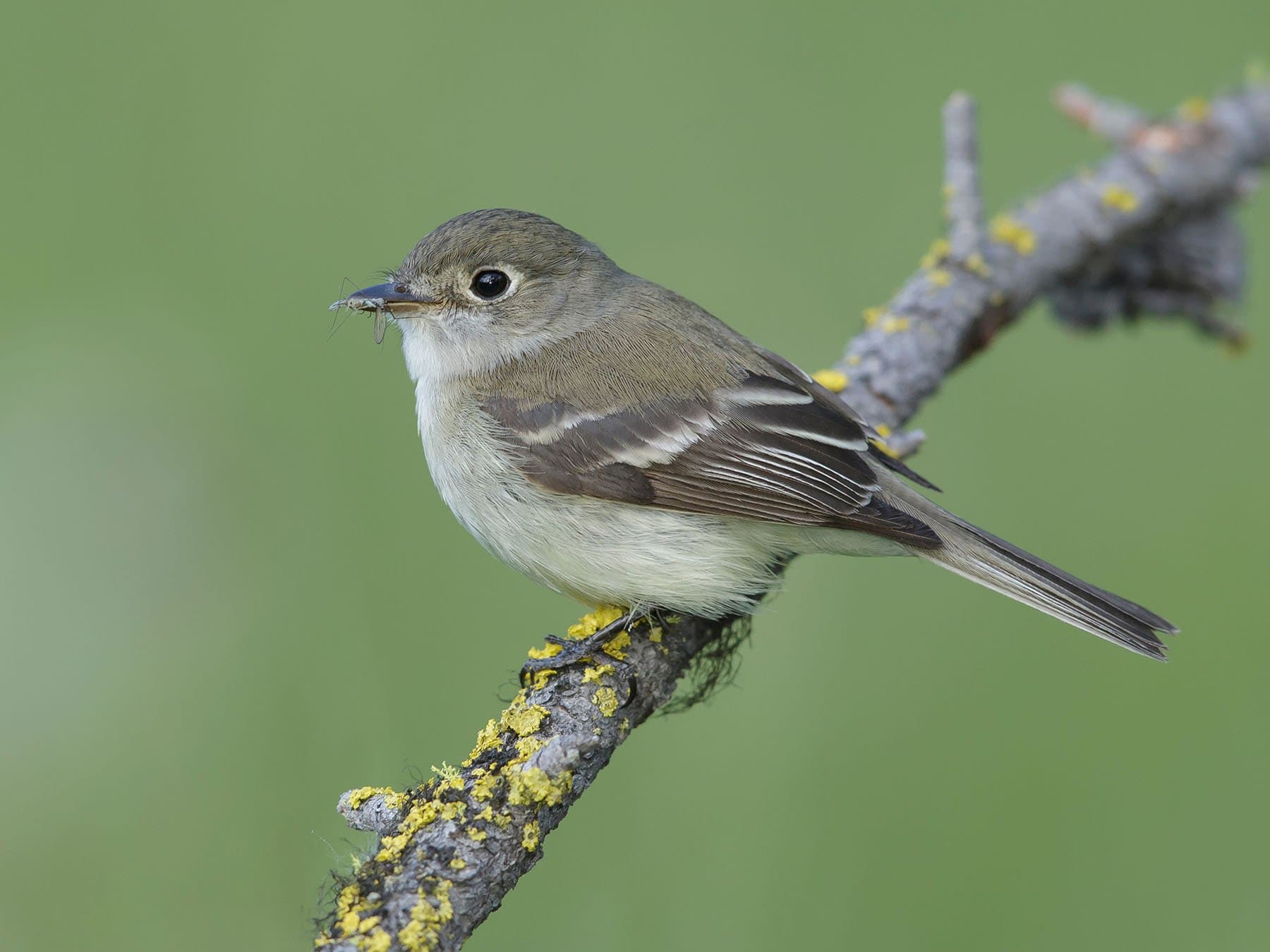
Least Flycatcher and Willow Flycatcher. The Least is smaller, 5 to 6 inches (13-15 cm), with contrasting white wing bars, a white eye-ring and a dry che-bec song.3 The Willow has a faint eye-ring at most and is best told by its wheezy fitz-bew.4
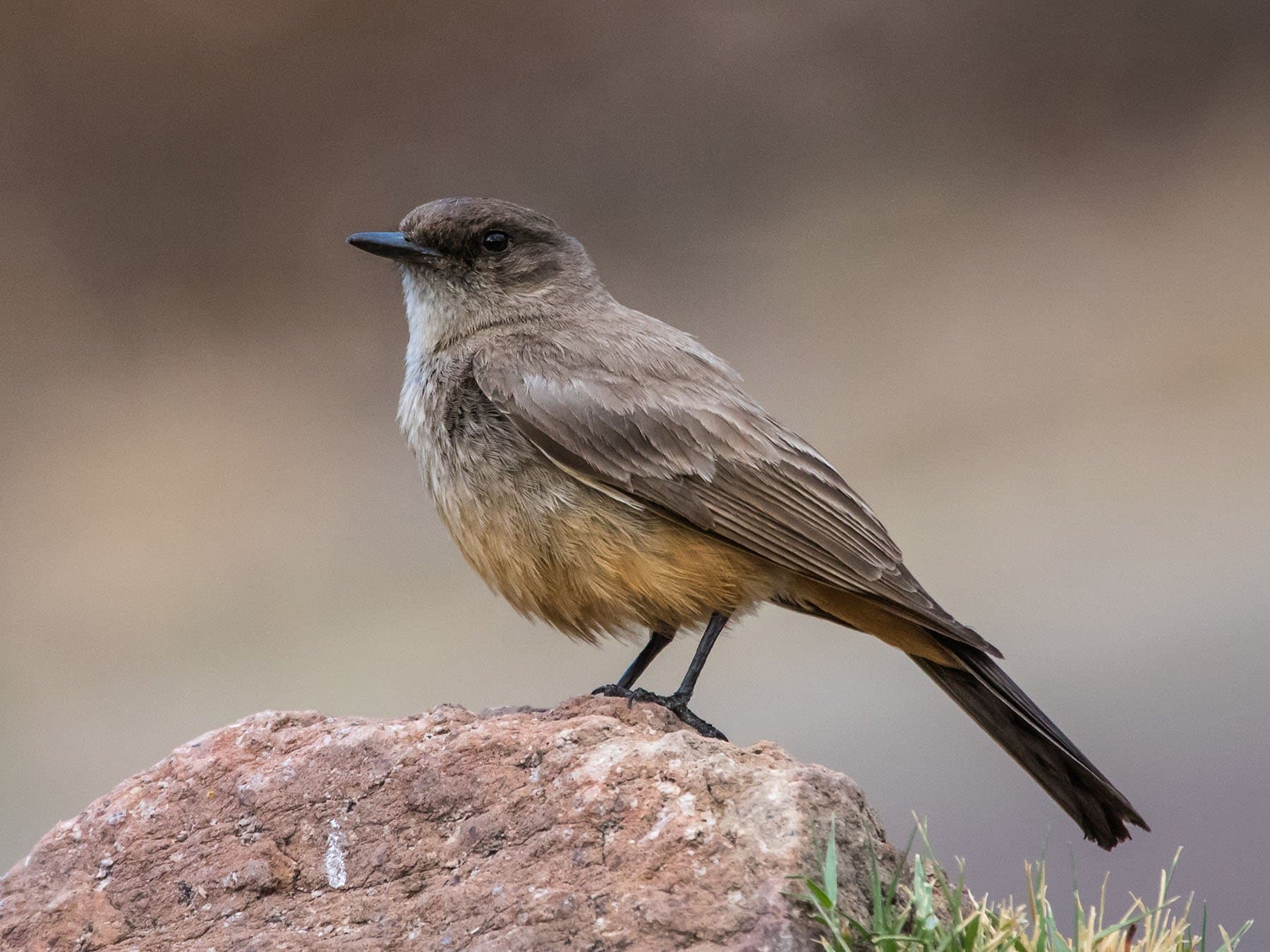
Say's Phoebe. A bird of dry, open country in the West, larger, 6.7 to 7.5 inches (17-19 cm), soft dusty gray with a pale orange-buff belly and a black tail. In red-soil country an Eastern Phoebe's belly can be stained orange, but its face shows much more contrast.5
Black Phoebe. The western phoebe of shady streams, canyons and towns: mostly dark charcoal gray, blacker on the head, with a white belly.
Dark-eyed Junco. A junco also has a dark head and a white belly, but it has a pale pink bill, flashes white outer tail feathers and feeds on the ground.6, 7
Eastern Kingbird. Bigger, 7.5 to 9.1 inches (19-23 cm), blackish above and bright white below, with a white band across the tip of its black tail.
Not sure it’s a Eastern Phoebe? Check your photo: Birdfact names the bird and shows the look-alike side by side.
Its size
Adults- Length
- 14–17 cm
- Wingspan
- 26–28 cm
- Weight
- 16–21 g
Its song and calls
The male says its name. His song is a raspy, two-part fee-bee, about half a second long, repeated over and over. He often alternates it with a stuttered fee-b-be-bee, which he sings more after a fight with a rival or with his mate.
Don't confuse it with the Black-capped Chickadee's clear, whistled fee-bee. The phoebe's song is much quicker and raspier.
Both sexes give a clear, short chip all year, and it is often the first sign of a phoebe nearby. Now and then a male showing a female a nest site hovers in front of it with a harsh, nasal chatter, and an angry phoebe snaps its bill shut with a loud click.
Males sing from the moment they reach their territories in early spring. An unmated male sings through much of the day; once nesting begins, the only regular song is before dawn. Females sing too, but rarely and briefly, in the early morning near their mate.
A phoebe does not learn its song. In laboratory experiments, hand-reared males sang normal songs without hearing phoebe song,8 and so did birds that could not hear themselves.9
More: Eastern Phoebe sounds, with recordings and spectrograms.
- Song0:00 / 0:11
Recorded in Massachusetts, United States · March 2025
- Call0:00 / 0:07
Recorded in Virginia, United States · May 2023
Heard one and not sure? Let the bird song identifier listen.
When and where to see it
Eastern Phoebes breed across central and eastern North America, from Alberta and the Prairie Provinces east to Nova Scotia and south to central Texas, the Gulf states and the Carolinas. They have long been scarce near the southern coasts, though bridges have been carrying them into the coastal plain.
Look in open woodland and woodland edges, on farms and in yards and parks, usually near a stream or other water. What decides where a pair breeds is a sheltered nest site, such as a bridge, a culvert, a barn or a porch, with some trees or shrubs close by. Bridges and buildings, with planted trees and shrubs, let phoebes spread into the Great Plains and the Prairie Provinces.
In winter, look in deciduous woods, edges and brushy places near water rather than closed forest. A phoebe often perches low but in the open, on a branch, fence or wire, and often returns to the same perch after a sally.
Do they migrate?
Northern birds do; in much of the Southeast phoebes are present all year. Eastern Phoebes winter mainly in the southeastern US, with the largest numbers along the Gulf Coast, in east-central Texas and in northern Florida, and south into eastern and central Mexico. Scattered birds winter regularly as far north as southern Illinois, southern Missouri, northern Kentucky and southern Ohio. Few other flycatchers spend the winter so far north, and phoebes can live on berries when cold weather cuts off insects.
They are among the first migrants back in spring: the first birds return in March across much of the range, apparently following the thaw and the first insects north, though the far north may not see them until early May. Fall migration probably peaks in October, later in the south. They seem to travel alone and by day.1
Tips for seeing it
What it eats
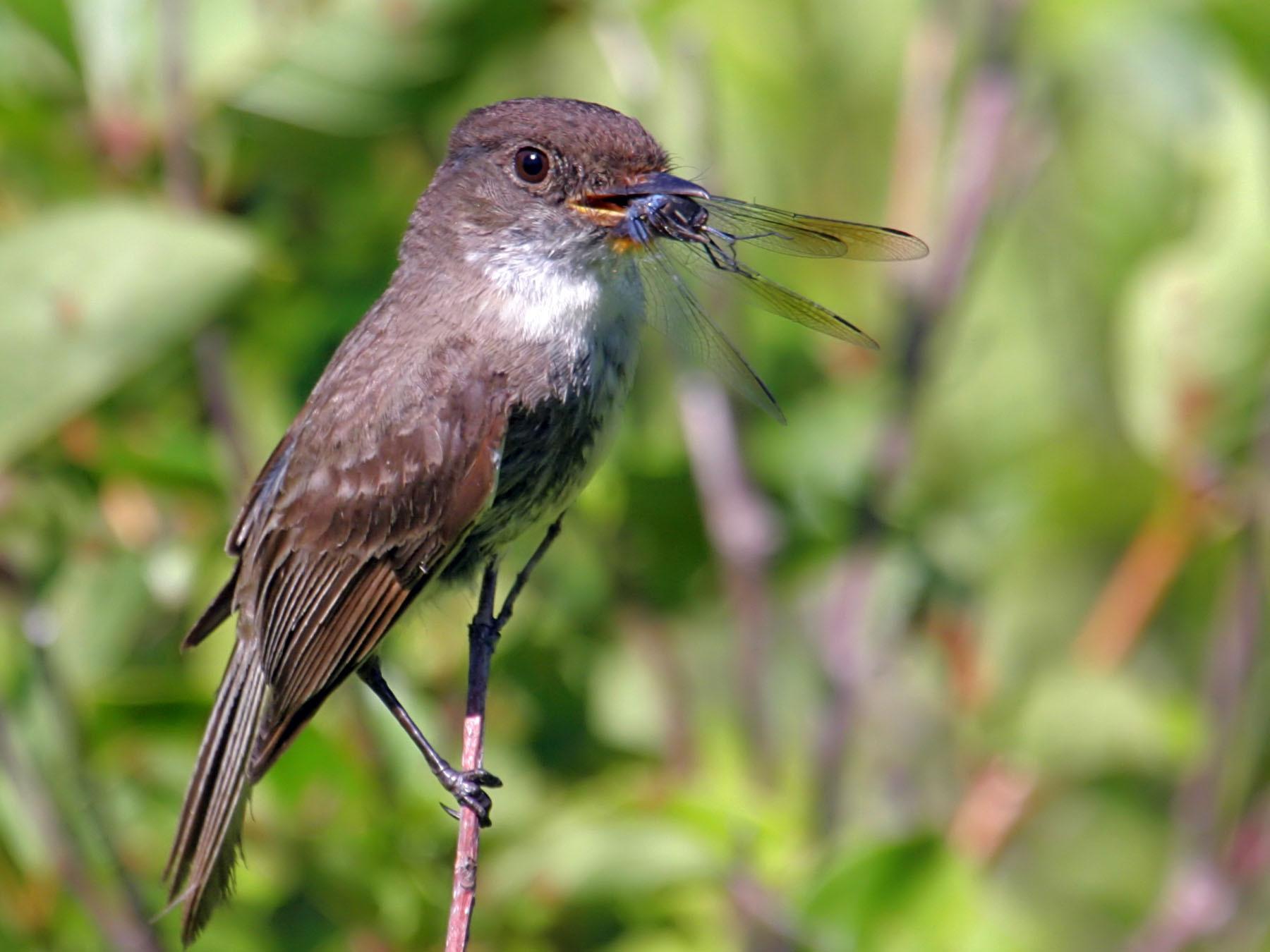
Mostly flying insects. In the one detailed study, of 370 stomachs, published in 1912, bees, wasps and ants made up 26% of the food over the year, more than any other group, with the most taken in late summer. A quick kill seems to keep the bird from being stung. Beetles came next at 15%, then grasshoppers and crickets and true bugs at 13% each, moths and butterflies at 9% and flies at 7%. Spiders, ticks and millipedes made up 6%.10
Plant food was only 11%, mostly small fruits taken in fall, winter and early spring. In winter, berries swallowed whole from a perch are probably an important food.
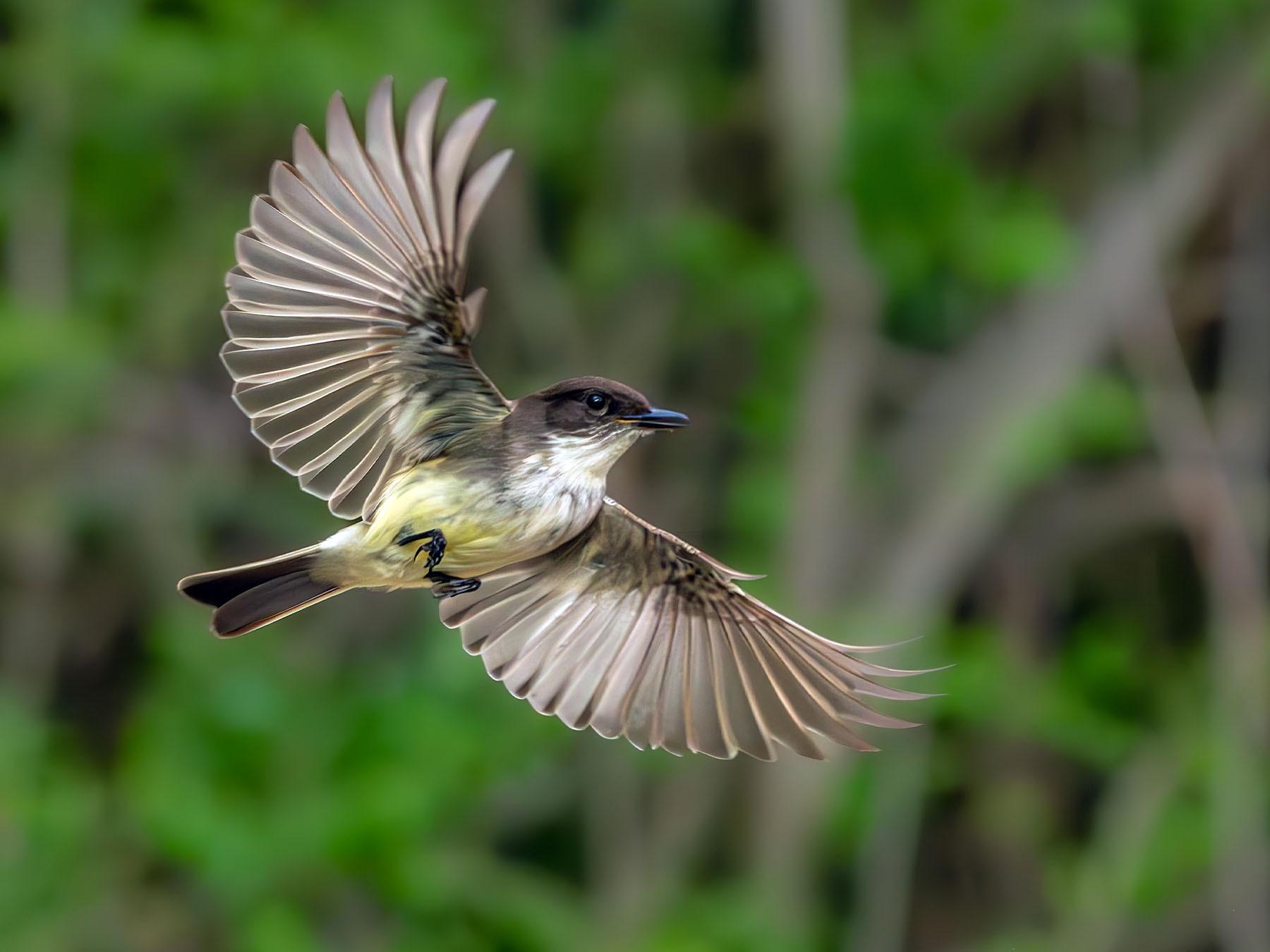
A phoebe hunts from a low perch, usually under about 33 feet (10 m) up. It flies out to snap up a passing insect and often comes back to the same perch; it also hovers to pick insects off leaves and drops to the ground for prey. It makes the most of sudden plenty, such as hatches of water insects, swarms of midges and emergences of periodical cicadas.
Nesting and breeding
Pairs form soon after the birds arrive, from mid-March in the south of the range to mid or late April in the northern US and southern Canada. A pair usually stays together and at the same site for the season: in an Indiana study, about 9 in 10 birds kept the same mate between nesting attempts.11 Adults rarely move between years, so the same pair sometimes nests in the same place for 2 or 3 years running.
That loyalty to a site has a long history. John James Audubon wrote that in 1804 he tied a silver thread round the legs of young phoebes in a nest and found two of them nesting nearby the next year: the first known bird banding in North America.1, 12
The nest
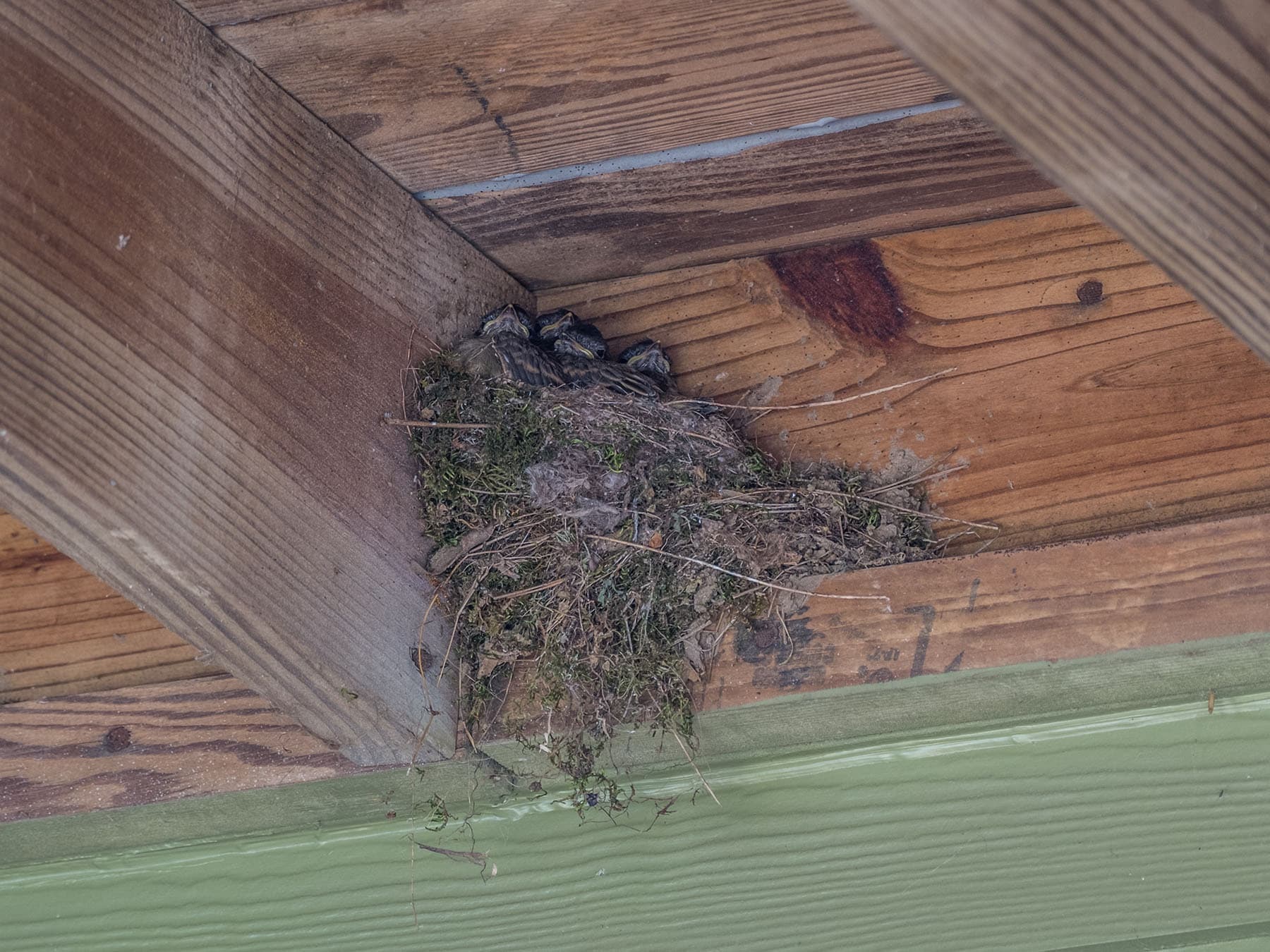
Phoebes nest on a ledge or in a niche, nearly always with a roof close above: under bridges and eaves, on porch lights and beams, in barns and culverts, and still on rock outcrops along streams, one of their original sites. The nest is usually low, from under 3 feet up to about 16 feet (1-5 m) above the ground or water. Damp spots are avoided, because a mud nest can loosen there and fall.
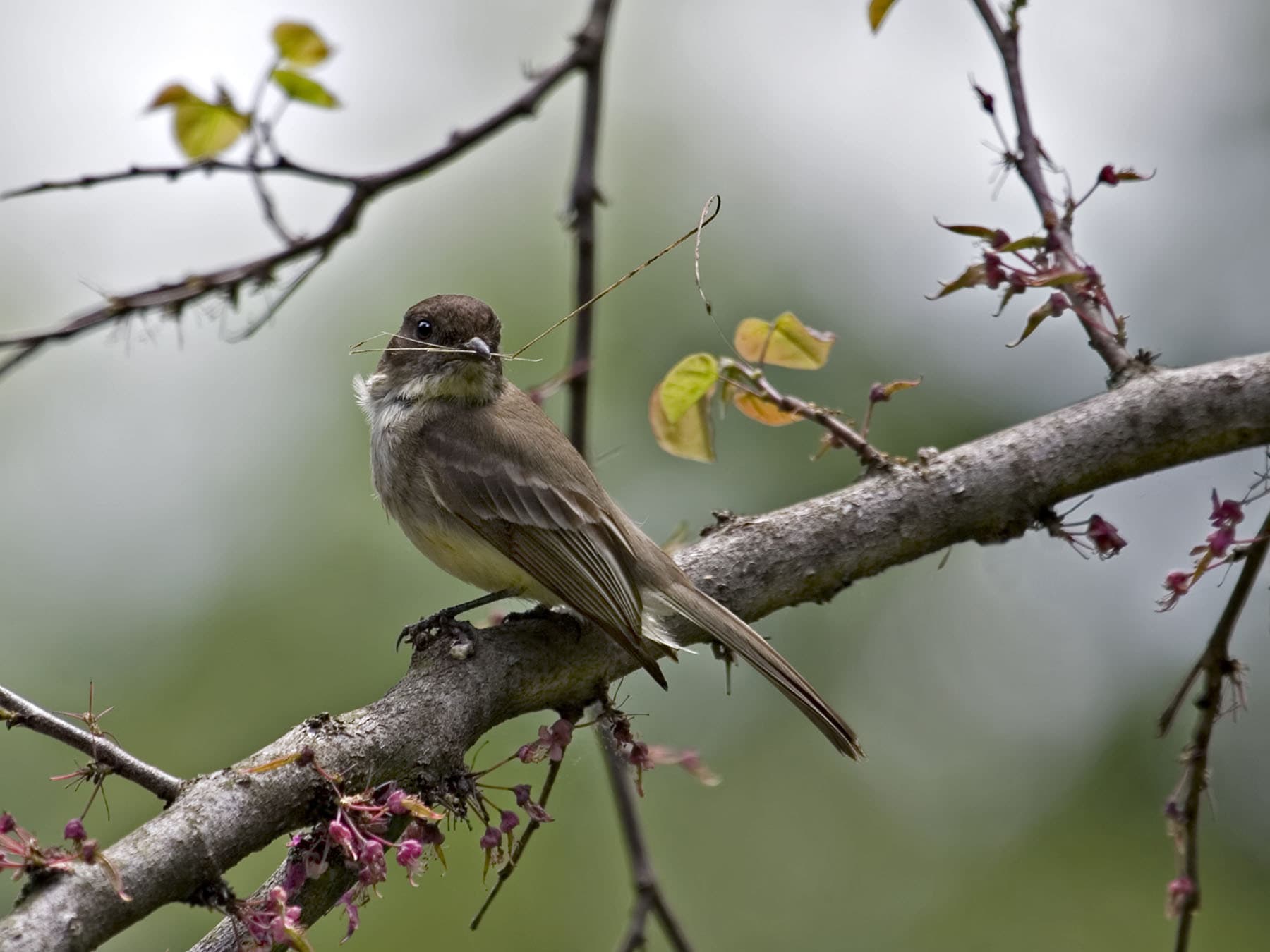
The female builds alone, often with the male following her to and fro. Her nest is a cup of mud and green moss with some leaves, lined with fine grass and hair; the green moss is always there. It is stuck to a wall or set on a ledge, about 4.5 inches (11-12 cm) across, with a cup about 2.5 inches (6.4 cm) wide. A first nest takes about a week to build, sometimes two.
Old nests are often repaired with a fresh rim of moss and a new lining and used again, the same year and the next. In a year, more than half (up to 78%) of the old nests already in place are renovated and used. Phoebes also take over old Barn Swallow and American Robin nests, and swallows use phoebe nests in turn.
More: Eastern Phoebe nesting, from the nest to the fledglings.
Nest shelves
Phoebes readily take to a nesting shelf. Fix it to a building 3 to 16 feet (1-5 m) up, right under an overhang, ideally near fresh water, and put it up before the breeding season.13 In a south-central Indiana study, platforms fixed inside round culverts were taken up fast: 17 of the first 20 were used in their first season, and after 10 more went up, 29 of 30 were used the next year.1
Eggs and young
The first eggs are laid in late March in the south of the main range, with laying peaking in mid-April in southern Illinois, Kansas and Indiana and starting in early May in northern Wisconsin. The clutch is usually 4 or 5 white eggs, sometimes with a few reddish-brown dots, usually on the last egg laid. The female alone incubates, for about 16 days, and she sleeps in the nest cup every night, even before laying begins.
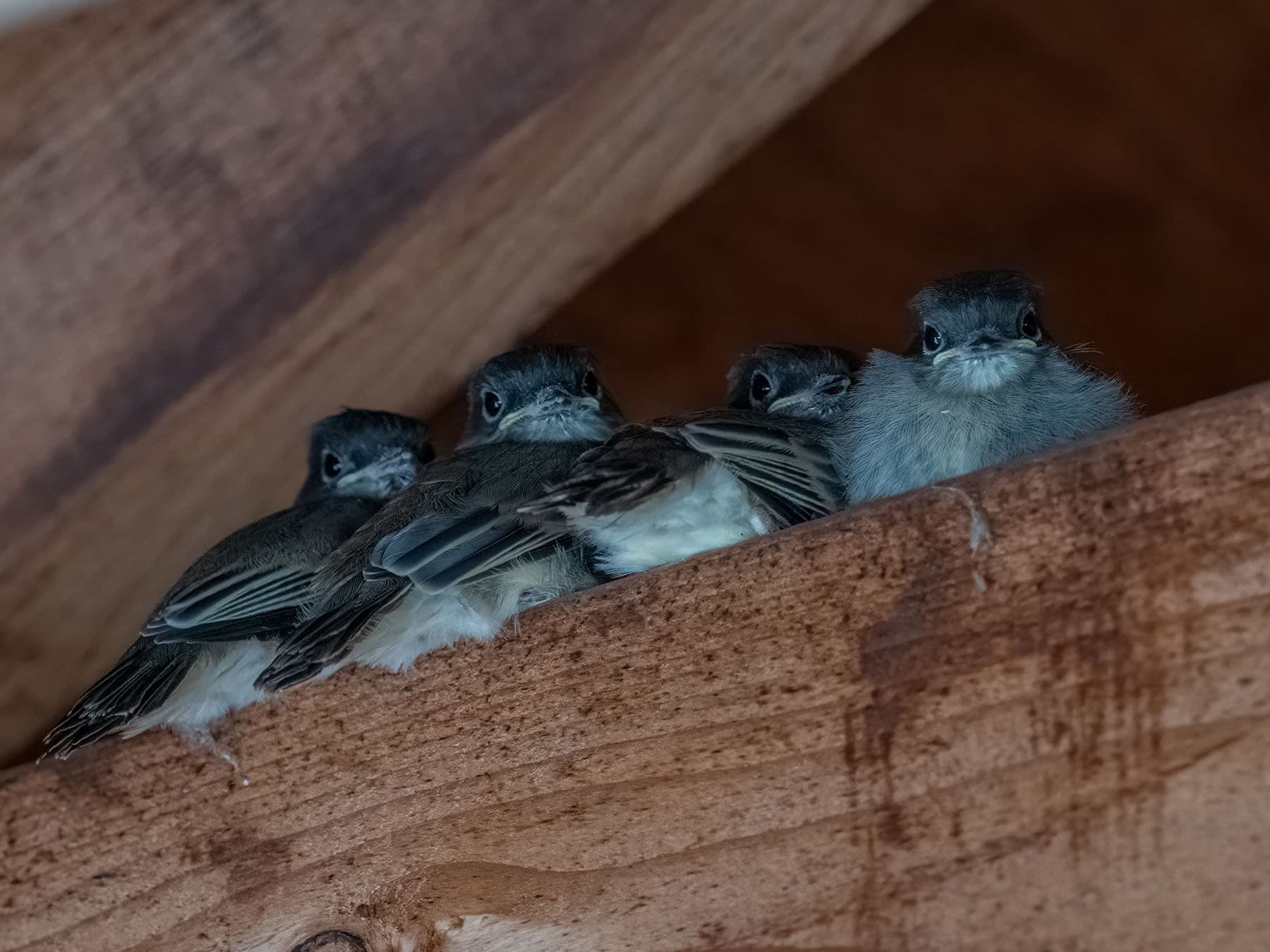
Both parents feed the chicks, the female more. At one nest of four young, the parents made nearly 9,000 feeding trips from hatching to fledging.14 The young leave at about 16 days (16-20), hide in low cover near the nest for a week, start feeding themselves in the second week and are independent about 2 weeks after leaving.
Most pairs nest twice a year, usually at the same site and with the same mate; in a northern Wisconsin study just over half the females tried a second brood. In southern Indiana a female raised about 6 young a year on average.15
Phoebes are often hosts of the Brown-headed Cowbird, though rates vary widely: none of the nests in one western Maryland study, about a quarter in eastern Kansas. In most nests a cowbird lays in, only the cowbird egg hatches.1
Behaviour
Why do phoebes wag their tails? A 2009 study points to a signal aimed at predators: the pumping may tell a predator that it has been seen.16
Phoebes are loners all year apart from their mates, and even a pair spends much of its time apart: the female often chases the male away, though he stays close to her while she builds. A male defends the area round the nest with song and chases, and breeding adults stay within about 330 feet (100 m) of it. Phoebes rarely hop; they fly from perch to perch on direct, steady wingbeats.
They are tolerant of people and often nest on lived-in houses, which is why so many people know them.
Lifespan and predators
In an Indiana study, at least 40% of birds over a year old survived each year, and birds of 3 or 4 are not unusual.1 The oldest on the North American banding records was at least 10 years 4 months old: banded as a young bird in Iowa in October 1979, it was found dead in Alberta in October 1989.17
Predators take far more eggs and chicks than adults are known to lose. Rat snakes, raccoons and coyotes are confirmed nest predators, and Blue Jays, crows, chipmunks, mice and House Wrens probably take eggs or young. Raccoons sometimes catch the sitting female; predation on adults is otherwise rarely recorded, though remains of one were found in a Northern Saw-whet Owl's nest box in Alberta.
Conservation
The Eastern Phoebe is common and widespread, with about 35 million birds in a Partners in Flight estimate for around 2010, and of low conservation concern.18 On the North American Breeding Bird Survey its numbers rose slightly from 1966 to 2025, by about 0.3% a year.19 Numbers dipped in the 2010s: the same estimates' 10-year figure to 2021 showed a 17% fall, but on the survey the index was back to its 2015 level by 2025. Severe winters in the southern US can also cut numbers for several years, as after 1976-77.
People helped it: buildings and bridges gave it many new nest sites, so it probably increased as the land was settled. It now relies on people for many of its nest sites. Replacing square concrete culverts and small bridges with round metal or plastic pipes removes nest sites, and clearing shrubs from streamsides makes good sites useless. In the US it is protected under the Migratory Bird Treaty Act.20
Similar birds
Often mistaken for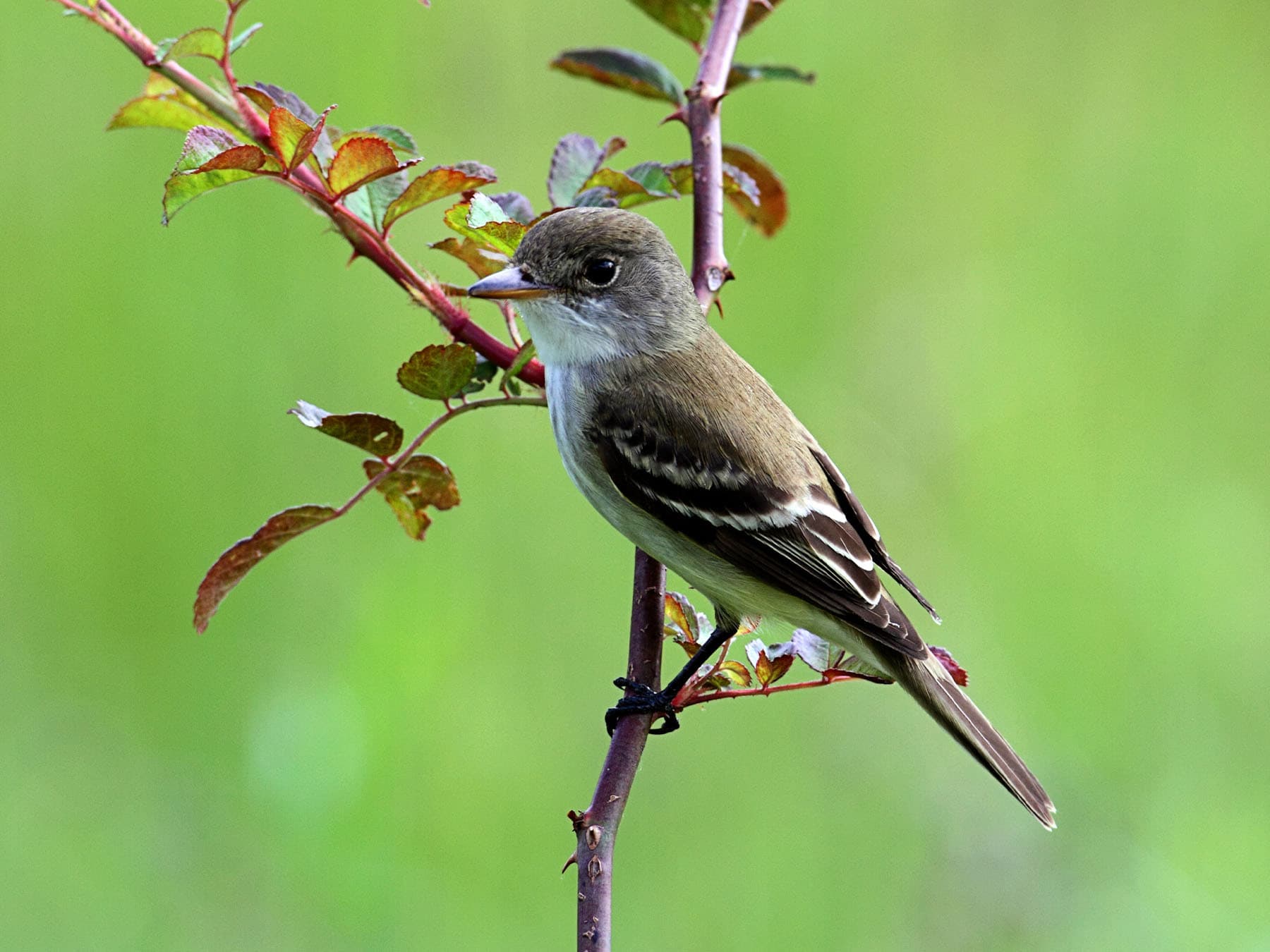

Eastern Phoebe guides
2 guidesQuick facts
- Length
- 14–17 cm
- Wingspan
- 26–28 cm
- Weight
- 16–21 g
- Lifespan
- oldest recorded 10 years 4 months
- Family
- Tyrant Flycatchers
- Migration
- Short-distance migrant
- Global status (IUCN)
- Least Concern
- World population
- About 35 million (Partners in Flight, about 2010)
- Population trend
- Common and widespread, of low conservation concern (Partners in Flight)
- Also called
- Phoebe
- Scientific name
- Sayornis phoebe
Questions
4Do Eastern Phoebes come back to the same nest?
Often. Adults rarely change sites between years, and old nests are often repaired and reused, so the same pair can nest in the same spot for 2 or 3 years. See nesting.
Do phoebes mate for life?
Not quite. Most pairs keep the same mate through the season, and when both birds survive the winter they rarely switch partners, because both come back to the same site. Some males have two mates at once.
Is an Eastern Phoebe rare?
No. It is common and widespread across central and eastern North America, and often nests on bridges, barns and houses near water. See where and when to see them.
Do Eastern Phoebes come to bird feeders?
Not usually. They live on flying insects and, in winter, small fruits, and we found no feeder food recommended for them in Birds of the World or Audubon's guide. A nesting shelf is the way to bring one close. See what they eat.
Sources
27- 1Weeks, H. P., Jr. (2020). Eastern Phoebe (Sayornis phoebe), version 1.0. Birds of the World (A. F. Poole, editor). Cornell Lab of Ornithology. doi:10.2173/bow.easpho.01 (opens in a new tab)
- 2National Audubon Society. Eastern Wood-Pewee. Guide to North American Birds. Accessed 1 November 2026. Source (opens in a new tab)
- 3National Audubon Society. Least Flycatcher. Guide to North American Birds. Accessed 1 November 2026. Source (opens in a new tab)
- 4National Audubon Society. Willow Flycatcher. Guide to North American Birds. Accessed 1 November 2026. Source (opens in a new tab)
- 5National Audubon Society. Say's Phoebe. Guide to North American Birds. Accessed 1 November 2026. Source (opens in a new tab)
- 6Nolan Jr., V. et al. (2020). Dark-eyed Junco (Junco hyemalis), version 1.0. Birds of the World (A. F. Poole and F. B. Gill, editors). Cornell Lab of Ornithology. doi:10.2173/bow.daejun.01 (opens in a new tab)
- 7National Audubon Society. Dark-eyed Junco. Guide to North American Birds. Accessed 1 November 2026. Source (opens in a new tab)
- 8Kroodsma, D. E. (1985). Development and use of two song forms by the Eastern Phoebe. Wilson Bulletin 97: 21-29. Accessed 1 November 2026.
- 9Kroodsma, D. E. and Konishi, M. (1991). A suboscine bird (Eastern Phoebe, Sayornis phoebe) develops normal song without auditory feedback. Animal Behaviour 42: 477-487. doi:10.1016/S0003-3472(05)80047-8 (opens in a new tab)
- 10Beal, F. E. L. (1912). Food of our important flycatchers. U.S. Department of Agriculture, Biological Survey Bulletin 44. Accessed 1 November 2026.
- 11Beheler, A. S., Rhodes, O. E. and Weeks, H. P. (2003). Breeding site and mate fidelity in Eastern Phoebes (Sayornis phoebe) in Indiana. The Auk 120: 990-999. doi:10.1642/0004-8038(2003)120[0990:BSAMFI]2.0.CO;2 (opens in a new tab)
- 12Cornell Lab of Ornithology. Eastern Phoebe. All About Birds. Accessed 1 November 2026. Source (opens in a new tab)
- 13NestWatch, Cornell Lab of Ornithology. Eastern Phoebe: Right Bird, Right House. NestWatch. Accessed 1 November 2026. Source (opens in a new tab)
- 14Kendeigh, S. C. (1952). Parental care and its evolution in birds. Illinois Biological Monographs 18. Accessed 1 November 2026.
- 15Weeks, H. P., Jr. (1979). Nesting ecology of the Eastern Phoebe in southern Indiana. Wilson Bulletin 91: 441-454. Accessed 1 November 2026.
- 16Carder, M. L. and Ritchison, G. (2009). Tail pumping by Eastern Phoebes: an honest, persistent predator-deterrent signal?. Journal of Field Ornithology 80: 163-170. doi:10.1111/j.1557-9263.2009.00218.x (opens in a new tab)
- 17USGS Bird Banding Laboratory. Longevity records of North American birds. USGS Eastern Ecological Science Center, Bird Banding Laboratory. Accessed 1 November 2026. Source (opens in a new tab)
- 18Partners in Flight (2023). Avian Conservation Assessment Database and Population Estimates Database. Bird Conservancy of the Rockies. Accessed 1 November 2026. Source (opens in a new tab)
- 19Hostetler, J. A. et al. (2026). The North American Breeding Bird Survey, Analysis Results 1966-2025. U.S. Geological Survey data release. doi:10.5066/P1OSNSFC (opens in a new tab)
- 20U.S. Fish and Wildlife Service (2026). 50 CFR 10.13: List of Birds Protected by the Migratory Bird Treaty Act. Electronic Code of Federal Regulations. Accessed 1 November 2026. Source (opens in a new tab)
- 21National Audubon Society. Eastern Phoebe. Guide to North American Birds. Accessed 1 November 2026. Source (opens in a new tab)
- 22National Audubon Society. Black Phoebe. Guide to North American Birds. Accessed 1 November 2026. Source (opens in a new tab)
- 23National Audubon Society. Eastern Kingbird. Guide to North American Birds. Accessed 1 November 2026. Source (opens in a new tab)
- 24National Audubon Society. Black-capped Chickadee. Guide to North American Birds. Accessed 1 November 2026. Source (opens in a new tab)
- 25Via, J. W. (1979). Foraging tactics of flycatchers in southwestern Virginia. The Role of Insectivorous Birds in Forest Ecosystems (J. G. Dickson et al., editors). Academic Press. Accessed 1 November 2026.
- 26Smith, W. J. (1969). Displays of Sayornis phoebe (Aves, Tyrannidae). Behaviour 33: 283-322. Accessed 1 November 2026.
- 27Hill, S. R. and Gates, J. E. (1988). Nesting ecology and microhabitat of the Eastern Phoebe in the central Appalachians. American Midland Naturalist 120: 313-324. Accessed 1 November 2026.

Checked by
Nathan Cope, founder and editor
Nathan founded Birdfact and leads its writers and contributors in the UK, the US and Canada. He has watched and studied birds for more than ten years, and checks every article and species guide before it’s published.