Published 1 Nov 2026
Eastern Phoebe Sounds: Song, Calls and What They Mean
By the Birdfact teamChecked by Nathan Cope
The Eastern Phoebe sings its name, a raspy fee-bee, and mixes in a stuttered fee-b-be-bee. Both sexes give a short chip all year. Hear them, see the two songs on a spectrogram, and learn to tell a phoebe from a chickadee or a pewee.
On this page10 sections
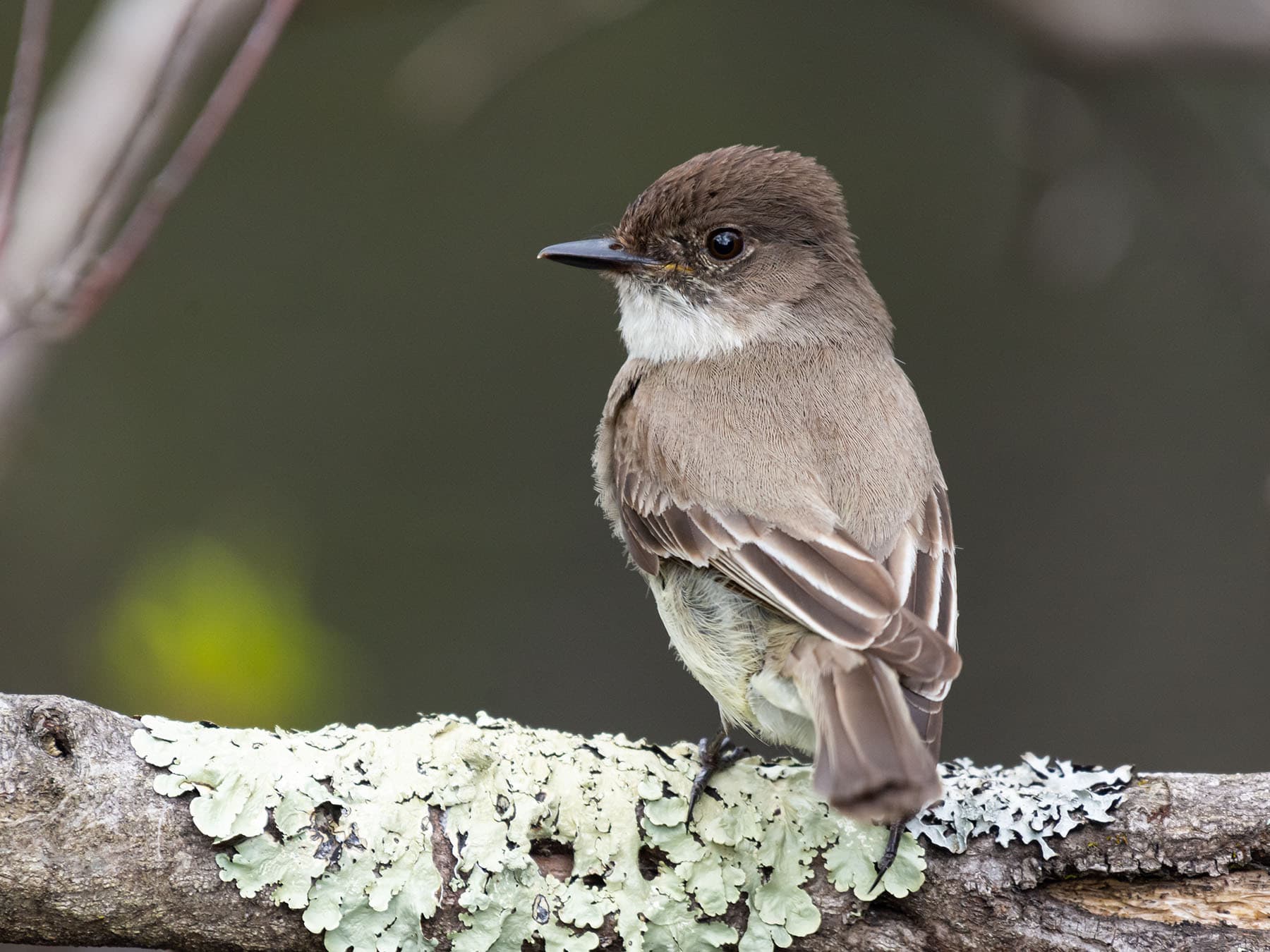
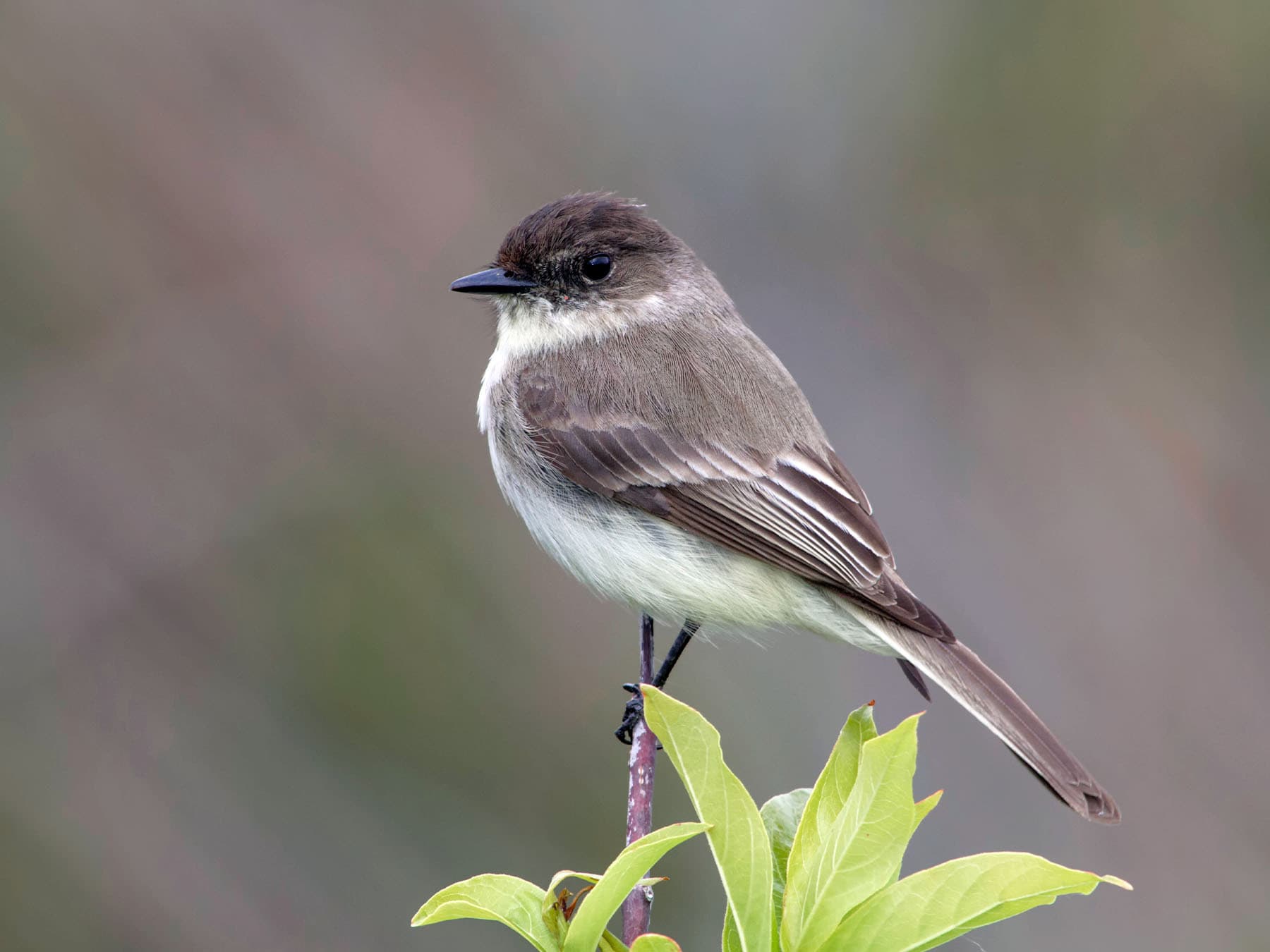
The Eastern Phoebe is named for its song. The male's song is a raspy, two-part fee-bee, and both sexes give a short chip all year. This page plays both, shows what the song looks like, and explains how to tell a phoebe from the chickadee and the pewee, which also sing something like a name. For the bird itself, see the Eastern Phoebe guide.
What does an Eastern Phoebe sound like?
A quick, rough fee-bee, about half a second long and repeated again and again from a perch, often with a stuttered version, fee-b-be-bee, mixed in. Between songs, and all through the year, listen for a clear, short chip, which is often the first sign of a phoebe nearby.
The song: fee-bee and fee-b-be-bee
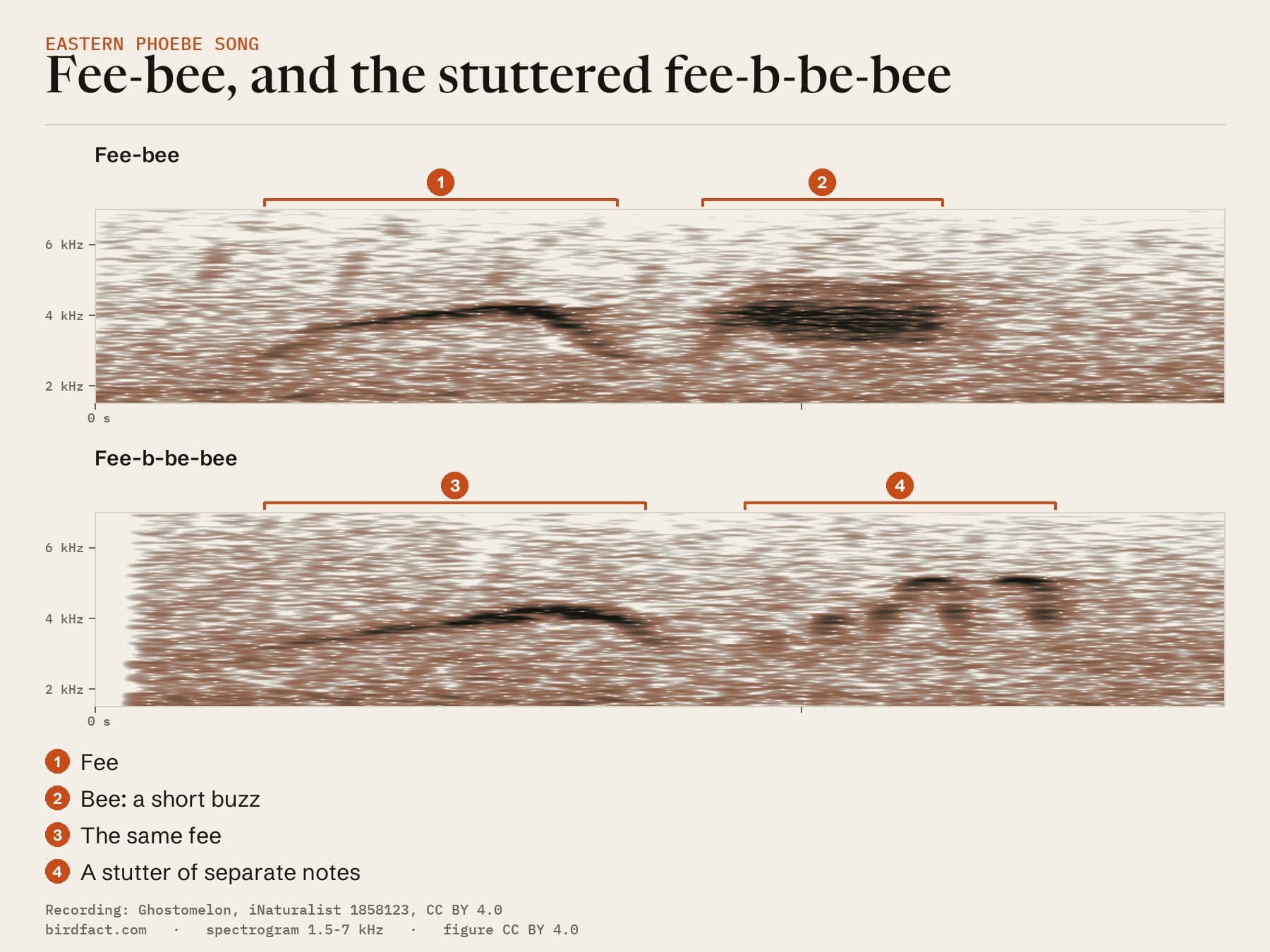
Each male regularly sings two forms of the song, often alternating them. The one he uses most is the fee-bee that gives the bird its name. The other starts the same way but seems to stutter on the second half: fee-b-be-bee. In the stuttered form the "bee" is quite different, a run of separate notes rather than one buzz.1
In our recordings, an Indiana male sang one of each, the second starting about a second and a half after the first. Both open with the same arched note near 4 kHz; then the first ends in a short buzz and the second in four or five separate notes.
How the two songs are mixed
A song bout can be all fee-bees, or about half stuttered ones, but rarely more. Males sing more of the stuttered form after a fight, whether they have just chased off another male or been attacked by their own mate.2
Speed matters too. In one-minute samples of dawn song from five males in 1984, three wild birds near Amherst, Massachusetts, and two of the hand-reared birds described below, the faster a male sang, the more stuttered songs he mixed in. One male singing under 25 songs a minute gave more than 90% fee-bees in 9 of 10 sampled minutes; another never went above 80% even at 10 songs a minute. A stuttered song nearly always comes straight after a fee-bee, a little sooner than one fee-bee follows another, and two stuttered songs in a row are rare.
On a close look at a spectrogram, one male's fee-bee can usually be told from another's, for example by how fast the "bee" buzzes, and each male's is very constant from one song to the next. The stuttered form varies more between males, in the number of its notes, but each male keeps to his own version.1
When phoebes sing
Males are singing when they reach their territories in early spring. An unmated male sings through much of the day. Once he has a mate and nesting begins, the only regular song is before dawn, when every territorial male sings; later in the day he sings mostly when another phoebe or a predator turns up. There is some song in late summer and on the wintering grounds too.2
Females sing as well, but rarely and briefly, in the early morning near their mate.
A song that is not learned
Most songbirds, such as wrens and thrushes, learn their songs by copying adults. The phoebe, a tyrant flycatcher, does not need to. In a 1981 experiment, five nestlings about 5 to 6 days old were taken from a nest in Amherst, Massachusetts, and hand-reared; in the laboratory they heard recorded Willow Flycatcher and Marsh Wren songs, but no phoebe song. All five developed normal fee-bee songs, indistinguishable on sonograms from wild birds' songs; each also sang the stuttered form and used the two in early-morning singing just as wild birds do. The two females sang only after a testosterone implant.1
A later study went further: phoebes that could not hear themselves still sang perfectly normal songs.3
Calls
The chip is the call you will hear most, from both sexes, all year and anywhere: in spring and summer, on migration and in winter. When a phoebe, usually the female, finds a predator near the nest, the chips become loud, frequent and insistent.2
Mostly in the breeding season, and mainly from males, there are also a few two-syllable calls, written as twee-t or t-keet. Now and then a male gives a harsh, nasal chatter of up to 30 notes as he flutters in front of a spot he is offering a female as a nest site. Parents give a food call on about a quarter of visits to the nest, and in tests captive nestlings gaped and begged when they heard it.
Not every phoebe sound is a call. A phoebe snaps its bill shut with a loud click when feeding, especially when it misses, and as a threat to predators near the nest; a bird in a bander's hand snaps hard enough to startle a beginner.
Phoebe, chickadee or pewee
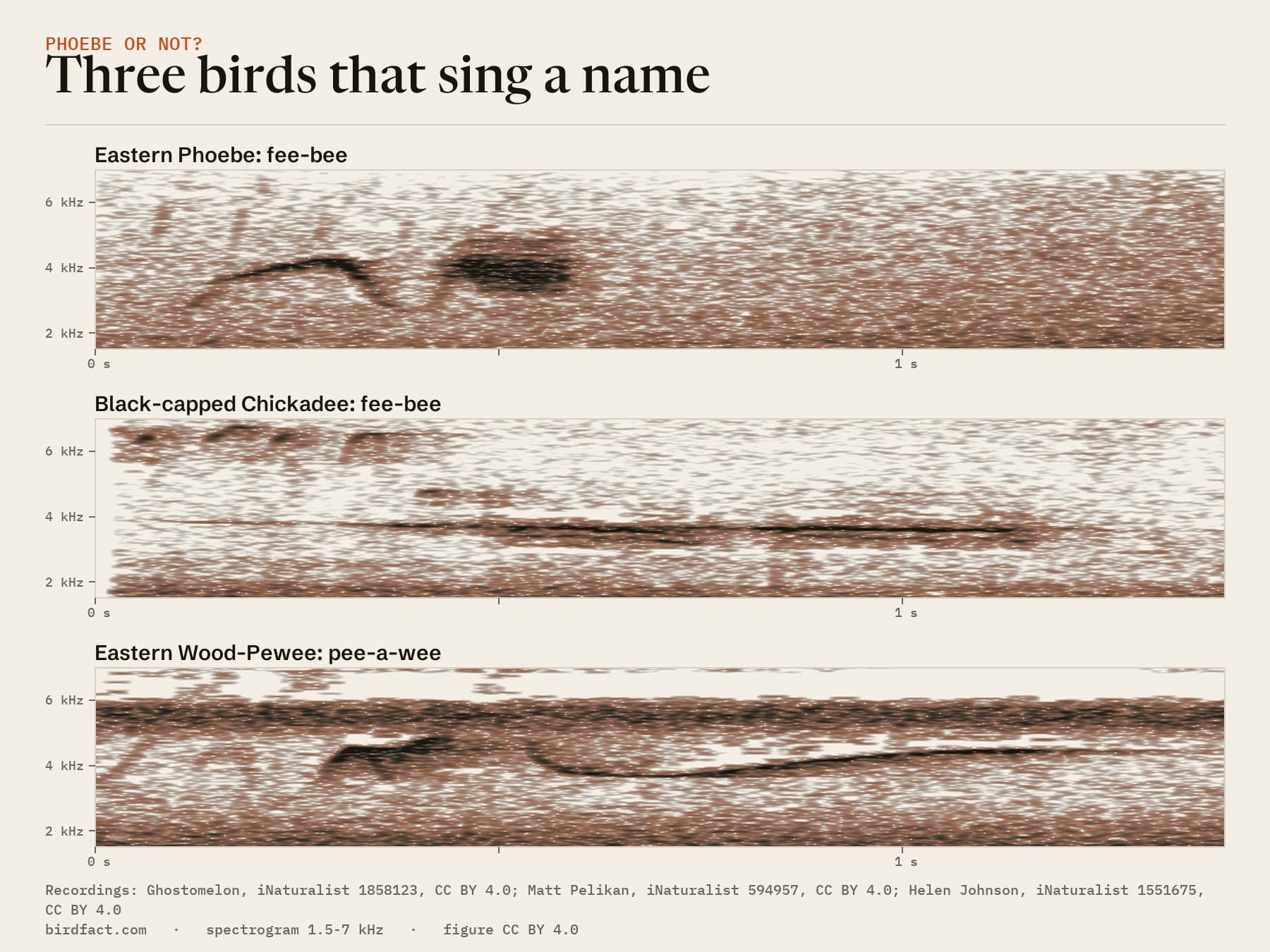
Three common eastern birds sing something like a name. The Black-capped Chickadee's song is two clear, whistled notes, fee-bee, the second one lower and often given twice.4 The phoebe's is much quicker and raspier.
The Eastern Wood-Pewee's song is a slow, plaintive pee-ah-weee, or a shorter pee-weee that drops at the end, sung from leafy forest, where the bird is more often heard than seen.5 Heard side by side, the phoebe's song is the brisker and the pewee's the more mournful.6 Timing helps too: across much of their range the first phoebes are back in March, while pewees return from the tropics mostly in May.
In the West, Say's Phoebe gives a mellow, plaintive, whistled pee-ur, and the Black Phoebe sings a thin, buzzy pi-tsee.7, 8
Questions
What bird makes a sound like "phoebe"?
Usually the Eastern Phoebe itself, which sings a rough fee-bee. A clear, whistled fee-bee is more likely a Black-capped Chickadee. See phoebe, chickadee or pewee.
Do male and female phoebes sound different?
Both give the chip. The song is the male's; females sing only rarely and briefly, and the chatter at a nest site is a male call.
Does the Eastern Phoebe have a distress call?
Its alarm is loud, frequent, insistent chips from a bird that has found a predator near its nest, most often the female. See Eastern Phoebe nesting for the nest itself.
About the recordings
Sources
- Kroodsma, D. E. (1985). Development and use of two song forms by the Eastern Phoebe. Wilson Bulletin 97: 21-29. Accessed 1 November 2026. Source
- Weeks, H. P., Jr. (2020). Eastern Phoebe (Sayornis phoebe), version 1.0. Birds of the World (A. F. Poole, editor). Cornell Lab of Ornithology. doi:10.2173/bow.easpho.01
- Kroodsma, D. E., Konishi, M. (1991). A suboscine bird (Eastern Phoebe, Sayornis phoebe) develops normal song without auditory feedback. Animal Behaviour 42: 477-487. doi:10.1016/S0003-3472(05)80047-8
- National Audubon Society. Black-capped Chickadee. Guide to North American Birds. Accessed 1 November 2026. Source
- National Audubon Society. Eastern Wood-Pewee. Guide to North American Birds. Accessed 1 November 2026. Source
- BirdNote (2018). Is That a Phoebe or Pewee Calling? Audubon Magazine (National Audubon Society). Accessed 1 November 2026. Source
- National Audubon Society. Say's Phoebe. Guide to North American Birds. Accessed 1 November 2026. Source
- National Audubon Society. Black Phoebe. Guide to North American Birds. Accessed 1 November 2026. Source
- Tyler Ekholm (2025). Eastern Phoebe singing, Topsfield, Massachusetts, 22 March 2025 (iNaturalist sound 1344771). iNaturalist. Accessed 1 November 2026. Source
- Anne Parker (2023). Eastern Phoebe calls near its nest, Kilmarnock, Virginia, 4 May 2023 (iNaturalist sound 680555). iNaturalist. Accessed 1 November 2026. Source
- Ghostomelon (2026). Eastern Phoebe song, Yorktown, Indiana, 12 April 2026 (iNaturalist sound 1858123). iNaturalist. Accessed 1 November 2026. Source
- Matt Pelikan (2023). Black-capped Chickadee song, Martha's Vineyard, Massachusetts (iNaturalist sound 594957). iNaturalist. Accessed 1 November 2026. Source
- Helen Johnson (2025). Eastern Wood-Pewee song, Montgomery County, Maryland, 2 July 2025 (iNaturalist sound 1551675). iNaturalist. Accessed 1 November 2026. Source
- Cornell Lab of Ornithology. Eastern Phoebe. All About Birds. Accessed 1 November 2026. Source