Species Profile
Say's Phoebe
Sayornis saya
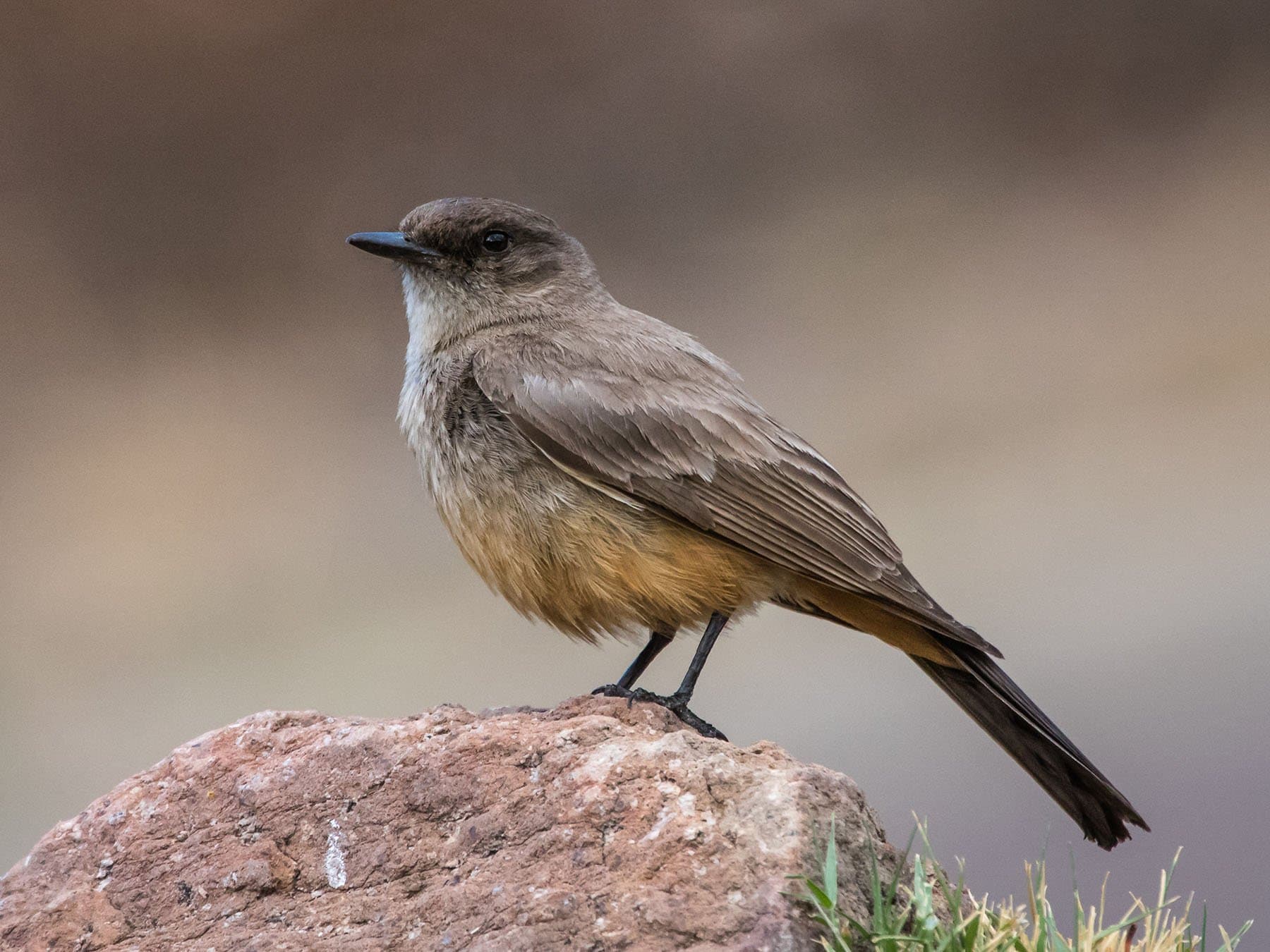
Say's Phoebe perched on a reddish-brown rock, showing brownish-gray plumage, dark eye, and buffy belly. Green grass visible.
Quick Facts
Conservation
LCLeast ConcernLifespan
3–7 years
Length
17–20 cm
Weight
18–22 g
Wingspan
30–33 cm
Migration
Partial migrant
Pale grey above and washed with warm cinnamon below, Say's Phoebe is the quintessential bird of the arid American West — a restless, tail-pumping flycatcher equally at home on an arctic tundra ledge in Alaska and a sun-baked canyon wall in Arizona. It breeds farther north than any other flycatcher in the world, and has lived in the American Southwest for at least 400,000 years.
Think you've spotted a Say's Phoebe?
Upload a photo and we'll confirm it instantly
Confirm with a PhotoAppearance
Say's Phoebe is a medium-sized, barrel-chested flycatcher with a large head, long black tail, and a distinctively flat-topped or slightly peaked crown that gives it a subtly angular silhouette. Adults measure 17–20 cm in length with a wingspan of 30–33 cm, weighing a modest 18–22 g — roughly the same as a large marshmallow.
The upperparts are soft, pale brownish-grey, darkening slightly on the head and around the lores and eye, which creates a faint dusky mask. The throat and breast are clean grey, transitioning cleanly into the species' most distinctive feature: a warm cinnamon or salmon-pink belly that deepens to a more orange-rufous tone around the vent and undertail coverts. Field guides describe this colour variously as apricot, tawny-cinnamon, and pale rufous — the variation reflects both individual differences and the quality of the light.
The tail is long, square-tipped to slightly notched, and distinctly black — a sharp contrast against the pale underparts that makes it easy to pick out even at distance. The bill is short, straight, and black. Eyes are dark brown. Adult plumage carries no wingbars, eye-rings, or bright patches; the cinnamon belly and black tail are the two field marks to lock onto.
The species is sexually monomorphic: males and females are essentially identical in plumage, and there is no significant seasonal change. Juveniles are browner overall, with buffy-orange to whitish wingbars and a yellowish gape; these wingbars fade as the bird matures into its first winter. The lack of wingbars in adult plumage is itself a useful identification feature, separating Say's Phoebe from several superficially similar flycatchers.
Identification & Characteristics
Colors
- Primary
- Grey
- Secondary
- Pale Orange
- Beak
- Black
- Legs
- Dark Brown
Markings
Warm cinnamon to salmon-pink belly contrasting with grey breast; long black tail; pale brownish-grey upperparts; no wingbars or eye-ring in adult plumage
Tail: Long, square-tipped to slightly notched, distinctly black; frequently pumped and fanned while perched
Attributes
Understanding Attributes
Rated 0–100 based on research and observation. A score of 50 is average across all bird species. These attributes are relative and don't necessarily indicate superiority.
Habitat & Distribution
Say's Phoebe is a bird of dry, open, and sparsely vegetated landscapes. It favours sagebrush flats, badlands, dry barren foothills, canyons, desert borders, semi-arid grasslands, prairies, and ranch country. In the northern part of its range it occupies dry upland tundra. Unlike the Eastern Phoebe and Black Phoebe, Say's Phoebe has no attachment to water and is rarely found near streams or ponds. It actively avoids heavily forested areas.
The breeding range is enormous — from central Mexico north through the western United States and western Canada all the way to central Alaska, including the arctic tundra at the foot of the Brooks Range. This makes it the northernmost-breeding flycatcher in the world. Breeding occurs across a broad elevation range, from around 300 m up to approximately 2,835 m, with records up to about 9,300 feet in some areas. Year-round residents are found from western Colorado and southern California east to the western Texas Panhandle and south through western Mexico, including Baja California. Wintering birds extend south through Mexico to northern Central America, including Belize and Guatemala.
In the United States, Say's Phoebe is most common and widespread in Arizona, New Mexico, California, Colorado, Utah, Nevada, Idaho, Oregon, Washington, Montana, Wyoming, and Texas — particularly the Trans-Pecos region and western Edwards Plateau. The species is absent from the Pacific Coast west of the Cascades and Sierra Nevada except locally in south-central California and western Oregon. An estimated 5% of the North American population breeds within the Boreal Forest zone.
For North American birdwatchers, Say's Phoebe is a reliable year-round resident across much of the arid West. In Washington state, it is one of the earliest spring arrivals of any flycatcher, often appearing by late February or early March. During autumn migration, individuals regularly stray far east of their normal range, with regular fall records from New England states and Nova Scotia, Canada. Vagrants have reached Florida, the Mid-Atlantic coast, and once even Bermuda.
Where to See This Bird
Explore regional guides for locations where this bird has been recorded.
Diet
Say's Phoebe is almost exclusively insectivorous. Its diet spans beetles, grasshoppers, crickets, flies, wild bees, wasps, winged ants, moths, dragonflies, and true bugs, with spiders and millipedes taken opportunistically. Bees and wasps are particularly important prey items. The species rarely eats plant matter — berries are occasionally consumed during prolonged cold spells when insects are unavailable, but plant material makes up less than 5% of the diet overall. Small fish have been recorded as prey on rare occasions.
The primary foraging technique is aerial hawking: the bird launches from a low perch, intercepts an insect in mid-air, and returns to a perch to process it. It also pounces on insects on the ground, gleans prey from low foliage, and hovers low over open fields before dropping to capture ground-dwelling prey. Near water, it will feed just above the surface.
Indigestible insect parts — exoskeletons, wings, and legs — are compacted and regurgitated as pellets, a behaviour more commonly associated with owls and raptors. This pellet-casting also serves a water-conservation function: by processing prey this way, the bird retains moisture that would otherwise be lost through digestion. The diet of nestlings differs from that of adults, with chicks receiving a higher proportion of soft-bodied prey items that are easier to swallow and digest.
One of the most striking aspects of Say's Phoebe's ecology is its complete independence from standing water. Unlike most birds, it never needs to drink directly — its insect diet provides all the moisture it requires. This adaptation makes it uniquely suited to the driest desert environments in North America, where water sources may be absent for many kilometres.
Behaviour
Say's Phoebe is a perch-and-sally hunter, spending much of its day scanning from a low vantage point — a fence post, a rock, a shrub tip, or a wire — before launching out to snatch insects in mid-air and returning to the same or a nearby perch. This sit-and-wait strategy is punctuated by bouts of hovering low over open ground, kestrel-style, before dropping to take prey from the surface.
The tail is in near-constant motion. Say's Phoebe pumps and fans its tail repeatedly while perched, a behaviour shared with the other two phoebe species and useful for identification at distance. The tail-pumping appears to serve a communication function, though it also occurs when the bird is simply resting.
Outside the breeding season, Say's Phoebes are largely solitary. Pairs form during the breeding season, and males defend nesting territories through song and countersinging against rival males. Males perform flight-song displays — hovering over open fields while singing — particularly during courtship. When escorting a female to a potential nest site, the male flutters his wings and chatters until she makes her selection.
The species adapts readily to human presence. It nests on buildings, barns, bridges, and other structures without apparent disturbance, and will forage around farmyards and ranch buildings where insect activity is high. This tolerance of people makes it one of the more approachable western flycatchers, often allowing close observation from a vehicle or building.
Calls & Sounds
Say's Phoebe is a suboscine flycatcher, which means its vocalisations are innate rather than learned. Unlike true songbirds (oscines), which acquire their songs through imitation during a critical developmental window, Say's Phoebe is born knowing its calls — no tutor required. This has implications for how the species communicates: its vocal repertoire is relatively fixed and consistent across its vast range, without the regional dialects that characterise many learned-song species.
The primary song is a mellow, plaintive, slurred whistle rendered as pee-ur or phee-ur, with a falling, slightly melancholy quality. A second common vocalisation is a burry, hiccupping note transcribed as pit-tsee-ar or pidiweew. The Eastside Audubon Society describes the calls as soft, low whistles that typically alternate: pidiweew, pidireep, pidiweew, pidireep. The song begins at a notably high pitch before levelling off — a distinctive trait that separates it from the Eastern and Black Phoebes.
Males sing primarily to defend nesting territory, usually from an exposed perch, and during the early stages of courtship. They also perform flight-song displays, singing while hovering over open fields. Almost all singing is done by males, though a small number of females also vocalise. Call types include buzzes, chirps, and whistles. The species can be quite vocal at times but is also capable of going undetected when quiet — a useful reminder that absence of song does not mean absence of bird.
Flight
In flight, Say's Phoebe has a buoyant, slightly undulating action typical of the phoebe group, with quick wingbeats interspersed with brief glides. The long black tail is conspicuous and often fanned or flared during aerial manoeuvres, adding to the bird's distinctive silhouette.
One of the most useful flight features is the appearance of the outer primary wing feathers, which are notably pale and translucent — giving the wings a washed-out, almost bleached look that has been compared to the wing pattern of a female Mountain Bluebird. This translucency is visible when the bird is backlit or flying against a bright sky, and can be a useful confirmatory feature at distance.
Say's Phoebe regularly hovers low over open ground in a kestrel-like manner, hanging in place on rapidly beating wings before dropping to take prey from the surface. This hovering behaviour is more sustained and deliberate than the brief hover-and-drop of most flycatchers, and is a useful behavioural field mark in open country where the bird may be distant. The tail is often spread and pumped during these hovering bouts. Aerial pursuits of flying insects are swift and direct, with the bird snapping up prey and returning to a perch in a single fluid arc.
Nesting & Breeding
The breeding season runs from late March through late August, with peak egg-laying varying by elevation and latitude — early April at lower elevations, late May at higher ones. Males typically arrive on breeding grounds before females and establish territories through song from exposed perches.
Nest sites are highly variable but share one consistent feature: overhead shelter. Rocky ledges and crevices in cliffs or canyon walls, caves, wells, mine shafts, dirt banks, barn rafters, eaves of buildings, and the undersides of bridges all serve as nest locations. The species will also take over old nests built by Cliff Swallows, Barn Swallows, Bank Swallows, and American Robins. Unlike the Eastern Phoebe, Say's Phoebe uses no mud in nest construction.
The female builds the open cup nest alone, using plant stems, sage, grasses, forbs, moss, wood, and spiderwebs to form the base, then lining it with hair, wool, feathers, or paper. Nests are approximately 15 cm wide and 18 cm long, with an inner cup around 10 cm in diameter. Clutch size is typically 4–5 eggs, occasionally up to 7. Eggs are pure white and mostly unmarked, though some — thought to be the last laid in a clutch — may carry small reddish or brown spots. Eggs measure approximately 18–22 mm long and 14–17 mm wide.
Incubation is performed by the female alone and lasts 12–14 days (range 12–18 days). Chicks hatch mostly naked with eyes closed. Both parents feed the nestlings, and young leave the nest 14–16 days after hatching (range 13–21 days). Pairs raise 1–2 broods per year, sometimes 3 in the south. Nest-site fidelity is strong: one pair in central Kansas reused the same nest for five consecutive years, and one or both birds frequently return to the same territory in subsequent seasons.
Lifespan
Say's Phoebe typically lives 3–7 years in the wild, with a maximum recorded lifespan of 8 years. As with most small passerines, first-year mortality is the highest — many birds do not survive their first winter migration. Those that do tend to show strong site fidelity, returning to the same breeding territories year after year, which likely improves their survival odds by reducing the energy costs of finding new nest sites.
The main causes of mortality are predation (particularly of eggs and nestlings by snakes, corvids, and small mammals), collision with vehicles and windows, and the hazards of migration. Cold snaps that suppress insect activity can also be fatal, particularly for birds wintering at the northern edge of the winter range where the insect supply is less reliable.
Compared to the Eastern Phoebe, which has a similar body size and ecology, Say's Phoebe's lifespan is broadly comparable. The Eastern Phoebe's maximum recorded age is around 10 years, suggesting Say's Phoebe may be capable of slightly longer survival than current records indicate. Both species benefit from strong nest-site fidelity and tolerance of human structures, which reduces the energy expenditure associated with territory establishment each spring.
Conservation
Say's Phoebe is listed as Least Concern on the IUCN Red List (2019). BirdLife International estimates the global population at approximately 5.9 million mature individuals, while Partners in Flight puts the global breeding population at 4–10 million, with around 85% spending at least part of the year in the United States, 62% in Mexico, and 6% breeding in Canada.
The population trend is positive. North American Breeding Bird Survey data from 1966 to 2015 recorded a small but consistent annual increase. Across 635 BBS routes in the western US and Canada between 1966 and 2004, the species showed a +1.6% annual increase; in Texas the increase was stronger, at +2.9% per year. The species scores 9 out of 20 on the Continental Concern Score (Cornell Lab/Partners in Flight) and is not on the State of North America's Birds Watch List.
No major threats are currently identified. Say's Phoebe adapts well to human-modified landscapes and may actually benefit from the proliferation of buildings, bridges, and barns in arid regions, which provide additional nest sites where natural ledges are scarce. NatureServe ranks the species G5 — globally secure. Climate change is a potential long-term concern, with modelled projections suggesting range shifts under warming scenarios, though the species' broad ecological tolerance and northward range expansion suggest considerable resilience.
Say's Phoebe is protected under the US Migratory Bird Treaty Act. There are no active conservation programmes targeting the species specifically, as its population is healthy and growing.
Population
Estimated: Approximately 5.9 million mature individuals (BirdLife International, 2025); Partners in Flight estimates 4–10 million globally
Trend: Increasing
Increasing. North American Breeding Bird Survey data (1966–2015) show a consistent annual increase of +1.6% across 635 western routes, with a stronger +2.9% annual increase in Texas.
Elevation
300–2,835 m (approximately 1,000–9,300 ft)
Additional Details
- Family:
- Tyrannidae (Tyrant Flycatchers)
- Subspecies:
- Two subspecies recognised: S. s. saya (nominate, covering the vast majority of the range from Alaska to southern Mexico) and S. s. quiescens (Grinnell, 1926), restricted to the northern half of Baja California and Isla de Cedros — slightly paler than the nominate.
- Clutch size:
- 3–6 eggs (typically 4–5), occasionally up to 7
- Diet detail:
- Almost exclusively insectivorous; beetles, grasshoppers, crickets, flies, bees, wasps, winged ants, moths, dragonflies, true bugs, spiders, millipedes; plant matter
- Fledging age:
- 14–16 days (range 13–21 days)
- Broods per year:
- 1–2 (sometimes 3 in southern parts of range)
- Incubation period:
- 12–14 days (range 12–18 days), by female alone
- Conservation score:
- 9/20 Continental Concern Score (Cornell Lab/Partners in Flight); NatureServe G5 (globally secure)
Similar Species
Three species are most likely to cause confusion with Say's Phoebe in the field. The Eastern Phoebe overlaps with Say's in the Great Plains and occasionally further west. It is darker above, with a blackish head and no cinnamon on the belly — the underparts are whitish with a faint olive-yellow wash in fresh plumage. Eastern Phoebe also pumps its tail, but lacks the black tail contrast and warm belly tones of Say's.
The Black Phoebe shares the western range but is strikingly different: jet black above and on the breast, with a clean white belly. It is almost always found near water — streams, ponds, irrigation ditches — whereas Say's Phoebe avoids water entirely. The two species rarely occupy the same microhabitat.
Female and immature Western Kingbirds can appear superficially similar at distance — both are grey-brown above with a pale orange-yellow belly. However, Western Kingbirds are noticeably larger (22–24 cm), have a yellow rather than cinnamon belly, and show distinctive white outer tail feathers. They also lack the constant tail-pumping behaviour of Say's Phoebe. Ash-throated Flycatchers are another potential confusion species in arid western habitats, but are larger, with a pale yellow belly, rufous tail, and two distinct wingbars — features absent in adult Say's Phoebe.
Taxonomy And Naming
Say's Phoebe belongs to the genus Sayornis, which contains three species: Say's Phoebe (S. saya), the Eastern Phoebe (S. phoebe), and the Black Phoebe (S. nigricans). All three are medium-sized, tail-pumping flycatchers of the family Tyrannidae, but they occupy largely non-overlapping ecological niches: the Eastern Phoebe favours wooded areas near water in the east, the Black Phoebe is almost always found near water in the west, and Say's Phoebe occupies dry, open, waterless terrain across the western interior.
The species was first collected scientifically by Thomas Say (1787–1834) near present-day Cañon City, Colorado, in 1819, during Major Stephen Long's Rocky Mountain expedition. Say was the expedition's naturalist and is regarded as the 'Father of American Entomology' — fittingly, he first encountered a bird that would spend its life eating insects. On that same expedition, Say documented 10 other bird species new to science. The species was formally described by Charles Lucien Bonaparte in 1825, who named the genus Sayornis in Say's honour, combining his surname with the Greek ornis (bird). Bonaparte was a nephew of Napoleon and a significant figure in early American ornithology.
Two subspecies are currently recognised. The nominate S. s. saya covers the vast majority of the range from Alaska to southern Mexico. S. s. quiescens (Grinnell, 1926) is restricted to the northern half of Baja California and Isla de Cedros, and is slightly paler overall than the nominate form — a common pattern in desert-adapted birds, where paler colouration reduces heat absorption and improves camouflage against pale sandy substrates.
Birdwatching Tips
Say's Phoebe is one of the more obliging western flycatchers — it perches in the open, tolerates close approach, and has a habit of returning to the same fence post or rock repeatedly, making it easy to observe at leisure. The combination of cinnamon belly and long black tail is distinctive and visible at considerable distance, even in poor light.
In the United States, the best places to look are open, dry landscapes: sagebrush flats, canyon rims, ranch fences, desert roadsides, and the edges of agricultural land in the arid West. Arizona, New Mexico, and the Texas Trans-Pecos are particularly reliable year-round. In California, look in the Central Valley and the desert regions of the south and east. In Washington and Oregon, the species is most common east of the Cascades from late February through September.
The tail-pumping behaviour is a useful identification cue — Say's Phoebe bobs its tail almost constantly while perched, which draws the eye even when the bird is partially obscured. In flight, watch for the pale, translucent outer primary feathers, which give the wings a washed-out look reminiscent of a female Mountain Bluebird.
The most likely confusion species are the Eastern Phoebe (darker, no cinnamon belly, overlaps only in the Great Plains) and the Black Phoebe (black-and-white, found near water in the West). Female and immature Western Kingbirds can appear superficially similar but are larger, with a yellow belly and white outer tail feathers. Say's Phoebe is one of the earliest spring migrants in the West — if you see a flycatcher in Washington or Oregon in late February, it is almost certainly this species.
Did You Know?
- Say's Phoebe breeds farther north than any other flycatcher in the world — its range extends from central Mexico to the arctic tundra of Alaska at the foot of the Brooks Range, a latitudinal span of roughly 6,000 km. There is evidence it may be pushing even further north by nesting on the Alaska pipeline itself, using the structure as an artificial ledge.
- Say's Phoebe never needs to drink water directly. Its insect diet provides all the moisture it requires — a genuine desert adaptation that allows it to thrive in landscapes where water sources may be absent for many kilometres. Indigestible insect parts are regurgitated as pellets, conserving additional fluids in the process.
- Fossil evidence shows Say's Phoebe has been a resident of the American Southwest for at least 400,000 years. Pleistocene-era fossils have been found in Arizona, California, New Mexico, and Texas — making it one of the longest-established bird species in the region.
- The species is named after Thomas Say (1787–1834), the 'Father of American Entomology,' who first encountered the bird near present-day Cañon City, Colorado, in 1819. On that same Rocky Mountain expedition, Say documented 10 other bird species new to science. The genus name Sayornis — combining 'Say' with the Greek ornis (bird) — was coined by Charles Lucien Bonaparte, a nephew of Napoleon.
- One individual in central Kansas reused the same nest for five consecutive years — an exceptional record of nest-site fidelity for a small migratory passerine.
Records & Accolades
Northernmost Flycatcher
Breeds to arctic Alaska
Say's Phoebe breeds farther north than any other flycatcher in the world, reaching the arctic tundra at the foot of Alaska's Brooks Range.
Desert Survivor
Never needs to drink
Say's Phoebe obtains all its moisture from its insect diet and never needs to drink water directly — a rare adaptation among birds.
Ancient Resident
400,000 years in the Southwest
Pleistocene fossils of Say's Phoebe found in Arizona, California, New Mexico, and Texas show it has inhabited the American Southwest for at least 400,000 years.
Community Photos
Be the first to share a photo of the Say's Phoebe
Upload a PhotoIdentify Any Bird Instantly
- Upload a photo from your phone or camera
- Get an instant AI identification
- Ask follow-up questions about the bird
Monthly Birds in Your Area
- Personalised for your location
- Seasonal tips and garden advice
- Updated every month with new species