


Black-capped Chickadee
Chickadee · Poecile atricapillus
By the Birdfact teamChecked by Nathan Cope
On this page15 sections
How to recognise it
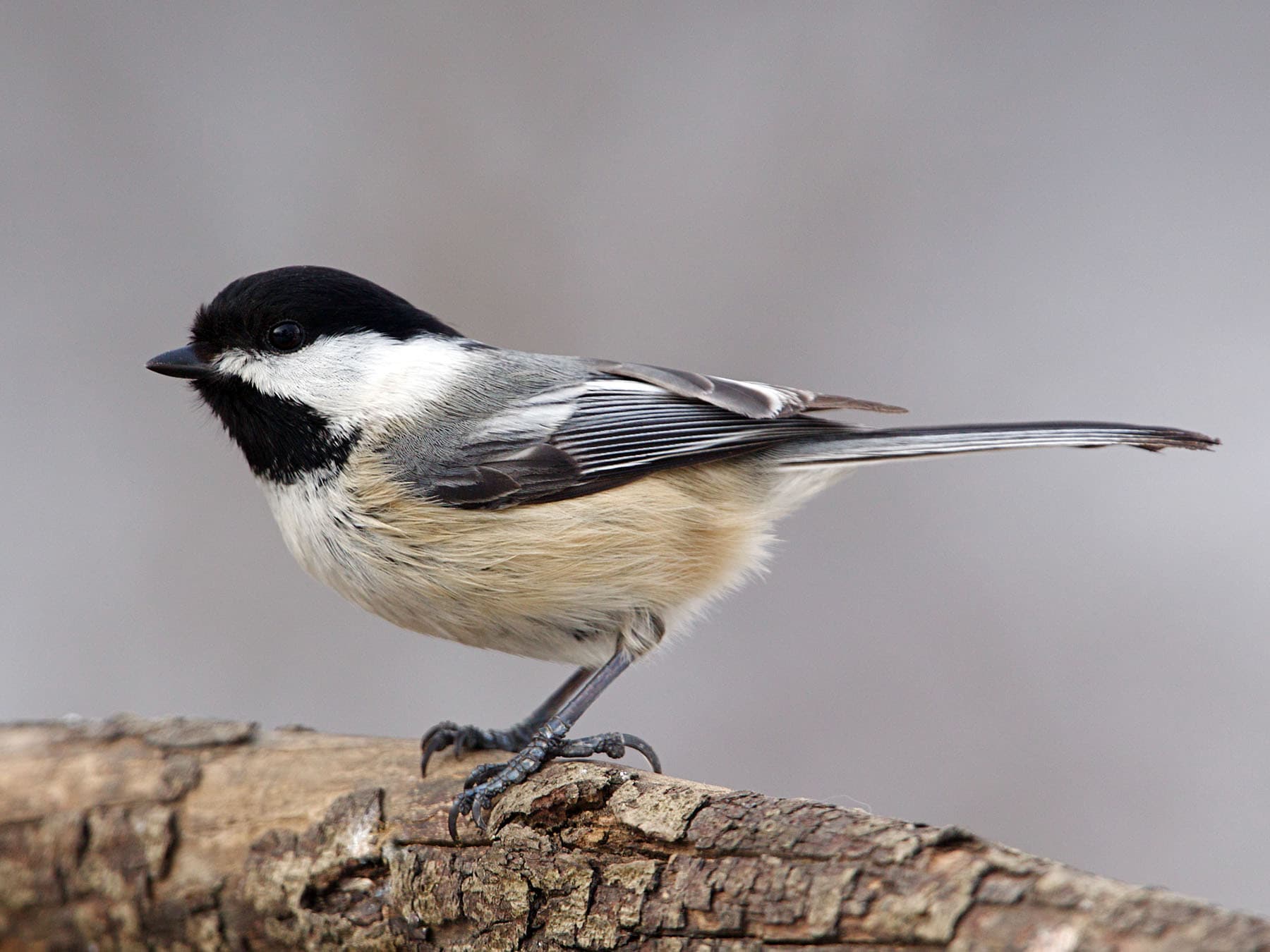
A Black-capped Chickadee is 4.7 to 5.9 inches (12-15 cm) long and weighs 0.3 to 0.5 ounces (9-14 g), smaller than a sparrow.1 It has a big, round head on a short neck, a rather spherical body, a long, narrow tail and a short, strong black bill.
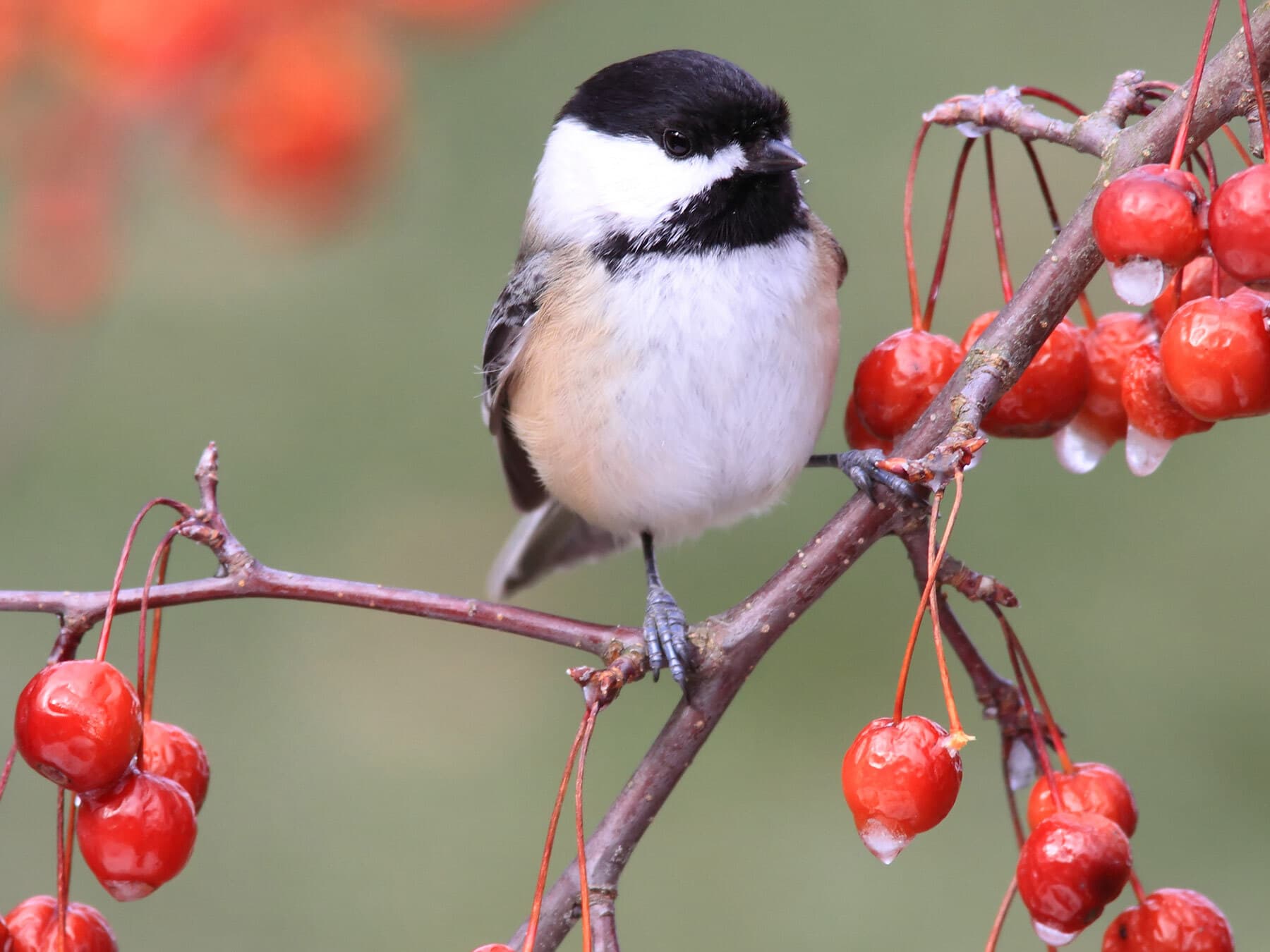
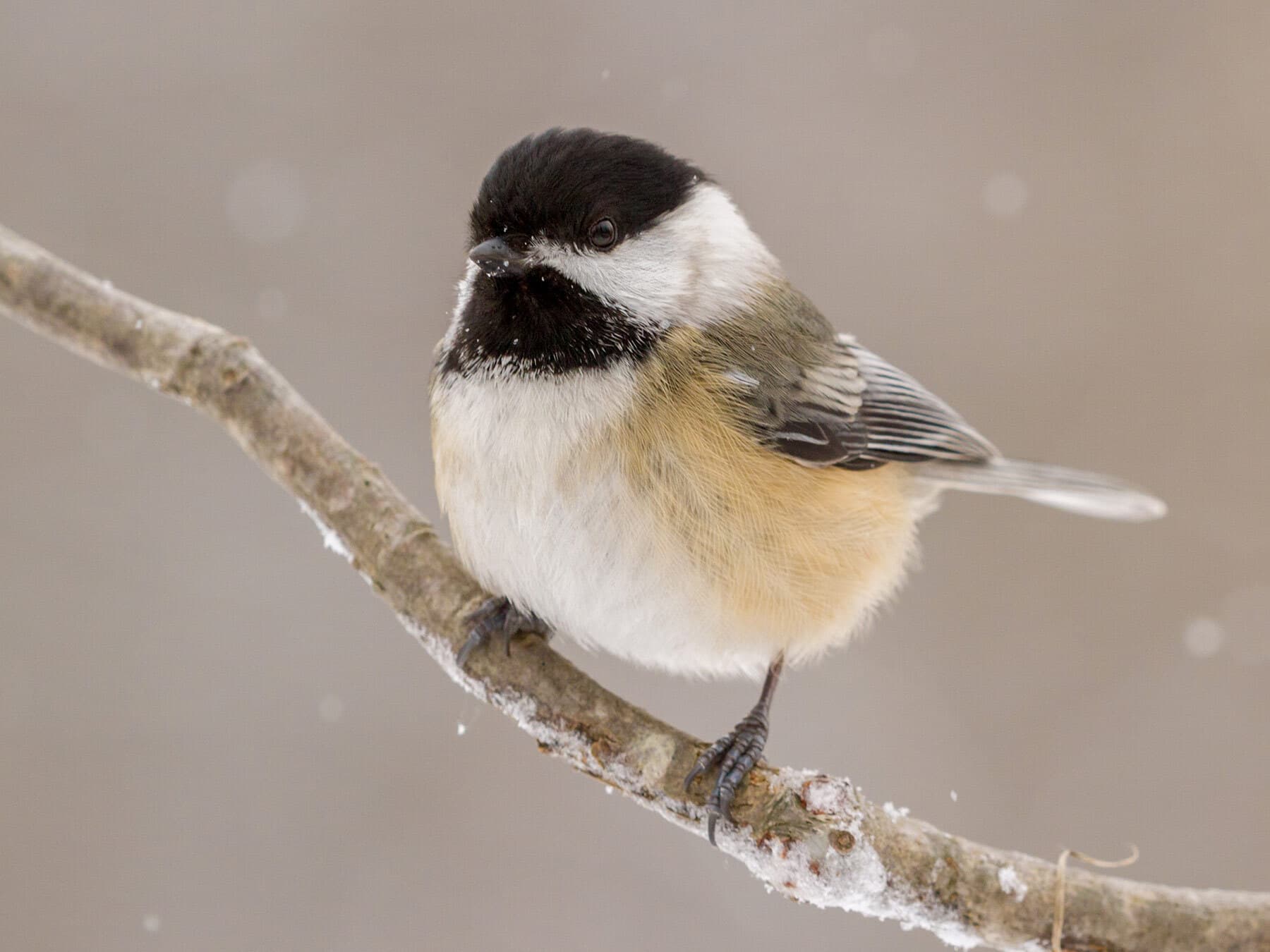
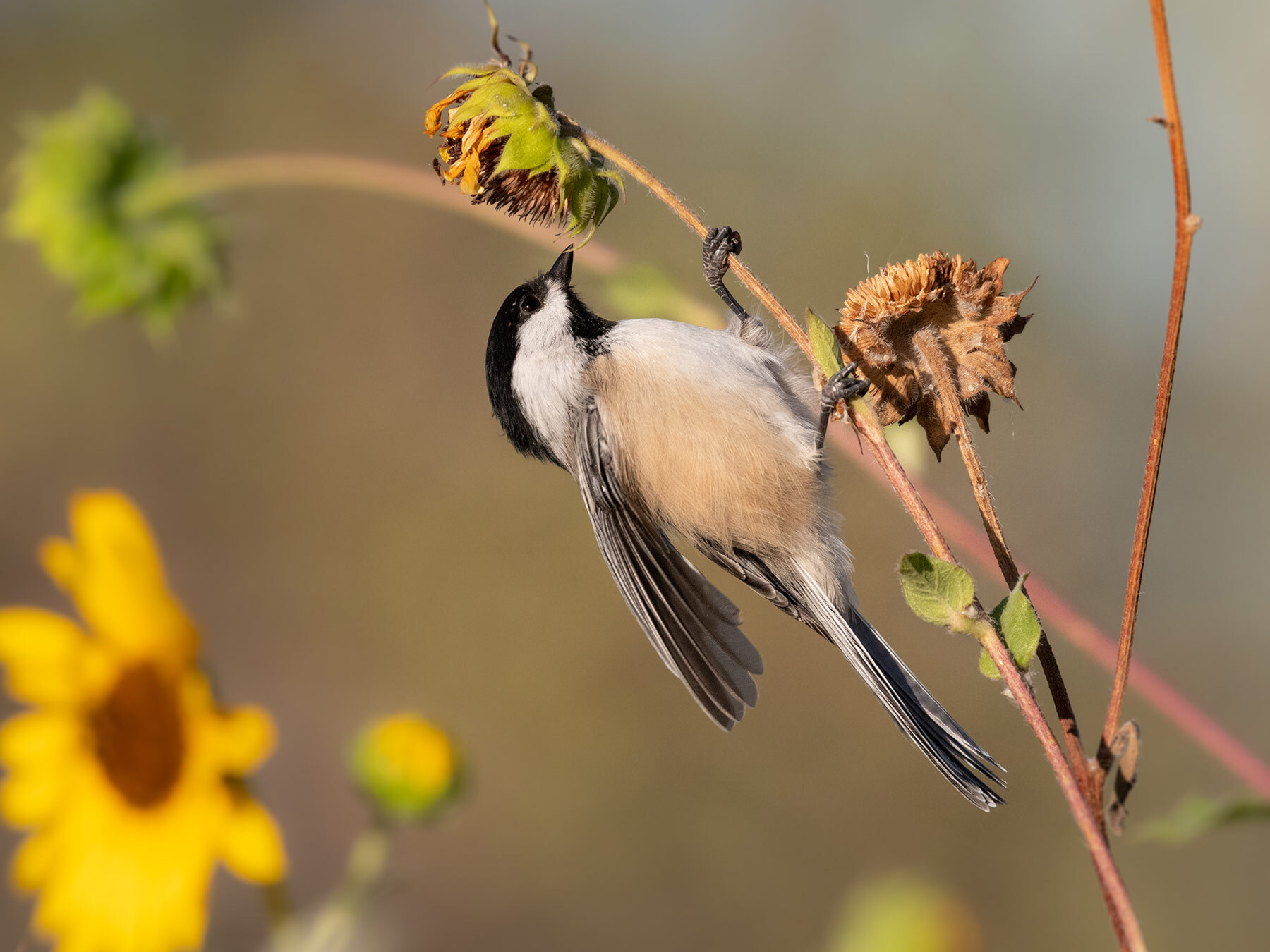
The head is the giveaway: a solid black cap that reaches just below the eye, a black bib, and bright white cheeks between them. The back is soft gray with a faint green tinge, the wings and tail darker gray, and the underparts white with warm buff along the sides. Look at the folded wing: broad white edges on the larger feathers make a pale panel, and the bottom edge of the bib looks ragged rather than neat. Legs are bluish gray and the eye dark brown, which makes it hard to pick out against the cap.2
There is no separate breeding plumage. Chickadees molt once a year, in late summer, and in fall and winter they look their richest, with the buff flanks at their brightest. The pale feather tips wear off by late winter, so spring birds look grayer.
Male, female and young
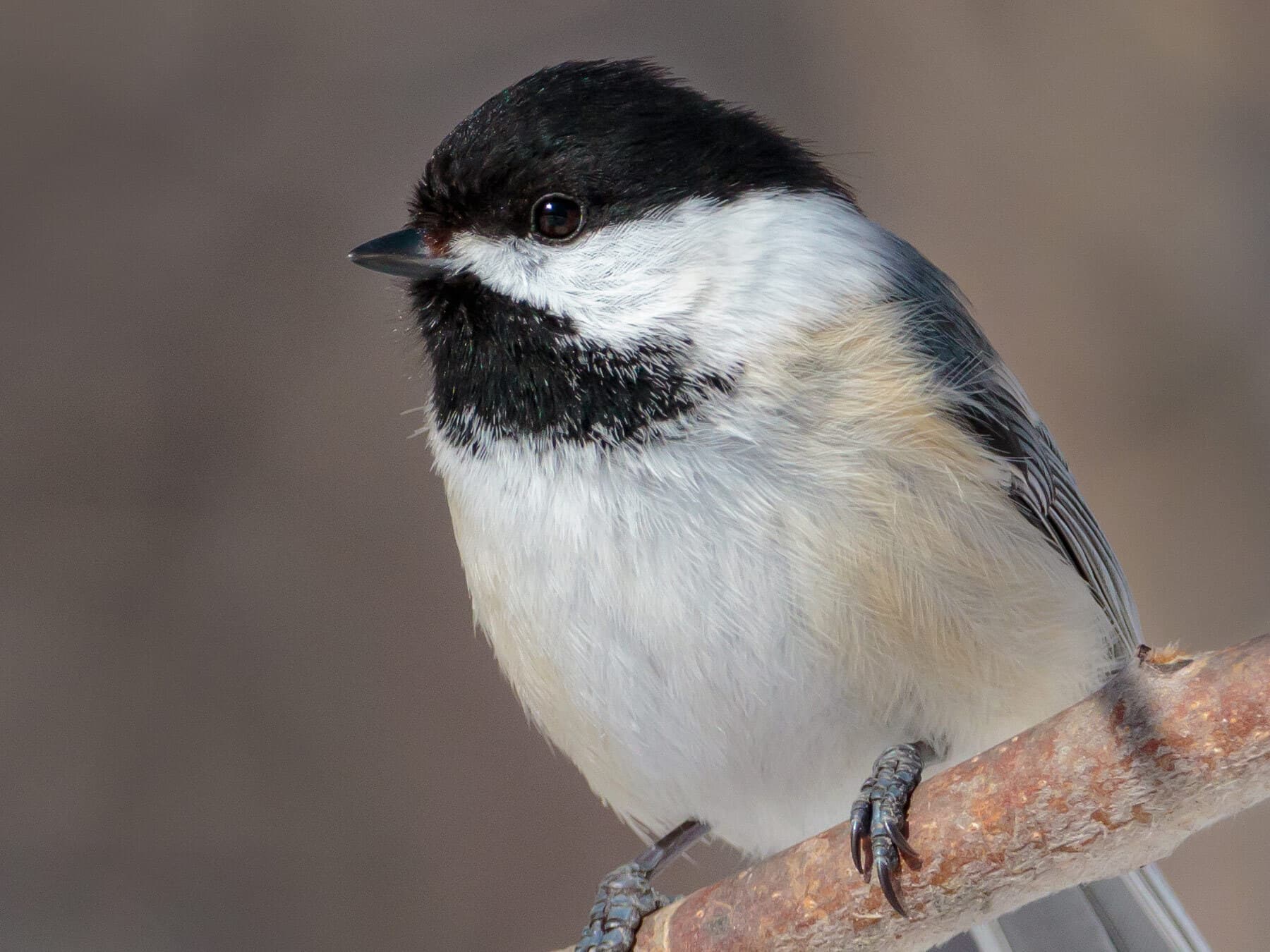
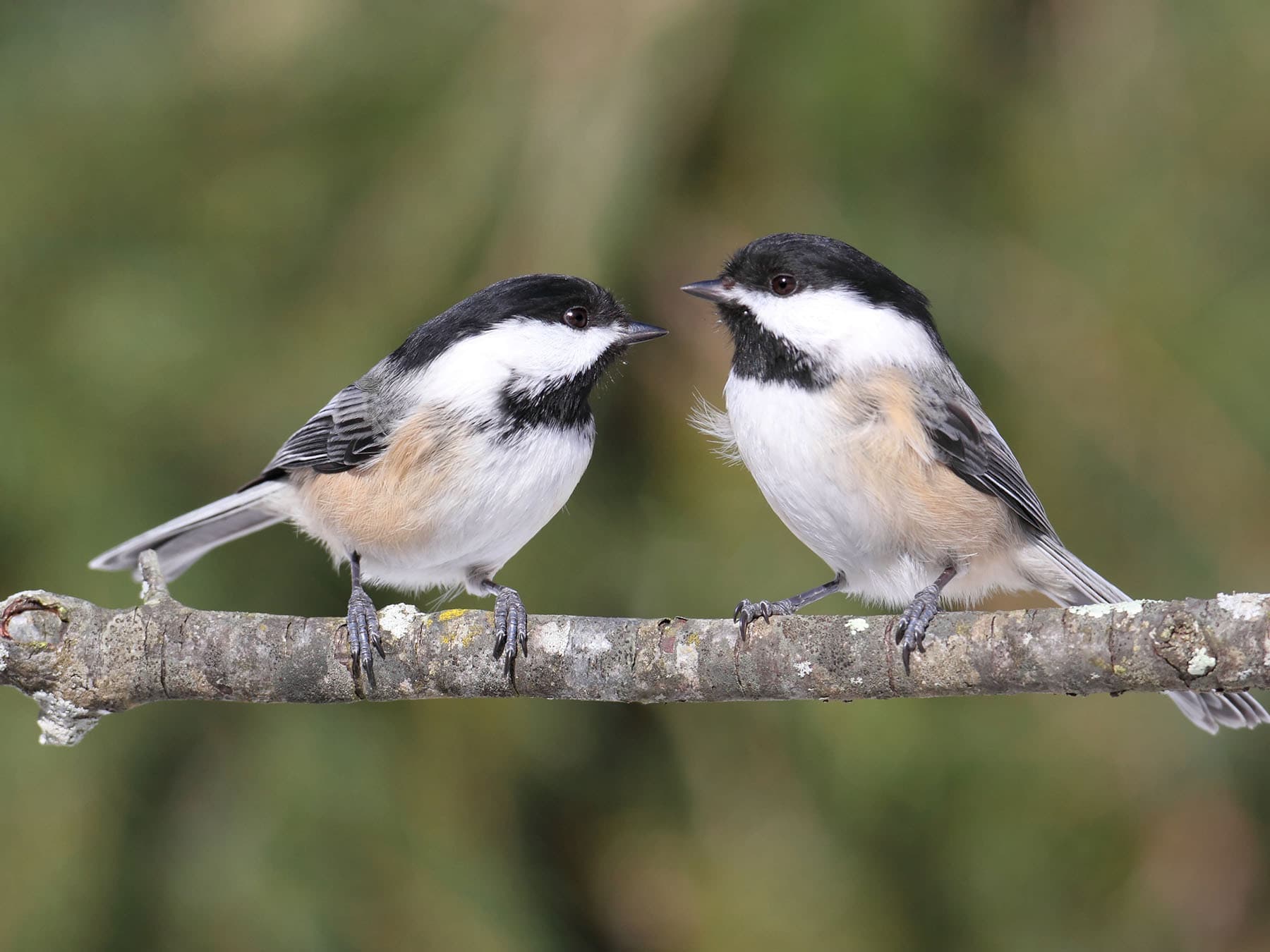
Males and females look the same to us. Males average a little bigger, with slightly longer wings and tails, and when researchers measured their plumage with a spectrometer, males had brighter white, deeper black and bigger bibs; the chickadees themselves can see the difference. In the field, behavior is the clue: only the female sits on the eggs, and in spring she begs food from her mate with quivering wings, while the whistled song comes mostly from males.
Young chickadees leave the nest looking much like their parents, but fluffier, with a duller cap, a short tail and yellow corners to the bill, and within 7 to 10 days they are hard to tell from adults. More: male vs female Black-capped Chickadees.
Identification: similar birds
Carolina Chickadee. The bird of the Southeast looks almost the same, and where the two meet they sometimes interbreed. Range is the best guide, then voice: a Carolina's chick-a-dee call is higher and faster, and its song has four whistled notes rather than two or three.3 A Black-capped shows more white in the folded wing and a messier lower edge to the bib, and its tail is longer for its wing length. Side by side: Carolina or Black-capped?
Mountain Chickadee. The chickadee of western mountain conifers has a white stripe over the eye, though it can be hard to see on worn summer birds, and plainer gray wings. Where both live, the Mountain Chickadee is usually higher up.
Boreal Chickadee. In northern spruce forests, a chickadee with a brown cap, brown sides and dusky cheeks is a Boreal.
Dark-eyed Junco. Gray or black-hooded, with no white cheek, a pale pink bill and white outer tail feathers that flash in flight. Side by side: junco or chickadee?
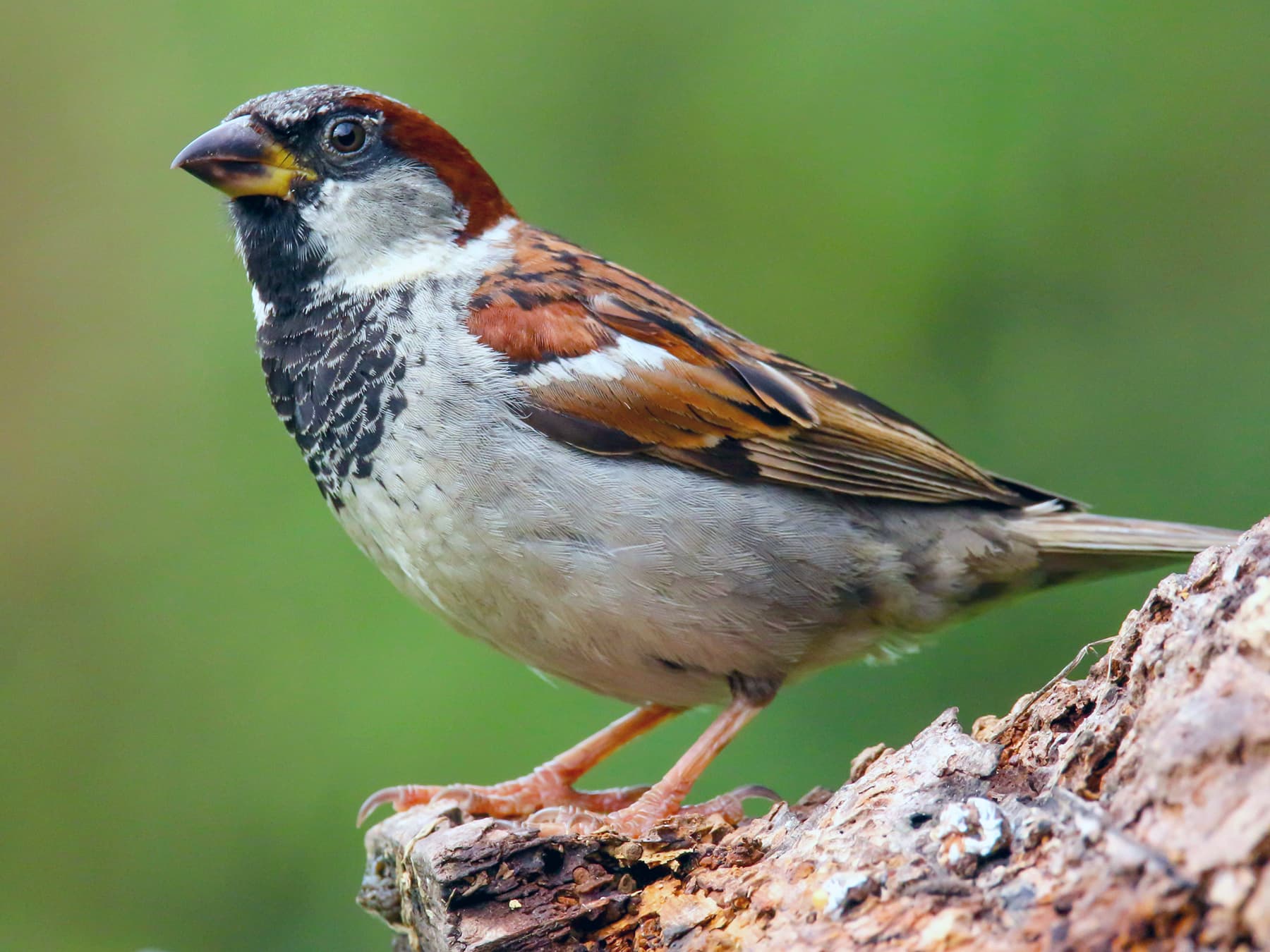
House Sparrow. Audubon's guide notes that the male House Sparrow is sometimes taken for a chickadee: he has a black bib and pale cheeks too, but a gray crown and a chestnut nape.
Its size
Adults- Length
- 12–15 cm
- Wingspan
- 16–21 cm
- Weight
- 9–14 g
Its song and calls
The song is "fee-bee": two clear, whistled notes lasting about a second, the second lower than the first and often with a tiny break in it, "fee-bee-ee". It is remarkably uniform across the continent, with a few local exceptions: in the Pacific Northwest, birds sing three or four notes on one pitch. Males sing it most, starting in mid-January in much of the range and building through late winter and spring, especially at dawn. A male repeats his song on the same pitch some 31 to 41 times, on average, before shifting it higher or lower.2
The call that gives the bird its name, chick-a-dee-dee-dee, is used by both sexes all year: to keep in touch, to mob a predator, to sound the all-clear and to tell others about food. The number of "dee" notes carries information. In tests with captive flocks and 15 kinds of live predators, chickadees added more dees for small predators, which are more of a threat to them than big ones, and birds that heard those calls mobbed harder.4 A thin, high "see" is the alarm for a hawk coming fast; chickadees that hear it freeze until a chick-a-dee call gives the all-clear.
Chickadees have at least 16 kinds of calls in all, including a fast, sputtering gargle that dominant birds, mostly males, use in disputes, and a soft "tseet" they give almost constantly to keep in touch.
Hear them, with spectrograms and what each call means: chickadee calls and song.
- Song0:00 / 0:31
Recorded in Minnesota, United States · January 2011
- Chick-a-dee calls0:00 / 0:37
Recorded in Newfoundland, Canada · March 2011
- Gargle calls0:00 / 0:11
Recorded in Minnesota, United States · May 2011
When and where to see it
Black-capped Chickadees live only in North America: from western Alaska and the Yukon across Canada to Newfoundland, and south to northwestern California, central New Mexico, central Kansas and Missouri, central Illinois and Indiana, northern Ohio, southern Pennsylvania and northern New Jersey, and along the higher Appalachians to western North Carolina and eastern Tennessee. Farther south they give way to the Carolina Chickadee.
They live in deciduous and mixed woods, open woodland, parks, willow thickets, cottonwood groves, old fields and suburbs: anywhere with trees, nest holes and insects to feed young. They are most often found within about 250 feet (75 m) of a forest edge, and especially where birch or alder grow. Chickadees are easiest to see in winter, when small flocks travel through yards and visit feeders.
Spotting tips
Listen first: a chick-a-dee call or a whistled fee-bee often gives them away before you see them. Chickadees come to investigate a soft "pishing" sound. In fall and winter, look through each chickadee flock for the nuthatches, kinglets, creepers and woodpeckers that travel with it; in migration, warblers often join them too.
Do they migrate?
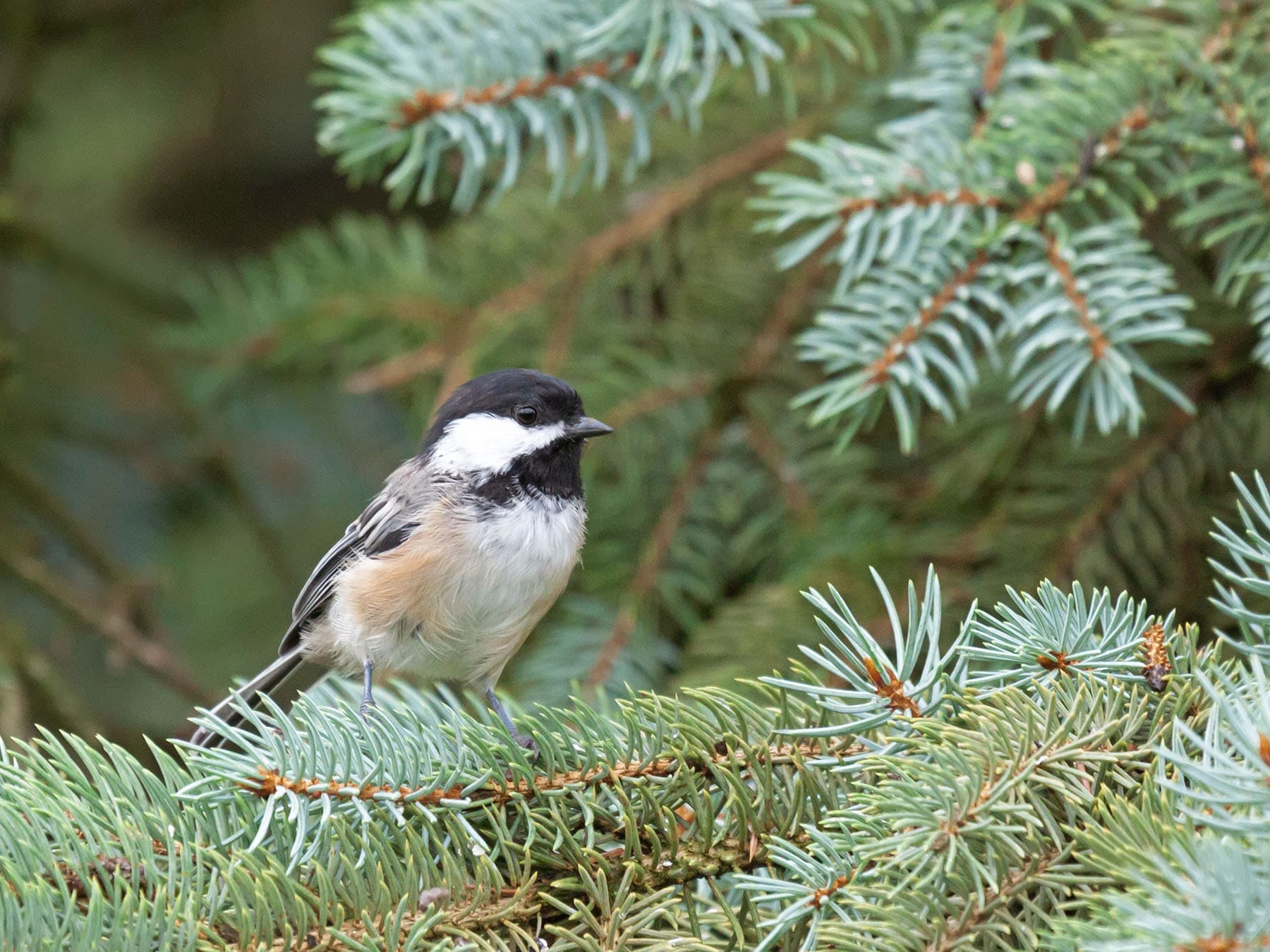
No. Black-capped Chickadees are year-round residents. In more than 60,000 Canadian banding records from 1921 to 1995, 90% of the those caught again had not moved. In the mountains, some come down from the highest ground for the winter.
Every few years, though, irregularly (often every 2 or 3 years in the Northeast), numbers of chickadees move south in fall, mostly young birds and mostly east of the Rockies. These irruptions follow food: in the East they track the seed crops of northern trees, often after a big conifer seed year followed by a poor one. They travel by day, unusual for a small songbird, and rarely go far beyond the edge of the breeding range.
What it eats
In summer chickadees are insect-eaters: animal food, mostly caterpillars, makes up 80 to 90% of what they eat in the breeding season, with spiders, other insects, small snails and slugs. In winter about half the diet is still animal (insects, often as eggs and pupae picked from bark, and spiders) and half is seeds and berries: weed seeds such as goldenrod and ragweed, hemlock seeds, and fruits from blueberries to poison ivy berries. They also peck fat from frozen carcasses.
They feed mostly in trees, working the bark from trunk to the thinnest twigs, and hang upside down beneath branches and leaves; special leg muscles help them hang. A chickadee seldom eats where it finds food: it carries it off to a perch, holds it under its feet and hammers it open.
Food stores and memory
Chickadees hide food, mostly seeds but also insects, putting each item in a different place: under bark, in dead leaves, lichen, clusters of conifer needles, knotholes, even snow. Most caching happens in fall. In experiments they found their caches accurately a day later and after 28 days, and they remember which spots they have already emptied.2 Northern chickadees depend on these stores to get through the winter, and they use spatial memory to find them.5
The part of the brain behind this memory, the hippocampus, is larger in chickadees than in birds that don't store food. Chickadees from harsher northern climates have larger ones than birds farther south. Some studies found it grows and takes on new neurons in fall, when caching peaks, but later work found no clear link between its seasonal changes and caching.
Feeding them in your yard
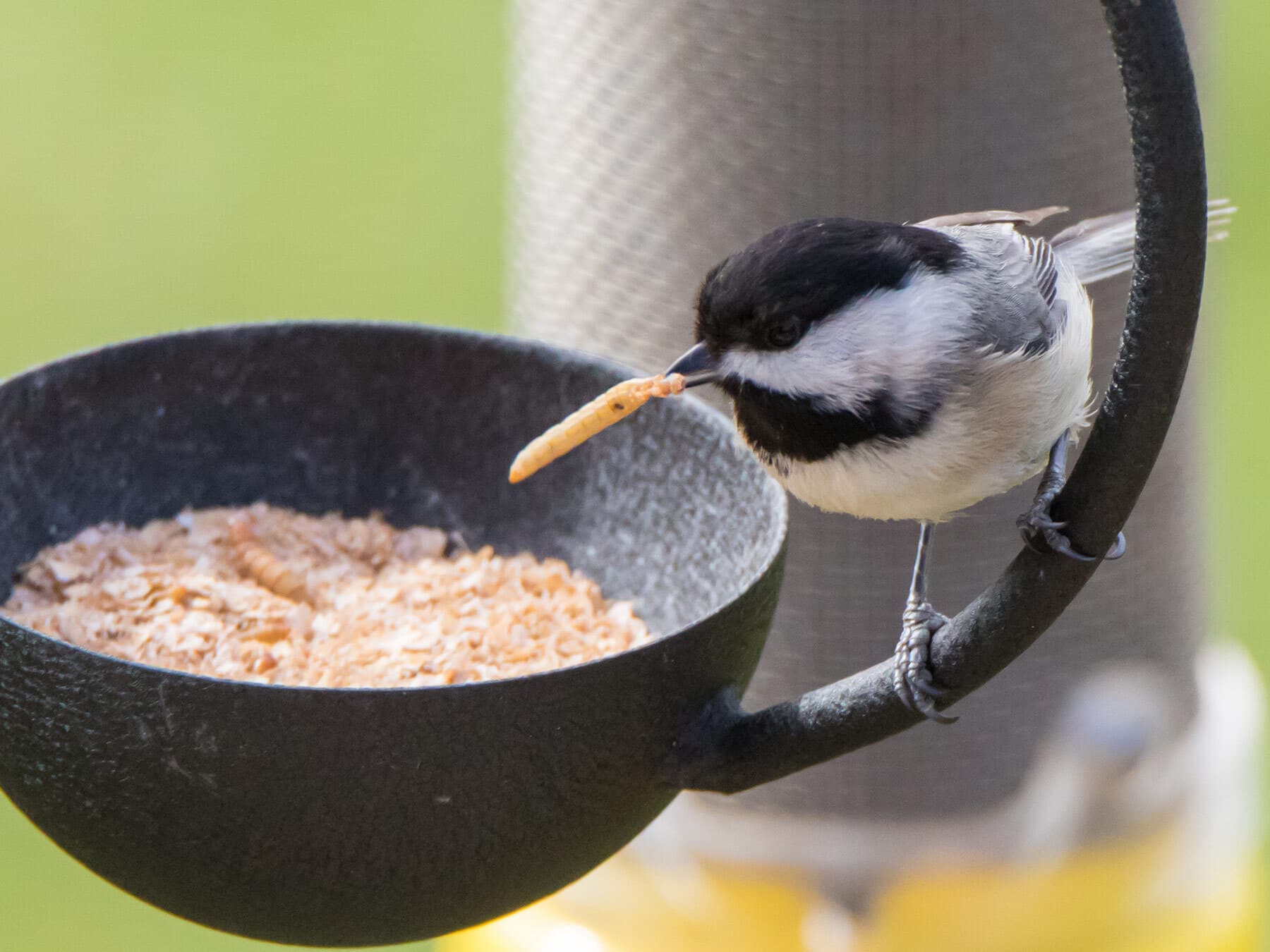
Chickadees are quick to find a new feeder. They take sunflower seed, suet, peanuts and peanut butter, and mealworms,1 and Project FeederWatch also lists hulled sunflower, safflower and nyjer. Small tube or hopper feeders and suet cages work,6 and so do window feeders. Expect one seed at a time: a chickadee grabs it and flies off to eat it or hide it.
Feeders can matter in hard winters. In a study over three winters, chickadees with feeders survived the winter at 69%, against 37% for birds without, and the difference showed up mostly in months with more than 5 days below 0 °F (-18 °C).7
Nesting and breeding
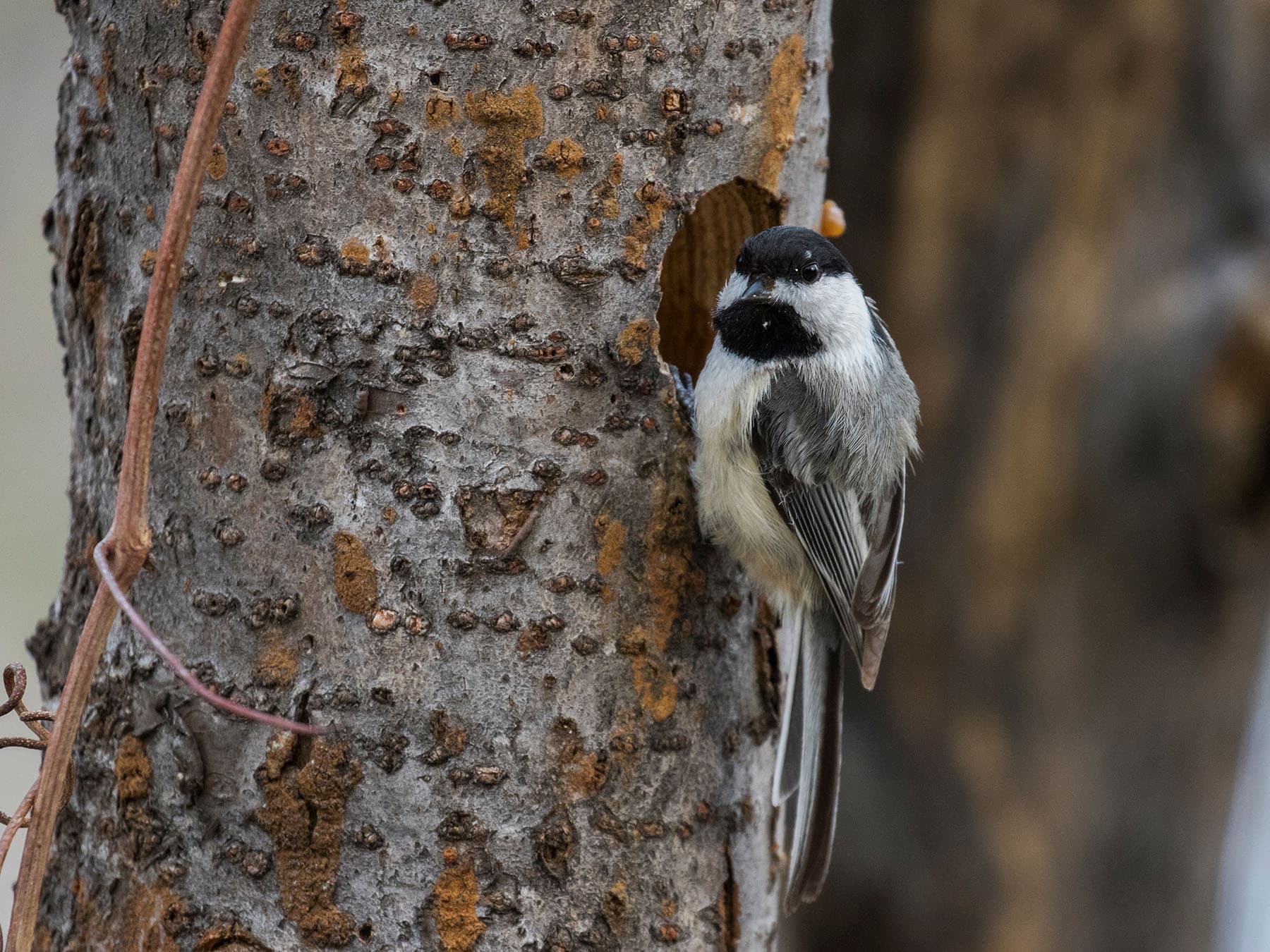
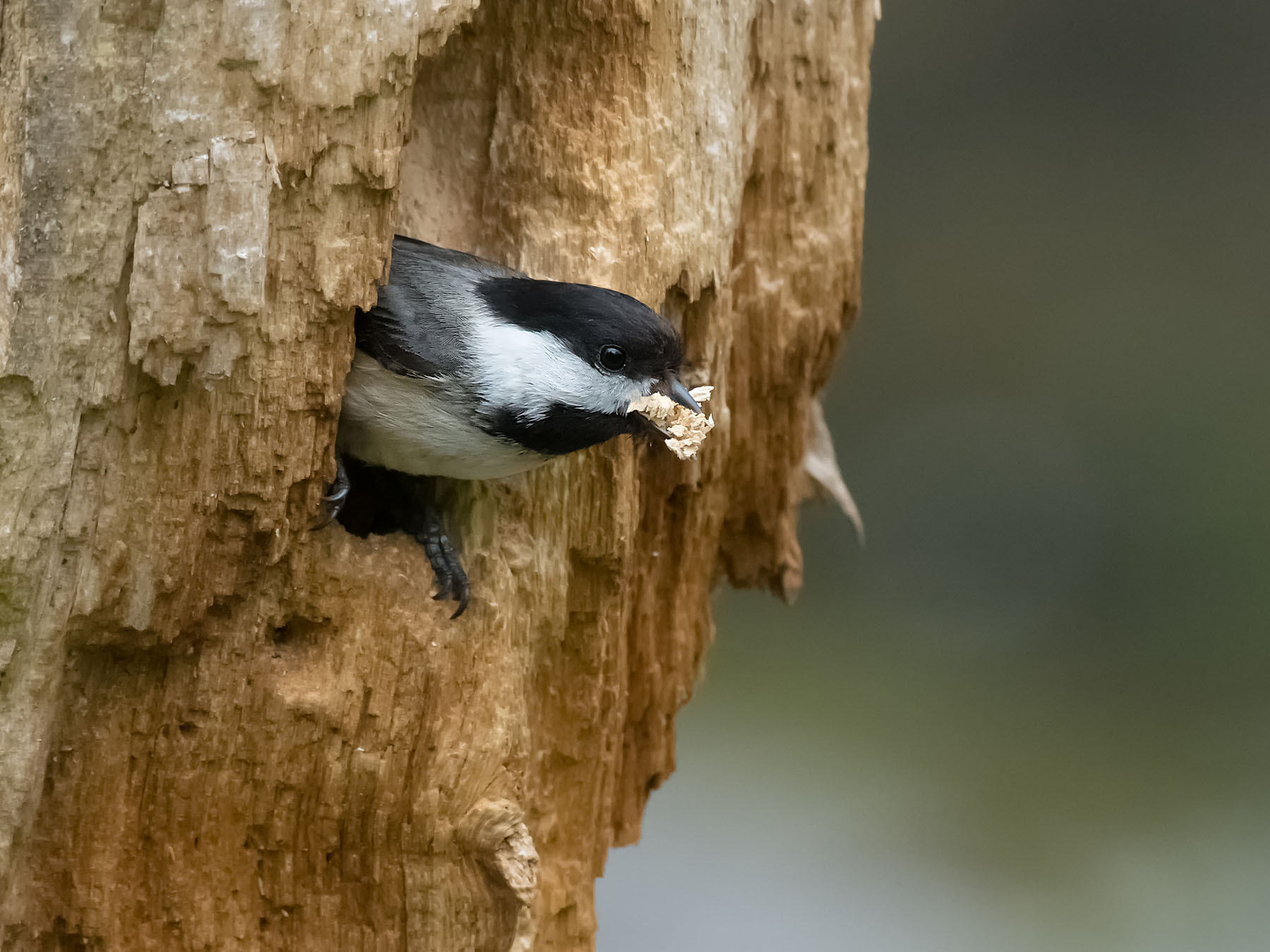
Chickadees nest in tree holes, often ones they dig themselves: the pair chips out a cavity in soft, rotten wood, often in a dead birch or aspen. They also use natural holes, old woodpecker holes and nest boxes. Nests are usually 5 to 23 feet (1.5-7 m) up. Inside, the female builds a cup on a base of moss, lined with soft fur or hair.2
Eggs are laid from April to July, usually 6 to 8, white with fine reddish-brown dots. The female incubates them for 12 to 13 days while the male brings her food, and the young leave the nest at about 16 days old. Pairs raise one brood a year. More: Black-capped Chickadee nesting, eggs and young.
Nest boxes
Where dead trees are scarce, chickadees will use a nest box. NestWatch recommends an entrance hole of 1 1/8 inches (about 29 mm), a floor 5 1/2 inches (14 cm) square, a box 8 inches (20 cm) deep, mounted 5 to 15 feet (1.5-4.5 m) up, with an inch (2.5 cm) of wood shavings in the bottom.8 Chickadees like to dig, and a box filled with shavings or sawdust attracts them. A hole that size keeps out bigger competitors such as House Sparrows. Put the box up well before spring, with a predator guard, and at least 60 feet into the woods to discourage House Wrens.
Behaviour
Outside the nesting season chickadees live in flocks of usually 3 to 12 birds, made up of mated pairs and unrelated young birds from elsewhere, which hold a home range of roughly 20 to 57 acres (8-23 ha) in two studies. Each flock has a strict pecking order, males above females and older birds usually above younger ones. Chickadees are the core of mixed winter flocks, leading nuthatches, woodpeckers, kinglets, creepers and others, which listen to chickadee alarm calls too.
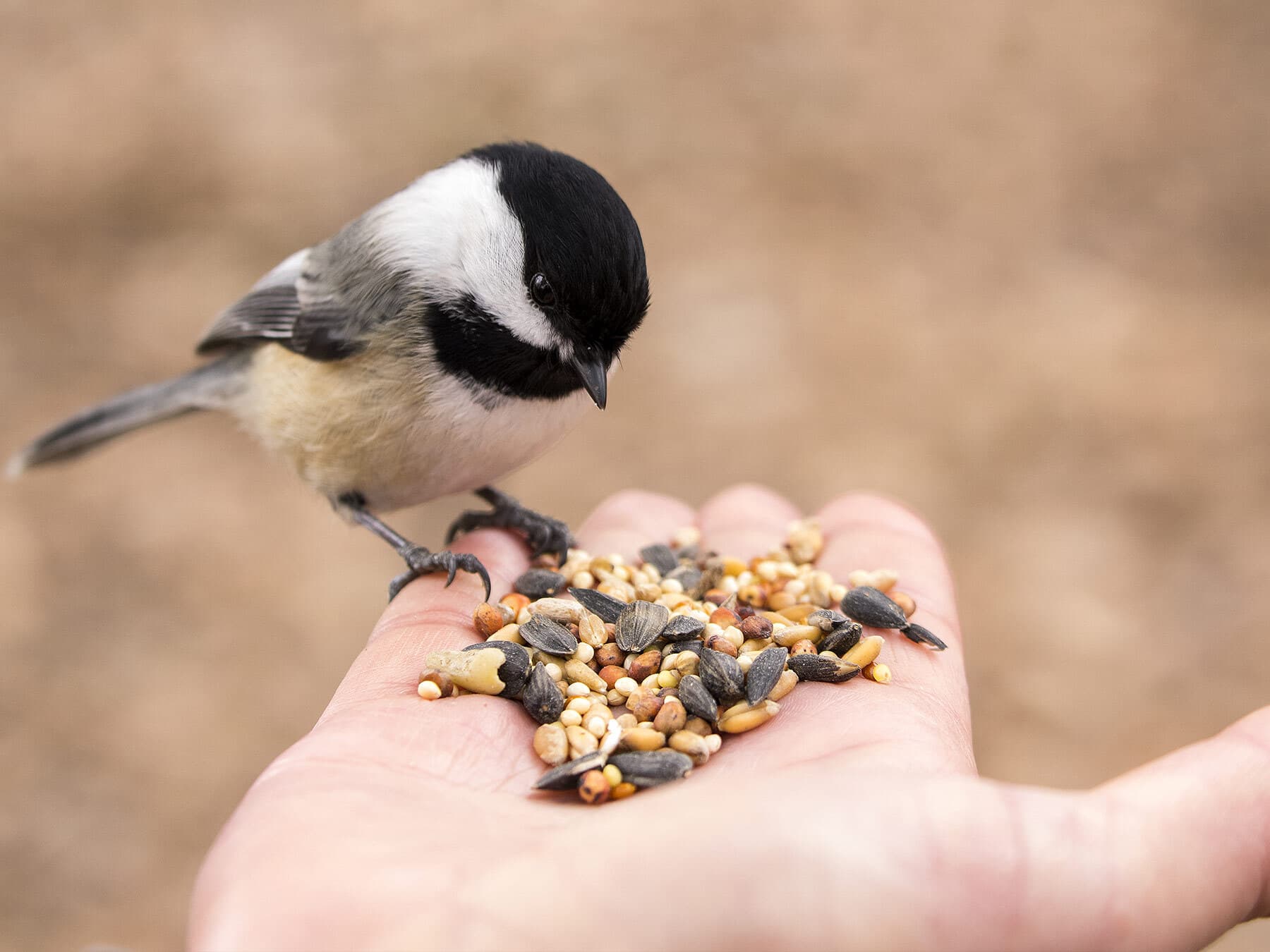
Pairs form in fall and stay together through the winter, and many stay together for years. They are famously curious and bold, coming to look at people, and some will take seed from an open hand.
Winter behavior
For a bird under half an ounce, a northern winter night is a long fast. Chickadees roost alone in tree holes or thick cover, tuck their heads into their feathers, and on cold nights let their body temperature fall, typically by 18 to 22 °F (10-12 °C) below its daytime level, a controlled hypothermia that saves a significant amount of energy.2 By day they eat, cache and retrieve food, and in winter they can start feeding earlier and stop later in the dim light than at other seasons.
Lifespan and predators
The oldest Black-capped Chickadee on the U.S. Bird Banding Laboratory's list was at least 11 years 8 months old: banded in New York as a young bird on November 19, 2009, and caught and released there on March 24, 2021.9 The next two, from Minnesota and Massachusetts, were 11 years 6 months and 11 years 2 months. Most live far less: the average life span has been put at about 2.5 years,2 many young birds disappear in their first summer, and roughly 40 to 60% of adults survive from one year to the next.
Predators and other dangers
The main predators of adult chickadees are small hawks, owls and shrikes, especially Sharp-shinned Hawks, Northern Shrikes, Eastern Screech-Owls and Northern Saw-whet Owls, and cats kill some. At the nest, raccoons, squirrels, opossums and some snakes take eggs and young, and House Wrens destroy many nests in competition for holes.
In Alaska, since the late 1990s, large numbers of Black-capped Chickadees have grown overlong, often crossed beaks, a condition called avian keratin disorder. It is linked to a virus, poecivirus, found in all 28 affected chickadees tested in one study but in only 9 of 96 with normal beaks, and similar deformities are now seen in dozens of species on several continents.10
Conservation
The Black-capped Chickadee is common, widespread and of Least Concern, with about 43 million birds. Partners in Flight scores it 7 out of 20 for continental concern, which is low.11 The North American Breeding Bird Survey shows a slight increase from 1966 to 2019, with western populations slightly down and eastern ones up;1 in Canada, numbers have risen moderately since 1970.12
It benefits from forest edges, feeders and nest boxes, and can lose out where dead trees are cleared away. It is protected under the Migratory Bird Treaty Act.13
Similar birds
Often mistaken for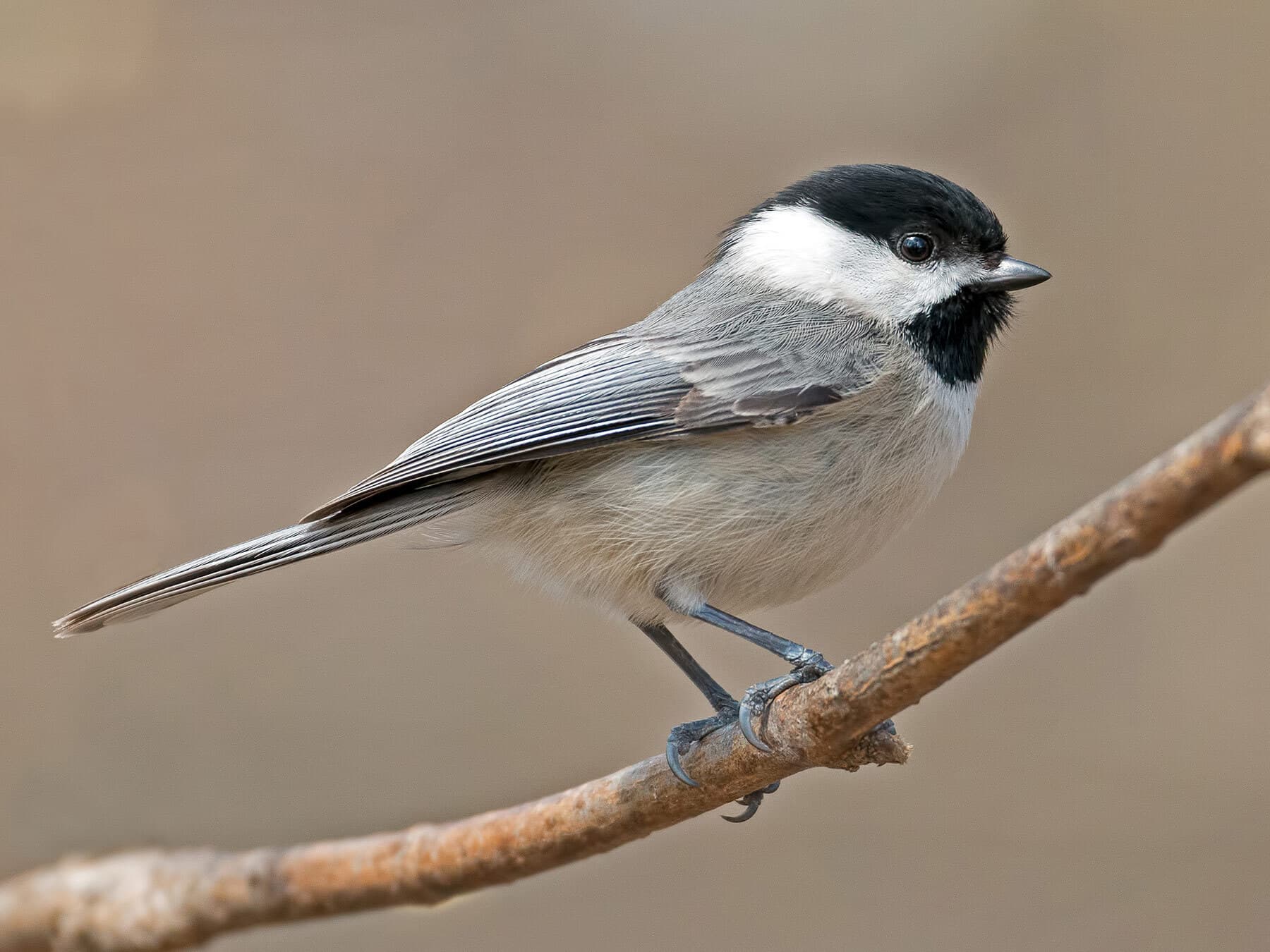

More photos
3 photos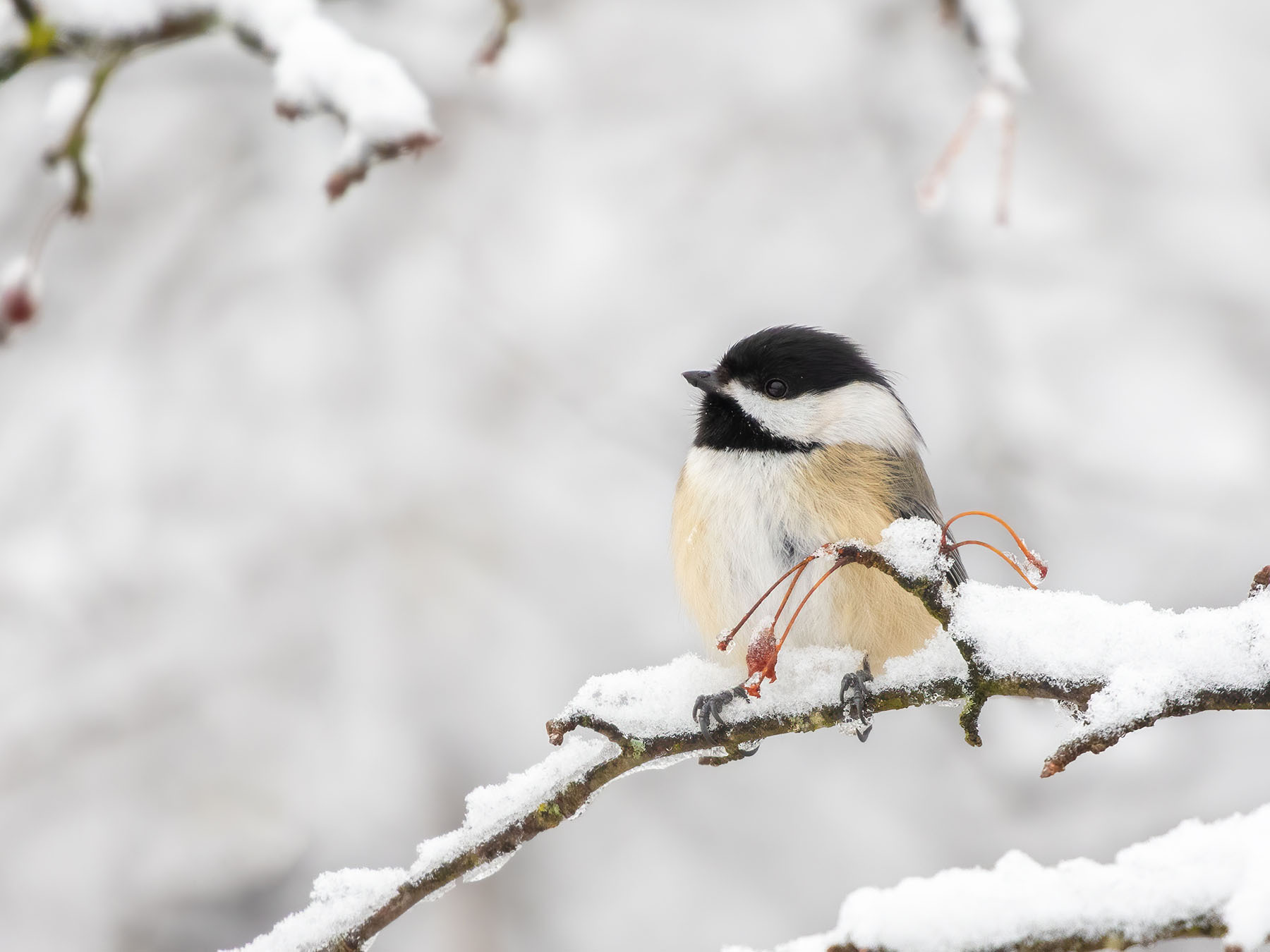
Black-capped Chickadee guides
5 guidesQuick facts
- Length
- 12–15 cm
- Wingspan
- 16–21 cm
- Weight
- 9–14 g
- Lifespan
- oldest recorded 11 years 8 months
- Family
- Tits & Chickadees
- Migration
- Resident
- Global status (IUCN)
- Least Concern
- World population
- About 43 million (Partners in Flight)
- Population trend
- Increasing slightly: up from 1966 to 2019 (North American Breeding Bird Survey), with small declines in the West; a moderate increase in Canada since 1970
- Also called
- Chickadee
- Scientific name
- Poecile atricapillus
Questions
2Is the chickadee a state bird?
Why do chickadees hang upside down?
To reach food. Chickadees glean insects, eggs and pupae from the undersides of twigs, leaves and branches, and special leg muscles let them hang there while they search.
Sources
24- 1Cornell Lab of Ornithology. Black-capped Chickadee: Overview, Identification, Life History and Sounds. All About Birds. Accessed 11 October 2026. Source (opens in a new tab)
- 2Foote, J. R., Mennill, D. J., Ratcliffe, L. M. and Smith, S. M. (2020). Black-capped Chickadee (Poecile atricapillus), version 1.0. Birds of the World (A. F. Poole, editor). Cornell Lab of Ornithology. doi:10.2173/bow.bkcchi.01 (opens in a new tab)
- 3National Audubon Society (text: Kaufman, Lives of North American Birds). Carolina Chickadee. Audubon Guide to North American Birds. Accessed 11 October 2026. Source (opens in a new tab)
- 4Templeton, C. N., Greene, E. and Davis, K. (2005). Allometry of alarm calls: black-capped chickadees encode information about predator size. Science 308(5730): 1934-1937. doi:10.1126/science.1108841 (opens in a new tab)
- 5Pravosudov, V. V., Roth, T. C., LaDage, L. D. and Freas, C. A. (2015). Environmental influences on spatial memory and the hippocampus in food-caching chickadees. Comparative Cognition & Behavior Reviews 10: 25-43. doi:10.3819/ccbr.2015.100002 (opens in a new tab)
- 6Project FeederWatch (Cornell Lab of Ornithology and Birds Canada). Common Feeder Birds: Black-capped Chickadee. Project FeederWatch. Accessed 11 October 2026. Source (opens in a new tab)
- 7Brittingham, M. C. and Temple, S. A. (1988). Impacts of supplemental feeding on survival rates of black-capped chickadees. Ecology 69(3): 581-589. doi:10.2307/1941007 (opens in a new tab)
- 8NestWatch (Cornell Lab of Ornithology). Right Bird, Right House: Black-capped Chickadee. NestWatch. Accessed 11 October 2026. Source (opens in a new tab)
- 9USGS Bird Banding Laboratory. Longevity records of North American birds. Accessed 11 October 2026. Source (opens in a new tab)
- 10Zylberberg, M., Van Hemert, C. R., Handel, C. M. and DeRisi, J. L. (2018). Avian keratin disorder of Alaska black-capped chickadees is associated with Poecivirus infection. Virology Journal 15: 100. doi:10.1186/s12985-018-1008-5 (opens in a new tab)
- 11Partners in Flight (2024). Avian Conservation Assessment Database, global scores (ACAD version 2024.05.23; population estimates 2020.04.29). Partners in Flight Databases (Bird Conservancy of the Rockies). Accessed 11 October 2026. Source (opens in a new tab)
- 12Environment and Climate Change Canada. Status of Birds in Canada 2019: Black-capped Chickadee. Government of Canada. Accessed 11 October 2026. Source (opens in a new tab)
- 13U.S. Fish and Wildlife Service. List of birds protected by the Migratory Bird Treaty Act. Code of Federal Regulations, 50 CFR 10.13. Accessed 11 October 2026. Source (opens in a new tab)
- 14Maine Legislature. Maine Revised Statutes, Title 1, §209: State bird. Maine Revised Statutes. Accessed 11 October 2026. Source (opens in a new tab)
- 15Massachusetts Department of Commerce and Development (1977). Massachusetts Facts. Commonwealth of Massachusetts. Accessed 11 October 2026. Source (opens in a new tab)
- 16National Audubon Society (text: Kaufman, Lives of North American Birds). Black-capped Chickadee. Audubon Guide to North American Birds. Accessed 11 October 2026. Source (opens in a new tab)
- 17National Audubon Society (text: Kaufman, Lives of North American Birds). Mountain Chickadee. Audubon Guide to North American Birds. Accessed 11 October 2026. Source (opens in a new tab)
- 18National Audubon Society (text: Kaufman, Lives of North American Birds). Boreal Chickadee. Audubon Guide to North American Birds. Accessed 11 October 2026. Source (opens in a new tab)
- 19Nolan Jr., V. et al. (2020). Dark-eyed Junco (Junco hyemalis), version 1.0. Birds of the World (A. F. Poole and F. B. Gill, editors). Cornell Lab of Ornithology. doi:10.2173/bow.daejun.01 (opens in a new tab)
- 20National Audubon Society (text: Kaufman, Lives of North American Birds). House Sparrow. Audubon Guide to North American Birds. Accessed 11 October 2026. Source (opens in a new tab)
- 21Grava, T., Grava, A. and Otter, K. A. (2009). Supplemental feeding and dawn singing in black-capped chickadees. The Condor 111(3): 560-564. doi:10.1525/cond.2009.080061 (opens in a new tab)
- 22NestWatch (Cornell Lab of Ornithology). Black-capped Chickadee. NestWatch. Accessed 11 October 2026. Source (opens in a new tab)
- 23Zylberberg, M. et al. (2016). Novel picornavirus associated with avian keratin disorder in Alaskan birds. mBio 7(4): e00874-16. doi:10.1128/mBio.00874-16 (opens in a new tab)
- 24AviList Core Team (2025). AviList: The Global Avian Checklist, v2025b. doi:10.2173/avilist.v2025b (opens in a new tab)

Checked by
Nathan Cope, founder and editor
Nathan founded Birdfact and leads its writers and contributors in the UK, the US and Canada. He has watched and studied birds for more than ten years, and checks every article and species guide before it’s published.