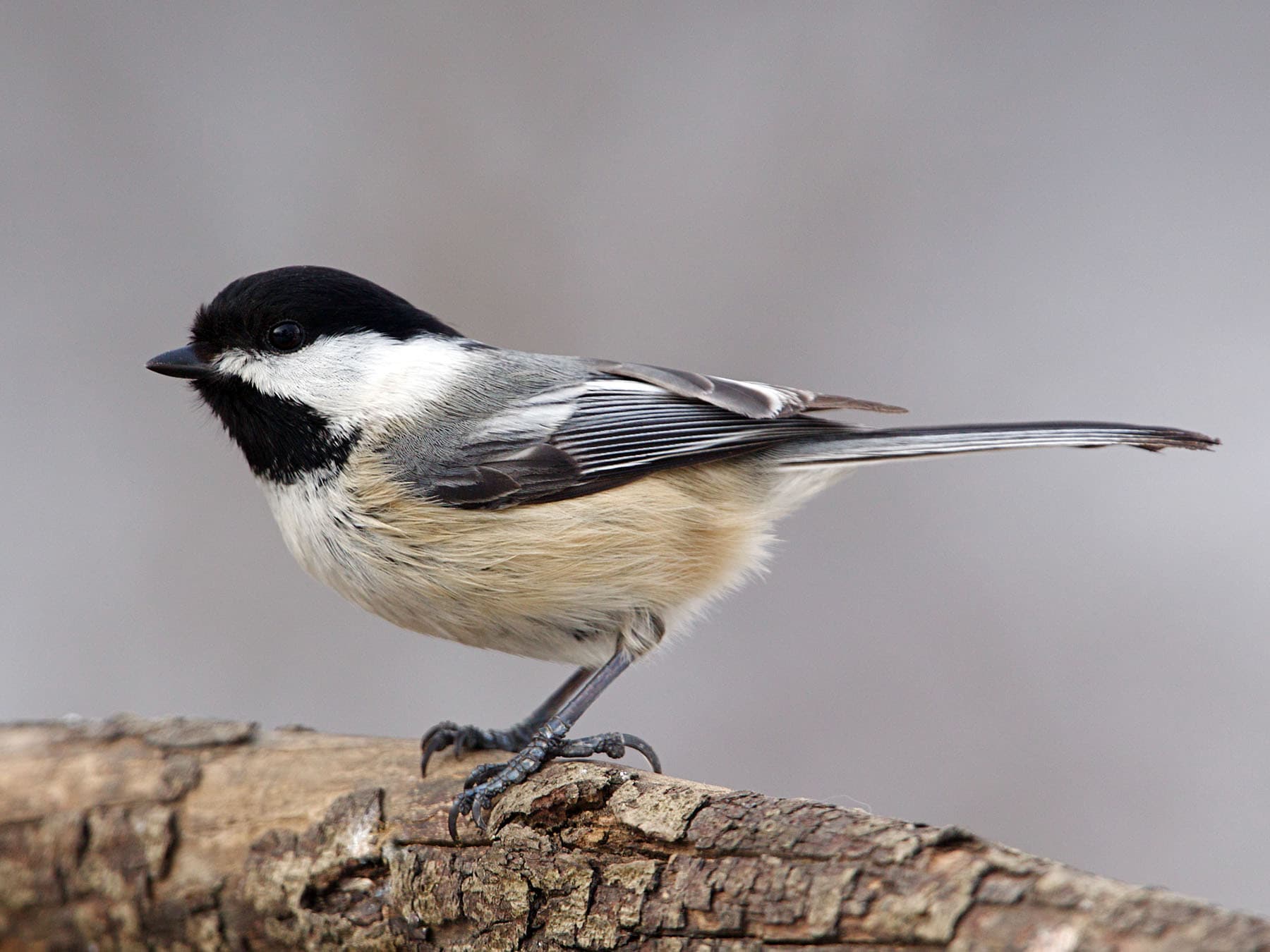
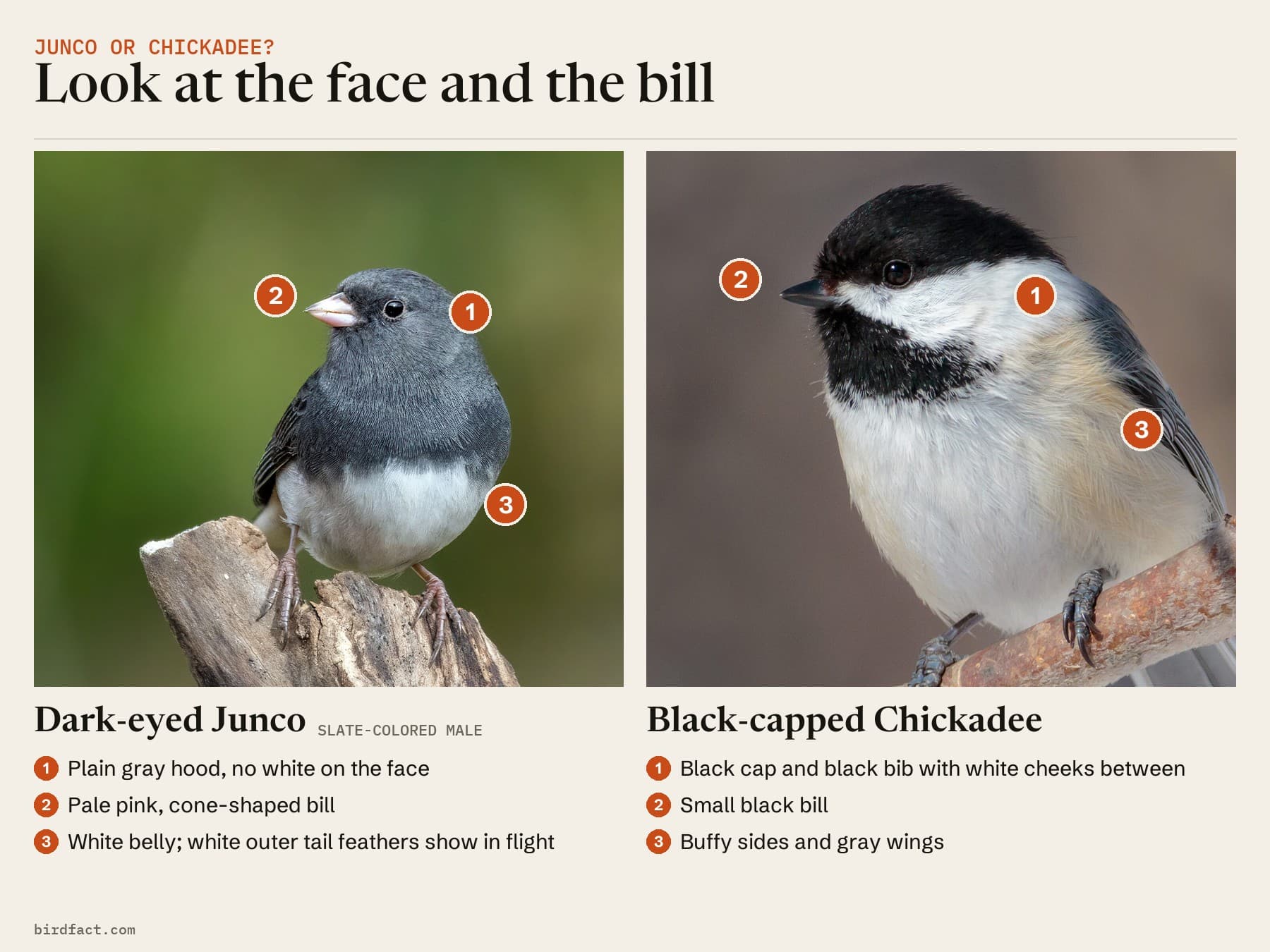
Facts · Updated 11 Oct 2026
Carolina Chickadee vs Black-capped Chickadee: How to Tell Them Apart
By the Birdfact teamChecked by Nathan Cope
Carolina and Black-capped Chickadees look almost identical. Start with where you are, then look at the wing: bright white edges on a Black-capped, plain gray on a Carolina. Listen for two whistles or four, and learn why hybrids in the meeting zone can fool everyone.
On this page16 sections
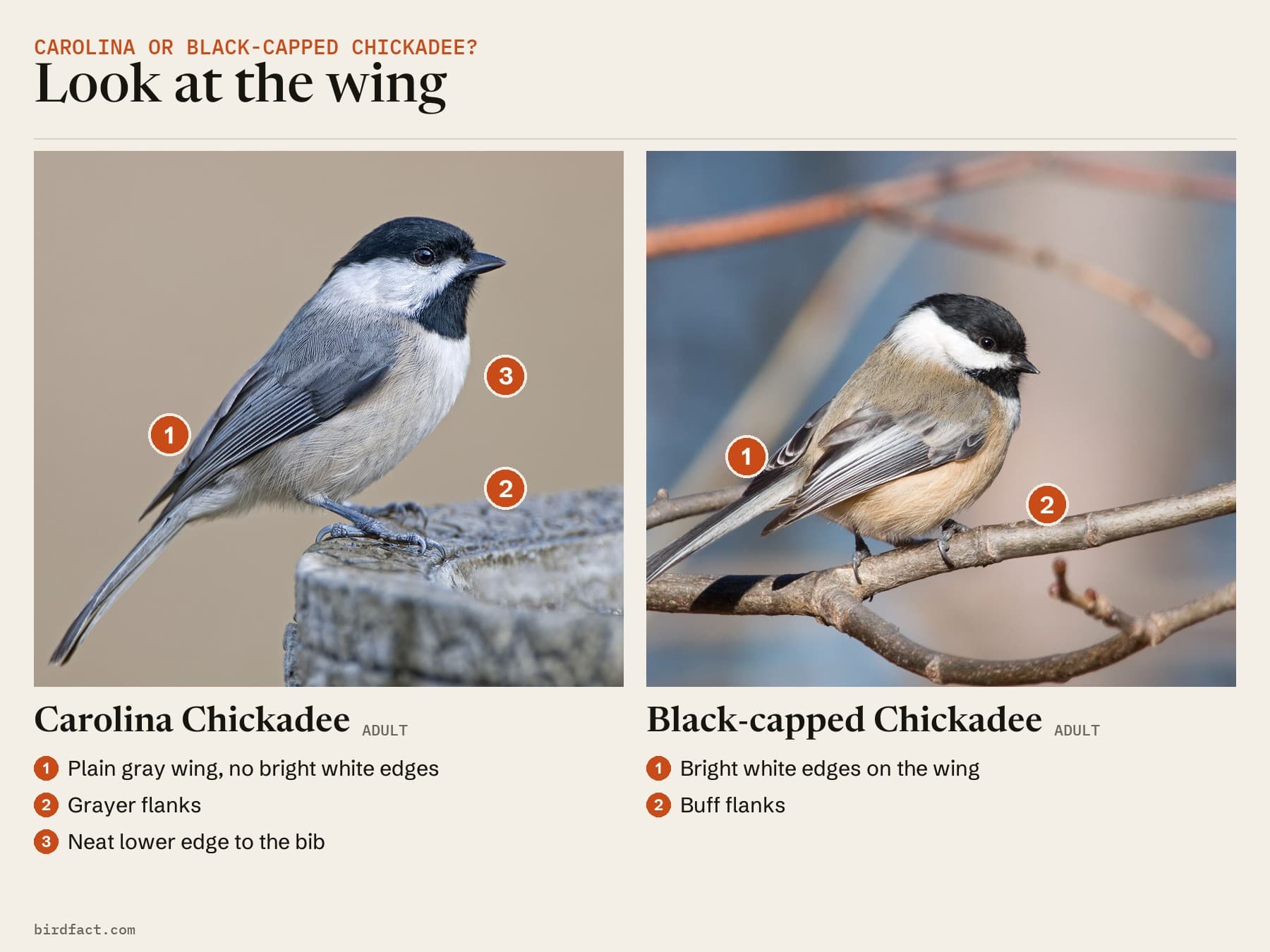
Carolina and Black-capped Chickadees look so alike that they are often confused.1 The good news is that across most of their ranges you only have to know where you are: Carolinas live in the Southeast and Black-cappeds in the North, and the two meet only along a narrow line from Kansas to New Jersey and in the Appalachians.2
Where they do meet, look at the wing: a Black-capped has bright white edges on its wing feathers, a Carolina a plainer gray wing.3 Then listen: a Black-capped whistles two notes, fee-bee; a Carolina usually four, fee-bee-fee-bay. Even then, some birds in the meeting zone are hybrids that no one can name by sight or sound.1
The quickest clues
- Where: the Southeast, north to south-central Kansas, central Missouri, northern Ohio, southern Pennsylvania and central New Jersey (Carolina); the North, from Alaska and Canada south to about the same line, and higher in the Appalachians (Black-capped).
- Wing: plain gray, the greater coverts only rarely edged bright white (Carolina); bright white edges on the greater coverts and secondaries (Black-capped).
- Bib: a neat lower edge (Carolina); a messier, ragged lower edge (Black-capped).
- Flanks: grayish to pale brownish (Carolina); usually buff, especially in fall and winter (Black-capped).
- Song: usually four or more whistles, high and low by turns (Carolina); two, the first higher (Black-capped).
- Call: a faster, higher chick-a-dee-dee-dee (Carolina); slower and hoarser (Black-capped).
- Size and tail: a little smaller, with a shorter tail for its wing (Carolina).
Start with where you are
The Carolina Chickadee is a bird of the Southeast. It lives year-round from south-central Kansas, central Missouri, southern Illinois, northern Indiana, northern Ohio, southern Pennsylvania and central New Jersey to the Atlantic, west into Texas, and down to the Gulf of Mexico and the middle of Florida. It does not migrate.1 The Black-capped Chickadee lives from Alaska and Canada south to about the same line, from central Kansas to northern New Jersey, and across the West to northwestern California, southern Utah and central New Mexico.2 All About Birds sums it up: there is very little overlap, so check a range map first.3
The two meet in a narrow zone, usually 12 to 19 miles (20-30 km) wide and about 31 miles (50 km) in Pennsylvania, running from Kansas to New Jersey. Within it, many birds are hybrids.2 Elsewhere along the line, gaps with few or no chickadees at all, 5 to 40 miles (8-64 km) wide, have been reported in parts of Illinois, Indiana and Ohio.1
In some winters Black-capped Chickadees move south in numbers and turn up along the northern edge of the Carolina's range, in places such as Maryland and the southern parts of Indiana, Ohio and Pennsylvania. They join Carolina flocks and leave again before the nesting season.1 Strays farther south may simply be overlooked among the Carolinas.2
In the mountains
In the Appalachians the two divide the slopes. Black-capped Chickadees live on the higher ridges as far south as West Virginia, western Virginia, eastern Tennessee and western North Carolina,2 and Carolinas below them. Where there are no Black-cappeds, Carolinas go up to about 6,070 feet (1,850 m); where Black-cappeds live above them, Carolinas may stop at 3,300 to 3,900 feet (1,000-1,200 m). On some mountains, such as the Great Smokies, a band up to 980 feet (300 m) deep separates them.1 So a chickadee high in the Smokies in summer may be a Black-capped, and one in the valley below a Carolina.
The wing
Of the three most reliable differences listed by Birds of the World, the wing is the easiest to see. A Black-capped Chickadee has broad, bright white edges on its greater wing coverts and its secondaries and tertials, which together make a pale panel on the folded wing. On a Carolina, the greater coverts have little or no pale edging, and what there is is rarely bright white.1, 2 All About Birds puts it simply: the Carolina's wing is a plainer gray.3
Two cautions. On a Carolina, the pale edges are brightest just after the summer molt and wear away over the year,1 so judge worn spring birds with care. And the amount of white varies by region: Black-cappeds show more white from east to west,2 and some Carolinas have more than others: the northeastern birds have more white on the secondaries than those of the Southeast, and the large Carolinas of Kansas and Oklahoma have flight feathers more clearly edged with whitish.1
Bib, flanks and nape
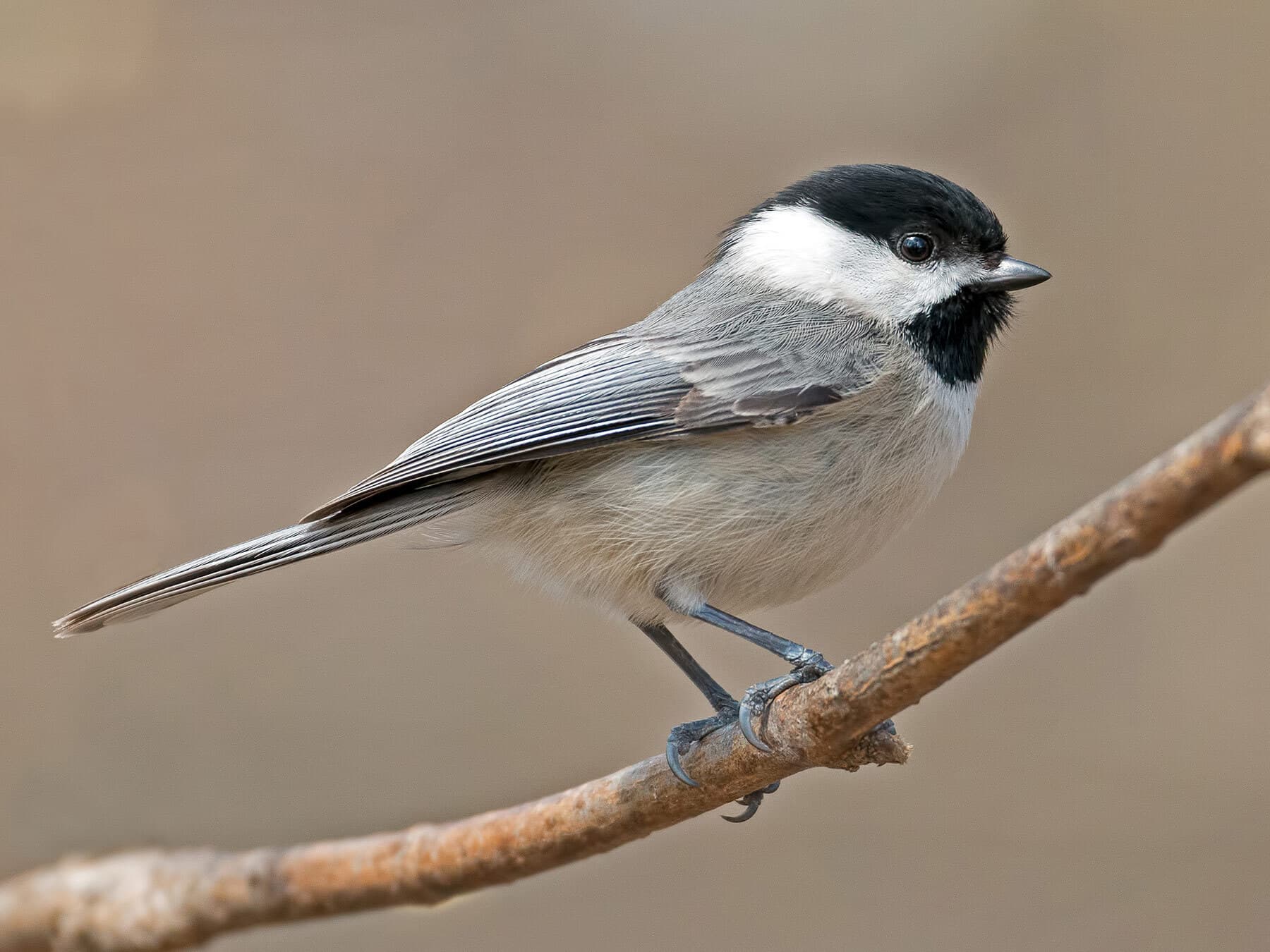
On a Black-capped Chickadee the lower edge of the black bib tends to be messy where it meets the white breast; on a Carolina it is neater.2 The Black-capped's flanks are usually washed buff;2 a Carolina's are gray, brownish gray or pale golden brown,1 so this one overlaps. The Black-capped's buff is richest in fall and winter and wears paler by spring, and its flanks are grayest in birds from the middle of the continent and Alaska.2 All About Birds also points to a grayish nape or collar on the Carolina.3
Size and shape
The Carolina is a little smaller: All About Birds gives 3.9 to 4.7 inches (10-12 cm) and 0.3 to 0.4 oz (8-12 g), against 4.7 to 5.9 inches (12-15 cm) and 0.3 to 0.5 oz (9-14 g) for the Black-capped.3, 4 The difference is real but small, and birds vary, with Carolinas smallest in the South.1
The Carolina also has a shorter tail for the length of its wing. In the hand, a tail-to-wing ratio under 0.9 points to a Carolina and over 0.9 to a Black-capped.2 In the field, a Carolina can look a little shorter-tailed.
Songs
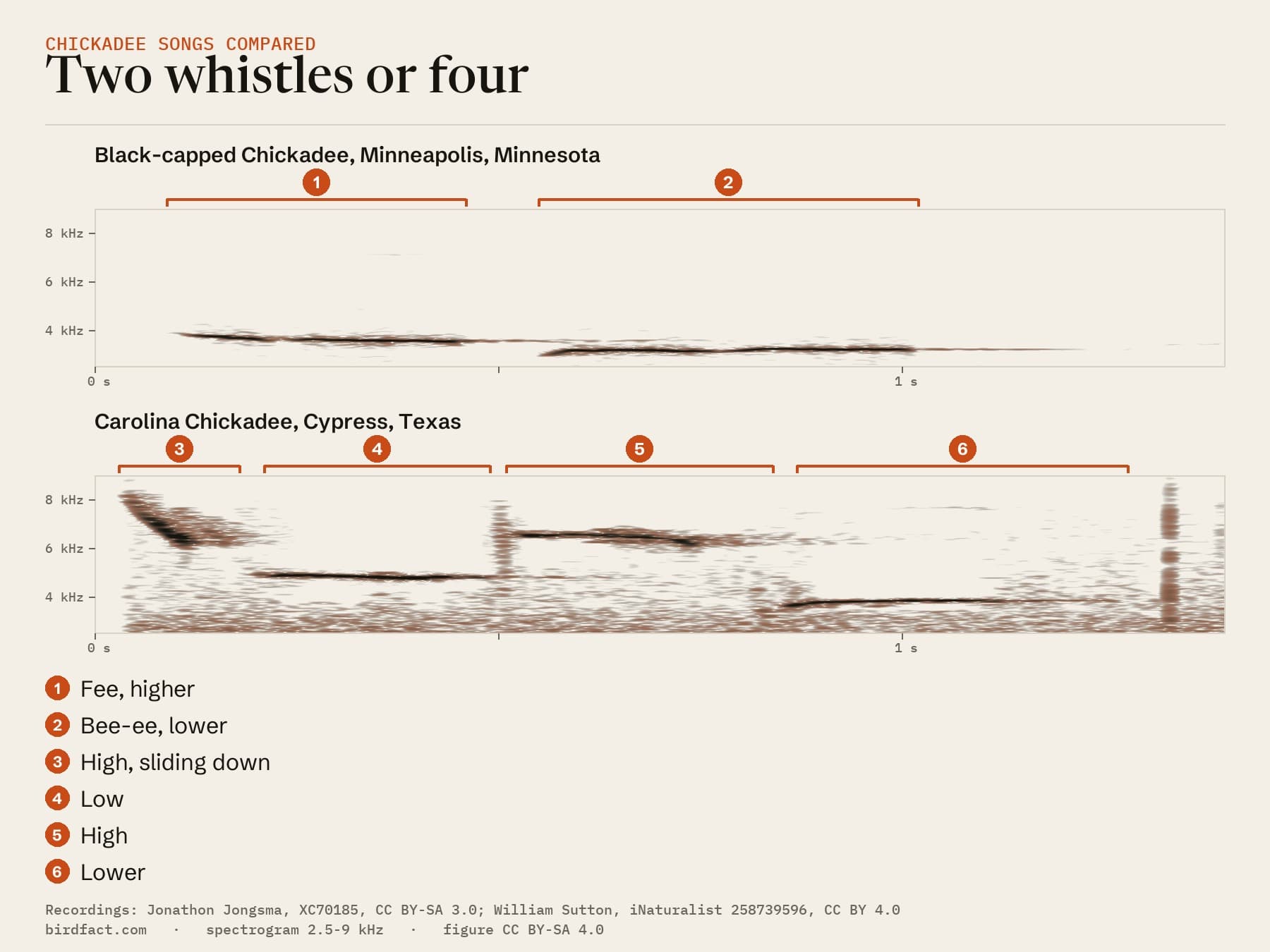
Song is the easiest way to tell them apart, outside the meeting zone. A Black-capped Chickadee whistles two clear notes, fee-bee, the first higher.2 A Carolina whistles four to six shorter notes, high and low by turns. The commonest pattern is four notes, high-low-high-low, with the high notes at about 5.4 to 7.0 kHz and the low ones at 3.0 to 4.3 kHz, both higher than a Black-capped's.1 All About Birds writes it fee-bee-fee-bay.3
Carolinas also have more variety: at least 35 song types have been heard from Pennsylvania to Florida, and each male sings two or three. They do not keep the fixed pitch ratio between notes that Black-cappeds hold to.1
In our recordings, the Minneapolis Black-capped's song lasts about 0.9 seconds. The Texas Carolina's lasts about 1.25 seconds: a whistle sliding down from about 8 to 6.3 kHz, then about 4.85, 6.5 and 3.8 kHz.
Calls
Both give the chick-a-dee-dee-dee call, built from the same four kinds of note in the same order.1 The Carolina's is higher and faster;5 the Black-capped's is slower and hoarser.2 Birds of the World adds that the Carolina's dee notes are generally shorter, but that the calls vary from place to place and the differences are not fully understood,1 so treat the call as a hint rather than proof. In hybrid zones, Carolina-type calls are the commoner kind.2
More on what the call means: Black-capped Chickadee calls and song.
Where song is no proof
Chickadees learn their songs, and in the meeting zone they can learn the wrong one. In one experiment with hand-reared birds, young Black-capped and Carolina Chickadees learned songs of the other species, and birds kept together came to sing alike.6 In the wild, hybrids can sing a Carolina song, a Black-capped song or something in between.3
A study at Hawk Mountain, Pennsylvania, genotyped 20 singing males: 10% were Black-capped, 50% Carolina and 40% hybrids. Their dawn songs did not follow their genes: repertoires ran from all Black-capped songs to mixtures, sometimes with new hybrid songs, and no male sang only Carolina songs.7 So in the meeting zone, a fee-bee does not prove a Black-capped.
Hybrids
Hybrids are common where the two meet,2 and many birds there look intermediate. They often cannot be named reliably by plumage or song; researchers use genetic markers.1 eBird holds hundreds of photos of birds reported as hybrids.2
Hybridizing has costs. Eggs in hybrid populations hatch less often: 65% in Illinois and 78% in southeastern Pennsylvania, against 85 to 92% in pure Carolina populations.1 In aviary tests, hybrids did worse than either parent species at a spatial learning task and at solving a new problem, which may count against them as birds that rely on hidden food in winter.8
The species seem to tell each other apart by more than looks and song. In a Pennsylvania study, the oil from their preen glands differed in chemistry, and wild chickadees preferred the smell of their own species.9 Carolina males also tend to win against Black-capped males, and females prefer dominant males,2 and Carolinas defend their territories against Black-cappeds and hybrids.1
A meeting zone on the move
In most places studied, the line between them is moving north. In southeastern Pennsylvania, genetic samples taken a decade apart (2000-2002 and 2010-2012) showed the center of the hybrid zone had shifted about 7 miles (11.5 km), roughly 0.6 mile (1 km) a year. Across its range, the Carolina's northern limit follows winter cold, lying close to where the average winter low is about 19°F (-7°C); winter lows at the Pennsylvania study sites rose by about 1.4°F (0.76°C) over the decade, and the zone kept pace.10
It has been happening for a long time. In Ohio the zone moved north about 60 miles (100 km) in 70 years,11 and Carolinas have pushed north in Illinois, Indiana, New Jersey and Pennsylvania too. On Mount Mitchell in North Carolina, Carolinas replaced Black-cappeds on the summit after logging and burning.1 The traffic is not all one way: in some Virginia and northern West Virginia mountains, Black-cappeds have moved lower and displaced Carolinas.1 Climate models suggest that the area suitable for the Carolina will shift much farther north by 2050, which may push Black-cappeds back as well.12
How closely related are they?
Less closely than they look. They were long thought to be each other's nearest relatives and were sometimes treated as one species, but genetic studies show two distinct species, separated for perhaps 1 to 2.5 million years. Some DNA evidence even suggests the Carolina's closest relative is the Mexican Chickadee, and the Black-capped's the Mountain Chickadee.1
Side by side
| Carolina Chickadee | Black-capped Chickadee | |
|---|---|---|
| Length | 3.9-4.7 in (10-12 cm) | 4.7-5.9 in (12-15 cm) |
| Weight | 0.3-0.4 oz (8-12 g) | 0.3-0.5 oz (9-14 g) |
| Wingspan | 5.9-7.9 in (15-20 cm) | 6.3-8.3 in (16-21 cm) |
| Wing | plain gray | bright white edges |
| Song | 4-6 notes, high and low by turns | 2 notes, fee-bee |
| Range | Southeast; does not migrate | North; some move south in some winters |
| Eggs | 3-10, most often 6 | usually 6-8 |
| Incubation | 12-15 days | 12-13 days |
| Young leave the nest | 16-19 days after hatching | about 16 days after hatching |
| Oldest known | 10 years 8 months | 11 years 8 months |
Questions
Do Carolina Chickadees only live in the Carolinas?
No. John James Audubon named the bird in South Carolina, but it lives across the Southeast, from Kansas and New Jersey south to Texas and Florida.1
Do both come to feeders and nest boxes?
Yes. Carolinas take sunflower seeds, peanut chips and suet,3 as Black-cappeds do.4 Both nest in boxes, with one difference: Black-cappeds prefer a box filled with sawdust or wood shavings that they can dig out, while Carolinas do not seem to mind either way.3, 1
About the recordings
The Texas recording has two songs, a quick run of very high notes between them and a faint whistle near the start; it was identified by the recordist and three other users, and the Georgia calls by the recordist and two others; another bird calls in the background of the Georgia recording. The Minneapolis Black-capped was seen by the recordist, without playback.15 More: Carolina Chickadee and Black-capped Chickadee.
Sources
- Mostrom, A. M., Curry, R. L., Lohr, B. (2020). Carolina Chickadee (Poecile carolinensis), version 1.0. Birds of the World (A. F. Poole and F. B. Gill, editors). Cornell Lab of Ornithology. doi:10.2173/bow.carchi.01
- Foote, J. R., Mennill, D. J., Ratcliffe, L. M., Smith, S. M. (2020). Black-capped Chickadee (Poecile atricapillus), version 1.0. Birds of the World (A. F. Poole, editor). Cornell Lab of Ornithology. doi:10.2173/bow.bkcchi.01
- Cornell Lab of Ornithology. Carolina Chickadee: Overview, Identification, Sounds and Similar Species. All About Birds. Accessed 11 October 2026. Source
- Cornell Lab of Ornithology. Black-capped Chickadee: Overview, Identification, Life History and Sounds. All About Birds. Accessed 11 October 2026. Source
- National Audubon Society (text: Kaufman, Lives of North American Birds). Carolina Chickadee. Audubon Guide to North American Birds. Accessed 11 October 2026. Source
- Kroodsma, D. E., Albano, D. J. (1995). Song development by Black-capped Chickadees (Parus atricapillus) and Carolina Chickadees (P. carolinensis). The Auk 112(1): 29-43. doi:10.2307/4088764
- Abbrescia, A., Curry, R. L. (2022). Dawn chorus male song patterns in relation to ancestry in the Black-capped Chickadee x Carolina Chickadee hybrid zone. Veritas: Villanova Research Journal 3(1). doi:10.61372/vvrj.v3i1.2643
- McQuillan, M. A., Roth, T. C., Van Huynh, A., Rice, A. M. (2018). Hybrid chickadees are deficient in learning and memory. Evolution 72(5): 1155-1164. doi:10.1111/evo.13470
- Van Huynh, A., Rice, A. M. (2019). Conspecific olfactory preferences and interspecific divergence in odor cues in a chickadee hybrid zone. Ecology and Evolution 9(17): 9671-9683. doi:10.1002/ece3.5497
- Taylor, S. A., White, T. A., Hochachka, W. M., Ferretti, V., Curry, R. L., Lovette, I. J. (2014). Climate-mediated movement of an avian hybrid zone. Current Biology 24(6): 671-676. doi:10.1016/j.cub.2014.01.069
- Bronson, C. L. (2002). Patterns and processes within a non-ecotone hybrid zone: the chickadees of Ohio (PhD dissertation, Ohio State University). OhioLINK Electronic Theses and Dissertations Center. Accessed 11 October 2026. Source
- McQuillan, M. A., Rice, A. M. (2015). Differential effects of climate and species interactions on range limits at a hybrid zone: potential direct and indirect impacts of climate change. Ecology and Evolution 5(21): 5120-5137. doi:10.1002/ece3.1774
- National Audubon Society (text: Kaufman, Lives of North American Birds). Black-capped Chickadee. Audubon Guide to North American Birds. Accessed 11 October 2026. Source
- USGS Bird Banding Laboratory. Longevity records of North American birds. Accessed 11 October 2026. Source
- Sutton, W., Bennett, D., Jongsma, J., iNaturalist and xeno-canto contributors. Recordings used on the Carolina vs Black-capped Chickadee page. iNaturalist; xeno-canto. Accessed 11 October 2026. Source