Identification · Updated 8 Oct 2026
Junco vs Chickadee: How to Tell Them Apart
By the Birdfact teamChecked by Nathan Cope
Look at the face and the bill. A chickadee has a black cap and bib with white cheeks and a black bill; a junco has a plain dark hood, a pink bill and white outer tail feathers. Size, feeding, song, nests and when you will see each, with photos.
On this page11 sections
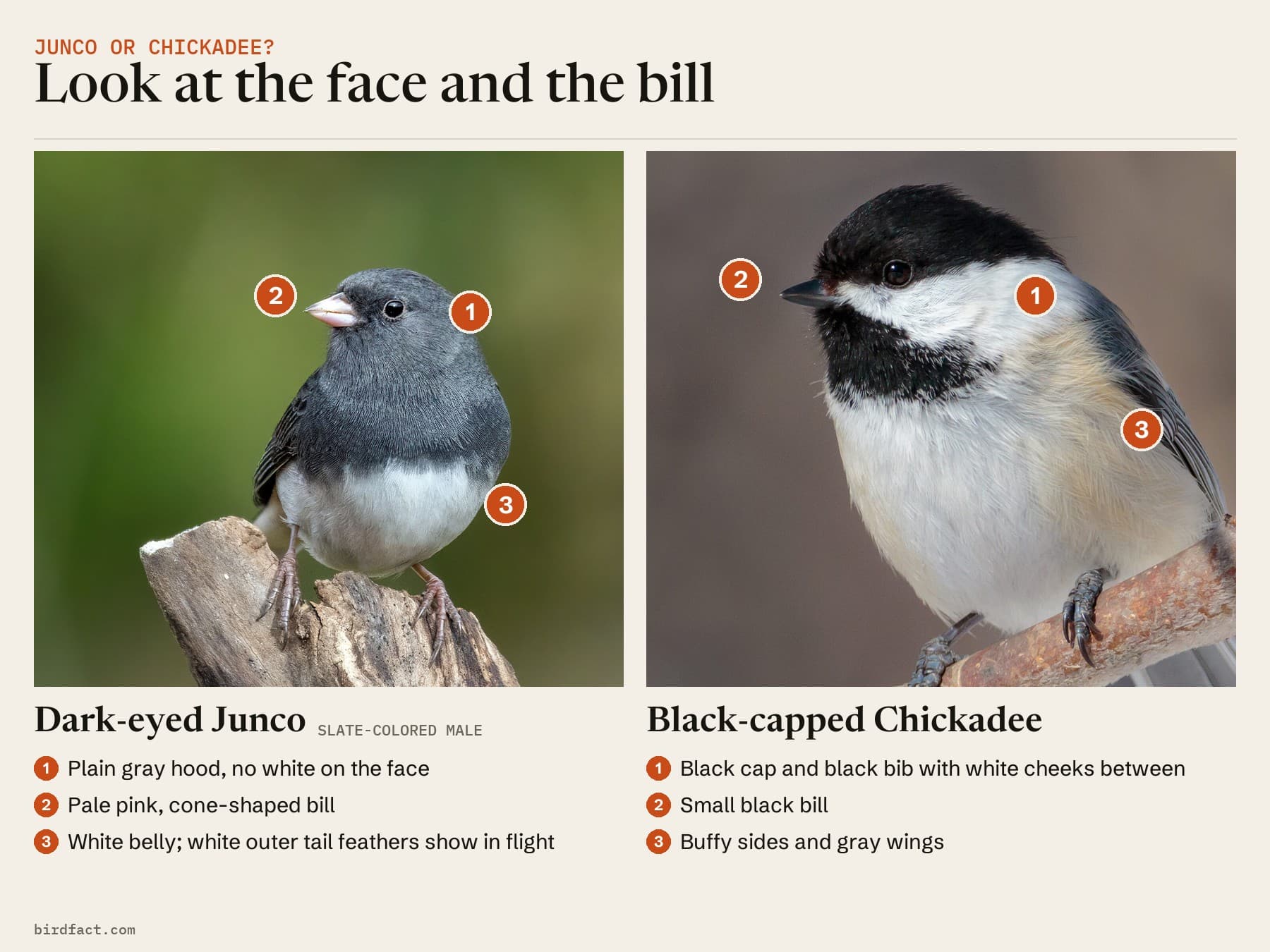
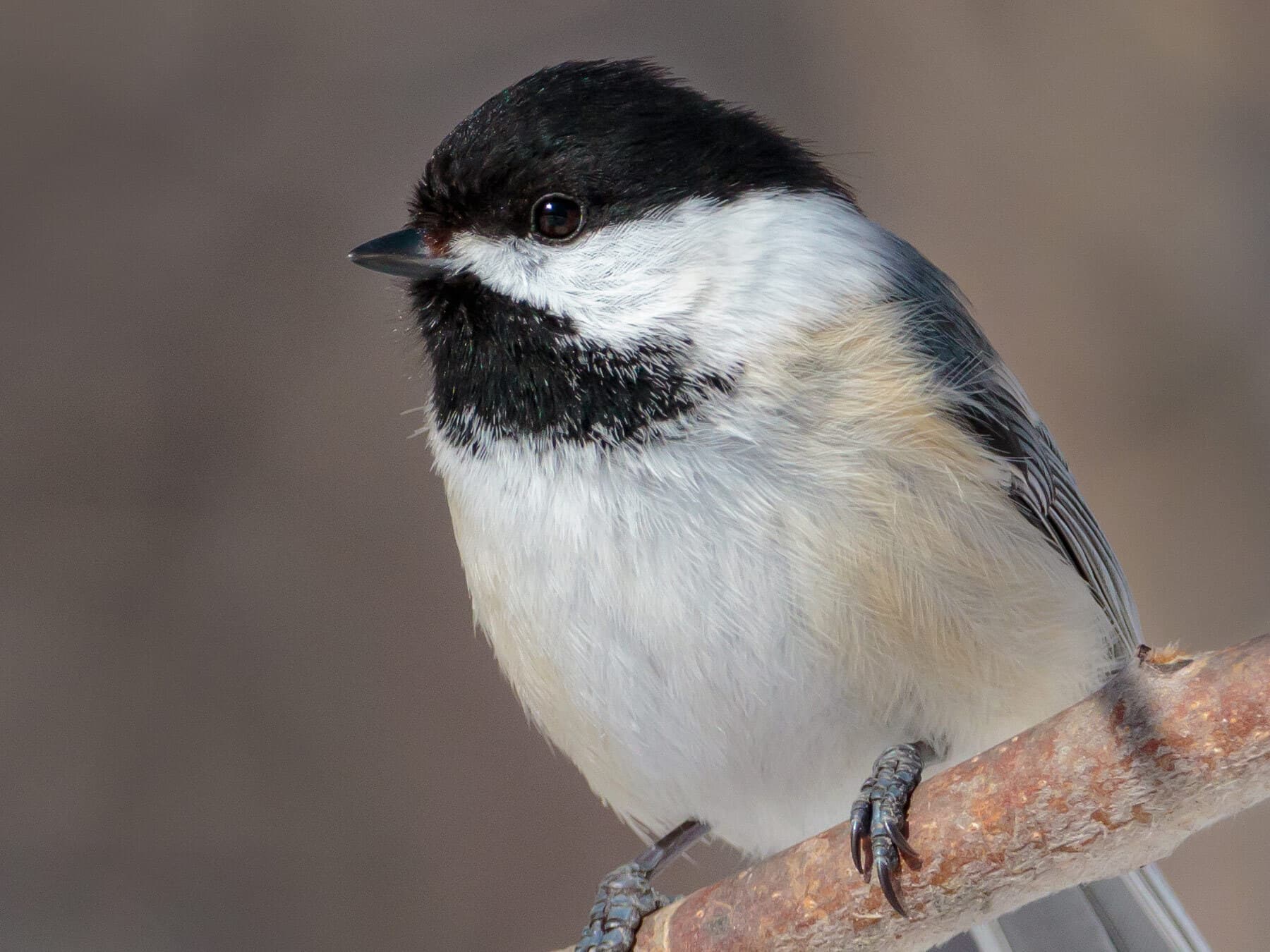
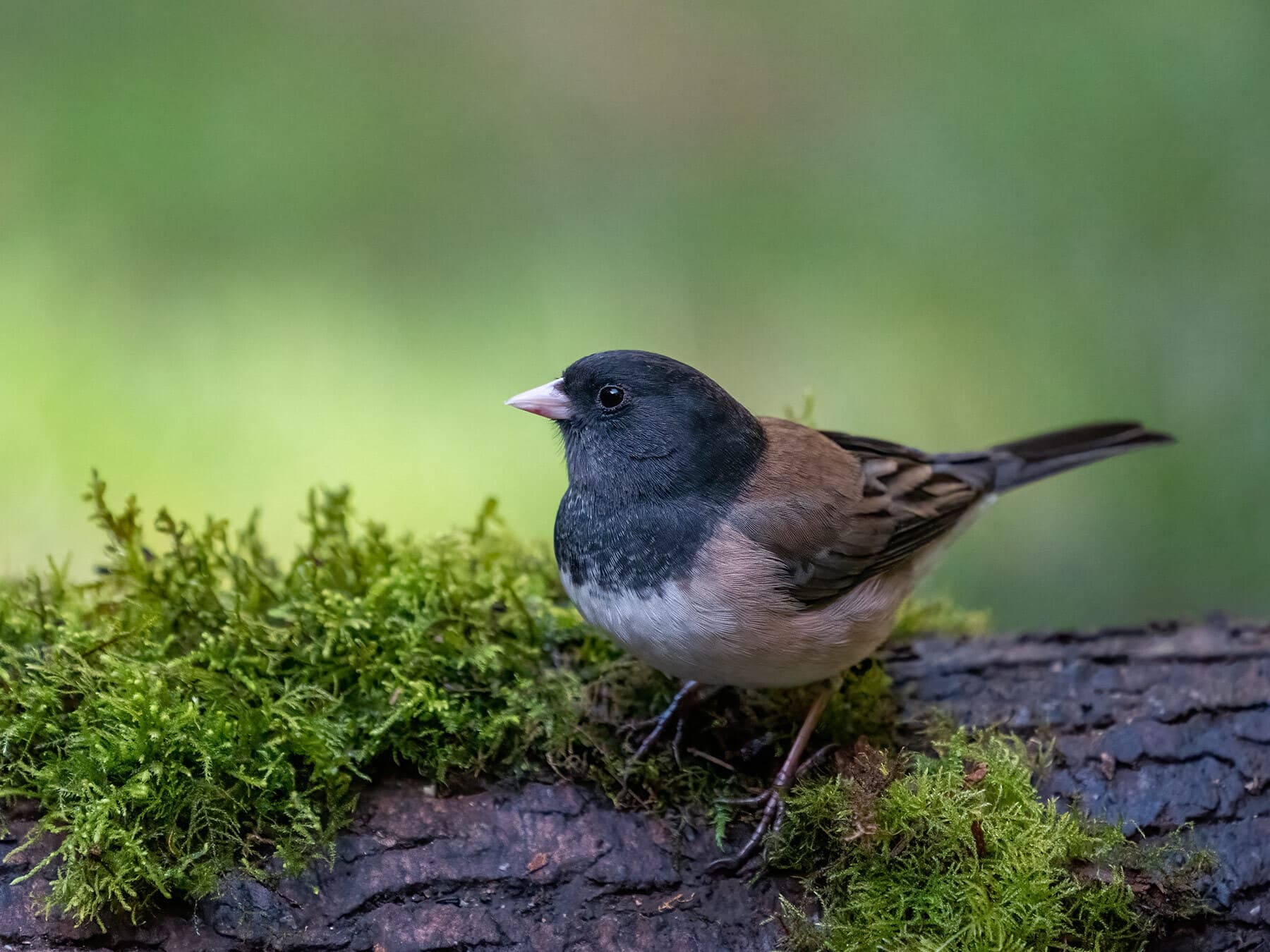
Look at the face and the bill. A Black-capped Chickadee has a black cap and a black bib with white cheeks between them, and a black bill. A Dark-eyed Junco has a plain dark hood with no white on the face, a pale pink bill, and white outer tail feathers that flash when it flies.1, 2
They are easy to mix up because both are small, gray, white-bellied birds that come to winter feeders together, and the male Oregon Junco of the West has a black hood that can suggest a chickadee's cap.
Comparison table
The main differences at a glance.
| Dark-eyed Junco | Black-capped Chickadee | |
|---|---|---|
| Length | About 6 in (14-16.5 cm) | 4.8-5.7 in (12.3-14.6 cm) |
| Weight | 18-30 g | 10-14 g |
| Bill | Pale pink, cone-shaped | Black, small |
| Head | Plain gray or black hood, no white on the face | Black cap and black bib, white cheeks |
| Tail | White outer feathers that flash in flight | Long, gray, no white |
| Feeds | On the ground, hopping | Mostly in trees and shrubs; stores food |
| Song | A fast, musical trill | fee-bee, two clear whistles |
| Nest | A cup on or near the ground | A hole it digs in rotten wood, or a nest box |
| Moves | Most migrate south for winter | Stays all year |
Size and shape
The junco is the bigger, heavier bird: about 6 in (15 cm) and 18 to 30 g, against 4.8 to 5.7 in (12.3 to 14.6 cm) and 10 to 14 g for the chickadee. A junco is plump and round-headed with a cone-shaped seed-eater's bill; a chickadee is smaller and slighter, with a long tail and a small black bill.
The head and face
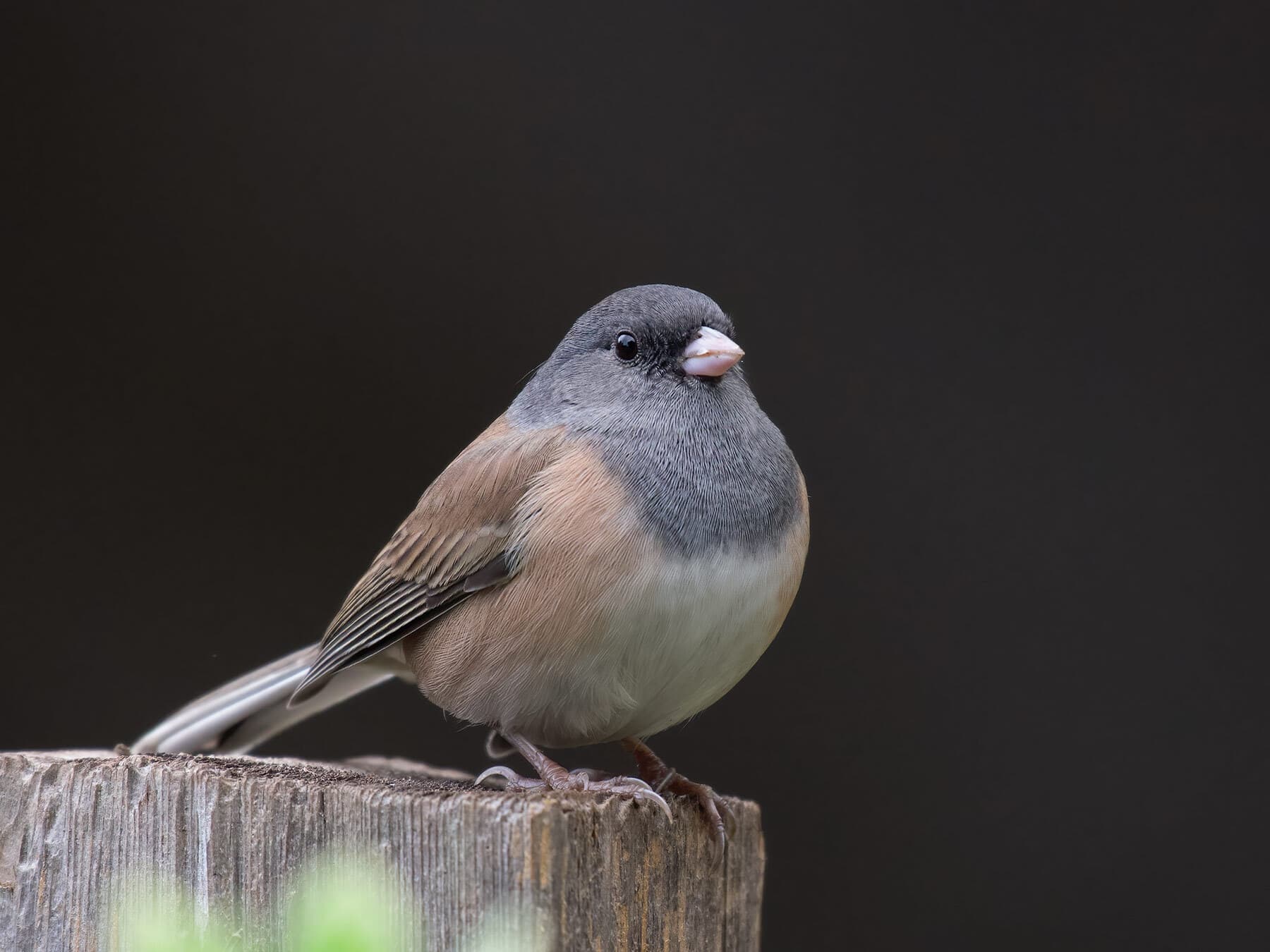
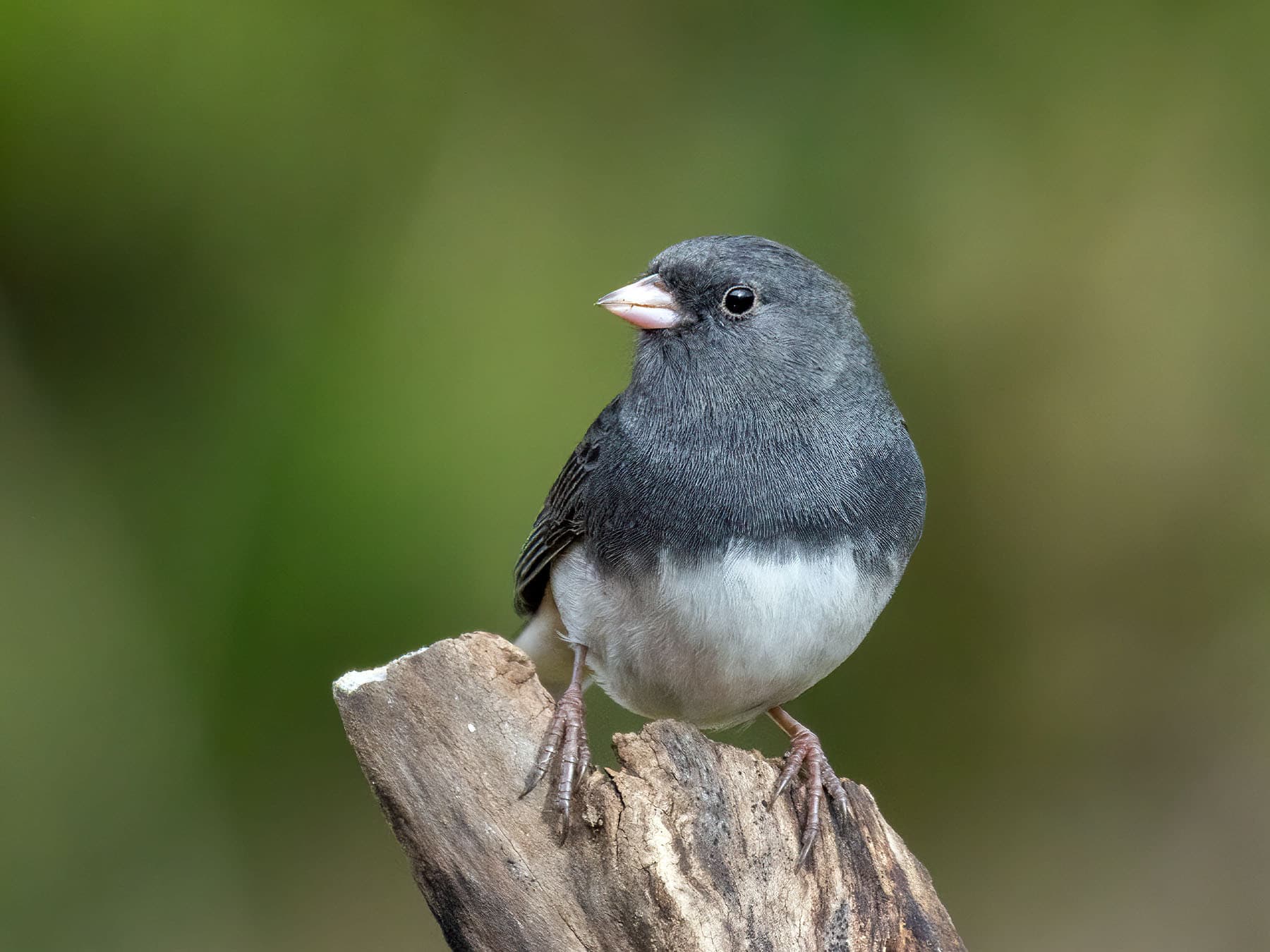
This is the clincher. A chickadee's face is black, white and black: a solid black cap, white cheeks, a black bib. A junco's hood is one color, slate-gray in the Slate-colored form or black in a male Oregon Junco, from the crown down over the throat and breast, with no white cheek. The junco's bill is pale pink; the chickadee's is black.3
Back, sides and tail
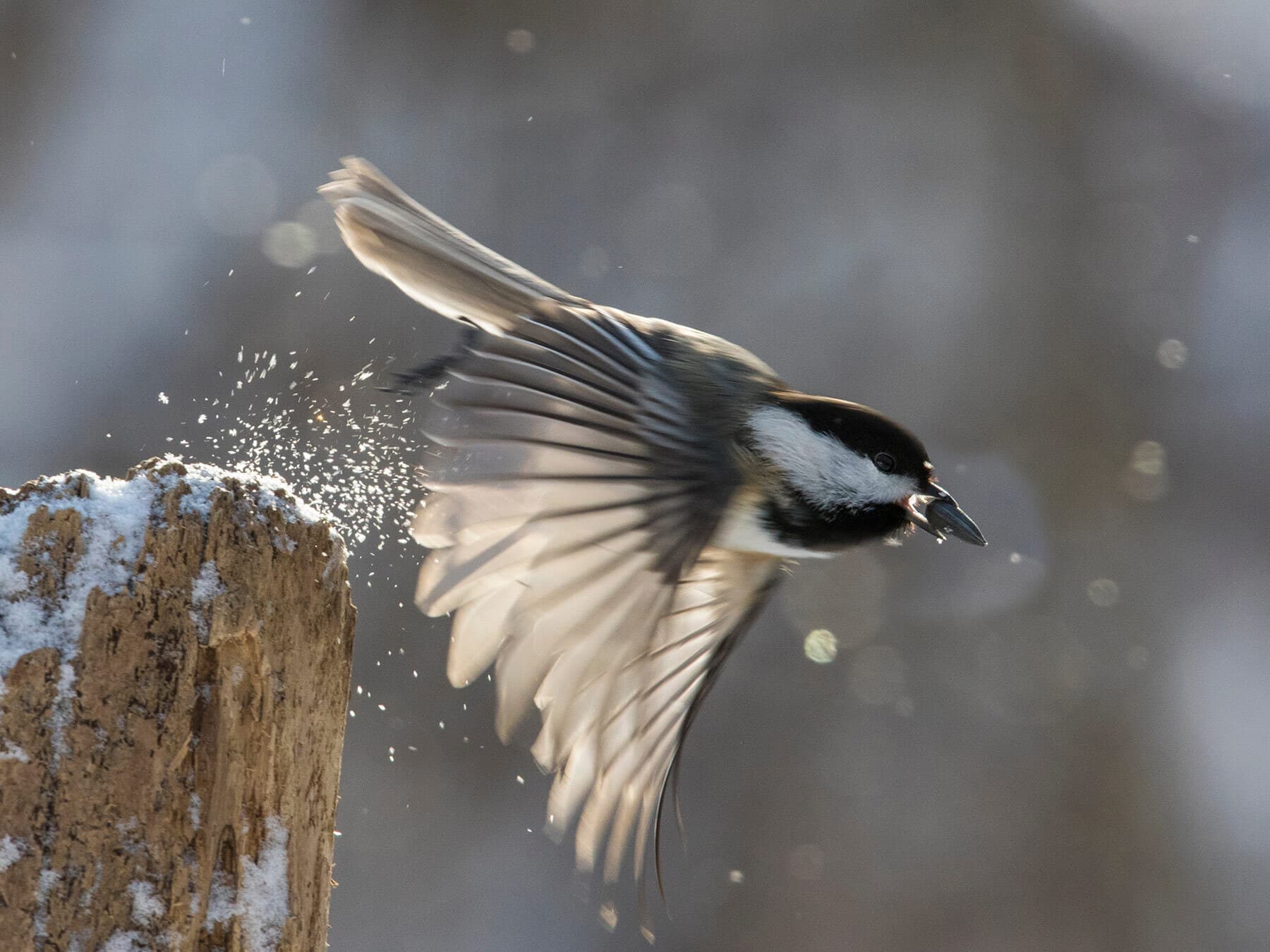
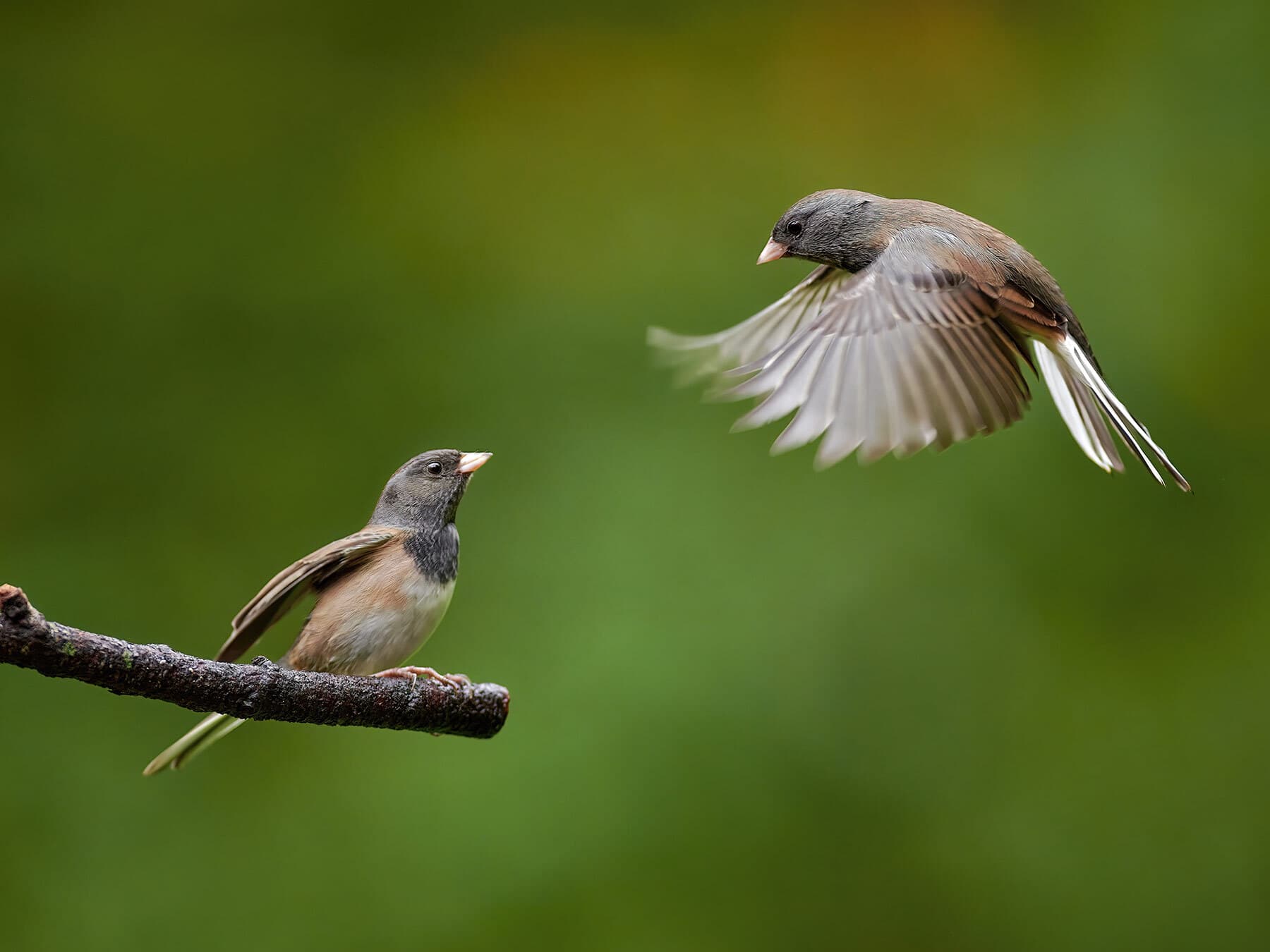
A Black-capped Chickadee has a greenish-gray back, buffy sides, and gray wings and tail with pale edges to the wing feathers. A junco's back is slate-gray (Slate-colored) or brown (Oregon), and its sides gray or rusty-buff. The tail is the giveaway in flight: a junco flashes white outer tail feathers, a chickadee shows none.
How they feed
Juncos are ground birds: at a feeder they hop about underneath, picking up fallen seed. Chickadees feed in trees and shrubs and they store food and find it again later by memory. Juncos do not store food. More: what juncos eat and what chickadees eat.
Song and calls
The junco sings a fast, even, musical trill about two seconds long, and calls with high, sharp chips. The Black-capped Chickadee sings fee-bee, two clear whistles with the first higher, and gives the chick-a-dee call it is named for.
Nests
A junco builds an open cup on or near the ground, in a hollow in a bank or among roots. A chickadee nests in a hole in a tree, usually one the pair dig themselves in soft, rotten wood, and will use a nest box where holes are scarce. More: junco nesting and chickadee nesting.
Where and when to see them
Black-capped Chickadees stay put all year, from coast to coast across much of Canada and the northern two-thirds of the US; in Canadian banding records, 90% of birds caught again had not moved. Most juncos breed in Canada, the northern states and the mountains and come south for the winter, so across much of the US the two meet only in winter.
That is also when they meet at feeders. In Project FeederWatch's 2021-22 season in the Northeast, chickadees (Black-capped and Carolina counted together) came to 93.95% of sites and juncos to 91.89%, the top two birds.4
What about the Carolina Chickadee?
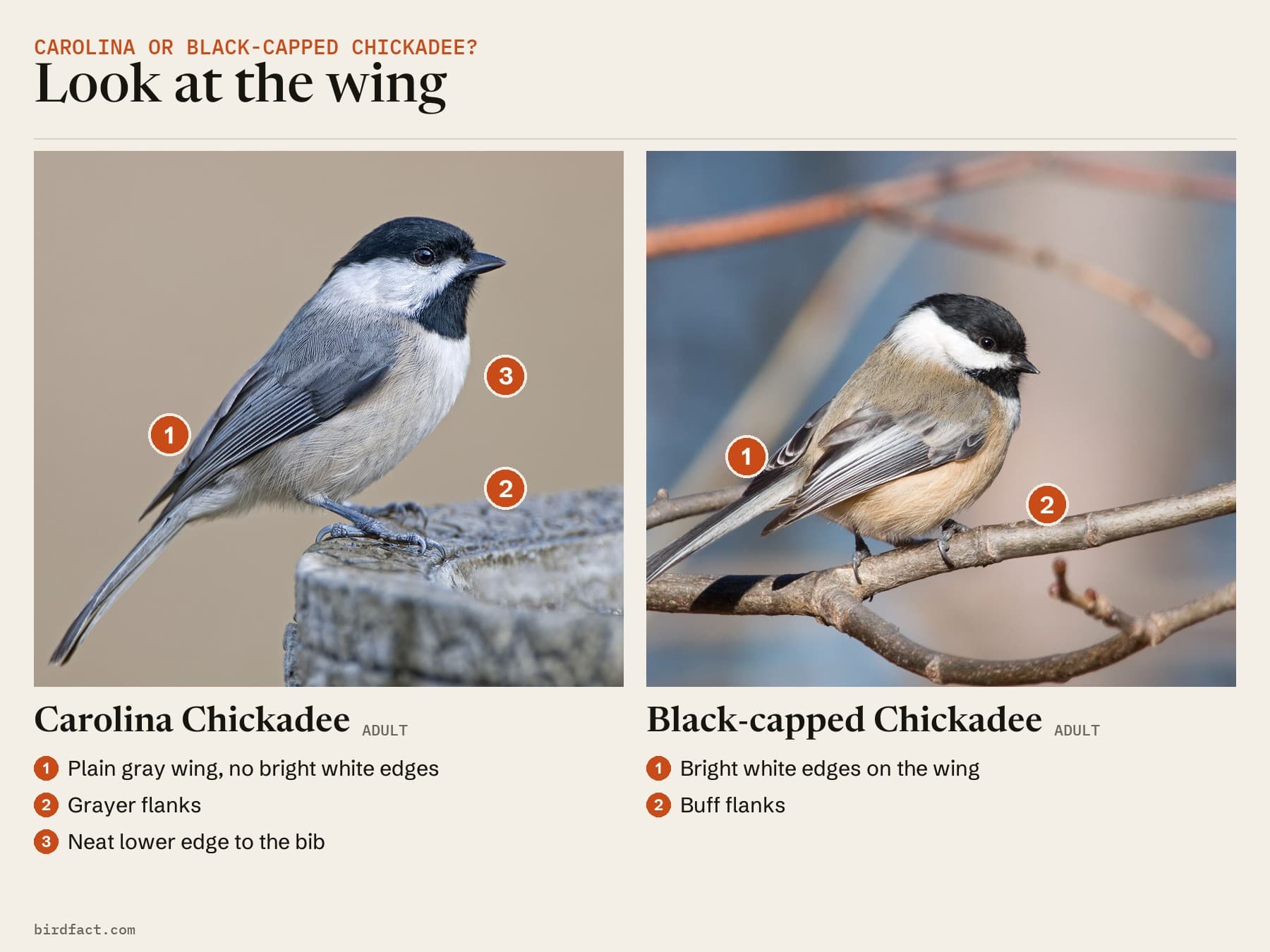
In the Southeast, the chickadee at your feeder is the Carolina Chickadee, which looks almost the same as the Black-capped. The face pattern on this page applies to it too: black cap, black bib, white cheeks, black bill. The two chickadees are best told apart by voice.
Which lives longer?
They are much alike. The oldest known Black-capped Chickadee was at least 11 years and 8 months old, and the oldest Dark-eyed Junco at least 11 years and 4 months.5
Dark-eyed Junco
Junco hyemalis

The Dark-eyed Junco is a plump little sparrow with a pale pink bill, a gray or blackish hood and a clean white belly, best known for the white outer tail feathers it flashes as it flies off. It breeds
Black-capped Chickadee
Poecile atricapillus
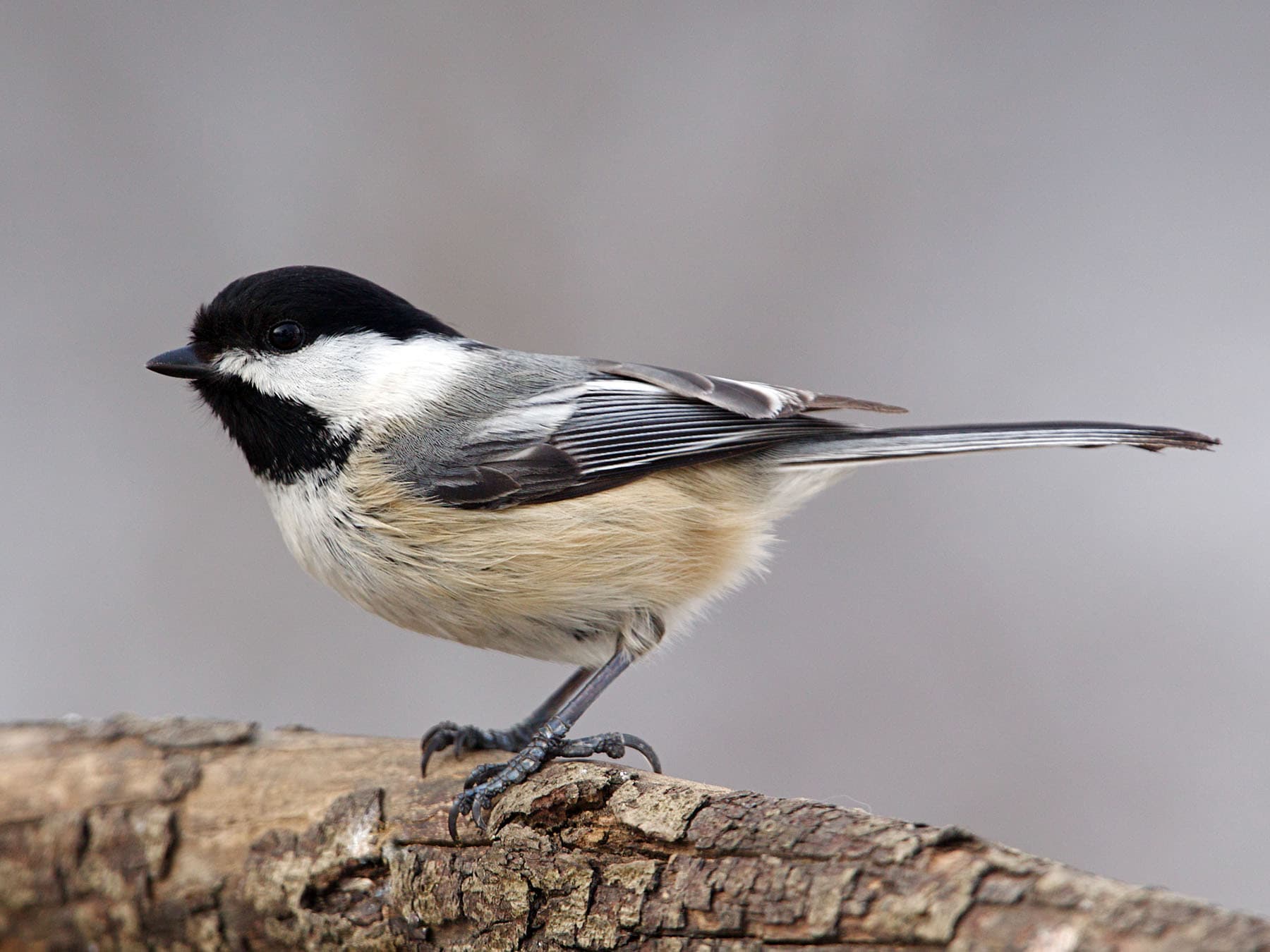
The Black-capped Chickadee is the small, friendly bird with a black cap, a black bib and bright white cheeks that visits backyard feeders across Canada and the northern United States all year. It hide
Sources
- Foote, J. R., Mennill, D. J., Ratcliffe, L. M., Smith, S. M. (2020). Black-capped Chickadee (Poecile atricapillus), version 1.0. Birds of the World (A. F. Poole, editor). Cornell Lab of Ornithology. doi:10.2173/bow.bkcchi.01
- Cornell Lab of Ornithology. Dark-eyed Junco: Overview, Identification and Life History. All About Birds. Accessed 7 October 2026. Source
- Nolan Jr., V., Ketterson, E. D., Cristol, D. A., Rogers, C. M., Clotfelter, E. D., Titus, R. C., Schoech, S. J., Snajdr, E. (2020). Dark-eyed Junco (Junco hyemalis), version 1.0. Birds of the World (A. F. Poole and F. B. Gill, editors). Cornell Lab of Ornithology. doi:10.2173/bow.daejun.01
- Project FeederWatch (Cornell Lab of Ornithology and Birds Canada) (2022). Top 25 Feeder Birds, 2021-22, Northeast Region. Project FeederWatch. Accessed 7 October 2026. Source
- USGS Bird Banding Laboratory. Longevity records of North American birds. Accessed 7 October 2026. Source