Facts · Updated 11 Oct 2026
Black-capped Chickadee Nesting: Nests, Eggs and Young
By the Birdfact teamChecked by Nathan Cope
Black-capped Chickadees nest in tree holes they usually dig themselves in rotten wood, or in nest boxes. The female builds a nest of moss and fur, lays usually 6 to 8 white eggs with reddish-brown dots from April to July, and incubates them for 12 to 13 days. The young leave at about 16 days old, and pairs raise one brood a year.
On this page13 sections
Everything about Black-capped Chickadee nests: when they nest, how they dig their nest holes, nest boxes, eggs, chicks and fledglings. For the bird itself, see Black-capped Chickadee identification, calls and facts.
When do chickadees nest?
In spring. Pairs start digging a nest hole one to two weeks before the first egg, and eggs are laid from April to July: in the old egg records, from April 13 in Oregon and April 18 in Michigan to July 12 in Massachusetts.1 In Canada the season begins in mid-April to mid-May and is over by early to mid-July, depending on the region.2 Warm, dry springs bring laying forward, and older, higher-ranking females tend to start first.
Where they nest
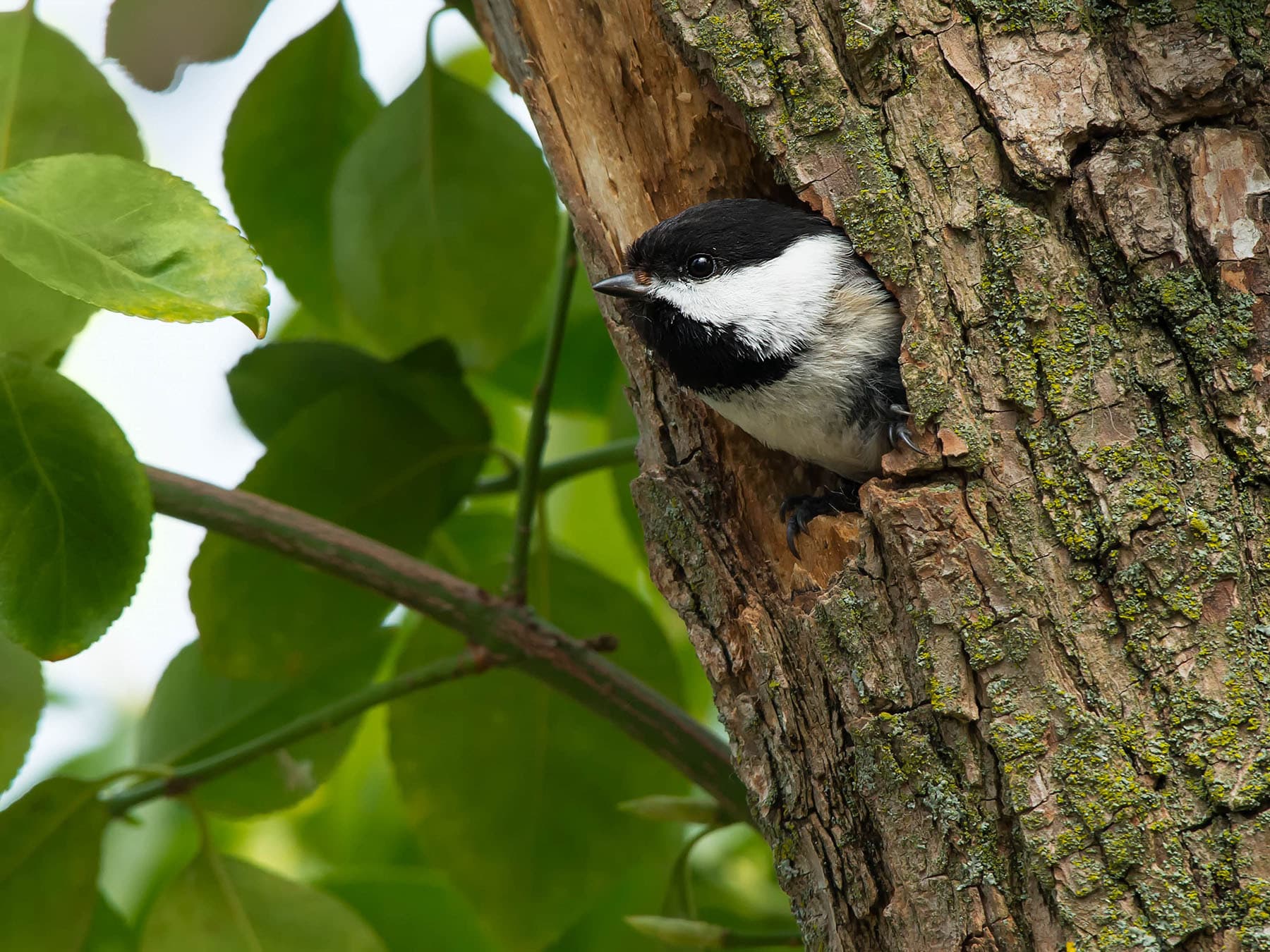
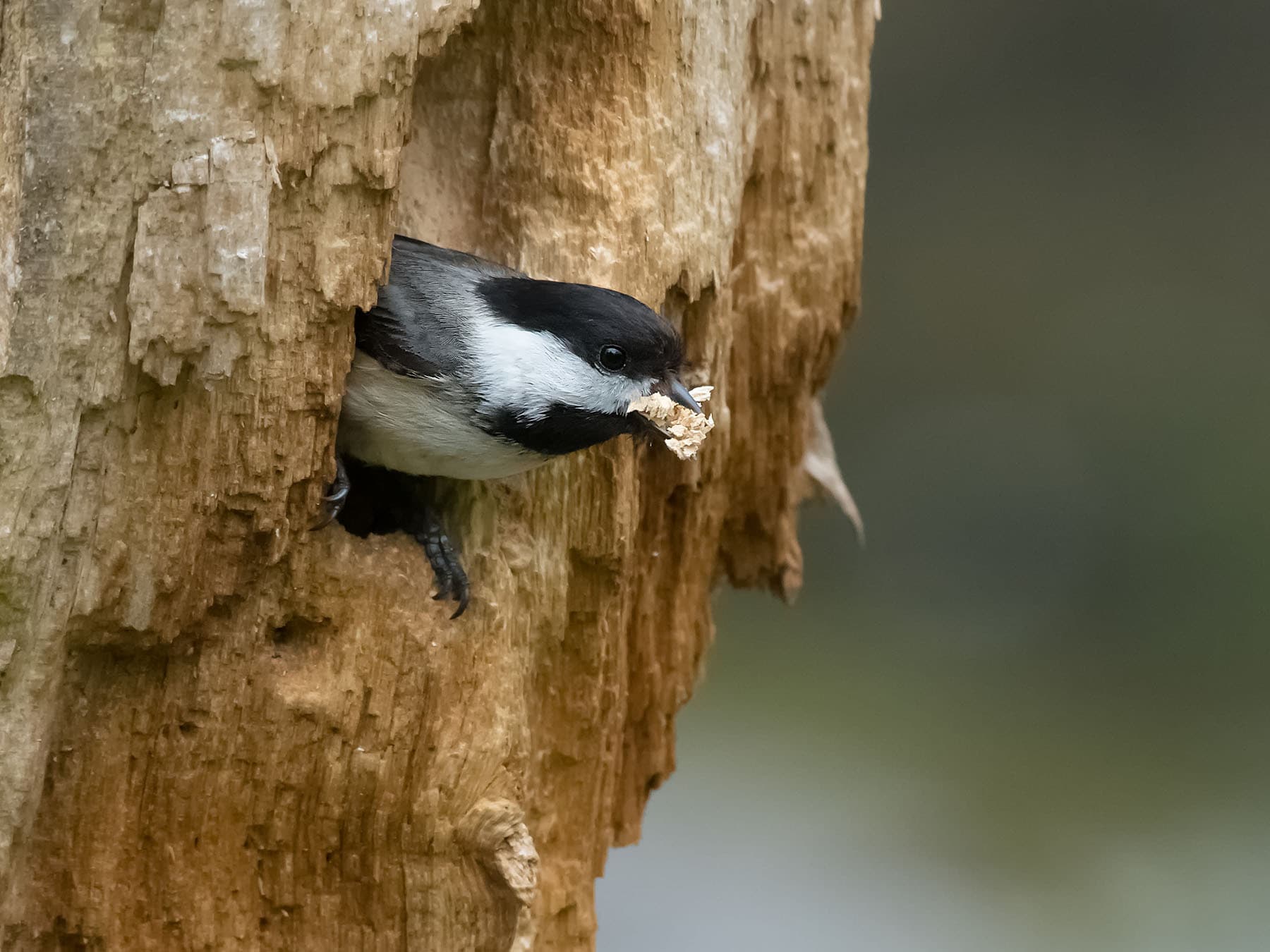
Chickadees nest in holes in trees, often ones they dig themselves. In one British Columbia study, 87% of nests were in cavities the birds had excavated and only 13% in existing holes.1 They need soft, rotten wood they can chip with their bills, so they choose dead snags and decaying branches, especially of birch, aspen and alder: in one Ontario study, half the nest holes were in birch. They also take over natural holes, old woodpecker holes, including those of Downy Woodpeckers, and nest boxes.
Nest holes can be anywhere from ground level to more than 65 feet (20 m) up, but most are 5 to 23 feet (1.5-7 m) high. Most entrances are on the side, often on the underside of a leaning snag, and about 15 to 20% on top. Which way the hole faces seems not to matter.
Digging the hole
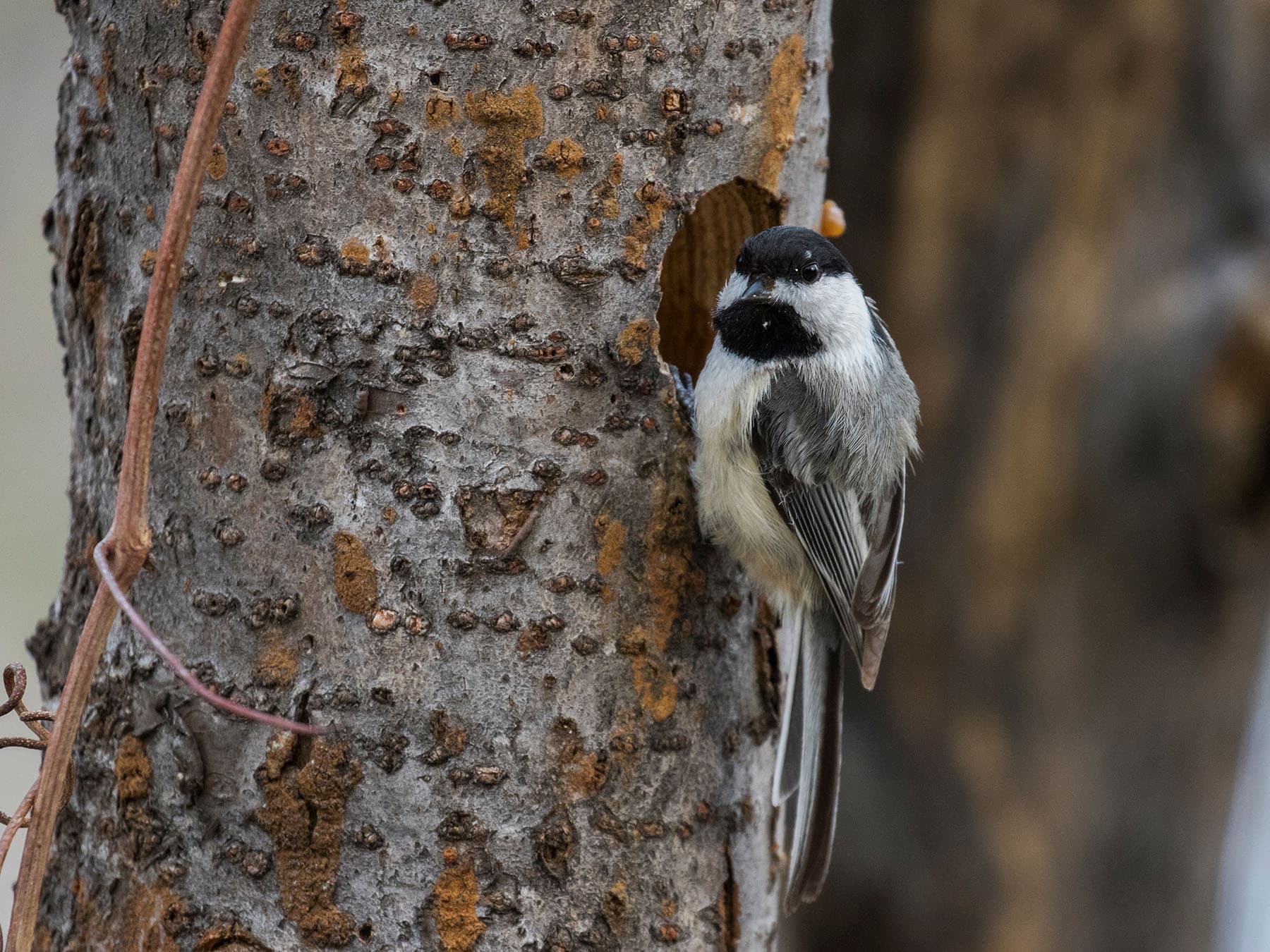
Both birds dig, taking out the rotten wood with their bills. They may start several holes before settling on one, and the female usually has the final say. A finished chamber is about 8 inches (21 cm) deep on average, though some reach 18 inches (46 cm).
The nest
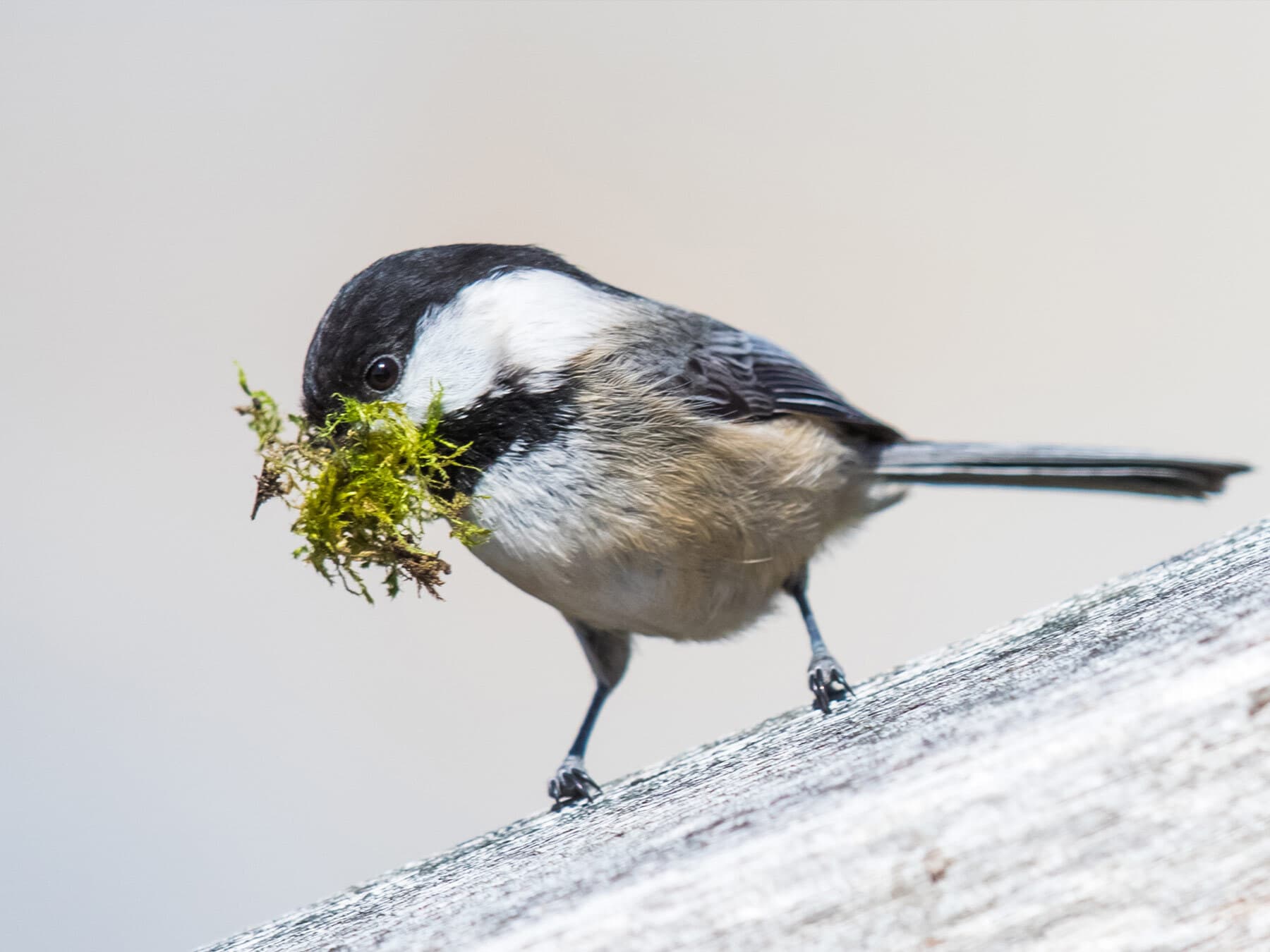
Inside the hole, the female alone builds a cup on a base of moss and other coarse material, lined with soft fur or hair, such as rabbit fur or deer hair. It often takes her 4 to 5 days, sometimes as little as 2 or as long as 2 weeks.1
Nest boxes
Chickadees use nest boxes, especially where dead trees are scarce, and they prefer a box they can dig in. NestWatch recommends:
- an entrance hole 1 1/8 inches (about 29 mm) across;
- a floor 5 1/2 by 5 1/2 inches (14 x 14 cm) and a box 8 inches (20 cm) deep inside;
- 1 inch (2.5 cm) of wood shavings on the floor;
- mounting 5 to 15 feet (1.5-4.5 m) up, facing away from the prevailing wind, with about 650 feet (200 m) between boxes.3
A hole this small keeps out bigger competitors such as House Sparrows. Put the box up well before the breeding season, add a predator guard, keep branches clear of the entrance, and place it at least 60 feet into the woods to discourage House Wrens.
Eggs
Chickadee eggs are white, finely dotted with reddish brown, often most thickly toward the larger end, and about 0.6 by 0.5 inches (15 x 12 mm). The female lays one a day, early in the morning, often starting within a day or two of finishing the nest.
A clutch is usually 6 to 8 eggs,4 though clutches of 1 to 13 have been recorded. Of 225 clutches in one museum collection, nearly 80% held 6, 7 or 8.
Incubation
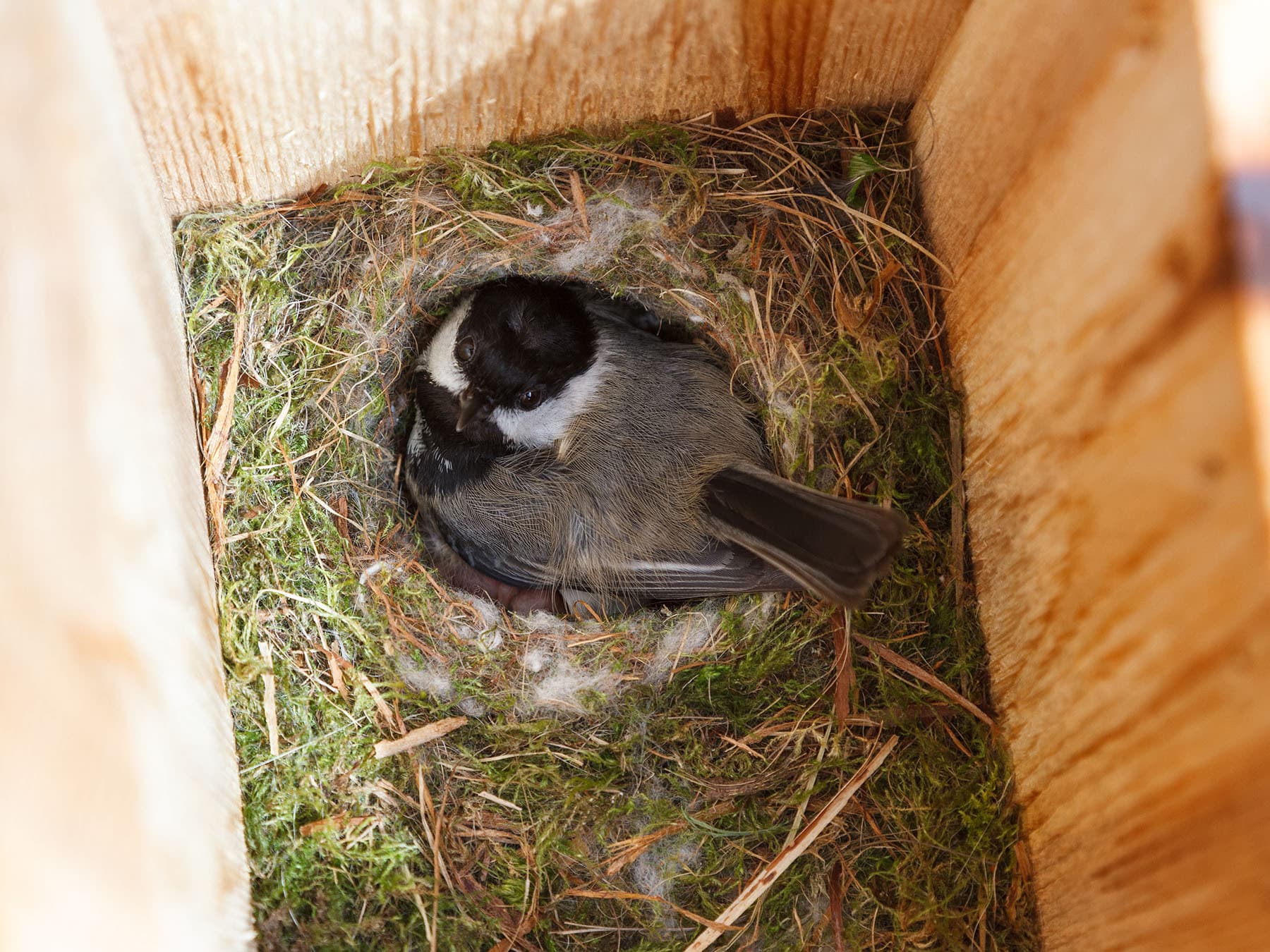
Only the female incubates, for 12 to 13 days, starting when she lays her next-to-last egg. She sits for about 20 to 25 minutes at a time and leaves for 7 or 8, and covers the eggs with nest lining when she goes. The male brings her food throughout, and she begs for it with quivering wings and soft broken "dee" calls.
If a predator looks into the hole, a sitting chickadee may give a startling defense, the "snake display": a sudden, explosive hiss, sometimes with a slap of the wings against the walls.
Chicks
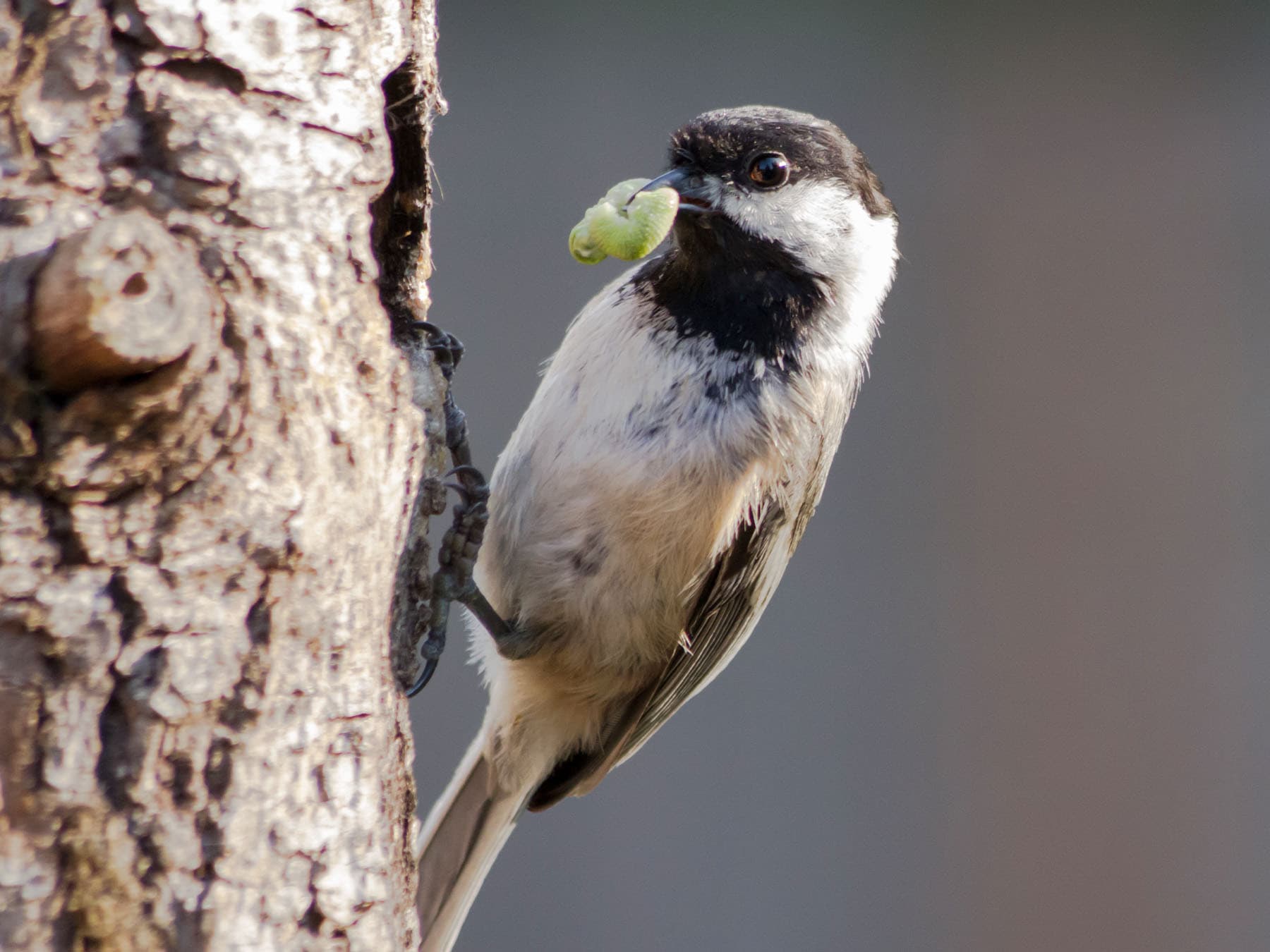
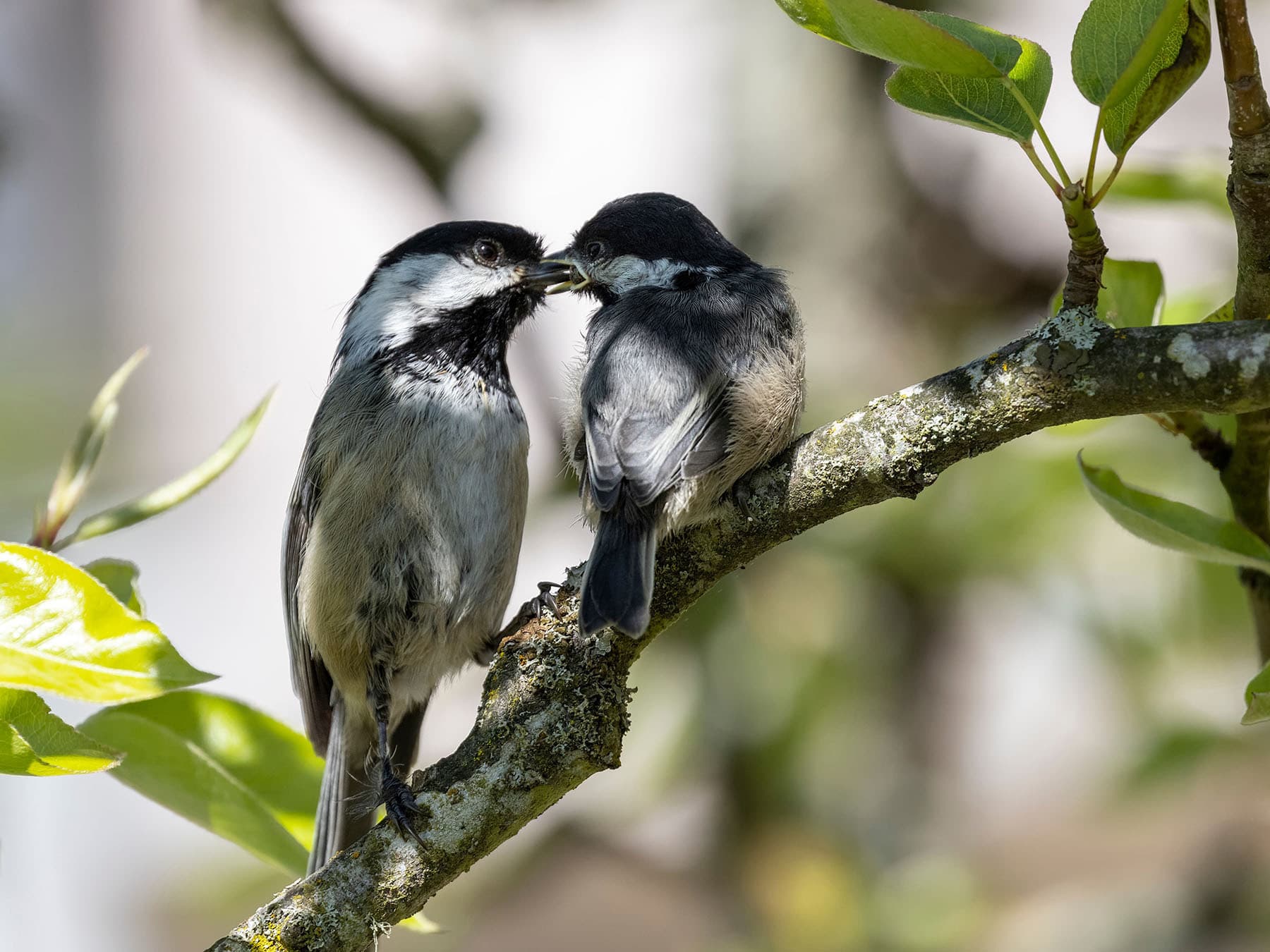
The eggs hatch within a day or so of each other. The chicks are born with their eyes closed, naked except for six small tufts of gray down, and weigh about 1 g (0.04 oz). For the first 12 days or so the female broods them while the male brings most of the food; by the time they are 13 days old both parents bring equal shares. The food is mostly caterpillars, with spiders and other insects. The chicks grow fast, to 10 to 12 g (0.35-0.4 oz), about adult weight, by day 15. The parents carry away their droppings in neat sacs.
Leaving the nest
Undisturbed young leave at about 16 days old, usually in the morning, the whole brood within an hour or two;1 if disturbed, they can leave as early as 12 days. They don't come back to the nest but follow their parents, which feed them for 3 to 4 weeks. Then, almost overnight, the young scatter. In one study, half settled within about 650 feet (200 m) of where they hatched, though some went 7 miles (11 km), and they join the local winter flocks.
Broods
One. Black-capped Chickadees raise a single brood a year. If a nest is lost, they often start a replacement within a few days, some distance away, but true second broods after a successful first are rare.
Do chickadees reuse their nests?
Rarely. They usually dig or find a new hole each year, generally more than 200 feet (60 m) from the last one, and reuse old holes mainly where there is nothing else. Parasites are rare in chickadee nests, probably because they seldom reuse a hole.
Nest predators
Raccoons, squirrels, opossums, woodpeckers and some snakes raid chickadee nests. House Wrens destroy many clutches in competition for nest holes and even kill chickadee chicks. In one Ithaca, New York, study, predators took 13 of 21 nests;1 thick, hard walls gave the best protection.
When a predator comes near the nest, a parent may put on a distraction display: leaning forward with its tail fanned, it lifts its outstretched wings and lowers them again, slowly.
Sources
- Foote, J. R., Mennill, D. J., Ratcliffe, L. M., Smith, S. M. (2020). Black-capped Chickadee (Poecile atricapillus), version 1.0. Birds of the World (A. F. Poole, editor). Cornell Lab of Ornithology. doi:10.2173/bow.bkcchi.01
- Environment and Climate Change Canada. Status of Birds in Canada 2019: Black-capped Chickadee. Government of Canada. Accessed October 11, 2026. Source
- NestWatch (Cornell Lab of Ornithology). Right Bird, Right House: Black-capped Chickadee. NestWatch. Accessed October 11, 2026. Source
- National Audubon Society (text: Kaufman, Lives of North American Birds). Black-capped Chickadee. Audubon Guide to North American Birds. Accessed October 11, 2026. Source
- Cornell Lab of Ornithology. Black-capped Chickadee: Overview, Identification, Life History and Sounds. All About Birds. Accessed October 11, 2026. Source
- NestWatch (Cornell Lab of Ornithology). Black-capped Chickadee. NestWatch. Accessed October 11, 2026. Source
- U.S. Fish and Wildlife Service. List of birds protected by the Migratory Bird Treaty Act. Code of Federal Regulations, 50 CFR 10.13. Accessed October 11, 2026. Source