Facts · Updated 8 Oct 2026
Dark-eyed Junco Nesting: Nests, Eggs and Baby Juncos
By the Birdfact teamChecked by Nathan Cope
Dark-eyed Juncos nest on or near the ground, in a hollow in a bank or among roots, sometimes on a ledge or in a hanging flower pot. The female builds the cup, lays 3 to 5 eggs and incubates them for 12 to 13 days, and the young leave the nest at about 10 to 13 days. When, where, the eggs, the chicks, and what to do if you find one.
On this page12 sections
This page follows a Dark-eyed Junco nest from start to finish: when and where juncos nest, the nest and eggs, how long each stage takes, and the young, including what to do if you find one. For the bird itself, see Dark-eyed Junco identification, song and facts.
Nesting season
The season depends on where they are. Juncos that stay put all year start earliest: in California and Arizona the first eggs can be laid in March. In the Appalachians of Virginia, females start building from mid-April. Farther north, the first eggs are laid from late April in Ontario and Alaska and from May in British Columbia and Alberta.1
Pairs raise one brood in the far north and high mountains, and two, sometimes three, farther south.2 A female whose nest is lost usually builds a new one and tries again, so recently fledged young can be seen from May into August, and occasionally September.
Where do juncos nest?
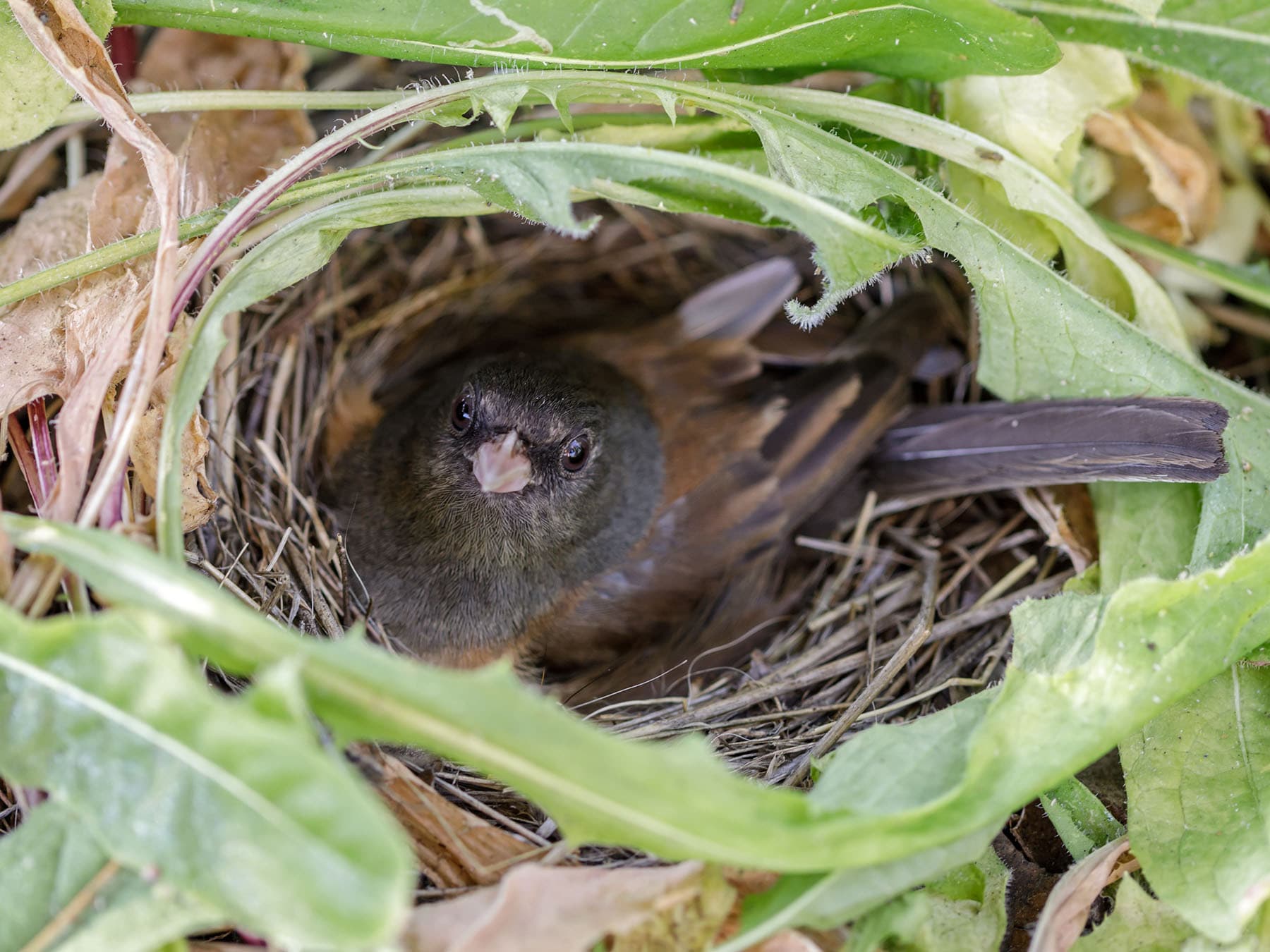
On or near the ground, almost always well hidden. The female chooses the site: typically a small hollow in a sloping bank, a road cut or a rock face, a gap under a rock or among the roots of a fallen tree, under a log, or at the base of a bush or fern, often under overhanging grass.3
Some juncos nest higher up: on horizontal branches, rarely as high as 45 ft, on window ledges, beams and light fixtures, in hanging flower pots, and in or under buildings. In one study in Virginia, 41 of 317 nests were off the ground, 24 of them in or under buildings. Juncos sometimes reline an old American Robin nest.
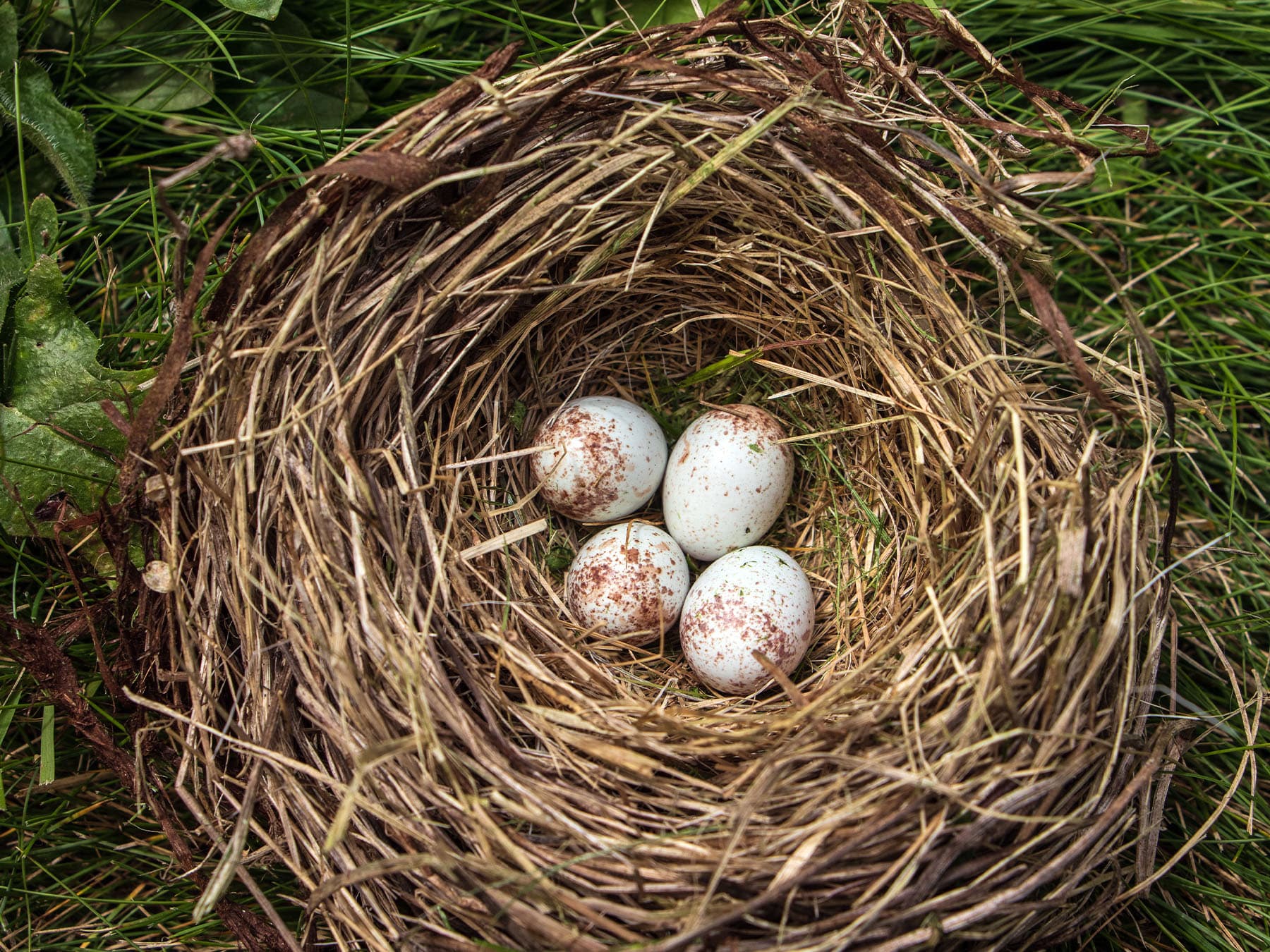
Nesting on the ground
Juncos are birds of the ground: they feed mostly on the ground and in low shrubs, and most nest there too, hidden in a hollow or under cover. It is risky: in one long study in Virginia, predators took about half of all nests in an average year (from 20% to 85%), mostly chipmunks and mice. Juncos make up for it by nesting again quickly.
The nest
A neat cup. It starts with a base of dead leaves, moss, bark strips and coarse rootlets, then a cup of grass, fern rhizomes and rootlets, lined with fine grass, hair and moss. In a small hollow it may be just a thin lining of grass or pine needles. A finished nest is 3 to 5.5 in across, with a cup 2.4 to 2.8 in wide and 1.6 to 2.8 in deep.
Building
The female builds it on her own, in 3 to 7 days for a first nest and as little as a day or two later in the season. The male sometimes picks up moss or grass while courting her, but she does not use it.
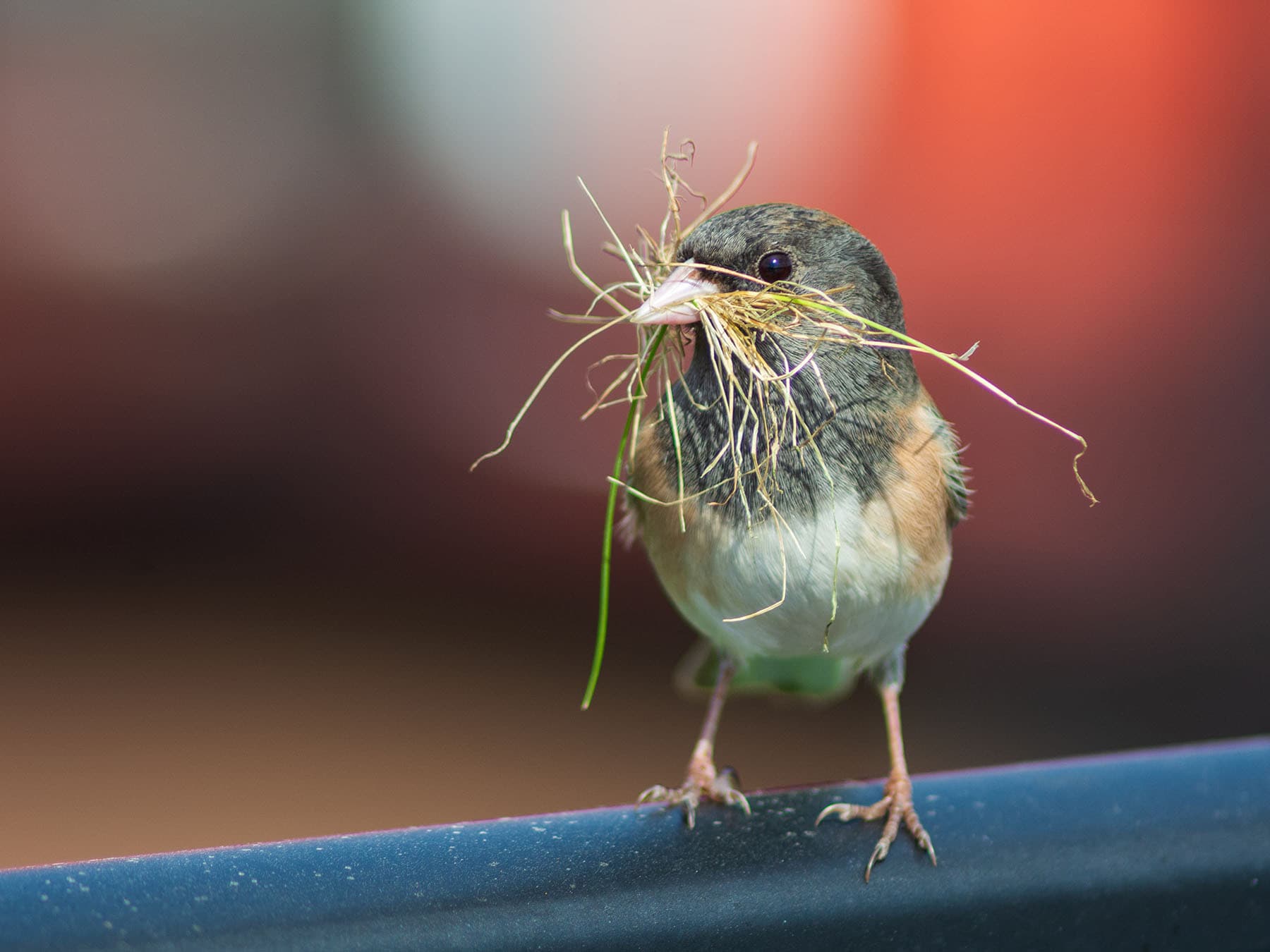
Eggs
A clutch is usually 4 eggs, sometimes 3 or 5; 3 is common late in the season. The eggs are white, gray, or pale bluish or greenish white, speckled with reddish brown to brown, mostly at the larger end, and sometimes plain. Each is about 0.8 by 0.6 in (20 by 15 mm). The female lays one a day, early in the morning.
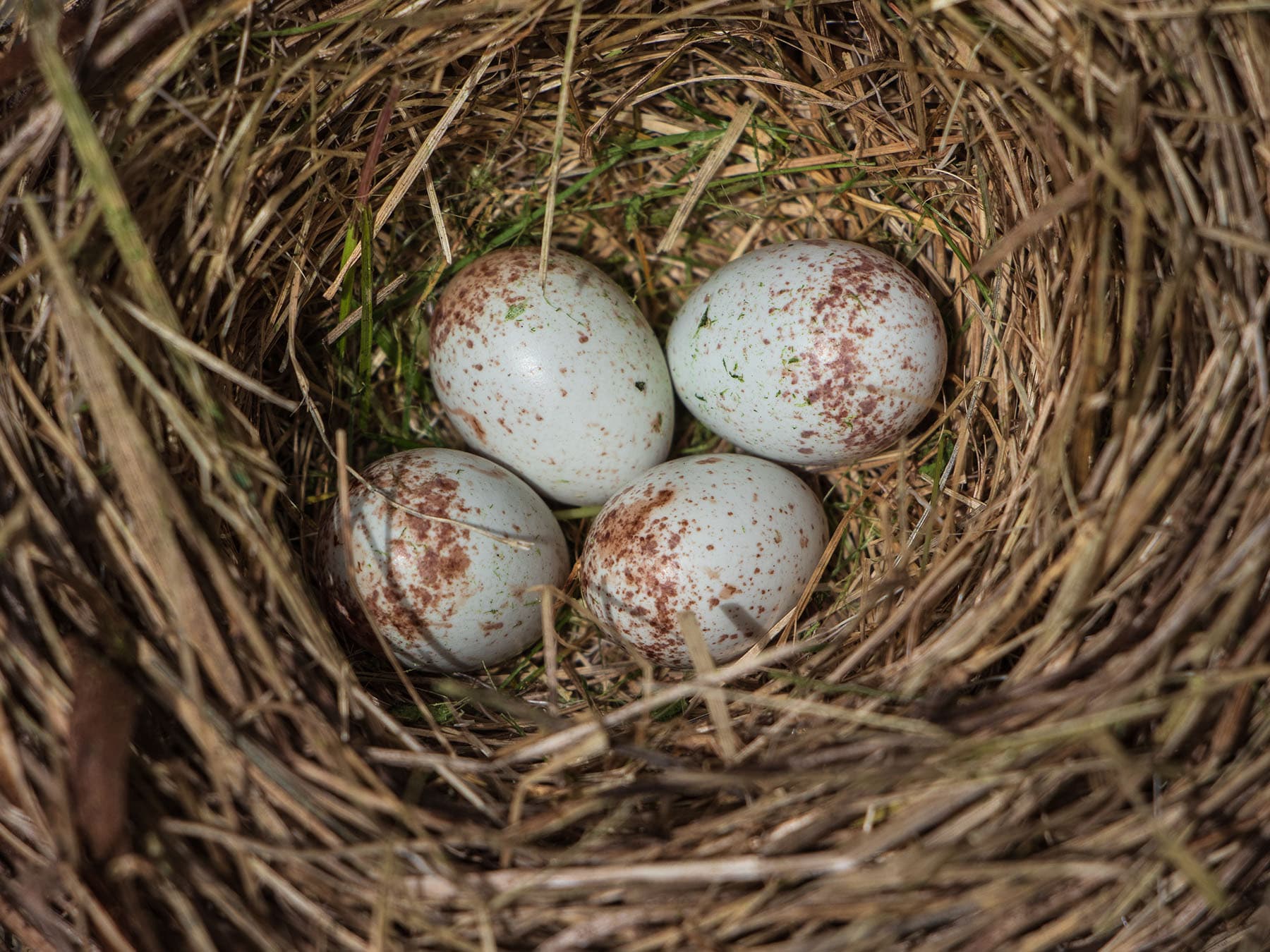
How long do junco eggs take to hatch?
12 to 13 days. Only the female incubates; she alone has a brood patch. She starts on the evening the next-to-last egg is laid, and most clutches hatch within a few hours. While she sits, the male stays nearby, warns of danger and chases off chipmunks and small birds.
Baby juncos
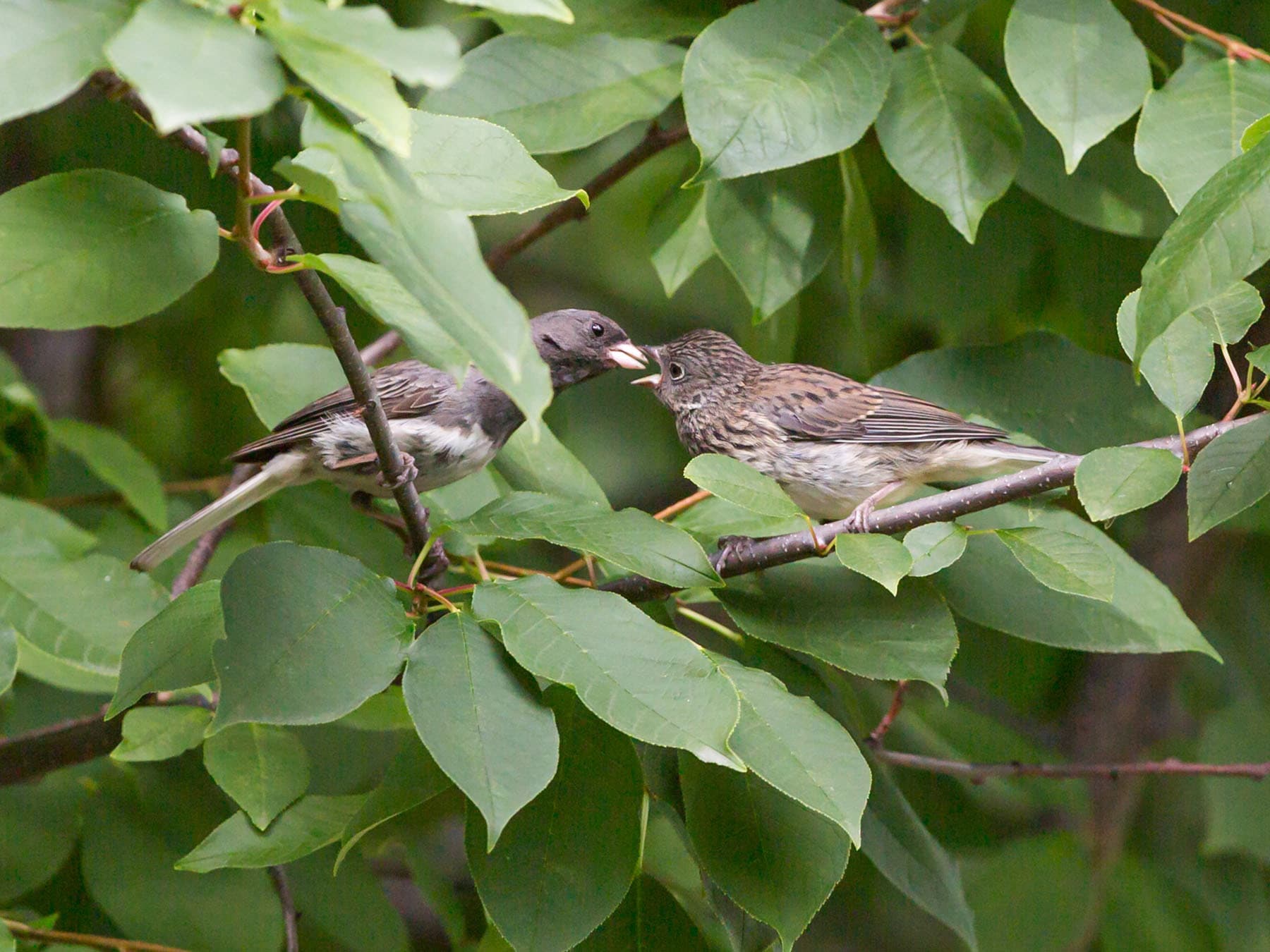
The chicks hatch with tufts of dark gray down, closed eyes and bright yellow bill flanges, and open their eyes at about 6 to 7 days. Both parents feed them, in roughly equal shares, mostly on insects and spiders, and carry away their droppings.
They leave the nest at about 10 to 13 days old, hopping out before they can fly properly. For the next two weeks they keep still in low cover, calling to be fed, and they feed themselves from about 25 days old.
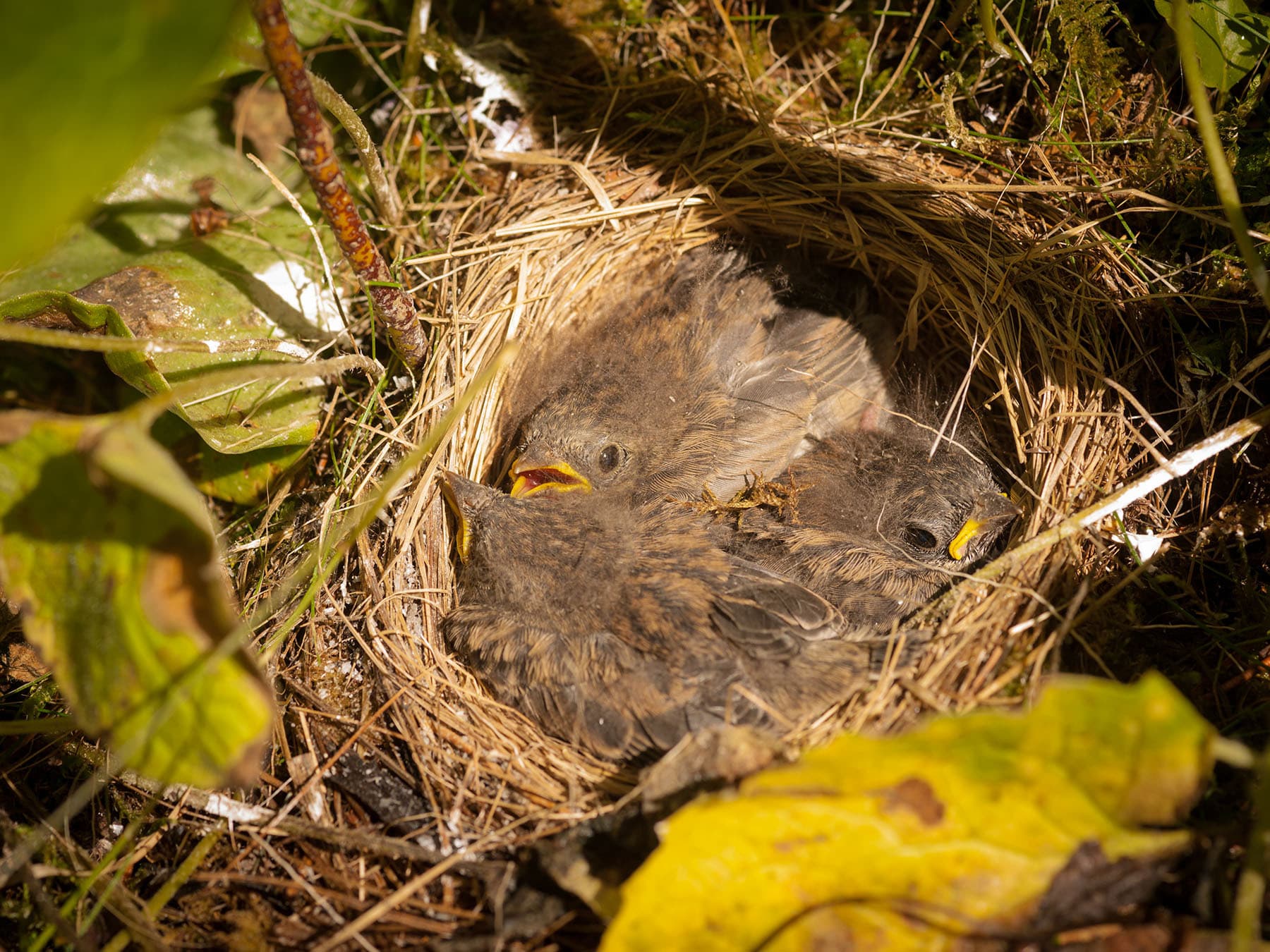
If you find a baby junco on the ground
Usually you need do nothing. A young junco that is feathered and hopping about is a fledgling, and its parents are nearby and still feeding it; give it space. If it is featherless or its eyes are closed, it is a nestling: if you can find the nest, put it back. Your scent will not put the parents off. For an injured bird, contact a licensed wildlife rehabilitator.4
Do juncos reuse their nests?
Rarely. In one Virginia study, only a few of 77 pairs reused a successful first nest. Juncos usually build a new nest for each attempt, often several in a season.
A junco nest in your yard
Leave it alone until the young have gone. It is only a few weeks from building to fledging, and under the Migratory Bird Treaty Act it is illegal to destroy a nest with eggs or chicks in it, or to keep a nest without a permit.5
Sources
- Nolan Jr., V., Ketterson, E. D., Cristol, D. A., Rogers, C. M., Clotfelter, E. D., Titus, R. C., Schoech, S. J., Snajdr, E. (2020). Dark-eyed Junco (Junco hyemalis), version 1.0. Birds of the World (A. F. Poole and F. B. Gill, editors). Cornell Lab of Ornithology. doi:10.2173/bow.daejun.01
- Cornell Lab of Ornithology. Dark-eyed Junco: Overview, Identification and Life History. All About Birds. Accessed 7 October 2026. Source
- National Audubon Society. Dark-eyed Junco. Audubon Guide to North American Birds. Accessed 7 October 2026. Source
- Shaw, T.. What to do if you find a baby bird, injured or orphaned wildlife. U.S. Fish and Wildlife Service. Accessed 7 October 2026. Source
- U.S. Fish and Wildlife Service. Bird nests. U.S. Fish and Wildlife Service. Accessed 7 October 2026. Source