



Dark-eyed Junco
Snowbird · Junco hyemalis
By the Birdfact teamChecked by Nathan Cope
On this page15 sections
How to recognise it
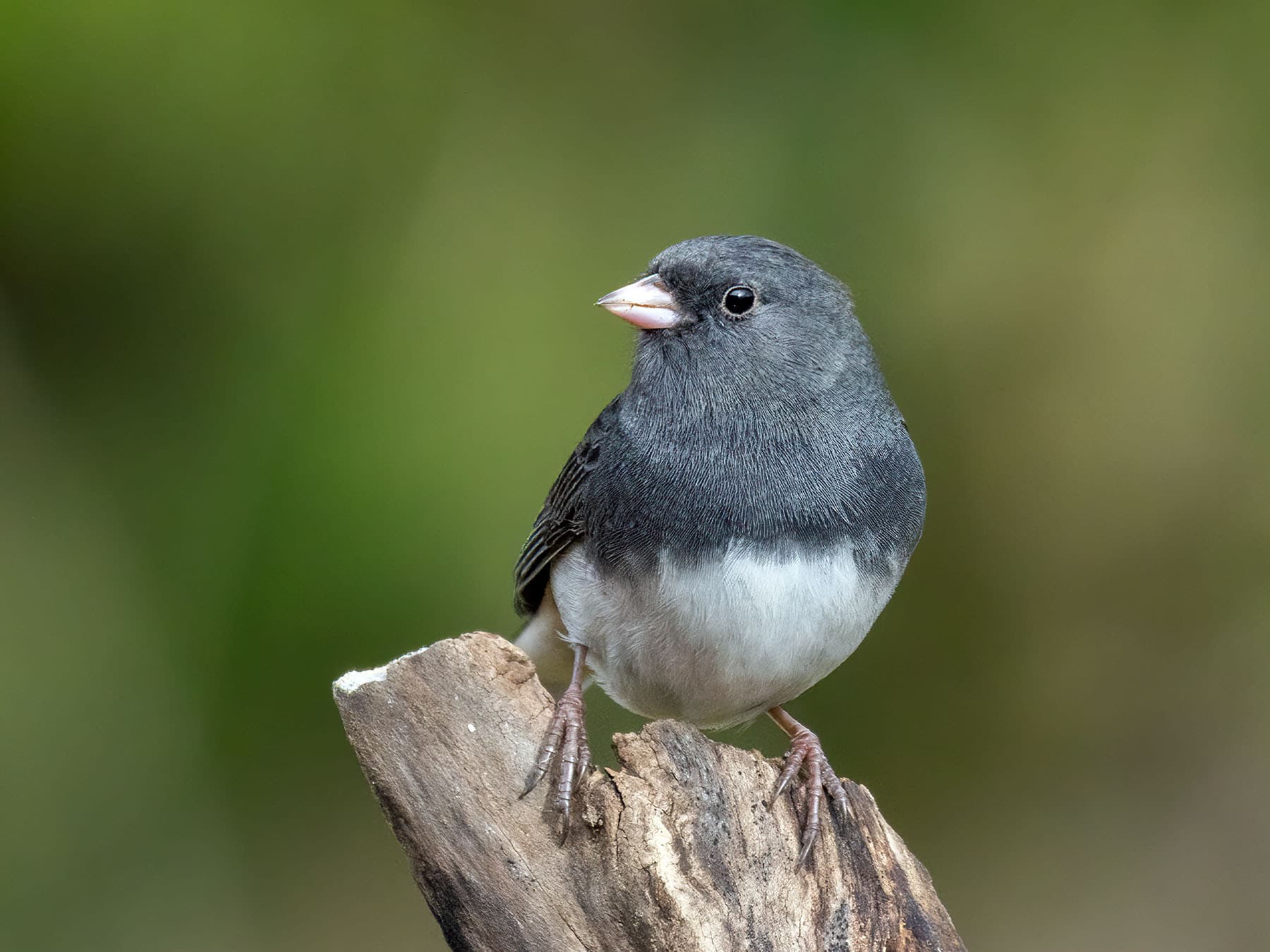
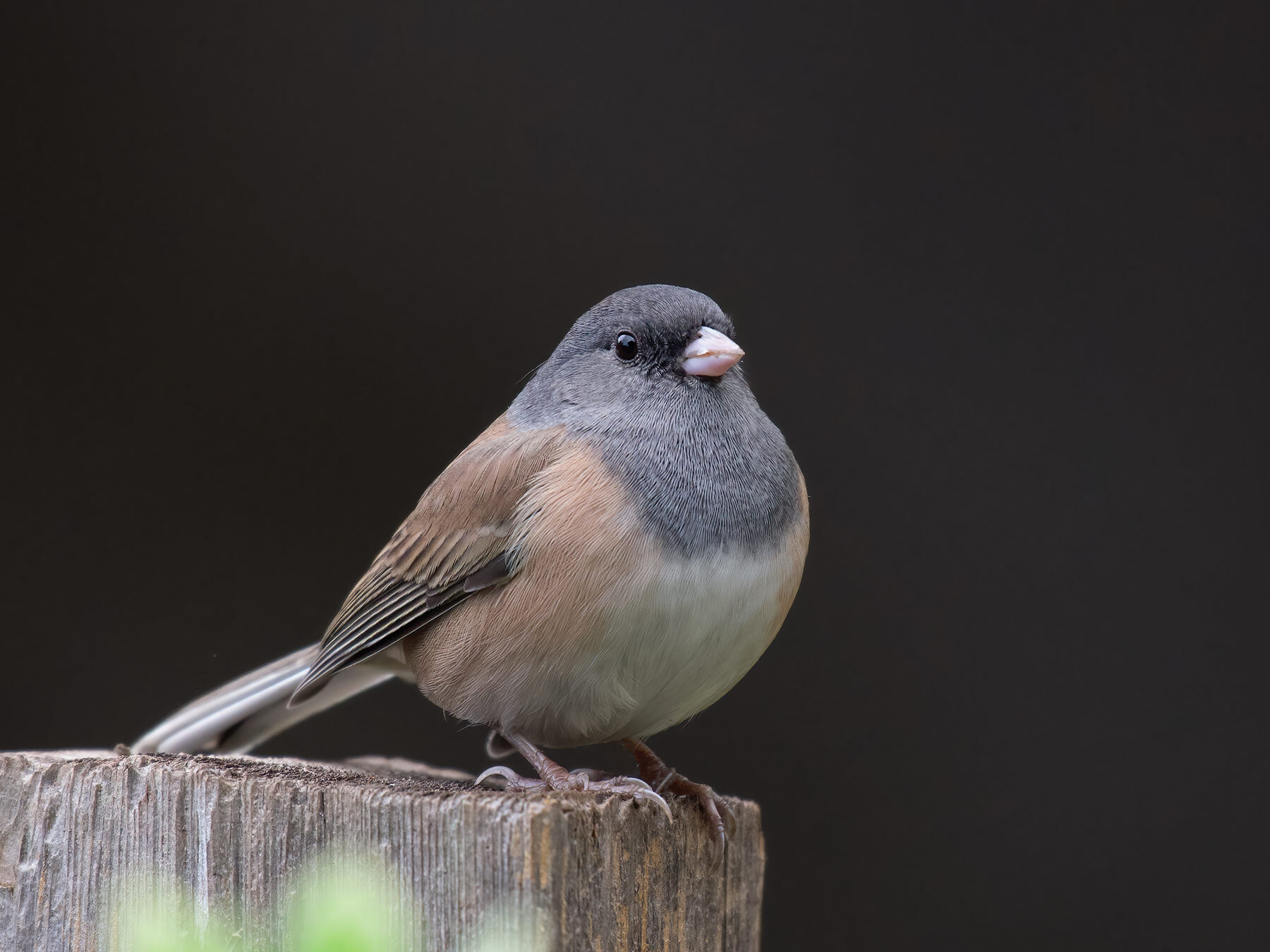
Think of a small, round-headed sparrow in a neat gray or black hood, with a white belly, a pale pink bill and a longish tail. When it flies, the outer tail feathers flash bright white on each side; on the ground they are often hidden.1
It is about 6 in (15 cm) long, a little bigger than a Chipping Sparrow, and weighs 0.6 to 1.1 oz (18 to 30 g). Adults are unstreaked. The eye looks dark but is reddish brown to dark red in adults; the bill is pale pink to whitish, often with a dusky tip in winter, and the legs pinkish to dark pinkish-brown.2
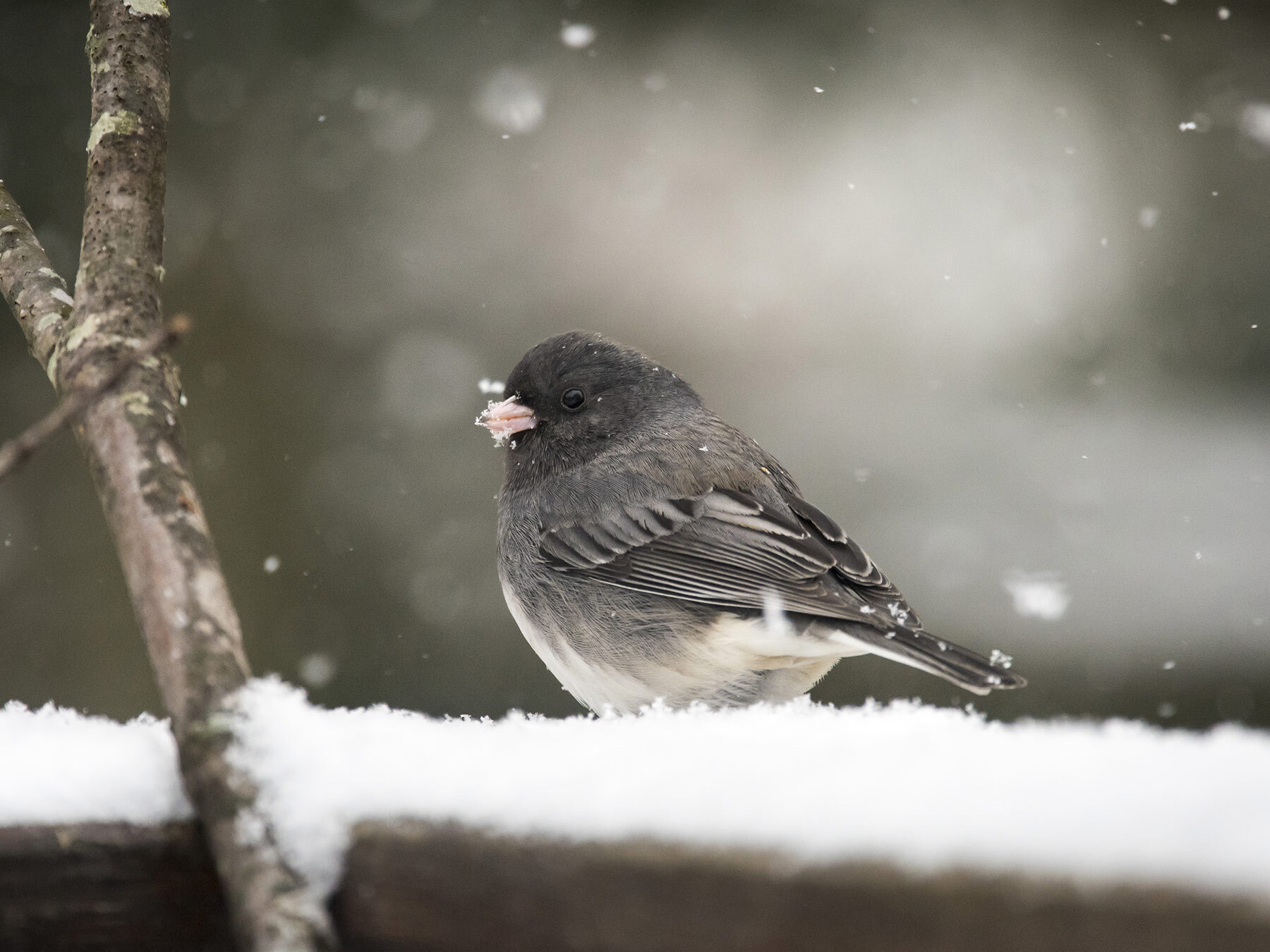
In the East and across most of Canada, the junco you see is the Slate-colored form: plain dark slate-gray above and on the breast, the gray meeting the white belly in a smooth curve, like an upside-down U.
Identification: the forms
Juncos look different from one region to another, which confuses many people. Until 1973 the forms were treated as five separate species; the American Ornithologists' Union then joined them as one, the Dark-eyed Junco, and about 15 subspecies are now described.2 Six forms are easy to recognize in the field:
- Slate-colored (the East, Canada and Alaska): all slate-gray above, white belly.
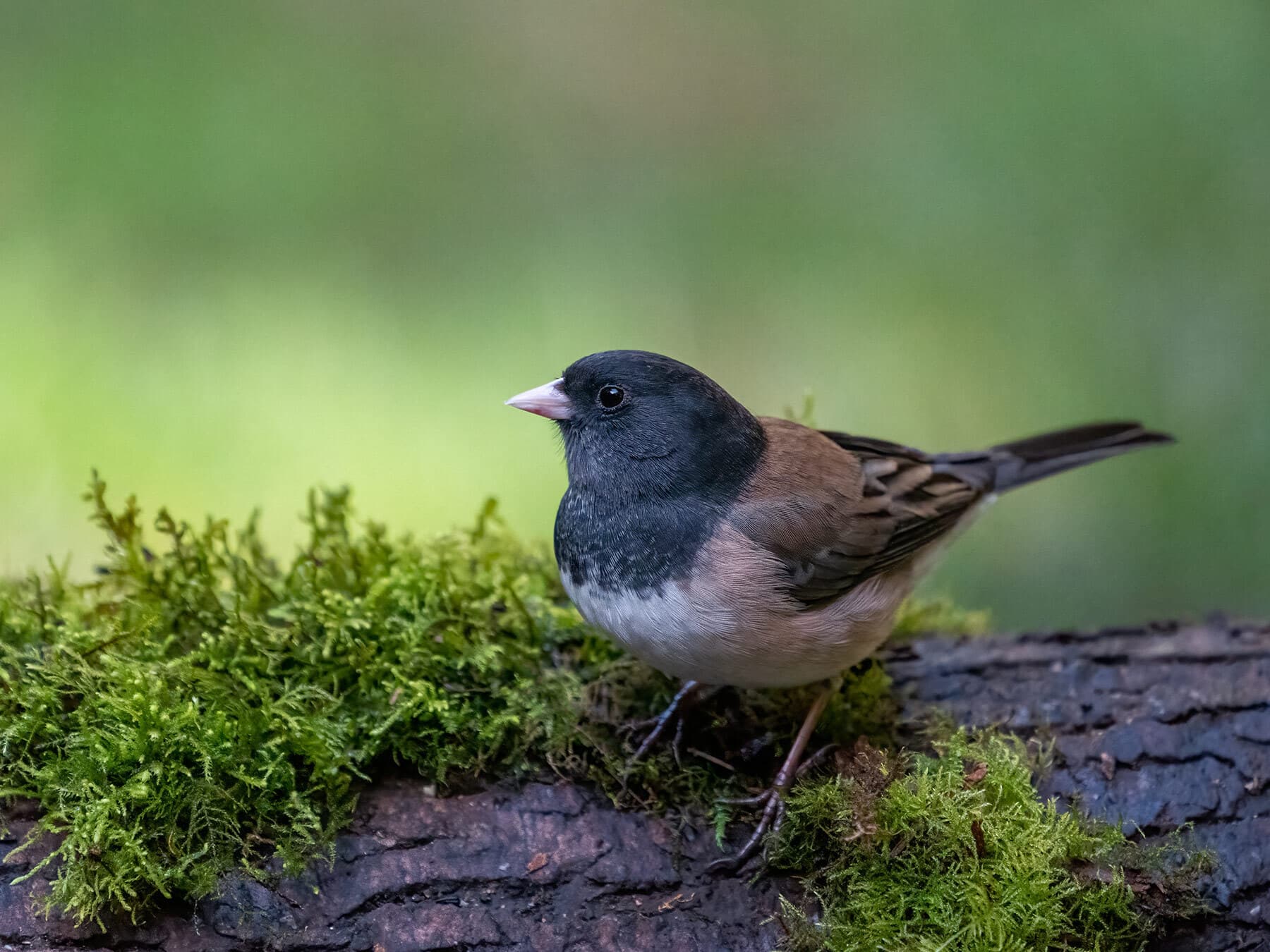
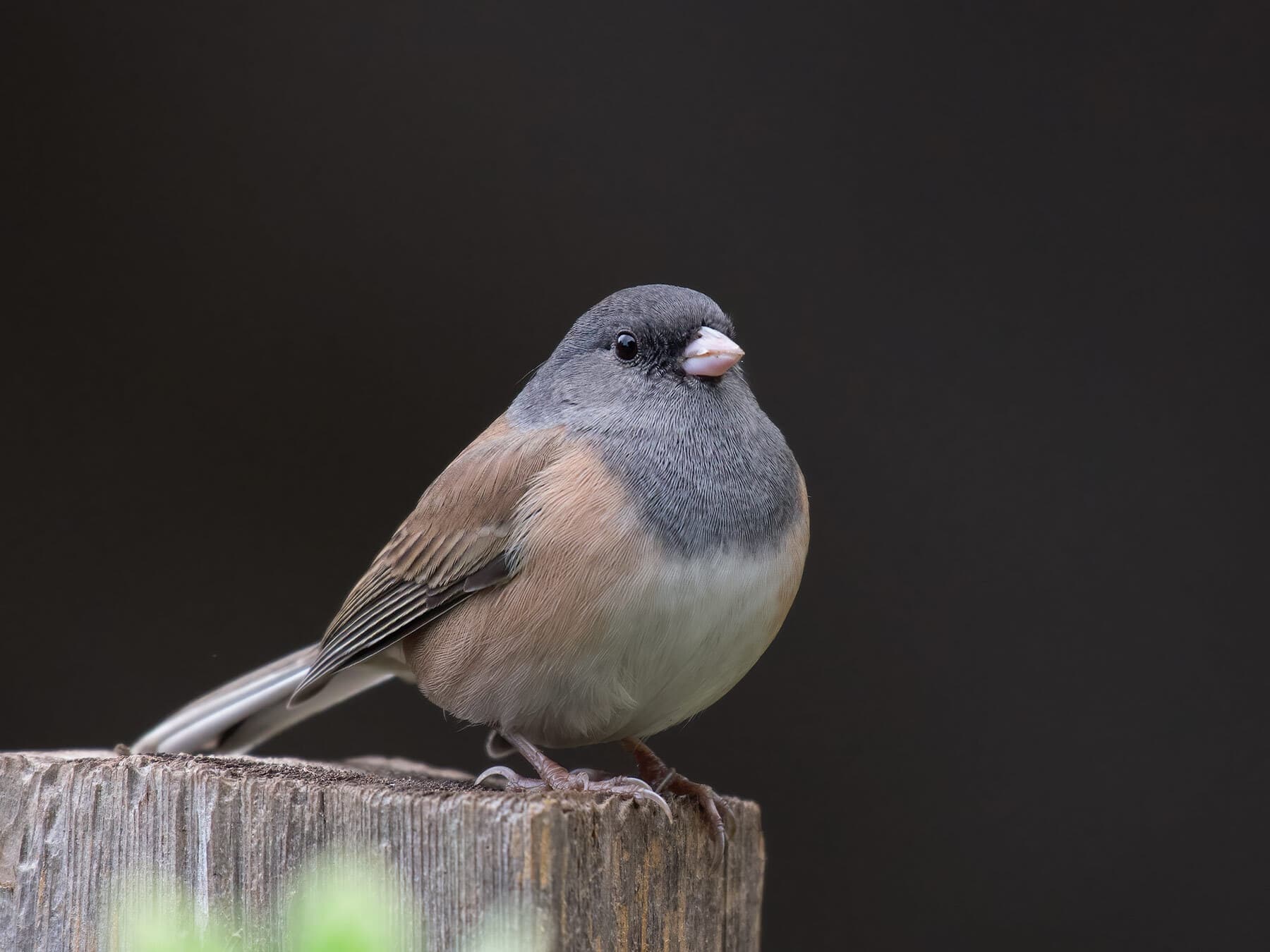
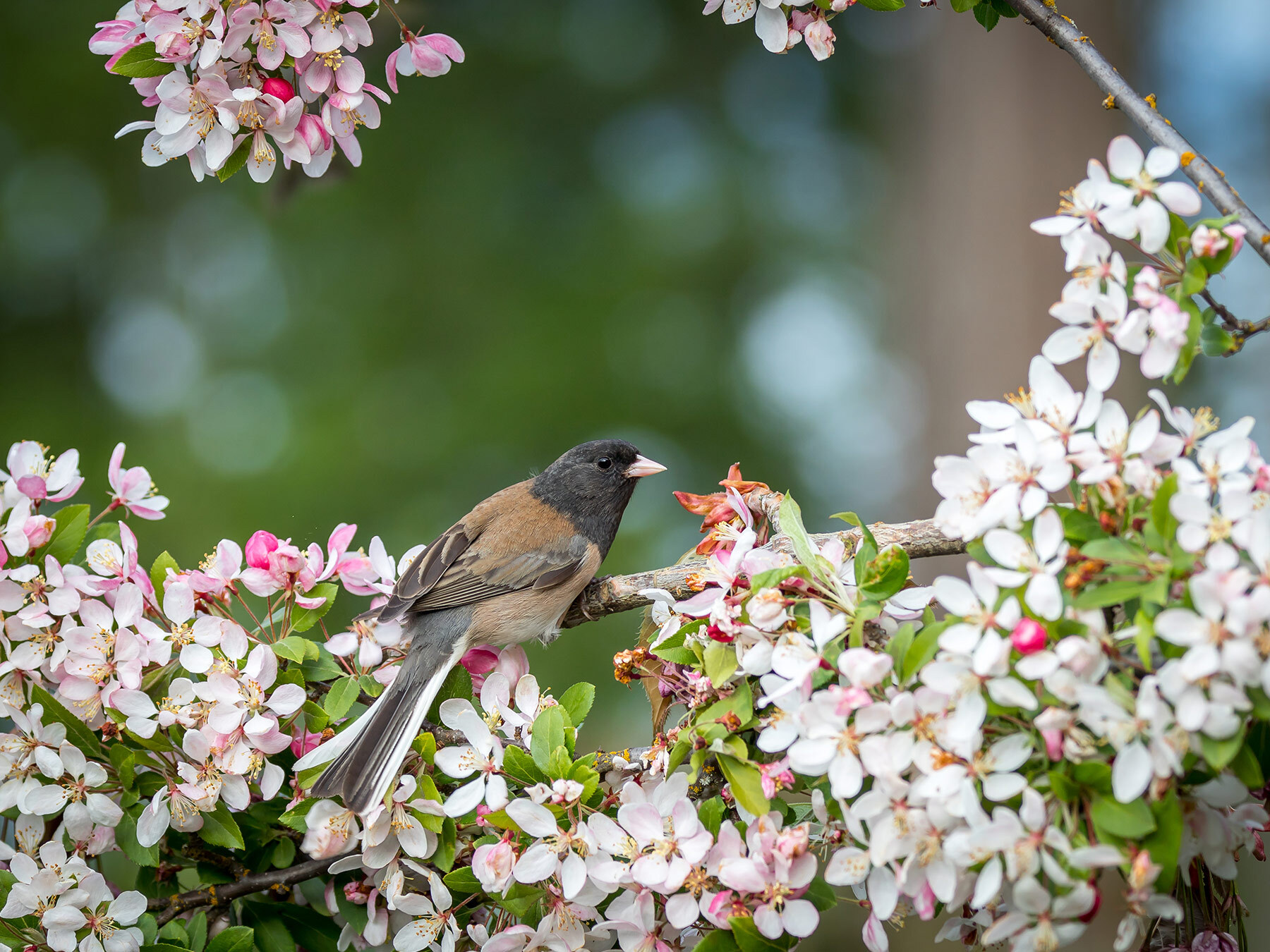
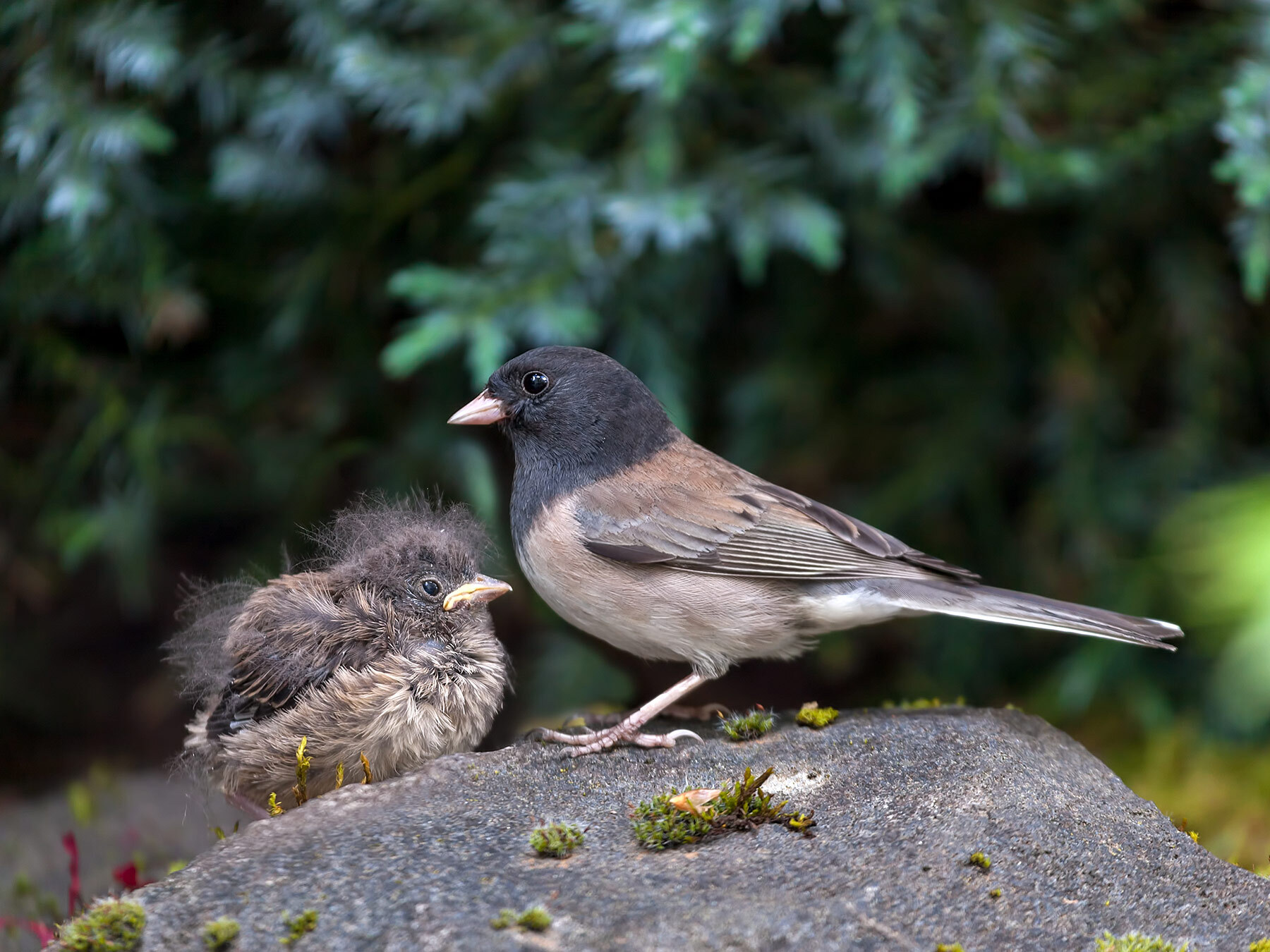
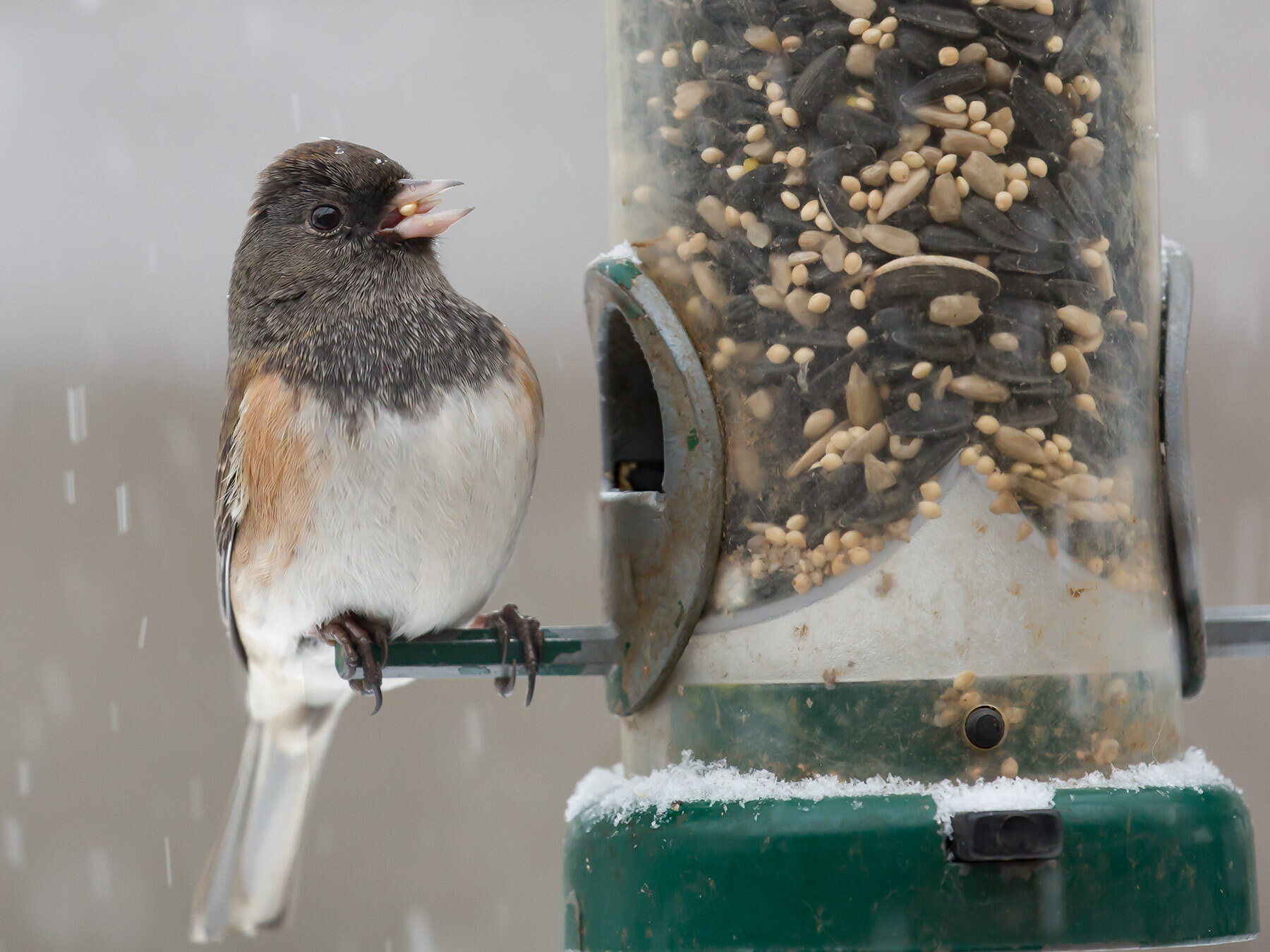
- Oregon (much of the West): a black hood in the male, gray in the female, sharply cut off from a warm brown back and pinkish-buff to rusty sides.
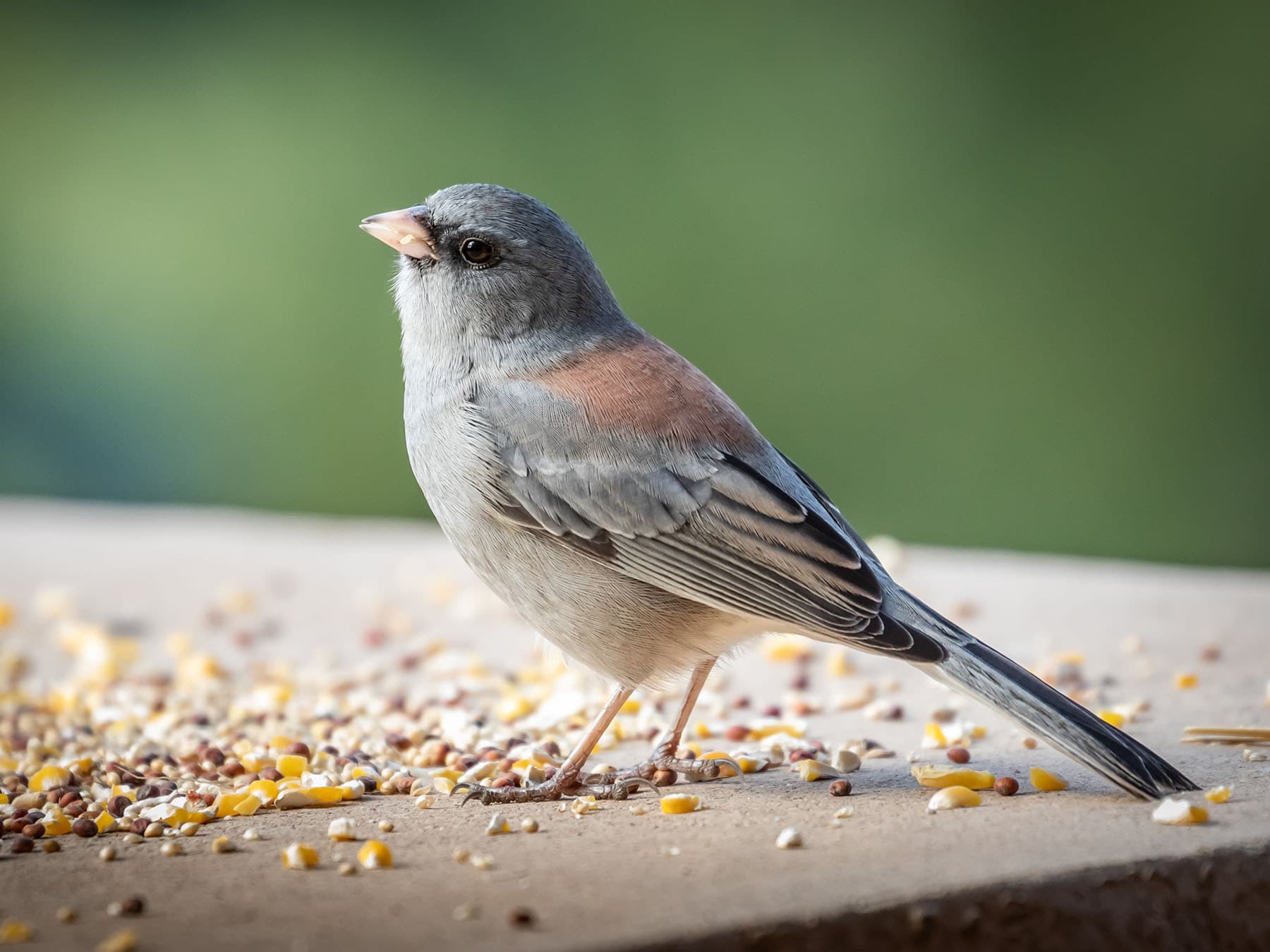
- Pink-sided (the northern Rockies): a pale bluish-gray head with dark lores, a dull brown back and broad pinkish-cinnamon sides.
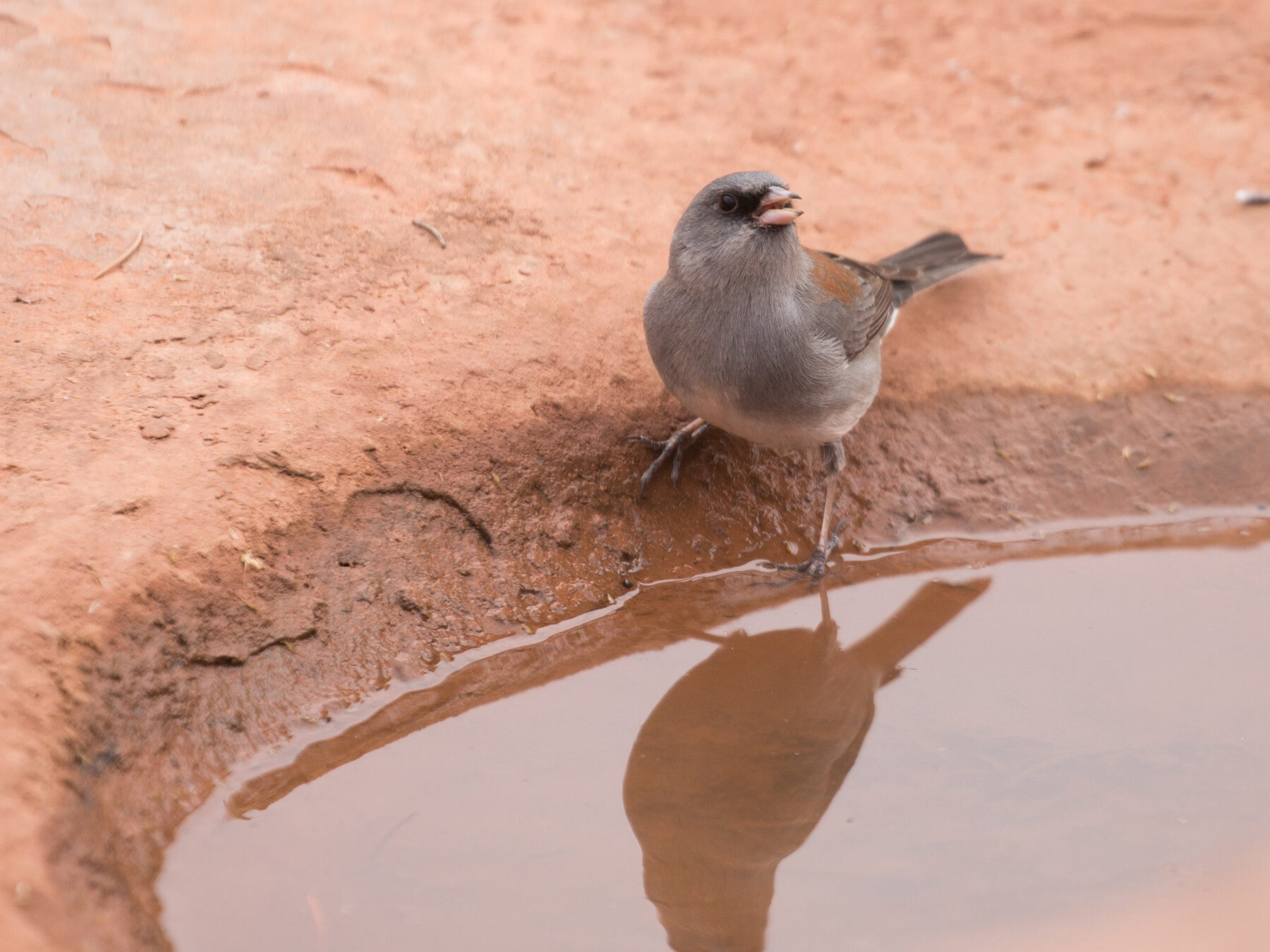
- Gray-headed (the southern Rockies and Great Basin): gray, with paler gray sides, black lores and a bright rusty patch on the back.
- Red-backed (Arizona and New Mexico): like the Gray-headed, but the upper half of the bill is dark.
- White-winged (the Black Hills region): paler and larger than the Slate-colored, usually with two thin white wing-bars.
Where forms meet they interbreed, and in winter several can turn up in one flock, so not every junco fits a box. Photos of every form, and how juncos diversified in 10,000 years: Oregon Junco and the other forms.
Male, female and young
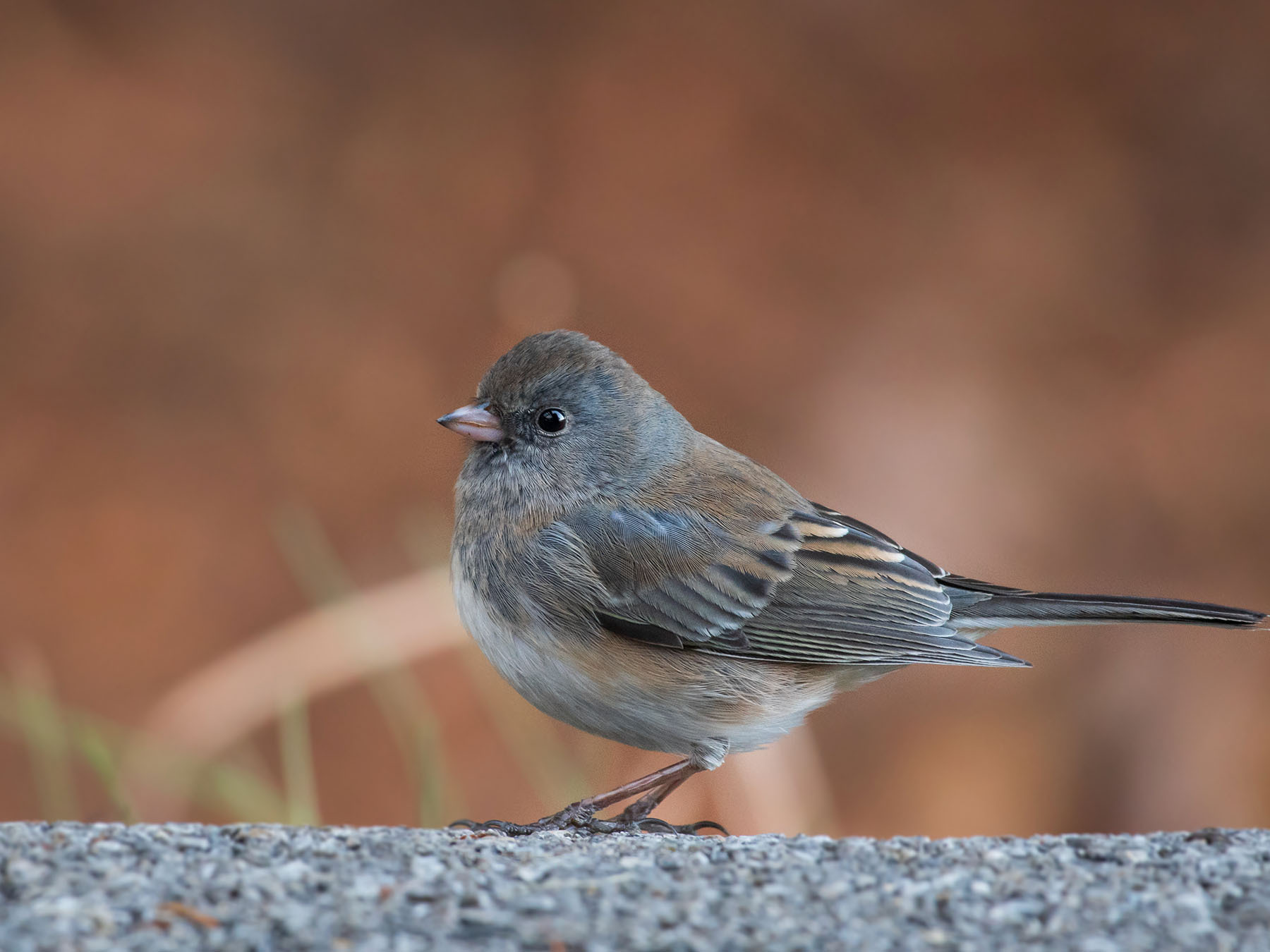
Males and females share the pattern. Females are paler and browner, especially on the back; a female Slate-colored can look quite brown, and a female Oregon has a gray rather than black hood. Young birds in their first winter look like adults but paler and browner again.
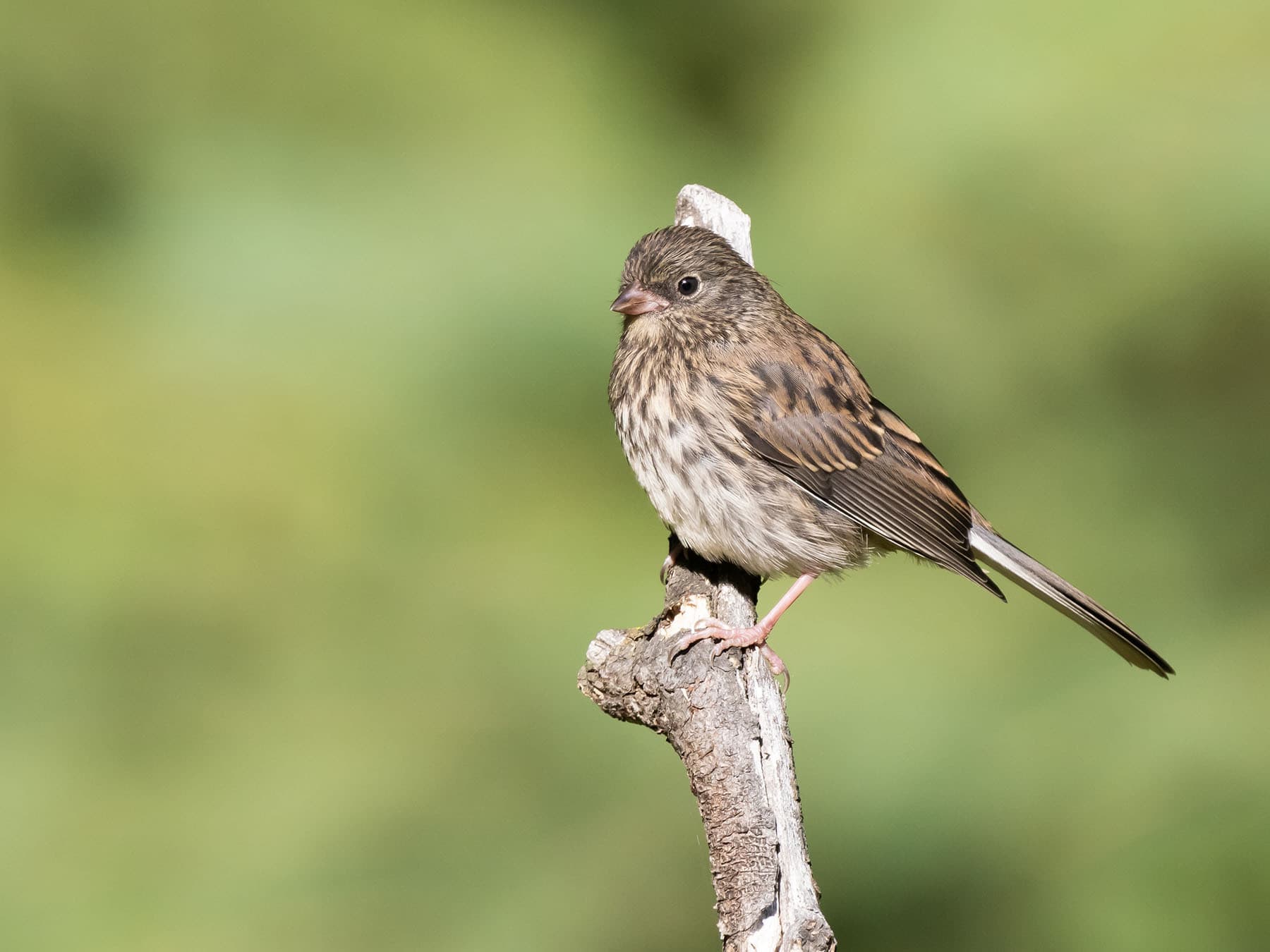
Juveniles, in summer, look like a different bird: brownish and heavily streaked all over. The giveaways are the small pale bill and the white outer tail feathers, which they already have. Photos and how to tell them apart: male, female and juvenile juncos.
Identification: similar birds
At a feeder, a junco is most often mistaken for a Black-capped Chickadee. A chickadee is smaller, with a black cap and a black bib separated by white cheeks, and a small black bill. A junco has no white cheek, and its bill is pink. See junco vs chickadee.
Spotted and Eastern Towhees share a dark hood, a white belly and white in the tail, but they are much bigger, 7 to 8.5 in (17 to 22 cm), with rusty sides; the Spotted Towhee has bold white spots on its back and wings.3 A Black Phoebe in the Southwest is also charcoal with a white belly, but it is a slim, upright flycatcher that dips its tail and darts out after insects, nearly always near water.4
In Arizona and Mexico, look out for the Yellow-eyed Junco: a yellow eye, rusty on the wing, and it walks or shuffles where a Dark-eyed Junco hops.
Its size
Adults- Length
- 14–16.5 cm
- Wingspan
- 18–25 cm
- Weight
- 18–30 g
Its song and calls
The song is a musical trill: the same note repeated quickly and evenly, for about two seconds. It is like the trill of a Chipping Sparrow, but more musical and shorter. Males sing from a treetop or a high perch, sometimes on warm days in February, and mostly from spring until July.
Both sexes also have a quiet, rambling song of whistles, trills and call notes that carries only 10 to 20 yards. The calls are easier to learn: high, sharp chips, tsip or tsick, given while feeding and in flight, often almost absent-mindedly; a sharp, musical kew in squabbles at feeders; and a short chack or tik alarm call when a predator is near the ground.5 Hear them all: junco song and calls.
- Song0:00 / 0:12
Recorded in Newfoundland and Labrador, Canada · May 2010
- Call0:00 / 0:44
Recorded in California, United States · September 2012
When and where to see it
Dark-eyed Juncos breed across Alaska and Canada up to the tree line, through the western mountains south to Arizona, New Mexico and northern Baja California, in the northern Great Lakes states and New England, and south along the Appalachians to northern Georgia. They nest from sea level to more than 11,000 feet.
In winter they spread across almost every state in the lower 48 and into northern Mexico, scarce in south Texas and the Louisiana delta and very rare in Florida south of Gainesville. They are among the commonest feeder birds: in Project FeederWatch's 2021-22 season they visited 91.89% of sites in the Northeast, second only to chickadees.6
Spotting tips
Look on the ground under feeders and along the edges of shrubs, lawns, roadsides and woods, where flocks hop about picking up seeds. Listen for their chips. If one flies, watch for the white flashing in the tail.
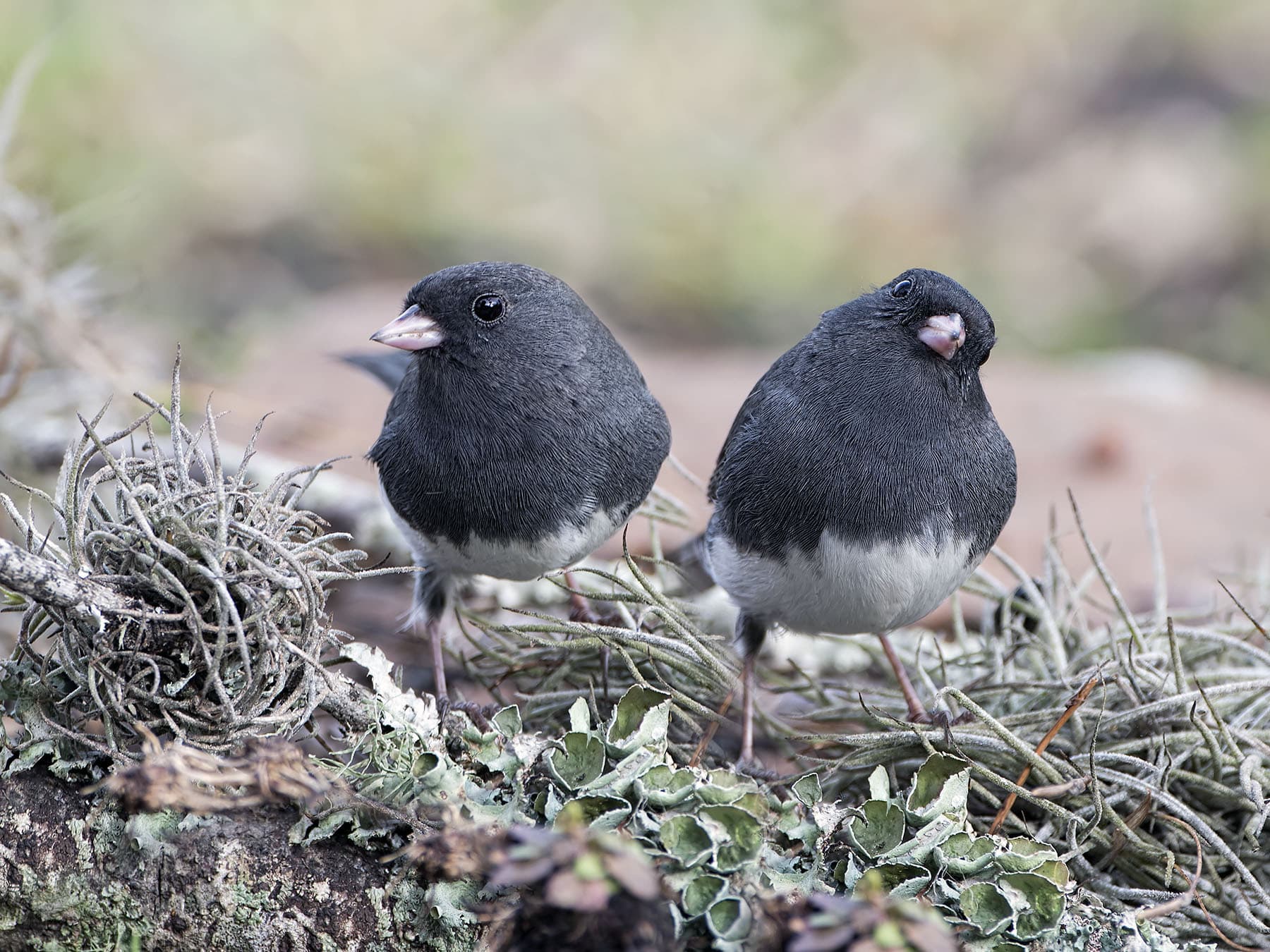
Do juncos migrate?
Most do. Juncos that breed in the North and in Canada move south for the winter, usually a few hundred kilometers (a couple of hundred miles) or less. They travel mainly at night. Northern birds typically start moving in September, and most have reached their wintering grounds by early December. They start back about the first of March, mostly from mid-March to early April, with stragglers into May and even early June. That timing is why so many people call them snowbirds: they arrive as winter sets in and leave in spring.
Females travel farther than males. In the East, about 70% of wintering juncos in the South are females, against 20% in the North.7 Not all juncos migrate: many in the Appalachians stay all year, moving downhill in hard weather, and several western mountain and coastal forms are nearly resident.
Juncos also have a place in the history of migration research. From 1924, William Rowan kept juncos outdoors through the Canadian winter under artificially lengthened days, experiments that began the study of how day length times migration and breeding.
What it eats
Mostly seeds. Seeds of weeds and grasses, such as chickweed, buckwheat, lamb's quarters and sorrel, make up about three-quarters of a junco's year-round diet. In summer, insects make up close to half of what adults eat: caterpillars, beetles, moths, ants, wasps, flies and grasshoppers, plus spiders. The chicks are fed mostly on insects and spiders. Juncos do not store food.
They feed mainly on the ground, hopping and pecking, and sometimes scratching in the leaf litter with both feet. After a snowfall they look for bare patches under trees and shrubs. More: what juncos eat.
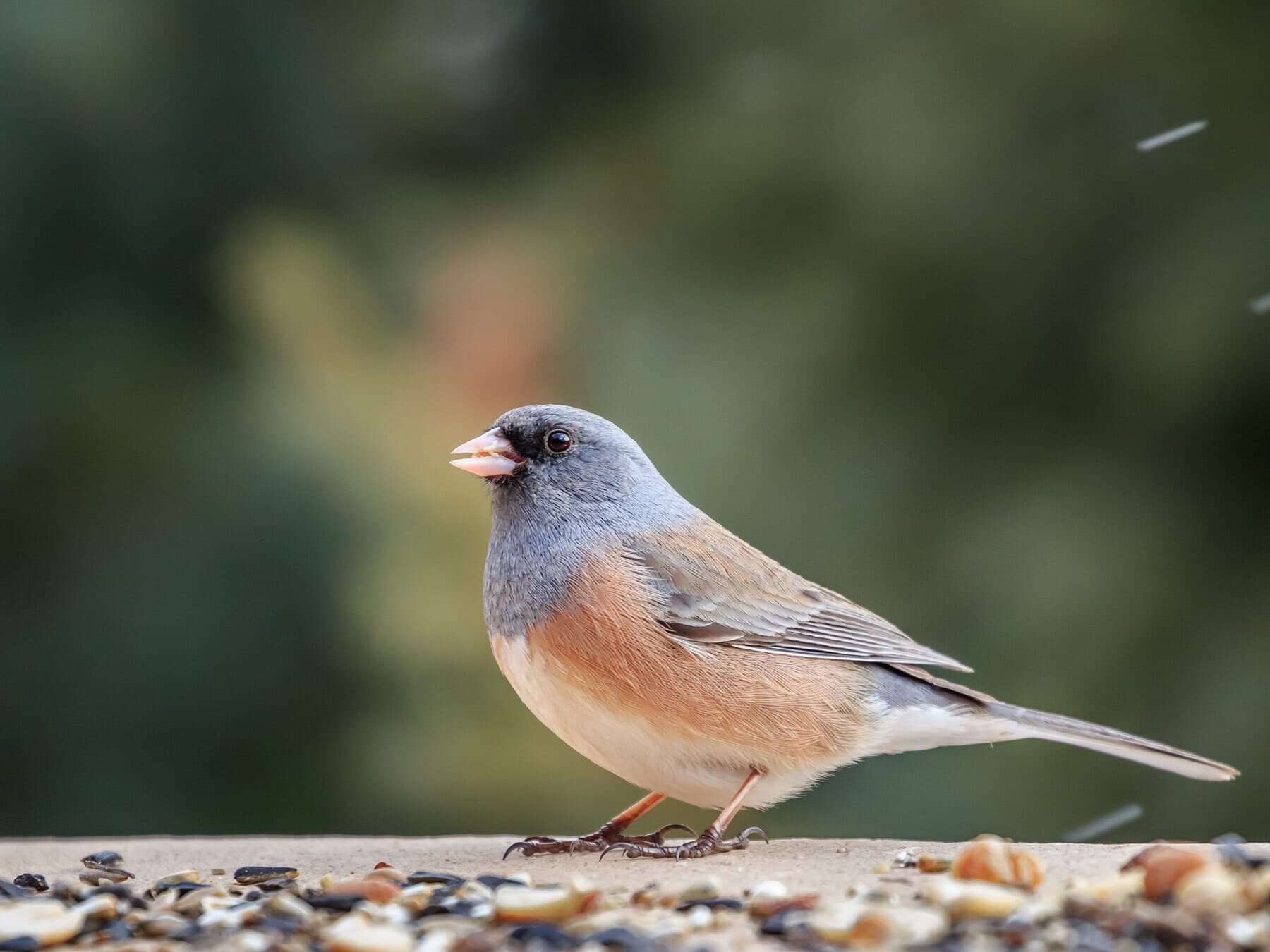
Feeding them in your yard
Juncos feed on or near the ground, so scatter seed there or use a low platform. Project FeederWatch recommends millet: a handful scattered on the ground for juncos and sparrows.8 Juncos take sunflower seed, but they seem to prefer millet.
Ground feeding needs keeping clean. Clear husks and droppings from under feeders, especially if they are wet or moldy, clean seed feeders every two weeks or so with one part bleach to nine parts water, and spread several feeders out.9 More: feeding juncos.
Nesting and breeding
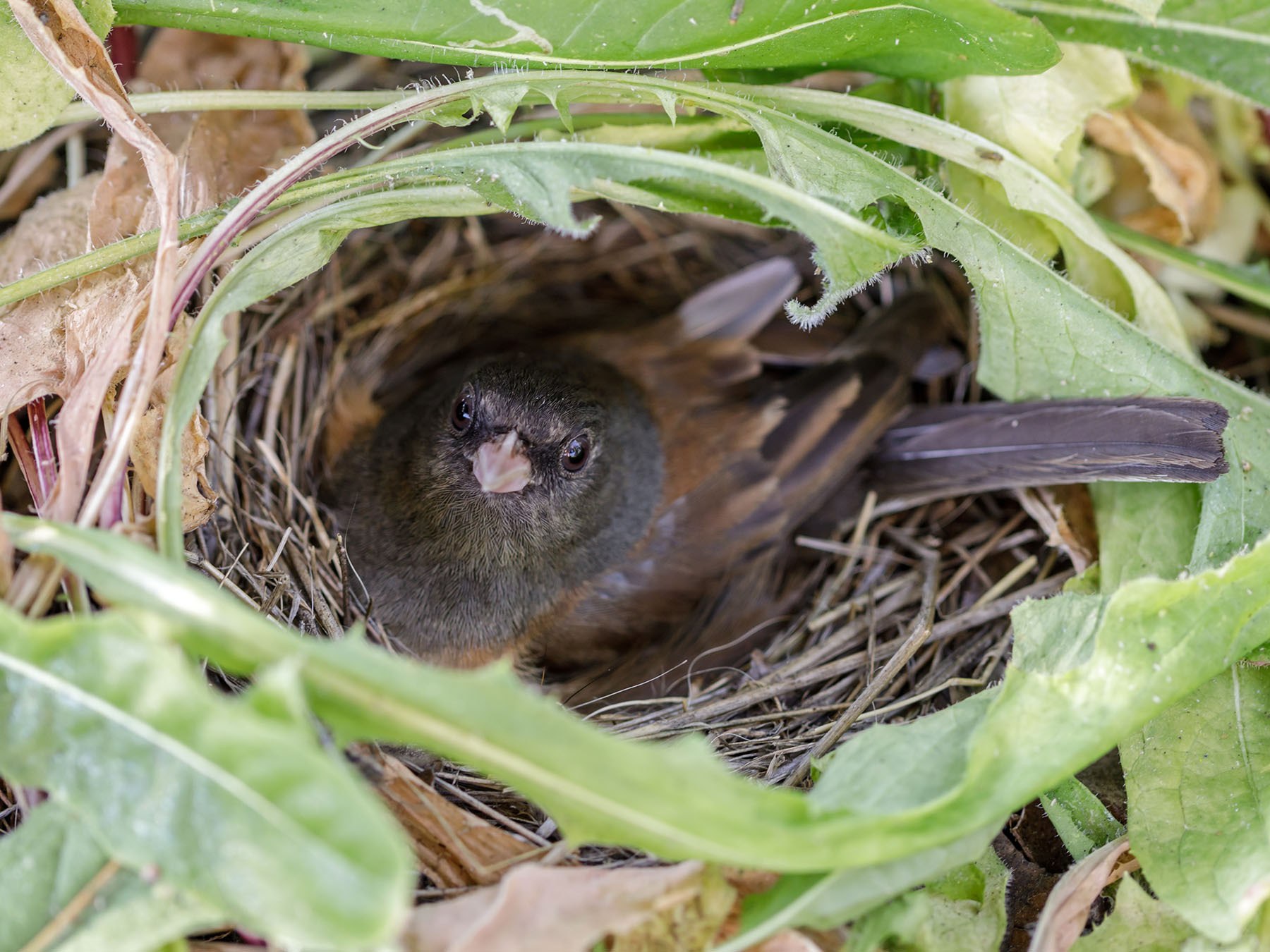
Juncos nest on or near the ground. The female chooses a hollow in a bank, a road cut or a rock face, a gap among the roots of a fallen tree, or a spot under overhanging grass, and builds a cup of grass, rootlets and moss lined with fine grass and hair. Some nest off the ground, on ledges, beams, light fixtures or in hanging flower pots.
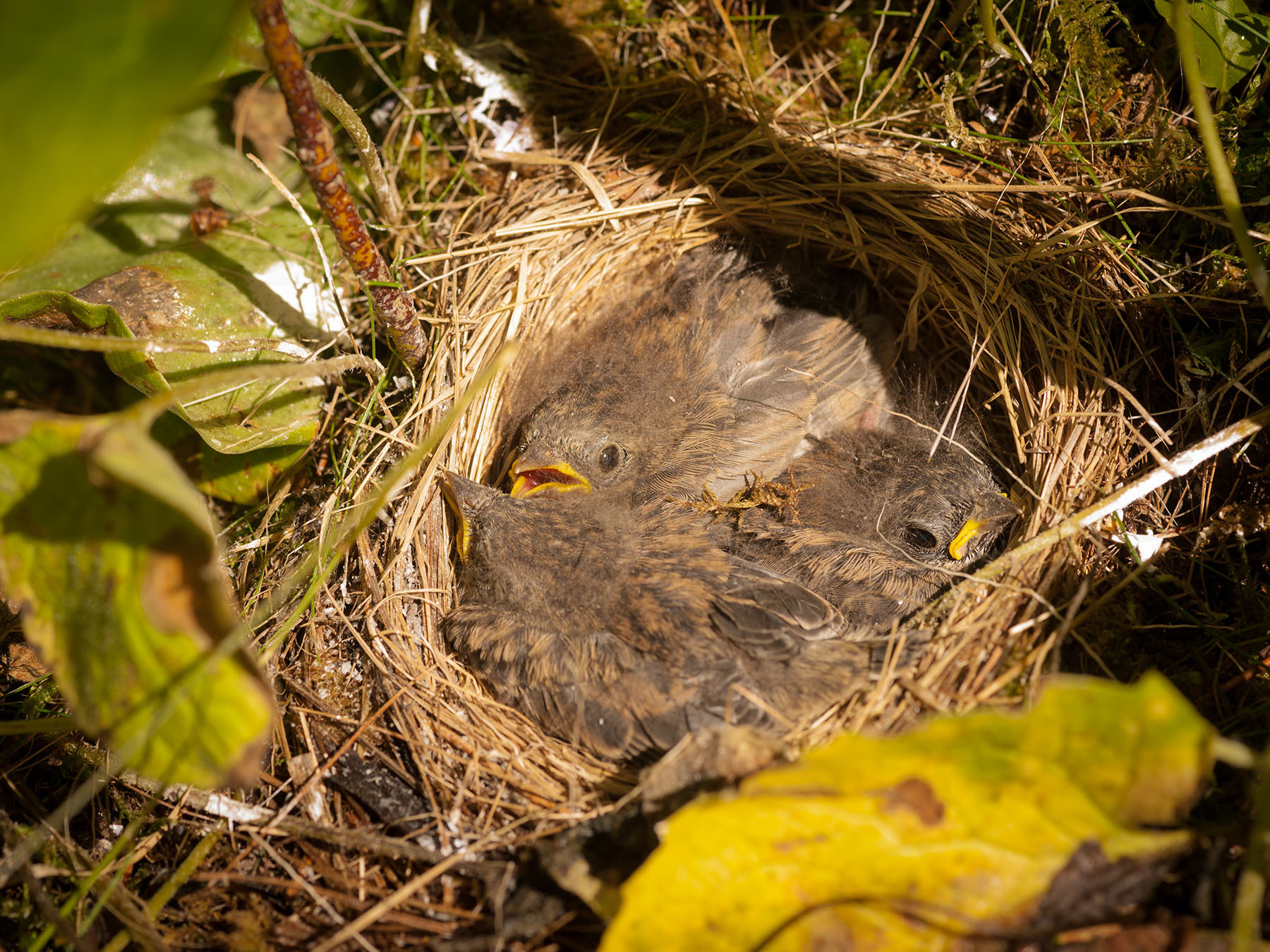
She lays 3 to 5 eggs, usually 4, and incubates them alone for 12 to 13 days. Both parents feed the chicks, which leave the nest at about 10 to 13 days old, before they can fly well. Pairs raise one brood in the far north and high mountains, and two, sometimes three, farther south.
A junco nest in your yard is protected: under the Migratory Bird Treaty Act it is illegal to destroy a nest with eggs or young in it.10 More: junco nests, eggs and young.
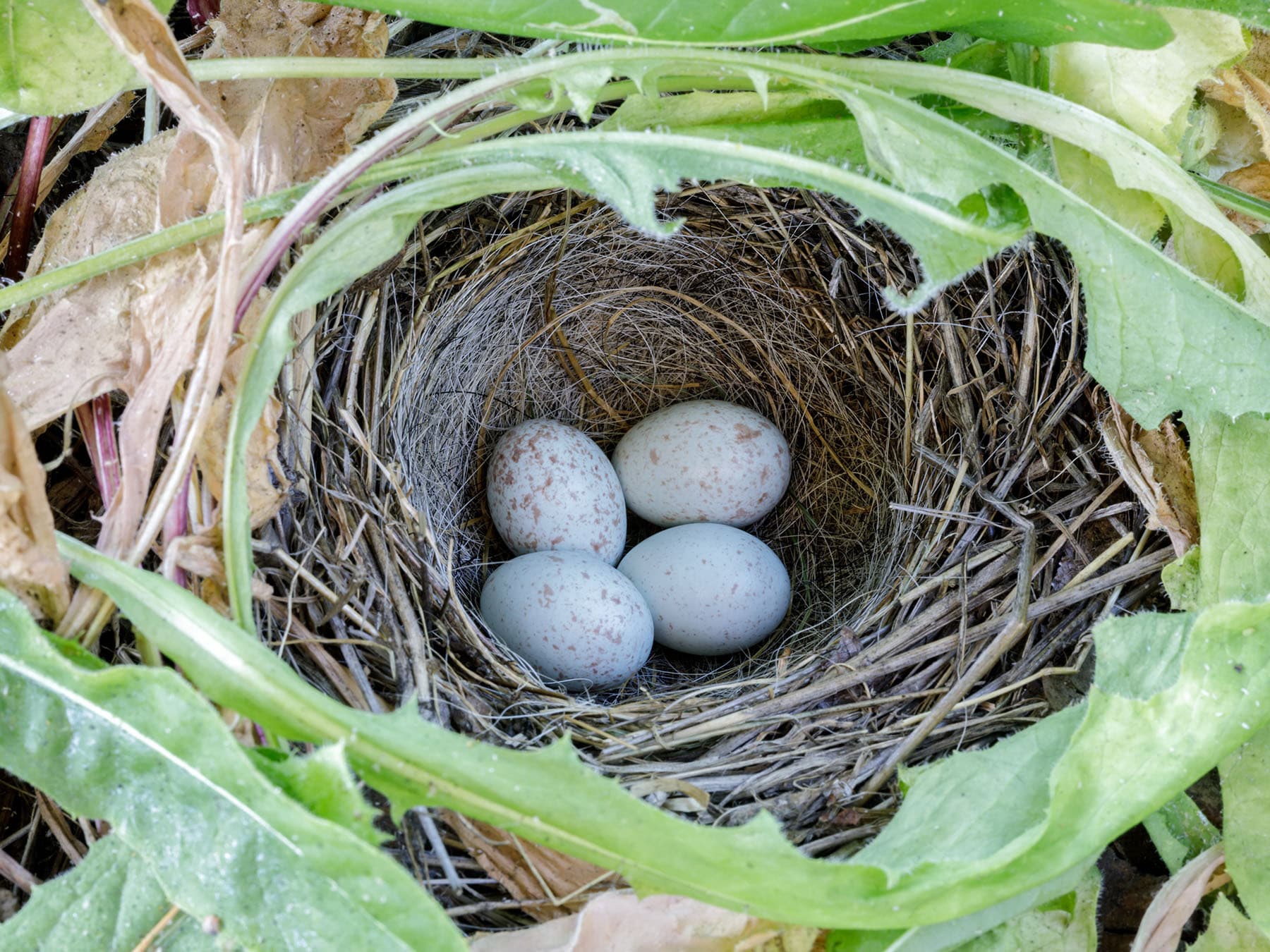
Behaviour
Juncos hop, rarely walk, and keep flicking their tails open to show the white, especially in feeding flocks. In winter they live in flocks, often of about 20, with a firm pecking order: bigger birds outrank smaller ones, so males usually outrank females and adults outrank young, and birds that arrive early rank higher.
That white tail matters in courtship too. A male courts a female by hopping around her with his wings and tail fanned to flash the white, and in experiments females preferred males whose tails had been given extra white.11
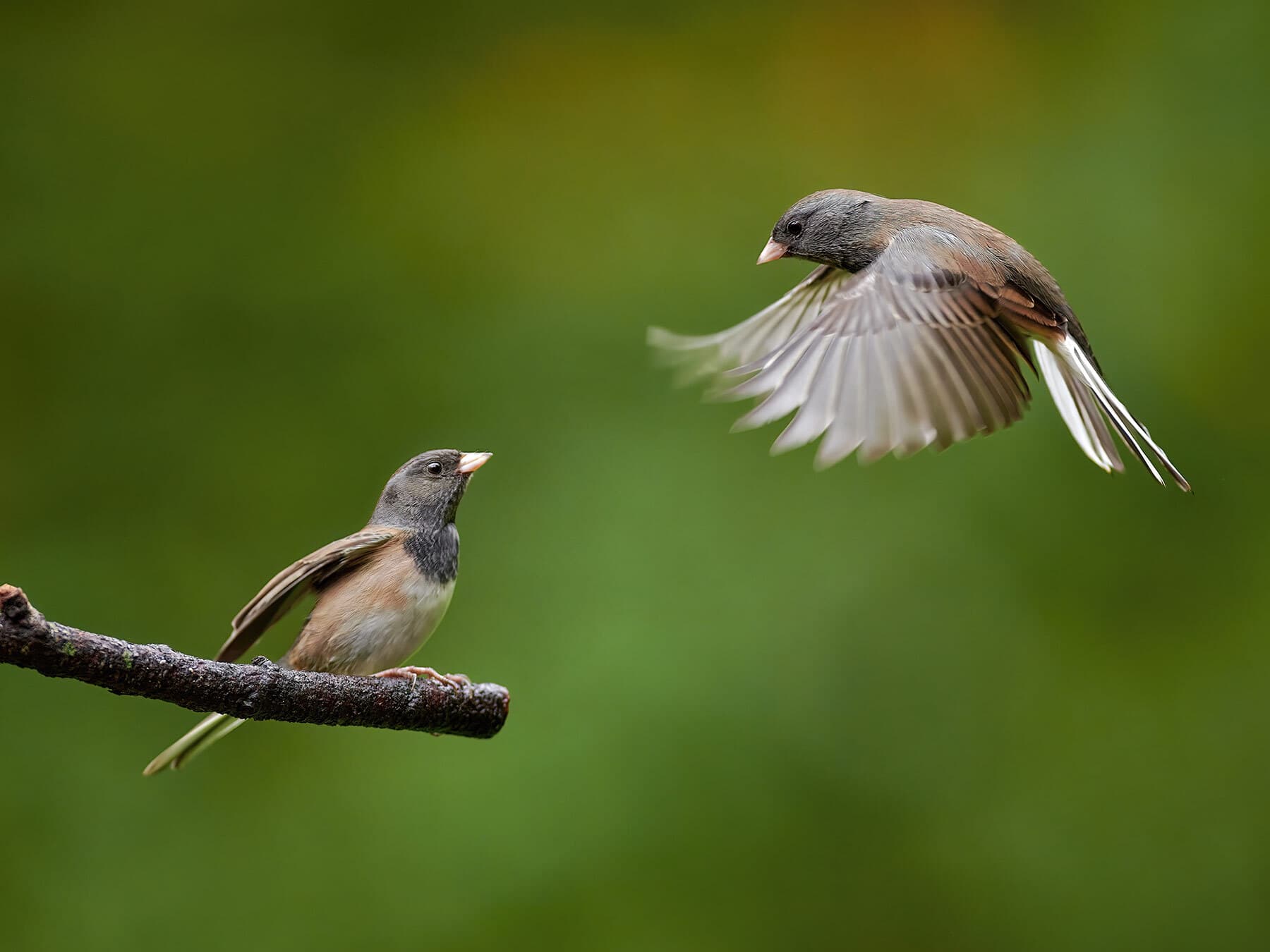
Behavior in winter: how juncos survive the cold
A junco puts on fat each day and burns it overnight: birds in one winter flock in Massachusetts were about 10% heavier at dusk than at dawn. In winter its plumage is heavier, by 31% in one study of western birds, and it roosts in dense conifers, cedars, brush piles or tall grass. Those roosts do not make the night warmer, but they cut the wind about fivefold, which saves energy.12
Lifespan and predators
A junco that survives its first year lives about 2 years on average, by one estimate for males. In a Virginia study, about half of breeding males survived from one year to the next.
Lifespan records
The oldest known Dark-eyed Junco was a Slate-colored bird banded as an adult in West Virginia in August 1991 and caught again there in October 2001, at least 11 years and 4 months old.13 Another, banded in Massachusetts in 1931, was recovered in South Carolina in 1941.
Predators and other dangers
Small hawks, including the Sharp-shinned Hawk, owls and shrikes take adult juncos, and cats kill many, particularly around feeders. Many nests are lost: in one long study in Virginia predators took about half in an average year, from 20% to 85%, mostly chipmunks and mice, and Brown-headed Cowbirds lay their eggs in some. Juncos migrating at night sometimes hit tall towers.
Conservation
The Dark-eyed Junco is one of the most abundant birds in North America, with about 220 million, and is of Least Concern. Numbers have fallen slowly: by about 0.7% a year between 1966 and 2019, about 31% in all, according to the North American Breeding Bird Survey. Partners in Flight rates it a species of low conservation concern.
Similar birds
Often mistaken for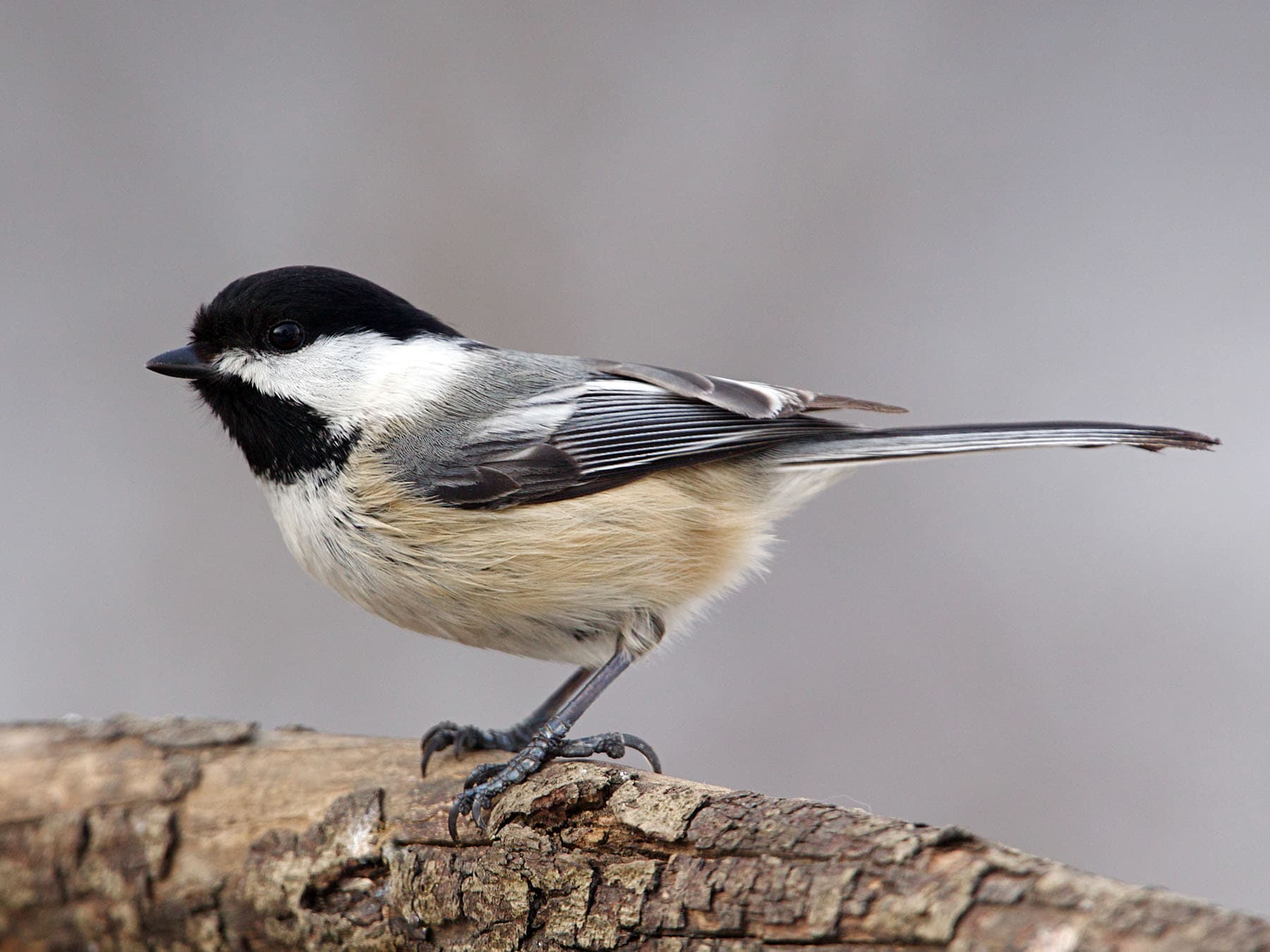
More photos
9 photos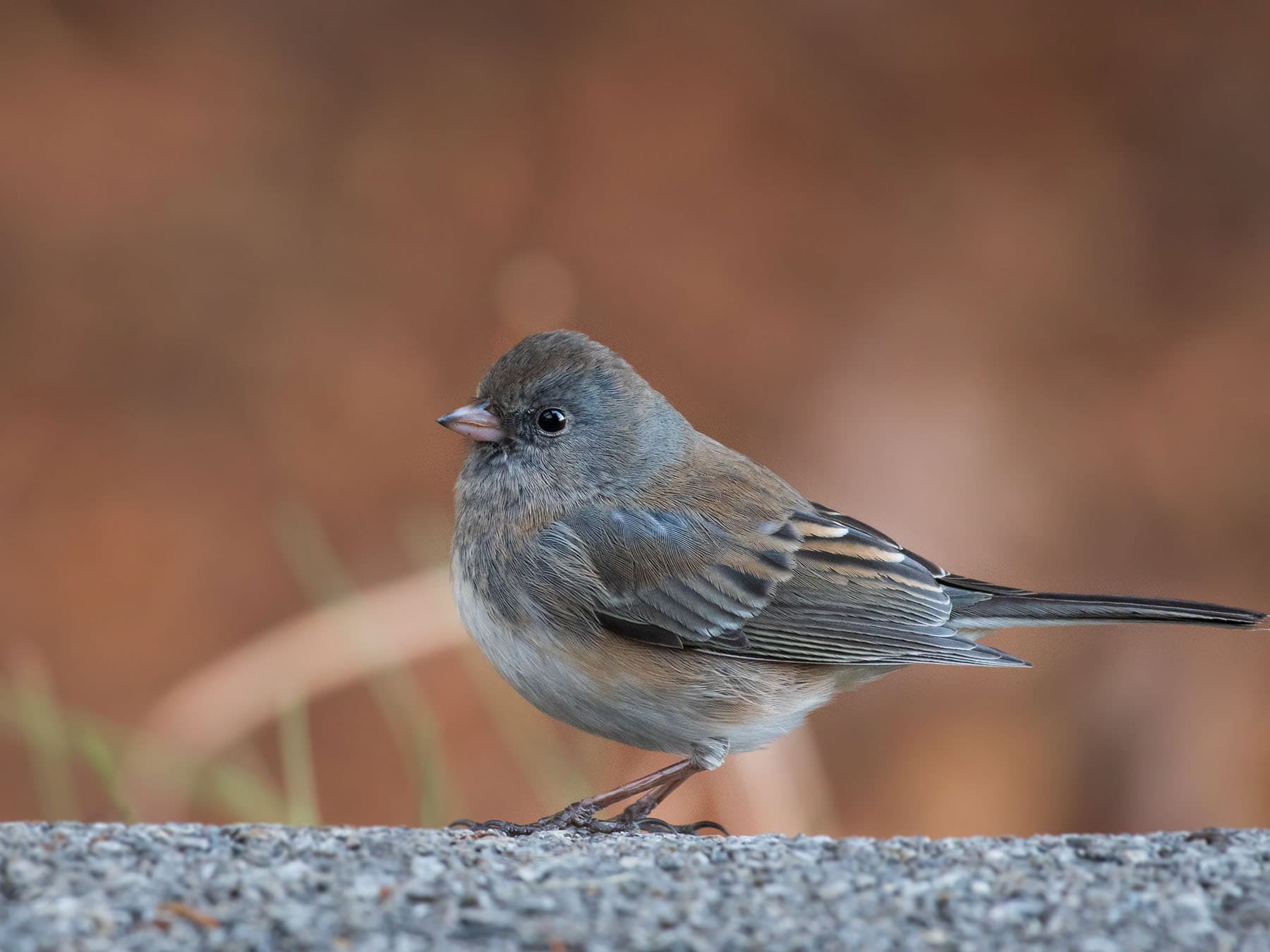 A female Slate-colored Dark-eyed Junco: paler and browner than the male
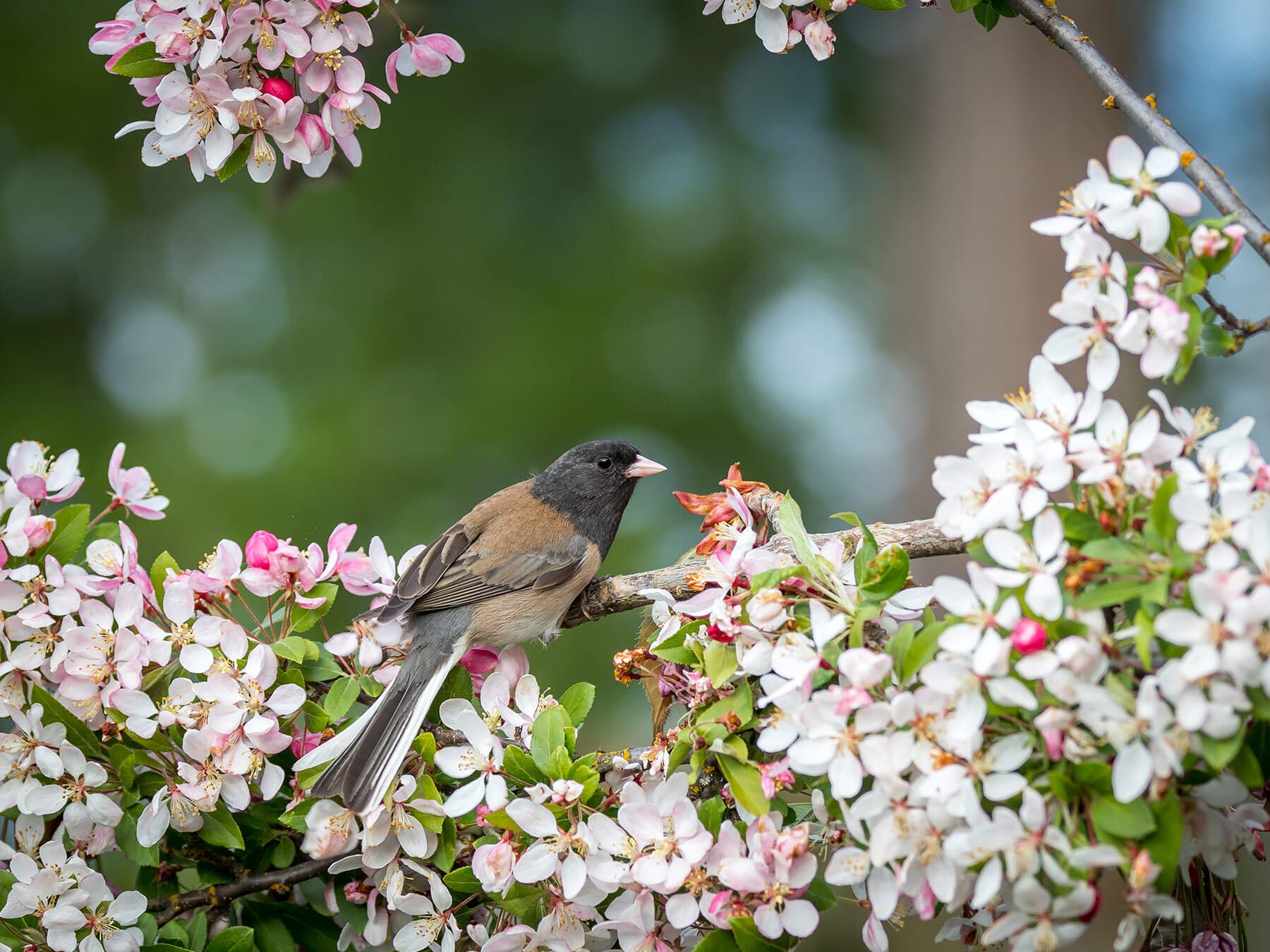 A male Oregon Dark-eyed Junco among cherry blossom
 A Pink-sided Dark-eyed Junco: pale gray head and pinkish-cinnamon sides
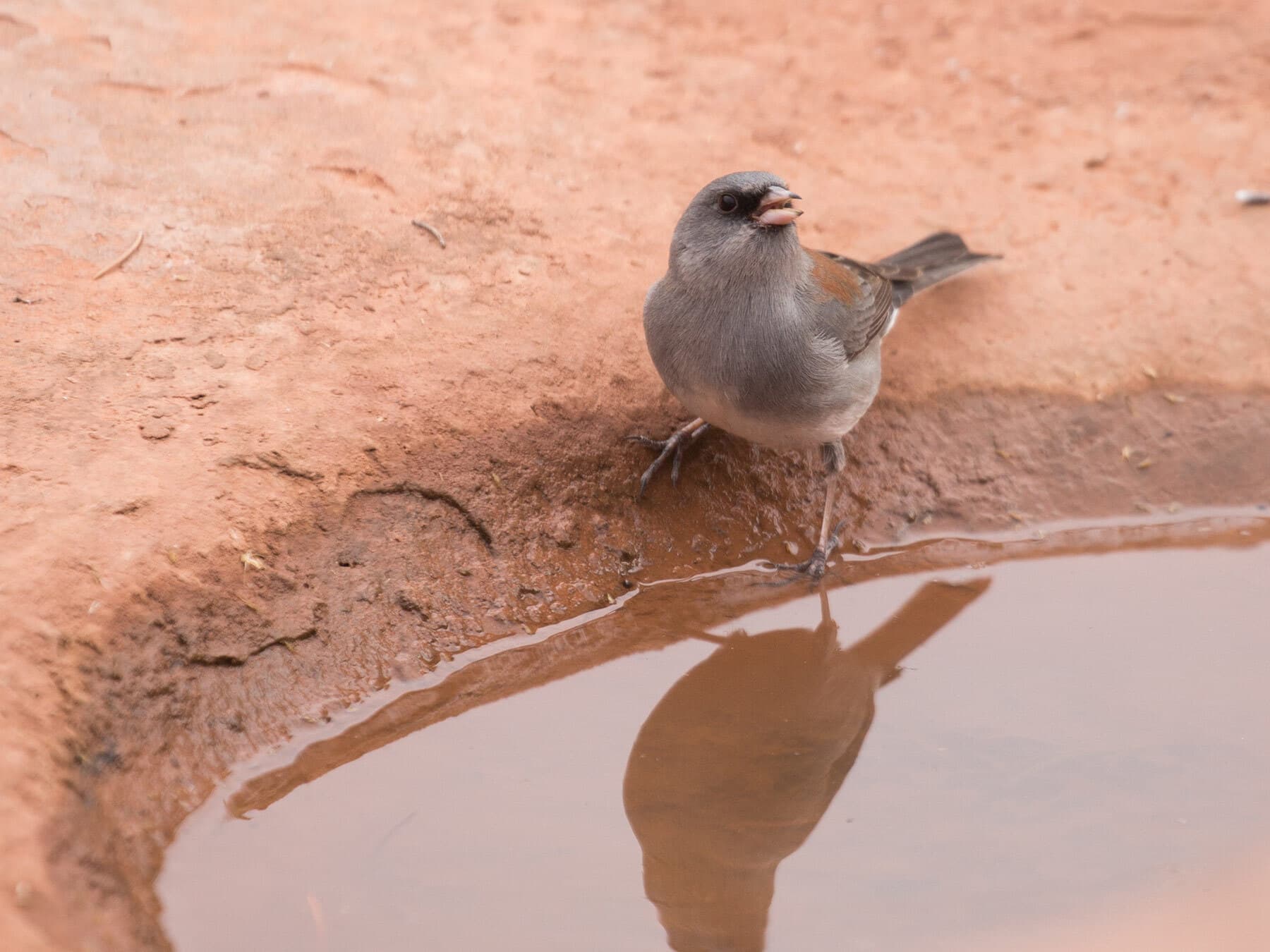 A Gray-headed Dark-eyed Junco drinking at a pool on red rock
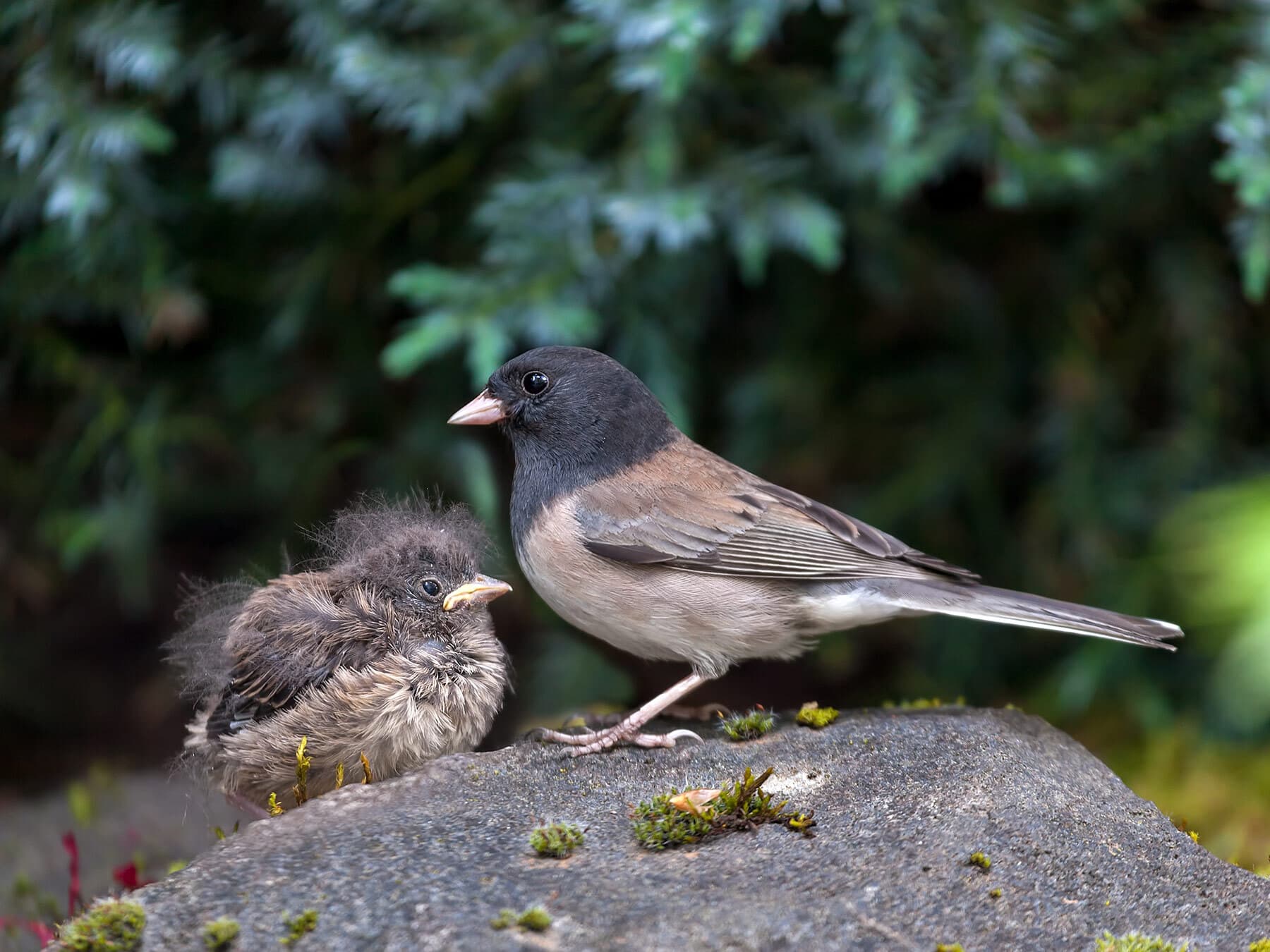 An Oregon Dark-eyed Junco beside a fluffy, streaked chick
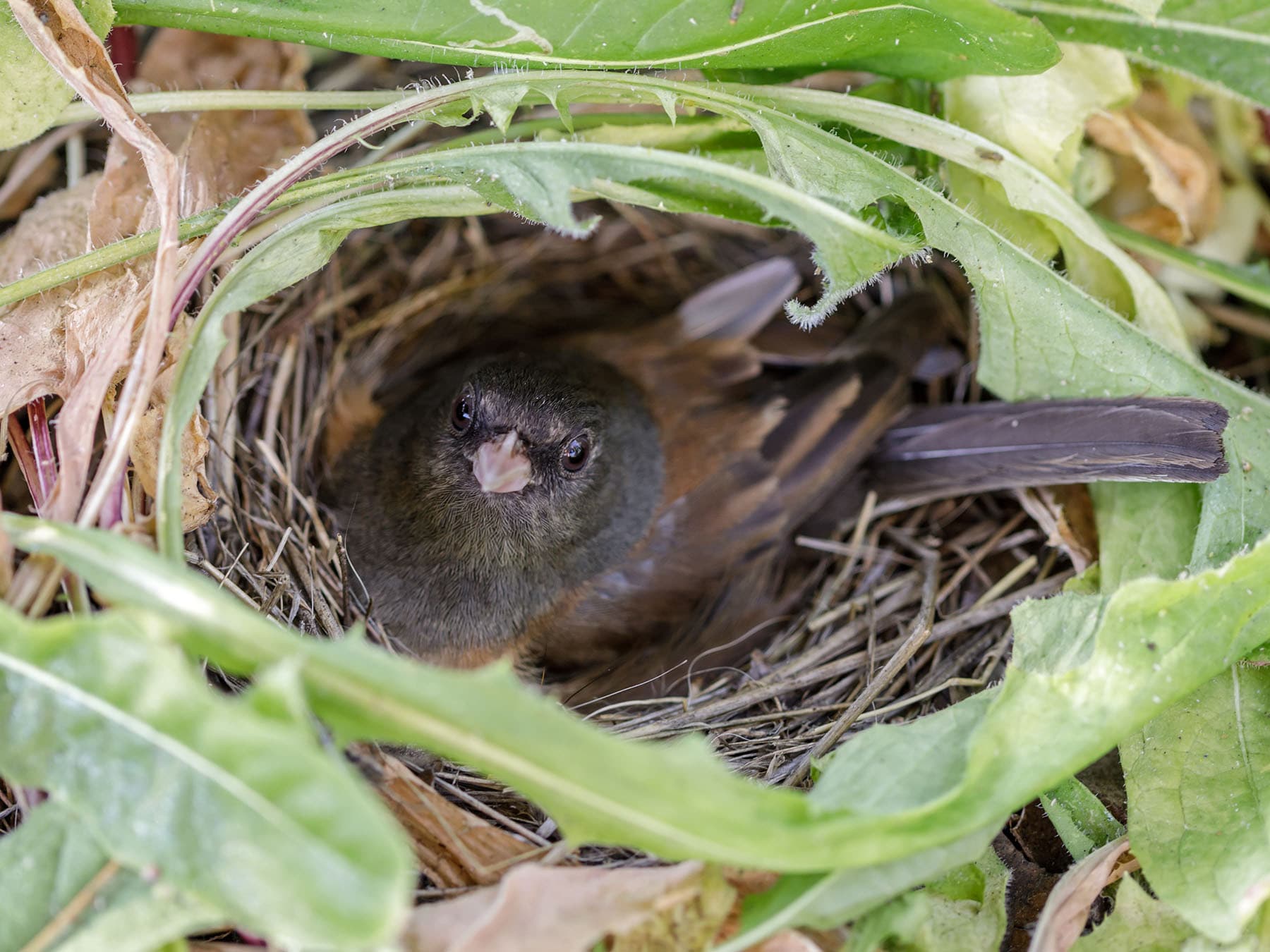 A female Dark-eyed Junco sitting on her nest on the ground
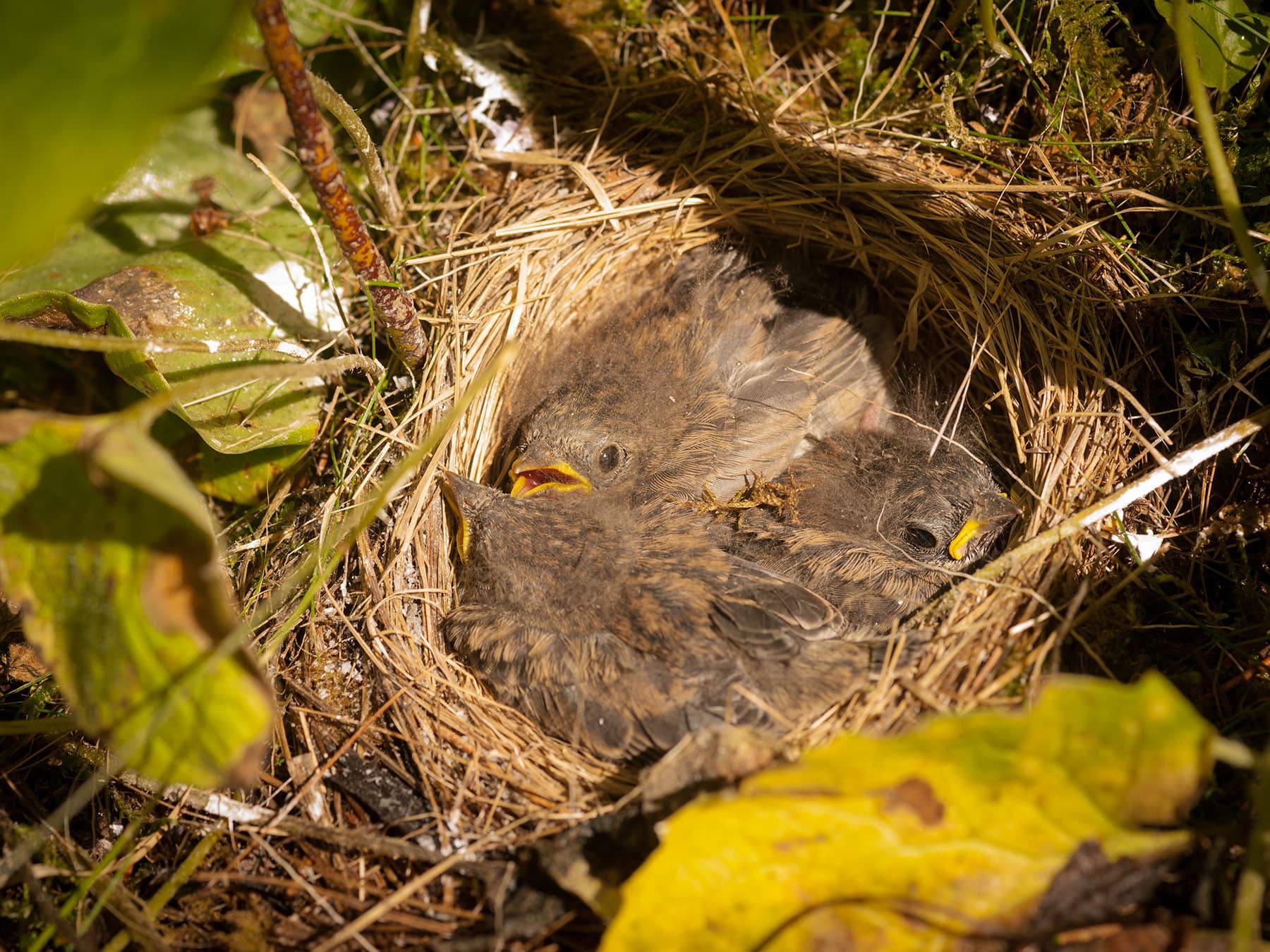 Dark-eyed Junco nestlings in a ground nest
 A Slate-colored Dark-eyed Junco in falling snow
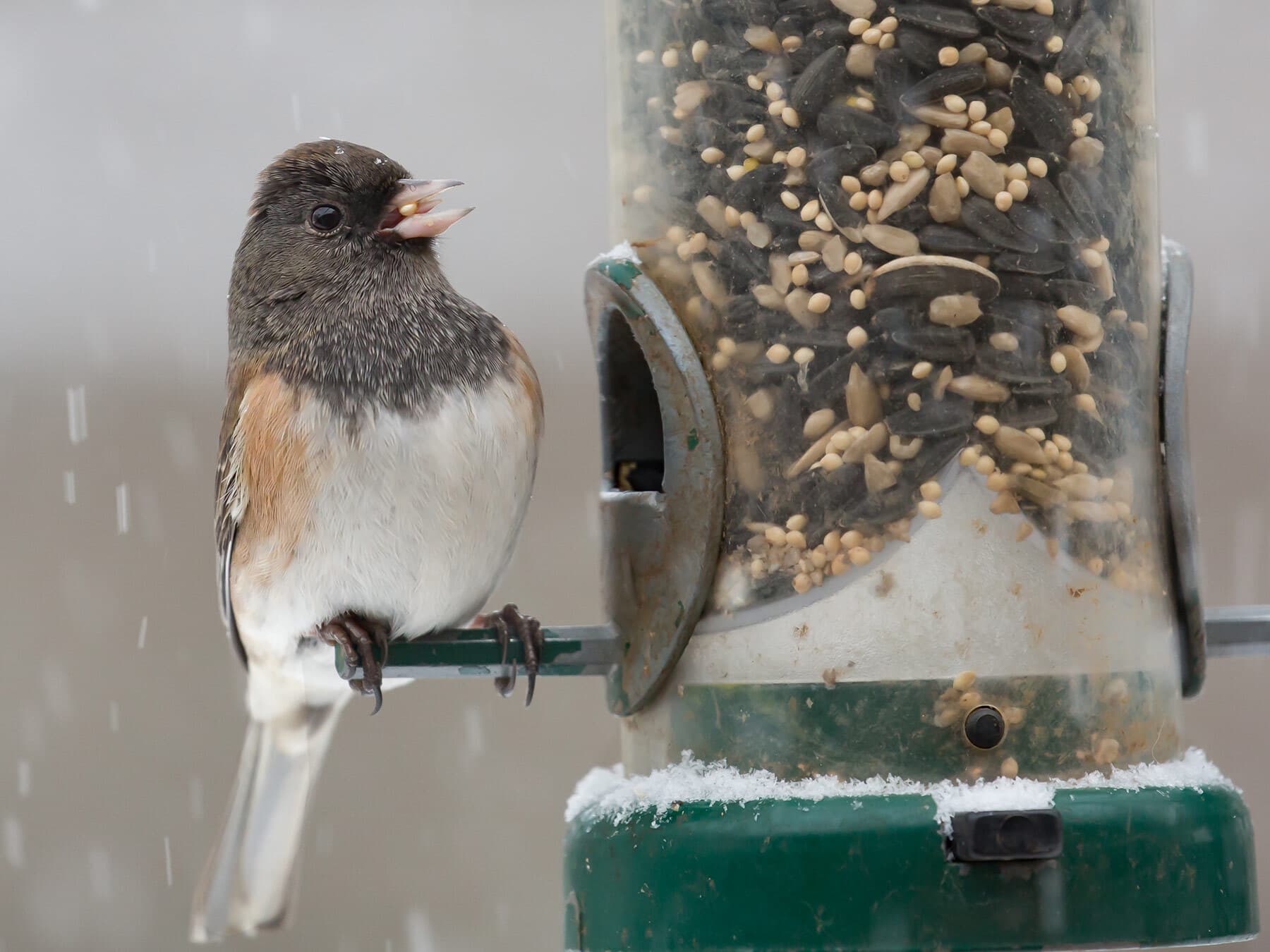 An Oregon Dark-eyed Junco at a hanging seed feeder in snow
Dark-eyed Junco guides
6 guides- Dark-eyed Junco Nesting: Nests, Eggs and Baby Juncos
- Male vs Female Dark-eyed Juncos: How to Tell Them Apart (and Juveniles)
- What Do Juncos Eat? Diet and Feeding Juncos
- Junco vs Chickadee: How to Tell Them Apart
- Oregon Junco, Slate-colored and the Other Dark-eyed Junco Forms
- Dark-eyed Junco Song and Calls: What They Sound Like
Quick facts
- Length
- 14–16.5 cm
- Wingspan
- 18–25 cm
- Weight
- 18–30 g
- Lifespan
- 2 years · oldest recorded 11.3 years
- Family
- New World Sparrows
- Migration
- Partial migrant
- Global status (IUCN)
- Least Concern
- World population
- About 220 million (Partners in Flight)
- Population trend
- Decreasing slowly: about 0.7% a year from 1966 to 2019 (North American Breeding Bird Survey); still one of the most abundant North American birds
- Also called
- Snowbird
- Scientific name
- Junco hyemalis
Questions
7Is a junco a sparrow or a finch?
A sparrow: it belongs to the New World sparrow family, and its closest relatives outside the juncos are thought to be sparrows such as the White-crowned Sparrow.
Why are juncos called snowbirds?
Over much of the US they arrive as winter sets in and leave in spring. John James Audubon called it the little "Snow-bird" in 1831, writing that everyone in the Union knew it. See do juncos migrate.
Why is it called a junco?
Junco is a late medieval Latin name for the Reed Bunting, from the Latin for a rush. The species name, hyemalis, means "of winter": Linnaeus named it in 1758, from Mark Catesby's "snow sparrow" of Virginia and Carolina in winter.
Is the Oregon Junco a different bird from the Dark-eyed Junco?
No. The Oregon Junco is one form of the Dark-eyed Junco, as is the Slate-colored. See Oregon Junco and the other forms.
Are juncos rare?
No. With about 220 million, they are one of the most abundant birds in North America. See conservation.
Where do juncos go in the summer?
North and up: to Canada and Alaska, the northern states, the western mountains and the Appalachians, where they nest. See where and when to see them.
How can you tell a male from a female junco?
Females are paler and browner; in the Oregon form the male's hood is black and the female's gray. See male and female juncos.
Sources
16- 1Cornell Lab of Ornithology. Dark-eyed Junco: Overview, Identification and Life History. All About Birds. Accessed 7 October 2026. Source (opens in a new tab)
- 2Nolan Jr., V. et al. (2020). Dark-eyed Junco (Junco hyemalis), version 1.0. Birds of the World (A. F. Poole and F. B. Gill, editors). Cornell Lab of Ornithology. doi:10.2173/bow.daejun.01 (opens in a new tab)
- 3National Audubon Society. Spotted Towhee. Audubon Guide to North American Birds. Accessed 7 October 2026. Source (opens in a new tab)
- 4National Audubon Society. Black Phoebe. Audubon Guide to North American Birds. Accessed 7 October 2026. Source (opens in a new tab)
- 5National Audubon Society. Dark-eyed Junco. Audubon Guide to North American Birds. Accessed 7 October 2026. Source (opens in a new tab)
- 6Project FeederWatch (Cornell Lab of Ornithology and Birds Canada) (2022). Top 25 Feeder Birds, 2021-22, Northeast Region. Project FeederWatch. Accessed 7 October 2026. Source (opens in a new tab)
- 7Ketterson, E. D. and Nolan Jr., V. (1976). Geographic variation and its climatic correlates in the sex ratio of eastern-wintering Dark-eyed Juncos (Junco hyemalis hyemalis). Ecology 57: 679-693. doi:10.2307/1936182 (opens in a new tab)
- 8Project FeederWatch. Food types. Project FeederWatch. Accessed 7 October 2026. Source (opens in a new tab)
- 9National Audubon Society (2024). Three easy but important ways to keep your bird feeders disease-free. Audubon. Accessed 7 October 2026. Source (opens in a new tab)
- 10U.S. Fish and Wildlife Service. Bird nests. U.S. Fish and Wildlife Service. Accessed 7 October 2026. Source (opens in a new tab)
- 11Hill, J. A. et al. (1999). Mate choice based on static versus dynamic secondary sexual traits in the dark-eyed junco. Behavioral Ecology 10: 91-96. doi:10.1093/beheco/10.1.91 (opens in a new tab)
- 12Webb, D. R. and Rogers, C. M. (1988). Nocturnal energy expenditure of Dark-eyed Juncos roosting in Indiana during winter. The Condor 90: 107-112. doi:10.2307/1368439 (opens in a new tab)
- 13USGS Bird Banding Laboratory. Longevity records of North American birds. Accessed 7 October 2026. Source (opens in a new tab)
- 14Foote, J. R., Mennill, D. J., Ratcliffe, L. M. and Smith, S. M. (2020). Black-capped Chickadee (Poecile atricapillus), version 1.0. Birds of the World (A. F. Poole, editor). Cornell Lab of Ornithology. doi:10.2173/bow.bkcchi.01 (opens in a new tab)
- 15National Audubon Society. Eastern Towhee. Audubon Guide to North American Birds. Accessed 7 October 2026. Source (opens in a new tab)
- 16Rowan, W. (1925). Relation of light to bird migration and developmental changes. Nature 115: 494-495. doi:10.1038/115494b0 (opens in a new tab)

Checked by
Nathan Cope, founder and editor
Nathan founded Birdfact and leads its writers and contributors in the UK, the US and Canada. He has watched and studied birds for more than ten years, and checks every article and species guide before it’s published.