Species Profile
White-crowned Sparrow
Zonotrichia leucophrys
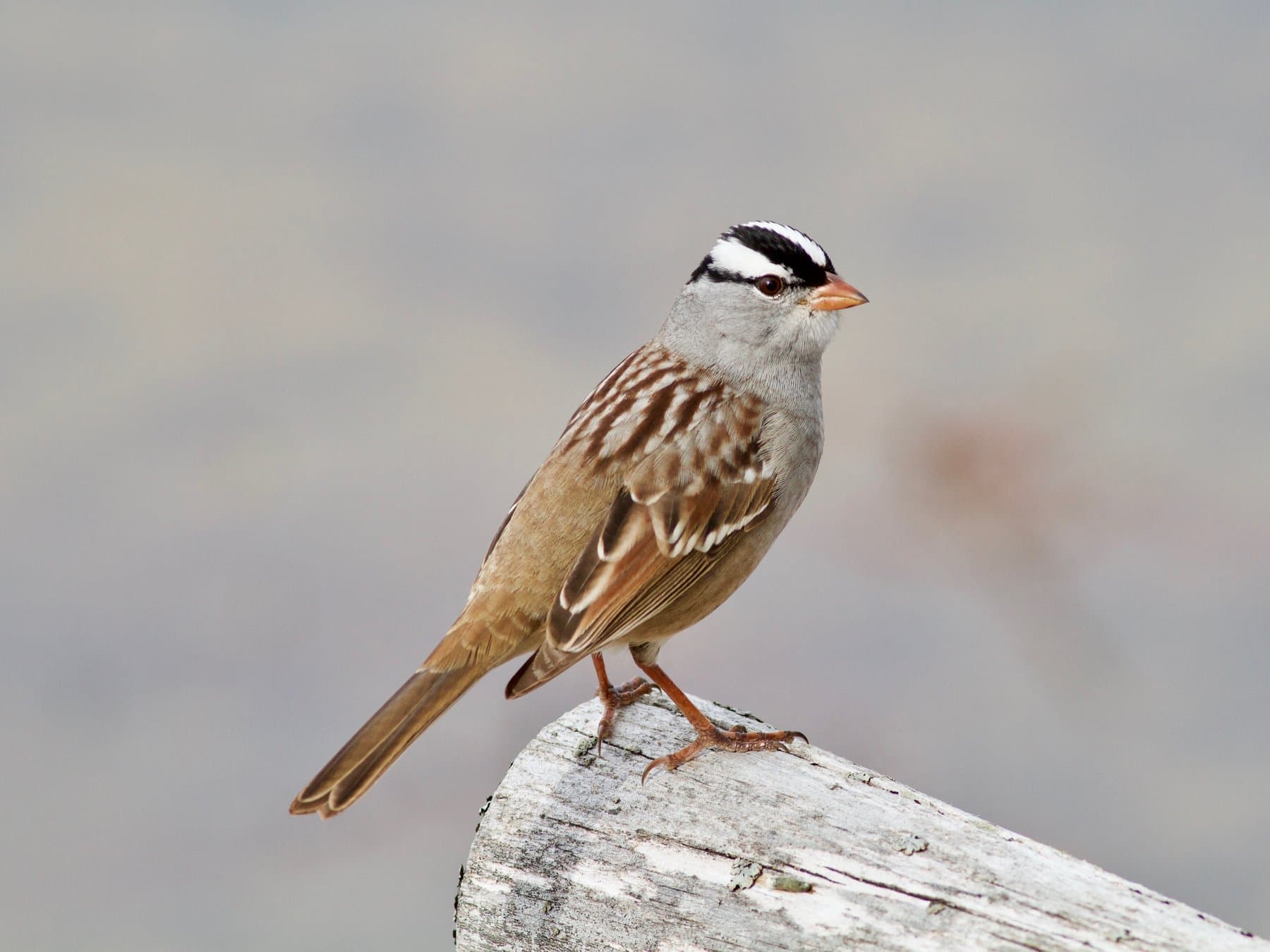
White-crowned Sparrow perched on a weathered wooden log, showing its black and white striped crown, gray breast, and brown streaked back.
Quick Facts
Conservation
LCLeast ConcernLifespan
2–6 years
Length
15–16 cm
Weight
25–28 g
Wingspan
21–24 cm
Migration
Partial migrant
Few sparrows announce themselves as boldly as the White-crowned Sparrow. The crisp black-and-white helmet pattern on its crown is unmistakable — a field mark so clean and consistent that even a beginner can identify it at a glance. Beyond its looks, this bird has become one of the most scientifically studied songbirds in North America, revealing secrets about sleep, song dialects, and the surprising speed of cultural evolution.
Think you've spotted a White-crowned Sparrow?
Upload a photo and we'll confirm it instantly
Confirm with a PhotoAppearance
The White-crowned Sparrow is a large, long-tailed sparrow built on generous proportions — noticeably bigger and more upright than a House Sparrow. The defining feature is the crown: two broad black stripes flank a clean white central stripe, with a further black stripe running behind each eye, creating a bold black-and-white helmet that makes identification almost effortless. The face and neck are plain grey, the breast and underparts pearly grey, and the back and wings are warm brown with black streaking. Two white wingbars cross each wing. The tail is long and dark.
Bill colour varies by subspecies and is one of the most useful field marks for separating them. The "dark-lored" group — Z. l. leucophrys from eastern Canada and Z. l. oriantha from the Rocky Mountains — has black lores where the crown stripe meets the bill base, and a pink bill. Gambel's White-crowned Sparrow (Z. l. gambelii), breeding across Alaska and western Canada, has pale grey or white lores and an orange to pink bill. The Pacific Coast subspecies (Z. l. nuttalli and Z. l. pugetensis) have pale lores, a yellow bill, drabber and browner upperparts, and a more prominent malar stripe.
First-winter birds retain the same body pattern as adults but replace the crisp black-and-white head stripes with tan and rusty-brown, giving a softer, more muted appearance. Juveniles are more heavily streaked on the breast and belly, with a mottled back and no distinct crown stripes. There is no seasonal plumage change — breeding and non-breeding adults look identical. The head can appear peaked or flat depending on posture, which can briefly alter the bird's silhouette.
Identification & Characteristics
Colors
- Primary
- Grey
- Secondary
- Brown
- Beak
- Pink
- Legs
- Pink
Markings
Bold black-and-white crown with two broad black lateral stripes flanking a clean white central stripe; plain grey face, neck, and underparts; brown streaked upperparts with two white wingbars
Tail: Long and dark brown, slightly rounded at the tip
Attributes
Understanding Attributes
Rated 0–100 based on research and observation. A score of 50 is average across all bird species. These attributes are relative and don't necessarily indicate superiority.
Habitat & Distribution
The White-crowned Sparrow breeds across a broad arc of northern and western North America, from Newfoundland and Labrador west through the boreal zone to Alaska, and south through the Rocky Mountains and along the Pacific Coast of the United States. On its breeding grounds, it favours open or semi-open country with a combination of bare or short-grass ground for foraging, dense low shrubs for nesting cover, and taller perches for singing. Specific habitats include dwarf willow and alder thickets at the tundra edge, bushy clearings in boreal forest, high alpine meadows, and coastal chaparral. In the mountains, it breeds from around 800 m up to the treeline.
In winter, the species spreads across much of the southern United States from California east to the Atlantic seaboard, and south into central Mexico. It is common year-round in California, Nevada, Arizona, and New Mexico, where resident Pacific-coast birds are joined by migratory birds from the north. In the eastern United States it is an uncommon to rare winter visitor, becoming rarer towards the southeast. It occurs as a non-breeding visitor in Louisiana, Mississippi, Alabama, Georgia, Florida, and the Carolinas. In winter and on migration, habitat requirements relax considerably: hedgerows, weedy roadsides, agricultural fields, desert washes, suburban gardens, and city parks all attract the species.
In the UK, the White-crowned Sparrow is a rare but increasingly recorded transatlantic vagrant. As of 2023, there are 16 accepted British records (BBRC), making it one of the more frequently recorded Nearctic sparrows in Britain. Records span from 1977 to 2023 and include sightings in Fair Isle, Yorkshire, Lancashire, Norfolk, Fife, Cheshire, the Outer Hebrides, Shetland, Argyll, East Sussex, Aberdeenshire, and Cornwall. Most records fall between late April and June, with a secondary autumn peak in September–November. The species has also been recorded in Ireland and Norway.
Where to See This Bird
Explore regional guides for locations where this bird has been recorded.
United States
Montana
Iowa
Illinois
Idaho
Kansas
Nevada
Indiana
Nebraska
Kentucky
Michigan
Alaska
Missouri
Arkansas
Arizona
New Mexico
Colorado
California
Ohio
Oklahoma
Utah
Oregon
South Dakota
Texas
Tennessee
Washington
West Virginia
Wyoming
Wisconsin
Canada
British Columbia
Alberta
Manitoba
Northwest Territories
Nunavut
Ontario
Quebec
Saskatchewan
Yukon Territory
Diet
Seeds dominate the White-crowned Sparrow's diet, making up around 92% of its annual food intake. In winter, the birds feed heavily on seeds of wild grasses, sedges, and herbaceous weeds, supplemented by grains such as oats, wheat, barley, and corn where available. Berries and small fruits — elderberries and blackberries in particular — are taken opportunistically. Other plant material consumed includes buds, flowers, moss capsules, and willow catkins.
The breeding season brings a dramatic dietary shift. Caterpillars, wasps, beetles, ants, spiders, and other invertebrates are consumed in large quantities from late spring through summer, and nestlings are fed almost exclusively on insects — the protein load essential for rapid growth. The switch is timed precisely to the peak of invertebrate abundance on the breeding grounds.
Foraging technique is characteristic and shared with towhees and fox sparrows: a quick backward hop to flip leaf litter, followed by a forward pounce to grab whatever is exposed — the "double-scratch." Birds also feed up in low shrubs and make short aerial sallies to catch flying insects. Because the species lacks a functional crop, it cannot store food between meals, which explains why feeding activity is concentrated in two daily peaks — morning and late afternoon — rather than spread evenly through the day. At feeders, White-crowned Sparrows readily take millet and sunflower seeds, and will visit gardens throughout the winter months across much of the southern and western United States.
Behaviour
White-crowned Sparrows are ground birds at heart. They spend most of their time foraging on bare earth or short grass, hopping with a purposeful, upright posture. When alarmed, they dive into the nearest dense shrub rather than taking flight — a reliable escape strategy that makes dense cover as important to them as food. Outside the breeding season, they are sociable birds, foraging in loose flocks that may include other sparrow species such as the White-throated Sparrow or Golden-crowned Sparrow.
Territorial males sing persistently from exposed perches — shrub tops, fence posts, low tree branches — particularly in the early morning. Song is the primary tool for territory defence and mate attraction, and males will counter-sing against rivals, matching phrase types in a structured vocal duel. Females occasionally sing too, particularly when competing for winter food patches, though their songs are quieter and less structured than those of males.
When approaching the nest, adults use a distinctive predator-avoidance strategy: rather than flying directly in, they land some distance away and walk the final stretch through dense vegetation, making it harder for watching predators to pinpoint the nest location. Females perform distraction displays — fluttering along the ground as if injured — to draw potential threats away from eggs or chicks. Feeding activity peaks early in the morning and again in the late afternoon; the species lacks a functional crop, so it cannot store food and must feed regularly throughout the day.
Calls & Sounds
The White-crowned Sparrow's song is one of the most studied in ornithology. It opens with one or more thin, sweet, clear whistled notes, moves through a variable succession of jumbled whistles, and ends with a buzzy trill or series of buzzy notes. The overall pattern is consistent enough to be recognisable across the species, but the specific phrasing, pitch, and tempo vary considerably — both between subspecies and between local dialect populations within the same subspecies. Songs typically last two to three seconds and are delivered from an exposed perch.
Song dialects are a defining feature of this species, particularly in western North America. Young males learn the local dialect during a sensitive developmental window in the first two to three months of life — absorbing it from the general soundscape of their natal neighbourhood rather than directly from their father. Once learned, the song is largely fixed for life. Males breeding at the boundary of two dialect zones can become effectively bilingual, singing both dialects fluently. These dialects have been intensively documented along the Pacific Coast and function as a natural laboratory for studying cultural transmission in animals, with parallels to human language acquisition.
Urban populations have been shown to modify their songs in response to anthropogenic noise. Research by Elizabeth Derryberry and colleagues demonstrated that San Francisco White-crowned Sparrows shifted to higher-pitched, louder songs over decades as traffic noise increased. During the COVID-19 shutdown of spring 2020, when urban noise dropped to levels last recorded in the 1950s, the same birds rapidly shifted to lower, quieter, higher-quality songs. Despite singing more softly, their songs were audible at nearly two to three times the distance, because background noise had dropped so dramatically — a striking demonstration of rapid acoustic adaptation in real time.
The call is a loud, sharp, metallic "pink" or "chink," used as an alarm and contact note. Flocking birds give a husky chatter. The flight call is a sharp "tseep." Females occasionally sing, particularly when contesting winter food sources or breeding territories, though their songs are quieter and more variable than those of males.
Flight
In flight, the White-crowned Sparrow shows a long tail and relatively broad, rounded wings — a silhouette that distinguishes it from slimmer warblers and pipits. Flight is typically undulating: a few rapid wingbeats followed by a brief closed-wing glide, producing a bounding trajectory characteristic of many sparrows and finches. Over short distances between foraging patches and cover, the flight is low and direct, often ending with an abrupt drop into dense vegetation.
During migration, the species flies at night, navigating by the stars and the Earth's magnetic field. A single bird has been tracked covering 480 km in one nocturnal flight — a distance that underlines the physical demands of long-distance migration for a bird weighing around 26 g. Gambel's White-crowned Sparrows completing their 4,300 km journey between Alaska and California must sustain this level of effort across multiple nights, fuelled by pre-migratory hyperphagia that can nearly double their body mass.
In the hand or at close range, the white wingbars are visible against the brown wing, and the long primary projection of migratory subspecies (compared to the shorter projection of resident Pacific birds) is a useful feature for subspecies identification. The flight call — a sharp "tseep" — is frequently given by birds passing overhead at night during migration, and learning it is one of the most reliable ways to detect the species during autumn passage.
Nesting & Breeding
Breeding season length varies enormously by latitude. In Alaska and northern Canada, it is compressed into the short Arctic summer — typically June to July — with a single brood. Along the Pacific Coast, the season runs from April through August, and pairs may raise two to four broods per year. Males arrive on the breeding grounds before females and begin defending territories immediately through song. Pair formation follows within days of the females' arrival.
The nest is built entirely by the female and takes two to nine days to complete. It is an open cup of twigs, coarse grasses, pine needles, moss, bark strips, and dead leaves, lined with fine grasses, feathers, and animal hair — approximately 13 cm across and 5 cm deep. In the Arctic and subarctic, nests are placed on the ground at the base of a shrub or grass clump, often in a shallow depression. Along the Pacific Coast, nests are more often placed in shrubs, typically 0.5–3 m above ground.
Clutch size is three to seven eggs, typically four or five. Eggs are greenish, greenish-blue, or bluish, heavily spotted with reddish-brown. Incubation is by the female alone and lasts 10–14 days, typically 12 days. She leaves the nest periodically to forage, usually in bouts of around 10 minutes. Nestlings hatch weighing approximately 2.7 g, with sparse down and closed eyes. Both parents feed the chicks, though the female contributes more in the early days; the male's share increases as the chicks grow. Young birds fledge at 8–10 days — northern populations tend to fledge earlier than southern ones. Fledglings do not fly well for the first week after leaving the nest, and siblings may remain together for more than two months. When the female begins a second clutch, the male takes over care of the first brood. Brown-headed cowbird brood parasitism occurs occasionally but is not common.
Lifespan
White-crowned Sparrows typically live two to six years in the wild, with most mortality occurring in the first year of life — the period when young birds must learn to navigate, find food, and avoid predators without the benefit of experience. Annual survival rates for adults are considerably higher than for juveniles, as is typical for passerines of this size.
The maximum recorded lifespan is 13 years and 4 months, documented in a wild Gambel's White-crowned Sparrow — an exceptional individual that survived more than twice the typical lifespan. Primary causes of mortality include predation by crows, jays, owls, hawks, Belding's ground squirrels, and Western terrestrial garter snakes. Nest predation is a significant source of breeding failure, and the species' habit of approaching the nest on foot rather than flying directly in is a behavioural adaptation to reduce this risk.
Compared to similar-sized New World sparrows, the White-crowned Sparrow's maximum longevity is broadly typical. The White-throated Sparrow has a similar maximum recorded age of around 14 years. The physiological demands of long-distance migration — particularly the extraordinary sleep reduction documented during migratory periods — do not appear to impose a measurable cost on maximum lifespan, suggesting the species has evolved robust mechanisms for managing the stresses of migration.
Conservation
The White-crowned Sparrow is listed as Least Concern on the IUCN Red List (2021), with a global population estimated at approximately 79 million breeding individuals (Partners in Flight, 2020). North American Breeding Bird Survey data show populations held broadly stable between 1966 and 2019. Partners in Flight rates the species 7 out of 20 on the Continental Concern Score, indicating low conservation concern at the range-wide level.
Localised declines tell a more nuanced story. At Point Reyes National Seashore in California, the breeding population fell by 85% over 30 years as Douglas-fir forest gradually replaced the open scrub habitat the species depends on — a textbook example of how vegetation succession can devastate a locally abundant bird without any direct persecution. Fragmented shrubsteppe zones in the interior west have recorded declines of 6–12% per decade for similar reasons.
Other localised threats include cattle grazing (which degrades foraging habitat), oil and gas exploration, poorly managed logging, mining, and climate change — including spring heat waves that can kill nestlings and wildfires that alter habitat structure. Urban noise pollution has been shown to affect song quality and communication effectiveness, though the species has demonstrated a capacity to adapt its vocalisation in response. There are no range-wide threats of comparable severity, and the species' broad habitat tolerance and very large population mean it is not currently at risk of significant overall decline.
Population
Estimated: Approximately 79 million breeding individuals
Trend: Stable
Stable overall between 1966 and 2019 (North American Breeding Bird Survey); localised declines in areas of habitat succession
Elevation
Sea level to treeline; breeds from around 800 m up to the alpine zone in the Rocky Mountains and Sierra Nevada
Additional Details
- Predators:
- Main predators include crows, jays, owls, hawks, Belding's ground squirrels, and Western terrestrial garter snakes. Adults approach the nest on foot through dense vegetation rather than flying directly in, reducing the risk of leading predators to the nest site. Females perform distraction displays — fluttering along the ground as if injured — to draw threats away from eggs or chicks.
Courtship & Display
Courtship in the White-crowned Sparrow is initiated by the female, not the male — an unusual arrangement among songbirds. Once a female has settled near a singing male, she signals her receptiveness through a series of specific postures: crouching low, fluffing the body feathers, and quivering the wings rapidly while giving soft calls. The male responds by intensifying his song output and moving closer. Copulation typically follows within a few days of pair formation.
In the southernmost coastal populations (Z. l. nuttalli), pairs may remain together on permanent territories year-round, effectively maintaining a long-term pair bond. Elsewhere, pairs form anew each spring, though approximately two-thirds of pairs that bred together the previous year will re-form when both individuals return to the same breeding area — a pattern of "site fidelity" rather than true mate fidelity. Males that return to the same territory year after year tend to achieve higher reproductive success, as they are already familiar with local food sources, predator pressure, and rival males. Females that re-pair with the same male benefit from a shorter courtship period and earlier nest initiation, which is particularly valuable in the short Arctic breeding season.
Subspecies & Variation
Five subspecies of White-crowned Sparrow are recognised, and together they span one of the widest spectrums of migratory behaviour found within a single North American bird species. At one extreme, Z. l. nuttalli (Nuttall's White-crowned Sparrow), resident along the California coast from Marin County to Santa Barbara, is entirely sedentary — pairs hold permanent territories year-round and rarely move more than a few kilometres from their natal area. At the other extreme, Z. l. gambelii (Gambel's White-crowned Sparrow), breeding across Alaska and northern Canada, migrates approximately 4,300 km to winter in southern California. The remaining three subspecies fall between these poles: Z. l. pugetensis is a short-distance migrant from the Pacific Northwest; Z. l. oriantha moves from high-elevation Rocky Mountain meadows to the southwestern lowlands; and Z. l. leucophrys from eastern Canada is a long-distance migrant wintering across the southern United States.
Identification of subspecies groups in the field rests primarily on lore colour and bill colour. Dark-lored birds (leucophrys and oriantha) have black lores and a pink bill. Gambel's birds have pale lores and an orange to pink bill. Pacific birds (nuttalli and pugetensis) have pale lores and a yellow bill, with drabber, browner upperparts and a shorter primary projection. Song dialects also differ between subspecies groups, with Pacific birds producing notably different phrasing from interior and eastern populations. Where subspecies ranges meet, intergrades occur and can be challenging to assign to either group.
Birdwatching Tips
In the United States, the White-crowned Sparrow is one of the most reliably found sparrows at winter feeders across the southern and western states. Millet and sunflower seeds draw them readily, and they are often confiding birds that allow close approach. Look for them foraging on the ground beneath feeders or in weedy patches at field edges. The bold black-and-white crown pattern eliminates most confusion species at a glance — no other common North American sparrow has such a clean, graphic head pattern.
The most similar species is the White-throated Sparrow, which shares the striped crown but has a yellow spot between the eye and bill, a white throat patch, and a more heavily streaked breast. First-winter White-crowned Sparrows, with their tan-and-brown head stripes, can briefly suggest a Golden-crowned Sparrow, but the Golden-crowned has a yellow central crown stripe rather than white. Subspecies identification is worth attempting: look at lore colour (black vs pale) and bill colour (pink, orange, or yellow) to separate the five groups.
In the UK, any sparrow with a boldly striped crown should be scrutinised carefully — White-crowned Sparrows have turned up at a range of coastal sites, particularly in Shetland, Fair Isle, and along the east coast, between late April and June. The song — a series of clear whistles followed by buzzy trills — is distinctive and carries well, so listening is as important as looking. Spring 2023 produced four British records in a single season, suggesting that patient observers at coastal watchpoints have a realistic chance of encountering one.
Did You Know?
- During migration, White-crowned Sparrows reduce their sleep by approximately two-thirds compared to non-migratory periods — yet their cognitive performance remains fully intact. Research published in PLOS Biology (2004) showed that even a single night of forced sleep deprivation during the non-migratory season caused measurable cognitive decline in the same birds. No other bird has been shown to sustain this level of sleep reduction without impairment.
- A single migrating White-crowned Sparrow was tracked covering 480 km (300 miles) in a single night. Gambel's White-crowned Sparrows breeding in central Alaska make a round-trip migration of approximately 4,300 km to winter in southern California — one of the longest migrations of any North American sparrow.
- During the COVID-19 shutdown of spring 2020, urban White-crowned Sparrows in San Francisco reverted to lower, softer songs not heard since the 1950s. Despite singing more quietly, their songs carried nearly three times further in the quieter soundscape — a real-world demonstration of how rapidly birds can adapt their communication to environmental change.
- The 2008 White-crowned Sparrow at Cley-next-the-Sea in Norfolk — a singing adult male that stayed from January to March — became a local celebrity, attracting hundreds of birdwatchers. It was commemorated with a stained-glass window in St Margaret's Church, Cley. As of 2023, there are 16 accepted British records, with four birds recorded in a single year (2023) alone.
- White-crowned Sparrows can run on a laboratory treadmill at approximately half a kilometre per hour without tiring, making them a model species for research into avian energetics and endurance physiology.
Records & Accolades
Song Dialect Pioneer
5 distinct subspecies dialects
One of the first bird species in which geographically distinct song dialects were scientifically documented and studied as cultural transmission analogous to human language.
Sleep Science Model
Two-thirds sleep reduction during migration
The only bird proven to reduce sleep by approximately two-thirds during migration while maintaining full cognitive performance — a finding published in PLOS Biology (2004) with implications for human sleep medicine.
Marathon Migrant
~4,300 km one-way (Gambel's subspecies)
Gambel's White-crowned Sparrows breeding in central Alaska migrate approximately 4,300 km to winter in southern California — one of the longest migrations of any North American sparrow. Individual birds have been tracked covering 480 km in a single night.
Community Photos
Be the first to share a photo of the White-crowned Sparrow
Upload a PhotoIdentify Any Bird Instantly
- Upload a photo from your phone or camera
- Get an instant AI identification
- Ask follow-up questions about the bird
Monthly Birds in Your Area
- Personalised for your location
- Seasonal tips and garden advice
- Updated every month with new species