Species Profile
Chipping Sparrow
Spizella passerina
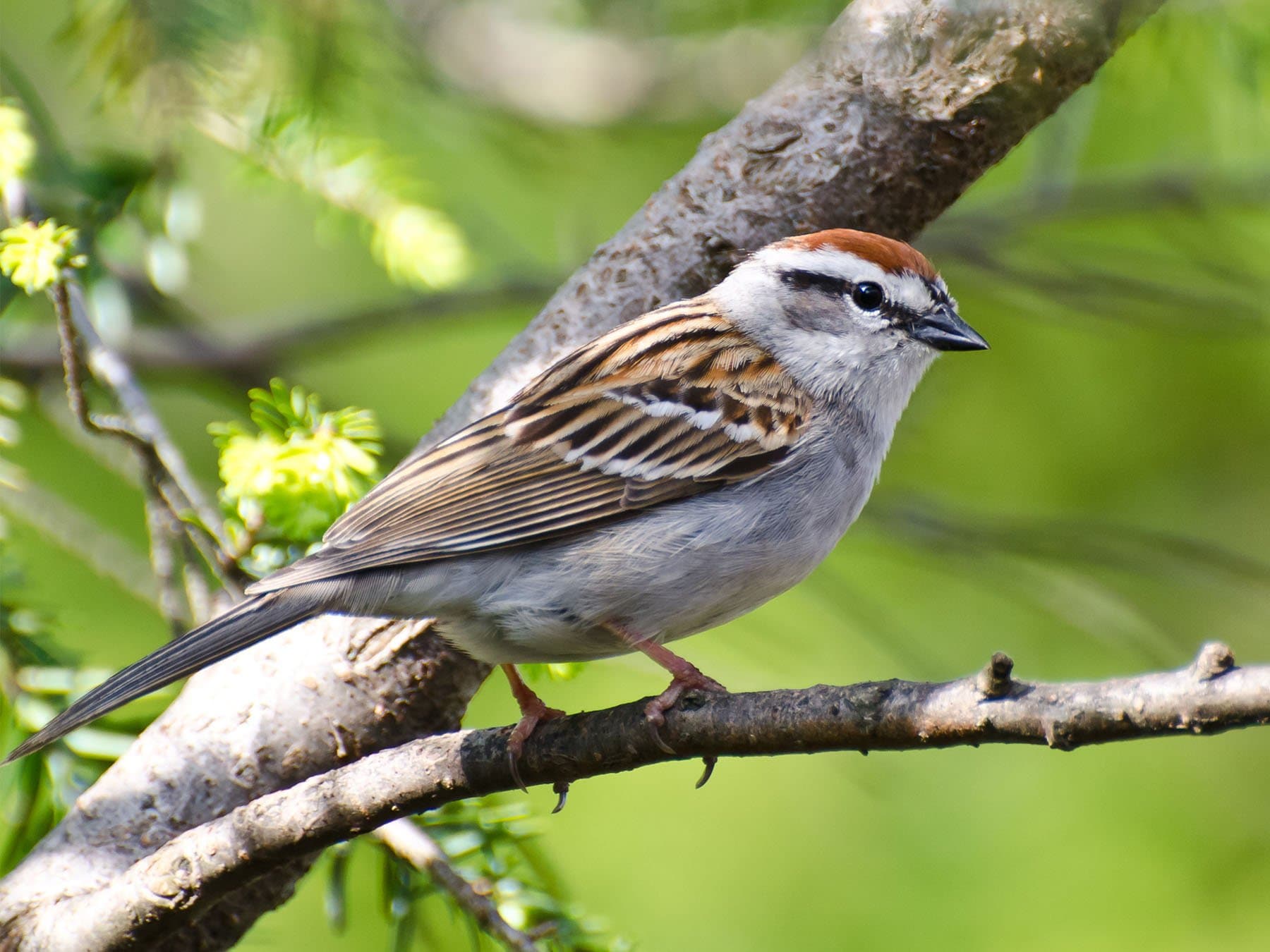
Chipping Sparrow perched on a branch, showing rufous cap, white supercilium, black eye line, and streaked back against a green background.
Quick Facts
Conservation
LCLeast ConcernLifespan
2–5 years
Length
12–15 cm
Weight
11–17 g
Wingspan
21 cm
Migration
Partial migrant
A bright rufous cap, a razor-clean white eyebrow, and a bold black eye-stripe make the breeding Chipping Sparrow one of the most crisply marked small birds in North America. Once the most common city sparrow on the continent — before House Sparrows arrived from Europe and displaced it — this slender, chickadee-sized bird now fills parks, gardens, and coniferous forests from Alaska to Honduras with its rapid, mechanical trill.
Think you've spotted a Chipping Sparrow?
Upload a photo and we'll confirm it instantly
Confirm with a PhotoAppearance
In breeding plumage, the Chipping Sparrow is among the most neatly patterned of North American sparrows. The crown is a vivid rufous (chestnut) red, sharply bordered below by a clean white supercilium. A bold black trans-ocular stripe runs from the base of the bill straight through the eye to the nape, giving the face a precise, almost painted quality. The cheeks and nape are clear grey, and the throat is pale. The underparts — breast, flanks, and belly — are unstreaked and pale grey to whitish, producing a clean, frosty look that immediately separates this species from most other streaky-breasted sparrows.
The back and wings are streaked black and brown, with two white wing bars. The rump is distinctively grey — a critical field mark that separates the Chipping Sparrow from the similar Clay-colored Sparrow, which has a brown rump. The bill is black in the breeding season. The tail is slightly notched, and the overall body shape is slender and trim — noticeably smaller and neater than a Song Sparrow. Measurements: 12–15 cm in length, 11–17 g in weight, with a wingspan of around 21 cm.
Non-breeding plumage is considerably more subdued. The rufous cap becomes brownish and is often streaked or obscured. The supercilium turns dusky or buffy rather than clean white, and the eyeline loses its sharp definition. The bill becomes pinkish rather than black. The overall impression shifts to a streaky, buff-brown sparrow that can be confused with Clay-colored or Brewer's Sparrows in the field.
Juveniles are extensively streaked below — a key difference from adults — and show a streaked brown crown. They retain a dark eyeline extending both in front of and behind the eye, and the rump is finely streaked cinnamon, gradually transitioning to grey. Most juveniles in northern areas retain this plumage through fall migration. The species moults twice a year: a complete post-breeding moult in late summer produces non-breeding plumage, and a partial pre-breeding moult in late winter restores the crisp breeding dress.
Identification & Characteristics
Colors
- Primary
- Rufous
- Secondary
- Grey
- Beak
- Black
- Legs
- Pink
Markings
Bright rufous crown, clean white supercilium, bold black trans-ocular stripe, unstreaked grey underparts, and grey rump (breeding adult). Bill black in breeding season, pinkish in non-breeding.
Tail: Slightly notched tail; medium length, grey-brown with pale edges
Attributes
Understanding Attributes
Rated 0–100 based on research and observation. A score of 50 is average across all bird species. These attributes are relative and don't necessarily indicate superiority.
Habitat & Distribution
Unlike most North American sparrows, which favour open grasslands, the Chipping Sparrow gravitates strongly toward open woodland and forest edge. In the West it breeds mainly in coniferous forests — ponderosa pine, Douglas fir, lodgepole pine, and spruce-fir stands — while in the East it uses a wider variety of woodland types, farmland, parks, orchards, cemeteries, and suburban gardens. The species has adapted exceptionally well to human-modified landscapes and is now one of the most familiar birds of North American suburbs, particularly where evergreen trees are present. It nests in conifers wherever they are available, but also uses aspen, birch, oak, pecan, eucalyptus, crabapples, honeysuckle tangles, maples, and ornamental shrubs.
The breeding range is vast, extending from eastern Alaska and the Northwest Territories south through virtually all of Canada and the contiguous United States, continuing through the highlands of Mexico, Guatemala, Belize, and Honduras. In the United States, the species is common to abundant across eastern and central states — Pennsylvania, Maryland, Georgia, Alabama, Iowa, Minnesota, Nebraska, Michigan, and Ohio among them — and uncommon to fairly common in western states including Montana, Oregon, Colorado, and California. Year-round residents occur in the southeastern US (Georgia, Alabama, the Carolinas, Virginia, Florida), Texas, and parts of the Southwest (Arizona, New Mexico).
In Canada, Chipping Sparrows breed across all provinces and territories south of the Arctic Circle, from British Columbia east to Newfoundland. They are a familiar breeding bird throughout Ontario and Quebec. Wintering birds are found across the southern United States from California east to the Carolinas and south through Florida and Mexico, occasionally reaching the Greater Antilles. The species breeds from sea level to treeline; in Texas, breeding has been recorded between 60 and 2,400 m (200–8,000 ft) elevation.
Where to See This Bird
Explore regional guides for locations where this bird has been recorded.
United States
Montana
Georgia
Illinois
Idaho
Iowa
Indiana
Nebraska
Kansas
Louisiana
Kentucky
Maine
Massachusetts
Michigan
Maryland
Nevada
New Jersey
New Mexico
North Carolina
Mississippi
Missouri
Minnesota
Arkansas
Arizona
Alabama
North Dakota
Connecticut
District of Columbia
Colorado
Delaware
Florida
New Hampshire
Oklahoma
Ohio
New York
Oregon
Pennsylvania
Rhode Island
South Carolina
South Dakota
Utah
Virginia
Tennessee
Texas
Vermont
Washington
Wyoming
West Virginia
Wisconsin
Canada
Alberta
British Columbia
Manitoba
New Brunswick
Northwest Territories
Ontario
Prince Edward Island
Quebec
Yukon Territory
Saskatchewan
Diet
Seeds form the dietary staple year-round. Chipping Sparrows take seeds from a wide variety of grasses and herbs, including dandelion (Taraxacum officinale) in spring, black bindweed (Fallopia convolvulus), sweet clover (Melilotus spp.), chickweed (Stellaria media), lamb's quarters (Chenopodium album), oats (Avena spp.), and numerous other weeds and grasses. Small fruits such as cherries are occasionally taken.
During the breeding season, insects become a large and important part of the diet, supplying the protein needed for egg production and chick growth. Prey includes grasshoppers, caterpillars, beetles, leafhoppers, true bugs, and a range of other invertebrates. Spiders are also taken. Nestlings are fed almost entirely on insects and other invertebrates during their first days of life.
Foraging takes place primarily on the ground, typically in covered areas or near the edges of fields and open spaces. Birds run or hop through grasses, stopping frequently to scratch the surface for seeds. They are most active in the morning and early evening. Outside the breeding season, foraging is almost always a social activity — flocks work through open ground together, with individuals occasionally making short sallying flights to catch insects in mid-air. At garden feeders, Chipping Sparrows readily take black oil sunflower seeds and mixed seed scattered on the ground, and they are among the most regular small-bird visitors to North American suburban gardens.
Behaviour
Chipping Sparrows are ground foragers for much of the year, hopping and running through short grass and leaf litter with quick, purposeful movements. They scratch the soil surface for seeds and clamber up into shrubs and low branches to pick off buds and small arthropods. Outside the breeding season they are gregarious, forming flocks of several dozen birds that often associate with other sparrow species — Field Sparrows, Dark-eyed Juncos, and American Tree Sparrows are frequent flock companions in winter.
During the breeding season, males become strongly territorial. They sing persistently from exposed perches — typically the upper branches of a conifer — to advertise territory and attract females. Territory sizes in Montana's Douglas fir and lodgepole pine forests range from 1.1 to 1.8 acres. Males guard females closely after copulation, a behaviour consistent with the species' documented tendency toward extra-pair mating: despite appearing conventionally monogamous, males travel outside their territories in search of extra-pair opportunities, and polygyny has been recorded in some populations.
Activity peaks in the morning and again in the early evening. At bird feeders, Chipping Sparrows are approachable and relatively tame, often feeding on the ground beneath hanging feeders. When alarmed, they give a sharp, flat 'chip' call and retreat into dense cover. Post-breeding, birds in the West often disperse to higher elevations — sometimes appearing on alpine tundra or along roadsides in open grassland — before undertaking their southward migration. This dispersal can mislead observers into thinking the species bred in those areas when it has simply moved there to moult.
Calls & Sounds
The Chipping Sparrow's song is one of the most recognisable sounds of a North American spring. It is a long, rapid, mechanical trill — a sustained, monotonous repetition of a single dry 'chip' note delivered at a consistent, fast tempo. The song stays on a single pitch or oscillates within a very narrow range, giving it a buzzy, wiry quality that some describe as resembling a tiny sewing machine or a pneumatic tool chipping paint from metal. A single trill can last several seconds and is delivered from an exposed perch, typically in the upper branches of a conifer. Males sing persistently during the breeding season, especially in the morning, using the song for territory advertisement and mate attraction.
The call is a sharp, hard 'chip' — a single, flat note that gives the species its common name. It is used in alarm and contact contexts and is given by both sexes. A high-pitched 'tseep' is also produced. Crucially, the Chipping Sparrow also has a distinctive piercing flight call used during nocturnal migration, classified by researchers in the 'descending seep' complex — a group of similar calls produced by several sparrow species that can be detected and identified by observers monitoring night-migrating birds from the ground. This nocturnal call is quite different from the daytime 'chip' and is rarely described in popular field guides.
Only males sing the territorial trill. Both sexes give chip calls. Juveniles produce their own distinct calls, which differ from adult vocalisations. The species is most vocal from April through July; in winter, Chipping Sparrows are relatively quiet, and wintering flocks can be surprisingly inconspicuous despite their numbers.
Flight
In flight, the Chipping Sparrow appears small, slender, and slightly long-tailed for its body size. The flight style is typically undulating — a series of rapid wingbeats alternating with brief closed-wing glides — producing a bouncy, slightly erratic trajectory characteristic of many small sparrows. Direct flights between perches are fast and low, often dropping into cover almost immediately upon landing.
The slightly notched tail is visible in flight and helps distinguish the species from similar sparrows with more rounded or squared tails. The grey rump — one of the key field marks for separating Chipping Sparrow from Clay-colored and Brewer's Sparrows — can be glimpsed as a bird flushes from the ground, though it requires a good view. The two white wing bars are visible on perched birds but less obvious in flight.
During migration, Chipping Sparrows travel at night, producing distinctive piercing flight calls that researchers use to monitor passage. Daytime movements are typically low and short, with birds moving through scrub and woodland edge rather than making sustained open-sky flights. Migrating flocks can be sizeable, sometimes numbering several dozen birds moving together through suitable habitat. Post-breeding dispersal in the West sometimes takes birds to surprisingly high elevations — alpine tundra above treeline — before the main southward migration begins in September.
Nesting & Breeding
Males arrive on breeding grounds from March in southern areas such as Texas to mid-May in southern Alberta and northern Ontario, and begin singing immediately to establish territories. Females arrive one to two weeks later, and nesting typically begins within about two weeks of the female's arrival. Egg dates in Texas run from 11 April to 29 May; in Montana, nesting runs from late May to mid-July.
The nest is built by the female alone over 3–4 days while the male guards her closely. It is a loose, open cup of rootlets and dried grasses — so flimsy that light can often be seen through the walls — lined with animal hair and fine plant fibres. Historically, horsehair was the preferred lining material, earning the species the folk name 'hair-bird.' As horses disappeared from North American towns in the early 20th century, birds adapted: nests were found lined with human hair gathered from outside barber shops. Today any fine animal hair will do, including pet fur. Finished nests measure approximately 11 cm across and 5.6 cm deep. The nest is typically placed 1–3 m above ground, hidden in foliage at the tip of a branch, with a strong preference for conifers — though nests have been found as high as 18 m and in highly unusual locations, including among hanging strands of chilli peppers and inside tool sheds.
Clutch size is 2–7 eggs, most commonly 3–4. Eggs are pale blue to white, lightly streaked or spotted with black, brown, or purplish markings concentrated at the larger end; they measure approximately 17 × 12 mm. The female incubates alone for 10–15 days (typically 11–14), beginning just before the last egg is laid. The male feeds her on the nest throughout incubation. Hatchlings are altricial — naked, eyes closed, weighing around 1.3 g. Both parents feed the nestlings. Young become fully feathered by day 6 and fledge at 8–12 days, by which time they weigh roughly 80% of adult mass. Parents continue feeding fledglings for about three more weeks. Most pairs raise 1–2 broods per season, though three are possible.
Nests are frequently parasitised by Brown-headed Cowbirds (Molothrus ater). Research in southwest Colorado found 22% of nests were parasitised, with abandonment rates significantly higher among parasitised nests (29%) than unparasitised ones (5%). Chipping Sparrows are classified as a 'nest-deserting host' — unlike many cowbird hosts that accept foreign eggs, they frequently abandon parasitised clutches entirely.
Lifespan
The typical lifespan of a wild Chipping Sparrow is 2–5 years, reflecting the high mortality rates common to small passerines. First-year birds face the greatest risks: predation, starvation during their first winter, and the hazards of their first migration account for a large proportion of annual mortality. Predators include Sharp-shinned Hawks, American Kestrels, domestic cats, snakes, and small mammals such as chipmunks and squirrels that raid nests.
The maximum recorded longevity is 11 years and 10 months — a bird banded in Ontario in 1987 and recaptured in the same province in 1998. This figure, recorded in the AnAge longevity database, is exceptional and far exceeds the average. For context, the closely related Field Sparrow has a similar typical lifespan, while larger sparrows such as the White-throated Sparrow can occasionally reach 10 or more years in the wild.
Survival rates improve significantly for birds that successfully navigate their first year. Adults that establish territories in productive habitat and avoid cowbird parasitism can raise multiple broods across several seasons. Building and communication tower collisions during nocturnal migration are a significant source of adult mortality, as is window strike mortality in suburban areas where the species is common. Pesticide exposure in intensively farmed areas reduces insect prey availability and may affect survival indirectly.
Conservation
The Chipping Sparrow is listed as Least Concern on the IUCN Red List (2021), with a global breeding population estimated at approximately 240 million individuals by Partners in Flight. BirdLife International records an extent of occurrence of 22.2 million km² and classifies the global population trend as increasing.
The North American picture is more nuanced. The North American Breeding Bird Survey recorded a decline of approximately 0.6% per year between 1966 and 2019 — a cumulative reduction of around 28% over that period. Partners in Flight rates the species 9 out of 20 on the Continental Concern Score, indicating low but non-trivial concern. In Washington State, the species has experienced significant statewide decline since 1966 and is considered at-risk by the Washington Gap Analysis Project.
Key threats include successional changes in forests that reduce open woodland habitat; intensive agriculture and associated pesticide exposure that reduces insect prey; brood parasitism by Brown-headed Cowbirds, which frequently triggers nest abandonment; habitat loss from urban development; and collisions with buildings and communication towers during nocturnal migration. Predation by domestic cats is an additional pressure. Competition with introduced House Sparrows (Passer domesticus) displaced the Chipping Sparrow from its former role as the dominant city sparrow after House Sparrows were introduced to North America in the 1800s. Climate change is projected to affect the species' range, with modelling suggesting shifts in both breeding and wintering distributions in coming decades.
Population
Estimated: Approximately 240 million (Partners in Flight global breeding population estimate)
Trend: Increasing
Increasing globally (BirdLife International), but declining in North America at approximately 0.6% per year since 1966 — a cumulative decline of around 28% through 2019 (North American Breeding Bird Survey).
Elevation
Sea level to treeline; breeding recorded from 60 m to 2,400 m in Texas
Additional Details
- Family:
- Passerellidae (New World Sparrows)
- Predators:
- Known predators include Sharp-shinned Hawks (Accipiter striatus), American Kestrels (Falco sparverius), domestic cats, snakes, and small mammals such as chipmunks and squirrels that raid nests. Building and communication tower collisions during nocturnal migration are a significant source of adult mortality.
Similar Species
The Chipping Sparrow's breeding plumage is distinctive enough that confusion with other species is unlikely for observers with a reasonable view. The combination of bright rufous cap, clean white supercilium, bold black eyeline, and unstreaked grey underparts is not shared by any other common North American sparrow. The grey rump is the single most useful structural field mark when separating it from similar species.
The Clay-colored Sparrow is the most frequently confused species, particularly in non-breeding plumage and for juveniles. Clay-colored shows a brown rump (versus grey in Chipping), a more distinctly outlined pale median crown stripe, and a buffy wash on the breast. The face pattern is less sharply defined. In breeding plumage, Clay-colored lacks the rufous cap entirely, showing instead a streaked brown crown.
Brewer's Sparrow, found in sagebrush habitats of the West, is another potential confusion species. It is even plainer than non-breeding Chipping Sparrow — lacking any strong face pattern — and shows a brown rump. The American Tree Sparrow shares the rufous cap but has a distinctive dark central breast spot and a bicoloured bill (dark above, yellow below), and is a winter visitor to areas where Chipping Sparrows breed. Field Sparrow has a pink bill, a plain face with a faint eye ring, and a rufous patch behind the eye rather than a full cap — a useful distinction at any season.
Cultural Significance
For much of the 19th century, the Chipping Sparrow was the most familiar wild bird in North American towns and cities — the sparrow that hopped across doorsteps, foraged beneath kitchen windows, and nested in garden shrubs. Naturalist Edward Forbush, writing in 1929, called it 'the little brown-capped pensioner of the dooryard and lawn,' evoking a bird so embedded in daily domestic life that it was taken entirely for granted. Its folk name, 'hair-bird,' came from its habit of lining the nest with horsehair — a material so reliably sourced from the horses that pulled every cart and plough that the association became defining.
The arrival of House Sparrows from Europe, introduced to Brooklyn in 1851 and rapidly spreading across the continent, displaced the Chipping Sparrow from this role within a few decades. The House Sparrow was more aggressive, more adaptable to the densest urban environments, and willing to nest in cavities that Chipping Sparrows could not use. By the early 20th century, the Chipping Sparrow had retreated to the suburban fringe — still common, still familiar, but no longer the bird of the city centre.
The horsehair nest-lining habit itself became a small cultural footnote as the automobile replaced the horse. Observers noted nests lined with human hair from barber shops, a quiet adaptation that went largely unremarked at the time but now reads as a vivid illustration of how closely the species tracked the material world of its human neighbours.
Birdwatching Tips
The Chipping Sparrow's persistent, mechanical trill is usually the first clue to its presence — learn the song and you'll realise just how common this bird is in parks, gardens, and woodland edges across North America. The trill carries well and is delivered repeatedly from an exposed perch, typically near the top of a conifer. Once you've located a singing male, approach slowly; Chipping Sparrows are relatively tame and will often continue singing even when observed at close range.
In the US and Canada, the best time to find breeding birds is April through July. In the eastern states, suburban gardens with conifers are reliable year-round in the south and from spring through autumn further north. In the West, open ponderosa pine and Douglas fir forests are productive breeding habitat. During migration (April–May in spring; September–October in fall), look for small flocks moving through open woodland, scrub, and even grassland — Chipping Sparrows are less habitat-specific during passage.
Separating breeding adults from similar species is straightforward: the combination of rufous cap, clean white supercilium, bold black eyeline, and unstreaked grey underparts is unique. In non-breeding plumage, the key field mark is the grey rump — Clay-colored and Brewer's Sparrows both show a brown rump. Juveniles are trickier, being heavily streaked below, but the dark eyeline and gradually greying rump are useful pointers. At garden feeders, scatter seed on the ground — Chipping Sparrows rarely use hanging feeders, preferring to forage at ground level.
Did You Know?
- The oldest recorded wild Chipping Sparrow was at least 11 years and 10 months old when recaptured during banding operations in Ontario in 1998 — it had originally been banded in the same province in 1987, far exceeding the species' typical lifespan of 2–5 years.
- The Chipping Sparrow's nest is so flimsy that light can be seen through the walls. Despite this seemingly inadequate construction, the species can raise up to three broods in a single season from nests that take the female just 3–4 days to build.
- Before House Sparrows were introduced from Europe in the 1800s, the Chipping Sparrow was the most common city sparrow in North America. Naturalist Edward Forbush described it in 1929 as 'the little brown-capped pensioner of the dooryard and lawn, that comes about farmhouse doors to glean crumbs shaken from the tablecloth by thrifty housewives.'
- As horses disappeared from North American towns in the early 20th century, Chipping Sparrows adapted their nest-lining habits — nests were found lined with human hair gathered from outside barber shops, replacing the horsehair that had been the traditional material for centuries.
- Although outwardly monogamous, male Chipping Sparrows regularly travel outside their territories in search of extra-pair mating opportunities. Polygyny and extra-pair copulations are documented in multiple populations, revealing a hidden complexity beneath the species' apparently conventional family life.
Records & Accolades
The Mechanical Triller
One of North America's most persistent singers
The male Chipping Sparrow delivers a rapid, unwavering trill from an exposed conifer perch — sometimes for minutes at a stretch — making it one of the most heard birds of the North American breeding season.
The Hair-Bird
Famous for hair-lined nests
Historically lining nests with horsehair, the Chipping Sparrow adapted as horses disappeared from towns — nests were found lined with human hair gathered from outside barber shops in the early 20th century.
Continental Breeder
~240 million individuals
With a global breeding population estimated at approximately 240 million by Partners in Flight and a breeding range spanning from Alaska to Honduras, the Chipping Sparrow is one of the most abundant songbirds in the Americas.
Community Photos
Be the first to share a photo of the Chipping Sparrow
Upload a PhotoIdentify Any Bird Instantly
- Upload a photo from your phone or camera
- Get an instant AI identification
- Ask follow-up questions about the bird
Monthly Birds in Your Area
- Personalised for your location
- Seasonal tips and garden advice
- Updated every month with new species