Species Profile
American Tree Sparrow
Spizelloides arborea
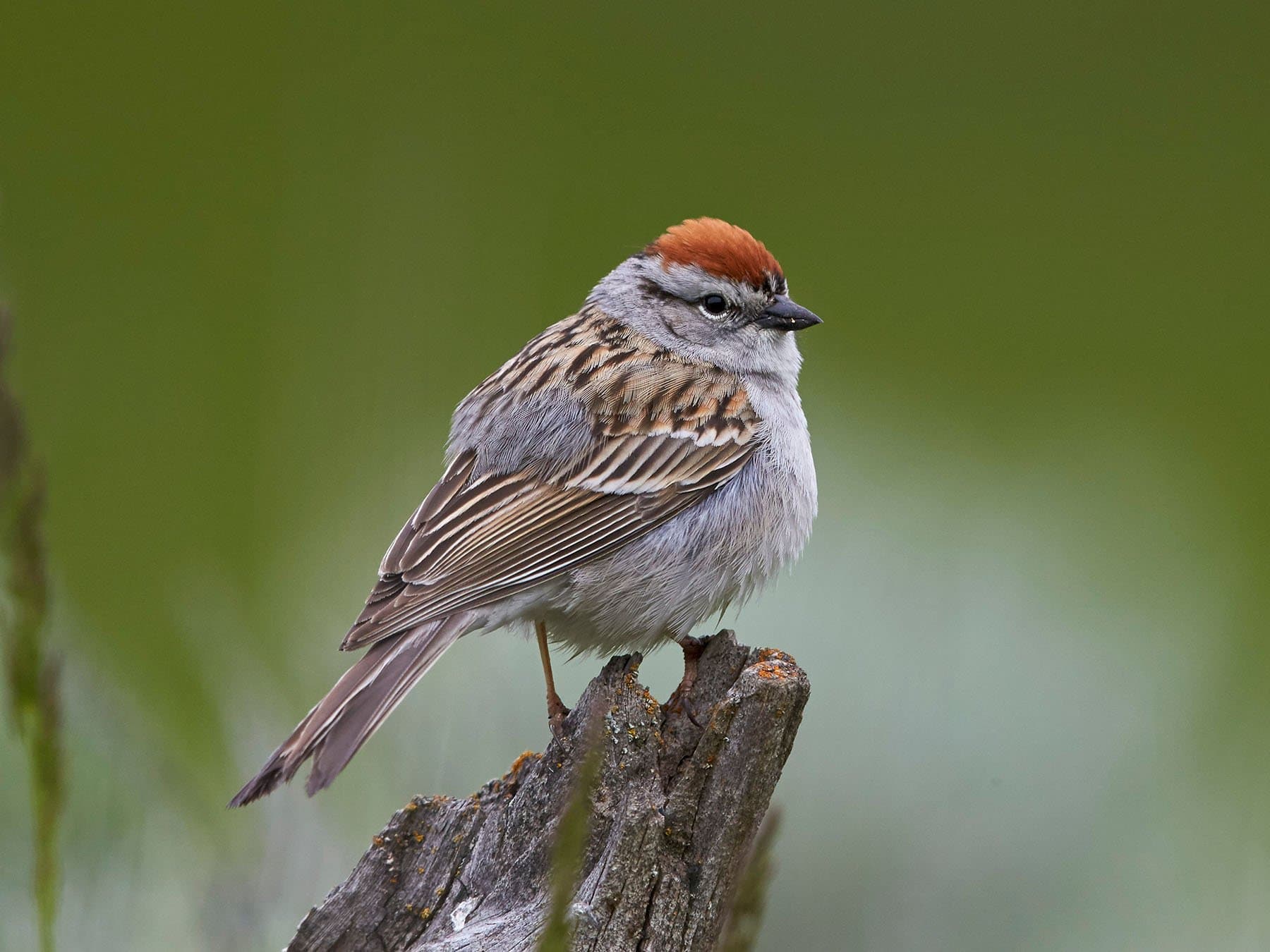
American Tree Sparrow perched on a weathered wooden stump, showing its reddish-brown cap, grey face, and streaked back against a green background.
Quick Facts
Conservation
LCLeast ConcernLifespan
2.3–3.4 years
Length
14–16.5 cm
Weight
13–28 g
Wingspan
21.6–24.8 cm
Migration
Long-distance Migrant
A plump, rusty-capped sparrow that arrives with the first hard frosts and disappears before the last snow melts, the American Tree Sparrow is one of North America's most familiar winter birds — yet its name is a complete misnomer. Named by homesick European settlers who saw a passing resemblance to the Eurasian Tree Sparrow, it is fundamentally a ground bird that breeds on Arctic tundra, often well above the treeline, and spends its winters scratching seeds from frozen fields.
Also known as: Tree Sparrow
Think you've spotted a American Tree Sparrow?
Upload a photo and we'll confirm it instantly
Confirm with a PhotoAppearance
The American Tree Sparrow is a compact, round-headed bird with a notably long, notched tail that gives it a slightly top-heavy look when perched. Adults of both sexes are virtually identical — the species shows no meaningful sexual dimorphism. The most immediately striking feature is the warm rufous (reddish-brown) crown, which contrasts sharply with the clean grey face and throat. A matching rufous eyeline runs from behind the eye toward the nape, giving the head a neatly patterned, two-toned look.
The back and wings are streaked reddish-brown, black, and tan, with two bold white wing bars that stand out clearly against the darker upperparts. The rump and tail are grey. The underparts are unstreaked grey-buff — and here lies the single most useful identification feature: a dark smudge, often called the "stickpin" spot, sits in the centre of an otherwise clean breast. The flanks are washed with a rusty-buff tone, a detail that complements the stickpin spot as a useful field mark when the bird is seen side-on. No other common winter sparrow in North America combines an unstreaked breast with a central dark spot quite so consistently.
The bill is small and bicoloured: dark (blackish) on the upper mandible and yellow on the lower — a detail that immediately separates it from the superficially similar Chipping Sparrow, which has an all-dark bill and a black (not rufous) eyeline. The legs are black. In cold weather, birds fluff out their feathers considerably, making their already plump bodies appear even rounder.
Two subspecies exist. The nominate eastern subspecies (S. a. arborea) breeds across Canada east of the Yukon and is the bird most North American birders encounter in winter. The western subspecies (S. a. ochracea) breeds in Alaska and the Yukon and is slightly larger, paler overall, with whiter underparts and more buff tones on the mantle feather edges. Juveniles, rarely seen away from Arctic breeding grounds, are heavily streaked on the breast and flanks — a plumage that disappears quickly after the post-juvenile moult.
Identification & Characteristics
Colors
- Primary
- Grey
- Secondary
- Rufous
- Beak
- Black
- Legs
- Black
Markings
Rufous (reddish-brown) crown; clean grey face and throat; rufous eyeline; bicoloured bill (dark above, yellow below); unstreaked grey-buff breast with a central dark \"stickpin\" spot; rusty-buff flank wash; two bold white wing bars; black legs.
Tail: Long, notched tail; grey in colour; often fanned or pumped during take-off and landing.
Attributes
Understanding Attributes
Rated 0–100 based on research and observation. A score of 50 is average across all bird species. These attributes are relative and don't necessarily indicate superiority.
Habitat & Distribution
American Tree Sparrows breed across the sub-Arctic and low-Arctic zones of North America, from Alaska and the Yukon east through the Northwest Territories, northern Manitoba, northern Ontario, Labrador, and northern Quebec. Most territories are positioned near the northern treeline, where straggling thickets of alder, willow, birch, and stunted spruce give way to open tundra. Males need at least a few elevated perches to sing from, and most pairs nest near a water source — a lake, bog, or stream. Some pairs nest on open tundra with only scattered shrubs. According to the Boreal Songbird Initiative, approximately 38% of the global population breeds within the Boreal Forest zone.
In winter, the species occupies most of the contiguous United States except the westernmost coastal strip, the Deep South, and Florida. It is most abundant across the Midwest and Great Plains — particularly Nebraska, Iowa, and the Dakotas — where weedy agricultural fields and brushy roadsides provide ideal foraging habitat. It is uncommon to rare in the northeastern and mid-Atlantic states, and a vagrant to the Pacific Coast, the Southwest, and the Gulf states. In Canada, small numbers winter in southern Ontario, southern Quebec, and the Maritime provinces.
For US and Canadian birders, the American Tree Sparrow is a reliable winter visitor across a huge swathe of the continent. In the northern United States, birds typically arrive in October and depart by late April. Weedy fields, brushy roadsides, hedgerows, marshes, woodland edges, overgrown gardens, and suburban areas with ground-level feeders all attract wintering birds. They are particularly associated with early-successional vegetation — fields where tall grasses and forbs protrude above the snow are prime habitat. The species is not found in the UK, Ireland, Australia, or New Zealand under normal circumstances, though it is a very rare vagrant to the western Palearctic.
The two subspecies have distinct wintering ranges. The eastern nominate (S. a. arborea) winters from Minnesota east to Nova Scotia, and south to eastern Oklahoma and North Carolina. The western subspecies (S. a. ochracea) winters from British Columbia east to North Dakota and south to northern Texas. Stable-isotope analysis of feathers from wintering birds in Ontario has shown that individuals originate from a broad area spanning eastern Alaska to Nunavut (Hobson et al., as cited in the 2025 Journal of Field Ornithology migration study), demonstrating that the wintering population in any given area draws from a wide geographic source.
Where to See This Bird
Explore regional guides for locations where this bird has been recorded.
United States
Montana
Iowa
Illinois
Kansas
Nebraska
Indiana
Massachusetts
Maine
Michigan
North Dakota
New Jersey
Minnesota
Missouri
Colorado
Connecticut
New Hampshire
Ohio
New York
Pennsylvania
Rhode Island
South Dakota
Vermont
Wyoming
Wisconsin
Canada
Manitoba
Nova Scotia
New Brunswick
Northwest Territories
Ontario
Quebec
Saskatchewan
Yukon Territory
Diet
The American Tree Sparrow's diet shifts dramatically between seasons. From autumn through spring, birds are almost exclusively vegetarian, eating seeds from grasses, sedges, ragweed, knotweed, goldenrod, and a wide variety of other weeds and forbs. Occasional berries, catkins, insect eggs, and overwintering larvae supplement the seed diet. At feeders, they readily take white millet and other small seeds scattered on the ground — they rarely use elevated feeders, preferring to forage at or near ground level.
The ecological scale of this seed consumption is striking. A study in Iowa estimated that American Tree Sparrows collectively consume approximately 875 tons of weed seeds from that state alone every winter. Across the agricultural Midwest and Great Plains, where the species is most abundant, this makes them a significant natural weed-control agent — an ecosystem service that goes largely unnoticed.
In summer, after arriving on Arctic breeding grounds, the diet pivots sharply toward invertebrates. By June and July, birds eat almost exclusively insects and other invertebrates: beetles, flies, leafhoppers, wasps, moths, caterpillars, spiders, and snails. This protein-rich food is critical for the rapid growth of nestlings, which are fed almost entirely on insects by both parents. Seeds from alder, spruce, blueberries, and crowberries may supplement the summer diet when insects are temporarily scarce.
Foraging takes place primarily on the ground or in low bushes. Birds will also beat grass seedheads with their wings to dislodge seeds from above the snow — a technique described in full in the Behaviour section — before collecting them from the snow surface below.
Behaviour
Outside the breeding season, American Tree Sparrows are sociable birds that forage in loose flocks, often alongside Dark-eyed Juncos and other winter sparrows. Flock sizes typically range from a handful of birds to several dozen, and these groups maintain loose dominance hierarchies — older birds and males tend to displace younger birds and females at concentrated food sources such as feeders. On average, females winter slightly farther south than males, a pattern of differential migration seen in several sparrow species.
Foraging takes place almost entirely on the ground or in low vegetation. One of the most distinctive winter foraging techniques involves a bird flying up to a grass seedhead protruding above the snow, beating it with its wings to dislodge seeds, then dropping to the snow surface to collect them. This behaviour is efficient and regularly observed in weedy fields after snowfall. Birds also scratch through leaf litter and hop beneath bent-over forbs to reach seeds sheltered from the wind.
At night, American Tree Sparrows roost in dense shrubs or in depressions in the snow, using the insulating properties of both vegetation and snowpack to conserve heat. The metabolic demands of winter are severe: birds must consume roughly 30% of their body weight in food every day to maintain body temperature. The physiological consequences of failing to meet that threshold are rapid and severe — see the Winter Survival Adaptations section for detail.
On the breeding grounds, males are territorial and sing persistently from exposed perches. Territories are defended primarily through song rather than direct aggression. Family groups join larger flocks in late summer before the southward migration begins.
These pre-migratory flocks travel and roost together through the winter months.
Calls & Sounds
Only male American Tree Sparrows sing, though both sexes use a variety of calls. The song is a sequence of high, thin whistles lasting one to two seconds: it opens with one or two clear, sweet introductory notes and then descends into a rapid, musical warble that becomes slightly buzzy near the finish. The overall effect is liquid and pleasant — one of the more melodious sparrow songs for its brevity. Males begin singing in late winter, often weeks before departing the wintering grounds, and song is used primarily for territorial defence and mate attraction once birds arrive on the Arctic breeding grounds.
A notable feature of this species' vocal biology, documented by Cornell Lab of Ornithology, is that each male sings only a single song type throughout his entire life. Unlike most songbirds, which learn multiple song variants during a sensitive period in early life and may switch between them, male American Tree Sparrows are committed to one song from the moment it crystallises. This makes individual males potentially identifiable by their song alone, though the songs of different males are similar enough that distinguishing them requires careful listening.
The most frequently heard winter call is a soft, silvery "tsee-ler" (also rendered as "teedleoo" or "tzeedle-eet") — a two- to three-syllable tinkling phrase given frequently by foraging flocks and carrying well across open fields. A sharp "tsiiw" flight note is also given, particularly during nocturnal migration. Chicks begin vocalising at around five days old, progressing from hunger calls to discomfort calls at six days and fear calls at eight days. Both sexes use a range of calls associated with specific contexts: feeding, alarm, and social contact within the flock.
The species is most vocal on the breeding grounds in June and July, and males may also sing persistently during late-winter migration staging — a useful cue for birders in the northern United States who want to know when the spring departure is imminent.
Flight
In flight, the American Tree Sparrow appears compact and slightly heavy-bodied, with a long tail that is often fanned or pumped during take-off and landing. The wings are relatively short and rounded, producing a slightly undulating flight pattern typical of small sparrows — a series of rapid wingbeats interspersed with brief glides in which the wings are partially closed. The overall impression is of a purposeful but not particularly fast flier, covering ground in low, direct bursts rather than the bounding, deeply undulating flight of finches.
When flushed from the ground, birds typically fly a short distance and drop back into cover, often calling with a sharp "tsiiw" flight note as they go. Longer flights between foraging patches are more sustained, with birds travelling at moderate height above the vegetation. In open fields, flushed flocks tend to scatter and then regroup a short distance away, often landing in a nearby shrub or hedgerow before filtering back to the ground.
Migration is conducted at night, with movements positively associated with higher temperatures, higher atmospheric pressure, less cloud cover, and winds with less of a westerly component — weather cues identified in a 2025 radio-telemetry study published in the Journal of Field Ornithology. At Creamer's Field Migration Station in Fairbanks, Alaska, the American Tree Sparrow is one of the most commonly captured autumn migrants, with over 10,000 individuals banded since 1992 (Alaska Songbird Institute). It is one of the last species to move through in autumn, and very few are captured in spring, suggesting that northward spring migration through Alaska is rapid and concentrated.
The species migrates in a series of punctuated regional-scale movements that track the advancement of spring, with most birds departing southern wintering areas by late April and arriving on Arctic breeding grounds in late May.
Nesting & Breeding
American Tree Sparrows are monogamous and raise a single brood per season, though pairs will attempt to renest if the first clutch fails. Breeding pairs form shortly after birds arrive on the Arctic grounds, typically around mid-June. The female builds the nest alone over approximately seven days, constructing an open cup of moss, grasses, shreds of bark, and twigs, lined with fine grass and feathers — usually ptarmigan feathers, which provide exceptional insulation against the cold ground.
Nests are placed on or very close to the ground: typically in a tussock of grass at the base of a shrub, on a mossy hummock in open tundra, or occasionally up to about 1.2 metres above ground in a willow or spruce. The female lays 4–6 eggs (usually 5) at a rate of one per day, occasionally skipping a day. Eggs are pale blue or pale bluish-green, speckled with reddish-brown spots often concentrated at the larger end. Incubation is carried out by the female alone for 11–13 days; the male visits the nest frequently but does not incubate.
One of the most intriguing aspects of this species' breeding biology is its synchronised hatching. Despite eggs being laid over several days, the chicks hatch within a remarkably short window of each other — and not necessarily in the order their eggs were laid (Cornell Lab of Ornithology, All About Birds). This synchrony means all chicks begin development at the same stage, reducing the competitive disadvantage that later-hatched chicks typically face in asynchronously hatching species.
Both parents feed the altricial nestlings, which are covered in sparse grey down at hatching. Young leave the nest at just 8–10 days old, before their flight feathers are fully grown; parents may encourage them to leave through continued feeding behaviour just beyond the nest edge. Full flight is achieved at approximately 14–15 days after hatching. Parental feeding continues for about two to three weeks after fledging, ending when chicks are roughly 22 days old. In late summer, family groups join larger pre-migratory flocks.
Lifespan
The typical lifespan of an American Tree Sparrow in the wild is estimated at 2.3 to 3.4 years — a relatively short life expectancy that reflects the high annual mortality rates common among small passerines (Animal Diversity Web, based on banding recovery data). Winter is the most dangerous season: the combination of cold temperatures, food scarcity, and predation pressure from hawks and owls takes a heavy toll, and birds that cannot maintain their daily caloric intake face rapid deterioration.
The maximum recorded age for the species is 10 years and 9 months, based on a banded individual recovered in North America (Cornell Lab of Ornithology, All About Birds) — a lifespan more than three times the average, and a reminder that annual survival rates vary enormously between individuals. Birds that survive their first winter face somewhat better odds in subsequent years, as experienced individuals are more efficient foragers and better at locating reliable food sources.
Compared to related New World sparrows, the American Tree Sparrow's typical lifespan is broadly similar to species of comparable size and migratory habit. The Chipping Sparrow, for example, has a similar average lifespan, though its maximum recorded age is slightly lower. Larger sparrows and buntings that share the winter range, such as the White-throated Sparrow, tend to live somewhat longer on average. Predation by Sharp-shinned Hawks, Cooper's Hawks, and small owls accounts for a significant proportion of annual mortality, particularly during migration when birds are moving through unfamiliar terrain.
Conservation
The American Tree Sparrow is listed as Least Concern on the IUCN Red List (2021), with a global population estimated at approximately 26 million mature individuals (Partners in Flight 2019; BirdLife International 2024). However, the headline status masks a deeply concerning trend. Partners in Flight classifies the species as a 'Common Bird in Steep Decline': the population has fallen by approximately 50% over the last 50 years, equivalent to roughly 53% between 1970 and 2014, or about 1.8% per year. Canadian Breeding Bird Survey data paint an even starker picture, showing declines of approximately 87% in Canada.
The decline is not yet considered rapid enough to approach Vulnerable thresholds under IUCN criteria (which require a reduction of more than 30% over ten years or three generations), but the trajectory is alarming for a species that was once considered one of the most abundant winter birds across the northern United States.
The primary driver is habitat loss on the wintering grounds. Intensified agriculture across the Midwest and Great Plains has eliminated much of the weedy, early-successional vegetation that wintering birds depend on. Residential development and forest maturation in the Northeast have had similar effects. Climate change poses a longer-term threat to Arctic breeding habitat, though the precise impact on breeding success is not yet well understood. Most nesting areas are remote from direct human disturbance and are not threatened by logging or agriculture.
A more localised threat was identified in a study near Yellowknife, Northwest Territories, where American Tree Sparrows showed substantially elevated arsenic concentrations linked to gold-mining activity (Wayland et al., 2005, PubMed PMID 16117124). Notably, birds appeared to have adapted by converting inorganic arsenic to the relatively non-toxic arsenobetaine compound — a biochemical workaround that reduces toxicity but does not eliminate exposure. Conservation actions recommended for this species focus on maintaining bird-friendly yards, preserving weedy and shrubby habitats on wintering grounds, and supporting ground-level feeding stations through winter.
Population
Estimated: Approximately 26 million mature individuals (Partners in Flight 2019; BirdLife International 2024)
Trend: Decreasing
Decreasing. The population has declined by approximately 50% over the last 50 years (roughly 53% between 1970 and 2014). Canadian Breeding Bird Survey data show declines of approximately 87% in Canada. Partners in Flight classifies the species as a 'Common Bird in Steep Decline'.
Elevation
Breeds at low elevations near sea level to around 1,000 m in Arctic and sub-Arctic zones; winters primarily at low elevations across the northern and central United States.
Additional Details
- Family:
- Passerellidae (New World Sparrows)
- Predators:
- Sharp-shinned Hawks, Cooper's Hawks, small owls; nest predators include foxes, weasels, and corvids on the breeding grounds
- Subspecies:
- Two subspecies: S. a. arborea (eastern, nominate) and S. a. ochracea (western, paler and slightly larger)
- Similar species:
- Chipping Sparrow (all-dark bill, black eyeline, no breast spot), Field Sparrow (pink bill, plain face, eye-ring)
Taxonomy And Naming
The American Tree Sparrow has had an unsettled taxonomic history. For most of the twentieth century it was placed in the genus Spizella alongside the Chipping Sparrow, Field Sparrow, and several other small North American sparrows. However, molecular phylogenetic studies revealed that the American Tree Sparrow is not closely related to the other Spizella species — it sits in a distinct lineage within the family Passerellidae (New World Sparrows) — and it was moved to its own monotypic genus, Spizelloides, in 2017. The scientific name arborea (Latin for "of trees") perpetuates the same misnomer as the common name.
The common name itself is a legacy of early European settlement. When colonists encountered this plump, rusty-capped sparrow in the fields and hedgerows of the northeastern United States, they were reminded of the Eurasian Tree Sparrow (Passer montanus) from their homelands — a superficial resemblance with no evolutionary basis. The two species belong to entirely different families: the Eurasian bird is an Old World sparrow (Passeridae), while the American bird is a New World sparrow (Passerellidae). This pattern of naming North American birds after familiar European species — regardless of actual relationship — is repeated across the continent: the American Robin is a thrush, not a robin; the American Kestrel is only distantly related to the Common Kestrel of Europe, the two having diverged along entirely separate evolutionary lines.
Two subspecies are currently recognised: the nominate S. a. arborea, breeding across Canada east of the Yukon, and the paler, slightly larger S. a. ochracea, breeding in Alaska and the Yukon. The two subspecies have largely non-overlapping wintering ranges and are separable in the field with care, though they intergrade where their ranges meet.
Winter Survival Adaptations
Few small birds face a more demanding winter than the American Tree Sparrow. Wintering across the northern United States and southern Canada, birds routinely experience temperatures well below freezing for weeks at a time, and the energy cost of maintaining a body temperature of around 40°C in sub-zero air is enormous. To meet this demand, birds must consume roughly 30% of their body weight in food every day. A bird weighing 20 grams needs to find and eat the equivalent of 6 grams of seeds daily — a significant challenge when food is buried under snow or locked in frozen vegetation.
Several behavioural and physiological adaptations help birds meet this challenge. The wing-beating foraging technique — flying up to a grass seedhead, beating it with the wings to dislodge seeds, then collecting them from the snow surface — is one of the most efficient ways to access seeds that would otherwise be inaccessible. Birds also roost in dense shrubs or in depressions in the snowpack itself, exploiting the insulating properties of snow to reduce heat loss overnight. Flocking behaviour reduces individual predation risk and allows birds to exploit information about food locations from flock-mates.
The metabolic consequences of failure are swift and severe. Studies have shown that a full day of fasting causes body temperature to drop and birds to lose nearly a fifth of their body weight within 24 hours — a physiological crisis from which recovery is unlikely in cold conditions. This extreme energy dependence makes the loss of weedy, seed-rich wintering habitat — through agricultural intensification and development — particularly damaging for the species, and is a key driver of the roughly 50% population decline recorded over the last five decades.
Birdwatching Tips
In the United States and Canada, the American Tree Sparrow is most reliably found from October through April in weedy fields, brushy roadsides, and overgrown hedgerows. The Midwest and Great Plains offer the best concentrations — Nebraska, Iowa, and the Dakotas are particularly productive in midwinter. Look for birds foraging on the ground beneath bent-over grasses and forbs, often in loose flocks of 10–30 individuals. They frequently associate with Dark-eyed Juncos, so any winter sparrow flock is worth checking carefully.
The key identification features to lock in are: the rufous crown, the bicoloured bill (dark above, yellow below), the clean unstreaked breast with a central dark "stickpin" spot, and the rufous (not black) eyeline. The combination of these four features is essentially diagnostic. The most likely confusion species is the Chipping Sparrow, which shares the rufous cap but has an all-dark bill, a black eyeline, and a clean breast with no central spot. American Tree Sparrows are also noticeably plumper and longer-tailed than Chipping Sparrows.
Backyard feeders are an excellent way to attract wintering birds. Scatter white millet or mixed seed on the ground or on a low platform — American Tree Sparrows rarely use elevated tube feeders. A brush pile or dense shrub nearby gives them cover to retreat to when alarmed. In areas with regular snowfall, check weedy fields after a fresh snowfall: birds will be actively beating grass seedheads to dislodge seeds, a behaviour that is both distinctive and easy to observe.
Listen for the soft, silvery "tsee-ler" or "teedleoo" call — a two- to three-syllable tinkling phrase that carries well across open fields and is one of the most characteristic sounds of a North American winter. In late February and March, males begin singing their sweet, descending warble even before departing for the breeding grounds, so late-winter flocks can be surprisingly musical.
Did You Know?
- Blind American Tree Sparrows in captivity show completely normal hormonal and physiological responses to increasing day length in late winter — including sex organ growth — proving that their photoperiodic response is mediated through extraretinal light receptors that do not require vision (Cornell Lab of Ornithology, All About Birds). This means the birds effectively "see" the lengthening days through their skulls.
- Each male American Tree Sparrow sings only a single song type for his entire life — a commitment made early in development that is essentially irreversible. Most songbirds learn and cycle through multiple variants; this species locks in one and never deviates.
- Despite eggs being laid one per day over up to a week, the chicks hatch within a remarkably short window — and not necessarily in the order their eggs were laid. This synchronised hatching means all chicks begin development simultaneously, reducing the size hierarchy that typically disadvantages late-hatched chicks in other species.
- American Tree Sparrows collectively consume an estimated 875 tons of weed seeds from Iowa alone every winter. Across the agricultural Midwest, this makes them one of the most significant natural weed-control agents on the continent — yet the species has declined by roughly 50% over the last 50 years, largely due to the loss of the weedy habitats they depend on.
- The name is a historical accident. Early European settlers named the bird after the Eurasian Tree Sparrow back home, noticing a superficial resemblance. The two species are not closely related and share no particular association with trees — the American bird breeds primarily on open tundra, often well above the treeline, and forages almost exclusively on the ground.
Records & Accolades
Weed Controller
~875 tons
Estimated weight of weed seeds consumed by American Tree Sparrows in Iowa alone every winter, making them one of the most significant natural weed-control agents in the agricultural Midwest.
Winter Survivor
30% body weight/day
Must consume roughly 30% of its body weight in food every single day to survive winter temperatures. A full day of fasting is typically fatal.
One-Song Bird
1 song type for life
Each male sings only a single song type throughout his entire life — unlike most songbirds that learn and switch between multiple variants.
Community Photos
Be the first to share a photo of the American Tree Sparrow
Upload a PhotoIdentify Any Bird Instantly
- Upload a photo from your phone or camera
- Get an instant AI identification
- Ask follow-up questions about the bird
Monthly Birds in Your Area
- Personalised for your location
- Seasonal tips and garden advice
- Updated every month with new species