Species Profile
Clay-colored Sparrow
Spizella pallida
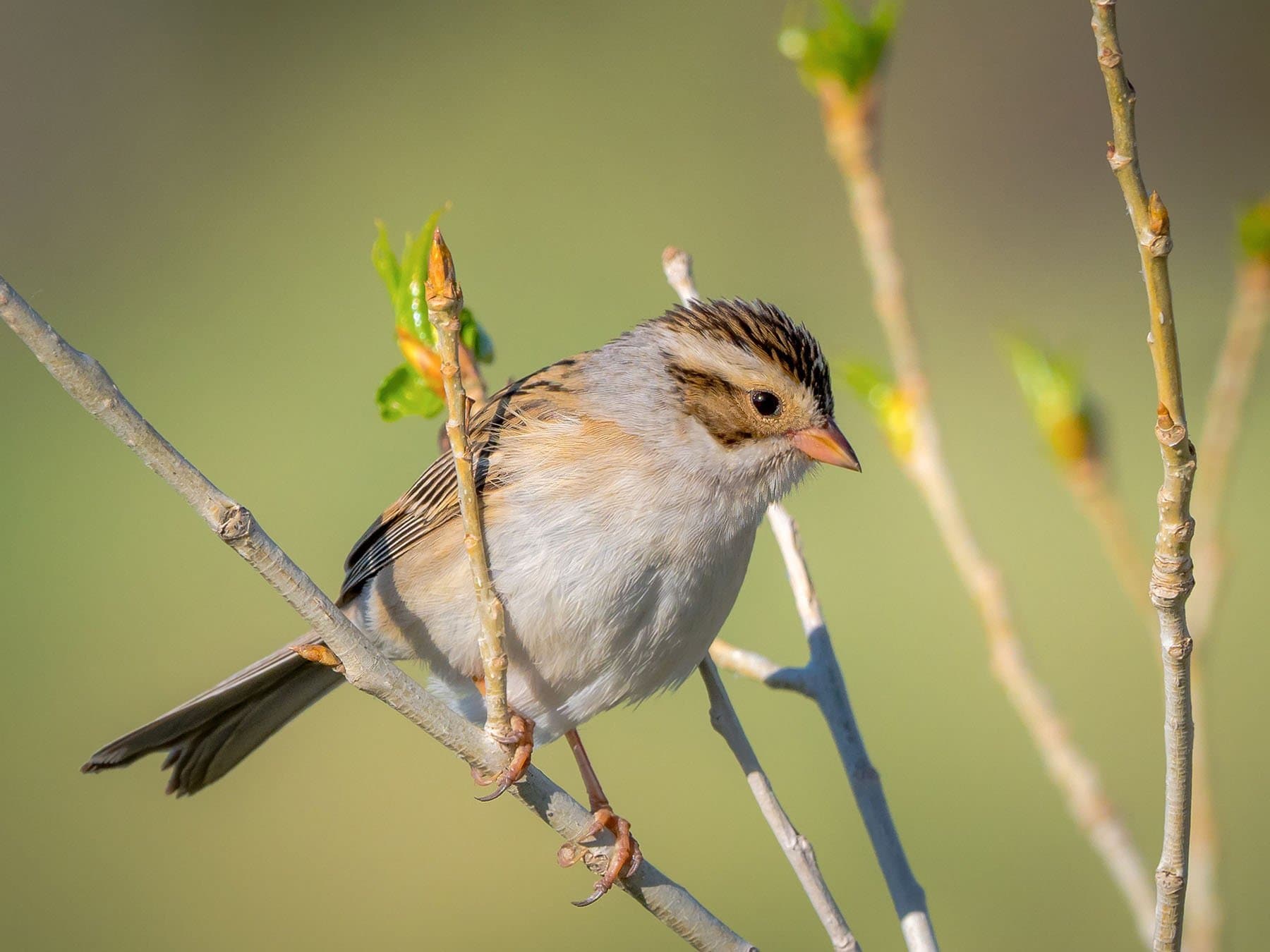
Clay-colored Sparrow perched on a bare branch with new green leaf buds, showing its striped crown and pale bill against a soft green background.
Quick Facts
Conservation
LCLeast ConcernLifespan
2–5 years
Length
13–15 cm
Weight
10–14 g
Wingspan
19–20.5 cm
Migration
Long-distance Migrant
Few North American sparrows are as deceptively plain — or as precisely patterned — as the Clay-colored Sparrow. Its crisp, bordered cheek patch and clean grey collar make it one of the most crisply marked small sparrows on the continent, yet its song sounds more like a grasshopper than a bird: a flat, mechanical series of buzzes that experienced birders routinely walk straight past.
Also known as: Clay-coloured Sparrow
Think you've spotted a Clay-colored Sparrow?
Upload a photo and we'll confirm it instantly
Confirm with a PhotoAppearance
The Clay-colored Sparrow is a petite, trim bird — roughly 13–15 cm long and weighing just 10–14 g — with a slender body, small pale bill, and a fairly long, notched tail. Despite its understated palette of pale tans and greys, the plumage is precisely and distinctively patterned once you know what to look for.
The most diagnostic feature is the face. A buff-brown cheek patch (ear coverts) is sharply outlined above and below by dark brown lines, creating a neatly bordered rectangle on the side of the head. A white supercilium runs above the eye, and a dark eyeline extends behind the eye — but crucially does not extend in front of it, which immediately separates this species from the Chipping Sparrow. A pale central crown stripe divides the finely streaked, dark brown crown. The nape is clean grey, forming a distinctive grey collar that contrasts sharply with the streaked brown back.
The underparts are pale and unstreaked, with a faint buff wash on the breast. The rump is brownish-buff — not grey as in the Chipping Sparrow — and the wings show two white wing bars. The short bill is pale with a dark tip. In breeding plumage, all facial markings are at their sharpest and most contrasting. In autumn and winter, the markings become slightly buffier and less defined, making the bird more similar to the Chipping and Brewer's Sparrow, with which it frequently flocks.
Juveniles are more heavily streaked overall, including across the breast, and show less defined facial patterning. The sexes are alike — there is no significant sexual dimorphism in colour or pattern, though males average very slightly larger in body size, a difference not reliably visible in the field.
Identification & Characteristics
Colors
- Primary
- Brown
- Secondary
- Grey
- Beak
- Cream
- Legs
- Pink
Markings
Crisp bordered cheek patch (dark lines above and below buff-brown ear coverts); pale central crown stripe; clean grey collar contrasting with streaked brown back; white supercilium; eyeline not extending in front of eye; brownish-buff rump; two white wing bars.
Tail: Fairly long, notched tail; brown with pale outer edges, visible in flight.
Attributes
Understanding Attributes
Rated 0–100 based on research and observation. A score of 50 is average across all bird species. These attributes are relative and don't necessarily indicate superiority.
Habitat & Distribution
Clay-colored Sparrows are birds of low shrublands, brushy grasslands, and open areas with scattered shrubs. Habitat structure matters more than plant species: research by the USGS found the species favours areas with average vegetation heights of 20–186 cm, 15–74% grass cover, 5–23% forb cover, less than 30% shrub cover, and 10–63% litter cover. They occupy more open ground than Chipping Sparrows but denser brush than Brewer's Sparrows. Typical breeding habitats include shrubby open prairies, field edges, thickets along waterways and forest edges, young second-growth regenerating after fire or logging, and the shrubby understory of jack pine woodlands.
The breeding range is centred on the Canadian Prairie Provinces — Saskatchewan and Manitoba are the stronghold, with an estimated 85% of the global breeding population nesting in Canada. The range extends east across southern Ontario and into southwestern Quebec, and south through the northern Great Plains of the United States, with North Dakota holding the densest US breeding populations. The species also breeds across Minnesota, Wisconsin, Michigan, and at the eastern edge, New York and parts of New England.
An estimated 52% of the entire population breeds within the Boreal Forest, making this one of the most boreal-dependent sparrows in North America — a fact that rarely features in standard field guides. The species has been expanding its range northeastward since the early 20th century: it took roughly 75 years to spread east across Ontario, reached southwestern Quebec in 1960 (confirmed breeding 1975), and continues to push into the Maritime Provinces and New England, following the trail of logging, farm abandonment, and Christmas tree plantations that create suitable shrubby habitat.
In winter, the species is a complete migrant: approximately 92% of the population winters in the highlands of northern and central Mexico and southern Baja California, with smaller numbers in southern Texas. On the wintering grounds, birds use desert grasslands, upland plains, thorn scrub, and brushy hillsides. During migration, the species is a common to uncommon passage migrant through the Great Plains states — Kansas, Nebraska, and Oklahoma are reliable spots — but only a rare vagrant further east and west. In autumn, small numbers of immatures regularly appear along both the Atlantic Coast (Maine south to Florida) and the Pacific Coast (California and Oregon), typically turning up in flocks of Chipping or Brewer's Sparrows.
Where to See This Bird
Explore regional guides for locations where this bird has been recorded.
Montana
Nebraska
Minnesota
North Dakota
South Dakota
Wisconsin
Canada
Alberta
Manitoba
Saskatchewan
Diet
Seeds form the bulk of the Clay-colored Sparrow's diet throughout the year. The species shows a preference for the seeds of weedy and grassland plants, including tumbleweed, alyssum, lambsquarters, mustard, and mesquite. It also takes leaf buds, catkins, berries, and new shoots when available.
During the breeding season, insects become a critical dietary component, particularly for feeding nestlings. Recorded prey includes leafhoppers, ants, grasshoppers, moths, caterpillars, true bugs, and damselflies, as well as spiders. Young birds are fed predominantly insects in the first days after hatching, when protein demand is highest.
Foraging is done almost entirely on the ground or low in shrubs, always close to cover. The birds hop steadily through leaf litter and grass stems, picking up seeds and invertebrates with their small, pointed bill. Because Clay-colored Sparrows forage outside their breeding territories — using separate areas for nesting and feeding — they are often seen in loose aggregations at productive foraging sites even during the nesting season.
Outside the breeding season, foraging is typically a social activity. Flocks work through brushy fields, weedy roadsides, and dry scrub, sometimes alongside other sparrow species. The species will occasionally visit garden feeders for millet and other small grains, though it is not a regular feeder visitor in the way that Chipping Sparrows can be.
Behaviour
Clay-colored Sparrows are ground-level birds by habit, spending most of their time hopping through low vegetation or foraging on bare or litter-covered ground. They move with a quick, low-profile style, always staying close to cover and retreating into dense shrubs at the first sign of disturbance.
One of the most ecologically unusual aspects of this species is its approach to territory. Clay-colored Sparrows hold the smallest breeding territories of any Spizella sparrow — a direct consequence of their habit of foraging entirely outside the nesting territory. Unlike most songbirds, which feed within the area they defend, Clay-colored Sparrows use completely separate zones for nesting and foraging. This means they only need to defend a small patch around the nest itself, with territorial disputes between males typically resolved through song rather than physical confrontation.
Outside the breeding season, the species is sociable. Migrants and wintering birds form flocks — sometimes numbering up to 100 individuals — and regularly join mixed-species groups alongside Chipping, Brewer's, Lark, and other sparrows. Males sing persistently from exposed perches near the tops of low shrubs during the breeding season, though typically from slightly lower positions than many other territorial songbirds.
Pair bonds are monogamous but rarely persist across seasons. Males show strong site fidelity, returning to the same territory year after year. Females, by contrast, typically select a different breeding area each season, meaning persistent multi-year pairs are uncommon. After the chicks hatch, both parents remove eggshells from the nest — usually carrying them away, though they are sometimes eaten — a behaviour that reduces the risk of predators locating the nest.
Calls & Sounds
The Clay-colored Sparrow's song is one of the most distinctive — and most frequently overlooked — of any North American sparrow. The male's territorial song consists of a simple series of 2–8 low, flat, toneless buzzes, all delivered on a single pitch and lasting approximately 2 seconds in total. The sound is best described as "bzzzz bzzzz bzzzz" — dry, mechanical, and profoundly un-birdlike. It sounds far more like a grasshopper or cicada than a songbird, and experienced birders regularly walk past singing males without registering them as birds at all.
This buzzy quality makes the song immediately distinguishable from the two species it most closely resembles. The Chipping Sparrow produces a rapid, dry trill — faster and more continuous than the Clay-colored's spaced buzzes. The Brewer's Sparrow delivers a longer, more varied, canary-like song with multiple phrase types. Once you have heard all three side by side, the Clay-colored's flat, repetitive buzzing is unmistakable.
Males sing persistently from exposed perches — typically near the tops of low shrubs, though somewhat lower than many other territorial songbirds — to advertise territory ownership and attract mates. Singing is most intense during the breeding season from May through July but continues through migration. Only males sing the territorial song; females do not sing.
The most frequent call note is a soft, high "tsip," used for communication between mates and between parents and offspring. When alarmed, this sharpens to a louder "chip." Young birds in distress give higher-pitched "seep" notes. Flight calls have also been recorded, though they are less well documented than the territorial song and contact calls.
Flight
In flight, the Clay-colored Sparrow appears small, light, and slightly elongated, with a noticeably long, notched tail that is visible even at distance. The wings are relatively short and rounded, producing a flight style that is slightly undulating — a series of rapid wingbeats interspersed with brief closed-wing glides, typical of small Spizella sparrows.
Low-level flight between shrubs is quick and direct, with the bird dropping immediately back into cover on landing. Longer flights — such as those between foraging areas and the nest — are slightly higher and more sustained, but the species rarely flies in the open for extended periods. During migration, birds travel in flocks and are more likely to be seen in sustained flight, crossing open fields or moving along hedgerows and scrubby field margins.
In flight, the brownish-buff rump is a useful identification feature, contrasting with the streaked brown back and separating the species from the Chipping Sparrow, which shows a greyer rump. The long, notched tail with pale outer edges is also visible in flight. The overall impression is of a small, pale, slightly washed-out sparrow — less contrasty than a Chipping Sparrow and less streaked than a Savannah Sparrow — moving with quick, slightly bouncy wingbeats close to the ground.
During migration, Clay-colored Sparrows travel in flocks, sometimes numbering up to 100 individuals, and frequently join mixed-species flocks with Brewer's, Chipping, and Lark Sparrows. Migration is concentrated through a relatively narrow corridor along the Great Plains, making the species a common sight in flight over the prairies of Kansas and Nebraska in September.
Nesting & Breeding
The breeding season runs from late May through July, with peak activity in June. Males arrive on the breeding grounds a few days before females and immediately begin singing to establish territories. Physical confrontations between males are rare — territory ownership is almost entirely negotiated through song.
Nest sites are selected by the female and are typically very low, often less than 30 cm from the ground, in the lower branches of dense shrubs such as snowberry or rosebush, or in grass tussocks early in the season. Later nests tend to be placed slightly higher as vegetation grows. The female builds the open-cup nest over 2–4 days, constructing a platform of grasses, weed stems, and small twigs, then shaping the cup by turning in place. The finished nest is approximately 4.6 cm across and 3.8 cm deep, lined with fine grasses, rootlets, and animal hair from horses, deer, and cattle.
The clutch consists of 3–5 eggs, usually 4, pale blue-green in colour with dark brown spots concentrated at the larger end. Incubation lasts 10–14 days and is performed mostly by the female, though the male assists and feeds her during this period. Chicks hatch naked with sparse down, and both parents feed the nestlings.
The nestling period is just 7–9 days — unusually short — after which the young leave the nest before they can fly. Rather than taking their first flight from the nest, the chicks hop to the ground and run, averaging about 12 metres (40 feet), to seek cover in nearby thickets. Parents continue to feed them there for approximately another week until the young finally take flight, around 6–8 days after leaving the nest. The species typically raises 1–2 broods per year.
Nests are frequently parasitised by Brown-headed Cowbirds. Research by Hill and Sealy (1994) revealed a counterintuitive finding: Clay-colored Sparrows do not desert parasitised nests because of the cowbird egg itself, but because the female cowbird removes one of the host's eggs when laying. It is the reduction in clutch size — not the presence of the alien egg — that triggers nest abandonment, suggesting the species has not evolved a true egg-recognition anti-parasite defence.
Lifespan
Clay-colored Sparrows typically live 2–5 years in the wild, with most individuals not surviving beyond their third or fourth year. The oldest confirmed individual was at least 6 years and 11 months old — a bird banded in Alberta and recaptured in 1995 — which represents the longevity record for the species.
Survival rates in the first year of life are significantly lower than in subsequent years, as is typical for small passerines. Young birds face the highest mortality during their first migration and first winter, when inexperience and the demands of long-distance travel combine with the challenges of finding suitable wintering habitat in the Mexican highlands. Predation by raptors, snakes, and small mammals is the primary cause of mortality across all age classes.
Nest failure — through predation, weather events, and Brown-headed Cowbird parasitism — limits recruitment into the adult population. The species typically raises 1–2 broods per year, which partially compensates for high annual mortality. Males that survive to adulthood show strong site fidelity, returning to the same breeding territory year after year, which may improve their breeding success over time as they become familiar with local resources and predator activity.
Compared to other Spizella sparrows, the Clay-colored Sparrow's lifespan is broadly similar to the Chipping Sparrow, which has a recorded maximum of around 9 years, suggesting the Clay-colored's longevity record may yet be surpassed as more banding data accumulates.
Conservation
The Clay-colored Sparrow is listed as Least Concern by the IUCN (Red List 3.1) and Secure by NatureServe, with a global population estimated at approximately 60 million mature individuals (Partners in Flight 2019 / BirdLife International). Despite this, the species is declining. The North American Breeding Bird Survey recorded an estimated 51% overall decline in numbers between 1966 and 2015, with consistent losses recorded across the central and southern Prairie Provinces of Canada and the Great Plains states. The species rates a 10/20 on the Partners in Flight Continental Concern Score.
The primary driver of decline is habitat loss in the core breeding range. Conversion of brushy grassland and shrubland to agricultural fields — particularly in the Canadian Prairie Provinces — has removed large areas of suitable nesting habitat. Agricultural intensification, pesticide spraying, heavy livestock grazing that degrades shrubby field structure, and the planting of exotic species such as crested wheatgrass in native prairie all reduce habitat quality. Brown-headed Cowbird brood parasitism adds further pressure on nesting success.
The picture is complicated by a simultaneous range expansion. Fire suppression allowing proliferation of low shrubs, forest clearing, farm field abandonment, and the creation of Christmas tree plantations have all expanded available habitat at the northeastern edge of the range. Habitat management for Sharp-tailed Grouse in Minnesota and Wisconsin has also benefited Clay-colored Sparrows. The species is therefore in the paradoxical position of colonising new territory in the east while declining in its core prairie stronghold — a range expansion that masks a genuine population-level contraction.
Climate change is projected to affect the species' range further, with modelling suggesting potential shifts in the distribution of suitable shrubland habitat across the Great Plains and Prairie Provinces.
Population
Estimated: Approximately 60 million mature individuals
Trend: Decreasing
Declining — an estimated 51% overall decline recorded by the North American Breeding Bird Survey between 1966 and 2015, with consistent losses across the Prairie Provinces and Great Plains. Despite this, the species is simultaneously expanding its range northeastward into Quebec, New England, and the Maritime Provinces.
Elevation
Lowlands to mid-elevations; winters in Mexican highlands typically 1,000–2,500 m
Additional Details
- Family:
- Passerellidae (New World Sparrows)
- Predators:
- Raptors (hawks, falcons), snakes, small mammals; nests parasitised by Brown-headed Cowbird
- Similar species:
- Chipping Sparrow (Spizella passerina), Brewer's Sparrow (Spizella breweri), Field Sparrow (Spizella pusilla)
Similar Species
Three species cause the most identification confusion with Clay-colored Sparrow, and all three regularly occur alongside it during migration.
The Chipping Sparrow is the most frequent source of confusion, particularly in non-breeding plumage when both species become buffier and less defined. The key differences: the Chipping Sparrow has a grey rump (Clay-colored is brownish-buff), the eyeline extends in front of the eye on Chipping (it does not on Clay-colored), and the Chipping Sparrow lacks the bordered cheek patch — its ear coverts are not outlined above and below by dark lines. In breeding plumage, the Chipping Sparrow's bright rufous crown and clean white supercilium make it straightforward to separate.
The Brewer's Sparrow is the most similar species overall, sharing the pale, washed-out tones and finely streaked crown. However, Brewer's Sparrow lacks the Clay-colored's clean grey collar, has a less distinctly bordered cheek patch, and shows a more uniformly streaked appearance without the pale central crown stripe. Brewer's Sparrow also tends to occupy drier, more open sagebrush habitat rather than the shrubby grasslands preferred by Clay-colored.
The Field Sparrow shares the pink bill and plain face of some Clay-colored Sparrows but has a distinctive white eye-ring, a plain unstreaked crown, and a more strongly pink bill. Its song — a series of pure whistles accelerating into a trill — is completely different from the Clay-colored's mechanical buzzing. In autumn, when immature Clay-colored Sparrows are at their most washed-out and confusing, focusing on the bordered cheek patch and grey collar remains the most reliable approach to identification.
Courtship & Display
Male Clay-colored Sparrows arrive on the breeding grounds a few days before females and immediately begin singing to establish territories. Song is the primary currency of both territory defence and mate attraction: males sing persistently from exposed perches near the tops of low shrubs, delivering their flat, buzzy territorial song throughout the day. The intensity of singing peaks in the first weeks after arrival and again when females are selecting mates.
Physical displays between rival males are relatively rare. When they do occur, they typically involve brief aerial chases above the shrub layer, with the resident male pursuing an intruder back across the territory boundary. Full physical contact is uncommon — most disputes are resolved by the relative persistence and volume of song output.
Pair bonds form quickly after female arrival. Courtship behaviour includes the male following the female closely through the territory, singing at close range, and performing short song-flights — low, fluttering flights above the shrubs while singing. Once a pair bond is established, the female takes the lead in nest-site selection, with the male following and continuing to sing nearby.
Pair bonds are monogamous but typically last only a single breeding season. Males show strong site fidelity, returning to the same territory in successive years, while females usually disperse to a new breeding area each season. This asymmetry means that persistent multi-year pairs are uncommon, even when both individuals survive to the following breeding season. The species may raise 1–2 broods within a season, with the male continuing to feed fledglings from the first brood while the female begins incubating the second clutch.
Birdwatching Tips
In the United States and Canada, the best time to find Clay-colored Sparrows is during the breeding season from late May through July, when males sing persistently from exposed perches atop low shrubs. The song — a flat, mechanical series of 2–8 identical buzzes — is the most reliable way to locate the species, but it is easily mistaken for an insect. Train your ear to distinguish it from the rapid dry trill of the Chipping Sparrow and the more varied, canary-like song of the Brewer's Sparrow.
In the US, the northern Great Plains offer the most reliable breeding-season access: North Dakota, South Dakota, Nebraska, and Minnesota all hold good populations. In Canada, the Prairie Provinces — particularly Saskatchewan and Manitoba — are the stronghold. During spring and autumn migration (late April to late May; August to October), the species is a common passage migrant through Kansas, Nebraska, and Oklahoma, where it can be found in brushy fields, weedy roadsides, and thickets.
On both the Atlantic and Pacific coasts, keep an eye out in autumn for immature birds turning up in flocks of Chipping Sparrows — Clay-colored Sparrows are rare but regular vagrants from Maine to Florida and from California to Oregon in September and October. The key identification features to check are the bordered cheek patch (dark lines above and below the ear coverts), the pale central crown stripe, the clean grey collar, and the brownish-buff rump. The eyeline not extending in front of the eye is a reliable separator from the Chipping Sparrow.
In non-breeding plumage, the markings become buffier and less defined, making separation from Chipping and Brewer's Sparrows more challenging. Focus on the bordered cheek patch and the grey collar — both remain visible even in worn autumn plumage. Binoculars with good close-focus capability are helpful, as these birds often feed low in dense vegetation.
Did You Know?
- The Clay-colored Sparrow holds the smallest breeding territory of any Spizella sparrow — not because it is especially timid, but by design. It forages entirely outside its nesting territory, so it only needs to defend a small patch around the nest itself.
- Clay-colored Sparrow chicks leave the nest before they can fly. After just 7–9 days, the young hop to the ground and sprint an average of 12 metres (40 feet) to the nearest thicket, where their parents continue to feed them for another week until they finally take flight.
- An estimated 52% of the entire North American Clay-colored Sparrow population breeds within the Boreal Forest — making it one of the most boreal-dependent sparrows on the continent, despite rarely being described that way.
- Research into Brown-headed Cowbird parasitism revealed a surprising finding: Clay-colored Sparrows desert parasitised nests not because of the cowbird egg, but because the female cowbird removes one of the host's own eggs when laying. It is the reduction in clutch size — not the alien egg — that triggers abandonment.
- The oldest recorded Clay-colored Sparrow was at least 6 years and 11 months old — a bird banded in Alberta and recaptured in 1995, well above the typical wild lifespan of 2–5 years.
Records & Accolades
Early Sprinter
~12 m ground run before first flight
Clay-colored Sparrow chicks leave the nest before they can fly, hopping to the ground and sprinting an average of 12 metres to the nearest thicket — one of the most dramatic fledging behaviours of any North American sparrow.
Insect Impersonator
Song mistaken for grasshopper or cicada
The male's territorial song — a flat, mechanical series of identical buzzes on a single pitch — is so un-birdlike that even experienced birders routinely fail to register it as a bird sound.
Smallest Territory
Smallest breeding territory of any Spizella sparrow
By foraging entirely outside its nesting territory, the Clay-colored Sparrow only needs to defend a tiny patch around the nest itself — the smallest defended area of any sparrow in its genus.
Community Photos
Be the first to share a photo of the Clay-colored Sparrow
Upload a PhotoIdentify Any Bird Instantly
- Upload a photo from your phone or camera
- Get an instant AI identification
- Ask follow-up questions about the bird
Monthly Birds in Your Area
- Personalised for your location
- Seasonal tips and garden advice
- Updated every month with new species