


Published 7 Oct 2026
Dark-eyed Junco Song and Calls: What They Sound Like
By the Birdfact teamChecked by Nathan Cope
A Dark-eyed Junco's song is a fast, musical trill about two seconds long; its calls are high, sharp chips. Hear the trill, a quiet song both sexes sing, the calls and a begging fledgling, in seven checked recordings, and learn when and why juncos sing.
On this page11 sections
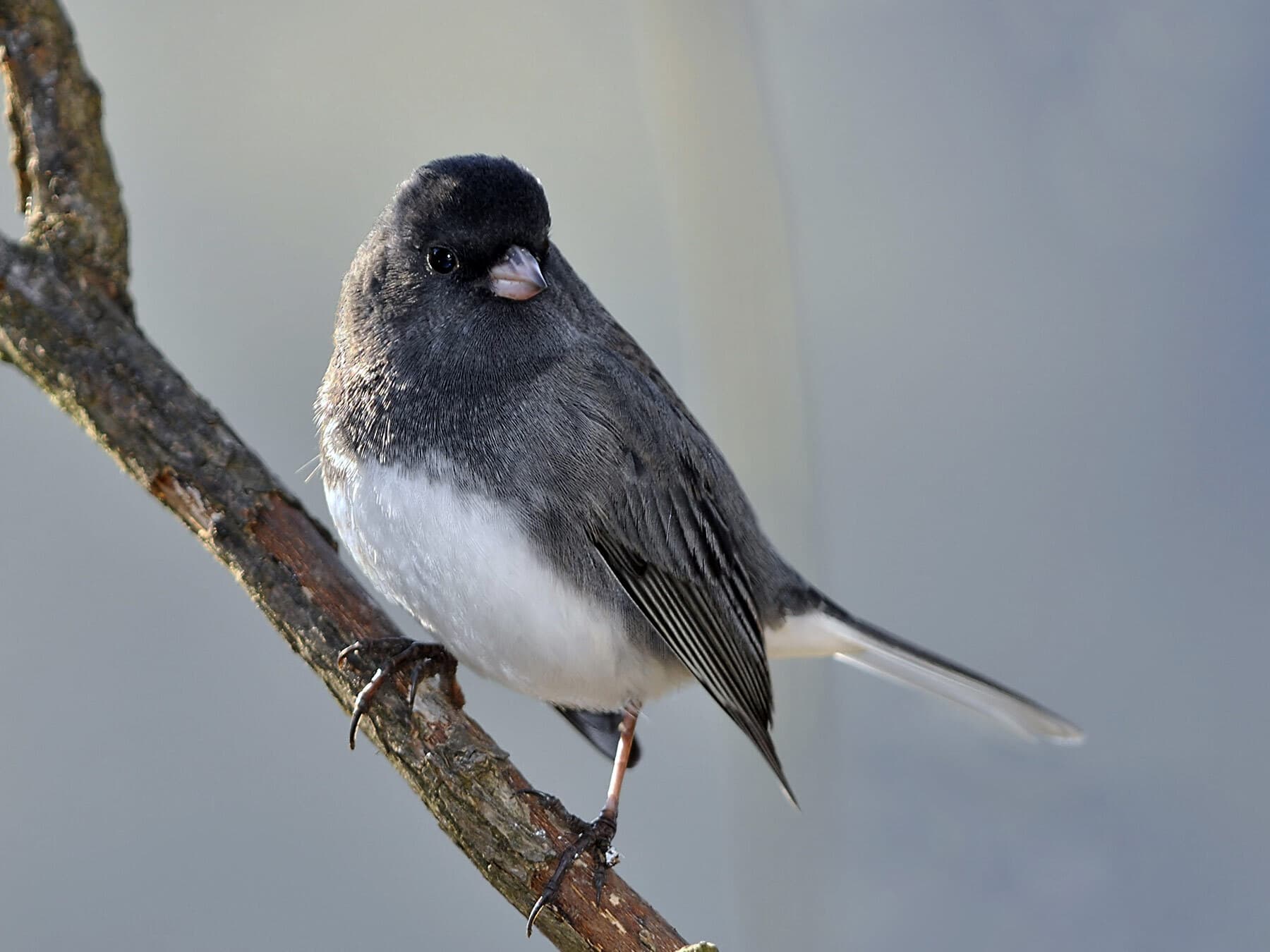
What a Dark-eyed Junco sounds like: the trill, the quiet song, the calls, and the sounds of young birds, with checked recordings, almost all of birds the recordists saw. For the bird itself, see Dark-eyed Junco identification, song and facts.
What does a Dark-eyed Junco sound like?
A musical trill: the same note repeated quickly and evenly for about two seconds, from a treetop or another high perch. You will often hear juncos before you see them: high, sharp chips given as they feed and as they fly off.1
The trill up close
Most songs are one short syllable repeated 7 to 23 times, the whole thing lasting 1.3 to 2 seconds. A singing male gives 8 to 13 songs a minute, and a full song carries 100 to 250 meters. Each male has from 1 to 7 different trill types and repeats one type many times before switching.2 A study of a California population counted 4.2 song types per male on average.3
Males sing the trill to hold a territory and attract a mate; unmated males sing it more. Juncos learn part of their songs. Young birds raised in a lab picked up the songs of White-crowned Sparrows and Spotted Towhees they could hear, and wild males have copied Brown Creepers.
Junco or Chipping Sparrow?
The junco's trill sounds much like the Chipping Sparrow's, but the junco's is more musical and shorter. It can also be mistaken for a Pine Warbler, but the junco's trill is faster and steadier in volume.2
Do the forms sing differently?
Less than their looks: there seem to be no local or regional dialects in the trill, and Slate-colored juncos in Nova Scotia and Virginia and Oregon juncos in California use similar syllables. The exception is the Guadalupe Junco, now treated as a separate species, which sings a variable warble.
The quiet song
Juncos have a second, very different song. Both males and females sing it: a quiet, rambling run of short whistles, trills, warbles and call notes, heard only within about 20 yards, usually about 10, which some compare to an American Goldfinch. Males sing it close to a female, often with their feathers fluffed and tail spread, and most often early in the season, when she is fertile.2
An experiment found that males react more strongly to this quiet song than to the trill, and most strongly when their own mate is fertile: hearing it may mean another male is courting her.4
The recording below is a very quiet, jumbled song from a bird at the top of a small tree in a Minneapolis park in March. xeno-canto lists it as subsong, the rambling practice song of young birds, so it may be either.5
When do juncos sing?
Males sing the trill occasionally in winter and often on warm days from February. They sing most in spring and early summer and keep going until mid to late July; song is unusual in August and occasional in October. Migrants sing too, but not often. There is no big dawn chorus: juncos sing through the day, a little less at midday, and not at night.
Do female juncos sing?
Yes, but not the trill: wild females are not known to sing it, though females given testosterone in experiments did. Females sing the quiet song, less often than males, mostly while feeding on the ground.
Calls
The calls to know:
- Chips: high, sharp tsip or tsick notes, given while feeding and in flight all year, including by migrants at night; the night flight call may be a quick tk or ti-dik.6
- Kew: a sharp but musical note, repeated, given year-round and most in winter squabbles, often by the winner.
- Twitter: a fast run of 6 to 19 high notes, given by females in their pre-mating display and by both sexes in disputes.
- Chack: a short, sharp note, the general alarm in winter, and given near a predator on the ground.
The calls of males and females are the same.2
Young juncos
Fledglings beg with short, repeated calls while their parents bring food, and squawk loudly if handled, which alarms the parents greatly. In their first winter young juncos start to sing: tentative, rambling, warbled phrases at first, which settle into an adult trill by about March. More: baby juncos.
City juncos sing higher
On the University of California, San Diego campus, where juncos have nested since the early 1980s, males sing with a higher lowest note than juncos in most forest populations studied.7 Another study found their songs shorter than in a mountain population.3 Many city birds sing higher, which helps them be heard over low-frequency noise; for these juncos, echoes off buildings may matter too. By one estimate, about half of the rise in their lowest note comes from birds modifying the song elements they learn.8 More: evolution on a college campus.
Sources
- Cornell Lab of Ornithology. Dark-eyed Junco: Overview, Identification and Life History. All About Birds. Accessed 7 October 2026. Source
- Nolan Jr., V., Ketterson, E. D., Cristol, D. A., Rogers, C. M., Clotfelter, E. D., Titus, R. C., Schoech, S. J., Snajdr, E. (2020). Dark-eyed Junco (Junco hyemalis), version 1.0. Birds of the World (A. F. Poole and F. B. Gill, editors). Cornell Lab of Ornithology. doi:10.2173/bow.daejun.01
- Newman, M. M., Yeh, P. J., Price, T. D. (2008). Song variation in a recently founded population of the dark-eyed junco (Junco hyemalis). Ethology 114: 164-173. doi:10.1111/j.1439-0310.2007.01457.x
- Reichard, D. G., Rice, R. J., Vanderbilt, C. C., Ketterson, E. D. (2011). Deciphering information encoded in birdsong: male songbirds with fertile mates respond most strongly to complex, low-amplitude songs used in courtship. The American Naturalist 178: 478-487. doi:10.1086/661901
- xeno-canto contributors. xeno-canto recordings of Junco hyemalis used on the song page. xeno-canto. Accessed 7 October 2026. Source
- National Audubon Society. Dark-eyed Junco. Audubon Guide to North American Birds. Accessed 7 October 2026. Source
- Slabbekoorn, H., Yeh, P. J., Hunt, K. (2007). Sound transmission and song divergence: a comparison of urban and forest acoustics. The Condor 109: 67-78. doi:10.1650/0010-5422(2007)109[67:STASDA]2.0.CO;2
- Cardoso, G. C., Atwell, J. W. (2011). Directional cultural change by modification and replacement of memes. Evolution 65: 295-300. doi:10.1111/j.1558-5646.2010.01102.x
