


Published 7 Oct 2026
Oregon Junco, Slate-colored and the Other Dark-eyed Junco Forms
By the Birdfact teamChecked by Nathan Cope
The Oregon Junco, the Slate-colored Junco and four other forms are all one species, the Dark-eyed Junco. How to recognize each one, male and female, where each lives, the Guadalupe Junco, and how juncos diversified in just 10,000 years.
On this page15 sections
- Is the Oregon Junco a different bird from the Dark-eyed Junco?
- The six forms at a glance
- Slate-colored Junco
- Oregon Junco
- Pink-sided Junco
- Gray-headed Junco
- Red-backed Junco
- White-winged Junco
- In-between birds
- The Guadalupe Junco
- Why do juncos look so different?
- Evolution on a college campus
- Which form will I see?
- Birds that look like a junco
- Sources
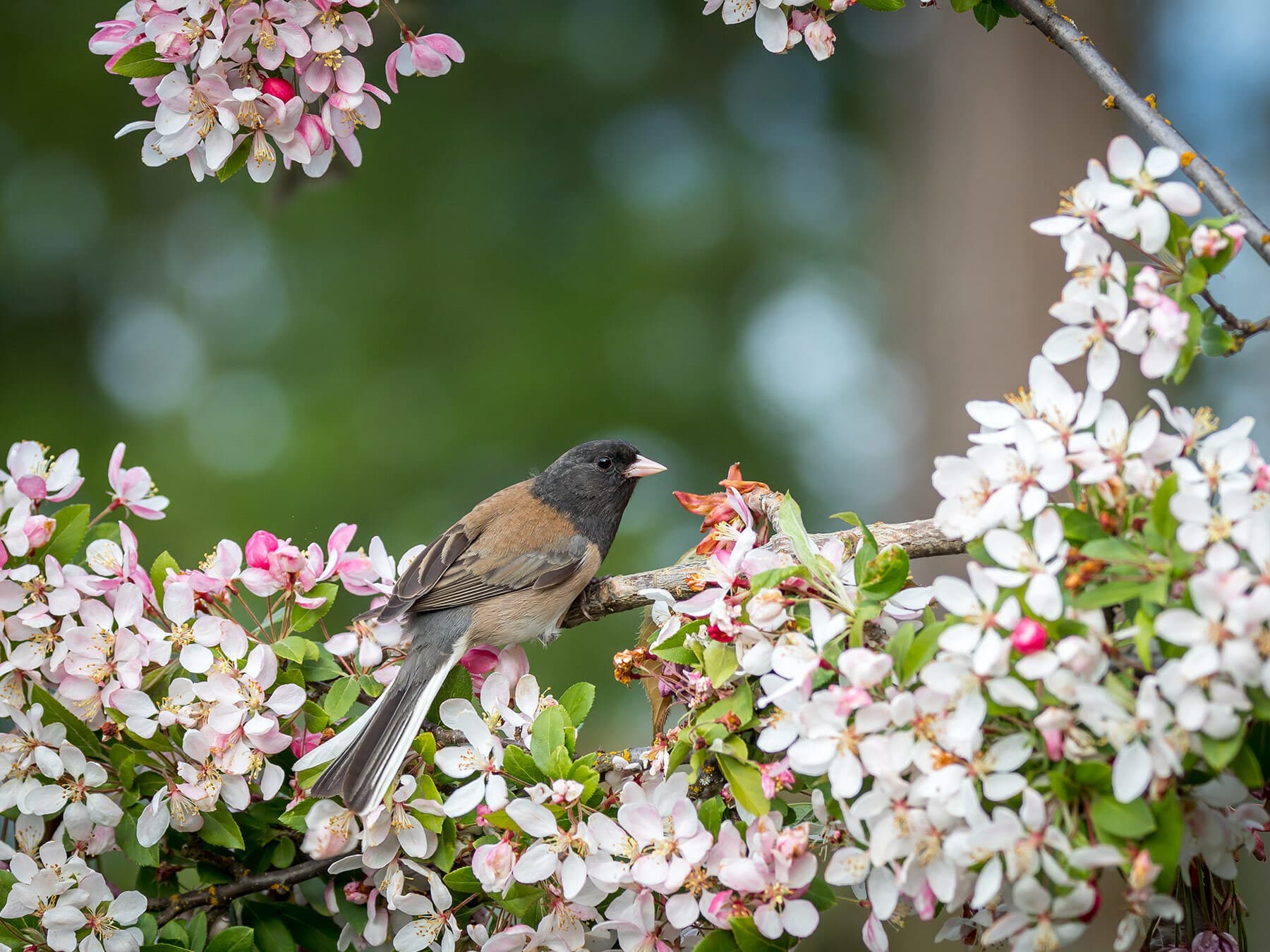
One species, many looks. This page explains the forms of the Dark-eyed Junco: how to recognize each one, where it lives, and why one species ended up looking so different from coast to coast. For the bird itself, see Dark-eyed Junco identification, song and facts.
Is the Oregon Junco a different bird from the Dark-eyed Junco?
No. The Oregon Junco is one form of the Dark-eyed Junco, and so are the Slate-colored, Pink-sided, Gray-headed, Red-backed and White-winged Juncos. Until 1973 several of them were treated as separate species; the American Ornithologists' Union then joined them into one species and kept the old names for the groups.1
Today AviList, the global checklist, recognizes 15 subspecies of the Dark-eyed Junco, and treats the Guadalupe Junco of Guadalupe Island, off Baja California, as a species in its own right.2 Six forms are easy to recognize in the field.3
The six forms at a glance
The main marks of each, for adult males; females are often paler and browner.
| Form | Where it breeds | Look for |
|---|---|---|
| Slate-colored | Alaska, Canada, the northern states, the Appalachians | Slate-gray hood, back and sides, all one color; white belly |
| Oregon | The Pacific Coast and much of the West | Black (male) or gray (female) hood sharply set off from a brown back and rusty-buff sides |
| Pink-sided | The northern Rockies | Pale bluish-gray head with dark lores, dull brown back, broad pinkish-cinnamon sides |
| Gray-headed | The southern Rockies and Great Basin | Gray with paler gray sides, black lores and a rusty patch on the back; pink bill |
| Red-backed | Arizona, New Mexico and far west Texas | Like the Gray-headed, but the upper half of the bill is dark |
| White-winged | The Black Hills region | Pale bluish gray, larger, usually two thin white wing-bars and more white in the tail |
Slate-colored Junco
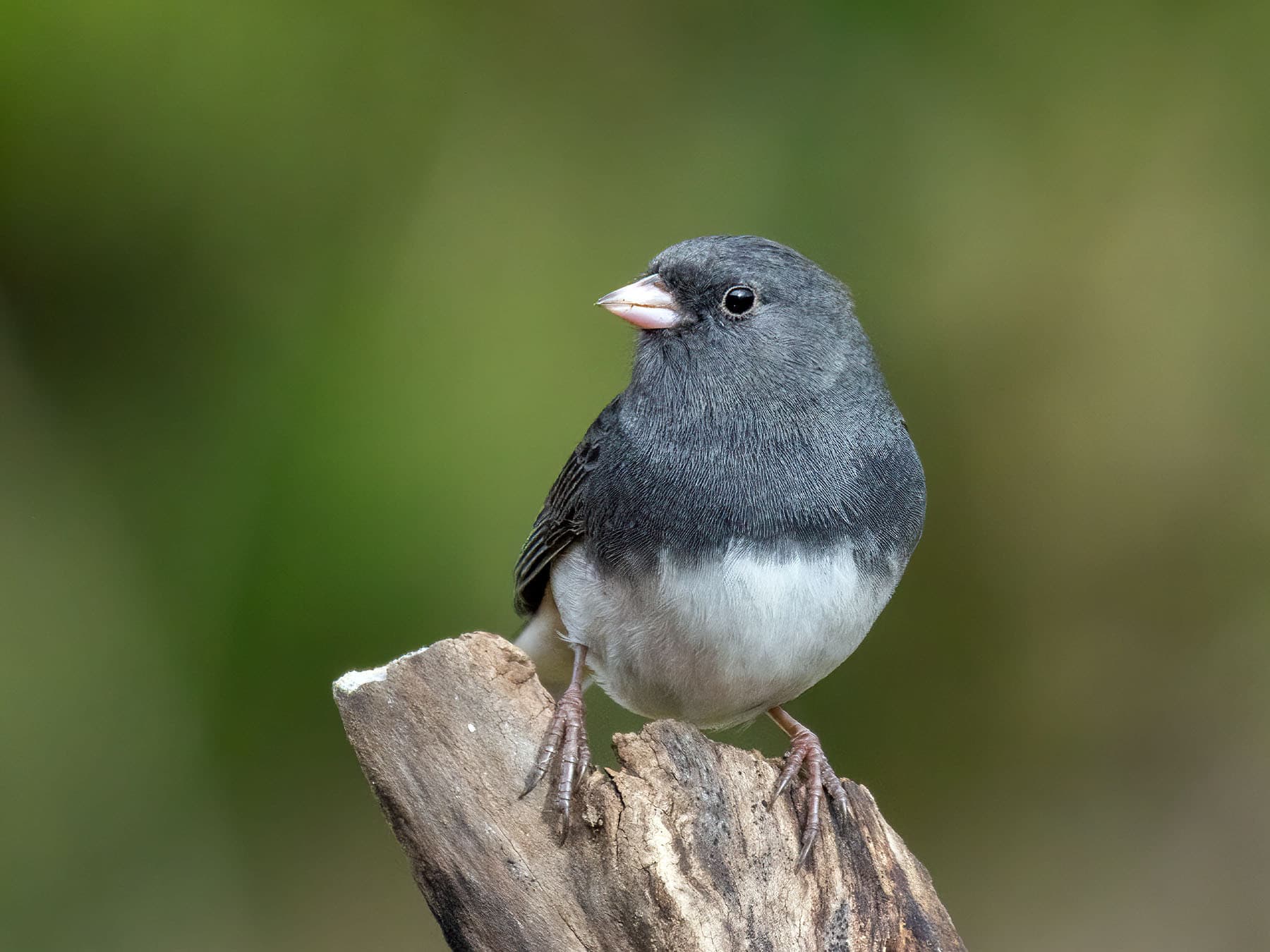
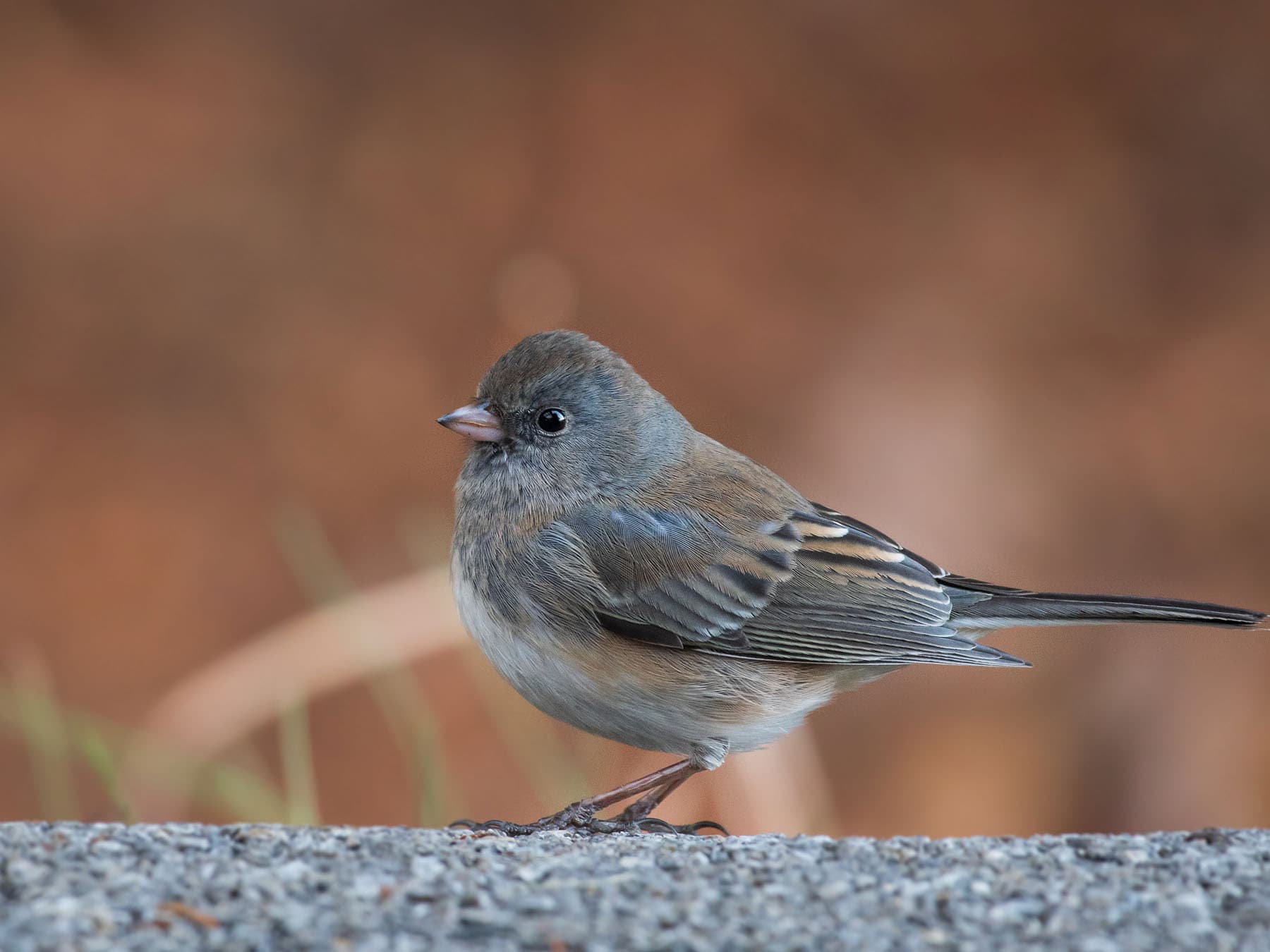
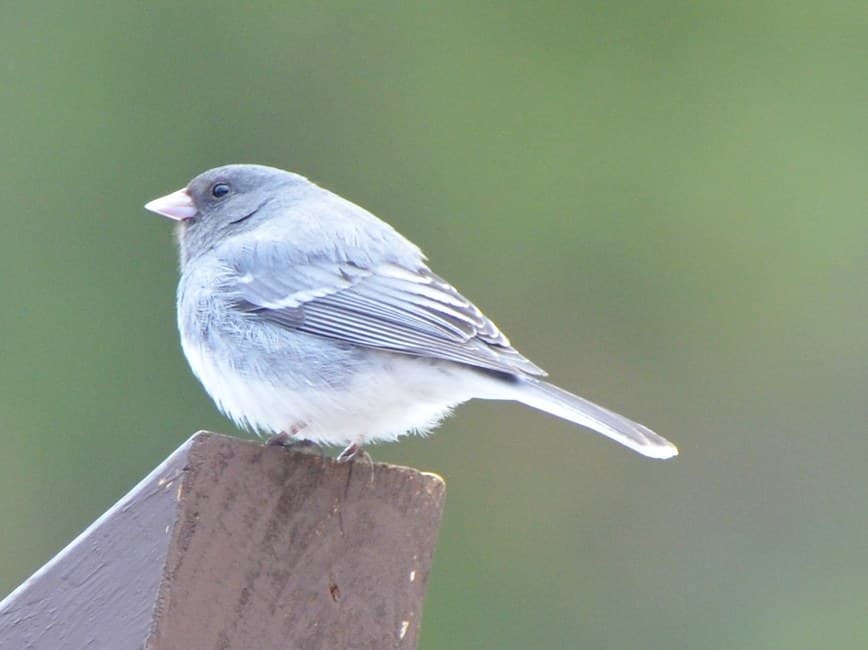
The form of the East, Canada and Alaska. Males are slate-gray above and on the breast, with a white belly; the gray blends into the back and sides, with no sharp line, and meets the white belly in a smooth curve like an upside-down U. The bill is pinkish white. Females are paler and more washed with brown, and a few are quite brown.
Appalachian Slate-colored Juncos, which mostly stay in the mountains all year, are a little paler and bigger and often have a light bluish-horn bill.
Oregon Junco
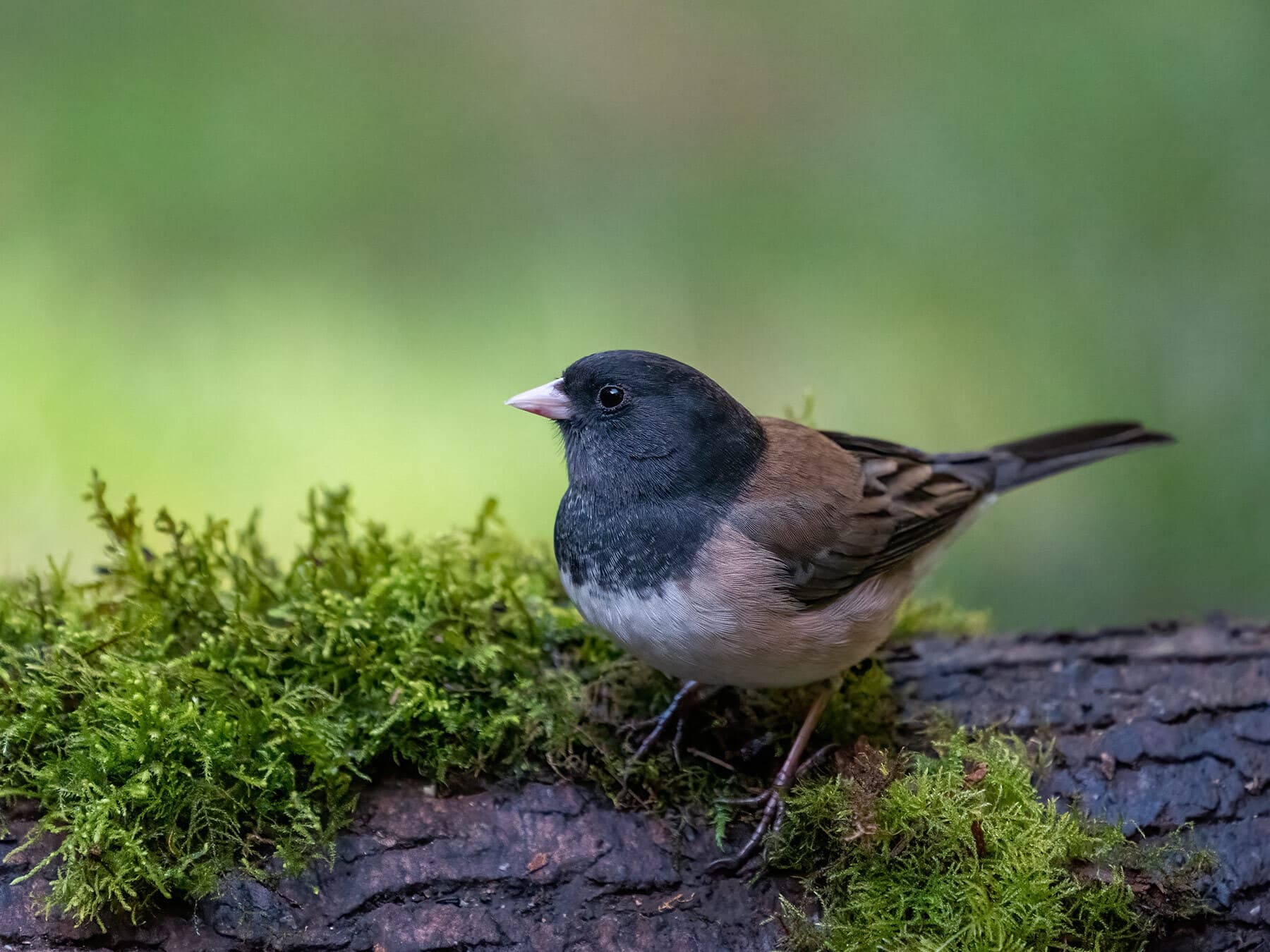
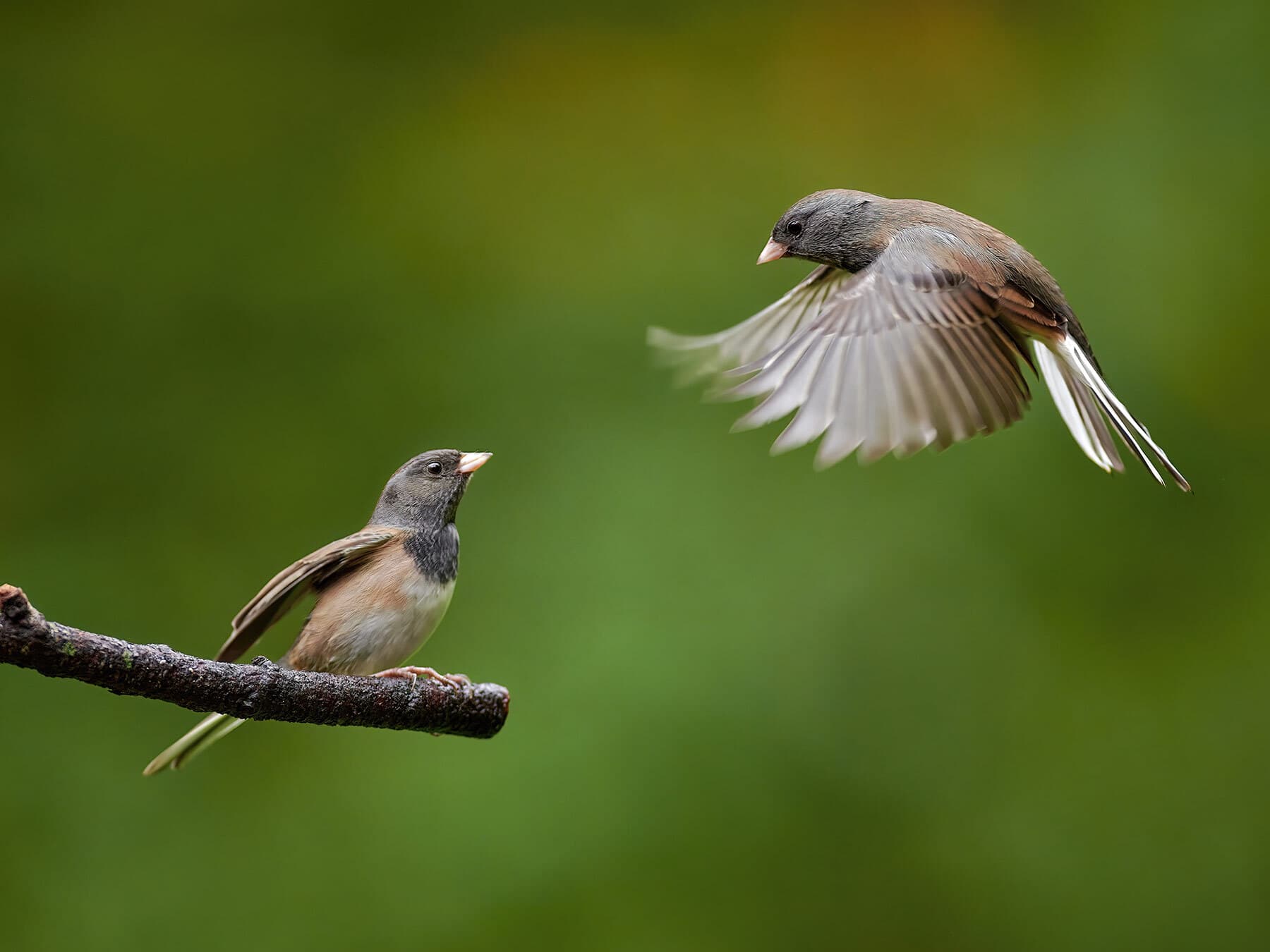
The common junco of the West. The male has a black to dark grayish-brown hood that stops sharply at the breast, in a line that bulges downward, a brown to reddish-brown back and pinkish-buff to rusty sides. The female has a gray hood and less contrast.
That sharp line is the quickest way to tell a brownish Slate-colored female from an Oregon: on the Slate-colored the hood blends into the back and sides, on the Oregon it is cut off.1
Pink-sided Junco
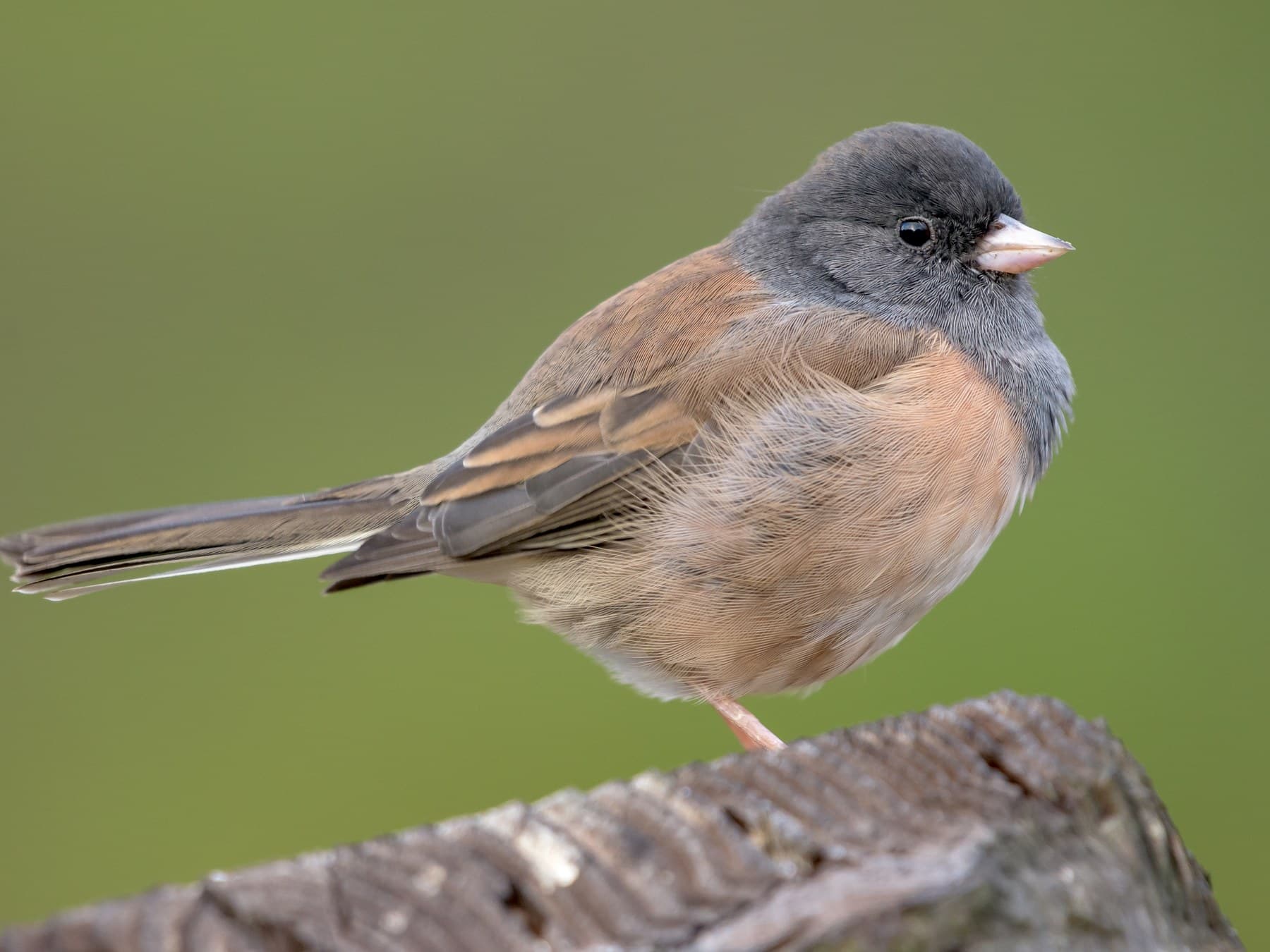
The junco of the northern Rockies, breeding from southeastern Alberta and southwestern Saskatchewan to eastern Idaho, Montana and Wyoming, and wintering south to northern Mexico. It has a pale, pearly gray head with a bluish cast and contrasting dark lores, a paler throat, a dull brown back and broad pinkish-cinnamon sides. Males and females differ less than in the Oregon Junco. It is sometimes counted as part of the Oregon group.
Gray-headed Junco
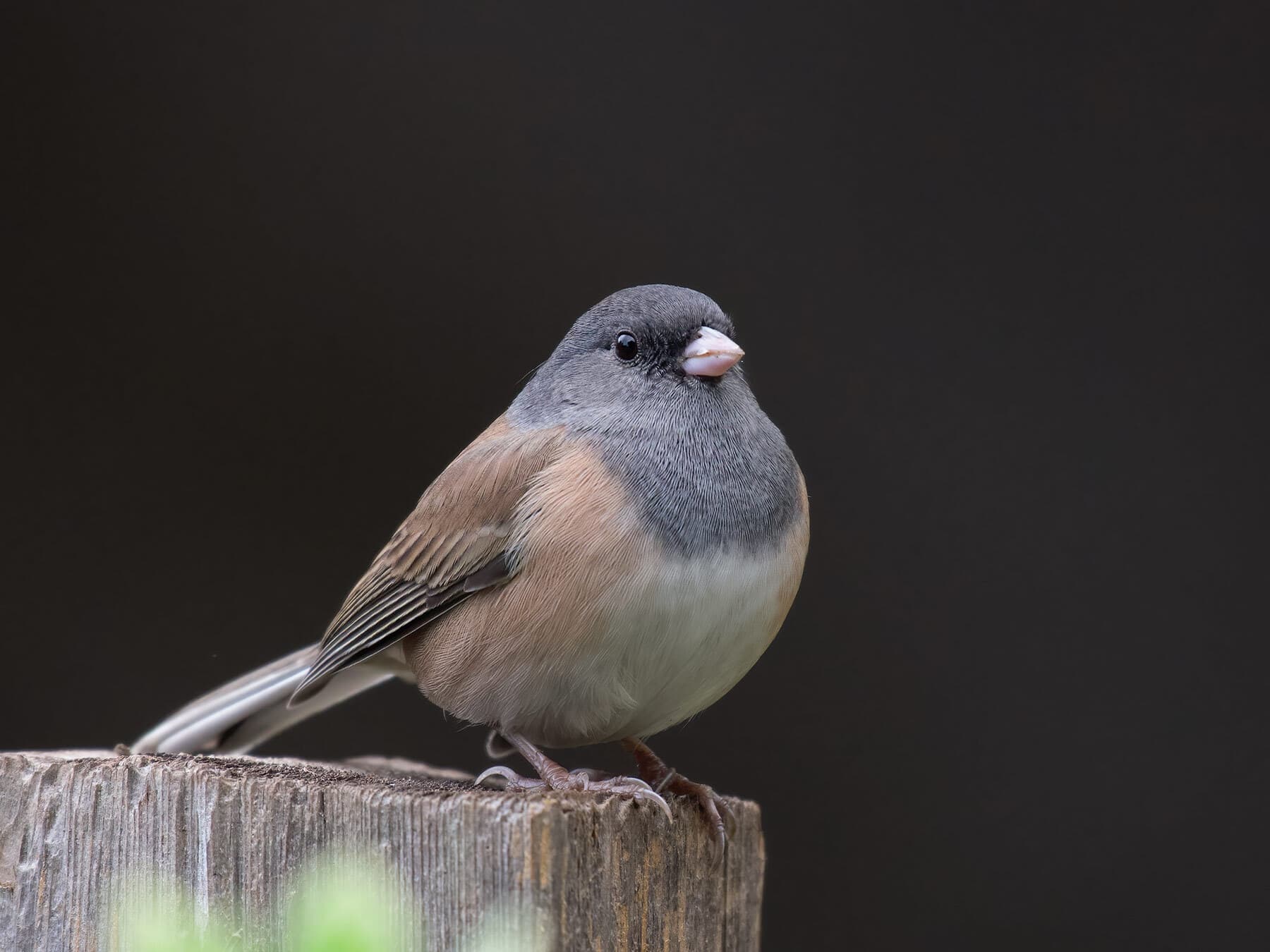
The junco of the southern Rockies and Great Basin mountains, from southern Idaho and Wyoming to northern New Mexico and Nevada. It is gray, with paler gray sides that do not contrast with the belly, black lores, and a bright rusty patch in the middle of the back. The bill is all pink.
Red-backed Junco
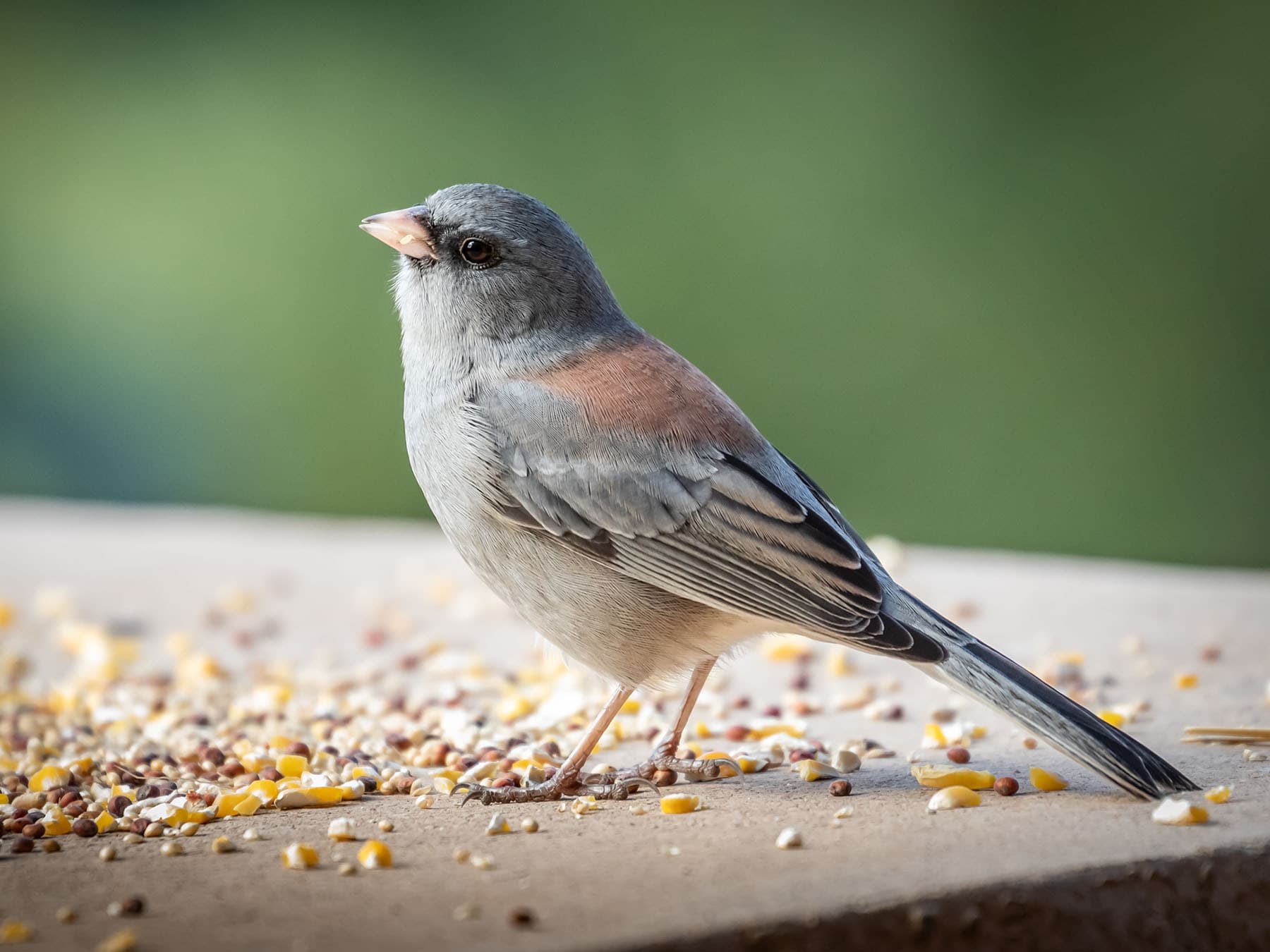
The junco of the mountains of Arizona, New Mexico and far west Texas. It looks like a Gray-headed Junco, but the upper half of its bill is dark and the lower half pink. It looks a lot like the Yellow-eyed Junco too, but its eye is dark, not yellow.
White-winged Junco
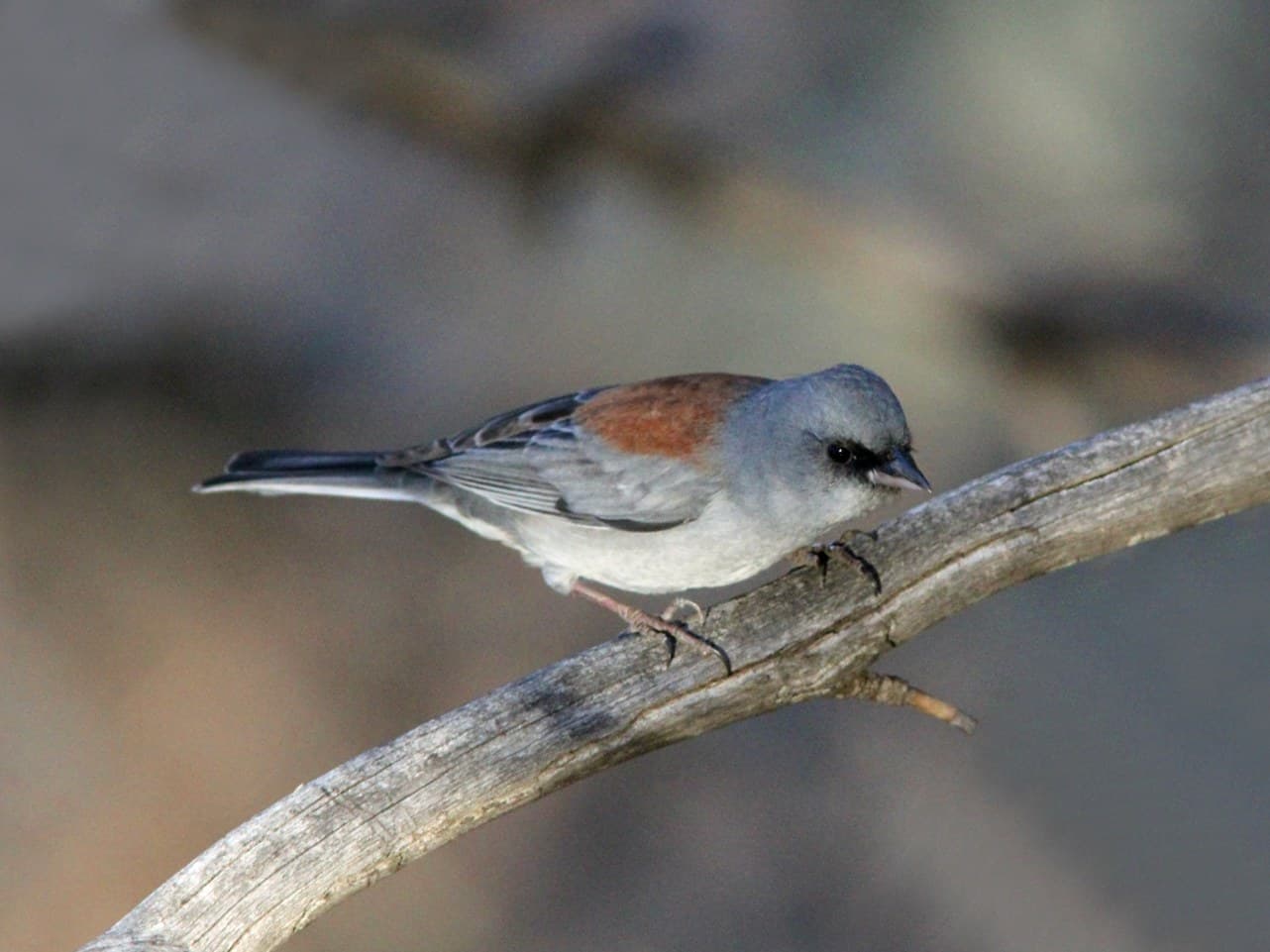
The junco of the Black Hills region, where South Dakota, Wyoming, Montana and Nebraska meet, breeding in pine forest. It is a large form, with a relatively big bill and long tail; paler gray than the Slate-colored, with a bluish cast, and usually with two narrow white wing-bars. Up to about a fifth of females lack the wing-bars. It has a lot of white in the tail.
A few Slate-colored Juncos, about 3 in 100, have white tips to the wing coverts too; they are darker and smaller, with less white in the tail.
In-between birds
Not every junco fits a box. Where some forms meet they interbreed, and the browner birds of the Yukon and interior British Columbia (the subspecies cismontanus) are thought of as a settled mix of Slate-colored and Oregon. In winter, several forms can turn up in one flock, especially in the West.1 Some birds are best called simply Dark-eyed Junco.
The Guadalupe Junco
On Guadalupe Island, off the Pacific coast of Baja California, lives a dull junco with a gray to brownish-gray hood, pinkish-cinnamon sides, a long bill, big feet and short wings and tail, and a song and call quite unlike other juncos'. It was one of the species joined into the Dark-eyed Junco in 1973. AviList now treats it as a separate species, the Guadalupe Junco, and it is rated Vulnerable on the IUCN Red List.2
Why do juncos look so different?
Because they changed fast. A genetic study of 264 juncos found that the Dark-eyed Junco arose as the Yellow-eyed Junco of Mexico and Central America spread north after the last ice age, and that it split into at least five distinct forms within the last 10,000 years.4 A later study using genome-wide DNA called the juncos "one of the fastest cases of speciation known in vertebrates": the northern forms are only a few thousand years old, while isolated southern juncos have gone their own way for hundreds of thousands of years with little change in looks.5
Evolution on a college campus
Juncos keep changing. In the early 1980s a small group settled on the University of California, San Diego campus, by the coast, far below the mountain forests where southern Californian juncos normally breed. Within about two decades the campus birds had about 22% less white in their tails than mountain juncos, and the study found that selection had played a part.6 Their songs changed too: the campus males sing with a higher lowest note than most forest juncos studied.7 More: junco song and calls.
Which form will I see?
In the East and across most of Canada, almost always a Slate-colored Junco. In the Pacific states and much of the West, an Oregon Junco. In the Rockies and the Southwest, especially in winter, look carefully: Pink-sided, Gray-headed and Red-backed Juncos join the flocks, and White-winged Juncos winter from the Black Hills south to New Mexico and Oklahoma.1 See where and when to see juncos.
Birds that look like a junco
The Yellow-eyed Junco of Arizona and Mexico has a yellow eye and rusty edges on the wing, and walks or shuffles rather than hops. At feeders, juncos are sometimes mixed up with chickadees: see junco vs chickadee. For telling males, females and young apart, see male and female juncos.
Sources
- Nolan Jr., V., Ketterson, E. D., Cristol, D. A., Rogers, C. M., Clotfelter, E. D., Titus, R. C., Schoech, S. J., Snajdr, E. (2020). Dark-eyed Junco (Junco hyemalis), version 1.0. Birds of the World (A. F. Poole and F. B. Gill, editors). Cornell Lab of Ornithology. doi:10.2173/bow.daejun.01
- AviList Core Team (2025). AviList: The Global Avian Checklist, v2025b. doi:10.2173/avilist.v2025b
- Cornell Lab of Ornithology. Dark-eyed Junco: Overview, Identification and Life History. All About Birds. Accessed 7 October 2026. Source
- Milá, B., McCormack, J. E., Castañeda, G., Wayne, R. K., Smith, T. B. (2007). Recent postglacial range expansion drives the rapid diversification of a songbird lineage in the genus Junco. Proceedings of the Royal Society B 274: 2653-2660. doi:10.1098/rspb.2007.0852
- Friis, G., Aleixandre, P., Rodríguez-Estrella, R., Navarro-Sigüenza, A. G., Milá, B. (2016). Rapid postglacial diversification and long-term stasis within the songbird genus Junco: phylogeographic and phylogenomic evidence. Molecular Ecology 25: 6175-6195. doi:10.1111/mec.13911
- Yeh, P. J. (2004). Rapid evolution of a sexually selected trait following population establishment in a novel habitat. Evolution 58: 166-174. doi:10.1111/j.0014-3820.2004.tb01583.x
- Slabbekoorn, H., Yeh, P. J., Hunt, K. (2007). Sound transmission and song divergence: a comparison of urban and forest acoustics. The Condor 109: 67-78. doi:10.1650/0010-5422(2007)109[67:STASDA]2.0.CO;2
