Published 11 Oct 2026
Black-capped Chickadee Calls and Song: What They Mean
By the Birdfact teamChecked by Nathan Cope
The Black-capped Chickadee sings a two-note fee-bee and calls chick-a-dee-dee-dee, adding more dees for more dangerous predators. Hear checked recordings, see them as spectrograms, and learn what the song, the gargle, the see alarm, the hiss and the young birds' calls mean, and how to tell other chickadees by ear.
On this page22 sections
- The fee-bee song
- Same tune, different pitch
- When chickadees sing
- Why chickadees sing
- Do female chickadees sing?
- Songs that break the rules
- Western songs
- How chickadees learn their songs
- The chick-a-dee call
- What the chick-a-dee call means
- More dees, more danger
- Other birds listen
- The see alarm
- The gargle
- Quiet calls
- Sounds at the nest
- Why do chickadees hiss?
- Young chickadees
- Telling other chickadees by ear
- Questions
- About the recordings
- Sources
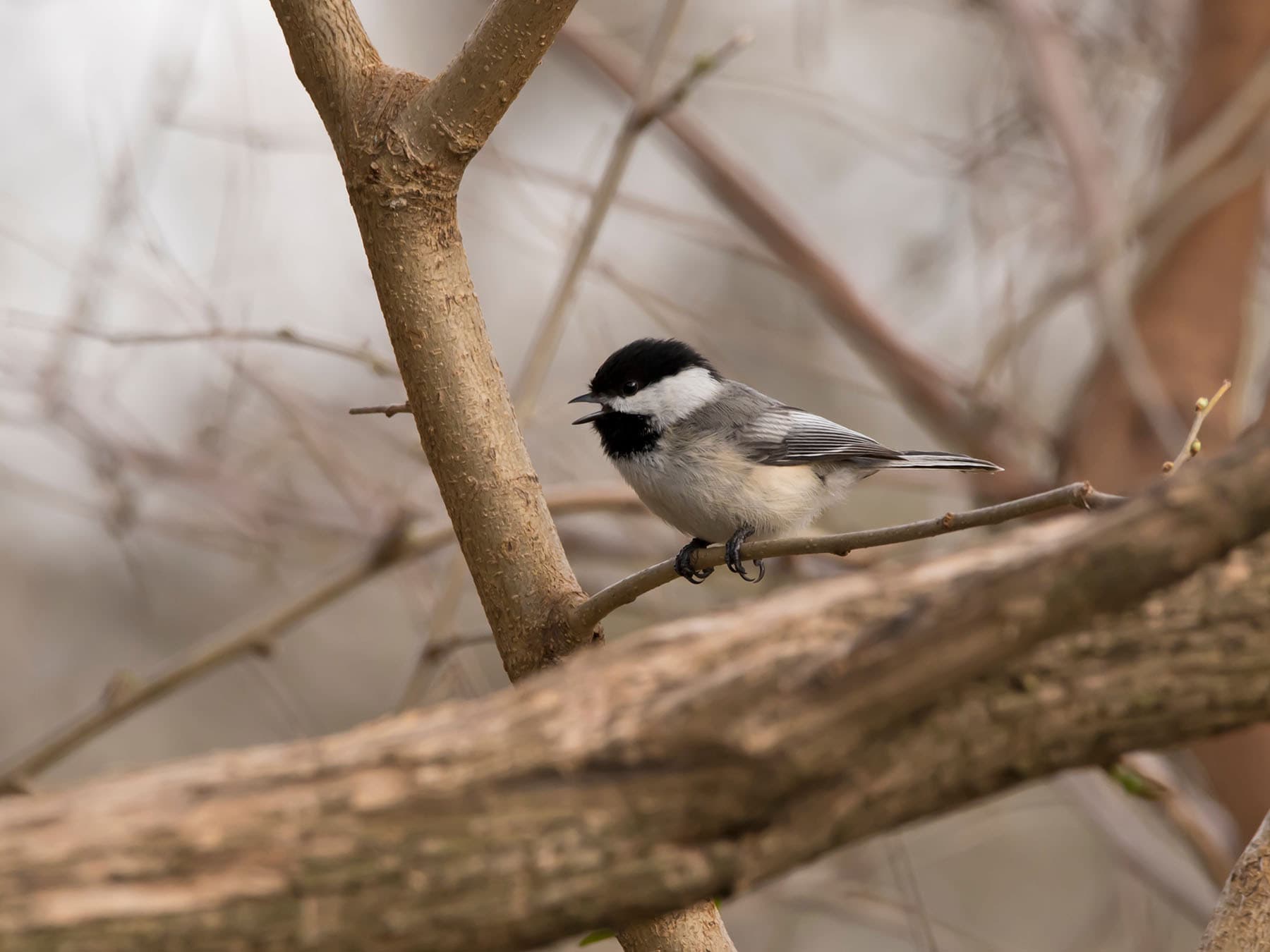
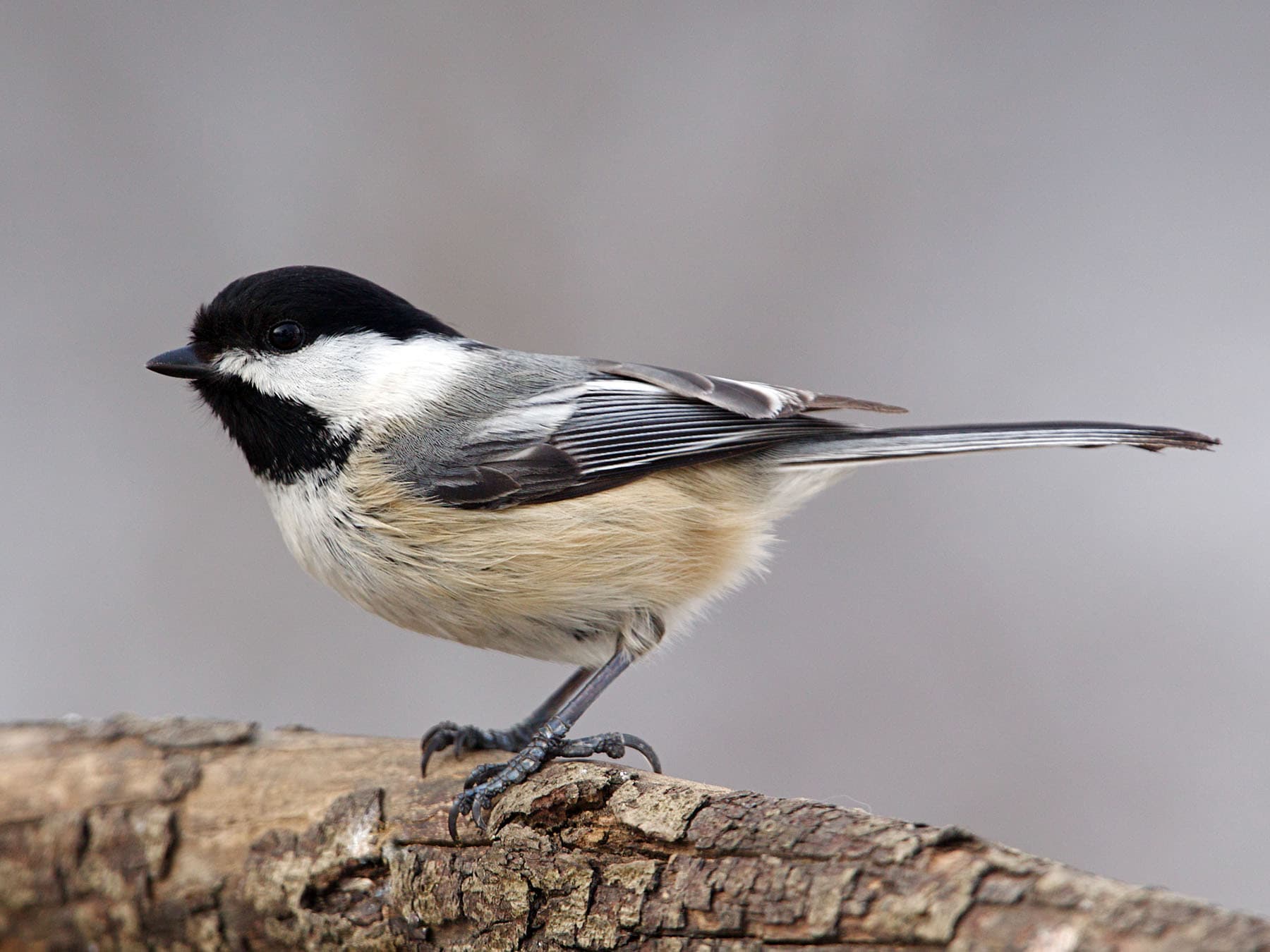
Two sounds give the Black-capped Chickadee away. The song is fee-bee: two clear, whistled notes, the second lower.1 Some people hear it as hey, sweetie.2 The call, a buzzy chick-a-dee-dee-dee,3 gives the bird its name, and it is far more than a name: chickadees use it to keep in touch, to announce food and to warn of predators, adding more dees for a more dangerous one.
Those two are only the best known. Birds of the World counts at least 16 kinds of sound,1 from a squabbling gargle to the hiss of the snake display. Below are recordings of the main ones, each checked, with pictures of the sound (spectrograms) and what researchers have learned about what they mean.
The fee-bee song
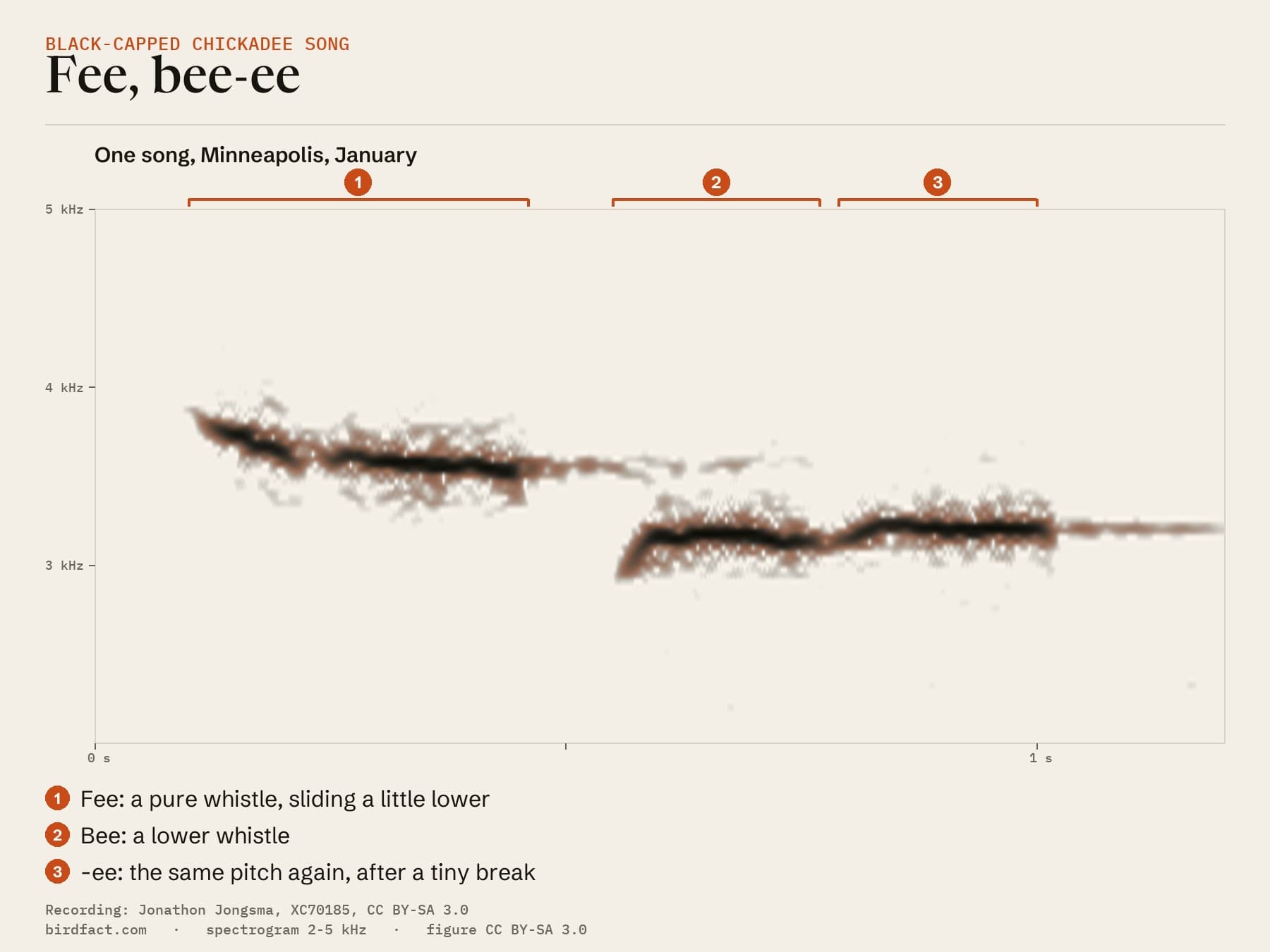
The song is short and pure: two whistles lasting about a second in all. The first, the fee, is higher; the second, the bee, often has a tiny break in the middle that you can hear close up, so it comes out bee-ee.1 Audubon's guide describes the second note as often doubled.3
Ficken and colleagues, who studied color-banded chickadees in Wisconsin in the 1970s, measured it closely. A silence of 0.1 to 0.15 seconds separates the notes, and the break in the second note lasts about 0.05 seconds. In five males, the first note lasted 0.31 to 0.37 seconds and sat between about 3.48 and 4.10 kHz, the second between about 3.10 and 3.64 kHz. They heard a three-note song only three times in hundreds.4
The Minneapolis bird at the top of the page sang in January from a pine in a city park. One of its songs lasts about 0.85 seconds: a fee of about 0.3 seconds that slides from about 3.75 to 3.5 kHz, a gap of about 0.12 seconds, then the bee-ee near 3.15 kHz with its slight dip. It repeats the song every few seconds at the same pitch. Fainter songs come in between, seconds apart: perhaps a second bird answering.
Same tune, different pitch
A male does not always sing at the same pitch. He sings one pitch for a run of songs, 31 to 41 on average, then shifts to another, over a range of about 860 Hz.1 What stays fixed is the gap in pitch between the notes. In a study of 151 wild chickadees, 19 of which also sang lower, shifted songs, the pitch of the song differed a lot from bird to bird, but the ratio between the notes hardly varied, either among birds or between a bird's normal and shifted songs.5 The authors suggest the exact pitch may help chickadees tell one another apart, and the fixed interval tells them it is a chickadee singing.
When chickadees sing
You can hear the song in any month, but mostly in late winter and spring.1 In much of the range males start in mid-January and sing more as winter goes on.2 In Ficken's Wisconsin study singing began in late December or early January, was at its height from April to July, and carried on into November, though only now and then in fall.4
In the breeding season males sing a dawn chorus, and neighbors sing back and forth during the day.1
Why chickadees sing
The song marks a territory and attracts a mate. It also carries each male's identity: parts of the song differ enough for birds to know one another by it.1
How much a male sings at dawn says something about him. High-ranking males sing more at dawn than low-ranking ones, and unpaired males more than paired ones.1 In one experiment, males given extra food (mealworms) sang more at dawn than males without it, whatever their rank.6 Females listen in on the singing contests between neighboring males, and how a male performs in them can influence females' breeding behavior. Matching a rival's pitch, or singing over him, seems to matter in these exchanges.1
Ficken's team noticed that a male in a winter flock first moved away from the others before singing, and never sang within about 33 feet (10 m) of his mate. In late-summer flocks they saw a bird fly about 160 feet (50 m), sing, and the rest of the flock follow it, 12 times.4
Do female chickadees sing?
Sometimes. The fee-bee is mostly a male's song, but not only his;1 females sing it occasionally.2 Ficken's team heard the full song only from males. Both sexes give a much quieter version, the faint fee-bee, at the nest (see below).4 Both sexes give the chick-a-dee call all year.1 Males and females look alike, so a singing chickadee could be either: how to tell male and female chickadees apart.
Songs that break the rules
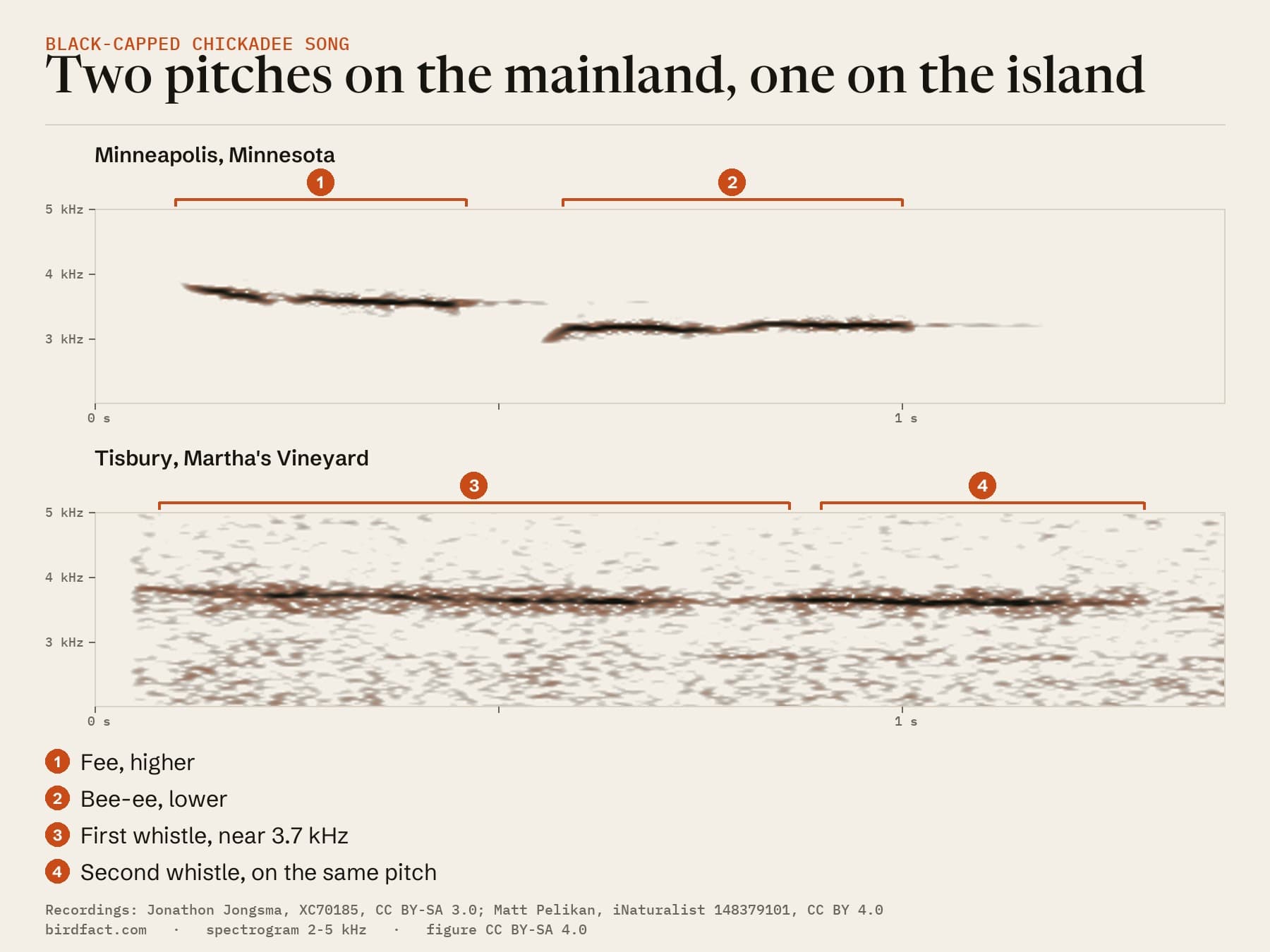
From Nova Scotia to British Columbia, chickadees sing almost exactly the same two-note song. A few populations do not.7
On Martha's Vineyard, Chappaquiddick and Nantucket, off Massachusetts, most songs keep both whistles on one pitch. The songs vary far more than on the mainland, with breaks in the first whistle, the second or both. Males there usually have two or more songs, and neighboring groups sing differently: there are dialects even on Chappaquiddick, an island about 4 miles (6 km) wide.7 The Martha's Vineyard recording below, made in February, has two whistles at about 3.6 to 3.7 kHz, the first about 0.8 seconds and the second about 0.4 seconds. The recordist notes several birds singing and calling.
Western songs
In the Pacific Northwest, chickadees may sing three or four notes on the same pitch.2 Some populations in Oregon and Washington have dialects and repertoires like the island birds.7 Around Fort Collins, Colorado, each male has 2 or 3 song types and answers a rival with the same type.1 So if you live in the West and hear an odd song, it may still be a Black-capped Chickadee.
How chickadees learn their songs
Chickadees learn their songs, and their calls, from other birds.1 In an experiment with hand-reared birds, young Black-capped and Carolina Chickadees raised together copied each other's songs; Black-capped males taught unusual songs sang highly unusual songs; and the birds in each group came to sound alike. Living with other birds mattered.8 In the wild, that means song can mislead where the two species meet: each can learn the other's song.3
The chick-a-dee call
The call that names the bird is given by both sexes all year, most often in fall and winter.1 It is built from up to four kinds of note, which researchers label A, B, C and D. Each can be repeated a varying number of times, and a call can use some or all of them: AB, ABC, AD, BCD and so on.4 The notes always come in the same order, a rule shared by the Carolina Chickadee.9 With so many possible combinations, the call has been compared with human language.1
The last notes, the buzzy dees, also carry a flock's signature: birds kept together in captive flocks come to give similar dees.1
The Newfoundland recording above has many calls, some overlapping. Most start with a high note falling from about 7.5 kHz, some with two or three; one run of dees has none. Each dee is a stack of bands, mostly between about 1.5 and 6 kHz. The two calls in the figure below have 4 and 11 dees.
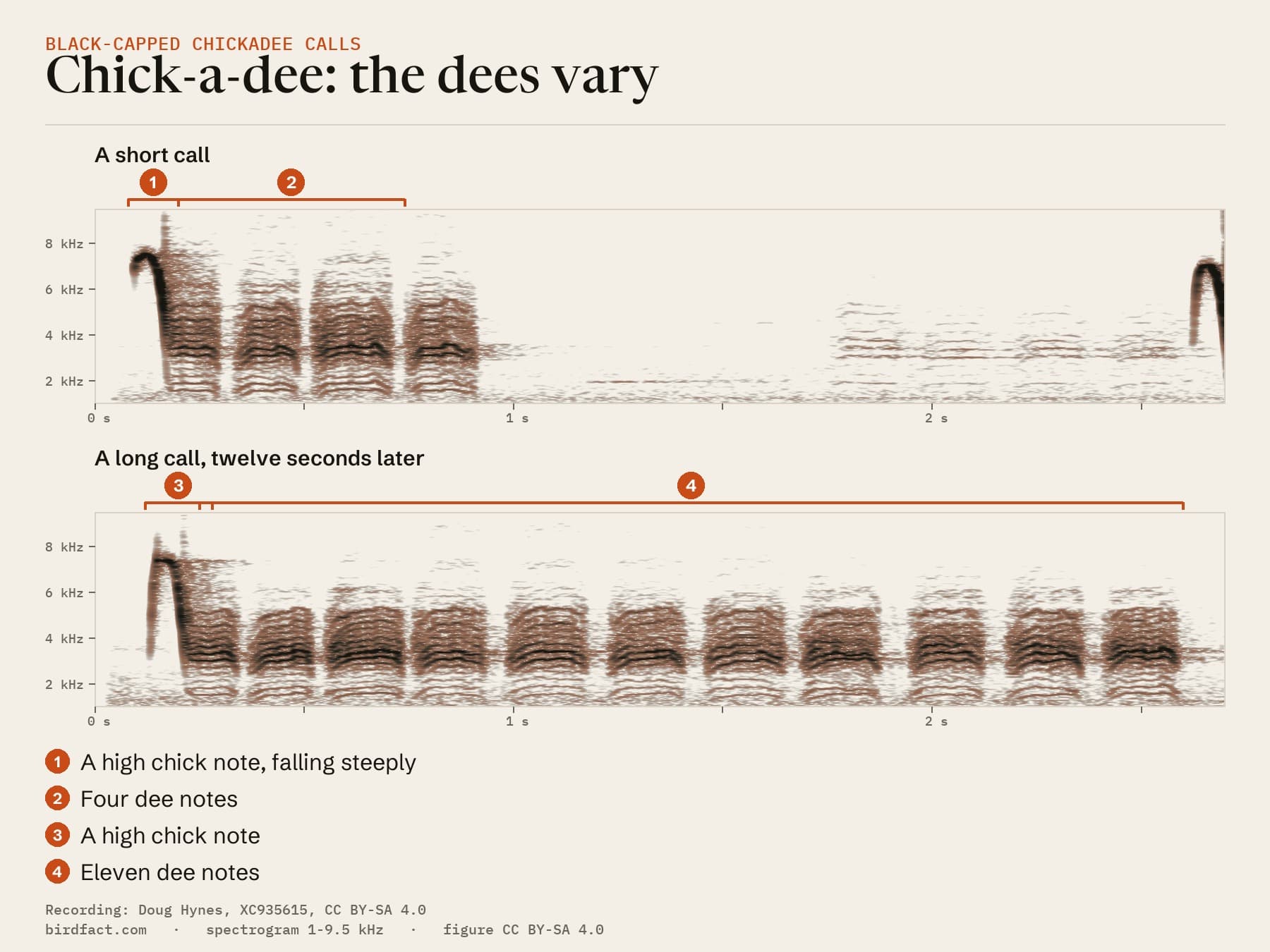
What the chick-a-dee call means
The same call does several jobs. Chickadees give it when they lose touch with their mate or flock, to get the flock moving, when they find new food such as a feeder just filled, when they gang up on (mob) a predator, and as an all-clear once the danger has passed.1, 4 Ficken's team also heard it as a mild alarm and as a contact call between mates.
More dees, more danger
The best-known finding is about the dees. Templeton and colleagues showed captive flocks 15 species of live predators. For small, agile predators, the more dangerous ones for a chickadee, the birds gave more dees than for large ones; and chickadees hearing those calls played back mobbed harder.10 A later paper showed two calls from one chickadee, given to a northern pygmy owl and to a great horned owl: they differed in how fast the birds called and in fine details as well as in the number of dees.11 Distance matters too: with a mounted predator about 3 feet (1 m) away rather than 20 feet (6 m), chickadees responded faster and called more.12
So a long string of dees is worth a look: it can mean a perched owl or hawk nearby. In the Wisconsin recording below, made when the birds were calling at a hawk, some runs reach eight or more dees.
Other birds listen
Chickadees are lookouts for the mixed flocks of nuthatches, kinglets, woodpeckers and other birds they lead in winter, and many species react to their alarm calls: between 24 and 50 species are known to.11, 1 In one test, playing chickadee mobbing calls drew 50 species in New Brunswick.1
Other birds also understand the dee code. Near Missoula, Montana, researchers played chickadee calls to Red-breasted Nuthatches when no chickadees were around. The nuthatches approached the speaker in 92% of trials with calls made to a small, dangerous predator, 69% with calls to a large predator, and 23% with a control sound, and mobbed longest for the small-predator calls.11
The see alarm
For a predator coming fast, such as a hawk flying at them, chickadees have a different alarm: a thin, high see (also written zee). It is given more often by males. Other chickadees freeze on hearing it and stay still until a chick-a-dee call gives the all-clear.1 Ficken's team heard it given to both bird and mammal predators, and found it sounds a little like the song but higher and shorter.4
The two alarms ask for opposite things. A high see makes birds freeze or dive for cover; a chick-a-dee mobbing call draws them toward a perched predator to harass it until it leaves.11 We have not found a clean, openly licensed recording of the see call to play here.
The gargle
The gargle is a fast jumble of short notes, about half a second long, given mainly by males and all year.1 It is a threat. Chickadees gargle when another bird comes too close at a feeder or in the flock, or at a territory boundary, and if the other bird does not leave, the gargler often lunges at it or takes its place. Of 145 gargles Ficken's team recorded, only 6 were by females.4
It works: in a later study at two Wisconsin feeders, the bird that gargled almost always won the encounter, and dominant birds gargled more than subordinates.13 Pair members also exchange gargles.2
Ficken's team called it the most complex chickadee call.4 A gargle has from 2 to at least 13 notes, drawn from at least 23 types; each bird uses 3 to 18 of them.1 A typical gargle has about 6 notes, and some notes are much more likely than others to come first or follow each other.14 Each bird has at least 13 different gargles, some more than 30.13 Gargles differ from place to place: two of five sites within about 9 miles (15 km) in Wisconsin shared a different dialect from the rest.14
The Minnesota recording above, made in May, has a bird gargling in bursts of rapid, varied notes as it fed in alders.
Quiet calls
Much of what chickadees say is soft. The tseet is a quiet contact note given almost constantly by both sexes, all year, that tells nearby birds where the caller is. A louder, faster version, the tsleet, comes just before a bird flies off.1 Ficken's team heard short tseets at feeders, too, when birds crowded each other.4
Sounds at the nest
Paired birds use a quiet version of the song, the faint fee-bee, around the nest, and parents give it to their young after they leave it.1 In Ficken's study a male bringing food gave it near the nest hole in 80% of 25 visits, and an incubating female coming out of the hole gave faint fee-bees (11 times) or broken dees (12 times) before her mate came and fed her.4
The broken dee is the female's begging call to her mate early in the nesting season, when he feeds her; how much she calls depends on how hungry she is.1 It sounds like a young bird's begging and comes in groups of 1 to 7 notes. Females in particular give the variable see, the highest chickadee call, a run of high notes with quivering wings, from the end of nest building into early incubation; in every case Ficken's team could see (5 of 7), mating followed.4
Two calls are rare. The twitter goes with sudden meetings, such as a male coming upon the female at the nest; the snarl is heard in close fights.1
Look into an occupied nest box and you may get an earful. The Pennsylvania bird below scolded with long chick-a-dee calls, each a high note and a run of about eight dees, while the recordist peeked into the box.
Why do chickadees hiss?
A chickadee sitting in its nest hole that is startled by an intruder may give a sudden, explosive hiss, a forced breath, and slap its wings against the walls of the cavity. This "snake display" is mostly heard in the breeding season, and many relatives of the chickadee, the tits and titmice, do it too.1 Ficken's team noted that a hiss aimed at nest predators had been reported in 13 species of the family, and that one researcher thought it might imitate a snake.4
More about nests, eggs and young: chickadee nesting.
Young chickadees
Nestlings start peeping the day they hatch, and for their first few weeks most of their calls are about food. Their chick-a-dee calls grow out of the peeps: by about 16 to 17 days old the timing is close to an adult's, and the notes are well formed by about 32 to 40 days. The song, the gargle and the tseet turn up suddenly at about 30 to 36 days. Young birds also give a faint, long, sometimes musical subsong, and loud squeals if caught. Parents at the nest give a squawk that makes the nestlings open their bills to be fed.1
From a few days before they leave the nest, young chickadees beg with a begging dee, a note rich in overtones that gets them fed and may help their parents find them.4 The Ontario recording below, of fledglings in a tree in June, is mostly these begging notes, with a few higher notes leading into runs of dees.
Telling other chickadees by ear
Carolina Chickadee: the chick-a-dee call is higher and faster, and the song has four whistled notes, see-dee, see-dee, instead of two or three.15 Where the two species meet, from Kansas to New Jersey, songs are less reliable, because each species can learn the other's song; range is the best guide.1, 3 More: Carolina vs Black-capped Chickadee.
Mountain Chickadee (western mountains): the call is hoarse, chick-a-zee-zee-zee, and the song has three notes, fee-bee-bee.16
Boreal Chickadee (northern spruce forests): a husky, lazier, more nasal chick-a-dee-dee.17
Questions
Why do chickadees say "cheeseburger"?
Some people remember a three-note song, a long high note and two lower ones, as "cheeseburger". In the West, a three-note fee-bee-bee like that usually means a Mountain Chickadee.18 A Black-capped Chickadee's song is normally two notes, sometimes three, though some in the Pacific Northwest sing three or four on one pitch.2
Is chick-a-dee-dee-dee a song or a call?
A call. The song is the whistled fee-bee; the chick-a-dee is a call both sexes use all year for many purposes.1
About the recordings
Each recording was checked against its source and by spectrogram. The xeno-canto recordists (Minneapolis, Newfoundland, Minnesota) saw the birds and did not use playback. The four iNaturalist recordings were each identified by the recordist and at least one other user, or by two users; the Ontario fledglings and the Pennsylvania nest were also photographed. The Martha's Vineyard recording has several birds; its recordist described it as an example of the island's one-pitch song. The Wisconsin recording was made with the Merlin app; the recordist did not say which hawk.19
More about the bird: Black-capped Chickadee.
Sources
- Foote, J. R., Mennill, D. J., Ratcliffe, L. M., Smith, S. M. (2020). Black-capped Chickadee (Poecile atricapillus), version 1.0. Birds of the World (A. F. Poole, editor). Cornell Lab of Ornithology. doi:10.2173/bow.bkcchi.01
- Cornell Lab of Ornithology. Black-capped Chickadee: Overview, Identification, Life History and Sounds. All About Birds. Accessed 11 October 2026. Source
- National Audubon Society (text: Kaufman, Lives of North American Birds). Black-capped Chickadee. Audubon Guide to North American Birds. Accessed 11 October 2026. Source
- Ficken, M. S., Ficken, R. W., Witkin, S. R. (1978). Vocal repertoire of the Black-capped Chickadee. The Auk 95(1): 34-48. doi:10.2307/4085493
- Weisman, R. G., Ratcliffe, L. M., Johnsrude, I. S., Hurly, T. A. (1990). Absolute and relative pitch production in the song of the Black-capped Chickadee. The Condor 92(1): 118-124. doi:10.2307/1368390
- Grava, T., Grava, A., Otter, K. A. (2009). Supplemental feeding and dawn singing in black-capped chickadees. The Condor 111(3): 560-564. doi:10.1525/cond.2009.080061
- Kroodsma, D. E., Byers, B. E., Hill, C. E., Farrington, J., Gill, F. B., Stoddard, P. K. (1999). Geographic variation in Black-capped Chickadee songs and singing behavior. The Auk 116(2): 387-402. doi:10.2307/4089373
- Kroodsma, D. E., Albano, D. J. (1995). Song development by Black-capped Chickadees (Parus atricapillus) and Carolina Chickadees (P. carolinensis). The Auk 112(1): 29-43. doi:10.2307/4088764
- Bloomfield, L. L., Phillmore, L. S., Weisman, R. G., Sturdy, C. B. (2005). Note types and coding in parid vocalizations. III: The chick-a-dee call of the Carolina chickadee (Poecile carolinensis). Canadian Journal of Zoology 83(6): 820-833. doi:10.1139/z05-067
- Templeton, C. N., Greene, E., Davis, K. (2005). Allometry of alarm calls: black-capped chickadees encode information about predator size. Science 308(5730): 1934-1937. doi:10.1126/science.1108841
- Templeton, C. N., Greene, E. (2007). Nuthatches eavesdrop on variations in heterospecific chickadee mobbing alarm calls. Proceedings of the National Academy of Sciences 104(13): 5479-5482. doi:10.1073/pnas.0605183104
- Baker, M. C., Becker, A. M. (2002). Mobbing calls of Black-capped Chickadees: effects of urgency on call production. The Wilson Bulletin 114(4): 510-516. doi:10.1676/0043-5643(2002)114[0510:MCOBCC]2.0.CO;2
- Ficken, M. S., Weise, C. M., Reinartz, J. A. (1987). A complex vocalization of the Black-capped Chickadee. II. Repertoires, dominance and dialects. The Condor 89(3): 500-509. doi:10.2307/1368640
- Ficken, M. S., Popp, J. W. (1992). Syntactical organization of the gargle vocalization of the Black-capped Chickadee, Parus atricapillus. Ethology 91(2): 156-168. doi:10.1111/j.1439-0310.1992.tb00860.x
- National Audubon Society (text: Kaufman, Lives of North American Birds). Carolina Chickadee. Audubon Guide to North American Birds. Accessed 11 October 2026. Source
- National Audubon Society (text: Kaufman, Lives of North American Birds). Mountain Chickadee. Audubon Guide to North American Birds. Accessed 11 October 2026. Source
- National Audubon Society (text: Kaufman, Lives of North American Birds). Boreal Chickadee. Audubon Guide to North American Birds. Accessed 11 October 2026. Source
- Cashwell, P. (2017). Teakettle, Cheeseburger . . . Pidaro? The Case for Using Real Words to Remember Bird Songs. Audubon magazine. Accessed 11 October 2026. Source
- Jongsma, J., Hynes, D., Pelikan, M., Clark, K., xeno-canto and iNaturalist contributors. Recordings used on the Black-capped Chickadee calls and song page. xeno-canto; iNaturalist. Accessed 11 October 2026. Source