


Downy Woodpecker
Downy · Dryobates pubescens
By the Birdfact teamChecked by Nathan Cope
See it in 3D
2 plumages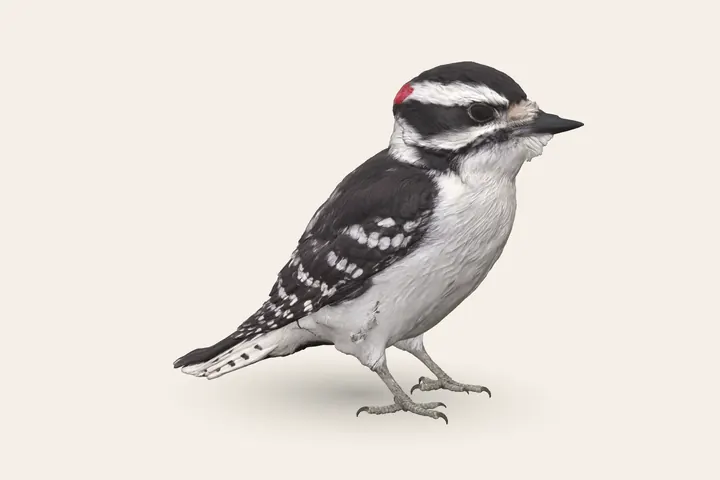 3D model
A Downy Woodpecker is 5.5–7 in (14–18 cm) long, bill to tail.
3D model · Adult male · Length 5.5–7 in (14–18 cm) · How we make our birds · Report a problem
© 2026 NC Digital Limited (Birdfact). All rights reserved. This 3D model may be viewed on this page and shared by link only. Downloading, extracting, copying or reusing it, or using it to train machine-learning models, is not permitted without our written permission. Using our models
On this page16 sections
How to recognise it
What do Downy Woodpeckers look like?
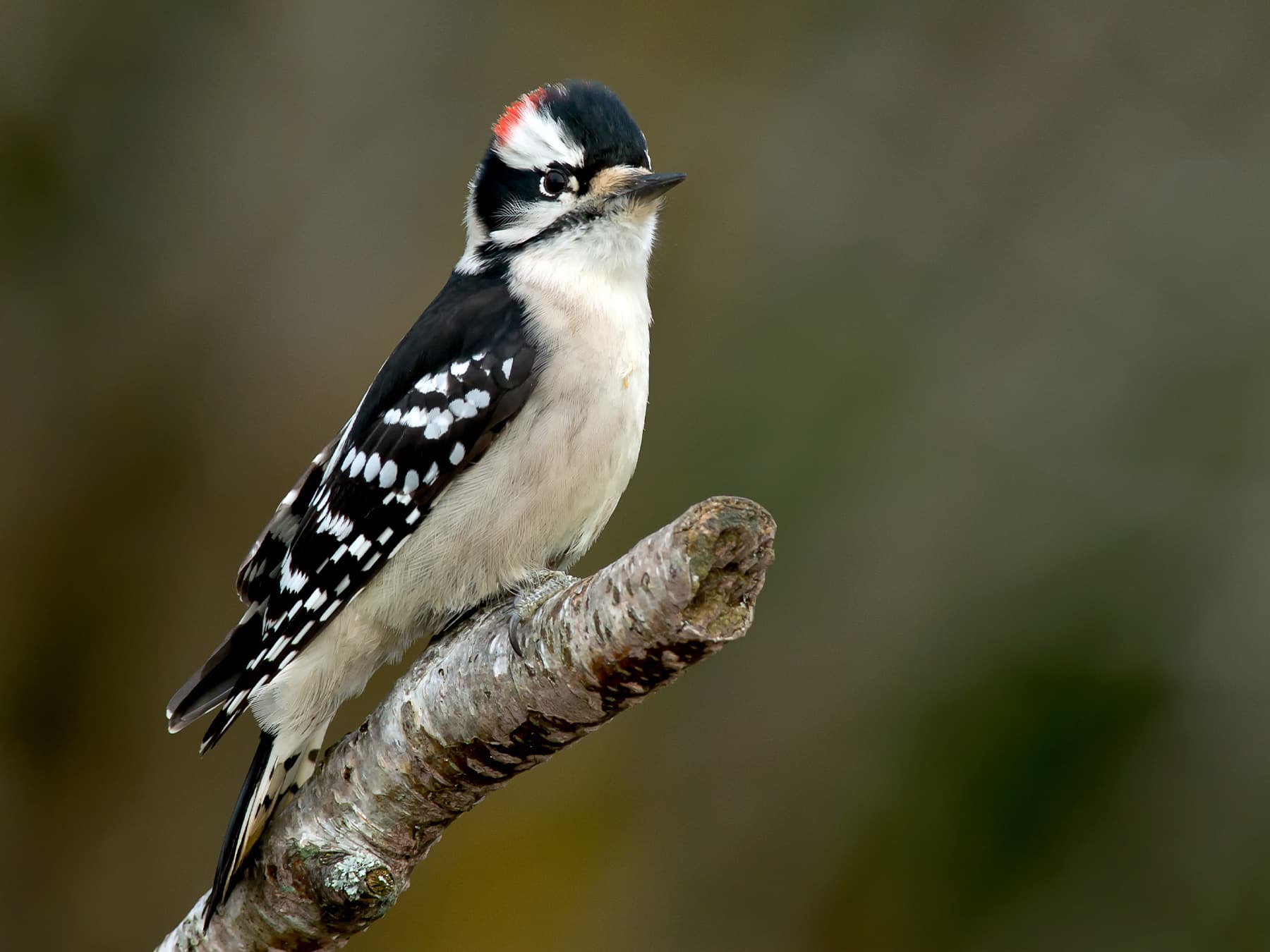
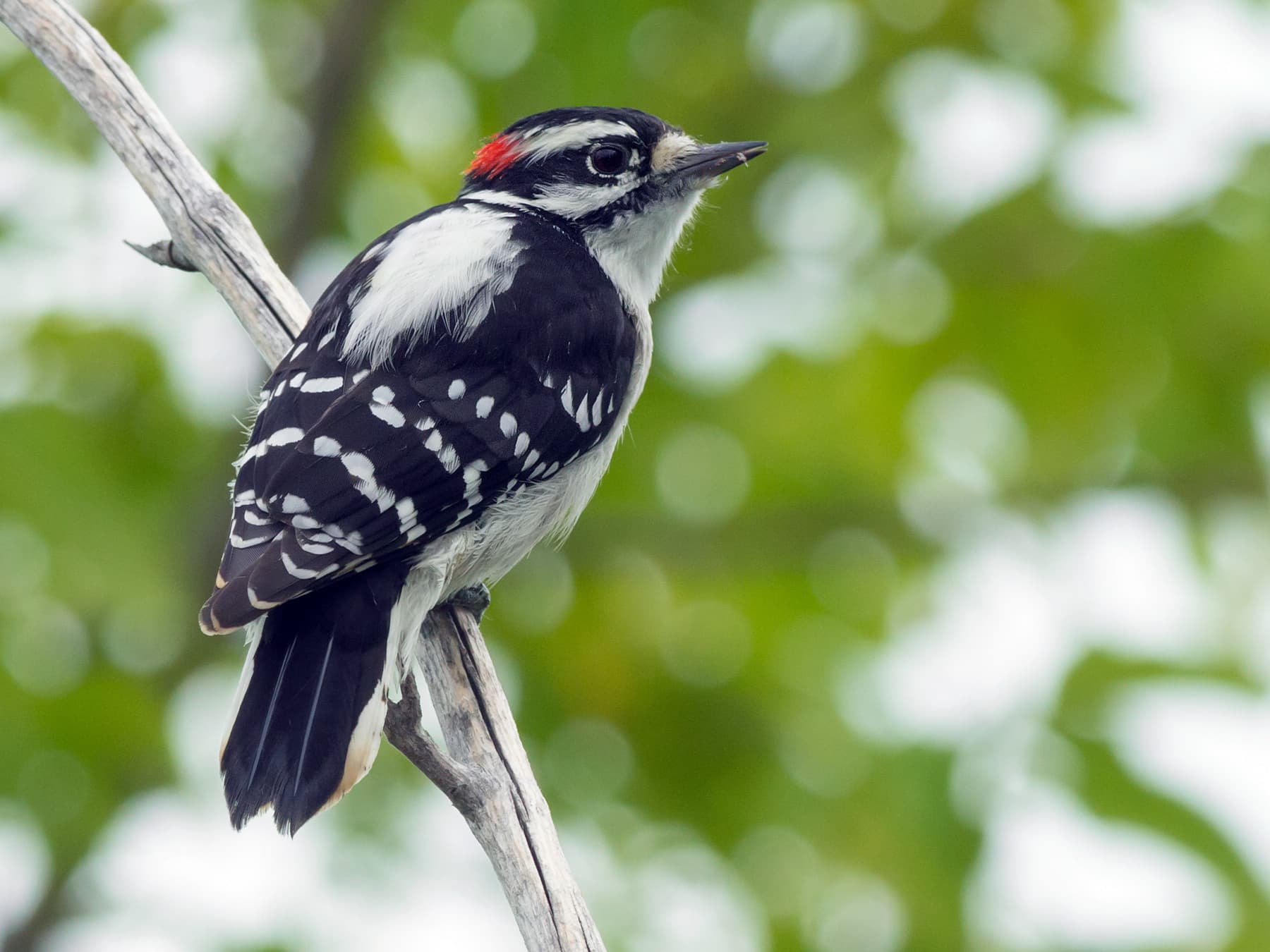
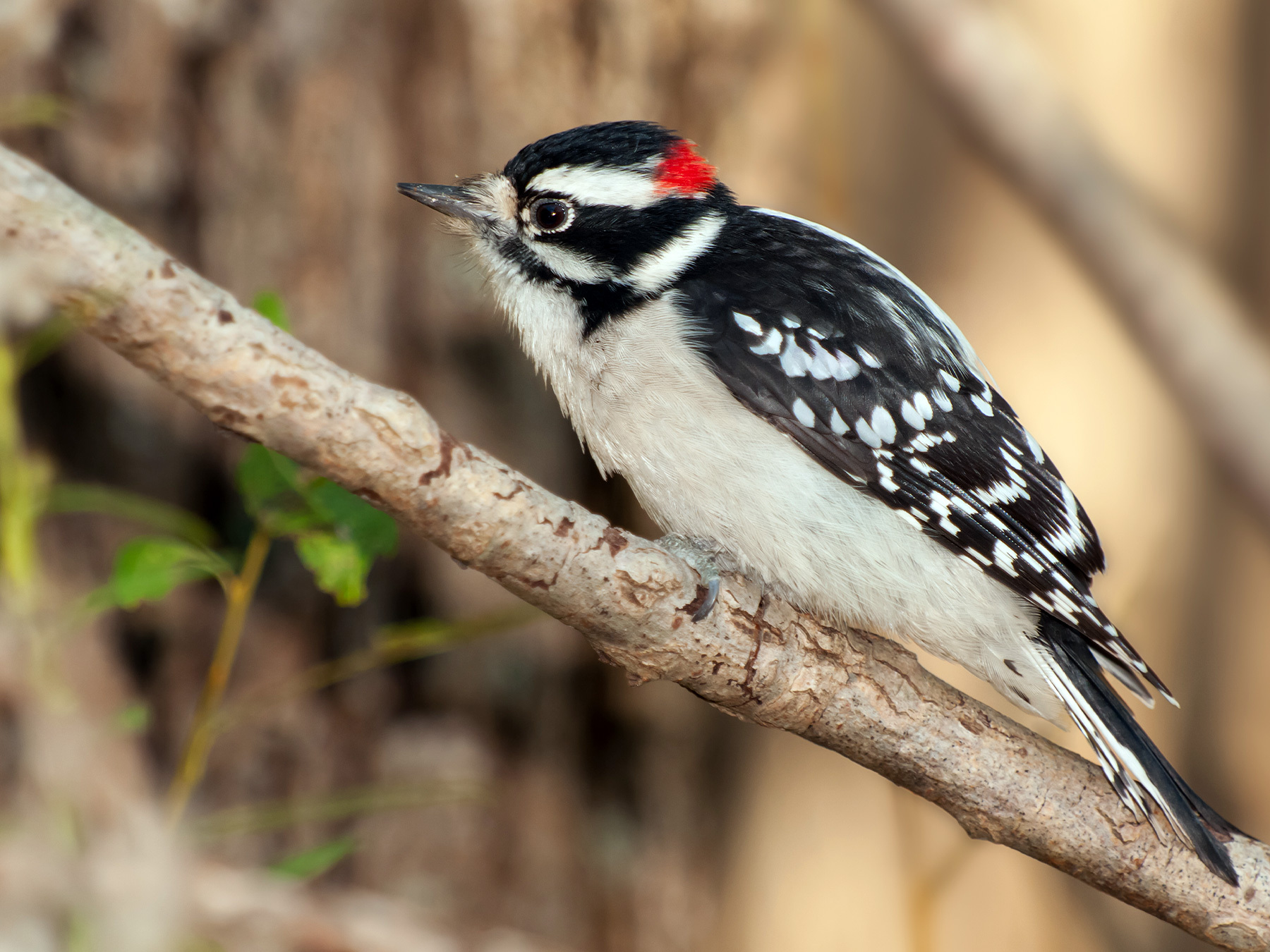
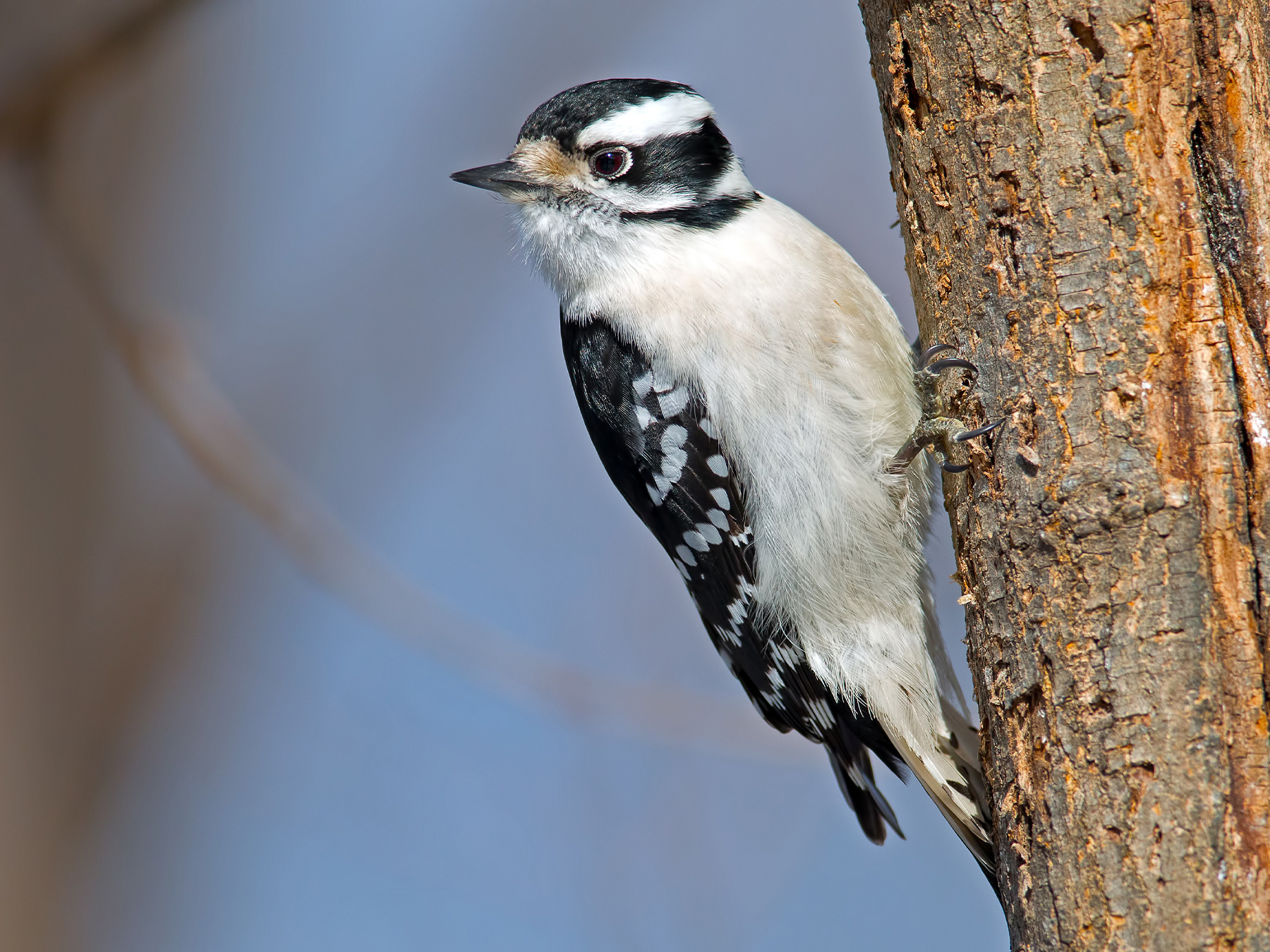
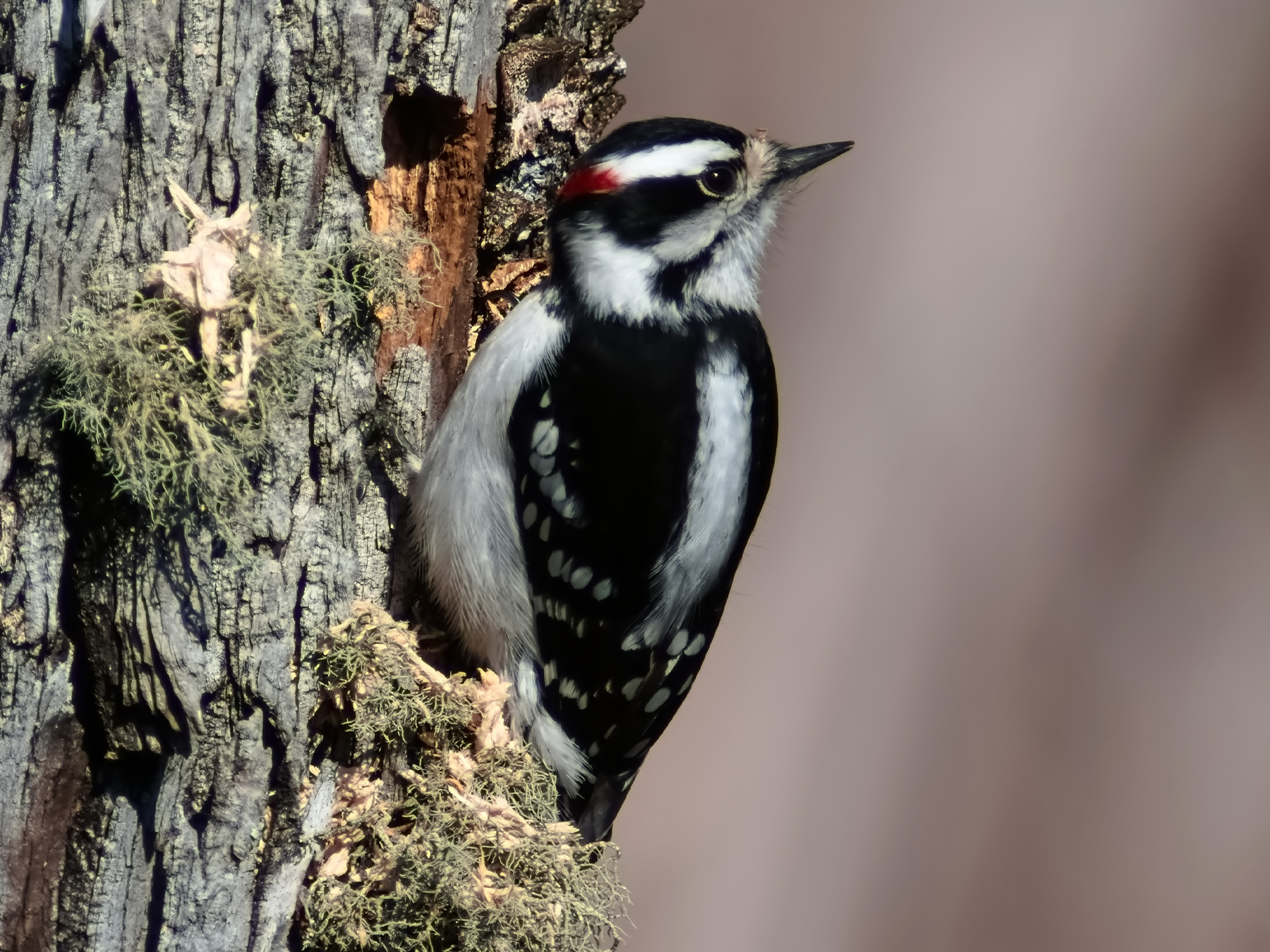
Downy Woodpeckers are small woodpeckers with short, straight bills and contrasting black and white plumage. They are pure white to grayish brown below and on their back. Their wings are black, with numerous small white spots, and their head is boldly striped in black and white.
Their tail is also black but bordered with white outer feathers (rectrices). These outer feathers are spotted, which is a helpful identifying feature visible when birds are perched or seen in their characteristic dipping or undulating flight path. Their eyes and bills are black and their legs are gray.
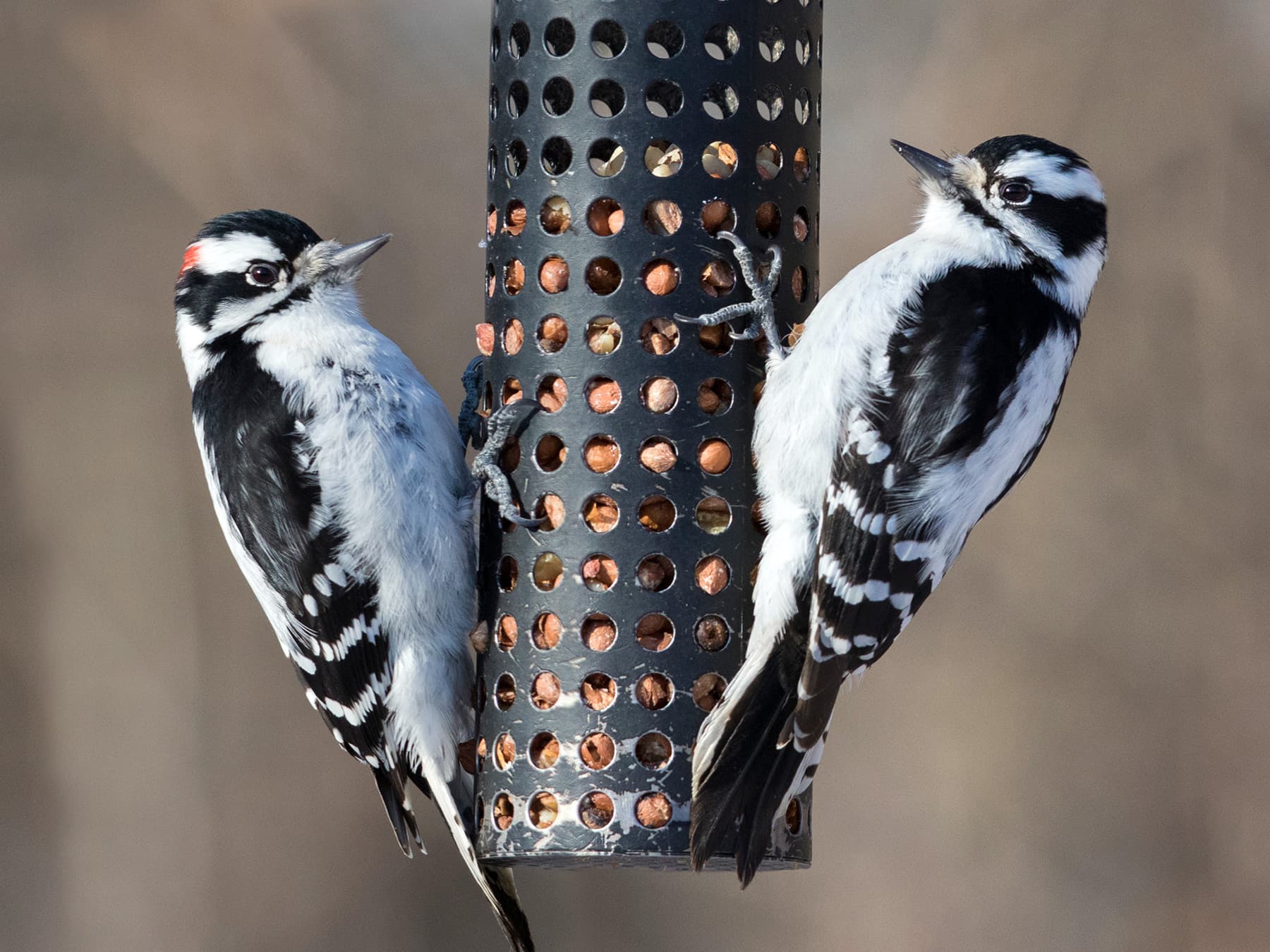
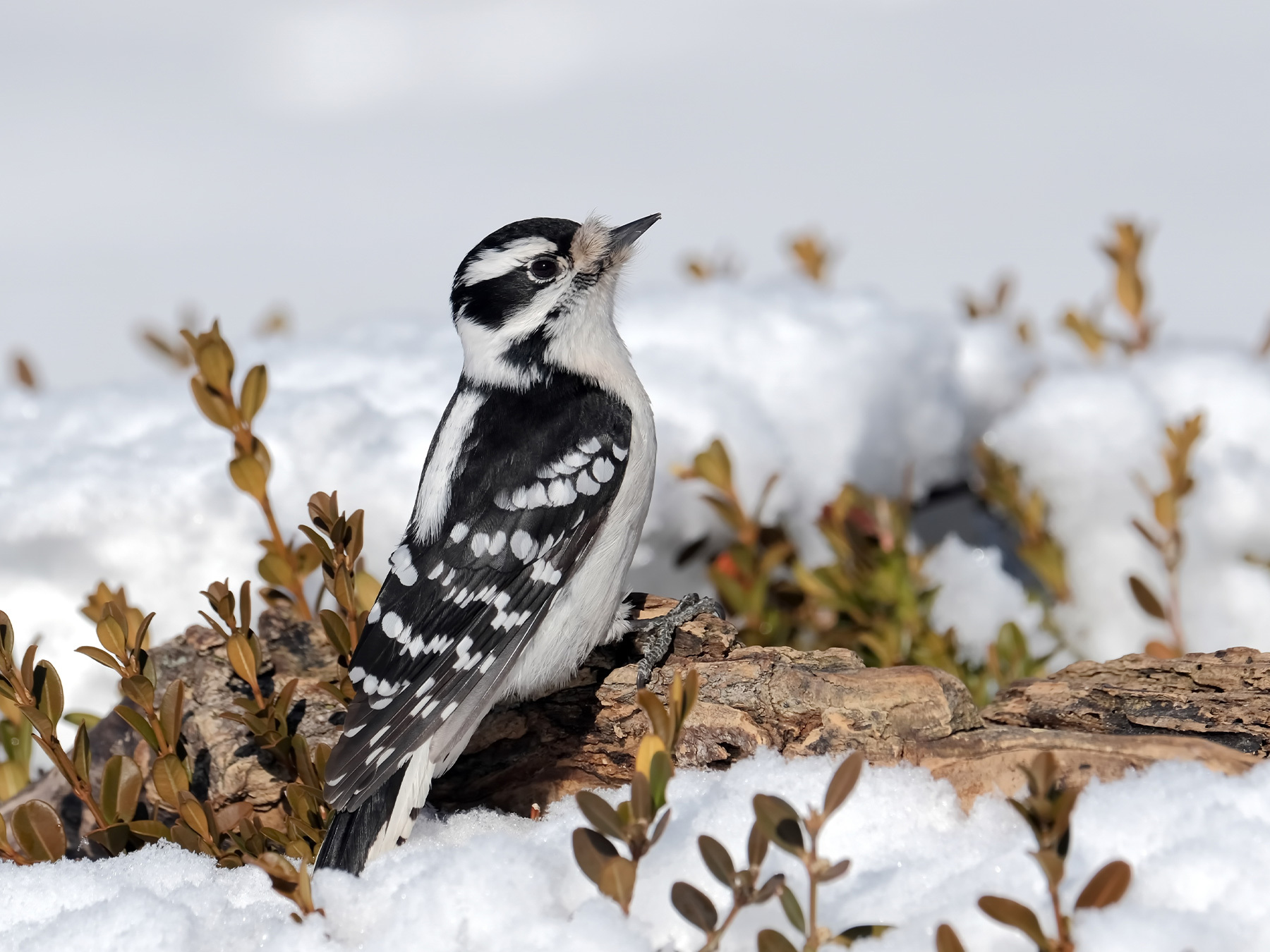
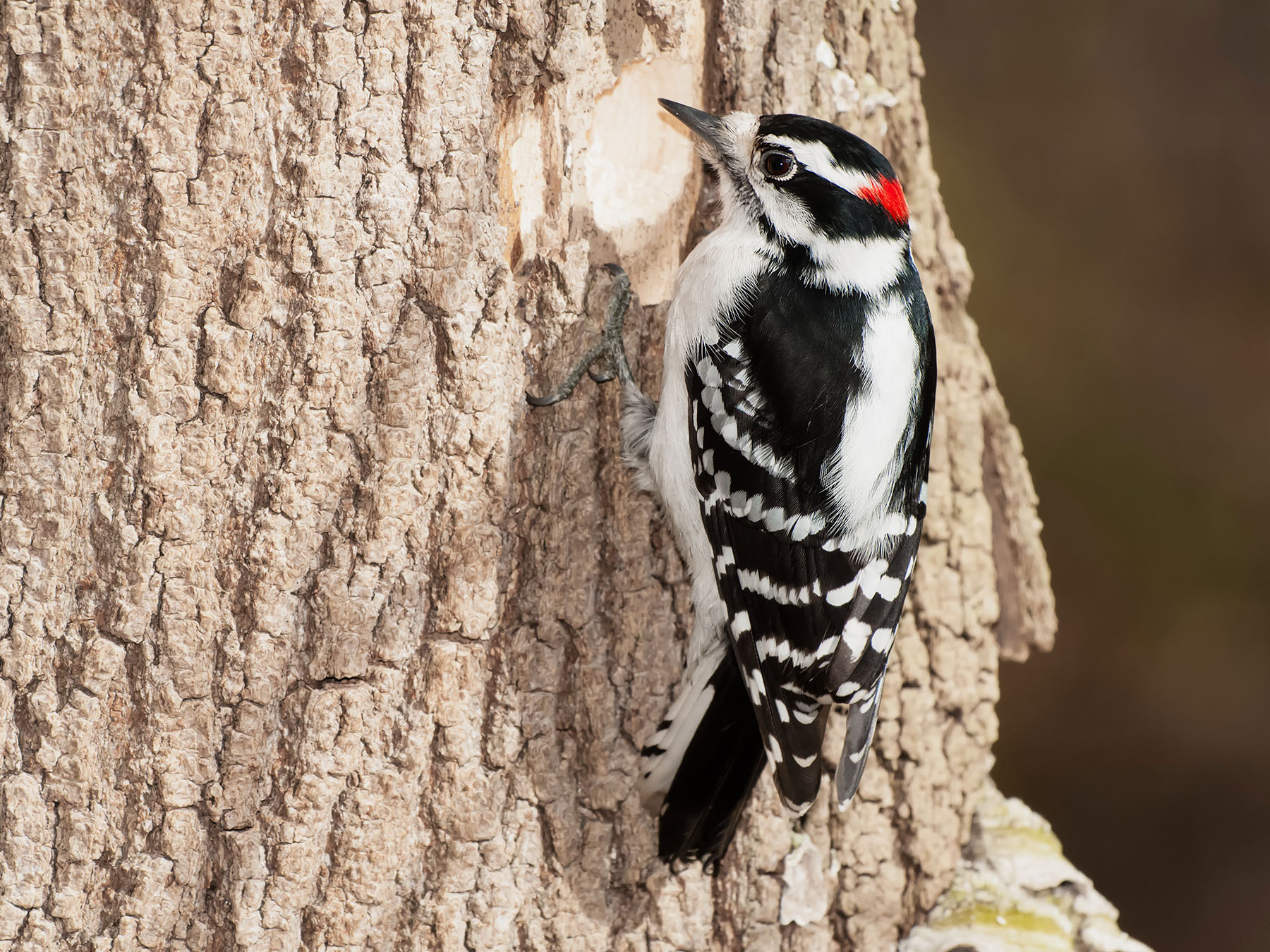
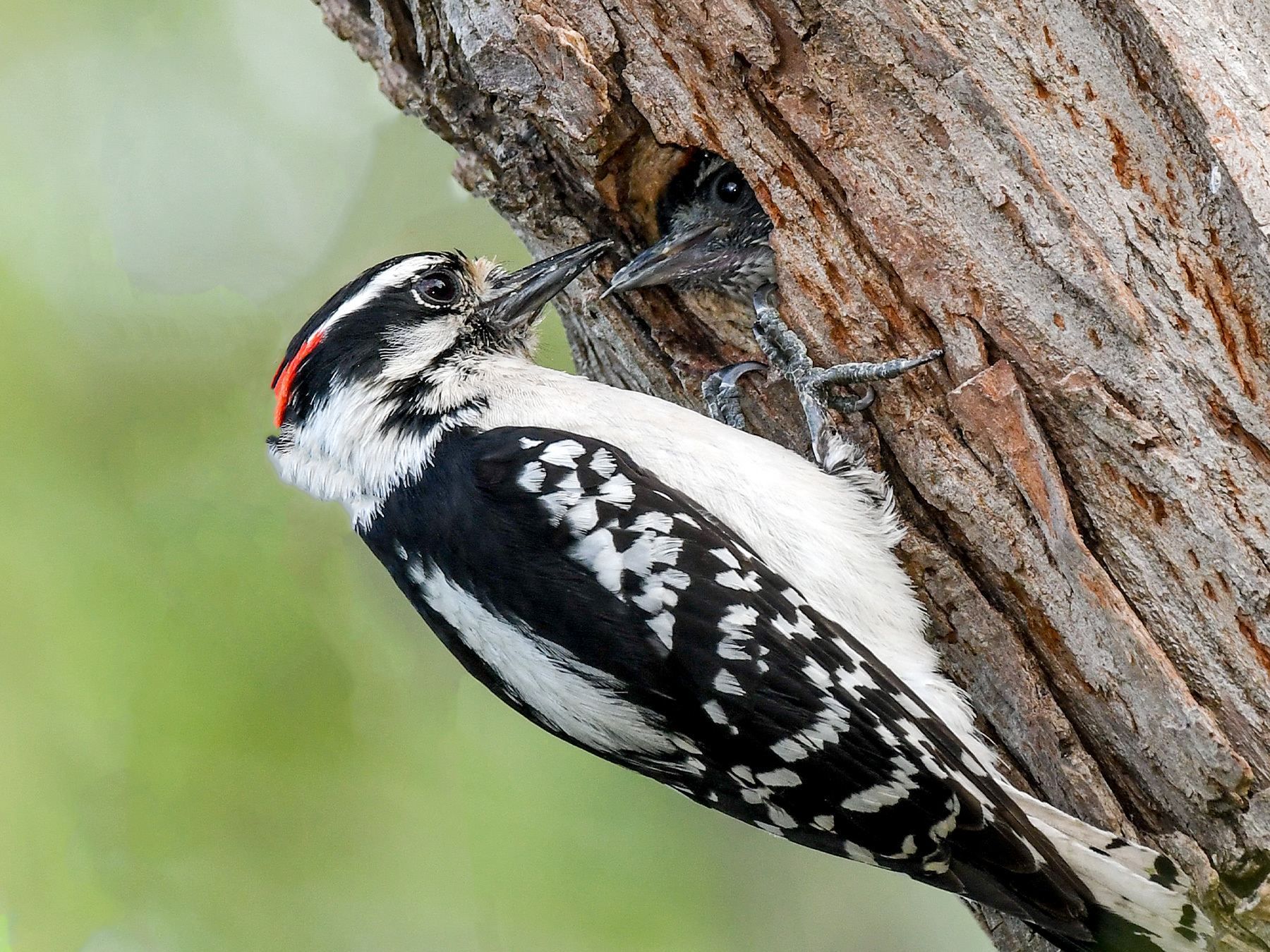
Male and female Downy Woodpeckers are similar but easily identified if you get a good look at their head. Males have a bright red spot on the nape, while females have an all-black cap and nape.
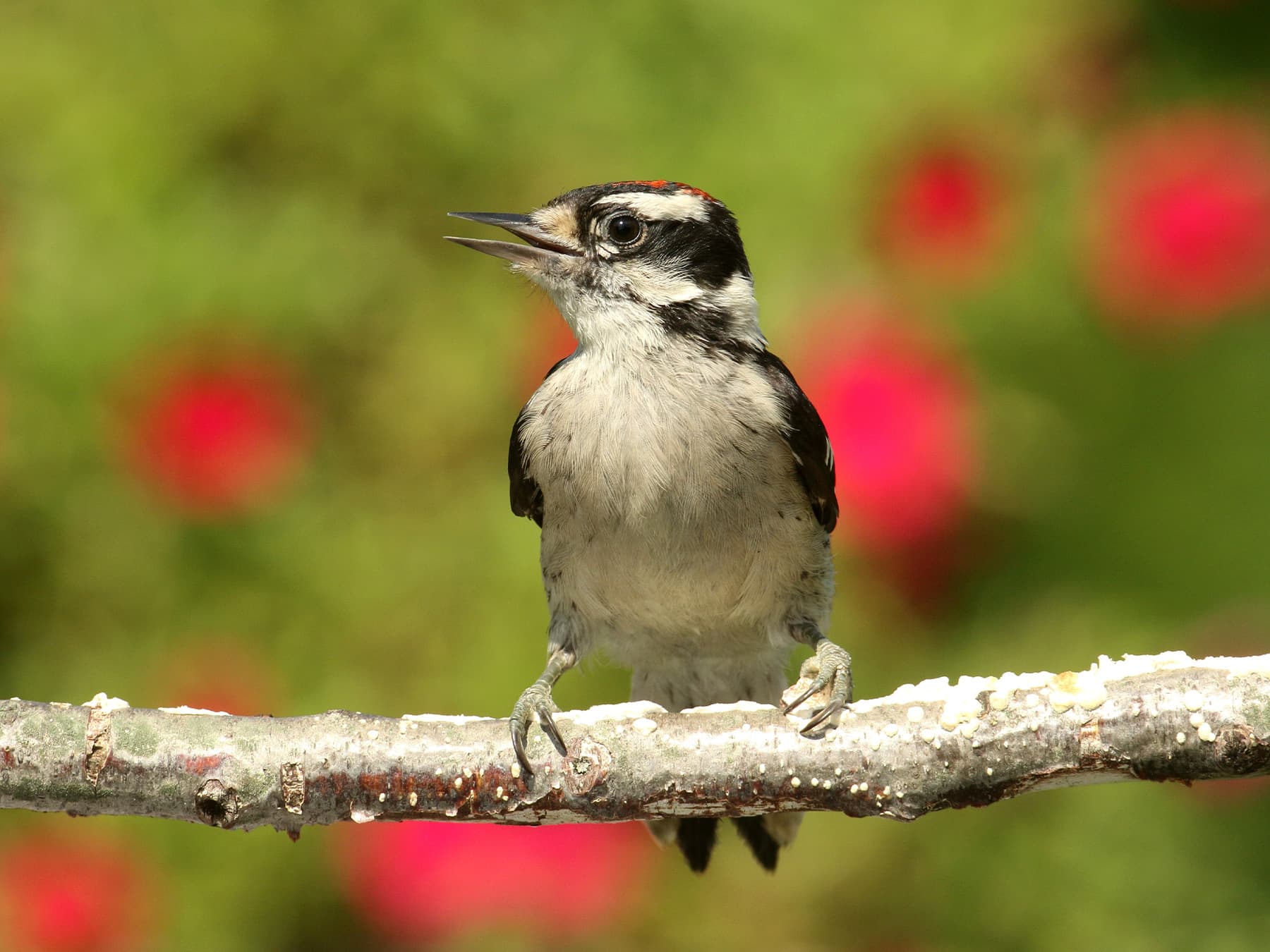
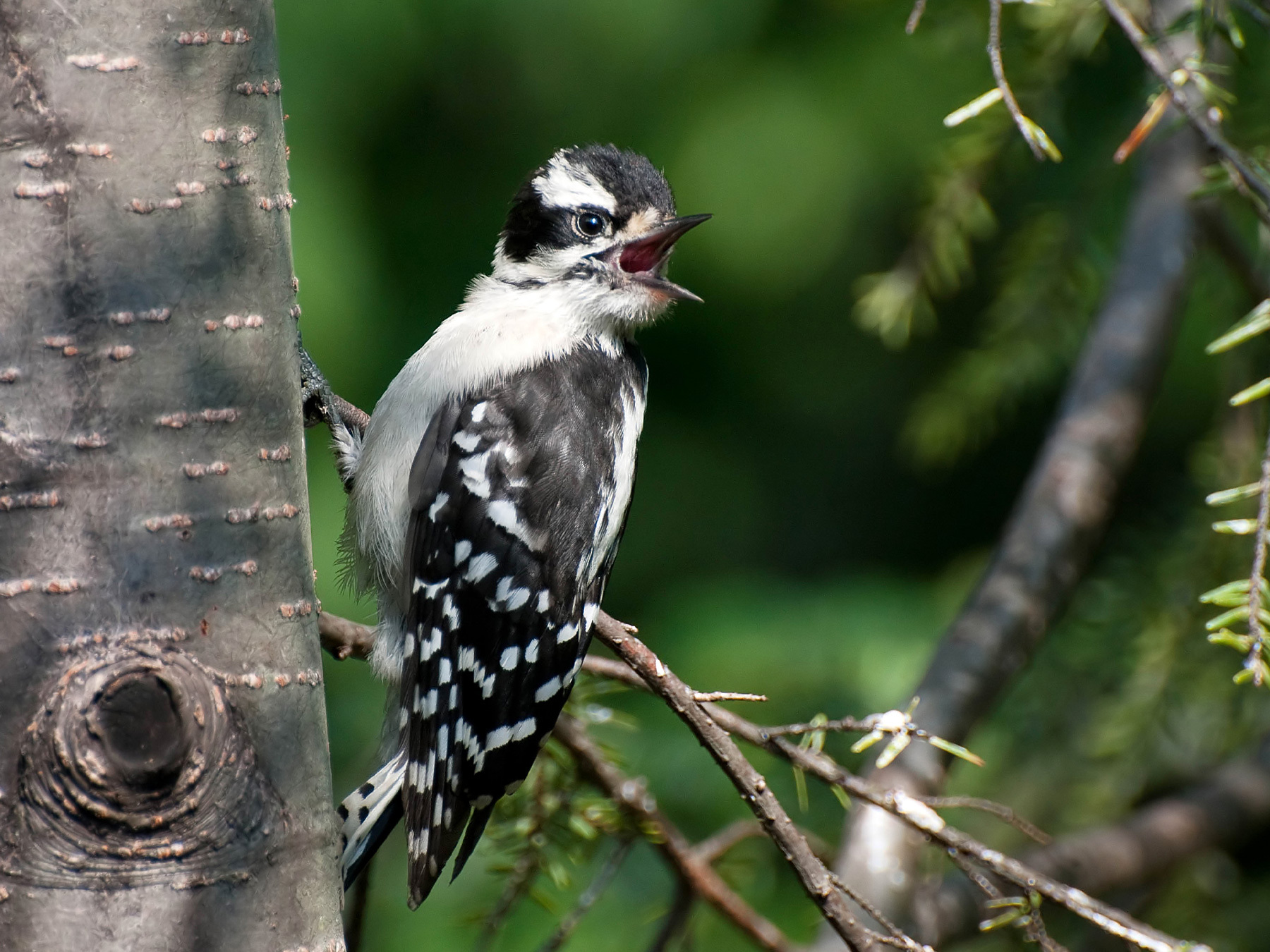
Juveniles are similar to adults but have duller plumage. Again, looking at the head is the best way to identify young birds. Juveniles of both sexes have a red cap, unlike adult males that have a red nape, and adult females that have no red markings at all.
The Downy Woodpecker is most easily confused with the Hairy Woodpecker, but that species is much larger (more than double the weight) and has a longer bill. Check out this in-depth comparison guide for more information on telling them apart.
How big are Downy Woodpeckers?
Downy Woodpeckers are the smallest member of their family in North America. Males and females are similar in size.
Length
Most adults measure about 5½ to 6⅔ inches or 14 to 17 centimeters.
Weight
These birds weigh ¾ to one ounce or 21 to 28 grams.
Wingspan
Their typical wingspan is approximately 10 to 12 inches or 30 to 35 centimeters.
Its size
Adults- Length
- 14–18 cm
- Wingspan
- 25–30 cm
- Weight
- 21–28 g
Its song and calls
What sound does a Downy Woodpecker make?
Downy Woodpeckers make a sharp ‘Pik’ call, either singly, at long intervals, or in a rapid series that speeds toward the end. Both sexes also drum rapidly.
- Call0:00 / 0:04
Recorded in Minnesota, United States · April 2016
- Drumming0:00 / 0:54
Recorded in St, United States · May 2011
When and where to see it
OctoberIn season
Most recorded in October
- 1. Wisconsin3.1%
- 2. Minnesota3.0%
- 3. Michigan3.0%
- 4. Indiana2.9%
- 5. Missouri2.9%
Each dot is a county, state or province: the bigger and darker, the larger the bird’s share of that place’s bird records that month. Grey dots: no regular records. The ringed point is the centre of the bird’s records this month; the arrow shows how it moved since last month, and the dashed loop its path through the year. “Arrivals” colours places where it becomes regular this month (orange) or is in its last regular month (grey). GBIF eBird Observation Dataset, 2019–2024. Map data: Natural Earth, US Census Bureau; place centres © OpenStreetMap contributors.
In your area
See when the Downy Woodpecker is recorded in your county, state or province.
How often the Downy Woodpecker turns up in the United States and Canada through the year, from birdwatchers' records.
United States
Resident · all year · most records in February
Canada
Resident · all year · most records in February
Show as a table
| Month | United States | Canada |
|---|---|---|
| January | 1.9% (regular) | 3.4% (regular) |
| February | 2.0% (regular) | 3.5% (regular) |
| March | 1.7% (regular) | 2.4% (regular) |
| April | 1.5% (regular) | 1.8% (regular) |
| May | 1.2% (regular) | 1.2% (regular) |
| June | 1.1% (regular) | 0.74% (regular) |
| July | 1.3% (regular) | 1.1% (regular) |
| August | 1.4% (regular) | 1.4% (regular) |
| September | 1.8% (regular) | 1.5% (regular) |
| October | 1.8% (regular) | 1.8% (regular) |
| November | 1.8% (regular) | 2.5% (regular) |
| December | 2.0% (regular) | 3.2% (regular) |
Worldwide: recorded regularly in 3 countries
Countries where it was recorded in at least 3 of the 6 years 2019–2024. Linked countries have their own bird list.
North America (3)
Data: EOD – eBird Observation Dataset (Cornell Lab of Ornithology), accessed via GBIF.org, CC BY 4.0. Records from 2019–2024, aggregated and filtered by Birdfact. How these lists are made
What is the habitat of a Downy Woodpecker?
Downy Woodpeckers prefer deciduous forests and woodlands, although they are adaptable and can be found in parks, backyards, orchards, and other human-altered environments.
What is the range of a Downy Woodpecker?
Downy Woodpeckers are restricted to North America, where they are widespread from Alaska to Canada’s Maritime Provinces and south through the Contiguous United States to Florida in the Southeast and coastal California in the Southwest. They do not occur in Mexico.
Where do Downy Woodpeckers live?
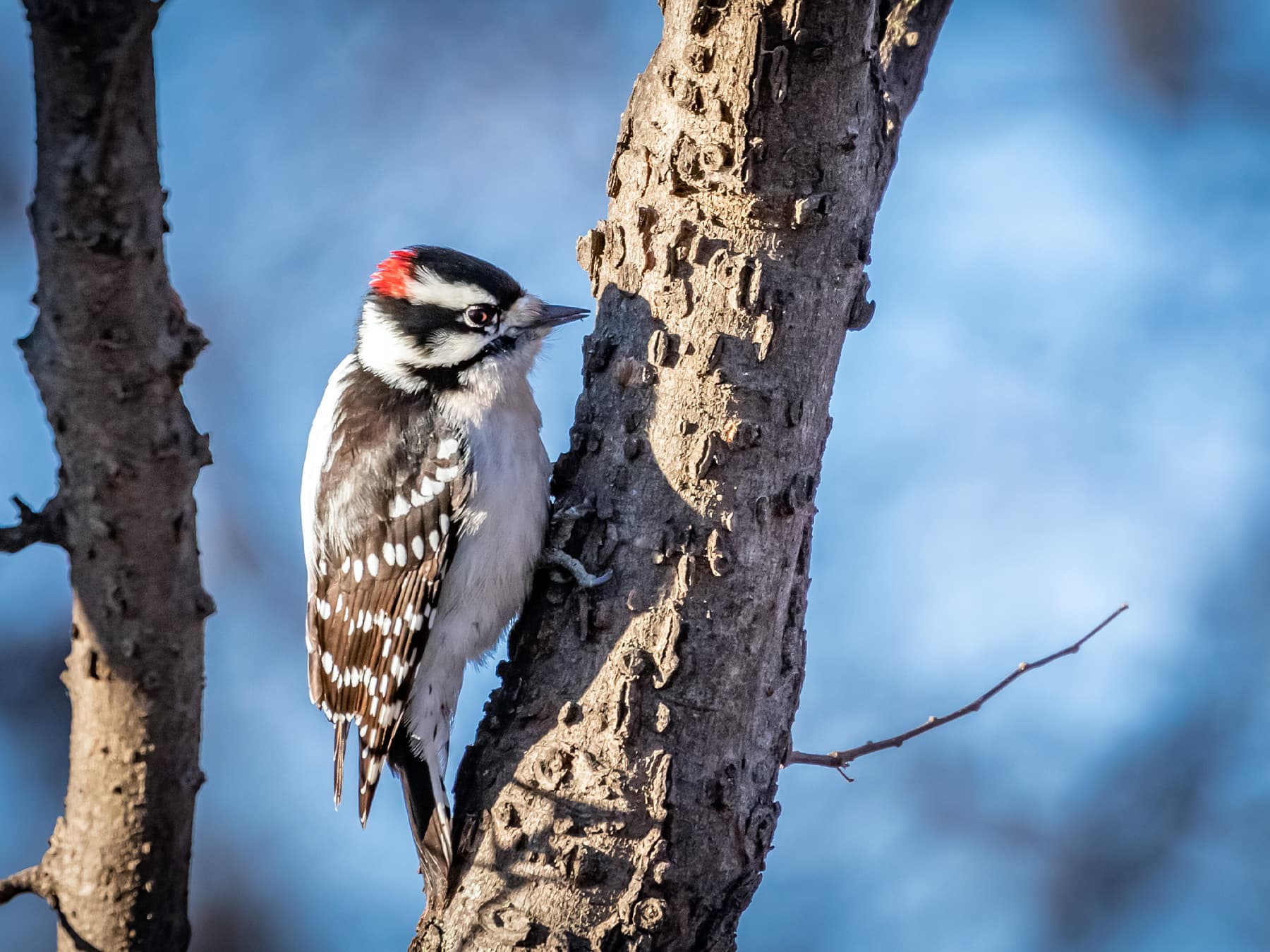
Downy Woodpeckers spend most of their lives in trees and other tall vegetation. They are expert climbers that use their specialized zygodactyl feet to cling to tree bark, easily hanging upside down. These birds also descend to the ground to forage, bathe, and drink.
How rare are Downy Woodpeckers?
Downy Woodpeckers are the most numerous woodpeckers across much of their range. They are common birds in suitable habitats and regular backyard visitors.
Where can you see Downy Woodpeckers in the US?
This species occurs year-round in every state in the Continental US, including the south of Alaska. However, they are absent from parts of the Southwest, including western California, Arizona, New Mexico, and eastern Texas.
Look and listen out for Downy Woodpeckers everywhere from deciduous woodlands in wilderness areas to city parks and backyards. American birdwatchers can also encourage these birds by putting out their favorite foods and a bird bath.
Where can you see Downy Woodpeckers in Canada?
Downy Woodpeckers occur in suitable habitats in every province and territory in Canada except for Nunavut.
Migration
Do Downy Woodpeckers migrate?
Downy Woodpeckers are primarily sedentary, although birds from the far north of their range may undertake irregular southward winter movements in some years.
Are Downy Woodpeckers native to the US?
Downy Woodpeckers are native to the United States. Each of the seven known subspecies occurs at least partially in the USA.
Tips for seeing it
- Look for Downy Woodpeckers in wooded areas, parks, and backyard gardens
- Listen for their distinctive 'pik' call or rapid drumming on trees
- Observe their foraging behavior on small branches and twigs
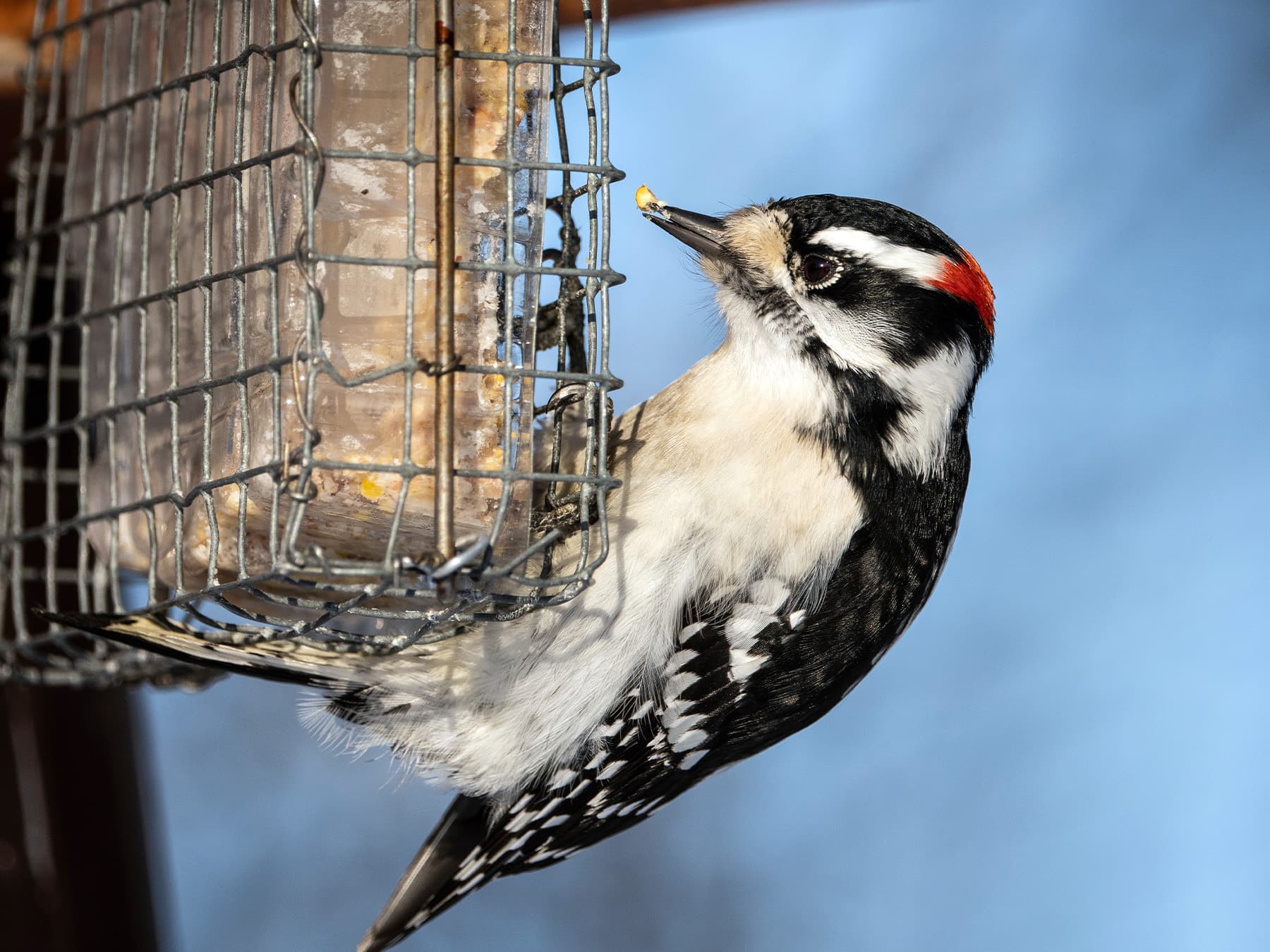
- Attract them to your yard with suet feeders or peanut butter
- Note their small size to distinguish them from the similar but larger Hairy Woodpecker
What it eats
What do Downy Woodpeckers eat?
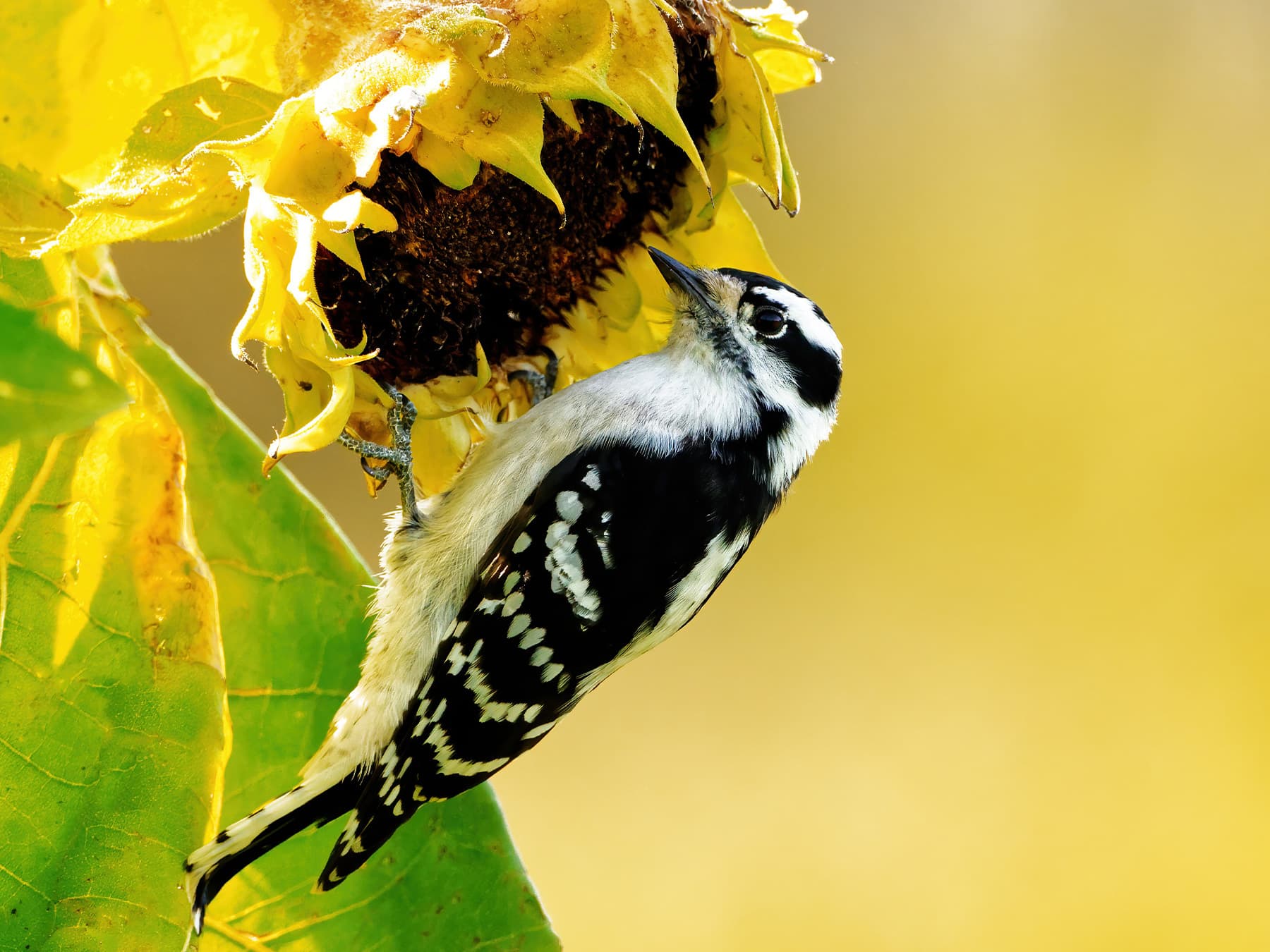
Downy Woodpeckers are mostly insectivorous, although they will take seeds, berries, and acorns. Their favorite prey is ants, beetle grubs, and caterpillars which they find in soft wood, under bark, on tree trunks and foliage, and occasionally, on the ground. These birds are regular visitors to well-stocked bird feeders where they enjoy suet, peanut butter, and sunflower seeds.
Read this complete guide for more information on the Downy Woodpecker diet.
What do Downy Woodpecker chicks eat?
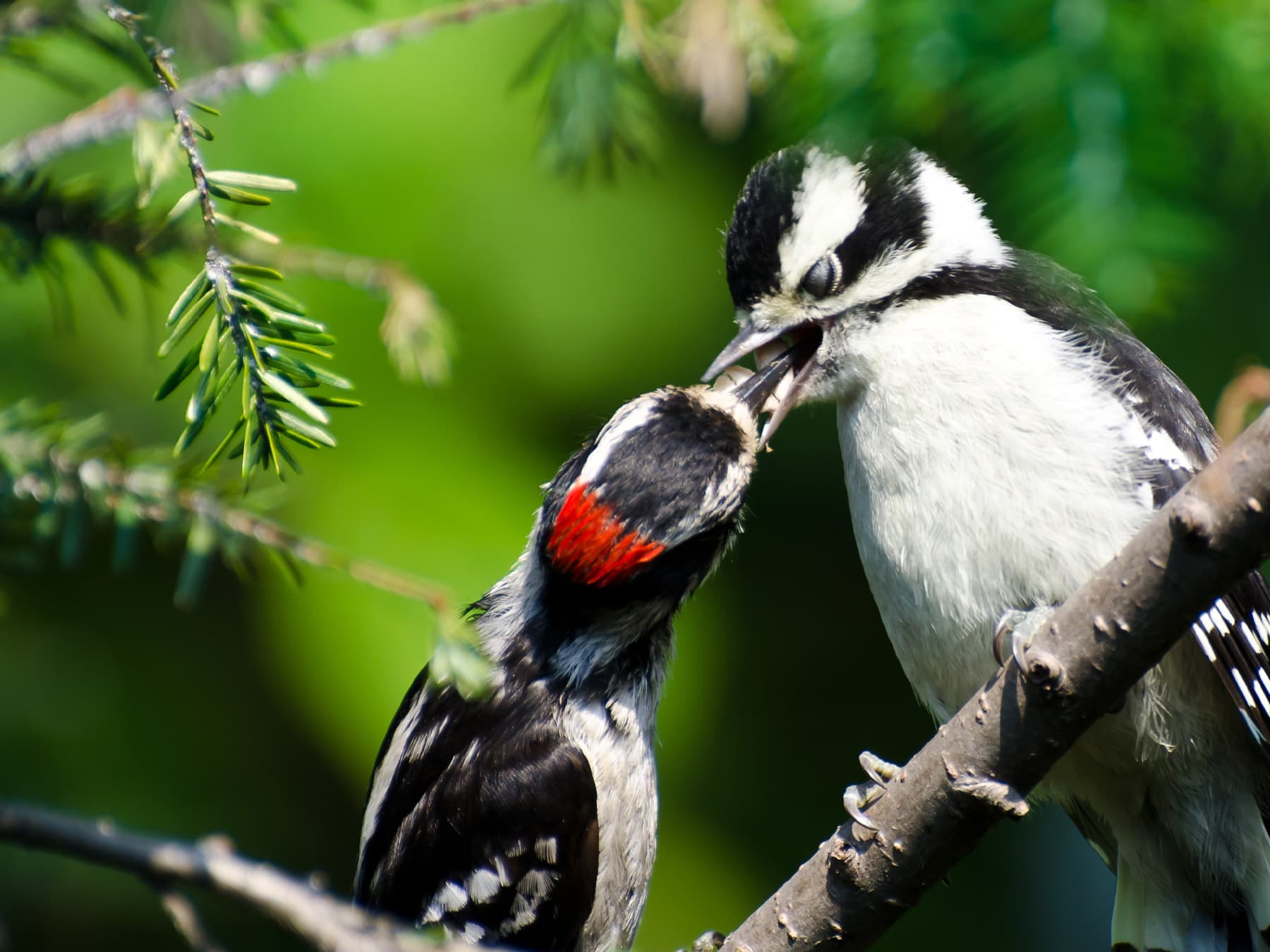
Downy Woodpecker chicks eat insects supplied by both parents.
Nesting and breeding
Where do Downy Woodpeckers nest?
Downy Woodpeckers nest in cavities excavated in trees. They do not build a nest at the end of the tunnel, although wood chips create a soft bed for their eggs and chicks.
These birds prefer dead trees or dead branches of living trees that are easier to work, and they will nest anywhere from three to sixty feet above the ground. Both partners work together to build the nest, which usually takes one to three weeks.
When do Downy Woodpeckers nest?
Downy Woodpeckers nest in spring and summer between March and July. They produce a single clutch of eggs which hatch after about twelve days. The young birds leave the nest some three weeks later but continue to rely on their parents for several weeks after fledging.
Check out this article for much more on Downy Woodpecker nesting.
What do Downy Woodpecker eggs look like?
Downy Woodpeckers lay three to eight plain white eggs, each measuring about ¾ inches long and ⅗ inches wide (19 x 15 mm).
Do Downy Woodpeckers mate for life?
Downy Woodpeckers are monogamous in the breeding season, although they may pair up with different partners in their lifetime. Some pairs will remain together throughout the year or reunite before the following nesting season.
Behaviour
Are Downy Woodpeckers aggressive?
Downy Woodpeckers are very aggressive in the breeding season and do not tolerate other members of their species near their nest. They respond by displaying, calling, drumming, and even physically attacking the intruder if necessary.
Where do Downy Woodpeckers sleep at night?
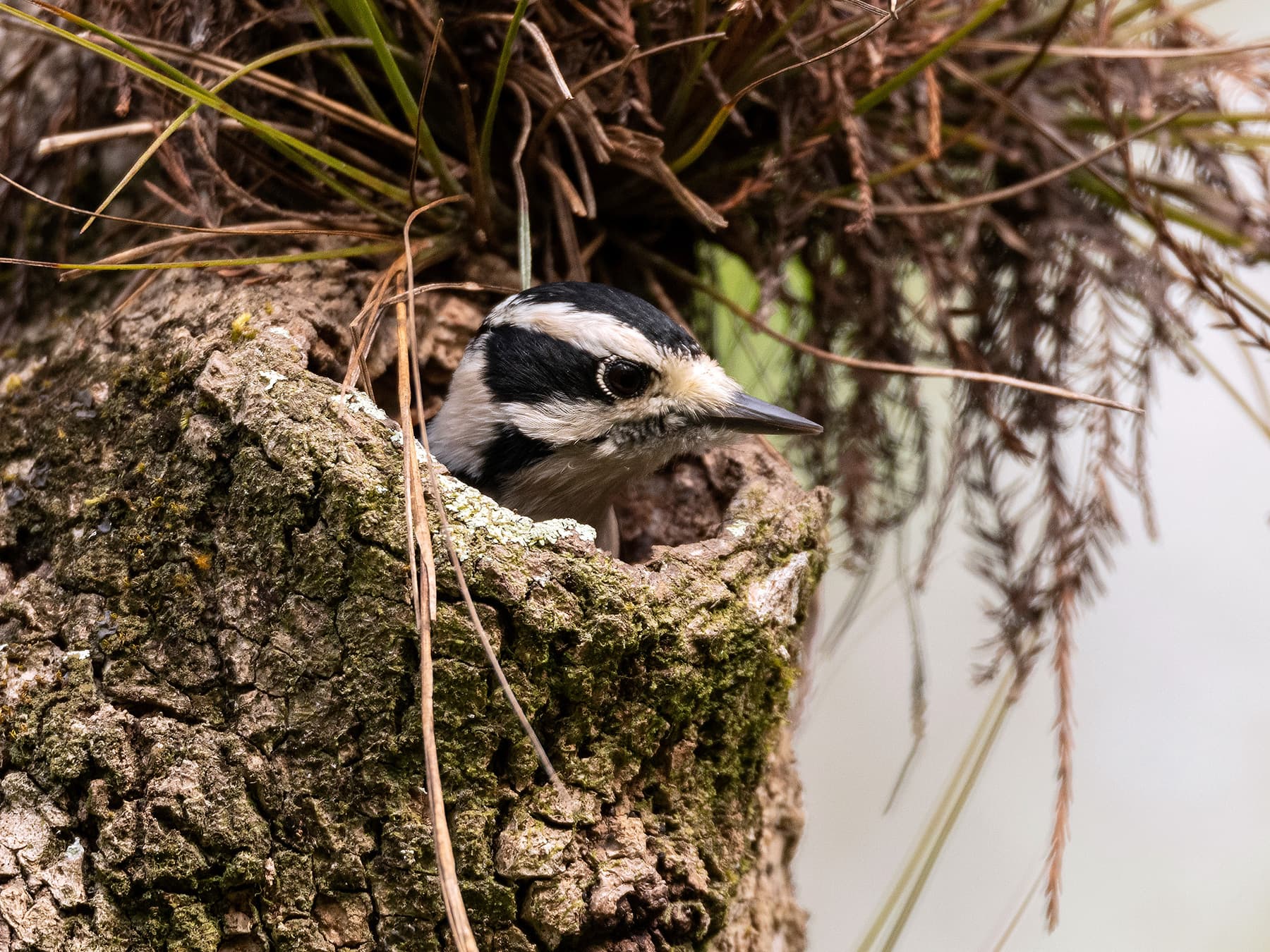
Downy Woodpeckers sleep in holes that they drill into trees. They may also use nest boxes or drill their holes into buildings.
Lifespan and predators
How long do Downy Woodpeckers live?
Downy Woodpeckers have been known to live for over eleven years, although their average lifespan is just a few years.
What are the predators of Downy Woodpeckers?
Many small predators will take Downy Woodpeckers if given the chance, although adults are most vulnerable to small birds of prey like Sharp-shinned and Cooper’s Hawks. Domestic cats are also a potential threat to low-foraging birds. Their eggs and chicks are safe from most large predators, although snakes and squirrels may access their nests.
Are Downy Woodpeckers protected?
Downy Woodpeckers are a protected species in the United States and Canada.
Are Downy Woodpeckers endangered?
Downy Woodpeckers are a common and secure species with a ‘Least Concern’ status on the IUCN Red List.
Conservation
Downy Woodpeckers are currently listed as Least Concern due to their large range and stable population. However, they face challenges from habitat loss and fragmentation in urban areas.
Conservation efforts focus on preserving mature trees and promoting diverse forest structures to maintain suitable habitats.
Similar birds
Often mistaken for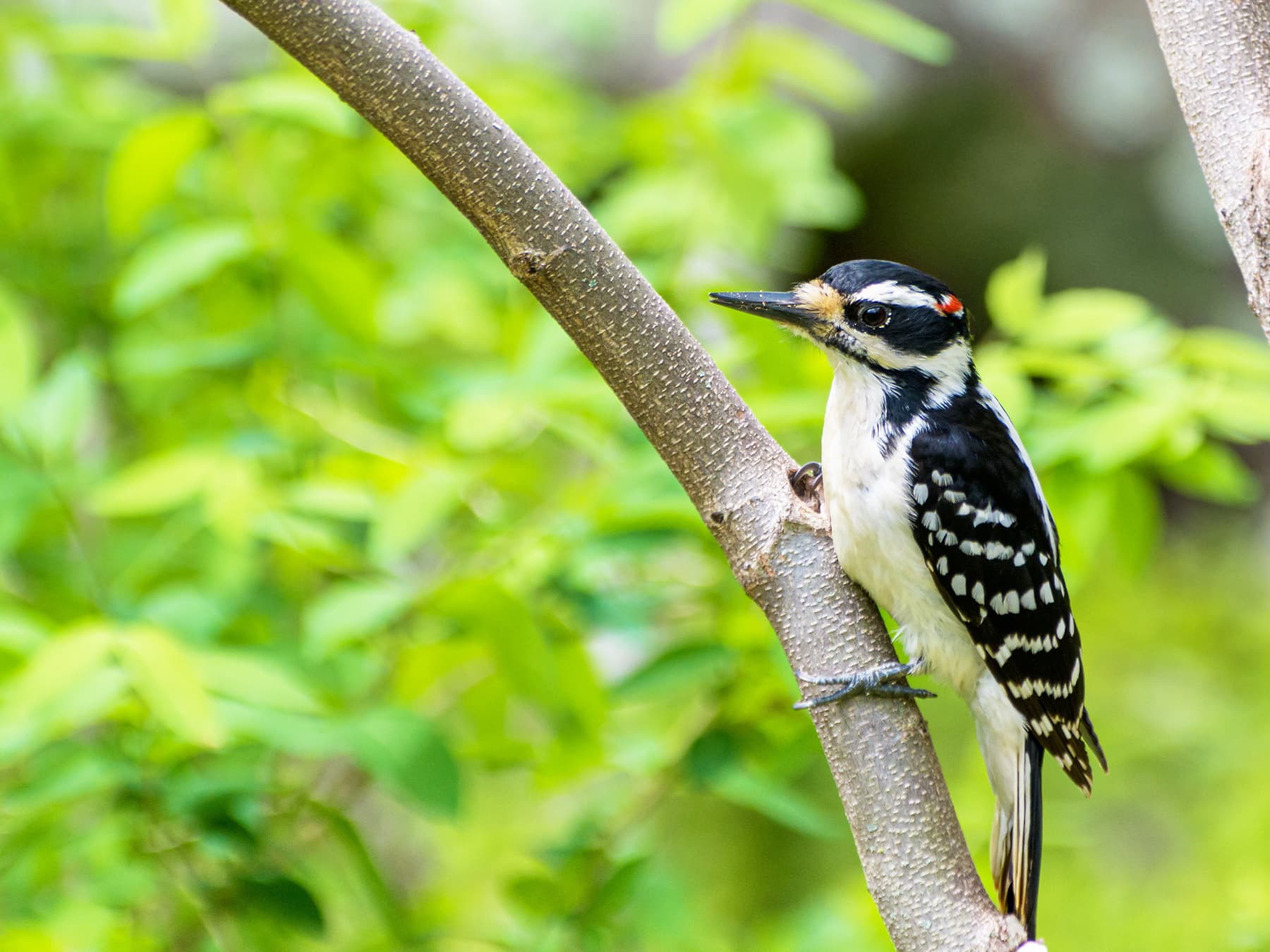
More photos
8 photos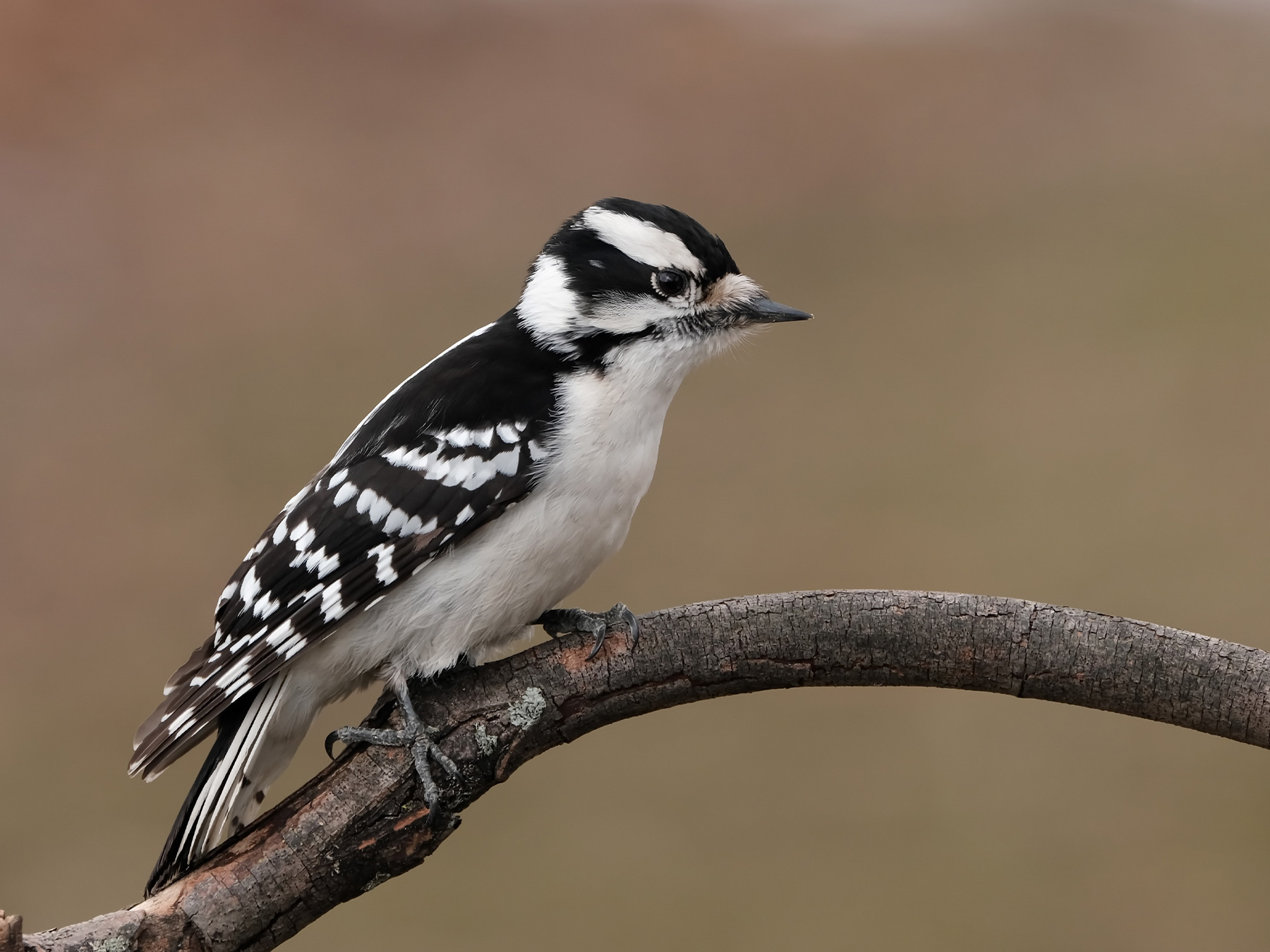
Downy Woodpecker guides
2 guidesQuick facts
- Length
- 14–18 cm
- Wingspan
- 25–30 cm
- Weight
- 21–28 g
- Lifespan
- 2–5 years
- Family
- Woodpeckers
- Migration
- Resident
- Global status (IUCN)
- Least Concern
- World population
- 13,000,000 mature individuals
- Population trend
- Stable
- Also called
- Downy
- Scientific name
- Dryobates pubescens
Questions
6What attracts Downy Woodpeckers?
Birdwatchers can attract Downy Woodpeckers by hanging out suet cage feeders. They will also visit other bird feeders to snack on oily, energy-rich foods like peanut butter and sunflower seeds. A native woodland-style garden will also attract these entertaining birds, along with many songbird species.
What trees do Downy Woodpeckers prefer?
Downy Woodpeckers forage on a wide variety of trees, although they definitely prefer deciduous species over conifers. They are commonly seen feeding and nesting in trees like maples, willows, aspens, beeches, cottonwoods, and birch trees.
Do Downy Woodpeckers harm trees?
Downy Woodpeckers usually do not harm trees. They prefer to excavate nesting and roosting chambers in trees that are already dead or on limbs that are dead or dying from fungal infections.
Do Downy Woodpeckers go to bird feeders?
Downy Woodpeckers are regular visitors to bird feeders in backyards across North America. They feed from various feeder styles but are best adapted to hang from suet feeders and mesh tube feeders.
Will a Downy Woodpecker drink from a hummingbird feeder?
Downy Woodpeckers have a sweet tooth. These birds are known to feed on nectar from hummingbird feeders, but only if there’s a spot for them to cling or perch.
Why is a Downy Woodpecker pecking my house?
Unfortunately, Downy Woodpeckers are known to peck on houses for various reasons, including:
- Nest/roost site excavation
- Drumming
- Feeding
Downy Woodpeckers drill holes to make a cozy chamber for nesting or sleeping at night. They also peck to make noise because timber walls provide a resonant surface for attracting a mate or deterring other woodpeckers in the area. Lastly, woodpeckers might peck on rotten or untreated timber to access woodboring beetle larvae living in the wood.
Sources
3- 1BirdLife International. 2016. Dryobates pubescens. The IUCN Red List of Threatened Species 2016: e.T22681155A92894756. Source (opens in a new tab)
- 2Butcher and Niven (2007)
- 3Rosenberg, K. V., J. A. Kennedy, R. Dettmers, R. P. Ford, D. Reynolds, J. D. Alexander, C. J. Beardmore, P. J. Blancher, R. E. Bogart, G. S. Butcher, A. F. Camfield, A. Couturier, D. W. Demarest, W. E. Easton, J. J. Giocomo, R. H. Keller, A. E. Mini, A. O. Panjabi, D. N. Pashley, T. D. Rich, J. M. Ruth, H. Stabins, J. Stanton, and T. Will (2016). Partners in Flight Landbird Conservation Plan: 2016 Revision for Canada and Continental United States. Partners in Flight Science Committee.

Checked by
Nathan Cope, founder and editor
Nathan founded Birdfact and leads its writers and contributors in the UK, the US and Canada. He has watched and studied birds for more than ten years, and checks every article and species guide before it’s published.