Species Profile
Least Flycatcher
Empidonax minimus
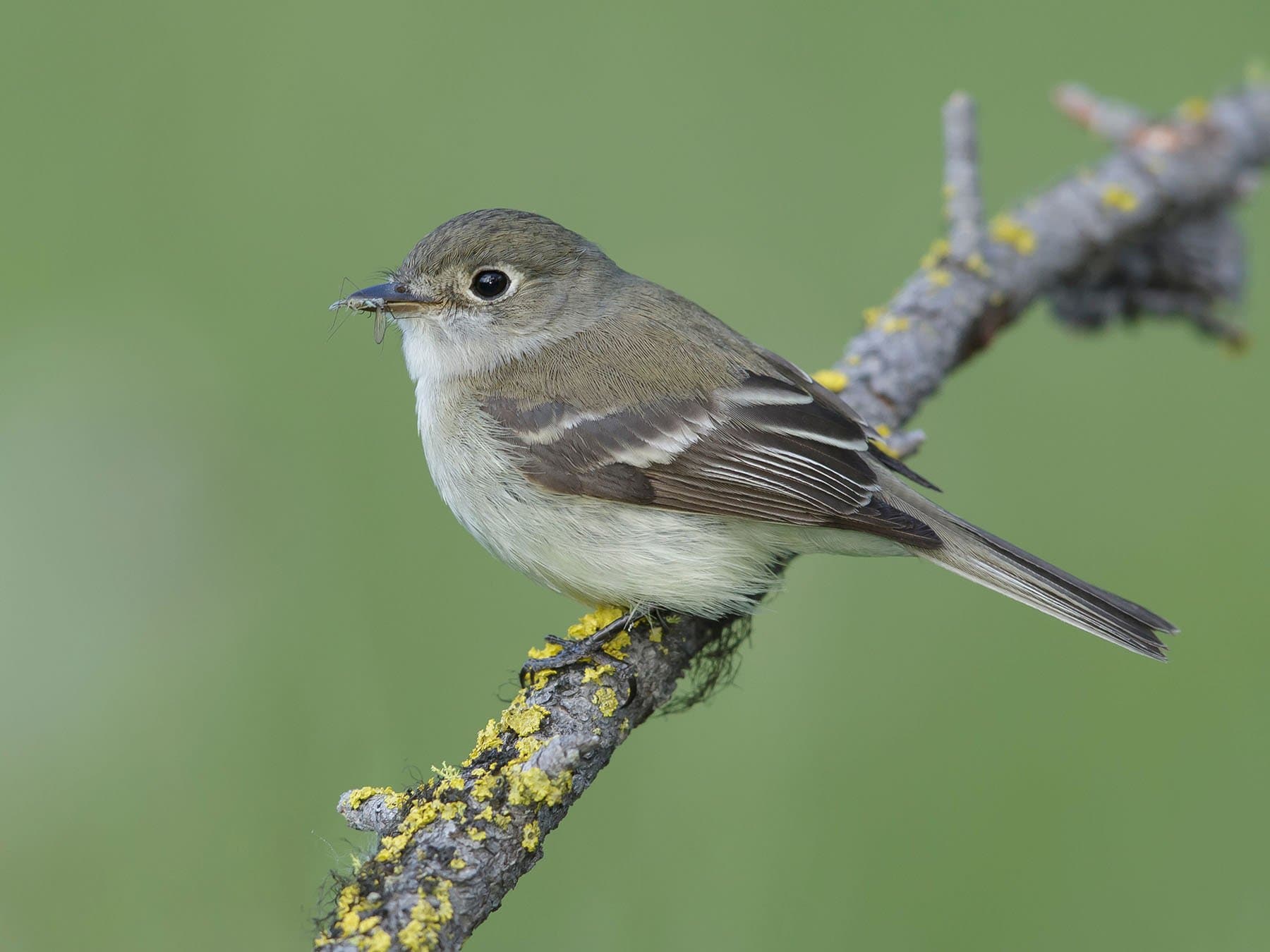
Least Flycatcher perched on a lichen-covered branch, holding an insect in its beak. Shows grayish-olive plumage, pale underparts, and two wing bars.
Quick Facts
Conservation
LCLeast ConcernLifespan
3–6 years
Length
12–14 cm
Weight
8–13 g
Wingspan
19–22 cm
Migration
Long-distance Migrant
Barely larger than a sparrow, the Least Flycatcher packs an outsized personality into a compact frame — its dry, emphatic che-BEC call, fired at roughly 60 times per minute on a summer morning, is one of the most insistent sounds in the North American forest. Despite a global population of around 27 million, this small tyrant flycatcher has lost more than half its numbers since 1970, making it one of the continent's most quietly troubled common birds.
Think you've spotted a Least Flycatcher?
Upload a photo and we'll confirm it instantly
Confirm with a PhotoAppearance
Among the Empidonax flycatchers of eastern North America, the Least Flycatcher holds the title of smallest — a compact, upright bird with a notably round, unpeaked head and a short, narrow bill. Its upperparts are dull olive-grey, distinctly greyer than most of its close relatives, with two crisp white wingbars visible on the folded wing. The underparts are whitish, with a dusky wash across the breast and a faint yellowish tinge to the belly. The most reliable visual feature is a bold, clean white eye-ring, which stands out sharply against the grey face.
The bill is short and slightly flattened — typical of aerial insect-catchers — with a yellowish lower mandible that can catch the light at close range. The primary feathers are notably short, which gives the tail a proportionally longer appearance; the tail itself is notched to square-tipped. Legs and feet are dark grey to black. A characteristic behaviour that aids identification is frequent wing-flicking while perched, a nervous, repetitive flick that draws the eye even when the bird is otherwise still.
Males and females are essentially identical in plumage — the species is not sexually dimorphic in coloration. Females tend to average slightly smaller, but this is not reliably distinguishable in the field. Juveniles closely resemble adults but their wingbars are slightly darker, carrying a tawny or olive tinge rather than clean white. The Least Flycatcher is notoriously difficult to separate from other Empidonax species — Willow, Alder, and Acadian Flycatchers all share similar olive-grey tones and white eye-rings — making voice and habitat the most reliable identification tools in most situations.
Identification & Characteristics
Colors
- Primary
- Olive
- Secondary
- White
- Beak
- Black
- Legs
- Black
Markings
Bold white eye-ring; two crisp white wingbars; dull olive-grey upperparts; yellowish lower mandible; frequent wing-flicking while perched
Tail: Notched to square-tipped; proportionally long relative to the short primary projection
Attributes
Understanding Attributes
Rated 0–100 based on research and observation. A score of 50 is average across all bird species. These attributes are relative and don't necessarily indicate superiority.
Habitat & Distribution
The Least Flycatcher breeds across a broad arc of northern North America, from southeastern Yukon and southern British Columbia east through the boreal and mixed forests of Canada — Alberta, Saskatchewan, Manitoba, Ontario, Quebec, and the Maritime Provinces — and south into the northern United States. In the US, breeding populations occur across the Great Lakes states, New England, New York, Pennsylvania, and south along the Appalachian Mountains to northern Georgia and western North Carolina.
An estimated 65% of the global population breeds within Canada's Boreal Forest, making the health of that vast ecosystem critical to the species' survival.
In winter, the species migrates to Central America, from southern Mexico south through Guatemala, Belize, Honduras, El Salvador, Nicaragua, Costa Rica, and Panama. On the Pacific slope of Central America, wintering birds favour wooded ravines and forest edges below around 975 m; on the Caribbean slope, they use dense brush and wooded edge habitats up to approximately 1,525 m. A small number may occasionally winter in southern Florida.
For birders in Canada and the northern United States, the Least Flycatcher is a familiar breeding-season presence from late April through August in deciduous and mixed woodland edges, orchards, and village shade trees. During spring and autumn migration, it passes through much of the central and eastern US — including the Great Plains states and the southeast — though autumn birds are often silent and easily overlooked.
Western migrants are scarce; birds breeding in western Canada are thought to migrate east before heading south, which explains why the species is only a rare vagrant in California, Nevada, Oregon, and Arizona. In Europe, the species holds Mega rarity status — any occurrence on the Atlantic coast would be an exceptional vagrant record deserving careful scrutiny.
Breeding habitat is characteristically semiopen: forest edges, clearings, aspen groves, birch and maple woodlands, orchards, riparian corridors, and shade trees in parks and villages. The species favours areas with a well-developed canopy but an open or shrubby understory with saplings. In Tennessee, breeding birds have been recorded in open beech-maple forests, Virginia and Shortleaf Pine groves, cedar groves, and apple orchards, typically at elevations of 760–1,600 m (2,500–5,250 ft).
Where to See This Bird
Explore regional guides for locations where this bird has been recorded.
Montana
Maine
Michigan
North Dakota
Minnesota
New Hampshire
New York
South Dakota
Texas
Vermont
Wisconsin
Canada
Alberta
Nova Scotia
Manitoba
New Brunswick
Ontario
Saskatchewan
Quebec
Diet
Insects make up the overwhelming majority of the Least Flycatcher's diet. On the breeding grounds, the menu includes small wasps, winged ants, beetles, caterpillars, midges, flies, mosquitoes, moths, leafhoppers, true bugs, and grasshoppers. Spiders are taken regularly. The ability to subsist on small, early-emerging insects is thought to be one reason the species can arrive on its northern breeding grounds relatively early in spring, ahead of many other insectivorous migrants.
Foraging is primarily by aerial sallying from a perch in the middle to lower levels of the forest canopy, typically less than 15 metres above the ground. The bird watches from a dead twig, then launches to intercept or pluck prey. Research by Robinson and Holmes (1982) broke down the attack methods in detail: hovering over foliage to pluck stationary prey accounted for 81.1% of attacks, direct hawking of flying insects 9.6%, flush-chasing 6.2%, and gleaning just 3.1%. This heavy reliance on hover-gleaning — hanging briefly in place to pick insects from leaves or twigs — distinguishes the Least Flycatcher from many of its relatives, which rely more heavily on open-air hawking.
Compared to related species, the Least Flycatcher is a relatively slow searcher, switching perches approximately 10 times per minute and frequently rotating on its perch to achieve a near-360° view of its surroundings. Outside the breeding season, the diet is supplemented with small berries — including black elderberry and blackberries — and occasionally grass seeds, providing useful energy during migration stopovers when insect availability may be unpredictable.
Behaviour
Restless and assertive for its size, the Least Flycatcher is among the most persistently vocal of any North American passerine on the breeding grounds. Males sing from multiple perches across their territory at a rate that can exceed 60 songs per minute in the early morning — a pace that gradually slows through the day. This intensity is not merely decorative: singing is the primary mechanism for territory establishment and defence. Males in a cluster tend to sing in near-synchrony, creating a dense, overlapping chorus that can be heard from some distance.
One of the most striking aspects of this species' social behaviour is its tendency to nest in dense clusters of 2 to 30 pairs. Rather than spacing territories evenly across available habitat, males actively seek proximity to other males — with males in the best condition securing central positions, pairing earliest, and gaining greater access to extra-pair matings with neighbouring females. Both sexes pursue a mixed reproductive strategy, and over 500 copulation events have been recorded in detailed field studies, revealing a breeding system of considerable complexity beneath what appears, at first glance, to be a straightforward monogamous woodland bird.
Away from the nest, the Least Flycatcher is a vigorous defender of its territory. It will chase intruders as large as Blue Jays, and is particularly aggressive towards Brown-headed Cowbirds and American Redstarts, both of which it actively evicts from the nesting area.
The characteristic wing-flick seen in perched birds is thought to be a social signal as well as a foraging aid, helping to flush small insects from nearby foliage.
Calls & Sounds
Dry, emphatic, and unmistakable, the che-BEC — sometimes rendered as 'chebec', 'chebeck', or 'che-bek' — is the Least Flycatcher's primary song and its most reliable field mark. The second syllable is louder, sharper, and slightly higher than the first, giving the call an insect-like, snapped quality quite unlike the more liquid songs of many woodland birds. The species is so strongly associated with this call that it has acquired the folk names 'chebec' and 'chebecker'.
During the breeding season, males sing at a rate of approximately 60 times per minute in the early morning, gradually slowing through the day. On the hottest days of summer, a male may call incessantly for hours. All males in a cluster tend to sing in near-synchrony, producing a staccato chorus that can be disorienting to locate in dense woodland. Singing serves a dual purpose: territory establishment and mate attraction. Males sing from multiple perches distributed across their territory, typically at a height slightly above nest level and well away from the nest itself.
The female rarely sings but uses a softer call-note described as chweep, given when feeding nestlings, greeting her mate, or defending the nest from intruders. Both sexes also produce a short, dry whit contact call, similar to calls given by several related species. In autumn migration, birds are often completely silent, which is one reason why silent Empidonax flycatchers are among the most challenging identification problems in North American birding.
Flight
Small, compact, and slightly short-winged, the Least Flycatcher cuts a distinctive silhouette in flight — its notably short primary feathers give the wingtip a rounded rather than pointed profile. Flight between perches is typically direct and swift, with rapid wingbeats interspersed with brief glides, covering short distances through the forest interior or across clearings with confident purpose. The tail appears proportionally long relative to the wing, a useful impression to note when a bird flushes unexpectedly.
Foraging flights are quite different in character: the bird launches from a perch, hovers briefly to pluck an insect from foliage or intercept it in mid-air, then returns — often to the same perch — in a smooth arc. This hovering style, which accounts for over 80% of all foraging attacks, is more deliberate and sustained than the rapid aerial sallies typical of some other flycatchers. During migration, the species travels at night, as is typical for small Neotropical migrants, and is rarely observed in sustained long-distance flight.
The wing shape and flight style are not reliably diagnostic in the field — several other Empidonax species appear very similar in flight. However, the combination of small size, rounded wingtip, and the habit of returning to a favoured exposed perch after each sally can help draw attention to the bird in mixed woodland-edge habitats.
Nesting & Breeding
The Least Flycatcher's entire breeding cycle — from mate acquisition to offspring independence — takes just 58 days, one of the most compressed schedules of any North American passerine. The species spends only around 64 days on its breeding grounds in total, meaning every stage must proceed with near-clockwork efficiency. Males arrive in late April to mid-May and begin singing immediately to establish territories, with females following roughly six days later.
Nest-site selection is a joint affair, but the female alone builds the nest over 5–7 days. She weaves strips of bark, fine grasses, plant fibres, lichens, and spider and caterpillar silk into a compact, tidy cup approximately 6.5 cm wide and 5 cm tall. The cup is lined with fine grasses, animal hair, feathers, and downy plant material. Nests are placed in a vertical fork of a deciduous sapling or small tree — maple, birch, and ash are typical choices — at heights ranging from 0.6 to 15 m, with most nests between 3.5 and 7.5 m.
The clutch typically consists of 4 eggs (range 3–6), creamy white and unmarked. The female incubates alone for 13–16 days while the male remains nearby, occasionally bringing food. Eggs hatch together over 1–3 days, typically in June. Both parents feed the helpless, downy nestlings, which take their first flight at 12–17 days of age. The young continue to be fed by both parents for a further 2–3 weeks after fledging. Both adults are fiercely territorial during this period, chasing intruders — including species considerably larger than themselves — from the nesting area.
Lifespan
Most Least Flycatchers live for 3–6 years in the wild — the oldest recorded individual, banded in Virginia in 1985, reached 8 years of age. This maximum is modest compared to some longer-lived passerines, but broadly typical for a small, long-distance migratory flycatcher facing the cumulative hazards of two transcontinental journeys per year.
Annual survival rates are influenced by several factors. The long migration to Central America and back exposes birds to predation, collision with structures, and weather events twice yearly. On the breeding grounds, nest predation by snakes, corvids, and small mammals is a significant source of mortality for eggs and nestlings. Brood parasitism by Brown-headed Cowbirds reduces productivity, though the species is an active and effective defender of its nest. Pesticide-driven reductions in insect prey may affect survival indirectly by reducing body condition before and during migration.
The species' compressed breeding schedule — just 58 days from pairing to offspring independence — means that a single failed nesting attempt leaves little time for a replacement clutch, making each breeding season a high-stakes event. Populations in the southern part of the breeding range show the steepest recent declines, suggesting that conditions at the range margin may be particularly challenging for long-term survival.
Conservation
The Least Flycatcher is listed as Least Concern on the IUCN Red List, with a global population estimated at approximately 27 million mature individuals. But the headline status masks a troubling trajectory. According to the North American Breeding Bird Survey (BBS), populations declined by approximately 43% between 1966 and 2019 — roughly 1% per year. Broader estimates that incorporate additional data sources suggest the species has lost more than half its numbers since 1970, and short-term trends are no more encouraging: a further 18% decline has been recorded over the most recent ten-year period.
Partners in Flight rates the species 11 out of 20 on the Continental Concern Score and classifies it as a 'Common Bird in Steep Decline'. This category is reserved for species still too numerous for Watch List status but experiencing declines severe enough to warrant serious attention. At current rates, the species could lose another half of its remaining population within 42 years. It is listed as a Species of Special Concern in New Jersey.
The primary drivers of decline are structural changes to forest habitat. Forest maturation is a key factor: as forests age in the absence of periodic disturbance — whether from selective logging, natural treefall gaps, or fire — sapling density declines and the open understory that Least Flycatchers depend on for nesting disappears. Excessive deer browsing compounds this problem by suppressing the regeneration of shrubs and saplings.
Pesticide use reduces insect prey availability, a particular concern for aerial insectivores. Brood parasitism by Brown-headed Cowbirds poses a threat, though the species actively chases cowbirds from its territories. Climate change is projected to shift the breeding range northward, threatening current habitat relationships on both breeding and wintering grounds. Habitat loss and fragmentation through clearing of deciduous and mixed forests reduces available breeding area directly.
Population
Estimated: Approximately 27 million mature individuals
Trend: Decreasing
Decreasing. Populations declined by approximately 43% between 1966 and 2019, with a further 18% decline recorded over the most recent ten-year period. Partners in Flight classifies the species as a 'Common Bird in Steep Decline'.
Elevation
Breeding: up to 1,600 m (5,250 ft); Wintering: up to 1,525 m (5,000 ft) on Caribbean slope, up to 975 m (3,200 ft) on Pacific slope
Additional Details
- Family:
- Tyrannidae (Tyrant Flycatchers)
- Predators:
- Nest predators include snakes, corvids, and small mammals targeting eggs and nestlings. Adults face predation from small raptors such as Sharp-shinned Hawks and Merlins, particularly during migration. Brown-headed Cowbirds are brood parasites, though the species actively chases them from its territory.
Identification Tips
Voice, structure, and behaviour — not plumage — are the keys to confident Least Flycatcher identification. The che-BEC song is the single most reliable field mark: dry, emphatic, and delivered at a rate that no other Empidonax matches. If a bird is singing, identification is straightforward. If it is silent, the challenge increases considerably.
Structurally, focus on the head shape — round and unpeaked, with no suggestion of a crest — and the overall impression of greyness. The Least Flycatcher is distinctly greyer above than the Willow or Alder Flycatcher, which tend towards browner or more olive tones. The eye-ring is bold and complete, typically whiter and crisper than in the Acadian Flycatcher. The bill is short and narrow. The primary projection — the distance the wingtip extends beyond the tertials on the folded wing — is notably short, giving the wing a stubby appearance and making the tail look proportionally long.
Behaviour provides additional clues. The wing-flick is persistent and regular — more so than in most related species. Perching posture is upright. Foraging sallies tend to be short, with the bird returning to the same or a nearby perch. In spring, look for the species in deciduous woodland edges, orchards, and village parks from late April onwards; in autumn, silent birds in scrubby edge habitat are best left as 'Empidonax sp.' unless a call is heard. The short, dry whit contact call, if given, can help narrow the identification even when the full song is absent.
Courtship And Clustering
The Least Flycatcher's approach to territory and mate selection is unlike that of most small songbirds. Rather than distributing themselves evenly across available habitat, males actively cluster together in groups of 2 to 30 pairs. Territories are packed so tightly that neighbouring nests may be only 20–30 metres apart. The proximity of other males appears to be more important to site selection than habitat quality alone — males in the best physical condition secure central positions within the cluster and are the first to attract mates.
Courtship involves a perch-hopping display between male and female, followed by silent flights through the territory and eventual mating. But the social dynamics extend well beyond the pair bond. Males holding central territories venture to the cluster's edges to engage in extra-pair copulations, and females actively seek extra-pair matings from nearby males. Over 500 copulation events have been recorded in detailed field studies, revealing that both sexes pursue a mixed reproductive strategy.
This pattern has led researchers to propose the 'hidden lek' hypothesis. The idea is that Least Flycatcher clusters function analogously to leks in grouse or manakins — with extra-pair mating opportunities being a primary driver of why males choose to nest in aggregations rather than in isolation.
The evolutionary logic is subtle. A male in the centre of a cluster may lose some paternity in his own nest to extra-pair rivals, but gains more than he loses through access to the nests of multiple neighbours. Females benefit by being able to assess and select high-quality extra-pair sires from a pool of nearby males. The result is a breeding system of considerable complexity hidden within what appears, at first glance, to be a straightforward monogamous woodland bird.
Birdwatching Tips
The Least Flycatcher's song is by far the most reliable way to find the bird. The emphatic, two-syllable che-BEC carries well through woodland; in late April and May, males sing at up to 60 songs per minute, and following the sound will usually lead you to a bird perched on an exposed dead twig in the mid-canopy. Early morning is the most productive time.
In Canada and the northern US, the best strategy is to visit deciduous woodland edges, orchards, and village parks from late April through July. Listen for clusters of singing males — where one is present, there are often several within earshot. In migration (late April to mid-May in spring; late August to early October in autumn), check woodland edges and scrubby areas along river corridors. Spring migrants are more likely to sing than autumn birds, making spring the better season for a confirmed sighting.
Autumn birds are often completely silent and genuinely difficult to pin down — even experienced observers frequently leave them as 'Empidonax sp.' If a bird does call, the short, dry whit contact note can help narrow the identification. The species is a rare but annual vagrant on the Atlantic coast of Europe, so any small, grey-olive flycatcher with a white eye-ring in western Europe in autumn deserves careful scrutiny.
Did You Know?
- Unlike virtually all other songbirds, which replace their flight feathers on the breeding grounds before migrating, Least Flycatchers delay their complete moult until after arriving on their Central American wintering grounds. This unusual strategy is thought to allow birds to establish wintering territories more quickly after arrival.
- Least Flycatchers travel to their wintering grounds at a pace of approximately 97–116 km (60–72 miles) per day, completing the journey in around 25 days — a rapid transit for a bird weighing less than 13 g.
- An estimated 65% of the global Least Flycatcher population breeds within Canada's Boreal Forest — making the health of that vast ecosystem critical to the survival of a species found across much of North America.
- One nest was found lined with dragonfly wings — an unusual choice of material that has never been fully explained. Females have also been observed stealing nesting material from the nests of neighbouring pairs.
- Least Flycatcher clusters may function as a 'hidden lek': males settle in aggregations partly because proximity to neighbours increases their opportunities for extra-pair copulations. Over 500 copulation events have been recorded in field studies, revealing that both sexes pursue a mixed reproductive strategy.
Records & Accolades
Most Persistent Singer
~60 songs per minute
Males sing their emphatic che-BEC call at up to 60 times per minute during peak morning activity — one of the highest sustained singing rates of any North American passerine.
Speed Migrant
97–116 km per day
Travels to its Central American wintering grounds at approximately 97–116 km per day, completing the journey in around 25 days — rapid for a bird weighing less than 13 g.
Fastest Breeding Cycle
58 days total
The entire breeding cycle from mate acquisition to offspring independence takes just 58 days — one of the most compressed schedules of any North American passerine.
Community Photos
Be the first to share a photo of the Least Flycatcher
Upload a PhotoIdentify Any Bird Instantly
- Upload a photo from your phone or camera
- Get an instant AI identification
- Ask follow-up questions about the bird
Monthly Birds in Your Area
- Personalised for your location
- Seasonal tips and garden advice
- Updated every month with new species