


American Crow
Common Crow · Corvus brachyrhynchos
By the Birdfact teamChecked by Nathan Cope
On this page15 sections
How to recognise it
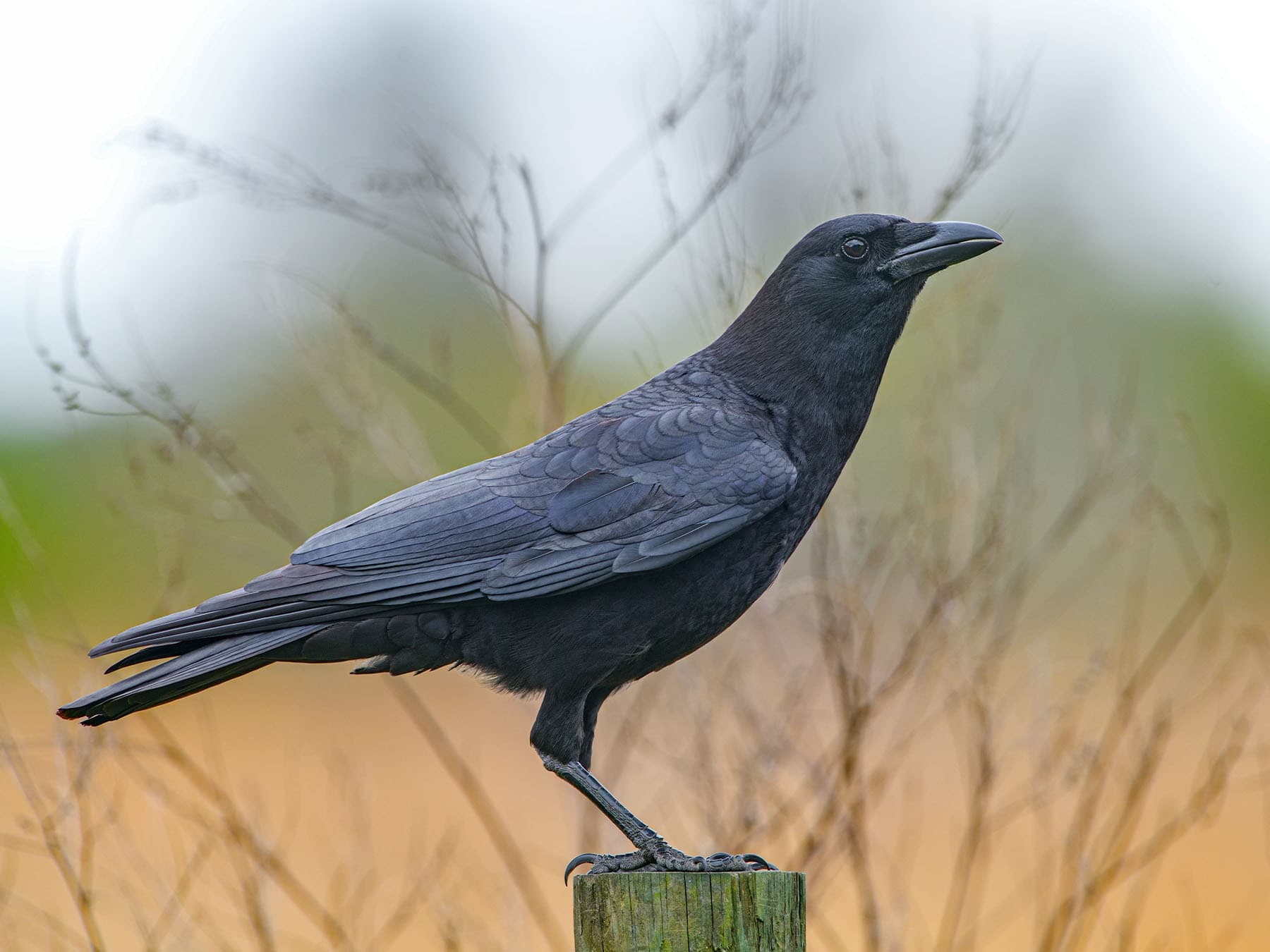
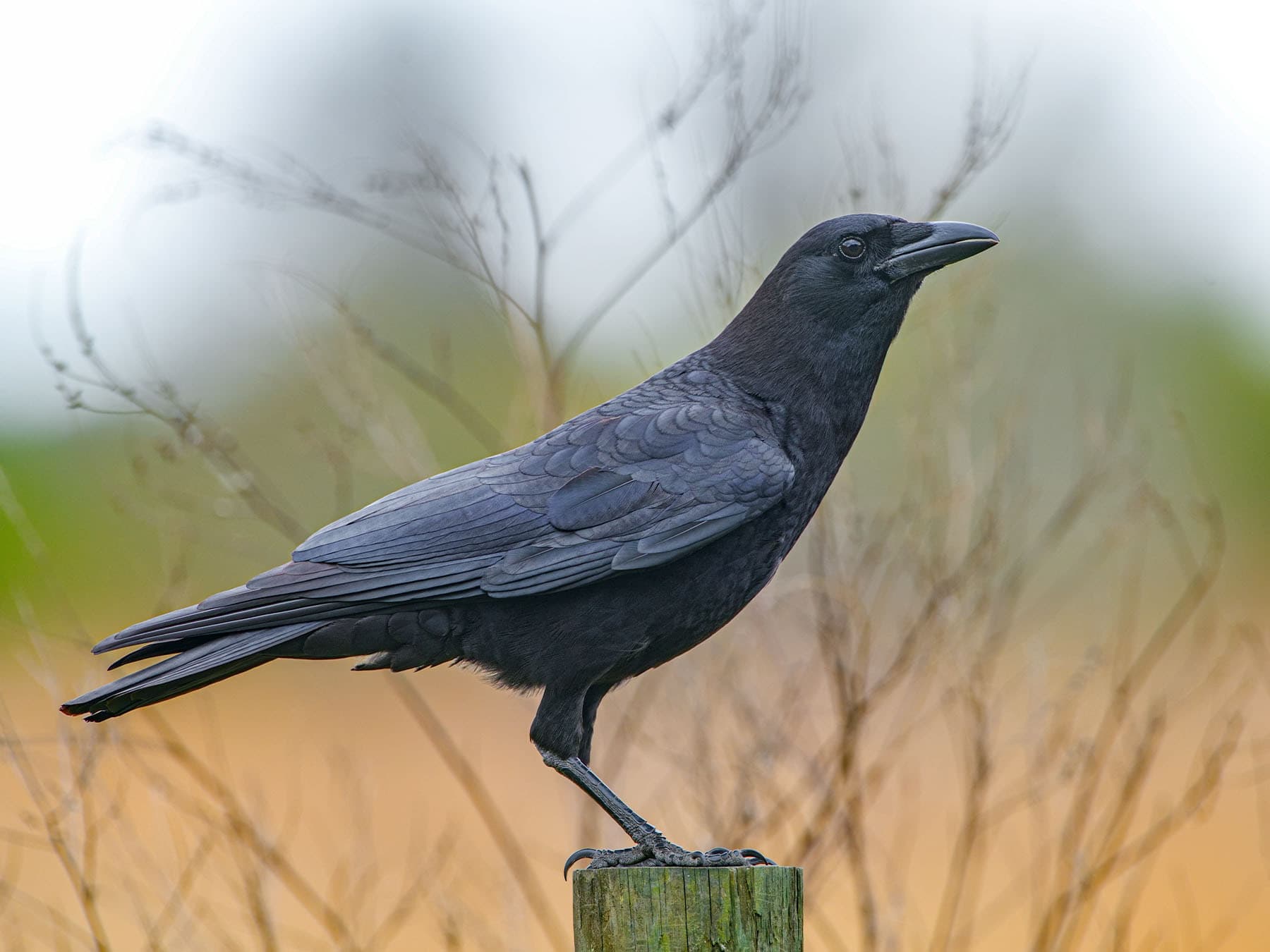
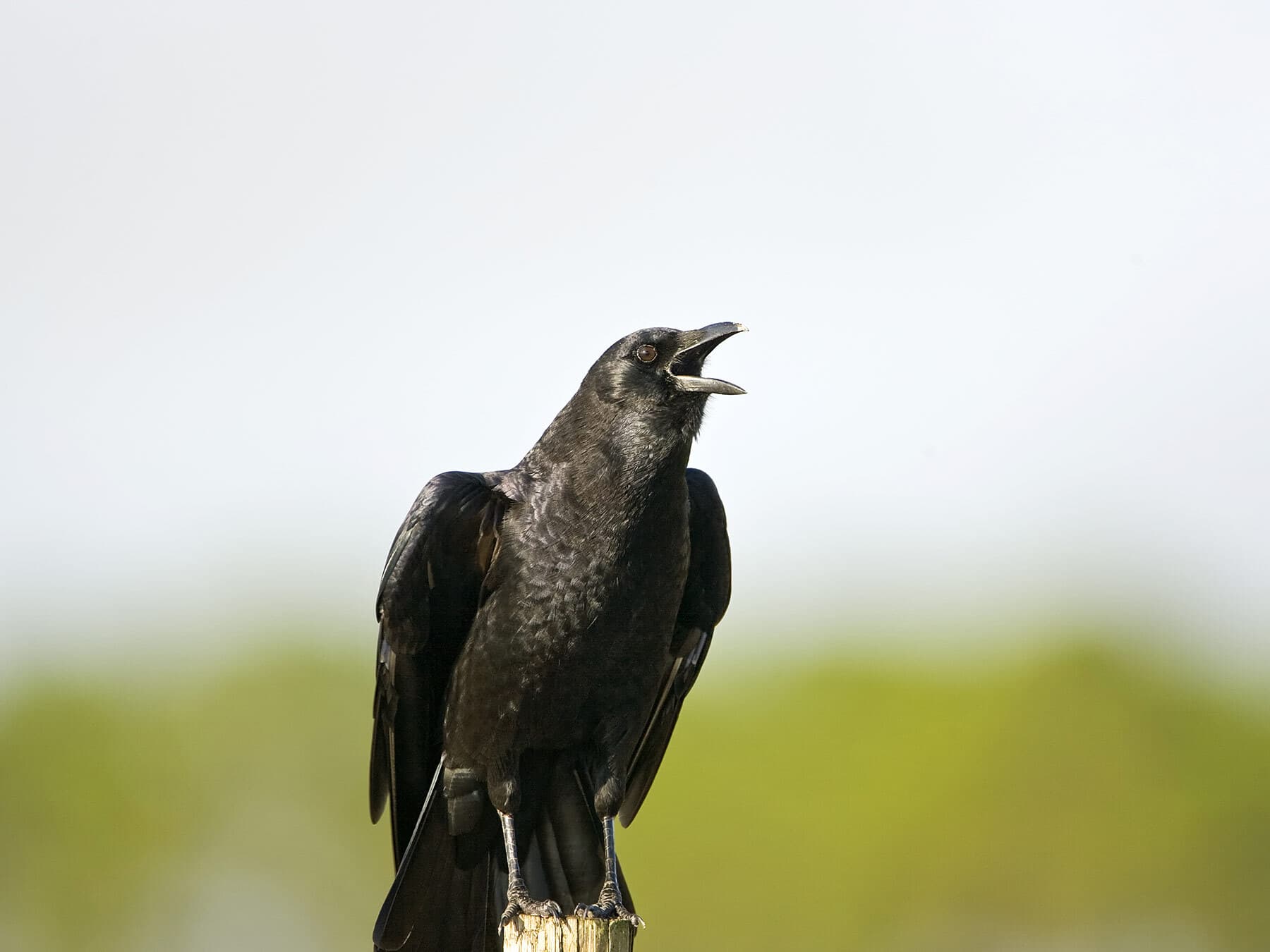
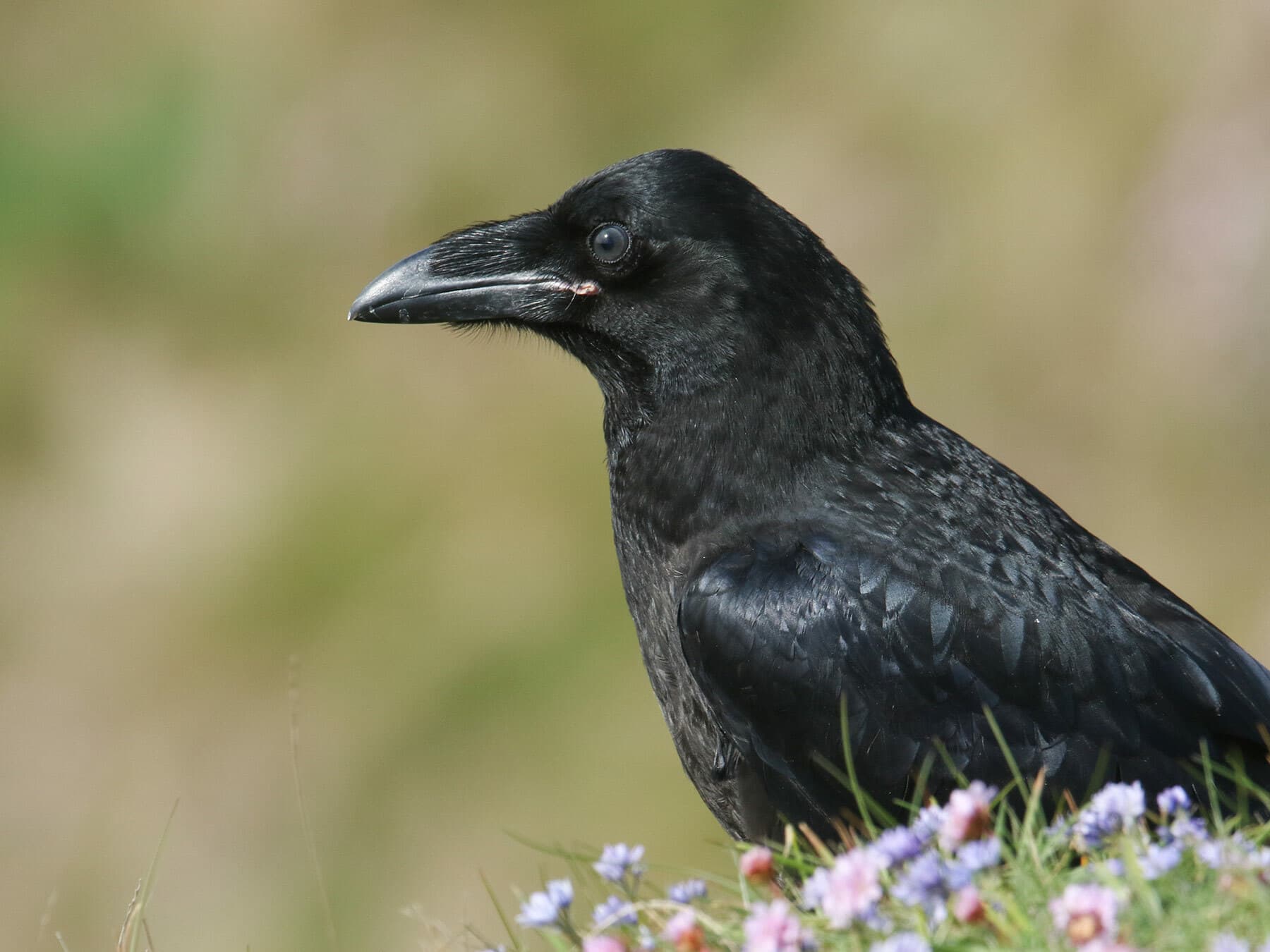
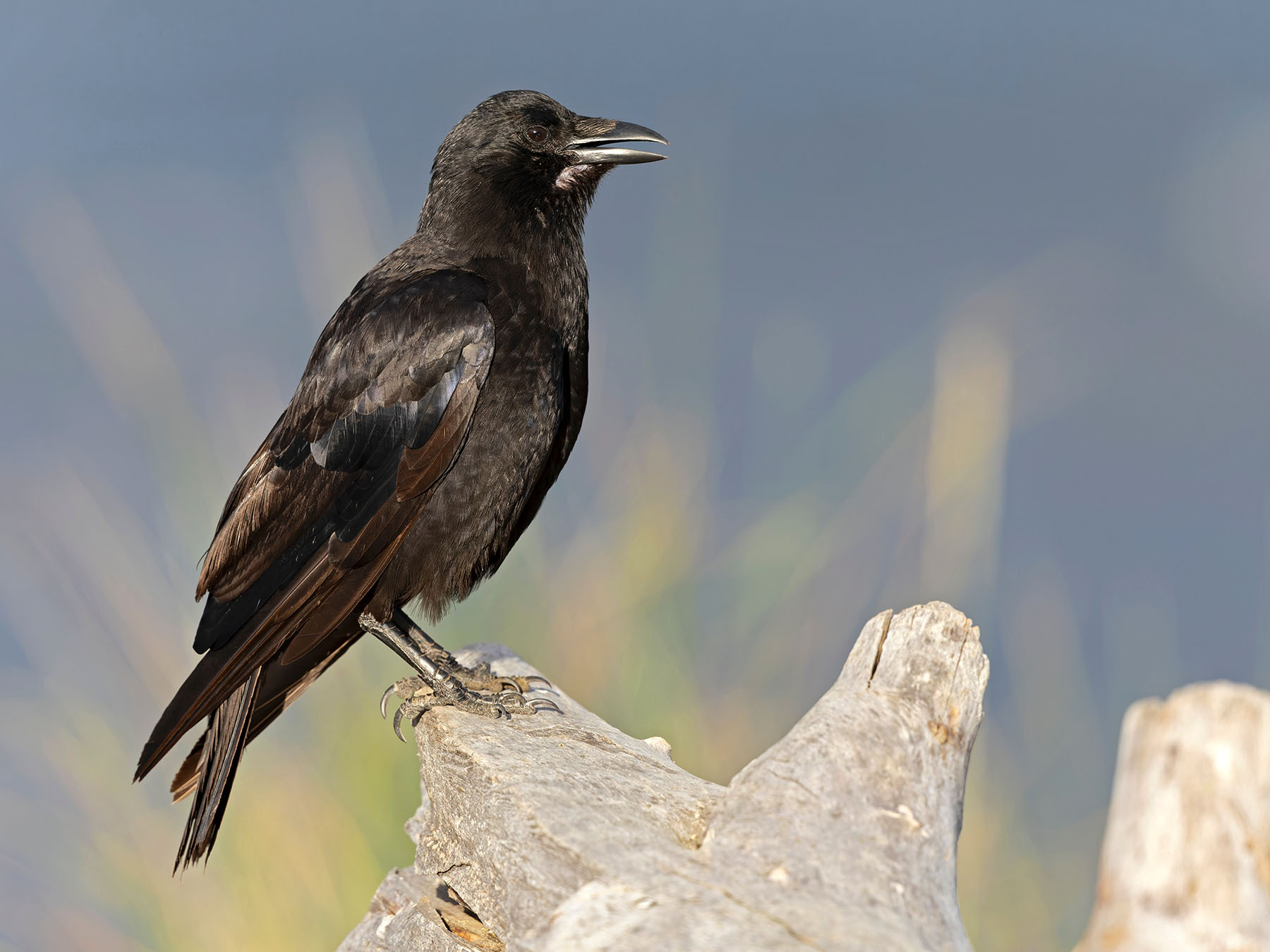
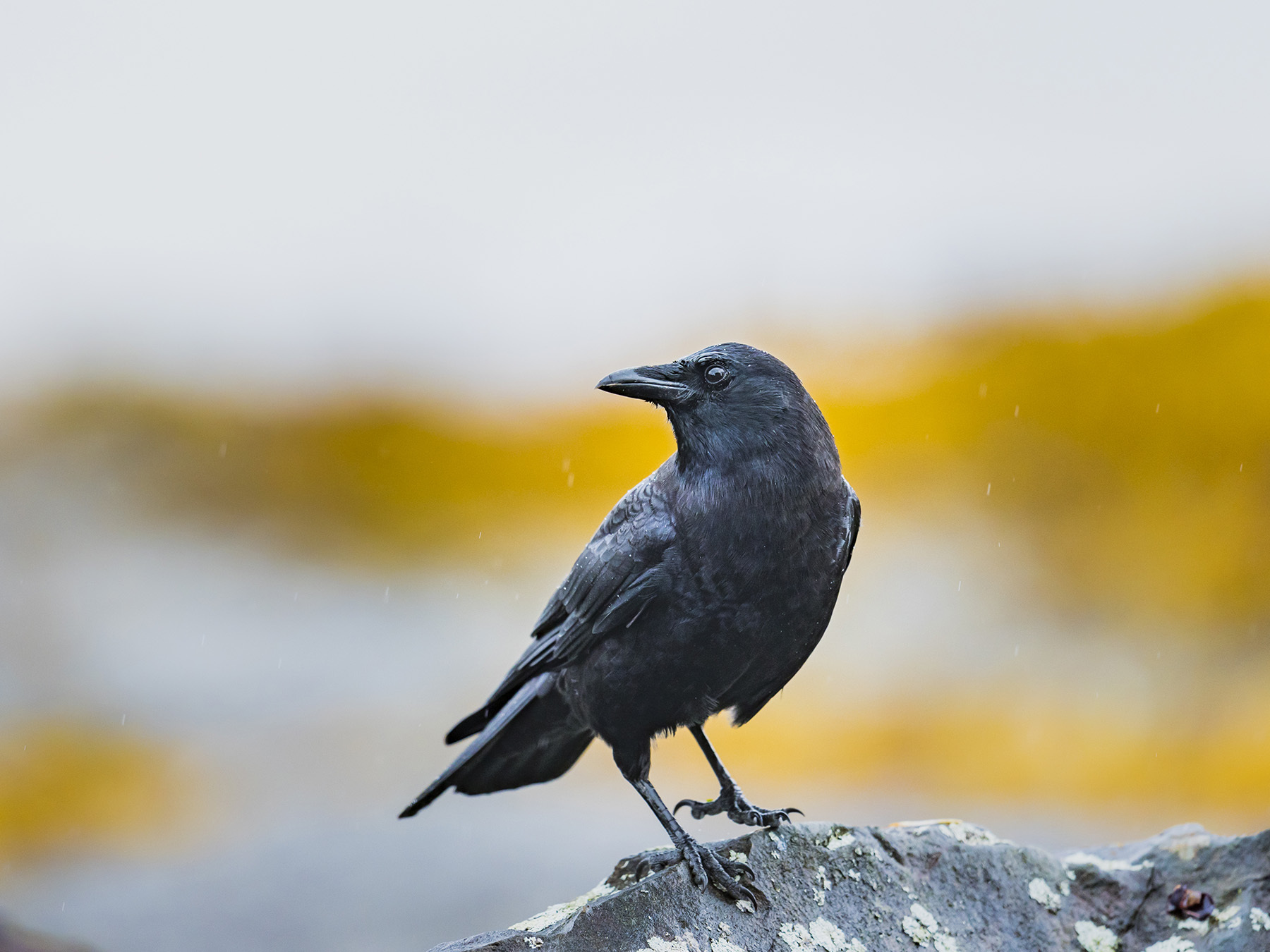
A large, all-black bird, 16 to 21 inches (41 to 53 cm) long, with a wingspan of 34 to 39 inches (86 to 99 cm) and a weight of 11 to 22 ounces (311 to 623 g). Everything is black: feathers, bill and legs.1 In good light the plumage has a bluish-violet gloss. The bill is stout, with stiff, bristly feathers over the nostrils, and the short tail is square or slightly rounded at the tip.2
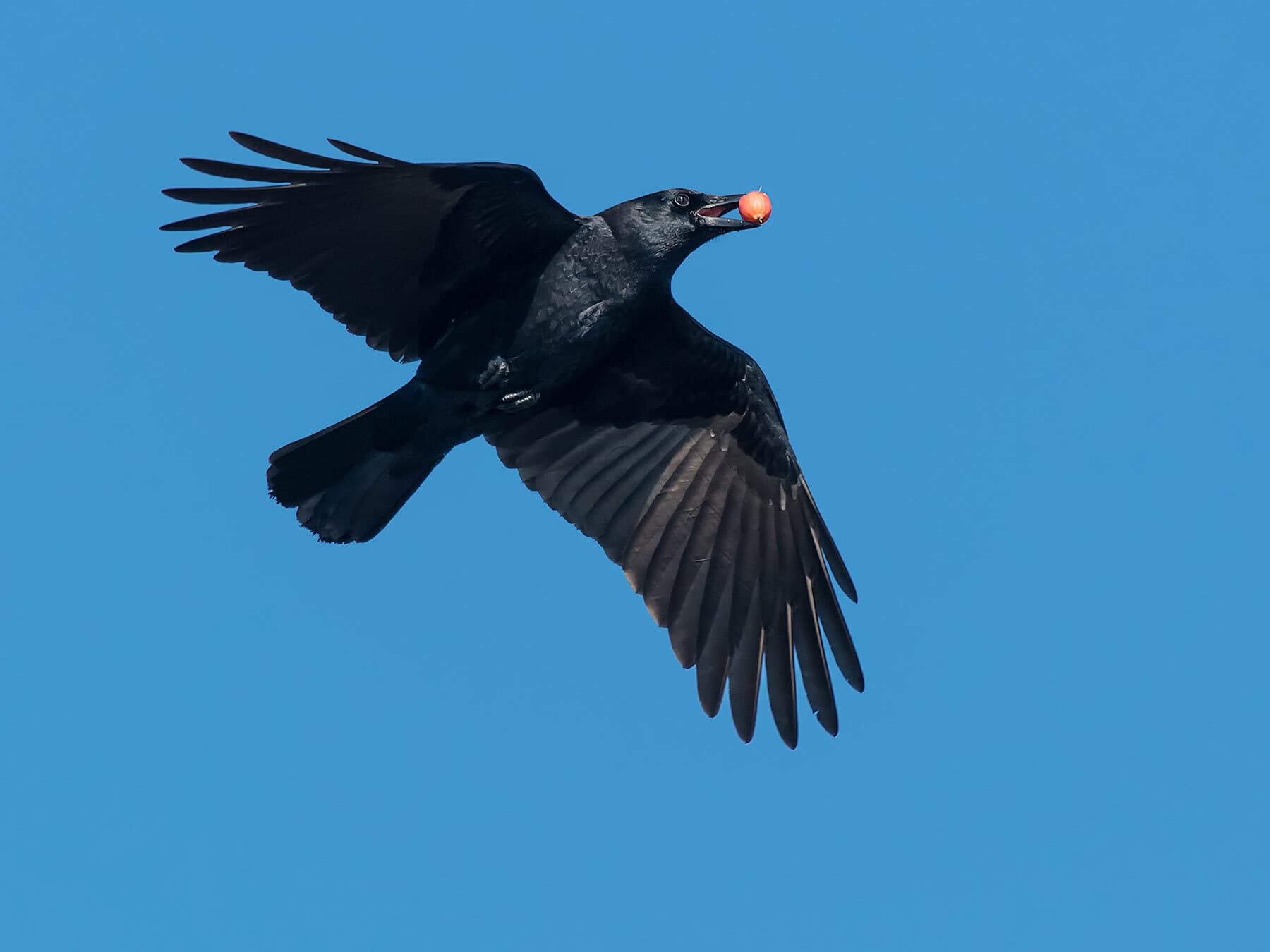
In flight a crow rows along with steady wingbeats and rarely glides. Around the molt, old feathers can look brownish or scaly.
Male, female and young
Males and females look alike, though males average slightly larger, and when a pair is together the male's voice is lower.
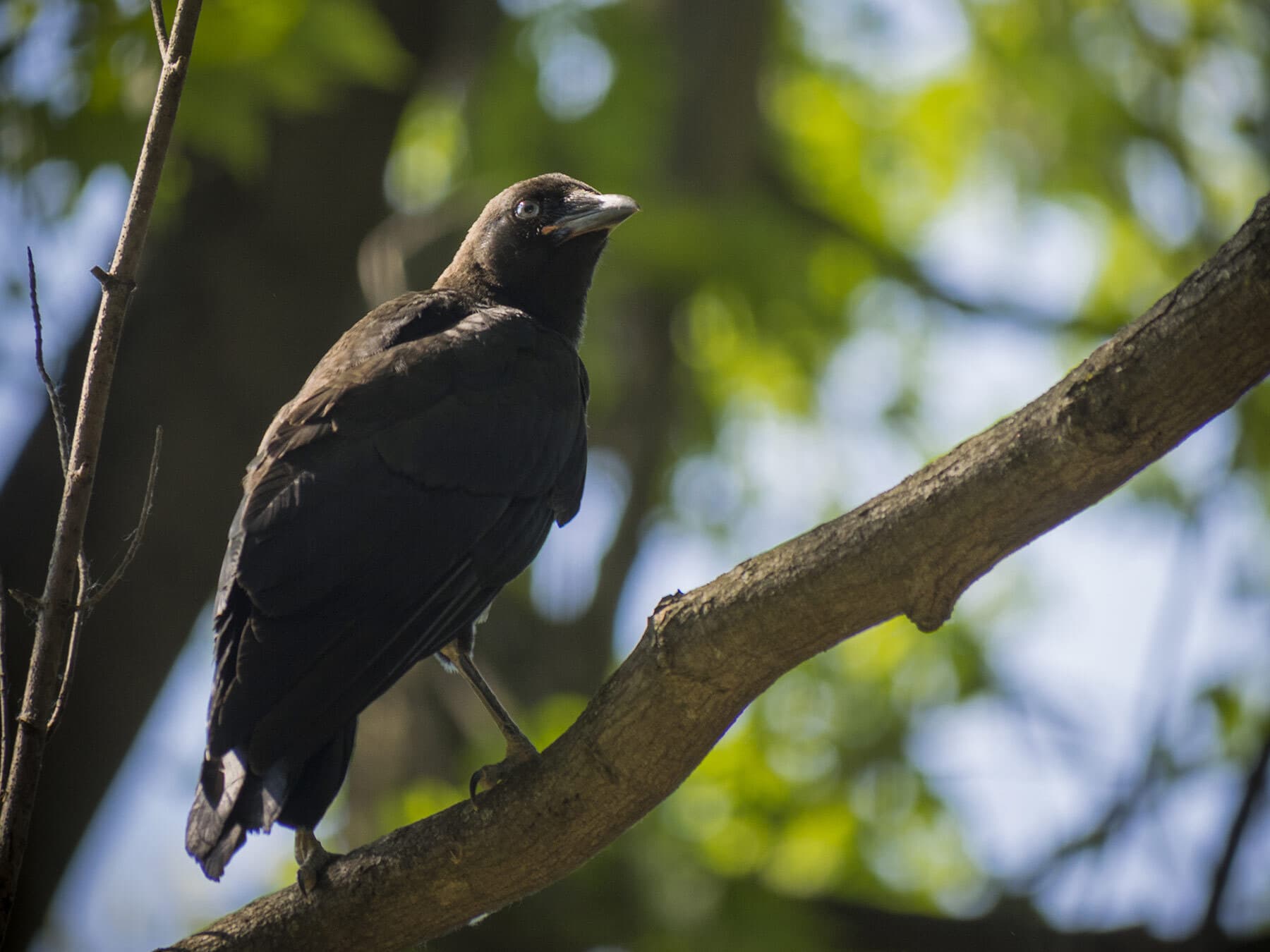
Young crows in their first months are a duller, sooty black, with fluffier feathers, a blue to gray eye and a pink gape at the base of the bill. Through their first year their wing and tail feathers fade to brownish, and the eye turns brown. The pink inside the mouth may not disappear until after a crow's third or fourth year (in studies in Oklahoma and California). See baby crows.
Identification: similar birds
The Fish Crow of the Southeast and the Atlantic coast is about 10% smaller, which is hard to judge on a lone bird. Listen instead: its call is nasal and often two-noted. Careful, though: begging young American Crows, and females begging from their mates, sound nasal too.
A Common Raven is much bigger, with a heavier bill, shaggy throat feathers, a wedge-shaped tail in flight, and its voice is different. A crow is about two-thirds the size of a raven.3 See Raven or crow?
Identification: regional differences
Western crows are a little smaller than eastern ones, and Florida crows have large feet. The crows of the Pacific Northwest coast, once a separate species called the Northwestern Crow, are now treated as a subspecies of the American Crow because the two interbreed widely.
Its size
Adults- Length
- 41–53 cm
- Wingspan
- 86–99 cm
- Weight
- 311–623 g
Its song and calls
The familiar call is a hoarse caw, usually given two to five times in a row, all year round. It carries: crows use it between birds about a third to two-thirds of a mile (0.5 to 1 km) apart. Researchers have sorted caws into several types, for territory, alarm and mobbing, and individual crows caw in slightly different ways.
Crows also make a dry rattle, like a woodpecker tapping, especially in fall, and a soft, rambling "song" of coos, caws, rattles and clicks that is heard only up close. They can mimic other sounds, including a Barred Owl, the human voice, cats, dogs and geese. See can crows talk?
Hear them all, with recordings and spectrograms: crow sounds and what they mean.
- Call0:00 / 0:06
Recorded in Nova Scotia, Canada · August 2021
When and where to see it
OctoberIn season
Most recorded in October
- 1. Prince Edward Island6.8%
- 2. Newfoundland and Labrador6.5%
- 3. Nova Scotia5.8%
- 4. New Brunswick5.6%
- 5. Vermont5.4%
Each dot is a county, state or province: the bigger and darker, the larger the bird’s share of that place’s bird records that month. Grey dots: no regular records. The ringed point is the centre of the bird’s records this month; the arrow shows how it moved since last month, and the dashed loop its path through the year. “Arrivals” colours places where it becomes regular this month (orange) or is in its last regular month (grey). GBIF eBird Observation Dataset, 2019–2024. Map data: Natural Earth, US Census Bureau; place centres © OpenStreetMap contributors.
In your area
See when the American Crow is recorded in your county, state or province.
How often the American Crow turns up in the United States and Canada through the year, from birdwatchers' records.
United States
Resident · all year · most records in February
Canada
Resident · all year · most records in March
Show as a table
| Month | United States | Canada |
|---|---|---|
| January | 2.5% (regular) | 4.4% (regular) |
| February | 2.7% (regular) | 4.9% (regular) |
| March | 2.7% (regular) | 5.3% (regular) |
| April | 2.0% (regular) | 3.8% (regular) |
| May | 1.7% (regular) | 2.4% (regular) |
| June | 1.9% (regular) | 2.6% (regular) |
| July | 2.0% (regular) | 3.0% (regular) |
| August | 2.1% (regular) | 3.1% (regular) |
| September | 2.3% (regular) | 3.4% (regular) |
| October | 2.6% (regular) | 3.7% (regular) |
| November | 2.6% (regular) | 4.0% (regular) |
| December | 2.6% (regular) | 4.4% (regular) |
Worldwide: recorded regularly in 5 countries
Countries where it was recorded in at least 3 of the 6 years 2019–2024. Linked countries have their own bird list.
North America (5)
Data: EOD – eBird Observation Dataset (Cornell Lab of Ornithology), accessed via GBIF.org, CC BY 4.0. Records from 2019–2024, aggregated and filtered by Birdfact. How these lists are made
Across most of the U.S. and southern Canada, from coastal Alaska to Newfoundland and south to Florida and the Gulf Coast. They are scarce or absent in the southwestern deserts and other dry areas.
American Crows need open ground to feed on and trees nearby: farmland, pastures, woodlots, parks, golf courses, cemeteries, yards and city streets, and the shores of rivers, lakes and the sea. They avoid large stretches of unbroken forest. They began to move into towns and cities in the 1950s, perhaps because they were safer from guns there, with food, water and warmth close at hand.
Spotting tips
Look for crows walking across lawns, fields and roadsides, or perched on treetops and posts, and listen for the caw. In late afternoon in fall and winter, watch for long streams of crows flying to a roost.
Do they migrate?
Some do. Many American Crows spend their whole lives in a small area, but most of those that breed in the North, the Great Plains and the Canadian prairies move south and to lower ground for the winter, a few of them 1,700 miles (2,800 km) or more each way. Northern birds start to leave in September, with October the main month of travel, and are among the first migrants back, from February to April. They migrate by day, often stopping to feed with local crows. See do crows migrate?
Where they roost in winter
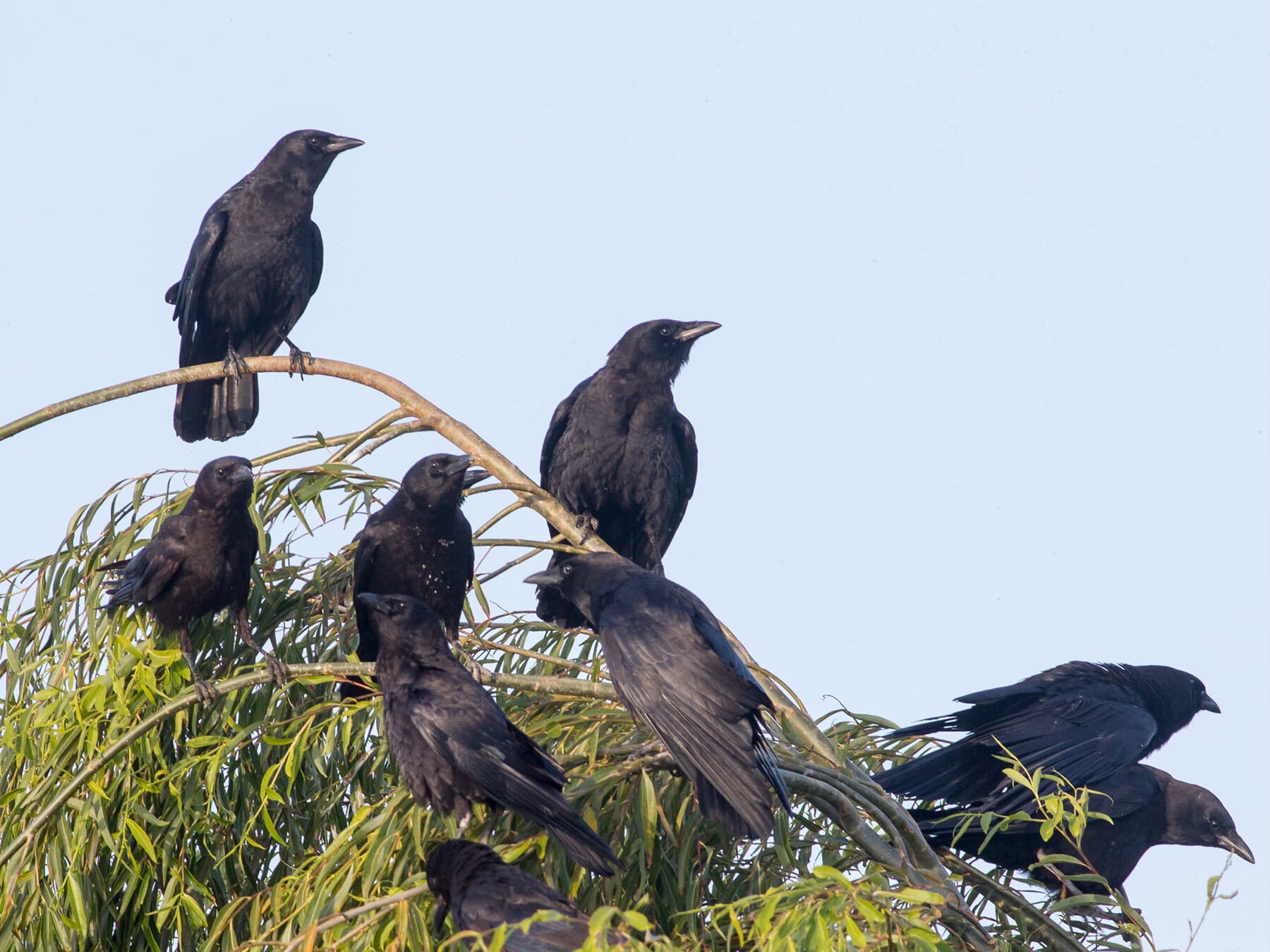
In fall and winter, crows gather at night in communal roosts that can hold a few hundred to hundreds of thousands of birds; the biggest have been estimated at two million or more. Some roosts have been used for decades, and since the 1960s more and more have moved into towns.
In one study, crows from the same family did not stay together away from their territory, and roosted on their own territory more often in spring (87%) than in winter (42%), when some flew 11 miles (18 km) to a big roost by a landfill.4
What it eats
Almost anything: earthworms, insects, spiders, snails, frogs, small snakes and mammals, shellfish, carrion, garbage, the eggs and nestlings of other birds, grain, seeds, nuts, fruit and berries.1, 2
A classic 1939 study of 1,340 adult crow stomachs found 72% plant food, with corn alone 38%, and 28% animal food; nestlings' food, though, was 83.5% animal, with beetles and grasshoppers the largest items.2 Crows feed mostly on the ground, walking and probing. They drop clams, walnuts and other hard foods from the air to crack them, carry food in a pouch at the base of the throat, and hide surplus food in the ground, in trees or in snow. See what crows eat.
Feeding crows in your yard
Crows don't often visit bird feeders, but peanuts left in an open place will attract them, and so will compost and pet food.3
Nesting and breeding
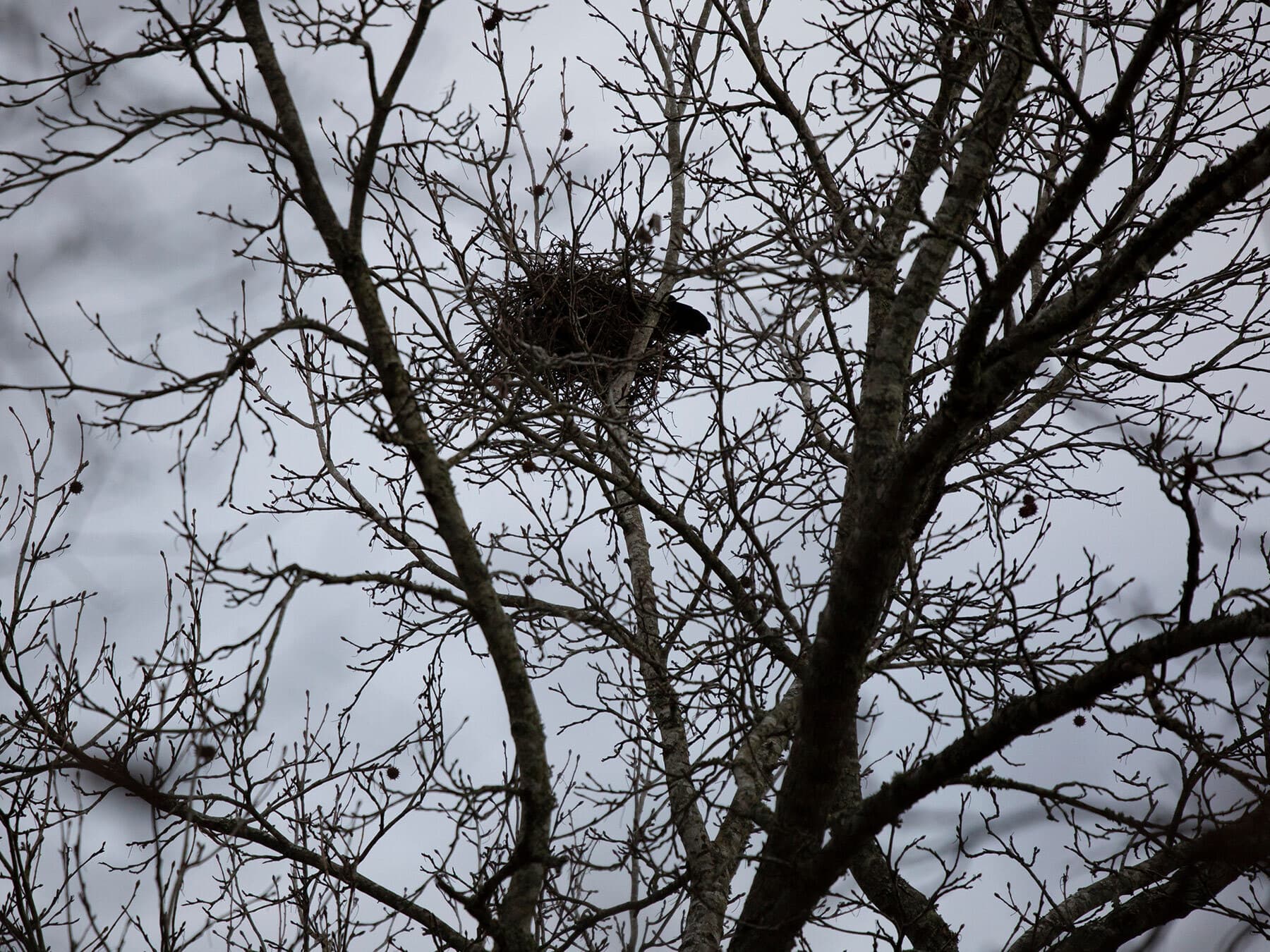
The nesting season runs from February to July, and pairs raise one brood a year, trying again if the first nest fails. Both members of the pair build the nest, sometimes with help, usually in a crotch near the trunk in the upper part of a tree, often a conifer, 10 to 70 feet up. It is a bulky basket of sticks lined with bark strips, grass, moss, hair and other soft material.
The female lays 4 to 6 eggs (sometimes 3 to 9), pale bluish-green to olive-green blotched with brown and gray, and she alone incubates them, for about 17 to 18 days, fed on the nest by her mate. The young leave the nest about 4 to 5 weeks after hatching, and the family feeds them for weeks afterward, in some places until at least the end of August. See crow nesting.
Nesting with helpers
In many year-round populations, grown young from earlier years stay with their parents and help: they bring food to the incubating female and to the chicks, guard the nest and keep it clean. Family groups in Florida averaged about seven crows. It is not yet known whether migratory northern crows have helpers. Helping may not raise more young: in one California study the helpers' effect disappeared once differences between pairs were taken into account.5
Behaviour
American Crows are very social. In many places a family of a breeding pair and young from earlier years, often 3 to 5 birds and sometimes up to 15, lives on a territory all year and joins bigger flocks to feed and to roost. In well-studied populations most do not breed until their fourth or fifth year. Pairs usually stay together for years: in New York, among about 200 pairs watched over more than 30 years, only one divorce was recorded.2
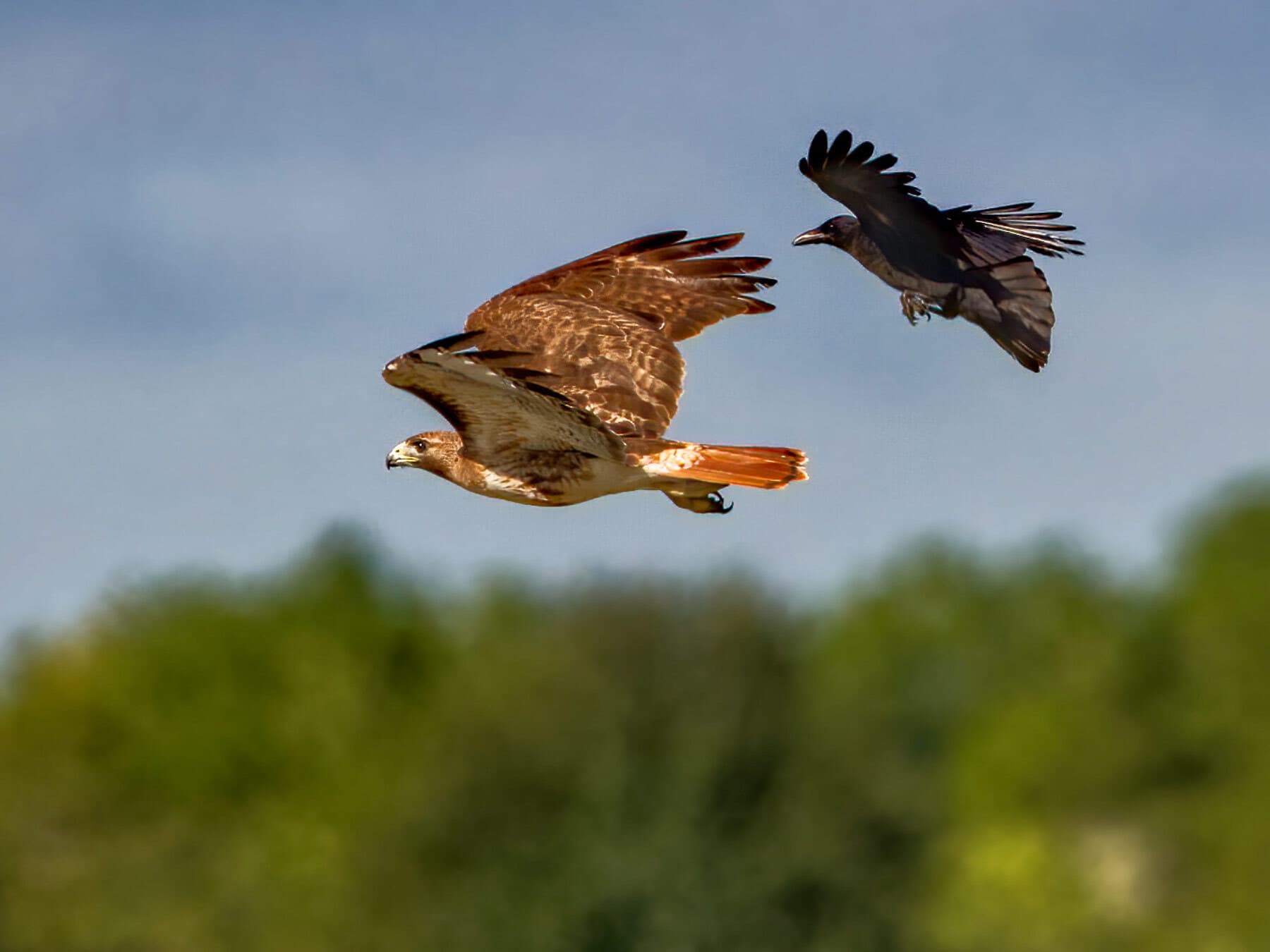
Crows mob owls and hawks, calling other crows in, and a Great Horned Owl draws more mobbing than a raccoon. They play, too: sliding down wet roofs, dropping and catching sticks or paper in the air, rolling on their backs, one with a plastic cup. There are several records of tool use, such as a captive crow carrying water in a cup to soak dry food, and a wild crow shaping a piece of wood to probe a hole. See do crows remember faces?
Lifespan and predators
Young crows have the hardest time: in New York about 35% of rural and 52% of urban young survived their first year, and in Seattle an estimated 45%.6 Adults do much better, with more than 70% surviving each year in New York.
The oldest known wild American Crow was at least 18 years 4 months old: a female banded in Washington in 2006 and seen alive there in 2022.7 See how long crows live.
Conservation
The American Crow is of Least Concern worldwide1, with an estimated 28 million birds.3
Breeding Bird Survey counts across the U.S. and Canada show a small decline between 1966 and 2025, of 0.16% a year, with no significant change in the U.S. alone and a decline in Canada. Numbers peaked around 2000.9
Crows were once killed in huge numbers: in Oklahoma, dynamiting 127 winter roosts killed more than 3.8 million crows between 1934 and 1945, with no noticeable effect on crow numbers or crop damage.2
Legal status
The American Crow is protected under the Migratory Bird Treaty Act.10 Unlike most protected birds, though, crows may be hunted: states can set crow seasons of up to 124 days a year, outside the peak nesting period, though not in Hawaii.11 A federal depredation order also allows crows to be controlled without a federal permit when they cause serious damage to crops or livestock feed, a health hazard or structural damage to property, but only after non-lethal methods have been tried, and state law must also be followed.12
Similar birds
Often mistaken for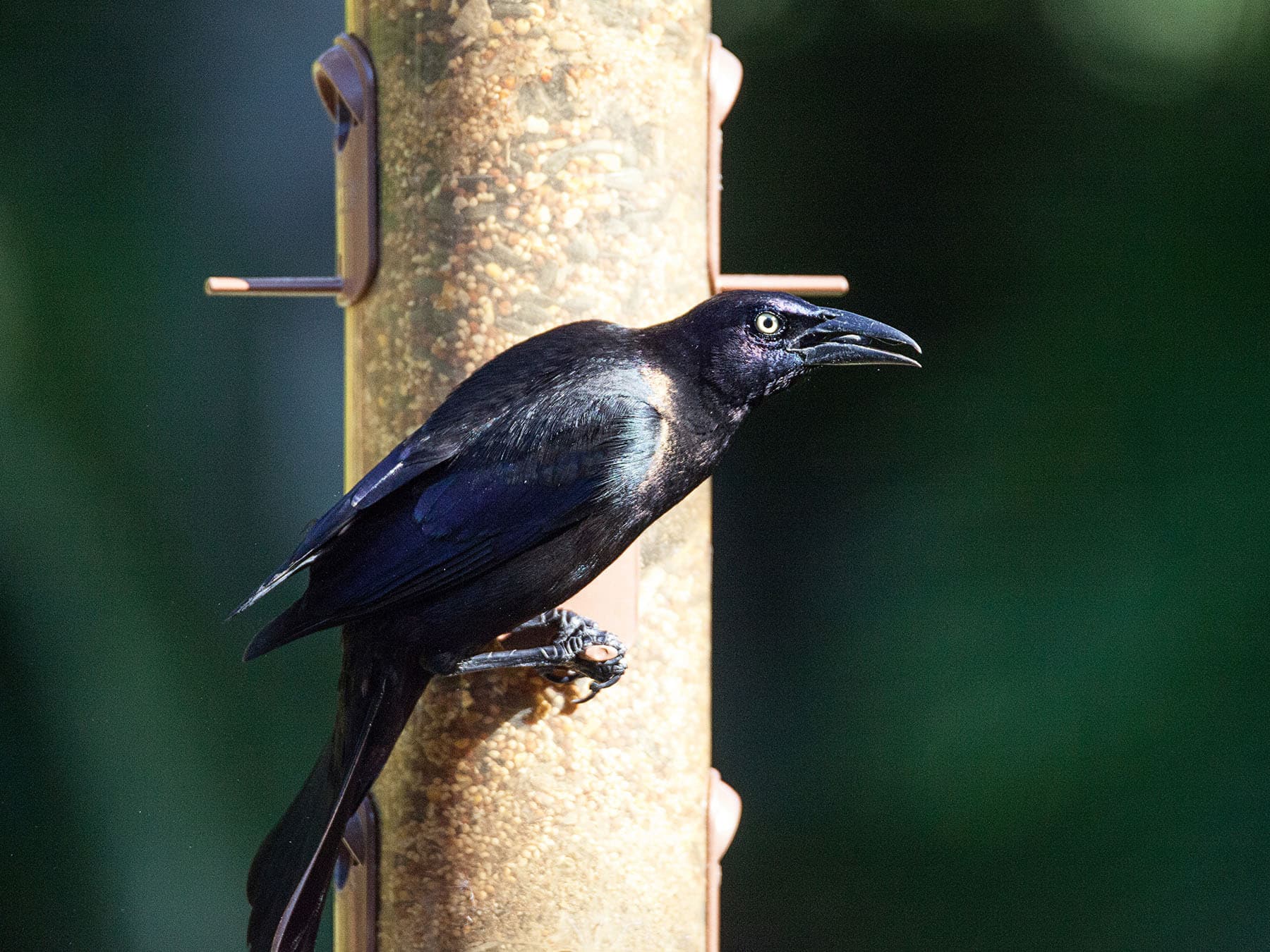
More photos
3 photos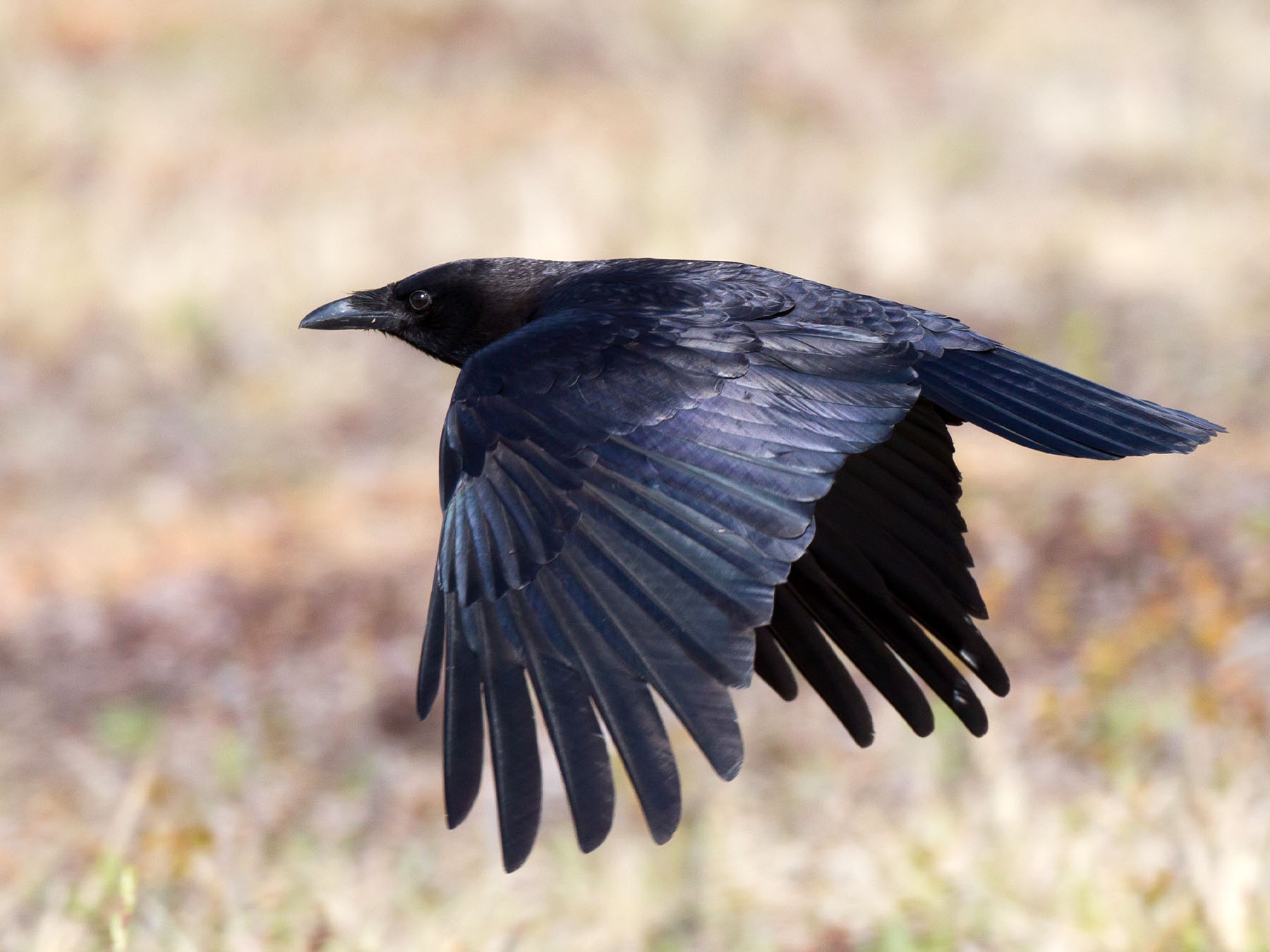
American Crow guides
6 guidesQuick facts
- Length
- 41–53 cm
- Wingspan
- 86–99 cm
- Weight
- 311–623 g
- Lifespan
- oldest recorded 18 years 4 months
- Family
- Crows & Jays
- Migration
- Partial migrant
- Global status (IUCN)
- Least Concern
- Population trend
- Breeding Bird Survey counts show a small long-term decline across the U.S. and Canada, after a peak around 2000; West Nile virus hit crows hard (USGS BBS, LaDeau et al. 2007)
- Also called
- Common Crow
- Scientific name
- Corvus brachyrhynchos
Questions
3Do American Crows mate for life?
Pairs usually stay together for many years, some until one of them dies: in a New York study of about 200 pairs over 30 years, only one divorce was recorded. See behavior.
Do crows hold funerals?
When researchers set out stuffed dead crows, wild crows often gathered, called loudly and mobbed, and touched the body in about a quarter of trials. The researchers think this helps crows learn about danger; others caution that the crows may have been reacting to something strange.
Is the American Crow the same as the Carrion Crow?
No, but they are close relatives. The Carrion Crow is the all-black crow of Britain and western Europe and eastern Asia.
Sources
15- 1Kaufman, K.. American Crow. Audubon Guide to North American Birds (text from Lives of North American Birds). Accessed 8 October 2026. Source (opens in a new tab)
- 2Caffrey, C. et al. (2026). American Crow (Corvus brachyrhynchos), version 1.6. Birds of the World (A. F. Poole, F. B. Gill and M. G. Smith, editors). Cornell Lab of Ornithology. doi:10.2173/bow.amecro.01.6 (opens in a new tab)
- 3Cornell Lab of Ornithology. American Crow. All About Birds. Accessed 8 October 2026. Source (opens in a new tab)
- 4Caccamise, D. F., Reed, L. M. and Stouffer, P. C. (1997). Roosting behavior and group territoriality in American Crows. The Auk 114(4): 628-637. doi:10.2307/4089282 (opens in a new tab)
- 5Caffrey, C. (2000). Correlates of reproductive success in cooperatively breeding Western American Crows: if helpers help, it's not by much. The Condor 102(2): 333-341. doi:10.1650/0010-5422(2000)102[0333:CORSIC]2.0.CO;2 (opens in a new tab)
- 6Withey, J. C. and Marzluff, J. M. (2005). Dispersal by juvenile American Crows influences population dynamics across a gradient of urbanization. The Auk 122(1): 205-221. doi:10.1093/auk/122.1.205 (opens in a new tab)
- 7USGS Bird Banding Laboratory. Longevity records of North American birds. USGS Patuxent Wildlife Research Center. Accessed 8 October 2026. Source (opens in a new tab)
- 8LaDeau, S. L., Kilpatrick, A. M. and Marra, P. P. (2007). West Nile virus emergence and large-scale declines of North American bird populations. Nature 447(7145): 710-713. doi:10.1038/nature05829 (opens in a new tab)
- 9Hostetler, J. A. et al. (2026). The North American Breeding Bird Survey, Analysis Results 1966-2025. U.S. Geological Survey data release. doi:10.5066/P1OSNSFC (opens in a new tab)
- 10U.S. Fish and Wildlife Service (2026). 50 CFR 10.13: List of Migratory Birds. Accessed 8 October 2026. Source (opens in a new tab)
- 11U.S. Fish and Wildlife Service (2026). 50 CFR 20.133: Hunting regulations for crows. Accessed 8 October 2026. Source (opens in a new tab)
- 12U.S. Fish and Wildlife Service (2026). 50 CFR 21.150: Depredation order for blackbirds, cowbirds, crows, grackles, and magpies. Accessed 8 October 2026. Source (opens in a new tab)
- 13AviList Core Team (2025). AviList: The Global Avian Checklist, v2025b. doi:10.2173/avilist.v2025b (opens in a new tab)
- 14Caffrey, C. (1992). Female-biased delayed dispersal and helping in American Crows. The Auk 109(3): 609-619. doi:10.1093/auk/109.3.609 (opens in a new tab)
- 15BirdLife International. American Crow Corvus brachyrhynchos: species factsheet. BirdLife DataZone. Accessed 8 October 2026. Source (opens in a new tab)

Checked by
Nathan Cope, founder and editor
Nathan founded Birdfact and leads its writers and contributors in the UK, the US and Canada. He has watched and studied birds for more than ten years, and checks every article and species guide before it’s published.