
Caspian Tern
Hydroprogne caspia
By the Birdfact teamChecked by Nathan Cope
On this page13 sections
How to recognise it
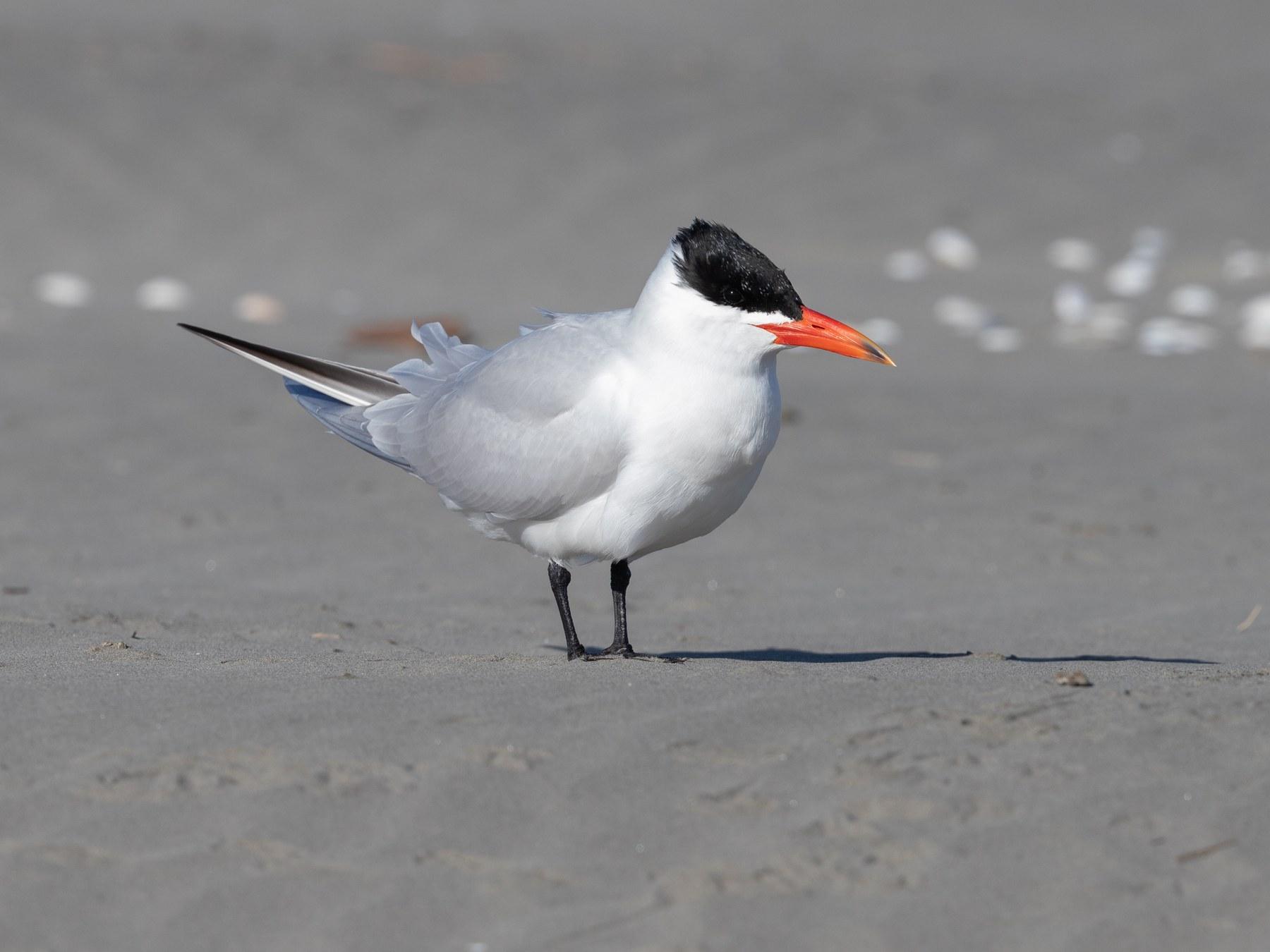
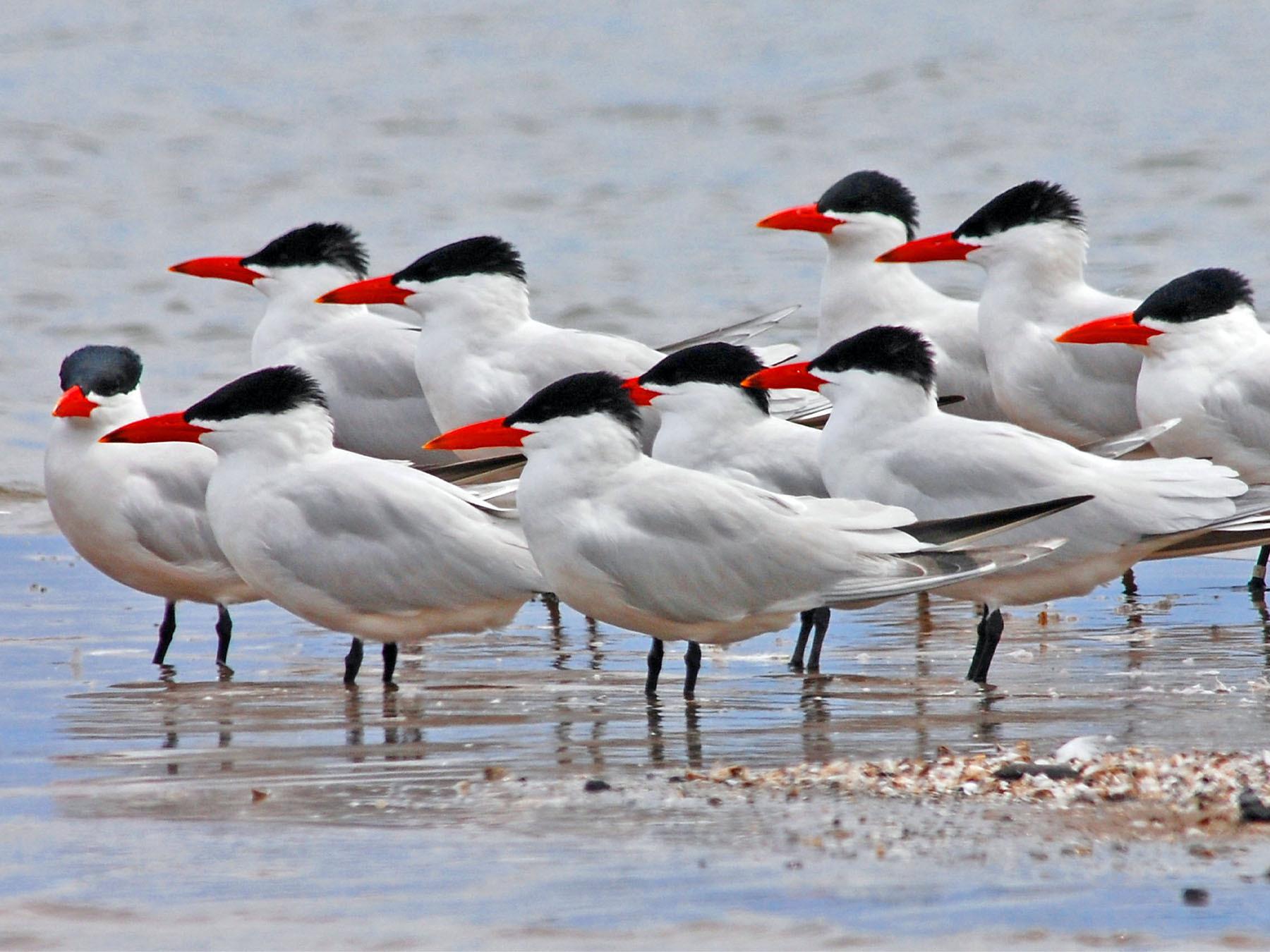
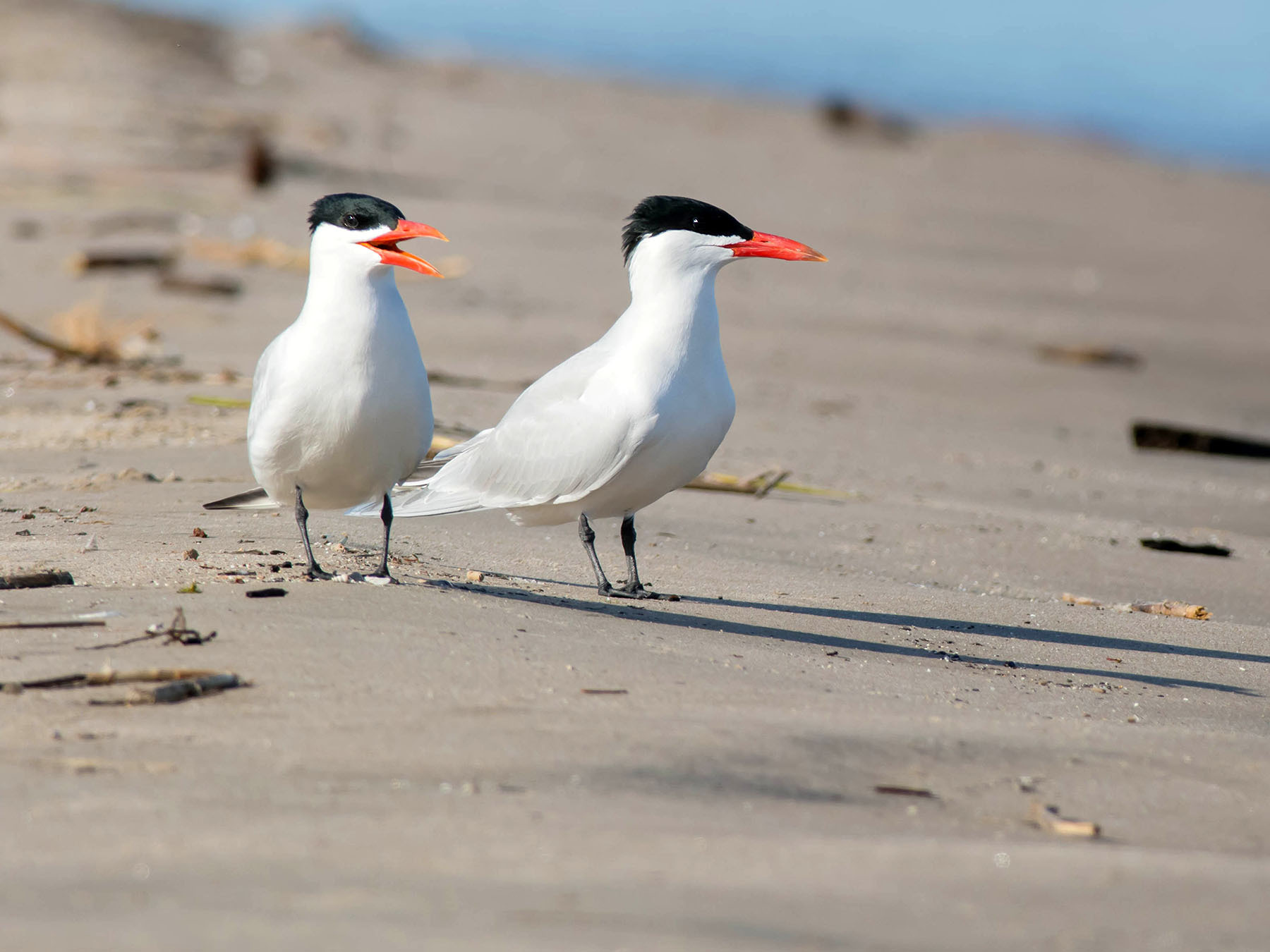
A heavy, gull-sized tern with a huge red bill. In summer an adult has a black cap that reaches below the eye and ends in a short, ragged crest at the back of the head. The back and wings are pale gray, and the underparts, rump and tail are white.
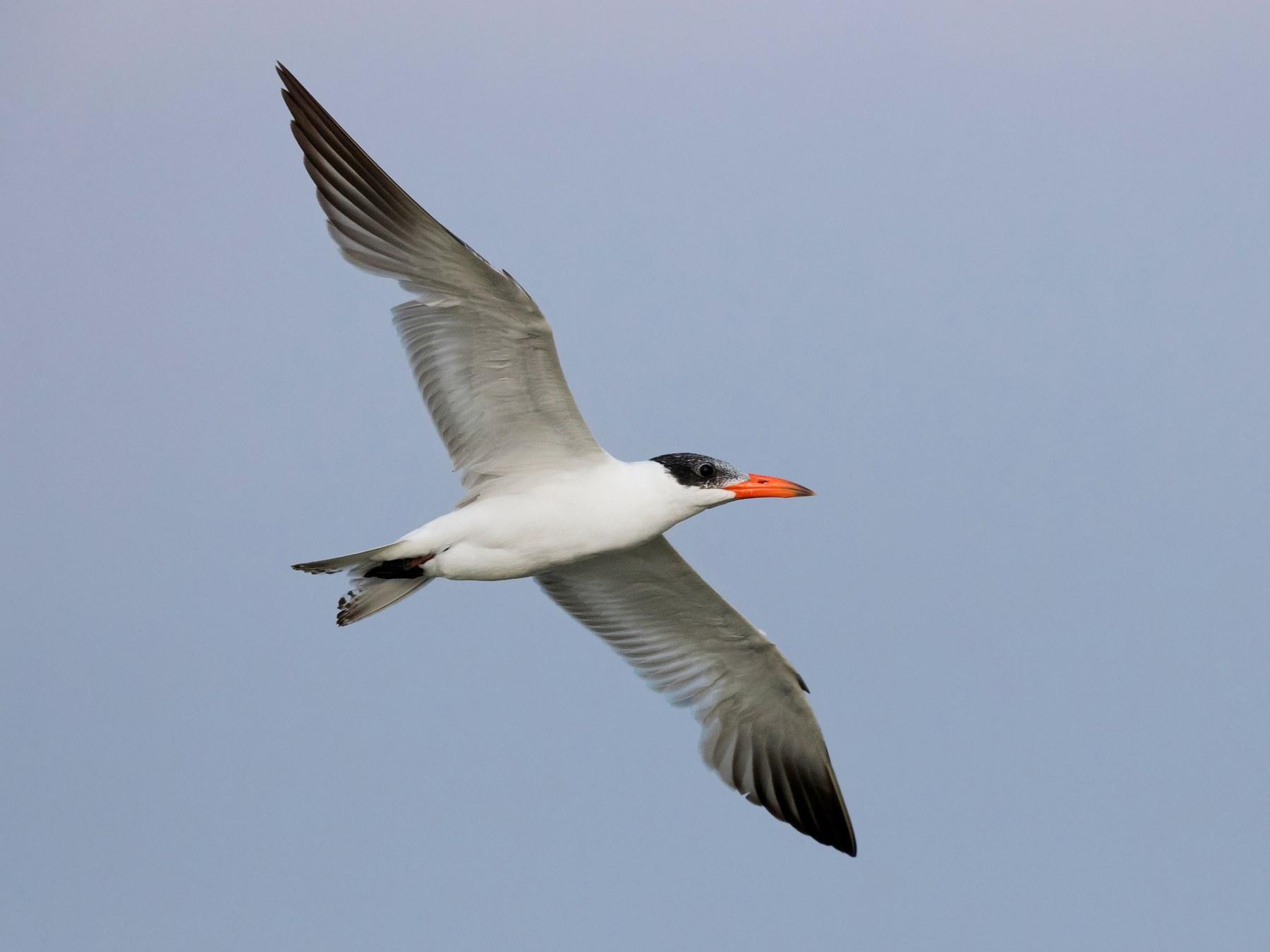
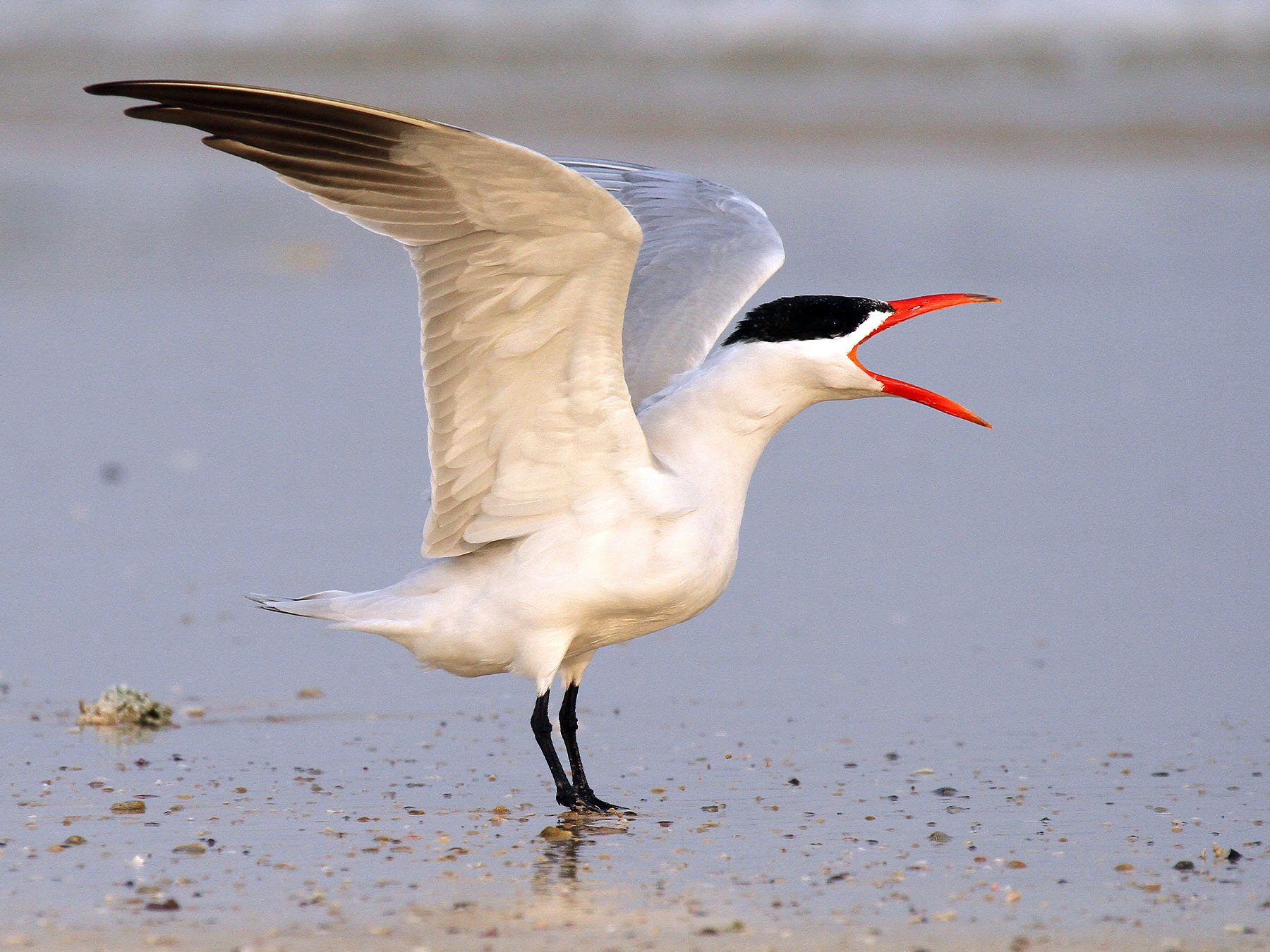
The bill is the mark to look for. It is thick and dagger-shaped, blood red to scarlet, with a dark gray smudge near the end and often a yellow, orange or white tip. In flight, look under the wing: the outer five or six flight feathers are blackish below, making a big dark patch that shows at every age, though from above they look whitish. The legs are black, and the eye is dark brown.
For a tern it is bulky, with a large head, a short tail that is only slightly notched and long, pointed wings that are unusually broad. Its flight is heavier and more gull-like than other terns', at about three wingbeats a second, and it soars and wheels like a gull.
Size and weight
It is 18.5-21.3 in (47-54 cm) long, with a wingspan of 50-55 in (127-140 cm), and weighs 18.7-27.6 oz (530-782 g). That makes it the largest tern anywhere and bigger than many gulls: it falls between a Ring-billed Gull and a Herring Gull in size. Next to a Royal Tern it is about a fifth larger, with much broader, blunter wings and a bigger head.
Size varies a little across the range. Birds from Europe, Asia and Africa tend to have longer bills, wings, legs and tails than North American ones.1
Male and female
Males and females look the same and cannot be told apart in the field. Their measurements overlap widely. Males average slightly, but not significantly, lighter than females, and in museum specimens males seem to have slightly longer bills; neither difference helps with a bird in front of you.1
Adult plumage in summer and winter
Most adults wear the full black cap from about February until autumn migration. In winter the crown turns streaky, black or gray-brown mixed with white, and can look gray from a distance. Usually the forehead is only a little paler than the rest of the crown, unlike the mostly white foreheads most terns show in winter. Some winter birds do get a white forehead, but never as much white as a Royal Tern. The winter bill is a paler orange-red with a blackish tip.
In North America adults usually begin molting the feathers of the forehead and crown by August. Much of what is known about this species' molt timing comes from European birds, and North American birds may differ.
Juvenile and immature plumage
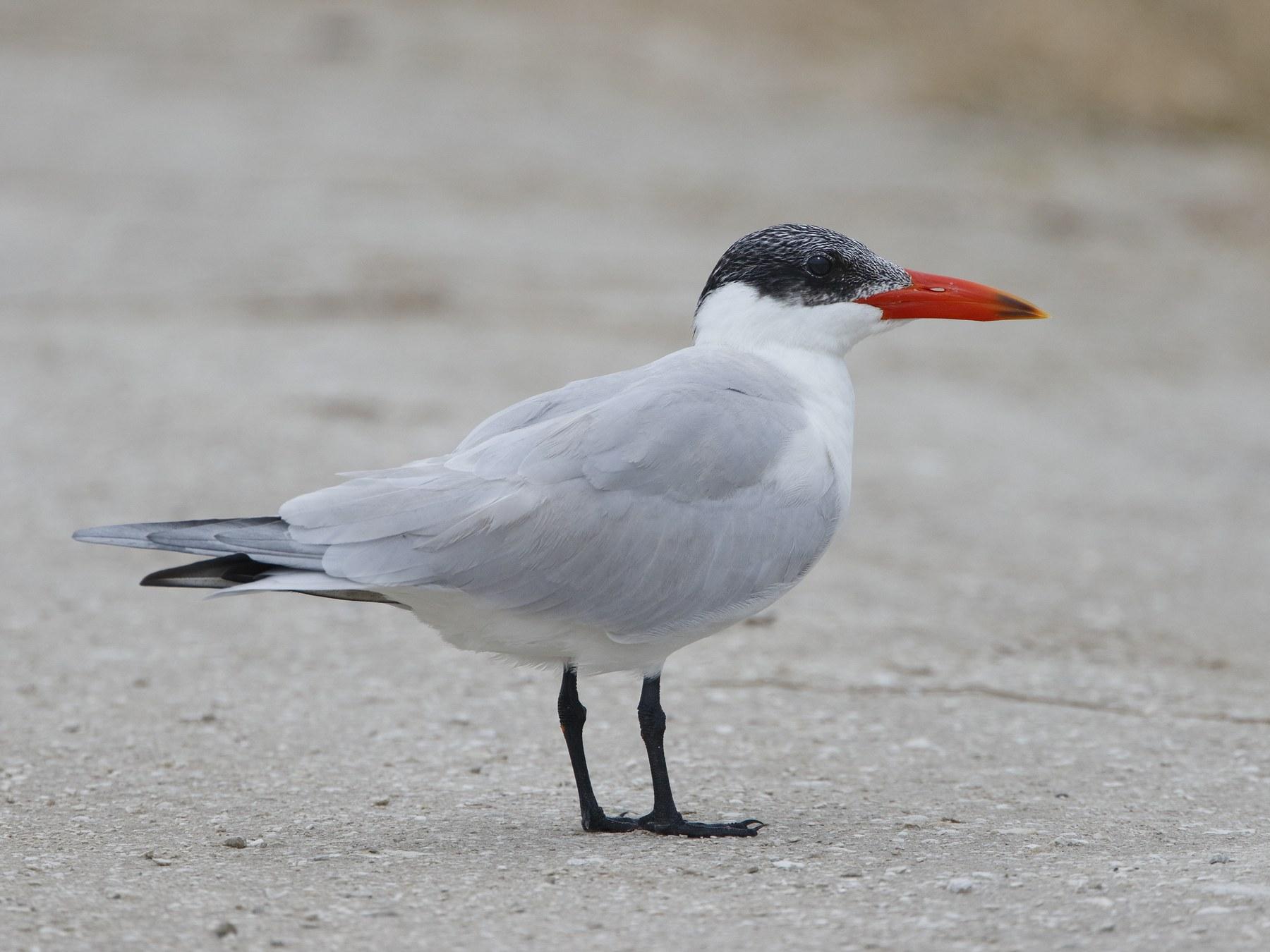
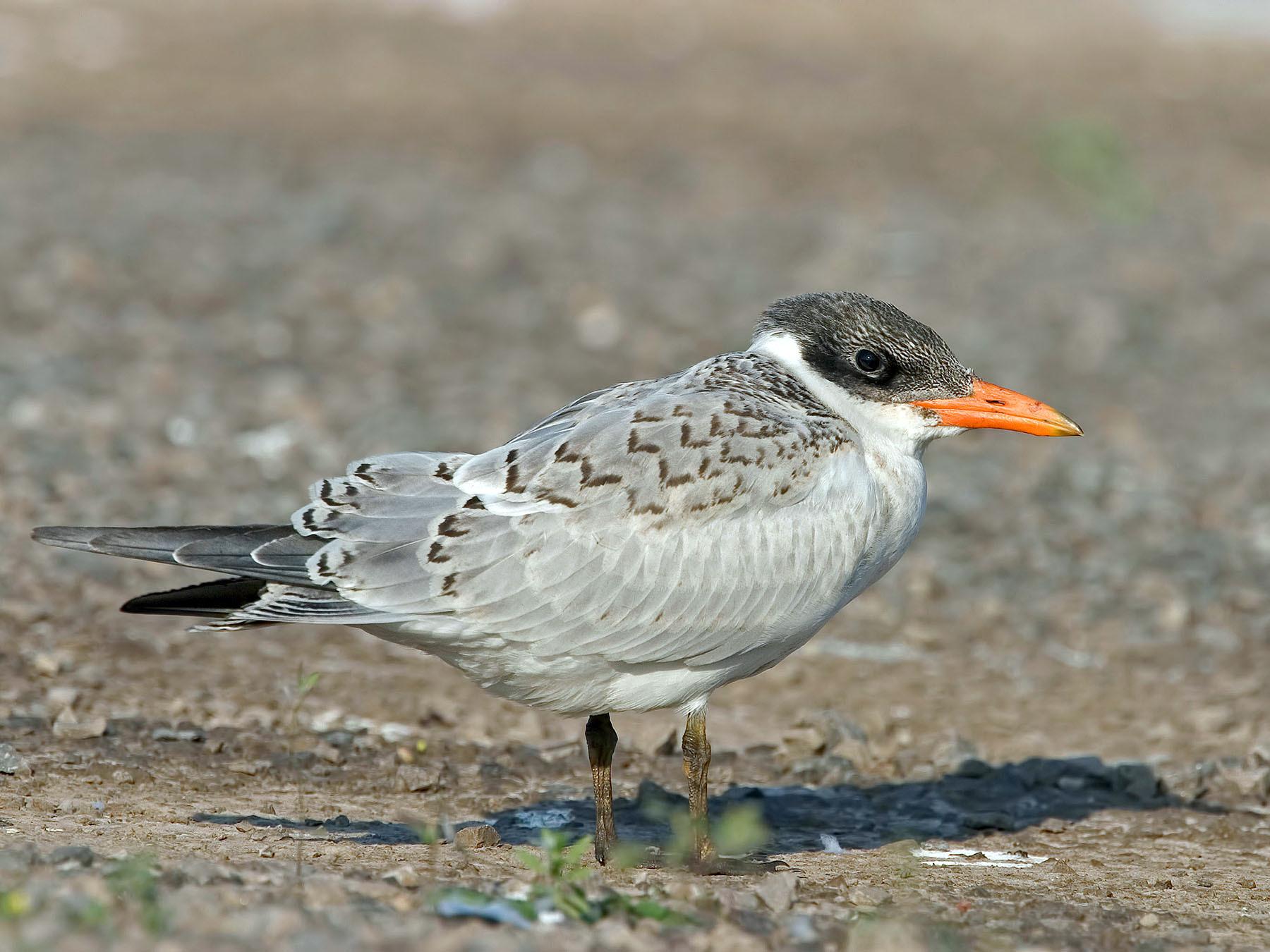
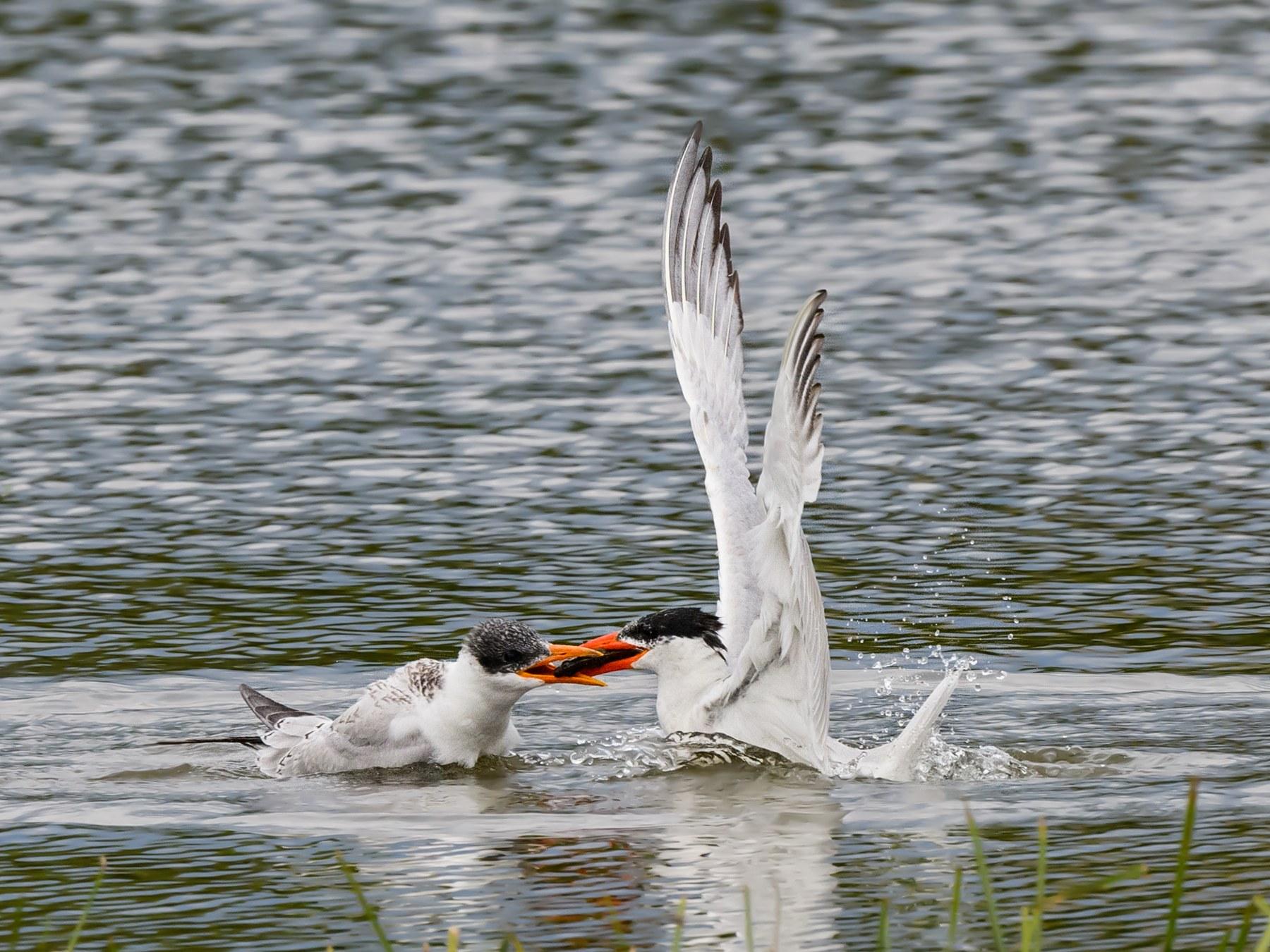
Juveniles, this year's young, have a blackish, finely streaked cap that runs farther down the sides of the neck than an adult's, and a thin pale ring around the eye. The pale gray back often carries dark V-shaped marks, though some birds have none. The bill is red-orange to orange-yellow with a large dark tip. That dark cap is a good clue, because most young terns have largely white crowns.
In their first winter and second year, young birds look much like winter adults. Most still show a faint dark bar along the front of the wing, worn and darker outer flight feathers, and dark marks on the tail and on some wing feathers. Birds with a patchy black cap in summer are in their second or third calendar year, though it is not known whether every young bird shows one.
Identification: similar terns
Its size and massive red bill set it apart from other terns. In North America the bird most like it is the Royal Tern. A Royal is smaller, with a thinner, orange bill that has no dark tip, and much less black under the wingtips: only a dark trailing edge. Royals have a shaggy crest, where a Caspian's is only slight, lose the black on the crown early and show a white forehead for most of the year. A very few Royals can have a bill close to a Caspian's red: under 1 in 10,000 of those breeding in North America.2
The Elegant Tern is much smaller and slimmer, with a long, thin yellow to orange bill that often looks drooped at the tip, the longest crest of any tern and a deeply forked tail. Outside the Americas, the only real confusion is the Greater Crested Tern, which has a yellowish bill, paler undersides to the wingtips and a less gull-like look.
Not sure it’s a Caspian Tern? Check your photo: Birdfact names the bird and shows the look-alike side by side.
Its size
Adults- Length
- 47–54 cm
- Wingspan
- 127–140 cm
- Weight
- 530–782 g
Its song and calls
It has no song in the songbird sense, only calls, and it is noisy, especially at colonies, where males and females share most of their calls. In flight it gives a low, hoarse croak, written kaaa. A threatened bird gives a briefer kow or kowk.
In a quiet colony the commonest call is a loud, drawn-out rau or rrau. The alarm is a loud, barking ra, ra, ra, and a male bringing a fish gives a run of four or five notes, ra-ra-ra-ratschrau. Begging chicks make a high, vibrating whistle, and young birds traveling with their parents often call with a thin, whistled weee.
Its calls can sound deep and raspy, and on autumn nights rolling calls can sometimes be heard from birds passing overhead. In high display flights, the wings can make a soft, falling buzz.
- Calls (heard, not seen)0:00 / 0:05
Recorded in California, United States · August 2023
Heard one and not sure? Let the bird song identifier listen.
When and where to see it
November
Mostly absent
The year across the UK and Ireland
Choose a place on the map to see its year, or find yours.
Not regularly recorded in November
Up to 0.35% of a place’s bird records that monthHere in other months
How this map is made
Each county, state or province is shaded by the Caspian Tern’s share of all the bird records there that month: the darker, the larger the share. A place with only a trace of records in a month is left unshaded. Shades compare places on this map with each other, not one bird with another. Records: GBIF eBird Observation Dataset, 2019–2024. Map: Natural Earth; place centres © OpenStreetMap contributors.
How often the Caspian Tern turns up in the UK, the United States and Canada through the year, from birdwatchers' records.
United Kingdom
Summer visitor · regularly May–Aug · most records in July
United States
Summer visitor · all year · most records in August
Canada
Summer visitor · regularly Apr–Sep · most records in August
Show as a table
| Month | United Kingdom | United States | Canada |
|---|---|---|---|
| January | – | 0.050% (regular) | – |
| February | – | 0.043% (regular) | – |
| March | – | 0.046% (regular) | <0.001% |
| April | – | 0.15% (regular) | 0.11% (regular) |
| May | 0.003% (regular) | 0.14% (regular) | 0.17% (regular) |
| June | 0.007% (regular) | 0.12% (regular) | 0.12% (regular) |
| July | 0.010% (regular) | 0.23% (regular) | 0.21% (regular) |
| August | 0.002% (regular) | 0.32% (regular) | 0.35% (regular) |
| September | <0.001% | 0.19% (regular) | 0.19% (regular) |
| October | – | 0.086% (regular) | 0.017% |
| November | – | 0.054% (regular) | <0.001% |
| December | – | 0.044% (regular) | – |
Recorded regularly in
Worldwide: recorded regularly in 115 countries
Countries where it was recorded in at least 3 of the 6 years 2019–2024. Linked countries have their own bird list.
Europe (35)
Africa (26)
- Algeria
- Angola
- Botswana
- Cape Verde
- Côte d’Ivoire
- Djibouti
- Egypt
- Ethiopia
- Gabon
- Gambia
- Ghana
- Guinea
- Guinea-Bissau
- Kenya
- Madagascar
- Mauritania
- Morocco
- Mozambique
- Namibia
- Senegal
- Seychelles
- South Africa
- Tanzania
- Tunisia
- Western Sahara
- Zambia
Asia (34)
- Azerbaijan
- Bahrain
- Cambodia
- China
- Cyprus
- Georgia
- Hong Kong SAR China
- India
- Indonesia
- Iran
- Israel
- Japan
- Jordan
- Kazakhstan
- Kuwait
- Kyrgyzstan
- Macao SAR China
- Malaysia
- Mongolia
- Myanmar (Burma)
- Oman
- Pakistan
- Philippines
- Qatar
- Saudi Arabia
- Sri Lanka
- Taiwan
- Tajikistan
- Thailand
- Turkey
- United Arab Emirates
- Uzbekistan
- Vietnam
- Yemen
North America (16)
- Bahamas
- Belize
- Canada
- Cayman Islands
- Costa Rica
- Cuba
- Dominican Republic
- El Salvador
- Guatemala
- Honduras
- Jamaica
- Mexico
- Nicaragua
- Panama
- St Pierre & Miquelon
- United States
South America (2)
- Colombia
- Venezuela
Oceania (2)
Data: EOD – eBird Observation Dataset (Cornell Lab of Ornithology), accessed via GBIF.org, CC BY 4.0. Records from 2019–2024, aggregated and filtered by Birdfact. How these lists are made
It lives on every continent except Antarctica, on coasts and on big inland lakes, rivers and marshes. As its North American range was mapped in the 1990s, it breeds in scattered colonies in six main areas. In the west these are the Pacific coast from Alaska to Baja California and Sinaloa, central Canada and the west-central interior of the US. In the east they are the Great Lakes, the Gulf coast from Texas to Tampa Bay, and the Atlantic coast in Newfoundland and Labrador and in North Carolina and Virginia.
In winter it is found on the Pacific coast from southern California south to Guatemala. In the east it winters from southern North Carolina around Florida to Texas and on through Mexico to Honduras, and also in Panama, Colombia and Venezuela. Early-winter numbers in the US are highest on Florida's east coast and the Texas Gulf coast. It fishes over shallow water near shore and rarely goes out to sea. Of the terns that migrate through North America, it is one of the likeliest to turn up inland on rivers and large marshes.
The North American range has spread since the early 1900s. Western birds moved from inland marshes to coastal sites made by people, and the first nests came in Florida, Alabama and North Carolina in the 1960s and 1970s. Breeding was documented in British Columbia in 1984 and in west-coastal Alaska in 1996.1 In 2015 a pair raised two chicks at Krusenstern Lagoon on Alaska's Chukchi Sea coast, the first breeding known north of the Arctic Circle, and the authors suggest the Arctic may have recently become open to it.3
In the Old World it breeds patchily, around the Baltic, from the Black and Caspian Seas east to Mongolia and northeast China, on southern Asian coasts, in western and southern Africa and Madagascar, and in northern and eastern Australia and New Zealand.
Spotting tips
Look for a tern as big as a gull with a thick red bill, and check the bill tip for the dark mark. In flight the blackish patch under the wingtips stands out. Listen for the low, harsh croak.
Migration
It is a partial migrant. Most birds leave the northern colonies for the winter, but some stay all year on the Gulf and Pacific coasts. Pacific coast birds come back from late March and Great Lakes birds from mid-April, and Great Lakes birds leave from July and August, passing through into October.
About a month after the young can fly, families meet at long-used feeding areas, then work south in stages, alone, in family parties (often one parent with one or two young) or in groups. Young birds stay in the south through their first full year and usually their second winter, and most do not come back to the colonies until their third summer.
Banding shows where each population goes. Records from 1922 to 2015 put Pacific breeders in central and western Mexico for the winter and Great Lakes breeders on the Gulf of Mexico and in the Caribbean.4 Great Lakes birds found in November to February were on average about 1,270 mi (2,040 km) from where they had been banded.1 Satellite-tagged adults from eastern Washington almost all stopped at California's Salton Sea in autumn: all 25 tracked in 2014 and 98% of 63 in 2015, for a median of 36 and 25 days.5
In Europe, 39 GPS-tracked terns from Baltic colonies took six different autumn routes to winter in the Sahel, the Nile basin and southern Iberia.6
What it eats
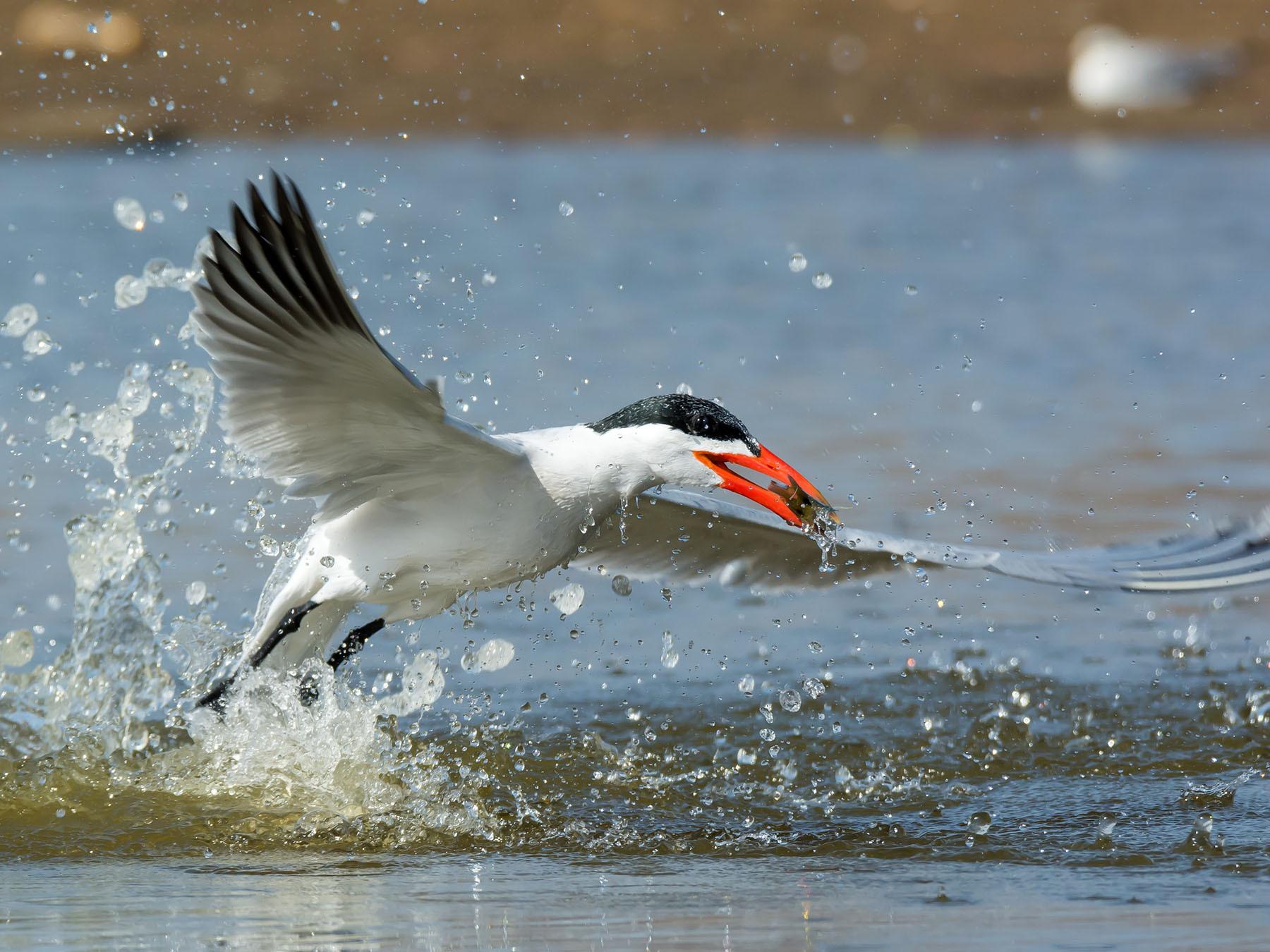
It eats almost nothing but fish, with crayfish, other crustaceans or large insects now and then. It tends to take whatever fish are plentiful nearby, such as shiner perch in California and alewife on the Great Lakes. Parents often bring small minnows to newly hatched chicks. On northern Lake Michigan most fish it takes are 2-6 in (5-15 cm) long.1
It hunts from the air. It flies with the bill pointed down, hovers, then plunges in and usually disappears under the water, coming up a second or two later. It also steals fish in flight from other terns and small gulls, and from other fish-eating birds and people, and is robbed in turn by gulls and jaegers.
Fishing success varies by place. Dives that caught a fish were 42% at Grays Harbor, Washington, 26% in the Gulf of Suez and 15% in the Baltic.1 On the Great Lakes in 1963-1964, alewife made up 74% of the diet, from 169 fish at 8 colonies.1 GPS-logged adults at two Baltic colonies chose shallow water, some fished inland lakes, and each bird kept to its own fishing spots through the breeding season.7
Salmon in the diet
In a few places young salmon are a large part of the diet. At Rice Island, in the Columbia River estuary, young salmon and steelhead made up 74% of the diet by mass in 1997-1998.8 A model based on the birds' energy needs estimated that Rice Island terns ate about 8.1 million young salmon and steelhead in 1997 and 12.4 million in 1998, up to 15% of the young fish reaching the estuary from some listed populations. From simple salmon population models, the authors say it appears unlikely that managing tern predation alone would reverse salmon declines.9
In San Francisco Bay in 2003-2009, salmon were a far smaller share: 22.9% of the diet in the North Bay, against 5.3% in the Central Bay and only 0.1% in the South Bay, with marine fish making up most of it.10 How many salmon terns take varies sharply from one colony site to the next, even over short distances.1
Nesting and breeding
It nests on open, fairly flat islands of sand, shell, gravel or rock with few plants, because its eggs and chicks are easy prey for ground predators. On the Pacific and Gulf coasts many of the biggest colonies are on islands of dredged spoil and on the dikes of salt ponds. Colonies are often small, under 100 pairs, but can hold 1,000 pairs or more, and some birds nest as single pairs. It often nests beside gulls and other terns. On the Great Lakes in 1962-1964, colonies averaged 151 pairs.11 East Sand Island in the Columbia River estuary held about 9,000 pairs each year from 2001 to 2011, the largest colony in North America.12
The nest and eggs
The nest is a scrape in sand or gravel, sometimes lined with plants, pebbles or bits of shell, and sometimes with a raised rim like a gull's. Both birds make it. Each pair defends only a tiny patch around the nest, roughly 1.6-4.9 ft (0.5-1.5 m) across.
First eggs come two to three weeks after the birds arrive: mainly in April in Texas, from the first week of April in San Diego Bay, from early May on the Great Lakes and in June and July in Manitoba. In the Southern Hemisphere they lay from September to December. The clutch is usually one to three eggs, rarely four, with two commonest in the south and three in the north. The eggs are pinkish to pale buff with small dark spots. Both parents incubate, starting with the first egg, for an average of 25-27 days depending on the site; on the Great Lakes the average was 26.1 days from 32 eggs.1
Chicks and fledging at the nest
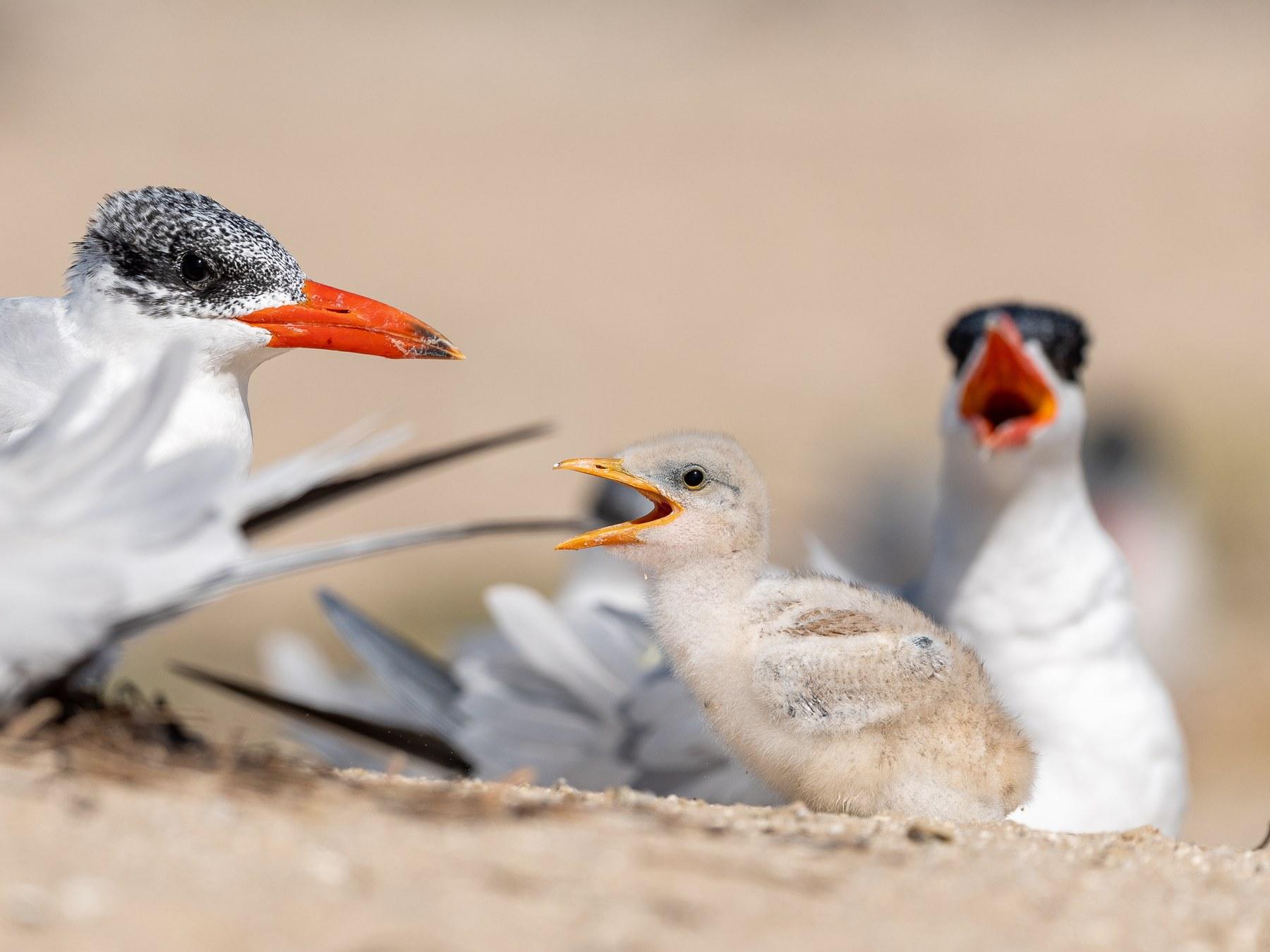
The eggs hatch a few days apart, so chicks in one nest differ in size. In North America most downy chicks are light wood brown or pale creamy white above, with a few in between, and the bill is apricot-orange, usually tipped black. They can leave the nest cup within hours but usually stay a day or two. At a few days old they run and crouch at an alarm, gather in groups and can walk more than 650 ft (200 m) to water if disturbed. They grow more slowly than other terns of temperate regions, probably because of their size, and first fly at about 37 days old (35-45 days).
Both parents brood the chicks. At one Texas colony females spent more time at the nest and males brought more food to the chicks. A pair raises one brood a year, and pairs that lose their eggs early often move and lay again.
In five well-studied North American colonies, 70-85% of eggs hatched, and pairs fledged 0.6-1.6 chicks per nest. At Rice Island in the 1990s, where eagles and gulls took many eggs and chicks, only about 5% of nests were estimated to raise a chick.1
Care of the young
Parents look after their young for longer than any other tern. Most young birds stay partly dependent and are fed for several months after they fly, often at sea, and follow their parents south. In New Zealand, fledglings were not independent until they were about 9 months old.1 Other accounts give up to eight months, or five to seven months after fledging.13, 14 Young birds may start fishing for themselves at about 60 days but rarely succeed, and in Texas two-year-olds still missed more often than adults.
Mates and breeding age
Pairs are generally monogamous, but not always for long. At colonies in northeastern Lake Michigan, only a quarter of pairs (25%) stayed together from one season to the next. Keeping a mate was linked to how stable the nest site stayed from year to year, as water levels changed, rather than to the previous year's success.15 At two Pacific Northwest colonies, the adults were caught at five nests: the three with four or five eggs were each incubated by two females, and the two with three eggs by a male and a female.16
Most do not breed until they are at least three years old, and a few may try at two. On the Copper River Delta, Alaska, the youngest banded birds came back and bred at three.17 Adults usually return to the previous year's colony, especially after a success, and tend to move after a failure.18 Young birds mostly breed away from where they hatched: of 20 color-banded three-year-olds on the Great Lakes, only 10% nested at home.1
Behaviour
On the ground it tends to waddle when it walks and lurch when it runs, and on water it settles and rides high like a gull. All year it gathers in flocks to roost at night and loaf by day. On migration and in winter it often roosts with Royal, Sandwich and Gull-billed Terns and with Ring-billed and Herring Gulls, in mixed flocks of up to 1,000 at wintering sites. Away from roosts and colonies it is not very sociable, though, and is often seen alone or in small groups of two to five.
It is much more aggressive than most terns, at colonies and roosts alike. It chases gulls, Turkey Vultures and Great Blue Herons, and nesting birds have struck researchers on the head hard enough to draw blood. Adults attack and kill strange chicks that wander onto their patch.
In courtship the male flies low over the colony carrying a fish and calling, then feeds the female. Pairs also climb high in display flights, gliding long distances. It is active by night as well as by day, though colonies are much quieter after dark. On hot days, incubating adults on the Great Lakes turn the black cap away from the sun, pant with a fluttering throat and fly to water to wet their feet and breast.1
Lifespan and predators
The oldest Caspian Tern on the US Bird Banding Laboratory's longevity list was at least 32 years 1 month old. It was banded as a nestling in Michigan on 13 June 1986 and found dead in Illinois on 26 July 2018.19 In Europe, the longevity list has two Swedish birds at least 31 years old, both identified by reading their rings in the field.20
Most live much shorter lives, and the first months are the riskiest. In a 1965 study of Great Lakes banding, birds that reached adulthood lived 11.9 years on average, from 260 band recoveries.1 On the Pacific coast, banding up to 1980 showed 57% of fledglings reaching their fourth year, after which adults survived 89% of years.21
Predators
Gulls take eggs and chicks across the range. Great Horned Owls, Common Ravens, cats, dogs, striped skunks, raccoons, red foxes, coyotes, northern pike and western diamondback rattlesnakes also take eggs or young, while Bald Eagles, red foxes and coyotes kill adults. On the Pacific coast, a whole colony can leave its nests when an eagle flies over, and gulls then take the unguarded eggs and chicks.
On East Sand Island, young fledged per pair fell from 1.39 in 2001 to 0.05 in 2010 and none in 2011. The authors say their results support the idea that the fall was driven mainly by food supply and predators acting together: high river flows in May and June, linked to fewer forage fish, along with eagle disturbance and gulls stealing fish.12
Conservation
Worldwide it is not considered threatened. The IUCN Red List rates it Least Concern, in a 2019 assessment.22 NatureServe ranks it secure worldwide (G5), but some states and provinces rank it low, such as New York (S1) and Michigan and Florida (S2); these are conservation ranks, not legal listings.14 In Canada, COSEWIC, the national assessment committee, judged it Not at Risk in 1999 after designating it Special Concern in 1978, while Wild Species 2015, Canada's general status report, ranked it Vulnerable.23, 14 Partners in Flight gives it a continental concern score of 9 on its 20-point scale.24
Population and trends
Estimates of the world population differ. Wetlands International's 2015 figures give 240,000-420,000 birds, increasing overall, while Partners in Flight's extrapolation gives about 530,000, for around 2010.1, 24 Partners in Flight puts 78,000 in the US and Canada, and Canada's 2019 assessment gives 25,000-50,000 breeding birds there.24, 23 Elsewhere there are up to 100,000 in Australia and 45,000-60,000 in West Africa, and 11,800-14,800 pairs in Europe, most of them in Russia.1
The North American Breeding Bird Survey finds no significant change from 1966 to 2025 (-0.06% a year, 95% credible interval -1.45 to +1.20, on 236 routes), but this colonial bird is scarce on its routes and the survey flags the result as having a deficiency.25 Colony counts tell more. A review of North American counts to 1998 found numbers up in the Great Lakes, central Canada and on the Gulf and Pacific coasts, with the Atlantic coast the only region of significant decline.26 By 2000 the Pacific coast population had more than doubled since 1980, to about 12,900 pairs.27
Recent years on the Pacific coast look different. A 2023 review reports that the Pacific Flyway breeding population has fallen by more than half since the two salmon-protection management plans were put in place.28 Bird flu (H5N1) then hit Rat Island, Washington, in July and August 2023. There, 1,101 dead adults and 520 dead chicks were counted, at least 56% of the adult colony; counting other deaths in Washington and Oregon, the authors put that summer's loss at an estimated 10-14% of the Pacific Flyway population.29 In San Francisco Bay, nesting pairs fell from 1,287 in 2003 to 830 in 2009.10
Population history
By the late 1800s it had nearly vanished from most colonies in eastern North America and central Europe, and it recovered slowly from the mid-1900s. In North America the rise apparently owes most to habitat made by people, such as salt-pond levees and islands of dredged spoil, helped by legal protection, protected colony sites and public concern, and on the Great Lakes by plentiful alewife and smelt.1 The 2000 review of colony counts suggests food supply may be at least partly responsible.26
The main limit on its numbers appears to be safe nest sites, free of floods and predators. Rising water, competition with gulls that nest earlier and disturbance all lower nesting success, and birds readily desert colonies disturbed early in the season. In Great Lakes chicks of 1992-1994, higher levels of PCBs and related chemicals went with weaker immune responses.30
Legal status
In the United States it is protected under the Migratory Bird Treaty Act and is on the federal list of protected birds (50 CFR 10.13).31 The Fish and Wildlife Service lists it as a Species of Concern, which is not a listing under the Endangered Species Act.32 In Canada it is protected under the Migratory Birds Convention Act, 1994.33
More photos
3 photos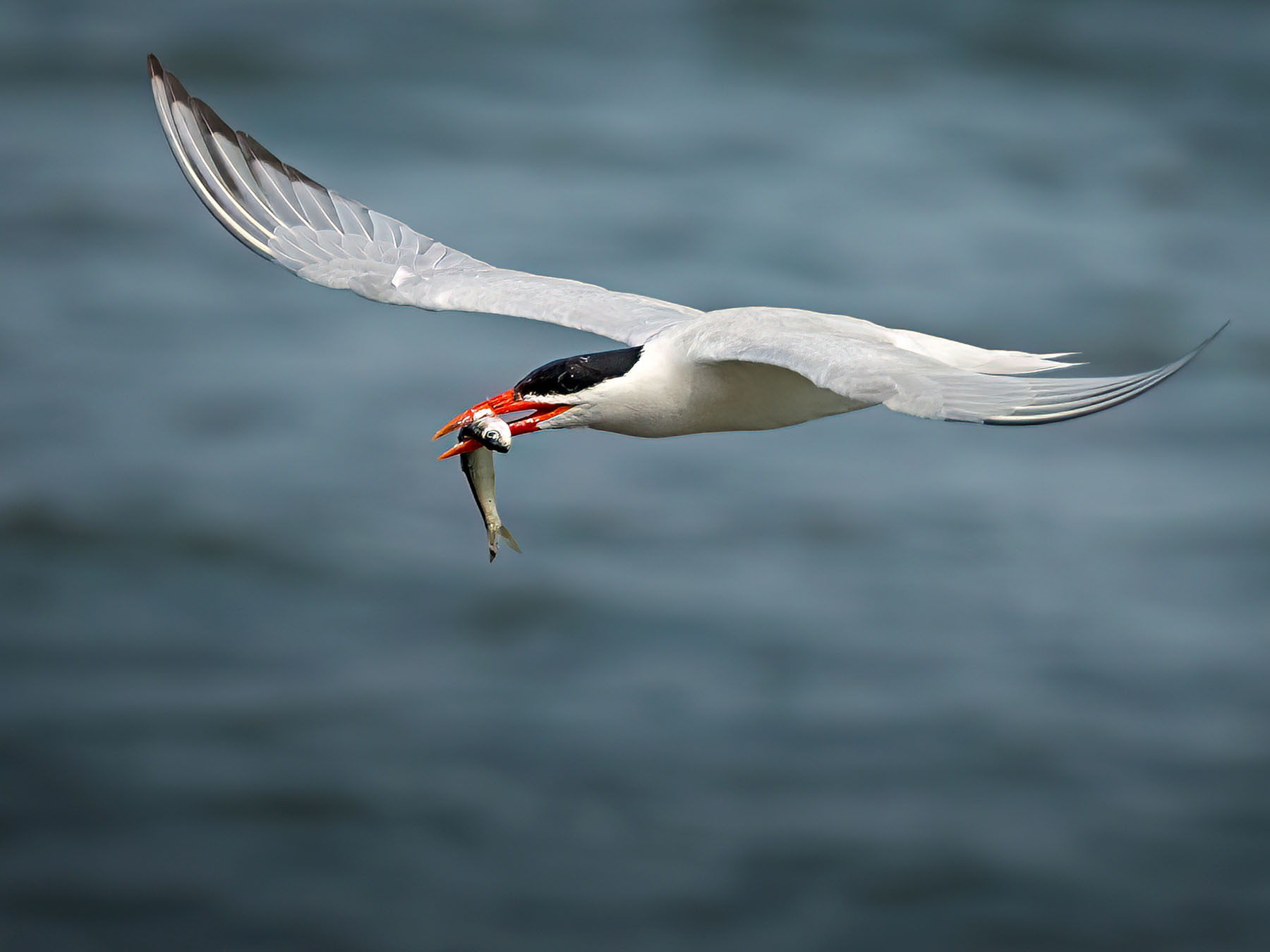
Quick facts
- Length
- 47–54 cm
- Wingspan
- 127–140 cm
- Weight
- 530–782 g
- Lifespan
- oldest recorded 32 years 1 month
- Family
- Gulls & Terns
- Migration
- Partial migrant
- Global status (IUCN)
- Least Concern
- World population
- About 240,000-420,000 birds worldwide (Wetlands International 2015); Partners in Flight estimates 530,000 (around 2010)
- Population trend
- No significant change in the Breeding Bird Survey since 1966, though the survey flags the result as having a deficiency for this scarce colonial bird; colony counts showed increases to the late 1990s, and a 2023 review reports the Pacific Flyway breeding population down by more than half since the salmon-protection management plans began
- Scientific name
- Hydroprogne caspia
Questions
2Where does the name come from?
It is named for the Caspian Sea. Pallas described it in 1770 as Sterna caspia, and, by our reading of his Latin, wrote that he had seen it only toward the Caspian Sea and around the mouth of the river Yaik.34
What is its scientific name?
Hydroprogne caspia. The genus Hydroprogne holds only this species.35 It was long placed in Sterna with most other terns, until DNA work showed that the old Sterna was not a natural group; its closest relative is the Gull-billed Tern.1 There are no subspecies. Australian and New Zealand birds are sometimes treated as a race, strenua, but many birds from other populations share their features.
Sources
39- 1Cuthbert, F. J. and Wires, L. R. (2020). Caspian Tern (Hydroprogne caspia), version 1.0. Birds of the World. Cornell Lab of Ornithology. doi:10.2173/bow.caster1.01 (opens in a new tab)
- 2Buckley, Buckley and Mlodinow (2021). Royal Tern (Thalasseus maximus), version 1.1. Birds of the World. Cornell Lab of Ornithology. Accessed 28 November 2026. Source (opens in a new tab)
- 3Haynes Trevor B. et al. (2017). Successful Breeding of Caspian Terns in the Arctic: Part of the New Normal?. Marine Ornithology 45(2). doi:10.5038/2074-1235.45.2.1221 (opens in a new tab)
- 4Craig David P. and Larson Keith (2017). Migratory Connectivity of North American Caspian Tern Populations. Waterbirds 40(1): 58-62. doi:10.1675/063.040.0108 (opens in a new tab)
- 5Lyons Donald E. et al. (2018). The Salton Sea: Critical Migratory Stopover Habitat for Caspian Terns in the North American Pacific Flyway. Waterbirds 41(2): 154-165. doi:10.1675/063.041.0206 (opens in a new tab)
- 6Rueda‐Uribe Cristina et al. (2021). First tracking of declining Caspian terns breeding in the Baltic Sea reveals high migratory dispersion and disjunct annual ranges as obstacles to effective conservation. Journal of Avian Biology 52(9). doi:10.1111/jav.02743 (opens in a new tab)
- 7Beal Martin et al. (2022). Habitat selection and foraging site fidelity in Caspian Terns breeding in the Baltic Sea. Ornis Fennica 98(4). doi:10.51812/of.113445 (opens in a new tab)
- 8Collis Ken et al. (2002). Colony Size and Diet Composition of Piscivorous Waterbirds on the Lower Columbia River. Transactions of the American Fisheries Society 131(3): 537-550. doi:10.1577/1548-8659(2002)131<0537:CSADCO>2.0.CO;2 (opens in a new tab)
- 9Roby Daniel D et al. (2003). Quantifying the effect of predators on endangered species using a bioenergetics approach: Caspian terns and juvenile salmonids in the Columbia River estuary. Canadian Journal of Zoology 81(2): 250-265. doi:10.1139/z02-242 (opens in a new tab)
- 10Collis Ken et al. (2012). Trends in Caspian Tern Nesting and Diet in San Francisco Bay: Conservation Implications for Terns and Salmonids. Waterbirds 35(1): 25-34. doi:10.1675/063.035.0103 (opens in a new tab)
- 11Ludwig James Pinson (1965). Biology and Structure of the Caspian Tern Population of the Great Lakes from 1896-1964. Bird-Banding 36(4): 217. doi:10.2307/4511206 (opens in a new tab)
- 12Collar Stefanie, Roby Daniel D. and Lyons Donald E. (2017). Top-Down and Bottom-Up Interactions Influence Fledging Success at North America's Largest Colony of Caspian Terns. Estuaries and Coasts 40(6): 1808-1818. doi:10.1007/s12237-017-0238-x (opens in a new tab)
- 13National Audubon Society. Caspian Tern. Audubon Guide to North American Birds. Accessed 28 November 2026. Source (opens in a new tab)
- 14NatureServe. Hydroprogne caspia (ELEMENT_GLOBAL.2.104635). NatureServe Explorer. Accessed 28 November 2026. Source (opens in a new tab)
- 15Cuthbert Francesca J. (1985). Mate Retention in Caspian Terns. The Condor 87(1): 74-78. doi:10.2307/1367133 (opens in a new tab)
- 16Conover Michael R. (1983). Female-Female Pairings in Caspian Terns. The Condor 85(3): 346. doi:10.2307/1367073 (opens in a new tab)
- 17Suzuki Yasuko, Bishop Mary Anne, Roby Daniel D. and Bixler Kirsten S. (2019). Colony Connectivity and the Rapid Growth of a Caspian Tern Colony on Alaska's Copper River Delta, USA. Waterbirds 42(1): 1-7. doi:10.1675/063.042.0101 (opens in a new tab)
- 18Cuthbert Francesca J. (1988). Reproductive Success and Colony-Site Tenacity in Caspian Terns. The Auk 105(2): 339-344. doi:10.2307/4087499 (opens in a new tab)
- 19USGS Bird Banding Laboratory. Longevity records (current table), Caspian Tern, AOU 0640. USGS Bird Banding Laboratory. Accessed 28 November 2026. Source (opens in a new tab)
- 20Fransson, T., Kolehmainen, T., Moss, D. and Robinson, R. (2023). EURING list of longevity records for European birds (1 Sep 2023). EURING. Accessed 28 November 2026. Source (opens in a new tab)
- 21Gill Robert E. and Mewaldt L. Richard (1983). Pacific Coast Caspian Terns: Dynamics of an Expanding Population. The Auk 100(2): 369-381. doi:10.1093/auk/100.2.369 (opens in a new tab)
- 22BirdLife International (2019). Hydroprogne caspia. The IUCN Red List of Threatened Species 2019: e.T22694524A155509311. IUCN Red List. Accessed 28 November 2026. Source (opens in a new tab)
- 23Environment and Climate Change Canada (2019). Status of Birds in Canada: Caspian Tern (2019 edition, archived). ECCC. Accessed 28 November 2026. Source (opens in a new tab)
- 24Partners in Flight (2024). Avian Conservation Assessment Database, version 2024.05.23. Partners in Flight. Accessed 28 November 2026. Source (opens in a new tab)
- 25Hostetler, J. A. et al. (2026). The North American Breeding Bird Survey, Analysis Results 1966-2025. USGS data release. Accessed 28 November 2026. Source (opens in a new tab)
- 26Wires Linda R. and Cuthbert Francesca J. (2000). Trends in Caspian Tern Numbers and Distribution in North America: A Review. Waterbirds 23(3): 388. doi:10.2307/1522176 (opens in a new tab)
- 27Suryan Robert M. et al. (2004). Redistribution and Growth of the Caspian Tern Population in the Pacific Coast Region of North America, 1981-2000. The Condor 106(4): 777-790. doi:10.1093/condor/106.4.777 (opens in a new tab)
- 28Collis Ken et al. (2023). Caspian Tern Management to Increase Survival of Juvenile Salmonids in the Columbia River Basin: Progress and Adaptive Management Considerations. Fisheries 49(2): 71-84. doi:10.1002/fsh.11012 (opens in a new tab)
- 29Haman Katherine H. et al. (2024). A comprehensive epidemiological approach documenting an outbreak of H5N1 highly pathogenic avian influenza virus clade 2.3.4.4b among gulls, terns, and harbor seals in the Northeastern Pacific. Frontiers in Veterinary Science 11. doi:10.3389/fvets.2024.1483922 (opens in a new tab)
- 30Grasman K A, Fox G A, Scanlon P F and Ludwig J P (1996). Organochlorine-associated immunosuppression in prefledgling Caspian terns and herring gulls from the Great Lakes: an ecoepidemiological study. Environmental Health Perspectives 104(suppl 4): 829-842. doi:10.1289/ehp.96104s4829 (opens in a new tab)
- 31US Fish and Wildlife Service (2026). 50 CFR 10.13: List of Migratory Birds. eCFR (up to date as of 25 Nov 2026). Accessed 28 November 2026. Source (opens in a new tab)
- 32US Fish and Wildlife Service. ECOS species profile: Caspian Tern (Hydroprogne caspia), species 9657. ECOS. Accessed 28 November 2026. Source (opens in a new tab)
- 33Environment and Climate Change Canada. Birds protected in Canada. Government of Canada. Accessed 28 November 2026. Source (opens in a new tab)
- 34Pallas, PS (1770). Novi Commentarii Academiae Scientiarum Imperialis Petropolitanae, tomus XIV (Sterna caspia, p. 582). Internet Archive scan novicommentariia141impe (OCR text). Accessed 28 November 2026. Source (opens in a new tab)
- 35AviList Core Team (2025). AviList: The Global Avian Checklist, v2025b. AviList. doi:10.2173/avilist.v2025b (opens in a new tab)
- 36L'Arrivee Louis and Blokpoel Hans (1988). Seasonal Distribution and Site Fidelity in Great Lakes Caspian Terns. Colonial Waterbirds 11: 202. doi:10.2307/1521001 (opens in a new tab)
- 37Cornell Lab of Ornithology. Caspian Tern: Overview, ID, Life History, Range Map. All About Birds. Accessed 28 November 2026. Source (opens in a new tab)
- 38Velarde et al. (2026). Elegant Tern (Thalasseus elegans), version 2.0. Birds of the World. Cornell Lab of Ornithology. Accessed 28 November 2026. Source (opens in a new tab)
- 39Gochfeld et al. (2020). Greater Crested Tern (Thalasseus bergii), version 1.0. Birds of the World. Cornell Lab of Ornithology. Accessed 28 November 2026. Source (opens in a new tab)

Checked by
Nathan Cope, founder and editor
Nathan founded Birdfact and leads its writers and contributors in the UK, the US and Canada. He has watched and studied birds for more than ten years, and checks every article and species guide before it’s published.