


Bald Eagle
American Eagle · Haliaeetus leucocephalus
By the Birdfact teamChecked by Nathan Cope
On this page14 sections
How to recognise it
What do Bald Eagles look like?
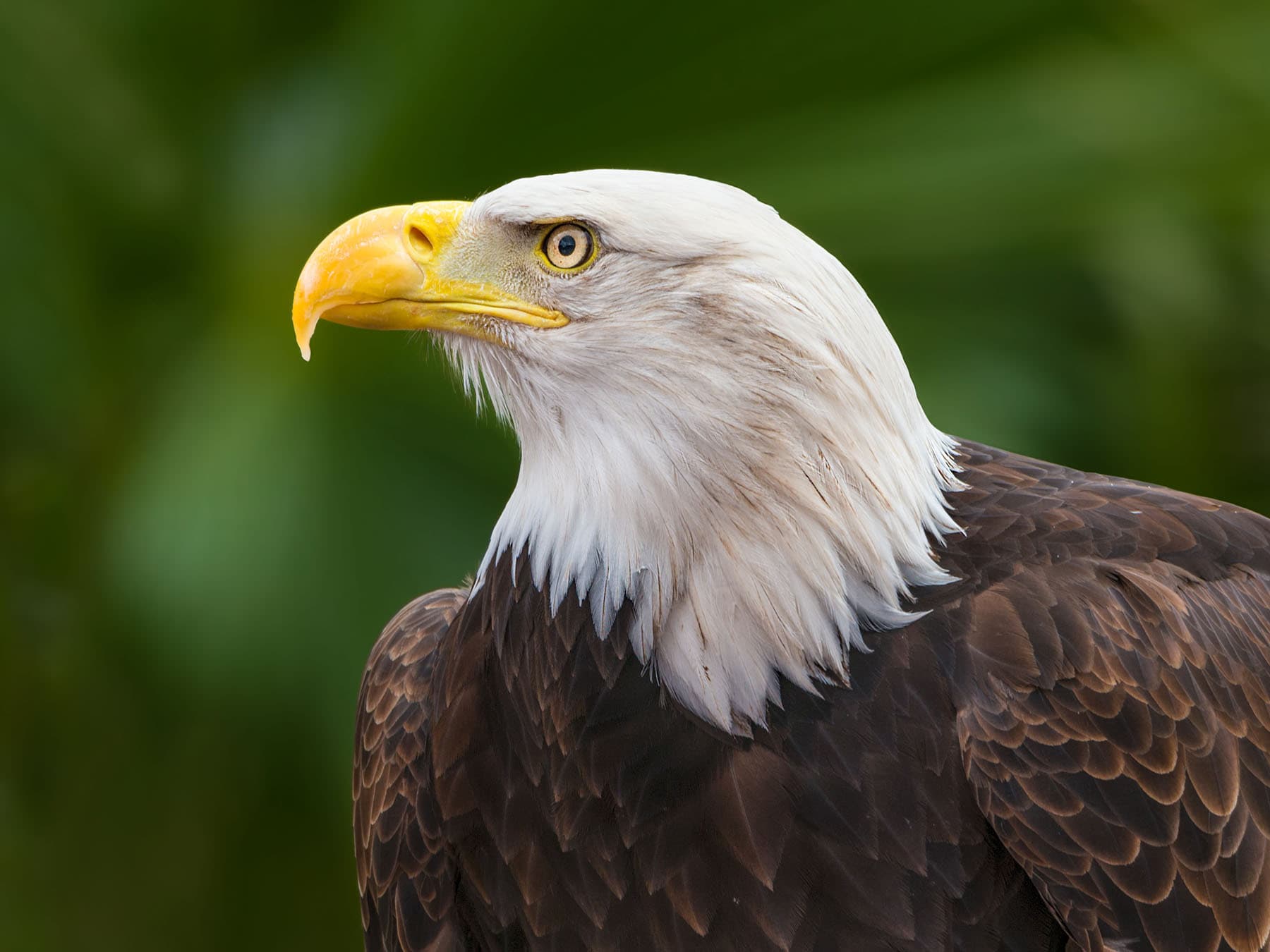
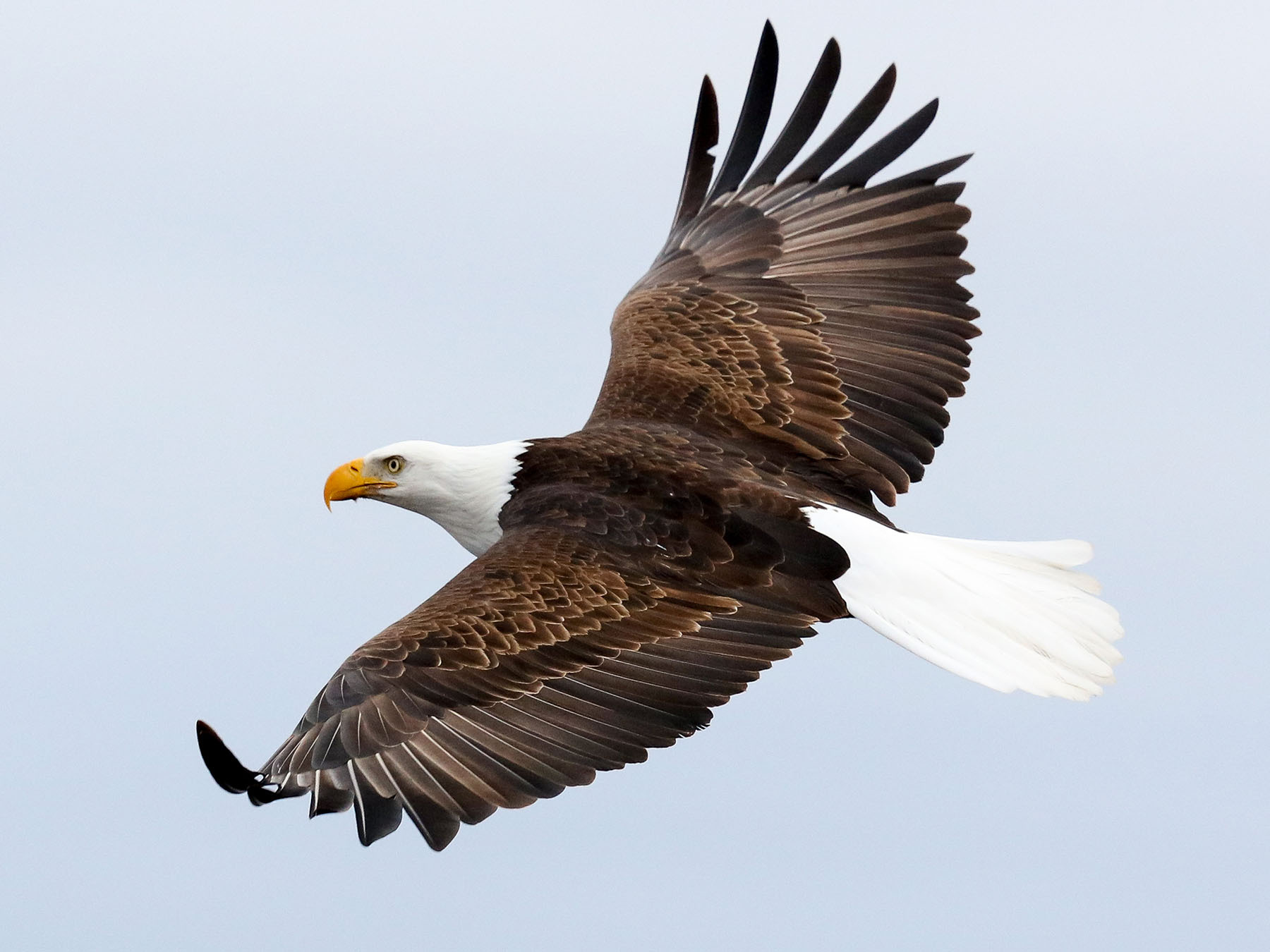
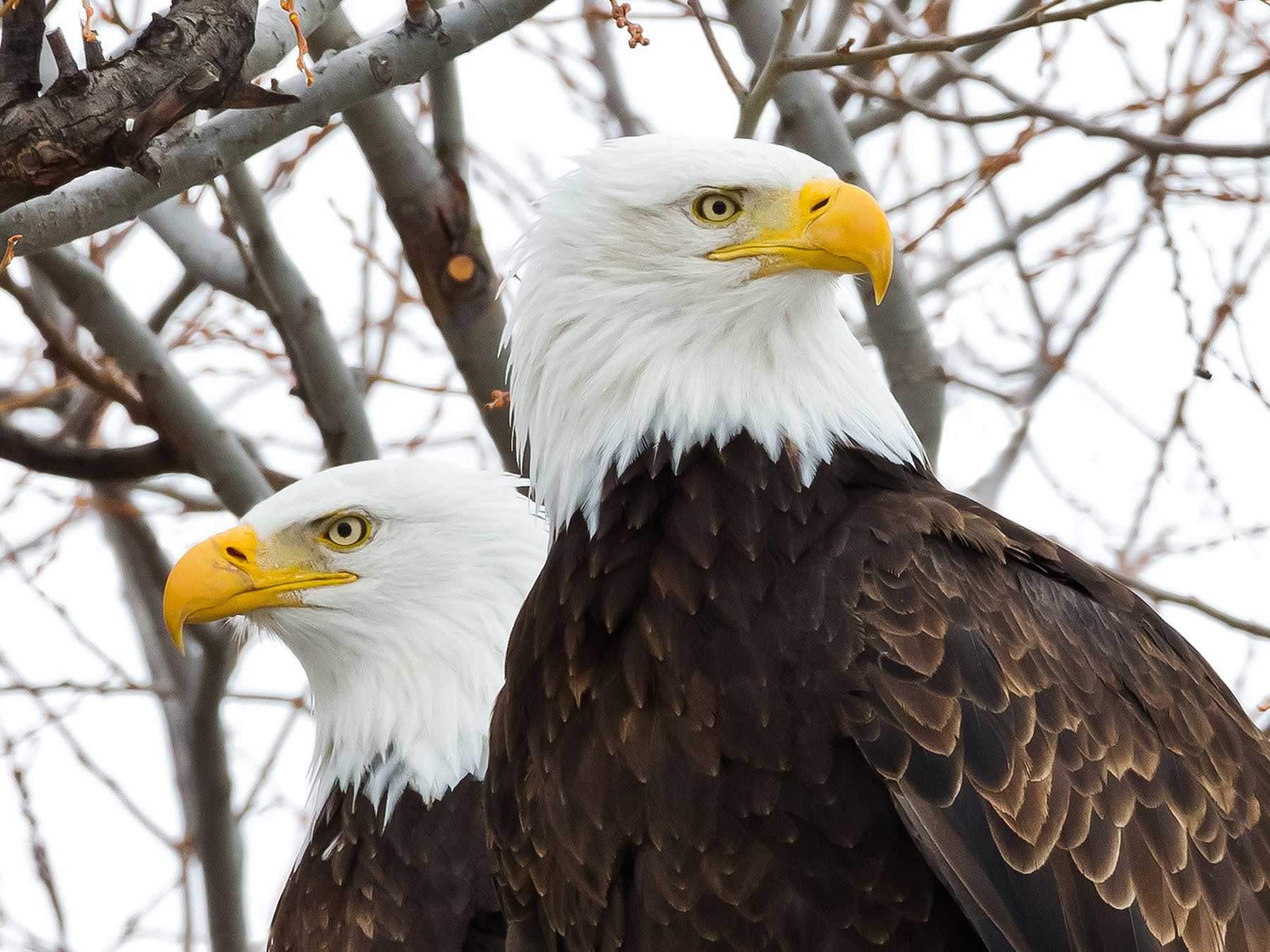
Bald Eagles are massive birds of prey, instantly recognizable by their white heads and tails, and chocolate-brown bodies. Their legs and large, hooked bills are yellow, and a close view reveals their piercing pale, yellow-blue eyes. Their scientific name translates as ‘white-headed sea-eagle.’
Female Bald Eagles look much the same as their male counterparts. One visible physical difference lies in their size. Females may be as much as a third larger than males, a common phenomenon in birds of prey.
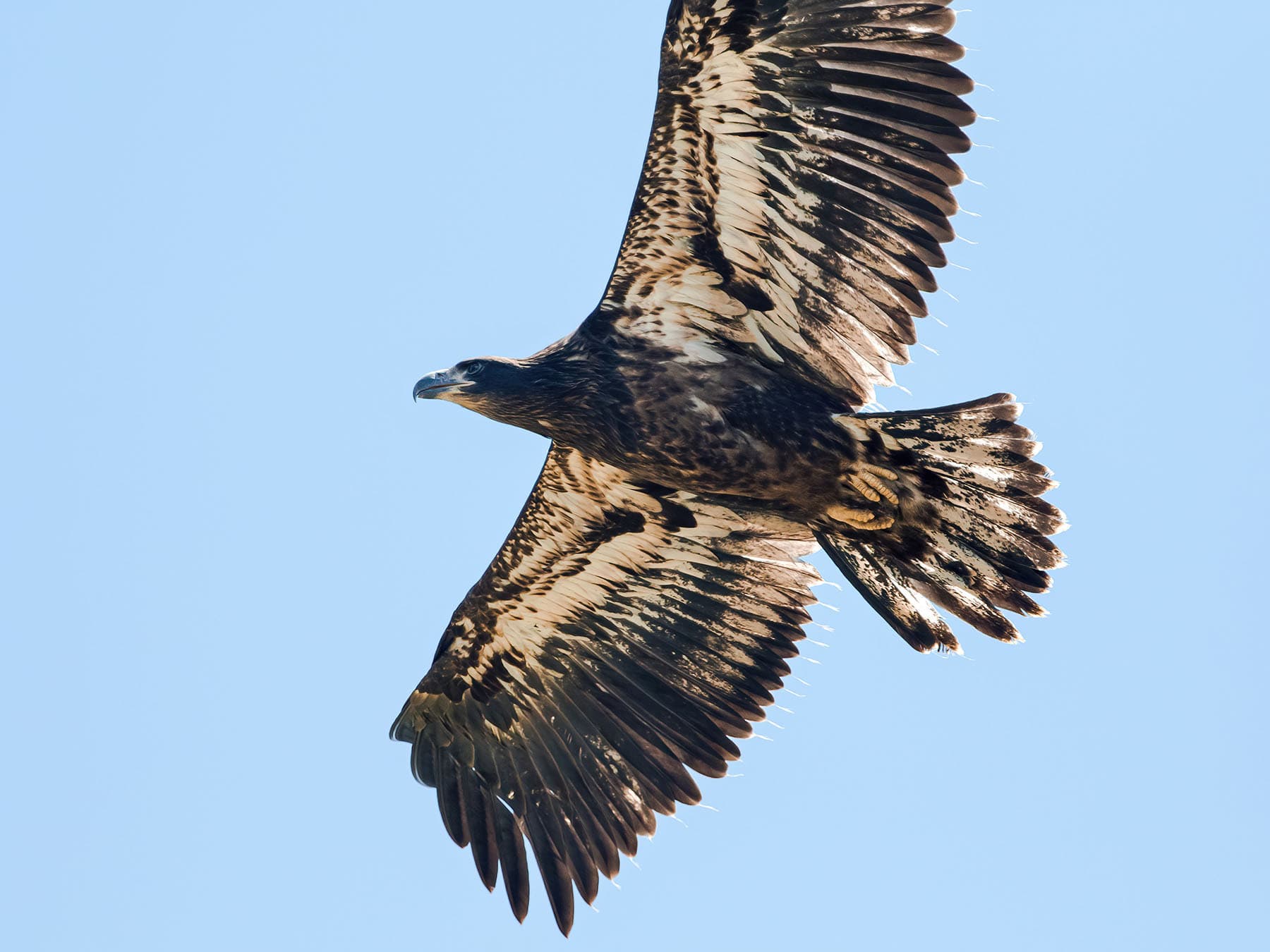
Juvenile Bald Eagles look distinct from adults and may be confused for another majestic American raptor, the Golden Eagle. That’s because young Bald Eagles don’t develop their characteristic white heads and yellow bills for their first five years or so. Until then, juveniles are mostly dark brown with yellow legs and increasing amounts of white plumage.
How big are Bald Eagles?
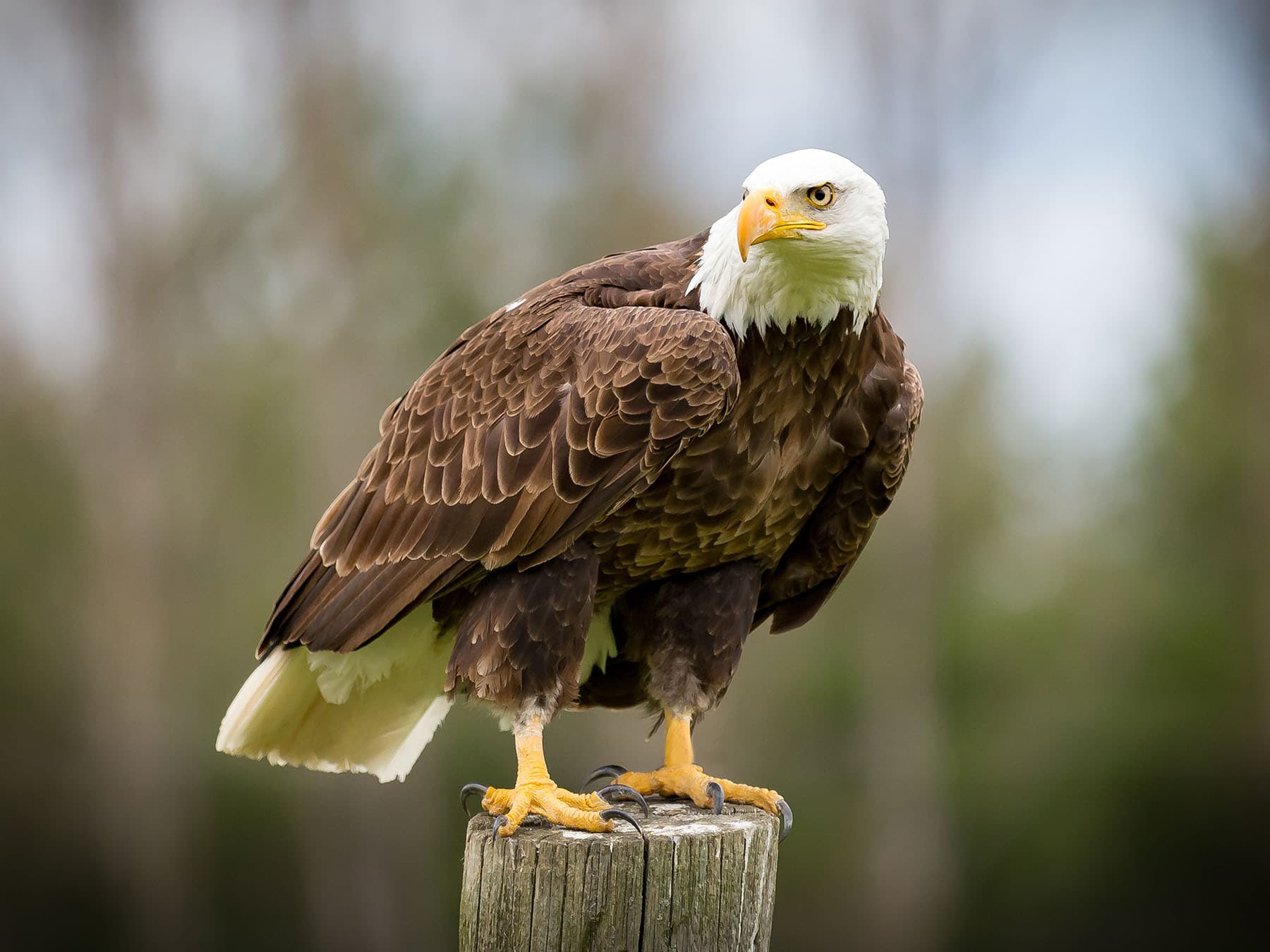
The Bald Eagle is an impressive bird both in flight and when perched. Their body length varies from about 2⅓ to 3 feet (0.7 - 0.9 m), with males being the smaller sex.
Despite their large size, Bald Eagles are surprisingly light. Females are significantly heavier than males, weighing up to nearly 14 pounds (6.3 kg) in some areas. However, adult mass can be as low as 6½ pounds (3 kg).
Bald Eagles have large, broad wings that end in a handful of exaggerated primary feathers. Their impressive wingspan can measure upwards of 6 ½ feet (2 m), making them a truly inspiring sight when soaring!
For more information on Bald Eagle size, check out this guide.

Its size
Adults- Length
- 70–102 cm
- Wingspan
- 180–244 cm
- Weight
- 3000–6300 g
Its song and calls
The stirring cry most commonly associated with Bald Eagles in popular culture is, in fact, that of the Red-tailed Hawk. Read on to learn what a Bald Eagle really sounds like.
What sound does a Bald Eagle make?
America’s National Birds are better known for their great size and striking appearance than their vocal abilities.
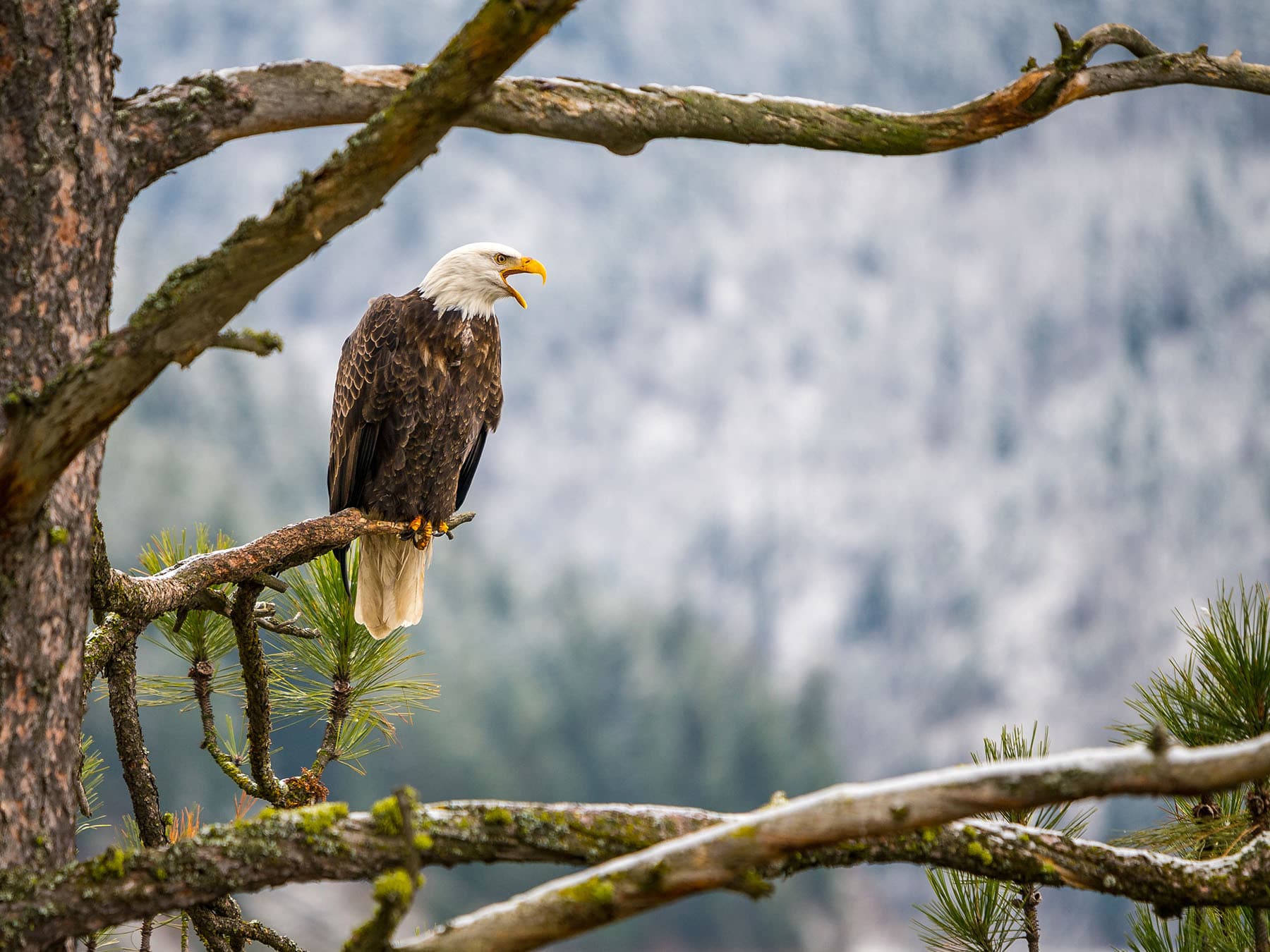
Bald Eagles produce soft, ‘thin’ calls during aggressive displays, when defending their nest, or while mating. These calls are best described as squeals and are usually produced in a quick sequence.
- Call0:00 / 0:12
Recorded in Nova Scotia, Canada · June 2024
When and where to see it
OctoberArriving
Most recorded in October
- 1. Northwest Territories5.4%
- 2. Yukon Territory3.8%
- 3. Alaska3.6%
- 4. Manitoba2.2%
- 5. Minnesota2.0%
Each dot is a county, state or province: the bigger and darker, the larger the bird’s share of that place’s bird records that month. Grey dots: no regular records. The ringed point is the centre of the bird’s records this month; the arrow shows how it moved since last month, and the dashed loop its path through the year. “Arrivals” colours places where it becomes regular this month (orange) or is in its last regular month (grey). GBIF eBird Observation Dataset, 2019–2024. Map data: Natural Earth, US Census Bureau; place centres © OpenStreetMap contributors.
In your area
See when the Bald Eagle is recorded in your county, state or province.
How often the Bald Eagle turns up in the United States and Canada through the year, from birdwatchers' records.
United States
Resident · all year · most records in January
Canada
Resident · all year · most records in January
Show as a table
| Month | United States | Canada |
|---|---|---|
| January | 0.96% (regular) | 1.7% (regular) |
| February | 0.90% (regular) | 1.6% (regular) |
| March | 0.80% (regular) | 1.4% (regular) |
| April | 0.55% (regular) | 0.89% (regular) |
| May | 0.42% (regular) | 0.54% (regular) |
| June | 0.35% (regular) | 0.55% (regular) |
| July | 0.39% (regular) | 0.71% (regular) |
| August | 0.46% (regular) | 0.81% (regular) |
| September | 0.52% (regular) | 0.78% (regular) |
| October | 0.64% (regular) | 0.97% (regular) |
| November | 0.79% (regular) | 1.4% (regular) |
| December | 0.86% (regular) | 1.6% (regular) |
Worldwide: recorded regularly in 4 countries
Countries where it was recorded in at least 3 of the 6 years 2019–2024. Linked countries have their own bird list.
North America (4)
Data: EOD – eBird Observation Dataset (Cornell Lab of Ornithology), accessed via GBIF.org, CC BY 4.0. Records from 2019–2024, aggregated and filtered by Birdfact. How these lists are made
Bald Eagles have a wide distribution, but you’re most likely to spot them near their favorite habitats. Read this section to learn more about their range and habitat preferences.
What is the habitat of a Bald Eagle?
As a sea eagle species, Bald Eagles are generally associated with water. They are usually seen in close proximity to rivers, swamps, lakes, and coastlines.
What is the range of a Bald Eagle?
Bald Eagles are endemic to North America. They can be seen virtually throughout the Lower 48 States and most of Alaska. These birds are also widespread in Canada, and low numbers visit and breed in the far north of Mexico.
Where do Bald Eagles live?
Bald Eagles spend most of their time perched on the ground, on trees, and at other vantage points where they can rest or look out for a meal. They also spend a significant amount of time (2-7% of the day) flying and soaring through the skies.
At night, these birds roost in large trees within a few miles of their hunting grounds. They often roost in groups during the non-breeding season when they are less territorial.
How rare are Bald Eagles?
The total population of Bald Eagles in the Contiguous United States was estimated at 316,700 individuals in 2020.
They can be plentiful in some areas, and large numbers occur in States like Florida, Minnesota, and Wisconsin. Bald Eagles can be even more common in Canada, and the highest numbers breed in Alaska.
Where to see Bald Eagles in the UK
Bald Eagles are not native to the United Kingdom, although some specimens are kept in captivity. However, birdwatchers can spot the closely related White-tailed Eagle (Haliaeetus albicilla) in Scotland and the Southeast coastline of England.
Migration
Many birds migrate between overwintering and breeding grounds to take advantage of seasonal food sources and climatic conditions. Bald Eagles are not well known for their migratory behaviors, although they do, in fact, undertake seasonal movements.
Continue reading to learn about their migratory behaviors.
Do Bald Eagles migrate?
Bald Eagles are partial migrants, which means some migrate, while others remain in the same areas throughout the year. Individuals that breed in the north tend to migrate south to warmer states when their hunting grounds freeze over, and fishing becomes impossible.
Where food supplies are available throughout the year, they often stay put, although young birds are nomadic for their first few years, sometimes traveling thousands of miles before settling. Bald Eagles generally migrate during the day and usually travel alone.
Tips for seeing it
- Look for Bald Eagles near large bodies of water, especially during winter months when they congregate.
- Scan tall trees along shorelines for perched eagles or large stick nests.
- Observe their distinctive flight pattern: steady wingbeats with soaring on flat wings.
- In the US, popular viewing spots include Alaska, the Chesapeake Bay, and the Mississippi River.
What it eats
Bald Eagles have a varied diet and are not too proud to scavenge or even steal from other birds and animals. Keep reading to learn more about their diet.
What do Bald Eagles eat?
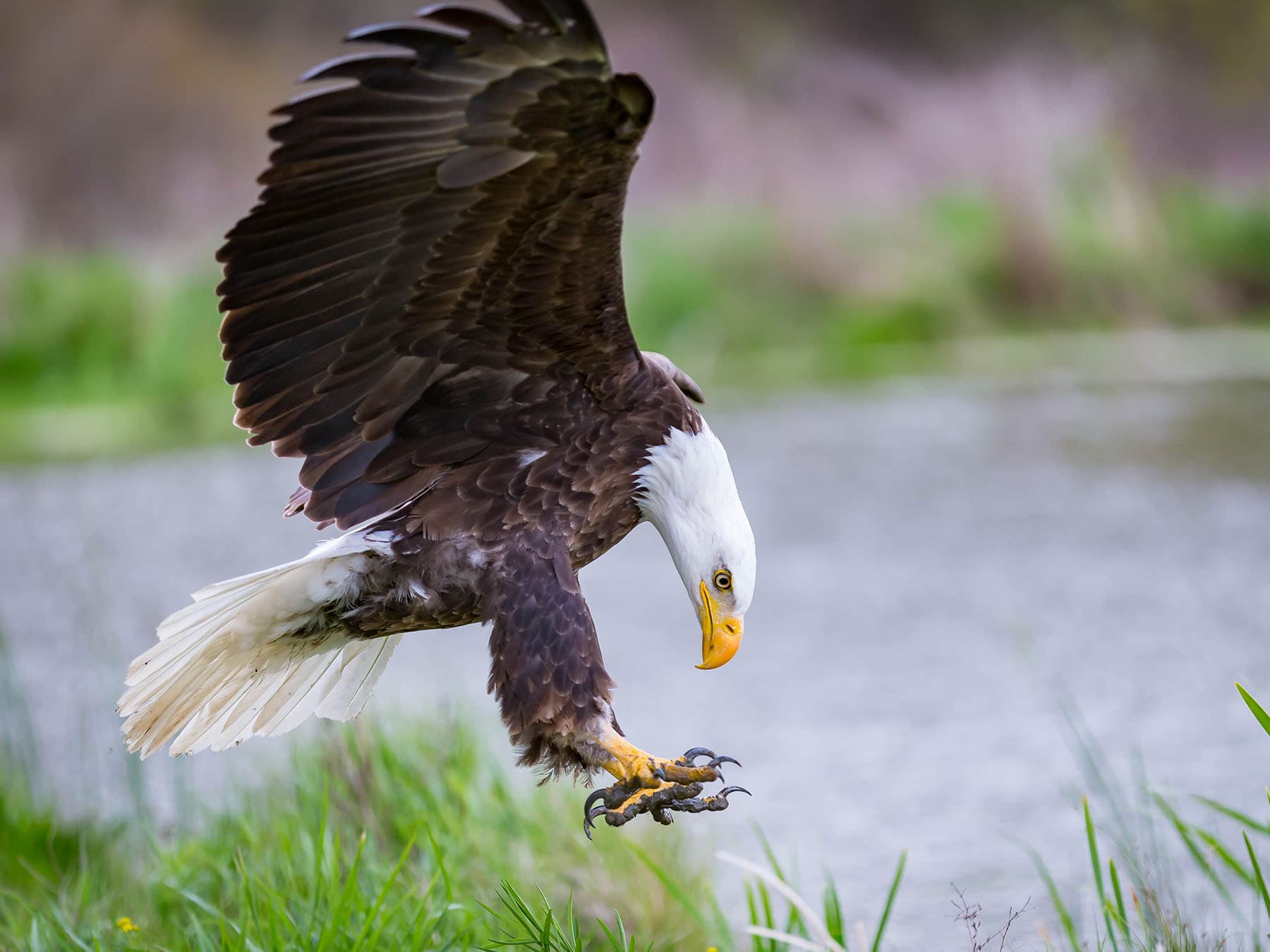
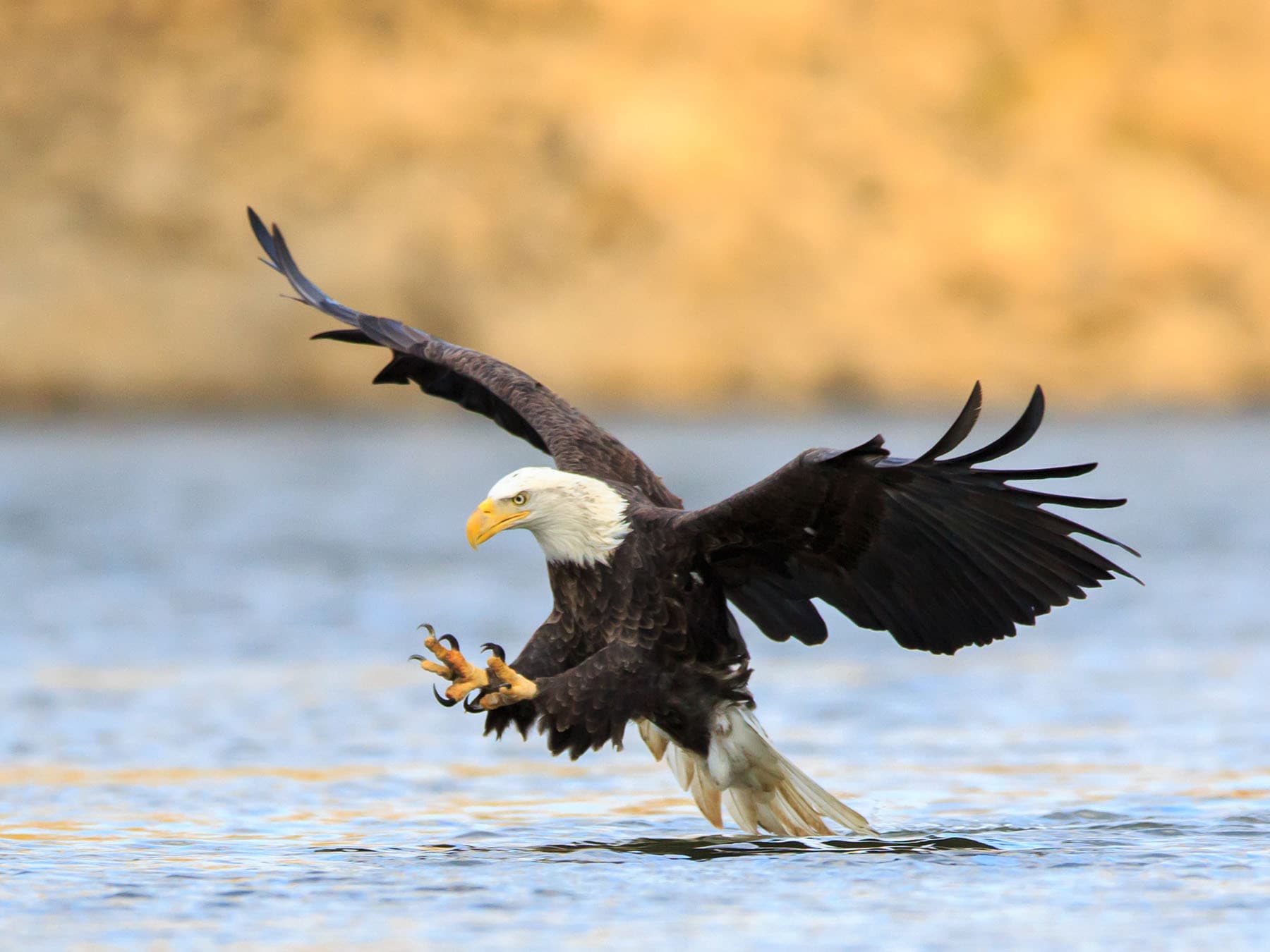
Bald Eagles are carnivorous birds, but that does not mean they only hunt live prey. These birds rely heavily on carrion, especially fish. However, they can also hunt live fish, waterbirds, and small mammals.
Bald Eagles feed on the following prey animals:
- Salmon, Shad, Catfish, and other fish species are eaten dead or alive
- Bald Eagles often hunt water birds like geese, coots, and even herons
- They occasionally hunt rabbits, ground squirrels, and other small mammals, and Bald Eagles will feed from larger animal carcasses like deer
What do baby Bald Eagles eat?
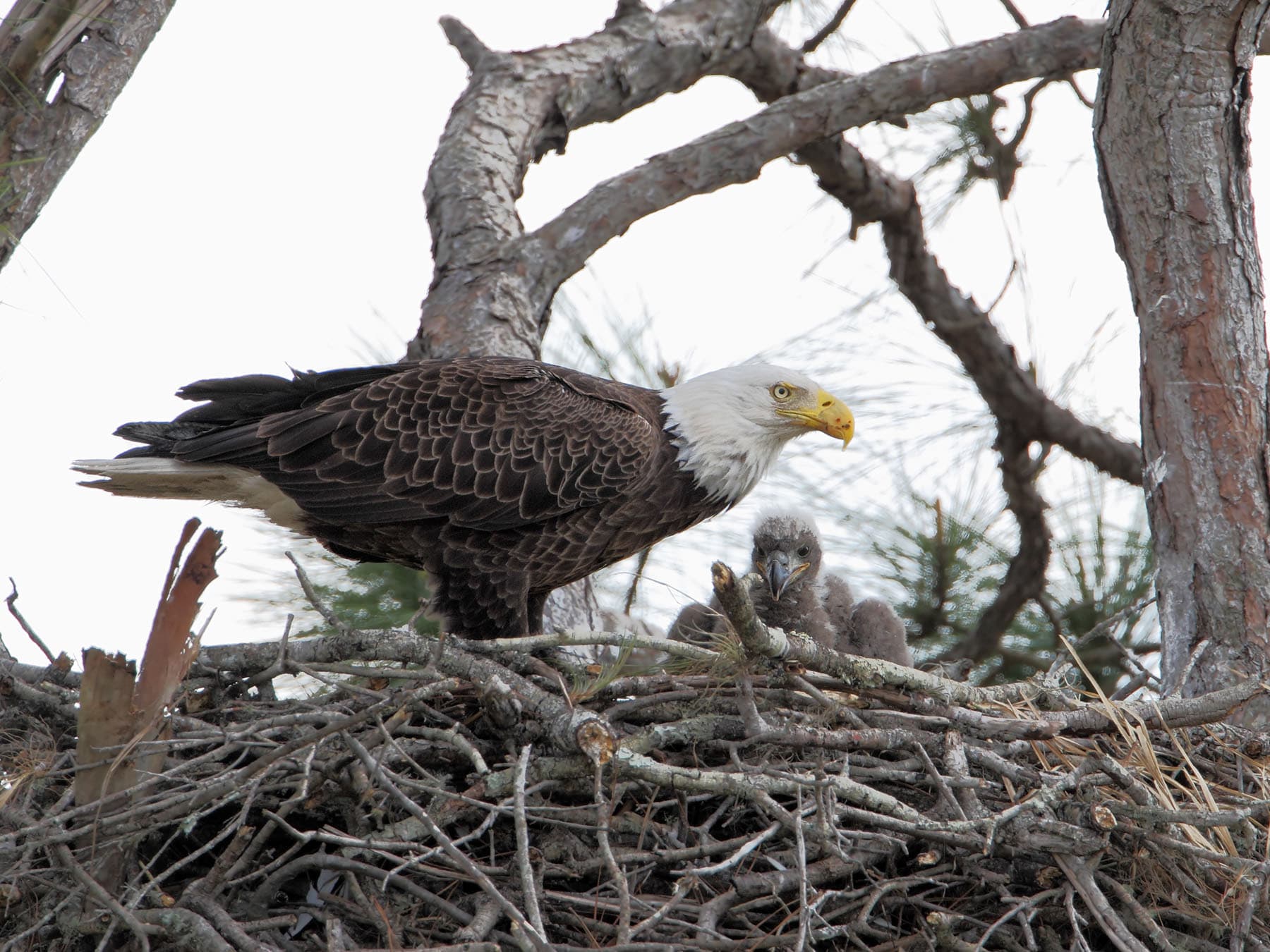
Baby Bald Eagles are fed by both parents, and the most important food source is fish. The adult birds tear small, bite-sized strips and present them directly to their chicks’ bills. In their second month, the young learn to use their own bills, although they rely on their parents for food for many weeks after fledging the nest.
Nesting and breeding
Bald Eagles begin breeding when they are four or five years old and raise just one brood each year. Read on for more fascinating facts about their nesting habits.
Where do Bald Eagles nest?
Bald Eagles nest in every state of the Continental United States. Pairs usually breed near aquatic and marine habitats that provide a rich food source for themselves and their chicks.
The nest is usually built in the branches of a large, sturdy tree, although Bald Eagles will nest on cliffs in areas without large trees.
What do Bald Eagle eggs look like?
Bald Eagles lay one to three large white eggs. The average egg measures about three inches (76 mm) long and two inches wide (51 mm) and weighs a little over four ounces (113 g).
Do Bald Eagles mate for life?
Bald Eagles will mate for life or until either partner passes away. Much time and effort go into raising their chicks, so it makes sense to stick with a successful partner rather than play the field. Some pairs remain together throughout the year, even outside the nesting season.
Behaviour
The mighty Bald Eagle was a somewhat controversial choice when first suggested as the United States National Bird. In fact, President Benjamin Franklin disagreed with its appointment, calling it ‘a bird of bad moral character’.
Are Bald Eagles aggressive?
Bald Eagles can be aggressive toward other birds, including members of their own species. Not only do Bald Eagles hunt waterbirds, but they will also use intimidation to steal a meal from other birds of prey like Ospreys and other fishing birds like Great Blue Herons.
Bald Eagles will fight amongst each other, and these conflicts can be fatal in some cases. Puncture wounds from their sharp talons can cause significant injuries, so most individuals avoid physical attacks.
Bald Eagles are rarely aggressive toward humans, and bird watchers can enjoy sightings of these majestic birds without fear. However, isolated attacks have been reported, and all wild animals should be given the respect they deserve.

Lifespan and predators
Bald Eagles are relatively long-lived birds that enjoy their position as apex predators at the top of the food chain. However, they can succumb to a number of causes, from shooting to starvation. Keep reading to learn more about their longevity and conservation status.
How long do Bald Eagles live?
Bald Eagles can live well over thirty years in the wild, although their average lifespan is much shorter. Many young eagles perish within their first year, and the youngest chick from larger clutches often dies of starvation. However, individuals that reach adulthood have few predators and usually live for many years.
What are the predators of Bald Eagles?
Adult Bald Eagles have few predators, although sick or injured individuals are vulnerable to larger carnivores like coyotes. However, many smaller carnivores and birds prey on their eggs and chicks, including foxes, ravens, and gulls.
Are Bald Eagles protected?
Bald Eagles may have been removed from the Endangered Species List, but they are still protected in the United States by the following two federal laws:
- Migratory Bird Treaty Act of 1918
- Bald and Golden Eagle Protection Act
Are Bald Eagles endangered?
Bald Eagles are no longer endangered. In fact, the species is listed as a ‘Least Concern’ species by the IUCN. They were officially removed from the endangered species list in 2007.
Conservation
Once endangered due to DDT use and habitat loss, Bald Eagles have made a remarkable recovery thanks to conservation efforts.
They were removed from the US Endangered Species List in 2007. However, they still face threats from lead poisoning, habitat degradation, and human disturbance.
Similar birds
Often mistaken for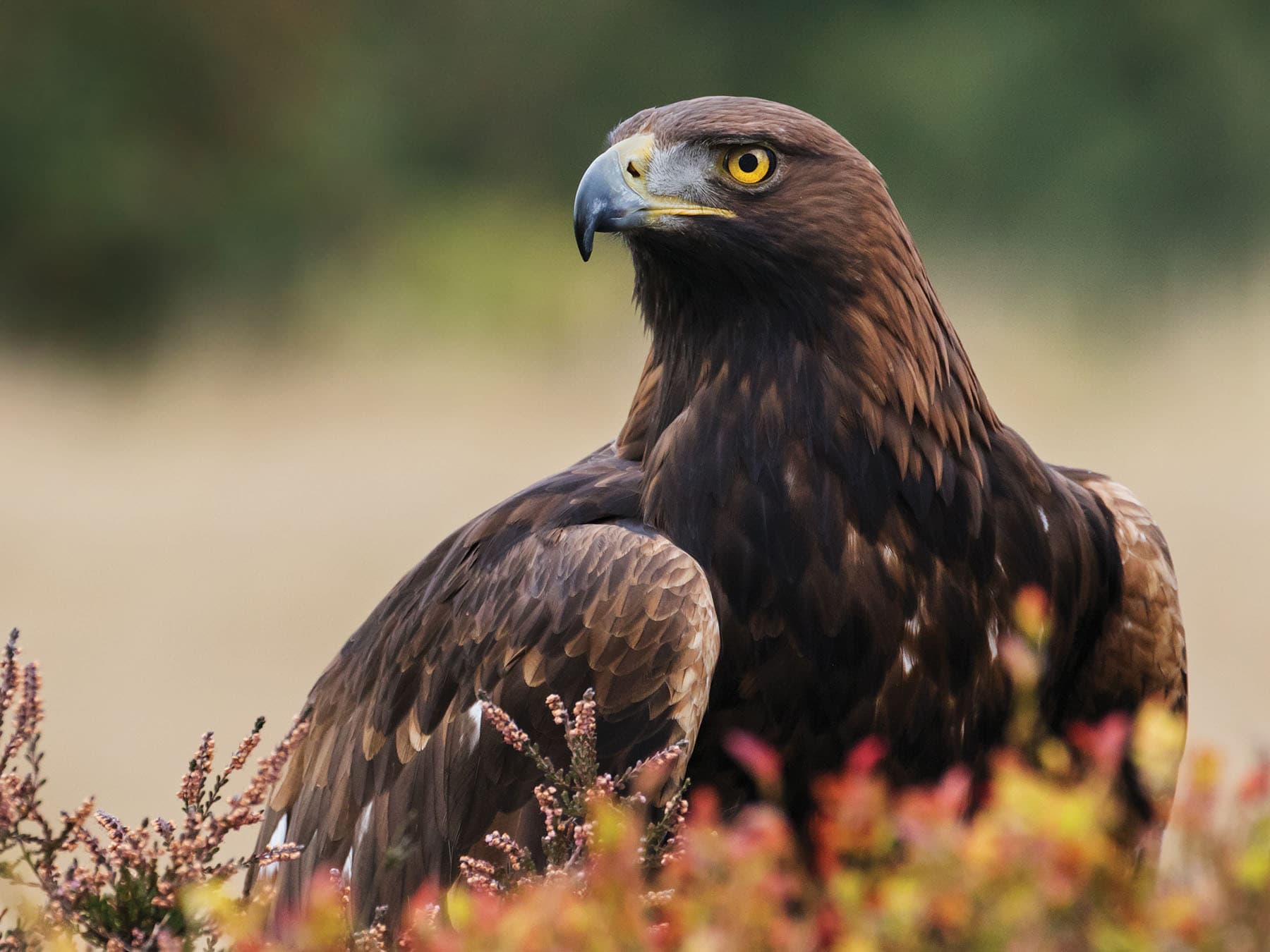
More photos
3 photos
Bald Eagle guides
4 guidesQuick facts
- Length
- 70–102 cm
- Wingspan
- 180–244 cm
- Weight
- 3000–6300 g
- Lifespan
- 20–30 years · oldest recorded 48 years
- Family
- Hawks & Eagles
- Migration
- Partial migrant
- Global status (IUCN)
- Least Concern
- World population
- 200,000 mature individuals
- Population trend
- Increasing
- Also called
- American Eagle
- Scientific name
- Haliaeetus leucocephalus
Sources
4- 1BirdLife International. 2016. Haliaeetus leucocephalus. The IUCN Red List of Threatened Species 2016: e.T22695144A93492523. Source (opens in a new tab)
- 2BirdLife International. 2016. Haliaeetus leucocephalus. The IUCN Red List of Threatened Species 2016: e.T22695144A93492523. Source (opens in a new tab)
- 3Partners in Flight (2022) Source (opens in a new tab)
- 4Kohler et al., Comparative mortality levels among selected species of captive animals, Dem Res, 15:413-434 (2006)

Checked by
Nathan Cope, founder and editor
Nathan founded Birdfact and leads its writers and contributors in the UK, the US and Canada. He has watched and studied birds for more than ten years, and checks every article and species guide before it’s published.