Species Profile
Gull-billed Tern
Gelochelidon nilotica
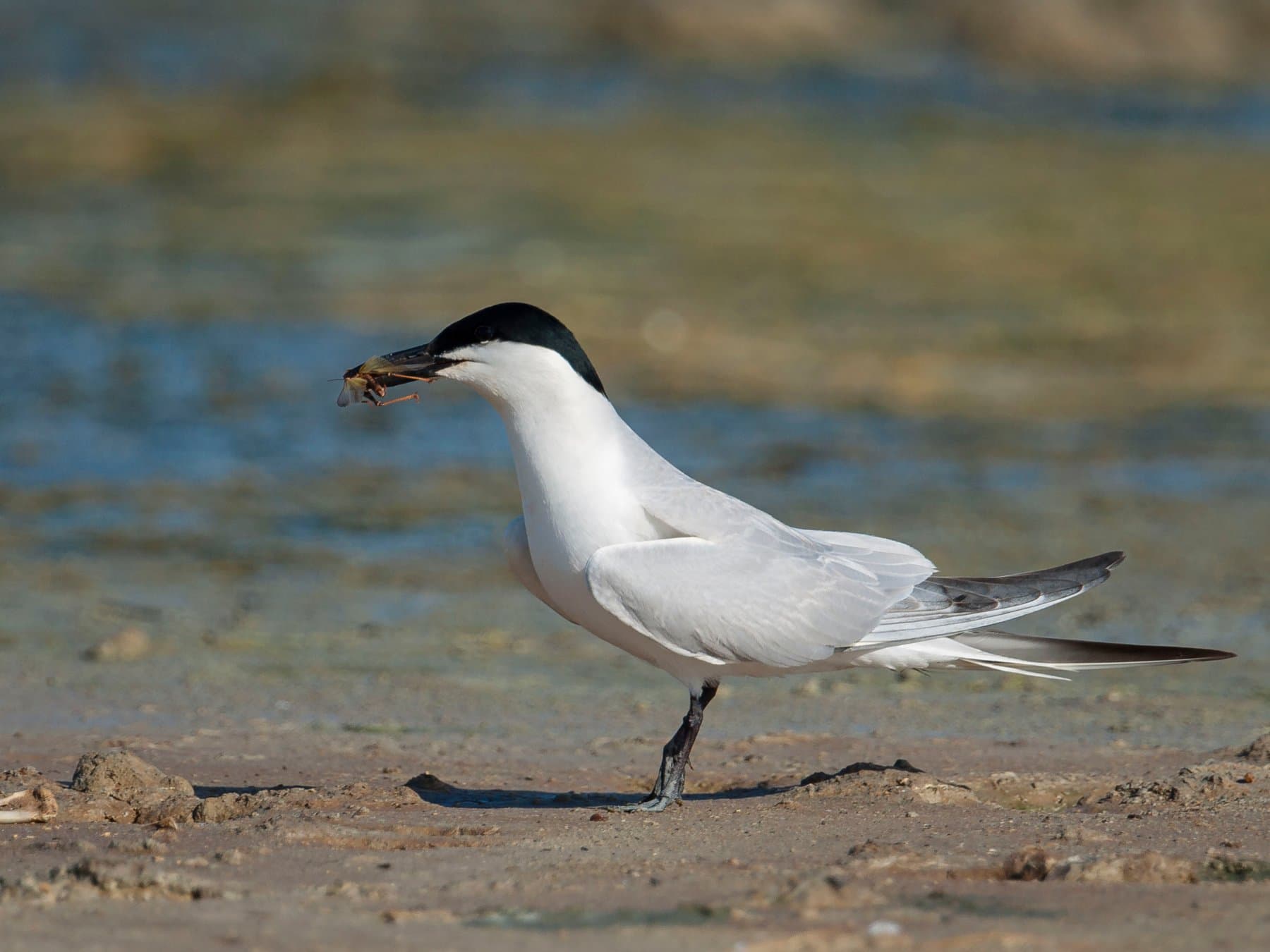
Gull-billed Tern standing on sandy ground, holding a large insect in its beak. Features a black cap and white plumage.
Quick Facts
Conservation
LCLeast ConcernLifespan
10–15 years
Length
33–42 cm
Weight
150–292 g
Wingspan
76–115 cm
Migration
Full migrant
With its thick, all-black bill and a hunting style more reminiscent of a harrier than a tern, the Gull-billed Tern breaks almost every rule its family is known for. Rather than plunge-diving for fish, it hawks insects over grasslands, snatches crabs from mudflats, and has even been recorded taking lizards and the chicks of other birds — making it one of the most ecologically versatile terns in the world.
Think you've spotted a Gull-billed Tern?
Upload a photo and we'll confirm it instantly
Confirm with a PhotoAppearance
The Gull-billed Tern is a large, stocky, and powerful tern — roughly the size of a Sandwich Tern at 33–42 cm long, but immediately set apart by its bill. Where most terns carry a long, dagger-like bill suited to plunge-diving, the Gull-billed Tern has a short, thick, blunt-tipped all-black bill that genuinely resembles a small gull's. Combined with notably long black legs — unusually long for a tern — and a broad-winged, robust body, the overall impression is of a bird built for versatility rather than speed.
In breeding plumage, adults are strikingly clean: pale silvery-grey upperparts, pure white underparts, and a sharp, solid black cap running from the bill base to the nape. The tail is white with a shallow fork — far less deeply forked than most terns — and the wingtips show dark grey on the outer primaries. At rest, the wingtips extend well beyond the tail tip, giving the bird a long-winged silhouette.
Non-breeding adults lose the black cap entirely. The head becomes largely white, with a distinctive dark smudge or patch behind the eye — a useful field mark that recalls a Forster's Tern or Mediterranean Gull in winter. The bill and legs remain black throughout the year.
Juveniles and first-winter birds closely resemble non-breeding adults, showing the dark eye-patch on a white head. Juveniles may show faint brownish-grey mottling on the shoulders and a slightly paler bill base. The sexes are identical in plumage at all seasons — the species is not sexually dimorphic in colouration, and males average only marginally larger, a difference not reliably detectable in the field.
Identification & Characteristics
Colors
- Primary
- White
- Secondary
- Grey
- Beak
- Black
- Legs
- Black
Markings
Short, thick all-black bill (gull-like); solid black cap in breeding plumage; dark smudge behind eye in non-breeding plumage; long black legs; pale silvery-grey upperparts; shallow tail fork
Tail: White, shallowly forked — less deeply forked than most terns
Attributes
Understanding Attributes
Rated 0–100 based on research and observation. A score of 50 is average across all bird species. These attributes are relative and don't necessarily indicate superiority.
Habitat & Distribution
The Gull-billed Tern breeds across warmer parts of every inhabited continent, with five recognised subspecies occupying distinct ranges. The nominate subspecies (G. n. nilotica) breeds from southern Europe and North Africa through the Middle East to western China and Thailand. G. n. affinis covers eastern Asia from Transbaikalia and Japan south through Southeast Asia to the Philippines and Sumatra. In the Americas, G. n. aranea breeds along the Atlantic and Gulf coasts of the United States and in the Greater Antilles; G. n. vanrossemi breeds from southern California to northwestern Mexico; and G. n. gronvoldi occupies South America from French Guiana to northeastern Argentina.
Unlike most terns, the Gull-billed Tern rarely ventures over open ocean. It is primarily an inland and coastal wetland bird, breeding on sandy beaches, barrier islands, shell banks, saltmarsh islands, dredged-material islands, and the shores of inland lakes and marshes. Foraging habitats are even more varied: saltmarshes, wet fields, pastures, farmland, irrigated croplands, floodwaters, and open shrublands. The species is frequently seen hawking insects over grasslands well away from water.
In the United States, over 60% of the estimated 3,600 eastern breeding pairs (subspecies aranea) are concentrated in Texas, with additional colonies in Georgia, Mississippi, Virginia, North Carolina, Florida, and South Carolina. The western subspecies (vanrossemi) is far rarer, with only 154–263 breeding pairs in the US at two sites: San Diego Bay and the Salton Sea in California. In Australia, the species is common and widespread across south-eastern regions, nomadic or partially migratory, and a vagrant in Tasmania.
In the UK, the Gull-billed Tern is a rare vagrant on the British List (Category A). Most records fall between May and July, with occasional autumn sightings. It has been recorded across coastal counties of England — including Norfolk, Kent, Essex, Suffolk, Cornwall, Devon, Hampshire, and Somerset — and as a vagrant in Scotland and Wales. Observers in Suffolk and Somerset have the best track record for passage birds.
Diet
Few terns eat as broadly as the Gull-billed Tern. Its diet spans insects (grasshoppers, dragonflies, beetles, moths), spiders, crabs (including fiddler crabs), shrimp, molluscs, earthworms, marine worms, small fish, lizards, frogs, toads, small mammals, and occasionally the chicks of other bird species. Fish, when taken at all, are plucked from the water surface rather than caught by diving — the bird fans its tail, glides swiftly down, tilts its head so the bill is nearly vertical, and seizes prey with only the bill tip touching the water.
The dominant foraging method is aerial: the bird flies slowly into the wind, 2–10 metres above the ground or water, dipping to pick up prey or catching flying insects in mid-air. It also hunts by walking on the ground — an unusual behaviour for a tern — and has been observed picking dead insects from road surfaces. Prey is typically swallowed whole in flight.
Diet varies considerably by population and season. Some colonies rely heavily on insects and reptiles; others take predominantly crabs and fish. Research at the Salton Sea in California showed that Gull-billed Terns can shift their diet in response to warm sea surface temperature events that reduce fish availability — switching to alternative prey without significant impact on breeding success. This dietary plasticity is a key reason the species can exploit such a wide range of habitats.
Kleptoparasitism — stealing food from other birds — has been recorded, and the species occasionally preys on the chicks of Least Terns at shared breeding colonies, a behaviour that has drawn attention from conservationists managing mixed-species tern colonies in the United States.
Behaviour
The Gull-billed Tern is a colonial species but tends to nest in smaller, less densely packed groups than many of its relatives — typically 5–50 pairs, often alongside other terns and Black Skimmers. Outside the breeding season, birds are often seen singly or in small loose flocks, and they mix readily with other tern species on migration and at wintering sites.
Foraging behaviour is what truly sets this species apart. Rather than the steep, headlong plunge-dive of a Common Tern or Arctic Tern, the Gull-billed Tern hunts with a slow, buoyant, quartering flight — flying into the wind and dipping to the surface to snatch prey, or catching insects in mid-air like a large swallow. It also hunts on foot, walking across mudflats and grassland to pick up invertebrates. Dead insects on roads are not beneath it.
Adults are vigorous defenders of their nest sites, mobbing and dive-bombing egrets, herons, large gulls, Caspian Terns, Peregrine Falcons, and humans with equal determination. The species has also been documented engaging in kleptoparasitism — stealing food from other birds — and, more strikingly, predating the chicks of neighbouring Least Terns at mixed colonies.
Daily activity patterns follow the light: foraging peaks in the morning and late afternoon, with birds resting on sandbars, mudflats, or open ground during the heat of the day. On migration, birds can travel considerable distances overnight, and nocturnal flight calls have been recorded from European populations.
Calls & Sounds
The Gull-billed Tern's calls are quite unlike the sharp, piercing screams of most other terns. The characteristic flight call is a rasping, two-syllable ker-wik (sometimes written ke-wik), delivered in flight and audible at considerable distance. North American observers often use the mnemonic katy-did — the call has a buzzy, insect-like quality that recalls the sound of a katydid, which is a useful memory aid in the field.
Other documented calls include a loud metallic gaa-gaa-gaa (described from Australian populations), a soft nasal kek-kek, and a stuttered kerrrr. At breeding colonies, the repertoire expands: alarm calls are harsher and more urgent, and a range of softer vocalisations accompany pair interactions and chick provisioning. Nocturnal flight calls have been recorded from European populations and are documented on Xeno-canto, where the species has over 175 foreground recordings.
The species is most vocal during the breeding season, particularly during aerial courtship displays and when defending nest sites against intruders. The sexes are not known to differ significantly in vocalisation. The genus name Gelochelidon is itself a nod to the voice: it combines the Ancient Greek gelaō ('to laugh') and khelidōn ('swallow') — a reference to the laughing quality of some calls and the swallow-like aerial hunting style. The species epithet nilotica means 'of the River Nile', reflecting where the first specimens described by European naturalists were collected.
Flight
In the air, the Gull-billed Tern is immediately recognisable by its flight style — buoyant, unhurried, and distinctly gull-like compared to the more purposeful, direct flight of most other terns. The wings are broad and long relative to body size, and the bird moves with a slow, elastic wingbeat that gives it a floating, almost lazy quality when foraging. This is deceptive: when pursuing flying insects or responding to a threat at the colony, it can accelerate sharply and manoeuvre with precision.
The foraging flight is the most distinctive feature: the bird typically flies 2–10 metres above the ground or water surface, facing into the wind, and dips smoothly to snatch prey without breaking its glide. This quartering, swooping action over grassland or saltmarsh is quite unlike the steep, folded-wing plunge-dive of a Common or Arctic Tern, and is one of the best ways to identify the species at a distance.
In flight, the overall impression is of a very pale bird — the pale grey upperparts and white underparts create a washed-out appearance, with only the black cap (in breeding plumage), dark outer primary tips, and black bill and legs providing contrast. The shallow tail fork is visible but unspectacular compared to the deeply forked tails of many terns. On migration, birds travel at moderate height and can cover long distances, with satellite telemetry studies confirming strong fidelity to migration routes and wintering grounds.
Nesting & Breeding
Gull-billed Terns arrive at North American breeding sites in March–April, with egg-laying beginning from mid-April to early May. In Europe, breeding typically runs from May to July; in Australia, it occurs from October to December, or opportunistically whenever flooding creates suitable conditions.
Courtship begins before colony establishment, with small groups of 6–8 birds performing synchronised aerial displays — flying together in a straight line for roughly 100 metres, reversing direction, and repeating. These group flights gradually transition into pair-specific aerial displays, followed by elaborate ground posturing: bill-pointing, bowing, and the male feeding the female (courtship feeding). Pairs are monogamous and often reunite across multiple seasons.
Both sexes build the nest — a shallow scrape in sand, mud, or gravel, roughly 18–30 cm in outer diameter and 2.5–4 cm deep. The cup is lined with shells, twigs, grasses, or sedge stems. Nest sites are typically on open, flat, sparsely vegetated ground on small islands or elevated areas that reduce predator access. In some Gulf Coast areas of the United States, the species has adapted to nesting on flat gravel rooftops — an unusual behaviour for a seabird.
Clutch size is 2–3 eggs (occasionally 1–4). Eggs are pale buff, yellowish, greyish, or greenish-buff with irregular brown spots, measuring approximately 4.7–6 cm long by 3.4–4 cm wide. Both parents incubate, with the female taking the larger share; incubation lasts 22–23 days from the first egg.
Chicks hatch covered in cream or buff down with dark dorsal markings. They are notably precocial: most leave the nest scrape within a few days of hatching, moving to nearby vegetation. Chicks as young as 4–5 days old can swim 20 metres or more if disturbed. Both parents provision the chicks, which fledge at approximately 28–35 days. Young birds may remain dependent on their parents for up to three months, accompanying them on southward migration.
Lifespan
The Gull-billed Tern is a relatively long-lived bird. Typical wild lifespans fall in the range of 10–15 years, and the oldest confirmed individual — a bird banded in California — lived to at least 20 years. European ringing data document individuals reaching 15 years, consistent with the longevity expected of a medium-sized migratory seabird.
Survival rates are highest in adults; the first year of life carries the greatest mortality risk. Young birds may not reach full feeding efficiency for several months after fledging, and they remain dependent on their parents well into the early stages of southward migration — sometimes for up to three months post-fledging. This extended dependency period is thought to reflect the complexity of the species' hunting techniques, which require practice to master.
Causes of mortality include predation (foxes, large gulls, Peregrine Falcons, and raptors take adults and chicks), flooding of nest sites, human disturbance causing nest abandonment, and contaminants at some wintering sites. Climate-driven changes to prey availability are an emerging concern, particularly for populations dependent on specific wetland systems. Compared to the closely related Sandwich Tern, which has a similar body size and comparable longevity records, the Gull-billed Tern's dietary flexibility may buffer it somewhat against environmental fluctuations — as demonstrated by studies at the Salton Sea showing successful breeding even when primary prey sources are disrupted.
Conservation
The Gull-billed Tern is listed as Least Concern on the IUCN Red List (2019), with a global population estimated at approximately 190,000 individuals. Globally, the population is considered stable, but this headline figure masks significant regional variation — some populations are in serious trouble.
In Europe, the species is classified as Endangered at the regional level. The Mediterranean breeding population is estimated at 5,800–7,150 pairs, concentrated in Spain, France, Italy, Greece, Turkey, and the Black Sea coast. The Central European population has suffered a catastrophic decline: Germany held approximately 500 breeding pairs in the 1940s; by 2024, only around 40 pairs remained. A 2024 genetic study published in Conservation Genetics found that despite this collapse, the German population retains surprisingly high genetic diversity and shows connectivity with Mediterranean colonies — suggesting it is not yet genetically isolated, which offers some hope for recovery.
In North America, the overall population has remained broadly stable since 1966 according to the North American Breeding Bird Survey, but declines have been documented in Maryland (possibly extirpated), Virginia, North Carolina, Florida, and Georgia. The western subspecies (vanrossemi) is particularly vulnerable, with only 495–1,042 breeding pairs rangewide.
Primary threats include: habitat loss through wetland drainage, coastal development, and beach erosion; human disturbance at breeding colonies causing nest abandonment and chick mortality; predation by foxes, rats, large gulls, herons, and Peregrine Falcons; flooding or drying of nesting islands; sea-level rise; and contaminants at some sites. The species is protected under the Agreement on the Conservation of African-Eurasian Migratory Waterbirds (AEWA), Annex II of the Bern Convention, and Annex I of the EU Birds Directive.
Population
Estimated: Approximately 190,000 individuals globally (Partners in Flight estimate)
Trend: Stable
Globally stable, but with significant regional declines. Endangered in Europe; Central European (German) population has fallen from ~500 pairs in the 1940s to ~40 pairs today. North American population broadly stable since 1966 but with localised declines in several eastern states.
Elevation
Sea level to moderate elevations; breeds at inland sites including the Salton Sea (~70 m below sea level) and various inland lakes and marshes across Eurasia
Additional Details
- Family:
- Laridae (Gulls & Terns)
- Diet type:
- Insects, crabs, fish, lizards, frogs, small mammals, other birds' chicks
- Predators:
- Foxes, rats, large gulls, herons, egrets, Peregrine Falcons
- Clutch size:
- 2–3 eggs (occasionally 1–4)
- Colony size:
- Typically 5–50 pairs
- Fledging age:
- 28–35 days
- Nesting type:
- Ground scrape on sand, mud, or gravel; occasionally flat gravel rooftops
- Subspecies count:
- 5 recognised subspecies
- Incubation period:
- 22–23 days
- Conservation europe:
- Endangered (regional)
Subspecies
Five subspecies of Gull-billed Tern are currently recognised, each occupying a distinct geographic range and showing minor differences in size and, in some cases, wintering behaviour. The nominate subspecies, G. n. nilotica, breeds across southern Europe, North Africa, the Middle East, and south-central Asia east to western China and Thailand. It is the subspecies most familiar to European observers and the one most affected by the regional population declines documented in the Mediterranean and Central Europe.
G. n. affinis covers a vast swathe of eastern Asia, from Transbaikalia and Manchuria south through Japan, China, Southeast Asia, and the Philippines to Borneo, Sulawesi, and Sumatra. In North America, two subspecies are recognised: G. n. aranea breeds along the Atlantic and Gulf coasts of the United States and in the Greater Antilles, while G. n. vanrossemi — the western Gull-billed Tern — occupies a much smaller range from southern California to northwestern Mexico. With only 495–1,042 breeding pairs rangewide, vanrossemi is the most range-restricted and vulnerable of the North American subspecies; it colonised California from western Mexico, first nesting at the Salton Sea in the 1920s and at San Diego Bay in the 1980s. The fifth subspecies, G. n. gronvoldi, breeds in South America from French Guiana to northeastern Argentina.
Australian birds were formerly treated as a separate species (the Australian Gull-billed Tern) but are now generally included within G. nilotica, most closely allied to affinis. The global population estimate of approximately 190,000 individuals was calculated prior to any formal split of the Australian population.
Courtship & Display
Courtship in the Gull-billed Tern begins before the colony is fully established, with a distinctive group aerial display that is rarely described in popular field guides. Small parties of 6–8 birds fly together in a tight formation for approximately 100 metres, then reverse direction and repeat — a synchronised, almost choreographed performance that gradually narrows in focus as pairs form within the group. These group flights transition into pair-specific aerial displays, with the male and female flying in close formation, the male often carrying a fish or insect as a courtship gift.
On the ground, displays become more elaborate. Both birds adopt upright postures with bills pointed skyward, bowing and circling each other. Courtship feeding — the male presenting food to the female — is a key component of pair bonding and continues through incubation, providing the female with additional energy during egg production. Pairs are monogamous and show strong pair-bond fidelity across seasons, though the species is less site-faithful than many other medium-sized terns and will relocate colonies if disturbance is persistent.
Once a nest scrape is established, both birds defend the territory vigorously. Intruders — whether rival terns, large gulls, herons, or humans — are met with alarm calls and dive-bombing. The intensity of colony defence increases as incubation progresses and peaks when chicks are small and mobile. The combination of aerial group displays, courtship feeding, and coordinated ground posturing makes the Gull-billed Tern's breeding behaviour considerably more complex than a casual observer at a tern colony might expect.
Birdwatching Tips
In the United States, the Gulf Coast of Texas offers the best chance of finding Gull-billed Terns — more than 60% of the eastern breeding population nests there, and birds are present from April through August. Bolivar Flats Shorebird Sanctuary and Galveston Island are reliable sites. On the Atlantic coast, look for birds at mixed tern colonies in Virginia, North Carolina, and Georgia. In California, the Salton Sea and San Diego Bay host the only breeding western subspecies birds in the US, present from April to September.
In Australia, the species is widespread across south-eastern regions and is regularly seen at coastal lagoons, estuaries, and inland wetlands. In the UK, patience is required — this is a genuine rarity. Check coastal watchpoints in Norfolk, Kent, Essex, and Suffolk between May and July, particularly during south-easterly winds that can drift European birds across the Channel.
Identification is straightforward once you know what to look for. The thick, all-black bill is the key feature — no other tern in its range has a bill this short and stout. In breeding plumage, the solid black cap and pale grey upperparts are clean and distinctive. In winter, look for the dark smudge behind the eye on an otherwise white head, combined with the characteristic bill shape and long black legs.
Watch the flight style: the Gull-billed Tern moves with a buoyant, swooping action quite unlike the more direct flight of a Common or Sandwich Tern. If you see a pale tern quartering low over a saltmarsh or grassland — dipping to pick up insects rather than diving into water — this species should be your first thought. Mixed tern colonies are worth scanning carefully; Gull-billed Terns often nest alongside Common Terns and Black Skimmers.
Did You Know?
- The Gull-billed Tern almost never plunge-dives for fish — instead it hunts like a harrier, quartering low over grassland and saltmarsh to snatch insects, crabs, lizards, and frogs. Its diet is so broad it has been recorded taking small rodents and the chicks of neighbouring Least Terns.
- The last breeding population of Gull-billed Terns in Central Europe — a colony in northern Germany — has crashed from approximately 500 pairs in the 1940s to just 40 pairs today. Yet a 2024 genetic study found the population retains high genetic diversity and remains connected to Mediterranean colonies, meaning it is not yet genetically doomed.
- Chicks as young as 4–5 days old can swim 20 metres or more if disturbed — an escape behaviour that is unusually well-developed for a tern chick of that age. Most leave the nest scrape within a few days of hatching, long before they can fly.
- The oldest recorded Gull-billed Tern lived to at least 20 years — a bird banded in California. The genus name Gelochelidon translates as 'laughing swallow', and the species name nilotica means 'of the Nile' — so the full scientific name roughly translates as 'the laughing swallow of the Nile'.
- In some Gulf Coast areas of the United States, Gull-billed Terns have adapted to nesting on flat gravel rooftops — a striking example of a seabird exploiting urban infrastructure. The western subspecies (vanrossemi) colonised California from western Mexico, first nesting at the Salton Sea in the 1920s and at San Diego Bay in the 1980s.
Records & Accolades
Most Varied Tern Diet
Insects to lizards to rodents
The Gull-billed Tern eats a broader range of prey than almost any other tern, including insects, crabs, lizards, frogs, small mammals, and occasionally the chicks of other birds.
Earliest Tern Swimmer
Swimming at 4–5 days old
Gull-billed Tern chicks can swim 20 metres or more when just 4–5 days old — an unusually precocial escape behaviour for a tern chick.
Longevity Record
20 years (California)
The oldest confirmed Gull-billed Tern lived to at least 20 years — a bird banded in California and one of the longest-lived records for this species.
Community Photos
Be the first to share a photo of the Gull-billed Tern
Upload a PhotoIdentify Any Bird Instantly
- Upload a photo from your phone or camera
- Get an instant AI identification
- Ask follow-up questions about the bird
Monthly Birds in Your Area
- Personalised for your location
- Seasonal tips and garden advice
- Updated every month with new species