


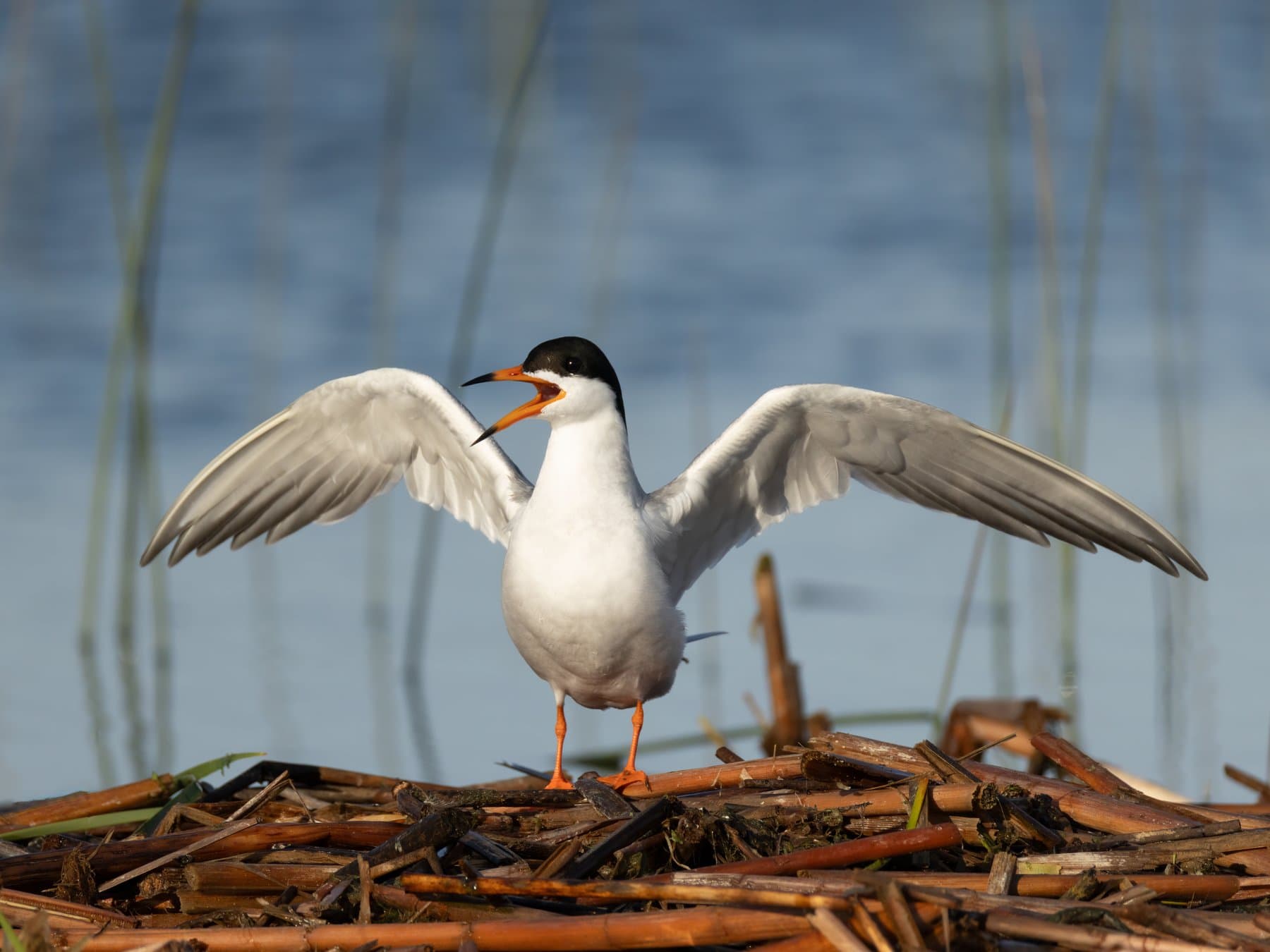
Forster's Tern
Sterna forsteri
By the Birdfact teamChecked by Nathan Cope
Forster's Tern is a slender, acrobatic marsh tern found year-round across North America — the only medium-sized tern that never needs to leave the continent. In breeding plumage, its pale silvery-grey wings and blazing orange bill make it one of the most elegant birds of the prairie marshes. In winter, look for the bold comma-shaped black eye-patch: that isolated mask is the surest way to pick it out from a crowd of roosting terns.
On this page13 sections
How to recognise it
Forster's Tern is a slender, medium-sized tern measuring 33–36 cm in length with a wingspan of 78–80 cm. Its most immediately striking features are the deeply forked tail — with outer streamers that extend well beyond the wingtips when the bird is perched — and the long, pointed wings that give it a scythe-like silhouette in flight.
In breeding plumage (spring and summer), the upperparts are a clean, pale silvery-grey and the underparts are bright white. The crown and nape are covered by an intense black cap. The bill is orange with a black tip, noticeably thicker and more orange in tone than the reddish bill of the Common Tern. The legs are bright orange to orange-red. In flight, the upperwings appear uniformly pale silvery-grey — crucially, without the darker primary wedge that marks the Common Tern's wing.
Non-breeding plumage (from late August through winter) is where Forster's Tern becomes most distinctive. The black cap is replaced by a white crown, and a bold, comma-shaped black patch covers the eye and ear-coverts. This mask does not connect across the nape — a key distinction from the non-breeding Common Tern, which retains a black nape. The bill turns entirely black and the legs become a duller brownish-red. There is no dark carpal bar on the folded wing, another reliable separation from non-breeding Common Tern.
Juveniles resemble non-breeding adults but show mottled rusty-brown, white, and grey feathering on the upperparts, a pale bill base, a shorter tail, and often darker primaries. Immature birds are pale grey above without shoulder markings, retaining the black eye-patch and black bill. Males and females are identical in plumage at all seasons — there is no sexual dimorphism in this species.
Not sure it’s a Forster's Tern? Check your photo: Birdfact names the bird and shows the look-alike side by side.
Its size
Adults- Length
- 33–36 cm
- Wingspan
- 78–80 cm
- Weight
- 130–190 g
Its song and calls
The most common call of Forster's Tern is a descending, buzzy "kerr" — also rendered as "keerrr" or "kyeer" — a single falling note that drops in pitch rather than the two level-pitched notes typical of most Common or Arctic Terns. The sound is lower, more raspy, and more wooden in quality than the equivalent call of Common Tern. It is sometimes followed by a rapid series of shorter similar notes: "keerr, kr kr kr kr kr." A short "kit" or "kuit" serves as a contact call between birds.
During courtship, the female uses a repeated begging call — a succession of "kerr kerr kerr" — to solicit fish from the male. Males respond with advertisement calls when approaching with a fish offering. The threat call, used during defensive attacks on nest predators or intruders, is a low, harsh "zaar" or "zaaaar" — distinctly different from the common call and described as suggestive of a small gull such as Bonaparte's Gull.
Both adults defend the nest territory with harsh calls, open-bill gestures, and raised or lowered head postures; trespassers receive a direct peck. Colonies mob predators with loud, coordinated calling and diving. The species is most vocal during the breeding season, particularly around active colonies. Outside the breeding season, Forster's Tern is generally quiet — a useful behavioural cue when scanning a mixed tern roost in winter.
- Call0:00 / 0:16
Recorded in Minnesota, United States · June 2013
Heard one and not sure? Let the bird song identifier listen.
When and where to see it
OctoberLeaving
Most recorded in October
Each dot is a county, state or province: the bigger and darker, the larger the bird’s share of that place’s bird records that month. Grey dots: no regular records. The ringed point is the centre of the bird’s records this month; the arrow shows how it moved since last month, and the dashed loop its path through the year. “Arrivals” colours places where it becomes regular this month (orange) or is in its last regular month (grey). GBIF eBird Observation Dataset, 2019–2024. Map data: Natural Earth, US Census Bureau; place centres © OpenStreetMap contributors.
In your area
See when the Forster's Tern is recorded in your county, state or province.
How often the Forster's Tern turns up in Ireland, the United States and Canada through the year, from birdwatchers' records.
Ireland
Passage migrant · regularly Feb–Aug · most records in February
United States
Resident · all year · most records in August
Canada
Summer visitor · regularly Apr–Oct · most records in May
Show as a table
| Month | Ireland | United States | Canada |
|---|---|---|---|
| January | – | 0.16% (regular) | <0.001% |
| February | 0.017% (regular) | 0.13% (regular) | – |
| March | 0.013% (regular) | 0.096% (regular) | <0.001% |
| April | – | 0.14% (regular) | 0.028% (regular) |
| May | <0.001% | 0.12% (regular) | 0.069% (regular) |
| June | 0.002% (regular) | 0.099% (regular) | 0.042% (regular) |
| July | 0.008% | 0.14% (regular) | 0.049% (regular) |
| August | 0.014% (regular) | 0.19% (regular) | 0.034% (regular) |
| September | 0.005% | 0.15% (regular) | 0.018% (regular) |
| October | <0.001% | 0.14% (regular) | 0.007% (regular) |
| November | 0.003% | 0.13% (regular) | <0.001% |
| December | 0.005% | 0.12% (regular) | <0.001% |
Recorded regularly in
Worldwide: recorded regularly in 16 countries
Countries where it was recorded in at least 3 of the 6 years 2019–2024. Linked countries have their own bird list.
North America (14)
- Bahamas
- Belize
- Bermuda
- Canada
- Cayman Islands
- Costa Rica
- Cuba
- El Salvador
- Guatemala
- Honduras
- Mexico
- Nicaragua
- Panama
- United States
Data: EOD – eBird Observation Dataset (Cornell Lab of Ornithology), accessed via GBIF.org, CC BY 4.0. Records from 2019–2024, aggregated and filtered by Birdfact. How these lists are made
Tips for seeing it
In the United States, the best opportunities to see Forster's Tern are along the Gulf Coast and southern Atlantic coast in winter, where birds roost on beaches, mudflats, and piers alongside other tern species. In summer, the Prairie Pothole region of the Dakotas, Minnesota, and Manitoba offers excellent breeding season views; scan open water within large marshes for birds hovering and plunge-diving. The species is more commonly encountered in autumn than spring along the Atlantic coast, with peak numbers in September.
The key identification challenge is separating Forster's from the Common Tern. In breeding plumage, focus on the bill: Forster's is thicker and more orange (not reddish), and the upperwing lacks the dark primary wedge of Common Tern. In non-breeding plumage — when the two species are most easily confused — look for the isolated black eye-patch on Forster's, which does not connect across the nape. Common Tern retains a black nape in winter. Forster's also lacks the dark carpal bar on the folded wing that non-breeding Common Terns typically show.
The tail is a useful supporting feature: Forster's has a pale grey forked tail, while Common Tern's tail is white. When perched, the long streamers of Forster's extend noticeably beyond the wingtips. In flight, the wingbeats are snappy and the bird is highly acrobatic; watch for the characteristic head-down posture when foraging.
In the UK and Ireland, Forster's Tern is a genuine rarity — check coastal sites in Cornwall, Dorset, Essex, and Kent in autumn and winter, and watch for it at well-watched Irish sites such as Nimmo's Pier in Galway. The distinctive winter eye-patch is the most reliable field mark at this season. Any tern showing a bold, isolated black comma-patch through the eye in autumn or winter deserves a very careful second look.
What it eats
Fish make up the bulk of Forster's Tern's diet at all seasons, typically small species between 2.5 and 10 cm long. In freshwater habitats, common prey includes carp, minnow, sunfish, trout, perch, killifish, stickleback, shiner, and pike. In brackish and marine environments, the diet shifts to pompano, herring, menhaden, anchovies, sardines, gobies, and silverside minnows. On the Pacific coast, birds also take juvenile Pacific lamprey.
During the breeding season in freshwater marshes, insects become a significant secondary food source. Dragonflies, caddisflies, and grasshoppers are taken regularly, along with aquatic insect larvae, small crustaceans, frogs, and tadpoles. This dietary flexibility allows the species to exploit the seasonal abundance of marsh invertebrates when fish are less accessible in dense vegetation.
The primary foraging method is the shallow plunge-dive. Birds typically fly 6–8 metres above the water along shorelines or just offshore, head angled downward, before hovering briefly and committing to a headfirst strike with wings partially folded back. Usually only the bill and head enter the water, though the entire body sometimes submerges. Prey is normally swallowed in the air; larger fish may be repositioned in the bill first. Birds occasionally drop and re-catch a fish before swallowing it.
Forster's Tern is a single prey loader when provisioning chicks, delivering one item at a time sized to match the chick's current age and capacity. In saltmarshes, birds often wait for incoming tides to push small fish to the surface near the marsh edge before beginning a foraging bout — a tidal timing strategy that maximises catch rates.
Nesting and breeding
The breeding season opens as early as April on the Gulf Coast, extending through May to mid-June at higher latitudes; in South Dakota and Montana, nesting occurs primarily in June and July. Forster's Tern is a colonial nester, with colony sizes ranging from just two nests to several thousand. Adults defend only a tiny territory immediately around the nest, and nests are typically clumped together. Colony locations shift frequently from year to year in response to changing water levels, storm damage, and disturbance.
In Manitoba, there is a particularly strong association between nesting Forster's Terns and muskrat lodges — up to five nests have been recorded on a single lodge. Where the species co-exists with Black Tern in the same marsh, Forster's Tern consistently selects higher, drier nest sites. Nests vary considerably: from a simple shallow scrape with no lining to a rough bowl platform of marsh plants (bulrush, cattail, sedge) roughly 18 cm across, with an interior cup about 13 cm across and 2.5 cm deep. Both sexes build the nest.
Clutch size is typically 2–4 eggs, most commonly 3. Eggs are olive to buff in colour, marked with numerous small spots and blotches of dark brown, often concentrated around the larger end, measuring approximately 3.35–4.7 cm long and 2.9–3.25 cm wide. Incubation lasts 23–28 days and is shared by both sexes, with males tending to incubate more during the day and females more at night. There is one brood per year.
Chicks hatch semi-precocially — downy, eyes open, able to walk but initially staying in the nest. Both upper and lower mandibles bear egg teeth, lost 3–5 days after hatching. Chicks typically leave the nest with their parents around 4 days after hatching, moving into areas of denser vegetation. The nestling period is 2–7 days; fledging occurs approximately 4 weeks after hatching. Both parents continue to feed young for several weeks after fledging, and family groups likely migrate together.
Behaviour
In the air, Forster's Tern is a study in controlled precision. The wingbeats are snappy and relatively quick for a bird of its size, giving it a lively, buoyant quality quite different from the heavier, more measured flight of gulls. The long, pointed wings and deeply forked tail create a distinctive silhouette — narrow and angular — that is recognisable at considerable distance once learned.
When travelling between foraging areas or on migration, the bird flies with its head pointed forward and the body held nearly horizontal. When foraging, the posture shifts: the head drops to point downward as the bird scans the water below, and the flight becomes slower and more hovering. The hover itself is brief — a few seconds at most — before the bird commits to a headfirst plunge, folding the wings partially backward as it strikes the surface.
The upperwing in flight is one of the best identification features. In breeding plumage, the entire upperwing is a uniform pale silvery-grey, without the dark primary wedge that marks the outer wing of the Common Tern. In non-breeding plumage, the primaries become a darker silvery-grey but still lack the strong contrast of Common Tern. The pale grey forked tail — rather than the white tail of Common Tern — is another useful in-flight feature when light conditions allow.
Forster's Tern is highly acrobatic when pursuing prey or engaged in courtship display flights, capable of rapid directional changes, steep banking turns, and extended hovering. During courtship, pairs perform coordinated high-altitude spiralling flights using exaggeratedly slow wingbeats, rising together before the male descends with wings raised above horizontal and bill pointed downward.
Lifespan and predators
Forster's Tern typically lives between 10 and 15 years in the wild. The maximum recorded lifespan is 15 years and 10 months — a bird banded in California in 1973 that was recovered dead in the same state in 1989, having died from environmental contaminants. This longevity record is consistent with the general pattern for medium-sized terns, which tend to outlive smaller shorebirds but fall well short of the exceptional lifespans recorded in larger gulls and albatrosses.
Sexual maturity is reached at around two years of age (approximately 730 days). As with most colonial waterbirds, annual adult survival rates are relatively high once birds reach breeding age, with mortality concentrated in the first year of life when inexperienced juveniles face the challenges of learning to forage and completing their first migration.
The main mortality causes include environmental contaminants (particularly mercury in areas such as San Francisco Bay), predation by American mink, raptors, and large wading birds, and nest flooding from storm events or recreational boat wakes. Human disturbance at colonies can cause chick mortality through hypothermia when young birds are flushed into cold water. The species' relatively short migration compared to Common or Arctic Terns likely reduces migration-related mortality, contributing to its ability to winter farther north than any other North American tern.
Conservation
Forster's Tern is listed as Least Concern on the IUCN Red List (v3.1). BirdLife International estimates the global population at approximately 120,000 individuals, while Partners in Flight puts the global breeding population at around 98,000. North American Breeding Bird Survey data from 1966 to 2015 shows populations broadly stable, with a small or statistically insignificant increase over the last 40 years. BirdLife International lists the overall trend as increasing, though population estimates carry more uncertainty than for many species because colonies shift locations frequently.
The primary long-term threat is wetland habitat loss. Drainage and development of freshwater prairie marshes and coastal saltmarshes for agriculture and construction has reduced available breeding habitat across much of the interior range. On the Atlantic coast, sea-level rise threatens coastal saltmarsh nesting sites, and increased storm frequency can flood nests and erode nesting vegetation. Recreational boating is a localised but significant threat: speedboat wakes flood nests and erode marsh vegetation, while boats anchoring near marsh islands disrupt parental care and leave eggs and chicks exposed to predation and hypothermia.
Mercury contamination remains a concern in specific areas, particularly San Francisco Bay, where environmental toxins have been documented in the local population. Nest predators include American mink, marsh rice rats (considered among the most efficient egg predators where ranges overlap), snapping turtles, black-crowned night-herons, herring gulls, great horned owls, short-eared owls, great blue herons, American bitterns, and Caspian terns.
Historically, the species suffered significant declines during the 1880s when birds were shot and mounted onto fashionable ladies' hats as part of the Victorian millinery trade. This practice was ultimately ended by the US Migratory Bird Treaty Act (1919) and Canada's Migratory Birds Convention Act (1917) — legislation whose passage was partly driven by public outrage over the slaughter of terns and other waterbirds, helping to spark the modern conservation movement.
Similar Species
The most important separation is from the Common Tern, which shares much of Forster's range and is very similar in size and general appearance. In breeding plumage, Forster's has a thicker, more orange (not reddish) bill, uniformly pale silvery-grey upperwings without a dark primary wedge, and a pale grey (not white) forked tail. The legs are brighter orange. In non-breeding plumage, the isolated black eye-patch of Forster's — not connecting across the nape — is the single most reliable field mark. Common Tern retains a black nape in winter and typically shows a dark carpal bar on the folded wing that Forster's lacks.
The Arctic Tern is another potential confusion species where ranges overlap during migration. Arctic Tern has a shorter bill (all red in breeding plumage, with no black tip), shorter legs, and a more translucent wingtip visible from below in flight. It also lacks the pale grey tail of Forster's.
The Black Tern is smaller, darker, and shorter-tailed, with a very different body shape — confusion is unlikely except with juvenile Black Terns in autumn, which are grey and white but much smaller and lack the forked tail. Bonaparte's Gull is sometimes mentioned alongside Forster's Tern in winter flocks; it is stockier, has a rounded (not forked) tail, and shows a distinctive white wedge on the outer primaries in flight.
Courtship & Display
Courtship in Forster's Tern is elaborate and begins almost immediately after birds arrive on the breeding grounds. The most spectacular element is the high-altitude spiral flight: a male and female ascend together using exaggeratedly slow, deep wingbeats, circling and rising until the male suddenly descends with wings raised above horizontal and bill pointed sharply downward, with the female following just above him. These flights can carry the pair high enough to be difficult to follow with the naked eye.
At lower altitude, males hover over the colony with tail fanned and a fish held in the bill — a visual advertisement of both fitness and provisioning ability. Courtship feeding, in which the male presents a fish to the female, is central to pair bonding and continues throughout incubation. The quality and frequency of fish deliveries is thought to signal male quality to prospective mates.
Ground displays include the pair parading in tandem through the colony with bills raised, and scraping — the male excavating a shallow depression in the substrate while the female watches. Copulation is preceded by extended posturing and parading. Once a pair bond is established, both sexes participate in nest building, incubation, and chick provisioning, with males typically taking the larger share of daytime incubation duties.
Colony attendance builds quickly after arrival, and the combination of aerial display flights, fish-carrying males, and ground parades makes an active Forster's Tern colony one of the more visually dynamic spectacles in North American marsh birding during May and June.
Quick facts
- Length
- 33–36 cm
- Wingspan
- 78–80 cm
- Weight
- 130–190 g
- Lifespan
- 10–15 years · oldest recorded 15.8 years
- Family
- Gulls & Terns
- Migration
- Short-distance migrant
- Global status (IUCN)
- Least Concern
- World population
- Approximately 120,000 individuals (BirdLife International); Partners in Flight estimates global breeding population at ~98,000
- Population trend
- Broadly stable with a small increase over the last 40 years (North American Breeding Bird Survey 1966–2015); BirdLife International lists the trend as increasing.
- Scientific name
- Sterna forsteri
Sources
14- 1Forster's tern - Wikipedia Source (opens in a new tab)
- 2Forster's Tern | Audubon Field Guide Source (opens in a new tab)
- 3Forster's Tern Overview, All About Birds, Cornell Lab of Ornithology Source (opens in a new tab)
- 4Forster's Tern Identification, All About Birds, Cornell Lab of Ornithology Source (opens in a new tab)
- 5Forster's Tern Life History, All About Birds, Cornell Lab of Ornithology Source (opens in a new tab)
- 6Forster's Tern - eBird, Cornell Lab of Ornithology Source (opens in a new tab)
- 7Forster's Tern Sterna forsteri Species Factsheet | BirdLife DataZone (2024) Source (opens in a new tab)
- 8Forster's Tern | BTO BirdFacts Source (opens in a new tab)
- 9Forster's tern (Sterna forsteri) longevity, ageing, and life history | AnAge Database Source (opens in a new tab)
- 10Forster's Tern Guide - New York Natural Heritage Program Source (opens in a new tab)
- 11Forster's Tern - Montana Field Guide Source (opens in a new tab)
- 12Forster's Tern | Missouri Department of Conservation Source (opens in a new tab)
- 13Forster's Tern as a vagrant for the Western Palearctic – Bird Lens Source (opens in a new tab)
- 14Forster's Tern - Sterna forsteri | South Dakota Birds Source (opens in a new tab)

Checked by
Nathan Cope, founder and editor
Nathan founded Birdfact and leads its writers and contributors in the UK, the US and Canada. He has watched and studied birds for more than ten years, and checks every article and species guide before it’s published.