


Bonaparte's Gull
Chroicocephalus philadelphia
By the Birdfact teamChecked by Nathan Cope
Barely larger than a Common Tern, Bonaparte's Gull is the most graceful of North America's gulls — a slender, buoyant bird that dips and wheels over open water with an agility more tern than gull. It is also the only gull in the world that nests in trees as a matter of course, building stick platforms in boreal conifers far from the nearest coast. Come winter, tens of thousands funnel through sites like the Niagara River, where a single day's count can represent up to 10% of the entire world population.
On this page13 sections
How to recognise it
Bonaparte's Gull is among the smallest gulls in the world — only the Little Gull and Saunders's Gull are smaller. At 28–38 cm long with a wingspan of 76–84 cm and a weight of 180–225 g, it is noticeably slimmer and more delicate than the familiar Black-headed Gull, with narrow, pointed wings and a distinctively short, thin black bill that led the naturalist George Ord to classify it as a tern when he first described it in 1815.
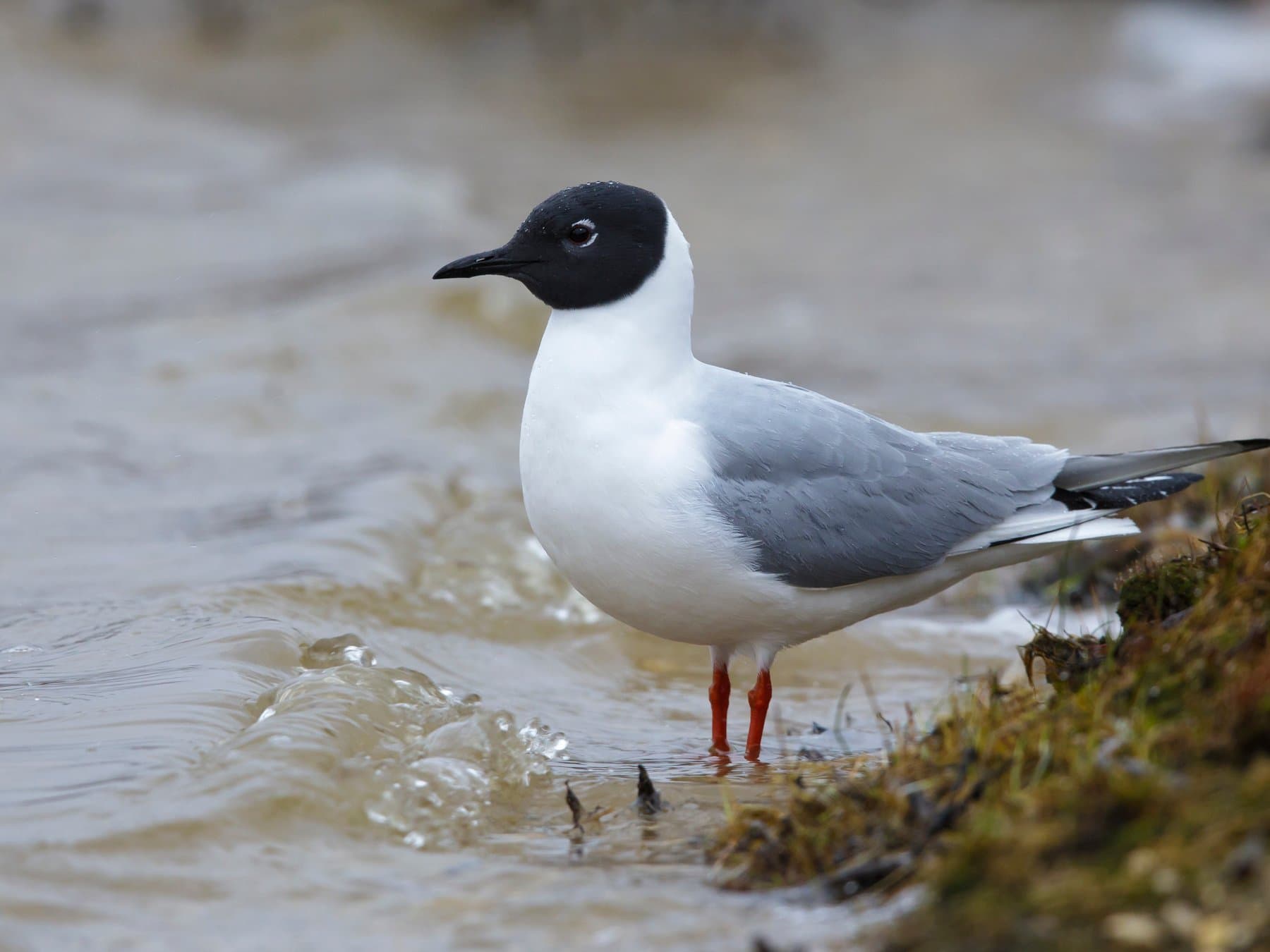
In breeding plumage, the adult wears a neat slaty-black hood covering the face and crown, offset by thin white eye crescents. The neck and underparts are white, and the back and upperwing are pale grey. The outer four primary feathers are white and almost translucent, with black tips — in flight, this creates a striking white wedge along the leading edge of the outer wing. The underwing is conspicuously pale, almost entirely white, which is the key distinction from the Black-headed Gull, whose primary undersides are dark. The bill is black, and the legs are orangish-red in summer.
In non-breeding (winter) plumage, the black hood is replaced by a white head with a distinctive dark smudge or spot behind the eye. The legs fade to pinkish-red. A subtle grey wash extends up the rear of the neck — a feature unique among Chroicocephalus gulls. First-year birds resemble adults in having a grey back but retain a brown bar across the forewing, blackish tips to the secondary feathers, and a black terminal tail band. In flight, immature birds show a dark, wide-stretched "M" pattern across the wings from wingtip to wingtip. Fewer than 5% of first-summer birds acquire a dark hood, and when they do it is duller than on breeding adults. Full adult plumage is attained at two years of age. Males and females are identical in plumage; males tend to be slightly heavier on average, but there is no reliable visual distinction in the field.
Not sure it’s a Bonaparte's Gull? Check your photo: Birdfact names the bird and shows the look-alike side by side.
Its size
Adults- Length
- 28–38 cm
- Wingspan
- 76–84 cm
- Weight
- 180–225 g
Its song and calls
Bonaparte's Gull has a voice that is distinctly nasal and raspy — more reminiscent of a tern than a typical gull. The most frequently heard call is a harsh, scratchy "cherrr" or "kheh", somewhat like a Forster's Tern but lower in pitch. Other described calls include a low rasping "kwah" and "rehow", and a louder, more plaintive "whee-hooah". Audubon's field guide describes the call as a "rasping tee-ar" and a "soft, nasal snarling note." The grating, tern-like quality of these calls is a useful identification feature in mixed flocks, where the species' voice stands out clearly from the mewing and laughing calls of larger gulls.
During courtship on the breeding grounds, pairs perform "long calls" with bills pointed skyward — a display shared with larger gull species — and engage in loud screaming bouts while facing each other on a perch, bills wide open and neck feathers erected. The species is generally vocal in flight, particularly in feeding flocks, and both sexes call similarly. Bonaparte's Gull is most vocal during the breeding season and at communal feeding aggregations, where the collective noise of a large flock can be considerable despite the small size of the individual birds.
- Call0:00 / 0:10
Recorded in Alaska, United States · August 2024
Heard one and not sure? Let the bird song identifier listen.
When and where to see it
OctoberLeaving
Most recorded in October
- 1. Carlow0.11%
- 2. Antrimunder 0.1%
- 3. Kerryunder 0.1%
- 4. Northumberlandunder 0.1%
Each dot is a county, state or province: the bigger and darker, the larger the bird’s share of that place’s bird records that month. Grey dots: no regular records. The ringed point is the centre of the bird’s records this month; the arrow shows how it moved since last month, and the dashed loop its path through the year. “Arrivals” colours places where it becomes regular this month (orange) or is in its last regular month (grey). GBIF eBird Observation Dataset, 2019–2024. Map data: Natural Earth, US Census Bureau; place centres © OpenStreetMap contributors.
In your area
See when the Bonaparte's Gull is recorded in your county, state or province.
How often the Bonaparte's Gull turns up in the UK, Ireland, the United States and Canada through the year, from birdwatchers' records.
United Kingdom
Summer visitor · regularly Nov–Sep · most records in July
Ireland
Passage migrant · regularly Apr–Sep · most records in August
United States
Winter visitor · all year · most records in November
Canada
Summer visitor · regularly Mar–Jan · most records in October
Show as a table
| Month | United Kingdom | Ireland | United States | Canada |
|---|---|---|---|---|
| January | 0.001% (regular) | 0.011% | 0.14% (regular) | 0.067% (regular) |
| February | <0.001% (regular) | 0.004% | 0.088% (regular) | 0.019% |
| March | 0.001% (regular) | <0.001% | 0.092% (regular) | 0.044% (regular) |
| April | 0.005% (regular) | 0.005% (regular) | 0.10% (regular) | 0.17% (regular) |
| May | 0.003% (regular) | 0.001% | 0.050% (regular) | 0.17% (regular) |
| June | 0.002% (regular) | – | 0.022% (regular) | 0.090% (regular) |
| July | 0.011% (regular) | 0.006% | 0.030% (regular) | 0.13% (regular) |
| August | 0.006% (regular) | 0.018% | 0.055% (regular) | 0.27% (regular) |
| September | <0.001% (regular) | 0.007% (regular) | 0.043% (regular) | 0.33% (regular) |
| October | <0.001% | 0.002% | 0.085% (regular) | 0.38% (regular) |
| November | <0.001% (regular) | 0.003% | 0.21% (regular) | 0.38% (regular) |
| December | <0.001% (regular) | 0.003% | 0.14% (regular) | 0.17% (regular) |
Recorded regularly in
Worldwide: recorded regularly in 16 countries
Countries where it was recorded in at least 3 of the 6 years 2019–2024. Linked countries have their own bird list.
North America (9)
Data: EOD – eBird Observation Dataset (Cornell Lab of Ornithology), accessed via GBIF.org, CC BY 4.0. Records from 2019–2024, aggregated and filtered by Birdfact. How these lists are made
Tips for seeing it
Bonaparte's Gull is most reliably seen in North America during migration and winter, when it gathers in large, accessible flocks. The Niagara River in November and December is arguably the best single site in the world for the species: position yourself at Niagara Falls State Park or the lower gorge overlooks and scan the river for the characteristic buoyant, tern-like flight. Flocks of thousands are routine, and the spectacle of birds working the rapids is unlike anything else in gull-watching.
Along the Atlantic coast, look for Bonaparte's Gulls in sheltered bays, estuaries, and harbour mouths from New England south to Florida from October through April. On the Pacific coast, coastal lagoons and river mouths in California and the Pacific Northwest are productive from October onwards. Inland, the Great Lakes — particularly Lake Erie and Lake Ontario — hold large numbers through the winter when conditions allow.
In the field, the key features to look for are the small size, thin black bill, and buoyant, dipping flight. In winter plumage, the dark ear spot on an otherwise white head is diagnostic. In flight, the white wedge on the leading edge of the outer wing (visible from above) and the almost entirely white underwing are the best features to separate it from the similar Black-headed Gull, which shows dark undersides to the primary feathers. The calls — a harsh, raspy "cherrr" quite unlike the mewing of larger gulls — are also a useful prompt to look more carefully at a mixed gull flock.
In Great Britain, Bonaparte's Gull is a rare find but worth searching for in flocks of Black-headed Gulls at coastal sites in Cornwall, Kent, and Northumberland, particularly between October and March. The Bamburgh site in Northumberland has hosted a returning individual for over a decade and is worth a visit in autumn.
What it eats
The diet of Bonaparte's Gull shifts markedly through the year, tracking the seasonal availability of prey. On the boreal breeding grounds in summer, the species is largely insectivorous. It hawks flying ants, termites, bees, midges, and other aerial insects in flight, sometimes foraging alongside Common Nighthawks or Black Terns. It is known to congregate rapidly in large numbers over termite dispersal flights, circling above emerging swarms and hovering briefly to snatch insects on the wing.
During migration and winter, insects are progressively replaced by aquatic prey. The non-breeding diet includes small fish — particularly sand lance, herring, pollock, emerald shiners, and Pacific herring — as well as euphausiid shrimp (krill), amphipods, copepods, molluscs, and marine worms. In western North America, Bonaparte's Gulls feed on salmon eggs and small fry during spawning runs, alighting on the water and diving if necessary to take drifting eggs. In Alaska, birds have been recorded taking shrimp from the edges of glaciers.
The primary foraging method is aerial: the bird dips to the surface or plunges into the water much like a tern, picking up items while swimming or wading. On wet agricultural fields, it takes earthworms, grasshoppers, locusts, ants, and beetles. Ripe berries and walnut meat have also been recorded in the diet. Unlike larger gulls, Bonaparte's Gull rarely scavenges at carrion or refuse — its feeding ecology is oriented almost entirely toward live, active prey.
Nesting and breeding
Bonaparte's Gull is unique among the world's gulls in that it nests in trees as a matter of routine — the only gull species to do so. Nests are placed almost exclusively in conifers: black spruce, tamarack, jack pine, Atlantic white cedar, Douglas-fir, and hemlock are all used, typically on a horizontal branch near the trunk. Most nests are 3–6 m above the ground, though nests as low as 1.5 m and as high as 15 m have been recorded. Occasionally, nests are placed on the ground or on top of dead marsh vegetation, but tree sites are strongly preferred.
The nest itself is a platform of small sticks, bark, and twigs, lined with lichen, moss, and grass, measuring approximately 25 cm in diameter. Both sexes participate in construction. The species nests singly or in loose colonies of 2–20 pairs, with nests typically spaced at least 30–50 m apart. Egg-laying begins in late May to early June. The clutch is typically 2–3 eggs (occasionally 4), olive to buff in colour with dark brown spots and blotches. Both parents incubate for 22–25 days.
Chicks hatch semiprecocial — eyes open, covered in brownish-cinnamon down with darker spots above and unmarked pinkish-cinnamon underparts. They are able to stand within a day but typically remain in the nest for about a week before following their parents to the nearest water. Both parents feed the young. One brood is raised per year. Bonaparte's Gulls begin breeding at two years of age and are thought to be monogamous. Adults defend nests aggressively, chasing hawks, Common Ravens, and humans, sometimes pursuing intruders up to a kilometre from the nest.
Behaviour
Bonaparte's Gull flies with a lightness and buoyancy that immediately sets it apart from larger gulls. The wingbeats are quick and elastic, and the bird dips and tilts constantly as it forages over water — an action that is far closer to the flight of a Common Tern than to the more measured, gliding style of a Herring Gull. In strong winds, it rides the gusts with ease, hanging almost motionless before dropping to the surface to take prey.
In flight, the key features visible from above are the white wedge on the leading edge of the outer wing — formed by the white, translucent outer primaries with their black tips — and the pale grey back and upperwing. From below, the underwing is almost entirely white, a feature that immediately distinguishes it from the Black-headed Gull, which shows dark undersides to the primary feathers. Immature birds show a dark "M" pattern across the wings from wingtip to wingtip, formed by the brown forewing bar and dark secondary tips.
The conveyor-belt feeding flight is one of the most distinctive aerial behaviours of any gull: large flocks fly upwind just above the water surface, each bird dipping to seize prey, before flying upward at the end of the food patch and being carried by the wind back to the start of the queue. Seen from a distance, the effect is of a continuous, rolling loop of birds — a behaviour that is both highly efficient and visually arresting.
Lifespan and predators
The maximum recorded lifespan for Bonaparte's Gull is 18 years, based on ringing data. Typical life expectancy in the wild is estimated at 5–10 years, with many birds lost to predation and the hazards of long-distance migration before reaching old age. This is broadly comparable to other small gulls of similar size and ecology.
Mortality is highest in the first year of life, when inexperienced birds face the full challenge of migration, competition for food, and predation. Adults that survive to breeding age — reached at two years — have significantly better annual survival rates. Known predators include large birds of prey such as Peregrine Falcons and accipiters, as well as mammalian predators that may raid nests on the rare occasions when they are placed on or near the ground. On the breeding grounds, adults mob potential predators aggressively, which likely reduces nest predation rates.
Bonaparte's Gull is protected under the Migratory Bird Treaty Act in North America, which prohibits taking, possession, or killing of the species without a permit. Long-term survival data remain limited given the remoteness of the breeding grounds, and ringing studies have been relatively sparse compared to more accessible gull species.
Conservation
Bonaparte's Gull is listed as Least Concern on the IUCN Red List, and its population is thought to be stable or slowly increasing over the long term. Partners in Flight (2017) estimated the global population at approximately 260,000 individuals, though Audubon places the figure closer to 790,000. The species scores 10 out of 20 on the Partners in Flight Continental Concern Score, indicating low conservation concern at present.
Climate change poses the most significant long-term threat. Projections suggest the species could lose more than 80% of its boreal breeding range if warming continues unchecked, as suitable taiga conditions shift northward and there is limited territory to expand into. Increased wildfire frequency in the boreal zone compounds this risk. Habitat degradation from logging, mining, oil and gas development, and hydroelectric flooding contributes to wetland loss and fragmentation on the breeding grounds. Pollution of aquatic environments — including heavy metals and other toxic materials — poses risks particularly in wintering areas.
Bonaparte's Gull is protected across North America by the Migratory Bird Treaty Act. It remains among the least-studied gulls on the continent, particularly on its remote boreal breeding grounds, and more data are needed on regional population trends. NH Audubon has noted a decreasing trend in New Hampshire, suggesting that even where the overall population appears stable, local declines may be occurring in parts of the wintering range.
Courtship & Display
Courtship in Bonaparte's Gull takes place primarily on the breeding grounds after arrival in late May. Pairs perform raucous swooping display flights, calling loudly and diving at each other before dropping to perch on a branch. Once perched, the two birds face each other with neck and crown feathers erected and wings slightly raised, screaming with bills wide open and bobbing up and down — a display that can continue for several minutes before ending abruptly. This face-to-face screaming bout is structurally similar to the "long call" displays of larger gull species, though delivered with the species' characteristic nasal, tern-like voice.
Both sexes participate equally in nest construction, incubation, and chick-rearing, consistent with the monogamous pair bond thought to characterise the species. Pairs are believed to re-form in successive years, though data on long-term pair fidelity are limited given the difficulty of studying the species on its remote boreal breeding grounds. The tree-nesting habit itself may be partly a product of mate and site fidelity: returning birds selecting the same conifer branch year after year would reinforce the preference for elevated nest sites over generations.
Similar Species Comparison
Bonaparte's Gull is most likely to be confused with the Black-headed Gull, which is larger (37–44 cm), heavier, and has a dark chocolate-brown (not black) hood in breeding plumage. The most reliable distinction in flight is the underwing: Bonaparte's Gull shows an almost entirely white underwing, while the Black-headed Gull has conspicuously dark undersides to the primary feathers. Bonaparte's Gull also has a thinner, all-black bill (the Black-headed Gull's bill is red), and its flight is noticeably more buoyant and tern-like.
The Little Gull is smaller still (25–30 cm) and in breeding plumage shows a full black hood extending down the neck, combined with a distinctive dark underwing — the reverse of Bonaparte's pale underwing. In winter, the Little Gull has a dark cap rather than a discrete ear spot. Immature Little Gulls show a bold dark "W" pattern across the upperwing, similar to but more contrasting than the "M" pattern of immature Bonaparte's.
Laughing Gull and Franklin's Gull are both larger, darker-mantled birds with heavier bills and less buoyant flight. In North America, Bonaparte's Gull's small size, thin black bill, white underwing, and tern-like agility are usually sufficient to identify it quickly in a mixed gull flock — it is often the species that prompts a second look precisely because it moves so differently from everything around it.
Quick facts
- Length
- 28–38 cm
- Wingspan
- 76–84 cm
- Weight
- 180–225 g
- Lifespan
- 5–10 years · oldest recorded 18 years
- Family
- Gulls & Terns
- Migration
- Long-distance Migrant
- Global status (IUCN)
- Least Concern
- World population
- 260,000–790,000 individuals
- Population trend
- Suspected stable or slowly increasing over the long term, though regional declines have been noted in parts of the wintering range such as New Hampshire. Partners in Flight rates the species 10/20 on the Continental Concern Score, indicating low conservation concern.
- Scientific name
- Chroicocephalus philadelphia
Sources
14- 1Bonaparte's gull - Wikipedia Source (opens in a new tab)
- 2Bonaparte's Gull Life History - All About Birds, Cornell Lab of Ornithology Source (opens in a new tab)
- 3Bonaparte's Gull Identification - All About Birds, Cornell Lab of Ornithology Source (opens in a new tab)
- 4Bonaparte's Gull - Audubon Field Guide Source (opens in a new tab)
- 5Bonaparte's Gull - eBird, Cornell Lab of Ornithology Source (opens in a new tab)
- 6Bonaparte's Gull - BirdLife International DataZone Source (opens in a new tab)
- 7Bonaparte's Gull - BTO BirdFacts Source (opens in a new tab)
- 8Bonaparte's Gull - Oiseaux-Birds.com Source (opens in a new tab)
- 9Bonaparte's Gull - Missouri Department of Conservation Source (opens in a new tab)
- 10Bonaparte's Gull - BirdWeb, Seattle Audubon Society Source (opens in a new tab)
- 11Bonaparte's Gull - Houston Audubon Bird Gallery Source (opens in a new tab)
- 12Bonaparte's Gull - NH Audubon State of the Birds Source (opens in a new tab)
- 13Gorge-ous Gulls of the Niagara in Winter - NY State Parks Blog (2019) Source (opens in a new tab)
- 14Movements and Migration - Bonaparte's Gull - Birds of the World Source (opens in a new tab)

Checked by
Nathan Cope, founder and editor
Nathan founded Birdfact and leads its writers and contributors in the UK, the US and Canada. He has watched and studied birds for more than ten years, and checks every article and species guide before it’s published.