



Common Tern
Sea Swallow · Sterna hirundo
By the Birdfact teamChecked by Nathan Cope
On this page15 sections
How to recognise it
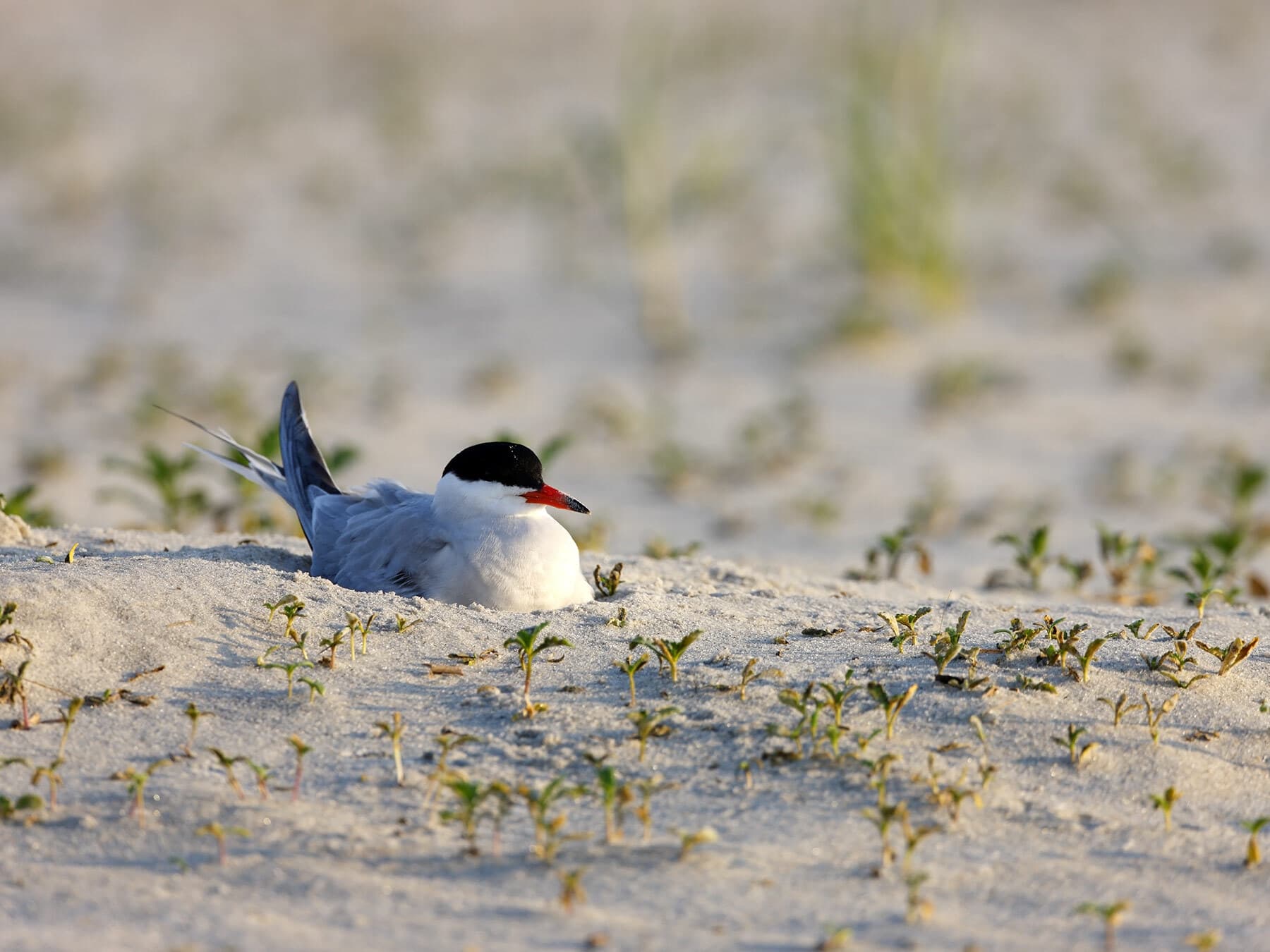
The Common Tern displays a striking combination of light grey upperparts and white underparts. Its black cap, forked tail, and slender wings are distinctive features. During the breeding season, adults have full black caps and vibrant red bills with a black tip.
Non-breeding adults have a white forehead and duller bill. Juveniles show a ginger-brown wash on their upperparts and a dark carpal bar on their wings.
Its size
Adults- Length
- 31–35 cm
- Wingspan
- 77–98 cm
- Weight
- 110–145 g
Its song and calls
Common terns use a wide range of vocalisations and are able to identify chicks and siblings by their call. An alarm call similar to ‘kee – yah, kee – yah’ will often silence an otherwise noisy flock or nesting colony often accompanied by a shorter, ‘kyar – kyar – kyar’. On approach to a nest, particularly if returning with food for the young, the adult will issue a, ‘keearr’ sound alerting the nest occupants of the imminent arrival. In social interactions with other terns a simple ‘kik’ or ‘kik – kik’ if often used.

- Call0:00 / 0:16
Recorded in Kalmar län, Sweden · April 2024
When and where to see it
OctoberMostly absent
Most recorded in October
- 1. Tyne and Wear0.19%
- 2. Dublin0.17%
- 3. East Riding of Yorkshire0.12%
- 4. Norfolk0.11%
- 5. North Yorkshire0.11%
Each dot is a county, state or province: the bigger and darker, the larger the bird’s share of that place’s bird records that month. Grey dots: no regular records. The ringed point is the centre of the bird’s records this month; the arrow shows how it moved since last month, and the dashed loop its path through the year. “Arrivals” colours places where it becomes regular this month (orange) or is in its last regular month (grey). GBIF eBird Observation Dataset, 2019–2024. Map data: Natural Earth, US Census Bureau; place centres © OpenStreetMap contributors.
In your area
See when the Common Tern is recorded in your county, state or province.
How often the Common Tern turns up in the UK, Ireland, the United States and Canada through the year, from birdwatchers' records.
United Kingdom
Summer visitor · regularly Apr–Sep · most records in July
Ireland
Summer visitor · regularly Apr–Oct · most records in July
United States
Summer visitor · regularly Apr–Oct · most records in August
Canada
Summer visitor · regularly Apr–Oct · most records in July
Show as a table
| Month | United Kingdom | Ireland | United States | Canada |
|---|---|---|---|---|
| January | <0.001% | – | 0.001% | – |
| February | <0.001% | – | 0.001% | – |
| March | 0.002% | 0.002% | 0.003% | – |
| April | 0.21% (regular) | 0.14% (regular) | 0.017% (regular) | 0.021% (regular) |
| May | 0.56% (regular) | 0.51% (regular) | 0.082% (regular) | 0.22% (regular) |
| June | 0.63% (regular) | 0.73% (regular) | 0.10% (regular) | 0.24% (regular) |
| July | 0.83% (regular) | 0.89% (regular) | 0.17% (regular) | 0.35% (regular) |
| August | 0.64% (regular) | 0.62% (regular) | 0.19% (regular) | 0.32% (regular) |
| September | 0.21% (regular) | 0.26% (regular) | 0.090% (regular) | 0.15% (regular) |
| October | 0.040% | 0.060% (regular) | 0.024% (regular) | 0.032% (regular) |
| November | 0.003% | 0.019% | 0.006% | 0.004% |
| December | – | – | 0.001% | – |
Recorded regularly in
Worldwide: recorded regularly in 160 countries
Countries where it was recorded in at least 3 of the 6 years 2019–2024. Linked countries have their own bird list.
Europe (41)
- Åland Islands
- Albania
- Austria
- Belarus
- Belgium
- Bulgaria
- Croatia
- Czechia
- Denmark
- Estonia
- Finland
- France
- Germany
- Greece
- Guernsey
- Hungary
- Ireland
- Isle of Man
- Italy
- Jersey
- Latvia
- Lithuania
- Luxembourg
- Moldova
- Monaco
- Montenegro
- Netherlands
- North Macedonia
- Norway
- Poland
- Portugal
- Romania
- Russia
- Serbia
- Slovakia
- Slovenia
- Spain
- Sweden
- Switzerland
- Ukraine
- United Kingdom
Africa (25)
- Algeria
- Angola
- Cape Verde
- Côte d’Ivoire
- Egypt
- Gabon
- Gambia
- Ghana
- Guinea-Bissau
- Kenya
- Liberia
- Libya
- Madagascar
- Mauritania
- Mauritius
- Morocco
- Mozambique
- Namibia
- Nigeria
- Senegal
- Seychelles
- South Africa
- Tanzania
- Tunisia
- Western Sahara
Asia (42)
- Armenia
- Azerbaijan
- Bahrain
- Bangladesh
- Bhutan
- Cambodia
- China
- Cyprus
- Georgia
- Hong Kong SAR China
- India
- Indonesia
- Iran
- Iraq
- Israel
- Japan
- Jordan
- Kazakhstan
- Kuwait
- Kyrgyzstan
- Malaysia
- Maldives
- Mongolia
- Myanmar (Burma)
- Nepal
- Oman
- Pakistan
- Philippines
- Qatar
- Saudi Arabia
- Singapore
- South Korea
- Sri Lanka
- Taiwan
- Tajikistan
- Thailand
- Timor-Leste
- Turkey
- United Arab Emirates
- Uzbekistan
- Vietnam
- Yemen
North America (34)
- Anguilla
- Antigua & Barbuda
- Aruba
- Bahamas
- Barbados
- Belize
- Bermuda
- British Virgin Islands
- Canada
- Caribbean Netherlands
- Cayman Islands
- Costa Rica
- Cuba
- Curaçao
- Dominica
- Dominican Republic
- El Salvador
- Grenada
- Guadeloupe
- Guatemala
- Haiti
- Honduras
- Mexico
- Nicaragua
- Panama
- Puerto Rico
- Sint Maarten
- St Kitts & Nevis
- St Lucia
- St Pierre & Miquelon
- Trinidad & Tobago
- Turks & Caicos Islands
- United States
- US Virgin Islands
South America (11)
Oceania (7)
- Australia
- Guam
- New Zealand
- Northern Mariana Islands
- Palau
- Papua New Guinea
- Solomon Islands
Data: EOD – eBird Observation Dataset (Cornell Lab of Ornithology), accessed via GBIF.org, CC BY 4.0. Records from 2019–2024, aggregated and filtered by Birdfact. How these lists are made
Common terns are migratory and breed across much of the mid Palearctic region from Sweden, east across Russia and through Kazakhstan to Kamchatka and Central and Northern China. There are also breeding populations on the islands in the Atlantic off the Northwest coast of Africa. Within North America they breed throughout central and Southeast Canada, south to the Great lakes and into the North East of the USA. During the winter, Eurasian breeding terns migrate south to the coastal regions of Africa, Indonesia, Malaysia, Papua New Guinea, the South Pacific Islands and the North and East coast of Australia. Those that breed in North America travel south along the Pacific coast of South America as far as Peru, across the islands of the Caribbean and down the Atlantic coast to Argentina and beyond.

Signs and Spotting tips
Common terns generally inhabit coastal regions although, unlike most members of the tern family, during the breeding season they can also be found great distances inland provided they have close access to rivers, lakes and reservoirs. In the main when they migrate to tropical and sub-tropical regions they confine themselves to coastal areas and spend much of the day fishing out at sea. They are a social bird frequently seen in large flocks or colonies, roosting on sandbars, offshore islands or salt and fresh water marshlands. They are extremely similar in appearance to the Arctic and Roseate Terns and careful observation of plumage, behaviour, location and voice is required in order to tell them apart.

What it eats
Predominantly a fish eater, the common tern will also feed on molluscs, crustaceans and insects. Almost all food is taken from the water with the bird either hovering then diving down to snatch its prey from beneath the water or simply swooping down and snatching it from the surface.

Nesting and breeding
The breeding season is commonly from late April through to June when nests are constructed on the ground, normally a natural hollow or scrape, lined with vegetable matter or surrounded with seaweed and stones. Frequently large colonies of common terns will nest on offshore islands of sand, earth or gravel. One clutch, averaging 2 – 3 buff coloured eggs with dark splodges or streaks, are laid annually and incubated for up to three weeks by both parents. Once hatched, chicks can stand and walk within a few hours and will wander from the nest after two to three days although they are still fed by their parents. Fledging occurs between twenty two to thirty days from hatching.

Behaviour
Lifespan and predators
Predation, particularly from other birds is common around nesting sites. On achieving adulthood, common terns can expect to reach up to ten years of age.
Conservation
What does a Common Tern look like?
Similar in size to the Arctic Tern, the summer plumage of the adult common tern is predominantly silver grey on the upperparts and pale grey on the underparts. A prominent black cap extends from the base of the upper mandible through the eye and across the head to just above the nape. The chin and face are white and the long thin bill is bright red with a black tip. The long primary flight feathers are a dark grey to black contrasting with the paler short primaries. The tail feathers appear as a similar length to the wing tips when folded with the bird in an upright stance. The upper tail and rump are white and the tail is forked with the longer outer feathers edged black. There is a wide dark bar on the underwing trailing edge and a white translucent patch on the underwing from the tips of the secondary flight feathers towards the flank. The neck is relatively long which is more apparent when the bird is in flight. The legs and webbed feet are a bright red. In winter plumage the forehead and lores, the area immediately in front of the eyes extending to the bill, are white whilst the rest of the cap remains black. The bill is black and the shoulders are a dark grey as are streaks which appear on the outer wing areas. Male and female birds are similar. Juvenile birds are grey in the main but with brown or light ginger barring to the upperparts, a dark grey nape and greyish brown crown with buff coloured forehead. The shoulders are dark, similar to the adult’s winter patternation and the rump, pale grey. The bill is dark grey with a pale pinkish base to the lower mandible and the legs are a light browny pink.

Sub-species
There are three sub-species of common tern with Sterna hirundo hirundo being the most populous and occupying the largest geographical area covering North America, Europe and Central Asia. Sterna hirundo tibetana breeds across Central Asia to the Tibetan Plateau and differs slightly from the nominate in that both its belly and back are a much darker grey in colour. Finally, Sterna hirundo longipennis, which is monotypic and breeds from Eastern Siberia through to North East China and migrates south to Australasia. This bird is similar in plumage to Sterna hirundo tibetana with the added anomaly of having a black bill. This latter characteristic easily identifies it within North America where it can be found as a vagrant to Western Alaska.
Similar birds
Often mistaken for
Common Tern guides
3 guidesQuick facts
- Length
- 31–35 cm
- Wingspan
- 77–98 cm
- Weight
- 110–145 g
- Lifespan
- 15–25 years
- Family
- Gulls & Terns
- Migration
- Long-distance Migrant
- Global status (IUCN)
- Least Concern
- World population
- 1,600,000 - 3,600,000 mature individuals
- Population trend
- Stable
- Also called
- Sea Swallow
- Scientific name
- Sterna hirundo
Sources
3- 1BirdLife International. 2019. Sterna hirundo (amended version of 2018 assessment). The IUCN Red List of Threatened Species 2019: e.T22694623A155537726. Source (opens in a new tab)
- 2Wetlands International (2015)
- 3Wetlands International (2015)

Checked by
Nathan Cope, founder and editor
Nathan founded Birdfact and leads its writers and contributors in the UK, the US and Canada. He has watched and studied birds for more than ten years, and checks every article and species guide before it’s published.