


Dunlin
Red-backed Sandpiper · Calidris alpina
By the Birdfact teamChecked by Nathan Cope
On this page13 sections
How to recognise it
A tough and hardy wading bird, Dunlins are no stranger to ultra-cold Arctic environments and breed across Greenland, Iceland, Siberia, Alaska, and the north Canadian provinces of Yukon, Nunavut, and the Northwest Territories.
Appearance & Identification
What does a Dunlin look like?
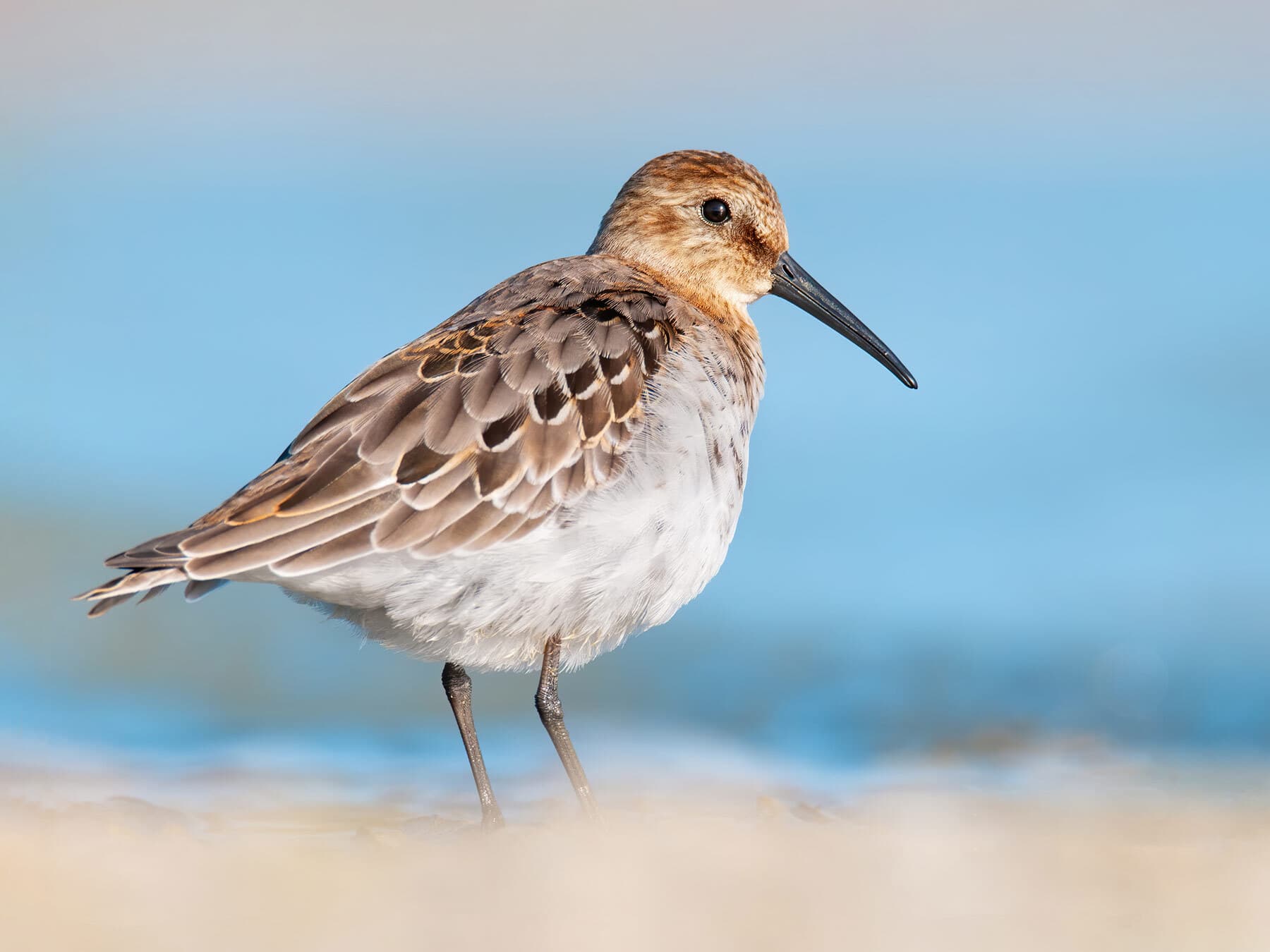
Dunlins exist in 10 different subspecies, all with subtle differences in the contrast and colouration of their predominantly brown and grey plumage.
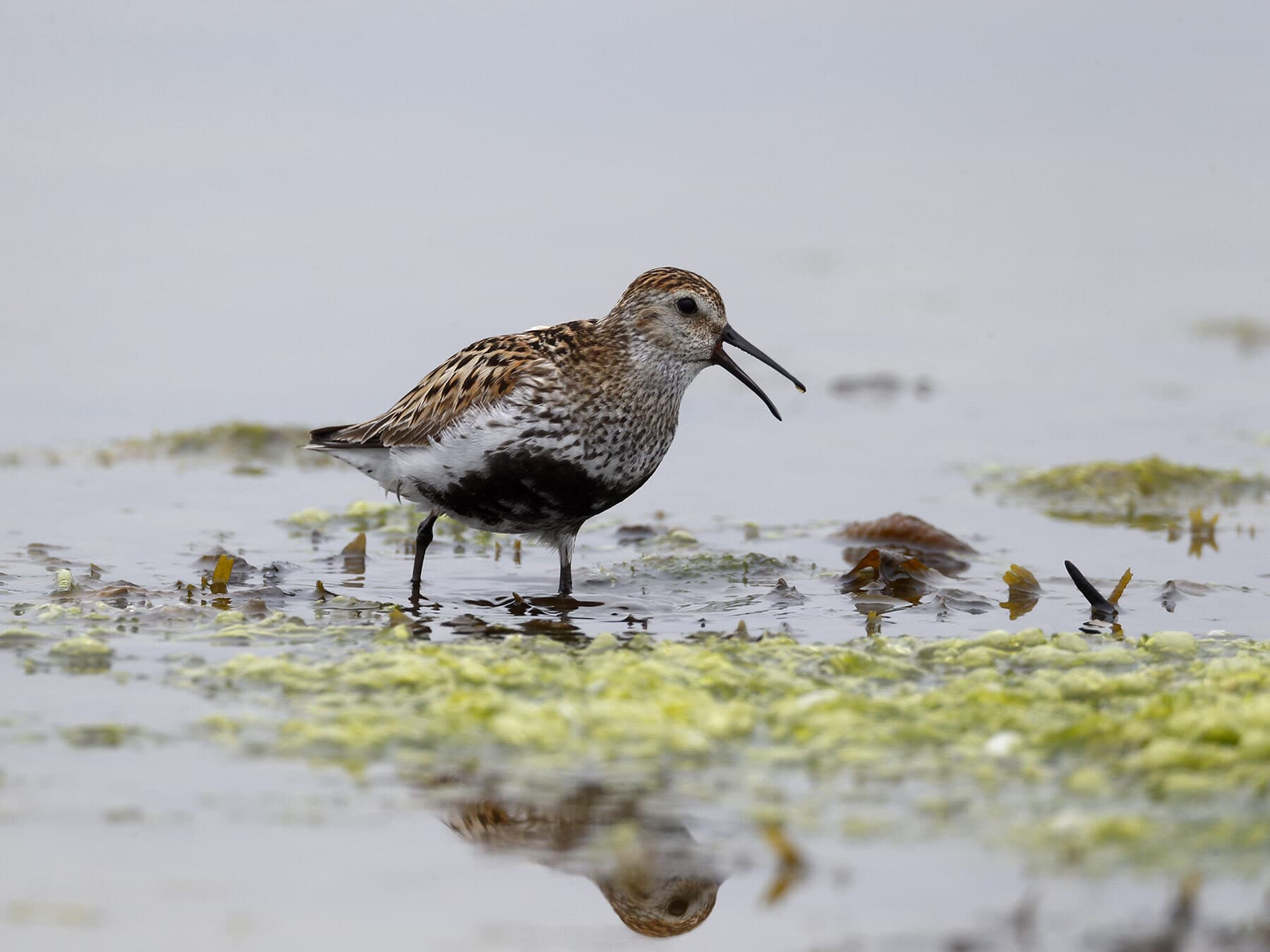
Dunlins have two different core plumage types; breeding and winter. Their breeding plumage is brighter and more coloured, and both males and females develop a dark belly.
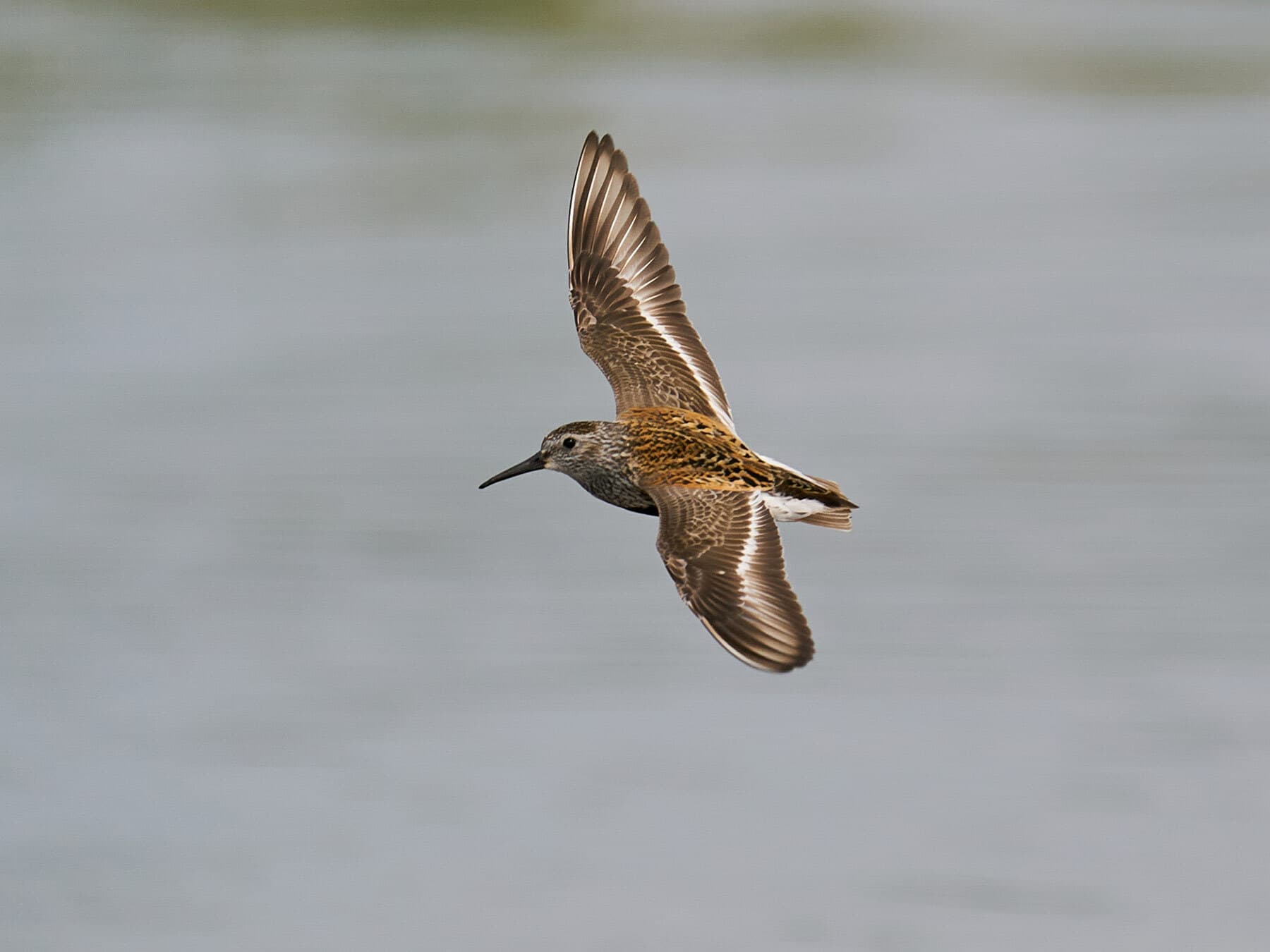
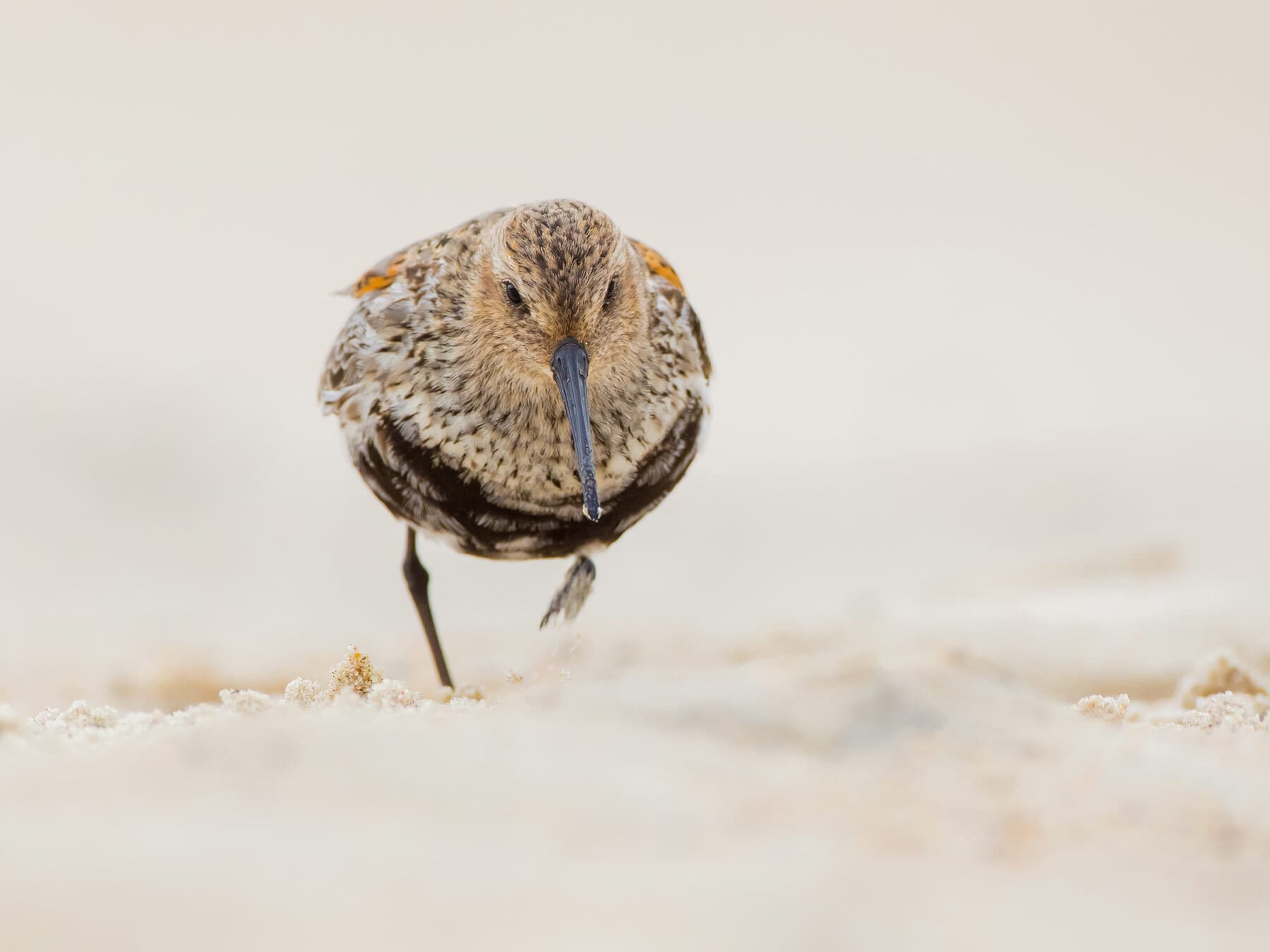
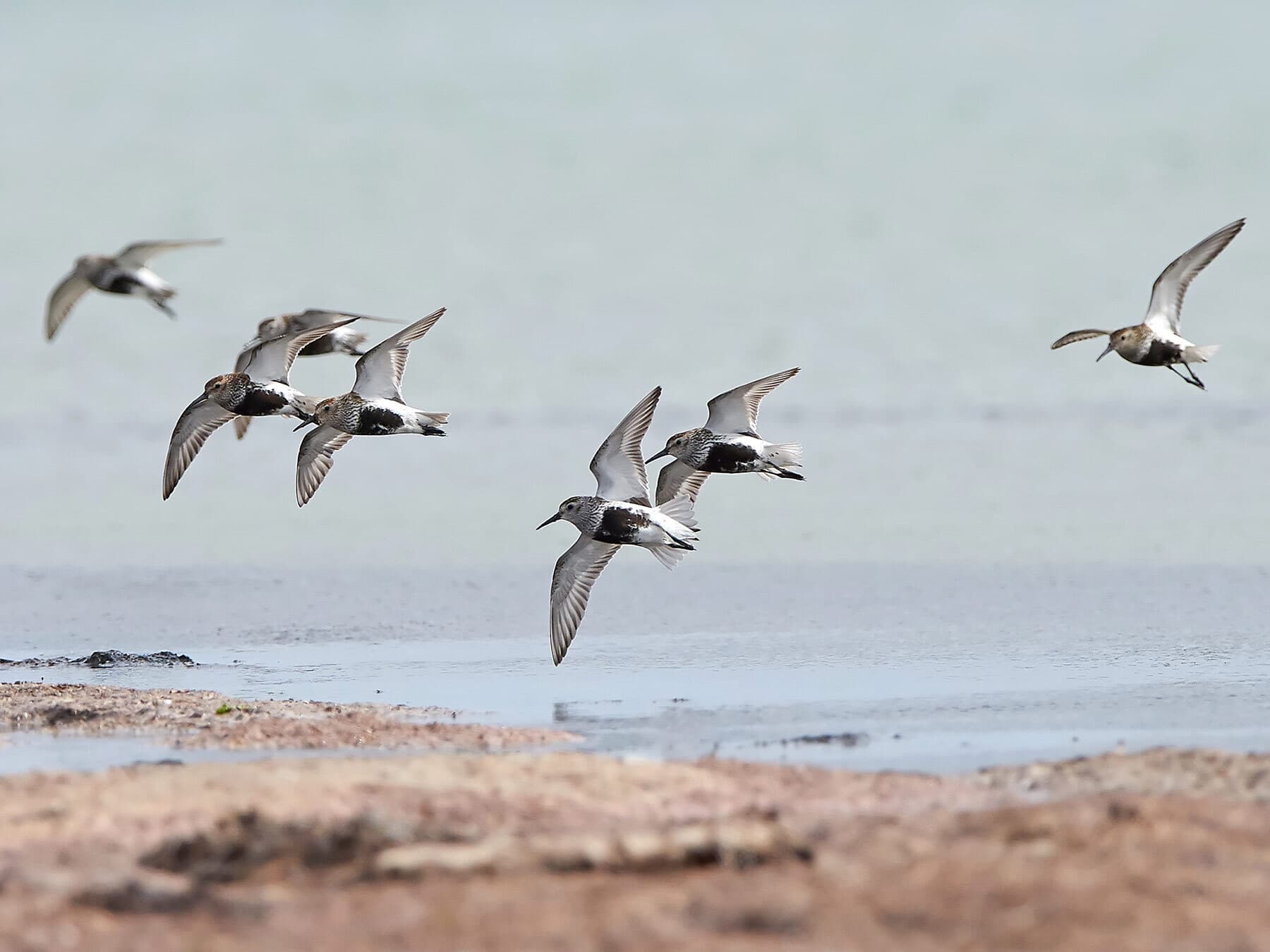
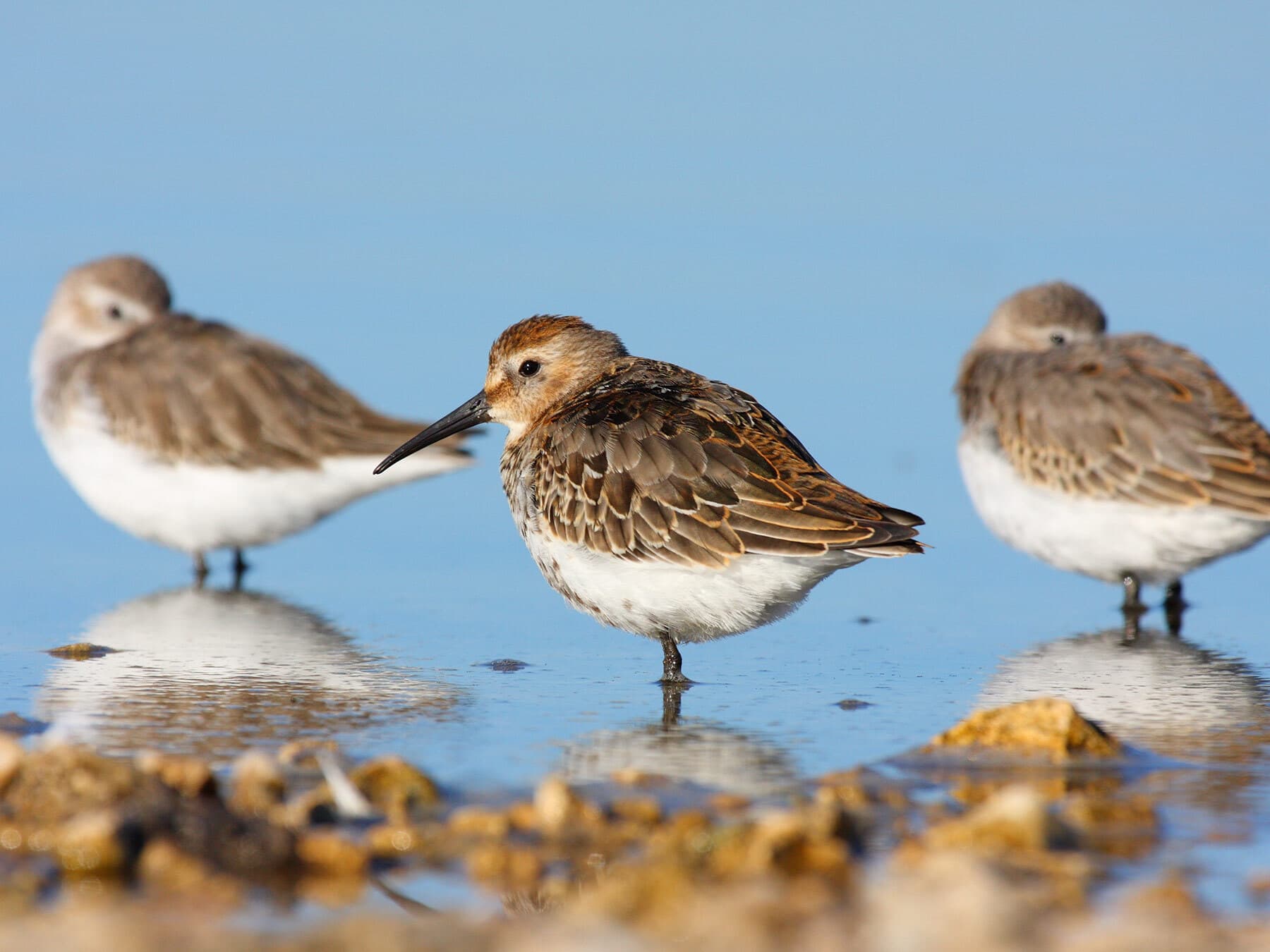
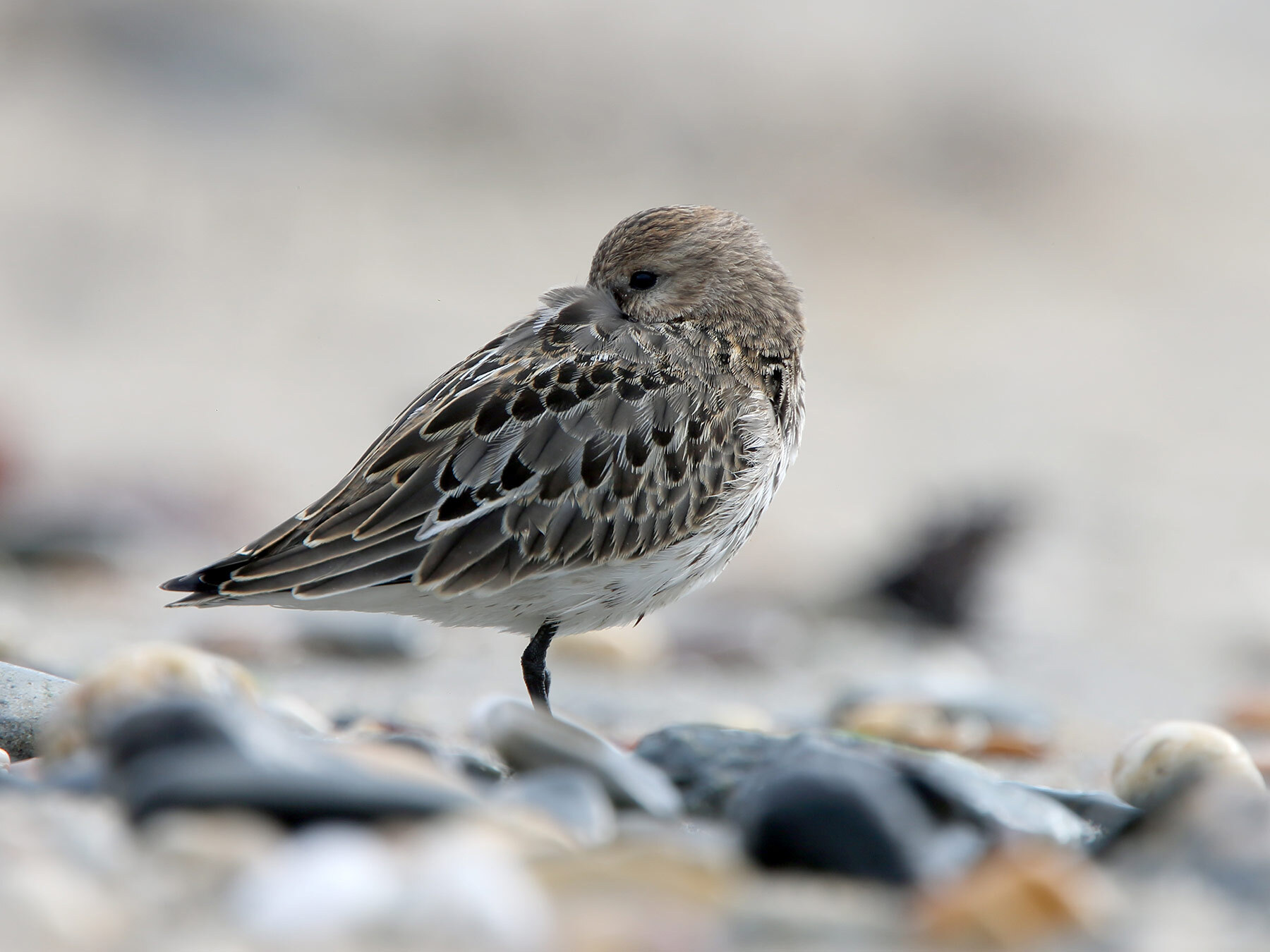
In the winter, Dunlins are grey above their stomachs and white below, with minimal but subtle orange-brown colouration to the wings. In the breeding season, Dunlins have a distinctive black belly and rufous upper parts that are more colourful in general. It’s probably easiest to identify Dunlins from their black legs, black curved bill and hunched wader-like form.
Juveniles
Juveniles are paler and streakier overall. Their upper halves are browner, and they have two V-shaped markings on their wings.
Females
Female and male Dunlins look similar, but males have darker bellies during the breeding season. The female is slightly larger than the male, with a longer bill.
How big are Dunlins?
Dunlins are small wading birds, measuring 16 to 22cm (6.3 to 8.7in) long, with a wingspan of 36 to 38 cm (14.2 to 15.0in). They weigh 48 to 77g (1.7 to 2.7oz).
Its size
Adults- Length
- 16–22 cm
- Wingspan
- 35–43 cm
- Weight
- 40–100 g
Its song and calls
What do Dunlins sound like?
Dunlins are particularly lively at their breeding grounds, where they produce an array of burry notes and high-pitched trills. The most common vocalisation is a short reed-like trill and a longer trill chrri-i-i-i-i-i-ri-ri-ri-ri-ri-r.
Prior to migration, flocks of gathering Dunlins produce a kree sound, and once chicks hatch, the parents communicate with a low-pitched purr-like sound.
- Song and calls0:00 / 0:22
Recorded in Manitoba, Canada · June 2010
- Call0:00 / 0:33
Recorded in Central Bedfordshire, England · May 2023
When and where to see it
OctoberLeaving
Most recorded in October
- 1. Louth1.9%
- 2. Falkirk1.3%
- 3. East Lothian1.2%
- 4. Aberdeenshire1.1%
- 5. Mayo1.1%
Each dot is a county, state or province: the bigger and darker, the larger the bird’s share of that place’s bird records that month. Grey dots: no regular records. The ringed point is the centre of the bird’s records this month; the arrow shows how it moved since last month, and the dashed loop its path through the year. “Arrivals” colours places where it becomes regular this month (orange) or is in its last regular month (grey). GBIF eBird Observation Dataset, 2019–2024. Map data: Natural Earth, US Census Bureau; place centres © OpenStreetMap contributors.
In your area
See when the Dunlin is recorded in your county, state or province.
How often the Dunlin turns up in the UK, Ireland, the United States and Canada through the year, from birdwatchers' records.
United Kingdom
Resident · all year · most records in September
Ireland
Resident · all year · most records in September
United States
Winter visitor · regularly Sep–Jun · most records in November
Canada
Winter visitor · regularly Aug–Jun · most records in November
Show as a table
| Month | United Kingdom | Ireland | United States | Canada |
|---|---|---|---|---|
| January | 0.38% (regular) | 0.93% (regular) | 0.12% (regular) | 0.093% (regular) |
| February | 0.33% (regular) | 0.89% (regular) | 0.094% (regular) | 0.072% (regular) |
| March | 0.23% (regular) | 0.52% (regular) | 0.070% (regular) | 0.047% (regular) |
| April | 0.17% (regular) | 0.28% (regular) | 0.090% (regular) | 0.055% (regular) |
| May | 0.29% (regular) | 0.38% (regular) | 0.10% (regular) | 0.12% (regular) |
| June | 0.14% (regular) | 0.21% (regular) | 0.022% (regular) | 0.018% (regular) |
| July | 0.37% (regular) | 0.39% (regular) | 0.005% | 0.006% |
| August | 0.57% (regular) | 0.86% (regular) | 0.007% | 0.018% (regular) |
| September | 0.60% (regular) | 1.1% (regular) | 0.022% (regular) | 0.092% (regular) |
| October | 0.44% (regular) | 0.81% (regular) | 0.12% (regular) | 0.18% (regular) |
| November | 0.41% (regular) | 0.89% (regular) | 0.19% (regular) | 0.21% (regular) |
| December | 0.35% (regular) | 0.92% (regular) | 0.12% (regular) | 0.081% (regular) |
Recorded regularly in
Worldwide: recorded regularly in 100 countries
Countries where it was recorded in at least 3 of the 6 years 2019–2024. Linked countries have their own bird list.
Europe (44)
- Åland Islands
- Albania
- Austria
- Belarus
- Belgium
- Bosnia & Herzegovina
- Bulgaria
- Croatia
- Czechia
- Denmark
- Estonia
- Faroe Islands
- Finland
- France
- Germany
- Greece
- Guernsey
- Hungary
- Iceland
- Ireland
- Isle of Man
- Italy
- Jersey
- Latvia
- Lithuania
- Malta
- Moldova
- Montenegro
- Netherlands
- North Macedonia
- Norway
- Poland
- Portugal
- Romania
- Russia
- Serbia
- Slovakia
- Slovenia
- Spain
- Svalbard & Jan Mayen
- Sweden
- Switzerland
- Ukraine
- United Kingdom
Africa (11)
- Cape Verde
- Djibouti
- Egypt
- Gambia
- Guinea-Bissau
- Libya
- Mauritania
- Morocco
- Senegal
- Tunisia
- Western Sahara
Asia (34)
- Armenia
- Azerbaijan
- Bahrain
- Bangladesh
- China
- Cyprus
- Georgia
- Hong Kong SAR China
- India
- Iran
- Israel
- Japan
- Jordan
- Kazakhstan
- Kuwait
- Kyrgyzstan
- Lebanon
- Macao SAR China
- Mongolia
- Myanmar (Burma)
- Nepal
- Oman
- Pakistan
- Palestinian Territories
- Philippines
- Qatar
- Saudi Arabia
- South Korea
- Taiwan
- Thailand
- Turkey
- United Arab Emirates
- Uzbekistan
- Vietnam
North America (10)
- Bahamas
- Belize
- Bermuda
- Canada
- Cuba
- Greenland
- Guatemala
- Mexico
- St Pierre & Miquelon
- United States
Oceania (1)
- US Outlying Islands
Data: EOD – eBird Observation Dataset (Cornell Lab of Ornithology), accessed via GBIF.org, CC BY 4.0. Records from 2019–2024, aggregated and filtered by Birdfact. How these lists are made
What is the habitat of a Dunlin?
Dunlins are aquatic wading birds that breed in boggy wetland habitats. Dunlins thrive in colder environments and live across the arctic and tundra, including mudflats, lagoons, ponds, coastlines, flooded fields, estuaries and freshwater bogs. Tall grasses and reeds provide cover and shelter.
In their non-breeding range, Dunlins winter near rivers, lakes, ponds and other coastal or freshwater landforms.
What is the range of a Dunlin?
Dunlins stretch across practically the entire sub-Arctic Northern Hemisphere. In North America, Dunlin populations span southwestern Alaska all the way to James Bay, Canada.
In Europe and Asia, Dunlins stretch from Iceland, Greenland, the UK and Ireland to Scandinavia, Russia, northeastern Europe, north Asia and parts of central and east Asia.
Where do Dunlins live?
Dunlins live across both upland and lowland habitats, in boggy, marshy, swampy or other wetlands. Habitats include everything from the frozen tundra marshes and permafrost peat bogs to the marshy uplands of Wales and Scotland. Dunlins are mostly found near the coast.
How rare are Dunlins?
Dunlins are the commonest sandpipers, with a global population exceeding 5.5 million. The IUCN lists them as a bird of Least Concern.
However, Dunlins are becoming rarer across some parts of their range. For example, populations are declining in the UK, and the species appears on the UK conservation red list.
Where to see Dunlins in the US?
Dunlins confine themselves to their northern breeding grounds, which are scattered across Alaska and Canada. In the non-breeding season, Dunlins migrate to the US, where they can be found across the Atlantic, Pacific and Gulf Coasts.
They're easiest to spot at coastal mudflats, especially when the tide falls, which is when Dunlins frequently forage.
Where to see Dunlins in the UK?
The UK’s breeding population of Dunlins is found across the coastal regions of Scotland, Wales and England. The largest populations are found in the Western and Northern Isles. Hotspots include Flow Country of Caithness and Sutherland in Scotland, in the Pennines in England.
In the nonbreeding season, Dunlins are easier to spot across the UK's estuaries. Some key RSPB reserves include RSPB Adur Estuary, RSPB Newport Wetlands, RSPB Nigg Bay, RSPB Loch na Muilne, and RSPB Forsinard Flows.
Migration
Do Dunlins migrate?
Dunlins are strongly migratory. In North America, Dunlins usually travel short-to-medium distances from their Canadian and Alaskan breeding grounds to their wintering grounds on the coastal USA, extending towards Mexico. In addition, some North American birds head towards Japan and China.
In Europe, migratory journeys are typically longer, with Dunlins heading from across northern Europe and north Asia to southeast Asia, Africa, the Mediterranean and Indian Subcontinent.
Dunlins migrate in large, synchronised flocks.
Tips for seeing it
- Look for Dunlins on coastal mudflats and sandy beaches during migration and winter
- Observe their distinctive feeding behavior of rapidly probing the mud with their bills
- In breeding plumage, watch for the black belly patch, which is a key identifying feature
- Listen for their trilling call, often given in flight
What it eats
What do Dunlins eat?
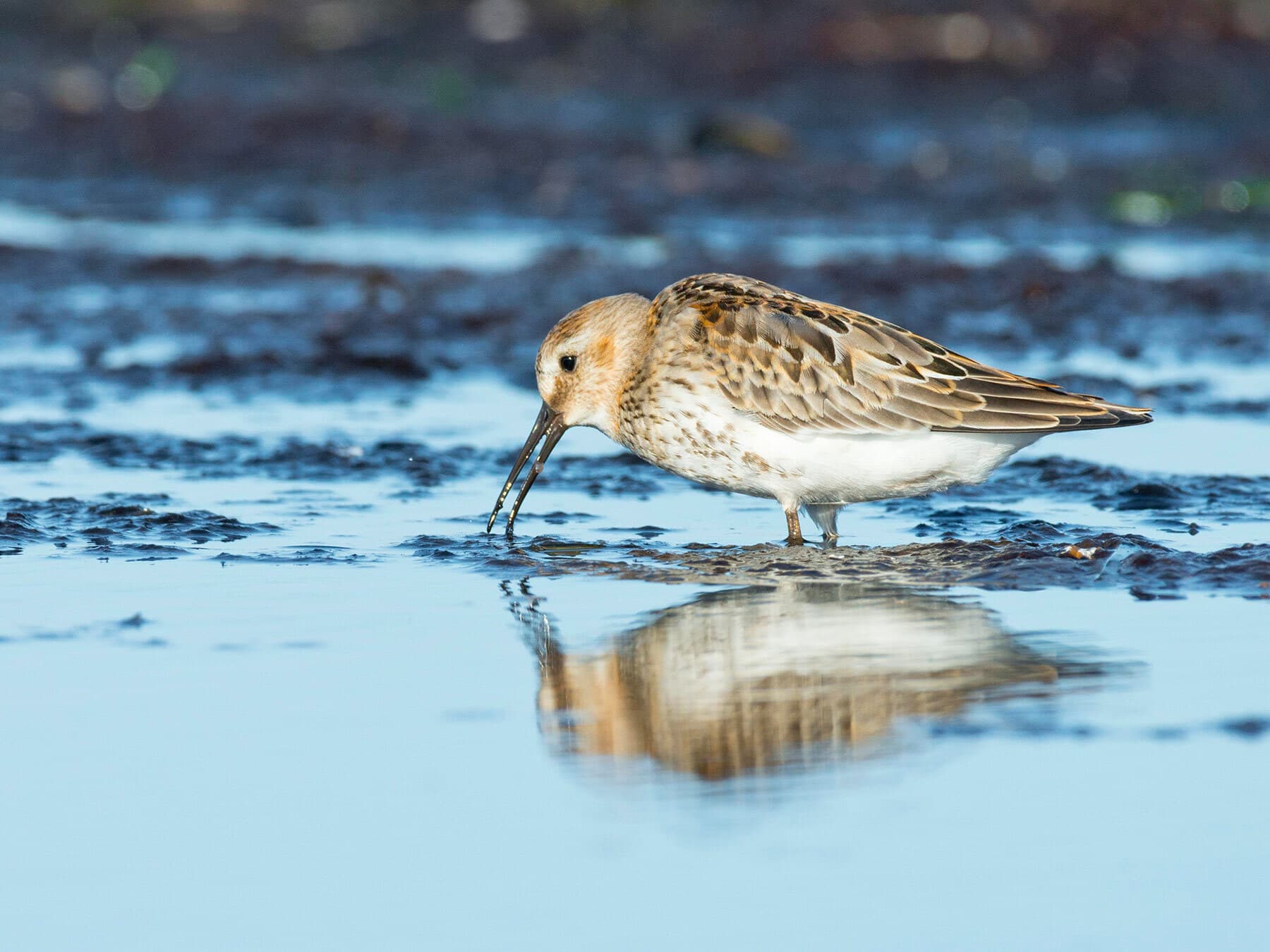
Dunlins forage in predominantly marine habitats and their diets consist primarily of marine invertebrates such as annelids (a type of marine worm).
They also eat earthworms, flies, crane flies, beetles, spiders, snails, mussels, clams, and amphipods. Small saltwater clams called Macoma are a staple food of Pacific Dunlins. Chironomid larvae (a family of midges) are especially important in the breeding season.
In Europe, Dunlins consume more gastropods than in North America. A staple food is Hydrobia, a genus of small aquatic snails. However, dunlins do also eat plant matter, including seeds, which has become an important part of their diet in some regions.
Dunlins forage by walking through their environments and pecking at foliage, sand, dirt and rocks. They feed both in the night and day, though some are observed to feed primarily at night. Dunlins seem to wash worms of dirt and sand before eating them.
What do baby Dunlins eat?
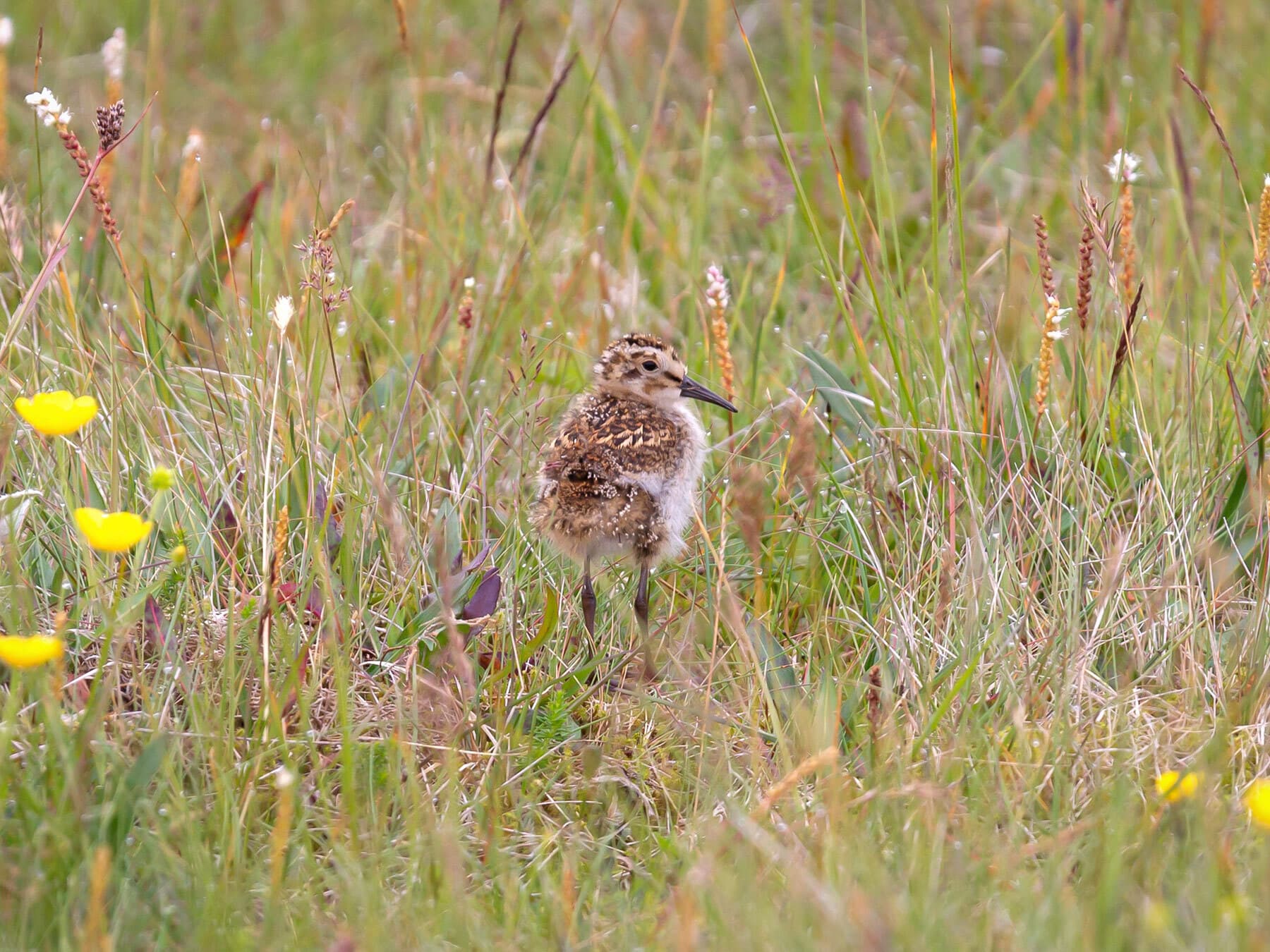
Dunlin chicks feed predominantly on small flies and their larvae. Adults lead the chicks to insect-abundant areas, and the chicks feed themselves.
Nesting and breeding
Where do Dunlins nest?
Dunlins nest in a small depression scraped into the ground. Nesting sites are typically situated close to where the Dunlin was born.
The male typically chooses the nesting site and creates the depression. The female then tosses moss, grasses and other lining materials into the nest. Typical nests measure around 12 to 15cm across and 75 to 120cm deep.
What do Dunlin eggs look like?
Dunlin eggs are ovular and measure around 36mm long. They’re usually olive to olive-brown, but some are blue-green, with light brown, black and orange, which are concentrated towards the widest part of the egg.
Do Dunlins mate for life?
Dunns are typically monogamous, mating for life. Both the male and female take part in incubation and the raising of chicks. The male often feeds the older chicks more than the female.
Do both Dunlin parents raise the chicks?
Female Dunlins lay a single small clutch of around 3 to 4 eggs. Both parents assist with incubation, which takes approximately 21 to 22 days. The birds fledge after 20 days or so, but don’t reach sexual maturity for 1 to 2 years. Both parents feed the young birds.
Young Dunlins leave the nest within just hours of being born and can feed themselves within just a day or two. Dunlins develop quickly and join their parents on the first migration the winter after birth.
Behaviour
Are Dunlins aggressive?
Dunlins are highly territorial during the breeding season and stoutly defend their nests from other Dunlins and other animals. In the winter, Dunlins are less aggressive and often form large sociable flocks. Aggression is nearly always associated with the breeding season.
Lifespan and predators
How long do Dunlins live?
Dunlins typically live around 5.5 years. Males are observed to live longer than females. The oldest known individual was 24 years old. Only around 3/10 birds survive their first year.
What are the predators of Dunlins?
Dunlins are targeted by many raptors, including eagles, falcons, hawks, ospreys and owls. Raptor predation accounted for 21% of all mortality in one study at Bolinas Lagoon, CA.
One of Dunlins’ main predators in Europe is the Merlin. Cold weather and disease also account for a large portion of Dunlin mortality. Most birds die during the non-breeding season.
Are Dunlins protected?
Dunlins are not globally threatened. However, in the UK, Dunlins are classified as Red under the Birds of Conservation Concern 5: the Red List for Birds (2021).
Are Dunlins endangered?
Dunlins are not globally threatened, but some populations are declining sharply. In the UK, Dunlins are classified as Red under the Birds of Conservation Concern 5: the Red List for Birds (2021).
Conservation
While currently listed as Least Concern, Dunlins face threats from habitat loss due to coastal development and climate change. Conservation efforts focus on protecting key stopover sites along migration routes and preserving breeding grounds in Arctic regions.
More photos
2 photos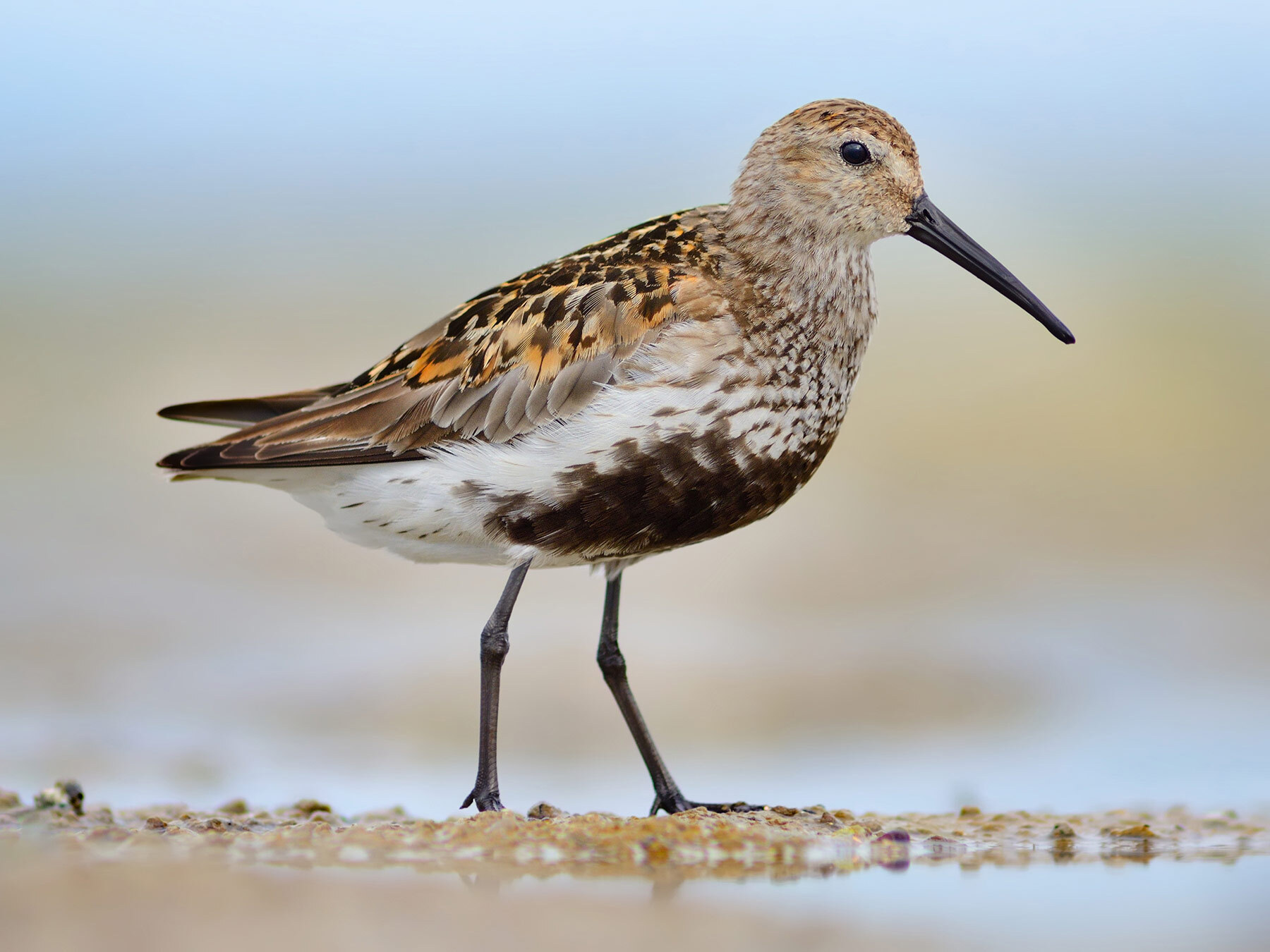
Quick facts
- Length
- 16–22 cm
- Wingspan
- 35–43 cm
- Weight
- 40–100 g
- Lifespan
- 10–15 years
- Family
- Sandpipers & Snipes
- Migration
- Long-distance Migrant
- Global status (IUCN)
- Least Concern
- World population
- 4,295,000 - 6,800,000 individuals
- Population trend
- Decreasing
- Also called
- Red-backed Sandpiper
- Scientific name
- Calidris alpina
Questions
2How did the Dunlin get its name?
The “dun” is derived from the Old English dun, meaning a mouse-brown or dull-brown colour. The suffix -ling refers to something of that quality. The name Dunlin first started appearing in the early 16th century.
Is a Dunlin a sandpiper?
Dunlins are the most common and widespread wading bird of the Scolopacidae family, also known as the sandpipers.
Sources
3- 1BirdLife International. 2019. Calidris alpina (amended version of 2017 assessment). The IUCN Red List of Threatened Species 2019: e.T22693427A155480296. Source (opens in a new tab)
- 2Wetlands International (2015)
- 3Wetlands International (2015)

Checked by
Nathan Cope, founder and editor
Nathan founded Birdfact and leads its writers and contributors in the UK, the US and Canada. He has watched and studied birds for more than ten years, and checks every article and species guide before it’s published.