


Blue Jay
Cyanocitta cristata
By the Birdfact teamChecked by Nathan Cope
On this page15 sections
How to recognise it
This page is about the Blue Jay of North America. Europe and Asia have a different bird simply called the Jay: see our Eurasian Jay guide.
Appearance and identification
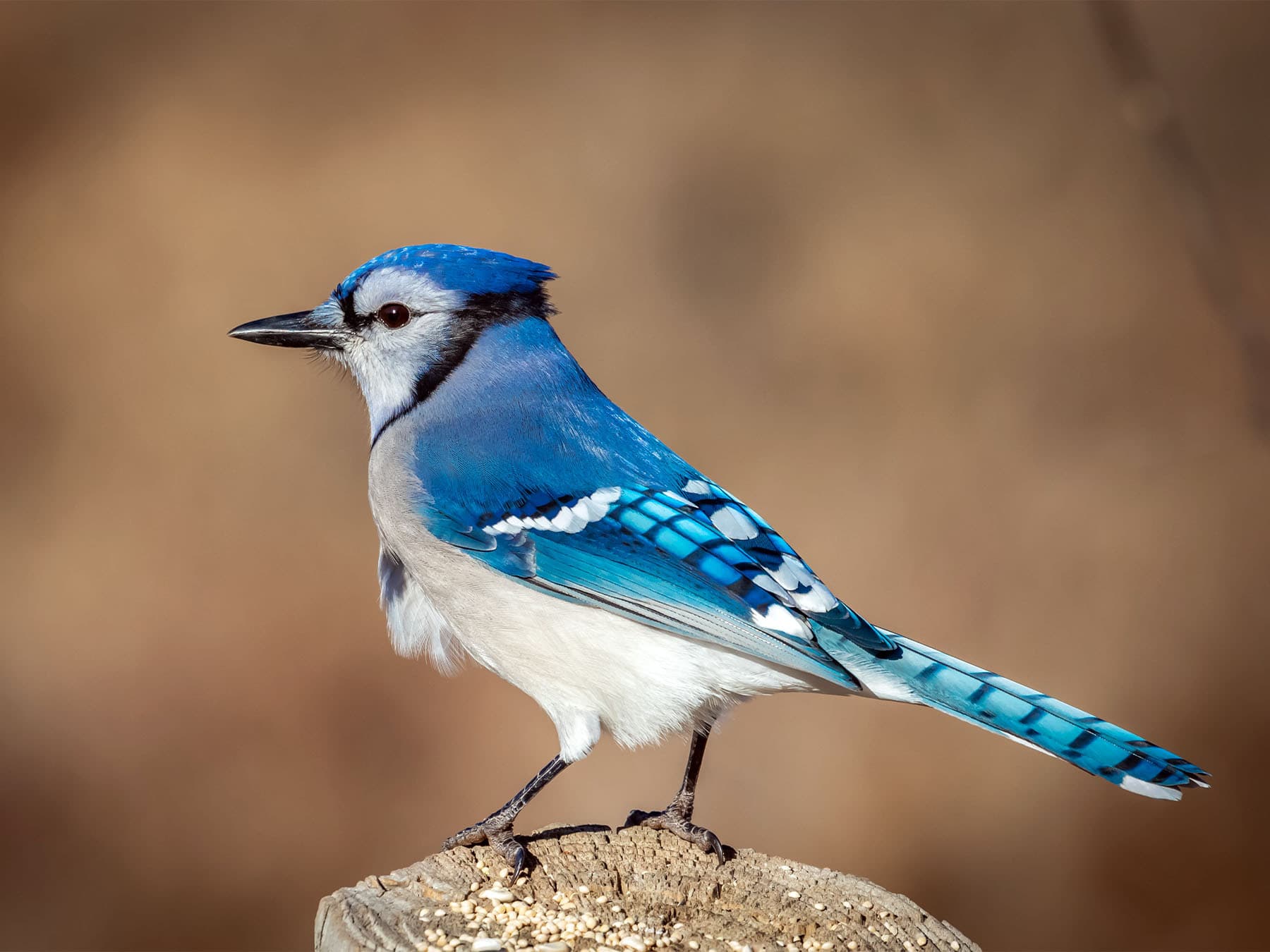
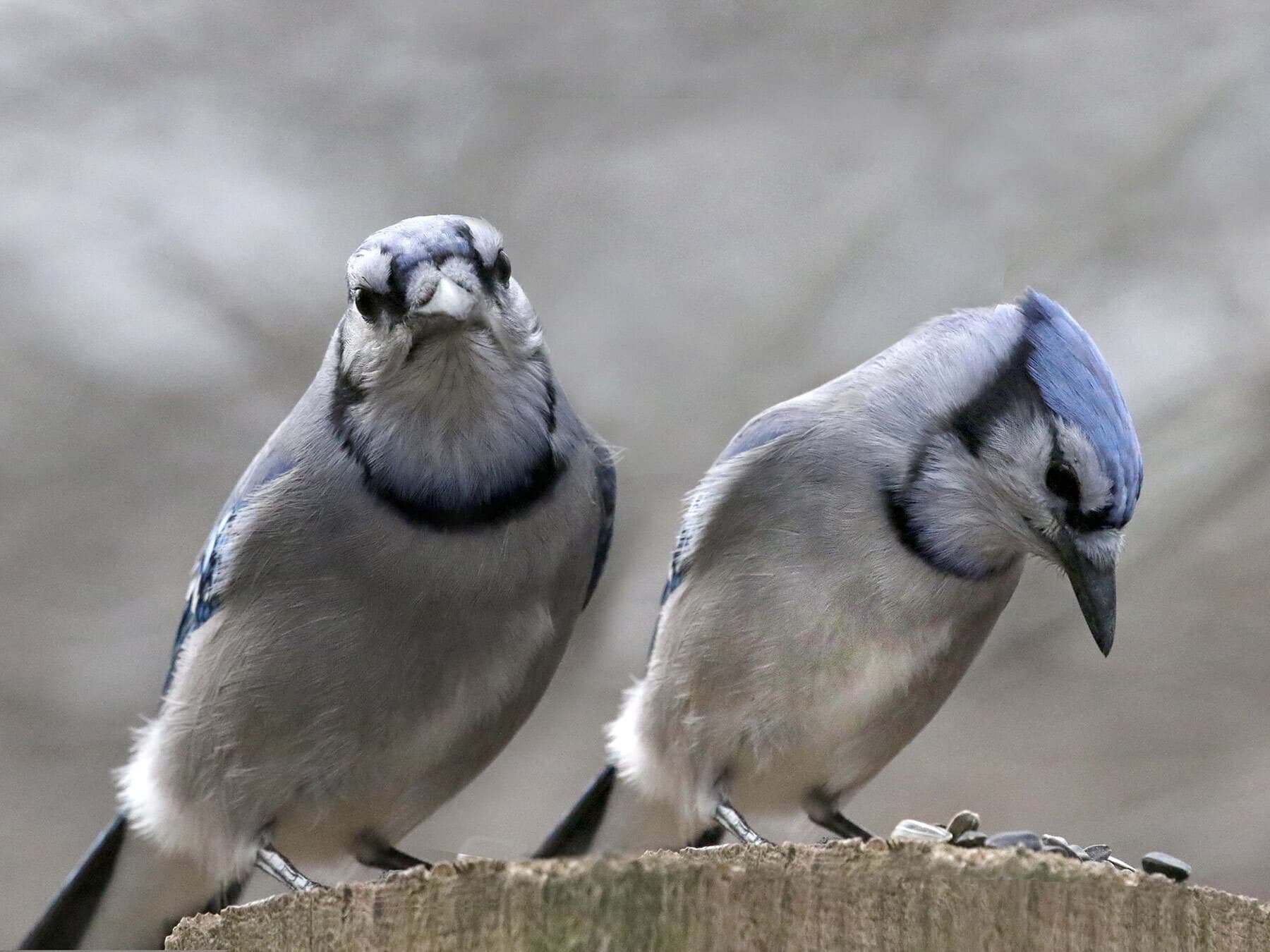
A Blue Jay is hard to mistake: a big, crested songbird, blue above and white or pale gray below, with a black necklace. In size it falls between an American Robin and an American Crow, about 10 to 12 inches (25-30 cm) long with a wingspan of 13 to 17 inches (34-43 cm), and it weighs 2.5 to 3.5 ounces (70-100 g).1
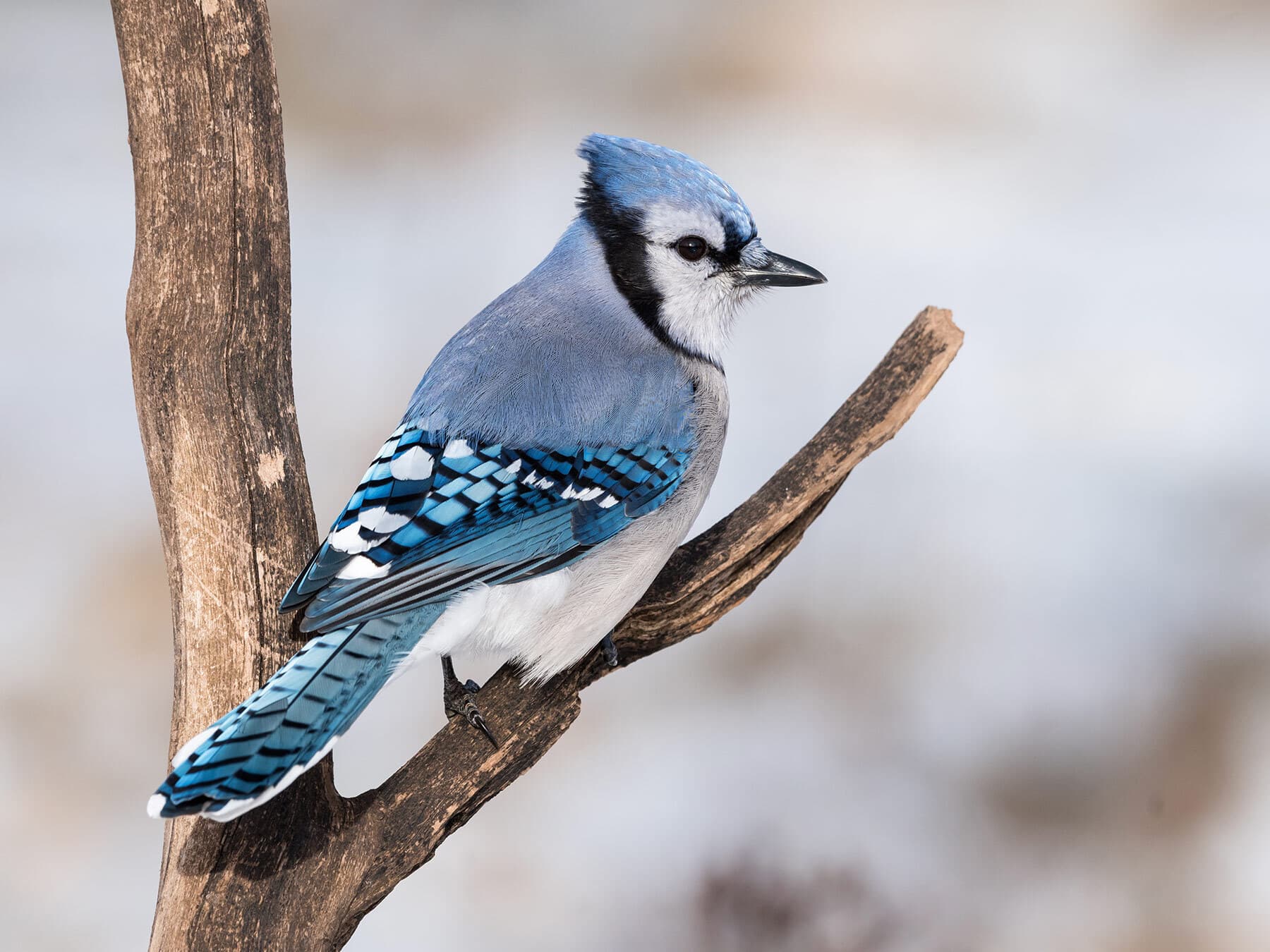
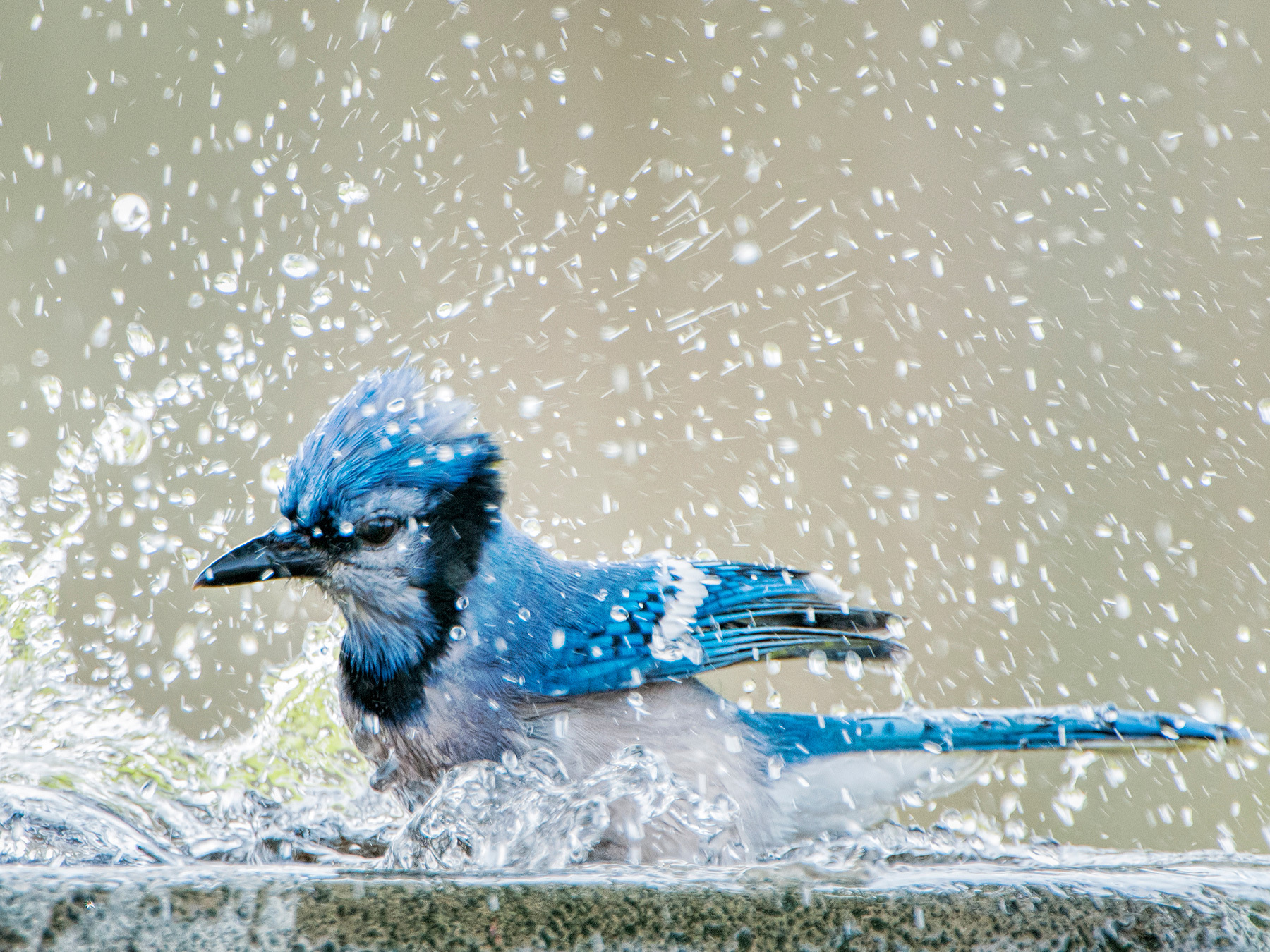
Look for the blue crest, which a jay raises when excited and lowers when relaxed; a black U-shaped necklace across the upper breast, bordering a white throat and joined to a black line through the eye and a black border behind the crest; and wings and tail barred with black, with a bold white wing bar, white tips to the inner flight feathers and big white corners to the broad, rounded tail, best seen in flight. The bill, legs and feet are black, and the eyes dark brown.
Why the plumage looks blue
A Blue Jay has no blue pigment. Its feathers hold only melanin, a brown pigment, and the blue you see is a structural color: light is scattered by tiny air-filled spaces inside modified cells in the feather barbs, which sit over a layer of cells holding the brown melanin.2 Hold a blue feather up to the light, so that it is lit from behind, and it looks dark, almost black. In a 1936 study, Gower examined Blue Jay feather barbs in cross-section and found the blue only on the upper side of each barb, with the pigment layer beneath strengthening the color.3
Male, female and young
Males and females look the same. Males are about 3% larger on average, too little to see in the field. Behavior gives a female away: only females make the dry, clicking rattle call, and only she incubates the eggs.2 More: male vs female Blue Jays.
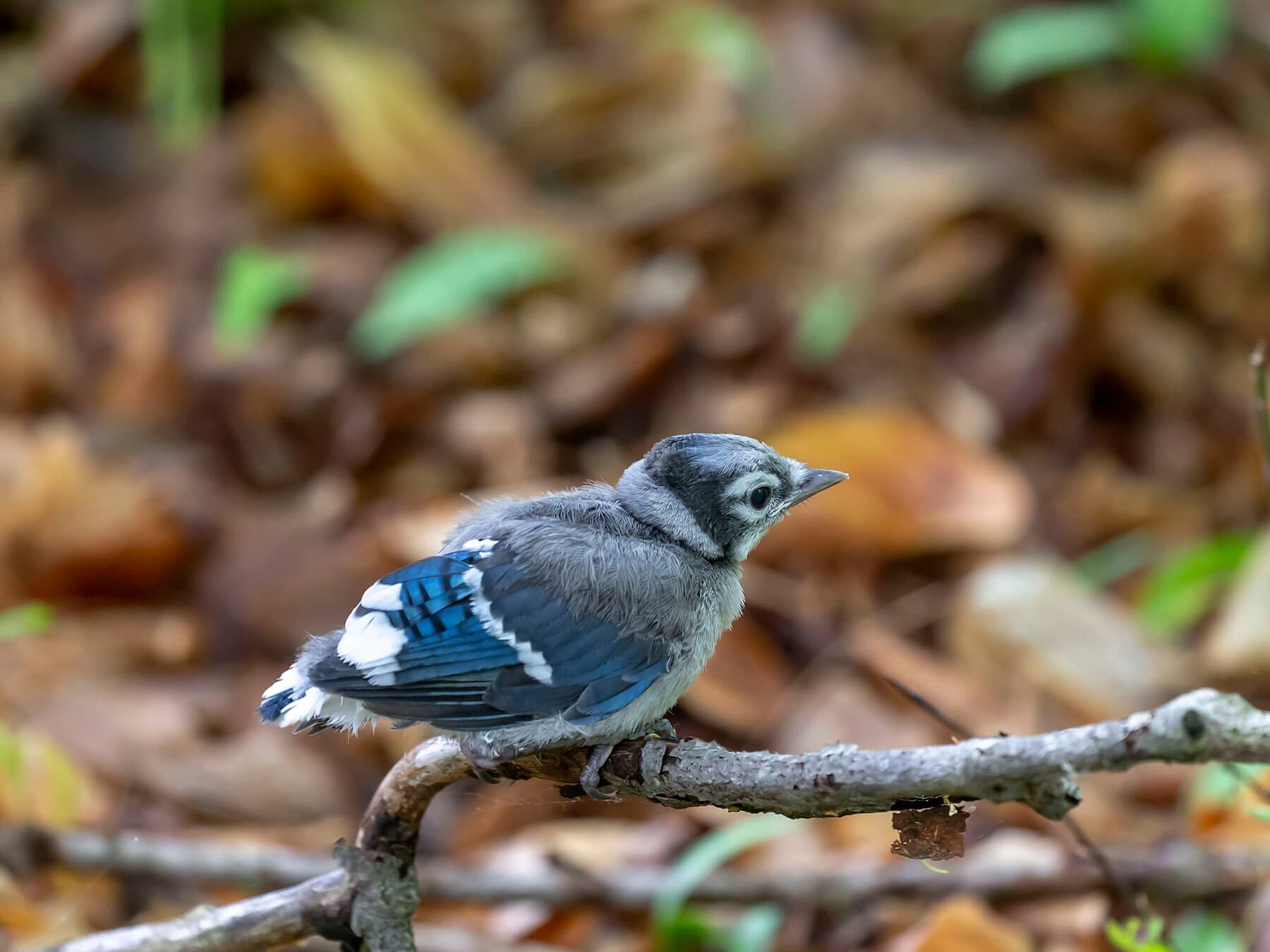
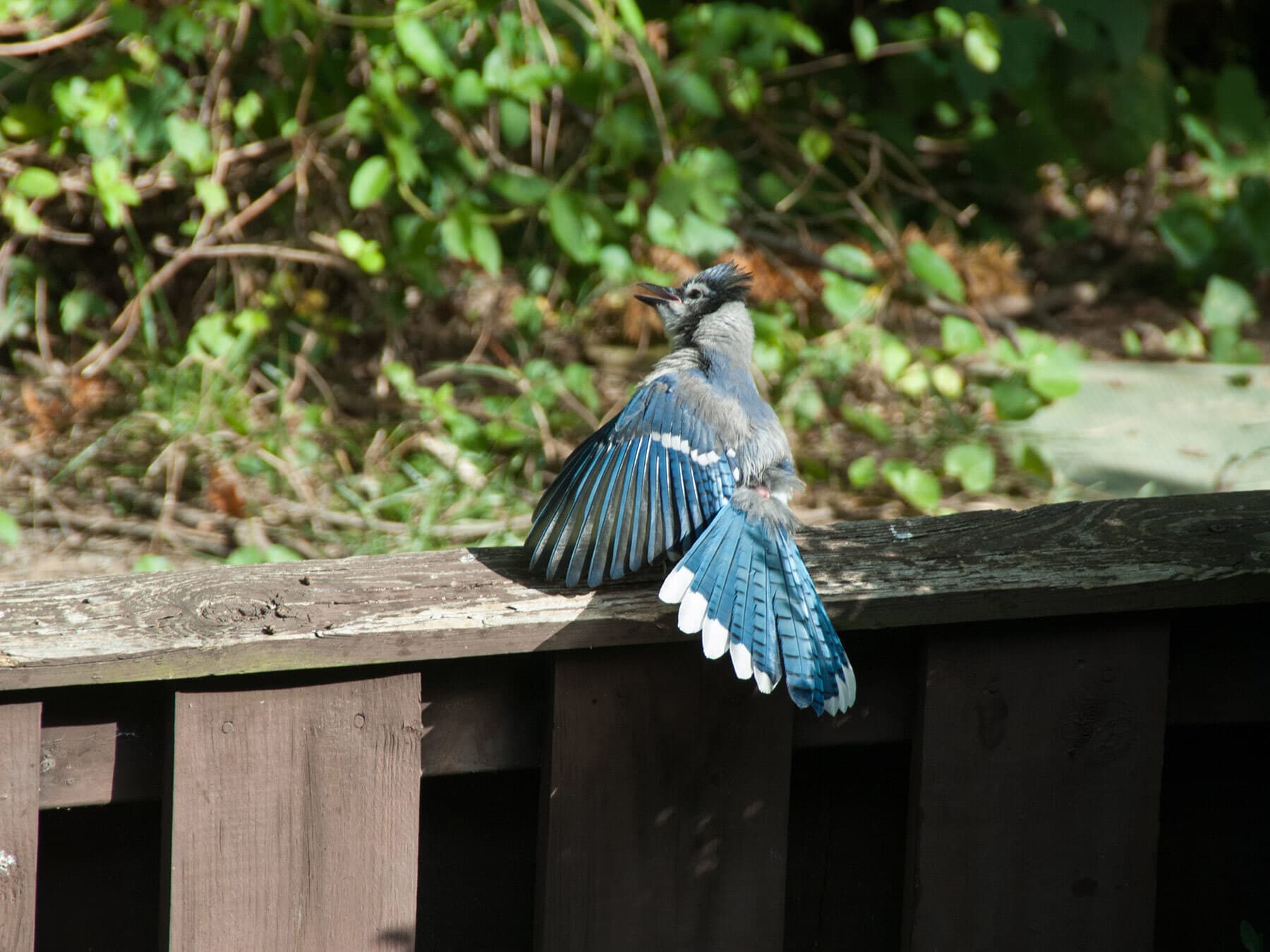
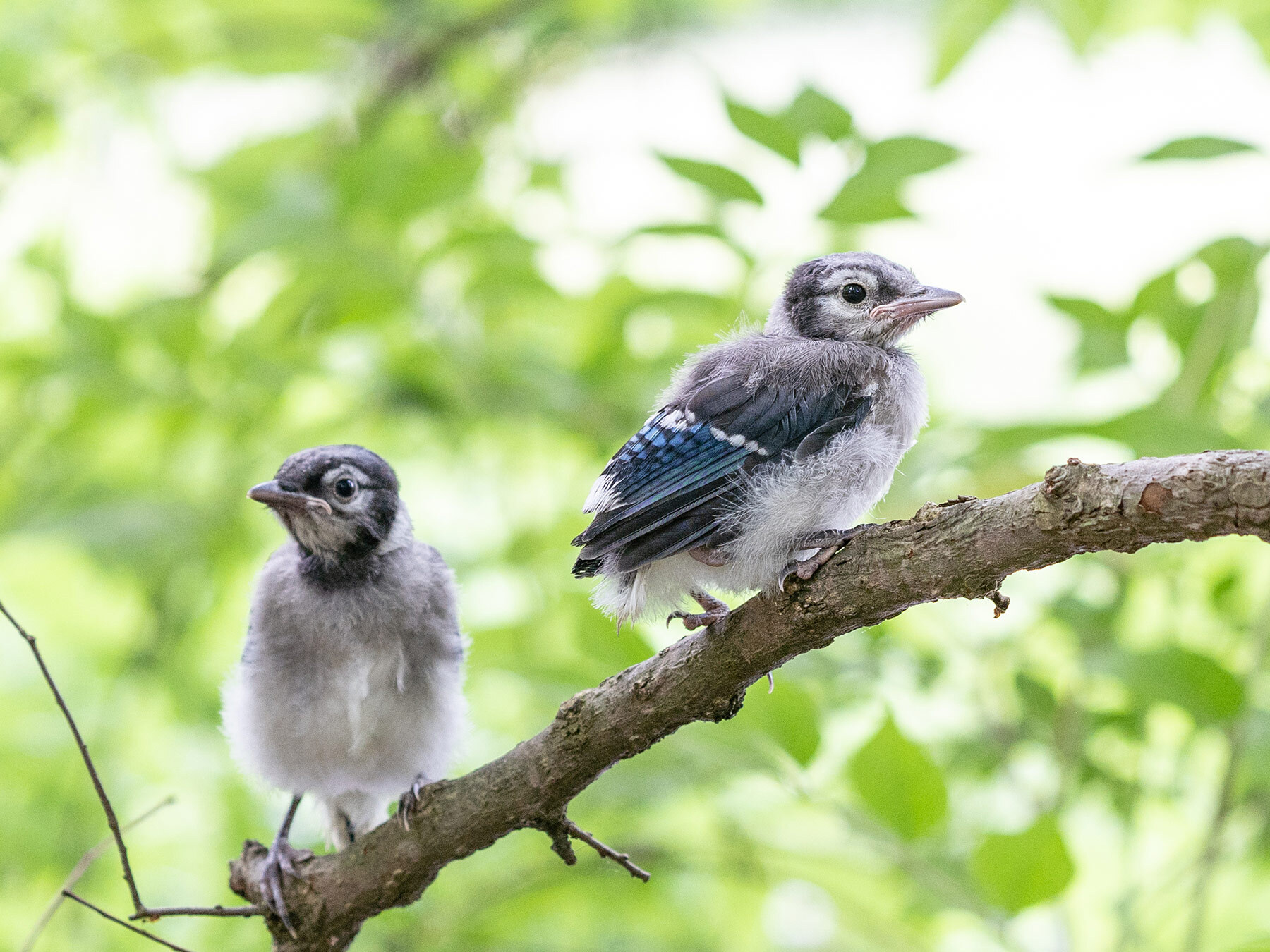
Young birds, seen from June to August, look like duller adults: grayer on the head, with a shorter crest, a softer brownish-gray necklace and plain, unbarred blue patches on the folded wing. Most look like adults by mid- to late fall. More: baby Blue Jays.
Plumage molt and bald jays
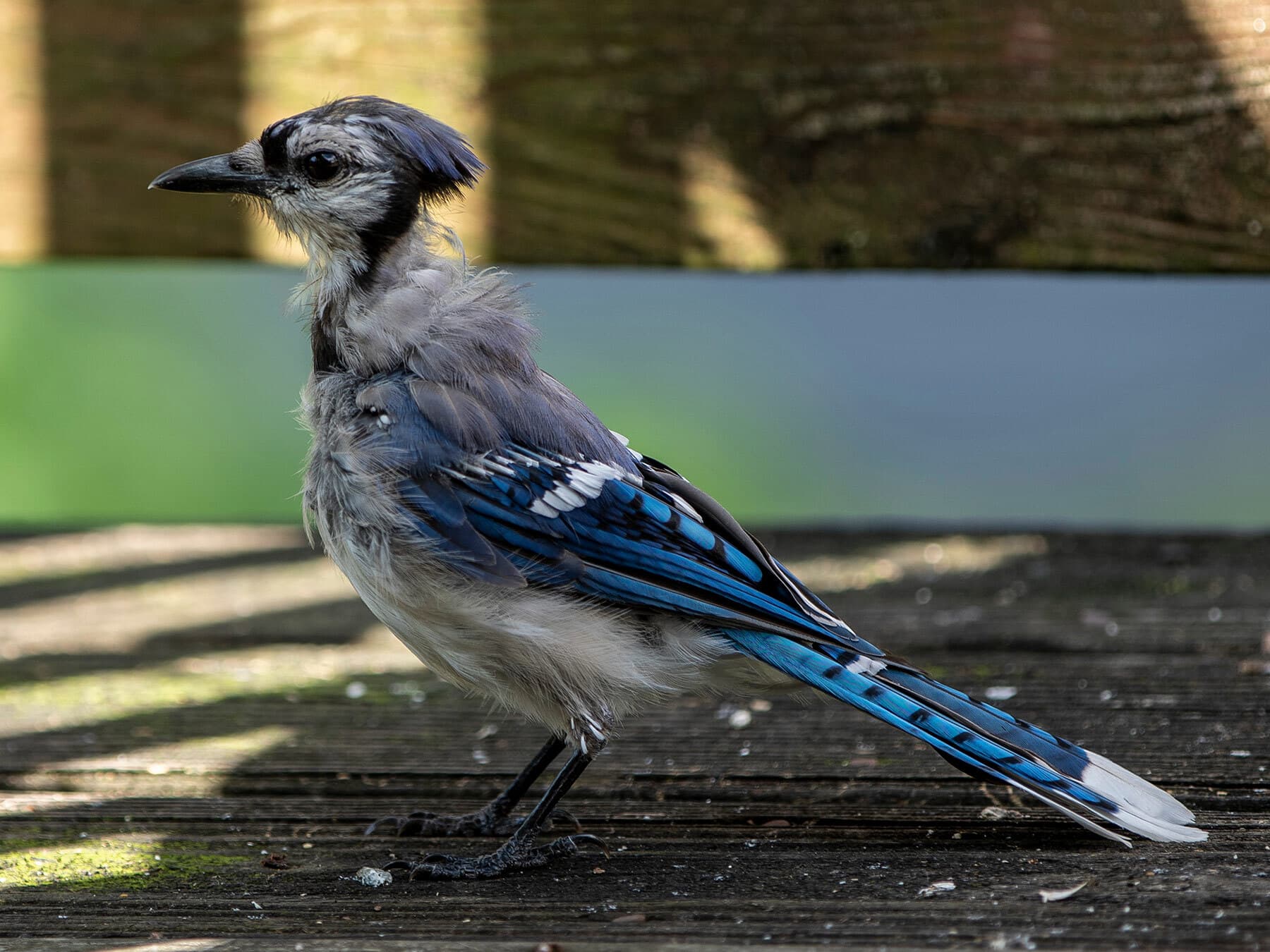
Adults replace all their feathers once a year, between June and November. During the molt, Blue Jays of all ages go through a "bald stage", when all the head feathers drop at almost the same time; a young bird can be nearly bald for about a week. So a Blue Jay with a bald head between summer and fall may simply be molting.2
Identification: similar birds
Within its range, the Blue Jay is hard to confuse with any other bird. Steller's Jay of the West is the one other crested North American jay that is mostly blue; it is very dark all over, with dark underparts and no white in its wings or tail; the two meet and sometimes interbreed along the eastern edge of the Rockies.4 Other blue jays lack the Blue Jay's white pattern in the wings and tail. Scrub-jays have grayer backs, and the Florida Scrub-Jay, which lives only in Florida, also lacks a crest. Bluebirds are blue too, but an Eastern Bluebird is much smaller, 6 to 8 inches (15-20 cm) long, and the male has a reddish-brown throat and chest. How to tell them apart: Blue Jay vs bluebird; see also our Eastern Bluebird guide.
Its size
Adults- Length
- 25–30 cm
- Wingspan
- 34–43 cm
- Weight
- 70–100 g
Its song and calls
Blue Jays are usually heard before they are seen, and their calls carry a long way. Their vocabulary is huge and hard to pin down: a seasoned listener may still hear an entirely unfamiliar call from them about once every three years. The common calls fall into a few groups:
- Jeers: the loud, harsh "jay" or "jeer", given when gathering, mobbing a predator or alarmed.
- Pumphandle calls: musical whistles that sound like a squeaky gate or an old hand pump, often given with the bird bobbing up and down; a softer bell-like version is a mild alert.
- Quiet calls between mates, a low kut kut.
- The rattle: a fast, dry clicking, given, as far as is known, only by females.
- The whisper song: a soft medley of clicks, whirrs and liquid notes from a relaxed bird alone, sometimes for over 2 minutes.
Blue Jays also give calls very like those of Red-shouldered and Red-tailed Hawks, and have been reported imitating other hawks, an Osprey and an Eastern Screech-Owl. Some imitations are nearly perfect but quieter than the real hawk; others are slurred. They are given mostly when a jay is excited, as when coming to a feeder or when someone nears its nest. Why jays do it is not settled; deceiving other birds seems to have the most support, but only from anecdotes.2
Hear the calls, see them drawn as spectrograms beside real hawks, and read what the studies say about the imitations: Blue Jay sounds.
- Call0:00 / 0:41
Recorded in New York, United States · September 2023
- Rattle (female)0:00 / 0:12
Recorded in Minnesota, United States · April 2014
- Red-shouldered Hawk imitation0:00 / 0:28
Recorded in Arkansas, United States · June 2026
When and where to see it
OctoberPeak season
Most recorded in October
- 1. Prince Edward Island6.0%
- 2. Vermont5.9%
- 3. New Hampshire5.2%
- 4. West Virginia5.1%
- 5. Nova Scotia5.0%
Each dot is a county, state or province: the bigger and darker, the larger the bird’s share of that place’s bird records that month. Grey dots: no regular records. The ringed point is the centre of the bird’s records this month; the arrow shows how it moved since last month, and the dashed loop its path through the year. “Arrivals” colours places where it becomes regular this month (orange) or is in its last regular month (grey). GBIF eBird Observation Dataset, 2019–2024. Map data: Natural Earth, US Census Bureau; place centres © OpenStreetMap contributors.
In your area
See when the Blue Jay is recorded in your county, state or province.
How often the Blue Jay turns up in the United States and Canada through the year, from birdwatchers' records.
United States
Resident · all year · most records in October
Canada
Resident · all year · most records in November
Show as a table
| Month | United States | Canada |
|---|---|---|
| January | 1.9% (regular) | 3.1% (regular) |
| February | 2.1% (regular) | 3.2% (regular) |
| March | 1.9% (regular) | 2.5% (regular) |
| April | 1.8% (regular) | 1.7% (regular) |
| May | 1.8% (regular) | 1.7% (regular) |
| June | 1.7% (regular) | 1.4% (regular) |
| July | 1.8% (regular) | 1.5% (regular) |
| August | 2.0% (regular) | 2.0% (regular) |
| September | 2.7% (regular) | 2.8% (regular) |
| October | 2.8% (regular) | 3.2% (regular) |
| November | 2.3% (regular) | 3.5% (regular) |
| December | 2.1% (regular) | 3.3% (regular) |
Worldwide: recorded regularly in 3 countries
Countries where it was recorded in at least 3 of the 6 years 2019–2024. Linked countries have their own bird list.
North America (3)
Data: EOD – eBird Observation Dataset (Cornell Lab of Ornithology), accessed via GBIF.org, CC BY 4.0. Records from 2019–2024, aggregated and filtered by Birdfact. How these lists are made
Blue Jays live year-round across eastern and central North America: from southern Canada, where they breed in all ten provinces, south to Florida and the Gulf Coast, and west to central Texas and the western edge of the Great Plains. They live in deciduous, coniferous and mixed woods, especially near oaks, more at the edges than deep in the forest, and they are common in towns, suburbs, parks and yards with big trees.2
They are spreading west. Starting in the late 1940s in Canada, and dramatically in the 1970s, Blue Jays have nested in New Mexico, Wyoming, Montana, Oregon and British Columbia, and they have now turned up in every state of the lower 48. Wooded towns, shelterbelts and bird feeders are thought to have helped. A few reach the Pacific Northwest, Utah and northern California in winter, mostly in "invasion" years.
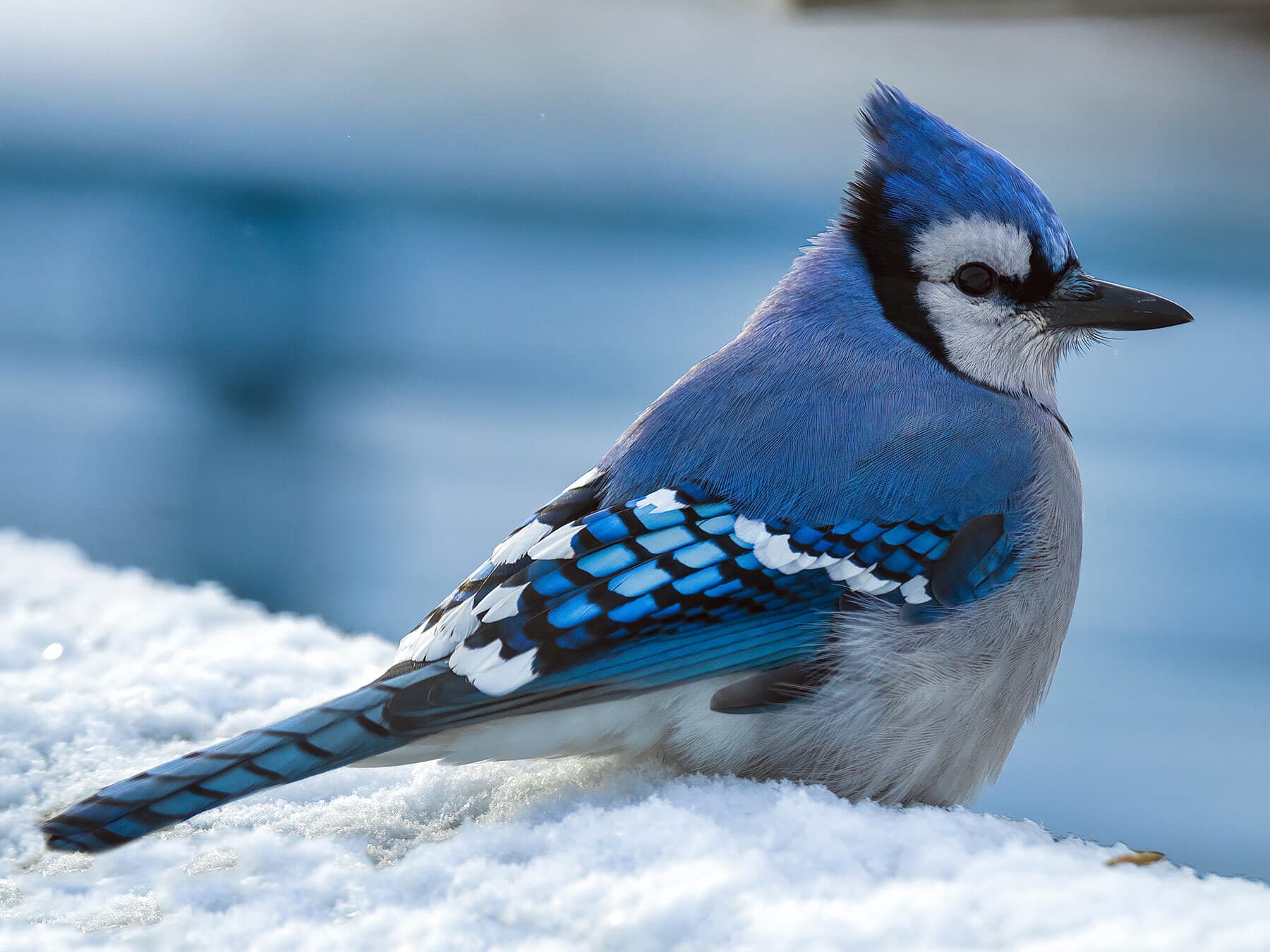
Do they migrate?
Some do. No other jay in the Americas makes north-south migrations like the Blue Jay's, and its migration is still poorly understood. Some birds stay all year in every part of the range, and in most areas many are resident; probably no more than about 20% migrate, even in the north. Banding studies suggest young and adult birds migrate alike, though at Whitefish Point on Lake Superior about 72% of spring migrants caught over several years were in their second year, from 2% to 90% depending on the year. A few individuals migrate one year, stay put the next, and migrate again after that.2 All About Birds notes that "no one has worked out why they migrate when they do."1
Migrants travel by day, in loose flocks, probably most often of 10 to 30, from mid-September to late October and from late April to late May. Along the Great Lakes and the Atlantic coast thousands pass in a day: 1,000 to 5,000 a day at Cape May, New Jersey, at the peak in fall, and an estimated 5,000 to 10,000 a day along Lake Erie in spring. More: do Blue Jays migrate, and where do they go in winter?
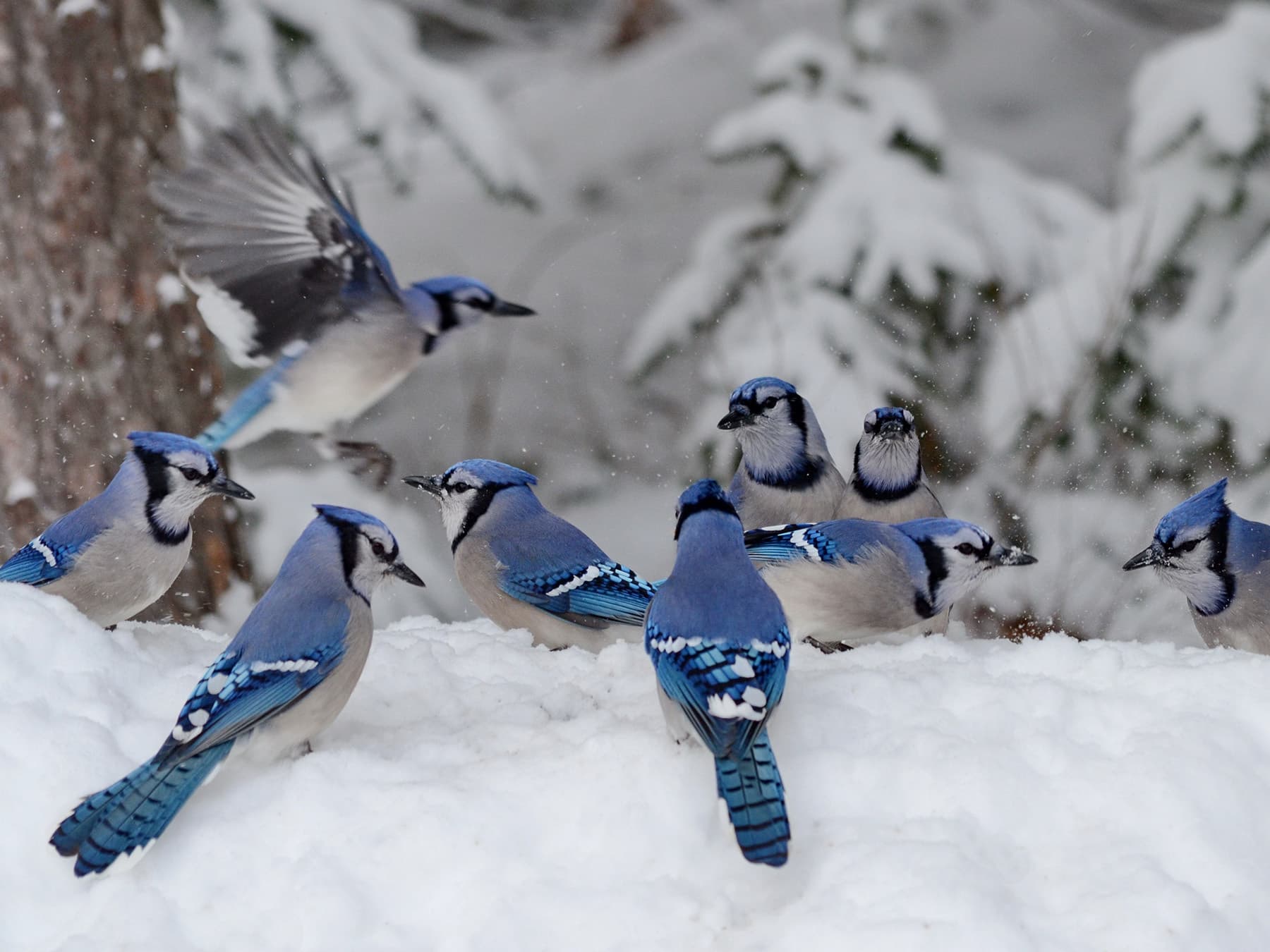
Tips for seeing it
What it eats
Nuts, above all acorns. In a federal study of 530 Blue Jay stomachs collected in every month from 30 states and Canada, published in 1915, nuts (mostly acorns, with beechnuts, chestnuts and hazelnuts) made up over 43% of the year's food, and about two-thirds from October to March. Insects made up about 22%, with caterpillars and grasshoppers prominent in summer; wild fruit about 7%; and corn about 18%, with some cultivated fruit.5 Blue Jays also eat seeds, spiders, snails and carrion, and small animals such as mice, bats, tree frogs and lizards.2
A jay holds a hard nut or seed against a branch with its feet and hammers it open with its bill. More: what Blue Jays eat.
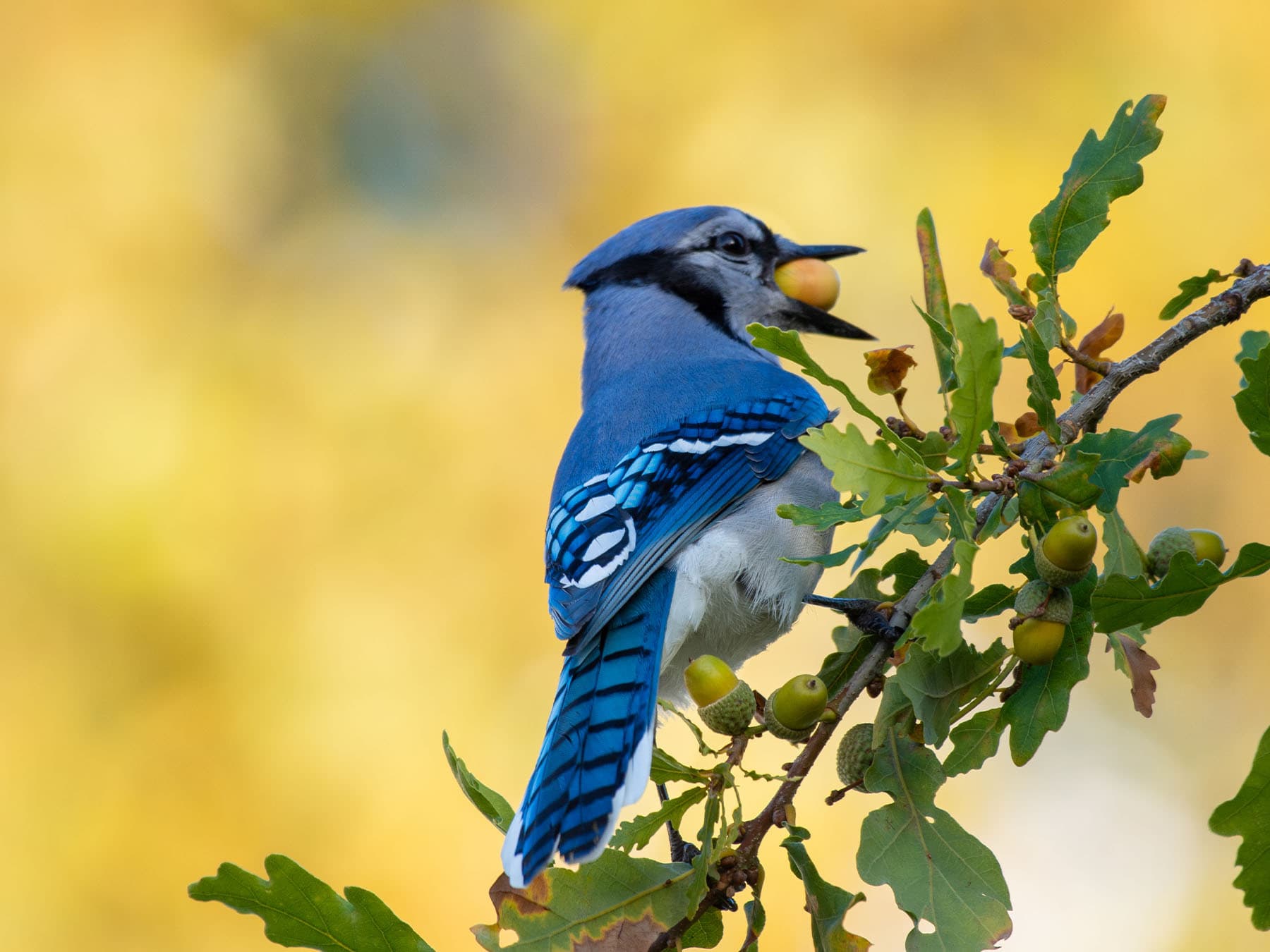
Acorns and buried food stores
Each fall, a Blue Jay probably harvests and eats or stores several thousand acorns, beechnuts or other nuts.2 It carries up to five acorns at a time, two or three in its throat, one in its mouth and one in the tip of its bill, and may fly up to 2.5 miles (4 km) to collect them, though 0.6 to 1.2 miles (1-2 km) is probably more typical. At the storage spot it puts them in a pile and buries them one by one within 3 to 10 feet (1-3 m), usually covering each with a dead leaf or a pebble. In unpublished work, six radio-tagged jays each stored 3,000 to 5,000 acorns in one fall.
Jays pick nuts free of weevils and seem to carry them back toward their own breeding areas, and the acorns they never recover can grow into trees. In one Virginia study, Blue Jays carried off and buried 133,000 acorns from a stand of pin oaks, 54% of the crop, taking them a mean 0.7 miles (1.1 km) away and covering each one; the researchers concluded that jays help oaks and beeches spread to new ground.6 The government biologist F. E. L. Beal suspected as much in 1897, writing that many isolated oaks and chestnuts probably grew from nuts jays had dropped or carried off and stored.7 Birds of the World adds that the habit may also explain how fast oaks spread north after the last ice age, though not everyone agrees.
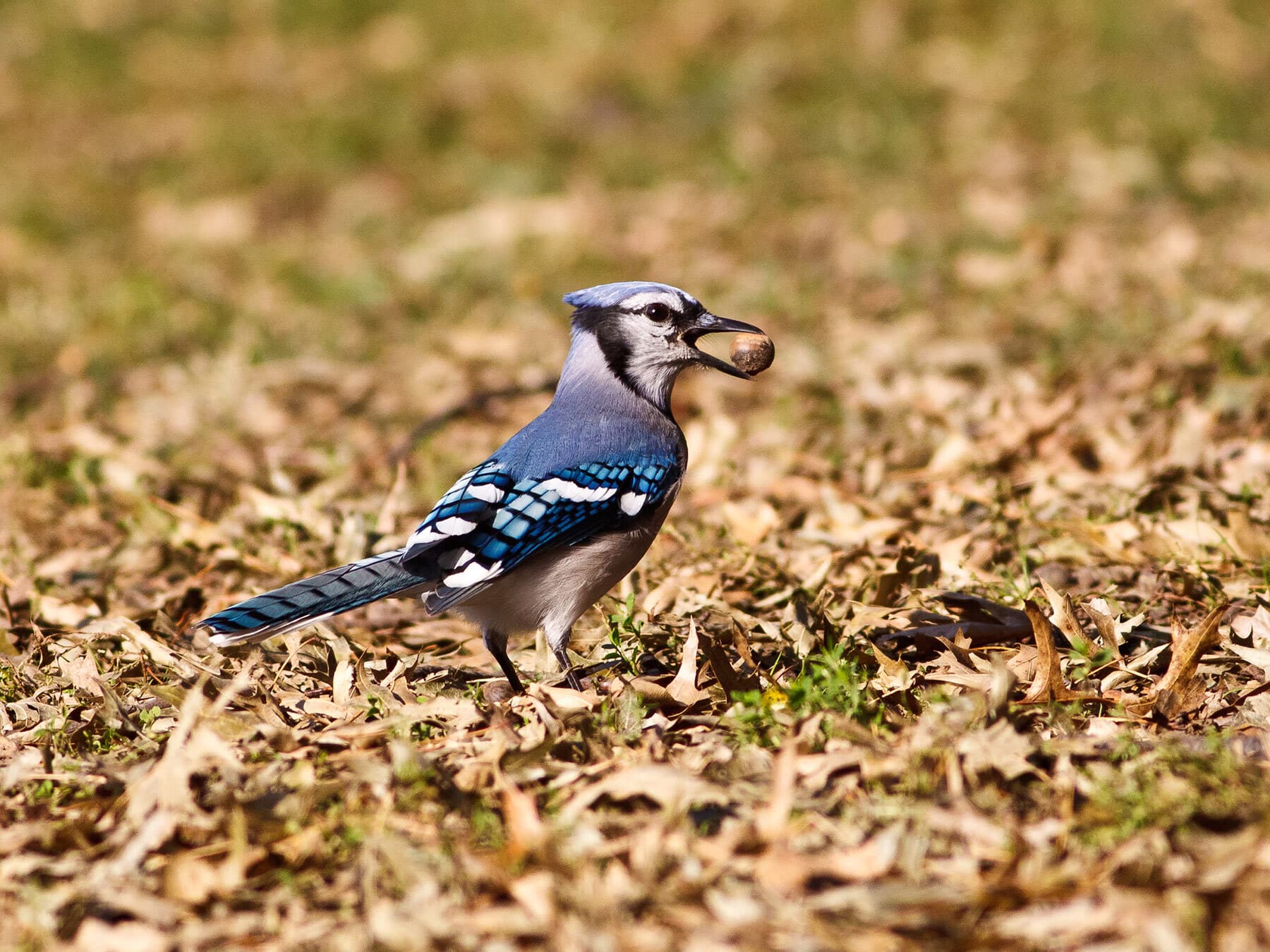
Do they eat other birds?
Sometimes. Birds of the World says Blue Jays take small vertebrates, including birds, eggs and nestlings, "occasionally (perhaps frequently)", and adult birds especially when stunned by hitting a window. In their stomachs, though, these are a small part of the diet.2 In the 1915 study, a special search turned up remains of wild birds or their eggs in only 6 of the 530 stomachs.5 Beal's earlier study of 292 stomachs found bird remains in 2 and small birds' eggshells in 3, and he concluded that the charges against the jay were "certainly not sustained", while adding that the question had to wait for more accurate observations.7 The camera studies that Birds of the World cites for jays as major nest predators in Maine and Massachusetts used artificial nests,89 and Birds of the World warns that such studies "may yield gross overestimates of jay nest predation rates".2 At real nests filmed by cameras, jays take a smaller share: even in Midwestern forests, where they were among the commonest birds caught raiding nests, they made about 15% of the filmed raids.10 The full evidence: do Blue Jays eat other birds?
Feeding them in your yard
Blue Jays frequent feeders in winter. They prefer big foods, such as peanuts and the larger sunflower seeds, and ignore small seeds like milo. All About Birds recommends platform or hopper feeders mounted on posts over hanging ones, offering peanuts, sunflower seeds and suet, and planting oak trees; Blue Jays often drink from birdbaths. Project FeederWatch also lists cracked corn, safflower, mealworms and fruit, at platform, hopper and ground feeders.11
Nesting and breeding
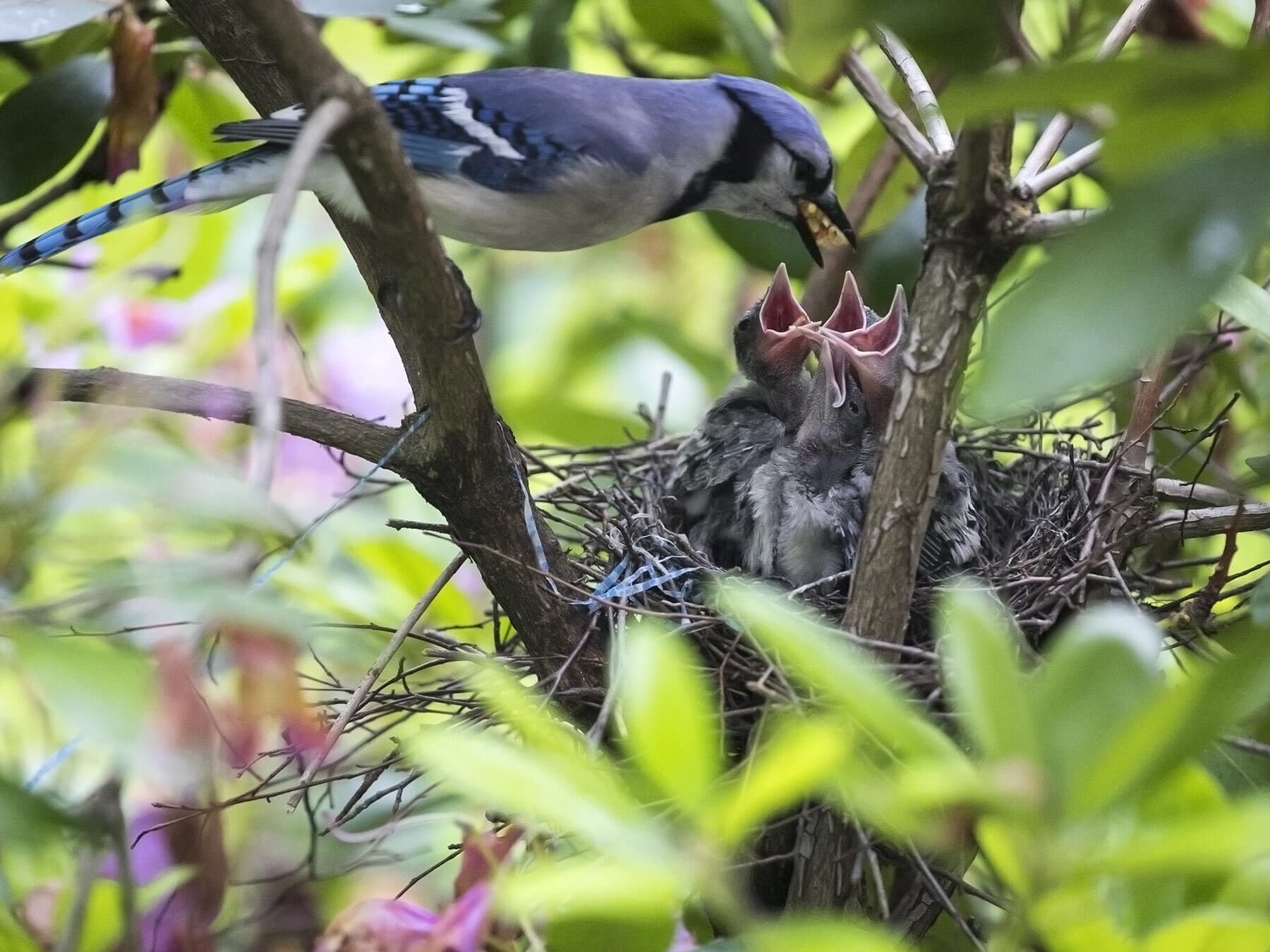
Blue Jays build an open cup of twigs, often with mud, lined with rootlets, usually 10 to 25 feet up in a tree. In spring the female lays 2 to 7 eggs, bluish, olive or buff with brown spots, from early March in Florida to May in the north. She alone incubates them, for 17 to 18 days, while the male feeds her. The young leave the nest at 17 to 21 days, and their parents feed them for one to two months more. Most pairs raise one brood a year.1 More: Blue Jay nesting, baby Blue Jays and do Blue Jays mate for life?
Behaviour
Blue Jays belong to the crow family, the Corvidae, and their closest relative is Steller's Jay of the West. They are clever, too: in a famous experiment, captive Blue Jays tore strips of newspaper and used them as rakes to pull in food pellets they could not reach.12 In 2025 researchers reported the first known case in the wild: an adult that apparently tried to use a piece of bark to pull out a spider.13 Captive jays also found their own buried food better than chance, which suggests a good memory for where they hide it.
Social behavior
Pairs stay together for years and keep company all year. They do not hold territories in the usual sense: neighbors' home ranges overlap, and disputes are mostly displays. In early spring, noisy groups of a few to 20 or more jays call, bob and chase through the neighborhood; once thought to be courtship, these displays now seem to be about space for breeding.
Blue Jays have a reputation as bullies, and where smaller birds use a feeder they can act as despots. But All About Birds calls them "far less aggressive than many other species"1: at Florida feeders, Red-bellied and Red-headed Woodpeckers, Common Grackles and gray squirrels strongly dominated them, and cardinals, mockingbirds and doves sometimes did too.2 They mob their own enemies: Blue Jays gang up on hawks, owls, snakes and cats, and they swoop at people who come too close to a nest.
They also "ant", rubbing ants along their flight feathers, often toppling over as they do it, and sunbathe with their crest up, wings spread and bill open. Hand-reared jays ant the first time they meet ants, so the habit is inborn.
Lifespan and predators
Most Blue Jays live only a few years. In a long study at a Wisconsin feeder, where 2,373 jays were color-banded, about 54% survived from one year to the next and the average life expectancy was about 1.4 years.14 Some live much longer. The oldest wild Blue Jay on the US Bird Banding Laboratory's list was at least 26 years 11 months old: banded in its first year in the Newfoundland and Labrador region in October 1989, it died after getting tangled in fishing gear there in May 2016.15 The next oldest on the list reached 17 years 6 months, in Ohio.
Predators and other dangers
Adult Blue Jays are taken by hawks, including Cooper's Hawks and Northern Goshawks, and by Peregrine Falcons and large owls. Eggs and nestlings are taken by crows, squirrels, snakes and other jays. Birds of the World names pet cats and dogs as probably the leading human-related cause of death; in the Wisconsin study, of 111 banded jays reported dead (most from unknown causes), 10% had been hit by cars, 5% killed by cats and 5% by flying into windows.14
Blue Jays are very susceptible to West Nile virus. Birds of the World reports that three of four captive birds infected with the 1999 strain died, and that the virus caused a large decline as it spread through the eastern United States, particularly the Northeast; but a 2011 analysis of survey counts in 10 states found Blue Jays mostly unaffected; only in Minnesota did the virus explain a large share, almost a third, of the ups and downs in their numbers.16
Conservation
The Blue Jay is common and of Least Concern, with about 17 million birds, nearly all of them in the United States (about 15 million) and Canada (about 2.5 million).17 The Breeding Bird Survey shows a slow decline in the United States, about 0.7% a year from 1966 to 2025, steepest in Massachusetts and parts of the Southeast, while numbers in Canada grew by about 0.9% a year.18 BirdLife International rates the population as relatively stable.19
In the United States, Blue Jays are on the list of birds protected by the Migratory Bird Treaty Act.20 Federal rules count "any part, nest, or egg" as part of a protected bird21, and the Act makes it illegal, unless regulations allow it, to take or possess one, so that includes a feather you pick up.22 In Canada, the crow family is not covered by the federal Migratory Birds Convention Act, but such birds may be protected under provincial or territorial law.23 The Blue Jay is the provincial bird of Prince Edward Island, chosen in a public vote in 1976 and made official in 1977.24 For the jay in folklore, literature and team names, see Blue Jay symbolism and meaning.
Similar birds
Often mistaken for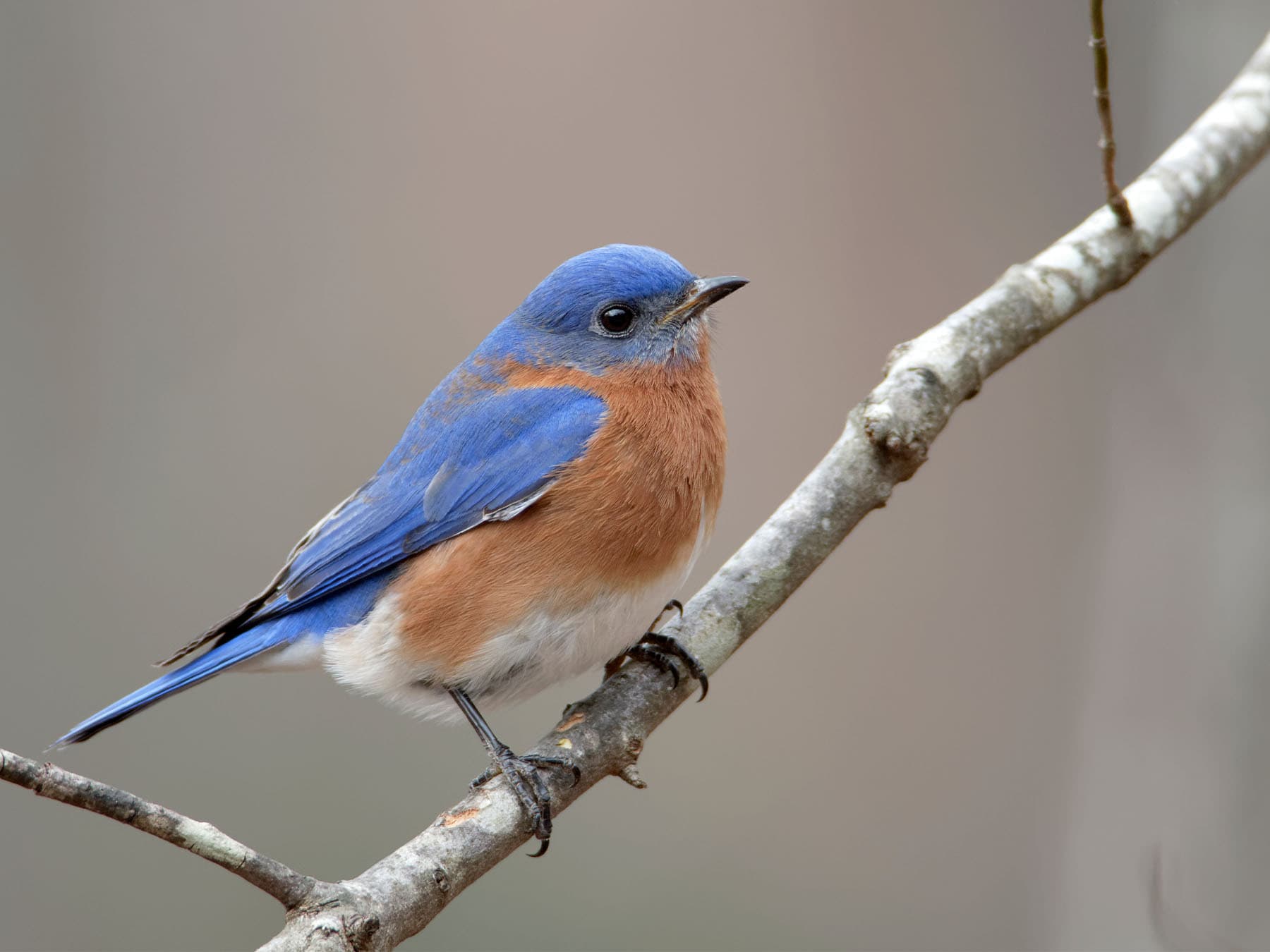
More photos
6 photos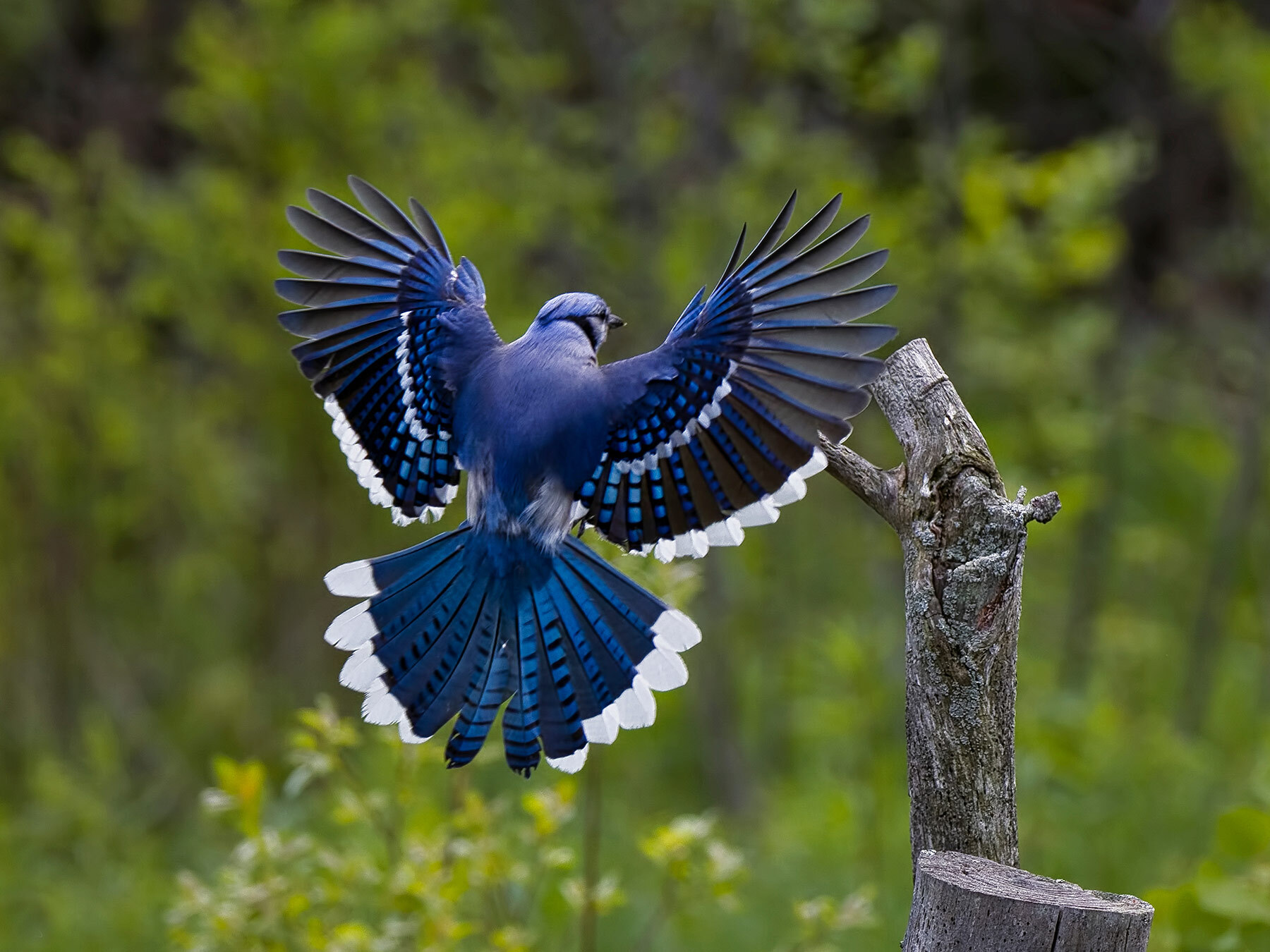
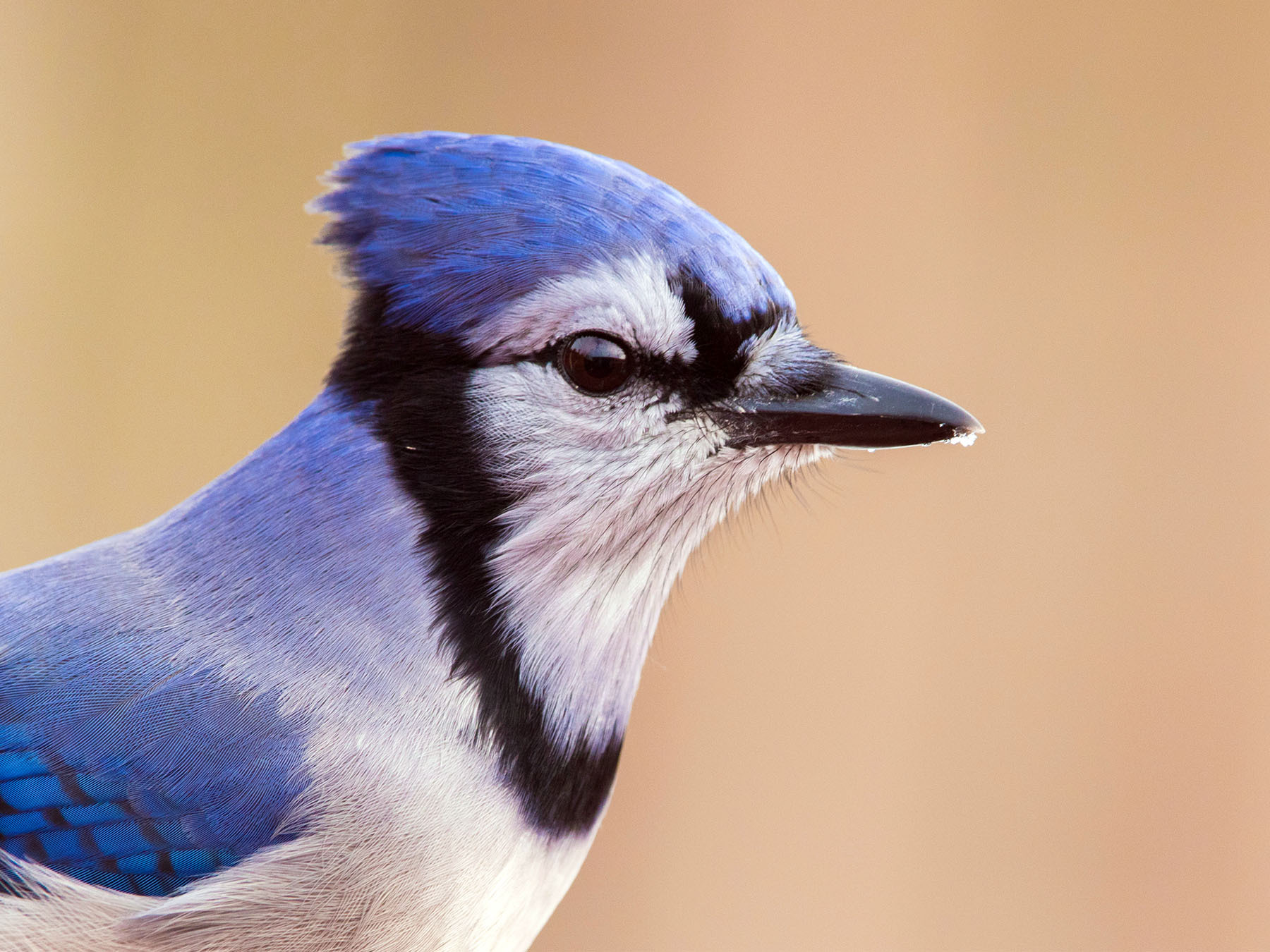
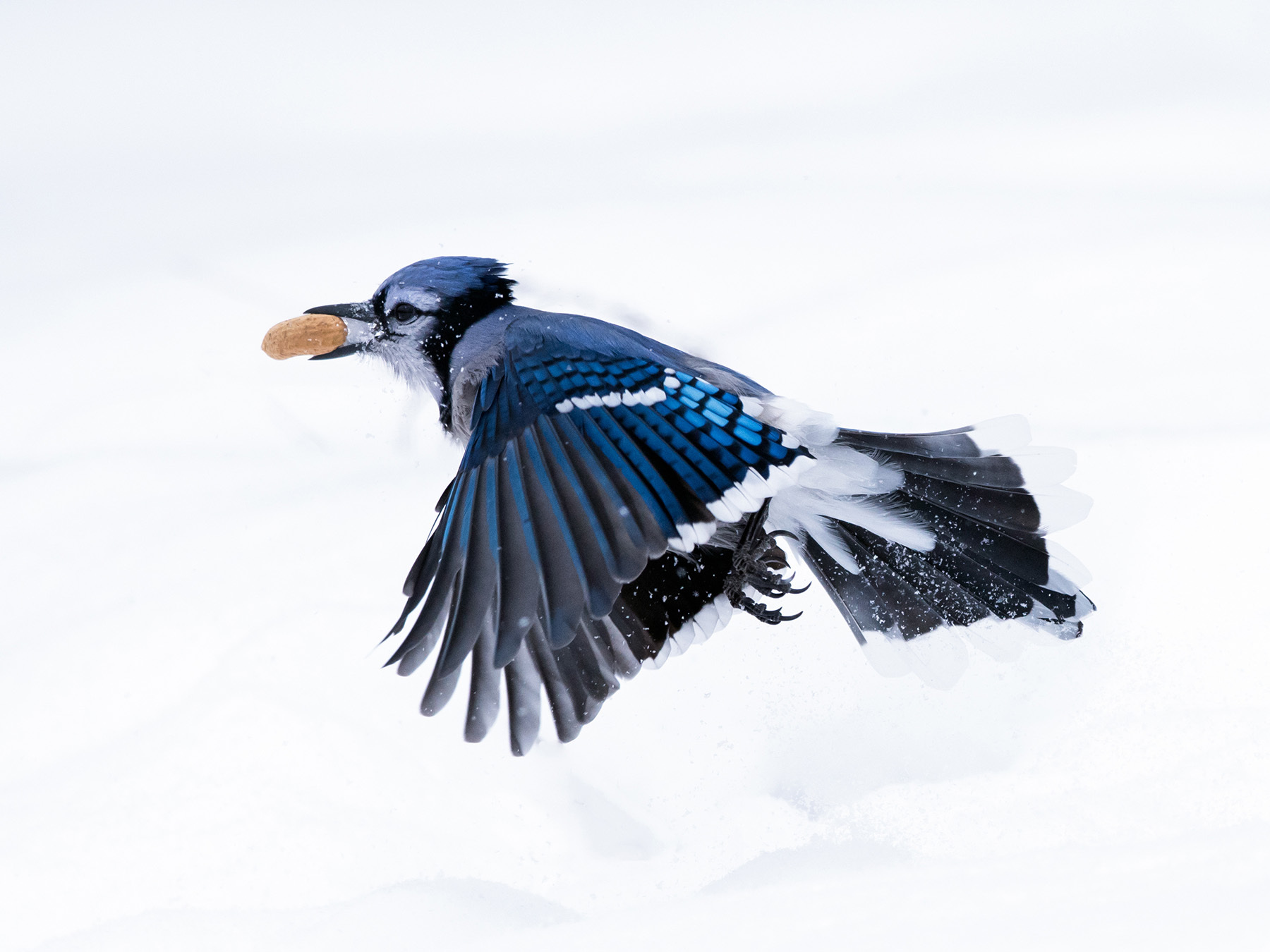
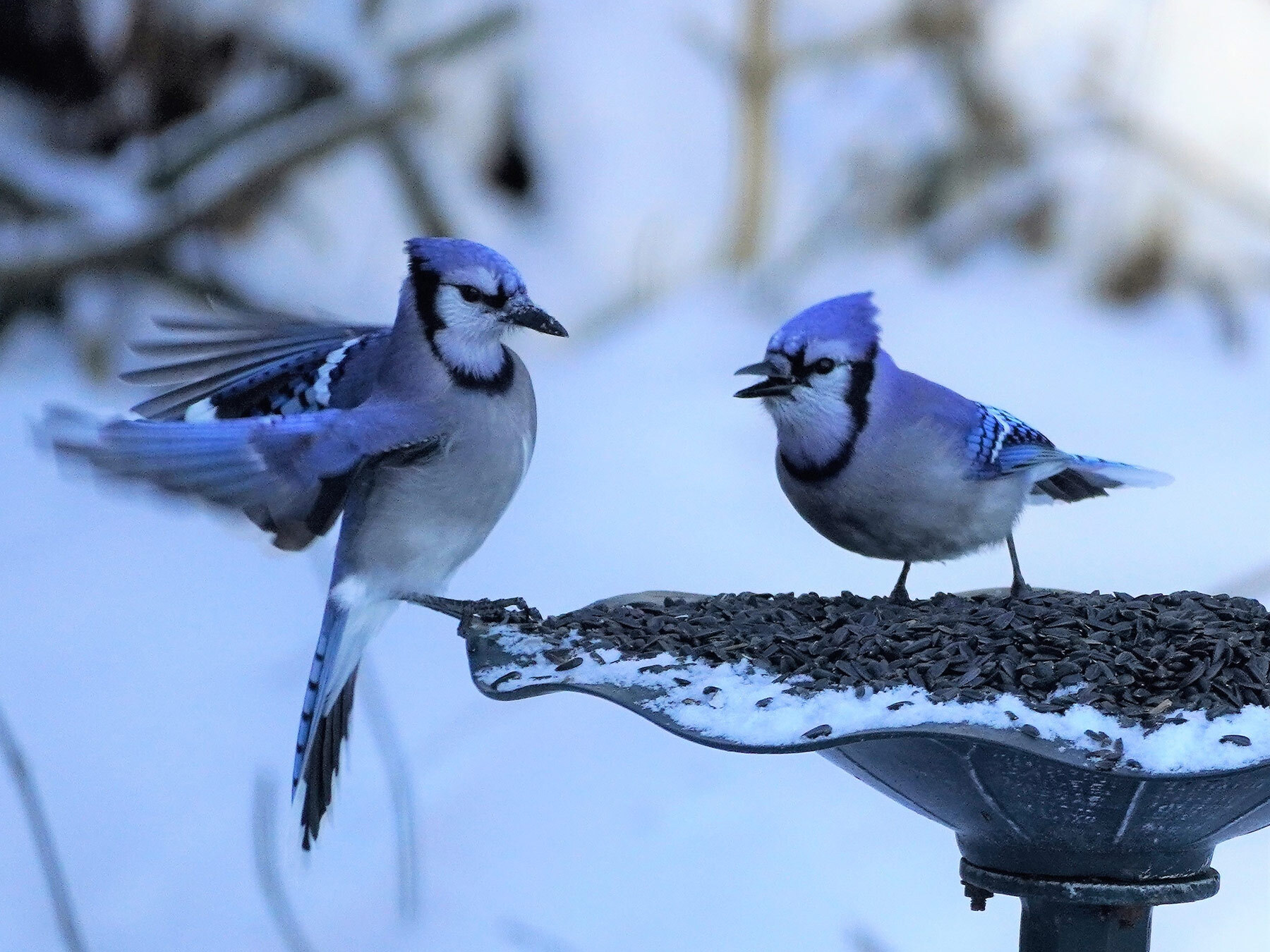
Blue Jay guides
5 guidesQuick facts
- Length
- 25–30 cm
- Wingspan
- 34–43 cm
- Weight
- 70–100 g
- Lifespan
- oldest recorded 26 years 11 months
- Family
- Crows & Jays
- Migration
- Partial migrant
- Global status (IUCN)
- Least Concern
- World population
- About 17 million (Partners in Flight)
- Population trend
- Breeding Bird Survey counts show a slow decline in the United States since 1966 (about 0.7% a year) and an increase in Canada; BirdLife rates the population as relatively stable (USGS BBS 1966-2025; BirdLife 2025)
- Scientific name
- Cyanocitta cristata
Questions
4Are Blue Jays rare?
No. They are common across eastern and central North America, with about 17 million birds, although numbers in the United States have fallen slowly since 1966.
Do Blue Jays and cardinals get along?
At feeders in a Florida study, Northern Cardinals occasionally pushed Blue Jays aside, while woodpeckers, grackles and gray squirrels did so more often. See our Northern Cardinal guide.
Do Blue Jays mate for life?
Usually. Pairs stay together for years and all year round, and probably part only when one bird dies. More: do Blue Jays mate for life?
Why is it called a Blue Jay?
Mark Catesby called it the "Blew Jay" in 1731, and Linnaeus based his 1758 description on Catesby's. The scientific name Cyanocitta cristata comes from the Greek for "dark blue" and "jay" and the Latin for "crested".25
Sources
29- 1Cornell Lab of Ornithology. Blue Jay. All About Birds. Accessed 14 October 2026. Source (opens in a new tab)
- 2Smith, K. G., Tarvin, K. A. and Woolfenden, G. E. (2020). Blue Jay (Cyanocitta cristata), version 1.0. Birds of the World (A. F. Poole, editor). Cornell Lab of Ornithology. doi:10.2173/bow.blujay.01 (opens in a new tab)
- 3Burg, S. L. and Parnell, A. J. (2018). Self-assembling structural colour in nature. Journal of Physics: Condensed Matter 30(41): 413001. doi:10.1088/1361-648X/aadc95 (opens in a new tab)
- 4National Audubon Society. Steller's Jay. Guide to North American Birds. Accessed 14 October 2026. Source (opens in a new tab)
- 5Beal, F. E. L. and Kalmbach, E. R. (1915). Some Common Birds Useful to the Farmer (Farmers' Bulletin 630; revised 1923). U.S. Department of Agriculture. Accessed 14 October 2026. Source (opens in a new tab)
- 6Darley-Hill, S. and Johnson, W. C. (1981). Acorn dispersal by the blue jay (Cyanocitta cristata). Oecologia 50(2): 231-232. doi:10.1007/BF00348043 (opens in a new tab)
- 7Beal, F. E. L. (1897). The Blue Jay and its food. Yearbook of the United States Department of Agriculture, 1896: 197-206. Accessed 14 October 2026. Source (opens in a new tab)
- 8Vander Haegen, W. M. and DeGraaf, R. M. (1996). Predation on Artificial Nests in Forested Riparian Buffer Strips. The Journal of Wildlife Management 60(3): 542-550. doi:10.2307/3802071 (opens in a new tab)
- 9Danielson, W. R., DeGraaf, R. M. and Fuller, T. K. (1997). Rural and suburban forest edges: effect on egg predators and nest predation rates. Landscape and Urban Planning 38(1-2): 25-36. doi:10.1016/s0169-2046(97)00016-9 (opens in a new tab)
- 10Cox, W. A., Thompson, F. R. and Faaborg, J. (2012). Species and temporal factors affect predator-specific rates of nest predation for forest songbirds in the Midwest. The Auk 129(1): 147-155. doi:10.1525/auk.2012.11169 (opens in a new tab)
- 11Project FeederWatch (Cornell Lab of Ornithology and Birds Canada). Common Feeder Birds: Blue Jay. Project FeederWatch. Accessed 14 October 2026. Source (opens in a new tab)
- 12Jones, T. B. and Kamil, A. C. (1973). Tool-making and tool-using in the northern blue jay. Science 180(4090): 1076-1078. doi:10.1126/science.180.4090.1076 (opens in a new tab)
- 13Cash, L. C. and Tarvin, K. A. (2025). Tool use by a wild Blue Jay (Cyanocitta cristata). The Wilson Journal of Ornithology 137(2): 276-283. doi:10.1080/15594491.2025.2464378 (opens in a new tab)
- 14Hickey, M. B. and Brittingham, M. C. (1991). Population dynamics of Blue Jays at a bird feeder. The Wilson Bulletin 103(3): 401-414. Accessed 14 October 2026. Source (opens in a new tab)
- 15USGS Bird Banding Laboratory. Longevity records of North American birds. USGS Patuxent Wildlife Research Center, Bird Banding Laboratory. Accessed 14 October 2026. Source (opens in a new tab)
- 16Foppa, I. M., Beard, R. H. and Mendenhall, I. H. (2011). The impact of West Nile virus on the abundance of selected North American birds. BMC Veterinary Research 7: 43. doi:10.1186/1746-6148-7-43 (opens in a new tab)
- 17Partners in Flight (2023). Avian Conservation Assessment Database and Population Estimates Database. Bird Conservancy of the Rockies. Accessed 14 October 2026. Source (opens in a new tab)
- 18Hostetler, J. A. et al. (2026). The North American Breeding Bird Survey, Analysis Results 1966-2025. U.S. Geological Survey data release. doi:10.5066/P1OSNSFC (opens in a new tab)
- 19BirdLife International. Blue Jay Cyanocitta cristata: species factsheet (IUCN Red List assessment 2025). BirdLife DataZone. Accessed 14 October 2026. Source (opens in a new tab)
- 20U.S. Fish and Wildlife Service (2023). 50 CFR 10.13: List of Birds Protected by the Migratory Bird Treaty Act. Electronic Code of Federal Regulations. Accessed 14 October 2026. Source (opens in a new tab)
- 21U.S. Fish and Wildlife Service (2023). 50 CFR 10.12: Definitions (migratory bird). Electronic Code of Federal Regulations. Accessed 14 October 2026. Source (opens in a new tab)
- 22United States Congress (1918). Migratory Bird Treaty Act, 16 U.S.C. 703. United States Code, Title 16, section 703 (Legal Information Institute). Accessed 14 October 2026. Source (opens in a new tab)
- 23Environment and Climate Change Canada. Birds protected under the Migratory Birds Convention Act. Government of Canada. Accessed 14 October 2026. Source (opens in a new tab)
- 24Government of Prince Edward Island. Provincial Bird. Prince Edward Island Executive Council Office. Accessed 14 October 2026. Source (opens in a new tab)
- 25Jobling, J. A.. The Key to Scientific Names: Cyanocitta; cristata. Birds of the World, Cornell Lab of Ornithology. Accessed 14 October 2026. Source (opens in a new tab)
- 26National Audubon Society. Blue Jay. Guide to North American Birds (text adapted from Kaufman 1996). Accessed 14 October 2026. Source (opens in a new tab)
- 27National Audubon Society. California Scrub-Jay; Woodhouse's Scrub-Jay; Florida Scrub-Jay. Guide to North American Birds. Accessed 14 October 2026. Source (opens in a new tab)
- 28National Audubon Society. Eastern Bluebird. Guide to North American Birds. Accessed 14 October 2026. Source (opens in a new tab)
- 29Parliament of Canada (1994). Migratory Birds Convention Act, 1994 (S.C. 1994, c. 22), Schedule: Convention and Protocol, Article I. Justice Laws Website. Accessed 14 October 2026. Source (opens in a new tab)

Checked by
Nathan Cope, founder and editor
Nathan founded Birdfact and leads its writers and contributors in the UK, the US and Canada. He has watched and studied birds for more than ten years, and checks every article and species guide before it’s published.