Published 14 Oct 2026
Blue Jay Sounds: Calls, Hawk Imitations, Rattle and Song
By the Birdfact teamChecked by Nathan Cope
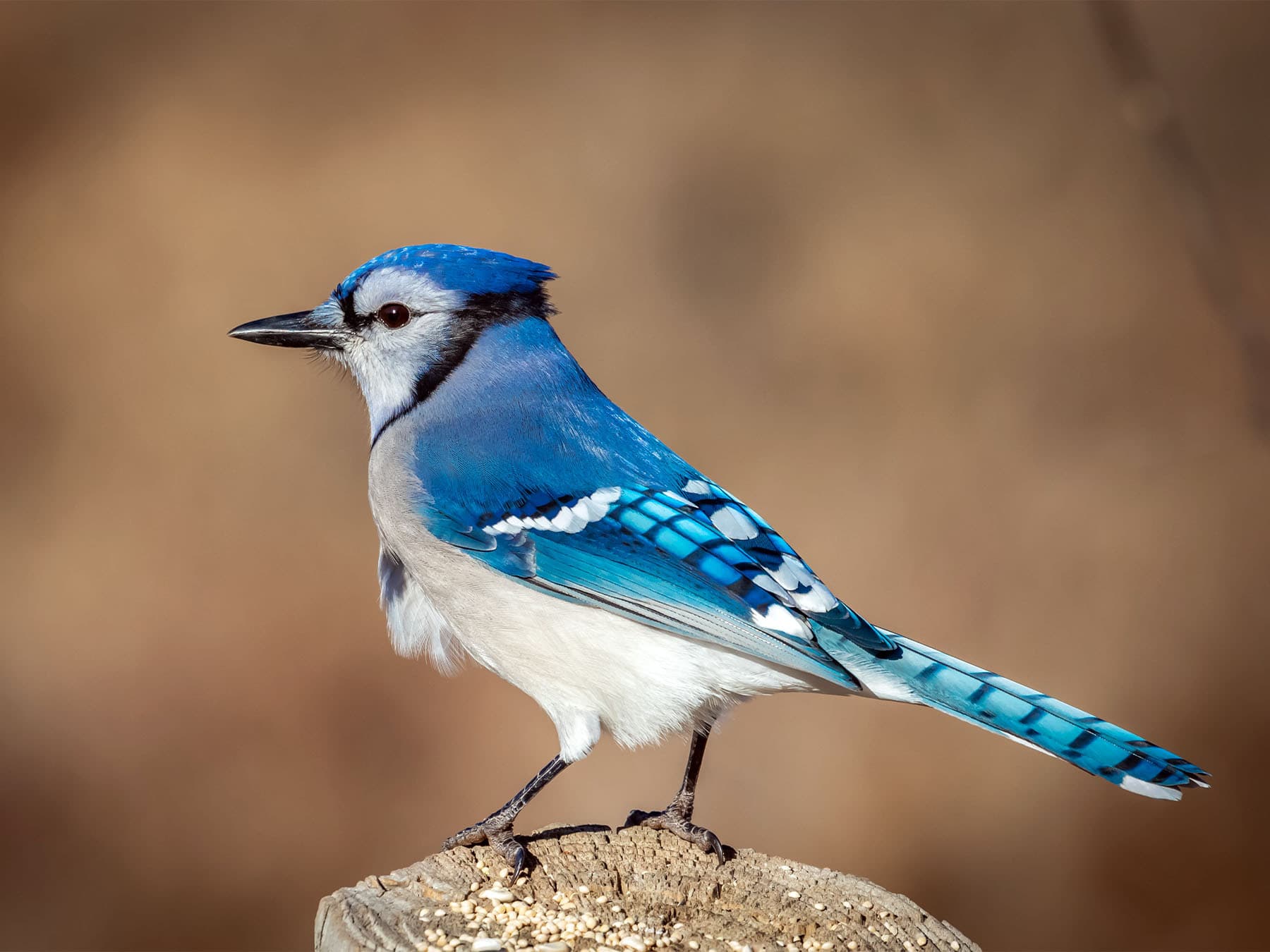
Blue Jays are loud and endlessly varied: a harsh jeer, musical "squeaky gate" and bell calls, a dry rattle (a female call, as far as is known), a quiet whisper song, and uncanny imitations of hawks. Listen to recordings, see them drawn as spectrograms, and find out what each call is for, which hawks jays copy and the ideas about why.
On this page16 sections
- What does a Blue Jay sound like?
- Jeers
- Pumphandle calls: squeaky gates and bells
- The rattle
- Quiet calls between mates
- Do Blue Jays sing?
- Hawk imitations
- Why do Blue Jays mimic hawks?
- Other imitations and talking
- Why do Blue Jays scream?
- Young jays
- When jays call most
- Telling a jay from a hawk
- Other sounds
- About the recordings
- Sources
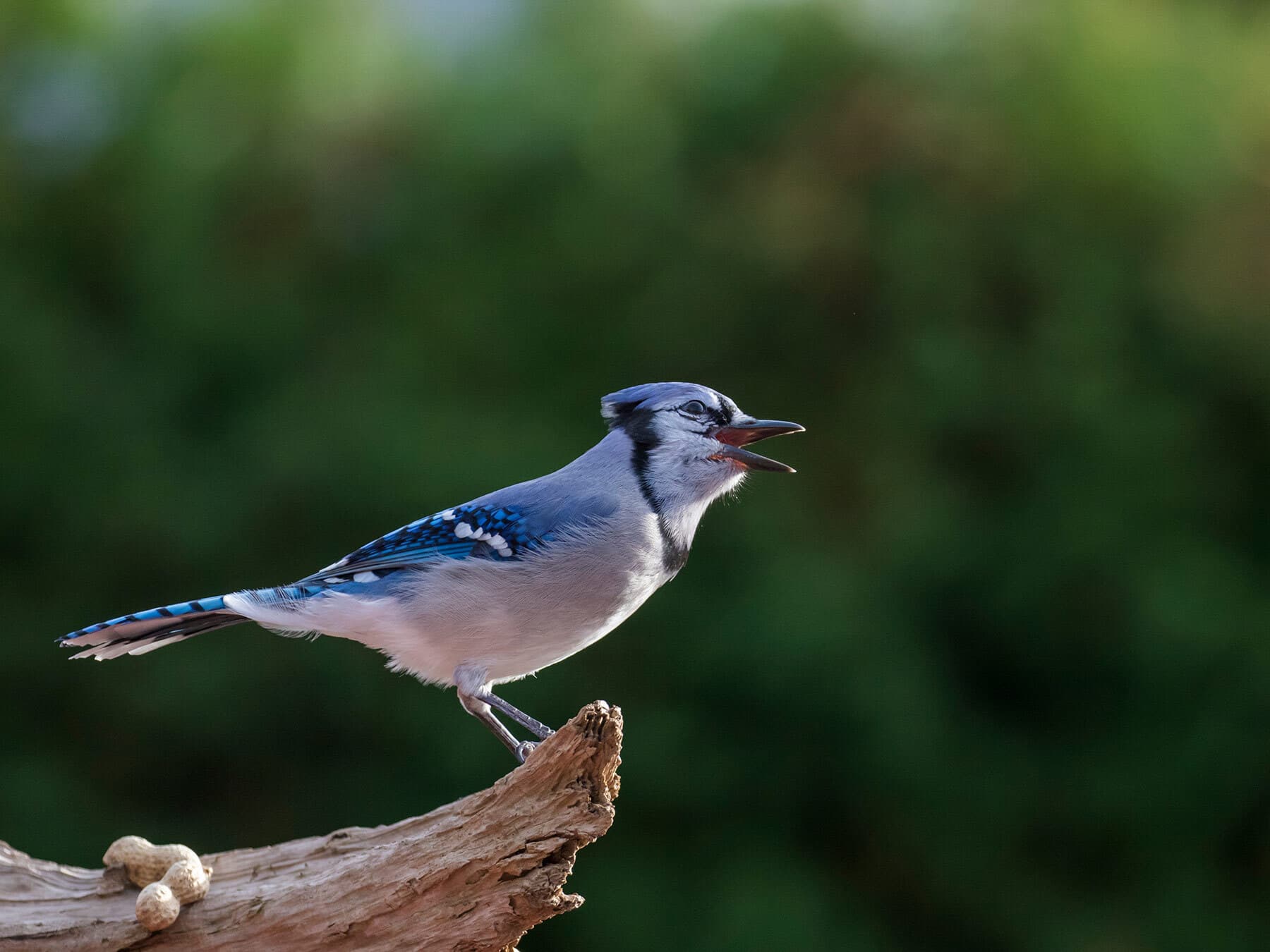
This page is about the sounds Blue Jays make: the loud jeer you hear first, the musical "pumphandle" calls, the rattle, the quiet song, the hawk imitations, and what each seems to be for. Every recording here is openly licensed and was checked as a spectrogram, a picture of sound with pitch against time; three figures below draw seven of them, including two real hawks. For the bird itself, see our Blue Jay guide.
What does a Blue Jay sound like?
Loud. The call you will hear most is a harsh, ringing jay! or jeer, often repeated, and it carries a long way. Winsor Tyler, writing in 1946, put it simply: "It is the blue jay's voice, more than his gay color, that makes him conspicuous."1 Behind the jeer is a huge range of other sounds: clear whistles, bell-like notes, a dry rattle, soft clucks between mates, and calls that sound like hawks.
Even specialists struggle to count them. Calls grade into one another, the same call is used in different situations, a jay can make two sounds at once, and it copies sounds around it. Birds of the World groups the common calls into four families plus a catch-all, and notes that a careful observer may still hear a completely new sound from a Blue Jay about once every 36 months.2 The most thorough count so far, Dustin Brewer's study of 7,153 calls recorded mostly in central Kentucky, described 36 types.3
Jeers
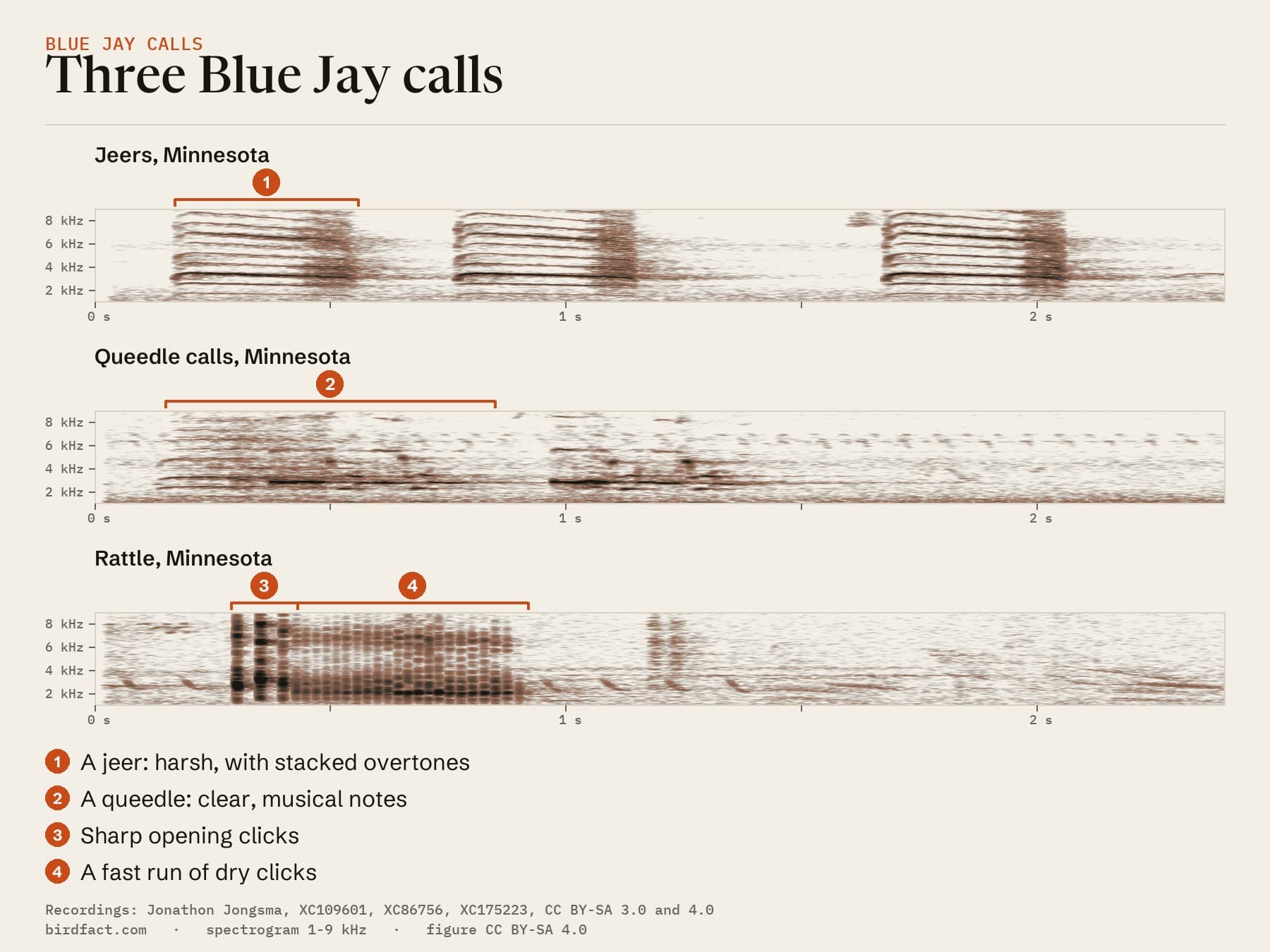
The jeer is the Blue Jay's all-purpose loud call: harsh, unmusical and full of overtones, which is why it looks like a stack of parallel lines in the figure above. Jays use it to gather, to mob a predator, when a person or animal threatens them, and probably just to keep in touch; a lone jay often jeers with nothing obvious going on. One form drops in pitch at the end (JEE-er) and is common when jays mob; a slightly shorter one stays level (jaay). Higher, louder jeers probably signal more alarm, and in a Michigan study summarized by Birds of the World, jeers made up more than half of all the calls heard in every season.
Tyler thought peer or beer, "with no r sound," perhaps a closer rendering than jay, and heard in it "remonstrance, taunting defiance, whining complaint, anger, but never, I think, fear." When Kentucky researchers set out stuffed hawks and owls, mobbing jays answered mostly with the same two kinds of jeer, built the same way whatever the raptor; what changed was how fast they gave the two-note jeer, fastest for an Eastern Screech-Owl and a Sharp-shinned Hawk.4
Pumphandle calls: squeaky gates and bells
Blue Jays also whistle: clear, ringing notes, often liquid, sometimes with a gurgle in them. To many ears they recall a pump handle, a clothesline running over a pulley or a gate that needs oil, and the jay usually bobs up and down as it calls; they are known as "pumphandle" calls. Birds of the World splits them in two. The squeaky-gate call has a break and a high-low or low-high-low turn in the middle (WHEEdle-ee); the bell call has a break but stays level (tull-ull).
Writers have reached for the same images for two centuries. Alexander Wilson thought a male's calls to his mate could be mistaken for "the repeated screakings of an ungreased wheel-barrow," and Hardy compared the squeaky-gate call to "a clothesline on a pulley."56 Tyler wrote the bell call as tull-ull or twirl-erl, and Audubon's field guide lists a "musical queedle-queedle".7
The bell call is a mild alarm. A male often gives it, sitting very still, when a person walks up to the tree where his mate is on the nest; if the person starts to climb or stares at the nest, the male, and often the female, switch to loud jeers and mob.2 Bell calls are local, too: jays were heard giving the same version together, and no jay used more than two versions in one bout of calling, which the researchers took as a dialect.8 In central Massachusetts, where 413 jays were banded over 3 years, bell calls varied enough to tell flocks, and individual birds within them, apart.9
The rattle
The rattle is a quick, dry clicking, often opening and closing with a crisper click; Birds of the World likens it to a big cat's purr, sped up. It comes as one long rattle of 2 to 3 seconds or as two or three short ones of 0.5 to 1.5 seconds, and the bird usually bobs as it rattles. Older writers heard it as "a dry, wooden rattle, almost a growl" and "like marbles being shuffled in a bag".10
Birds of the World says only females rattle, based on captive and color-banded wild birds, and that the call is probably related to female-only rattles in other crows and jays.2 Of the studies it cites, the one we could read, Conant's 1972 dissertation, sexed its captive jays by their behavior: the birds that rattled were either behaviorally female or never paired.11 Hardy, in 1961, wrote that the rattle "is given by both sexes". Other researchers have taken it as a female call: in Kentucky, Brewer could sometimes tell that a female was being chased because she was rattling.12 More on the sexes: male vs female Blue Jays.
Females often rattle in early spring and fall flocks, when a pair runs into other jays on its patch, and possibly when a person or a predator comes near. In the studies Birds of the World summarizes, the call was commonest in January and February.
Quiet calls between mates
Birds of the World describes a set of quieter calls. A pair foraging together, building a nest or meeting another pair keeps up a low, throaty clucking, kut kut kut. When the birds get excited, as when the male flies in with food, it becomes a nasal, whiny kueu-kueu, and in flocks an even whinier ennnyaa. A female begging food from her mate runs through the same sequence and flicks her wings, harder as she begs harder; young jays begging sound almost the same.
Two more quiet calls go with nesting. A few days before laying, and perhaps while laying, the female gives a soft, high, plaintive peep in an even series, about one every one to five seconds, usually while the male forages nearby. And when her mate feeds her, or parents feed their young, the food going down turns the begging call into a "swallowing call"; jays do not make it when feeding themselves.
Do Blue Jays sing?
Quietly. The sound most often counted as a song is the "whisper song": soft whirrs, clicks, whines and liquid notes mixed with snatches of the jay's other calls, sometimes for more than 2 minutes.13 Adults and older young sing it, usually alone on a perch and completely relaxed, and it can sound like a Gray Catbird or a Blue-gray Gnatcatcher.2
Few people know it, Tyler wrote in 1946. He called it "a potpourri of faint whistles and various low, sweet notes", and Francis Allen, quoted by Tyler, reckoned one continuous song in 1935 lasted two or three minutes. In Kentucky, Brewer recorded seven whisper songs, all in February and March, averaging 7.72 seconds, so soft that another jay would have to be very close to hear them.12 Conant, watching captive birds, linked the song mainly to males courting.11
Hawk imitations
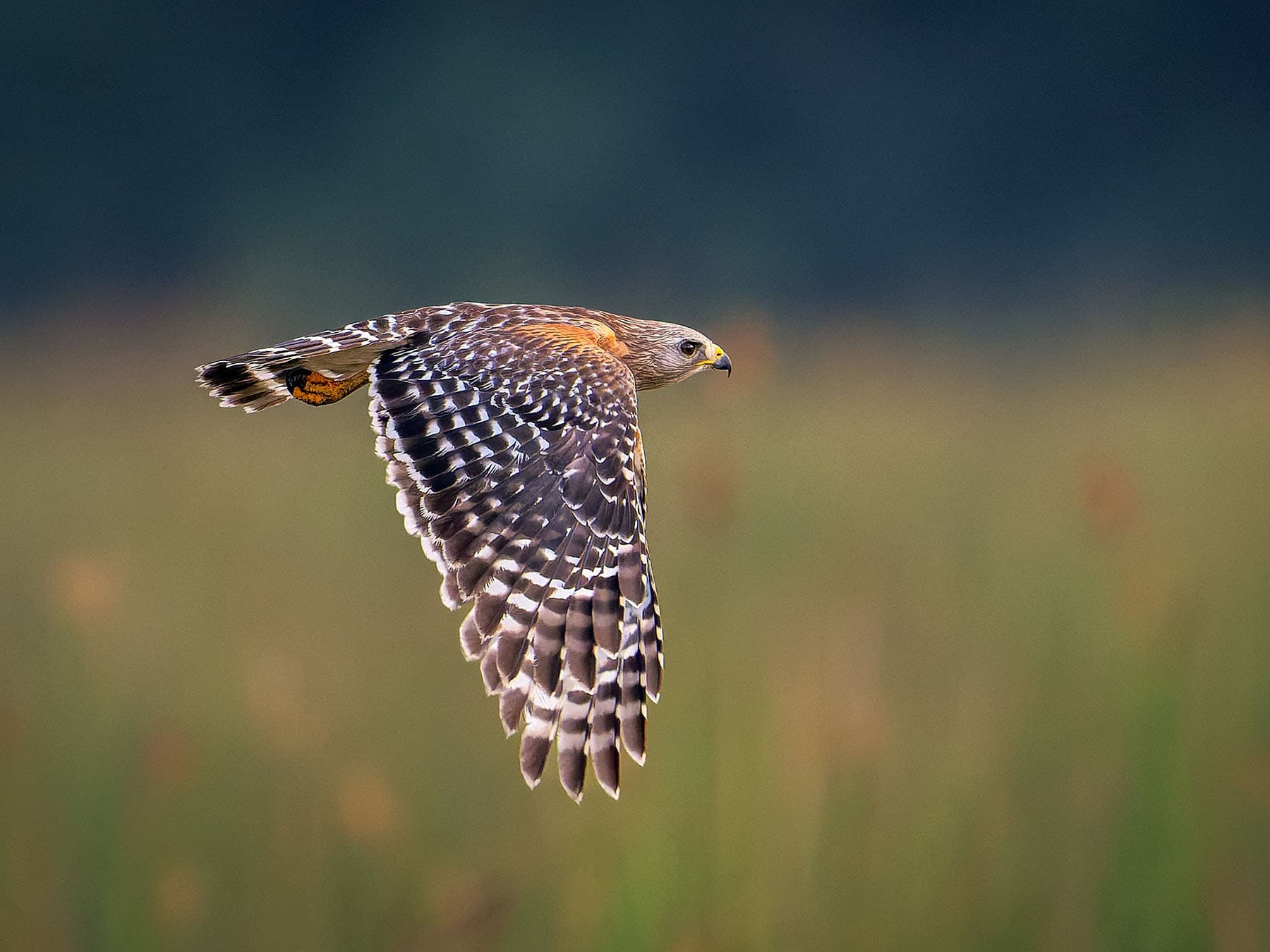
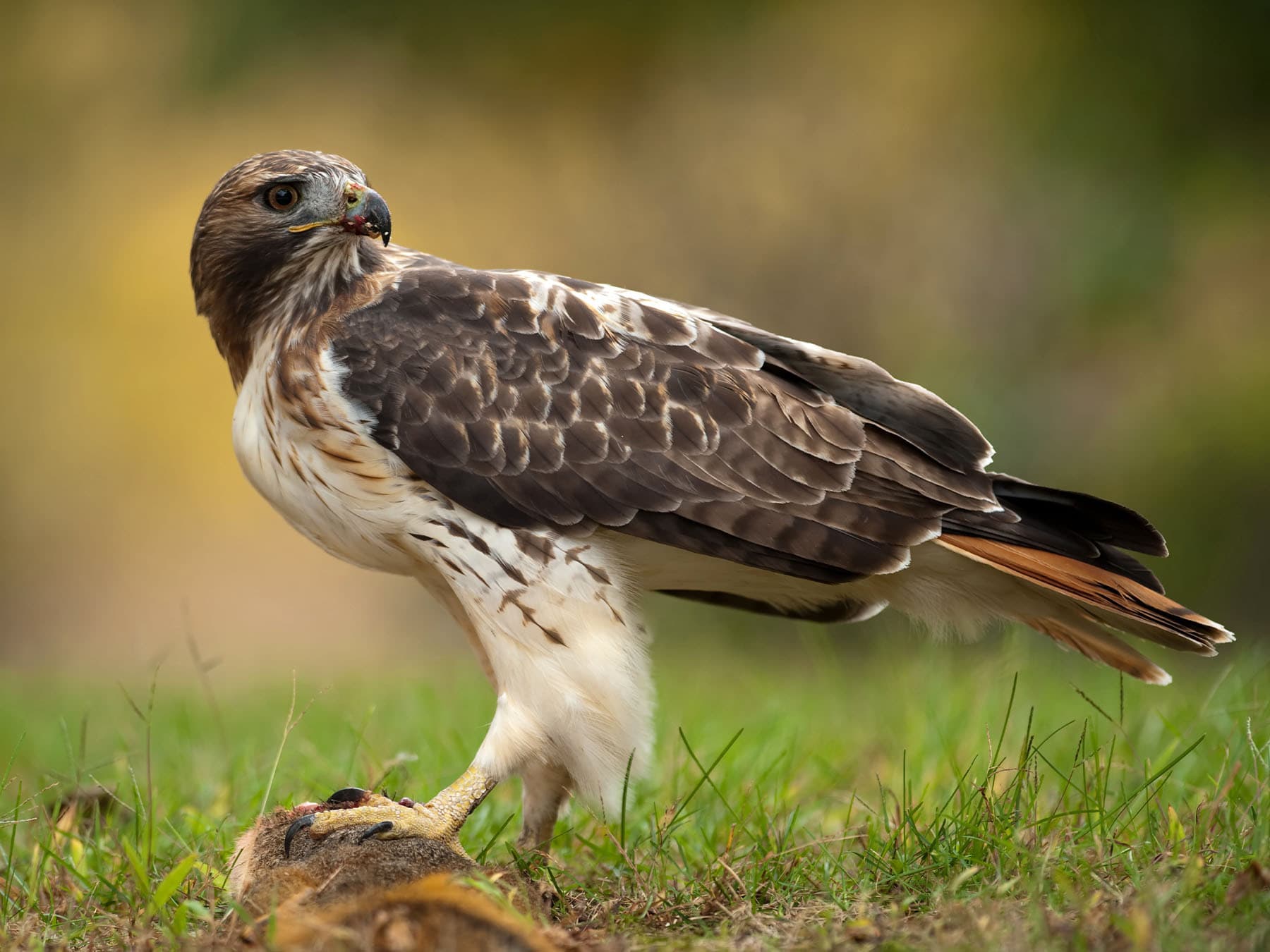
Blue Jays give calls that sound remarkably like hawks. The Red-shouldered Hawk's kee-arr is the classic, and Red-tailed Hawk imitations are common too. Birds of the World also lists reports of jays imitating Broad-winged and Cooper's Hawks, an Osprey, an American Kestrel, a Fish Crow and an Eastern Screech-Owl. Frank Chapman's handbook put it neatly: the Blue Jay "is both a mimic and a ventriloquist."14
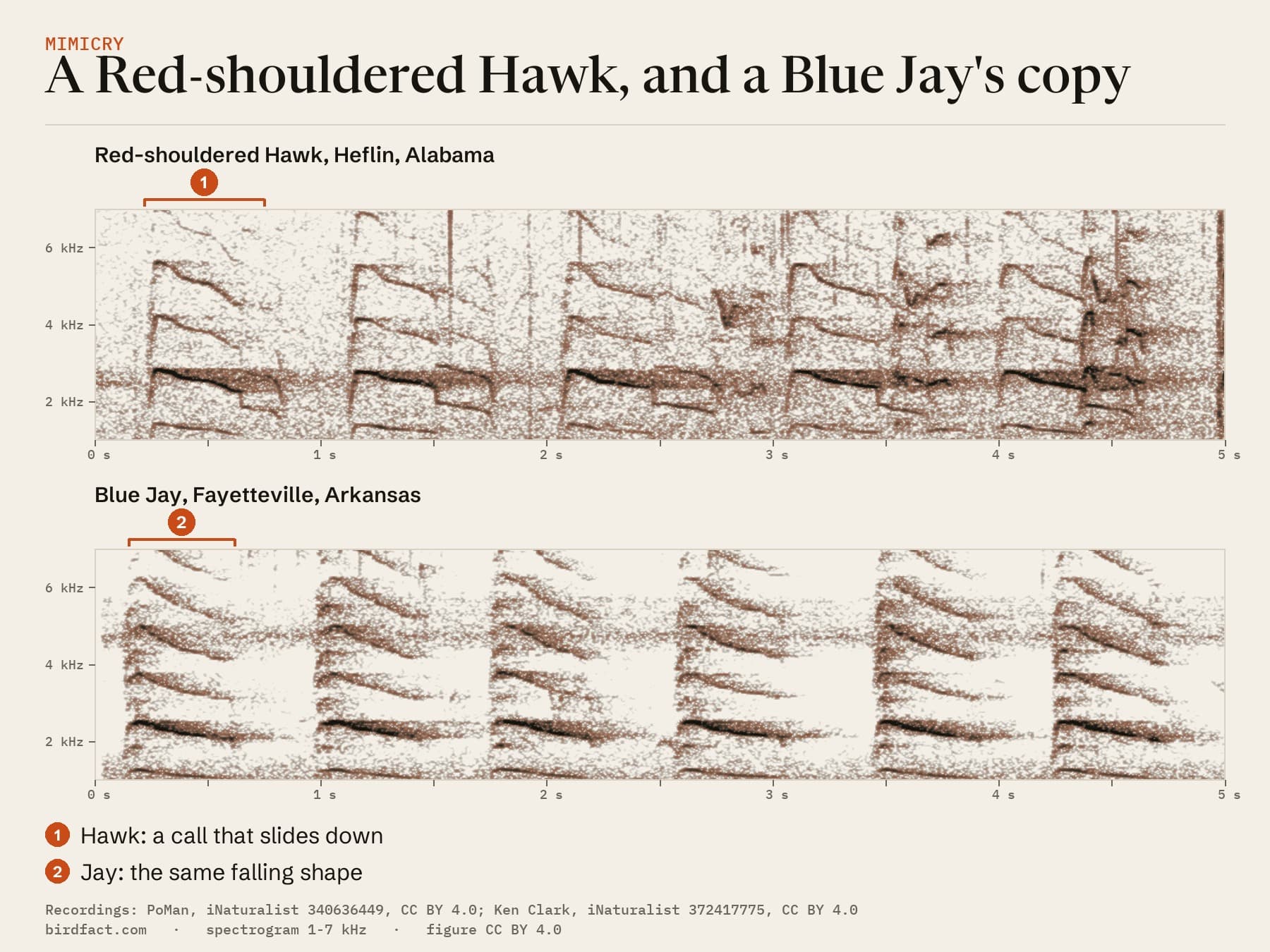
Some copies are almost perfect. In Ontario, R. D. James measured a jay's Red-shouldered Hawk call at 2 to 3 kHz and 0.47 seconds against the hawk's 0.51 seconds; the jay's version differed mainly in coming as single, well-spaced notes, where the hawk repeats itself.15 Birds of the World notes that the best renditions are not as loud as the real hawk, and some are slurred enough to tell apart easily.
Which hawk a jay copies seems to depend on which hawks live nearby. In an informal survey of birders on two New England email lists (44 replies), imitations of Broad-winged and Red-shouldered Hawks were reported by 16 people each, Red-tailed by 13, Cooper's by 9 and Osprey by 4.16 Brewer's Kentucky recordings had the Red-tailed Hawk imitated in 11 bouts and the Red-shouldered in 2; G. R. Graves heard a Broad-winged Hawk copy in the North Carolina mountains, where the Broad-winged was almost the only hawk he saw.17 As J. P. Hailman noted in 2009, no jay has been reported mimicking a raptor that does not live in its area.18
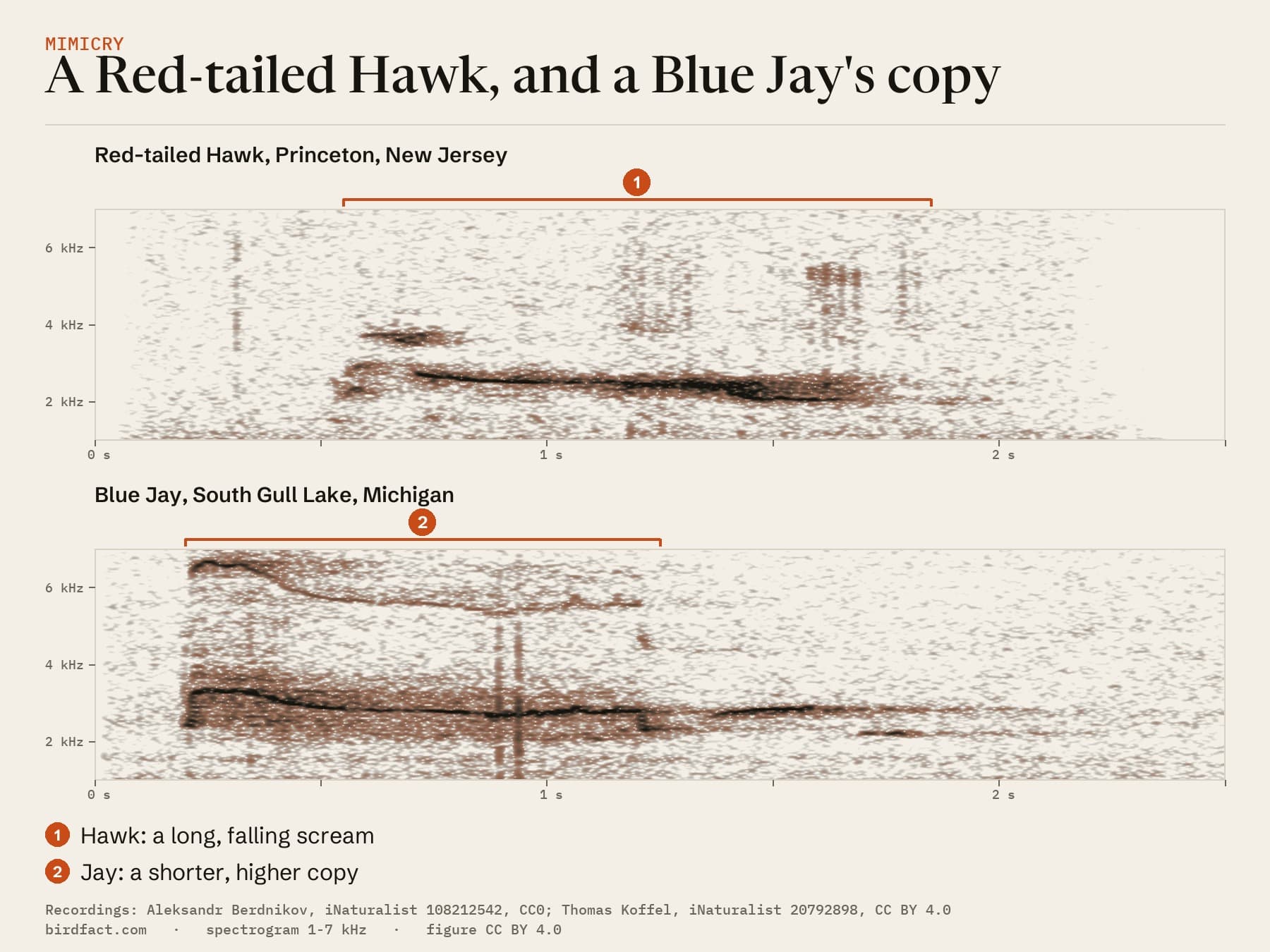
The two figures below set real hawks beside Blue Jays copying them. In the first, the jay matches the shape of the Red-shouldered Hawk's call, a note that slides down, with the same stack of overtones, a little lower in pitch. In the second, the jay's Red-tailed scream is shorter and higher than the hawk's; the recordist, who watched the jay call, thought it "a little less harsh".
Why do Blue Jays mimic hawks?
Nobody knows for sure. Hailman, who had heard a Florida jay copy an Osprey about ten times in the summer of 1988, always within 10 m (33 ft) of where Ospreys had been, set out four ideas in 1990: the jay is saying a hawk is here; it is marking where a hawk was; it is fooling other birds into thinking a hawk is near; or it simply picks up loud, simple sounds around it. He thought the second, that the jay marks where a hawk had been, the most likely.19 Birds of the World adds a fifth: the calls may simply be the jay's own, built from its jeers.
The trickery idea rests on a handful of stories. In 1975 an observer, S. L. Sutton, told R. W. Loftin of a jay at St. Marks National Wildlife Refuge, Florida, that gave a Red-shouldered Hawk call: a Boat-tailed Grackle dropped the bread it was eating, and the jay ate it. Loftin, publishing the story in 1991, wondered if it was "unique to this individual jay".20 At a feeder in Texas, watched for more than three years, a jay gave hawk calls only when other birds were already feeding, clearing them off before it landed, and flew in silently when the feeder was empty.21 Mainly on accounts like these, Birds of the World and Hailman, who by 2009 had changed his mind, judged deception the best supported.
Others are not convinced. James thought that only a few jays imitate, and that in most cases the calls probably mean nothing in particular: one Ontario jay used its Red-tailed scream "as if it were any other jay call".22 Brewer never saw an imitation used to steal food in 34 bouts of imitated calls; most came in the breeding season, and the Red-tailed Hawk copies mostly when jays were threatened.12 In the related Steller's Jay, 14 of 49 color-marked birds gave Red-shouldered Hawk imitations, the younger, bigger and bolder ones most;23 we found no such count for Blue Jays. Some imitations, at least, seem to be learned: Hailman thought his Florida jay had picked up the Osprey call from the Ospreys nearby, though he shared Tyler's caution, and James suggested young jays pick hawk calls up near hawks. Birds of the World notes that many "imitations" are just variations on the jay's own jeers.
Other imitations and talking
We found no report of a wild Blue Jay copying human speech, but captives can. Alexander Wilson passed on a report of a hand-reared jay that "could articulate a number of words pretty distinctly",6 and All About Birds notes that captive jays sometimes learn human speech and the meowing of cats.24 Conant's captive jays learned the call of crows feeding nearby and the meow of a pet Siamese cat.
Wild jays copy more than birds of prey. James heard an Ontario jay imitating the scream of a Ring-billed Gull among its ordinary calls, with no gulls about. Brewer recorded one "perfect crow" call in Kentucky that he could not tell from a real American Crow without seeing the bird. Other birds copy the jay, too: Eastern Towhees sometimes put Blue Jay calls in their songs, and a Spotted Towhee was filmed giving the "jay" call in Colorado in 2024.25
Why do Blue Jays scream?
Often because of danger. Jeers rally other jays to mob hawks, owls, cats and snakes, and those screams seem aimed at the predator as much as at the flock: captive birds of prey reacted more strongly to recordings of Blue Jay and American Crow mobbing calls than to those of a chickadee or a vireo, which fits the idea that mobbing is meant to make a predator move on.26
Other animals listen. Gray squirrels valued nuts for burying less when Blue Jay calls were played nearby, as if expecting jays to raid their caches,27 and cotton rats foraged more warily during jay alarm calls.28
Some of the noise has no obvious cause. Tyler wrote that "even a lone bird will break out, like a schoolboy, it seems, out of pure joy in making a noise," and that in fall jays "fill all outdoors with sound." In Kentucky, Brewer found jays most vocal early in the breeding season (April to early June), when noisy groups chase through the trees, and they called more often in the breeding season (4.5 calls a minute) than outside it (3.3).
Young jays
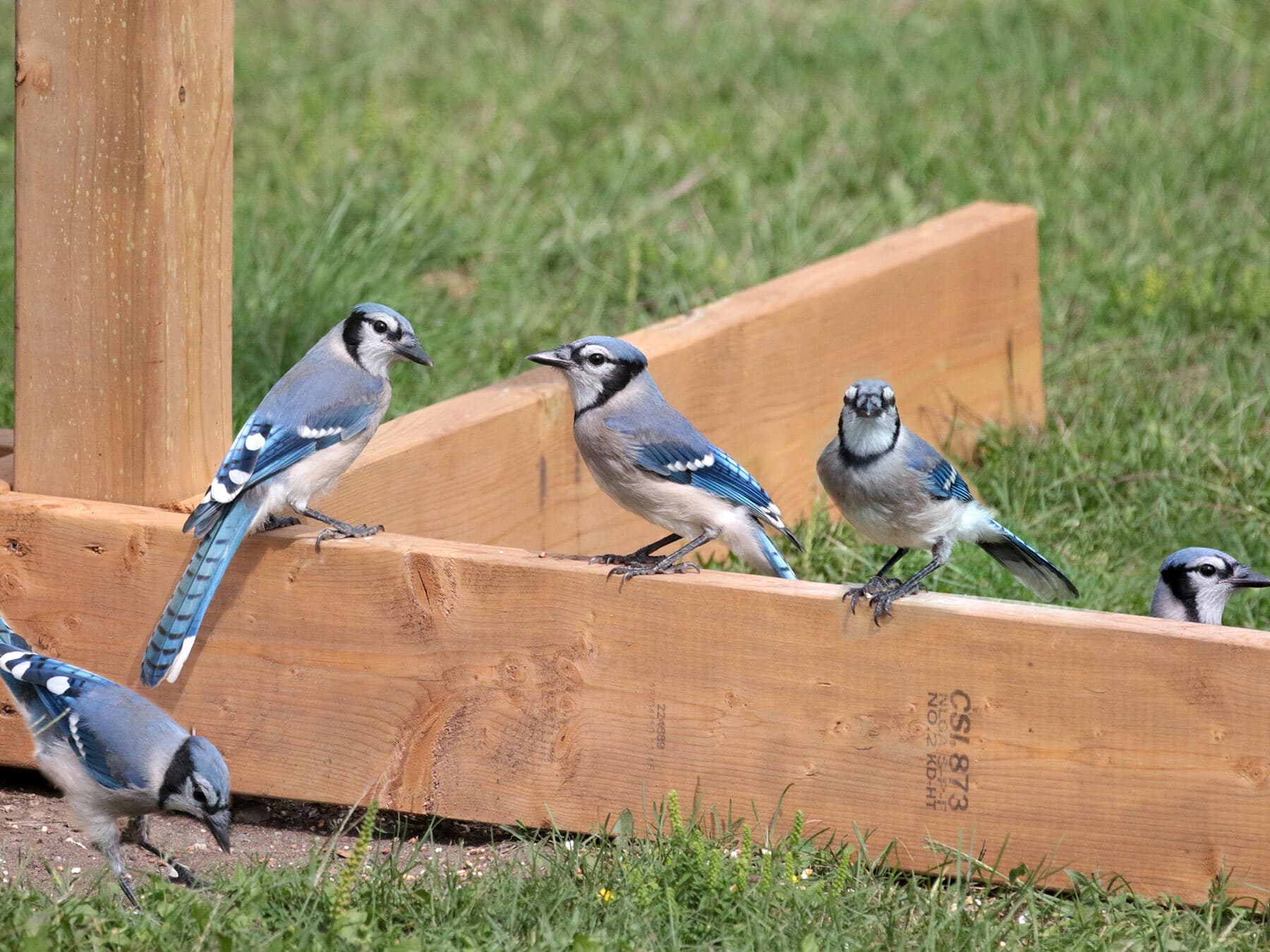
Hardy found that nestlings start with a thin squee when the nest is touched, harsher by the end of their first week, then a rich chortling call. Brewer recorded a high twitter, peaking at about 5.2 kHz, from nestlings only 3 to 10 days old as they waited for food, and fledglings waiting to be fed give a harsh, descending call. Fledglings begging sound much like an adult female begging from her mate. More: baby Blue Jays.
Jays learn their calls. According to Birds of the World, the full set is in place within 6 months of hatching. Jeers and the quiet pair calls probably grow out of begging and are recognizable when the young leave the nest, and pieces of the pumphandle calls and the rattle turn up in young birds' whisper songs 4 to 8 weeks after fledging. The pumphandle calls then take about 3 to 4 months of practice. Nestlings raised alone to about 8 months old never developed a squeaky-gate call, and isolated birds played recordings copied them, odd versions included. Mates, and perhaps flocks, seem to match each other's call types, so jays probably keep learning all their lives. Young jays also learn their nestmates' voices: captive birds preferred to perch near recordings of a nestmate, even when that nestmate was an American Robin.
When jays call most
It depends on the time of year, in the studies Birds of the World summarizes. In Michigan, lone jays called 6 to 9 times as often in April as in January and February or in May and June, while in Oklahoma calls were commoner from October to January than in April. Unpaired jays call more than paired ones before the breeding season. Squeaky-gate calls outnumber bell calls in January and February and in April, and the reverse holds in May and June, when jays are nesting. The daily pattern has not been studied, but a dawn chorus of jeers and pumphandle calls is easy to hear, especially in the breeding season and early fall. Pumphandle calls are often given in flight by spring and fall flocks.
Telling a jay from a hawk
If you hear a Red-shouldered or Red-tailed Hawk near a feeder or a patch of woods with jays in it, look for the jay before you look for the hawk. A copy is often quieter than the real thing, may come as single notes rather than the hawk's repeated series, and may be followed by ordinary jeers, as in the Michigan recording above. Tyler, who was sometimes "misled" himself, cautioned that, with so many sounds in the jay's vocabulary, a likeness might be coincidence rather than imitation.
The confusion has reached the search for the Ivory-billed Woodpecker. On recordings from the Arkansas woods, Jerome Jackson noted that Blue Jays and White-breasted Nuthatches "utter similar vocalizations" to calls attributed to the woodpecker.29 An analysis of calls attributed to an Ivory-bill found that they sounded like the Blue Jay's bell call but did not match its published spectrograms.30
Other sounds
Some Blue Jay chatter sounds like laughing. Tyler described a soft, conversational kuk that can run on into "a bubbling chatter", "a sort of tittering laugh"; a modified kuk, he wrote, is given by jays feeding in trees or at feeders. The short recording below is of a bird its recordist called "that laughing thing", watching its bill move as it called.
Not every sound is a call. Birds of the World notes that in intense aggression Blue Jays snap their bills, and a stressed jay may hammer its perch with its bill, as when a person takes a nestling or its mate is caught in a trap. A nestling grabbed by a predator or a person gives a "squack" call about half a second long.
Blue Jays hear less well than we do. In tests on two hand-reared jays, the birds were most sensitive to sounds near 2 kHz and did not respond at all above 10 kHz.31
About the recordings
Every recording on this page is openly licensed (CC0, CC BY or CC BY-SA), from xeno-canto or iNaturalist, and we checked each one as a spectrogram before using it. Jonathon Jongsma saw the jeering and rattling birds he recorded in Minnesota; the Michigan recordist watched the jay give its hawk call, and the Tennessee recordist watched the "laughing" jay. Labels such as "queedle", "juvenile" and "laughing" are the recordists' own. The rattle recording shows the call's shape; it does not tell us that bird's sex. Our figures pair one hawk with one jay each, and we make no wider claim from them. For another famous mimic, see mockingbird sounds.
Sources
- Tyler, W. M. (1946). Northern Blue Jay. In A. C. Bent, Life Histories of North American Jays, Crows, and Titmice. United States National Museum Bulletin 191. Accessed October 14, 2026. Source
- Smith, K. G., Tarvin, K. A., Woolfenden, G. E. (2020). Blue Jay (Cyanocitta cristata), version 1.0. Birds of the World (A. F. Poole, editor). Cornell Lab of Ornithology. doi:10.2173/bow.blujay.01
- Brewer, D. E. (2022). The vocal repertoire of Blue Jays (Cyanocitta cristata): Spectrographic snapshots and suggested nomenclature. The Wilson Journal of Ornithology 134(2): 309-317. doi:10.1676/19-00027
- Dahl, J. A., Ritchison, G. (2018). Responses of Blue Jays (Cyanocitta Cristata) to Raptors that Differ in Predatory Threat. Avian Biology Research 11(3): 159-166. doi:10.3184/175815618x15263796305056
- Hardy, J. W. (1961). Studies in Behavior and Phylogeny of Certain New World Jays (Garrulinae). University of Kansas Science Bulletin 42(2): 13-149. Accessed October 14, 2026. Source
- Wilson, A., Bonaparte, C. L. (1831). American Ornithology; or, the Natural History of the Birds of the United States, vol. 1. Constable, Edinburgh. Accessed October 14, 2026. Source
- National Audubon Society. Blue Jay. Guide to North American Birds (text adapted from Kaufman 1996). Accessed October 14, 2026. Source
- Kramer, H. G., Thompson, N. S. (1979). Geographic Variation in the Bell Calls of the Blue Jay (Cyanocitta cristata). The Auk 96(2): 423-425. doi:10.1093/auk/96.2.423
- Racine, R. N., Thompson, N. S. (1983). Social Organization of Wintering Blue Jays. Behaviour 87(3-4): 237-255. doi:10.1163/156853983x00444
- Nicholson, D. J. (1936). Observations on the Florida Blue Jay. The Wilson Bulletin 48(1): 26-33. Accessed October 14, 2026.
- Conant, S. (1972). Visual and acoustic communication in the blue jay, Cyanocitta cristata (Aves, Corvidae). PhD dissertation, University of Oklahoma. Accessed October 14, 2026. Source
- Brewer, D. E. (2016). Characteristics, contexts, and possible functions of the vocalizations of Blue Jays. MS thesis, Eastern Kentucky University. Accessed October 14, 2026. Source
- Cornell Lab of Ornithology. Blue Jay Sounds. All About Birds. Accessed October 14, 2026. Source
- Chapman, F. M. (1904). Handbook of Birds of Eastern North America, 6th edition. D. Appleton, New York. Accessed October 14, 2026. Source
- James, R. D. (1988). Blue Jays Mimic the Calls of Red-shouldered and Broad-winged Hawks. Ontario Birds 6(1): 11-14. Accessed October 14, 2026.
- Berry, J. (2004). An Informal Survey of Raptor Imitations by Blue Jays. Bird Observer 32(2): 92-96. Accessed October 14, 2026.
- Graves, G. R. (2005). Vocal mimicry of broad-winged hawk by blue jay. Banisteria 25: 50. Accessed October 14, 2026. Source
- Hailman, J. P. (2009). Context of Blue Jay (Cyanocitta cristata) Mimicking Cooper's Hawk (Accipiter cooperii) Cackle. Florida Field Naturalist 37(3): 94-95. Accessed October 14, 2026.
- Hailman, J. P. (1990). Blue Jay Mimics Osprey. Florida Field Naturalist 18(4): 81-82. Accessed October 14, 2026.
- Loftin, R. W. (1991). Blue Jay Imitates Hawk for Kleptoparasitism. Florida Field Naturalist 19(2): 55. Accessed October 14, 2026.
- Clench, M. H. (1991). Another Case of Blue Jay Kleptoparasitism. Florida Field Naturalist 19(4): 109-110. Accessed October 14, 2026.
- James, R. D. (2002). Of Blue Jays and Mimicry. Ontario Birds 20(1): 7-12. Accessed October 14, 2026.
- Harvey, T. C., Gabriel, P. O., Black, J. M. (2024). Propensity of Predator Mimicry in Steller's Jays. Birds 5(1): 173-189. doi:10.3390/birds5010012
- Cornell Lab of Ornithology. Blue Jay. All About Birds. Accessed October 14, 2026. Source
- Somershoe, S. G. (2025). Spotted Towhee Mimicry of a Blue Jay. Western Birds 56(2): 143-144. doi:10.21199/wb56.2.5
- Consla, D. J., Mumme, R. L. (2012). Response of Captive Raptors to Avian Mobbing Calls: the Roles of Mobber Size and Raptor Experience. Ethology 118(11): 1063-1071. doi:10.1111/eth.12007
- Schmidt, K. A., Ostfeld, R. S. (2008). Eavesdropping Squirrels Reduce Their Future Value of Food under the Perceived Presence of Cache Robbers. The American Naturalist 171(3): 386-393. doi:10.1086/527497
- Felts, J., Schmidt, K. A. (2010). Multitasking and eavesdropping in cotton rats foraging under predation risk. Behavioral Ecology 21(5): 1080-1086. doi:10.1093/beheco/arq113
- Jackson, J. A. (2006). Ivory-billed Woodpecker (Campephilus principalis): Hope, and the Interfaces of Science, Conservation, and Politics. The Auk 123(1): 1-15. doi:10.1642/0004-8038(2006)123[0001:IWCPHA]2.0.CO;2
- Collins, M. D. (2011). Putative audio recordings of the Ivory-billed Woodpecker (Campephilus principalis). The Journal of the Acoustical Society of America 129(3): 1626-1630. doi:10.1121/1.3544370
- Cohen, S. M., Stebbins, W. C., Moody, D. B. (1978). Audibility Thresholds of the Blue Jay. The Auk 95(3): 563-568. Accessed October 14, 2026. Source