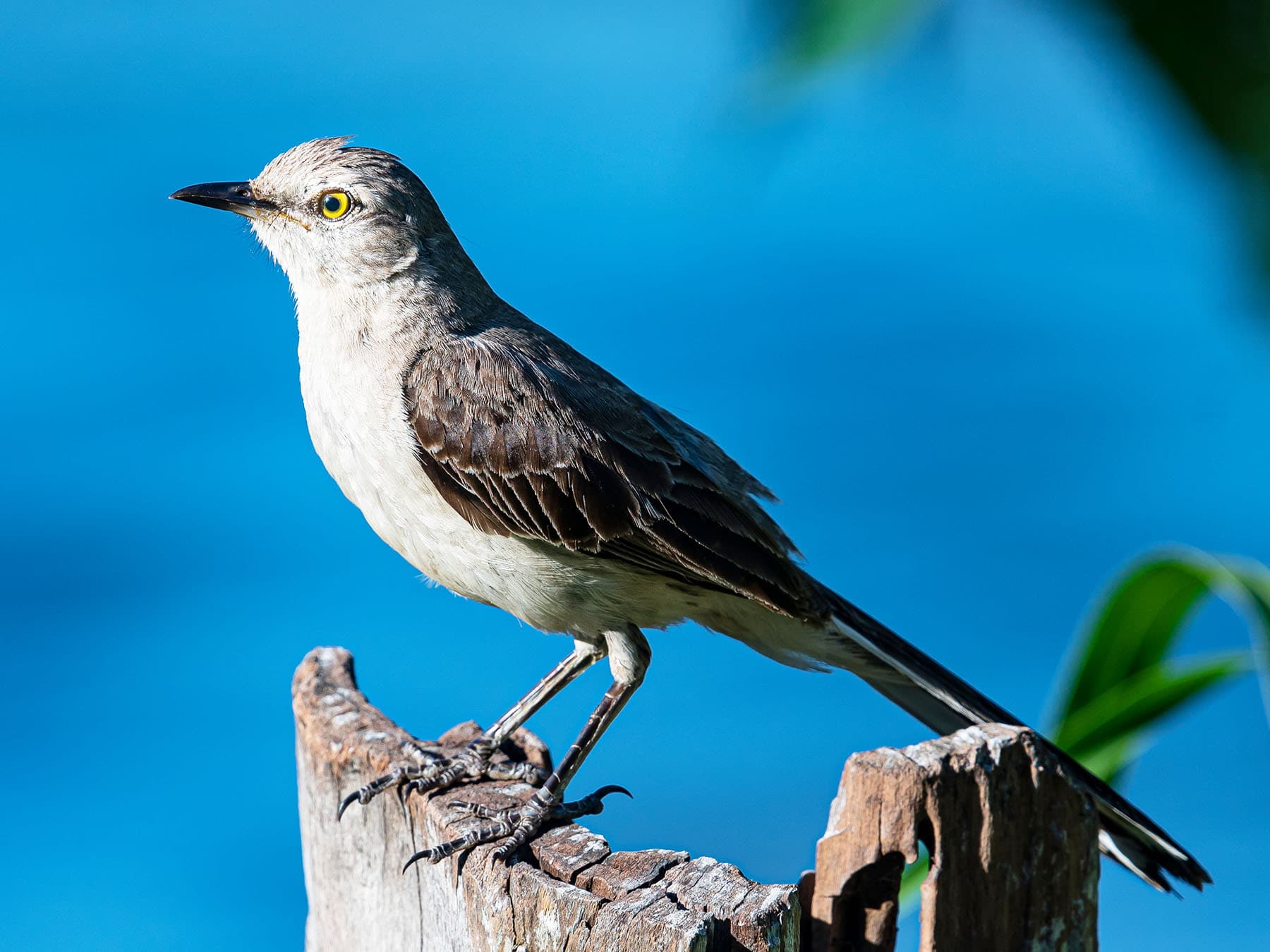
Published 12 Oct 2026
Mockingbird Sounds: Song, Mimicry, Calls and Night Singing
By the Birdfact teamChecked by Nathan Cope
A Northern Mockingbird sings a long, varied song in which each sound is repeated several times before the next, and many of those sounds are copies of other birds, frogs and even machines. Listen to recordings and see the song drawn as spectrograms: how many songs one bird knows, how good the copies are, why unmated males sing all night, and the calls.
On this page15 sections
- What does a mockingbird sound like?
- Mimicry
- How good the copies are
- Is it the real bird or a mockingbird?
- Famous mimics
- How many songs does a mockingbird know?
- Why do mockingbirds sing at night?
- When mockingbirds sing
- Do female mockingbirds sing?
- What the song is for
- Calls
- Mockingbird, thrasher or catbird by ear
- How a mockingbird makes its sounds
- About the recordings
- Sources
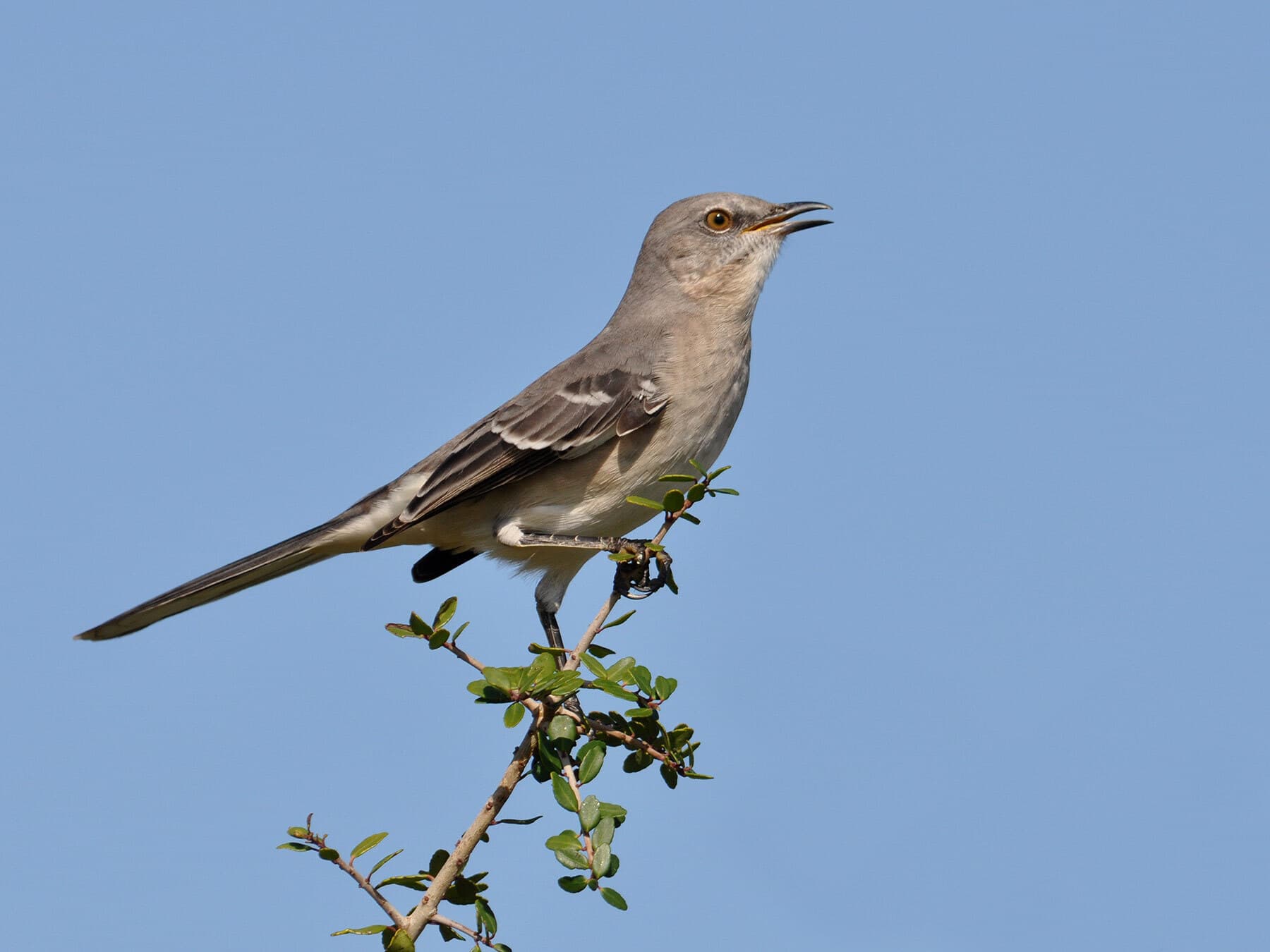
This page is about the sounds of the Northern Mockingbird: what its song sounds like and how to recognize it, what it copies and how well, how many songs one bird knows, why some sing all night, and its calls. Recordings from five states are on this page, and three of them are drawn in two spectrograms, pictures of sound with pitch against time. For the bird itself, see Northern Mockingbird identification and facts.
What does a mockingbird sound like?
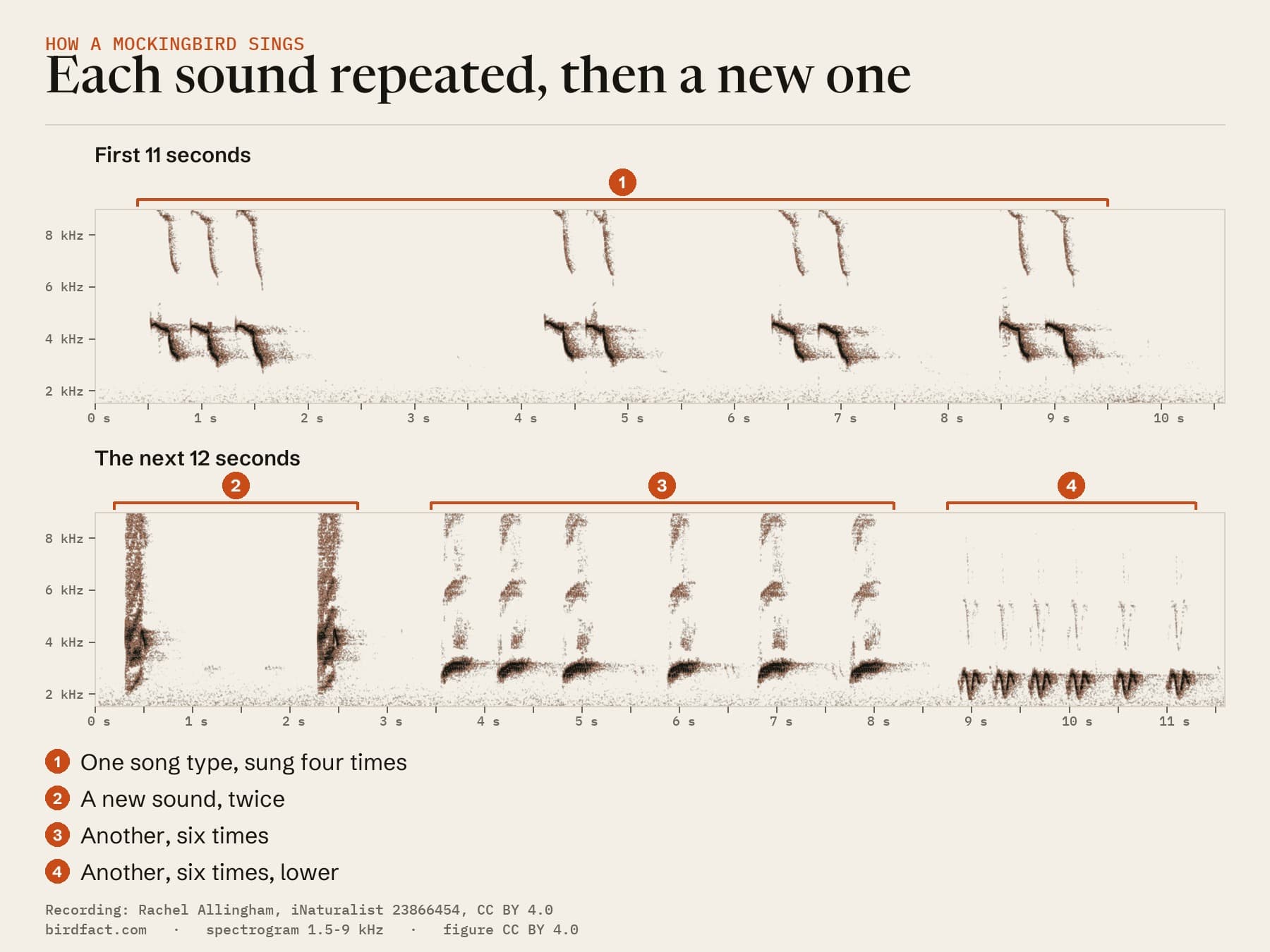
A long, rambling, varied song in which each sound is repeated several times before the bird moves on to the next. All About Birds describes a long series of phrases, each repeated two to six times, which can run for 20 seconds or more, with whistles, sharp rasps, scolds and trills, and many copies of other birds.1 The repetition is the giveaway: a male typically sings one song type several times in a row, a "bout", then switches to another.2
Listen to the recording below, made near midnight in California. In the first eleven seconds the bird sings one song type four times; then come a new, harsh sound, given twice, and two more song types, each repeated six times.
Mimicry
Mockingbirds copy other birds, other animals and mechanical sounds. Frank Chapman's 1912 handbook put it plainly: "Among our birds the Mockingbird takes first rank as a mimic".3 The scientific name says the same: Mimus means "mimic", and polyglottos comes from the Greek for "many" and "tongue". In 1731 Mark Catesby wrote that Native Americans called it cencontlatolly, "four hundred tongues".4 All About Birds lists shrikes, blackbirds, orioles, Killdeer, jays and hawks among the birds they imitate, and frogs too. A 2019 study found mockingbirds imitating at least 12 species of frogs and toads across North America.5
How much of the song is borrowed? In a study of nine males, mimicry made up about 61% of song in late spring and 48% outside the breeding season, and the birds went on singing copies of summer migrants all year, even while those birds were away.6 Birds of the World, whose text was last revised in 2011, before that study, says the share of imitated song is not known and would be extremely hard to estimate.
What a mockingbird copies seems to depend on its own voice. Of five explanations tested in one study, only acoustic similarity held up: mockingbirds copy sounds that resemble their own.7 Frog and toad calls, too, were copied more often than expected when their main pitch fell within the mockingbird's own range, about 750 to 7,000 Hz. When they mimic, they stretch their song upward: in 13 males, its top frequency rose by over 600 Hz and its range of pitch widened by 42%.8 They also tend to run copies of one species together. In a study of 18 males with 55 types of imitation, two different imitations of the same species (say, two different calls of one bird) came one after the other 4.2 times as often as chance would predict.9
How good the copies are
The best copies are very close. Laboratory work found that when a mockingbird copies another species accurately, it uses the two sides of its voice organ the way the model species does; where it departs from the model's method, the copy differs in predictable ways, and the features most typical of the model species seem hardest to copy.10
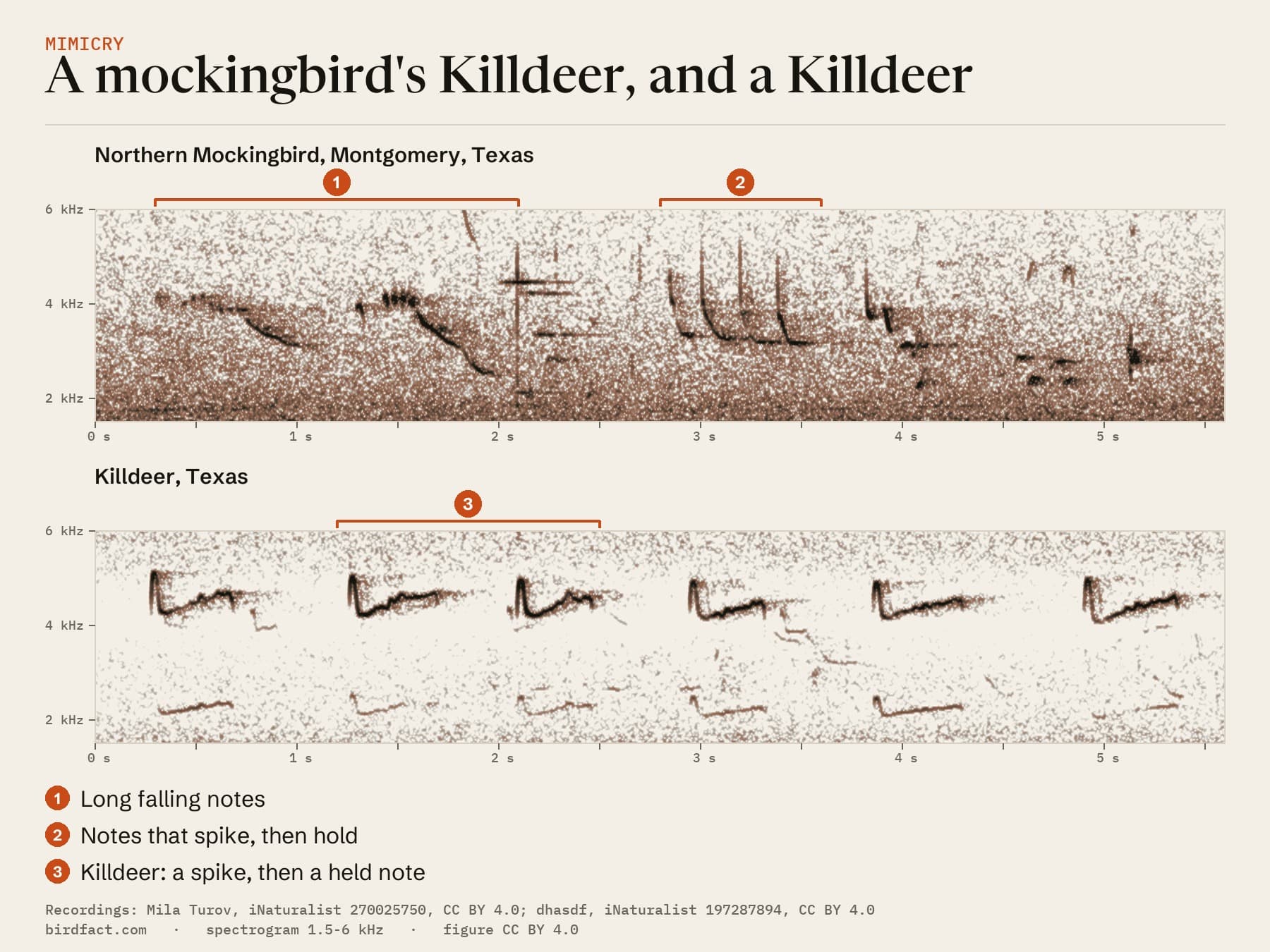
In the figure above, the mockingbird's spike-and-hold notes have the Killdeer's shape but sit about 1 kHz lower, near 3.3 kHz against 4.3 to 4.6 kHz. That is one pair of recordings, so it shows what to listen for, not a rule.
Do the copies fool other birds? Sometimes. In a test with ten territorial Red-winged Blackbirds near Ithaca, New York, in 1981, the birds responded no differently to a mockingbird's imitation of their song than to real Red-wing song.11 But Florida Scrub-Jays reacted more strongly to real scrub-jay calls than to mockingbird copies, whether played alone or inside mockingbird song, and that study found no support for the idea that mimicry deceives the copied species.12
Why mockingbirds mimic at all is still open. One idea is that it is a side effect of learning: if a bird's template for which sounds to learn is wide, copies of other species slip in as "learning mistakes". Another is that females prefer songs with copies in them, which might explain the higher, wider-ranging mimetic song; the study that measured it only raises the possibility.
Is it the real bird or a mockingbird?
Listen for the repeats. The bird-song writer A. A. Saunders noted that a thrasher repeats a phrase about twice on average, a mockingbird four or five times, and a 1956 study found that a mockingbird's Carolina Wren-like songs came about 27 a minute, against the real wren's ten.13 A run of the same sound, over and over, then a switch to something else, points to a mockingbird. A copy can also be off in pitch, like the Killdeer above, and the most distinctive features of the model are the hardest to copy.
Famous mimics
Two old counts are often quoted. Chapman's 1912 handbook passes on a count by L. M. Loomis, who heard a bird in South Carolina imitate 32 species of birds in ten minutes of continuous singing. Chapman called it "a phenomenal performance" and added that in his experience "many Mockingbirds have no notes besides their own, and good mockers are exceptional". The celebrated Arnold Arboretum mockingbird was credited with 91 imitated sounds: 39 bird songs, 50 bird calls, a frog and a cricket.14
Alexander Wilson, writing in 1810, heard a voice "capable of almost every modulation, from the clear mellow tones of the Wood Thrush, to the savage scream of the Bald Eagle", with the Killdeer, Blue Jay and others among its copies. His caged bird whistled for the dog, copied "the barking of the dog, the mewing of the cat, the creaking of a passing wheelbarrow", and repeated "the tune taught him by his master".15
Can mockingbirds talk? Wilson's bird learned a whistled tune, but Audubon, in 1831, wrote that he had never met an instance of one imitating the human voice.16 Machines are another matter: a hand-raised male studied by A. R. Laskey copied the squeak of a washing machine.17 Car alarms are often reported, but we found no study that measured them.
How many songs does a mockingbird know?
Often 150 or more, and some birds many more. Birds of the World summarizes repertoire estimates for single males from 45 to 203 song types, and says a male's repertoire often holds more than 150. In a close study of four Pennsylvania males, each male used from 102 to 412 different song types in a year, and the mean repertoire estimates were 100 to 200 song types; the study found repertoire size seemed to increase with age.18 The higher counts come partly from rarities: over a quarter of the song types were heard only once.19 So the count depends on how long a bird is recorded, and when.
Repertoires change. Birds of the World notes that in a study of two males the spring and fall repertoires shared only 1% of their song types. Older birds also mimic more in their fall song.20 Do mockingbirds keep learning all their lives? All About Birds and Birds of the World say they do,21 and repertoires do change from year to year. A 2020 study recorded 15 banded males in two years: the number of species they imitated barely changed (46.4 and 47.7 types on average), though they added new song types within the imitations that were checked. A separate six-month tutoring experiment found no adult learning the new sounds played to it, though the author says the tutoring may not have been enough. He still thinks mockingbirds are probably open-ended learners, but says that needs testing.22
Young birds start early. Laskey's hand-raised male first sang at 27 days old, began giving sounds like other species at four and a half months, copied a cowbird song within two days of hearing it, and once repeated a phrase 106 times in 45 seconds.
Why do mockingbirds sing at night?
Usually because they are unmated males. Birds of the World says unmated males sing at night; in south Florida, the long bouts of song between midnight and 4 a.m. came from unmated males alone. A Pennsylvania study likewise found that under natural lighting only unmated males sang extensively at night, and that night songs were delivered the way males sing before a female arrives.19 Unmated males sing more by day too. In fall, unmated males sang about twice as much as mated males, and males whose mates were removed sang three times as much.23 So a mockingbird singing all night in spring is usually one still looking for a mate.
Light plays a part. Birds of the World notes that in well-lit areas, mated males sometimes sing at night too, and that night singing seems more common around the full moon. In one study, 14 of 18 birds singing at night had more light falling on the belly than on the back, which suggests they faced the light.24 Light does not explain everything, though: on a South Carolina campus, light levels at dawn, midday and dusk explained no more than 5% of the variation in how much the mockingbirds sang.25
Night song belongs to spring and summer; Birds of the World records none in fall. In Florida, where it is the state bird, the Department of State notes that the mockingbird often sings through the night, above all when the spring moon is bright.26
When mockingbirds sing
According to Birds of the World, mockingbirds sing for about three-quarters of the year: from February (late January in the South) into August, and again from late September into early November, when they set up fall territories; now and then they sing in winter too. In spring, males start half an hour to an hour before sunrise, and sing most in the morning. In a study of six mated males, each sang much more while building a nest, and less during incubation and while caring for the young.27
City noise changes the song. Where background noise was louder, a smaller share of mockingbirds' syllable types were low, between 1 and 3 kHz, and a larger share between 3 and 5 kHz.28
Do female mockingbirds sing?
Yes. Females sing less and more quietly than males: rarely in summer, and then only when the male is off the territory, and more in fall. Birds of the World's account, last revised in 2011, says females were not heard singing while incubating. Newer studies say otherwise: one found singing on the nest at 74% of 65 nests, almost always by females during the egg stage, and the authors report that nests where birds sang were more likely to be lost to predators.29 Another found that females mimic other birds when they sing there, though less often and with less variety than males.30 More: male vs female mockingbirds.
What the song is for
Mostly, it seems, for attracting and stimulating a mate. Birds of the World sets out the evidence: unmated males sing more and broadcast their song in many directions, males sing quietly while mating, song peaks while the nest is being built, and males sing much more when their mate is removed. Fall song can attract a mate as well. Song is used in territory disputes too, though in fall, bursts of short calls do more of that work (see Calls, below).
How does a mockingbird tell another mockingbird's song from a thrasher's? Partly by the repetition, but not only: in playback tests, mockingbirds told their own species' songs from Brown Thrasher songs by the song types themselves, whatever the repetition pattern.31
Calls
Mockingbirds also have a few calls. The hew, or chew, is a harsh, dry call given at nest predators and in chases of other mockingbirds; mates exchange a softer version while they have eggs or young. Birds of the World describes the others. The chat is a short, explosive note given by both sexes all year, singly when mildly disturbed, or in bursts of two to eight about a twentieth of a second apart. These chatbursts come mostly in fall, when they are the main signal used to defend a fall territory. Chats are often the first sound of the morning twilight. A male may give a quiet, high call before flying in to the nest, and nestlings and fledglings beg with a high, tonal call. Chats and the begging call also turn up in males' song.
Nesting birds have a richer alarm vocabulary than that: a 2020 study identified nine alarm calls, one given only with snakes and two almost only with cats.32
Mockingbird, thrasher or catbird by ear
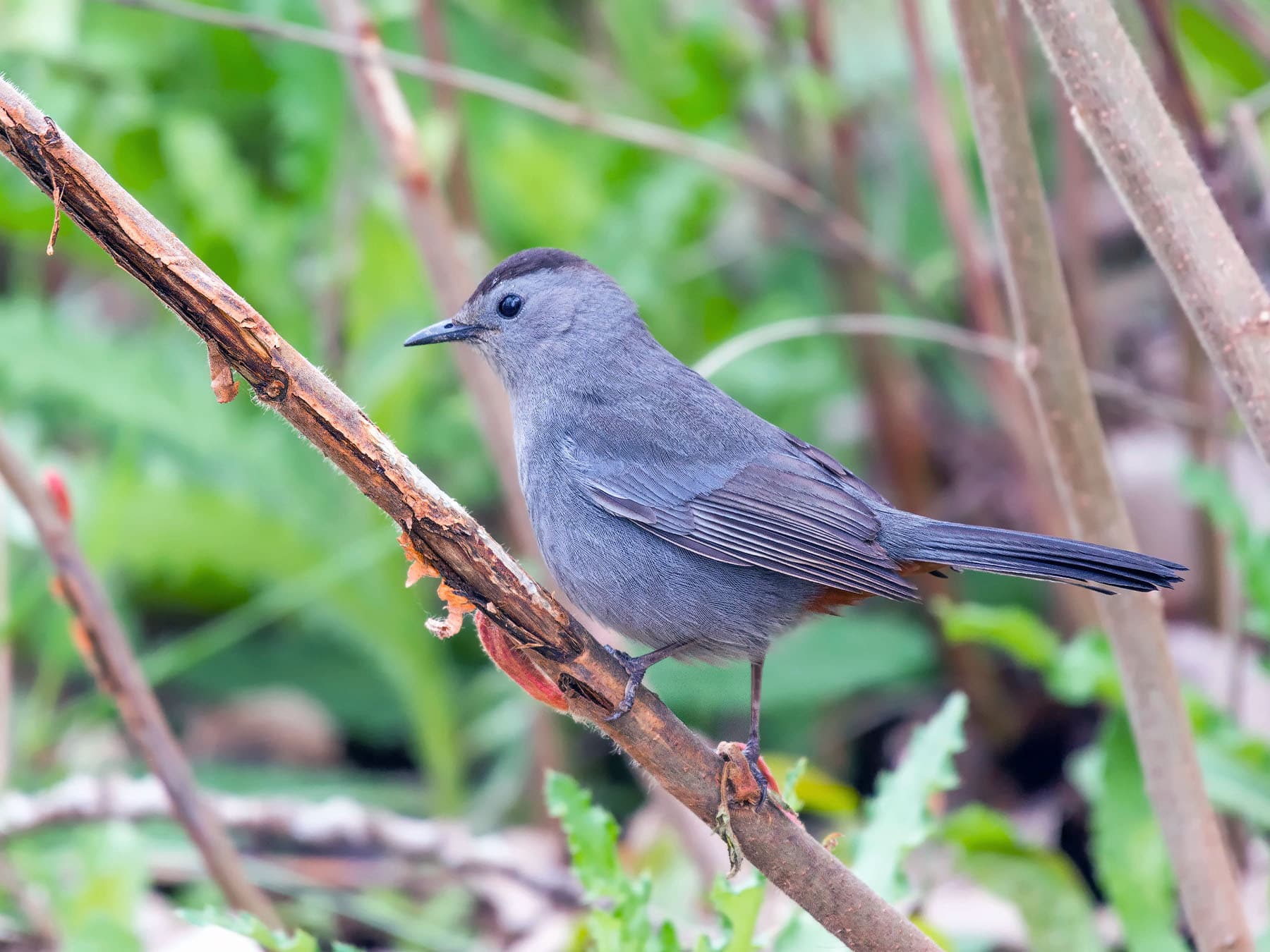
Two relatives also sing long, varied songs. A Brown Thrasher mostly gives each phrase two or three times, against the mockingbird's several; a Gray Catbird's phrases are more nasal, hurried and slurred. The catbird also gives a cat-like mew, and sometimes seems to copy other birds.33 More: Gray Catbird.
Sound-identification software can be fooled too. In a case study of 42 hours of recordings, mockingbird song caused 506 false BirdNET detections of other species, though only 18 got through its species-list and confidence filters.34 In another test, of the Merlin Bird ID app, mockingbirds made up about 31% of the false identifications.35
How a mockingbird makes its sounds
A mockingbird's voice organ, the syrinx, has two sides that work independently. Birds of the World gives the ranges: lower sounds, about 0.75 to 3 kHz, come from the left side, and higher ones, about 1.6 to 7 kHz, from the right. Some sounds that look like two notes at once are made by one side alone, and in harsh, chaotic calls the chaos can come from one side while both are working; the two sides are also linked, physically and acoustically.36
About the recordings
All the recordings on this page are openly licensed (CC BY or CC0) iNaturalist observations identified by two or three users; we checked each as a spectrogram before using it. The Maryland and Savannah observations include photos of the bird. The Killdeer copy is the recordist's identification, and our figure sets it beside a real Killdeer from Texas; we make no wider claim from one pair. The Savannah recording's imitations are the recordist's identifications too.
Sources
- Cornell Lab of Ornithology. Northern Mockingbird Sounds. All About Birds. Accessed October 12, 2026. Source
- Farnsworth, G., Londono, G. A., Martin, J. U., Derrickson, K. C., Breitwisch, R. (2020). Northern Mockingbird (Mimus polyglottos), version 1.0. Birds of the World (A. F. Poole, editor). Cornell Lab of Ornithology. doi:10.2173/bow.normoc.01
- Chapman, F. M. (1912). Handbook of Birds of Eastern North America (revised edition). D. Appleton and Company, New York. Accessed October 12, 2026. Source
- Jobling, J. A. The Key to Scientific Names: Mimus; polyglottos. Birds of the World, Cornell Lab of Ornithology. Accessed October 12, 2026. Source
- Gammon, D. E., Corsiglia, A. M. (2019). Mockingbirds imitate frogs and toads across North America. Behavioural Processes 169: 103982. doi:10.1016/j.beproc.2019.103982
- Gammon, D. E. (2014). Seasonal patterns of vocal mimicry in northern mockingbirds Mimus polyglottos. Journal of Avian Biology 45(6): 545-550. doi:10.1111/jav.00414
- Gammon, D. E. (2013). How is model selection determined in a vocal mimic?: Tests of five hypotheses. Behaviour 150(12): 1375-1397. doi:10.1163/1568539X-00003101
- Gammon, D. E., Lyon, R. P. (2017). An acoustic comparison of mimetic and non-mimetic song in Northern Mockingbirds Mimus polyglottos. Ardea 105(1): 1-6. doi:10.5253/arde.v105i1.a1
- Gammon, D. E., Altizer, C. E. (2011). Northern Mockingbirds produce syntactical patterns of vocal mimicry that reflect taxonomy of imitated species. Journal of Field Ornithology 82(2): 158-164. doi:10.1111/j.1557-9263.2011.00318.x
- Zollinger, S. A., Suthers, R. A. (2004). Motor mechanisms of a vocal mimic: implications for birdsong production. Proceedings of the Royal Society of London B 271(1538): 483-491. doi:10.1098/rspb.2003.2598
- Brenowitz, E. A. (1982). Aggressive response of Red-winged Blackbirds to Mockingbird song imitation. The Auk 99(3): 584-586. Accessed October 12, 2026. Source
- Owen-Ashley, N. T., Schoech, S. J., Mumme, R. L. (2002). Context-specific response of Florida Scrub-Jay pairs to Northern Mockingbird vocal mimicry. The Condor 104(4): 858-865. doi:10.1093/condor/104.4.858
- Wildenthal, J. L. (1965). Structure in primary song of the Mockingbird (Mimus polyglottos). The Auk 82(2): 161-189. doi:10.2307/4082931
- Whittle, C. L. (1922). Additional data regarding the famous Arnold Arboretum Mockingbird. The Auk 39(4): 496-506. doi:10.2307/4073572
- Wilson, A. (1810). American Ornithology, volume 2. Bradford and Inskeep, Philadelphia. Accessed October 12, 2026. Source
- Audubon, J. J. (1831). Ornithological Biography, volume 1. Adam Black, Edinburgh. Accessed October 12, 2026. Source
- Laskey, A. R. (1944). A Mockingbird acquires his song repertory. The Auk 61(2): 211-219. doi:10.2307/4079364
- Derrickson, K. C. (1987). Yearly and situational changes in the estimate of repertoire size in Northern Mockingbirds (Mimus polyglottos). The Auk 104(2): 198-207. doi:10.1093/auk/104.2.198
- Derrickson, K. C. (1988). Variation in repertoire presentation in Northern Mockingbirds. The Condor 90(3): 592. doi:10.2307/1368348
- Gammon, D. E., Tovsky, A. C. (2021). A cross-sectional field study of fall song in Northern Mockingbirds Mimus polyglottos. Journal of Ornithology 162(2): 461-468. doi:10.1007/s10336-020-01852-y
- Cornell Lab of Ornithology. Northern Mockingbird. All About Birds. Accessed October 12, 2026. Source
- Gammon, D. E. (2020). Are northern mockingbirds classic open-ended song learners? Ethology 126(11): 1038-1047. doi:10.1111/eth.13080
- Logan, C. A., Hyatt, L. E. (1991). Mate attraction by autumnal song in the Northern Mockingbird (Mimus polyglottos). The Auk 108(2): 429-432. Accessed October 12, 2026. Source
- Miskell, K. A., Justice, M. J. (2001). Nocturnally singing Northern Mockingbirds orient toward lights. The Chat 65(1): 1-6. Accessed October 12, 2026. Source
- Hill, C. E., Copenhaver, K. A., Gangler, R. K., Whaley, J. W. (2005). Does light intensity influence song output by Northern Mockingbirds? The Chat 69(2): 61-66. Accessed October 12, 2026. Source
- Florida Department of State. State Bird. Florida Facts: Florida State Symbols. Accessed October 12, 2026. Source
- Logan, C. A. (1983). Reproductively dependent song cyclicity in mated male mockingbirds (Mimus polyglottos). The Auk 100(2): 404-413. doi:10.1093/auk/100.2.404
- Walters, M. J., Guralnick, R. P., Kleist, N. J., Robinson, S. K. (2019). Urban background noise affects breeding song frequency and syllable-type composition in the Northern Mockingbird. The Condor 121(2): duz002. doi:10.1093/condor/duz002
- Stracey, C. M., Sanchez, K., Brown, B., Hawkins, D., Shepherd, T. (2023). Singing on the nest is a widespread behavior in incubating Northern Mockingbirds and increases probability of nest predation. Ornithology 140(2): ukad010. doi:10.1093/ornithology/ukad010
- Gammon, D. E., Stracey, C. M. (2022). First documentation of vocal mimicry in female northern mockingbirds. Journal of Ornithology 163(3): 749-756. doi:10.1007/s10336-022-01980-7
- Reichard, D. G., Price, J. J. (2008). Species recognition in a vocal mimic: repetition pattern not the only cue used by Northern Mockingbirds in discriminating songs of conspecifics and Brown Thrashers. The Wilson Journal of Ornithology 120(4): 717-724. doi:10.1676/07-162.1
- Savage, K., Sihm, J. S., Robinson, S. K., Stracey, C. M. (2020). Alarm calls of nesting Northern Mockingbirds (Mimus polyglottos) are associated with predator type. The Wilson Journal of Ornithology 132(3): 608-618. doi:10.1676/19-109
- National Audubon Society. Gray Catbird. Guide to North American Birds. Accessed October 12, 2026. Source
- Reisdorf, C. S., Kasner, A. C., Wied, J. P., Grace, J. K., Wu, X. B. (2026). Mimetic birdsong affects automated bioacoustic species classification: a case study using the Northern Mockingbird, a ubiquitous North American mimic. Avian Research 18(1): 100420. doi:10.1016/j.avrs.2026.100420
- Kalta, B., Gregory, A. J. (2024). Mocking Bird (Mimus polyglottos) calls potentially confound acoustic indices of bird diversity and provide a potential heuristic to distinguish them. microPublication Biology. doi:10.17912/micropub.biology.001148
- Zollinger, S. A., Riede, T., Suthers, R. A. (2008). Two-voice complexity from a single side of the syrinx in northern mockingbird Mimus polyglottos vocalizations. Journal of Experimental Biology 211(12): 1978-1991. doi:10.1242/jeb.014092